Abstract
We geometrically derive the explicit form of the unitary representation of the Poincaré group for vector-valued wave functions and use it to apply speed-of-light boosts to a simple polarization basis to end up with a Hawton–Baylis photon position operator with commuting components. We give explicit formulas for other photon boost eigenmodes. We investigate the underlying affine connections on the light cone in momentum space and find that while the Pryce connection is metric semi-symmetric, the flat Hawton–Baylis connection is not semi-symmetric. Finally, we discuss the localizability of photon states on closed loops and show that photon states on the circle, both unnormalized improper states and finite-norm wave packet smeared-over washer-like regions are strictly localized not only with respect to Hawton–Baylis operators with commuting components but also with respect to the noncommutative Jauch–Piron–Amrein POV measure.
Keywords:
photon wave function; unitary representation; Poincaré group; boost eigenmodes; position operator; POV measure; Riemannian metric; affine connection; semi-symmetric metric connection; loop-localized photon states MSC:
81V99
1. Introduction
In classical relativistic field theory, the electric and magnetic field strengths are combined into a closed two-form F over the Minkowski spacetime. Since F is closed, it admits a four-vector potential A (a 1-form), so that While in classical theory A is convenient, but not strictly necessary, when we move to quantum theory A is almost unavoidable. There, when describing the interaction of the electromagnetic field with charged matter (particles or fields), A has a simple geometrical interpretation as a one-form connection in a complex line bundle, and F becomes a curvature of this connection (physicists sometimes like to use the term “a non-integrable phase factor” for the fact that we are dealing with a connection form of a non-zero curvature). This simple and beautiful geometrical picture becomes, however, somewhat lost when we move to the quantum theory of an electromagnetic field itself (both first- and second-quantized). (A promising new way of keeping the geometry alive in quantum field theory (within the algebraic framework) was also suggested by D. Buchholz et al.—cf. [1] and references therein.) Photons, the quanta of the electromagnetic field, are treated there as relativistic elementary particles and as such are described by irreducible unitary representations of the Poincaré group. The whole machinery of Lie algebras, Casimir operators, Lie groups, induced representations, and “little groups” is brought forward, and geometry is almost completely forgotten. Physicists construct one-particle Hilbert spaces and multi-particle Fock spaces (while the first quantization is a “miracle”, the second quantization is a functor), moving into the algebra of operators, and this is a whole new world, with little place for differential geometry. V.S. Varadarajan in his classic monograph Geometry of Quantum Theory, chapter “Representations in vector bundles and wave equations”, comes very close to fulfilling this task; unfortunately, when it comes to photons, the chapter ends with the sentence “We do not get into these ideas here.” ([2], p. 371).
The group-theoretical analysis of elementary relativistic quantum systems led to the concept of imprimitivity systems, developed by G.W. Mackey (cf., e.g., ([2], Ch. VI) and references therein), and to the associated concept of the localization of elementary quantum particles. A.S. Wightman [3] applied these concepts to the study of the localizability of quantum mechanical systems and came to a conclusion confirming the previous analysis of T.D. Newton and E.P Wigner [4], namely, that photons (as well as other particles of rest mass zero and helicity ) are covariantly non-localizable in the strict sense of an imprimitivity system based on the 3-d Euclidean group acting on .
J.M. Jauch and C. Piron [5] developed a concept of “weak localizability”, replacing a projection-valued measure with POV (positive operator-valued) measures, and A.O. Amrein [6] proved that there exist photon states which are strictly POV-localized in arbitrarily small regions of space, while, more recently, I. and Z. Bialynicki-Birula [7] argued that photons cannot be sharply localized because of a kind of complementarity between magnetic and electric energy localization.
Closely related to the problem of a photon’s localization is the problem of the existence of the photon position operator . The problem is not exactly the same, since a given vector-valued operator may have infinitely many representations in terms of POV measures (except when s commute, and then there is a distinguished projection-valued spectral measure). It is known [8] that the standard requirements of the covariance with respect to the Euclidean group and inversions lead to a unique —known as the Pryce photon position operator (the proof of uniqueness provided in this reference has a hole, as it requires an additional restriction on the form of the operator. But the hole in the proof can be completed, and no extra assumptions are, in fact, necessary). The trouble is that the components do not commute, which makes the simple probabilistic interpretation for the photon’s localization problem impossible (while admits a natural decomposition with respect to a POV measure, K. Kraus [9] showed that there exists more than one such measure, so the question appears: which one of them is more natural than others, and why?). B.S. Skagerstam [10] interpreted the noncommutativity of the components of the Pryce operators in terms of the curvature of a connection in a photon’s momentum space (Skagerstam is using Jackiw’s concept of “three-cocycle” [11], developed before under a different name (generalized imprimitivity system) by the present author [12]), and applied it to the derivation of the Berry phase for a photon [13]. The same idea was discussed before by I. and Z. Bialynicki-Birula [14], except that in their paper the same connection was derived independently of the photon’s position operator question.
Abandoning the requirement of a covariance with respect to the 3D rotation group opens the way towards the construction of a huge family of “position operators” for photons, including those with commuting components and therefore admitting a unique spectral decomposition. M. Hawton [15] started a whole series of works in this direction. The commuting of the components of the position operator implies a flat (curvature-zero) connection on the positive light cone in momentum space. Connections of this type (no curvature, but torsion) were long ago investigated by A. Staruszkiewicz [16,17], who required that the parallel transport preserves the natural (degenerate) metric, the volume form, and that the connection is semi-symmetric (a constraint on the torsion). Hawton and Baylis [18] investigated a particular photon position operator with commuting components, the Hawton–Baylis operator, with axial symmetry. (If the Berry phase is related to the non-zero curvature of the connection responsible for the parallel transport, as it is usually assumed, then any such position operator must lead to a vanishing Berry phase.) Recently, these ideas were further developed by Dobrski et al. [19,20].
The present work started with the realization that there is an apparent discrepancy between the geometrical picture of the photon wave function as a section of the tangent or cotangent bundle (whenever a (non-degenerate) metric is available, there is no need to distinguish between tangent and cotangent bundles. The distinction between the two becomes relevant only in premetric formulations of electrodynamics—cf. [21] and references therein) and the way the Lorentz boosts act on vector-valued functions within the unitary representation of the Poincaré group considered in all papers dealing with the photon wave function and with photon position operators (for the photon wave function, see, e.g., [22], while for photon position operators discussed in a similar context as that taken in the present paper, see [20] and references therein). In the present paper, we start with a geometrical description of massive vector fields transforming naturally under the Poincaré group. We work in momentum space (a good introduction to a photon’s wave mechanics, in both momentum and position space, as well as to the photon’s localization problem, can be found in the review article [23] and in the monograph [24] by Ole Keller) and discuss the natural unitary representation acting on the Hilbert space of sections of the tangent bundle of the positive mass hyperboloid which is square-integrable with respect to the natural Lorentz-invariant measure. The natural Riemannian metric appearing there becomes degenerate in the limit For taking the positive square root of this metric, we split the tangent space at each point into two mutually orthogonal parts: the longitudinal-transversal split with respect to the mass-independent standard Euclidean metric. This enables us to twist the unitary representation along the longitudinal part. We obtain an explicit form of the so-obtained irreducible unitary representation and then take the limit , which now is finite (though not irreducible). Only then, the Lie algebra of the Poincaré group acquires the standard form.
We then use the explicit form of the boost unitary operators to obtain a rather unexpected result: the polarization basis used for constructing the teleparallel connection by Hawton and Baylis [18] can be obtained by taking the speed-of-light limit in the z-direction of simple Hertz-type potentials and We then discuss the Hawton–Baylis connection and the associated photon position operator with commuting components and compare it to the Pryce connection with non-zero curvature and torsion. In particular, we find that the Pryce connection is metric semi-symmetric, while the Hawton–Baylis connection does not have the semi-symmetry property.
In the last part of this paper, we analyze photon states localized on loops ℓ in a photon’s position space. They are given as simple superpositions of plane waves localized at the points of the loop. For the particular case when the loop is a circle on a plane, we show that are localized on the circle not only with respect to the Jauch–Piron–Amrein POV measure (what was known before) but also (which came as a surprise) with respect to
We construct simple wave packets made of these circle states that provide normalized photon states localized in arbitrarily small washer-like regions of space, again both with respect to and
Notation 1.
We work in the momentum representation, spacetime signature . Coordinates , We will write to denote the three-dimensional real vector space of the momentum vectors Greek indices run from 0 to 3. Latin indices run from 1 to 3. We use the Greek letter also running from 1 to 3, for numbering the basis vectors in momentum space. Summation over repeated indices is implied. Only positive energies, are used. We will use the notation π to denote the dimensionless unit vector in the direction of the momentum :
2. Massive Vector Field
For we denote by the hyperboloid i.e.,
Later on, we will be interested in the limit The mass hyperboloid is globally parametrized by In the limit , becomes the positive cone , and we remove the origin
2.1. The Tangent Bundle
Let be the tangent bundle of . Let be a (differentiable) path in , with . For each t, we have
Differentiating at and setting , we obtain
Therefore, in , at , we can use only the coordinates , the coordinate being given by
2.2. The Action of the Lorentz Group
Let be the matrix . The inverse matrix has the same matrix elements. Indices are raised and lowered with the matrices and , respectively. In particular, and (we will never use ).
Let be the orthochronous Lorentz group, that is, the group of those real matrices satisfying .
The group acts on via , . On the mass hyperboloid , is determined by . Therefore, on , we can write , where . Let denote this action:
It induces the action on the tangent bundle as follows.
If is a vector tangent to at ,, then is tangent to at . Now, using Equation (4), we obtain
We set
The wave functions of the massive spin-1 particle are sections of the tangent bundle . We denote by the space of these sections. If is in , then is defined through the formula
or, in coordinates:
Replacing with and with , we obtain
Formula (10) defines the natural linear action of on .
It can be verified by a direct calculation that the matrices satisfy the following “cocycle relations”:
which is equivalent to
which means that we have a linear representation of the group on . So far, no restrictions on sections are needed. The minimal assumption is that they are (Borel) measurable. Notice also that can be assumed to be real. As long as we are interested only in pure Lorentz transformations, and not in spacetime translations, there is no need to complexify .
2.3. Riemannian Metric on
For , the fibers of carry a natural Lorentz-invariant Riemannian structure: the scalar product is evidently Lorentz-invariant. Substituting the expression (4), we obtain the coordinate expression for the Riemannian metric
Its inverse is given by
Since the flat metric is invariant under the linear action of the Lorentz group, the induced metric is invariant under the induced action. We have
In what follows, we will need the positive square root of . Since, as long as , is positive definite, there exists a unique positive definite square root of . It can be verified that is given by the following explicit expression:
We will also need its inverse , which is given by
Remark 1.
We have two scalar products in , the standard, Euclidean one, , and the one determined by the metric In the following, whenever we write the dot product or raise or lower the space index we will always use the standard Euclidean metric.
2.4. The Hilbert Space and Unitary Representation
We have
Therefore, since is Lorentz-invariant, is a Lorentz-invariant measure on . We define the Hilbert space as the Hilbert space of sections of which are square-integrable with respect to the scalar product
By construction, the formula
defines a unitary representation of on .
The unitary representations of for different values of m have the same form but act in Hilbert spaces with different scalar products in the fibers. In order to be able to take the limit , it is convenient to use just one standard fiber scalar product, independent of the value of m, but make the form of the representation m-dependent. To this end, let be the Hilbert space of sections of which are square-integrable with respect to the standard Hermitian scalar product
where denotes the complex conjugate (not needed if is real). Then, the map
where is given by Equation (16), is an isometry from to . Correspondingly, we have a unitary representation of on . It then follows from the definition that can be written as
where
By using Equation (15) and the definition of , we find that the matrices are orthogonal, which makes the property of the unitarity of evident (using the terminology of ([2], p. 175), one says that the cocycles and are strictly cohomologous).
The Longitudinal-Transversal Split
Assuming the eigenvalue equation for the real symmetric matrix reads
i.e.,
Thus, either , and then or and then is proportional to For each , let be the orthogonal projection (in endowed with the Euclidean metric ) on the one-dimensional subspace consisting of vectors proportional to :
Then, projects onto the eigenspace of belonging to the eigenvalue Let be the orthogonal projection on the complementary subspace of vectors corresponding to the eigenvalue 1:
such that
Then, we immediately obtain
and
It should be noticed, however, that, as long as the split above is not invariant under the action of the boosts of the Lorentz group on
2.5. The Limit
For , the matrices are still given by Equation (7), but now . It is less obvious that the matrices given by Equation (26) remain finite in the zero-mass limit. In Proposition 1 below, we show that, for all L in and in , the limit
exists, and we provide its explicit form.
Proposition 1.
is finite and it is given by the following explicit formula:
where For each and , the matrix is orthogonal:
The representation
of on the Hilbert space is unitary.
Proof.
Noticing that the orthogonal projections and do not depend on m, we see that and are finite and are given by
while the third term vanishes:
We will now show that, surprisingly, the fourth term also vanishes in the limit To this end, we first consider the product
of its last two factors. Using the definitions, we have
Setting we have ; therefore,
Now, the projection vanishes on the first term as the range of this matrix is in the longitudinal subspace at , and acting on the second term vanishes linearly in Therefore, and so
Since the sub-bundle of longitudinal vectors is invariant under the action of we have and Therefore, Equation (47) simplifies to
We have already calculated the matrix —we just set in Equation (46). Now, using the fact that a straightforward algebra gives us
and leads to Formula (34) in Proposition 1 (notice that gives the first two terms of the right-hand side of (34)). The matrices are orthogonal as limits of a continuous family of orthogonal matrices, and, since the measure is Lorentz-invariant, the representation is unitary. □
We notice that for pure space rotations , we have .
2.6. The Poincaré Group Lie Algebra
So far, we have only discussed the homogeneous transformations from the Poincaré group—the Lorentz transformations from . Now, we add translations. They are implemented by complex phase rotations:
These transformations are evidently unitary on . Having the unitary representation of the whole group, we will now calculate the self-adjoint infinitesimal generators. For translations, we define , obtaining
The Lie algebra of the orthogonal group consists of antisymmetric matrices given by
The matrices then form a basis in the Lie algebra of the Lorentz group
Defining and through , we obtain the commutation relations
Then, the densely defined self-adjoint operators are given by
Using our explicit formulas, we obtain:
where
The commutation relations obtained from the definitions are the standard ones:
Replacing by and by , we obtain the same commutation relations.
Remark 2.
The representation defined by (36) is unitary on the Hilbert space of vector-valued functions which are square-integrable with respect to the scalar product
In Section 4, we will use a different scalar product using a non-Lorentz-invariant measure To make the representation unitary with respect to this scalar product, we need to adjust by introducing an extra scaling factor and defining
The expression for infinitesimal generators for this unitary representation remains the same, except that in the definition of we must replace with
Notice, however, that with the scalar product (62), and with replaced by D, the transversal components of cannot be directly interpreted as tangent vectors, since they do not have the correct transformation properties under boosts.
The unitary space inversion operator and antiunitary time inversion operator for this representation are given by
For a general representation of the Poincaré group, one defines the four-dimensional Pauli–Lubanski pseudovector as
We have
It follows from the very definition that . For mass-zero representations, is lightlike, and therefore is proportional to :
The proportionality operator commutes with all the generators and is called the helicity operator (see, e.g., [25], p. 64). In our case, one finds that for the generators , we have , and therefore, , while for the generators , we have
or explicitly, using Equation (59),
The spectrum of is discrete and consists of three points and . Therefore, is a projection onto the subspace of . is a direct sum of eigenspaces of corresponding to eigenvalues . The photon states are represented by vectors in . The orthogonal complement of in describes a spinless particle. It follows from these definitions that
and that
for some scalar function . Since commutes with all the generators of the Poincaré group, they leave the subspaces and invariant.
3. An Application of the Explicit Form: Photon Polarization Vectors Boosted to the Speed of Light
3.1. Action of Pure Boosts
We are interested in one-parameter subgroups of Lorentz transformations , defined by
For the matrix , we then obtain (the parameter s is known as rapidity, , )
For a fixed , we have the group property:
In particular, we have .
For some special sections of , we are interested in calculating the limits
Having in mind Equation (36), let
The following proposition shows that the limits
exist, and it provides their explicit form.
Proposition 2.
For all not parallel to we have
where for any two vectors we denote by the matrix with components
Proof.
The proof is performed by using a straightforward (though tedious) algebra. From the definition of and Equation (34), we have the following explicit expression for :
where now Substituting for we obtain fractions containing and their squares and products. The terms with cancel out, while the terms with collect so that we can apply the identity . Dividing the numerators and denominators (which are now linear in and ) by , we use the fact that to obtain the result. □
3.2. The Polarization Basis
Using the Euclidean metric, we will silently rise and lower the space indices with the Kronecker deltas and .
Let be a unit () vector in , and let be a non-zero vector in , with not parallel to . Define the following two vectors in as (cf. Ref. [26], Equation (3.3))
Adding the third vector field defined as
we obtain an orthonormal basis, which can be considered as an orthonormal moving frame in the (real) tangent bundle of the positive light cone in momentum space. The sections and of the tangent bundle become singular on the straight line determined by .
Remark 3.
One can check that and that the states are eigenstates of the helicity operator to the eigenvalue :
Proposition 3.
The limits exist, and they are given by
Moreover, the vector fields are invariant under the boosts in the -direction. We have
where is the boost generator (56).
Proof.
We know from Proposition 2 that the limits exist. On the other hand, using the definitions of and as well as the fact that we obtain
Lorentz-Boost Eigenmodes
Let us take for the vector
(boost in the direction of the third axis), and for the vector
We consider the case of . Using the formulas (87) and (88), we obtain the following two mutually orthogonal unit vector fields:
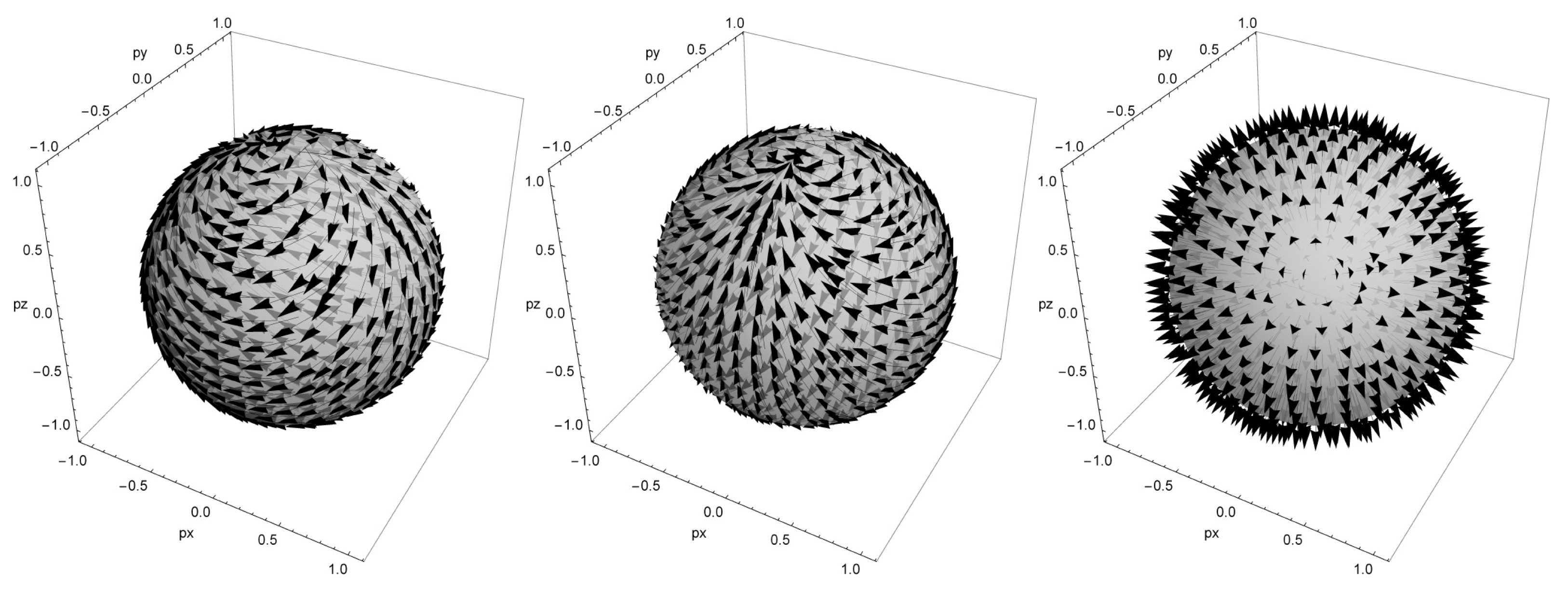
These two vector fields are transversal; they define a photon polarization basis (notice that while each of the original vector fields has two singular points on the unit sphere, in their speed-of-light limits these two singularities merge into just one—the minimum required by the “hairy ball theorem” of algebraic topology). Together with the third vector field
which is longitudinal and spans the helicity-zero subspace, they form an orthonormal basis in —cf. Figure 1.
Figure 1.
The vector fields plotted at the unit sphere in momentum space.
It is easily verified that
and
Remark 4.
The vector fields are real. Introducing their complex combinations
we obtain two unit complex vector fields of definite helicity and the third component of angular momentum:
Evidently, we also have
The basis is naturally embedded into a one-parameter family of Lorentz-boost eigenmodes (for the scalar wave equation, some of their properties are discussed in Ref. [27]) defined by the formula below:
A straightforward verification shows that still satisfies Equation (91), but Equation (92) is replaced by
Remark 5.
In fact, one can show that every solution of the eigenvalue problem
is of the form
3.3. The Teleparallel Connection
In the following, we will use the notation, assumptions, and results of Section 3.2.
3.3.1. Stereographic Coordinates on the Light Cone
We will use the moving frame on to define a teleparallel affine connection on The frame has a singularity at the points and a natural rotational covariance with respect to rotations around the third axis. It takes especially simple form in a coordinate system using the stereographic projection from the unit sphere in momentum space (stereographic projection coordinates are also used, in a similar context, in Refs. [16,17], but the coordinates in these papers are twice our , as the projection plane in these papers is positioned at the bottom of the unit sphere, and not through the center).
We set
and the inverse transform
Given a coordinate system and a vector with coordinates we have the standard transformation law to another coordinate system :
Applying this law to the vectors , we obtain their components in stereographic coordinates (surprisingly, they happen to essentially coincide with the basis considered in (Ref. [19], Equation (2.42)): In fact, we have where the hat over a vector denotes the unit vector in its direction):
The Euclidean metric in stereographic coordinates has the form
while the Lorentz-invariant degenerate metric is obtained from by replacing 1 with 0 in the right bottom corner. We can use the metric to obtain the corresponding dual basis in the cotangent bundle:
The Lorentz-invariant volume form becomes
3.3.2. The Connection Coefficients
The moving frame defines a unique flat affine connection on in which the vector fields are parallel:
The coefficients of this teleparallel connection in the coordinate system are then given by
where is the dual basis; thus,
A straightforward calculation then gives the following expressions:
where Our connection has the properties and ; therefore, it should come under the scope of affine connections discussed by Staruszkiewicz in Refs. [16,17]. However, as we show in the paragraph below, it is not “semi-symmetric”—an extra condition imposed on the class of connections analyzed by Staruszkiewicz.
The connection given by Equation (114) is not semi-symmetric.
Let M be an n-dimensional manifold with a coordinate system A linear connection ∇ with connection coefficients is said to be semi-symmetric if its torsion tensor is of the form
being a 1-form. If that is the case, contracting the indices , we obtain In our case, ; therefore,
4. Photon Position Operator with Commuting Components and Axial Symmetry
To discuss photon localization, it is more convenient to work in a representation in which the scalar product in the Hilbert space of the sections of the tangent bundle is given by the formula (cf. Remark 2)
Since the measure is not Lorentz-invariant, the formula for the boost operator now obtains an extra term (compared to Equation (57)) and takes the form
As a consequence, the sections do not satisfy Equation (92) any longer—but the sections do.
In what follows, we will be using the scalar product (117). We will denote as the corresponding Hilbert space:
The map is an isometry between the two Hilbert spaces, the space , with the scalar product defined with the measure , and with the scalar product
4.1. Position Operators as Covariant Derivatives
There is a straightforward relation between the position operator and a covariant derivative concept in vector bundles. Indeed, the main property required from any position operator is the property of satisfying the canonical commutation relations with the momentum operators :
In our case, it implies that for any section of and any scalar function , we have
Thus, the operators have the Leibniz rule property, the main property defining a covariant derivative in a vector bundle (cf., e.g., [28], p. 89, Equation (1.1)). For to be Hermitian, must be anti-Hermitian, and for this to be the case, the (linear) connection determined by should preserve the fiber scalar product . Then,
or, explicitly,
4.2. The Pryce Connection and Operator—Geometric Construction
There is a standard construction in the differential geometry of vector bundles that results in a canonical connection adapted to a split of a trivial vector bundle into a direct sum of its two vector sub-bundles (cf., e.g., [29], p. 319, 4, [30], Exercise 10). We adapt this standard construction to our purpose as follows. First, using the global coordinates , we realize the tangent bundle as a trivial product bundle . In the trivial bundle, we have a canonical covariant derivative . Our trivial bundle is naturally split into a direct sum of the helicity-zero sub-bundle and the helicity- sub-bundle of photon states. Let denote the orthogonal projection on the helicity-zero states
Then, is the orthogonal projection on the complementary sub-bundle of photon states. The natural covariant derivative adapted to this splitting is then defined by the formula (cf. [31], Equation (2); we use the label to mean either “Projection” or “Pryce”)
Using the idempotent property , we find a simpler form:
while substituting the explicit form (123) of P leads to
Thus, the corresponding connection coefficients are given by
4.2.1. The Pryce Connection Is Metric Semi-Symmetric
A metric connection is semi-symmetric—cf., e.g., [32,33] and references therein—if its connection coefficients are of the form
where are the coefficients of the Levi-Civita connection of the metric, and where and are the covariant and contravariant components of a vector field, respectively. In that case, the curvatures of the two connections are related by (for the curvature tensor components of a connection ∇, we use the convention )
where
and
In our case, and the connection coefficients are all zero. Comparing Equations (128) and (127), we can see that the connection is metric semi-symmetric, with
We then obtain
where
and the curvature tensor simplifies to
4.2.2. The Difference between the Teleparallel and Pryce Connections
4.2.3. The Pryce Operator
We now use Equations (121) and (124). Denoting
the position operator corresponding to is
or, explicitly,
Using Equations (53) and (59), it can be also written as
and, in this form, it is known as the Pryce position operator. The following alternative formula for this operator, expressing it in terms of the Poincaré group generators, is easily verified and is well known:
where are the boost generators (118). It should be mentioned that even though the bundle is trivial, the non-triviality of its splitting defined by the helicity-related projection P is reflected in the fact that the adapted connection has a non-zero curvature, and, as a consequence, the components of the Pryce operator do not commute.
Remark 6.
The flat covariant derivative d does not mix the two photon helicities. As a consequence, the Pryce operator commutes with the helicity operator Λ and not only with its square
Now, using Equation (134), we obtain
which is usually written as (see, e.g., [34], Equation (5,9), p. 40) (in Ref. [34], helicity is defined with the opposite sign)
where is the helicity operator.
4.3. The Hawton–Baylis Operator
The teleparallel connection described in Section 3.3 leads to the Hawton–Baylis photon position operator with commuting components
with the defining relations
where are given by Equations (89) and (90). It follows from Equations (145) and (146) that the states are localized at . To obtain states localized at any point , we multiply these states by .
In particular,
Using this last equality, together with Equations (142) and (118), we recover the fact, mentioned after Equation (118), that the states are invariant under boosts in the direction of the third axis. Indeed, from the Leibniz property (120) and from (146), we obtain
Thus,
On the other hand, using (142) and the Lie algebra commutation relation , can be written as
which, together with (150), leads to , and thus, . But this reasoning does not give us a clue as how the basis can be obtained by taking the speed-of-light limit of the simple polarization basis (81). (A brief discussion of an application of the Hawton–Baylis photon position operator to optical beams (derived via Wigner’s little group method) can be found in Ref. [35]; cf. also references therein.)
It is straightforward to verify that the operators have axial symmetry:
4.3.1. Photon States Localized on Circles
Since the three components of commute, they can be simultaneously diagonalized, and the simultaneous eigenvalue equation has three independent solutions:
The states describe photons localized at of helicity and is of helicity However, since the states have a rather complicated -dependence, and owing to the axial symmetry of it is natural to look for simple axially symmetric simultaneous eigenvalue equations for :
These would give us states localized on the circle in the Cartesian coordinates in the photon’s position space. To this end, it is convenient to introduce cylindrical coordinates , One can then verify that states of the form
are simple solutions of Equations (154) and (155), while Equation (156) imposes a second-order ordinary differential equation on :
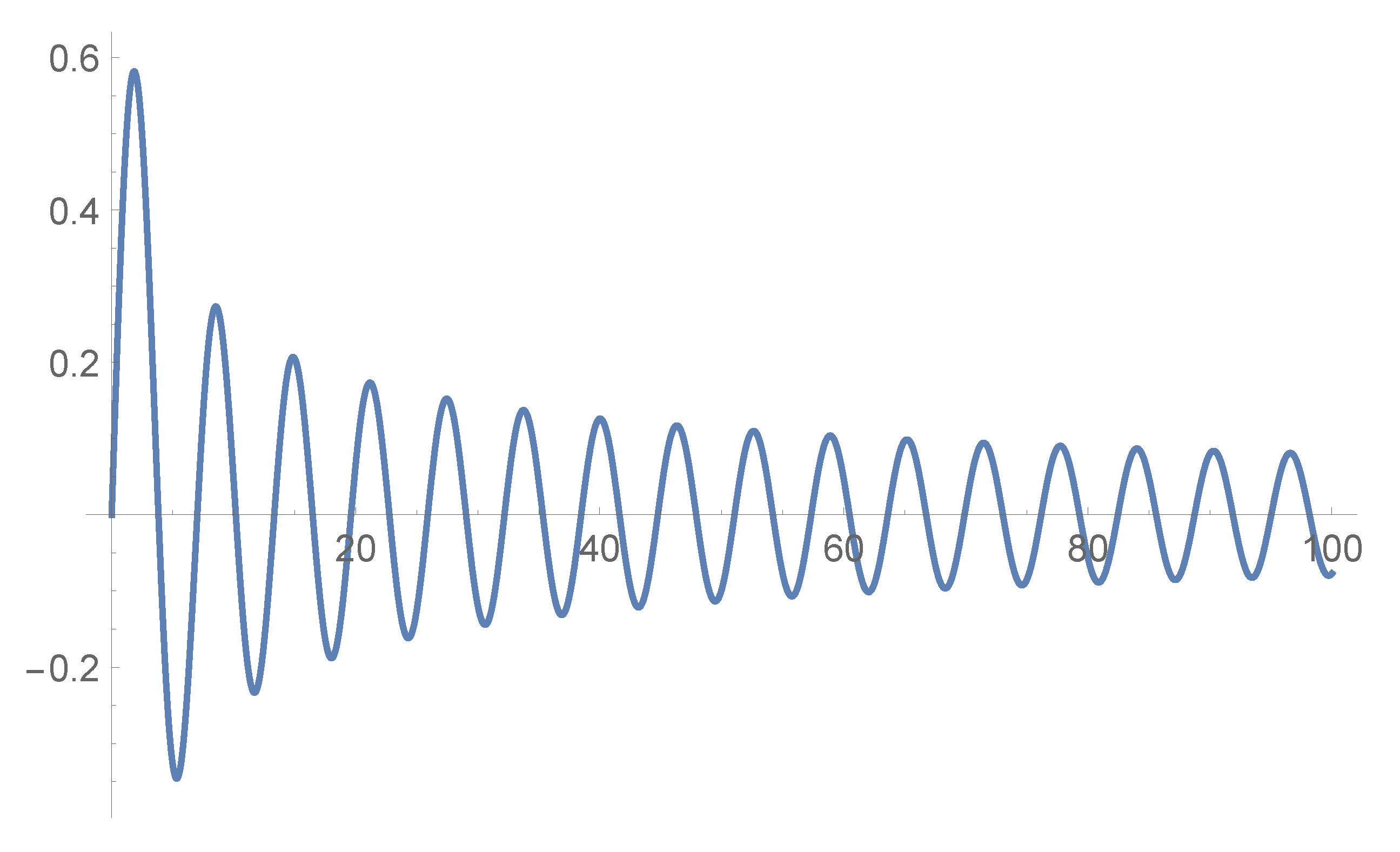
with the following solution finite at the origin [36]:
where is the Bessel function of the first kind and c is a constant—see Figure 2.
Figure 2.
Bessel function .
For reasons that will be clear from the next paragraph, we choose for the constant c the value:
Loop States
Let ℓ be a closed loop in defined by a function Following Ref. [31], let us define the state by
Then, is a superposition of simultaneous eigenstates of —see Equation (138)—-localized in at the points of the loop ℓ. Therefore, it is -localized on The fact that the loop is closed, i.e., implies that the state is an (improper) element of i.e., that
Taking the Fourier transform of , we obtain
and it is clear that has its support on the loop in the position coordinates space—it vanishes at all points outside the loop. It is also clear that for two non-intersecting loops the states and are orthogonal to each other. (Loops may form topologically inequivalent knots. In this respect, the loop states discussed above are similar to knotted solutions of Maxwell equations discussed in Ref. [26], Sec. 7.)
As an example, let us take for ℓ the circle in the plane of radius R given by the parametric equations
A straightforward calculation in cylindrical coordinates (in momentum space) then leads to
where is the Bessel function and which coincides with the state given by Formula (157).
Amrein’s Washer Photon States
Thus,
We will use cylindrical coordinates in position space. In these coordinates,
while
Thus,
After integrating over , we obtain
We now take a continuous superposition of these states for R varying between and and varying between and . As a superposition of photon states, it will still be a photon state. Let be the function equal to 1 for and zero otherwise, and, similarly, let be the function equal to 1 for and zero otherwise. Taking the integral
we obtain
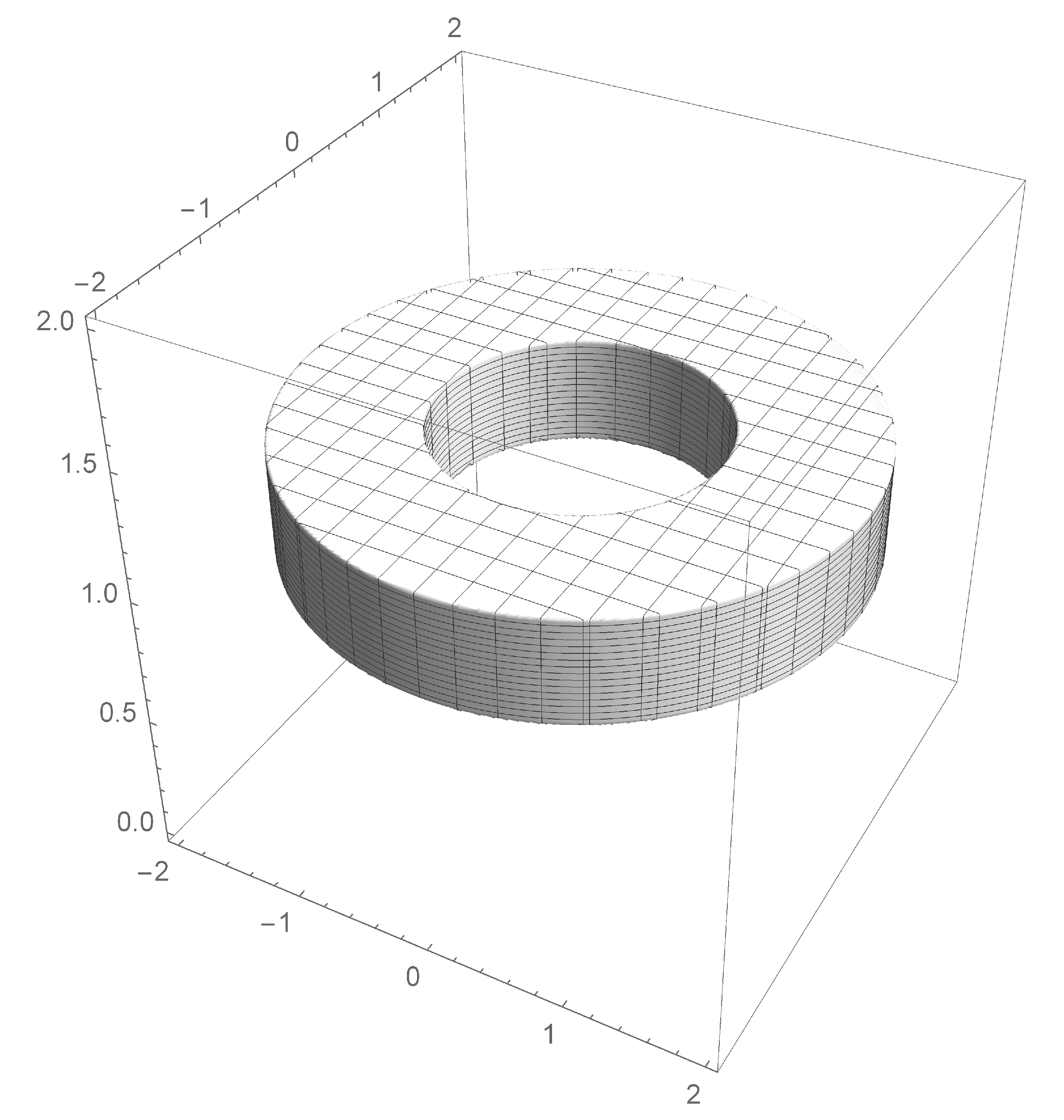
The function is evidently square-integrable with respect to , and its probability density is zero everywhere except for the bolt washer-like region , —see Figure 3.
Figure 3.
Amrein’s washer state (171) is strictly (weakly) localized in the region .
We call it Amrein’s state, as the existence of such states was first proven in 1968 by A.O. Amrein [6]. These states are also strictly localized with respect to the commuting position operators
4.4. POV Measure Photon Localization
Every self-adjoint operator admits a spectral decomposition. Usually, we write it as:
More generally, given a family of commuting observables, we have a spectral measure on the common spectrum of these observables. Here, we have operators defined on , with commuting components , and we have a unique spectral measure on such that
Then, for every Borel set , the operator
is a projection operator on the subspace of states localized in ; for any two sets and , the operators and ) commute.
However, the operators do not leave the subspace invariant; therefore, we introduce
where is the orthogonal projection operator on . Thus, we have
where
Now, are not projection operators any longer, and for different they do not commute. Nevertheless, they are non-negative operators and
Therefore, we have a POV—positive operator-valued—measure. Jauch and Piron [5] called a photon state weakly localized in if , and they conjectured the existence of such states. Amrein [6] provided a rigorous proof of their existence and showed how to construct them. Our formula (171) provides a rich explicit family of such states. Notice, however, that the circle states , while satisfying
are not eigenstates of . Instead, for any real measurable function on , they are eigenstates of the eigenvalue of the operator defined as
where is the POV measure defined by Equation (179) (for instance, in Ref [37], the square root function is proposed).
The circle-localized states are superpositions of helicity- and helicity- states, in agreement with Theorem 2 of Ref. [6]. Their projections on definite helicity subspaces, or , are still circle-localized with respect to the Hawton–Baylis operator, but they are not weakly localized in the sense of the POV measure —in agreement with Theorem 1 of Ref. [6].
5. Conclusions
In conclusion, using differential geometric structures on the mass hyperboloid and on the light cone in momentum space, we derived the explicit form of the unitary representation of the Poincaré group for helicity-zero and helicity- massless particles. Using this explicit form for a boost in the direction of the third axis, we have found that simple photon polarization states based on Hertz-type potentials survive the light speed limit and generate a polarization basis used in the construction of photon position operators with commuting components. We have compared these operators, as well as the underlying affine connections, to the classical Pryce operator and connection, and we have found that the Pryce connection, Equation (125), non-flat but with rotational symmetry, is metric semi-symmetric, while the Hawton–Baylis connection, flat but only axially symmetric, Equation (114), does not have this property. We have constructed finite-norm photon states localized in bolt washer-like regions and proven that they are strictly localized in these regions with respect to Hawton–Baylis position operators and also with respect to the Jauch–Piron–Amrein POV measures. They are also z-localized (but not radius-localized) with respect to the Pryce photon position operator.
Funding
This work was supported by Quantum Future Group Inc.
Data Availability Statement
No new data were created or analyzed in this study. Data sharing is not applicable to this article.
Acknowledgments
Thanks are due to M. Schlichtinger and J. Szulga for the discussion of the preliminary version of the part of Section 3.1, as well as to G. Koczan, P. Lescaudron, and R. Coquereaux for their interest and for a stimulating discussion on related subjects. I wish to thank my wife, Laura, for reading the manuscript and for her constant support. Thanks are also due to anonymous referees for their valuable criticism and suggestions.
Conflicts of Interest
The author declares no conflicts of interest.
Correction Statement
This article has been republished with a minor correction to resolve spelling and grammatical errors. This change does not affect the scientific content of the article.
References
- Buchholz, D.; Cioli, F.; Ruzzi, G.; Vesselli, E. The universal C*-algebra of the electromagnetic field II. Topological charges and spacelike linear fields. Lett. Math. Phys. 2017, 107, 201–222. [Google Scholar] [CrossRef]
- Varadarajan, V.S. Geometry of Quantum Theory, 2nd ed.; Springer: Berlin/Heidelberg, Germany, 2007. [Google Scholar]
- Wightman, A.S. On the Localizability of Quantum Mechanical Systems. Rev. Mod. Phys. 1962, 34, 845–872. [Google Scholar] [CrossRef]
- Newton, T.D.; Wigner, E.P. Localized States for Elementary Systems. Rev. Mod. Phys. 1949, 21, 400–406. [Google Scholar] [CrossRef]
- Jauch, J.M.; Piron, C. Generalized Localizability. Helv. Phys. Acta 1962, 40, 539–570. [Google Scholar]
- Amrein, A.O. Localizability of Particles of Mass Zero. Helv. Phys. Acta 1969, 42, 149–190. [Google Scholar]
- Bialynicki-Birula, I.; Bialynicka-Birula, Z. Why photons cannot be sharply localized. Phys. Rev. A 2009, 79, 032112. [Google Scholar] [CrossRef]
- Mourad, J. Optimal photon localization. Phys. Lett. 1993, 182, 319–322. [Google Scholar] [CrossRef]
- Kraus, K. Position Observables of the Photon. In The Uncertainty Principle and Foundations of Quantum Mechanics; Price, W.C., Chissic, S.S., Eds.; John Wiley & Sons: London, UK; New York, NY, USA; Sydney, Australia; Toronto, ON, Canada, 1977; pp. 293–320. [Google Scholar]
- Skagerstam, B.S. Localization of Massless Spinning Particles and the Berry Phase. In On Klauder’s Path: A Field Trip; World Scientific: Singapore, 1994; pp. 209–222. [Google Scholar]
- Jackiv, R. Dirac’s Magnetic Monopole (Again). arXiv 2002, arXiv:hep-th/0212058. [Google Scholar]
- Jadczyk, A. Magnetic Charge Quantization and Generalized Imprimitivity Systems. Int. J. Theor. Phys. 1975, 14, 183–192. [Google Scholar] [CrossRef]
- Ciao, R.; Wu, Y.-S. Manifestations of Berry’s Topological Phase for the Photon. Phys. Rev. Lett. 1986, 57, 933–936. [Google Scholar]
- Bialynicki-Birula, I.; Bialynicka-Birula, Z. Berry’s phase in the relativistic theory of spinning particles. Phys. Rev. D 1987, 35, 2383–2387. [Google Scholar] [CrossRef]
- Hawton, M. Photon position operator with commuting components. Phys. Rev. A 1999, 59, 954–959. [Google Scholar] [CrossRef]
- Staruszkiewicz, A. On Affine Properties of the Light Cone and their Application in the Quantum Electrodynamics. Acta Phys. Pol. B 1973, 4, 57–63. [Google Scholar]
- Staruszkiewicz, A. On Parallel Displacement Within the Light Cone and its Application in the Electrodynamics of Charges Moving with the Velocity of Light. Int. J. Theor. Phys. 1973, 8, 247–252. [Google Scholar] [CrossRef]
- Hawton, M.; Baylis, W.E. Photon position operators and localized bases. Phys. Rev. A 2001, 64, 012101. [Google Scholar] [CrossRef][Green Version]
- Dobrski, M.; Przanowski, M.; Tosiek, J.; Turrubiates, F.J. The geometrical interpretation of the photon position operator. Phys. Rev. A 2021, 104, 042206. [Google Scholar] [CrossRef]
- Dobrski, M.; Przanowski, M.; Tosiek, J.; Turrubiates, F.J. Construction of a photon position operator with commuting components from natural axioms. Phys. Rev. A 2023, 107, 042208. [Google Scholar] [CrossRef]
- Hehl, F.W.; Itin, Y.; Obukhov, Y.N. On Kottler’s path: Origin and evolution of the premetric program in gravity and in electrodynamics. Int. J. Mod. Phys. D 2016, 25, 1640016. [Google Scholar] [CrossRef]
- Bialynicki-Birula, I. Photon Wave Function. arXiv 2005, arXiv:quant-ph/0508202v1. [Google Scholar]
- Keller, O. On the theory of spacial localization of photons. Phys. Rep. 2005, 411, 1–232. [Google Scholar] [CrossRef]
- Keller, O. Light the Physics of the Photon; CRC Press: Boca Raton, FL, USA, 2014. [Google Scholar]
- Ryder, L.H. Quantum Field Theory, 2nd ed.; Cambridge University Press: Cambridge, UK, 1966. [Google Scholar]
- Bialynicki-Birula, I.; Bialynicka-Birula, Z. The role of Riemann-Silberstein vector in classical and quantum theories of electrodynamics. J. Phys. A Math. Theor. 2013, 46, 053001. [Google Scholar] [CrossRef]
- Bliokh, K.Y. Lorentz-boost eigenmodes. Phys. Rev. A 2018, 98, 012143. [Google Scholar] [CrossRef]
- Hermann, R. Vector Bundles in Mathematical Physics, Volume I; W.A. Benjamin Inc.: New York, NY, USA, 1970. [Google Scholar]
- Greub, G.; Halpern, S.; Vanstone, R. Connections, Curvature, and Cohomology, Volume II; Academic Press: Cambridge, MA, USA, 1973. [Google Scholar]
- Crainic, N. Vector Bundles and Connections. Lecture Notes. 2016. Available online: http://www.staff.science.uu.nl/~crain101/DG-2016/chapter1.pdf (accessed on 24 December 2023).
- Jadczyk, A.; Jancewicz, B. Maximal Localizability of Photons. Bull. Acad. Polon. Sci. Ser. Math. Astr. Phys. 1973, 21, 477–483. [Google Scholar]
- Yano, K.; Imai, T. On Semisymmetric Metric Connections in a Sasakian Manifold. Kodai Math. Sem. Rep. 1977, 28, 150–158. [Google Scholar] [CrossRef]
- Yilmaz, H.B.; Zengin, F.O.; Uysal, S.A. On a Semi-Symmetric Metric Connection with a Special Condition on a Riemannian Manifold. Eur. J. Pure Appl. Math. 2011, 4, 152–161. [Google Scholar]
- Bacry, H. Localizability and Space in Quantum Physics; Springer: Berlin/Heidelberg, Germany, 1988. [Google Scholar]
- Hawton, M. Photon Position eigenvectors, Wigner’s little group, and Berry’s phase. J. Math. Phys. 2019, 60, 052104. [Google Scholar] [CrossRef]
- Shishkina, E.; Sitnik, S. Transmutations, Singular and Fractional Differential Equations with Applications to Mathematical Physics; Academic Press: Cambridge, MA, USA, 2020. [Google Scholar]
- Koczan, G.M. Physical unambiguity of the definition of the photon position operator and its special eigenstates. arXiv 2023, arXiv:2309.12125v2. [Google Scholar]
Disclaimer/Publisher’s Note: The statements, opinions and data contained in all publications are solely those of the individual author(s) and contributor(s) and not of MDPI and/or the editor(s). MDPI and/or the editor(s) disclaim responsibility for any injury to people or property resulting from any ideas, methods, instructions or products referred to in the content. |
© 2024 by the author. Licensee MDPI, Basel, Switzerland. This article is an open access article distributed under the terms and conditions of the Creative Commons Attribution (CC BY) license (https://creativecommons.org/licenses/by/4.0/).