1. Introduction
Mobile network operators (MNOs) face the challenge of growing user numbers. They demand multiple data and high speeds for various applications, such as high-quality content streaming and the ability to work remotely effectively. Therefore, the challenge for MNOs is to ensure a reliable and high-quality experience for users on the mobile network [
1,
2]. The mobile broadband network’s quality of service (QoS) is improved by having quality control and network performance monitoring [
3,
4]. In addition, it impacts the quality perceived by the user (QoE). Therefore, an alternative to evaluating the quality of service (QoS) of Long-Term Evolution (LTE) mobile networks is through crowdsourcing measurements with end-user equipment (UE) [
5,
6,
7].
On the other hand, the fifth generation 5G network is being implemented in two phases or two deployment approaches. The first approach is 5G Non-Standalone (NSA) or 5G NSA; it consists of deploying 5G on the 4G infrastructure. Therefore, the existing fourth-generation (4G) infrastructure is being used. The second approach is 5G standalone (SA) or 5G SA, whose Next-Generation Core Network (NGCN) network core is based on network software and the cloud; it is a unique development for 5G without the need to adapt legacy technologies [
8,
9]. In addition, according to the Global Mobile Suppliers Association (GSA), 94 mobile network operators in 48 countries worldwide had invested in 5G SA networks as of November 2021 [
10,
11]. Mexico has decided to start differently and implemented the first 5G NSA approach [
9,
12]. To date, no open data have been found on this network implemented in Mexico that allows the development of the QoS evaluation of the 5G network, so it has been decided to continue working with data from the 4G network.
Various research focus on presenting reviews and analyses of state-of-the-art networks to understand or solve the problems and challenges faced by mobile networks such as 5G or later. For example, the state-of-the-art coexistence between traffic in the enhanced mobile broadband (eMBB) and ultra-reliable low latency communication (URLLC) scenarios for resource scheduling has been investigated [
13]. On the other hand, a review of transfer management in future ultra-dense mobile networks has been carried out, finding methodologies, such as dual connectivity (DC) and handover management algorithms, that have the potential to be used in improving data speed, coverage, and spectral efficiency [
14]. Similarly, the analysis of the standardization activities in 3rd generation partnership program (3GPP) and open–radio access network (O-RAN) for artificial intelligence and machine learning (AI/ML) applications and the future technological trends of AI/ML in mobile systems was carried out, to improve the KPIs between the network and the UE [
15].
Among the works that aim to improve mobile networks, a service classifier using ML based on supervised learning (SL) is proposed, making use of the KPIs and key quality indicators (KQIs) of the different services to improve the management of 5G and beyond 5G (B5G) networks [
16]. Meanwhile, in [
17], a hidden Markov model (HMM) is proposed to proactively predict cellular degradation using KPI real-time time series data. On the other hand, to optimize the handover control parameters (HCP) configurations based on the network experiences experienced by UEs in 5G network mobility, an artificial intelligence multiple linear regression algorithm (AI-MLR) is proposed [
18]. To support the future implementation of large-scale 5G network performance in vehicular services, the design, development, and evaluation of four categories of 5G-enabled services/use cases in the Transport vertical were proposed [
19]. Similarly, a mobile network simulator is presented with the realistic recreation of the dual-link enabled Hybrid Vehicular Network (HNV) in a simulator running with dual-link radio access technologies (RATs), in addition to proposing a parameterized data traffic steering algorithm [
20]. Finally, proposing the use of multi-attribute decision-making based on fuzzy logic (MADM-FL), a scalable video coding—Dynamic adaptive streaming over HTTP (SVDC-DASH) method is presented over the vehicular environment based on the Multi-access Edge Computing (MEC) architecture [
21]. These works are an excellent contribution to emerging mobile networks.
Regarding the QoS of mobile networks, several researchers have proposed various methodologies. First, a machine learning (ML) model is proposed that analyzes the vertical sector quality of service and predicts the degradation of the perceived quality (QoP) in the next 5 min [
22]. Second, a cost-effective hybrid analytical model was proposed to obtain the user quality index (UQI) and know the quality perceived by the user of the eMBB scenario in the 5G SA network. ML and statistical tools were applied [
9]. Third, to provide a better QoS, the cubic Hermit spline (CHS) method is applied, which allows knowing the impact of the KPIs on a key quality indicator (KQI) [
23]. Finally, to know the characteristics of the QoS in the flow transfer between the Ethernet Time-Sensitive Networks (TSN) network exchange and 5G, a QoS mapping algorithm (QoS-MAN) is proposed [
24]. Although these investigations are valuable for improving QoS, they focus on benefiting mobile network operators and not users.
Particularly for the LTE mobile network, different investigations have addressed the evaluation of the quality of service of the LTE mobile network, such as the study of graphical comparisons of the key performance indicators (KPI) with the signal parameters [
25], as well as other works that aim to improve the quality of service and the quality of experience during video transmission by evaluating different configurations [
26,
27,
28,
29,
30]. However, their main objective is to serve mobile network operators (MNOs), not users.
In addition, other works focus on optimizing LTE mobile networks using various computational models and simulation-based techniques. For example, improvements in downlink scheduling aim to optimize resource allocation using algorithms such as Knapsack and Priority-only [
31]. The QoS-aware downlink scheduling algorithm (QuAs) improves the user-perceived quality of service (QoE) at the network edge [
32]. Simulators are often used to assess network capacity and propose improvements in the scheduling process, which affects QoS and QoE, leading to increased spectral efficiency [
33,
34,
35,
36,
37]. In handover scenarios, Sugeno-type fuzzy models have been applied to evaluate KPIs in LTE networks, with comparisons made against adaptive neuro-fuzzy inference systems (ANFIS) tailored for QoS [
38,
39]. The results of these simulations are often based on non-real-world data, which can lead to a discrepancy with real-world conditions [
38,
39].
It represents a significant challenge when designed with numerous inputs and membership functions in fuzzy inference systems [
40]. The design of the FIS can be based on expert knowledge, data, or a hybrid using expert knowledge and data [
41]. In particular cases, expert knowledge is applied when data are insufficient [
42]. Models based on expert knowledge are a good candidate for evaluations of different specific domains and are interpretable for users (non-experts) [
43].
On the other hand, the Analytic Hierarchy Process (AHP) is a multi-criteria decision-making method developed by Thomas L. Saaty [
44]. It allows for interpreting levels of importance in mathematical weights that amplify or reduce the behavior of each proper parameter in a decision system [
45]. In other words, AHP sections the problem into hierarchies of decision elements [
46]. At each hierarchical level, the weights of the components are calculated. The final decision is made based on these weights [
44]. The fuzzy inference system (FIS) uses the weights to hierarchize the fuzzy rules according to the importance given to each parameter [
47]. Several investigations have applied the weighted fuzzy inference system to evaluate air quality, the environmental risk of artificial nanomaterials, water quality, beach tourism factors, and the safety of coastal sites, among other things [
47,
48,
49,
50,
51,
52].
Within mobile networks, a simple additive weighting (SASAW) vertical handover algorithm based on the signal-to-interference ratio (SINR) and AHP has been proposed, allowing the consideration of the QoS of different attributes according to the traffic [
46]. Although a good performance is achieved for the network and the user, this work uses simulated data. On the other hand, a multiple handover parameter selection system has been proposed, using the AHP and FIS to determine when the handover is activated between an LTE and Worldwide Interoperability for Microwave Access (WiMAX) network [
53]. The relevance of this work prioritizes the connectivity between heterogeneous networks, giving more importance to the base stations than to the users.
This paper proposes a new solution for evaluating the quality of service and the effectiveness of data transfer in the LTE mobile network. A FIS is proposed, taking into account that LTE network users mostly use over-the-top (OTT) applications [
54]. Therefore, it is decided to assign levels of importance to the KPIs according to their relevance to the performance of these applications [
55].
In this FIS, the International Telecommunication Union (ITU)-recommended QoS KPIs are evaluated using a weighted fuzzy inference system, which will allow for the identification of desirable quality situations from the different combinations between the KPIs.
The Analytic Hierarchy Process identifies the importance of each KPI in the form of a weight for each rule, increasing the efficiency of the evaluation.
Finally, two indices are obtained for evaluating the QoS and the effectiveness of data transfer in the LTE network, in a range of [0–1] consistent with the QoE, Very good, Good, Acceptable, Poor, or Very Poor.
This work is organized as follows:
Section 2 presents the Materials and Methods, followed by the Results in
Section 3, and the discussion in
Section 4. Finally,
Section 5 presents the conclusions.
2. Materials and Methods
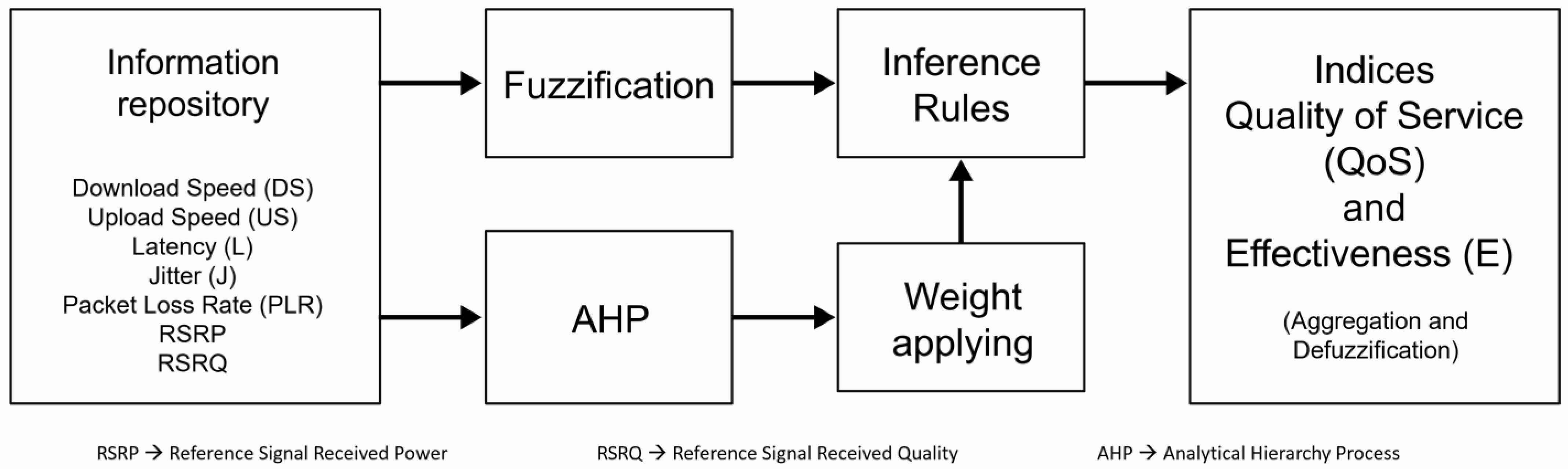
The proposed methodology is shown in the block diagram in
Figure 1, inspired by [
47,
49]. In the first block, reference is made to the information repository collected through crowdsourcing with user equipment (UE). The KPIs recommended by the ITU for the evaluation of the QoS of the LTE network are shown: download speed (DS), upload speed (US), latency (L), jitter (J), packet loss rate (PLR), the reference received signal power (RSRP), and the reference received signal quality (RSRQ). Next is the fuzzification block, where each input’s membership functions and membership degrees are determined. Then, the inference rules block is observed, and the fuzzy rules are proposed based on expert knowledge. On the other hand, the analytical hierarchy process block proposes the importance of weighting for each input KPI, aiming to obtain the importance weights corresponding to the weight application block, which are to be applied to the fuzzy rules. Finally, in the last block, the QoS and Effectiveness indices are obtained through Aggregation and Defuzzification. Each of the blocks is detailed in
Section 2.1,
Section 2.2,
Section 2.3,
Section 2.4,
Section 2.5 and
Section 2.6.
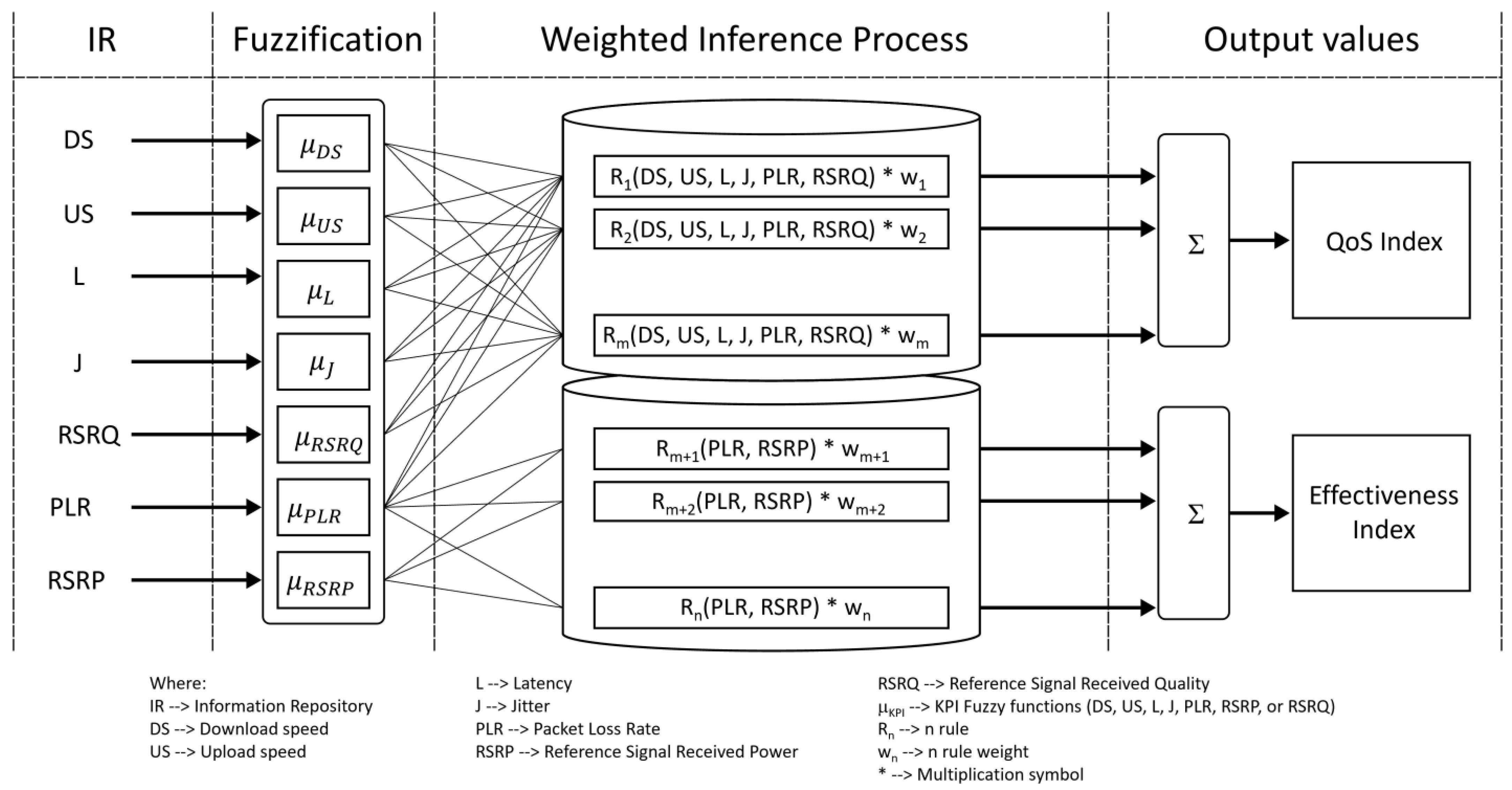
Figure 2 presents a complementary diagram to the block diagram in
Figure 1, detailing the architecture of the weighted fuzzy inference system. The first column contains the information repository (IR), where the input variables (KPI) used to obtain the fuzzy QoS index are DS, US, L, J, RSRQ, and PLR. The input variables for the fuzzy effectiveness index are PLR and RSRP. The second column shows the fuzzification, where each input KPI’s functions and degrees of membership are determined, with three linguistic variables for each: Low, Medium, and High. Next, in the third column, the Weighted Inference Process is observed. Here, the fuzzy rules are proposed as follows: 433 to obtain the fuzzy QoS index and 9 for the effectiveness index. In addition, the weight vector or eigenvector corresponding to the input variables is obtained for each output index. For quality of service, important comparisons between DS, US, L, J, PLR, and RSRQ are considered, while for effectiveness, importance comparisons between PLR and RSRP are considered. Subsequently, the result of each fuzzy rule is multiplied by the weight of the KPI that determines that same rule (weight that applies). Finally, in the output values column, the quality of service and effectiveness indices are obtained with aggregation and defuzzification. The above is detailed in
Section 2.1,
Section 2.2,
Section 2.3,
Section 2.4,
Section 2.5 and
Section 2.6.
2.1. Information Repository
The information repository used in this research is the same one used in [
56]. The variables of interest are the seven key performance indicators recommended by the ITU for evaluating the quality of service of the LTE network: download speed, upload speed, latency, jitter, packet loss rate, RSRP, and RSRQ [
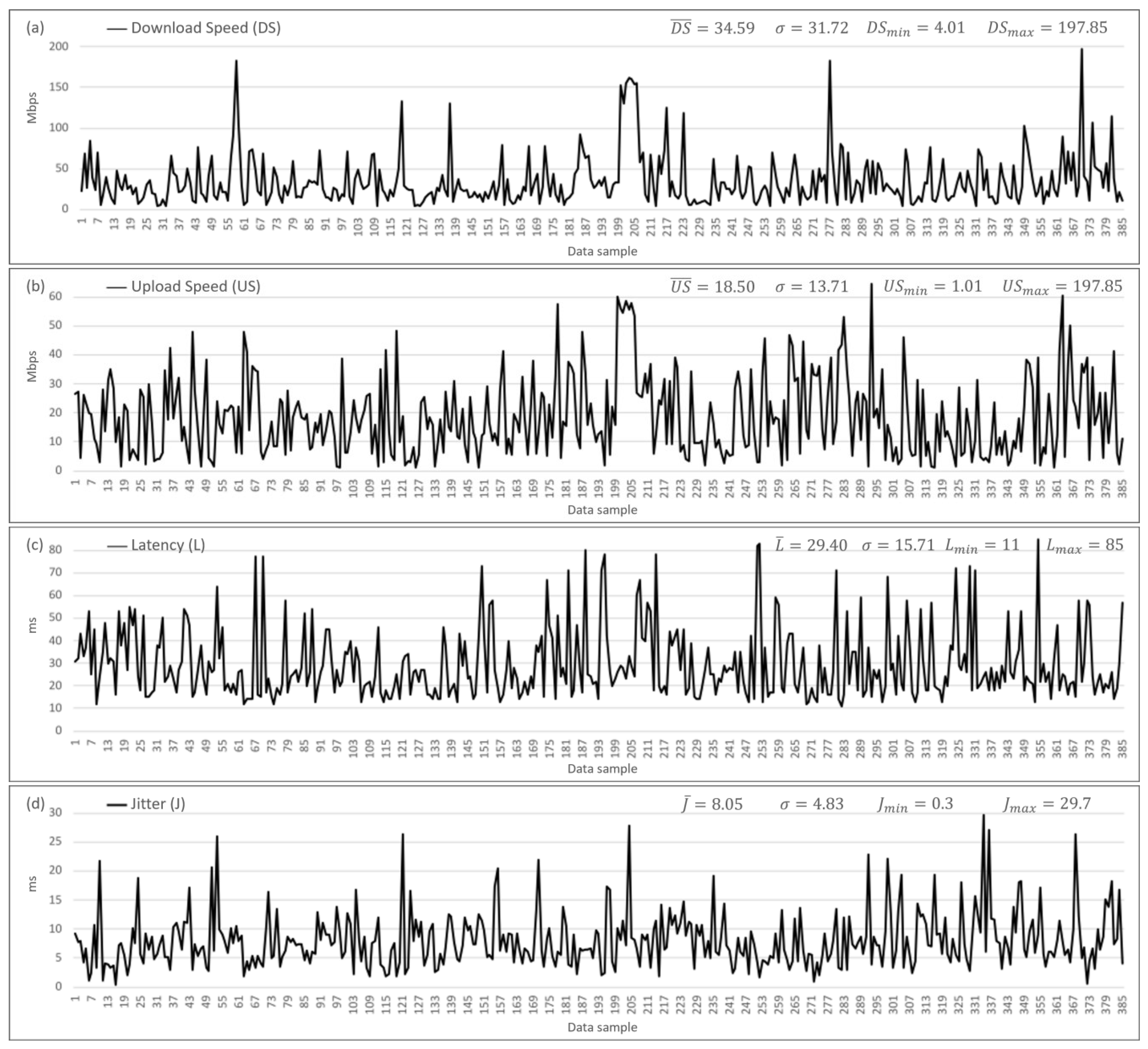
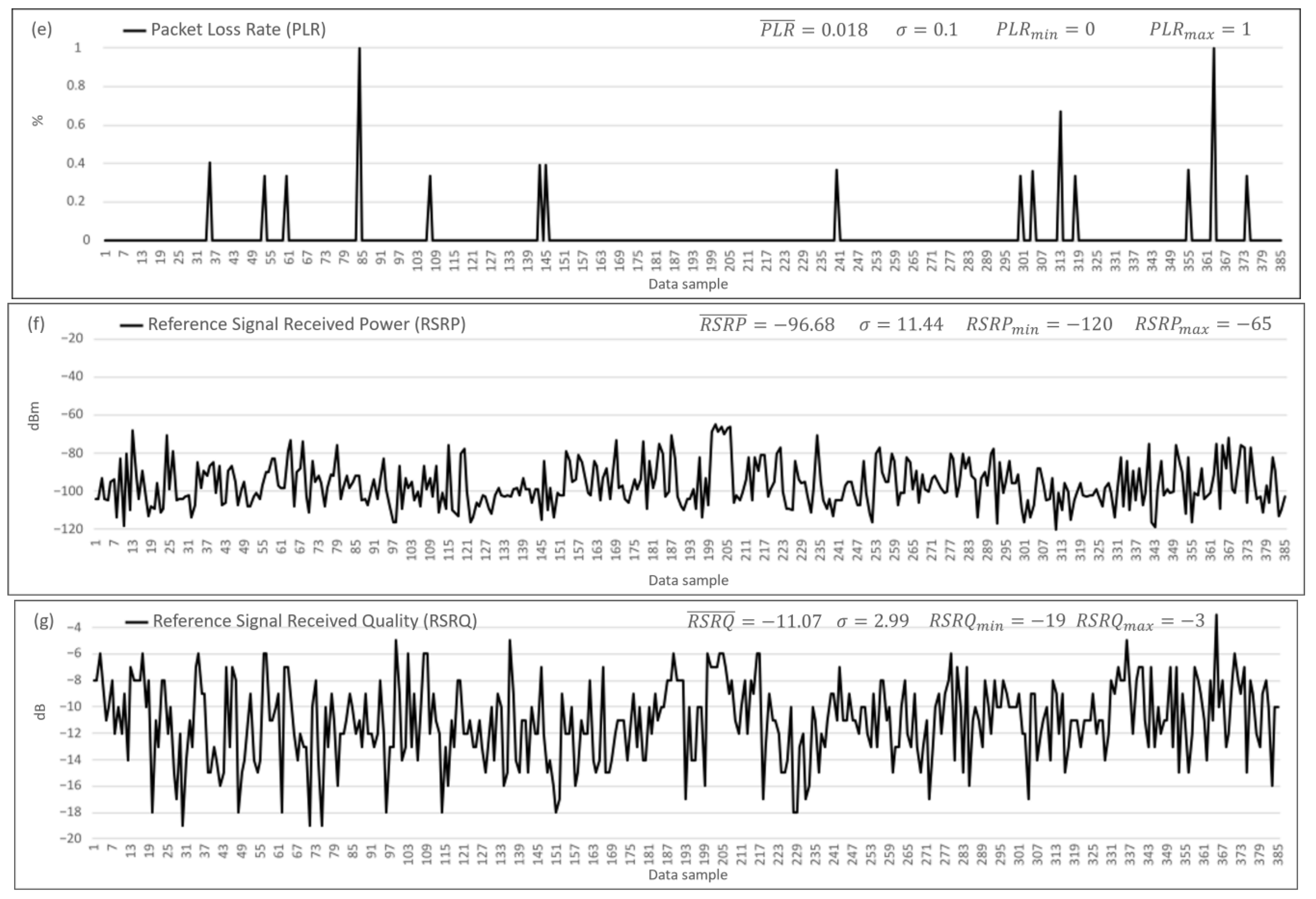
55]. The repository’s data dictionary is in
Table A1. The data samples were obtained collaboratively with mid-range user equipment in the Alameda Central area of Mexico City during the first two months of 2021.
The information repository analysis found that data samples from five mobile network operators are reported in 39 geolocated points of the study area. It is relevant to indicate that each geolocated point does not have data from each operator or measurements from each day of the collection period. This implies that the dataset of the information repository is not balanced. However, most data classification tools require balanced data or a balancing process. In the case of the FIS, the advantage is that when being designed, they can be based on expert knowledge and not on data. In addition, starting the FIS with expert knowledge is possible, and the parameters should be adjusted based on the available data, as was conducted in [
43].
Considering that we propose to evaluate and not classify the KPIs to obtain the LTE mobile network’s service quality and effectiveness indices, the statistics of mean, variance, and standard deviation shown in
Table 1 were obtained. It is essential to mention that for this calculation, from the total 607 samples of the information repository, filters were applied with the valid ranges for each KPI in
Table 2 and
Table 3, leaving 385 valid data samples. In this way, the characteristics of the input variables were determined. The statistics show that the variables are not linear and change over time; mathematically, these variables follow a stochastic process. Based on what was explained in the previous paragraph and this one, it was considered that this evaluation should be approached with a weighted fuzzy inference system, which is detailed in
Section 2.2,
Section 2.3,
Section 2.4,
Section 2.5 and
Section 2.6.
On the other hand, the valid ranges for each key performance index with linear units of the LTE mobile network, download speed, upload speed, latency, jitter, and packet loss rate, are shown in
Table 2. It is observed that the fuzzy limits
lower,
upper, and the optimal point
. These are values with which the trapezoidal membership functions of these KPIs are determined. Meanwhile, sigmoid membership functions are considered for the KPIs with nonlinear units RSRP and RSRQ. Thus, the values
that determine the slope, and
the crossing point value found in
Table 3, are essential fuzzy parameters for the sigmoid functions. The above is vital for the development of fuzzification in
Section 2.2.
2.2. Fuzzification
In this section, the membership degrees of each input KPI are determined according to the input membership functions. In
Section 2.1, two types of membership functions, trapezoidal and sigmoid, were assigned for KPIs with linear and nonlinear units, respectively. This is because linear membership functions (triangular and trapezoidal) are inappropriate in many practical situations. Instead, nonlinear membership functions may better reflect reality [
57,
58]. Three linguistic terms, Low, Medium, and High, were proposed for each KPI. Then, the boundaries of each term,
lower,
medium, and
upper, were assigned to the trapezoidal functions
, Equations (1)–(3), where
represents the sample data of the KPIs. In Equation (1), the
ranges are defined by the upper and lower boundaries, see
Table 2.
where
denotes the sample value of the KPI data,
is the lowest allowed value,
is the upper allowed value, and m is the central value. Meanwhile, Equation (2) occurs when the fuzzy function is defined with only the lower bound.
On the other hand, when a range is defined only with the upper bound, the fuzzy function can be obtained as follows.
Equations (1)–(3) are applied to each KPI: download speed, upload speed, latency, jitter, and packet loss rate, using the three linguistic terms Low, Medium, and High.
Similarly, Equations (4)–(6) apply to the KPIs with non-line units, RSRP and RSRQ. The values defining these sigmoid membership functions
are observed in
Table 3. The same linguistic terms,
Low,
Medium, and
High, are considered. Where the limits of each term are defined by
and
slope and lower crossing point, respectively. Also,
and
slope and upper crossing point are considered.
where
is the lowest crossing point, and
is the highest. Meanwhile, in Equation (5), the fuzzy function is defined with the lower limit.
Finally, when the membership function is defined with the upper bound, it is denoted as:
These membership functions allow for the definition of fuzzy rules, which are discussed in detail in
Section 2.3.
2.3. Inference Rules
To process each rule, the use of fuzzy logic operations is required. A fuzzy operator is used to process the results of membership functions within an inference rule, see Equation (7) [
59]. In this work, the fuzzy intersection operator (AND) has been used:
For evaluating the quality of service and the effectiveness of the LTE mobile network. Fuzzy logic-based systems are helpful due to the handling of subjectivity, which allows the interpretation of any knowledge and mapping them into several parallel evaluations. In the LTE mobile network data transfer, it is essential to identify all possible scenarios generated with the different key performance indicators that evaluate the QoS. In this sense, the combinations of the KPIs of the LTE network quality of service can be expressed with phrases commonly used by experts, such as, for example: if the download speed is high, the download speed is medium, the latency is high, the jitter is medium, and the packet loss rate is low, then the quality of service (QoS) is acceptable. This state can be expressed in fuzzy logic, as shown in the examples of the fuzzy rules in
Table 4.
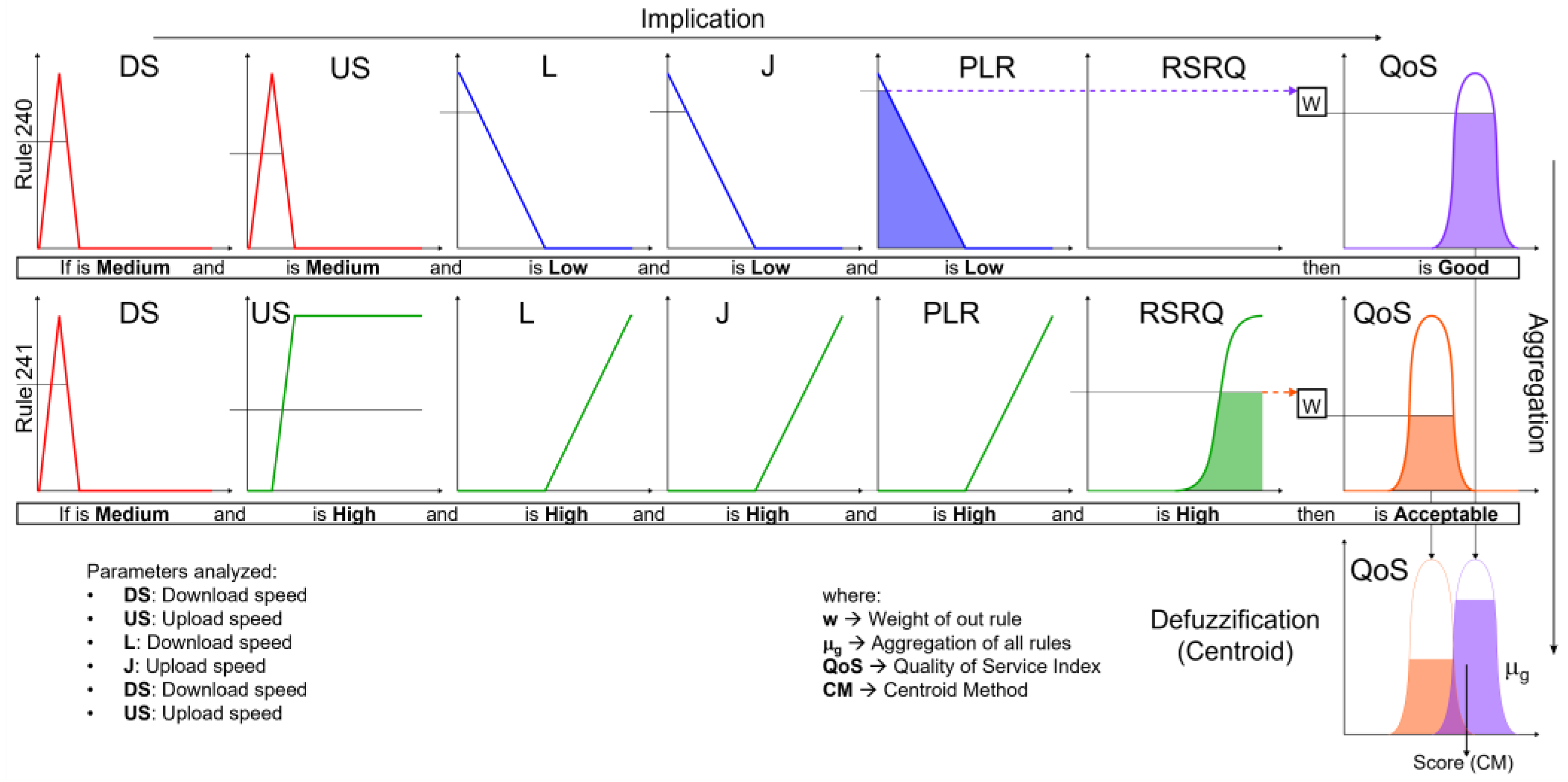
For this work, the set of fuzzy rules covering all possible scenarios was demonstrated. Once the rules are defined, their mathematical calculation can be performed in two phases, taking as an example the rules for obtaining the effectiveness index.
First, all membership functions for the effectiveness index are evaluated with Equation (8).
where
and
are the packet loss rate and RSRP is the reference signal received power. Furthermore,
and
and
is known as the rule’s antecedent. Finally, the consequent or output of the rule
is obtained with Equation (9).
where
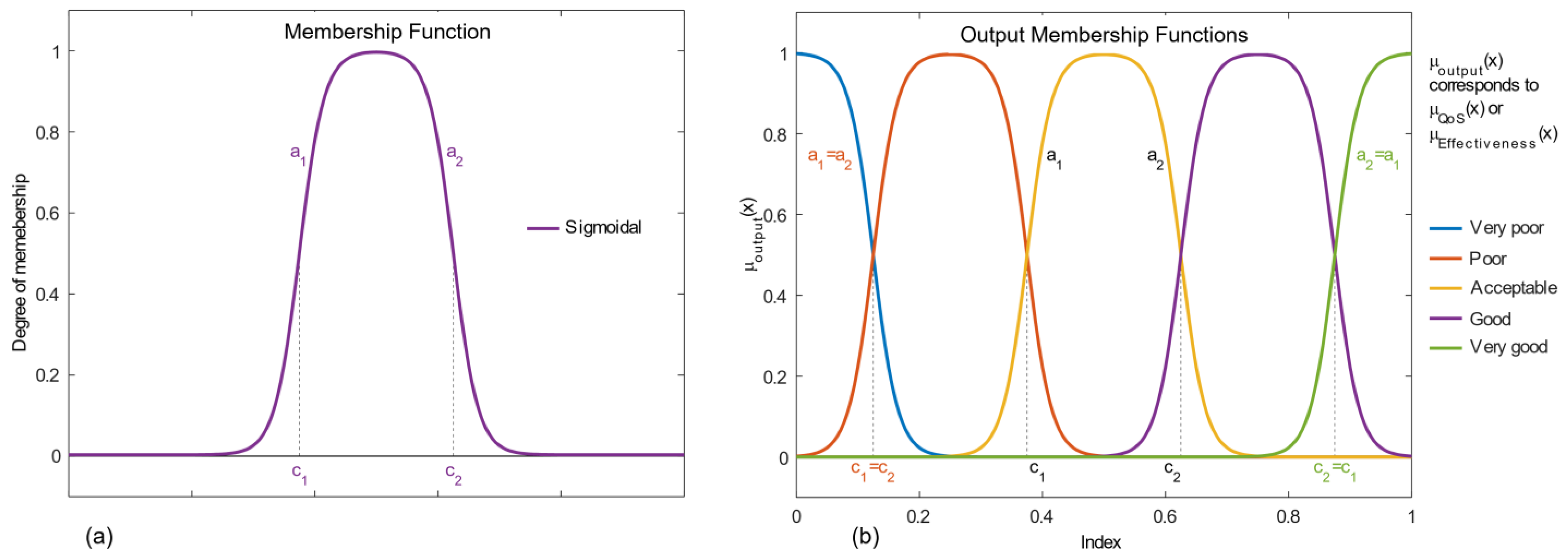
. The membership function of the QoS and effectiveness indices can be calculated using Equation (10).
where
,
,
, and
are the parameters defined by the output membership function; see
Table 5 and
Figure 3.
2.4. Analytical Hierarchy Process
The Analytical Hierarchy Process (AHP), a multi-criteria decision-making tool, can solve a problem by decomposing related factors in a hierarchy and evaluating the priorities of the hierarchy in simple pairwise comparison judgments [
60]. Thus, the fuzzy inference system (FIS) is robust using the AHP of L. Saaty in 1980 [
61].
2.4.1. Hierarchy Assignment
After establishing the rules between KPIs, hierarchies are assigned by applying the Analytic Hierarchy Process (AHP). To verify the order of hierarchy between the seven key performance indicators (download speed, upload speed, latency, jitter, packet loss rate, RSRP, and RSRQ), the dependency links must be identified to establish these hierarchies. Therefore, the relative importance scale proposed by Saaty was used to select the level of importance from a comparison between KPIs.
Table 6 shows the relative importance scale for obtaining the QoS and effectiveness indices.
The level of importance assigned to each KPI focused on the applications that general LTE network users use daily. These users take advantage of the cost reduction in the mobile network service to access over-the-top (OTT) applications [
54]. These are applications for video streaming, video calls, messaging, voice, audio, social networks, data transmission, cloud services, and browsers [
55,
62]. To evaluate the network quality aspects of these applications, the ITU in [
55] recommends the relevance of quality parameters in the performance of these applications. The download and upload speed is most relevant, followed by the packet loss rate, jitter and latency, and RSRP and RSRQ. It is essential to evaluate the degradation based on these considerations.
Considering these services, the upload speed and download speed KPIs are determined to be paramount for QoS. Meanwhile, for the packet loss rate, the level of importance is weak compared to upload and download. Jitter is moderate, and latency is moderate +. Finally, RSRQ was assigned a much lower level of importance because this relationship is considered lower regarding upload and download.
The packet loss rate KPI was found to be most important for the effectiveness index due to its influence on evaluating data transfer effectiveness. However, the RSRP was assigned the lowest importance concerning the packet loss rate.
2.4.2. Pairwise Comparison Matrix
Once the importance has been assigned to the KPIs, pairwise comparisons between each KPI are performed. First, a pairwise matrix
is used to store the comparisons of each index.
is a positive
reciprocal matrix and is constructed as follows:
where
is the importance scale of the
, substituting the assigned values from
Table 6 in Equations (11)–(13) for the
and effectiveness indices, respectively.
where
is the download rate,
is the upload rate,
is the latency,
is the jitter,
is the packet loss rate, and
is the reference signal received quality. Similarly, the matrix for effectiveness is defined by:
where
is the packet loss rate, and
is the reference signal received power.
2.4.3. Square Matrix of A
The square of the pairwise comparison matrix is then calculated using the expression in Equation (14).
Substituting values from Equation (12) into Equation (14) gives the square of the matrix
for the
.
The square of the effectiveness matrix
is calculated similarly.
2.4.4. Obtaining the Vector C
Next, vector C is obtained, which will be used to obtain the weight vector. To do this, the rows of matrix B are added using Equation (17) to calculate each element of vector
.
Using Equation (17), vector
for the quality of service is calculated.
For effectiveness, the corresponding steps are taken.
2.4.5. Weight Vector or Eigenvector
After obtaining the weight vector, the vector
must be normalized by applying Equation (18).
where
is the weight vector, known as the eigenvector, proposed by Perron in [
63]. This process is repeated until the eigenvector solution is unchanged from the previous iteration. The priority weights for each KPI concerning
and effectiveness are shown in Equations (19)–(20), respectively.
2.4.6. Iteration
The iteration starts by repeating the process described in
Section 2.4.3,
Section 2.4.4 and
Section 2.4.5. It ends when there are changes of less than four decimal places between the elements of the eigenvector of the current iteration and those of the eigenvector of the previous iteration. The matrix
is initially obtained by calculating the square matrix of
, obtained in the last iteration.
Then, the vector
of each index is obtained:
Next step is to calculate the weight vector
.
Finally, the difference between the current iteration’s eigenvector and the previous iteration’s eigenvector is obtained. The difference in eigenvectors for the
is calculated:
Meanwhile, for effectiveness:
when the result for both eigenvectors is less than four decimal places, the iteration stops, and the process continues to
Section 2.4.7.
2.4.7. Consistency
Finally, the Consistency Ratio (
) of the matrix “
” was calculated. According to Saaty [
44], a limit of 0.1 is defined as the maximum acceptable inconsistency. Equation (21) is used to calculate
.
where
is the maximum eigenvalue of the comparison pair matrix,
is the matrix’s size, and
is the random consistency index, which can be determined according to
Table 7.
If the ratio (called the consistency ratio ) between the consistency index and that of the random matrices is significantly tiny (it is carefully specified that it should be 10% or less), we accept the estimate of . Otherwise, we try to improve the consistency.
The Equation (22) is applied to obtain the
.
where
is the pairwise comparison matrix proposed in
Section 2.4.2,
is the maximum eigenvalue of the matrix, and
is the eigenvector or vector of resulting weights obtained at the end of the iteration of
Section 2.4.6. In addition, the equality shown in Equation (23) is fulfilled.
It is verified whether the matrix
for the
is consistent by applying Equation (23).
Furthermore, by relating Equations (22)–(23), it is observed that there is equality between
and
; therefore:
Calculating
for the quality of service we have:
To verify that the correct value of
is obtained, Equation (25) is applied.
It is observed that the result is the identical resulting vector of
; therefore,
can be used to calculate the consistency ratio for quality. The consistency ratio is calculated by substituting values.
It is verified that
; therefore, the matrix
is consistent. For effectiveness, the matrix
is of dimension
. Thus, the consistency is verified by demonstrating that
for each positive reciprocal matrix of 2 by 2. Therefore, each positive reciprocal matrix of 2 by 2 is a positive reciprocal matrix, as shown in Equation (26).
As the proof is fulfilled, it is verified that the matrix proposal is consistent. Therefore, the weight vector for the
is:
Furthermore, the weight vector for effectiveness is:
2.5. Weight Applying
The FIS works by giving equal importance to the input variables, in this case, to the KPIs. However, the significance of some KPIs can be weighted to benefit the response of the indices. In this sense, some KPIs must have a different mathematical importance for this hierarchy to impact each index. The weights of these variables were obtained in
Section 2.4. It is essential to mention that the assignment of these weights cannot be integrated separately into the rules since they would unbalance the calculation of the output rule; however, when the result of a function defined for a KPI establishes the result of the rule, then the weight corresponding to the KPI of this function is multiplied to the result according to the following expression.
where
is the selected weight of the
KPI that defined
. When two or more KPIs have the same membership value, the KPI with the highest priority establishes the weight to be used. Particularly for
, the rules are defined with six KPIs: download speed (
), upload speed (
), latency (
), jitter (
), packet loss rate (
), and
. Thus, the weight to be used is defined with Equation (30).
Similarly, the effectiveness index rules are generated with two
, the
and the
. Therefore, the weight to be used is assigned using Equation (31).
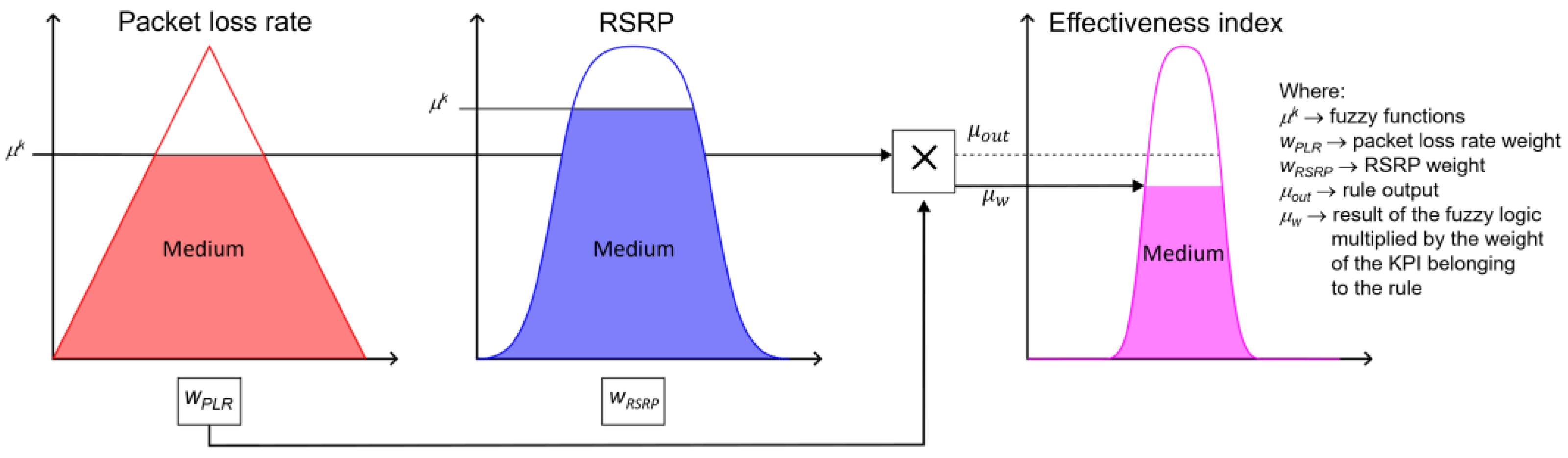
Figure 4 shows how the
influences the exit rule with the highest importance, exemplifying the process of obtaining the effectiveness index.
2.6. QoS and Effectiveness Indices (Aggregation and Defuzzification)
After the output rules (
) have been calculated, the area of all these rules is combined by superposition, known as the aggregation process. Thus, a final membership function (
) is obtained that integrates all the particular evaluations (
). The aggregation for the QoS index is presented as an illustrative example (see
Figure 5).
4. Discussion
The information repository was collected collaboratively with mid-range user equipment during the first two months of 2021. Data from five mobile network operators are reported at 39 geolocated points. It is essential to clarify that each geolocated point does not have data from all operators or measurements from all collection period days. In addition, after statistically analyzing the data, it was found that the KPI values are variants over time, so the behavior of these variables refers to a stochastic process. Therefore, it will be determined that the data in the repository are not balanced. Subsequently, the information repository was analyzed regarding the range of valid values for each KPI, as shown in
Table 1, and 385 valid data were found. Therefore, to evaluate the quality of service and effectiveness, the weighted fuzzy inference system (FIS-AHP) is used to strengthen the first FIS carried out [
38].
The relevance of this model is the ability to offer LTE mobile network users a pair of indices that allows them to assess the quality of service and effectiveness without being experts. In other words, an additional tool for assessment is proposed that does not replace the KPIs recommended by regulators. Particularly for QoS, the weighting assigned to the download speed and upload speed KPIs in the FIS-AHP is because this pair is decisive in the data transfer of over-the-top services. Similarly, importance was assigned to the KPI of the packet loss rate for effectiveness, considering that this KPI is essential in evaluating the effectiveness of data transfer.
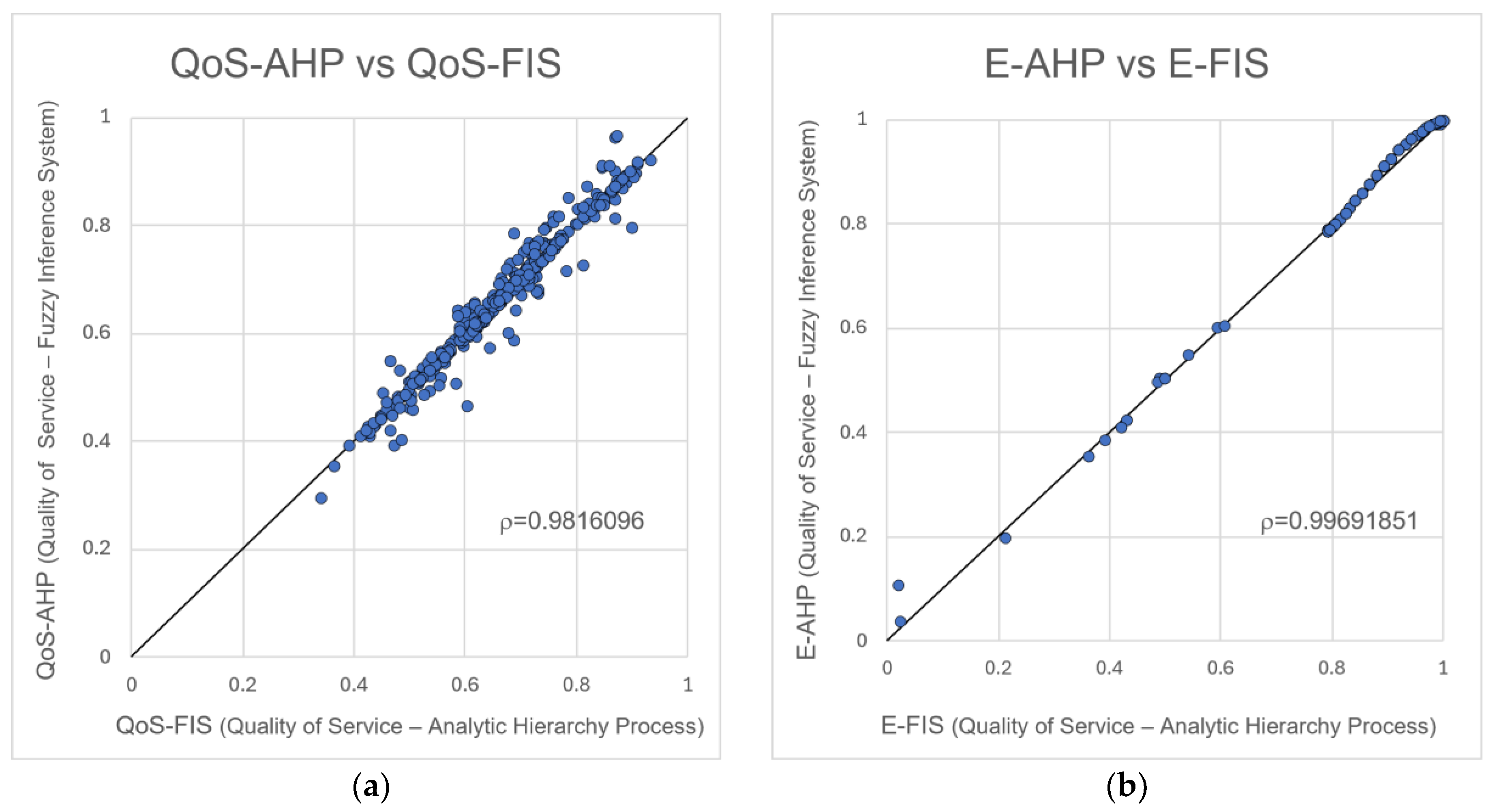
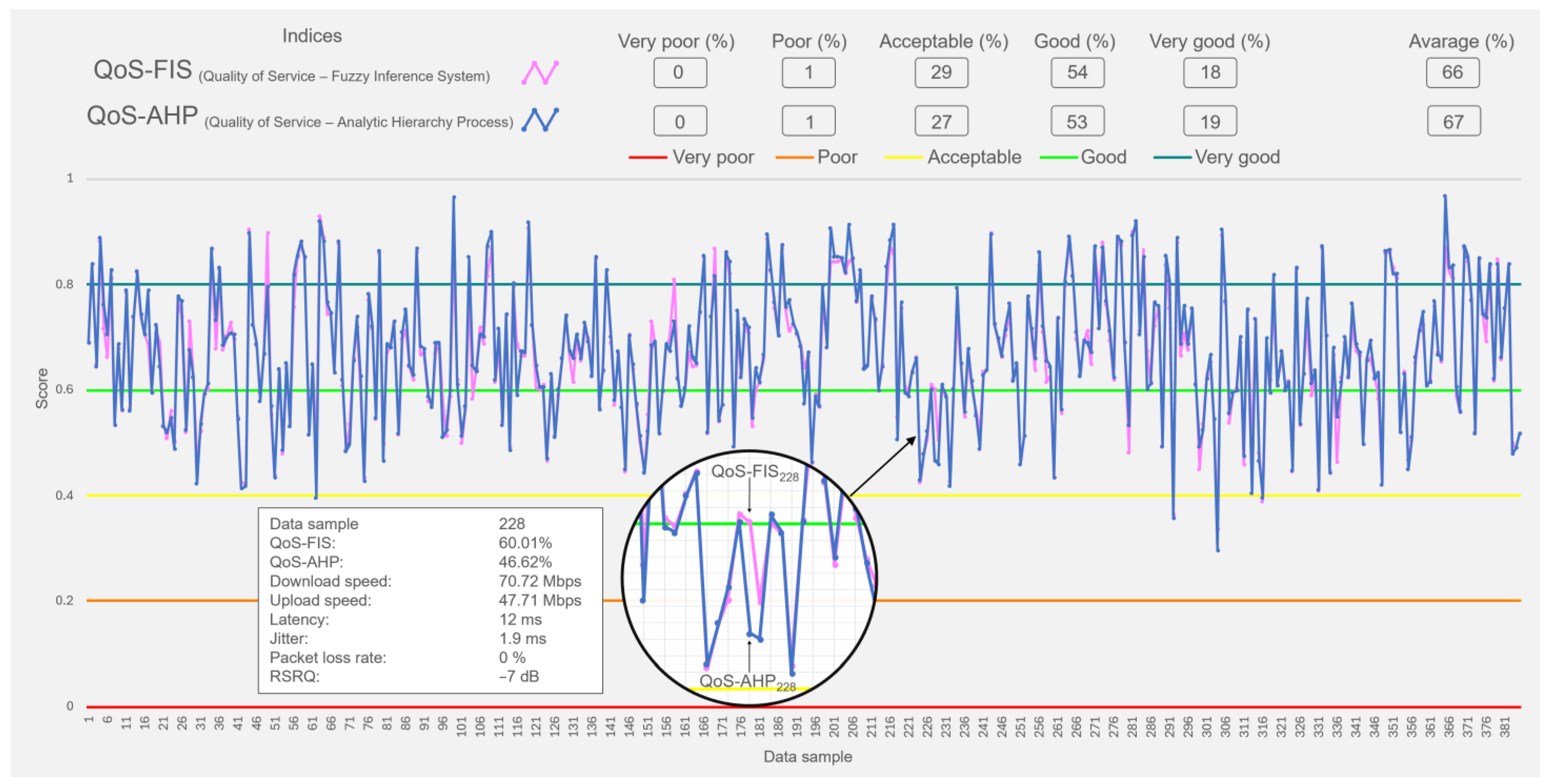
To discuss the results, an example is presented in
Figure 9. It can be observed that the evaluation coefficient of the absolute values (
ρ) in (a) and (b) is positive. In addition, in both sections, there is a strong relationship between the evaluation models due to the coincidence in the behavior of the input KPIs of the evaluation with the FIS and the importance weights assigned in each AHP. The differences in
Figure 9a between the QoS-FIS and the QoS-AHP can be seen in different data samples. This is caused because, in the AHP evaluation, the importance weights assigned to the upload and download speed amplify or attenuate the behavior of the quality of service concerning the FIS. In the AHP evaluation, the importance levels assigned to each KPI were based on the relevance of the quality parameters in the performance of OTT applications recommended in the ITU Quality of Service Regulator Manual. Download and upload speed are the most relevant, followed by packet loss rate, jitter, latency, RSRP, and RSRQ.
In other words, if the data samples from the information repository have values in the ranges of 55 to 300 Mbps and 20.5 to 100 Mbps for download and upload speed, respectively, or in linguistic terms, they have a high value for both, they will influence more than the rest of the KPIs to amplify the result of the evaluation. On the contrary, if the data samples have low linguistic values or values in the range of 0 to 21 Mbps for the upload speed or 0 to 7.5 Mbps for the download speed, they will weaken the result of the Quality of Service Index.
Meanwhile,
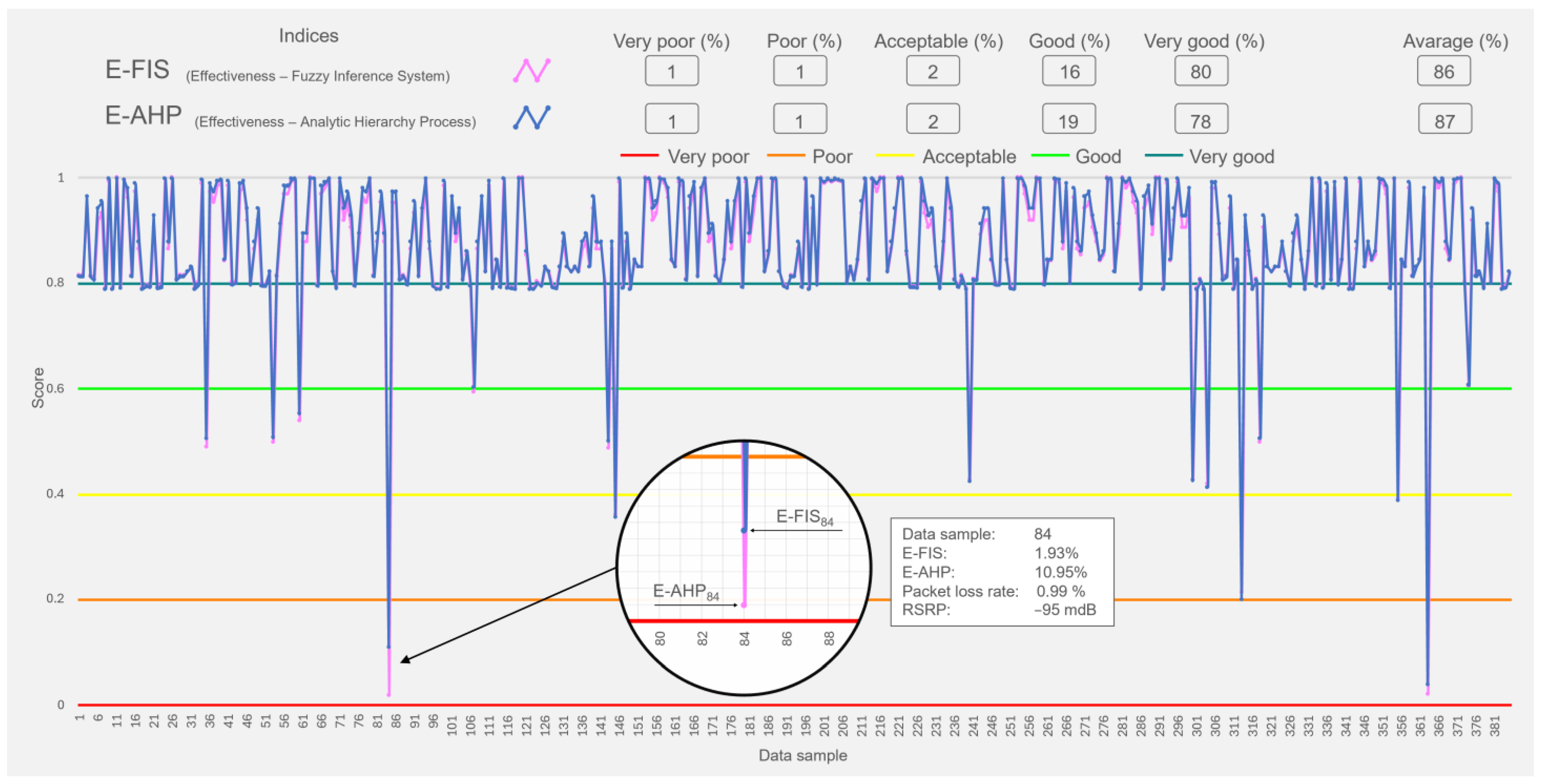
Figure 9b shows a more significant difference between the E-FIS and E-AHP models in the effectiveness evaluations with values of less than 1% because the influence of the weighting on the packet loss rate is more critical than RSRQ’s. In this case, the AHP evaluation is amplified. The rest of the values compared between E-FiS and EAHP present an average difference of 1% due to the similarity between both evaluation models.




 ,
,