


Abstract
The celebrated Heston’s stochastic volatility (SV) model for the valuation of European options provides closed form solutions that are given in terms of characteristic functions. However, the numerical calibration of this five-parameter model, which is based on market option data, often remains a daunting task. In this paper, we provide a theoretical solution to the long-standing ‘open problem’ of characterizing the class of risk neutral distributions (RNDs), if any, that satisfy Heston’s SV for option valuation. We prove that the class of scale parameter distributions with mean being the forward spot price satisfies Heston’s solution. Thus, we show that any member of this class could be used for the direct risk neutral valuation of option prices under Heston’s stochastic volatility model. In fact, we also show that any RND with mean being the forward spot price that satisfies Heston’s option valuation solution must also be a member of the scale family of distributions in that mean. As particular examples, we show that under a certain re-parametrization, the one-parameter versions of the log-normal (i.e., Black–Scholes), gamma, and Weibull distributions, along with their respective inverses, are all members of this class and thus, provide explicit RNDs for direct option pricing under Heston’s SV model. We demonstrate the applicability and suitability of these explicit RNDs via exact calculations and Monte Carlo simulations, using already published index data and a calibrated Heston’s model (S&P500, ODAX), as well as an illustration based on recent option market data (AMD).
Keywords:
Heston’s model; option pricing; risk neutral valuation; calibration; negatively skewed distribution MSC:
91G20; 60H35; 62E15
JEL Classification:
G10; G13
1. Introduction
Heston’s stochastic volatility (SV) model for option valuation in [1] is now widely accepted by both academics and practitioners. It prescribes, under a risk neutral probability measure , for example, the dynamics of a spot’s (stock, index) price process in relation to a corresponding though unobservable (and hence, untradable) volatility process via a system of stochastic differential equations. This system is given by
where and are two Brownian motion processes under with for some . Here, r is the prevailing risk-free interest rate, and are the long-run average and variance of the volatility V, and is the mean reversion rate of V.
The quest to incorporate a non-constant volatility into the option valuation model when modeling the price of a European call option has arisen in the literature (e.g., [2] or [3]) ever since the seminal works of Black and Scholes in [4] and of Merton in [5] (abbreviated herein as BSM). The BSM model assumes that a spot’s price evolves with the non-random and constant volatility of the spot’s returns as a geometric Brownian motion:
Coupled with the ingenious argument of instantaneous portfolio hedging (along with other assumptions, such as self-financing, no-cost trading/carry, etc.) and the application of Ito’s Lemma to the underlying PDE, the BSM model provides an explicit solution for the price of European call options. Specifically, given the current spot price and the risk-free interest rate r, the price of the corresponding call option with price-strike K and duration T can be expressed as follows:
where is the remaining time to expiry. Here, using the conventional notation, and denote the standard normal and , respectively, and
Similarly to the form of the BSM solution in (3), Heston found in [1] that the solution to the PDE system resulting from the stochastic volatility model (1) is given by
where are two related (under a risk neutral probability measure ) conditional probabilities that the option will expire in the money, which are conditional on the given current stock price and the current volatility . However, unlike the explicit BSM solution in (3), which is explicitly given in terms of the normal (or log-normal) distribution, Heston provided in [1] (semi)-closed-form solutions to these two probabilities: and , which are given in terms of their characteristic functions (for more details, see Appendix A). Hence, the option price in (5) is readily computable via complex numerical integration for any of the four parameters in (1), in addition to , and r. It should be noted that different choices for lead to different values of in (5) and hence, the value of must first be appropriately ‘calibrated’ for to actually match the option market prices (see Section 5 for an additional discussion). The problem of ’calibrating’ or estimating the parameters of Heston’s model has naturally received much attention in the literature. Various approaches have been utilized, from standard (weighted or penalized) MSE approaches (as in [6]) to fast SWIFT method approaches (as in [7]) and direct maximum likelihood approaches (as in [8]), as well as models with implied stochastic volatility approaches (as in [9]), to name a few.
On the other hand, the utility and usefulness of the risk neutral probability measure in option valuation, both in general and in determining specific solutions in (5) (or in (3)), cannot be overstated (in the ‘risk neutral’ world). The risk neutral probability links together option valuation and the corresponding risk neutral distribution of a spot price and its stochastic dynamics that govern the model (as in (1), for example). In the case of the BSM model with a non-random volatility in (2), the underlying RND is unique and is given by the log-normal distribution. However, this is not the case with Heston’s general stochastic volatility model (1). Since it involves the dynamics of two stochastic processes , one of which (the volatility ) is not directly observable, there are innumerable possible choices for RNDs that could satisfy the general solutions of an in (5).
However, since ample market data are readily available on the spot prices of underlying assets, as well as their market option prices, there is an extensive body of literature dedicated to the ‘extraction’, ‘recovery’, ‘estimation’, or even ‘approximation’ of RNDs from the available market option data. For comprehensive reviews of the subject, see [10,11,12,13], which cover both parametric and non-parametric approaches. With parametric approaches in particular, the parameters of assumed distributions are estimated by various means (maximum likelihood, method of moments, least squares, etc.) so as to approximate available option data or implied volatilities (c.f., [14]). These types of assumed multiparameter distributions include mixtures of log-normal ([12,15]), generalized gamma ([12]), generalized extreme value ([11]), gamma, and Weibull distributions ([16]), among others. While empirical considerations have often led to the suggestion that these parametric distributions are possible RNDs, the motivations for these considerations have not included any full theoretical justifications nor direct links to the governing pricing model and its dynamics as given in (1), as was the case in the BSM model, which directly (and uniquely) linked the log-normal distribution and the price dynamics of the model in (2). Accordingly, the important question of "what class of RNDs, if any, satisfies Heston’s SV model and its solution (5) for option valuation?" has remained a long-standing ‘open problem’.
In Theorem 2 below, we present the main result of our paper, which establishes the direct theoretical link, through Heston’s solution in (5), between a particular large class of RNDs and the assumed stochastic volatility model in (1) that governs the spot price dynamics. In Section 2, we provide the theoretical justification and rationale for our approach. In Section 3, we identify the class of distributions (and hence, the class of RNDs) that satisfies Heston’s solution for the option price, as is given in (5). Specifically, we show that any risk neutral probability distribution that satisfies (6) and (7) with a scale parameter (i.e., the forward spot price) would also satisfy Heston’s option pricing model in (5). In fact, we also show in Appendix A that RNDs that can be calculated directly from Heston’s characteristic function expressions of and must be members of this class of distributions as well. Hence, our main results of Theorem 2 provide a theoretical answer to the ’open problem’ of characterizing the class of Heston’s RNDs for direct option valuation. Some specific examples of well-known parametric distributions that satisfy Heston’s solution are provided in Section 4. As particular examples, we show that under a certain re-parametrization, the one-parameter versions of the log-normal (i.e., Black–Scholes), gamma, and Weibull distributions, along with their respective inverses, are all members of this special class of distributions and thus, provide explicit RNDs for direct option pricing under Heston’s SV model in (1) (or (5)). We note that a two-parameter generalization of these distributions as RNDs for Heston’s SV model, namely the generalized gamma distribution, has separately been discussed by the author in [17], who has also provided several applications for real market option data.
The extent of the agreement between these distributions as possible RNDs for Heston’s model, the actual Heston’s RNDs (calculated numerically from expression in Appendix A), and the simulated distributions of spot prices obtained under a discretized version of the model in (1) is illustrated numerically in Section 5. The applicability and suitability of these explicit RNDs are demonstrated using already published index data and a calibrated Heston’s model (S&P500 data from [18] and ODAX data from [6]), as well as an illustration based on recent market option data (AMD). In Appendix A, we present the expressions for Heston’s characteristic functions and discuss some of the immediate properties leading to our main results, as stated in Theorem 2.
2. Theoretical Rationale
As has been established in [19], the risk neutral equilibrium requires that for (with ),
and that (in the case of a European call option), must also satisfy
where, for any , . Here, is the risk neutral density (RND) under , which is reflective of the conditional distribution of the spot price at time T given the spot price at time , whose expected value is the future value of the spot price (as in (6)).
By expanding the last term in (7) with , we obtain that:
Clearly, by comparing (8) to Heston’s solution in (5), it follows that
which is the risk neutral probability of the option expiring in the money. Further, by utilizing Equation (6) as the first term of (8), it follows from (5) that:
We note that since by (6), we have
the probability is also typically interpreted as the probability of the option expiring in the money, but under the so-called physical probability measure that is dominated by . However, here, in the case of Heston’s SV model, we consider a different interpretation of the term , which enables us to characterize the class of RND candidates that satisfies (5).
It is standard notation to denote the so-called delta function (or hedging fraction) as in option valuation, as defined by:
In Appendix A, we show (see Claim 1) that for Heston’s call option price , as given in (5), we have
(also see [18]). Hence, under the model in (1), Heston’s solution for the option price in (5) can be written in an equivalent form as:
Accordingly, any risk neutral distribution that satisfies Heston’s SV model and its solution in (5) must also admit the presentation in (12) for the direct evaluation of option price . We point out in passing that this presentation (12) also trivially applies to the BSM option price in (3) since in that case, and are the probability that the option will expire in the money (as calculated under the log-normal distribution).
3. The Scale Parameter Class of Heston’s RND
In this section, we identify the class of distributions (and, therefore, the class of possible RNDs) that admit the presentation in (12) for the price of a European call option. Specifically, we show that any RND candidate that satisfies (6) and (7) with a scale parameter will admit the presentation in (12) and hence, in light of the results in (11), will equivalently satisfy Heston’s option pricing model in (5). While the development given below could be seen as straightforward (and perhaps even trivial), it is instrumental for the theoretical characterization of Heston’s RNDs as a scale family of distributions.
To that end and to simplify the presentation, we consider a continuous positive random variable X with the mean (with respect to the underlying probability measure ). We denote the and of X as and , respectively, to emphasize their dependency on as a parameter. Similarly, for a given , we denote the expectation of X (or functions thereof) under as , so that
Similarly to (7), we define the following for each :
Clearly, we have . Note that is merely the undiscounted version of in (7), so that with , as in (6), we have .
It is straightforward to see that, as in (8),
or equivalently
Hence, it follows immediately from (14) that for each ,
As we proceed to explore more of the basic properties of the function , we add the simple assumption that is a scale parameter of the underlying distribution of X.
Assumption 1.
We assume that is a scale family of distributions (under ), so that for any given ,
for some values with a satisfying and, where is an exogenous parameter to be specified later.
In Lemma 1, we establish the linear homogeneity of under Assumption 1 and in Lemma 2, we provide the implied re-scaling property of this function and the consequential specific derived form of , as presented in Theorem 1. For the linear homogeneity property of European options, in general, see Merton’s Theorems 6 and 9 in [5] or Theorem 2.3 in [20].
Lemma 1.
Proof.
With a simple change in variable, it follows immediately from Assumption 1 and (14) that with , , and , we have
□
- Now, by applying the results of Lemma 1 to , we immediately obtain the following useful result:
Lemma 2.
Suppose that and thus, it satisfies the conditions of Assumption 1. Then, it holds that
for any , where is as defined in (14) but with respect to :
It should be clear from these results that the function can be re-scaled or ’standardized’ so that is independent from . In particular, when for some , then by (16), .
Next, as in (10), we define the ‘Delta’ function corresponding to the function in (13) or (14) as . In the next theorem, we show that under Assumption 1, can be expressed in terms of the truncated mean of X and the consequential representation of .
Theorem 1.
Suppose that and thus, it satisfies the conditions of Assumption 1. Then, for each ,
Further, , where for any . Hence, in (13) can be written as
Proof.
An immediate conclusion of Theorem 1 is that when is a member of the scale family of the distribution (by Assumption 1), then the functions can easily be evaluated by first calculating the values of for the ratio . Specifically,
The results of the theorem, either as given in (19) or (21), can be used directly for the risk neutral valuation of a European call option with a strike K and a current spot price , providing the expression for is as given in (12), i.e., when , then with applied to (21), we have
We summarize these findings in the following Corollary.
Corollary 1.
Remark 1.
It should be clear from (22) that since the probability distribution is assumed to be a member of a scale family , its values only depend on K and S through the ratio . In Appendix A, we assert in Proposition A1 that any risk neutral probability distribution that satisfies the solution in (5) for Heston’s option pricing model must also be a member of a scale family of distributions with a scale parameter (or , in the case of a dividend yielding spot). This assertion follows directly from the specific form of Heston’s RNDs established in Appendix A, which are given in terms of the characteristic functions corresponding to the term (see (A5) and the subsequent comments). Hence, when combined, Corollary 1 and Proposition A1 provide the main results of the paper, which are summarized in the following theorem.
Theorem 2.
Clearly, Theorem 2 asserts that any RND for Heston’s stochastic volatility model must be a member of the class of scale parameter distributions that satisfies Assumption 1, with the mean being the forward spot price. Indeed, any member of this class of scale parameter distributions could serve as a possible RND for the direct and risk neutral calculation of an option price, as in (7) or Corollary 1. In the next section, we identify and list several one-parameter versions of some well-known distributions that could serve as RNDs under Heston’s SV model.
4. Examples of Explicit RNDs for Heston’s Model
In view of Theorem 2, the quest for finding appropriate RNDs for Heston’ SV model for particular parametrizations of must be focused only on the members of a scale family of distributions with a scale parameter . Accordingly, in this section, we provide five particular examples of well-known distributions that satisfy the conditions of Assumption 1 and hence, admit, as per Corollary 1, the presentation (12) for Heston’s option pricing model in (5). These well-known distributions, namely, the log-normal, gamma, inverse Gaussian, Weibull, and inverse Weibull distributions, are re-parametrized under Assumption 1 to a standardized, one-parameter versions, denoted as , with the mean 1 and a second moment that depends on a single parameter (in fact, we later take for some ). Due to their relative simplicity (i.e., involving only one parameter), we view these distributions as computationally inexpensive RNDs, which are easier to obtain, calculate, and calibrate compared to the alternatives approaches available in the literature. We note that while the gamma and Weibull distributions were considered in [16,21] for deriving ‘alternative’ option pricing formulae, the motivation for the parametrization discussed there did not consider the spot price dynamics (i.e., as in the model in (1)) but rather fitting kurtosis and skew; therefore, they are inherently different.
With these standardized distributions in hand and the corresponding explicit expressions for as obtained under Assumption 1, we utilize (21) (with ) to first calculate in each case the expression for
which is then used to obtain the expression for the undiscounted option price, with :
Finally, as in (22), the corresponding expression for the call option price is obtained as (with , and ). We point out again that each of these five distributions would satisfy Heston’s general solution for the valuation of European call options as RNDs, as given in (5). We begin with the log-normal distribution, which results in the classical Black–Scholes option pricing model (as given in (3) and (4)).
4.1. The Log-Normal RND
Suppose that the random variable U has the ’standard’ (one-parameter) log-normal distribution with the mean and variance for some , so that . Accordingly, the of U is given by
and the of U is
It is straightforward to verify that when for some , then the of X is the ’scaled’ version of , namely, . So, this distribution satisfies Assumption 1.
Next, we calculate the expression of , which upon using the relation , becomes
Hence, for the ’standardized’ model, we have that
Accordingly, by Lemma 2 and (21), and, therefore, we immediately obtain the following expression for :
where the last equality utilizes the symmetry of the normal distribution. Finally, to calculate the price of a call option under the log-normal RND at a strike K when the current price of the spot is S, we utilize the above expression with , , and to obtain , which exactly matches the Black–Scholes call option price, as given in (3) and (4).
4.2. The Gamma RND
We begin with some standard notations. We write to indicate that the random variable W has the gamma distribution with a scale parameter and a shape parameter , in which case we write and for the corresponding and values of W, respectively. Recall that and . Additionally, we denote the gamma function whose incomplete version is as , which is defined for any .
Now, suppose that a random variable U has the ’standard’ (one-parameter) gamma distribution with the mean and variance for some , so that , where we substitute . Accordingly, the of U is given by
and the of U is given by
for any . It is straightforward to verify that when for some , then the , of X is the ’scaled’ version of and that Assumption 1 holds in this case too. Next, we calculate the expression for :
Accordingly, for the ’standardized’ gamma model, we obtain that
Again, by Lemma 2 and (21), and, therefore, we immediately obtain the following expression for in the case of the gamma model:
Finally, to calculate the price of a call option under this gamma RND at a strike K when the current price of the spot is S, we utilize (23) with , , and (so that ) to obtain .
4.3. The Inverse Gaussian RND
Using standard notation, we write to indicate that the random variable W has the inverse Gaussian distribution with the mean and . Now, suppose that a random variable U has the ’standard’ (one-parameter) inverse Gaussian distribution with the mean and variance for some , so that . Accordingly, the and values of U are given by
and
Again, we can verified that when for some , then the , of X is the ’scaled’ version of , so Assumption 1 holds for this distribution too. In this case. the values of must be evaluated numerically and when combined with the expression of given above, they provide the values of
for any . Here, again, the corresponding values of the call option can be obtained through exactly the same lines as in the previous examples, with , , and .
4.4. The Weibull RND
Using standard notation, we write to indicate that the random variable W has the Weibull distribution with and values in the form of
respectively, where is the scale parameter and is the shape parameter. The mean and variance of W are given by
where Now, suppose that a random variable U has the ’standard’ (one-parameter) Weibull distribution with the mean and variance for some , i.e., for a given , we let be the (unique) solution of the following equation:
in which case, , , and . Accordingly, the and values of U are given by
Again, it can be easily verified that when for some , then the , of X is the ’scaled’ version of , so Assumption 1 holds in this case too. For this RND, the values of can be obtained in closed form as
which, together with the expression of given above, provide the values of
for any . Here, again, the corresponding values of the call option can be obtained through exactly the same lines as in the previous examples, with , , and .
4.5. The Inverse Weibull RND
Similarly to the above example, we write to indicate that the random variable W has the inverse Weibull distribution with and values in the form of
respectively, where is the scale parameter and is the shape parameter. In this case, the mean and variance of W are given by
where Here, too, we let U have the ’standard’ (one-parameter) inverse Weibull distribution with the mean and variance for some , i.e., for a given , we let be the (unique) solution of the following equation:
in which case, with . Accordingly, the and of U are as given in (25) but with and . Hence, we can proceed along exactly the same lines as the previous examples to calculate and and hence, (with , and ).
4.6. On Skewness and Kurtosis
As already seen, the distributions in each of the five examples satisfy the conditions of Assumption 1 and hence, by Corollary 1, could potential serve as RNDs for Heston’s SV model in (1). These distributions are defined by a single parameter, namely , which affects their features, such as kurtosis and skewness, and hence, their suitability as RNDs for each particular scenario in the SV model (1), as determined by the structural model parameter (more on this point in the next section). However, for the sake of completeness and for future reference, we provide the expressions for the kurtosis and skewness of these five distributions in Table 1.
Table 1.
The skewness and excess kurtosis measures of the RND examples (3.1–3.5) as functions of the single parameter .
It is interesting to note that in the relevant parametric domain, all but the Weibull example have positive skewness measures. It can be numerically verified that in the Weibull case, changes its sign and is negative once and that for and is a largely leptokurtic distribution for . Hence, the Weibull distribution could be particularly useful when the implied RND is expected to be negatively skewed, such as when the spot is an index (more on this point in the next section).
5. Comparisons of Heston’s RNDs
Having introduced several examples of distributions that could serve as possible RNDs for Heston’s option valuation (5) under the stochastic volatility model (1) in the previous section, we dedicate this section to the illustration of their applicability and their relative comparison. In Appendix A, we provide the closed form expressions for Heston’s and , which are given in terms of their characteristic functions (see [1]). These expressions enable us to compute Heston’s call price for given , , and r values and for each choice of , as in (5), as well as calculate RNDs that are derived from Heston’s characteristic functions of (see (A5) in Appendix A for details on , the exact RND (under ) for Heston’s model). The features of this distribution, such as kurtosis and skewness, are largely determined by and , respectively (see [18]) and could serve as guides for matching particular proposed RNDs from among our five examples (also see Table 1), all corresponding to a particular ‘scenario’, as determined by . For instance, in cases which admit a RND with a distinct negative skew, the Weibull distribution could be considered, whereas in cases with a distinct positive skew, the inverse Weibull or one of the other distributions discussed in Section 4 could be considered.
Additionally, utilizing a discretized version of Heston’s stochastic volatility process (1), we can simulate observations on to obtain simulated renditions of the marginal distributions of and (which are conditional on S and , with ). In light of the scaling property of the RNDs, we present the results in terms of the rescaled spot prices whenever convenient, where (see Corollary 1). In the simulations, we employ either the (reflective version of) bMilstein’s discretization scheme (see [22]) or Alfonsi’s implicit discretization scheme (see [23]), depending on whether the so-called Feller condition (i.e. [24]), holds or not (see [25] for a discussion). We note that is intimately related to the conditional distribution of that is implied by the SV model in (1) (see Proposition 2 of [26] for details). In fact, it can be verified from [27] that the conditional distribution of given can be expressed under the parametrization and as
which is the non-central chi-squared distribution with degrees of freedom and a parameter of non-centrality of .
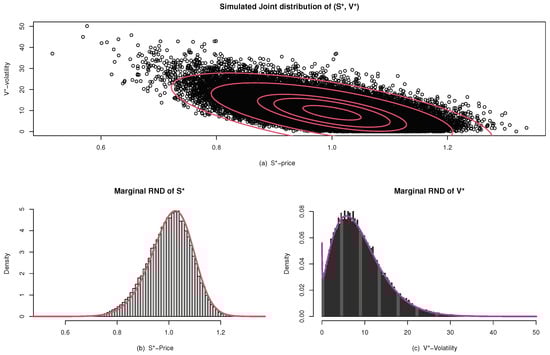
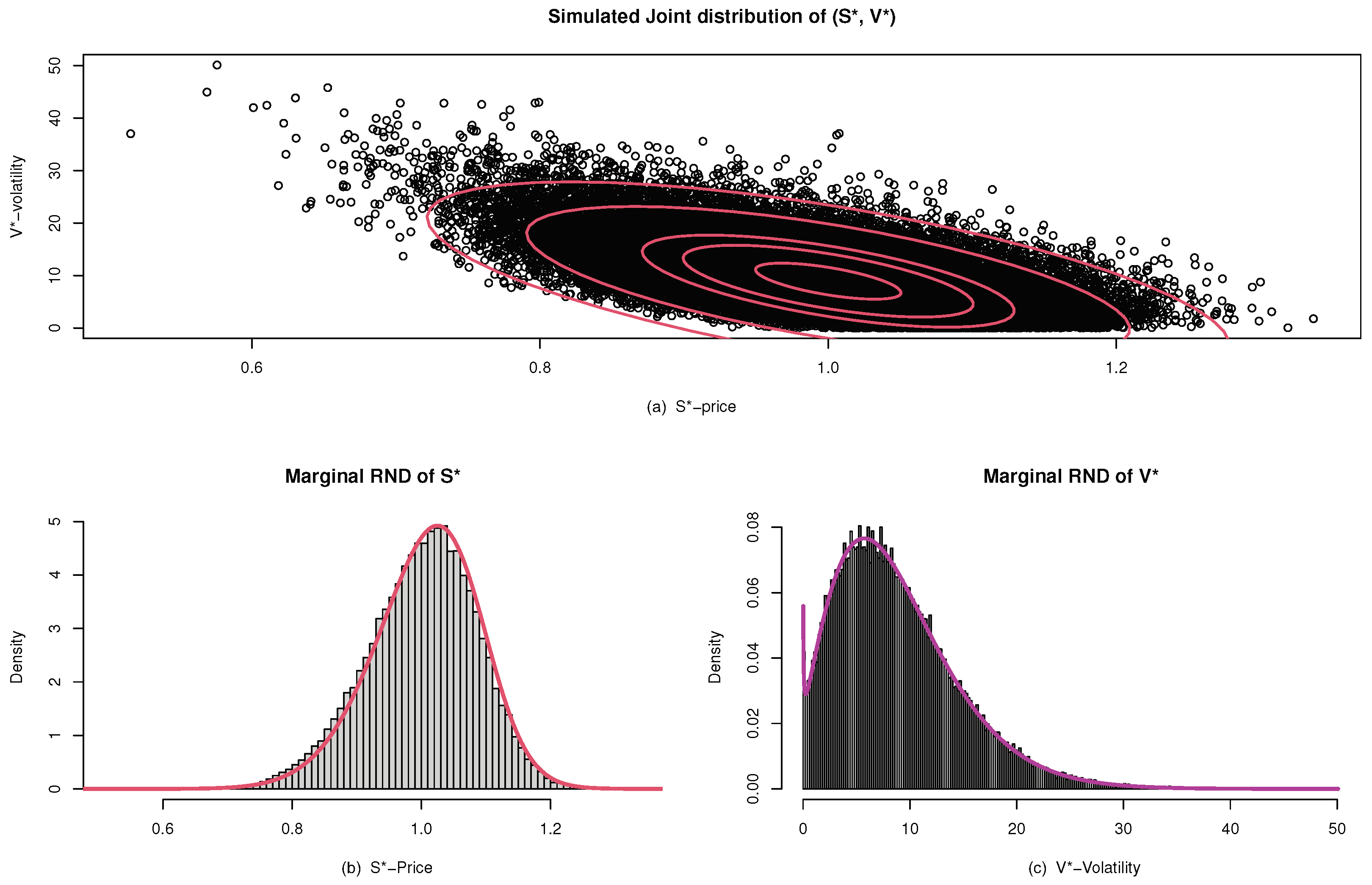
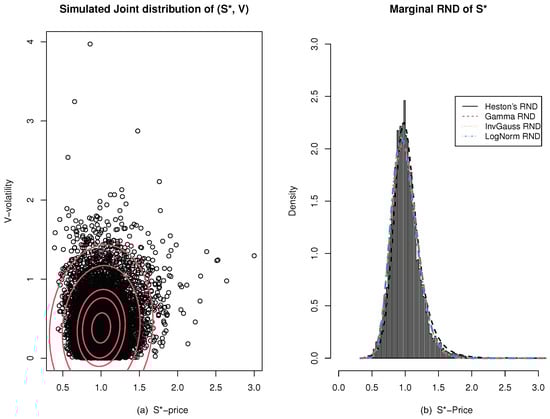
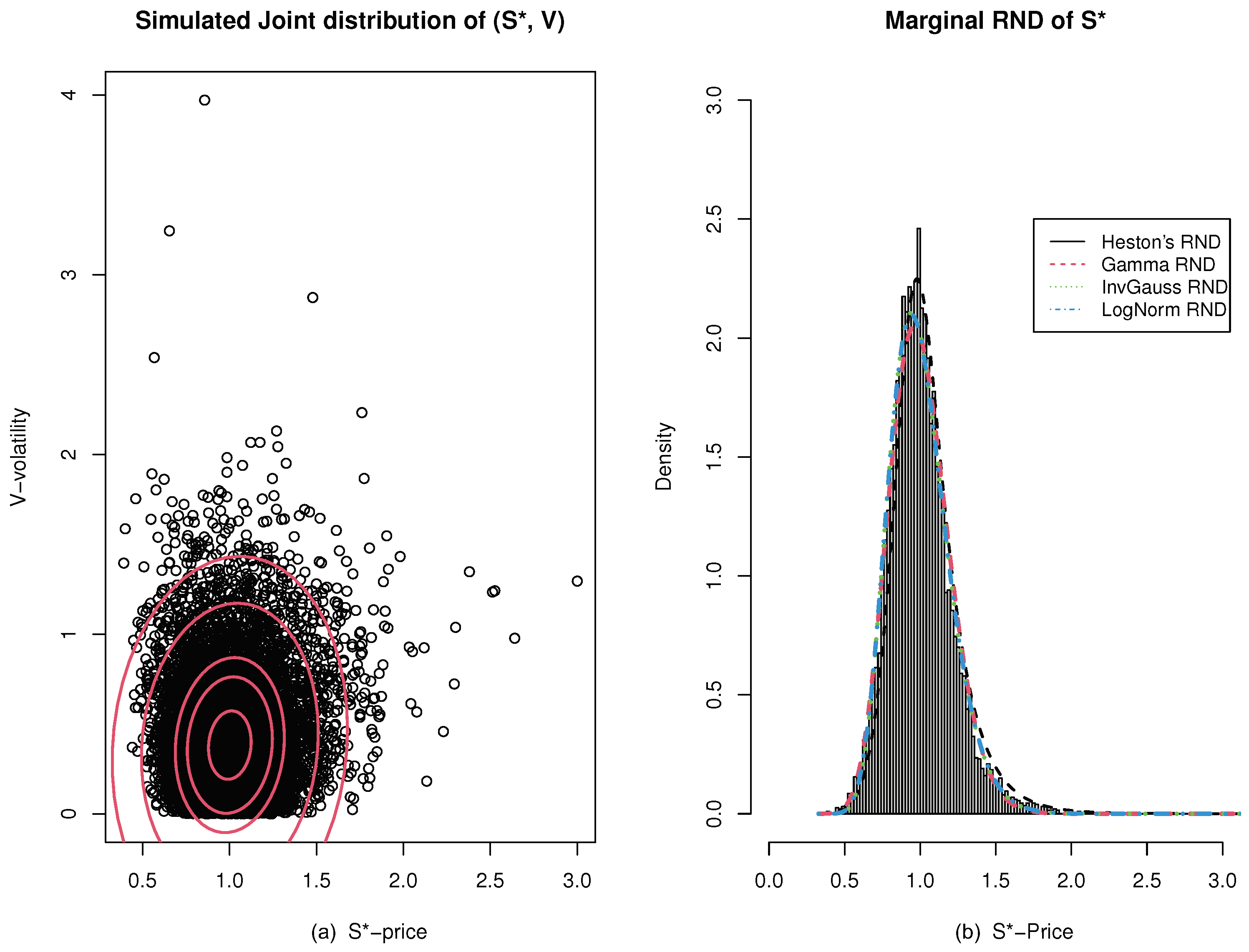
To illustrate this relation, we draw 10,000 simulated pairs with a standardized spot price and volatility, according to the SV model in (1) as described above, with (arbitrarily chosen) and and with , , , and . Their joint distribution is presented in Figure 1a, where we have superimposed the matching 16%, 50%, 68%, 95%, and 99.5% contour lines. In Figure 1b, we present a histogram of the simulated marginal distribution of the spot price , along with the theoretical Heston’s RND calculated using (A5). In Figure 1c, we display a histogram of the simulated marginal distribution of the standardized volatility , along with the theoretical chi-squared density curve, according to (27).
The same approach is utilized in the following examples, which are intended to illustrate the extent of the agreement between our proposed class of RNDs in the various cases and Heston’s semi-closed form RNDs for , which can be calculated using (A5) under the ‘calibrated’ values of . In all cases, we also include a comparison to the Monte Carlo distribution of , which is generated using the corresponding discretized version of model (1).
In the first two examples, we use values that are already calibrated to market data for the structural parameters , which can be found in [18] (on the S&P500) and in [6] (on the ODAX). These two examples, involving market data on traded indexes are used to illustrate the applicability of the Weibull distribution to situations in which the RND is negatively skewed and largely leptokurtic. Other similar illustrations using calibrated parameter values, such as those in [28] (on the EURO STOXX 50), are also available but not presented here due to limited space. To allow for the additional comparisons to be as realistic as possible, the next example is based on current (as of 31 December 2020) AMD market option data. This example serves to illustrate the applicability of the other RND candidates discussed in Section 4 to situations exhibiting mildly positive skews.
Example (S&P500). Bakshi, Cao, and Chen presented in [18] an extensive market data study comparing several competing stochastic volatility models, including Heston’s model. The data used in their study covered options and spot prices for the S&P500 Index from 1 June 1988 to 31 May 1991. From their Table III (see page 2008 in [18], we find that in addition to , the ‘All Option’ estimated (or implied) structural parameter corresponding Heston’s SV model is
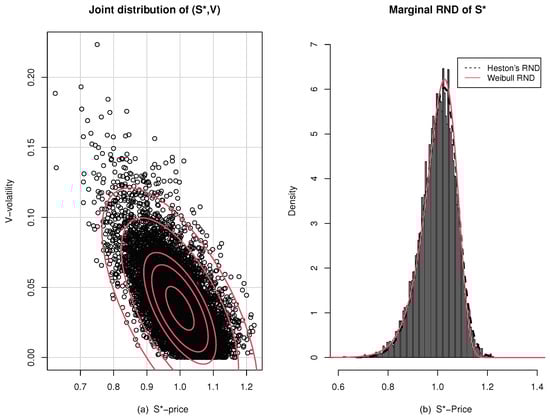
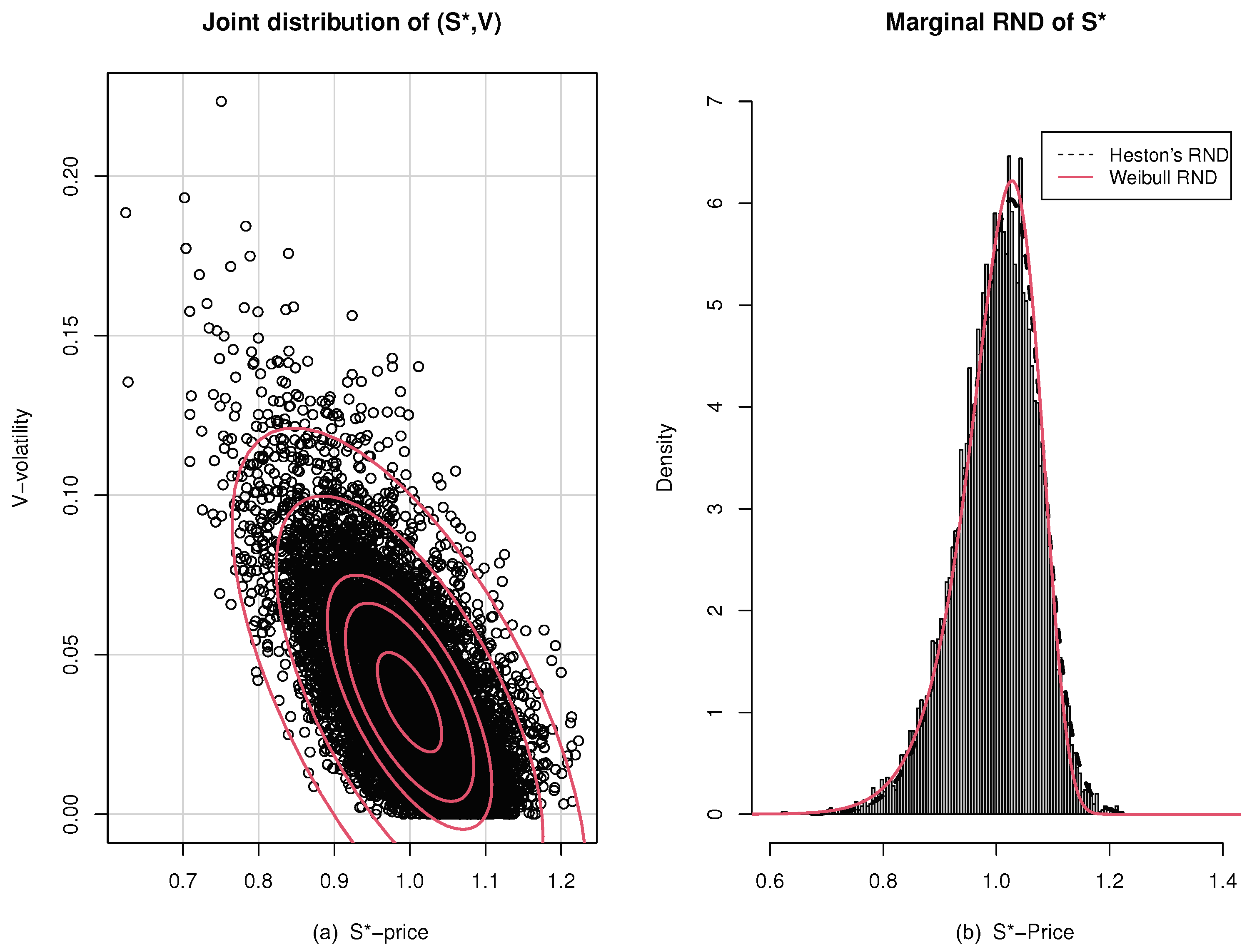
In this case, ; hence, for a short contract duration with year, we used Milstein’s (reflective) scheme to obtain a Monte Carlo sample of 10,000 simulated pairs with a standardized spot price and volatility, according to the SV model in (1). The results of their joint distribution is presented in Figure 2a. In Figure 2b, we present a histogram of the simulated marginal distribution of the spot price . The mean and standard deviation of these M simulated spot price values are and . We also include in the figure the curve of the implied (by ) Heston’s RND, as computed directly using (A5). As is expected in the case of risk neutrality modeling the spot prices of an index, the implied RND is negatively skewed (), which suggests that it is comparable to the Weibull distribution discussed in Section 4.4. To that end and since we do not have the actual option data used by [18], we simply matched to the ‘observed’ value of and use this to obtain the numerical solution of Equation (24) as , where . For comparison, we also include the plot of the RND in Figure 2b. As can be seen, the two RND curves are almost indistinguishable.
Figure 2.
The simulated joint distribution and the Heston’s and Weibull RNDs for the S&P500 data, based on the calibrated parameter provided in [18].
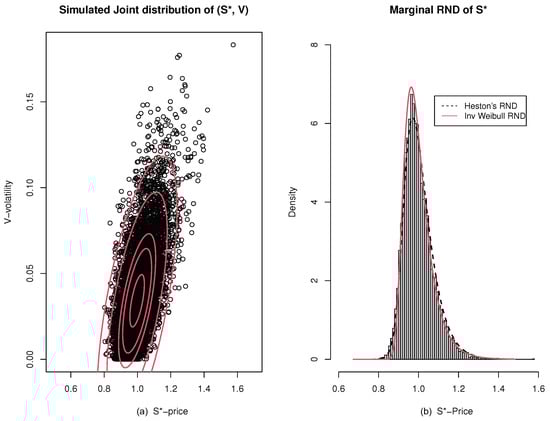
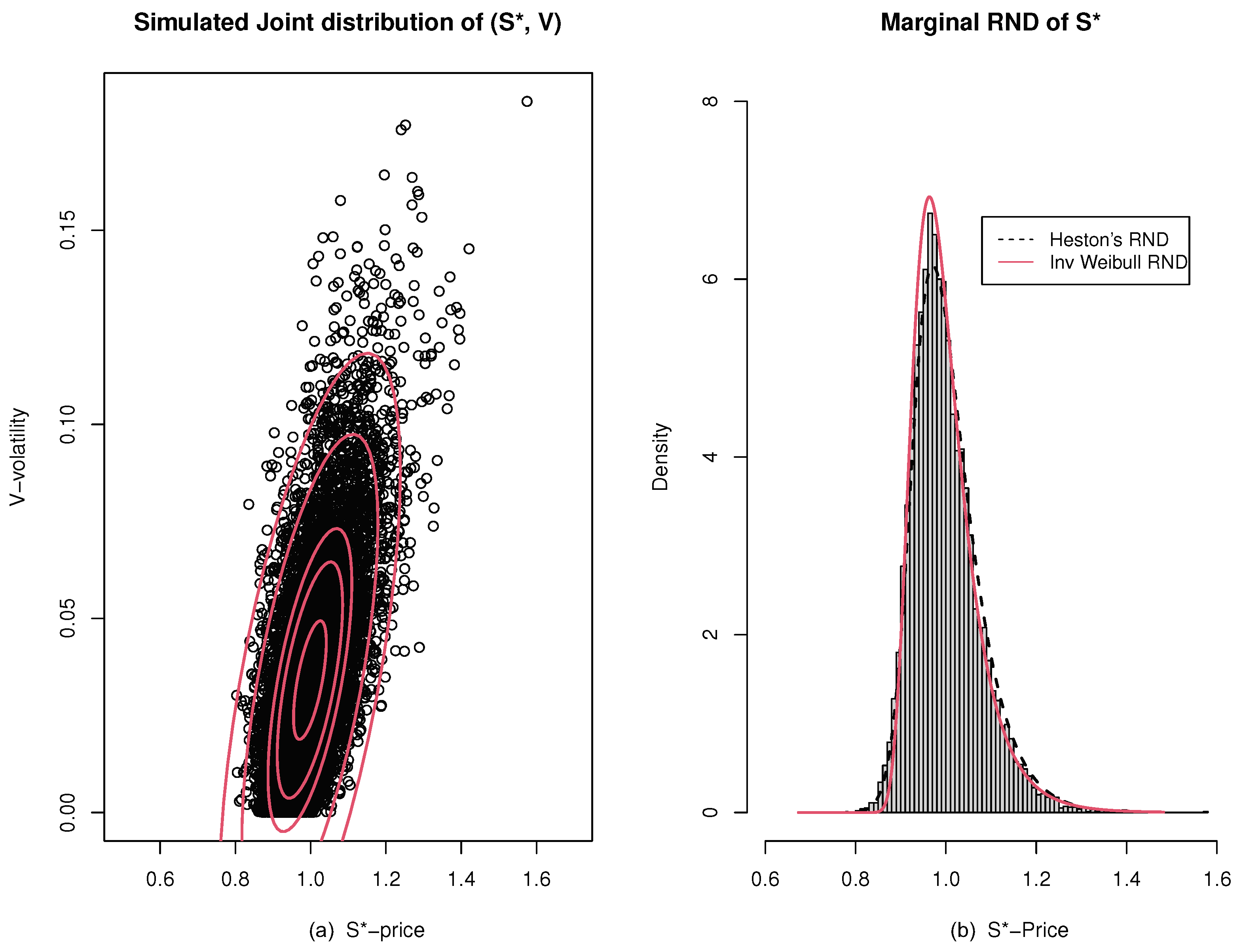
To further illustrate the applicability of the proposed RNDs to situations with distinctly positive skewness, we again consider the calibrated parametrization of [18] that we used for Figure 2 but with a hypothetically positive correlation, so that = (1.15, (0.04/1.15), 0.39, 0.64). The simulated Monte Carlo distributions (both joint and marginal) are presented in Figure 3, exhibiting the distinctly positive skewness of the Heston’s RND (calculated from (A5)). This suggests that it is comparable to the inverse Weibull distribution discussed in Section 4.5. The mean and standard deviation of these M simulated spot price values are and . Again, the value of is matched to to obtain the solution of Equation (26) as , where . Accordingly, we include the plot of the RND to Figure 3b for comparison, illustrating the extent of the agreement between the Heston’s (implied) RND and the inverse Weibull distribution in this case (with a distinctly positives skew).
Figure 3.
Illustrations of the inverse Weibull for the S&P500 data from [18] with a calibrated parameter but with hypothetically positive correlation (), resulting with a positively skewed RND.
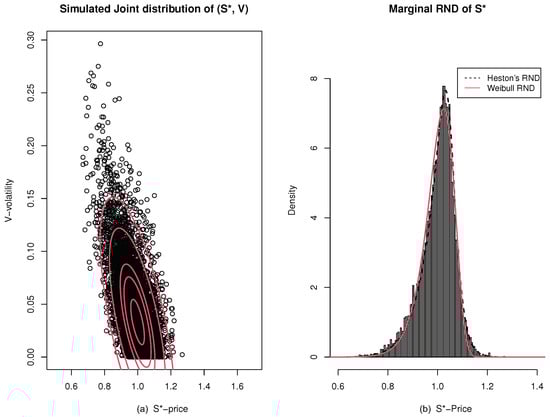
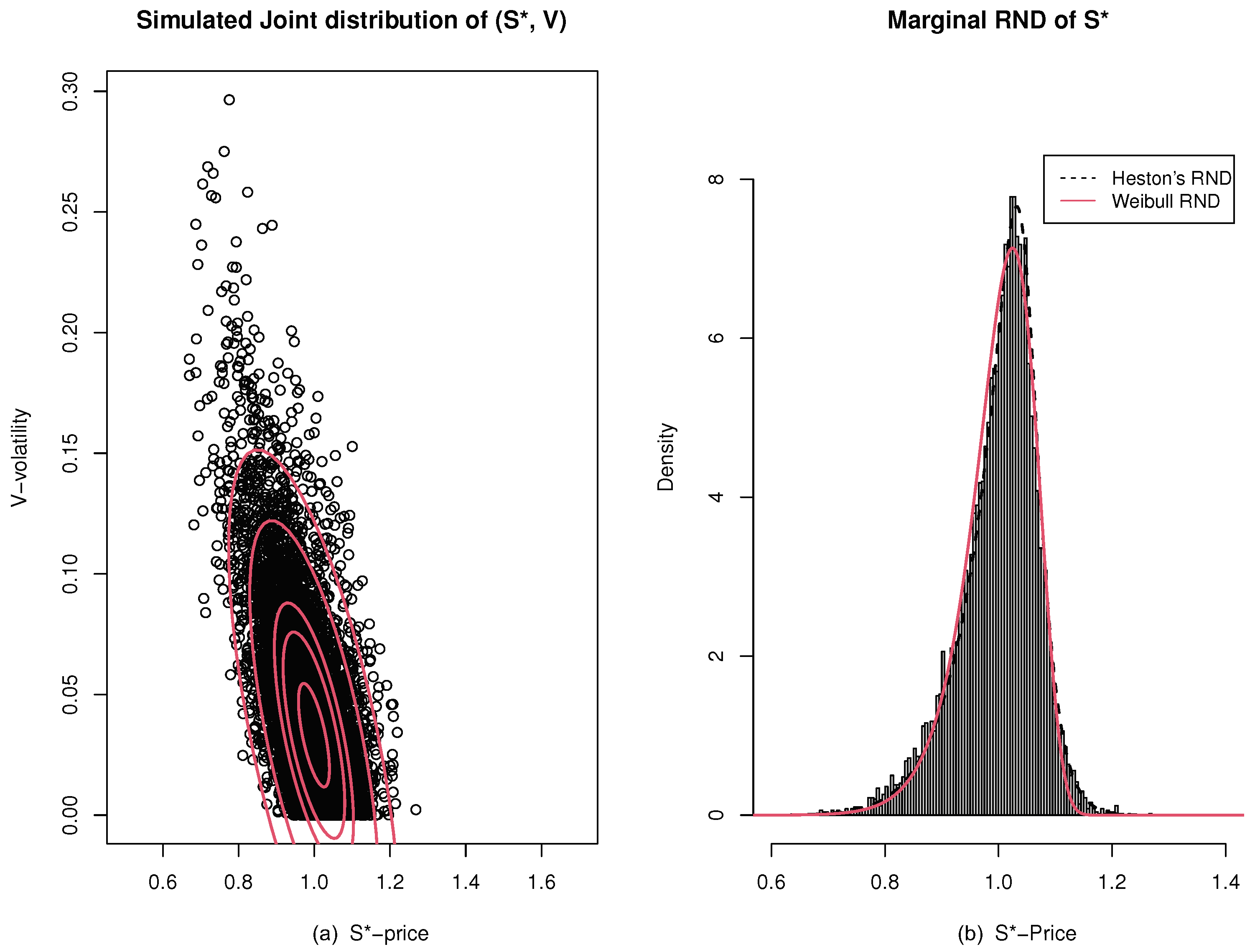
- Example (ODAX): The authors of [6] studied various optimization techniques for calibrating and simulating Heston’s model. To demonstrate their results, they used the ODAX option index with five blended maturities of 3 and 6 months and with 107 strikes, which were recorded on 19 March 2013. The calibrated results of the structural parameter are provided in their Table 4 (see page 698 in [6]):
Figure 4.
The simulated joint distribution and the conditional Heston’s and Weibull RNDs for the ODAX data, based on the calibrated parameter provided by [6].
- Example (AMD): This example is based on recent real option data we retrieved from Yahoo Finance as of the closing of trading on 31 December 2020. On that day, the closing price of this stock was and it paid no dividend, so was added to the prevailing (risk-free) interest rate of . We chose this stock (AMD, Advanced Micro Devices Inc.), which is a member of the technology sector, since it exhibits more directional risk to the upside and hence, would produce potentially positively skewed RNDs.
From the available option series, we selected the 19 February 2021 expiry due to the relatively short contract with , strikes, and with corresponding available call option (market) prices (we actually recorded the option prices as the averages between the bids and asks). As the standard measure of the goodness-of-fit between the model-calculated option price and the option market price , we use the mean squared error (MSE):
To calibrate Heston’s SV model, we use the optim(·) function of R to minimize over the model’s parameter with the initial values of and . The results of the calibrated values are
The calibrated parameter is then used to calculate the option prices according to Heston’s SV model in (5) using Heston’s characteristic function (i.e., (A5)). These values are displayed in Table 2, along with the actual observed market prices. Next, as in the previous examples, we obtain a Monte Carlo sample of , whose results are displayed in Figure 5. The mean and standard deviation of these simulated stock prices are and , respectively. As can be seen, the implied Heston’s RND is positively skewed (), as expected. Accordingly, we consider the distributions in Table 1 as possible RND candidates in this situation.
Table 2.
A comparison of the option prices obtained using the Heston’s, gamma, inverse Gaussian, and Black–Scholes models for the 19 February 2021 option series of AMD (with 47 DTE), as of the closing of trading on 31 December 2020. The start to end time for calculating the option prices in this table was 0.1007299 s.
Figure 5.
The simulated joint distribution and Heston’s, gamma, log-normal, and inverse Gaussian RNDs, calculated based on the AMD option data in Table 2.
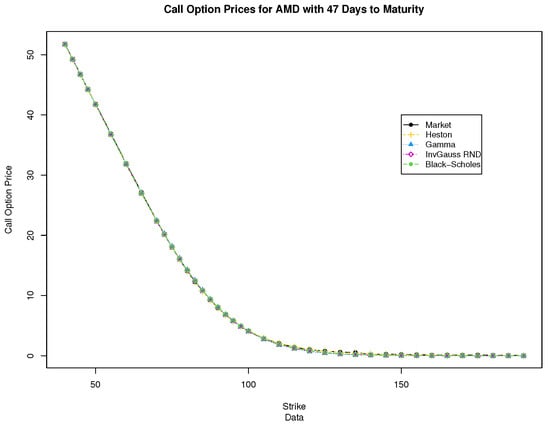
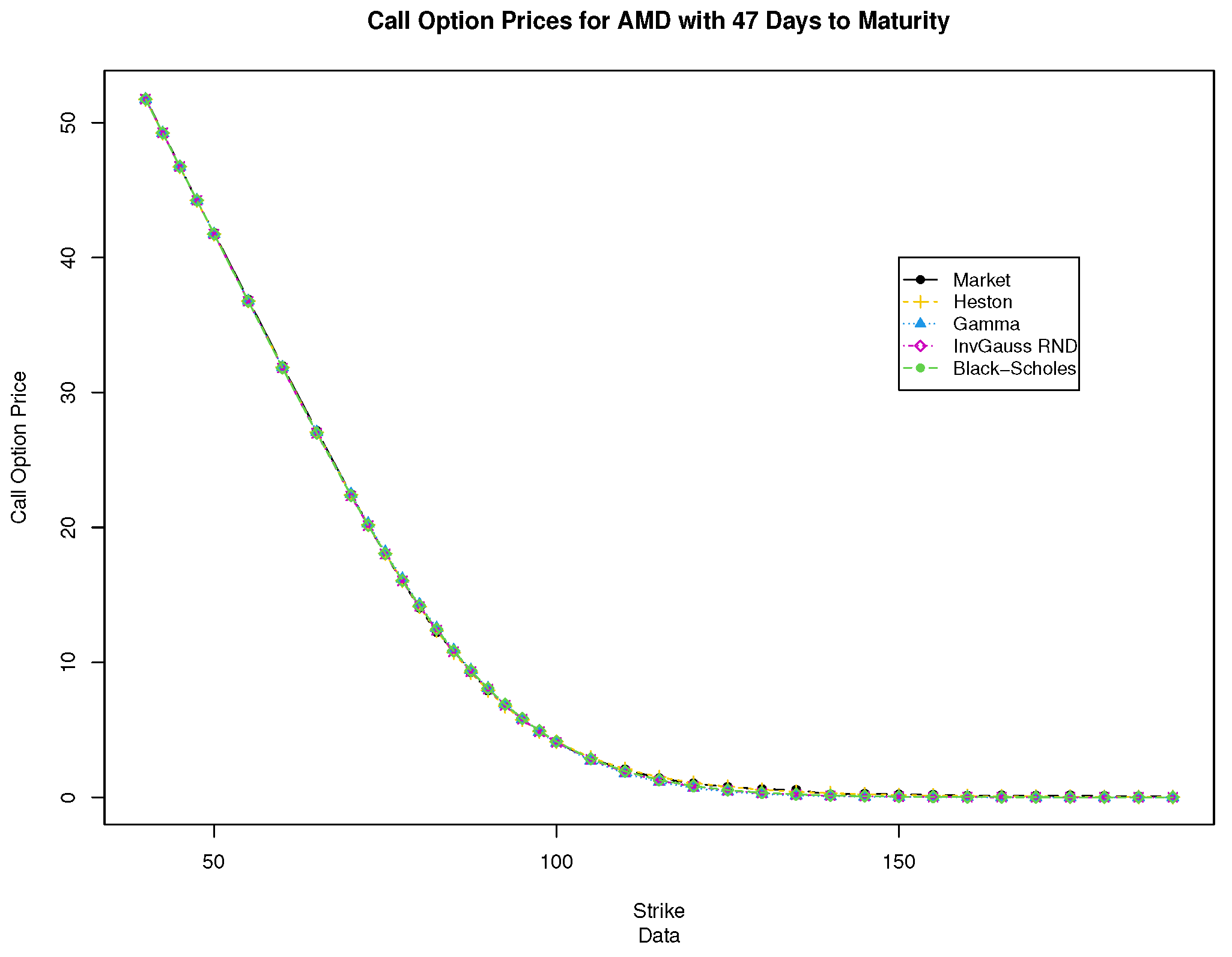
Since in this case, we have the actual market option prices available, we can estimate the parameter , thereby defining these distributions directly using the ‘standard’ Black–Scholes implied volatility, namely . This entails using the optim(·) function again to minimize the with respect to the single parameter . This standard estimation procedure yields , so that . For this value, we present the graphs of the gamma, inverse Gaussian, and log-normal RNDs in Figure 5b, as in Table 1. The extent of their agreement with the Heston’s implied RND is evident. To further demonstrate this point, we calculate the option prices under each of the modeled RNDs and calculate the corresponding . The results of this comparison are presented in Table 2. Finally, Figure 6 shows the option price curves for each of these pricing models, which are virtually almost identical in this example.
Figure 6.
A comparison of the option prices obtained using the Heston’s, gamma, inverse Gaussian, and Black–Scholes models for the 19 February 2021 option series of AMD (with 47 DTE), as of the closing of trading on 31 December 2020.
6. Concluding Remarks
It should clear that the main results of this paper are not concerned with the estimation of the Heston’s SV model parameters. Rather, this paper provides a theoretical solution for a long-standing ‘open problem’, namely, which class of risk neutral distributions, if any, satisfies Heston’s stochastic volatility model for option valuation. In Section 3, we provided an affirmative theoretical answer to this question by characterizing the unique class of RNDs that corresponds to the SV model (1). In Theorem 2, we established that any RND for Heston’s SV model must be a member of the class of scale parameter distributions that satisfies Assumption 1, with the mean being the forward spot price. Indeed, any member of this class of scale parameter distributions could serve as a possible RND for the direct risk neutral calculation of an option price, as in (7) or Corollary 1. Each such RND allows for direct option valuation under Heston’s SV model without the need to actually ‘calibrate’ or ‘estimate’ its five parameters. We pointed out that the particular choice of RND from within this class could be guided by the perceived skewness (i.e., an RND with an inherently negative skew could be used in the case of pricing options on an index, such as S&P500).
In Section 4, we identified and listed several well-known distributions that could serve as RNDs under Heston’s SV model. These possible Heston’s RNDs included one-parameter versions of the gamma, inverse gamma, Weibull, inverse Weibull, log-normal, and inverse Gaussian distributions. In a separate paper [17], we highlighted and detailed the usefulness of a two-parameter generalization of these distributions as an RND for Heston’s SV model, namely, the generalized gamma (and its inverse) distribution. In Section 5, we illustrated our theoretical results in cases involving negatively skewed RNDs (i.e., the S&P500 and ODAX examples) and positively skewed RNDs (i.e., the AMD example). In the latter example, we used the standard MSE-based approach (see, for example, [6]) to illustrate the ‘calibration’ (estimation) of the five parameters of Heston’s model and the single parameter of the comparable RNDs (i.e., the gamma, inverse Gaussian, and log-normal distributions). We then proceeded to calculate the price option chains accordingly. As can be seen from Table 2, the option prices calculated under the four ‘competing’ models were virtually identical, which well illustrates the main theoretical results of our paper (i.e., Theorem 2).
Funding
This research received no external funding.
Institutional Review Board Statement
Not applicable.
Informed Consent Statement
Not applicable.
Data Availability Statement
The data are available upon request from the author.
Conflicts of Interest
The author declares no conflict of interest.
Appendix A. Heston’s (1993) Solution
In [1] Heston provided (semi)-closed-form expressions for the probabilities and , which comprise the solution in (5) for option valuation under the stochastic volatility model in (1). Starting from a ‘guess’ of the Black–Sholes style solution:
he showed that with , this solution must satisfy the SDE resulting from the SV model in (1)
for , where , and . These closed-form expressions are given by
where and are the characteristic function
where is the of corresponding to the probability and
We point out that is taken to be the positive root of the Riccati equation involving . However, using the negative root instead, namely , has been shown to provide an equivalent but more stable solution for (see [29] for more details about this so-called ‘Heston Trap’). In either case, efficient numerical routines, such as the cfHeston and callHestoncf functions of the NMOF package of R, [30], are readily available to accurately compute the values of and hence, the values of and call option values for given , and v values, as well as any choice of .
Now, having established (A3), the standard application of the Fourier transform shows (see, for example, [31] ) that the of can be obtained for :
Hence, it follows immediately that the of is given by
Further, since the characteristic functions in (A3) are affine in , where , as in Corollary 1, we can rewrite as
where
Wepoint out that in light of (8), the in (A5) is the RND (under ) for Heston’s model and can similarly be easily evaluated numerically alongside the evaluation of . Indeed, we have
It should be noticed from expression (A5) that any of a Heston’s model RND and the corresponding risk neutral distribution of constitute a scale family of distributions in , so that it satisfies the terms of Assumption 1. This assertion is summarized in Proposition A1.
Proposition A1.
The result stated in the next claim is known but the details are instructive to proving (11).
Claim 1.
References
- Heston, L.S. A closed-form solution for options with stochastic volatility with applications to bond and currency options. Rev. Financ. Stud. 1993, 6, 327–343. [Google Scholar] [CrossRef] [Scilit]
- Wiggins, B.J. Option values under stochastic volatility: Theory and empirical estimates. J. Financ. Econ. 1987, 19, 351–372. [Google Scholar] [CrossRef] [Scilit]
- Stein, M.E.; Stein, C.J. Stock price distributions with stochastic volatility: An analytic approach. Rev. Financ. Stud. 1991, 4, 727–752. [Google Scholar] [CrossRef] [Scilit]
- Black, F.; Scholes, M. The pricing of options and corporate liabilities. J. Political Econ. 1973, 81, 637–654. [Google Scholar] [CrossRef] [Scilit]
- Merton, C.R. Theory of rational option pricing. Bell J. Econ. Manag. Sci. 1973, 4, 141–183. [Google Scholar] [CrossRef] [Scilit]
- Mrá¡zek, M.; Pospíšil, J. Calibration and simulation of Heston model. Open Math. 2017, 15, 679–704. [Google Scholar] [CrossRef] [Scilit]
- Romo, E.; Ortiz-Gracia, L. SWIFT Calibration of the Heston Model. Mathematics 2021, 9, 529. [Google Scholar] [CrossRef] [Scilit]
- Aït-Sahalia, Y.; Kimmel, R. Maximum likelihood estimation of stochastic volatility models. J. Financ. Econ. 2007, 83, 413–452. [Google Scholar] [CrossRef] [Scilit]
- Aït-Sahalia, Y.; Li, C.; Li, C.X. Implied Stochastic Volatility Models. Rev. Financ. Stud. 2021, 34, 394–450. [Google Scholar] [CrossRef] [Scilit]
- Jackwerth, J.C. Option-Implied Risk-Neutral Distributions and Risk Aversion; Research Foundation of AIMR: Charlotteville, NC, USA, 2004. [Google Scholar]
- Figlewski, S. Estimating the Implied Risk Neutral Density for the U.S. Market Portfolio. In Volatility and Time Series Econometrics: Essays in Honor of Robert F. Engle; Bollerslev, T., Russell, J., Watson, M., Eds.; Oxford University Press: Oxford, UK, 2010. [Google Scholar]
- Grith, M.; Krätschmer, V. Parametric Estimation of Risk Neutral Density Functions. In Handbook of Computational Finance; Duan, J.C., Härdle, W., Gentle, J., Eds.; Springer Handbooks of Computational Statistics; Springer: Berlin/Heidelberg, Germany, 2012. [Google Scholar]
- Figlewski, S. Risk Neutral Densities: A Review. 2018. Available online: http://ssrn.com/abstract=3120028 (accessed on 1 January 2021).
- Jackwerth, J.C.; Rubinstein, M. Recovering Probability Distributions from Option Prices. J. Financ. 1996, 51, 1611–1631. [Google Scholar] [CrossRef]
- Mizrach, B. Estimating Implied Probabilities from Option Prices and the Underlying. In Handbook of Quantitative Finance and Risk Management; Lee, C.-F., Lee, A., Lee, J., Eds.; Springer Science Business Media: Berlin/Heidelberg, Germany, 2010. [Google Scholar]
- Savickas, R. Evidence on delta hedging and implied volatilities for the Black-Scholes, gamma, and Weibull option pricing models. J. Financ. Res. 2005, 18, 299–317. [Google Scholar] [CrossRef] [Scilit]
- Boukai, B. The Generalized Gamma Distribution as a Useful RND Under Heston’s Stochastic Volatility Model. J. Risk Financ. Manag. 2022, 15, 238. [Google Scholar] [CrossRef] [Scilit]
- Bakshi, G.; Cao, C.; Chen, Z. Empirical Performance of Alternative Option Pricing Models. J. Financ. 1997, 53, 2003–2049. [Google Scholar] [CrossRef]
- Cox, C.J.; Ross, A.S. The valuation of options for alternative stochastic processes. J. Financ. Econ. 1976, 3, 145–166. [Google Scholar] [CrossRef] [Scilit]
- Jiang, L. Mathematical Modeling and Methods of Option Pricing; Li, C., Translator; World Scientific: Singapore, 2005. [Google Scholar]
- Savickas, R. A simple option formula. Financ. Rev. 2002, 37, 207–226. [Google Scholar] [CrossRef] [Scilit]
- Mil’shtein, G.N. Approximate Integration of Stochastic Differential Equations. Theory Probab. Appl. 1975, 19, 557–562. [Google Scholar] [CrossRef] [Scilit]
- Alfonsi, A. High order discretization schemes for the CIR process: Application to affine term structure and Heston models. Math. Comput. 2010, 79, 209–237. [Google Scholar] [CrossRef] [Scilit]
- Feller, W. Two singular diffusion problems. Ann. Math. 1951, 54, 173–182. [Google Scholar] [CrossRef] [Scilit]
- Gatheral, J. The Volatility Surface; John Wiley and Sons: Hoboken, NJ, USA, 2006. [Google Scholar]
- Andersen, L. Simple and efficient simulation of the Heston stochastic volatility model. J. Comput. Financ. 2008, 11, 1–42. [Google Scholar] [CrossRef] [Scilit]
- Cox, C.J.; Ingersoll, J.E.; Ross, S.A. A Theory of the Term Structure of Interest Rates. Econometrica 1985, 53, 385–407. [Google Scholar] [CrossRef] [Scilit]
- Lemaire, V.; Montes, T.; Pagès, G. Stationary Heston model: Calibration and Pricing of exotics using Product Recursive Quantization. arXiv 2020, arXiv:2001.03101v2. [Google Scholar] [CrossRef] [Scilit]
- Albrecher, H.; Mayer, P.; Schoutens, W.; Tistaer, J. The Little Heston Trap. Wilmott Mag. 2007, 1, 83–92. [Google Scholar]
- R Core Team. R: A Language and Environment for Statistical Computing; R Core Team: Vienna, Austria, 2017; Available online: https://www.R-project.org/ (accessed on 1 January 2021).
- Schmelzle, M. Option Pricing Formulae Using Fourier Transform: Theory and Application. Technical Report. 2010. Available online: https://pfadintegral.com/articles/option-pricing-formulae-using-fourier-transform/ (accessed on 1 January 2021).

Disclaimer/Publisher’s Note: The statements, opinions and data contained in all publications are solely those of the individual author(s) and contributor(s) and not of MDPI and/or the editor(s). MDPI and/or the editor(s) disclaim responsibility for any injury to people or property resulting from any ideas, methods, instructions or products referred to in the content. |
© 2023 by the author. Licensee MDPI, Basel, Switzerland. This article is an open access article distributed under the terms and conditions of the Creative Commons Attribution (CC BY) license (https://creativecommons.org/licenses/by/4.0/).