You are currently viewing a new version of our website. To view the old version click .
Mathematics
  • Article
  • Open Access

27 April 2023

Research on Distribution Optimization of Emergency Perishable Materials Considering Periodic Changes in Freshness

,
,
,
and
1
College of Economics and Management, Xi’an Technological University, Xi’an 710021, China
2
International Business School, Shaanxi Normal University, Xi’an 710119, China
3
School of Business Administration, Xi’an Eurasia University, Xi’an 710065, China
*
Author to whom correspondence should be addressed.

Abstract

The distribution of emergency perishable materials is crucial for rescue operations in disaster-stricken areas. However, the freshness of these materials changes over time, affecting the quantity of materials that can be distributed to demand points at different stages. To address this issue, this paper proposes a novel approach. Firstly, a piecewise function is constructed to describe the impact of freshness on the quality and quantity of emergency perishable materials at different time stages. Secondly, the paper establishes a vehicle distribution optimization model with the goal of maximizing the sum of the freshness of all emergency perishable materials delivered to different disaster-affected locations, taking into account the different minimum freshness constraints for the same kind of materials in different locations. Thirdly, an approximate algorithm is designed to solve the model, with the time complexity and the upper and lower bounds of the approximate ratio analyzed. Finally, an example analysis is conducted to demonstrate the validity of the proposed model and algorithm.

1. Introduction

In the aftermath of a sudden disaster, the disaster site requires a significant amount of emergency rescue materials, including perishable items such as blood, vegetables, milk powder, meat, and more. These emergency perishable materials are highly time-sensitive and require prompt delivery [1]. As a result, delivering high-quality and fast emergency perishable materials to disaster-stricken areas has become a crucial issue for scholars and business experts to address.
At present, the research on the vehicle routing problem of perishable materials mainly focuses on two aspects. One is the research that considers that the quantity of perishable materials will change with time during the distribution process. Generally, the corruption rate is used to measure the loss of quantity of perishable materials in a unit time, and there are only two states of corruption and non-corruption when the materials are delivered to the demand point, regardless of the degree of corruption of each emergency perishable material. With the goal of minimizing the cost of corruption, an optimization model for the distribution of perishable materials is established. The other is the research that considers the quality of perishable materials that will change over time during the distribution process. Generally, the freshness is used to measure the change of the quality of perishable materials over time; the change of the quantity of emergency perishable materials is not considered, and the discrete function is used—a linear or nonlinear continuous function that measures changes in freshness. Aiming at the minimum distribution cost or the minimum loss of freshness, an optimization model for the vehicle distribution of perishable materials is established.
In practical scenarios, the minimum freshness constraints for the same kind of emergency perishable materials at a demand point can vary based on the degree of damage and the distance between the demand point and the rescue center. Furthermore, the change characteristics of freshness for emergency perishable materials differ across different time stages, and the fitting functions for these changes also vary. As the freshness of emergency perishable materials decreases, there comes a point where the physical and chemical freshness indicators of the materials continue to decline, rendering them inedible and useless. As a result, changes in freshness can significantly impact the quantity of materials that can be distributed.
This study addresses the limitations of previous research by constructing a piecewise function that describes the changes in the quality and quantity of emergency perishable materials across different time periods. Additionally, to account for the varying minimum freshness constraints of the same kind of materials at different disaster-stricken points, we propose a vehicle distribution optimization model. The objective of this model is to maximize the freshness of all emergency perishable materials delivered to the disaster-stricken points.
The vehicle distribution optimization problem is known to be a challenging NP-hard problem [2], as an exact algorithm cannot solve it, and finding the optimal solution is not possible. Therefore, only a sub-optimal solution can be obtained. In contrast to heuristic algorithms, approximate algorithms [3,4] can quickly find reasonable solutions and only need to prove the quality and running time bounds of the solution. Thus, using an approximate algorithm can guarantee the quality of the solution. In this article, we propose an approximation algorithm to solve the constructed model, calculate the time complexity of the algorithm, and analyze its approximation ratio.
The paper is organized as follows. The second section presents the related work. The third section presents the methodology, including the problem formulation, the model design, and the solution. The following section presents a case analysis. The last section presents the conclusion and future directions.

3. Methodology

This section first presents the problem definition. Second, this section presents the designed mathematical model for the problem. Finally, this section presents the designed solution for this mathematical model. The key notations used in this paper are listed in Table 3.
Table 3. Summary of key notations.

3.1. Problem Formulation

Let G = ( V , E ) be an undirected network. Let V = v 0 , v 1 , v 2 , , v n be the set of points in G = ( V , E ) . Let v 0 be the distribution center for emergency perishable materials. Let v 1 , v 2 , , v n be demand points. Let E e v i , v i v i , v i V be the set of edges in G = ( V , E ) . Emergency rescue center v 0 has an emergency perishable material that must be distributed to each demand point v i . Let q i be the demand for the emergency perishable materials from the demand point v i . Let d i j be the shortest distance from demand point v i to v j . Let t i j be the delivery time of the vehicle from demand point v i to v j along the shortest path. Let F t 0 i be a measure function of the freshness of emergency perishable materials. Let t 0 i be the delivery time of the vehicle from v 0 to demand point v i along the shortest path. Let f i be the demand point v i ’s minimum freshness requirements for emergency perishable materials. Let F i be the freshness of emergency perishable materials at demand point v i . The distribution center currently has a vehicle with a maximum load of Q * and Q * n q i . The problem to be solved is described as follows. We schedule vehicles to travel at average speed ϑ from distribution center v 0 . Vehicles deliver materials to various demand points. We expect to compute the delivery route of the vehicle to maximize the sum of the freshness of all demand points.

3.2. Mathematical Model

The measure function for the freshness: The freshness of emergency perishable materials is a comprehensive expression of their quality characteristics, which are determined by their physical and chemical freshness indicators.
Perishable materials have varying freshness measurement functions in practice. Two types of freshness functions are commonly used, namely the segmented freshness measurement function and continuous freshness measurement function. The continuous freshness function assumes that the freshness of perishable materials decays continuously over time. The forms of the continuous freshness function typically include linear, exponential, and polynomial freshness functions.
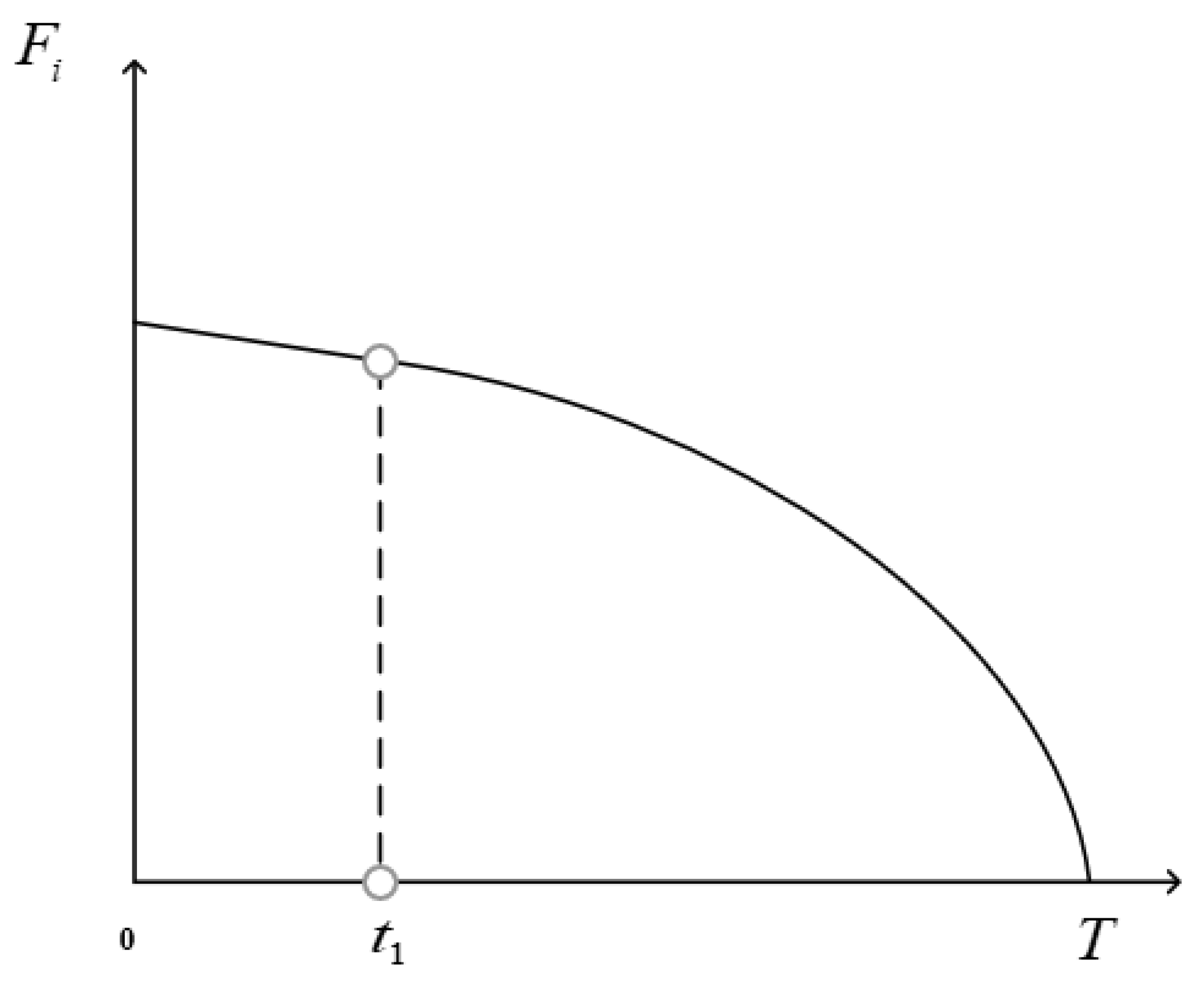
Emergency perishable materials undergo two stages of freshness decay. During the first stage, which is due to short delivery times, the freshness decay rate is relatively slow and the material quality remains stable. This stage can be approximated as a constant decay rate, with a linear relationship between freshness and time. In the second stage, as time increases, the material quality deteriorates gradually. The deteriorated part affects the remaining material, accelerating its decay. The freshness attenuation rate in this stage increases continuously and can be approximated by a quadratic function describing the relationship between freshness and time. The resulting freshness measurement function is shown in Figure 1. The measure function of freshness is given by
F t 0 i = 1 β t 0 i ,   0 t 0 i t 1 1 t 0 i 2 T 2 ,   t 1 t 0 i T
Figure 1. The measure function of the freshness of emergency perishable materials.
In actual distribution, the emergency perishable materials deteriorated severely before their freshness dropped to zero. At this time, the material loses its reason for distribution. Thus, we improve the above freshness measure function.
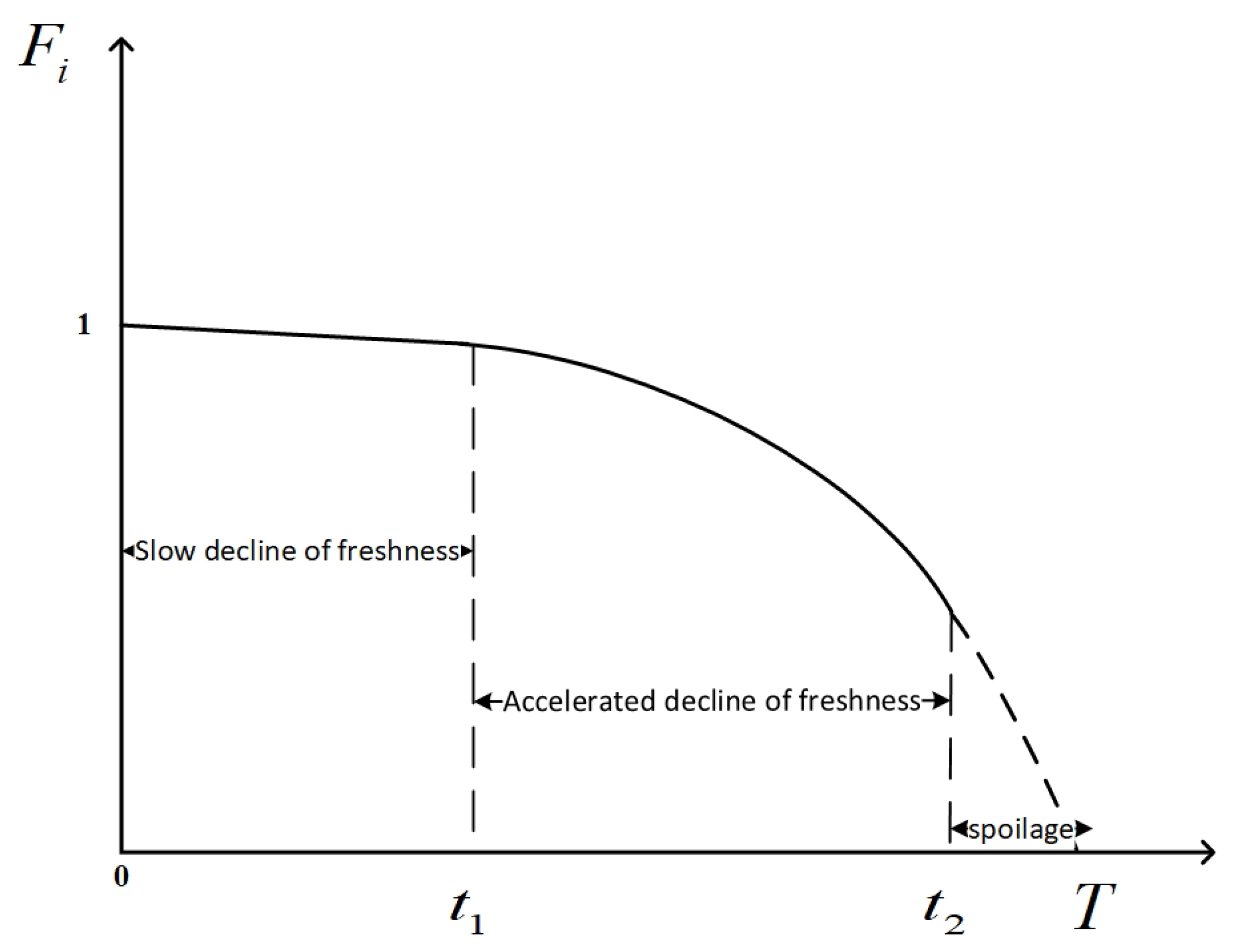
We divide the change of freshness into three stages. The first stage is the freshness period ( 0 t 1 ), as shown in Figure 2. At this time, the emergency perishable materials are in the freshness period and the freshness decreases slowly, which can be regarded as a constant decay rate. We use a linear function to measure the change of freshness, and this stage is the best period for material distribution.
Figure 2. The improved measure function for freshness.
The second stage is the secondary freshness period ( t 1 t 2 ). At this time, the emergency perishable materials are in the sub-fresh period, and the decay rate of freshness in this stage is gradually increasing. Thus, we use a quadratic function that opens downward to describe the decay rate. Although this stage is not the best period for material distribution and the loss of freshness is large, the material still has value.
The third stage is the metamorphic period ( t 2 T ). At this time, the emergency perishable materials are in the deterioration period. Although the freshness of emergency perishable materials is still declining at an accelerated rate and has not dropped to zero, emergency perishable materials have deteriorated severely and are useless at this stage.
When the material delivery time satisfies t 0 i t 2 , all the materials are damaged. At this point, the vehicle will stop delivering emergency perishables. The improved freshness measure function of emergency perishable materials is given by
F t 0 i = 1 β t 0 i ,   0 t 0 i t 1 1 t 0 i 2 T 2 ,   t 1 t 0 i < t 2
where β is the decay rate of freshness during the freshness period, 0 < β 2 t / T 2 , and t 0 i 0 , t 2 . t 1 is the freshness period of emergency perishable materials. t 2 is the second freshness period of emergency perishable materials. T is the time when the freshness of emergency perishable materials drops to zero. t 1 , t 2 , T are constants. t 0 i is the delivery time of the vehicle from v 0 to v i . The improved freshness measure function is shown in Figure 2.
The mathematical model: We begin by making the following six assumptions. First, the demand quantity at the demand point is known. Second, the distribution center has complete temperature-controlled refrigeration facilities, ensuring that emergency perishable materials are 100% fresh upon arrival and have not deteriorated in freshness. Third, emergency perishable materials are transported in ordinary vehicles at room temperature, with no changes to the environment during transportation. Any changes in freshness are solely due to time. Fourth, we do not consider the loading and unloading time of materials at the demand point. Fifth, t 1 , t 2 , T are all constants. Sixth, the total amount of materials in the emergency rescue center is sufficient.
Moreover, we define the decision variable x i j as follows:
x i j = 1 , Vehicle moves from v i to v j along e i j 0 , Otherwise
Based on the above assumptions, we formulate the mathematical model associated with the decision variable x i j .
The objective function is as follows.
Z = max i = 1 n F i q i
The constraints are as follows.
t i j = d i j x i j ϑ
i = 1 n q i Q *
i = 1 n x i j 1 ( j = 1 , 2 , 3 , , m )
x i j = { 0 , 1 } ( j = 1 , 2 , 3 , , m )
0 F i 1 ( i = 1 , 2 , 3 , , n )
0 f i < 1 ( i = 1 , 2 , 3 , , n )
0 < t 1 < t 2
t 1 < t 2 < T
0 t 0 i < t 2 ( i = 1 , 2 , 3 , , n )
i = 1 n j = 1 n x i j | S | 1 , 2 | S | n 2
A description of each formula is shown in Table 4.
Table 4. Summary for formulas.

3.3. Solution

In this section, we first review the proposed solution and then analyze the time complexity and approximate ratio of the proposed solution.

3.3.1. Overview for Solution

The vehicle cannot reach some demand points within t 2 if it travels along the shortest path since some demand points are far away from the distribution center. Thus, we first preprocess the model to remove redundant constraints in the model. We check the transit time t 0 i of the shortest path from v 0 to v i , and if t 0 i is greater than the transit time of the shortest path from v 0 to v i , we remove the constraint corresponding to v i . Meanwhile, q i = 0 .
Firstly, we apply the Dijkstra algorithm to compute the shortest path from emergency rescue center v 0 to each demand point v i . Let P v 0 , v i be the shortest path from v 0 to v i . Then, we compute the travel time t 0 i along the shortest path from the emergency rescue center to each demand point. Next, we compute the material freshness F t 0 i of each demand point, according to the freshness measurement function F i of emergency perishable materials. Then, we compare the material freshness F i of each demand point with the minimum freshness requirement f i of the demand point. If the demand point F i < f i , we delete the constraint corresponding to the demand point and make the demand q i = 0 . If F i f i , we compute the product of the freshness F i of each demand point and the demand q i of each demand point. Finally, we sort the values of F i q i and select the largest demand point of F i q i as the first demand point to be delivered by vehicles.
Secondly, we mark the first delivered demand point as the new starting point of the vehicle and use the Dijkstra algorithm to compute the shortest path from the new starting point of the vehicle to the remaining demand points. We compute the travel time along the shortest path from the new starting point to the remaining demand points and then compute the freshness of the materials at the remaining demand points. Similarly, we compare the material freshness of each demand point with the minimum freshness requirement of the demand point. If F i f i , we delete the demand point. Conversely, we compute the product of the freshness F i of each demand point and the demand q i of each demand point. Next, we sort the values of F i q i , and select the largest demand point of F i q i as the second demand point to be delivered by vehicles. Meanwhile, we compare n t * α and t 2 . If n t * α t 2 , the vehicle stops delivering. If n t * α < t 2 , we continue to deliver to other demand points according to the above rules. When n t * α t 2 or all demand points are serviced, the vehicle stops delivering. Finally, we output x i j and the freshness F i q i of the delivered demand points and output the sum of the freshness of all demand points n F i q i . The detailed procedure for the designed solution is as follows.
Step 1. Create a set of demand points as V N α = v 1 α , v 2 α , , v n α .
Step 2. Let v 0 be the starting point and α = 1 .
Step 3. Apply the Dijkstra algorithm to compute the shortest path P v 0 , v i 1 from the starting point to each demand point v i 1 ( i = 1 , 2 , , n ) . Record all the edges e P v 0 , v i 1 on each shortest path, and the distance d v 0 , v i 1 from the starting point to each demand point v i 1 .
Step 4. Compute the travel time t i 1 along the shortest path from the starting point to each demand point according to t i j = d i j x i j ϑ .
Step 5. Compute the material freshness F i 1 of each demand point according to the freshness measure function F t 0 i of emergency perishable materials.
Step 6. Compare F i 1 and f i 1 of each demand point. If the demand point satisfies F i 1 < f i , we remove the demand point from set V N . If F i 1 f i is required, go to step 7.
Step 7. Compute the product F i 1 * q i of the freshness F i 1 of each demand point and the demand q i of each demand point. We denote the freshness F i 1 * q i of each demand point as z i 1 .
Step 8. Sort the freshness z i 1 of each demand point in descending order and find the maximum value in z i 1 and record it as z * 1 . Record the corresponding demand point as v * 1 , the demand quantity of the corresponding demand point as q * 1 , and the delivery time from the starting point to v * 1 as t * 1 .
Step 9. Vehicles deliver from v 0 to demand point v * 1 . After the distribution is over, we record the set of remaining demand points as V N 1 , record v * 1 as the new starting point, and delete v * 1 from V N 1 .
Step 10. If α = 1 n t * α t 2 , the vehicle stops delivering and skips to step 11. If α = 1 n t * α < t 2 , α = α + 1 and skip to step 3.
Step 11. Output x i j and z * α .
Step 12. Compute α = 1 n z * α and output the result.

3.3.2. Analysis of Time Complexity

We now analyze the time complexity of the proposed algorithm. In the third step, the number of computations with the Dijkstra algorithm is O n 2 . In the fourth step, the number of computations is O n . In the fifth step, the number of computations is O n . In the sixth step, the number of comparisons is O n . In the seventh step, the number of computations is not greater than O n . The number of computations is O n 2 in the eighth step. The number of computations in steps 3–11 is O n . The number of computations in step 12 is O n .
Theorem 1. 
When there is only one distribution center and only one distribution vehicle, the time complexity of the proposed algorithm for the optimization of the distribution of emergency perishable materials with freshness is O n 2 O log ( n ) . n is the number of disaster points.

3.3.3. The Approximate Ratio of the Proposed Algorithm

Let O P T ( I ) be the optimal solution of the instance and A ( I ) be the solution of the instance obtained by applying the proposed algorithm. First, we analyze the optimal solution and give the following lemma.
Lemma 1. 
The upper bound of the optimal solution of the problem is 1 β t * 1 Q * for any instance I.
We now prove Lemma 1. If other constraints are satisfied, all demand points are delivered within the freshness period in the optimal case. In other words, all demand points are on the shortest path with v 0 as the root node and q * 1 q * 2 . q * n .
1 β t * 1 q * 1 + 1 β α = 1 2 t * 2 q * 2 + + 1 β α = 1 n t * n q * n = 1 β t * 1 Q * β t 2 * q * 1 + q * 2 + + q * n 1 β t * 3 q * 1 + q * 2 + + q * n 2 β t * n q * n 1 β t * 1 Q *
Therefore, for any instance I, its optimal solution is O P T ( I ) 1 β t * 1 Q * . In other words, for any instance I, the upper bound of the optimal solution O P T ( I ) is 1 β t * 1 Q * . The proof is complete.
Therefore, we apply the proposed algorithm to solve any instance I, and the solution obtained by the algorithm is given by
A ( I ) = 1 β t * 1 q * 1 + 1 β α = 1 2 t * 2 q * 2 + + 1 β α = 1 p t * p q * p + + 1 α = 1 n t * n 2 1 T 2 q * n > 1 t * 1 2 1 T 2 q * 1 + 1 t * 1 + t * 2 2 1 T 2 q * 2 + + 1 α = 1 n t * n 2 1 T 2 q * n 1 α = 1 n t * n 2 1 T 2 q 1 *
According to the above analysis, we give the following theorem.
Theorem 2. 
The approximate ratio of the proposed algorithm is given by
θ = 1 β t * 1 Q * 1 β t * 1 q * 1 + 1 β t * 1 + t * 2 q * 2 + + 1 α = 1 n t * n 2 1 T 2 q * n
We further discuss the variation range of the approximate ratio in conjunction with Theorem 2 and give the following inferences.
Corollary 1. 
The upper bound of the approximate ratio of the proposed algorithm is b Q * a q * 1 .
We have known
1 β t * 1 q * 1 + 1 β t * 1 + t * 2 q * 2 + + 1 α = 1 n t * n 2 1 T 2 q * n > 1 t * 1 2 1 t 2 2 q * 1 + 1 t * 1 + t * 2 2 1 T 2 q * 2 + + 1 α = 1 n t * n 2 1 T 2 q * n 1 α = 1 n t * n 2 1 T 2 Q *
Thus, we can obtain
θ = 1 β t * 1 Q * 1 β t * 1 q * 1 + 1 β t * 1 + t * 2 q * 2 + + 1 α = 1 n t * n 2 1 T 2 q * n 1 β t * 1 Q * 1 α = 1 n t * n 2 1 T 2 q * 1 .
Let a be
a = 1 α = 1 n t * n 2 T 2
and b = 1 β t * 1 then we get θ b Q * a q * 1 .
Therefore, the upper bound of the approximate ratio of the algorithm is b Q * a q * 1 . Corollary 1 is proven.
Corollary 2. 
The lower bound of the approximate ratio of the proposed algorithm is 1 β t * 1 Q * η .
θ = 1 β t * 1 Q * 1 β t * 1 q * 1 + 1 β t * 1 + t * 2 q * 2 + + 1 α = 1 n t * n 2 1 T 2 q * n
Since
1 β t * 1 q * 1 + 1 β t * 1 + t * 2 q * 2 + + 1 α = 1 n t * n 2 1 T 2 q * n < 1 β t * 1 q * 1 + 1 β t * 1 + t * 2 q * 2 + + 1 β α = 1 n t * n q * n
Then, we can obtain θ 1 β t * 1 Q * 1 β t * 1 q * 1 + 1 β t * 1 + t * 2 q * 2 + + 1 β α = 1 n t * n q * n . Thus, we can get
η = 1 β t * 1 q * 1 + 1 β t * 1 + t * 2 q * 2 + + 1 β α = 1 n t * n q * n , θ 1 β t * 1 Q * η
Hence, by considering the approximation ratio of the approximation algorithm for the distribution optimization problem of emergency perishable materials with freshness constraints, we can obtain Corollary 2.


4. Case Analysis

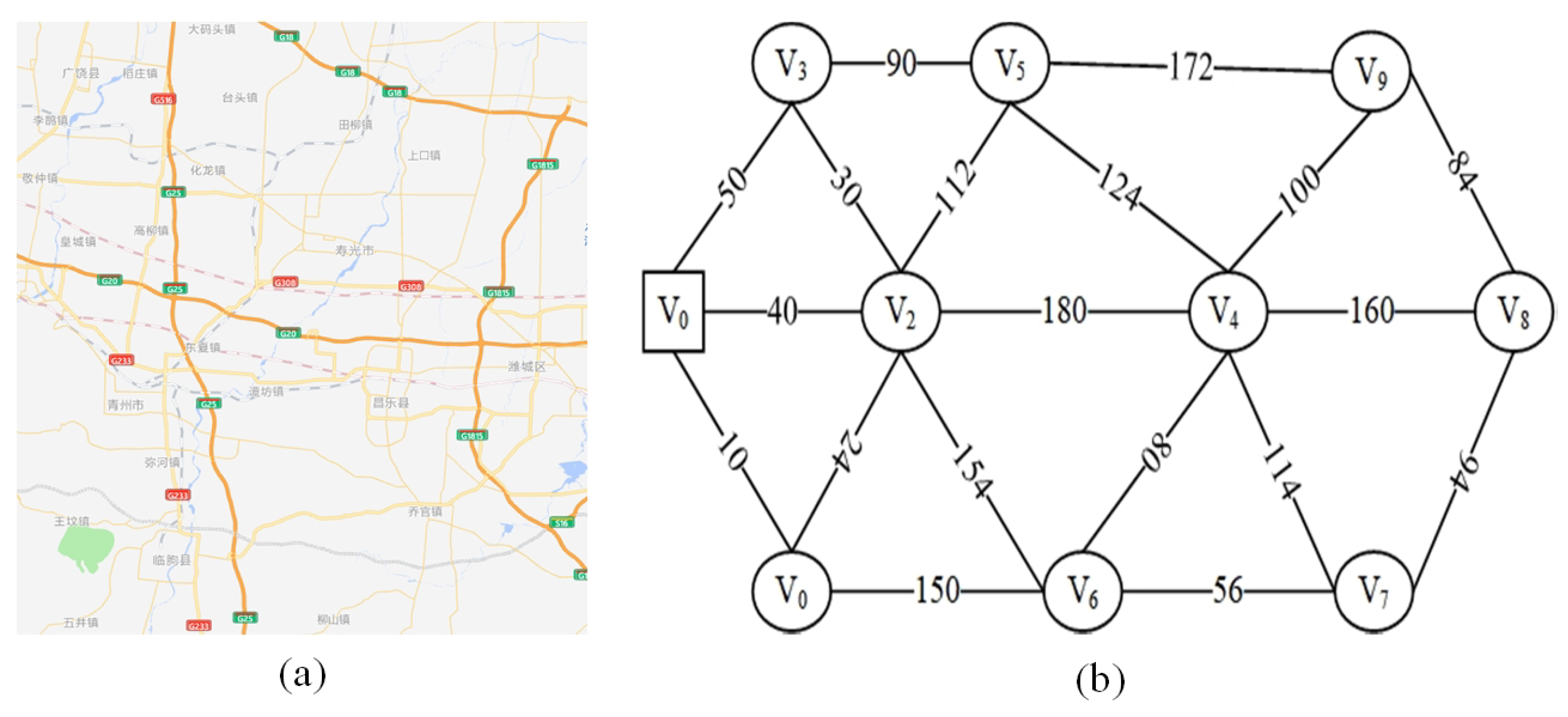
Figure 3 displays the local road network and abstract map of a disaster area. In Figure 3, v 0 denotes the distribution center for emergency perishable materials, v 1 , v 2 , , v 9 denotes the demand point for emergency perishable materials, and the number on the edge of the abstract graph represents the distance between two demand points. It is assumed that there is an emergency perishable material in the distribution center that needs to be delivered to each demand point. The delivery time of the vehicle from the distribution center to the demand point is represented by t 0 i . Table 5 illustrates the minimum requirements for the emergency perishable material demand and freshness of each demand point. Our objective is to arrange a vehicle to start from the distribution center v 0 , drive at an average speed of ϑ = 40 , deliver the materials to each demand point, and determine the distribution route of the vehicle when the sum of the freshness of all demand points is maximized.
Figure 3. The improved measure function for freshness. (a) The local road network in the flood-stricken area. (b) Abstract map of the local road network in the flood-stricken area.
Table 5. The minimum requirements of the demand point for the freshness of emergency perishable materials.
Assuming the freshness period of emergency perishable materials is t 1 = 4 , the sub-freshness period is t 2 = 16 , the time required for the freshness of emergency perishable materials to drop to zero is T = 20 , and the freshness decay rate during the freshness period is β = 0.01 , the freshness measurement function of the emergency perishable materials can be represented by F t 0 i = 1 0.01 t 0 i , 0 t 0 i 4 1 0.0025 t 0 i 2 , 4 t 0 i 16 . By utilizing the approximate algorithm to solve the model, we obtain the vehicle distribution demand points and distribution routes, which are outlined in Table 6 and Table 7.
Table 6. The distribution route of the vehicle.
Table 7. The sum of the freshness of the materials at each demand point.
The delivery route of the vehicle is v 1 v 2 v 3 v 5 v 4 v 6 v 7 v 8 v 9 according to Table 6 and Table 7. However, the freshness of demand point v 9 is 0.307, which is less than its minimum freshness requirement of 0.45. Meanwhile, when the vehicle is delivered to the demand point v 9 , t 0 i is 16.65 greater than t 2 , and the material will be completely lost when it reaches v 9 . Thus, the vehicle stops delivering only after delivering the demand point v 8 . Finally, the delivery route of the vehicle is v 1 v 2 v 3 v 5 v 4 v 6 v 7 v 8 . We compute the sum of the freshness of all demand points as 16.203. The approximate ratio of the designed algorithm is 1.231, which is close to 1. The computed approximate ratio shows that the proposed algorithm works well in practice.
Assuming the freshness period of emergency perishable materials is t 1 = 2 , the sub-freshness period is t 2 = 5 , the time required for the freshness of emergency perishable materials to drop to zero is T = 10 , and the freshness decay rate during the freshness period is β = 0.02 , the freshness measurement function of the emergency perishable materials can be represented by F t 0 i = 1 0.02 t 0 i , 0 t 0 i 2 1 0.001 t 0 i 2 , 2 t 0 i 8 . By utilizing the approximate algorithm to solve the model, we obtain the vehicle distribution demand points and distribution routes, which are outlined in Table 8 and Table 9.
Table 8. The distribution route of the vehicle.
Table 9. The sum of the freshness of the materials at each demand point.
If the delivery time from the distribution center to v 6 , v 7 , v 8 , v 9 exceeds t 2 , the emergency perishable materials will lose their use value, making distribution impractical. Therefore, we have determined the distribution route of the vehicle as v 1 , v 2 , v 3 , v 5 , v 4 and calculated the freshness ratio of all emergency perishable materials delivered to the demand point. The sum of the freshness ratio is 11.812, and the approximate ratio is 1.685, which is close to 1. This indicates that the algorithm works well in practice again.

5. Conclusions

This paper investigates the optimization of the delivery of emergency perishable supplies with freshness. With the objective of maximizing the sum of the freshness of all demand points, we design a distribution optimization model and a measurement function of the freshness of materials. Meanwhile, we design an approximate algorithm to solve the optimization model. Then, we prove that the time complexity of the designed approximate algorithm is O n 2 O log ( n ) . On this basis, we further analyze the approximate ratio of the designed algorithm. The upper bound of the approximate ratio of the designed algorithm is b Q * a q * 1 , and the lower bound is 1 β t * 1 Q * η . Finally, we demonstrate the effectiveness of the proposed model and algorithm with an example.

Author Contributions

Conceptualization, Z.Z. and Y.X.; methodology, Z.Z.; software, Z.Z.; validation, Z.Z. and Y.X.; formal analysis, K.-K.L.; investigation, X.L.; resources, Y.L. All authors have read and agreed to the published version of the manuscript.

Funding

This research is funded by Foreign expert project by Ministry of Science and Technology of China (G2022040004L) and Shaanxi Natural Science Basic Research Program (2023-JC-QN-0368) and National Office of Philosophy and Social Sciences (19XGL031).

Data Availability Statement

Not applicable.

Conflicts of Interest

The authors declare no conflict of interest.

References

  1. Sloof, M.; Tijskens, L.M.M.; Wilkinson, E.C. Concepts for modelling the quality of perishable products. Trends Food Sci. Technol. 1996, 7, 165–171. [Google Scholar] [CrossRef]
  2. Frederickson, G.N.; Hecht, M.S.; Kim, C.E. Approximation algorithms for some routing problems. In Proceedings of the 17th Annual Symposium on Foundations of Computer Science (SFCS 1976), Houston, TX, USA, 25–27 October 1976; Volume 7, pp. 216–227. [Google Scholar]
  3. Kannan, R.; Karpinski, M. Approximation algorithms for NP-hard problems. Oberwolfach Rep. 2005, 1, 1461–1540. [Google Scholar] [CrossRef]
  4. Nagarajan, V.; Ravi, R. Approximation algorithms for distance constrained vehicle routing problems. Networks 2012, 59, 209–214. [Google Scholar] [CrossRef]
  5. Dantzig, G.; Johnson, R.F. Solution of a Large-Scale Traveling-Salesman Problem. J. Oper. Res. Soc. Am. 1954, 2, 393–410. [Google Scholar] [CrossRef]
  6. Zandkarimkhani, S.; Mina, H.; Biuki, M.; Govindan, K. A chance constrained fuzzy goal programming approach for perishable pharmaceutical supply chain network design. Ann. Oper. Res. 2020, 295, 425–452. [Google Scholar] [CrossRef]
  7. Liu, Z.; Guo, H.; Zhao, Y.; Hu, B.; Shi, L.; Lang, L.; Huang, B. Research on the optimized route of cold chain logistics transportation of fresh products in context of energy-saving and emission reduction. Math. Biosci. Eng. 2021, 18, 1926–1940. [Google Scholar] [CrossRef]
  8. Feng, Y.; Liu, Y.K.; Chen, Y. Distributionally robust location–allocation models of distribution centers for fresh products with uncertain demands. Expert Syst. Appl. 2022, 209, 118180. [Google Scholar] [CrossRef]
  9. Liu, X.; Song, X. Emergency operations scheduling for a blood supply network in disaster reliefs. IFAC-PapersOnLine 2019, 52, 778–783. [Google Scholar] [CrossRef]
  10. Chen, J.; Dong, M.; Xu, L. A perishable product shipment consolidation model considering freshness-keeping effort. Transp. Res. Part E Logist. Transp. Rev. 2018, 115, 56–86. [Google Scholar] [CrossRef]
  11. Zhou, Y.; Zou, T.; Liu, C.; Yu, H.; Chen, L.; Su, J. Blood supply chain operation considering lifetime and transshipment under uncertain environment. Appl. Soft Comput. 2021, 106, 107364. [Google Scholar] [CrossRef]
  12. Zahiri, B.; Jula, P.; Tavakkoli-Moghaddam, R. Design of a pharmaceutical supply chain network under uncertainty considering perishability and substitutability of products. Inf. Sci. 2019, 70, 605–625. [Google Scholar] [CrossRef]
  13. Rahbari, A.; Nasiri, M.M.; Werner, F.; Musavi, M.; Jolai, F. The vehicle routing and scheduling problem with cross-docking for perishable products under uncertainty: Two robust bi-objective models. Appl. Math. Model. 2019, 70, 605–625. [Google Scholar] [CrossRef]
  14. Zhang, H.; Cui, Y.; Deng, H.; Cui, S.; Mu, H. An improved genetic algorithm for the optimal distribution of fresh products under uncertain demand. Mathematics 2021, 9, 2233. [Google Scholar] [CrossRef]
  15. Li, Y.; Lim, M.K.; Tseng, M.L. A green vehicle routing model based on modified particle swarm optimization for cold chain logistics. Ind. Manag. Data Syst. 2019, 119, 473–494. [Google Scholar] [CrossRef]
  16. Rong, A.; Akkerman, R.; Grunow, M. An optimization approach for managing fresh food quality throughout the supply chain. Int. J. Prod. Econ. 2011, 131, 421–429. [Google Scholar] [CrossRef]
  17. Jedermann, R.; Praeger, U.; Geyer, M.; Lang, W. Remote quality monitoring in the banana chain. Philos. Trans. R. Soc. A Math. Phys. Eng. Sci. 2014, 372, 20130303. [Google Scholar] [CrossRef]
  18. Amorim, P.; Almada-Lobo, B. The impact of food perishability issues in the vehicle routing problem. Comput. Ind. Eng. 2014, 67, 223–233. [Google Scholar] [CrossRef]
  19. Rabbani, M.; Farshbaf-Geranmayeh, A.; Haghjoo, N. Vehicle routing problem with considering multi-middle depots for perishable food delivery. Uncertain Supply Chain. Manag. 2016, 4, 171–182. [Google Scholar] [CrossRef]
  20. Mercier, S.; Uysal, I. Neural network models for predicting perishable food temperatures along the supply chain. Biosyst. Eng. 2018, 171, 91–100. [Google Scholar] [CrossRef]
  21. Hsiao, Y.H.; Chen, M.C.; Lu, K.Y.; Chin, C.L. Last-mile distribution planning for fruit-and-vegetable cold chains. Int. J. Logist. Manag. 2018, 29, 862–886. [Google Scholar] [CrossRef]
  22. Stellingwerf, H.M.; Groeneveld, L.H.; Laporte, G.; Kanellopoulos, A.; Bloemhof, J.M.; Behdani, B. The quality-driven vehicle routing problem: Model and application to a case of cooperative logistics. Int. J. Prod. Econ. 2021, 231, 107849. [Google Scholar] [CrossRef]
Disclaimer/Publisher’s Note: The statements, opinions and data contained in all publications are solely those of the individual author(s) and contributor(s) and not of MDPI and/or the editor(s). MDPI and/or the editor(s) disclaim responsibility for any injury to people or property resulting from any ideas, methods, instructions or products referred to in the content.

Article Metrics

Citations

Article Access Statistics

Multiple requests from the same IP address are counted as one view.