Abstract
We propose a scheme to generate and control high-dimensional rogue waves in a coherent three-level -type atomic system via electromagnetically induced transparency (EIT). Under EIT conditions, the probe field envelopes obey the non-integrable nonlinear Schrödinger equations (NLSE) with or without the external potential, which result from the stark (Zeeman) effect contributed by an electric (magnetic) field. By adjusting the amplitude and width of the initial pulse, we can generate the high-dimensional rogue waves and obtain the phase-transition curves of high-dimensional rogue waves. In the system, the far-detuned electric field, the random weak magnetic field, and the Gauss weak magnetic field are not conducive to the excitation of high-dimensional rogue waves. The results not only provide a theoretical basis for the experimental realization or prevention of the high-dimensional rogue waves, but also prove the possibility of generating and controlling the rogue waves in other high-dimensional non-integrable systems.
MSC:
81P40; 81V10
1. Introduction
Rogue waves, first detected in the ocean [1,2,3], are extreme local waves [4,5,6,7,8,9,10]. They could devour ships in the ocean as they sail. Draper, a British scientist, first proposed the concept of the freak wave in the scientific literature in 1965 [11], and it has since attracted the attention of researchers in the field of nonlinear optics. Since the United States ship Ramapo was hit by an extreme shock wave [1], rogue waves in the ocean have caused many catastrophic events [12,13,14,15,16]. Therefore, it is necessary to understand the characteristics of the rogue wave and to obtain the mechanism of its regulation. On the one hand, rogue waves have localization of time and space [4,5]. On the other hand, the peak height of the rogue wave is at least 2.2 times higher than the background plane value [6,7,17,18]. In the past few decades, the research progress of rogue waves was slow. In 2007, Solli et al. first observed rogue waves experimentally [19], and in 2010, Kibler et al. observed Peregrine solitons [20] through a combination of experiment and numerical simulations. These two works have made the study of rogue waves a hot topic. There have also been many reports of rogue waves in recent years [21,22,23,24,25,26,27,28,29,30,31,32,33,34,35,36,37,38,39,40,41,42,43,44,45].
In the past thirty years, the phenomena and applications of weak-light nonlinear optics have attracted much attention, especially electromagnetic induced transparency (EIT), which is an ideal platform for studying the nonlinear effects of weak light. Currently, there are many reports about EIT [46,47,48,49,50,51,52]. There are also reports about analytic solitons [53], dark solitons [54], and spatial solitons [55]. On the one hand, it can significantly enhance nonlinearity [56], inhibit absorption [57], and reduce group velocity [58]. On the other hand, parameters such as control field, detunings, and density with atoms can be regulated [59]. These advantages make it an ideal platform for studying nonlinear phenomena, especially rogue waves [17,60,61]. Recently, in the EIT system, one-dimensional analytic [60,61] and numerical [17] rogue waves of integrable model have been discussed. However, the high-dimensional rogue waves of non-integrable model have not been reported yet.
In this paper, we consider a resonant, three-level, -type EIT system. The high-dimensional envelope equation satisfied by the probe field is obtained. By taking the different initial parameters and external electric or magnetic fields, the different nonlinear Schrödinger equations (NLSE) are obtained, including the high-dimensional Kerr NLSE, the high-dimensional, non-integrable, saturated, nonlinear Schrödinger equation (SNLSE) and the high-dimensional, non-integrable SNLSE with external potential. By adjusting the amplitude and width of the initial pulse, we not only obtain the high-dimensional rogue waves, but also get the phase-transition curves between rogue wave and general wave. We find that the far-detuned electric field, the random weak magnetic field, and the Gauss weak magnetic field are not conducive to the excitation of high-dimensional rogue waves, so the external fields can be used to inhibit the excitation of high-dimensional rogue waves, prevent and control the high-dimensional rogue waves. There are three contributions of this article. Firstly, we obtain the rogue-wave solutions of three kinds of models under different conditions. Secondly, we provide a universal method for studying the rogue-wave solutions of non-integrable nonlinear models. Finally, it provides a scheme to control rogue waves through electric and magnetic fields.
2. Model
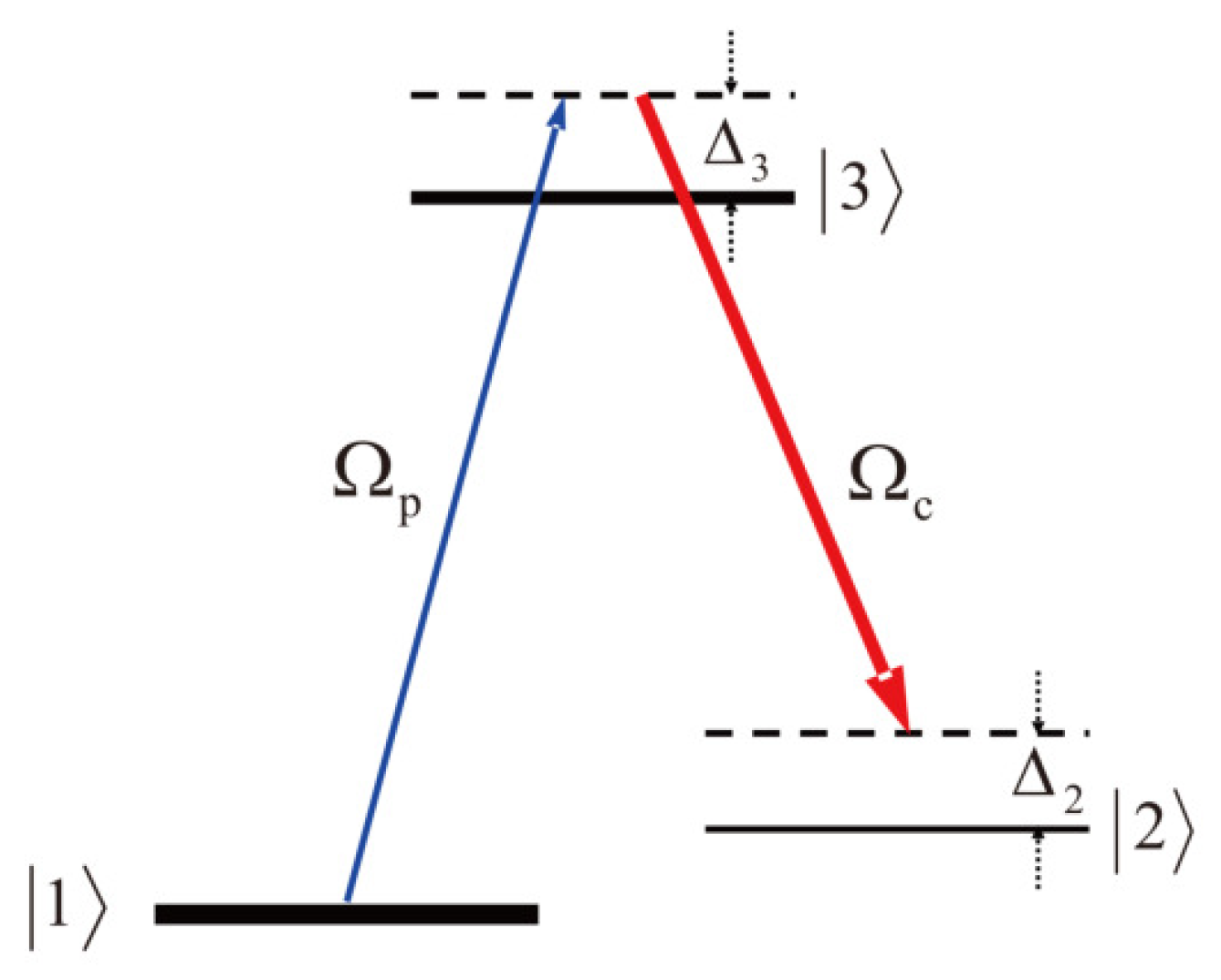
We consider a lifetime-broadened atomic system with a -type energy-level configuration, as shown in Figure 1. A weak probe field and a strong control field interact resonantly with levels and , respectively. Here, , and , are the polarization unit vector in the jth direction, the wave number, and the envelope of the jth field, respectively. The levels (), together with and , constitute a well-known -type EIT core in which the absorption of probe field is suppressed due to the quantum interference effect induced by the control field.
Figure 1.
(Color online) Excitation scheme of the lifetime broadened three-state atomic system interacting with a weak probe field with the half Rabi frequency , and a strong continuous-wave control field with the half Rabi frequency .
Furthermore, a far-detuned (Stark) optical lattice field and a weak magnetic field are added to the system, where and are the field amplitude and angular frequency, respectively; is a nonuniform magnetic field distributed in the transverse direction. Due to the existence of and , a small Stark shift and Zeeman level shift to the state occur in the transverse direction. Here, is the scalar polarizability of the level , and denotes the time average in an oscillating cycle, and is the Landéfactor.
The Stark shift contributed by the far-detuned Stark field and the Zeeman level shift contributed by the magnetic field will provide the refractive index to the probe filed. The form of the refractive index will be decided by the spatial distributions of the Stark field and magnetic field. In Figure 1, and are the half Rabi frequencies of the probe and control fields, respectively. signifies the electric dipole matrix element of the transition from state to ; and , are one- and two-photon detunings in the relevant transitions, respectively.
Under electric-dipole and rotating-wave approximations, the Hamiltonian reads where denotes the Hermitian conjugate, and The motion of atoms interacting with the light field is described by the time-dependent Schrödinger equation , and . Then, we can obtain
with and , and are the probability amplitude and the decay rate of the states .
Under a slowly varying envelope approximation, the Maxwell equation of the probe field , with the polarization intensity , is reduced to
with N being the atomic concentration. Here, the slowly-variable envelope approximation and .
We focus on steady-state regime, in which time-derivative terms in Equations (1)–(3) can be deleted. The regime can be realized by taking the probe field with a width time pulse (i.e., , where is the pulse length of the probe field), and hence, the response of atoms can follow the variation of the probe field adiabatically. The solutions of Equations (1) and (2) are acquired: , , with .
In general, we consider that the probe field is weaker than control field, and the Stark and Zeeman energy shifts are smaller than the detuning . After some simple calculations, and neglecting the higher-order terms, Equation (3) is reduced into the (2 + 1) D equation with the saturable nonlinearity and trapping potential [54].
with , , , and .
Equation (4) can be written into the dimensionless form
where , , , , and . With , , , , and being, respectively, the characteristic diffraction length, beam radius, half Rabi frequency of the probe field, intensity of far-detuned (Stark) optical lattice field, and intensity of the magnetic field. In Equation (5), , , , and .
We select the line transition of the Rb atoms. The levels, respectively, are , , and . Let , s, s, s, cm, s, cm s, , s, s, s, V/cm, and Gs. By substituting these parameters into Equation (5), we can obtain the characteristic diffraction length: cm.
The imaginary part of can be ignored because it is much smaller than its real part, and the dimensionless evolution equation of the probe field is obtained [54].
where the values of , , , and are individually controlled by , , , and . From these coefficient expressions below Equation (4), we find that relate to , but the effect of on can be ignored. Thus, these coefficients can be controlled individually by the system’s parameters. Thus, we obtain the (2 + 1) D Equation (7) with the trapping potential, and the nonlinear coefficient and the intensity of trapping potential can be adjusted at will.
3. High-Dimensional Rogue-Wave Solutions
In this section, we discuss the high-dimensional rogue waves based on the high-dimensional NLSE (7), which is non-integrable. Modulation instability (MI) is the most familiar numerical method for exciting rogue waves, but the rogue waves excited by MI are uncontrollable. Therefore, we propose a simple and effective method of generating rogue waves. It is the split-step Fourier propagation method, which is carried out by adjusting the amplitude and width of the initial pulse. Take initial pulse as
C is the height of uniform background; A and are the amplitude and width of Gaussian pulse, respectively. The method has been used to generate rogue waves in low-dimensional systems [17,18]. Without losing generality, we take .
3.1. High-Dimensional Rogue Waves of the Kerr Nonlinear Schrödinger Equation
By taking s, s, V/cm, and Gs, we can obtain , , , and . The high-dimensional Kerr NLSE,
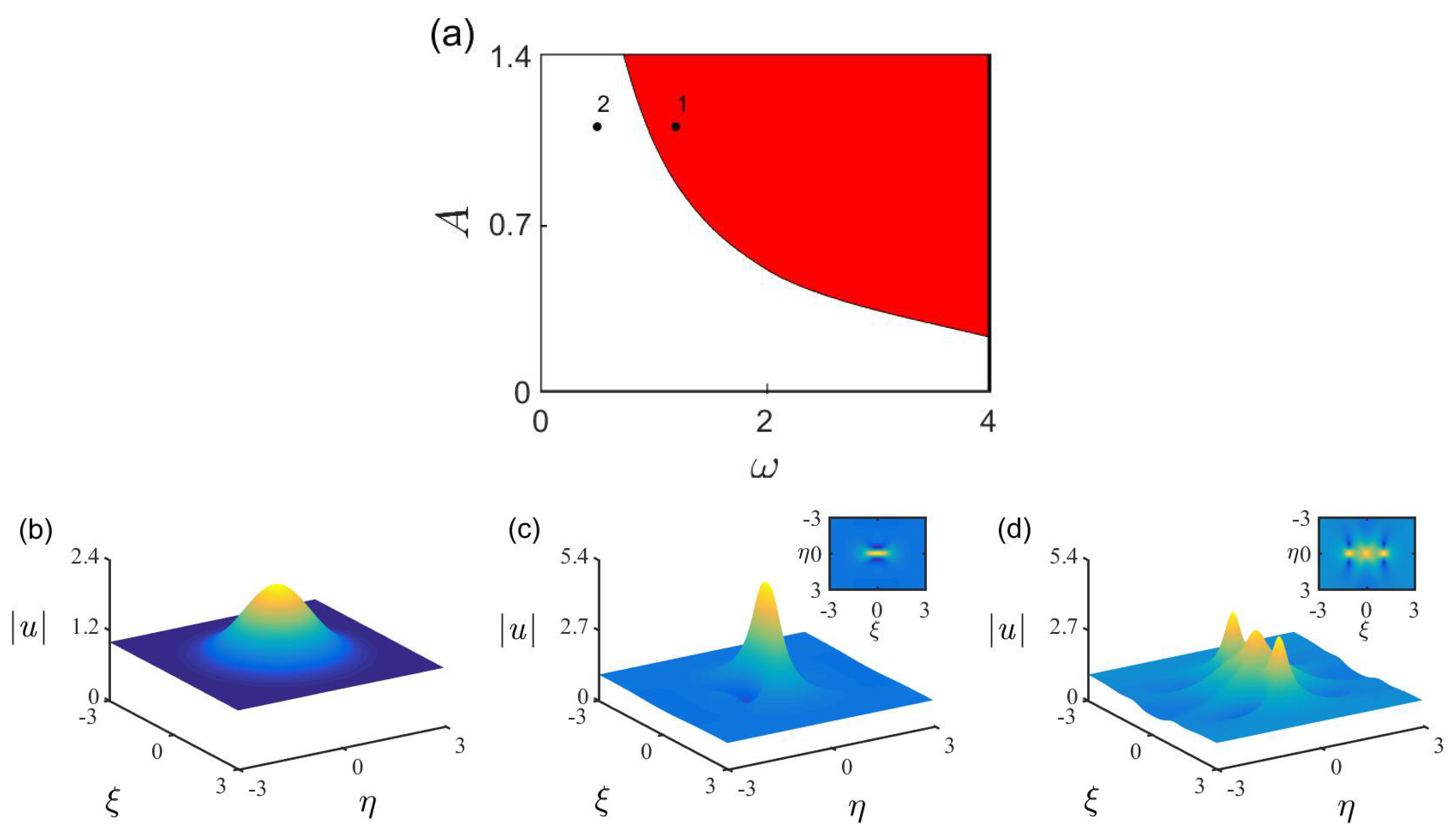
is obtained by substituting parameters into Equation (7), and performing Taylor-series expansion and the phase transformation. The phase-transition regions of nonlinear modes as functions of the amplitude and width of initial pulse are shown in Figure 2a when . We chose some points (black points 1–2 in Figure 2a) to exhibit their propagating results. According to above criteria about shock waves, we found the red region containing point 1 for high-dimensional rogue waves, and there are only general waves in the white regions containing point 2. The profiles of nonlinear modes with different distances are shown in Figure 2b–d. We chose . Figure 2b is the profile of initial input pulse at , Figure 2c is the profile of a high-dimensional rogue wave at , and Figure 2d denotes that the high-dimensional rogue wave disappeared at . Therefore, we can control the high-dimensional rogue waves by adjusting the amplitude (A) and width () of the initial pulse.
Figure 2.
(Color online) (a) The phase transition regions of nonlinear modes as functions of amplitude (A) and width () of the initial pulse when . According to above criteria about nonlinear modes, we found the red region containing point 1 is for high-dimensional rogue waves. (b–d) The profiles of nonlinear modes with different distance: , 0.72, and 1.63, respectively. Here, .
3.2. High-Dimensional Rogue Waves of the SNLSE
After choosing s, s, V/cm, and Gs, , , , and are obtained. Equation (7) is reduced to the high-dimensional SNLSE:
which is non-integrable model. We can use the same method to find its rogue wave solutions.
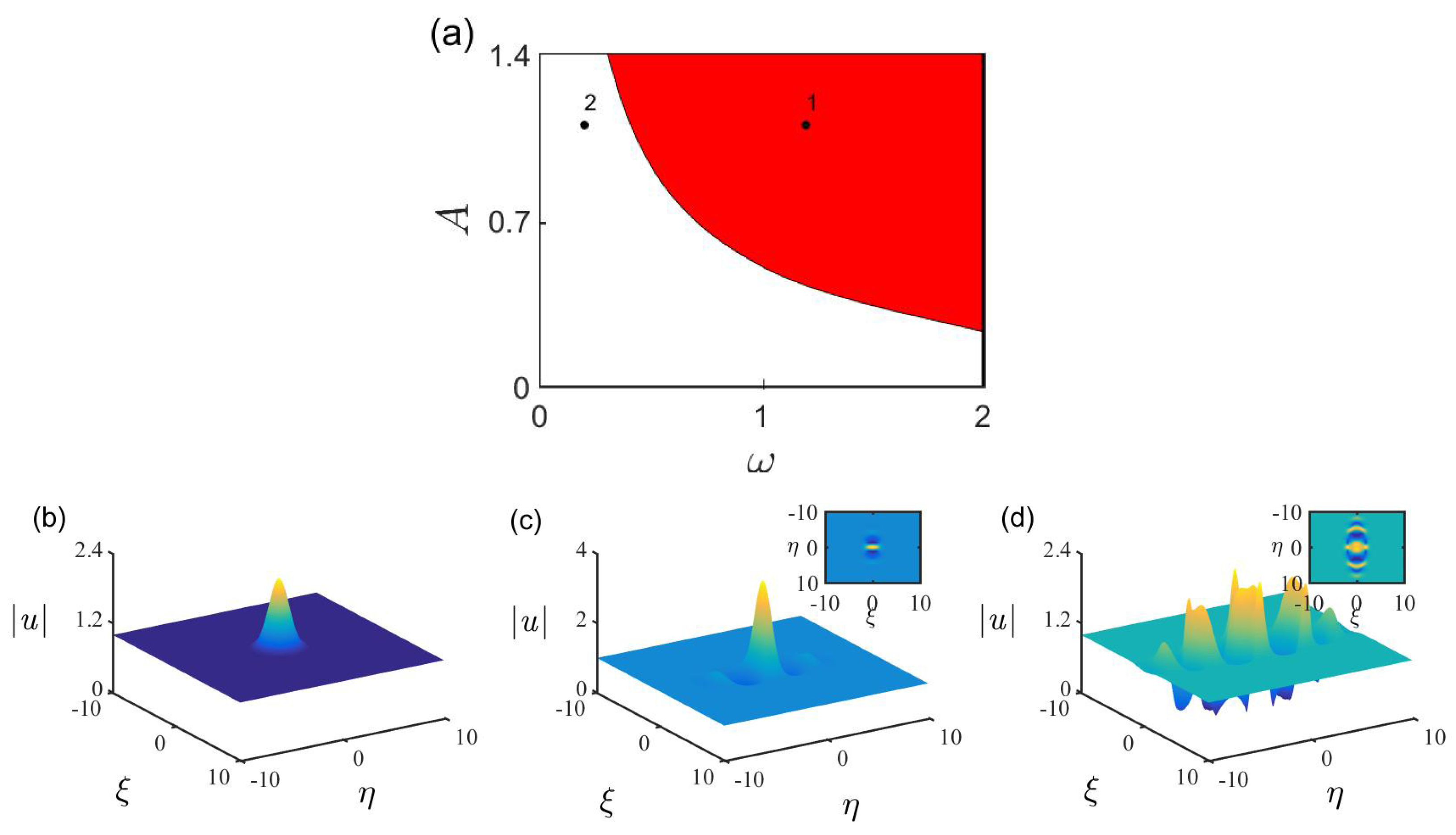
The existence regions of nonlinear modes are shown in Figure 3a. Point 1 in Figure 3a was chosen to exhibit the propagating results. The profiles of nonlinear modes are shown in Figure 3b–d for different distances when . Figure 3b–d are the initial pulse at , the high-dimensional rogue wave at , and the disappeared state of high-dimensional rogue waves at , respectively. These results tell us that the propagation method not only can be used to generate rogue waves for NLSE (9), but also for the SNLSE (10). Both of them are non-integrable.
Figure 3.
(Color online) (a) The existence regions of nonlinear modes as functions of the amplitude (A) and width () of initial pulse when . The red region containing point 1 is for high-dimensional rogue waves. (b–d) The profiles of nonlinear modes by taking , 1.08, and 2.0, respectively. Here, .
3.3. High-Dimensional Rogue Waves of the SNLSE with the Trapping Potential Contributed by a Far-Detuned (Stark) Optical Lattice Field
We can also take s, s, V/cm, and Gs; then, , , , and . The SNLSE
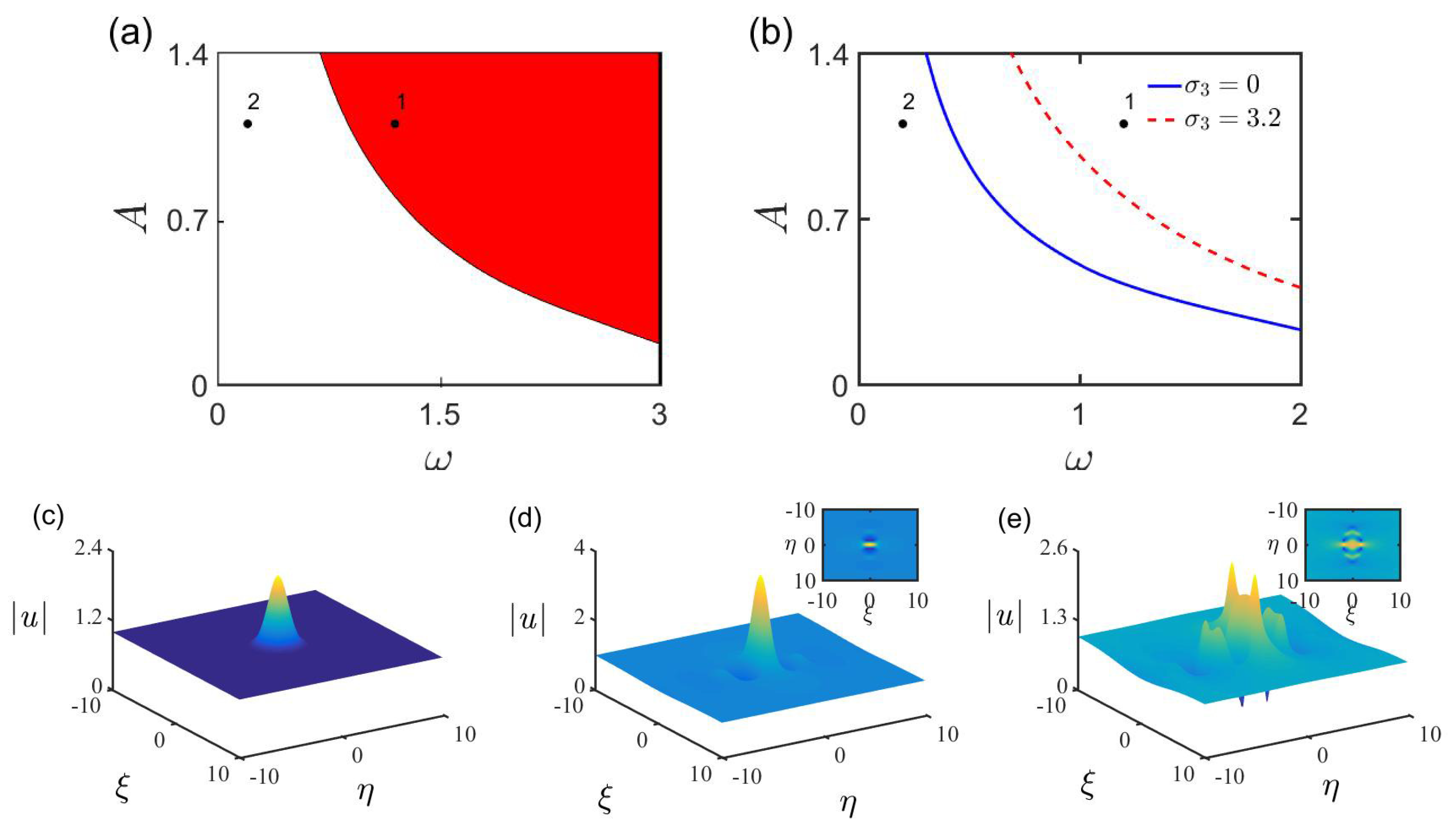
in which the trapping potential contributed by far-detuned (Stark) optical lattice field is derived. When is chosen, the phase-transition regions of nonlinear modes for the SNLSE (11) are shown in Figure 4a. In Figure 4b, the phase-transition curves of high-dimensional rogue waves are plotted with different values of . The blue solid line is for Equation (10), and the red dotted line is for Equation (11). The right regions of the phase-transition curves are for the rogue waves. From these, we know that the high-dimensional rogue waves can be suppressed by appropriately increasing the far-detuned electric field. The propagation process of nonlinear modes of point 1 are shown in Figure 4c–e. Here, . Figure 4c is the profile of the initial pulse at . Figure 4d is for the high-dimensional rogue wave at , when , the rogue wave disappears, as shown in Figure 4e.
Figure 4.
(Color online) (a) The existence regions of nonlinear modes as functions of A and when . The red region is for high-dimensional rogue waves. (b) The phase-transition curves of high-dimensional rogue waves for the SNLSE (11) with (blue solid line) and (red dotted line). The regions containing point 1 denote the existence interval of high-dimensional rogue waves. (c–e) The profiles of nonlinear modes by taking , 0.99, and 1.61, respectively. Here, .
3.4. High-Dimensional Rogue Waves of the SNLSE with a Weak Magnetic Field
Finally, s, s, V/cm, and Gs were chosen, so , , , and . Equation (7) can be reduced to the SNLSE with external potential contributed by the weak magnetic field:
When , and are random numbers, rogue waves cannot be excited by the initial pulse. We also took other types of random potential, and this conclusion was consistent. That is, the random weak magnetic field is not conducive to the rogue waves’ excitation. The reason is that rogue waves are the result of coherent resonance between waves, but random external potentials may destroy the coherence between waves, so rogue-wave generation is suppressed. Therefore, the random weak magnetic field can effectively inhibit the production of high-dimensional rogue waves, which will provide an idea for the prevention of high-dimensional freak waves, especially for the marine freak waves that could devour ships.
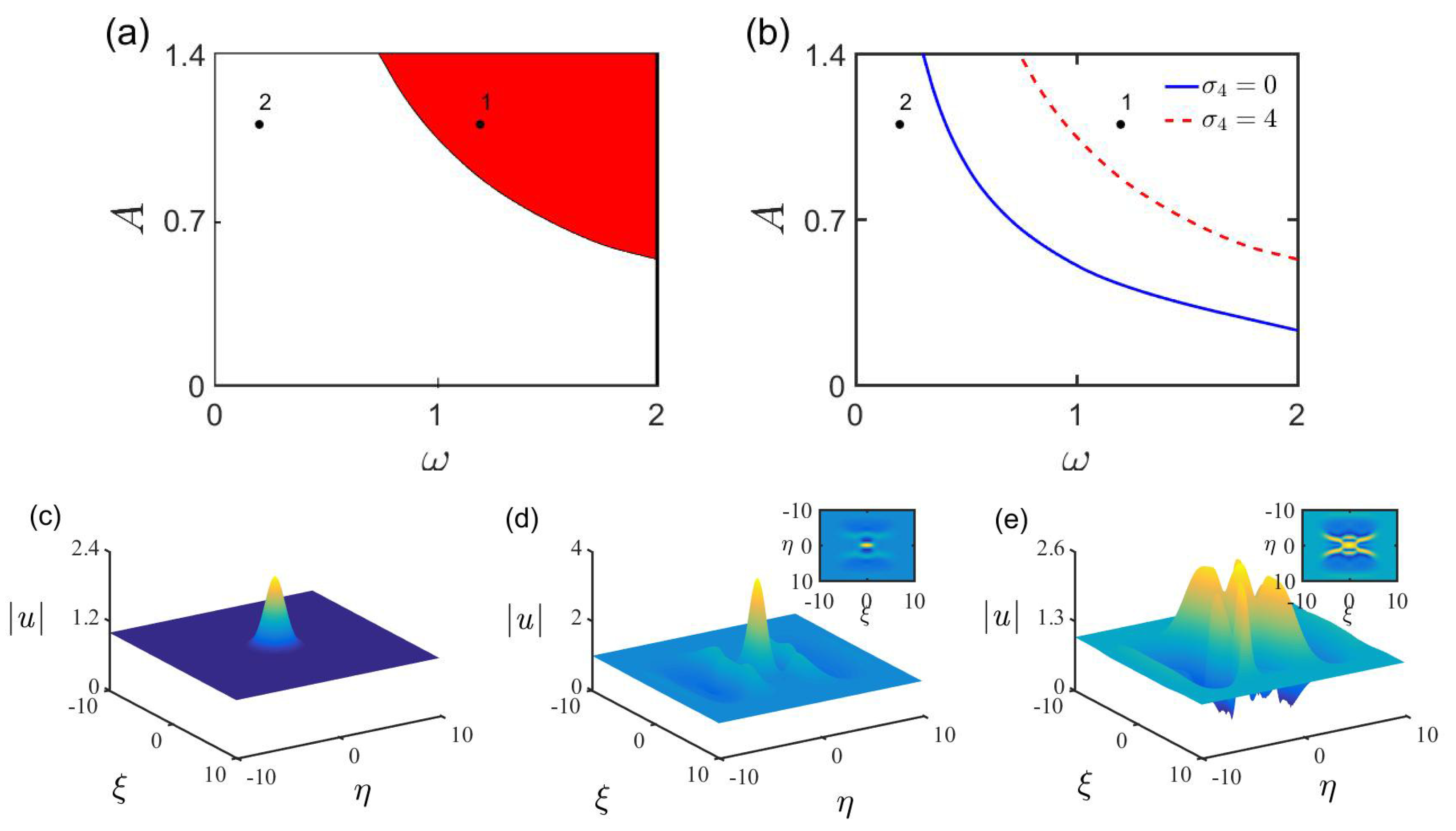
For when , the existence regions of nonlinear modes for SNLSE (12) are shown in Figure 5a. In Figure 5b, we show the phase-transition curve of the SNLSE (12) without (, blue solid line) or with (, red dotted line) the weak magnetic field. By comparing the phase-transition curves, we can see that the existence region of rogue waves becomes small after adding the weak magnetic field, which means it is more difficult to excite the high-dimensional rogue waves. This shows that the super-Gauss weak magnetic field is not conducive to the excitation of rogue waves. According to above criteria about nonlinear modes, we found the red region or the right regions of the phase-transition curves are for high-dimensional rogue waves. We took the parameters of point 1 to show the propagation process of rogue waves. Figure 5c is the profile of the initial pulse at . Figure 5d is for the profile of rogue wave at , and when , the rogue wave disappears, as shown in Figure 5e.
Figure 5.
(Color online) (a) The existence regions of nonlinear modes. The red region denotes rogue waves. (b) The phase-transition curves of rogue waves for Equation (11) with (blue solid line) and (red dotted line). (c–e) The profiles of nonlinear modes when , 1.08, and 1.60, respectively. Here, .
4. Conclusions
Based on the resonant, three-level, -type electromagnetically induced transparency system, the dimensionless envelope equation of the probe field was obtained. Furthermore, we were able to obtain the non-integrable, high-dimensional, nonlinear Schrödinger equations by reducing the envelope equations of the probe field, such as the Kerr-type nonlinear Schrödinger equation, SNLSE, and SNESE with external potential. By the numerical propagation method, we found their rogue-wave solutions and their existence regions in different cases. We not only proved that the numerical method can be used to find rogue-wave solutions of a non-integrable model, but also found the external potential can be used to suppress or even eliminate rogue waves. The work will not only provide a theoretical basis for experimentally controlling the high-dimensional rogue waves, but also provide an inspiration for the prevention of rogue waves disasters in the ocean. The research results also provide the ideas for excitation of rogue waves in other high-dimensional non-integrable systems.
Author Contributions
Methodology, Z.L., J.L. and H.L.; Writing—original draft, Z.L., J.L. and H.L.; Project administration, Z.L., J.L. and H.L.; Funding acquisition, Z.L., J.L. and H.L. All authors have read and agreed to the published version of the manuscript.
Funding
Project supported by Basic Scientific Research Ability of Middle-aged and Young Teachers in Colleges and Universities of Guangxi (2022KY1661, 2022KY1604), Natural Science Foundation of Zhejiang Province of China (LZ22A050002), and National Natural Science Foundation of China (11835011, 12074343).
Data Availability Statement
The original contributions presented in the study are included in the article, further inquiries can be directed to the corresponding author.
Conflicts of Interest
The authors declare no conflict of interest.
References
- Whitemarsh, R.P. Great sea waves. US Naval Inst. Proc. 1934, 60, 1094–1103. [Google Scholar]
- Kharif, C.; Pelinovsky, E.; Slunyaev, A. Rogue waves in the ocean. In Rogue Waves in the Ocean; Springer: Berlin/Heidelberg, Germany, 2009; p. 1. [Google Scholar]
- Kharif, C.; Pelinovsky, E.; Slunyaev, A. Rogue waves in the ocean-review and progress. EOS Trans. Am. Geophys. Union 2010, 91, 104. [Google Scholar]
- Peregrine, D.H.; Austral, J. Water waves, nonlinear Schrödinger equations and their solutions. Math. Soc. Ser. B 1983, 25, 16–43. [Google Scholar] [CrossRef]
- Akhmediev, N.; Soto Crespo, J.M.; Ankiewicz, A. Extreme waves that appear from nowhere: On the nature of rogue waves. Phys. Lett. A 2009, 373, 2137–2145. [Google Scholar] [CrossRef]
- Akhmediev, N.; Eleonskii, V.M.; Kulagin, N.E. Exact first-order solutions of the nonlinear Schrödinger equation. Theor. Math. Phys. 1987, 72, 809–818. [Google Scholar] [CrossRef]
- Kharif, C.; Pelinovshy, E. Physical mechanisms of the rogue wave phenomenon. Eur. J. Mech. B/Fluids 2003, 22, 603–634. [Google Scholar] [CrossRef]
- Onorato, M.; Residori, S.; Bortolozzo, U.; Montina, A.; Arecchi, T.F. Rogue waves and their generating mechanisms in different physical contexts. Arecchi Phys. Rep. 2013, 528, 47–89. [Google Scholar] [CrossRef]
- Akhmediev, N.; Dudley, J.M.; Solli, D.R.; Turitsyn, S.K. Recent progress in investigating optical rogue waves (Review). J. Opt. 2013, 15, 6. [Google Scholar] [CrossRef]
- Dudley, J.M.; Dias, F.; Erkintalo, M.; Genty, G. Instabilities, breathers and rogue waves in optics. Nat. Photon. 2014, 8, 755–764. [Google Scholar] [CrossRef]
- Draper, L. Freak wave. Mar. Obs. 1965, 35, 193–195. [Google Scholar]
- Kjeldsen, S.P. Dangerous wave groups. Nor. Marit. Res. 1984, 12, 4–16. [Google Scholar]
- Diekison, D. Huge waves. In Outside Magazine; W. W. Norton Company: New York, NY, USA, 1995; pp. 3–5. [Google Scholar]
- Lavernov, V. The wave energy concentration at the Agulhas current of South Affica. Nat. Hazards 1998, 17, 117–127. [Google Scholar] [CrossRef]
- Walker, D.A.G.; Taylor, P.H.; Taylor, R.E. The shape of large surface waves on the open sea and the draupner new year wave. Appl. Ocean Res. 2005, 26, 73–83. [Google Scholar] [CrossRef]
- Rosenthal, W.; Lehenr, S. Rogue waves: Results of the max wave project. J. Offshore Mech. Arct. Eng. 2008, 130, 021006. [Google Scholar] [CrossRef]
- Li, Z.Y.; Li, F.F.; Li, H.J. Exciting rogue waves, breathers, and solitons in coherent atomic media. Commun. Theor. Phys. 2020, 72, 075003. [Google Scholar] [CrossRef]
- Li, F.F.; Li, Z.Y.; Li, H.J. Manipulating rogue waves, breathers and solitons in several non-integrable nonlinear Schrödinger equations. Eur. Phys. J. D 2019, 73, 263. [Google Scholar] [CrossRef]
- Solli, D.R.; Ropers, C.; Koonath, P.; Jalali, B. Optical rogue waves. Nature 2007, 450, 1054–1057. [Google Scholar] [CrossRef]
- Kibler, B.; Fatome, J.; Finot, C.; Millot, G.; Dias, F.; Genty, G.; Akhmediev, N.; Dudley, J.M. The Peregrine soliton in nonlinear fibre optics. Nat. Phys. 2010, 6, 790–795. [Google Scholar] [CrossRef]
- Zaviyalov, A.; Egorov, O.; Iliew, R.; Lederer, F. Rogue waves in mode-locked fiber lasers. Phys. Rev. A 2012, 85, 013828. [Google Scholar] [CrossRef]
- Manikandan, K.; Muruganandam, P.; Senthilvelan, M.; Lakshmanan, M. Manipulating matter rogue waves and breathers in Bose-Einstein condensates. Phys. Rev. E 2014, 90, 062905. [Google Scholar] [CrossRef]
- Chen, S.H.; Baronio, F.; Soto-Crespo, J.M.; Grelu, P. Chirped Peregrine solitons in a class of cubic-quintic nonlinear Schrödinger equations. Phys. Rev. E 2016, 93, 062202. [Google Scholar] [CrossRef] [PubMed]
- Chen, S.H.; Ye, Y.L.; Soto-Crespo, J.M.; Grelu, P.; Baronio, F. Peregrine solitons beyond the threefold limit and their two-soliton interactions. Phys. Rev. Lett. 2018, 121, 104101. [Google Scholar] [CrossRef] [PubMed]
- Wang, X.; Liu, C.; Wang, L. Darboux transformation and rogue wave solutions for the variable-coefficients coupled Hirota equations. J. Math. Appl. 2017, 449, 1534–1552. [Google Scholar] [CrossRef]
- Wang, X.B.; Tian, S.F.; Yan, H.; Zhang, T.T. On the solitary waves, breather waves and rogue waves to a generalized (3 + 1)-dimensional Kadomtsev-Petviashvili equation. Math. Appl. 2017, 74, 556–563. [Google Scholar] [CrossRef]
- Wang, X.B.; Tian, S.F.; Qin, C.Y.; Zhang, T.T. Characteristics of the solitary waves and rogue waves with interaction phenomena in a generalized (3 + 1)-dimensional Kadomtsev-Petviashvili equation. Appl. Math. Lett. 2017, 72, 58–64. [Google Scholar] [CrossRef]
- Li, M.; Shui, J.J.; Xu, T. Generation mechanism of rogue waves for the discrete nonlinear Schrödinger equation. Appl. Math. Lett. 2018, 83, 110–115. [Google Scholar] [CrossRef]
- Wang, X.B.; Zhang, T.T.; Dong, M.J. Dynamics of the breathers and rogue waves in the higher-order nonlinear Schrödinger equation. Appl. Math. Lett. 2018, 86, 298–304. [Google Scholar] [CrossRef]
- Zhang, X.; Chen, Y.; Tang, X. Rogue wave and a pair of resonance stripe solitons to KP equation. Comput. Math. Appl. 2018, 76, 1938–1949. [Google Scholar] [CrossRef]
- Jia, R.R.; Guo, R. Breather and rogue wave solutions for the (2 + 1)-dimensional nonlinear Schrödinger-Maxwell-Bloch equation. Appl. Math. Lett. 2019, 93, 117–123. [Google Scholar] [CrossRef]
- Chen, S.; Yan, Z. The Hirota equation: Darboux transform of the Riemann-Hilbert problem and higher-order rogue waves. Appl. Math. Lett. 2019, 95, 65–71. [Google Scholar] [CrossRef]
- Yang, B.; Yang, J.K. On general rogue waves in the parity-time-symmetric nonlinear Schrödinger equation. J. Math. Anal. Appl. 2020, 487, 124023. [Google Scholar] [CrossRef]
- Banik, S.; Shikha, R.K.; Noman, A.A.; Chowdhury, N.A.; Mannan, A.; Roy, T.S.; Mamun, A.A. First and second-order dust-ion-acoustic rogue waves in non-thermal plasma. Eur. Phys. J. D 2021, 75, 43. [Google Scholar] [CrossRef]
- Mohammadnejad, M.; Akbari-Moghanjughi, M. Formation of ion acoustic rogue waves in warm dense matter. Eur. Phys. J. D 2021, 75, 307. [Google Scholar] [CrossRef]
- Talouneh, K.; Kheradmand, R.; Tissoni, G.; Eslami, M. Influence of transverse carrier diffusion on two-dimensional optical rogue waves in broad-area semiconductor lasers with a saturable absorber. Phys. Rev. A 2022, 105, 013501. [Google Scholar] [CrossRef]
- Cheng, D.; Wang, W.W.; Pan, C.C.; Hou, C.; Chen, S.H.; Mihalache, D.; Baronio, F. Photonic rogue waves in a strongly dispersive coupled-cavity array involving self-attractive Kerr nonlinearity. Phys. Rev. A 2022, 105, 013717. [Google Scholar] [CrossRef]
- Ablowitz, M.J.; Davide, T.C. Transverse instability of rogue waves. Phys, Rev. Lett. 2021, 127, 104101. [Google Scholar] [CrossRef]
- Marcucci, G.; Kheradmand, P.; Claudio, C. Theory of neuromorphic computing by waves: Machine learning by rogue waves, dispersive shocks, and solitons. Phys. Rev. A 2020, 125, 093901. [Google Scholar] [CrossRef]
- Asgarnezhad-Zorgabad, S.; Sadighi-Bonabi, R.; Kibler, B.; Ozdemir, S.K.; Sanders, B.C. Surface-polaritonic phase singularities and multimode polaritonic frequency combs via dark rogue-wave excitation in hybrid plasmonic waveguide. New J. Phys. 2020, 22, 033008. [Google Scholar] [CrossRef]
- Tan, Y.C.; Bai, X.D.; Li, T.T. Super rogue waves: Collision of rogue waves in Bose-Einstein condensate. Phys. Rev. E 2022, 106, 014208. [Google Scholar] [CrossRef]
- Tlidi, M.; Taki, M. Rogue waves in nonlinear optics. Adv. Opt. Photonics 2022, 14, 87–147. [Google Scholar] [CrossRef]
- Copus, M.G.; Camley, R.E. Creation of magnetic rogue waves. Phys. Rev. B 2020, 102, 220410. [Google Scholar] [CrossRef]
- Ankiewicz, A.; Chowdury, A. Analysis of characteristics of rogue waves for higher-order equations. Nonlinear Dyn. 2022, 22, 07497. [Google Scholar] [CrossRef]
- Sgrignuoli, F.; Chen, Y.; Gorsky, S.; Britton, W.A.; Negro, L.D. Optical rogue waves in multifractal photonic arrays. Phys. Rev. B 2021, 103, 195403. [Google Scholar] [CrossRef]
- Gatz, S.; Herrmann, J. Soliton propagation in materials with saturable nonlinearity. J. Opt. Soc. Am. B 1991, 8, 2296. [Google Scholar] [CrossRef]
- Gatz, S.; Herrmann, J. Soliton propagation and soliton collision in double-doped fibers with a non-Kerr-like nonlinear refractive-index change. Opt. Lett. 1992, 17, 484. [Google Scholar] [CrossRef]
- Herrmann, J. Propagation of ultrashort light pulses in fibers with saturable nonlinearity in the normal-dispersion region. J. Opt. Soc. Am. B 1991, 8, 1507–1511. [Google Scholar] [CrossRef]
- Krolikowski, W.; Luther-Davies, B. Analytic solution for soliton propagation in a nonlinear saturable medium. Opt. Lett. 1992, 17, 1414. [Google Scholar] [CrossRef]
- Jakubowski, M.H.; Steiglitz, K.; Squier, R. Information transfer between solitary waves in the saturable Schrödinger equation. Phys. Rev. E 1997, 56, 7267. [Google Scholar] [CrossRef]
- Melvin, T.R.; Champneys, A.R.; Kevrekidis, P.G.; Cuevas, J. Radiationless traveling waves in saturable nonlinear Schrödinger lattices. Phys. Rev. Lett. 2006, 97, 124101. [Google Scholar] [CrossRef]
- Chen, G.; Ma, S. Ground state and geometrically distinct solitons of discrete nonlinear Schrödinger equations with saturable nonlinearities. Stud. Appl. Math. 2013, 131, 389. [Google Scholar] [CrossRef]
- Krolikowski, W.; Luther-Davies, B. Dark optical solitons in saturable nonlinear media. Opt. Lett. 1993, 18, 188. [Google Scholar] [CrossRef]
- Zhang, K.; Liang, Y.Z.; Lin, J.; Li, H.J. Controlling the stability of nonlinear optical modes via electromagnetically induced transparency. Phys. Rev. A 2018, 97, 023844. [Google Scholar] [CrossRef]
- Li, H.J.; Dong, L.W.; Hang, C.; Huang, G.X. Gain-assisted high-dimensional self-trapped laser beams at very low light levels. Phys. Rev. A 2011, 83, 023816. [Google Scholar] [CrossRef]
- Schmidt, H.; Imamoglu, A. Giant Kerr nonlinearities obtained by electromagnetically induced transparency. Opt. Lett. 1996, 21, 1936–1938. [Google Scholar] [CrossRef]
- Harris, S.E. Electromagnetically induced transparency. Phys. Today 1997, 50, 36–42. [Google Scholar] [CrossRef]
- Hau, L.V.; Harris, S.E.; Dutton, Z.; Behroozi, C.H. Light speed reduction to 17 metres per second in an ultracold atomic gas. Nature 1999, 397, 594–598. [Google Scholar] [CrossRef]
- Li, H.J.; Wu, Y.P.; Hang, C.; Huang, G.X. (3 + 1)-dimensional superluminal spatiotemporal optical solitons and vortices at weak light level. Phys. Rev. A 2012, 86, 25181–25194. [Google Scholar] [CrossRef]
- Liu, J.Y.; Hang, C.; Huang, G.X. Weak-light rogue waves, breathers, and their active control in a cold atomic gas via electromagnetically induced transparency. Phys. Rev. A 2016, 93, 063836. [Google Scholar] [CrossRef]
- Liu, J.Y.; Hang, C.; Huang, G.X. Weak-light vector rogue waves, breathers, and their Stern-Gerlach deflection via electromagnetically induced transparency. Opt. Express 2017, 25, 23408–23423. [Google Scholar] [CrossRef]
Disclaimer/Publisher’s Note: The statements, opinions and data contained in all publications are solely those of the individual author(s) and contributor(s) and not of MDPI and/or the editor(s). MDPI and/or the editor(s) disclaim responsibility for any injury to people or property resulting from any ideas, methods, instructions or products referred to in the content. |
© 2023 by the authors. Licensee MDPI, Basel, Switzerland. This article is an open access article distributed under the terms and conditions of the Creative Commons Attribution (CC BY) license (https://creativecommons.org/licenses/by/4.0/).