
Abstract
This article explores the generalized Gerdjikov–Ivanov equation describing the propagation of pulses in optical fiber. The equation studied has a variety of applications, for instance, in photonic crystal fibers. In contrast to the classical Gerdjikov–Ivanov equation, the solution of the Cauchy problem for the studied equation cannot be found by the inverse scattering problem method. In this regard, analytical solutions for the generalized Gerdjikov–Ivanov equation are found using traveling-wave variables. Phase portraits of an ordinary differential equation corresponding to the partial differential equation under consideration are constructed. Three conservation laws for the generalized equation corresponding to power conservation, moment and energy are found by the method of direct transformations. Conservative densities corresponding to optical solitons of the generalized Gerdjikov–Ivanov equation are provided. The conservative quantities obtained have not been presented before in the literature, to the best of our knowledge.
Keywords:
Gerdjikov–Ivanov equation; phase portraits; conservation laws; periodic and solitary wave; optical soliton; partial differential equations; first integral; exact solutions; solitary wave MSC:
70H33
1. Introduction
In this paper we study the generalized Gerdjikov–Ivanov equation of the form,
where is a complex-valued function, which describes the wave profile, a, b, c, , and are parameters of the mathematical model, where a is responsible for the group velocity dispersion, b is the coefficient of quintic nonlinearity, is the coefficient of intermodal dispersion, c and are coefficients of nonlinear dispersion, and is the coefficient of the self-steepening term for short pulses.
Equation (1) is a well-known nonlinear partial differential equation for the description of optical solitons in fiber, especially in photonic crystal fibers. This equation does not pass the Painlevé test, and the Cauchy problem for Equation (1) cannot be solved by the inverse scattering transform in the general case. However, at , Equation (1) is an integrable equation, which has been shown in paper [1].
Equation (1) has been considered at in a number of articles. In [2], the authors generated new optical soliton solutions to the perturbed Gerdjikov–Ivanov equation which was detected by means of the extended direct algebraic method. The perturbed Gerdjikov–Ivanov equation which describes the dynamics of the soliton in an optical fiber was investigated in [3]. Using a traveling-wave transformation, the nonlinear perturbed equation was transformed into two nonlinear ordinary differential equations and reduced to a first-order ordinary differential equation. Bright, dark and kink soliton solutions were found. Optical propagation pulses, such as dark, bright, periodic-singular and periodic-M-shaped soliton solutions, of the perturbed Gerdjikov–Ivanov equation with perturbation effects, with various applications in optical fibers, were obtained in [4]. The perturbed Gerdjikov–Ivanov equation was examined in [5] by taking into account the Jacobi elliptic function expansion method.
The perturbed Gerdjikov–Ivanov equation with spatio-temporal dispersion was investigated in [6] by the trial equation method where the complex-envelope traveling-wave transformation and the complete discriminant system for polynomial method were utilized. The perturbed optical solitons for the time–space fractional Gerdjikov–Ivanov equation were investigated with conformable derivatives having a group velocity dispersion and quintic nonlinearity coefficients in [7], where abundant families of optical solitons in single and combined forms were found.
A bifurcation analysis and soliton solutions for the generalized Gerdjikov–Ivanov equation were presented by using the theory of dynamical systems for fixed-parameter cases in [8]. The cubic–quartic optical solitons for the perturbed Gerdjikov–Ivanov equation were considered for the scalar case and birefringent fibers in [9]. The optical solitons to the perturbed Gerdjikov–Ivanov equation in optical fibers were explored in [10] using the improved projective Riccati equations method to solve the ordinary differential equation analytically, where the existence conditions of all optical solitons were given. A new fractional-mapping method based on a generalized fractional auxiliary equation was proposed and applied to solve the space–time fractional perturbed Gerdjikov–Ivanov equation in [11], where some exact fractional nonlinear wave solutions were constructed by Mittag-Leffler function. Exact single traveling-wave solutions to the nonlinear fractional perturbed Gerdjikov–Ivanov equation were captured by the complete discrimination system for polynomial method and the trial equation method in the paper [12], where rational-function solutions, solitary-wave solutions, triangular-function periodic solutions and elliptic-function periodic solutions were obtained. The dark-soliton solutions to the perturbed Gerdjikov–Ivanov equation describing the effects of ultrashort (femtosecond) optical soliton propagation in non-Kerr media were investigated in the paper [13].
Exact solutions of the generalized Gerdjikov–Ivanov equation by means of the traveling-wave reduction of the first integral were found in [14]. The space–time-perturbed fractional Gerdjikov–Ivanov equation was studied based on the modified Riemann–Liouville derivative in [15], and the fractional projective Riccati expansion approach was utilized. The dynamics of solitons of the perturbed Gerdjikov–Ivanov equation was carried out by considering transformations and newly well-established methods to obtain optical solitons of the model in [16]. Some other questions corresponding to Equation (1) were considered in [16,17,18,19,20,21,22,23,24,25,26,27,28,29,30].
The purpose of this paper was to find some exact solutions of Equation (1) by applying the method of direct calculations. It has an advantage over special methods used in the previously mentioned papers (for instance, see [5,6,31]) as it can provide a more general class of solutions. There is no need to use a special method, when the exact solution can be found by integrating the equation. Our aim was also to propose a classification of phase portraits corresponding to Equation (1) and to write conservation laws for Equation (1) by means of the direct method. To the best of our knowledge, there has been no works devoted to the derivation of conservation laws for Equation (1). Finding conservation laws of partial differential equations is very important for practical applications, since they are used to check whether numerical schemes are conservative in experiments. This motivated us to look for conservation laws of the studied equation.
The paper is organized as follows. In Section 2, we obtain the nonlinear ordinary differential equation corresponding to Equation (1). The bifurcation of phase portraits of the ordinary differential equation corresponding to Equation (1) is presented in Section 3. The periodic- and solitary-wave solution of ordinary differential equation at and are given in Section 4 and Section 5. In the case of an arbitrary value m, exact solutions in the form of optical solitons are presented in Section 6. Conservation laws corresponding to Equation (1) are derived by direct calculations in Section 7. In Section 8, the conserved quantities are calculated.
2. Nonlinear Ordinary Differential Equation Corresponding to Equation (1)
The Cauchy problem for Equation (1) cannot be solved by the inverse scattering transform in the general case, so we look for exact solutions of Equation (1) taking into account the traveling-wave reduction
Substituting (2) into Equation (1), we obtain the system of equations of the form
From Equation (3), we obtain after integrating
where is an arbitrary constant of the integration.
3. Bifurcation of Phase Portraits Corresponding to Equation (6)
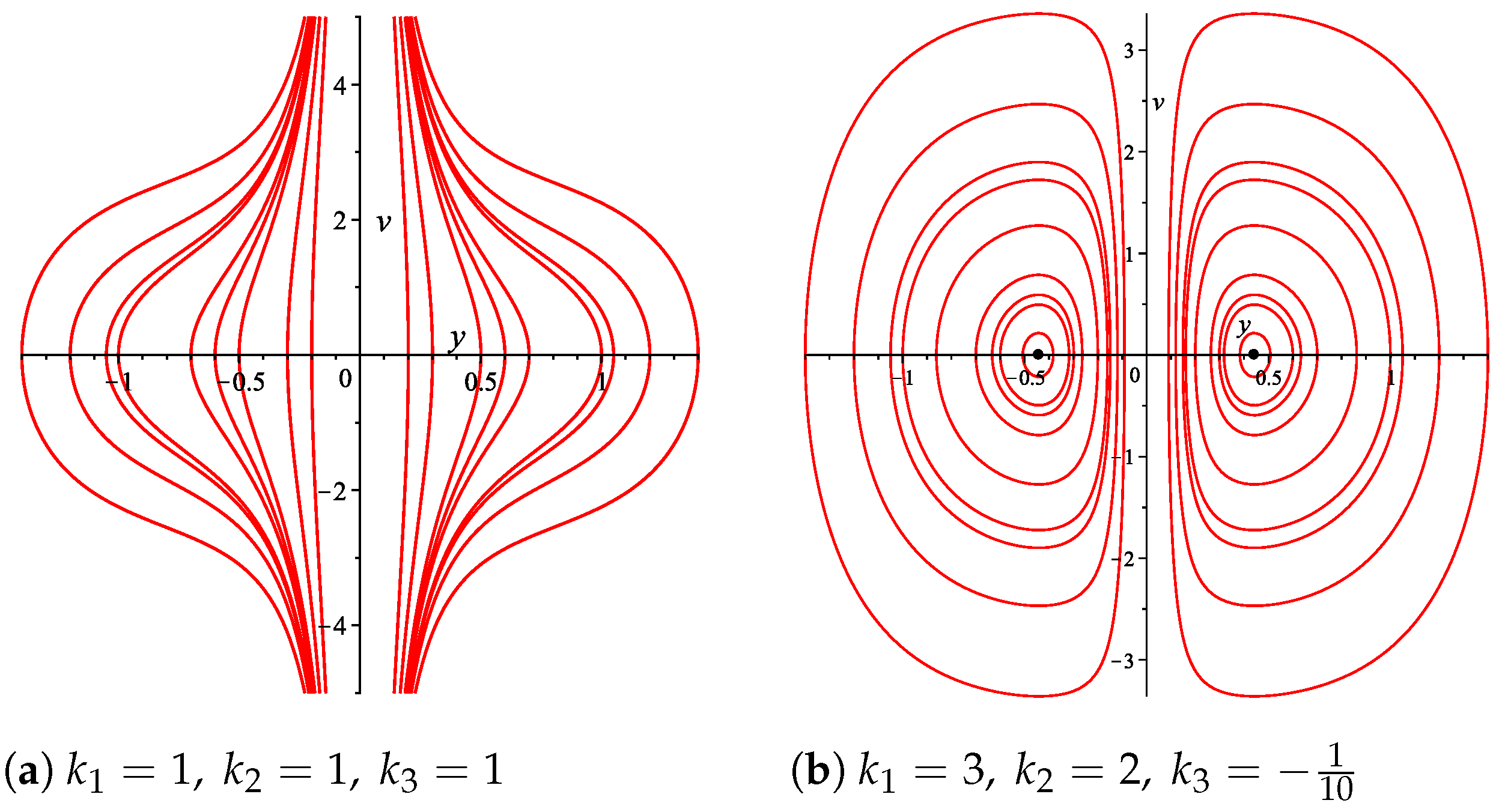
In this section, we visualize the results from the previous section by analyzing the stability of equilibrium points of the traveling-wave reduction of the explored equation and study the bifurcations of its phase portraits using the first integral (6) (see [32]). Let us write Equation (6) before integration in its canonical form
where parameters A, B, C, E, F and H are determined by formulas
Introducing into (7) the following transformation
yields the associated regular system
Ignoring the orientation, the trajectories of systems (7) and (10) are identical; therefore, systems (7) and (10) are topologically equivalent. Due to their first integrals being the same, they also have the same orbits, with the exception of the straight line .
The first integral of the regular system (10) is (6), which is written as follows, taking into account the notations of the current section:
Let us conduct the analysis of the equilibrium point stability for the regular system (10). All of its equilibrium points are located on the y axis (provided that ), with the coordinate determined by the following equation
The stability of an equilibrium point is determined by the eigenvalues of the following Jacobi matrix
where solves Equation (12).
One can see that the point is of the center stability type if decreases at and , it is of the saddle stability type if increases at and (if , then the stability type is reversed), and is a degenerate point if has a zero derivative at the equilibrium point and, therefore, a zero eigenvalue, since the eigenvalues of the matrix J are determined by the following formula
For example, let us explore the case of . Equation (12) takes the form
Thus, our explored system for can have either zero, two, four or six equilibrium points , since Equation (16) can possess at most three positive roots.
Let us introduce the notation
where are the turning points of the function , besides the turning point .
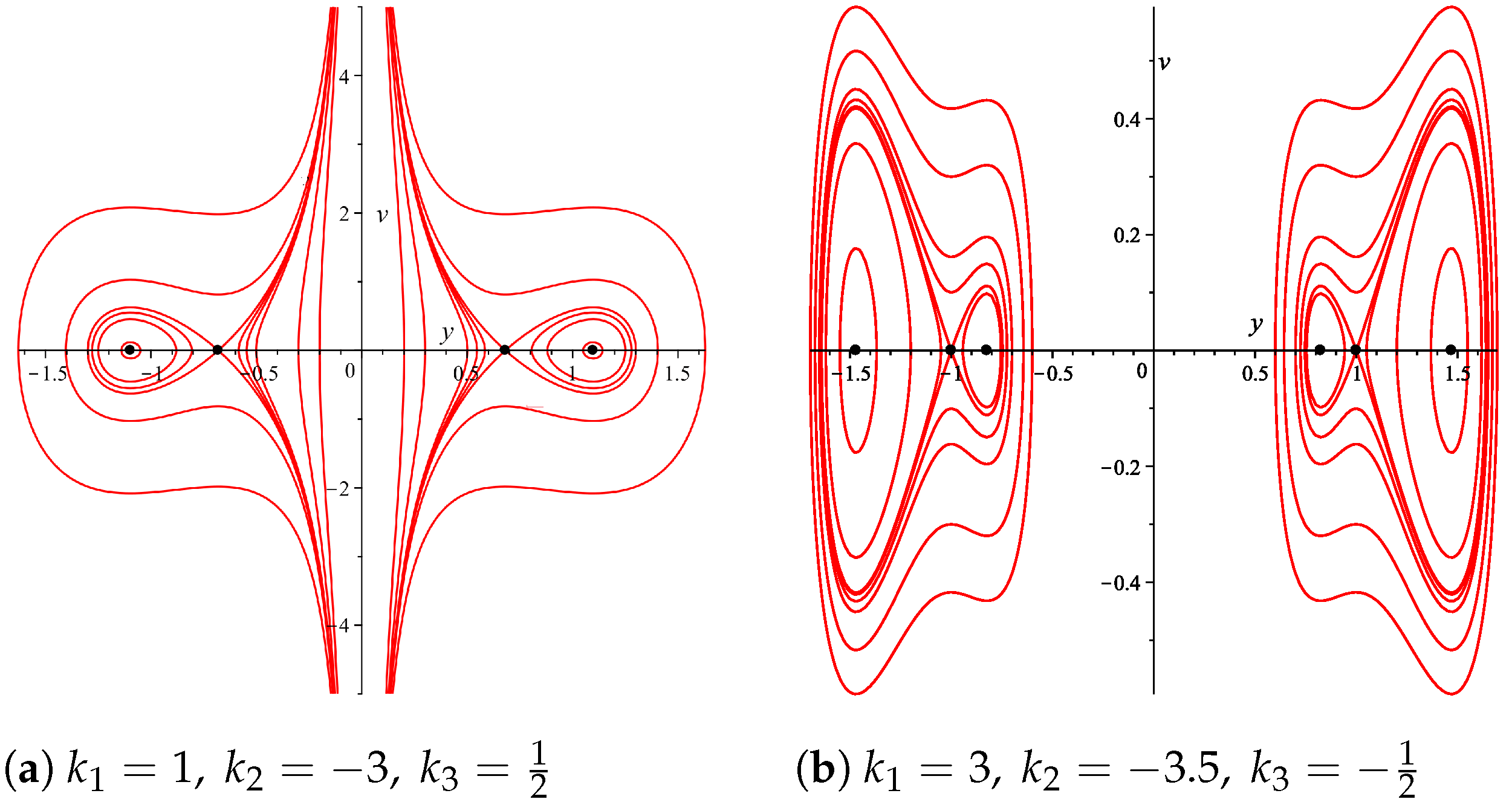
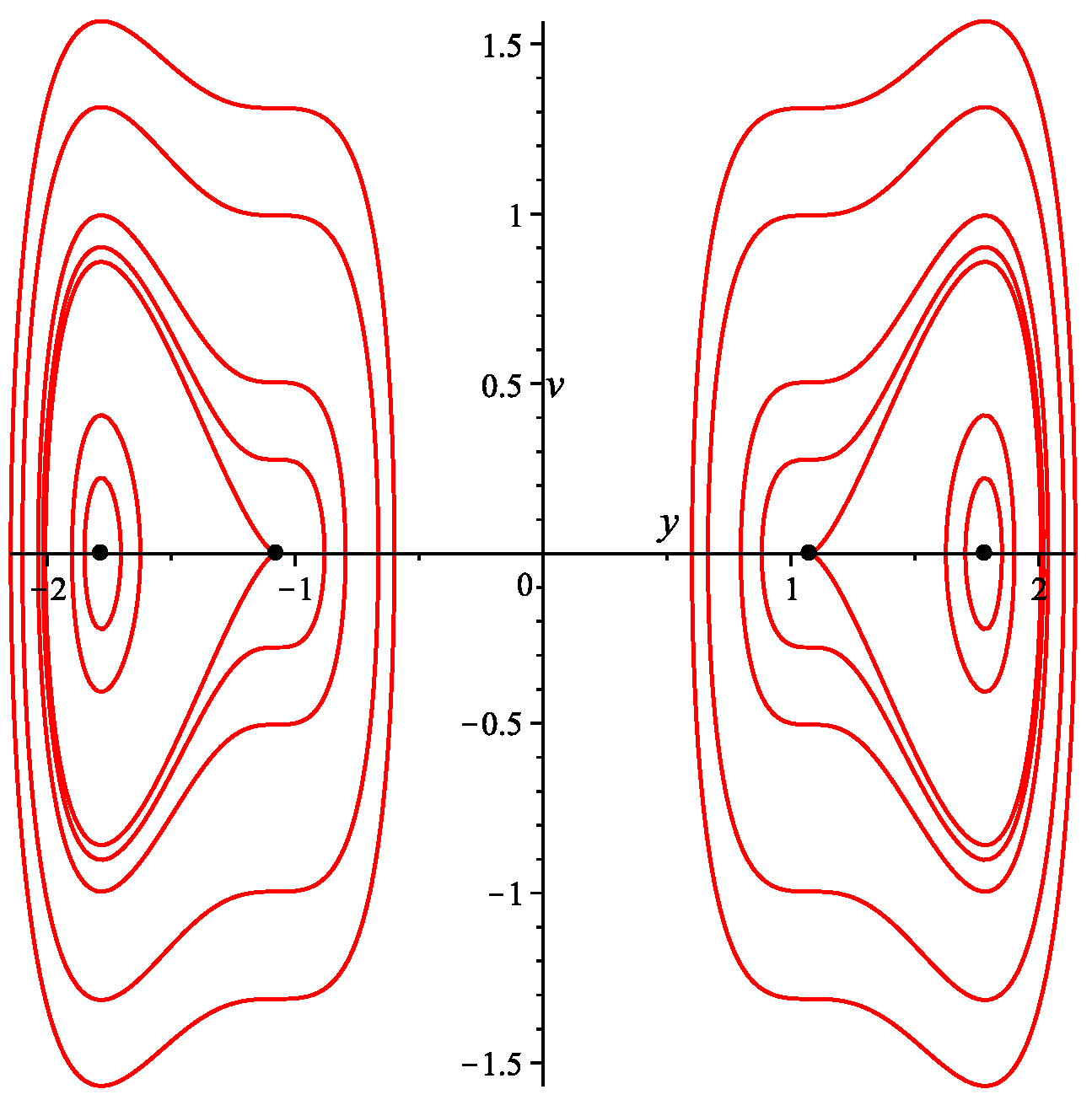
Based on the control parameter values, the sign of the discriminant (18) and the values of , there exist the following combinations of roots of Equation (16) (in particular, we are interested in the positive ones, due to the nature of the substitution ):
All the above cases do not include degenerate equilibria, since for , we must have .
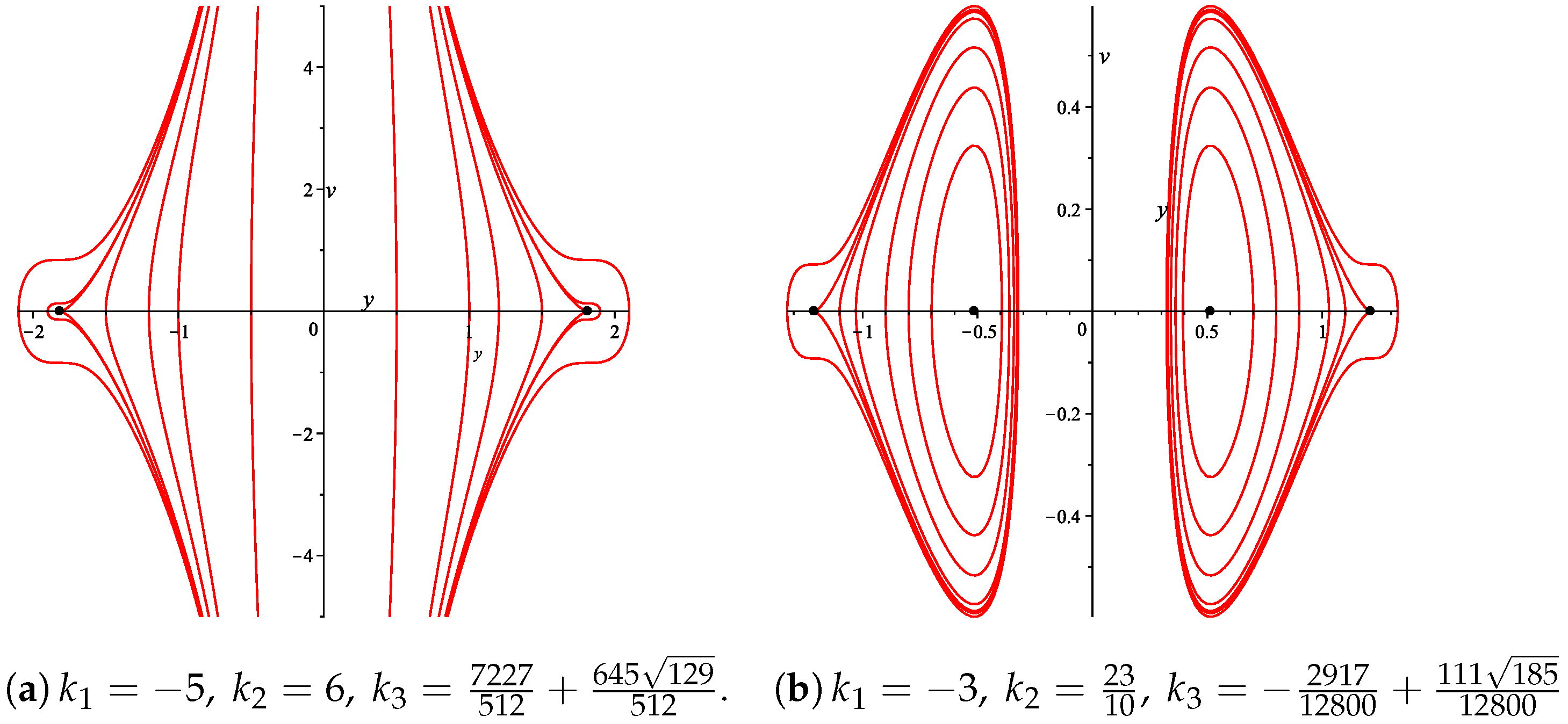
The degenerate cases can show the parameter values at which solitary-wave solutions vanish. For instance, Figure 2b and Figure 3a show how the phase plane may transform from having four solitary waves represented by homoclinic orbits to two solitary waves. Cases where degenerate equilibria exist and are as follows:
- . Two zero roots and two roots that are real if .
- and . At the root of Equation (16), has a zero derivative; therefore, the equilibrium points are degenerate provided that . There may exist one additional positive root of (16) depending on the parameter values, making it either two equilibria (Figure 4a) or four equilibria for system (10) (Figure 4b).
4. Periodic and Solitary Waves of Equation (1) at
The solution of Equation (6) in the general case cannot be presented in the form of quadratures. However, this integral can be calculated in a number of partial cases. Equation (6) at can be written as follows:
To simplify Equation (20), we introduce a new variable (see [33,34,35])
we obtain
where , and are determined by formulas
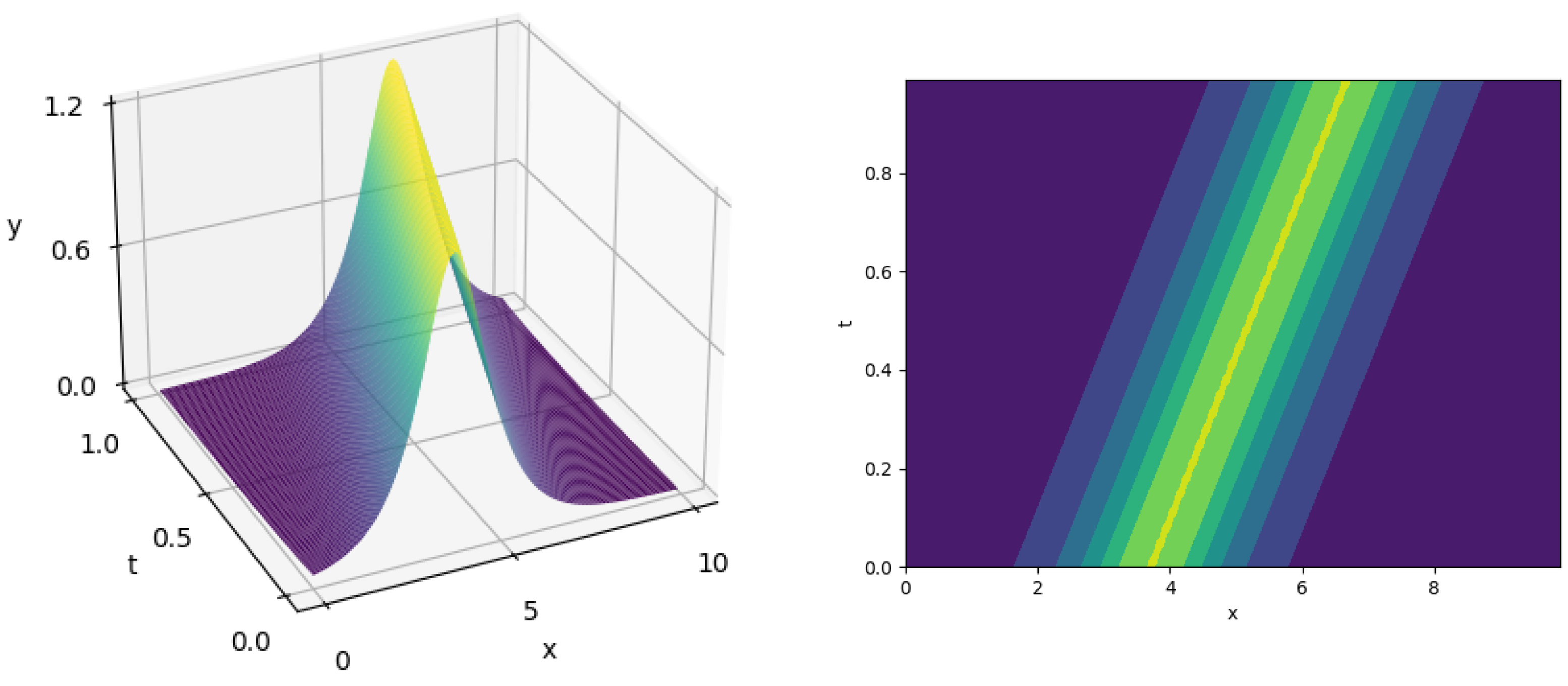
At and , the solution of Equation (20) is the solitary wave of the form
where is an arbitrary constant. Solution is expressed by the formula
The solitary wave for can be written as follows:
Here, the function is found as a result of solving Equation (5)
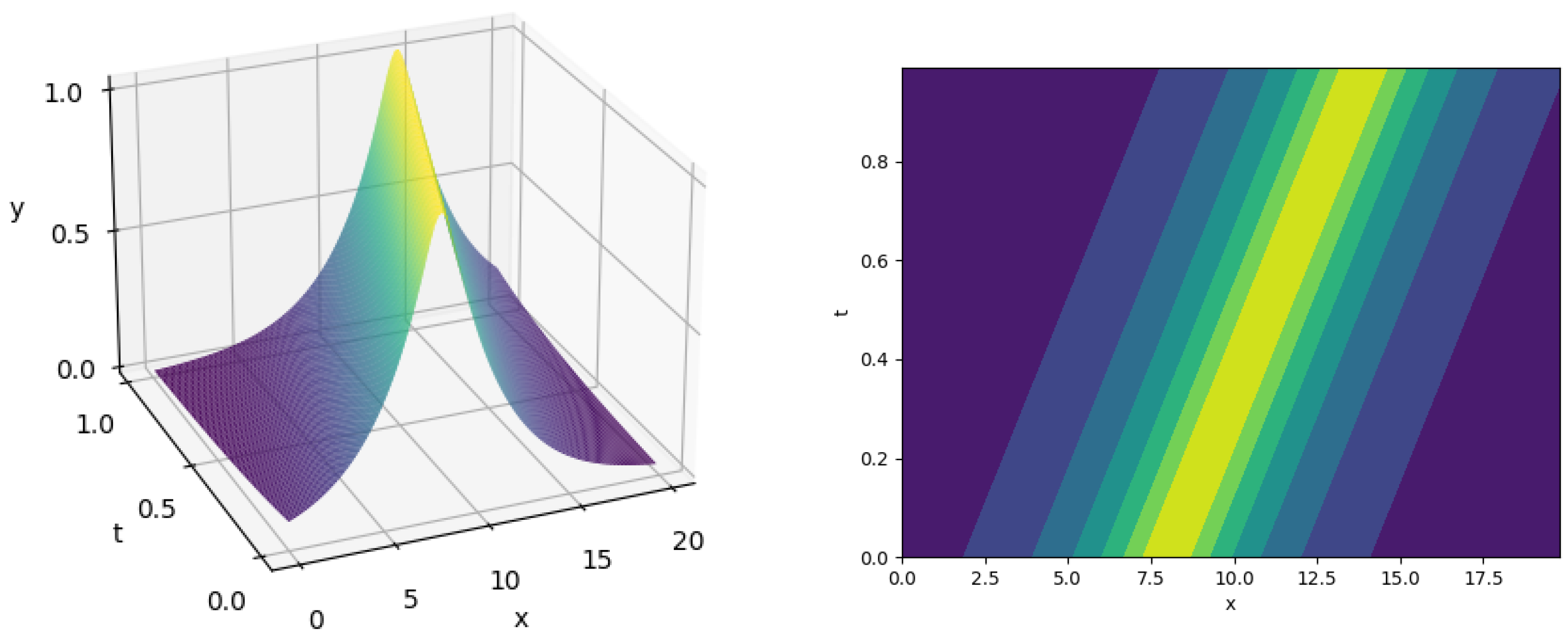
Figure 5.
Solution (25) at and .
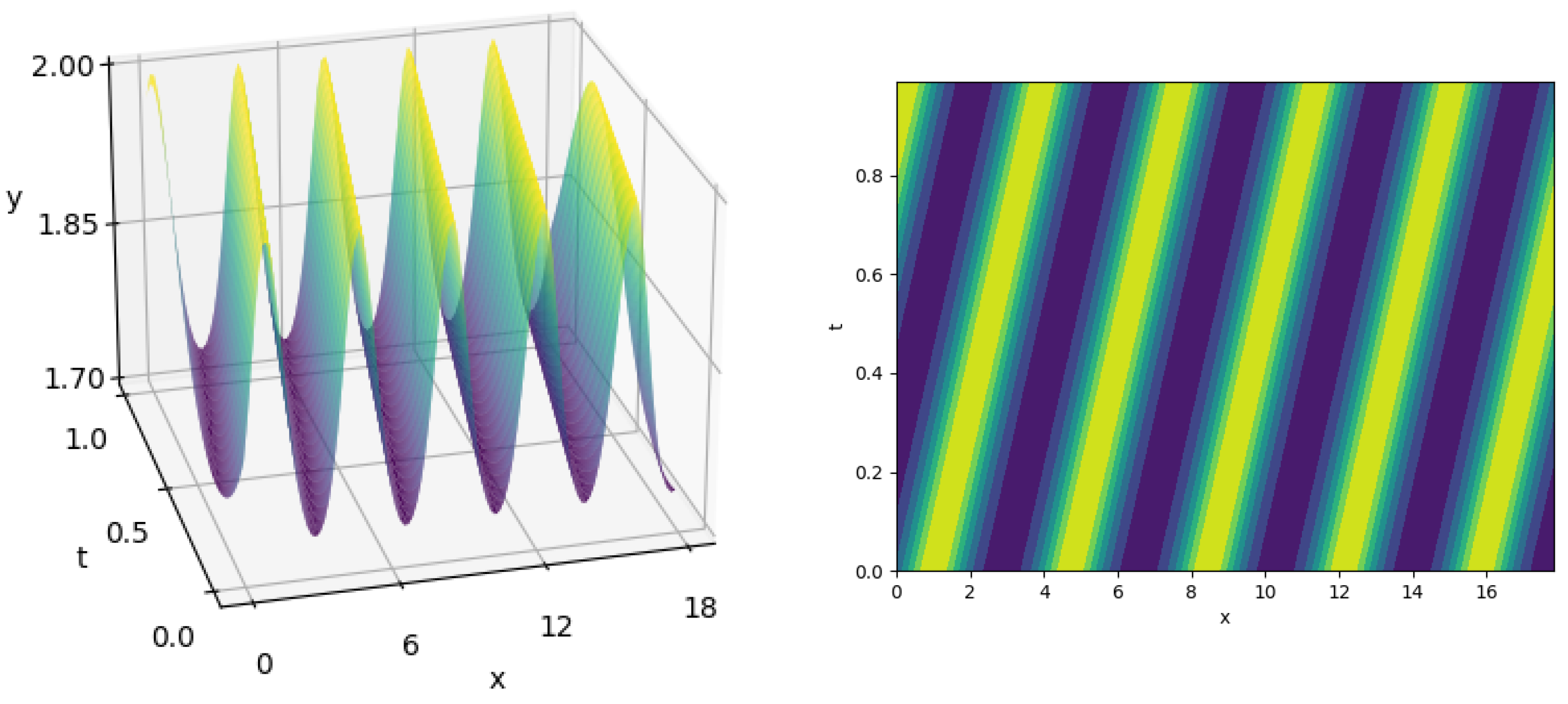
The general solution of Equation (20) can be found by taking into account the Jacobi elliptic function. It is well known that the solution of Equation (20) is expressed in terms of elliptic Jacobi or Weierstrass functions. The general solution at and of Equation (20) takes the form
provided that the following equation
has four real roots , , and .
Values and are given by formulas
and
The periodic solution of Equation (1) at is determined by Formula (2), taking into account (28).
Figure 6.
Solution (28) at and .
5. General Solution of Equation (6) at
Equation (6) at takes the form
Let us assume that the following conditions in Equation (32) are satisfied:
Substituting a new variable in Equation (32)
yields the following equation
Equation (35) can be written in the following form
where N and R are determined by formulas
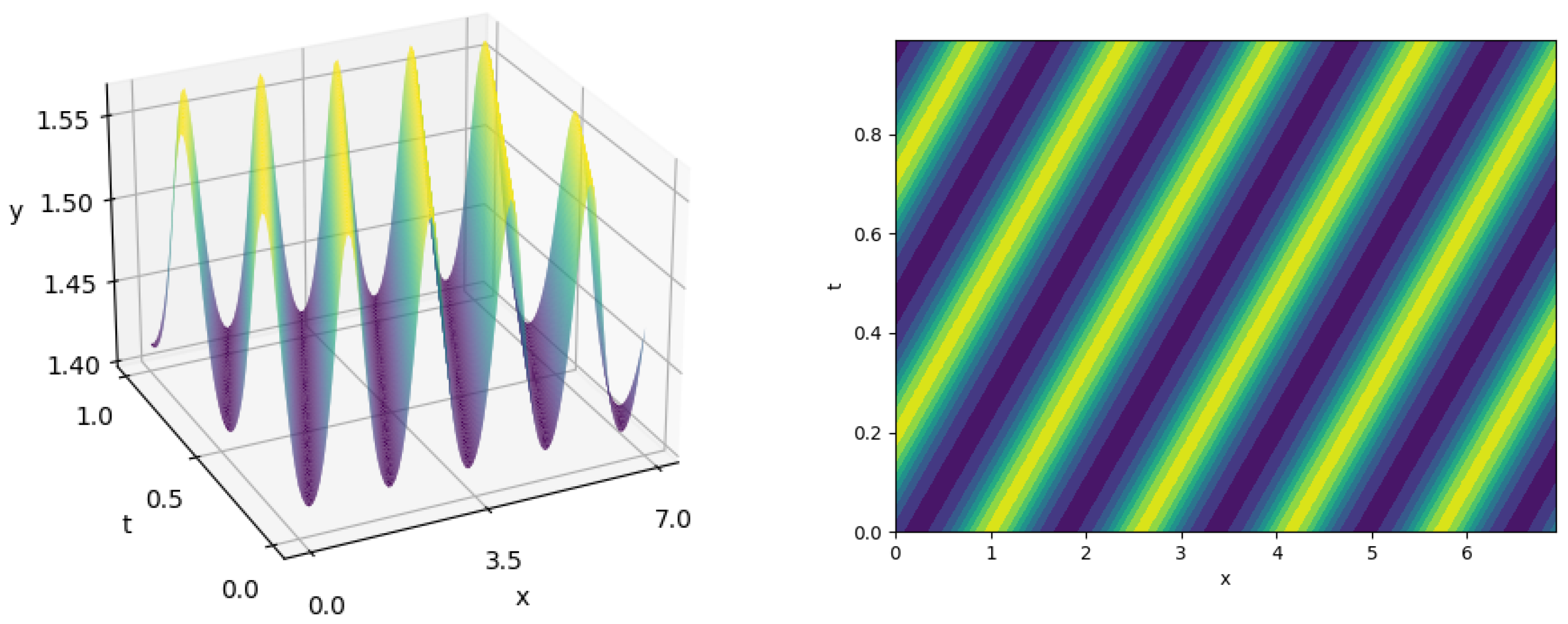
The general solution of Equation (36) is also expressed via the elliptic function
provided that the following equation
has three real roots and . The values and are determined by formulas
and
Figure 7.
Solution (43) at and .
At , we have the solitary-wave solution of Equation (35) of the form
and the solution of Equation (32) of the form
Solution (45) allows us to find the solution of Equation (1) by Formula (2).
Figure 8.
Solution (45) at and .
6. Exact Solutions of Equation (1) at an Arbitrary
There are solitary-wave solutions with additional conditions on the parameters of Equation (6) at an arbitrary value of m. Assuming
we have Equation (6) in the form
Using the new variable
we obtain the equation
where
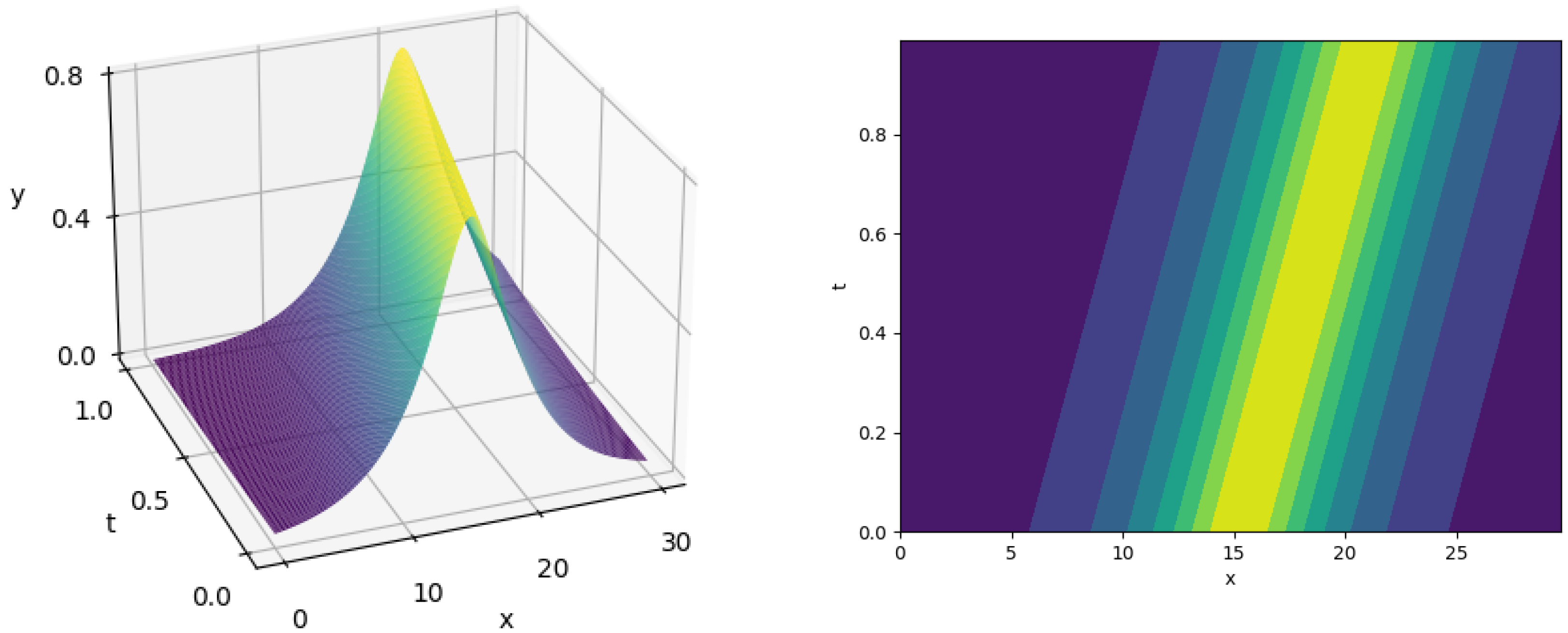
The solution of Equation (49) is the solitary-wave solution of the form
The solution of Equation (47) is
Figure 9.
Solution (52) at and .
7. Conservation Laws Corresponding to Equation (1)
Conservation laws are important characteristics of partial differential equations, which are especially useful in practical applications for numerical schemes testing. In this section, we find three conservation laws corresponding to Equation (1). In order to look for these laws, we write Equation (1) as the system of equations of the form (see, for example, [36])
and
Firstly, let us find the first conservation law of Equation (53). With this aim, we multiply Equation (53) by and Equation (54) by and then add these equations. As a result, we obtain the following equality:
where and are as follows:
In order to obtain the second conservation law, we use a similar approach to the first law. Differentiating Equations (53) and (54) with respect to x, multiplying the first equation by and the second equation by q, and then adding them yields
where is as follows:
Multiplying Equation (53) by and adding Equation (54) multiplied by , where , yields
where is as follows:
Adding Equation (57) and Equation (59) at and Equation (59) at , we have the second conservation law of the form
where and are as follows:
In order to obtain the third conservation law, we apply a similar approach. With this aim, we multiply Equation (53) by and Equation (54) by and then add these equations. As a result, we obtain the following equality:
In the case ,
At the next step, we obtain
As a result, we obtain the following equality:
where and are as follows:
Differentiating Equations (53) and (54) with respect to x and then multiplying the first equation by and the second equation by , we have
Further, we take into account the following equality:
8. Conservation Quantities
Let us consider Solution (26) and find conservation quantities for it.
Let us consider the following integrals:
where .
The density gives the conservative quantity for the first solution (26) of the form
where expression (5) is taken into account.
The density gives the conservative quantity for the first solution (26)
where expression (5) is taken into account.
Let us consider solution (52) and find the conservation quantities for it. Let us consider the following integral
The density gives the conservative quantity for solution (52) of the form
The density gives the conservative quantity for solution (52)
From the condition (46), we receive , and for , there exists a restriction . Thus, for , we have .
Density provides the conservative quantity for solution (52) of the form
The conservative quantities and correspond to the power, impulse and energy of the solitary wave, respectively.
9. Conclusions
In this paper, we have considered the generalized Gerdjikov–Ivanov Equation (1) in the case of arbitrary value m. Equation (1) does not pass the Painlevé test and the Cauchy problem cannot be solved for this equation by the inverse scattering transform. Therefore, we have studied this equation using the traveling wave reduction. We have found the first integral of the nonlinear ordinary differential equation and have presented the classification of the phase portraits corresponding to that equation. Taking into account the classification results, we have obtained the periodic- and solitary-wave solutions of the differential equation at various values m. We have constructed the conservation laws corresponding to Equation (1) by means of direct calculations and have calculated its conserved quantities. The three integrals of motion obtained correspond to the conservation of the power, the momentum and the energy of the optical soliton. These obtained theoretical results can be useful for practical applications as they are helpful in testing whether numerical schemes for partial differential equations are conservative.
Author Contributions
N.A.K.: Conceptualization, Supervision, Idea, Calculations—Section 2, Section 4, Section 5 and Section 6, Writing—Draft. D.R.N.: Checking, Calculations—Section 7 and Section 8. S.F.L.: Writing—Editing, Calculations—Section 4. All authors have read and agreed to the published version of the manuscript.
Funding
This research was supported by the Russian Science Foundation, grant no. 23-41-00070, https://rscf.ru/en/project/23-41-00070/.
Data Availability Statement
Data is contained within the article.
Conflicts of Interest
The authors declare no conflict of interest.
References
- Gerdjikov, V.S.; Ivanov, M.I. Expansions over the squared solutions and inhomgeneous nonlinear Schrodinger equation. Inverse Probl. 1992, 8, 831–847. [Google Scholar] [CrossRef]
- Zahran, E.H.M.; Bekir, A. New unexpected explicit optical soliton solutions to the perturbed Gerdjikov-Ivanov equation. J. Opt. 2023, 52, 1142–1147. [Google Scholar] [CrossRef]
- Farahat, S.E.; Shazly, E.E.; El-Kalla, I.L.; Kader, A.A. Bright, dark and kink exact soliton solutions for perturbed Gerdjikov-Ivanov equation with full nonlinearity. Optik 2023, 277, 170688. [Google Scholar] [CrossRef]
- Onder, I.L.; Secer, A.; Ozisik, M.; Bayram, M. Investigation of optical soliton solutions for the perturbed Gerdjikov-Ivanov equation with full-nonlinearity. Heliyon 2023, 9, 2. [Google Scholar] [CrossRef] [PubMed]
- Ali, K.K.; Tarla, S.; Sulaiman, T.A.; Yilmazer, R. Optical solitons to the Perturbed Gerdjikov-Ivanov equation with quantic nonlinearity. Opt. Quant. Electron. 2023, 55, 2. [Google Scholar] [CrossRef]
- Tang, M.Y. Exact chirped solutions of the perturbed Gerdjikov-Ivanov equation with spatio-temporal dispersion. Zeitschrift für Naturforschung A 2023, 78, 8. [Google Scholar] [CrossRef]
- Younis, M.; Bilal, M.; Rehman, S.U.; Seadawy, A.R.; Rizvi, S.T.R. Perturbed optical solitons with conformable time-space fractional Gerdjikov-Ivanov equation. Math. Sci. 2022, 16, 431–443. [Google Scholar] [CrossRef]
- Yang, D. New solitons and bifurcations for the generalized Gerdjikov-Ivanov equation in nonlinear fiber optics. Optik 2022, 264, 169394. [Google Scholar] [CrossRef]
- Yidirim, Y.; Biswas, A.; Alshehri, H.M.; Belic, M.R. Cubic-quartic optical soliton perturbation with Gerdjikov-Ivanov equation by sine-Gordon equation approach. Optoelectron. Adv. Mat. 2022, 16, 236–242. [Google Scholar]
- Al-Kalbani, K.K.; Al-Ghafri, K.S.; Krishnan, E.V.; Biswas, A. Solitons and modulation instability of the perturbed Gerdjikov-Ivanov equation with spatio-temporal dispersion. Chaos Soliton Fract. 2021, 153, 111523. [Google Scholar] [CrossRef]
- Lu, P.H.; Wang, Y.Y.; Dai, C.Q. Abundant fractional soliton solutions of a space-time fractional perturbed Gerdjikov-Ivanov equation by a fractional mapping method. Chin. J. Phys. 2021, 74, 96–105. [Google Scholar] [CrossRef]
- Xiao, X.; Yin, Z. Exact single travelling wave solutions to the fractional perturbed Gerdjikov-Ivanov equation in nonlinear optics. Mod. Phys. Lett. B 2021, 35, 22. [Google Scholar] [CrossRef]
- Muniyappan, A.; Monisha, P.; Nivetha, V. Generation of wing-shaped dark soliton for perturbed Gerdjikov-Ivanov equation in optical fibre. Optik 2021, 230, 166328. [Google Scholar] [CrossRef]
- Kudryashov, N.A. Traveling wave solutions of the generalized Gerdjikov-Ivanov equation. Optik 2020, 219, 165193. [Google Scholar] [CrossRef]
- Li, C.; Li, G.; Chen, L. Fractional optical solitons of the space-time perturbed fractional Gerdjikov-Ivanov equation. Optik 2020, 224, 165638. [Google Scholar] [CrossRef]
- Hosseini, K.; Mirzazadeh, M.; Ilie, M.; Radmehr, S. Dynamics of optical solitons in the perturbed Gerdjikov-Ivanov equation. Optik 2020, 206, 164350. [Google Scholar] [CrossRef]
- Guo, L.; Zhang, Y.; Xu, S.; Wu, Z.; He, J. The higher order rogue wave solutions of the Gerdjikov-Ivanov equation. Phys. Scr. 2014, 89, 035501. [Google Scholar]
- Zhang, J.B.; Gongye, Y.Y.; Chen, S.T. Soliton solutions to the coupled Gerdjikov-Ivanov equation with rogue-wave-like phenomena. Chin. Phys. Lett. 2017, 34, 090201. [Google Scholar] [CrossRef]
- He, B.; Meng, Q. Bifurcations and new exact travelling wave solutions for the Ggerdjikov-Ivanov equation. Commun. Nonlinear. Sci. 2010, 15, 1783–1790. [Google Scholar] [CrossRef]
- Biswas, A.; Yildirim, Y.; Yaşar, E.; Babatin, M. Conservation laws for Gerdjikov-Ivanov equation in nonlinear fiber optics and pcf. Optik 2017, 148, 209–214. [Google Scholar] [CrossRef]
- Biswas, A.; Ekici, M.L.; Sonmezoglu, A.; Triki, H.; Alshomrani, A.S.; Zhou, Q.; Moshokoa, S.P.; Belic, M. Optical solitons for Gerdjikov-Ivanov model by extended trial equation scheme. Optik 2018, 157, 1241–1248. [Google Scholar] [CrossRef]
- Ding, C.C.; Gao, Y.T.; Li, L.Q. Breathers and rogue waves on the periodic background for the Gerdjikov-Ivanov equation for the alfvén waves in an astrophysical plasma. Chaos Soliton Fract. 2019, 120, 259–265. [Google Scholar] [CrossRef]
- Biswas, A.; Yildirim, Y.; Yasar, E.; Triki, H.; Alshomrani, A.S.; Ullah, M.Z.; Zhou, Q.; Moshokoa, S.P.; Belic, M. Optical soliton perturbation with full nonlinearity for Gerdjikov-Ivanov equation by trial equation method. Optik 2018, 157, 1214–1218. [Google Scholar] [CrossRef]
- Biswas, A.; Yildirim, Y.; Yasar, E.; Triki, H.; Alshomrani, A.S.; Ullah, M.Z.; Zhou, Q.; Moshokoa, S.P.; Belic, M. Optical soliton perturbation with Gerdjikov-Ivanov equation by modified simple equation method. Optik 2018, 157, 1235–1240. [Google Scholar] [CrossRef]
- Arshed, S.; Biswas, A.; Abdelaty, M.; Zhou, Q.; Moshokoa, S.P.; Belic, M. Optical soliton perturbation for Gerdjikov-Ivanov equation by extended trial equation method. Optik 2018, 158, 747–752. [Google Scholar]
- Arshed, S.; Biswas, A.; Abdelaty, M.; Zhou, Q.; Moshokoa, S.P.; Belic, M. Optical soliton perturbation for Gerdjikov-Ivanov equation via two analytical techniques. Chin. J. Phys. 2018, 56, 2879–2886. [Google Scholar] [CrossRef]
- Arshed, S. Two reliable techniques for the soliton solutions of perturbed Gerdjikov-Ivanov equation. Optik 2018, 164, 93–99. [Google Scholar] [CrossRef]
- Yildirim, Y. Optical solitons to Gerdjikov-Ivanov equation in birefringent fibers with trial equation integration architecture. Optik 2019, 182, 349–355. [Google Scholar] [CrossRef]
- Yildirim, Y. Optical solitons of Gerdjikov-Ivanov equation in birefringent fibers with modified simple equation scheme. Optik 2019, 182, 424–432. [Google Scholar] [CrossRef]
- Yildirim, Y. Optical solitons of Gerdjikov-Ivanov equation with four-wave mixing terms in birefringent fibers using trial equation scheme. Optik 2019, 182, 1163–1169. [Google Scholar] [CrossRef]
- Ismael, H.F.; Baskonus, H.M.; Bulut, H.; Gao, W. Instability modulation and novel optical soliton solutions to the Gerdjikov-Ivanov equation with M-fractional. Opt. Quantum Electron. 2023, 55, 303. [Google Scholar] [CrossRef]
- Kudryashov, N.A.; Lavrova, S.F. Painlevé Test, Phase Plane Analysis and Analytical Solutions of the Chavy–Waddy–Kolokolnikov Model for the Description of Bacterial Colonies. Mathematics 2023, 11, 3203. [Google Scholar] [CrossRef]
- Kudryashov, N.A. A generalized model for description of propagation pulses in optical fiber. Optik 2019, 189, 42–52. [Google Scholar] [CrossRef]
- Kudryashov, N.A. Implicit solitary waves for one of the generalized nonlinear Schrödinger equations. Mathematics 2021, 9, 3024. [Google Scholar] [CrossRef]
- Kudryashov, N.A. Method for finding highly dispersive optical solitons of nonlinear differential equations. Optik 2020, 206, 163550. [Google Scholar] [CrossRef]
- Kudryashov, N.A.; Nifontov, D.R. Conservation laws and Hamiltonians of the mathematical model with unrestricted dispersion and polynomial nonlinearity. Chaos Solitons Fract. 2023, 175, 114076. [Google Scholar] [CrossRef]
Disclaimer/Publisher’s Note: The statements, opinions and data contained in all publications are solely those of the individual author(s) and contributor(s) and not of MDPI and/or the editor(s). MDPI and/or the editor(s) disclaim responsibility for any injury to people or property resulting from any ideas, methods, instructions or products referred to in the content. |
© 2023 by the authors. Licensee MDPI, Basel, Switzerland. This article is an open access article distributed under the terms and conditions of the Creative Commons Attribution (CC BY) license (https://creativecommons.org/licenses/by/4.0/).