1. Introduction
The constructive role of noise in processes related to various branches of natural science attracts the attention of many researchers. In mathematical models with strong nonlinearity, even small noise can cause qualitative changes in dynamic behavior [
1]. Here, one can note such phenomena as noise-induced transitions [
2,
3], stochastic bifurcations [
4], noise-induced order-chaos transformations [
5,
6], stochastic complexity [
7], stochastic and coherence resonance [
8,
9,
10]. Among such phenomena, stochastic excitability [
11] occupies a special place. This phenomenon is associated with a sharp increase in the amplitude of deviation from the equilibrium when a certain threshold level of noise intensity is reached. Stochastic excitability has been actively studied in models of neural activity, electronic generators, population and climate dynamics [
9,
11,
12,
13,
14]. This article is devoted to the study of this phenomenon in the processes of thermochemical kinetics.
The case when random disturbances are modeled by Gaussian white noise has been the subject of many investigations. Thermokinetic processes, where the Gaussian white noise models random fluctuations of temperature and concentration of reagents in the reactor, were studied in [
15,
16]. However, it is known that uncorrelated white noise being an idealization of real disturbances is not always realistic. To take into account temporal correlation of random forcing, one should use a model of colored noise where the characteristic time defines the decay of the correlation function [
17]. It should be noted that specific stochastic effects caused by colored noise have been found and investigated in different branches of natural science (see, e.g., [
18,
19,
20,
21,
22,
23]). This paper aims to study a specific role of colored noise for stochastic excitement in thermochemical processes. The novelty of this paper is related to the study of how the phenomenon of stochastic excitement is associated with the correlation time parameter of colored noise. To find resonances, we use the new mathematical tool associated with the technique of stochastic sensitivity and the geometric apparatus of confidence domains [
24].
In
Section 2, we briefly discuss bifurcations and variety of dynamic regimes in the initial deterministic model. In
Section 3, we study a stochastic variant of this model with colored parametric noise in the temperature of the reactor. Here, the phenomenon of noise-induced excitement is studied by means of stochastic bifurcations, interspike intervals, and exit probability. Possible resonances under variation of correlation time are discussed. To analyze the colored-noise-induced excitement, we apply stochastic sensitivity technique in
Section 4.
2. Deterministic Model
In this paper, as an initial deterministic skeleton, we consider a dimensionless model of the first-order thermochemical reaction in a continuous stirred tank reactor [
25]:
Here,
x and
y are dimensionless reactant concentration and reactor temperature. In Model (
1), function
characterizes the nonlinear interaction of system variables. Positive parameters of the model define recycling (
l), heat of reaction (
B), and heat transfer (
). In (
1), parameter
D is the Damköhler number. Following [
25,
26], we fix
and consider
as the bifurcation parameter.
Even small variation of
causes qualitative changes in System (
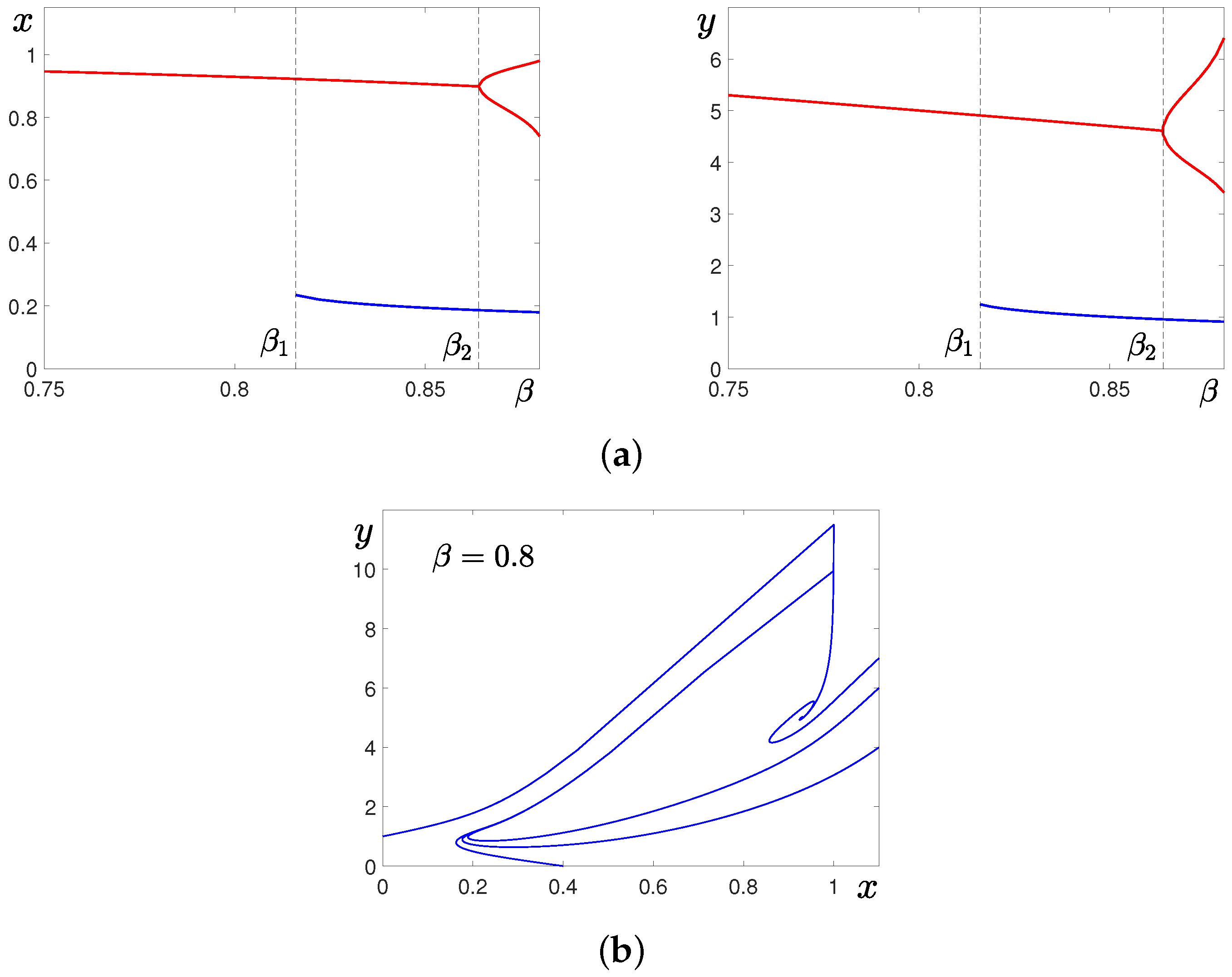
1) dynamic behavior. These changes are well seen in the bifurcation diagram (see
Figure 1a) where extrema of
x- and
y-coordinates of System (
1) attractors are plotted. Here, bifurcation values arBe
. In the bifurcation diagram, attractors with the higher temperature (hot attractors) are shown in red and attractors with the lower temperature (cold attractors) are plotted in blue.
For
, the hot attractor is a stable equilibrium, and for
this is a stable limit cycle. The cold attractor exists only in the equilibrium form for
. Therefore, for
, the system exhibits the hot equilibrium only. An example of the phase portrait for
is shown in
Figure 1b. Here, two types of transient processes are observed. Indeed, if the trajectory starts in the subthreshold zone, the solution of System (
1) immediately tends to equilibrium. The superthreshold zone in the phase plane corresponds to the initial data of solutions with large-amplitude outbreaks: the trajectory first moves away from the stable equilibrium and, before approaching it, shows a fragment of the phase trajectory that is very far from the equilibrium.
From the deterministic point of view, oscillatory modes, associated with limit cycles, exist only for
. It is well known that oscillations induced by noise can be observed in the bistability zone
where the deterministic system possesses two coexisting stable equilibria. Such large-amplitude stochastic oscillations are caused by noise-induced transitions between basins of these equilibria. However, in the monostability zone
, where System (
1) possesses the only stable equilibrium
H, noise-induced large-amplitude oscillations also can occur. This paper aims to study this effect of stochastic excitement and elucidate its underlying mechanisms.
3. Noise-Induced Excitement, Stochastic Bifurcations, and Resonance
As a stochastic version of Model (
1), we consider the following system:
Here, we study an impact of random fluctuations in parameter
. The stochastic forcing
of intensity
is modeled by colored noise
with characteristics
where parameter
is defined by the correlation time
. Here and further,
denotes a mean value.
In our paper, we model such colored noise
by the following stochastic equation:
where
is the standard uncorrelated Gaussian white noise with parameters
,
(here,
is the
-function). Therefore, the stochastic term
in System (
2) has the stationary variation
. As a result, the study of two-dimensional System (
2) with colored noise
comes down to the investigation of extended three-dimensional Systems (
2), (
3) with Gaussian white noise
.
We consider how the colored noise can change the equilibrium regime of the thermochemical system under consideration. In our study, we investigate the stochastic response of Systems (
2), (
3) on the variation of noise intensity
and parameter
a of colored noise. In numerical simulations of System (
2), (
3) solutions, we use the Euler–Maruyama scheme with time step 0.001.
First, let us fix
and change parameter
. In
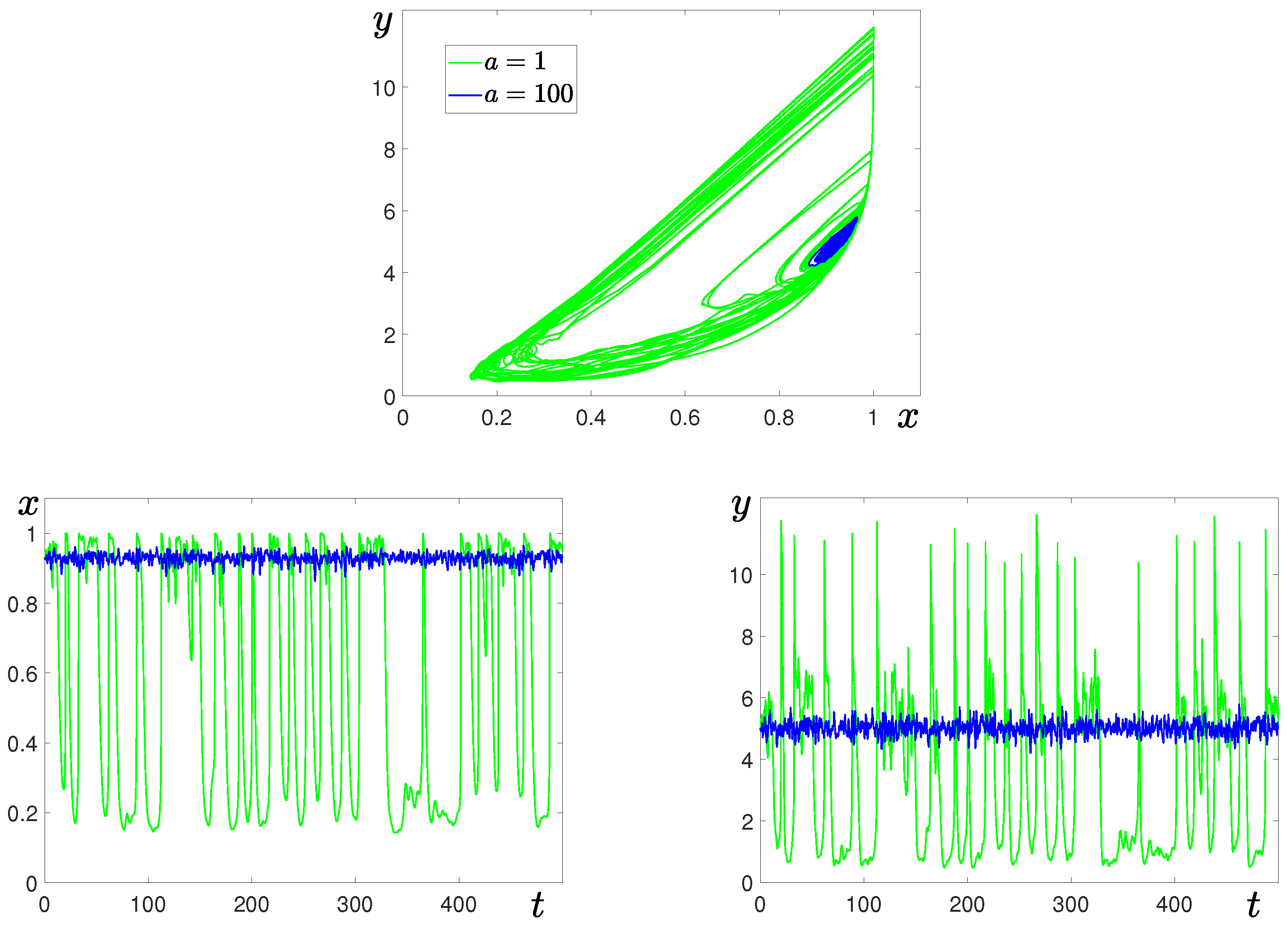
Figure 2, phase trajectories and time series of System (
2) solutions starting at the stable equilibrium
H are plotted. For weak noise
, these solutions (blue) reside in the small vicinity of equilibrium
H. For larger noise, dispersion of random solutions grows, and System (
2) begins to demonstrate large-amplitude stochastic oscillations (see green curves in
Figure 2 for
). We note that these oscillations have a spike shape: concentration
x of the reagent sharply falls down, and temperature
y deviates both up and down. These spikes alternate with the small-amplitude fluctuations near
H. Therefore, the system demonstrates mixed-mode stochastic oscillations.
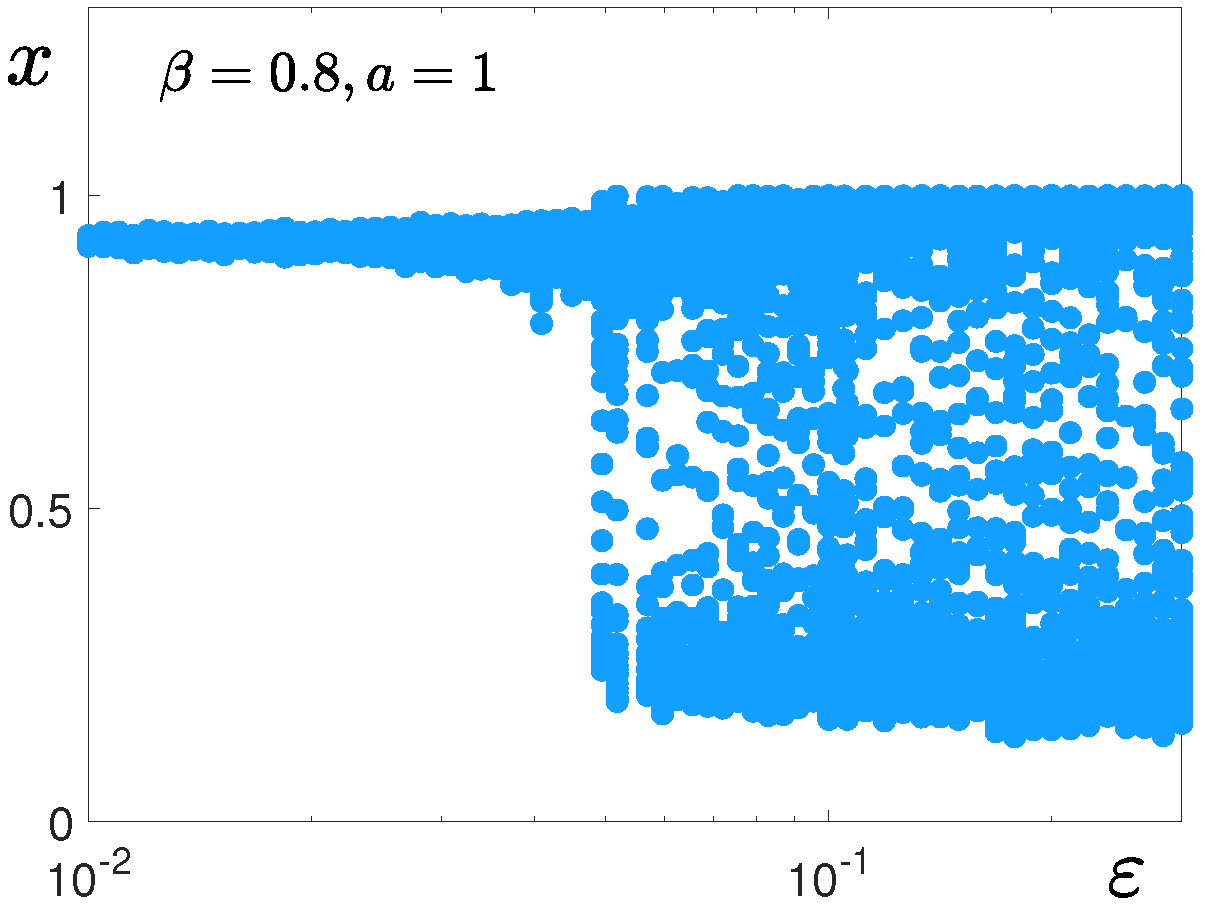
Details of the transformation of random states dispersion with increase in noise intensity
are shown in
Figure 3. Here, an abrupt transition from small- to large-amplitude oscillations is well seen. Such a transition can be explained by geometrical peculiarities of the phase portrait of deterministic Model (
1) (see
Figure 1b). Indeed, for small deviation of the initial state from equilibrium
H (the subthreshold zone in the phase plane), a deterministic solution immediately tends to
H. If the deviation exceeds some threshold, the solution falls into the superthreshold zone, demonstrates a large-amplitude loop far from
H, and only after this excursion approaches equilibrium
H. The abrupt jump in dispersion mentioned above can be explained by the fact that the stochastic solutions transit from the sub- to the superthreshold zone. Therefore, here, with increase in noise intensity
, a phenomenon of the noise-induced excitement is observed.
We consider now how this stochastic phenomenon depends on the correlation properties of the colored noise defined by parameter a. Let us fix and change the correlation parameter a of the colored noise.
In
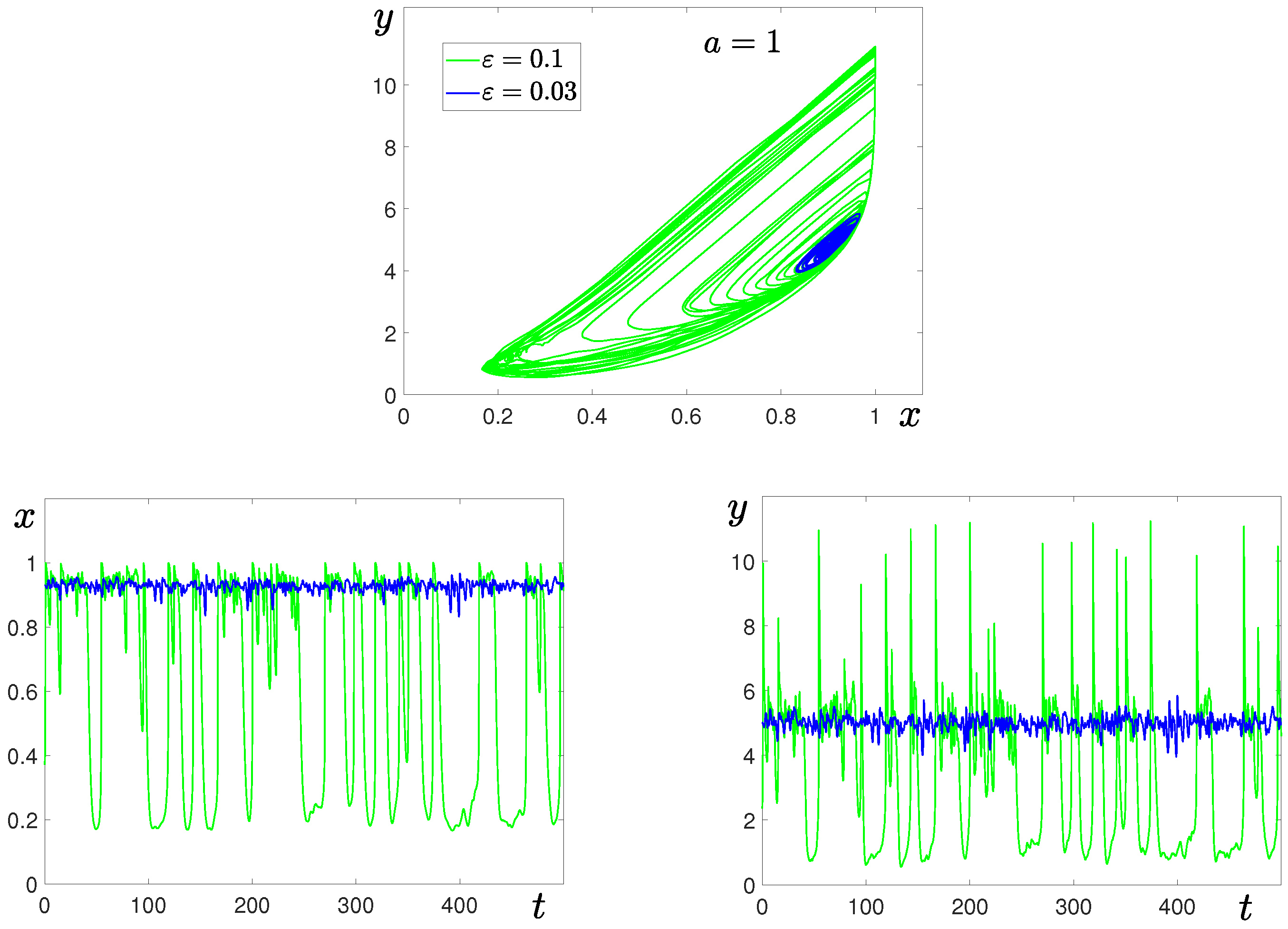
Figure 4, we plot phase trajectories and time series of System (
2) solutions starting at stable equilibrium
H for two values of parameter
a. For
, the noise-induced excitement of large-amplitude stochastic oscillations is observed (see green curves). For
, colored noise with the same intensity
does not cause large-amplitude spikes, and solutions (blue) are located near equilibrium
H.
Details of the dependence of the random state dispersion on parameter
a are shown in
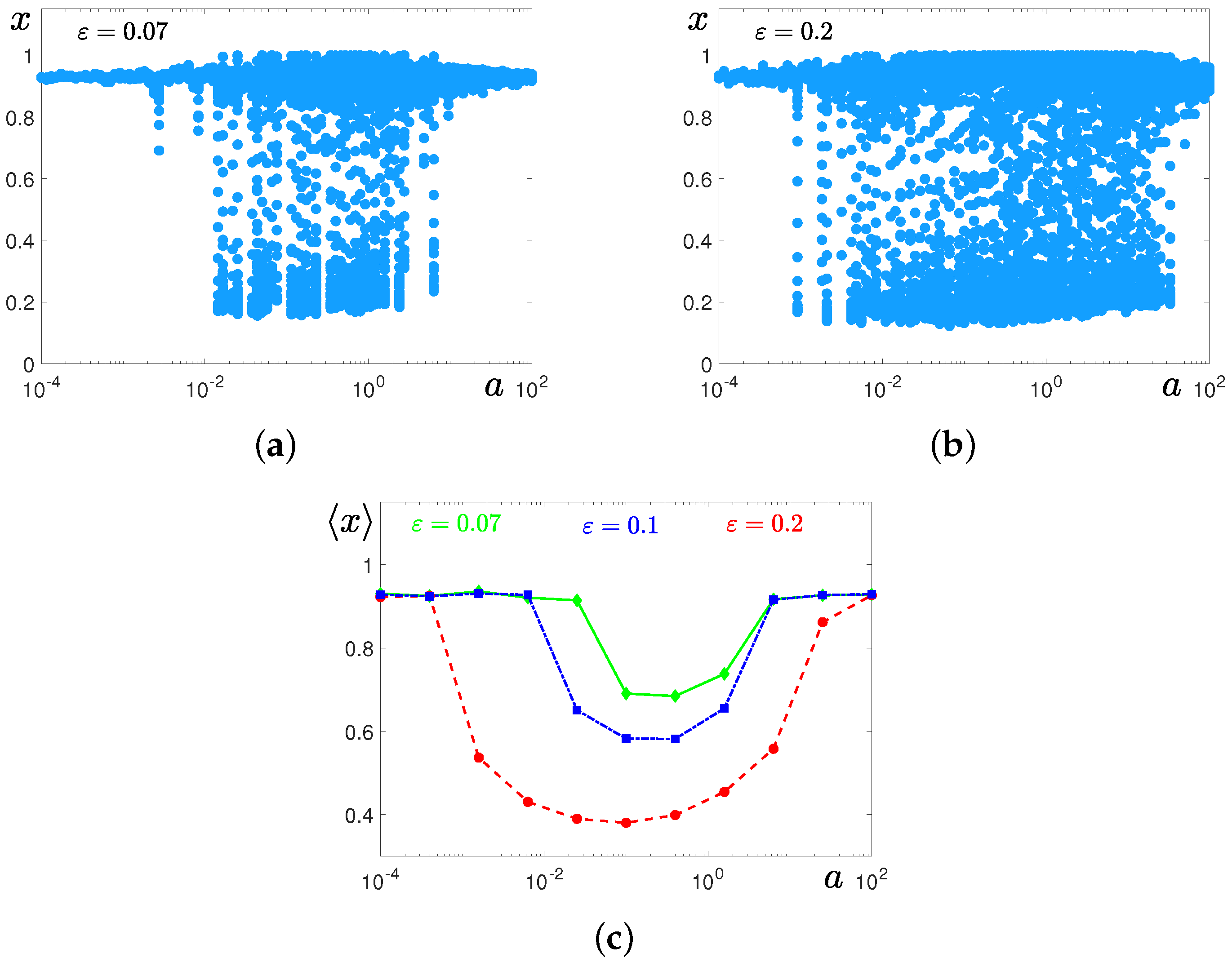
Figure 5. In
Figure 5a, random states of solutions starting at equilibrium
H are plotted for
in the range
. Here, the
a-zone of the stochastic excitement with large-amplitude oscillations is well localized. This
a-parameter zone can be interpreted as a resonance zone. It should be noted that with the change in
a, the transition from small-amplitude noisy oscillations near equilibrium
H to large-amplitude oscillations similar to stochastic cycle is rather sharp.
With increasing noise, the parametric zone of colored-noise-excitement is expanded (compare
Figure 5a for
and
Figure 5b for
).
Results of the statistical analysis of the changes in the random state dispersion are presented in
Figure 5c where plots of mean values
of reagent concentration
x are shown versus correlation parameter
a for three values of noise intensity. It should be noted that the minima of
correspond to the
a values at which the thermokinetic system is the most sensitive to colored noise.
Additional useful statistical information about the strong dependence of the phenomenon of stochastic excitation on correlation parameter
a and noise intensity
can be extracted from
Figure 6 and
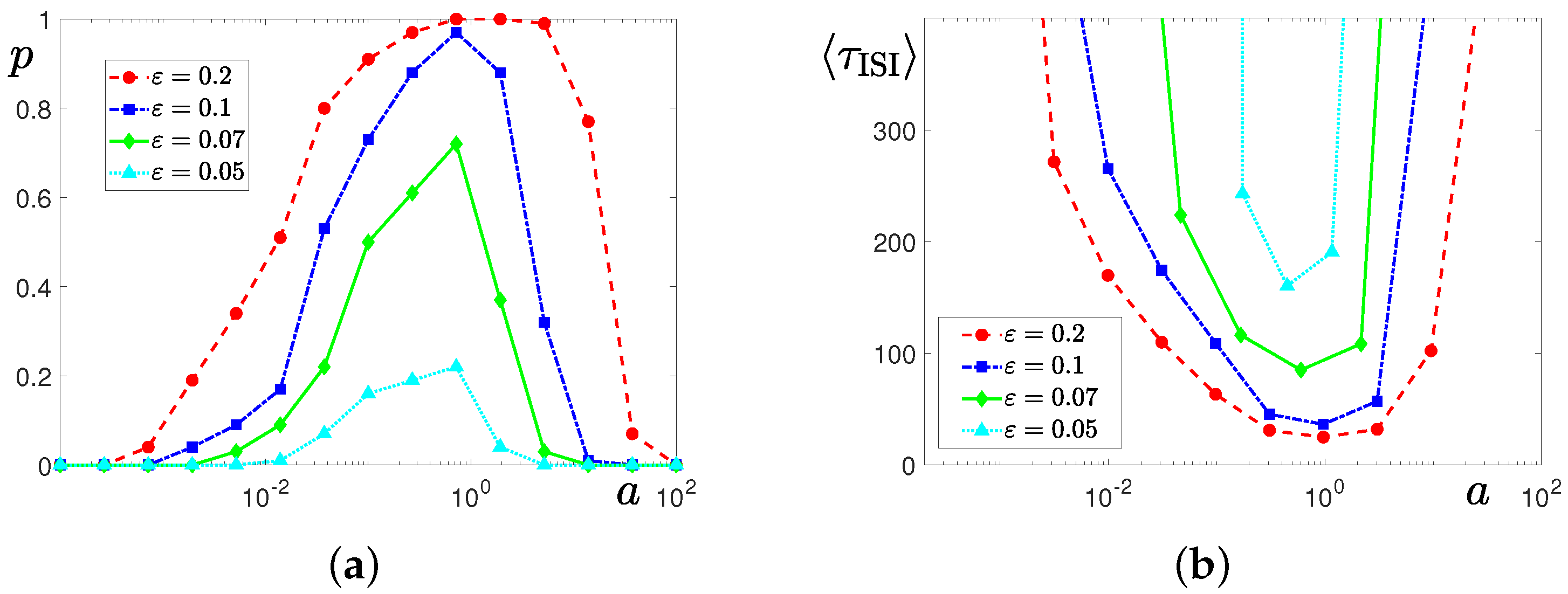
Figure 7. In
Figure 6a, for solutions starting at equilibrium
H, we show plots of function
which determines the exit probability from the subcritical zone during time
. As a threshold, we use
. As can be seen, for considered values of noise intensity
, there are
a-zones where this exit probability is not zero. Moreover, with increase of
, peaks of function
grow, and for
become close to one.
As one can see, the phenomenon of noise-induced excitement is accompanied by the formation of large-amplitude oscillations of a spike type. In the analysis of spiking, statistics on interspike intervals
are key characteristics. Results of the frequency analysis of spike oscillations are shown in
Figure 6b. Here, mean values
of interspike intervals
are plotted versus parameter
a for different noise intensities. For quite small and large
a, spikes are extremely rare, but there exists an active
a-zone where spikes appear and interspike time becomes rather small.
Along with the frequency characteristics of noise-induced excitement, it is interesting to consider spatial deformations of amplitudes of mixed-mode oscillations. As seen in
Figure 2 and
Figure 4, in the mode without excitement, random trajectories are concentrated near the equilibrium, while in the excitement mode an additional zone of concentration of trajectories appears. This zone corresponds to the spike oscillations of large amplitudes.
Let us fix
and consider intersection points of stochastic System (
2) solutions with line
. Here,
is the coordinate of deterministic equilibrium
. We let
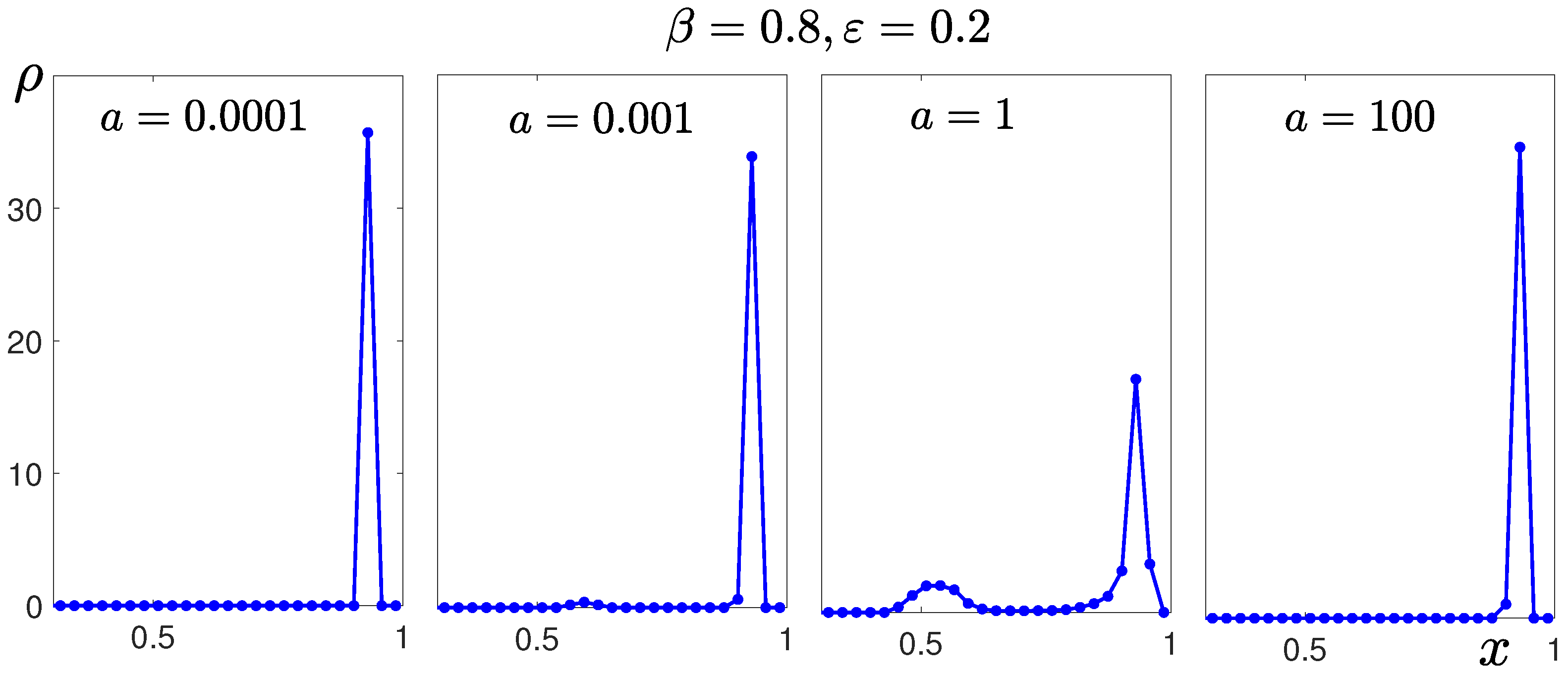
be the probability density of distribution of
x-coordinates of these random points. Details of the qualitative transformation of density
with a change in parameter
a are shown in
Figure 7. Here, plots
are shown for values
,
and
of the parameter of correlation time. For
, function
has a narrow and high peak localized near the stable equilibrium (no excitement). For
, an additional small peak is seen. This new peak reflects the appearance of large-amplitude loops. These two peaks are clearly seen at
. At
, the left peak disappears, leaving only the high right peak above the stable equilibrium.
Thus, with increase in
a, randomly forced System (
2) undergoes stochastic
P-bifurcations [
4] with the qualitative transformation of the shape of
: one-peak→two-peak→one-peak. It should be noted that these results of the analysis of stochastic bifurcations well complement the statistical description of the excitement phenomenon in
Figure 5 and
Figure 6.
In the next Section, we show how the phenomenon of colored-noise-induced excitement can be studied by the analytical stochastic sensitivity function technique and the confidence domain method. Mathematical details of this approach are briefly presented in
Appendix A.
4. Stochastic Sensitivity Analysis
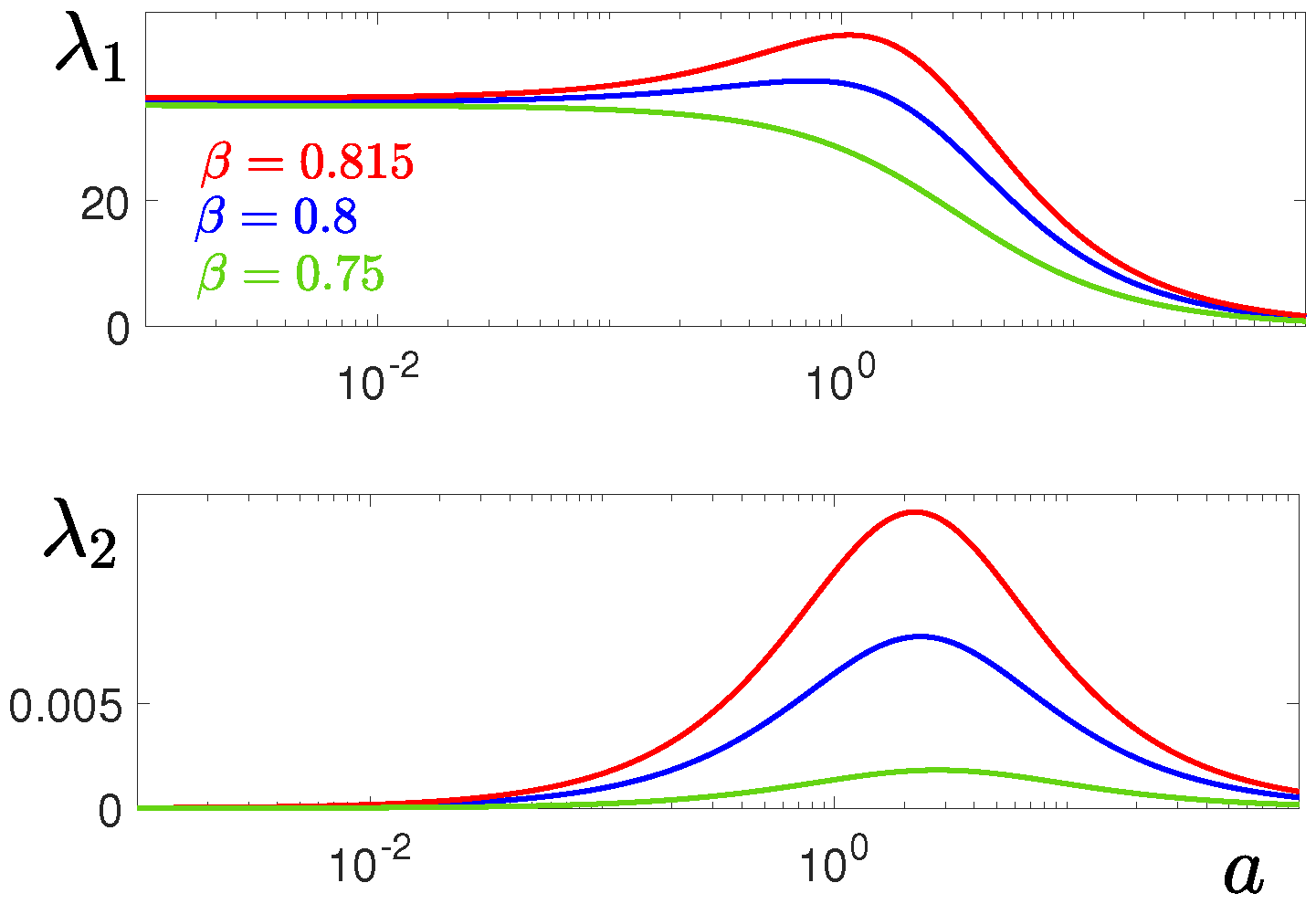
Let us consider how the stochastic sensitivity of equilibrium
H depends on parameter
a. In
Figure 8, eigenvalues
,
(
) of the stochastic sensitivity matrix
W of equilibrium
H in System (
2) are shown versus parameter
a for several values of
. As can be seen,
is significantly larger than
. In the behavior of
,
, one important feature should be underlined. The stochastic sensitivity essentially depends on
a: there is an
a-zone where values
,
, characterizing sensitivity, are high. With further increase in
a, stochastic sensitivity of equilibrium
H sharply decreases.
Variation in the stochastic sensitivity implies changes in the dispersion of random states. To describe the dispersion, we use the method of confidence ellipses. Eigenvalues
and
of the stochastic sensitivity matrix
W are key parameters of the confidence ellipse (see Formula (
A5)).
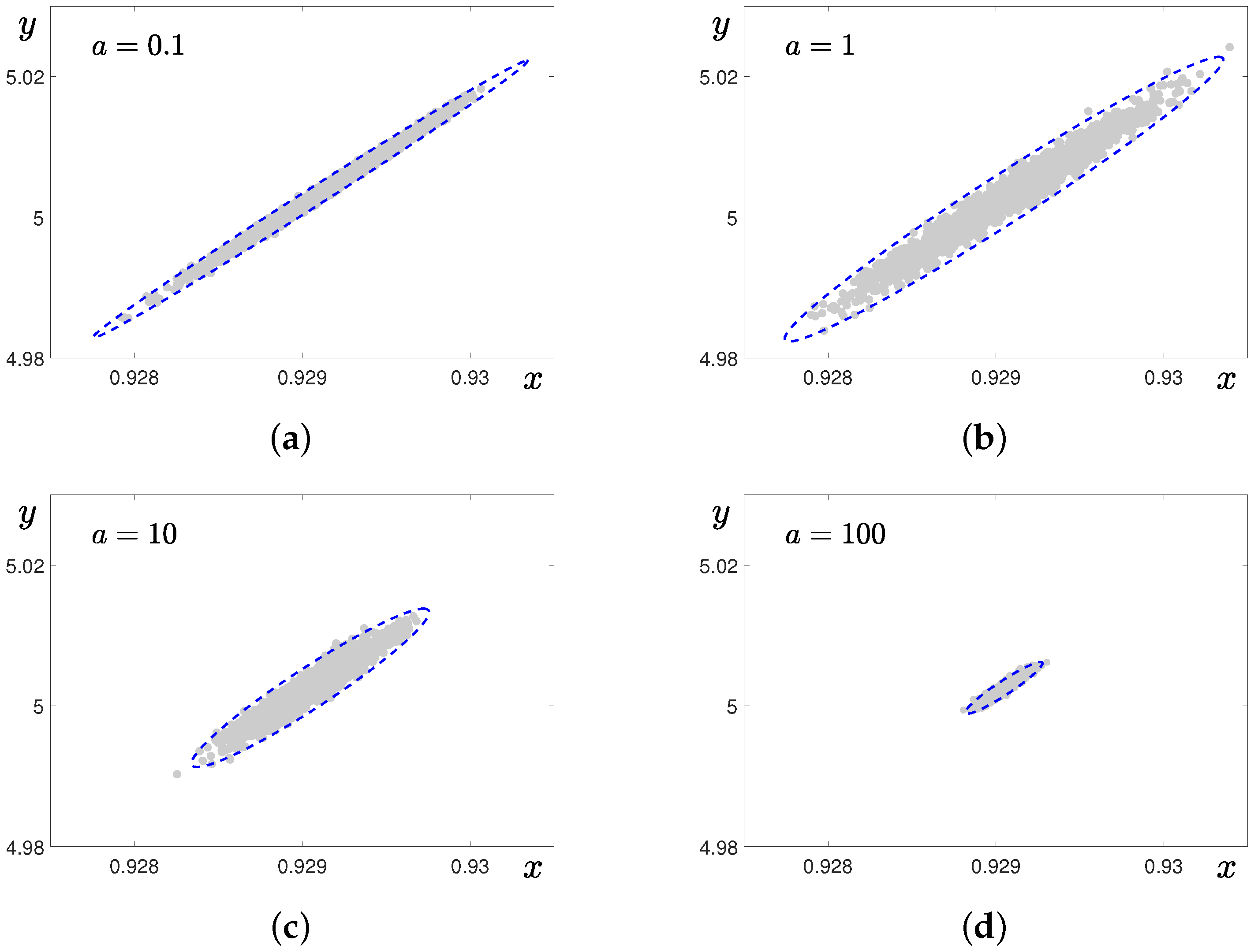
In
Figure 9, for fixed values of
and
, random states of System (
2) solutions are plotted by grey dots for different
a. Corresponding confidence ellipses are shown by blue dashed curves. As can be seen, these ellipses well describe the geometrical arrangement of the random states with the change in parameter
a. We note that the large eccentricity of the ellipses is explained by the significant difference in the values of
and
, which determine the size of their main axes.
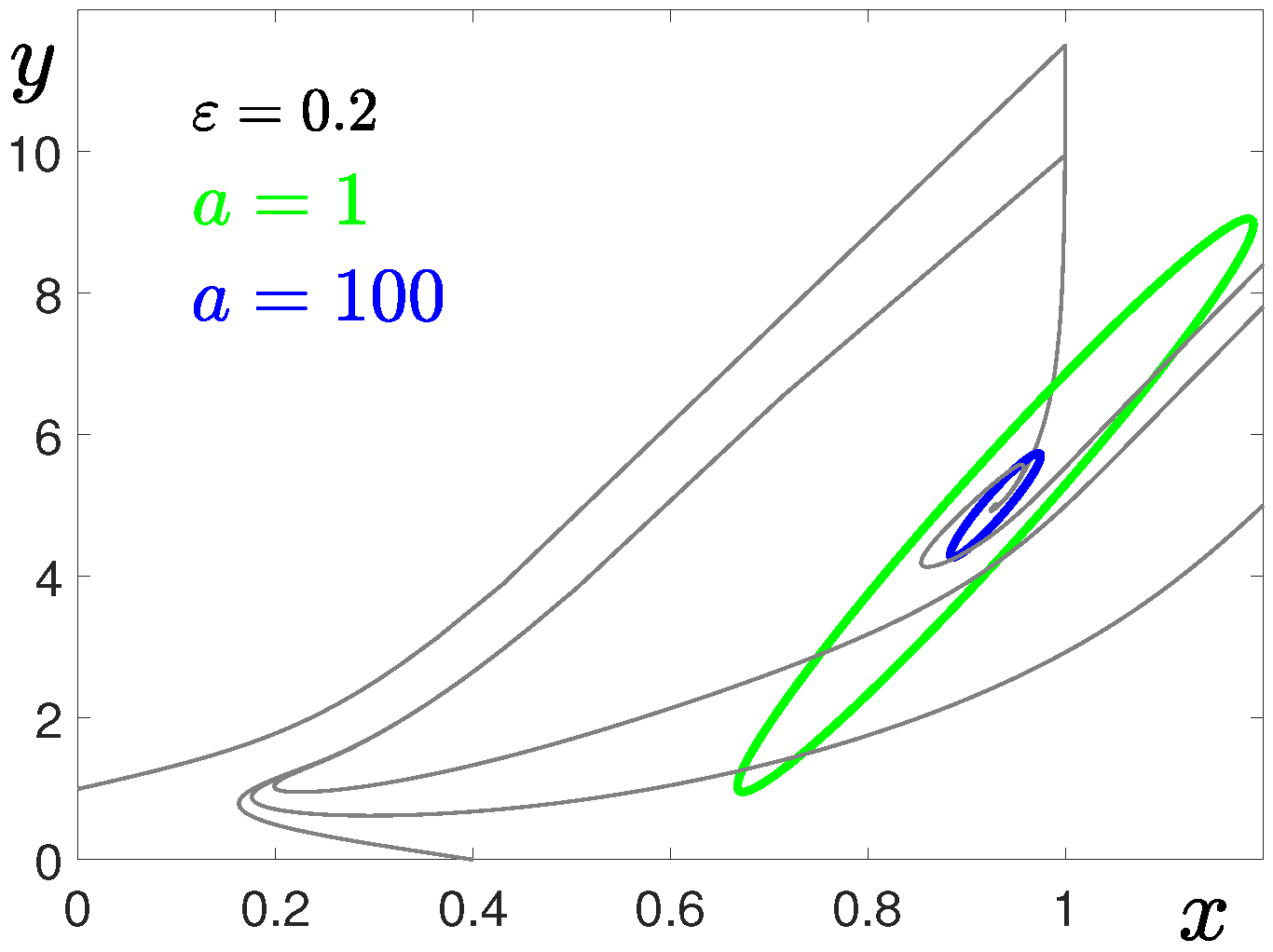
We consider now how the confidence ellipses can be used in the parametric analysis of the phenomenon of noise-induced excitement. In
Figure 10, by grey, we show phase trajectories of deterministic System (
1) with
, and confidence ellipses for stochastic System (
2) with
and two values of
a: for
(green) and
(blue). Such a difference in the size of ellipses is explained by the difference in stochastic sensitivity. Value
lies in a parameter zone of high sensitivity, and
corresponds to the low sensitivity (see eigenvalues in
Figure 8).
For , the small confidence ellipse lies entirely in the subthreshold zone, where deterministic solutions immediately tend to the equilibrium. Such an arrangement of the ellipse predicts the small-amplitude oscillations near equilibrium H. For , the large confidence ellipse partially occupies the superthreshold zone corresponding to the large-amplitude outbreaks of the deterministic trajectories. For the stochastic system, this location means the onset of noise-induced excitement.
We note that such a prognosis extracted from the confidence ellipses method well agrees with the results of direct numerical simulation (see
Figure 4). Thus, using this method in combination with the analysis of arrangement of sub- and superthreshold zones in the phase plane, one can estimate the critical values of noise intensity
and correlation parameter
a corresponding to onset of stochastic excitement.