
Exploration of New Optical Solitons in Magneto-Optical Waveguide with Coupled System of Nonlinear Biswas–Milovic Equation via Kudryashov’s Law Using Extended F-Expansion Method



Abstract
1. Introduction
2. Extended F-Expansion Method
3. Exact Wave Solutions
- (1.1)
- (1.2)
- (1.3)
- (1.1,1)
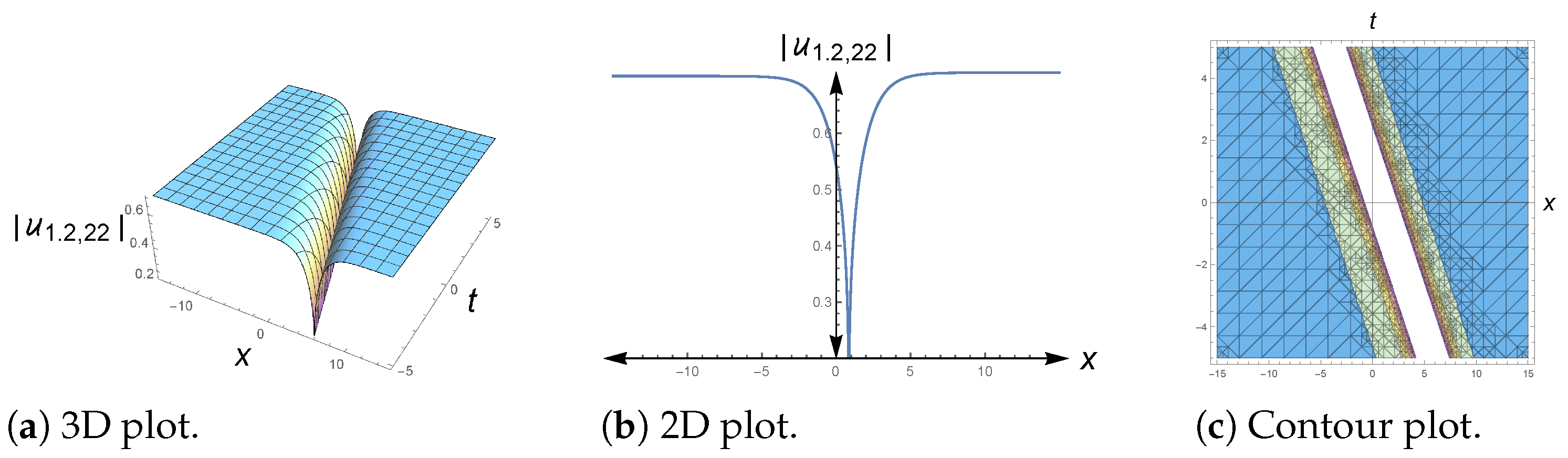
- If and ; thus, the Jacobi elliptic solutions are obtained as follows:orSpecial case. We extract the dark solitons when , as
- (1.1,2)
- If and ; thus, the Jacobi elliptic solutions are obtained as follows:orSpecial case. We derive singular solitons or singular periodic solutions when or , asorand
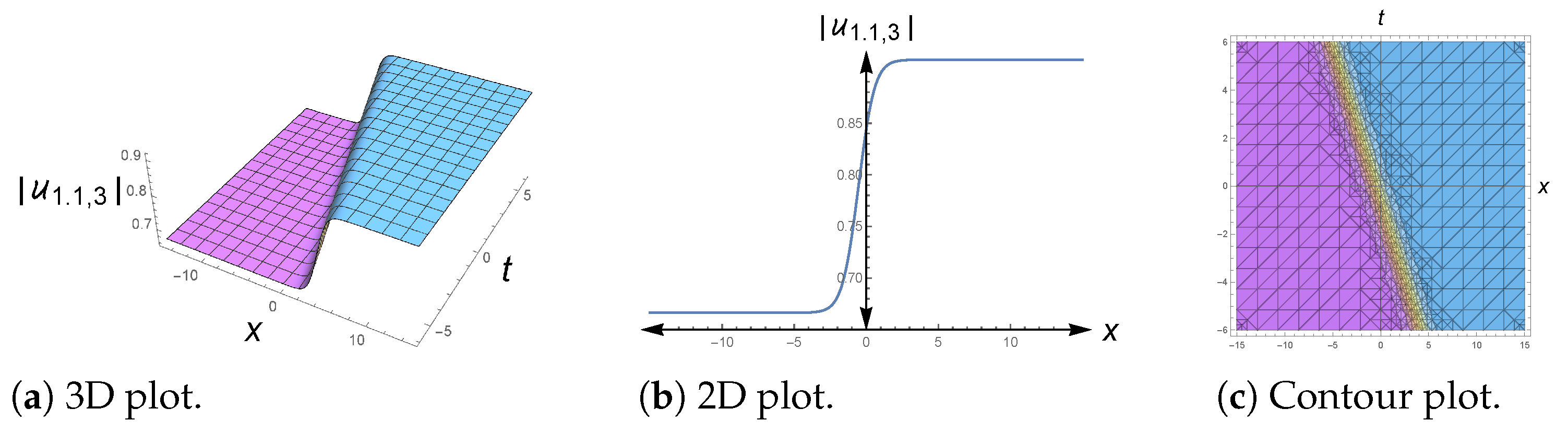
- (1.1,3)
- If and ; thus, the Jacobi elliptic solutions are obtained as follows:
- (1.1,4)
- If and ; thus, the Jacobi elliptic solutions are obtained as follows:Special case. We obtain periodic solutions when , as
- (1.1,5)
- If and ; thus, the Jacobi elliptic solutions are obtained as follows:Special case. When or , we derive singular solitons or periodic solutions asor
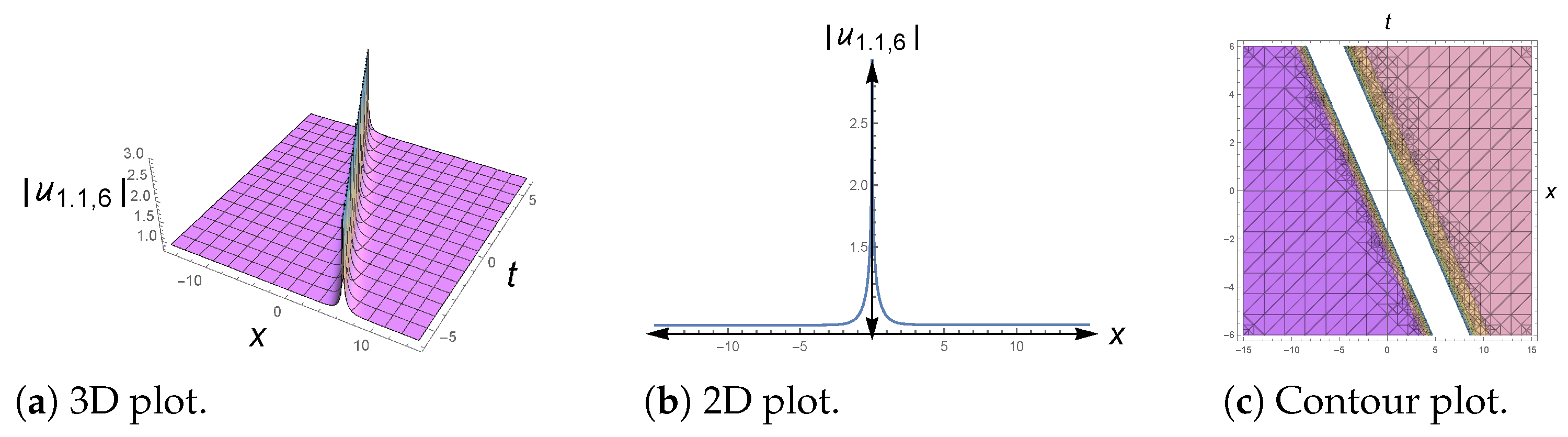
- (1.1,6)
- If and ; thus, the Jacobi elliptic solutions are obtained as follows:Special case. When or , we obtain singular solitons or periodic solutions asor
- (1.1,7)
- If and ; thus, the Jacobi elliptic solutions are obtained as follows:Special case. In the case of or , we obtain singular solitons and dark solitons or periodic solutions asandorand
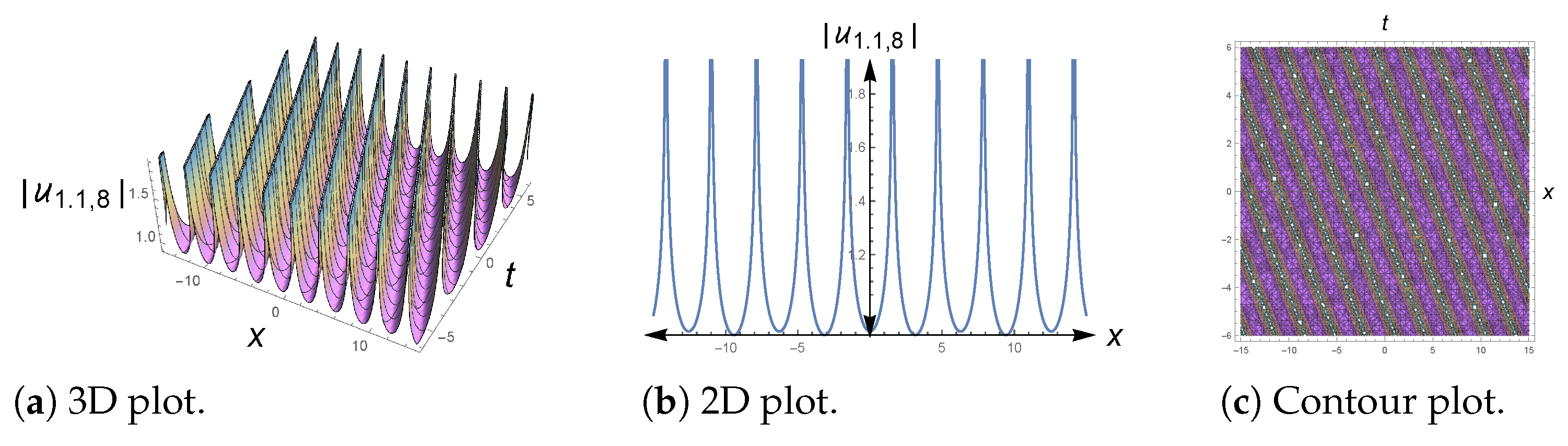
- (1.1,8)
- If and ; thus, the Jacobi elliptic solutions are obtained as follows:Special case. In the case of , the combo periodic solutions are obtained as follows:
- (1.1,9)
- If and ; thus, the Jacobi elliptic solutions are obtained as follows:Special case. In the case of , we obtain singular periodic solutions as follows:
- (1.1,10)
- If and ; thus, the dark soliton solutions are obtained as follows:
- (1.1,11)
- If and ; thus, the periodic solutions are obtained as follows:
- (1.1,12)
- If and ; thus, the Jacobi elliptic solutions are obtained as follows:
- (1.1,13)
- If and ; thus, the Jacobi elliptic solutions are obtained as follows:
- (1.1,14)
- If and ; thus, the Jacobi elliptic solutions are obtained as follows:Special case. In the case of , we thus obtain combo periodic solutions as follows:where is a constant.
- (1.1,15)
- If and ; thus, the Jacobi elliptic solutions are obtained as follows:
- (1.1,16)
- If and ; thus, the Jacobi elliptic solutions are obtained as follows:where and are constant.Special case. In the case of or , we extract singular combo solitons or combo periodic solutions as follows:or
- (1.1,17)
- If and ; thus, the Jacobi elliptic solutions are obtained asor
- (1.1,18)
- If and ; thus, the Jacobi elliptic solutions are obtained as follows:
- (1.1,19)
- If and , we derive the Jacobi elliptic solutions as follows:or
- (1.1,20)
- If and , we extract the periodic solutions as follows:or
- (1.2,1)
- If and ; thus, the Jacobi elliptic solutions are obtained as follows:orSpecial case. In the case of or , we extract singular solitons or periodic solutions asorand
- (1.2,2)
- If and , we establish Jacobi elliptic solutions as
- (1.2,3)
- If and , we obtain Jacobi elliptic solutions asorSpecial case. In the case of , we derive dark solitons as
- (1.2,4)
- If and ; thus, the Jacobi elliptic solutions are obtained as follows:Special case. In the case of or , we extract singular solitons or periodic solutions as follows:or
- (1.2,5)
- If and , we obtain Jacobi elliptic solutions as follows:
- (1.2,6)
- If and , we obtain Jacobi elliptic solutions as follows:Special case. In the case of , we obtain periodic solutions as follows:
- (1.2,7)
- If and ; thus, the Jacobi elliptic solutions are obtained asSpecial case. In the case of , we establish periodic solutions as
- (1.2,8)
- If and , we establish periodic solutions as
- (1.2,9)
- If and , we establish singular solitons as
- (1.2,10)
- If and , we establish Jacobi elliptic solutions as
- (1.2,11)
- If and , we obtain Jacobi elliptic solutions aswhere and are constant.Special case. In the case of , we establish hyperbolic solutions as
- (1.2,12)
- If and ; thus, the Jacobi elliptic solutions are obtained as
- (1.2,13)
- If and , we extract Jacobi elliptic solutions asor
- (1.3,1)
- If or and ; thus, the Jacobi elliptic solutions are obtained as follows:Special case. In the case of or , we derive singular solitons or periodic solutions asor
- (1.3,2)
- If or and , we obtain Jacobi elliptic solutions asSpecial case. In the case of or , we establish singular solitons or periodic solutions asor
- (1.3,3)
- If and , we derive Jacobi elliptic solutions asSpecial case. In the case of either or , we extract singular solitons or periodic solutions asor
- (1.3,4)
- If and , we obtain Jacobi elliptic solutions asSpecial case. In the case of , we derive combo periodic solutions as
- (1.3,5)
- If and , we derive singular solitons as
- (1.3,6)
- If and , we obtain periodic solutions as
- (1.3,7)
- If and , we establish Jacobi elliptic solutions aswhere and is a constant.Special case. In the case of , we derive periodic solutions as
- (1.3,8)
- If and ; thus, the Jacobi elliptic solutions are obtained aswhere .
- (1.3,9)
- If and ; thus, the Jacobi elliptic solutions are obtained aswhere , while and are constant.Special case. In the case of either or , the singular–bright combo solitons or combo periodic solutions are thus obtained asorwhere .
- (1.3,10)
- If and , we obtain Jacobi elliptic solutions as follows:orwhere , and .
- (1.3,11)
- If and , we obtain Jacobi elliptic solutions asSpecial case. In the case of , we derive combo periodic solutions asCase: 2 .,.
- (2.1)
- If ; thus, the combo periodic solutions are obtained asand
- (2.2)
- If , we obtain singular combo solitons asCase: 3 .Through this case, if , we obtain rational solutions to (1) and (2), under the conditions , and , in the following forms:Case: 4 .
- (4.1)
- If and , we obtain exponential solutions as
- (4.2)
- If , and , we derive periodic solutions as
- (4.3)
- If , and , we extract singular solitons asCase: 5 .
4. Results and Discussion
5. Conclusions
Author Contributions
Funding
Data Availability Statement
Conflicts of Interest
References
- Seadawy, A.R.; Iqbal, M.; Lu, D. Applications of propagation of long-wave with dissipation and dispersion in nonlinear media via solitary wave solutions of generalized Kadomtsev–Petviashvili modified equal width dynamical equation. Comput. Math. Appl. 2019, 78, 3620–3632. [Google Scholar] [CrossRef]
- Iqbal, M.; Seadawy, A.R.; Khalil, O.H.; Lu, D. Propagation of long internal waves in density stratified ocean for the (2 + 1)-dimensional nonlinear Nizhnik—Novikov—Vesselov dynamical equation. Results Phys. 2020, 16, 102838. [Google Scholar] [CrossRef]
- Seadawy, A.R.; Zahed, H.; Iqbal, M. Solitary Wave Solutions for the Higher Dimensional Jimo-Miwa Dynamical Equation via New Mathematical Techniques. Mathematics 2022, 10, 1011. [Google Scholar] [CrossRef]
- Ali, A.; Seadawy, A.R.; Lu, D. New solitary wave solutions of some nonlinear models and their applications. Adv. Differ. Equ. 2018, 2018, 1–12. [Google Scholar] [CrossRef]
- Ahmed, H.M.; Rabie, W.B.; Arnous, A.H.; Wazwaz, A.-M. Optical solitons in birefringent fibers of Kaup-Newell’s equation with extended simplest equation method. Phys. Scr. 2020, 95, 115214. [Google Scholar] [CrossRef]
- Lu, D.; Seadawy, A.R.; Ali, A. Structure of traveling wave solutions for some nonlinear models via modified mathematical method. Open Phys. 2018, 16, 854–860. [Google Scholar] [CrossRef]
- Mohyud-Din, S.T.; Irshad, A. Solitary wave solutions of some nonlinear PDEs arising in electronics. Opt. Quantum Electron. 2017, 49, 130. [Google Scholar] [CrossRef]
- Seadawy, A.R.; Lu, D.; Nasreen, N. Construction of solitary wave solutions of some nonlinear dynamical system arising in nonlinear water wave models. Indian J. Phys. 2020, 94, 1785–1794. [Google Scholar] [CrossRef]
- Samir, I.; Badra, N.; Seadawy, A.R.; Ahmed, H.M. Exact wave solutions of the fourth order non-linear partial differential equation of optical fiber pulses by using different methods. Int. J. Light Electron Opt. 2021, 230, 166313. [Google Scholar] [CrossRef]
- El-Sheikh, M.M.A.; Seadawy, A.R.; Ahmed, H.M.; Arnous, A.H.; Rabie, W.B. Dispersive and propagation of shallow water waves as a higher order nonlinear Boussinesq-like dynamical wave equations. Phys. A 2020, 537, 122662. [Google Scholar] [CrossRef]
- Sheikh, M.E.; Ahmed, H.M.; Arnous, A.H.; Rabie, W.B.; Biswas, A.; Khan, S.; Alshomrani, A.S. Optical solitons with differential group delay for coupled Kundu-Eckhaus equation using extended simplest equation approach. Optik 2020, 208, 164051. [Google Scholar] [CrossRef]
- Ahmed, H.M.; Rabie, W.B.; Ragusa, M.A. Optical solitons and other solutions to Kaup-Newell equation with Jacobi elliptic function expansion method. Anal. Math. Phys. 2021, 11, 1–16. [Google Scholar] [CrossRef]
- El-Horbaty, M.M.; Ahmed, F.M. The solitary travelling wave solutions of some nonlinear partial differential equations using the modified extended tanh function method with Riccati equation. Asian Res. J. Math. 2018, 8, 1–13. [Google Scholar] [CrossRef]
- Kudryashov, N.A. A generalized model for description of propagation pulses in optical fiber. Optik 2019, 189, 42–52. [Google Scholar] [CrossRef]
- Kudryashov, N.A. Mathematical model of propagation pulse in optical fiber with power nonlinearities. Optik 2020, 212, 164750. [Google Scholar] [CrossRef]
- Kudryashov, N.A. Highly dispersive optical solitons of the generalized nonlinear eighth-order Schrödinger equation. Optik 2020, 206, 164335. [Google Scholar] [CrossRef]
- Kudryashov, N.A. Highly dispersive optical solitons of an equation with arbitrary refractive index. Regul. Chaotic Dyn. 2020, 25, 537–543. [Google Scholar] [CrossRef]
- Kudryashov, N.A.; Antonova, E.V. Solitary waves of equation for propagation pulse with power nonlinearities. Optik 2020, 217, 164881. [Google Scholar] [CrossRef]
- Biswas, A.; Milovic, D. Bright and dark solitons of the generalized nonlinear Schrödinger’s equation. Commun. Nonlinear Sci. Numer. Simul. 2010, 15, 1473–1484. [Google Scholar] [CrossRef]
- Rizvi, S.T.R.; Ali, K.; Ahmad, M. Optical solitons for Biswas–Milovic equation by new extended auxiliary equation method. Optik 2020, 204, 164181. [Google Scholar] [CrossRef]
- Manafian, J.; Lakestani, M. Optical solitons with Biswas-Milovic equation for Kerr law nonlinearity. Eur. Phys. J. Plus 2015, 130, 1–12. [Google Scholar] [CrossRef]
- Zhou, Q.; Ekici, M.; Sonmezoglu, A.; Mirzazadeh, M.; Eslami, M. Optical solitons with Biswas–Milovic equation by extended trial equation method. Nonlinear Dyn. 2016, 84, 1883–1900. [Google Scholar] [CrossRef]
- Tahir, M.; Awan, A.U. Analytical solitons with the Biswas-Milovic equation in the presence of spatio-temporal dispersion in non-Kerr law media. Eur. Phys. J. Plus 2019, 134, 1–9. [Google Scholar] [CrossRef]
- Khalil, T.A.; Badra, N.; Ahmed, H.M.; Rabie, W.B. Optical solitons and other solutions for coupled system of nonlinear Biswas–Milovic equation with Kudryashov’s law of refractive index by Jacobi elliptic function expansion method. Optik 2022, 253, 168540. [Google Scholar] [CrossRef]
- Akram, G.; Zainab, I.; Peakon, D. Kink and periodic solutions of the nonlinear Biswas–Milovic equation with Kerr law nonlinearity. Optik 2020, 208, 164420. [Google Scholar] [CrossRef]
- Rabie, W.B.; Ahmed, H.M. Dynamical solitons and other solutions for nonlinear Biswas–Milovic equation with Kudryashov’s law by improved modified extended tanh-function method. Optik 2021, 245, 167665. [Google Scholar] [CrossRef]
- Cinar, M.; Onder, I.; Secer, A.; Sulaiman, T.A.; Yusuf, A.; Bayram, M. Optical solitons of the (2+ 1)-dimensional Biswas-Milovic equation using modified extended tanh-function method. Optik 2021, 245, 167631. [Google Scholar] [CrossRef]
- Elmandouh, A.A. Integrability, qualitative analysis and the dynamics of wave solutions for Biswas–Milovic equation. Eur. Phys. J. Plus 2021, 136, 1–17. [Google Scholar] [CrossRef]
- Guo, L.-F.; Xu, W.-R. The traveling wave mode for nonlinear Biswas-Milovic equation in magneto-optical wave guide coupling system with Kudryashov’s law of refractive index. Results Phys. 2021, 27, 104500. [Google Scholar] [CrossRef]
- Zayed, E.M.E.; Gepreel, K.A.; Shohib, R.M.A.; Alngar, M.E.M.; Yıldırım, Y. Optical solitons for the perturbed Biswas-Milovic equation with Kudryashov’s law of refractive index by the unified auxiliary equation method. Optik 2021, 230, 166286. [Google Scholar] [CrossRef]
- Zayed, E.M.E.; Gepreel, K.A.; Shohib, R.M.A.; Alngar, M.E.M. Solitons in magneto-optics waveguides for the nonlinear Biswas-Milovic equation with Kudryashov’s law of refractive index using the unified auxiliary equation method. Optik 2021, 235, 166602. [Google Scholar] [CrossRef]
- Kengne, E. Comment on “Solitons in magneto-optics waveguides for the nonlinear Biswas–Milovic equation with Kudryashov’s law of refractive index using the unified auxiliary equation method”. Optik 2021, 242, 167352. [Google Scholar] [CrossRef]
- Abdou, M.A. The extended F-expansion method and its application for a class of nonlinear evolution equations. Chaos Solitons Fractals 2007, 31, 95–104. [Google Scholar] [CrossRef]
- Apriliani, V.; Maulidi, I.; Azhari, B. Extended F-expansion method for solving the modified Korteweg-de Vries (mKdV) equation. J. Pendidik. Mat. 2020, 11, 93–100. [Google Scholar] [CrossRef]


Disclaimer/Publisher’s Note: The statements, opinions and data contained in all publications are solely those of the individual author(s) and contributor(s) and not of MDPI and/or the editor(s). MDPI and/or the editor(s) disclaim responsibility for any injury to people or property resulting from any ideas, methods, instructions or products referred to in the content. |
© 2023 by the authors. Licensee MDPI, Basel, Switzerland. This article is an open access article distributed under the terms and conditions of the Creative Commons Attribution (CC BY) license (https://creativecommons.org/licenses/by/4.0/).
Share and Cite
Rabie, W.B.; Ahmed, H.M.; Hamdy, W. Exploration of New Optical Solitons in Magneto-Optical Waveguide with Coupled System of Nonlinear Biswas–Milovic Equation via Kudryashov’s Law Using Extended F-Expansion Method. Mathematics 2023, 11, 300. https://doi.org/10.3390/math11020300
Rabie WB, Ahmed HM, Hamdy W. Exploration of New Optical Solitons in Magneto-Optical Waveguide with Coupled System of Nonlinear Biswas–Milovic Equation via Kudryashov’s Law Using Extended F-Expansion Method. Mathematics. 2023; 11(2):300. https://doi.org/10.3390/math11020300
Chicago/Turabian StyleRabie, Wafaa B., Hamdy M. Ahmed, and Walid Hamdy. 2023. "Exploration of New Optical Solitons in Magneto-Optical Waveguide with Coupled System of Nonlinear Biswas–Milovic Equation via Kudryashov’s Law Using Extended F-Expansion Method" Mathematics 11, no. 2: 300. https://doi.org/10.3390/math11020300
APA StyleRabie, W. B., Ahmed, H. M., & Hamdy, W. (2023). Exploration of New Optical Solitons in Magneto-Optical Waveguide with Coupled System of Nonlinear Biswas–Milovic Equation via Kudryashov’s Law Using Extended F-Expansion Method. Mathematics, 11(2), 300. https://doi.org/10.3390/math11020300