3. Endomorphism Spectra of Double-Edge Fan Graphs
Let
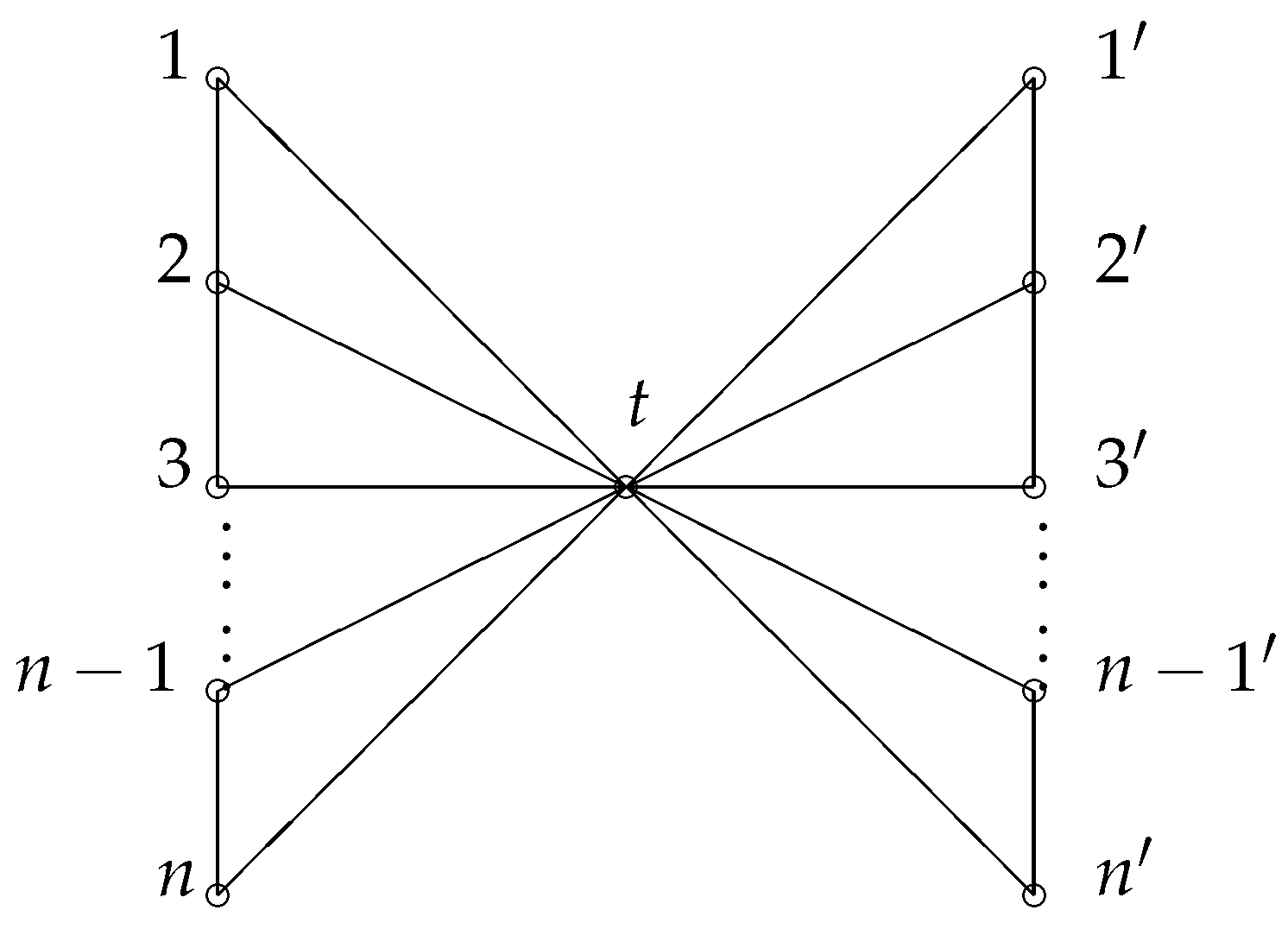
be a double-edge fan graph (see
Figure 1). We denote
,
and
. We denote
,
and
. We denote by
,
,
and
the subgraph of
induced by
A,
,
and
, respectively.
Lemma 1 ([
15])
. Let G be a graph and . Then, if and only if is an induced subgraph of G. Lemma 2. Let . Then, the following apply:
- (1)
for any .
- (2)
If , then or , or .
- (3)
If , then or .
Proof. (1) Note that for any . If , then forms a loop in , which is a contradiction.
(2) If , then we have or . Otherwise, there are such that and . Since is connected, there exists a path from u to v in . Thus, there exists a path from to in . Note that every path from to must contain t. Hence, there exists such that . This contradicts (1). It is similar for or .
(3) If , then for some . Since for any , . Note that . If , then . If , then . □
Lemma 3. if and only if .
Proof. Necessity. We just need to verify that
for any
. Let
f be a mapping on
defined by
Then, . Clearly, , , . Note that there exist no and such that . Then, . Therefore, .
Sufficiency. Let and . If , then or by Lemma 2 (3). Note that both and are induced subgraphs of . By Lemma 1, .
If , then for by Lemma 2 (1). Thus, or , or . Let for some . If , then . If , then . Now, we suppose that . Then, for any . If and , then there exist and such that , since is connected. If and , then there exist and such that . Without loss of generality, let us suppose that and , then . Note that and ; thus, . This is a contradiction. Therefore, . □
Proof. Let . There are two cases.
(1)
. By Lemma 2 (2),
or
,
or
. Clearly, there are
endomorphisms of
satisfying
and
. Analogously, there are
endomorphisms for the cases of
and
,
and
, and
and
. Thus, we obtain
endomorphisms satisfying
. It is known from [
16] that
(2)
. By Lemma 2 (3), there are two cases.
(i) Let us assume that . Then, , and or . There are subgraphs Y in such that . Let K be a subgraph of such that and for some . Since , . Furthermore, there are two methods to map to . Hence, we obtain endomorphisms satisfying and . (ii) Let us assume that . Then, , and there are subgraphs Y in such that . Let F be a subgraph of satisfying and for some . Note that and for any . Hence, . Since for any , . There are four cases.
Case 1. Let us assume that and .
If n is odd, then and . Since , or . If , then and . Note that we have methods to divide set C into two non-empty subsets, and . Clearly, there are methods to map to . If , then and . Similarly, we have methods to divide set B into two non-empty subsets, and . Clearly, there are methods to map to . Thus, there are ways to map A to . Analogously, there are ways to map to . Therefore, there are endomorphisms in this case.
Similarly, if n is even, we can obtain endomorphisms.
Case 2. Let us assume that and .
If n is odd, then and . Since , there are ways to map A to by Case 1. Since , or . Now, we have two methods to map to or . Therefore, there are endomorphisms in this case.
Similarly, if n is even, we can obtain endomorphisms.
Case 3. Let us assume that and .
If n is odd, we can obtain endomorphisms by Case 2. If n is even, we can obtain endomorphisms.
Case 4. Let us assume that and .
Clearly, and , or and . If and , then there are two methods to map to , and there are two methods to map to . Analogously, if and , then there are also four methods to map A to and to map to . Hence, we obtain endomorphisms.
From the above discussion, the result of Lemma 4 can be obtained. □
Lemma 5. Let be a double-edge fan graph with . Then, , where .
Proof. Let for some . If , then or . Thus, is an induced subgraph of . By Lemma 1, .
If , then or , or . Then, if and only if , with ; , with ; and , with . Clearly, there are subgraphs in isomorphic to . Then, there are ways to map A to , and there are ways to map A to . Thus, there are endomorphisms, which are not half-strong.
It is known from [
16] that
, where Z is a set of integers.
From the above discussion, the result of Lemma 5 can be obtained. □
Lemma 6. if and only if .
Proof. Necessity. We just need to verify that
when
. Let
f be a mapping on
defined by
Then, . Clearly, , , . Note that ; then, . Therefore, .
Sufficiency. Let . Then, , or . If , then the subgraphs of induced by , or have no isolated vertices. If , then the subgraphs of induced by , or have no isolated vertices. Therefore, . □
Lemma 7. Let and . If , then if and only if one of the following conditions holds:
- (1)
and , or and ;
- (2)
, and , where P is a subgraph of induced by ;
- (3)
and , where or , , , and the subgraph of induced by is disconnected.
Proof. Necessity. Let . Since , by Lemma 2 (2), or , or .
(1) Let us assume that and . Let be such that . Since , for every , there exists such that , and it is similar for the preimage of b. Note that and . Then, . In the same way, we can obtain . Similarly, if and , then and .
(2) Let us assume that or . Let P be a subgraph of induced by . Let be such that . Since , the subgraph of induced by contains no isolated vertices. Since and ( and ), the subgraph of induced by and contains no isolated vertices. Then, and .
(3) Let us assume that or , but . Since , it is easy to obtain and , where or , and the subgraph of induced by is disconnected.
Sufficiency. Let and be such that .
(1) Let us suppose that and . Note that . If , then . Clearly, for any . If , then . Clearly, for any . If and , then or . If , then for every , there exists such that , and it is similar for the preimage of b. Thus, and . Analogously, if , then and . Therefore, . Similarly, if and , then .
(2) Let us suppose that , and , where P is a subgraph of induced by . If , then . Clearly, for any . If , then . Clearly, for any . If and , then or . Since and , the subgraphs of , which is induced by and , contain no isolated vertices. Since and , the subgraph of , which is induced by , contains no isolated vertices. Therefore, .
(3) Let us suppose that , and , where or , and the subgraph of induced by is disconnected. Then, it is a routine matter to verify that . □
Lemma 8. Let and . If , then if and only if one of the following conditions holds:
- (1)
;
- (2)
n is odd; ; and or , where , , and .
Proof. Necessity. Let . Since , or by Lemma 2 (3).
Let us assume that
. If
n is even, then
, and
and
is not a complete folding. Thus,
f is not locally strong according to [
17].
If n is odd, then . We only need to prove that when and . Without loss of generality, we suppose that , where , , , . Note that , but is an isolated vertex of . Thus, f is not locally strong.
Sufficiency. (1) If , then or . It is easy to verify that .
(2) Let us suppose that for some . Since , then . If , then , and , or and . It is not difficult to check that . If , then a similar argument shows that . □
Lemma 9. Let .
- (1)
If n is odd, then ;
- (2)
If n is even, then , where ∣ means divisible.
Proof. Let . If , then there exist three cases by Lemma 7.
Case 1. Let us assume that
and
, or
and
. If
and
, then there are
ways to map
to
and to map
to
. Analogously, if
and
, then there are
ways to map
to
and to map
to
. It is known from [
17] that
. Thus, we obtain
locally strong endomorphisms.
Case 2. Let us assume that , satisfying Lemma 7 (2). If , then there are ways to map and to P. Analogously, if , then there are ways to map and to P. Thus, we obtain locally strong endomorphisms.
Case 3. Let us assume that
, satisfying Lemma 7 (3). Then, there are
ways to map
A to fixed
, and there are
ways to map
to fixed
. There are
subgraphs in
and
isomorphic to
. It is known from [
17] that
. Thus, we have
locally strong endomorphisms.
If , then there exist two cases by Lemma 8.
Case 4. Let us assume that . Then, we have locally strong endomorphisms by Lemma 4.
Case 5. Let us assume that , satisfying Lemma 8(2). Then, or . Let us suppose that for some . Since , . Then, . Note that there are two methods to map to ; there are two methods to map to ; and there are subgraphs of induced by . Thus, we obtain locally strong endomorphisms.
From the above discussion, the result of Lemma 9 can be obtained. □
Lemma 10. .
Proof. Let
f be a mapping on
defined by
Then, . Thus, . □
Lemma 11. if and only if .
Proof. Necessity. We just need to prove that
when
. Let
f be a mapping on
defined by
Then, . Hence, . Note that . Then, . Therefore, .
Let
f be a mapping on
defined by
Then, . Note that , and . Then, . Therefore, .
Sufficiency. Let ; then, it is easy to see that .
Let and . Then, there exist such that . Clearly, . There are two cases.
(1) One between i and j is in A, and the other is in . Then, there exists such that . Since , there exists such that is adjacent to both i and j. This is impossible.
(2) , or . Without loss of generality, we suppose that . Then, there are two cases.
Case 1. . Then, there exists such that . Then, either and are true, or and are true. Note that . Then, . Since , there exists such that for any . This contradicts that c is adjacent to at most two vertices of B.
Case 2. . If is the middle point in image , then there exist such that and . Since , there exists such that and , and there exists such that and . So, form cycle . This contradicts that the subgraph of induced by A is a path. If is the end point in image , then there is exactly one vertex such that . But there still exists one vertex such that , since . Since , there exists such that and , and there exists such that . Then, is adjacent to at least three vertices of set A. This is impossible.
Consequently, for . □
Lemma 12. .
Proof. Let , then . If and , then there are four automorphisms in this case. Analogously, there are also four automorphisms such that and . Therefore, . □
Now, we obtain the main theorems of this paper.
Theorem 1. where; ;
;
;
;
, where ∣ means divisible;
, where Z is the set of integers.
Proof. This follows immediately from Lemmas 3–6, 9, 11 and 12. □
Proof. This follows immediately from Theorem 1. □