Article

IC-SNN: Optimal ANN2SNN Conversion at Low Latency

1
School of Electrical Engineering, Zhengzhou University, Zhengzhou 450001, China
2
School of Cyber Science and Engineering, Zhengzhou University, Zhengzhou 450001, China
3
Department of Automation, Tsinghua University, Beijing 100084, China
*
Author to whom correspondence should be addressed.
Mathematics 2023, 11(1), 58; https://doi.org/10.3390/math11010058
Submission received: 14 November 2022 / Revised: 11 December 2022 / Accepted: 19 December 2022 / Published: 23 December 2022
(This article belongs to the Special Issue Mathematical Method and Application of Machine Learning)

Abstract

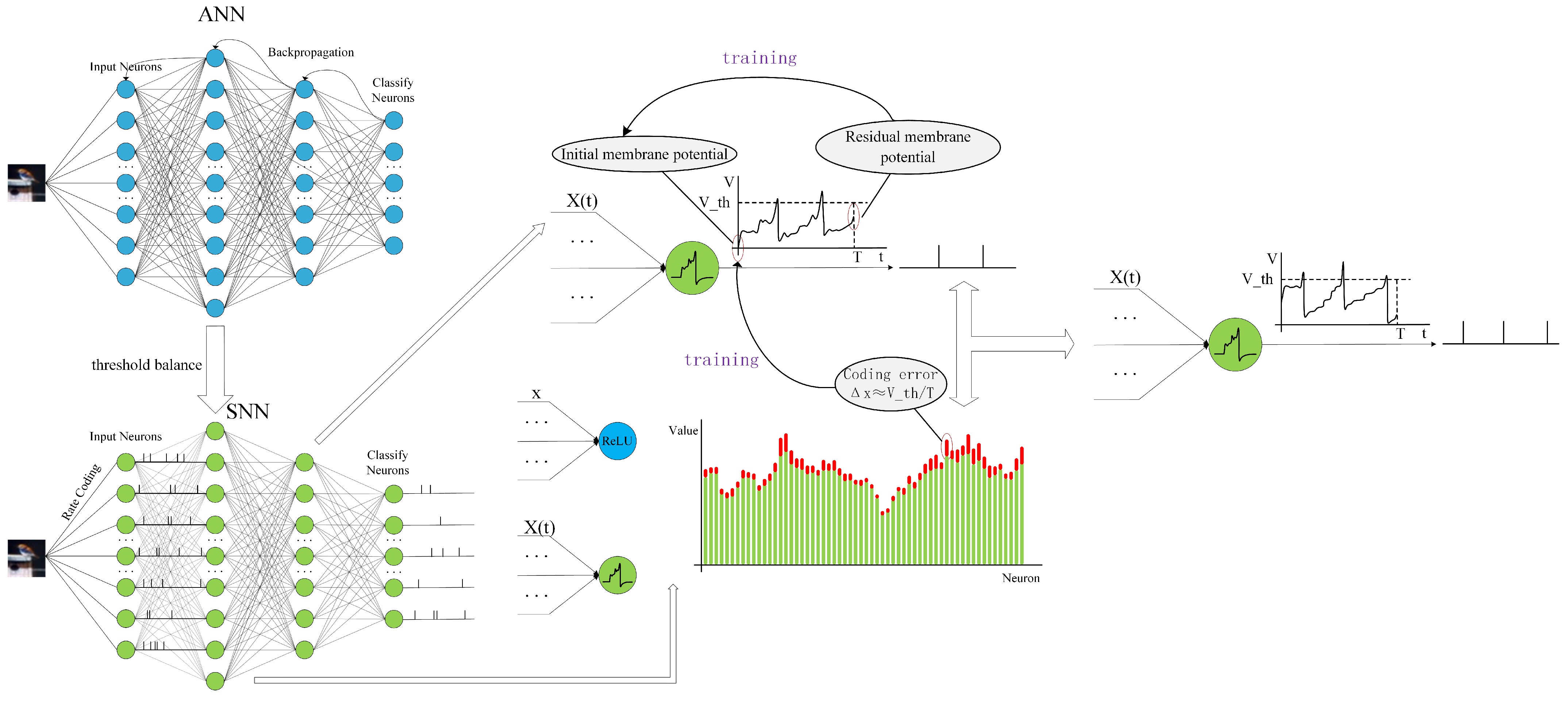
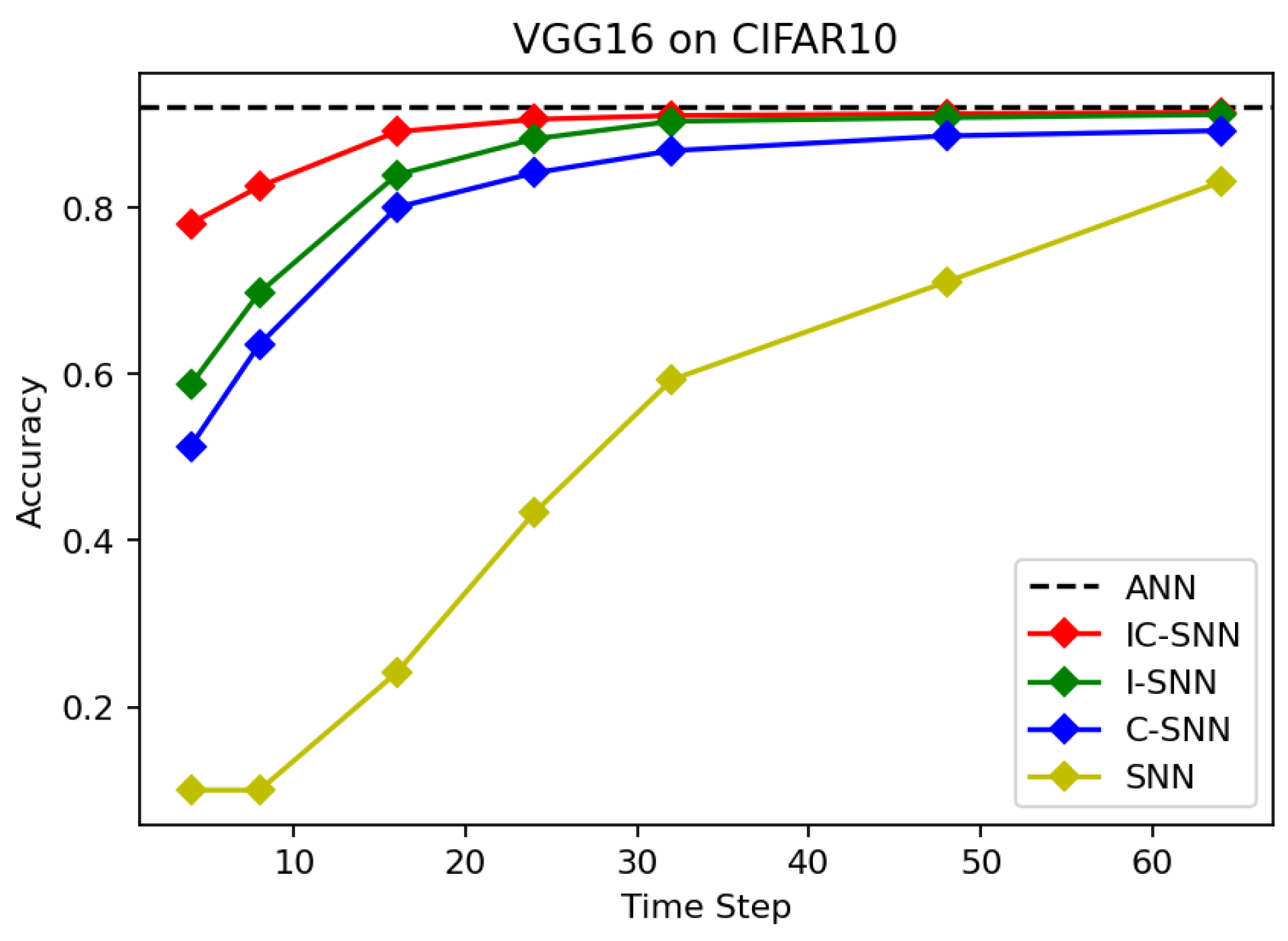
The spiking neural network (SNN) has attracted the attention of many researchers because of its low energy consumption and strong bionics. However, when the network conversion method is used to solve the difficulty of network training caused by its discrete, too-long inference time, it may hinder the practical application of SNN. This paper proposes a novel model named the SNN with Initialized Membrane Potential and Coding Compensation (IC-SNN) to solve this problem. The model focuses on the effect of residual membrane potential and rate encoding on the target SNN. After analyzing the conversion error and the information loss caused by the encoding method under the low time step, we propose a new initial membrane potential setting method and coding compensation scheme. The model can enable the network to still achieve high accuracy under a low number of time steps by eliminating residual membrane potential and encoding errors in the SNN. Finally, experimental results based on public datasets CIFAR10 and CIFAR100 also demonstrate that the model can still achieve competitive classification accuracy in 32 time steps.
Keywords: spiking neural networks; conversion error; initial membrane potential spiking neural networks; conversion error; initial membrane potential