1. Introduction
A CAT(0) space is a specific type of geodesic metric space, where every geodesic triangle in is at least as ‘thin’ as its comparison triangle in the Euclidean plane. This property is formally encrypted in the so-called CAT(0) inequality and ultimately stands as source for the non-positive curvature. Henceforth, the geometry of CAT(0) spaces exceeds any linear framework and goes toward a curved setting. We note in particular that all the pre-Hilbertian spaces, as well as the hyperbolic spaces or the -trees, provide nontrivial examples of CAT(0) spaces.
The original study of non-positively curved spaces belongs to Alexandrov and dates from the 1950s, but the formalism related to CAT(0) spaces, still used today, was developed later by Mikhael Gromov [
1,
2]. Initially, CAT(0) spaces played a central role in geometric group theory (see [
3,
4,
5]). More recently, they also provided a fit setting for nonlinear analysis and fixed point theory, as proven in [
6,
7,
8,
9,
10]. It was shown in [
11,
12] that several methods and procedures specific to (uniformly convex) Banach spaces carry over to the class of CAT(0) spaces, as well. For instance, the uniqueness of the asymptotic center is guaranteed in this particular setting (see [
13]). Moreover, CAT(0) spaces provide a natural framework to define the so-called
-convergence (see also [
14,
15]), which shares many properties of the usual notion of weak convergence in normed spaces. The CAT(0) spaces for which completion is also assumed are known as Hadamard spaces.
Beyond the chosen framework, whether we are talking about a metric or a curved one, a fixed point problem is primarily related to a specific class of operators. Banach’s contraction principle has completely clarified the issue of the existence, uniqueness and numerical approximation through Picard iterations for the fixed points of contractive mappings. However, many nonlinear equations, variational inequalities or variational inclusions often require nonexpansive mappings rather than contractions. Therefore, the fixed point search is extended to more general classes of operators: nonexpansive [
16], quasinonexpansive, asymptotically nonexpansive [
17,
18], or Suzuki mappings with condition (
C) [
19,
20]. In [
21], Garcia-Falset et al. introduce two distinct, generally unrelated nonexpansivity conditions, both intended primarily to generalize Suzuki’s condition (
C): condition
and condition
, respectively. Each of them generated important developments in fixed point theory and not only: conditions of type
were analyzed in connection with other nonexpansivity properties [
22], various iterative processes including polynomiographic techniques [
23,
24], or in connection with signal recovery problems [
25]. On the other hand, the conditions of type
were further extended in [
26] to a wider class of operators, the so-called “Suzuki type”. We can state without a doubt that condition (E) introduced by Garcia-Falset et al. in [
21], as well as the Suzuky-type mappings defined by Dominguez Benavides and Lorenzo Ramirez in [
26] are two of the most general nonexpansivity conditions subject to analysis so far, equally relevant in matters of fixed points and, at the same time, not subordinate to each other.
On the other hand, when contractions are waived in favor of generalized nonexpansive mappings, the iteration procedure to be used to numerically reckon the fixed points must be updated as well. Several iterations schemes have been analyzed so far for various nonlinear problems connected to fixed point or common fixed point theory. For instance, in [
27], the Ishikawa procedure was used for a pair of Suzuki–Karapinar-conditioned mappings in CAT(0) spaces. A modified Ishikawa procedure was also used in [
28], in connection with a hybrid pair of nonexpansive single and multi-valued mappings. In [
20], fixed points of Suzuki-type mappings were searched via the so-called TTP-procedure. The
procedure introduced in [
29] was fit to solve the problem for Berinde mappings.
In this paper we provide a convergence analysis for the iteration procedure in connection with two Garcia-Falset mappings, properly adapted for the non-positively curved setting, looking to obtain approximate common fixed points. We also include some numerical simulations on the Euclidean plane, as well as on the Poincaré half-plane.
2. Preliminaries
In-depth studies of geodesic spaces in general, and CAT(0) structures in particular have been conducted for more than 50 years. A main concern was related to their geometric characteristics and very important aspects were revealed in this direction (please see [
2,
3,
5]. More recently, they have been found to provide a suitable framework for fixed point theories, as well (see [
6,
7,
8,
9,
10,
11,
12,
14]). This is not very surprising, since
spaces share often a nice resemblance with (uniformly convex) normed spaces.
A CAT(0) space is first of all a uniquely geodesic metric space (each two points are connected by an unique geodesic segment, see [
14]). The key element in defining it is the concept of geodesic triangle (a set of three vertices and some connecting geodesic segments as edges). The main interest is related to the appearance of these geodesic triangles when compared with adequate euclidean triangles of the same size. If the distance between any two points of some given geodesic triangle is at most equal to the distance of the corresponding comparison points of the euclidean triangle, then the geodesic space is precisely of CAT(0) type. The formal description and immediate properties coming out from the definition are described leisurely in all the works mentioned above.
The following lemma includes some very important properties of CAT(0) spaces, which are to be used later to prove the main results of this study.
Lemma 1. The following properties are specific to a given CAT(0) space .
- (i)
Let . For each , there exists a unique point such that and (see [14]). Further on, we shall denote this unique point by . - (ii)
For and the following convex inequality holds true (see [14]): - (iii)
For and one has (see [14]) - (iv)
For any bounded sequence in X, the asymptotic center consist of exactly one point [13]. We recall that the asymptotic center center in this setting is defined as follows:where and denotes the so-called asymptotic radius of the sequence. - (v)
If C is a closed and convex subset of X and if is a bounded sequence in C, then the asymptotic center of is in C ([11,14]).
The result in Lemma 1 (iv) regarding the uniqueness of the asymptotic center suggested the possibility of defining a new type of convergence, sharing some similarities with the weak convergence on normed spaces. A sequence
in
X is said to be
-convergent to
and we write
-
([
11,
12,
15]) if
x is the unique asymptotic center of
for every subsequence
of
.
Lemma 2. The following properties related to Δ-convergence on a CAT(0) space hold true:
- (i)
every bounded sequence in X has a Δ-convergent subsequence.
- (ii)
every CAT(0) space satisfies the Opial property, that is whenever a given sequence Δ-converges to x and .
Next we will briefly present some aspects of the nonexpansivity condition provided by Garcia-Falset et al. in [
21]. They defined the so-called operators with property (E), thus extending the class of operators with property
previously introduced by Suzuki in [
19] (see also [
20]). Let
C be a nonempty subset of a Banach space
X and
. Any mapping
which satisfies the inequality
for all
, is said to be endowed with
property. Furthermore,
T satisfies condition (E) on
C if
T satisfies condition
, for some
.
We adapt the definition stated above for CAT(0) spaces, asserting that a mapping
satisfies condition
provided that
for all
.
The following result was proved in a Banach space setting, but it could be easily extended to the curved setting as well.
Proposition 1 ([
21]).
Let be a mapping which satisfies condition (E) on C. If T has some fixed point, then T is quasinonexpansive mapping. In 2016, Sintunavarat and Pitea [
29] introduced an iterative scheme in connection with Berinde-type operators. For an arbitrary
, a sequence
results as output of the following three-step procedure:
for all
, where
,
and
are real sequences in
. We will further denote this iterative process
.
For CAT(0) spaces, the iteration procedure
can be adapted as follows: for an arbitrary
, let
be generated by the procedure below
for all
, where
,
and
are real sequences in
. Furthermore, we assume that
T is a Garcia-Falset operator. Moreover, this iterative process can be presented in connection with two Garcia-Falset operators, as follows: for an arbitrary
, let
be generated by the procedure
for all
, where
,
and
are real sequences in
. It should be noted that by considering
in the iteration (
2), the iterative process (
1) is obtained.
3. Main Results
Further, we will study some aspects regarding the convergence of the iterative process previously presented in CAT(0) spaces, presumably to a common fixed point for some operators satisfying condition (E). Let S and T be such operators. We will denote by F the set of common fixed points for the operators S and T.
Lemma 3. Let C be a nonempty convex subset of complete CAT(0) space X. Let and be mappings satisfying condition (E) with . Let be an iteration process described by (2). Then, exists, for all . Proof. Since T and S satisfy condition (E) with and , then T and S are quasinonexpansive mappings by Proposition 1.
Now, using the convexity property described in Lemma 1 (ii) and the quasinonexpansiveness of
S, we have
Given the relationship (
3), it follows
From (
3) and (
4) we obtain
Based on (
5), we have
so
is a decreasing sequence of non-negative real numbers.
Therefore, the sequence is bounded and decreasing, so is convergent. □
Lemma 4. Let C be a nonempty convex subset of complete CAT(0) space X. Let and be mappings satisfying condition (E) with . Let be an iteration process described by (2). If , and are such that , for some , then and . Proof. In Lemma 3 we proved that exists, for each common fixed point p of S and T.
Using (
6) and (
4) we find
Taking
in this last inequality, we see that
but from (
3)
Now, from (
8) and (
9), we obtain
From (
7) and (
10), we obtain
Given that
we also obtain
Otherwise, based on the quasinonexpansiveness of
S and
T, we can say
and, by applying again (
3) and (
4), we find
Taking the limit in the inequality (
12), we obtain
Since
S has property (E), we have
However, using the definition of the iterative process (
2), we can say that
From (
11), (
14) and (
15), we obtain
Since
and using (
13) and (
16), we conclude that
Furthermore,
and from (
11) and (
17), we have
We will now use the fact that the operator
T has the property (E), so
Therefore, from (
19), (
11) and (
18), we can say
Finally, we could use inequality
in order to conclude that
which completes the proof. □
Theorem 1. Let C be a nonempty closed convex subset of a CAT(0) space X. Let and be mappings satisfying condition (E) with . Let be an iteration process described by (2). If , and are such that , for some , then Δ
;- converges to a common fixed point p of T and S. Proof. Using Lemma 3,
exists, for all
. Thus the sequence
is bounded and according Lemma 4, the following equalities hold true:
Consider , the set containing the asymptotic centers of all the subsequences of . According to Lemma 1 (v), . First, we wish to prove more, namely that . Let . Then, there exists a subsequence of such that .
Since
T is a mapping with condition (E), we obtain
Using this last inequality and the fact that
, taking
on both sides implies that
However, u is the unique asymptotic center of , which implies that , meaning . Similarly, it can now be shown that , thus .
We prove next that consists of exactly one common fixed point. Let and let and be subsequences of such that and . We will assume that .
According to Lemma 1 (i),
contains a subsequence
, which is
-convergent to an element
. Obviously,
. Then,
and
exist for sure and moreover,
, and similarly
. Assuming that
, the Opial property from Lemma 2 (ii) leads to
that is
which is impossible. Therefore,
. Similarly,
contains a subsequence
such that
.
By using again the Opial property, we get
This impossible inequality came out from the initial assumption . Therefore, one must have equality, . In conclusion, is a singleton, and the unique element is a common fixed point of T and S. This proves the -convergence of . □
Corollary 1. Let C be a nonempty closed convex subset of a CAT(0) space X. Let be a mapping satisfying condition (E) with . Let be an iteration process described by (1). If , and are such that , for some , then Δ
-converges to a fixed point of T. Proof. The conclusion comes out immediately by taking in Theorem 1. □
Next we will use an additional condition to prove a strong convergence result. For this, we first remember that Khan and Fukhar-ud-din [
17,
18] introduced the condition (A’) for two mappings, extending this way a similar condition for one mapping defined previously by Senter and Dotson [
16]. In the following we recall this condition as it was presented in [
17].
Definition 1. Let C be a nonempty subset of a CAT(0) space X. Two mappings and with are said to satisfy the condition (A’) if there exists a nondecreasing function with , , for all such that eitherorfor all . It should be noted that this definition becomes the definition of mappings with condition (A) if we consider .
Theorem 2. Let C be a nonempty bounded closed convex subset of complete CAT(0) space X. Let and be mappings satisfying condition (E) with . Let be an iteration process described by (2). If , and are such that , for some and, in addition, the two mappings satisfy the condition (A’), then converges strongly to a common fixed point of T and S. Proof. According to Lemma 3 we know that exists, for all . Let be its value. If , the conclusion is obvious. Therefore, we will further assume that .
Since
, we have
so
and we may easily conclude that
exists.
Now, using the condition (A’), either
or
In both cases, we get
. Moreover, because
f is a nondecreasing function with
it follows that
. Based on this, we can say that for each
, there exists a positive integer
k such that
From this,
so there will be
such that
Moreover, for all
, we have
This proves that is a Cauchy sequence in a closed subset C of a complete CAT(0) space, so it must converge to a point . We obtain because . Using the fact that F is closed, it follows that , which concludes the proof. □
Corollary 2. Let C be a nonempty bounded closed convex subset of complete CAT(0) space X. Let be a mapping satisfying condition (E) with . Let be an iteration process described by (1). If , and are such that , for some and, in addition, the mapping T satisfies the condition (A), then converges strongly to a fixed point of T. Proof. This is an immediate consequence of Theorem 2, by taking . □
4. Examples and Numerical Simulations
To emphasize the practical value of the formal analysis revealed above, we provide some examples of mappings satisfying generalized nonexpansivity conditions in non-positively curved spaces.
Example 1. It is well known that pre-Hilbertian structures (in particular the real axis , or the real two-dimensional plane ) are also spaces. For start, let us consider on the closed and bounded domain , where we define two self-mappings as follows:where We prove next that and satisfy condition , while and satisfy condition . Consequently, the operators T and S will satisfy conditions and , respectively, relative to the Euclidean norm on .
For satisfying condition explicitly means to check if the following inequality holds true: Case I: Let and . The inequality (20) written for this particular case isthat is which is ultimately equivalent to condition . This inequality is clearly satisfied when . Case II: Let and . The inequality (20) for these particular assignments is written Let us assume first that . Since the function is nondecreasing, one has and the inequality which needs to be satisfied isthat is . Once more, the function in the right side is nondecreasing and attains its minimal value , which is clearly positive. Assuming now that , the inequality which needs to be satisfied isthat iswhich is undoubtedly true. Case III: Let . The inequality (20) is this time Yet it is not at all difficult to see thatwhich is precisely the intended conclusion. Case IV: Let and . The inequality (20) which concerns us gets written this timeand it is obviously satisfied. In view of the demonstrations made in cases I, II, III and IV we could now state that satisfies the property .
We prove next that satisfies condition , hence we check the inequality Case I: Let and . The inequality (21) written for this particular case isthat iswhich is ultimately equivalent to condition . Since f is nondecreasing in the interval , one has , so this inequality is satisfied. Case II: Let and . The inequality (21) for these particular assignments is writtenthat isor even more precisely Taking this time the function , we notice that it is also nondecreasing over the interval , hence , so .
Case III: Let . One haswhich is precisely the inequality (21) for . Case IV: Let and . The inequality (21) which needs to be fulfilled isand it is obviously satisfied. The four cases listed above prove that satisfies the property . Moreover, in an absolutely similar way, we can prove that and satisfy condition . Finally, the statement regarding the two-dimensional operators T and S satisfying specific (E)-type conditions is an immediate consequence of applying Minkowski’s inequality.
N
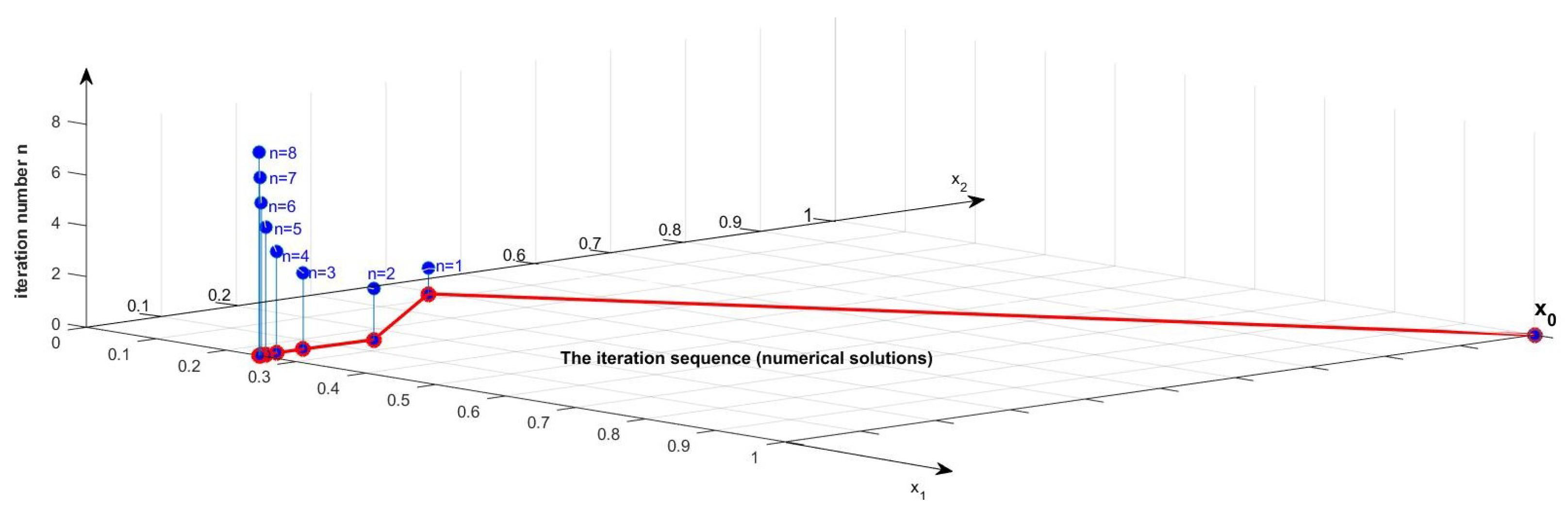
umerical simulation. For the two mappings included in this example, we shall apply next the iteration procedure (2) to obtain approximate value for the common fixed point. We consider the initial estimation and we generate the corresponding approximation sequence . The stopping criterion is set to be , for an admissible error . Moreover, the iteration step coefficients are settled to be and . By running the algorithm for this particular setting, we obtain the approximate solution corresponding to the 8th execution of the iterative procedure. A more precise image of the approximation sequence is included in Figure 1. Example 2. For a given real number p, consider the set , the Poincaré half-plane. We define the mapping Then, T is nonexpansive on C with respect to the Poincaré metric d.
Indeed, for two points having the same projection p on the horizontal axis, that is , one finds Therefore, if , thenso T is nonexpansive with respect to the hyperbolic distance. We notice that C could also be embedded in . However, T fails to be nonexpansive with respect to the Euclidean metric on . Indeed, by considering the points and one haswhile Example 3. Consider the Poincaré half-plane , with the Poincaré metric Then, T is nonexpansive in connection with the hyperbolic distance d.
N
umerical simulation. The aim this time is to apply the iterative procedure (1), for a selected initial estimation in order to obtain the corresponding fixed point of T. This requires first to have a precise image about how could be computed exactly. Given two points and the scalar , we want to find the expression for (see Lemma 1 (i)), that is the unique point on the geodesic segment between x and y such thatObviously, one also has .
It is well known that the geodesic segments of the Poincaré half-plane are either
We analyze next two distinct cases:
C
ASE 1.
Assume that x and y have the same projection on the horizontal axis, that is , . In this case, the geodesic segment is of Type a), therefore . Moreover, assume also that . Then . Using the Poincaré metric, condition (22) becomesExactly the same result is to be found when .
C
ASE 2.
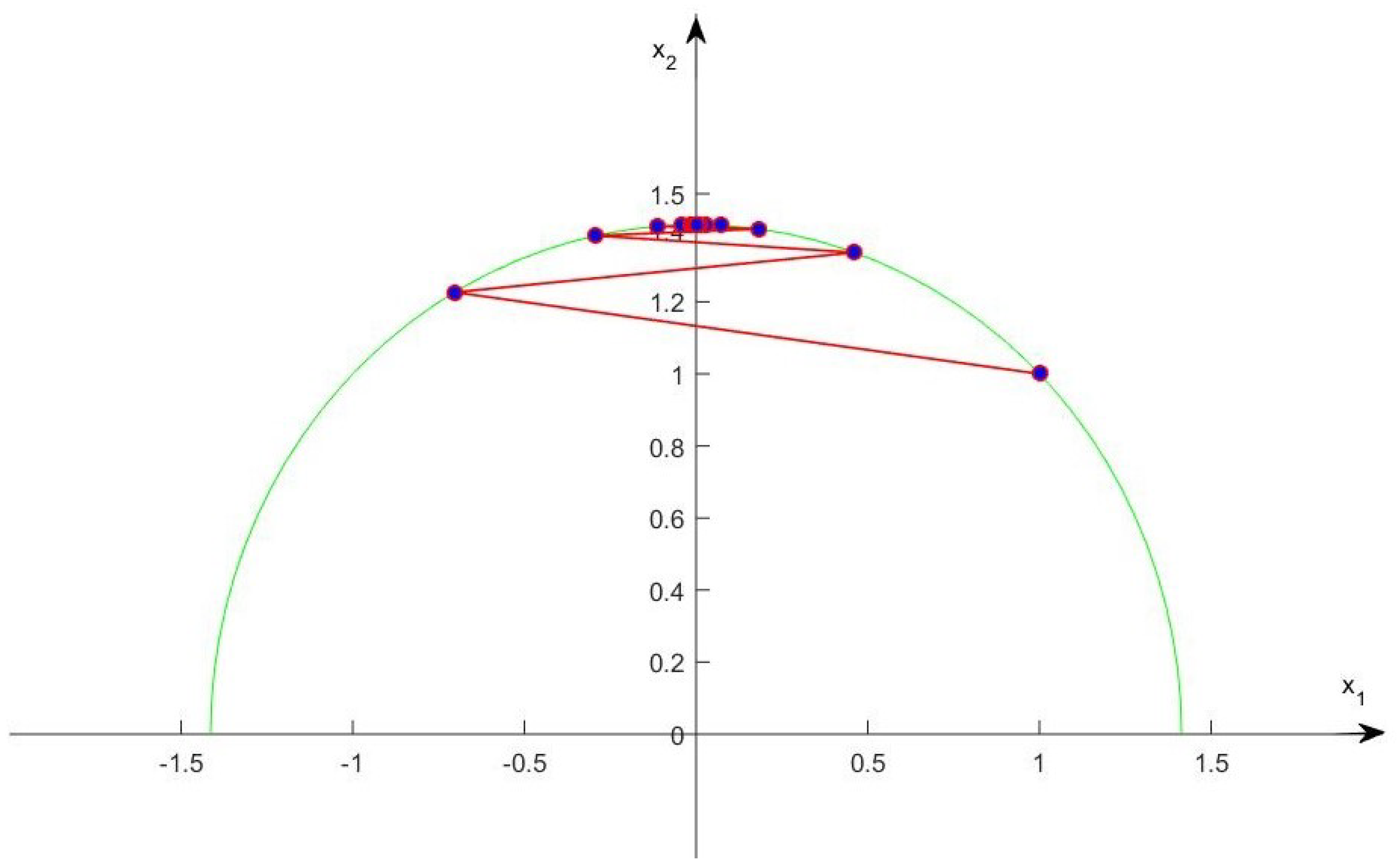
Assume next that . The geodesic segment is of Type b). Let and be the center and the radius, respectively, of the semicircle passing through x and y. Then,The Cartesian coordinates of x, y and z can now be related to the polar coordinates. Thus, we have By evaluating the hyperbolic length of the geodesic segments and we find the expression in polar coordinates:where Let us assume first that , that is . Then, and, since μ is a nondecreasing function, the condition (22) could be written as Exactly the same result is obtained when . By denoting and going back to Cartesian coordinates we find In conclusion, for two given points and , one haswhere a, R and are defined by the relations (23) and (24). Next, we include the formula we have just found into the procedure (1) to reckon the fixed point of the hyperbolic nonexpansive operator T. For this, let us consider the initial estimation and the admissible error . The existing criterion for the algorithm is set to be , where d is the Poincaré metric. Running the algorithm we find the approximate solution and the number of iterations to be performed . The image included in Figure 2 pictures the approximate sequence between the initial estimation and the resulted solution. It is nice to notice that is entirely displayed on the geodesic connecting and (the green semicircle). 5. Conclusions
Property (E) is one of the most general nonexpansivity conditions to be included in the fixed point theory. Even more interesting becomes the study of two operators with this property in order to identify their common fixed points. This paper properly answers this issue and relies on the numerical approach on a iteration procedures adapted for two operators and a curved metric setting of CAT(0) type. The resulting iterative sequence is proven to act as a -convergent one under standard setting related assumptions. Moreover, additional hypotheses regarding the operators, such as condition (A’), change the convergence behavior into a strong one.
To emphasize the practical value of this formal analysis, several examples of nonexpansive or Garcia-Falset operators are provided. The settings chosen for the numerical simulations are standard models of CAT(0) structures, such as the real axis or the Poincaré half-plane. As expected, fixed points or common fixed points are approximated within an acceptable error through algorithms including the analyzed iteration procedure.
The results obtained in this paper inspire us to experiment in the future a study of Suzuki-type operators on CAT(0)-spaces. They also provide an extremely wide class of generalized nonexpansive operators, which does not establish an inclusion relationship with the class of operators with property (E). We are also interested in iteration procedures based on metric projections on Hadamard spaces, possibly for problems of optimal proximity.