1. Introduction
This work deals with the introduction of a mathematical model aimed at describing the thermal interaction between vegetation and soil. The main feature of this model is how the temperature inside the ground is affected by the vegetation on the surface. Several aspects of the vegetation are considered in the model, such as the Leaf Area Index (LAI), the latent heat of vaporization, the sensible heat flux, the density of the foliage, or emissivities, just to name a few of them. Some of these characteristics are typically used to study vegetation–soil interaction in green roof modeling, such as in [
1,
2]. Background on different aspects of the evolution of temperature in soils can be found—for instance, in [
3], where the determination of the evolution of temperature with depth is used for geothermal energy applications. Soil temperature is also important in seed germination and plant growth (see for instance [
4]), for which the determination of the temperature in the region of the ground close to the surface is of great importance, since this is the region where the most important thermal phenomena take place. In [
5], the prediction of ground temperature variation with depth for Jamshedpur (India) for different values of air temperature and solar radiation was studied, based on a finite difference scheme. As referred to in [
6] and the references therein, there is a strong dependence of soil temperature with surface cover, which also affects the fraction of solar radiation reflected by the surface—that is, the albedo. Both concepts, albedo and coalbedo, are very relevant in models accounting for thermal interaction between vegetation and soil. Coalbedo, which is equal to 1-
, is the fraction of the radiation that is absorbed by the surface, which has an effect on soil temperature.
The model studied in this work is built on a two-dimensional domain, where
x represents the horizontal coordinate and
z stands for the ground depth. The vegetation layer is considered to be located at the upper edge of the domain; hence, it is assumed to be one-dimensional and acts as a dynamic and diffusive boundary condition to obtain the evolution of the temperature in the ground. The numerical resolution is performed by means of a finite volume (FV) scheme with Weighted Essentially (WENO) reconstruction in space and a third order Runge–Kutta TVD (RK3-TVD) scheme for time discretization. The rest of the document is organized as follows. In
Section 2, we describe the mathematical model introduced to represent the vegetation cover and its interaction with soil.
Section 3 is devoted to a brief description of the numerical method used. In
Section 4, numerical examples are given.
Section 5 presents the conclusions and discussion.
2. The Model
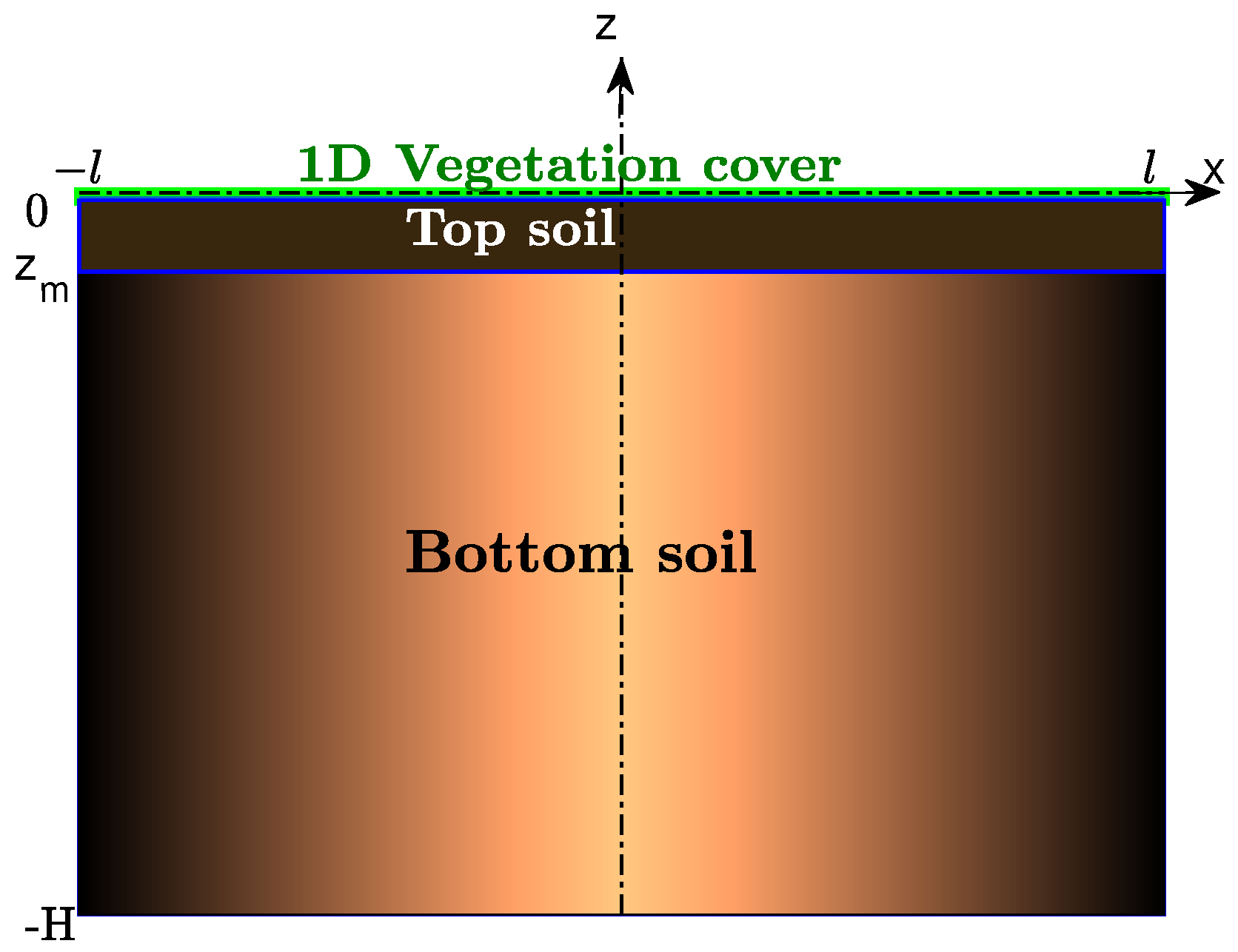
We consider a rectangular
domain, where the upper boundary represents the
vegetation cover. In
Figure 1, a sketch of the
domain is shown. The region of the soil where the main interaction processes between the soil and the vegetation cover take place is the top soil and, hence, this is the zone where the most important variations in temperature occur, as will be verified in the numerical simulations.
The equation representing the evolution of the temperature in the vegetation cover is given as
where
is the temperature of the vegetation cover,
is the temperature of the soil,
is the heat conductivity of the vegetation cover,
is the conductivity of the soil in vertical direction,
represents the heat capacity of the vegetation cover,
x is the spatial coordinate, and
t is time. The term
, which includes the normal derivative of the soil temperature, represents the influence of soil temperature on the upper boundary where the vegetation is located. This term has been introduced to account for conduction phenomena from the ground to the vegetation cover.
In (
1), the source term is given by
where
represents the sensible heat flux, which stands for the energy loss due to heat transfer from the vegetation cover to the surrounding air. Its expression, following [
7,
8], is
where
is the windless exchange coefficient depending on temperature difference;
is the leaf area index, which is a dimensionless quantity defined as the one-sided green leaf area per unit ground surface area. The density of the foliage is represented by
.
is the specific heat of air at constant pressure;
stands for the bulk transfer coefficient, given by the expression
, as proposed in [
9], where
is the wind speed at the interface of air–foliage.
represents the ambient temperature, while
is the temperature of the vegetation cover. In (
2), the emissivities of the vegetation cover
and the soil
are also included. The emissivity represents the ability of a body to emit energy and ranges from 0 to 1. The parameter
represents the fractional vegetation cover, which is taken here as
, as proposed in [
10] for grasses. The absorbed solar radiation is taken in this work as
, where
Q is the solar constant and
is the coalbedo (fraction of absorbed energy).
The latent heat flux is given by
where
is the latent heat of vaporization, which, according to Henderson-Sellers [
11], is given by
In (
4), the following coefficient was introduced
which represents the vegetation surface wetness factor, where the stomatal resistance is given by
, where
is the minimum stomatal resistance. The multiplying factor
depends on solar radiation and, following [
2], is given by
The factor
depends on the moisture content. In the case of low moisture, the value considered is
, whereas for high moisture content, the value is
(see [
1,
2] for details). Concerning the factor
, it is taken here as
. The resistance to moisture exchange offered by the boundary layer formed on the leaf surface, known as aerodynamic resistance, reads
(see [
1]). The mixing ratio of the air within the vegetation layer (see [
1,
2]) is given by
where
is the saturated mixing ratio at the soil temperature and
is the saturated mixing ratio at the vegetation temperature, with
being the saturated air vapor pressure at soil temperature and
representing the saturated air vapor pressure at vegetation temperature.
As for the equation for the evolution of the temperature in the soil, this is given by
where
and
are the heat conductivities of the soil in
x and
z directions, respectively. Equation (
9) considers the water phase change (ice–liquid water), which is represented by the function
. In this work, we use the following expression (see [
8]),
where
and
.
In order to consider that the interaction between the vegetation cover and the soil takes place within the top soil, the right-hand side of Equation (
9) is given by
where, as aforementioned,
is the depth of the top soil, which is the zone of the soil where the influence of the vegetation takes place. In (
9),
and
are defined by means of the Stefan–Boltzmann law for radiation and are expressed as
In expression (
12),
is introduced, where
is the radiation absorbed by the soil and is taken here as
, where
is the coalbedo of the soil.
In (
11), the following quantities are introduced
and
where
with
, where
is the resistance to moisture exchange and
is the stomatal resistance.
We also consider the Bulk Richardson number given by
. According to this value, the so-called atmospheric stability factor is defined as
In expression (
13), the bulk transfer coefficient
can be expressed as a function of the bulk transfer coefficients near ground
and close to the foliage–atmosphere interface
, multiplied by the stability factor
(see [
1])—that is,
with
and
, where
is the universal von Kármán constant, which is frequently used in turbulence modeling, as it happens in boundary-layer meteorology to account for fluxes of momentum, heat, and moisture from the atmosphere to the land surface. We also have the bulk transfer coefficient for latent heat exchange given by
and the mixing ratio at the ground surface
.
The values taken in this work for the different parameters involved in this model for the numerical simulations are displayed in
Table 1.
3. Numerical Approach
In this section, the numerical technique conducted, based on the finite volume method, is briefly described.
The main reasons behind using finite volume schemes are as follows:
They are conservative by construction in the sense that physical variables are conserved.
Due to their discontinuity nature, since it makes use of cell averages of the solution, discontinuities are well resolved.
In this work, a semidiscrete finite volume scheme is built for the vegetation cover, Equation (
1), and for the soil, Equation (
9). Regarding the vegetation cover (
1), the
domain
is discretized in
control volumes. Equation (
1) is integrated over each control volume dividing by its length. Let us consider the control volume
whose size is
and integrate Equation (
1) on
dividing by
to yield
with
being the spatial cell average of the temperature
in the control volume
at time
t;
is the right interface numerical flux at time
t; and
is the spatial average of the source term
in the control volume
at the particular time
t.
Considering the soil Equation (
9), the
region
is discretized in
rectangular control volumes. Denoting as
one of these
control volumes of dimensions
, where
and
, integration on the control volume gives
where
is the cell average of the soil temperature inside the control volume
, while the value
is the right intercell numerical flux in
direction and
is the intercell numerical flux in
direction at time
t;
are the spatial average of physical fluxes over cell faces at time
t; and
is the spatial average of the source term
over the control volume
.
The numerical solution may be evolved in time by means of different procedures. In this work, the third-order TVD Runge–Kutta method is performed, as introduced in [
12] and described in [
13] for global climate modeling. The expressions of this method read
where
refers to the temperature of the vegetation cover
or to
for the evolution of the temperature in the soil. Furthermore, the operator
is
in (
16) for the vegetation cover whereas it refers to the operator
in (
20) for the soil part.
The main features of this process are as follows:
High-order reconstruction of fluxes at cell interfaces, achieved using Weighted Essentially Non-Oscillatory (WENO) reconstruction.
Third-order evolution in time, using a RK3-TVD approach.
For each particular time step, we first solve the evolution of the temperature in the
vegetation cover
given in (
1), and use this numerical solution as the Dirichlet boundary condition to solve Equation (
9) and compute the function
, which allows to obtain the soil temperature
by applying a nonlinear solver, described in
Section 3.2.
3.1. Spatial WENO Reconstruction
In a finite volume scheme, it is necessary to carry out a reconstruction process since, at each particular time step, a piecewise constant function is achieved, due to the use of cell averages of the solution. There are many ways to carry out this reconstruction process. Among them, the Weighted Essentially Non-Oscillatory (WENO) approach is used here. This is a nonlinear process, since weights depend on the solution itself. This nonlinear feature is important as, according to Godunov’s theorem [
14], there are no linear monotone numerical schemes of orders higher than one. Due to this, nonlinear numerical schemes were introduced, aiming to circumvent Godunov’s theorem and achieve monotone numerical schemes of order higher than one. Essentially Non-Oscillatory (ENO) schemes, developed by Ami Harten and collaborators in the 1980s [
15,
16], were among the first successful, relevant nonlinear numerical schemes that preserved monotonicity and a high order of accuracy. WENO schemes were subsequently introduced, in which weights are assigned to each particular candidate stencil, taking into consideration certain smoothness indicators. In this work, we utilize entire polynomials (see for instance [
13,
17,
18,
19]), instead of obtaining pointwise values as in the classical WENO approach introduced in [
20]. The use of entire polynomials allows us to attain point values were needed, such as intercell boundaries or quadrature points. For the
case, we make use of a dimension-by-dimension reconstruction procedure as detailed in [
13,
21,
22,
23], among others. This process is less expensive than the fully
WENO procedure. We note that there are other variants of the WENO procedure that can be mentioned, such as CWENO (Central WENO approach), as described in [
24,
25]; the recently introduced CWENOZ scheme [
26], where boundary conditions are introduced without using ghost cells; or WENO scheme with Unconditionally Optimal Accuracy, as reported in [
27].
In the
dimension-by-dimension WENO procedure, we consider the control volume
, where cell averages of the solution are computed, and introduce the following set of one-dimensional reconstruction stencils
where
L and
R represent left and right spatial extension of the stencil. The process considered here follows the strategy put forward in different references such as [
13,
21,
22], where three candidate stencils are used for odd order while four possible stencils are taken into account for the even order case; see the aforementioned references for details on this process.
We introduce the mapping
with
,
, with
. The procedure, which is described in detail in several references—see, for instance, [
21]—is briefly explained here.
We start by carrying out reconstruction in
direction. For each control volume, the reconstruction polynomials are
with the basis interpolation functions
, which in this work are Lagrange ones, although different types, such as Legendre ones, could also be used perfectly well. The values
are the coefficients of interpolation. Now, we obtain
applying integral conservation. Now, we carry out a data-dependent nonlinear combination of the coefficients of the polynomials for each particular stencil. Applying now a nonlinear combination—typical of WENO approach—of the coefficients, we achieve
with
, with
, and
is introduced to avoid division by zero. In this work, we use
and the parameter
is taken as
. The oscillation indicators are
with the oscillation matrix
The next step consists of reconstruction in
z-direction, performing in a similar way to the previous case, but applying conservation to each particular degree of freedom
. Then, we have
Integral conservation in
z-direction is carried out for each particular degree of freedom in
x-direction, for all the control volumes of the stencil in
z-direction—that is,
where
are the control volumes in
direction.
Eventually, for the control volume
, we obtain
as the final reconstruction polynomial.
In the present work, we use a WENO7 approach, where four cells are used for each stencil (, ) and the developed scheme is seventh-order accurate in space. This method is computationally less expensive than the fully two-dimensional reconstruction.
3.2. Numerical Algorithms
As previously indicated, the process conducted for numerical simulation is based on a finite volume scheme with WENO reconstruction in space from cell averages and RK3-TVD numerical method for time integration, following the main steps given in Algorithm 1.
| Algorithm 1 General process. |
- 1:
Discretize the domain to produce a Cartesian regular finite volume mesh, formed by () control volumes. - 2:
Compute cell averages of the initial condition, both for the vegetation cover and the soil: , and , , respectively. - 3:
Define the output time of the simulation - 4:
Compute the size of the time step - 5:
- 6:
while
do - 7:
Solve the model representing the evolution of the temperature in the vegetation cover, applying the RK3-TVD scheme (Equation ( 25)), performing WENO reconstruction in space for each control volume for each one of the RK3-TVD stages. We obtain the values , which represent the cell averages of the temperature of the vegetation cover for the control volumes . - 8:
Solve the soil model by means of the RK3-TVD scheme, performing dimension-by-dimension WENO reconstruction in space for each control volume for each one of the RK3-TVD stages (Equation ( 25)). We obtain the values , which represent the cell average of the temperature of the soil for each control volume , . Here, the values , previously attained, are used as the Dirichlet boundary condition for the numerical resolution in the domain. - 9:
From the values obtained before, apply the nonlinear solver described in Algorithm 2 (for the combination of Newton–Raphson’s procedure and the regula–falsi one, which turned out to be the most efficient process) to obtain the temperature in the soil, namely, - 10:
- 11:
end while
|
When solving the model (
9)
is obtained. According to the expression given in (
10), the temperature of the soil
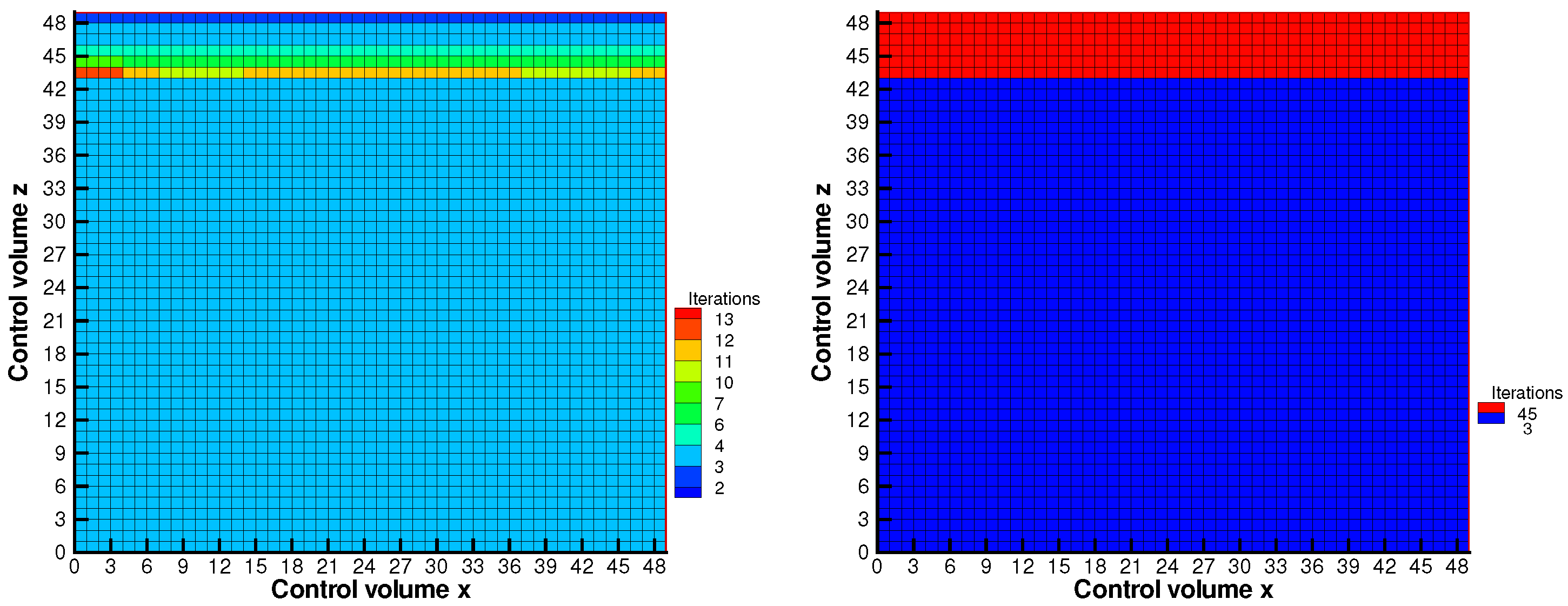
can be computed by means of a solver of nonlinear equations. In this work, we implemented in the computer code a numerical technique based on an efficient combination of Newton–Raphson’s technique and another solver such as the bisection method or the regula–falsi one. In this process, Newton–Raphson’s method is allowed to perform a certain number of iterations and, in the case it fails to converge, the other procedure (bisection or regula–falsi) starts automatically. This way to proceed is useful, since it is well-known that Newton–Raphson’s method is the one that converges faster, in the vicinity of the sought solution—that is, in local convergence—whilst the bisection or regula–falsi technique work fine in most of the cases. However, since bisection and regula–falsi numerical schemes usually require more iterations than Newton–Raphson’s method, it is always advisable to start with the latter one. In order to illustrate the iterations carried out by the nonlinear solver,
Figure 2 displays the number of iterations performed for a
spatial mesh
cells using Newton–Raphson combined with bisection and Newton–Raphson combined with regula–falsi. The plots show the mesh used and the colors indicate the number of iterations performed to compute the solution for each control volume. The blue region in both plots indicate that Newton–Raphson’s method converged using 2–3 iterations (very fast convergence). When Newton–Raphson fails to converge, the left plot reveals that regula–falsi needs 13 iterations, whereas bisection (right frame) requires 45 iterations. The color of each particular cell in the mesh depends on the number of iterations required to converge. In this example, a tolerance of
is prescribed for each one of the numerical schemes. Newton–Raphson is allowed to make up to 10 iterations before changing to one of the other techniques. These results come from one of the numerical examples conducted in the next sections, but it is included here for the sake of the explanation of the nonlinear solver. We recall that this is an automatic process, in the sense that the regula–falsi or bisection technique only acts when Newton–Raphson does not converge.
Since the heat capacity of ice is around half the heat capacity of liquid water, we used in this work the values
,
. Other values taken are
and
, which refer to the latent heat of fusion of water measured in KJkg
. The algorithm for the nonlinear solver is as follows.
| Algorithm 2 Nonlinear solver. |
- 1:
Prescribed , , , - 2:
; - 3:
- 4:
while & do - 5:
( 10) - 6:
- 7:
- 8:
- 9:
- 10:
end while - 11:
ifthen - 12:
- 13:
end if - 14:
- 15:
Prescribed , , , - 16:
- 17:
while & do - 18:
- 19:
( 10) - 20:
( 10) - 21:
( 10) - 22:
if then - 23:
- 24:
else - 25:
- 26:
end if - 27:
- 28:
- 29:
end while - 30:
|
4. Numerical Examples
The mathematical model under study is a coupled model formed by a vegetation cover and soil underneath it, describing the evolution of temperature. The main processes and equations are described in
Section 2. The system (
36) represents the full coupled model.
In problem (
36),
and
are constant values. The spatial domain considered is
. The numerical simulation is conducted applying a finite volume method with seventh-order WENO reconstruction in space and RK3-TVD for time integration, as described in
Section 3. As previously detailed, the nonlinearity appearing due to the latent heat of fusion
is solved by Newton–Raphson’s numerical scheme combined with regula–falsi technique. The algorithm followed is described in
Section 3.2. The spatial mesh is formed by
control volumes. The size of the time step is computed as
, where
for stability reasons. Concerning heat conduction, we take
,
, and
.
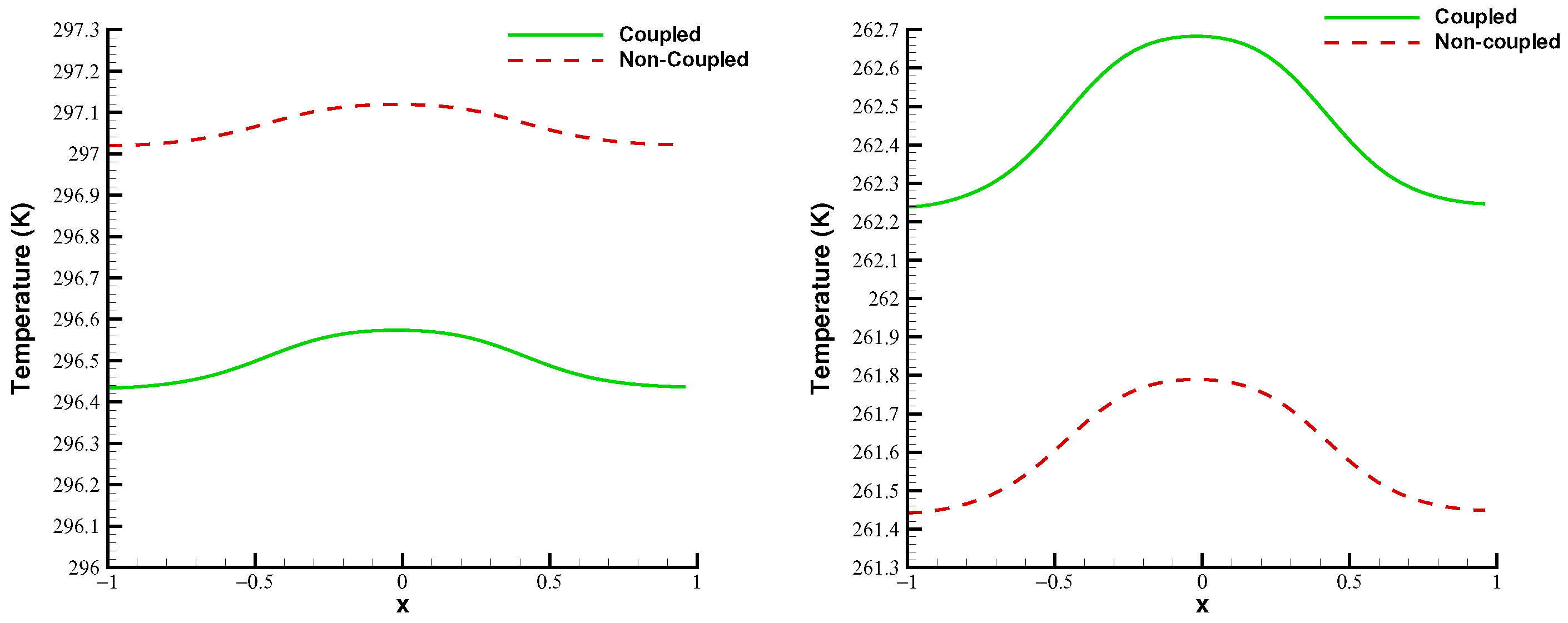
In
Figure 3, results for the evolution of the temperature in the vegetation layer are shown for time
. We took
and
in the initial condition of the model (
36), an ambient temperature of
for the results shown in the left frame, and
for the results displayed in the right frame. The curves displayed are labeled as follows:
Without coupling, which means that
is removed in (
1);
With coupling, which means that
is considered. It can be observed that when the temperatures are low (right frame of
Figure 3), the coupled case gives rise to higher temperatures than the uncoupled one; on the other hand, when the temperatures are higher, the coupled case gives rise to lower temperatures than the uncoupled one (left frame of
Figure 3). This is due to the effect of the top soil, which can be considered as a major insulator of heat (see [
4]) and may have an important influence on the vegetation cover.
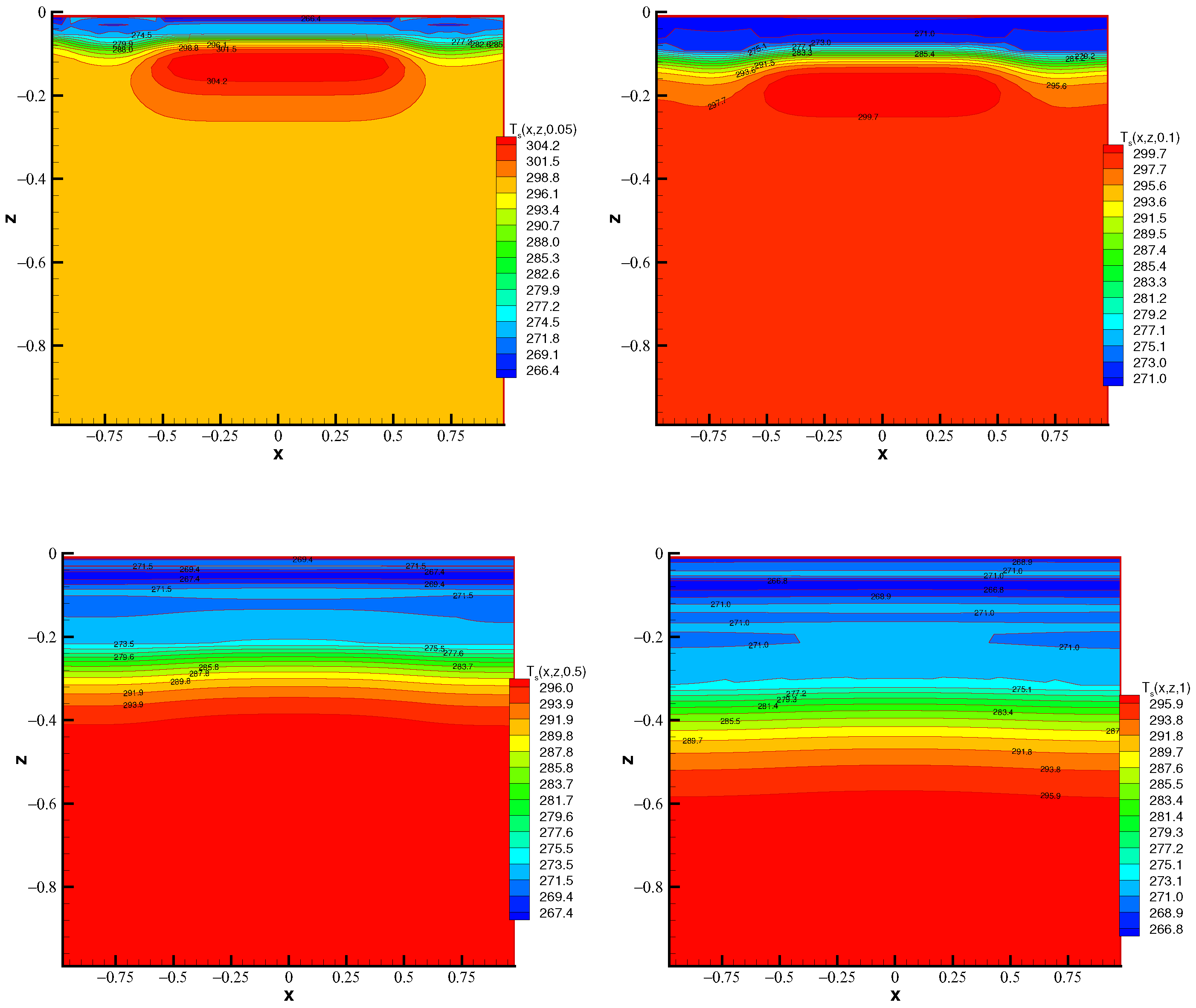
We study now the space-time evolution within the bottom soil. The plots displayed in
Figure 4 show the distribution of temperature
inside the ground solving the problem (
36) for several output times.
It can be observed that the strongest variations of temperature take place in the top soil, close to the surface; whereas, when advancing in depth, the temperature tends to an approximate constant value, which agrees with practical experience. In this case, the values used are
and
in the initial condition of the problem (
36) and the ambient temperature is
. In this example and the subsequent ones, we considered
in the vegetation cover equation. The effect of the latent heat of fusion in the different plots can also be observed since, around 273 K, the temperature remains approximately constant as the phase change is taking place.
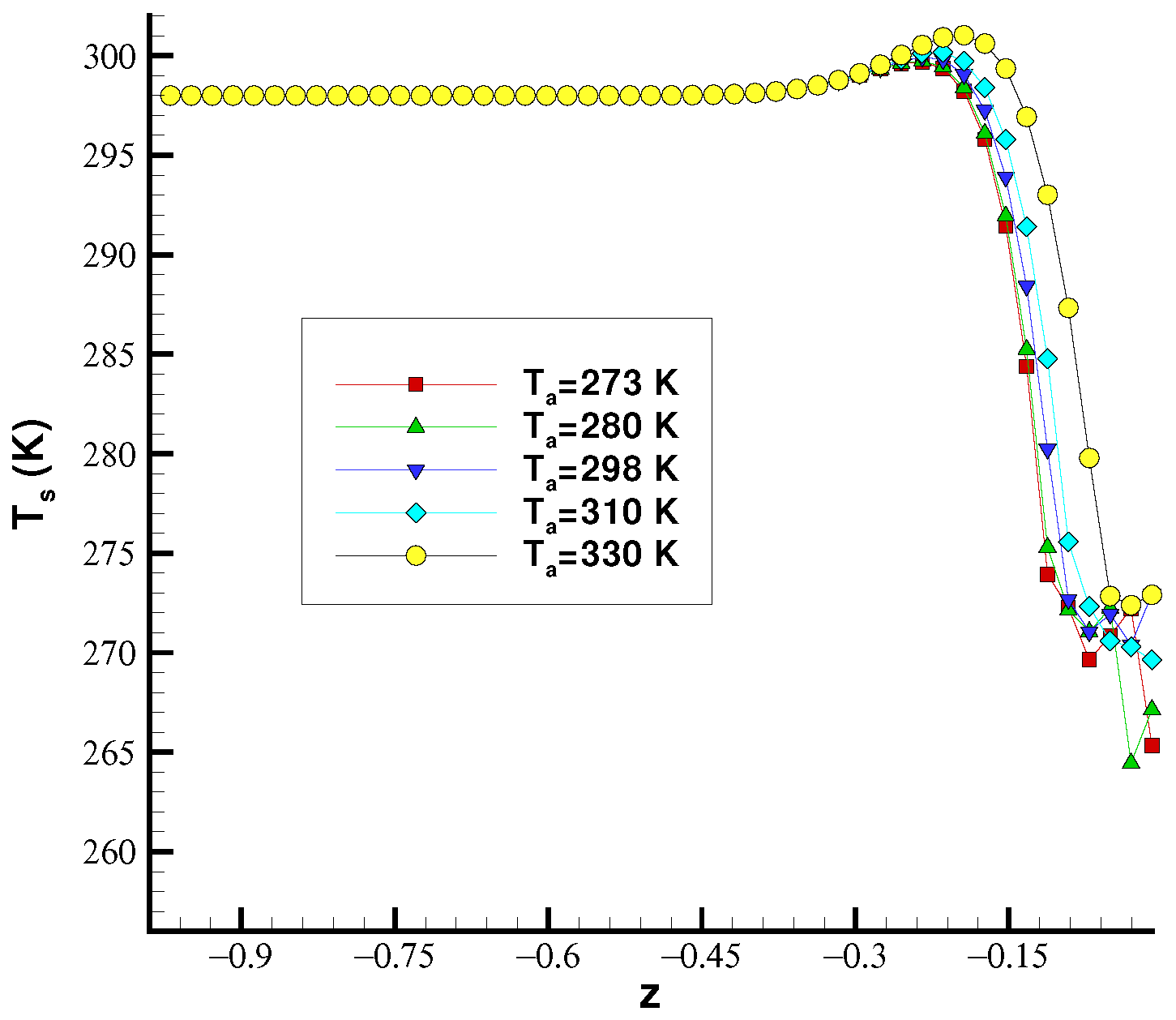
In
Figure 5, the evolution of the temperature
in the bottom soil is depicted with depth for different ambient temperatures
. The results show that as depth increases, the temperature attains a value close to the constant 298 K, independent of the ambient temperature considered. In this case, the values
and
are used in the initial condition of problem (
36).
The results displayed indicate that seasonal variations in the ambient temperature do not have an effect on the temperature of the bottom soil as depth increases, since the temperature remains close to a constant value. This fact has been verified in all the numerical examples presented. It also agrees with [
28], where it is also stated that a similar situation takes place universally around the world.
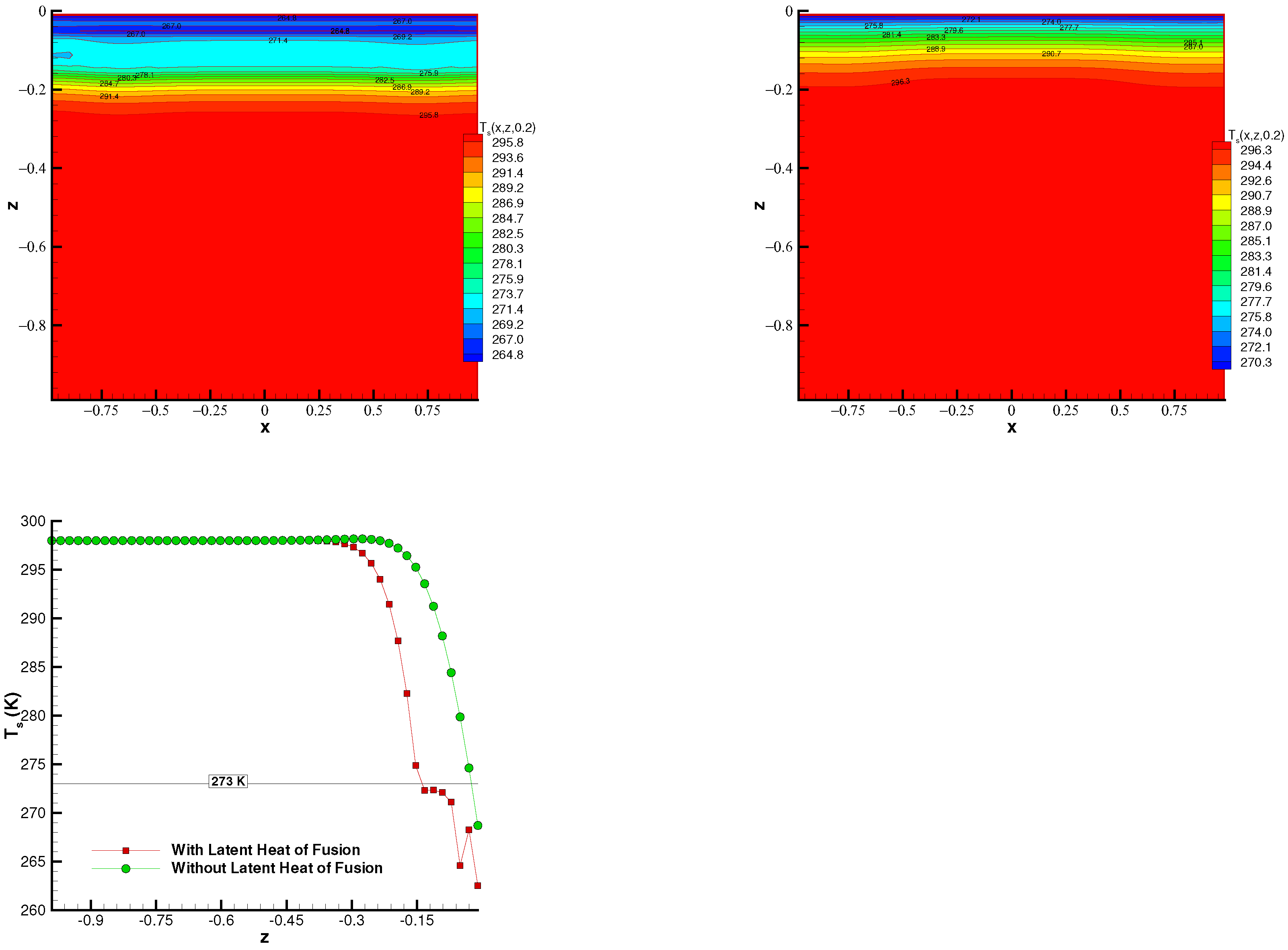
In the last numerical example, results with and without latent heat of fusion are shown. To proceed, the coefficients
and
are introduced in the initial condition of the system (
36) and, as ambient temperature, the function
has been considered. Since the temperature varies between values lower and higher than 273 K, the effect of the latent heat of fusion is clearly visible. It can be appreciated, in the top-left panel of
Figure 6, that when the temperature in the soil is around 273 K, it remains approximately constant since the energy goes to the phase change instead of to increasing the temperature. This effect has also been studied in climate models, such as those reported in [
29].
In the top-right panel, the effect of the latent heat of fusion is not considered. This means that
is used in Equation (
36) and the plot shows that the variation of temperature is smoother than when latent heat of fusion is taken into consideration.
The bottom panel represents a cut with of the plots above for a clearer comparison of the cases with and without latent heat of fusion. It can be observed that there is a decrease in the temperature in the vicinity of the surface but, as depth increases, the temperature starts to rise, with a similar profile to the situation without latent heat of fusion (). When the phase change temperature is reached, around = 273 K, the temperature slows its growth as the phase change occurs.
5. Conclusions and Discussion
In this work, we introduced a mathematical model describing the interaction between a vegetation cover and the ground underneath this cover. The model is coupled, in the sense that vegetation cover is a dynamic and diffusive boundary condition for the domain. The main heat exchange processes take place in the top soil, which is the part of the soil that is closer to the vegetation cover. The equation of the vegetation cover includes a normal derivative, accounting for heat conduction from the soil to the vegetation. The model also takes into account the water phase change, which is described by the function , where is the temperature in the soil. Therefore, heat capacity is not a constant, but a function of the temperature of the soil. This nonlinearity is resolved by means of a Newton–Raphson’s technique combined with a regula–falsi one (which acts automatically when Newton–Raphson’s scheme fails to converge).
The main interactions between the vegetation and the soil take place in a thin region close to the surface, the top soil.
The mathematical model is solved using a finite volume numerical scheme, with a third-order TVD Runge–Kutta scheme for time integration and a seventh-order WENO approach for spatial reconstruction. These techniques are very efficient for solving this type of problems.
The results obtained show that the main temperature variations take place in the vicinity of the surface—namely, the top soil—whereas as depth increases the temperature tends to a constant value, as expected. This conclusion agrees with the real situation as reported in references on this topic.
Further research will include the consideration of water content and moisture in the soil, as well as taking into account different types of plants. In addition, it will be interesting to introduce the effect of precipitation, as it may affect the integrity of the vegetation cover.