1. Introduction
The isothermal motions of incompressible Newtonian or non-Newtonian fluids over an infinite plate have been extensively studied in the past. They are some of the most important motion problems near moving bodies and have multiple industrial applications including the processing of polymers, food products, pharmaceuticals, clay suspensions, and many others. Generally, in practice, an infinite plate cannot be used. However, its dimensions can be large enough so that the solutions corresponding to motions over such a plate can be sufficiently approximated by solutions for motions over an infinite plate. In the existing literature, there are many studies on the motion problems of fluids over an infinite plate or between two infinite parallel plates. The most recent results regarding oscillatory motions of incompressible Burgers’ fluids over an infinite plate seem to be those of Akram et al. [
1]. The MHD motions of these fluids also have different applications in hydrology, horticulture, and engineering structures. The exact solutions for the MHD second Stokes flow of the same fluids can be obtained from the work of Khan et al. [
2]. In addition, the study of different motions through porous media has a distinguished importance in different fields, including those in the natural sciences and technology. Hydrodynamic studies of the Maxwell fluid flow through a porous medium were recently provided by Ullah et al. [
3] and Fetecau et al. [
4]. Exact solutions for MHD unsteady motions of incompressible non-Newtonian fluids over an infinite flat plate embedded in a porous medium were previously established; for instance, by Hayat et al. [
5] and Ali et al. [
6] for second-grade fluids, Khan et al. [
7] for Oldroyd-B fluids, and Algahtani and Khan [
8] and Hussain et al. [
9] for Burgers’ fluids. General solutions for isothermal MHD motions of incompressible Newtonian fluids over an infinite plate embedded in a porous medium were obtained by Fetecau et al. [
10]. The combined effects of free convection MHD flow past a vertical plate embedded in a porous medium were recently investigated by Vijayalakshmi et al. [
11].
Many exact solutions for MHD unsteady motions of the incompressible non-Newtonian fluids over an infinite plate embedded in a porous medium were determined previously by different authors. However, Khan et al. [
2] seemed to be the first authors who established exact solutions for such motions of incompressible Burgers’ fluids. The one-dimensional form of the constitutive equation of incompressible Burgers’ fluids was proposed by Burgers [
12]; his model is often used to describe the behavior of different viscoelastic materials such as polymeric liquids, cheese, soil, and asphalt [
13,
14]. A good agreement between the prediction of this model and the behavior of asphalt and sand-asphalt was found by Lee and Markwick [
15]. The extension of the one-dimensional Burgers’ model to a frame-indifferent three-dimensional form was provided by Krishnan and Rajagopal [
16], while the first exact steady solutions for motions of such fluids seem to be those of Ravindran et al. [
17] for a fluid flow in an orthogonal rheometer. Other interesting solutions for oscillatory motions of incompressible Burgers’ fluids were established by Hayat et al. [
18], Khan et al. [
19,
20], and recently Safdar et al. [
21]. Exact steady-state solutions for isothermal motions of same fluids when a differential expression of shear stress was given on a part of the boundary were recently obtained by Fetecau et al. [
22]. In order to study similar flows of the same fluids in bounded domains, which are useful in industrial applications, readers can use the recent works by Çolak et al. [
23] and Abderrahmane et al. [
24].
Earlier, Renardy [
25,
26] showed that boundary conditions containing differential expressions of stresses must be imposed in order to formulate well-posed boundary value problems for motions of rate-type fluids. The main purpose of this work was to provide the first exact steady-state solutions for motions of incompressible Burgers’ fluids, which are rate-type fluids, when differential expressions of the shear stress were given on a part of the boundary and the magnetic and porous effects were taken into consideration. These solutions, which are presented in simple forms, could easily be particularized to give exact solutions for incompressible Oldroyd-B, Maxwell, second-grade and Newtonian fluids that were performing similar motions. For illustration, the adequate solutions for the Newtonian fluids are brought to light. In addition, for the validation of the results, all of the solutions are presented in different forms and their equivalence is graphically proved. Finally, as an application, the required time to reach the steady or permanent state was graphically determined for distinct values of the magnetic and porous parameters.
2. Statement of the Problem
Consider an incompressible, electrically conducting Burgers’ fluid (IECBF) at rest over an infinite horizontal flat plate embedded in a porous medium. Its constitutive equations, as presented by Ravindran et al. [
15], are given by the relations:
where
T is the Cauchy stress tensor;
S is the extra-stress tensor;
I is the unit tensor;
is the first Rivlin–Ericksen tensor (
L being the gradient of the velocity vector
);
p is the hydrostatic pressure;
is the fluid viscosity;
, and
are material constants; and
D/
Dt denotes the well-known upper-convected derivative. Since the incompressible fluids undergo isochoric motions only, the following continuity equation must be satisfied:
We also most consider the fact that the fluids characterized by the constitutive Equation (1) contain the incompressible Oldroyd-B, Maxwell, and Newtonian fluids as special cases if , or , respectively. For the motions to be considered here, the governing equations corresponding to the incompressible second-grade fluids can also be obtained as particular cases of the present equations.
In the following, and based on Khan et al. [
2], we shall consider isothermal MHD unsteady motions of an IECBF over an infinite flat plate embedded in a porous medium for which
where
is the unit vector along the
x-direction of a convenient Cartesian coordinate system of
x,
y, and
z with the
y-axis perpendicular to the plate. For such motions, the continuity equation is identically satisfied. Substituting
and
from Equation (3) in the second equality from the relations in (1) and bearing in mind the fact that the fluid has been at rest up to the initial moment
one can prove that the components
and
of
S are zero. On the other hand, the non-trivial shear stress
must satisfy the next partial differential equation [
18].
The balance of linear momentum in the presence of conservative body forces and of a transverse magnetic field of the magnitude
B but in the absence of a pressure gradient in the flow direction reduces to the following partial differential equation [
2]:
where
is the constant density of the fluid,
is its electrical conductivity, and the Darcy’s resistance
satisfies the relation [
2].
In the above relation, and k are the porosity and the permeability, respectively, of the porous medium.
The appropriate initial conditions of:
have been already used to show that some of the components of the extra-stress
S are zero. The boundary conditions to be here used are given by the following relations:
or
In the above relations, S is a constant shear stress and is the frequency of the oscillations.
The second condition from the relations (8) and (9) assures us that the fluid is quiescently far away from the plate. We also assume that there is no shear in the free stream; i.e.,:
For convenience, we also assume that the fluid is finitely conducting so that the Joule heating due to the presence of external magnetic field is negligible. In addition, the magnetic Reynolds number is small enough so that the induced magnetic field can be neglected and the electromagnetic energy does not penetrate the boundary for computing the Umov–Poynting vector [
27]. Moreover, there is no surplus electric charge distribution present in the fluid and the Hall effects can be ignored due to moderate values of the Hartman number.
In order to provide exact solutions that are independent of the flow geometry, let us introduce the next dimensionless functions, variables and parameters:
Using the non-dimensional entities from the relations in (11) in the equalities (4)–(6) and abandoning the star notation for writing simplicity, one obtains the non-dimensional forms of these equations:
where the constants
M and
K are the magnetic and porous parameters, respectively, which are defined by the following relations:
When eliminating
between Equations (12) and (13) and bearing in mind Equation (14), one obtains for the dimensionless velocity field
the following partial differential equation:
The corresponding boundary conditions are given by the next equalities:
or
The adequate initial conditions have the same forms as in Equation (7) but they will not be used in the following because only steady-state (permanent or long-term) solutions will be provided. The non-dimensional shear stress
also must satisfy the following condition:
The form of the boundary conditions in (17) and (18), as well as the fact that the fluid was at rest at the moment
suggests that the two motions become steady in time. For such motions, a very important problem for experimental researchers is to know the time needed to reach the steady or permanent state. This is the time after which the fluid moves according to the steady-state solutions. In the following, in order to avoid a possible confusion, we denote by
,
,
and
,
,
the starting solutions corresponding to the two fluid motions whose boundary conditions are given by the relations in (17) and (18), respectively. These solutions, which characterize the fluid motion some time after its initiation, can be written as sum of their respective steady-state and transient components; i.e.,:
and
After this time, when the transients disappear or can be negligible, the fluid behavior is described by the steady-state or permanent solutions , , or , , . In order to determine this time for a given motion, at least the steady-state or transient solutions have to be known. Since, for the transient solutions of the motions, we do not know a modality to verify their correctness, in the following we shall provide closed-form expressions for the steady-state solutions of the two above-mentioned motion problems. These steady-state solutions, which are independent of the initial conditions, satisfy the boundary conditions and governing equations.
3. Dimensionless Steady-State Solutions
In this section, we provide closed-form expressions for the dimensionless steady-state velocity and shear stress fields , and , , respectively, and the corresponding Darcy’s resistances . For a check of the obtained results, these expressions are presented in different forms and their equivalence is graphically proved.
3.1. Calculation of the Steady-State Velocities and
To determine the dimensionless velocity fields
and
that satisfy the governing Equation (16) and the respective boundary conditions (17) and (18), we follow two different methods. Firstly, while bearing in mind the linearity of the governing Equation (16) and the form of the boundary conditions (17) and (18), we define the steady-state complex velocity:
where
i is the imaginary unit and is searching for a solution of the form:
where
is a complex function. Of course, the dimensionless complex velocity
must satisfy the governing Equation (16) and the boundary conditions.
Direct computations show that
can be presented in the following form:
while the dimensionless steady-state velocity fields
and
are given by the following relations:
where Re and Im denote the real and imaginary parts, respectively, of that which follows, and:
Secondly, in order to determine the equivalent forms for the dimensionless steady-state solutions given by Equation (26), we use the dimensionless steady-state solutions:
of the second problem of Stokes for incompressible Burgers’ fluids. It is the fluid motion over an infinite flat plate that oscillates in its plane with the dimensionless velocity
or
In these solutions, which were determined by direct computations, the constants
m and
n are given by the following relations:
which satisfy the algebraic system of equations:
where
a and
b are defined by following equalities:
More precisely, we are looking for the present dimensionless steady-state velocity fields
and
under the following forms:
They must satisfy the respective boundary conditions in (17) and (18). Lengthy but straightforward computations show that
and
can be presented in the following simple forms:
In the last two relations, the angle
while the constants
,
,
p, and
q have the following expressions:
in which
c and
d are given by the following relations:
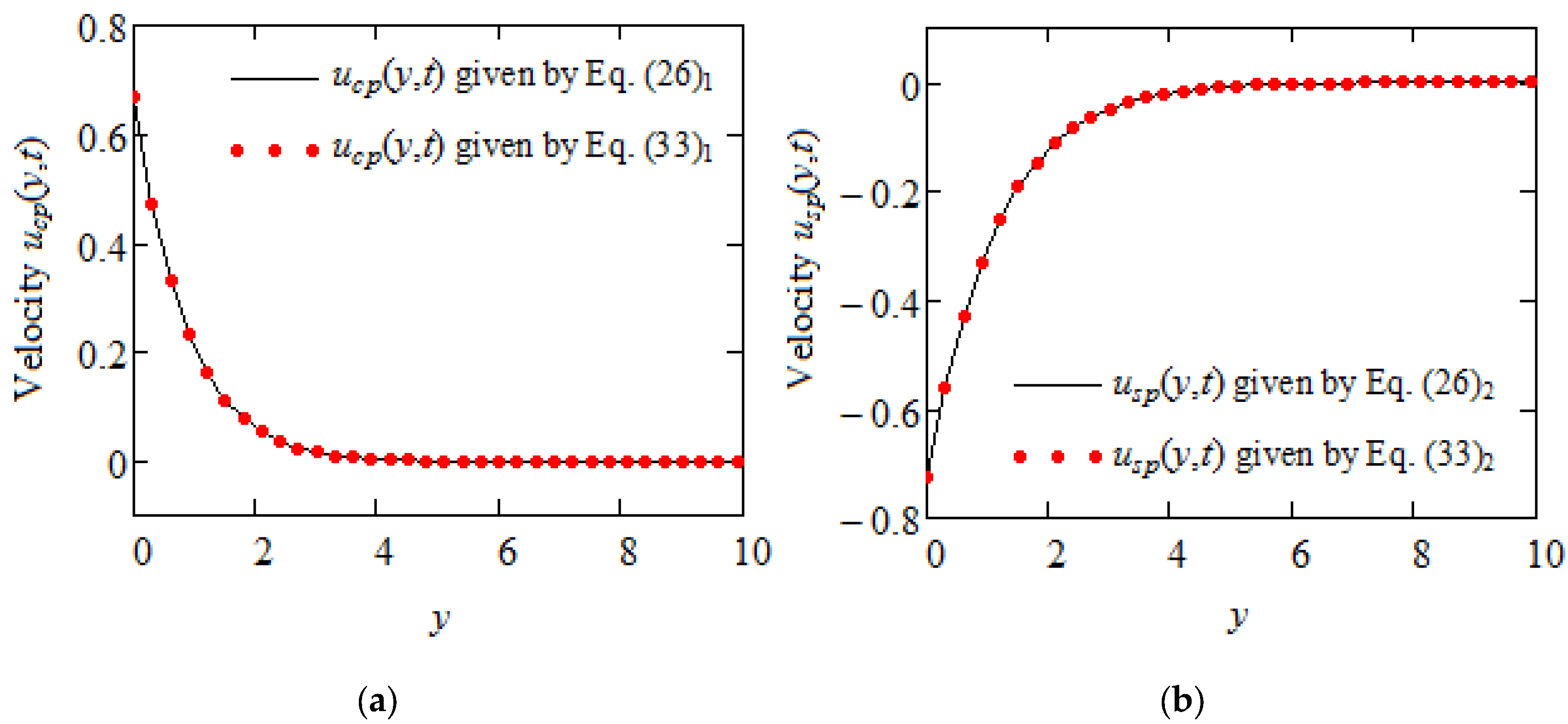
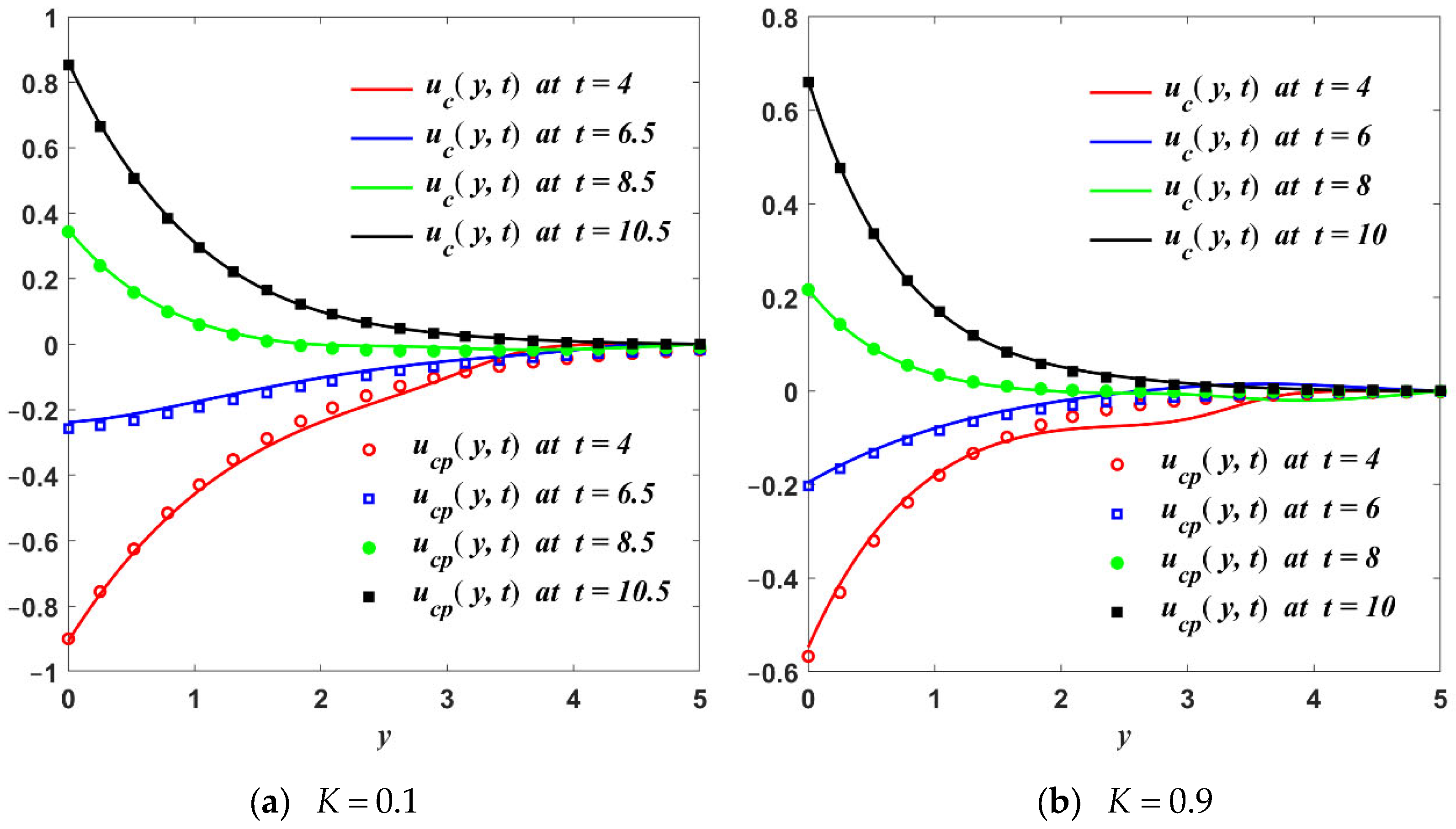
The equivalence of the dimensionless steady-state solutions given by the equalities in (26) and (33) is graphically proved in
Figure 1a,b.
The dimensionless steady-state velocity fields
and
corresponding to isothermal motions of the same fluids in the absence of magnetic or porous effects can immediately be obtained by taking
, respectively
in Equations (26) and (33), respectively. In the absence of both effects, when
the present solutions reduce to those obtained by Fetecau et al. [
22] (Equations (19) and (20)). Moreover, the dimensionless steady-state solutions corresponding to incompressible Oldroyd-B, Maxwell, and Newtonian fluids that are performing similar motions are immediately obtained by taking
or
, respectively, in the previous relations. The dimensionless steady-state velocity fields corresponding to motions of the incompressible Newtonian fluids over an infinite flat plate that apply an oscillatory shear stress
or
to the fluid, for instance, have the following simple forms:
or the equivalent
where
and
is the effective permeability [
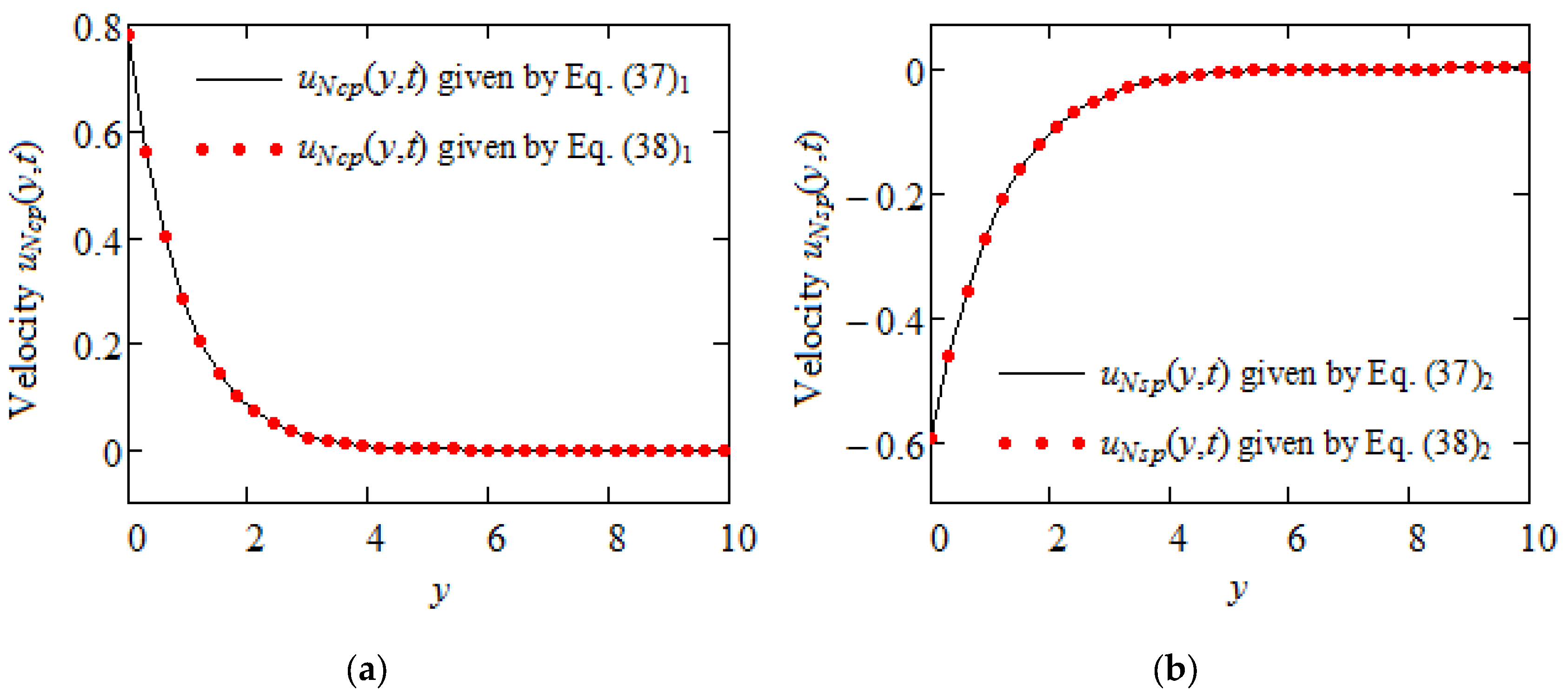
10]. The equivalence of the solutions in (37) and (38) is graphically proved in
Figure 2a,b.
3.2. Exact Expressions for and
In order to determine the dimensionless steady-state shear stresses
and the Darcy’s resistances
corresponding to the two unsteady motions of the IECBF when magnetic and porous effects are taken into account, we firstly use the complex shear stress and Darcy’s resistance:
and follow the same method as for the steady-state velocities. The obtained results when using for
and
the expressions from the equalities in (26) are given by the following respective relations:
and
Direct computations clearly show that the dimensionless steady-state velocity, shear stress, and Darcy’s resistance fields and given by the relations in (26), (41), and (42) satisfy the governing Equations (12)–(14) and the respective boundary conditions in (17) and (18).
Equivalent expressions for
and
namely:
and
were obtained by using the corresponding velocity fields
and
from the equalities in (33). In these relations:
where
and
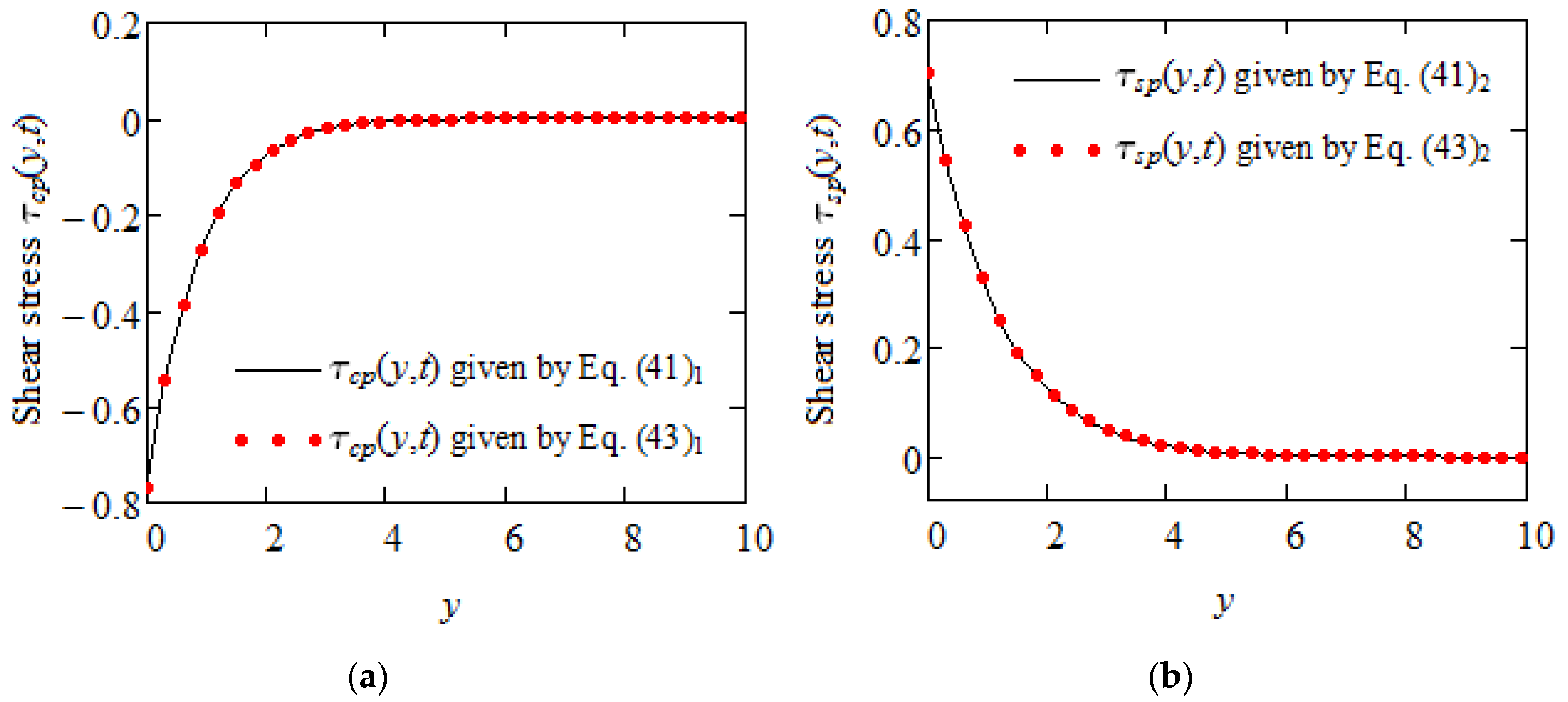
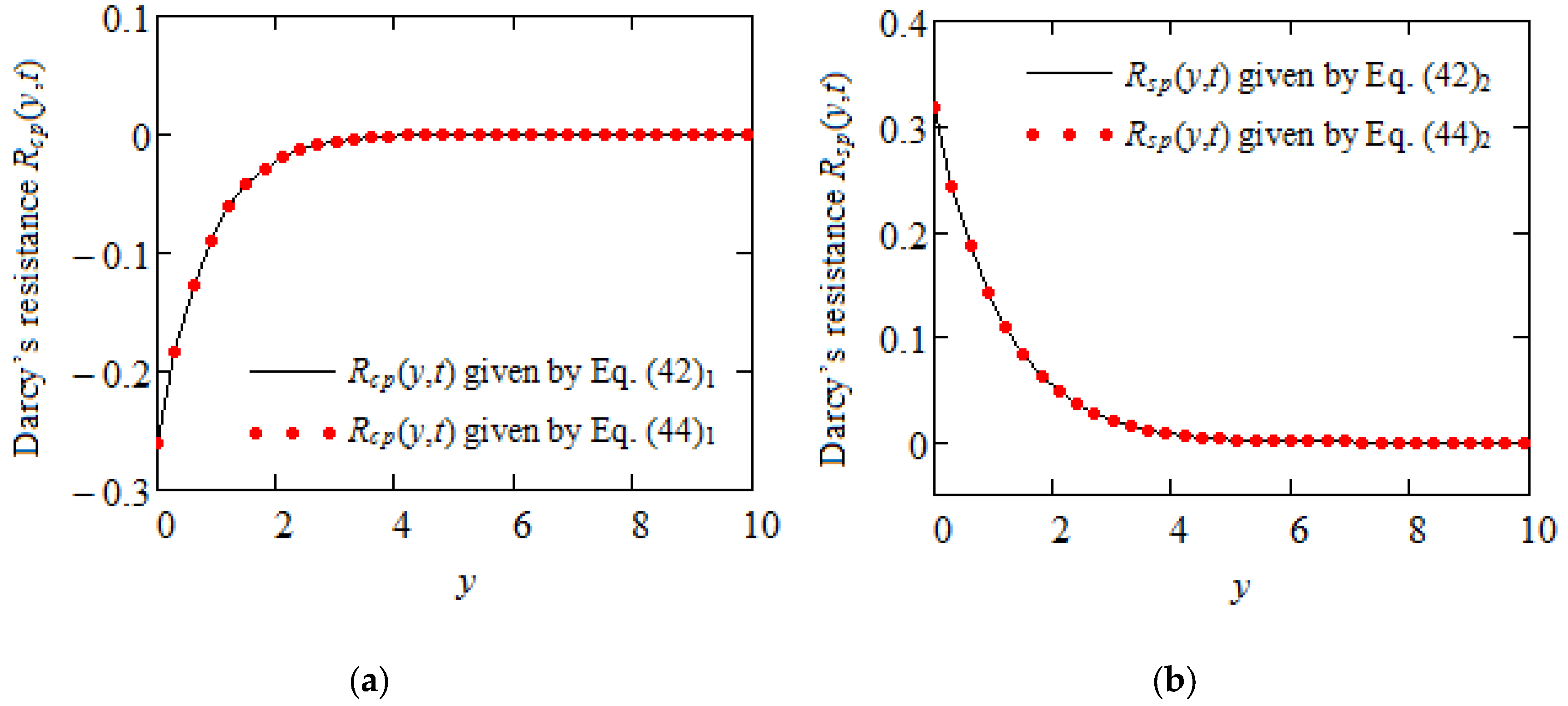
The equivalence of the dimensionless shear stresses
and of the Darcy’s resistances
given by Equation (41) and (42), respectively, to those from the relations in (43) and (44) is proved in
Figure 3 and
Figure 4.
The dimensionless steady-state shear stresses and Darcy’s resistances corresponding to the velocity fields
and
of incompressible Newtonian fluids given by the relations in (37) and (38) have the following simple forms:
or the equivalent:
4. Some Numerical Results and Applications
Closed-form expressions for the dimensionless steady-state solutions , , and , , corresponding to two isothermal MHD motions of an IECBF over an infinite flat plate embedded in a porous medium were presented in simple forms in the previous section. They are the first exact solutions for MHD motions of an IECBF with differential expressions of shear stress on the boundary. For validation, all solutions are presented in double forms and their equivalence was graphically proved. These solutions can easily be particularized to give corresponding solutions for incompressible Oldroyd-B, Maxwell, and Newtonian fluids that are performing similar motions.
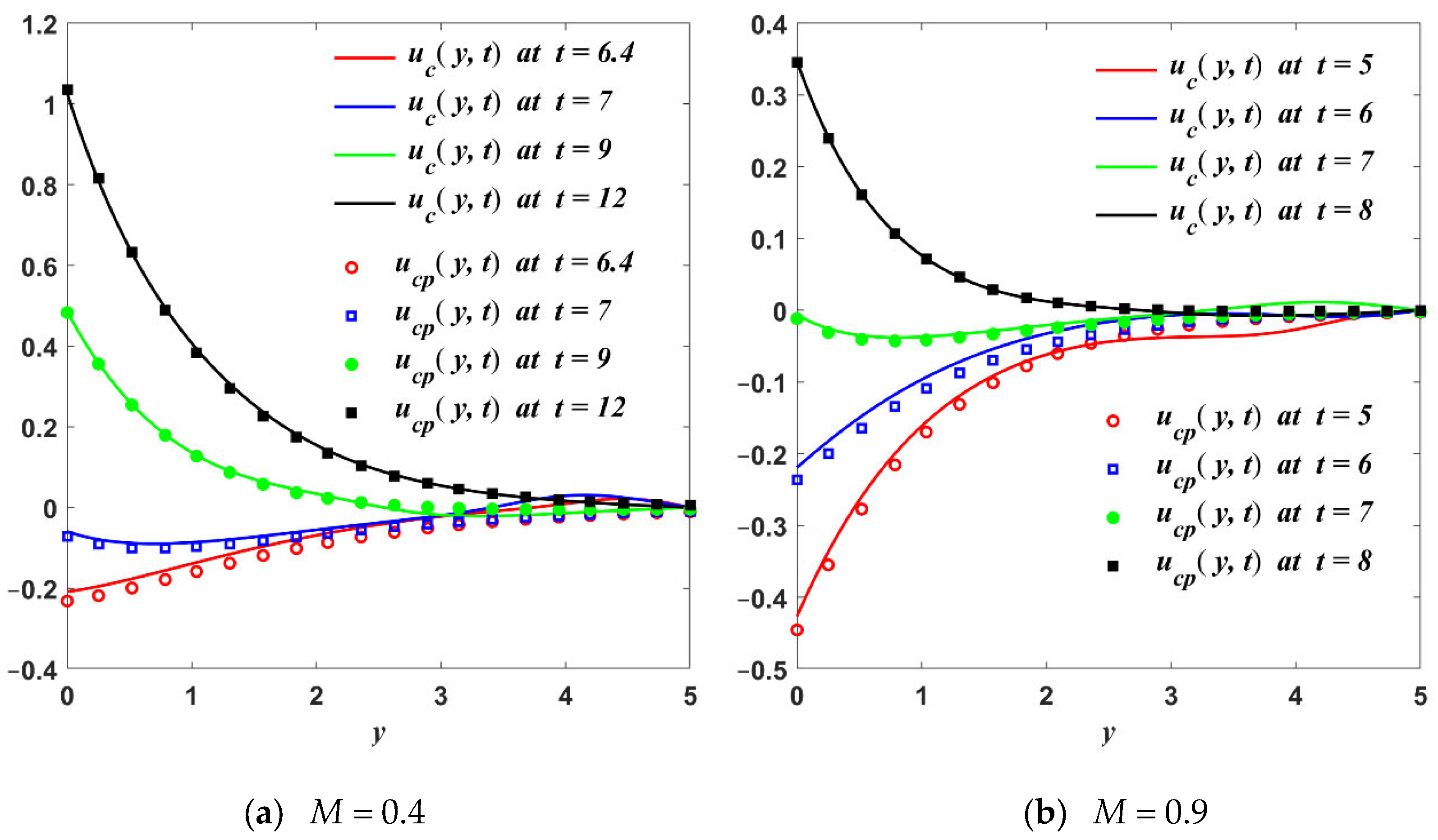
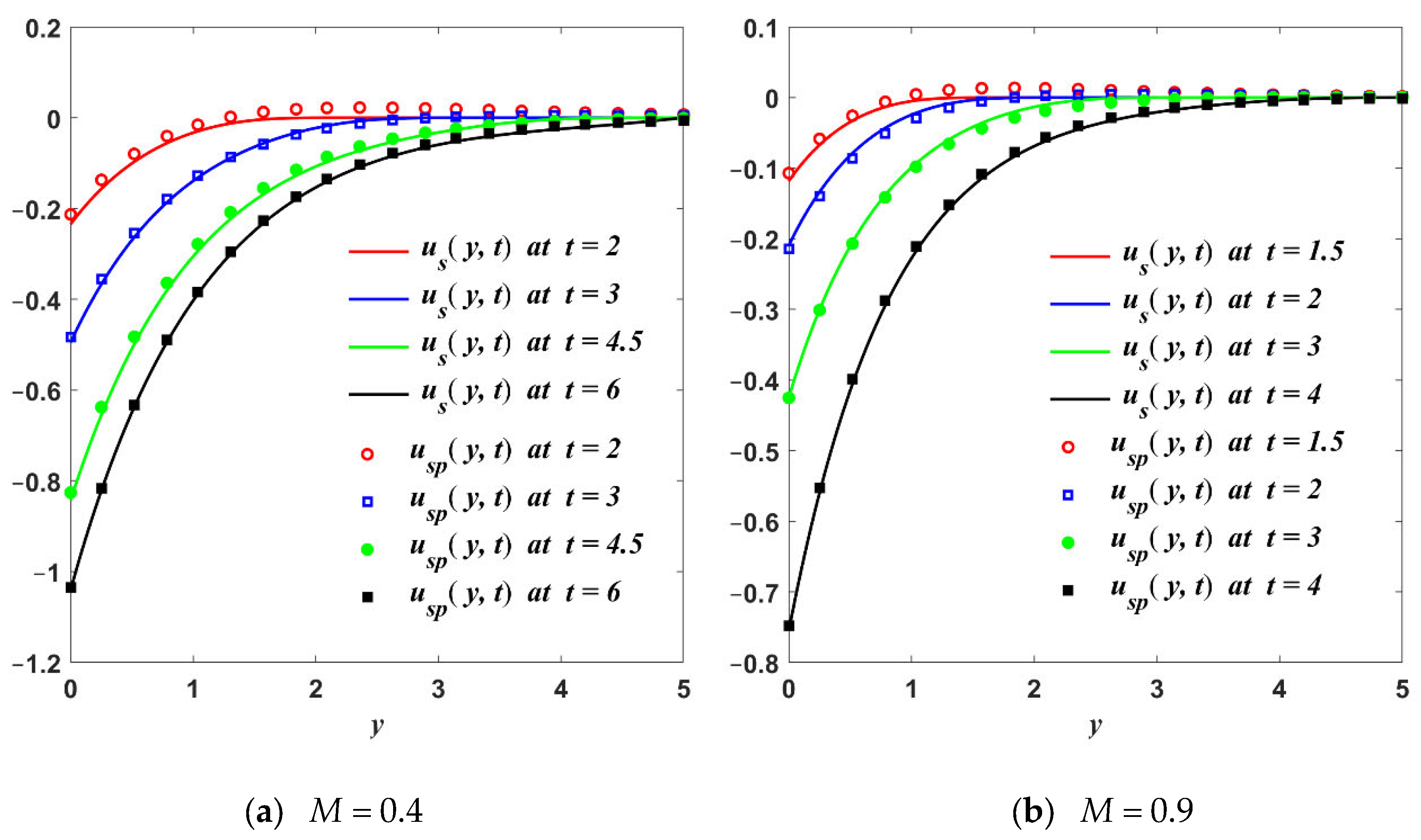
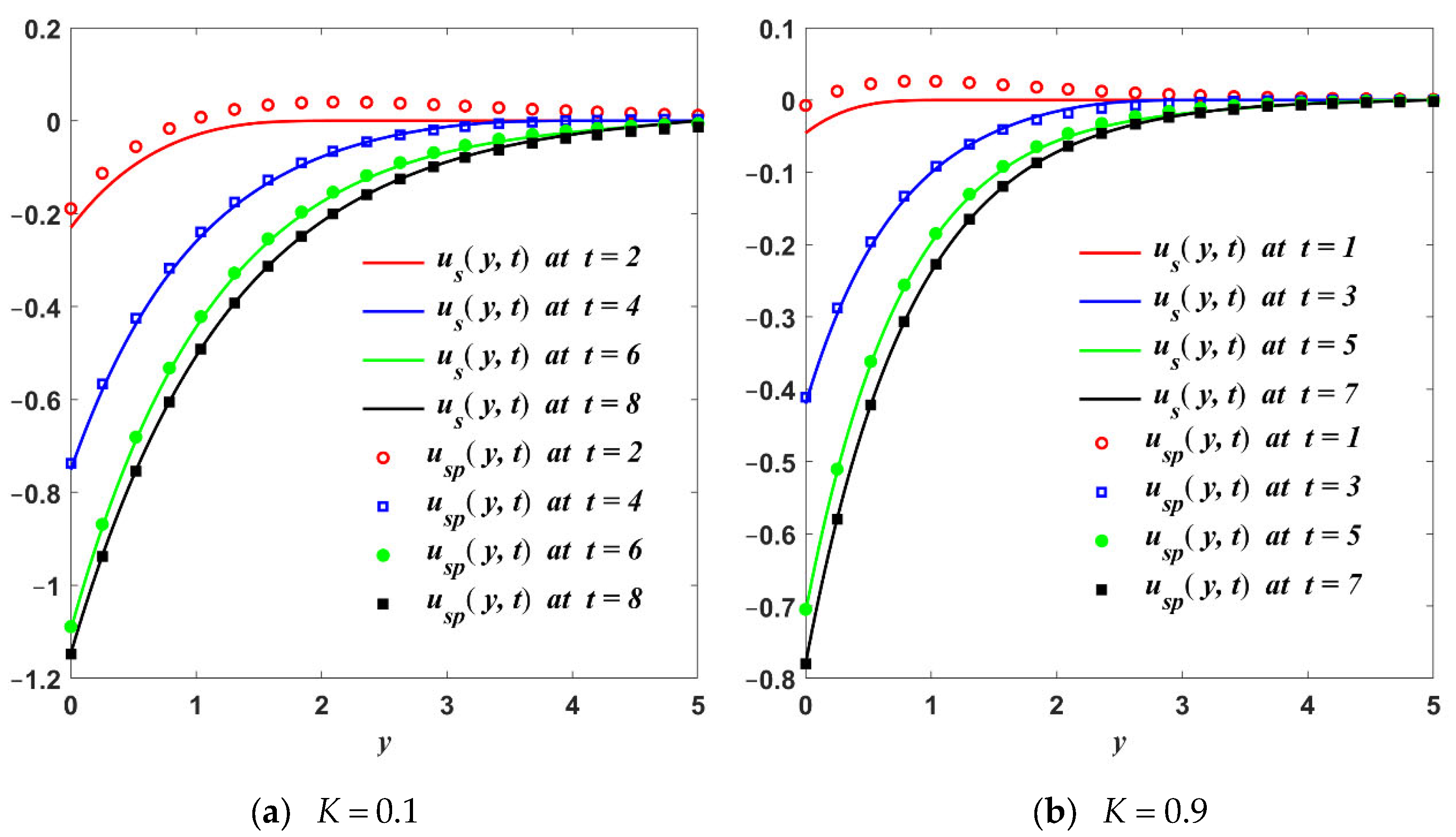
As an application, some of the obtained results were used to determine the required time to reach the steady or permanent state. From a mathematical point of view, this was the time after which the diagrams of the starting velocities
and
(numerical solutions) were almost identical to those of their steady-state components
and
, respectively. The convergence of the two starting velocities to their steady-state components was proved in
Figure 5,
Figure 6,
Figure 7 and
Figure 8 for increasing values of the time
t at distinct values of
M and
K and fixed values of the other parameters. Based on these figures, it was clear that the required time to reach the steady state diminished with increasing values of the magnetic or porous parameters (
M and
K, respectively). Consequently, the steady state for isothermal motions of the IECBF was earlier reached in the presence of a magnetic field or porous medium. In addition, as expected, in all cases the fluid velocity tended to zero with increasing values of the spatial variable
y.
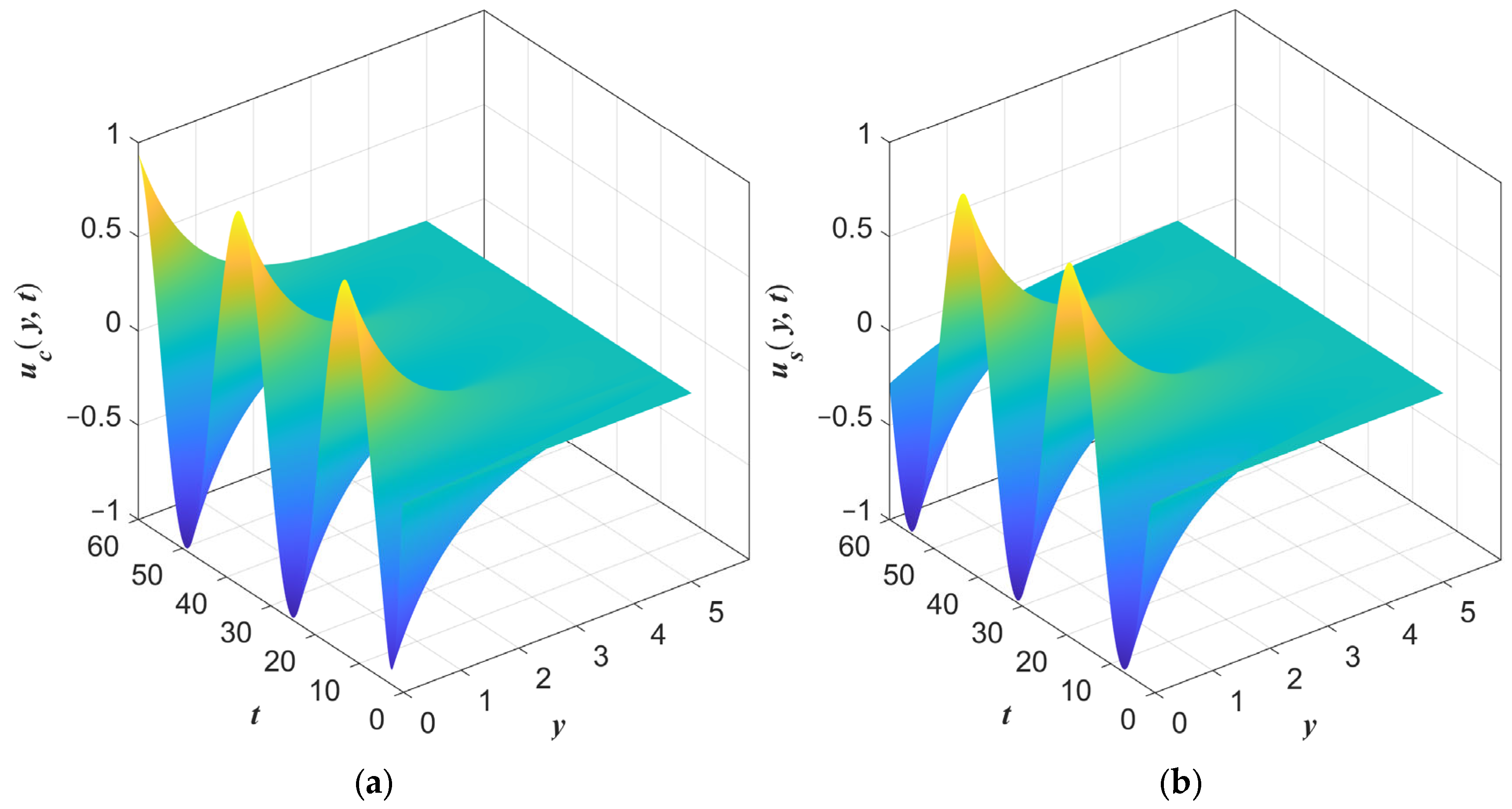
For comparison, as well as to bring to light some characteristic features of the two motions, the spatial distributions of the dimensionless starting velocity fields
and
(numerical solutions) are presented together in
Figure 9a,b, respectively, for the same values of the physical parameters. The oscillatory behavior of the two motions, as well as the phase difference between them, can be easily observed. In addition, the initial and boundary conditions were clearly satisfied. Blue and yellow colors were used in the current figure to designate the minimum and maximum values of the two solutions, respectively. The intermediate values between the maximum and minimum are denoted by the gradient of the colors between yellow and blue.
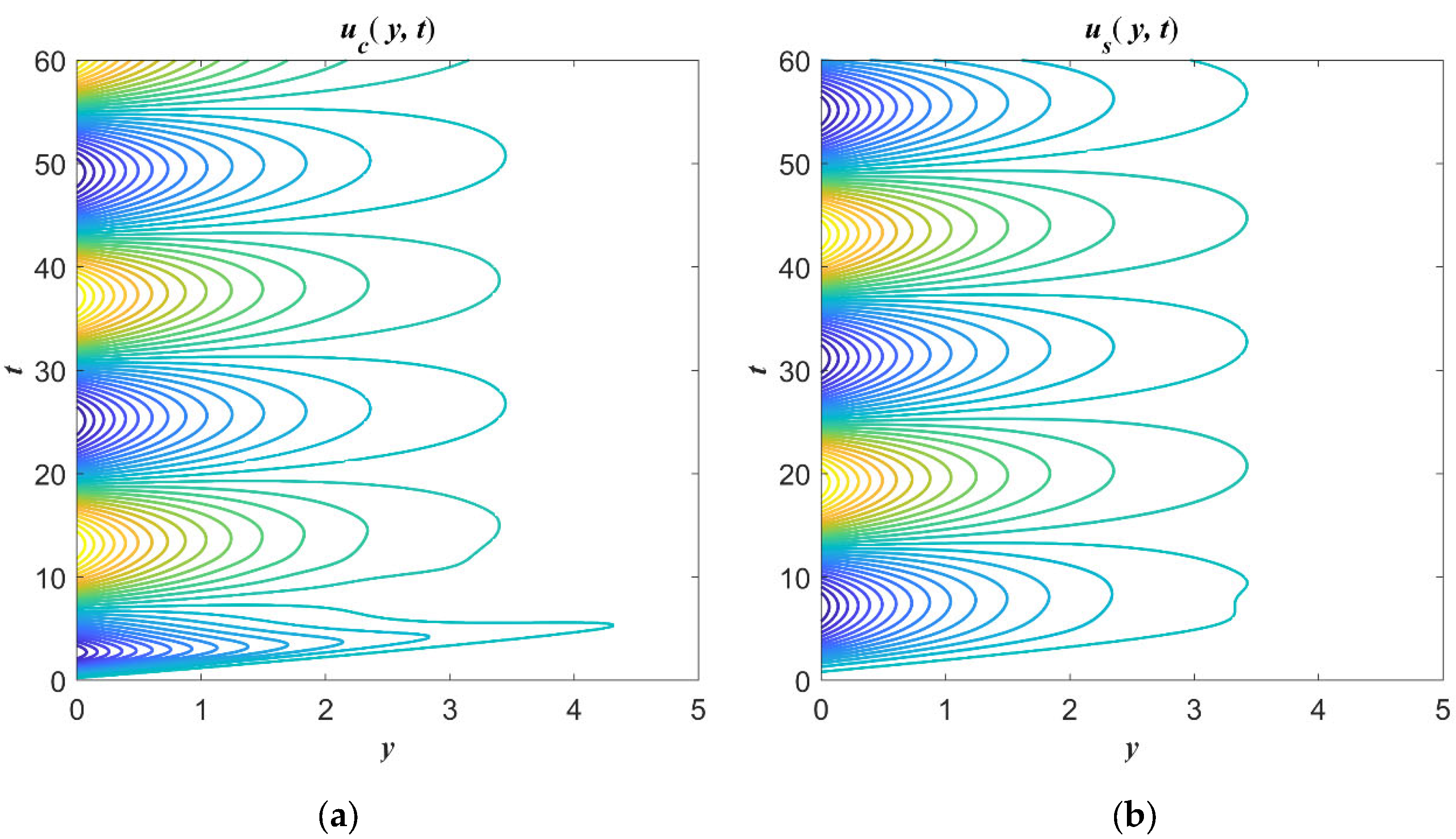
The three-dimensional distributions of the same non-dimensional starting velocities
and
are also visualized by means of the two-dimensional contour graphs (see, for example, the paper of Fullard and Wake [
28]) in
Figure 10a,b, respectively, for
, and
.
5. Conclusions
Some unsteady motions of incompressible fluids become steady or permanent in time if the fluid is at rest at the initial moment. Of course, this also depends on the boundary conditions. For such motions, in practice, a very important problem is to know the time required to reach the steady or permanent state. This is the time after which the fluid moves according to the steady-state solutions. In order to determine this time for a given motion, it is sufficient to know the corresponding steady-state solutions. This is the reason why we established closed-form expressions for the dimensionless steady-state solutions corresponding to two isothermal MHD unidirectional motions of an IECBF over an infinite flat plate embedded in a porous medium. The boundary conditions that were used, contrary to what is usually found in the existing literature, contained differential expressions of the non-trivial shear stress on a part of the boundary. For a check of results that were obtained here, all solutions have been presented in different forms and their equivalence was graphically proved.
It is worth pointing out the fact that all of the obtained solutions could easily be particularized to give dimensionless steady-state solutions for the incompressible Oldroyd-B, Maxwell, second-grade and Newtonian fluids that were performing similar motions. By taking for instance, dimensionless steady-state solutions corresponding to motions of an incompressible Newtonian fluid induced by the flat plate that applied a shear stress or to the fluid were brought to light. In addition, the solutions for motions of Burgers’ fluids were used to determine the required time to reach the steady state. This time, which in practice is very important for experimental researchers, was graphically determined by showing the convergence of the starting solutions to the corresponding steady-state solutions. The oscillatory behavior of the two motions, as well as the phase difference between them, was graphically underlined. The main outcomes that were here obtained are:
- -
The first exact solutions for MHD motions of Burgers’ fluids through a porous medium were determined when differential expressions of shear stress were given on the boundary.
- -
The solutions corresponding to Oldroyd-B, Maxwell, and Newtonian fluids that were performing similar motions were immediately obtained as limiting cases of the present results.
- -
The convergence of the dimensionless starting velocities and to their respective steady-state components and was graphically proved. In addition, all of the obtained solutions were presented in different forms and their equivalence was proved.
- -
The steady state for isothermal motions of incompressible Burgers fluids’ was earlier reached in the presence of a magnetic field or porous medium.