Article

Three-Dimensional Synthesis of Manufacturing Tolerances Based on Analysis Using the Ascending Approach
1
Department of Mechanical Engineering, College of Engineering, University of Hail, Hail 81451, Saudi Arabia
2
Electro-Mechanical System’s Laboratory (LASEM), National Engineering School of Sfax, University of Sfax, Sfax 3029, Tunisia
*
Author to whom correspondence should be addressed.
Mathematics 2022, 10(2), 203; https://doi.org/10.3390/math10020203
Submission received: 27 November 2021 / Revised: 4 January 2022 / Accepted: 7 January 2022 / Published: 10 January 2022

Abstract

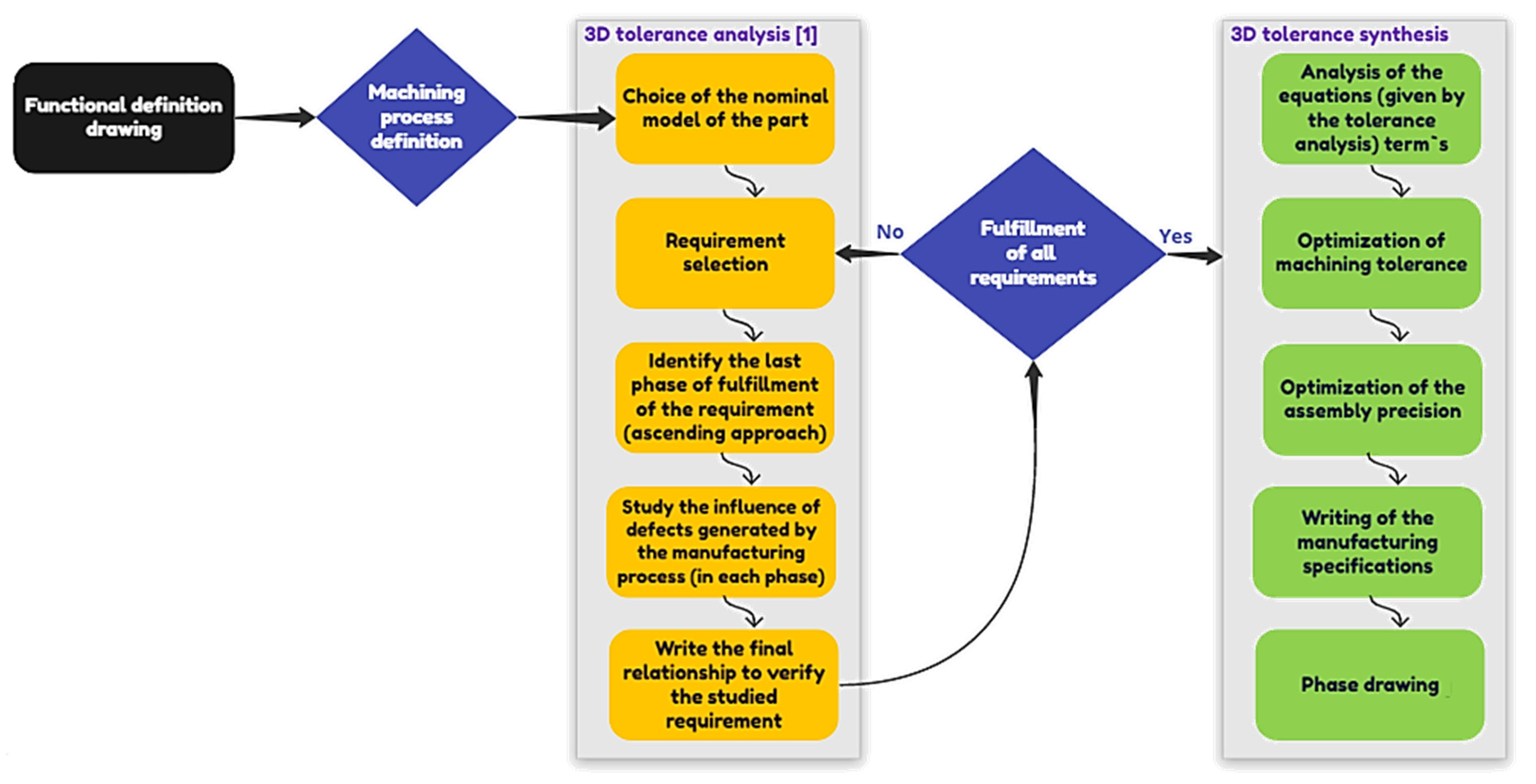
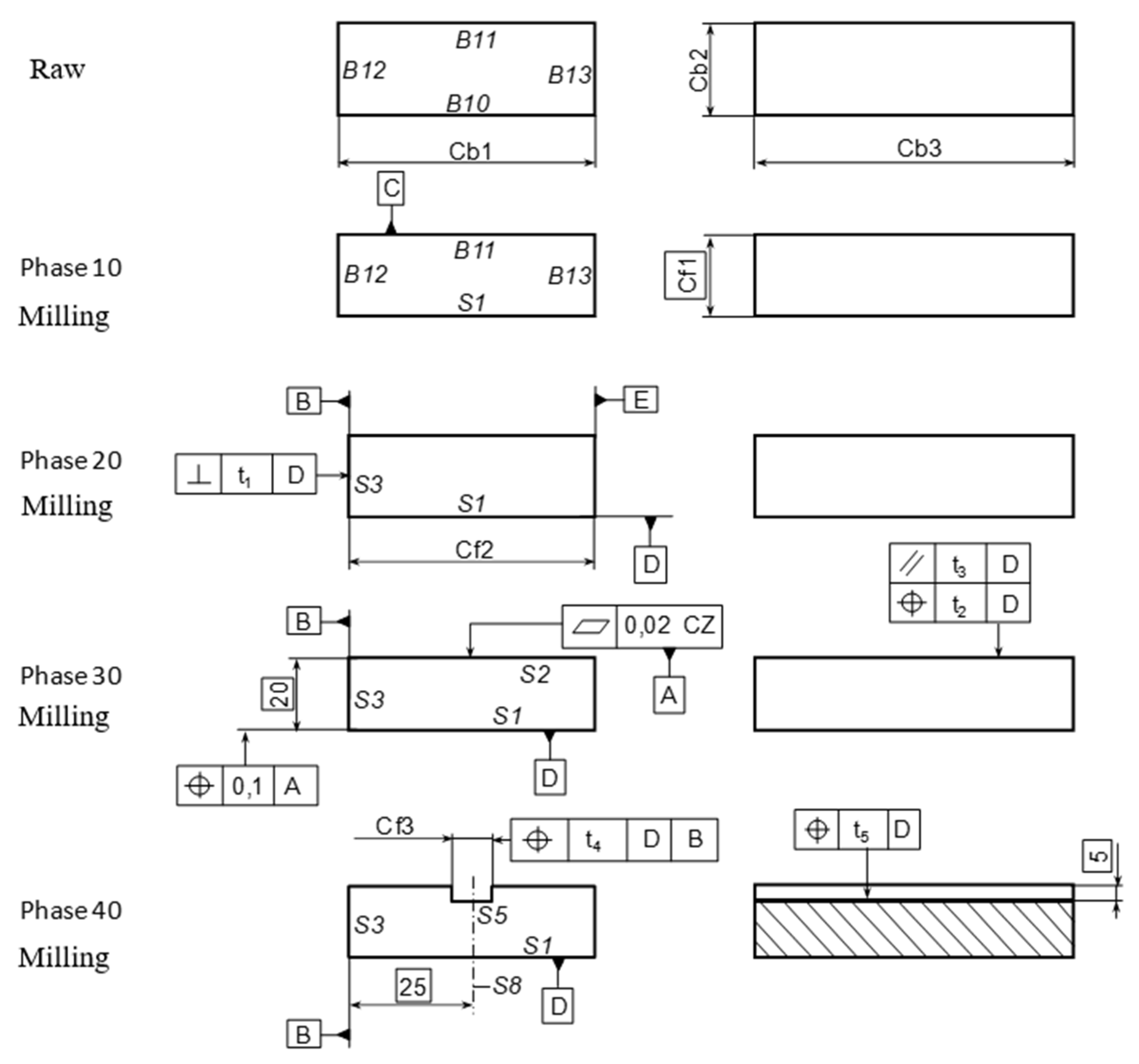
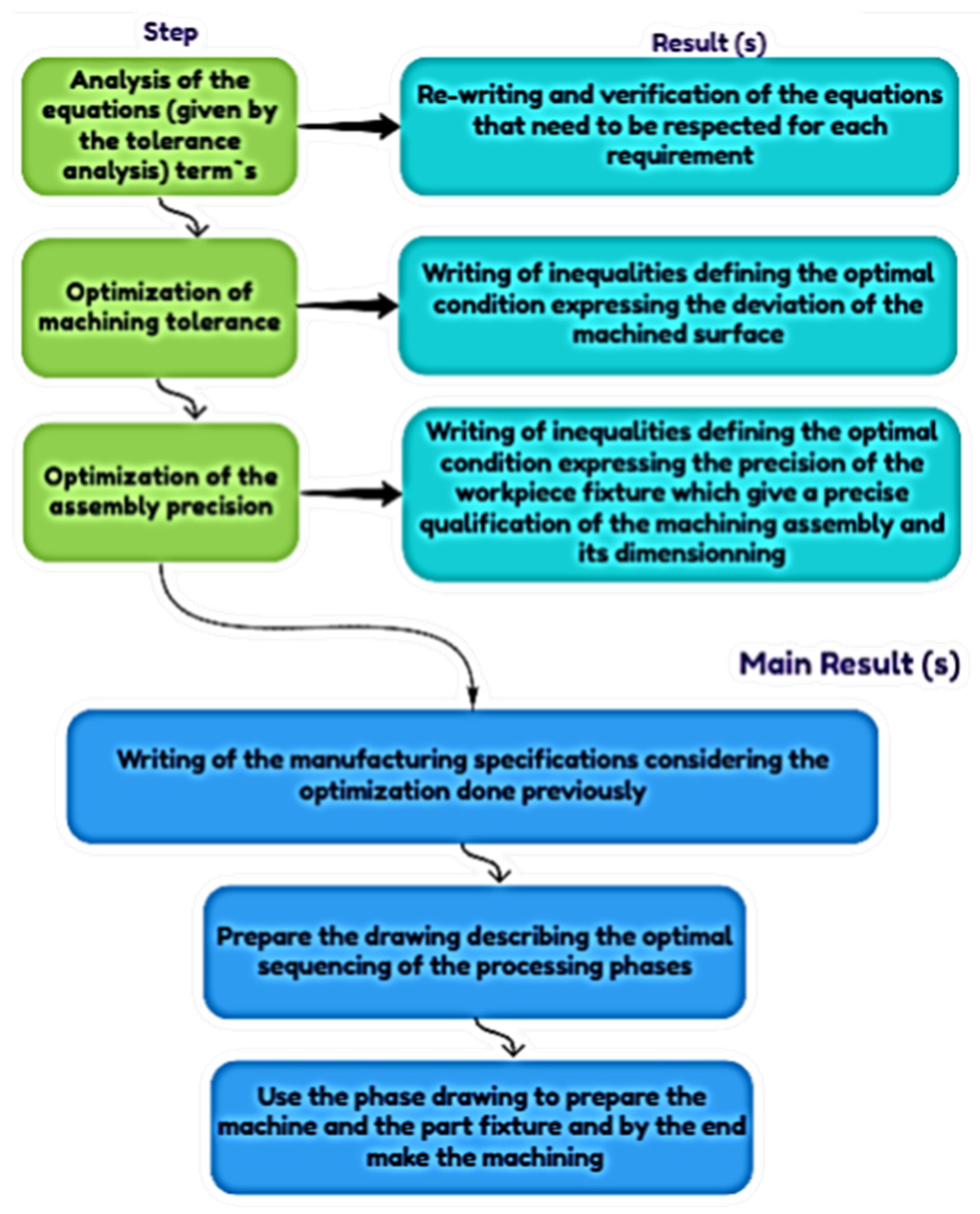
The present paper develops a new approach for manufacturing tolerances synthesis to allow the distribution of these tolerances over the different phases concerned in machining processes using relationships written in the tolerance analysis phase that have been well developed in our previous works. The novelty of the proposed approach is that the treatment of non-conventional surfaces does not pose a particular problem, since the toleranced surface is discretized. Thus, it is possible to study the feasibility of a single critical requirement as an example. During the present approach, we only look for variables that influence the requirements and the others are noted F (Free). These variables can be perfectly identified on the machine, which can be applied for known and unknown machining fixtures; this can be the base for proposing a normalized ISO specification used in the different machining phases of a mechanical part. The synthesis of machining tolerances takes place in three steps: (1) Analysis of the relationship’s terms, which include the influence of three main defects; the deviation on the machined surface, defects in the machining set-up, and the influence of positioning dispersions; then (2) optimization of machining tolerance through a precise evaluation of these effects; and finally (3) the optimization of the precision of the workpiece fixture, which will give the dimensioning of the machining assembly for the tooling and will allow the machining assembly to be qualified. The approach used proved its efficiency in the end by presenting the optimal machining process drawing that explains the ordered phases needed to process the workpiece object of the case study.
Keywords: tolerances; synthesis; ascending approach; positioning; manufacturing tolerances; synthesis; ascending approach; positioning; manufacturing