1. Introduction
As a special class of aggregation operators [
1], overlap functions [
2,
3] are mainly used in applications involving overlap problems, and also play a significant role on the multi-attribute group decision making and image processing [
4,
5,
6]. Later, Miguel et al. [
7] relaxed two boundary conditions of overlap functions and studied general overlap functions that can be used to handle multiple situations. However, they require commutativity in their definitions, which limits their application in practical problems to a certain extent. On the other hand, following the research of Paiva et al. [
8] on non-associative BL-algebras [
9] based on overlap functions, they put forward the concept of inflationary BL-algebras in [
10], but both of them were gained on commutative residuated lattices. In the paper, we present pseudo general overlap functions as a non-commutative generalization of general overlap functions, and discuss their corresponding non-commutative algebraic structures.
It is necessary to affirm our research motivation. (1) As a kind of extension of overlap functions, general overlap functions are also included in aggregation operators. However, the original aggregation functions, for example, copulas [
11], do not require commutativity, which signifies that commutativity of general overlap functions is not necessary. (2) In non-classical mathematical logic [
12], the commonly used conjunctions are t-norms [
13,
14] because they can better express the nature of logical “and”. Continuous t-norms are a special class of general overlap functions, pseudo t-norms have been proposed as their non-commutative generalization and some results have been obtained [
15,
16,
17]. In addition, in recent years, as a non-commutative generalization of overlap functions, pseudo overlap functions [
18,
19] have also been studied by some scholars, the facts have also proved that they are more effective in some practical applications. Batista et al. have also conducted some related research. Therefore, it is very natural to generalize the general overlap functions. (3) In practical problems, the classes of objects may have different emphasis; that is, they are not symmetrical. At this time, it is natural to think about using non-commutative functions in applications.
In this regard, we detach the commutativity of general overlap functions, give a construction theorem of pseudo general overlap functions, and explore the relationship between them and some other aggregation functions. Then, on the basis of the continuity of the functions, two residuated implications induced by them are discussed. Finally, a kind of non-commutative residuated lattice is defined; the inflationary pseudo general residuated lattices and weak inflationary pseudo BL-algebras are investigated.
The content of the article is arranged as below. In the second part, we recall a few prior pieces of knowledge, including the concepts of general overlap functions, pseudo overlap functions, fuzzy implications, etc. As for
Section 3, we introduce the definition of pseudo general overlap functions, elaborate some construction methods, and then analyze their relations with continuous t-norms, continuous copula, pseudo overlap functions, and general overlap functions. After that, we study the residuated implications induced by them, and give some specific examples. In
Section 4, inflationary pseudo general residuated lattices and weak inflationary pseudo BL-algebras are described, and the properties satisfied by them are discussed. Finally, the relationship between (weak) inflationary pseudo BL-algebras and other algebras such as non-commutative residuated lattice-ordered groupoids is studied. Conclusions and references are at the end of the paper.
2. Preliminaries
A number of basic notions that will be touched upon are listed.
Definition 1 ([2,8]). Given a binary mapping O on , if it meets requirements as below for arbitrary [0, 1], then it is called an overlap function:
- (O1)
O is symmetric;
- (O2)
when and only when ;
- (O3)
when and only when ;
- (O4)
when ;
- (O5)
O satisfies continuity.
Definition 2 ([7]). Given a binary mapping GO on , if it meets requirements as below for arbitrary [0, 1], then it is called a general overlap function (in short ):
- (GO1)
GO is symmetric;
- (GO2)
;
- (GO3)
;
- (GO4)
when ;
- (GO5)
GO is continuous.
Some examples of two-dimensional general overlap functions are as follows.
Example 1.
- (1)
Any overlap function is a .
- (2)
The mapping GO defined as max is a rather than an overlap function.
- (3)
The function GO defined as is a and it is also an overlap function.
Definition 3 ([18,19]). Given a binary mapping PO on , if it meets requirements as below for arbitrary [0, 1], then it is called a pseudo overlap function:
- (PO1)
when and only when ;
- (PO2)
when and only when ;
- (PO3)
PO satisfies monotonic increasing property;
- (PO4)
PO is countinuous.
Obviously, every overlap function is a pseudo overlap function. Some other common aggregation operators are defined as below.
Definition 4 ([1,8]). Given a mapping A: , if it meets requirements as below then it is called an aggregation function:
- (A1)
A is non-decreasing about every variable: for arbitrary , when ;
- (A2)
A holds two boundary conditions: (i) when and (ii) when .
Definition 5 ([12,13,14]). Given a binary operation T on , if it meets requirements as below for arbitrary [0, 1], then it is called a t-norm:
- (T1)
T satisfies symmetry;
- (T2)
T satisfies associativity;
- (T3)
T is increasing;
- (T4)
T with 1 as unit element, i.e., .
Definition 6 ([11]). Given a binary operator C on , if for arbitrary satisfying and , it meets requirements as below, then it is called a copula:
- (1)
;
- (2)
;
- (3)
it has 1 as unit element, i.e., .
Definition 7 ([20]). Given a two-dimensional mapping C on , if it meets requirements as below, then it is called a fuzzy conjunction:
- (1)
C is non-decreasing about each element;
- (2)
boundary conditions: .
Fuzzy implication is closely related to operations and is defined as below.
Definition 8 ([3,11,20]). Given a binary function I on , if it meets requirements as below for arbitrary [0, 1], then it is called a fuzzy implication:
- (I1)
decreasing about first element: when ;
- (I2)
increasing about second variable: when ;
- (I3)
when or , .
After that, some existing residuated lattice structures are given to facilitate the later content.
Definition 9 ([8,21]). An algebra is defined as a non-associative residuated lattice (also called “commutative residuated lattice-ordered groupoid”) if it meets requirements as below:
- (naR1)
is a lattice with 0 as the lower bound and 1 as the upper bound;
- (naR2)
is a commutative groupoid and it has 1 as unit element;
- (naR3)
when and only when for arbitrary (residuation principle).
Definition 10 ([8,21]). Given a non-associative residuated lattice A, if it meets requirements as below for arbitrary , then it is called a non-associative BL-algebra (in short naBL-algebra):
- (naBL1)
(divisibility)
- (naBL2)
, where (α-prelinearity)
- (naBL3)
, where (β-prelinearity)
Definition 11 ([10]). Given an algebra , if it meets requirements as below, then it is called an inflationary general residuated lattice (in short ), where the operator ∗ satisfies for arbitrary :
- (L1)
is a lattice with 0 as the lower bound and 1 as the upper bound;
- (L2)
is a commutative groupoid, i.e., L is a nonempty set, the operator ∗ is commutative on L;
- (L3)
satisfies the residuation principle.
3. Pseudo General Overlap Functions and Residuated Implications
In this part, we state the related concepts of pseudo general overlap functions and residuated implications induced by them.
Definition 12. Given a binary mapping PGO on , if it meets the following requirements then it is called a pseudo general overlap function (in short ):
- (PGO1)
for arbitrary ;
- (PGO2)
;
- (PGO3)
PGO is non-decreasing;
- (PGO4)
PGO is countinuous.
Example 2.
- (1)
Every and pseudo overlap function is a .
- (2)
The function PGO defined by max where is a , and it is a when .
- (3)
The function PGO defined by is a and is also a pseudo overlap function, but not a .
- (4)
The function PGO defined as min is a , but it is not a .
Lemma 1. Given a conjunctive continuous commutative aggregation function F on , F is a .
Proof. This is obvious from [
7] (Proposition 2). □
Theorem 1. Given a t-norm T, if it is continuous, then it meets , i.e., it is a .
Proof. By Lemma 1, we can obtain that T is a general overlap function, and then it is a PGOF. □
Since any continuous pseudo-t-norm is a t-norm (see [
15]) and any positive continuous copula is a pseudo overlap function (see [
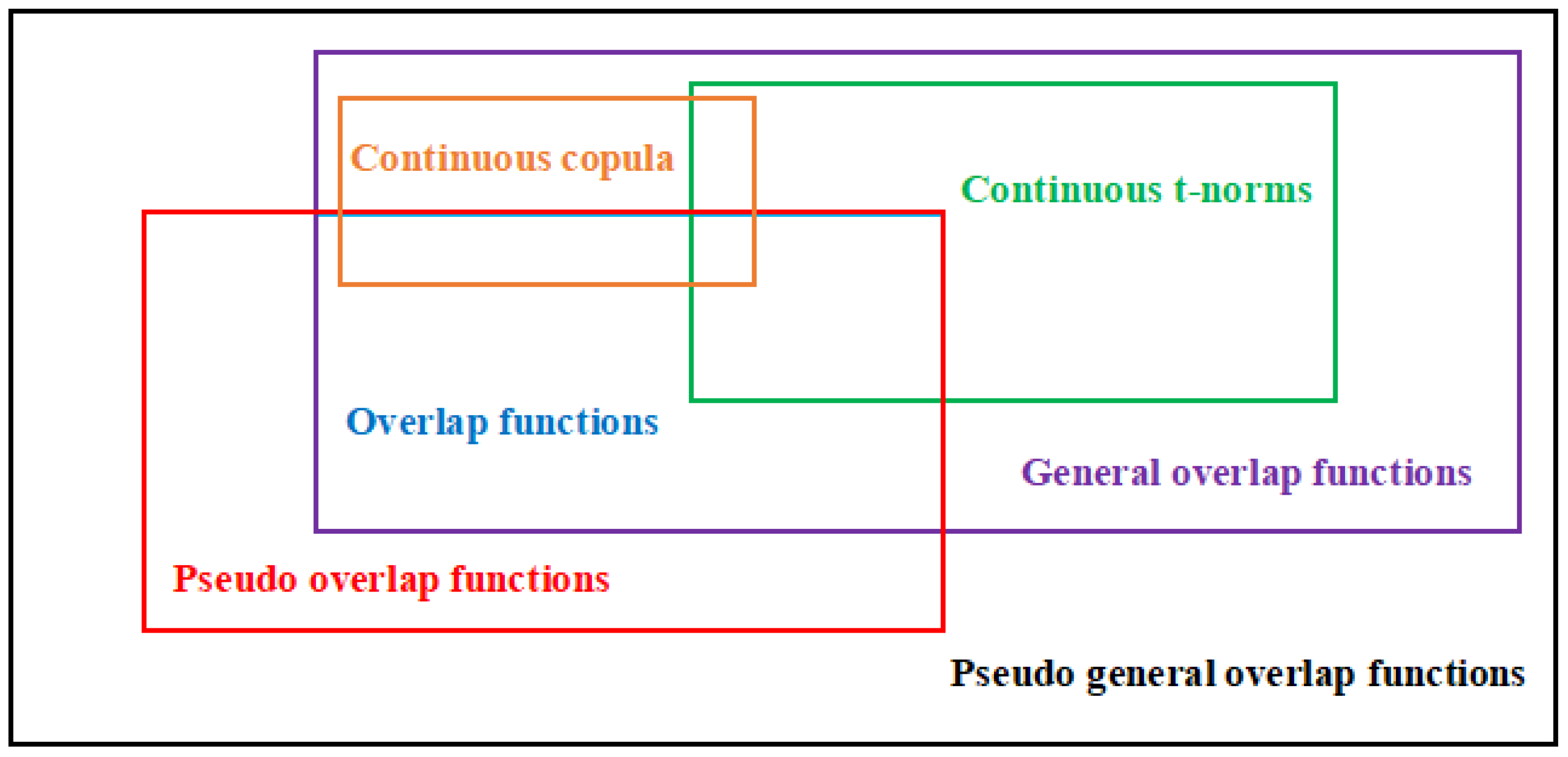
22]), based on the above theorem, we obtain the following relationship diagram between some operators (see
Figure 1).
Next, we give a construction theorem of pseudo general overlap function similarly.
Theorem 2. The mapping PGO on is a when and only when there exist binary operators g, h on with satisfying conditions as below:
- (1)
and when ;
- (2)
for arbitrary ;
- (3)
;
- (4)
g and h are continuous;
- (5)
for arbitrary .
Proof. (⇒) Assume that is a PGOF, and we make , ; then , are also obviously established.
(⇐) Suppose that there are binary operators g, h on [0, 1] keeping and they satisfy the conditions (1)∼(5), we verify that is a PGOF. By (2) and (5), if , then and , i.e., satisfies (PGO1). If , by (3) and (5), we obtain , then , i.e., satisfies (PGO2). Suppose that , , by (1), we have that and , i.e., , analogously, , so satisfies (PGO3). It is obvious that satisfies (PGO4) by (4). Therefore is a PGOF. □
Several methods for generating new pseudo general overlap functions from existing functions are displayed as below.
Proposition 1. Let be pseudo general overlap functions and be positive weights satisfying , then the operation is a pseudo general overlap function.
Proof. Monotonicity and continuity are obvious. If , , and if , . So satisfies (PGO1) and (PGO2), then is a pseudo general overlap function. □
Proposition 2. Given two pseudo general overlap function , , and a continuous t-norm T, then the operator formulated as is a .
Proof. We can easily obtain when , since T has 1 as identity element, , i.e., , so satisfies (PGO1). If , , then , so satisfies (PGO2). Since T is increasing and continuous, is also increasing and continuous. It holds that satisfies (PGO3) and (PGO4). □
We know that t-norms are included in aggregation operators, so we can expand to obtain the proposition as below.
Proposition 3. Given pseudo general overlap functions , …, , and A is a continuous aggregation function, then the mapping formulated as is a .
Proof. We can easily obtain when , for any ; then , i.e., satisfies (PGO1). Similarly, if , for any , then , so satisfies (PGO2). It is obvious that is increasing and continuous. Therefore is a PGOF. □
Proposition 4. Given a pseudo general overlap function PGO, and a continuous t-norm T, then the mapping defined as is a .
Proof. when , if , then , so we have satisfies (PGO1) and (PGO2). It is clear that satisfies (PGO3) and (PGO4). Therefore is a pseudo general overlap function. □
Similarly, we can extend the t-norm in the above proposition to the aggregation function to obtain such a proposition.
Proposition 5. Given a pseudo general overlap function PGO, and a continuous aggregation operator A, then function formulated as is also a .
Proof. It is obvious that the function satisfies (PGO3) and (PGO4). Since and when , also satisfies (PGO1) and (PGO2). It holds that is a PGOF. □
PGOFs also no longer have unit element, so we have the following definition.
Definition 13. Given a pseudo general overlap function PGO on , it is called deflationary when it satisfies , , ; and it is called inflationary when it meets , , .
Example 3.
- (1)
The pseudo general overlap function PGO defined by max where ; when it is deflationary, since and . When , it is inflationary, since and .
- (2)
The pseudo general overlap function PGO defined by min is inflationary, since and .
Now we discuss the residuated implications induced by pseudo general overlap functions. We first give an existing theorem as follows.
Theorem 3 ([3]). Given a fuzzy conjunction C satisfying for arbitrary . For any consider the fuzzy implication induced by C as sup, then statements as below are equivalent:
- (1)
C satisfies left continuity about the second element;
- (2)
C and meet the residuation property, i.e., ;
- (3)
max.
In fact, we can easily know that not all pseudo general overlap functions satisfy
for any
; for example, the mapping
defined as
is a pseudo general overlap function. However, when
,
. So we consider the case in the following lemma.
Lemma 2. Given an inflationary pseudo general overlap function PGO on , it is a fuzzy conjunction satisfying for any .
Proof. By definition it is clear that is a fuzzy conjunction. Since is inflationary, for any . □
Evidently, every PGOF is a fuzzy conjunction satisfying continuity according to definition. When the two arguments of an inflationary PGOF are symmetric, it can induce a residuated implication as an inflationary GOF (see [
10]). If the function is no longer commutative, then we have the following proposition.
Proposition 6. Given the function PGO is an inflationary , the mappings , defined by sup, sup, respectively, are fuzzy implication, PGO and they satisfy the residuation principle. In addition, , can be marked as follows: max, max.
Proof. For arbitrary , sup, = sup. Since is increasing, it holds that when . Then , so sup sup, i.e., . Therefore, the function is decreasing about the first element. Similarly, we can obtain that the function is also decreasing about the first element. On the other hand, sup and sup. Since , we have that sup sup, i.e., , so the function is increasing about the second element. Similarly, we also have that the function is increasing about the second element. Moreover, it holds that sup sup, sup. sup, since is inflationary, . If , . Therefore, . Similarly, we have that , , . Therefore the function and are fuzzy implication. By the above theorem and lemma, since is continuous, it is clear that and , satisfy iff iff . Moreover, max, max. □
Two fuzzy implications
,
are also called residuated implications (
-implication) induced by the pseudo general overlap function
, and they form adjoint pairs
and
. We give some examples as shown in the table below (see
Table 1).
Where , and , .
4. Inflationary Pseudo General Residuated Lattices and Weak Inflationary Pseudo BL-Algebras
In this part, we extend the inflationary general residuated lattices to the inflationary pseudo general residuated lattices, defined as below.
Definition 14. Given an algebra , where ∗ is a non-commutative inflationary binary operator, i.e., and , if it meets requirements as below then it is an inflationary pseudo general residuated lattice (in short ):
- (A1)
is a lattice with 0 as the lower bound and 1 as the upper bound;
- (A2)
is a groupoid;
- (A3)
when and only when , when and only when , for arbitrary (two-residuation principle).
Remark 1. Given an L, (A3) can also be marked as when and only when when and only when for arbitrary .
Example 4. Given an inflationary ∗, →, and ⇝ are residuated implications induced from ∗, i.e., max, max, then is an .
Next, we discuss some properties satisfied by IPGRLs.
Proposition 7. Given an , for arbitrary , it satisfies:
- (A4)
, ;
- (A5)
and when ;
- (A6)
and when ;
- (A7)
and when ;
- (A8)
, ;
- (A9)
, ;
- (A10)
, ;
- (A11)
, ;
- (A12)
;
- (A13)
;
- (A14)
when or ;
- (A15)
iff a and b are comparable and iff a and b are comparable and ;
- (A16)
when and only when and ;
- (A17)
If ∗ is associative, then and .
Proof. - (A4)
By (A3), ; similarly, , then ;
- (A5)
Since , by (A3), it is clear that ; then when , so . Similarly, since , it holds that ; then ;
- (A6)
If , by (A4) it is clear that , by (A3) it holds that ; similarly, ; then ;
- (A7)
If , by (A4) and (A5), ; then by (A3) it is clear that . Similarly, , so ;
- (A8)
The former has been proved in detail in [
10], here we only prove the latter. Because
and
, by (A5),
and
, so
. On the other hand,
and
, so by (A3) it holds that
and
, so
. Therefore
. Then
;
- (A9)
Since and , by (A7) it holds that and , so . Analogously, it holds that and ; then . On the other hand, assume that and ; then by (A3), and . By (A8) it is clear that according to (A3). So . Similarly, .
- (A10)
Since and , by (A6) we have that and , so . Similarly, and ; then . On the other hand, the certificate is the same as above;
- (A11)
Since , then by (A3); similarly, because , we can easily obtain ;
- (A12)
Since and , by (A3), it is clear that and . Since and , it is clear that ;
- (A13)
Since , by (A3) we have that , but , so . Similarly, . Therefore, .
- (A14)
If , then , by (A3), , since ∗ is inflationary, , so . In the same way if , then ; thus .
- (A15)
We can easily obtain and by (A5); then and according to (A3), since and , so . On the other hand, if then , since a and b are comparable, . Similarly, , according to a and b being comparable, it also holds that .
- (A16)
For arbitrary , if , by (A5), and , and , so and . On the other hand, if and , it is clear that and . Because ∗ is inflationary, we can obtain that and . Thus, .
- (A17)
By (A4) and (A5), . According to the residuation property, . Similarly, when , we have that .
□
Theorem 4. Given an , for arbitrary , it holds that and when is a complete lattice. Moreover, and .
Proof. By (A4), , so . Since when and only when , i.e., max, so . Similarly, since , when and only when , then max. Secondly, according to the above, we can obtain and . Since and for arbitrary , it holds that , i.e., and . So and . □
Then the notion and some properties of weak inflationary pseudo BL-algebras are presented. We first give the definition of weak inflationary BL-algebra.
Definition 15. Given an algebra , if it is an and satisfies the following requirements then it is called a weak inflationary BL-algebra (in short weak IBL-algebra):
- (1)
If , (general divisibility);
- (2)
(general prelinearity).
In fact, weak inflationary BL-algebras are a non-associative algebraic structure including BL-algebras (see [
9]), which can be gained by the inflationary general overlap functions with unit element 1. (If an inflationary GOF satisfies the divisibility, it is equivalent to it having 1 as unit element.) Some scholars have also conducted generalization research on the basis of pseudo BL-algebras [
23]. Then, based on inflationary pseudo general residuated lattices and considering the two residuated implications induced by inflationary PGOFs, we introduce a new kind of algebraic structure in which operator is non-associative, non-commutative, and does not have unit element.
Definition 16. Given an , if it meets the following requirements then it is a weak inflationary pseudo BL-algebra (in short ):
- (WIPBL1)
when (general two-divisibility);
- (WIPBL2)
(general two-prelinearity).
After that, we certify that there is a one-to-one correspondence between the inflationary PGOFs and the WIPBLs.
Lemma 3. Given the function PGO is an inflationary on , PGO satisfies general two-divisibility and general two-prelinearity.
Proof. We might as well write the function as ∗, and → and ⇝ represent two residuated implications induced by .
(i) Since ∗ is inflationary, when . Moreover, , so there is satisfying . Then we gain , and according to residuation property (A3). Thus by (A5), . On the other hand, by (A4), . So . Analogously, when . Therefore meets (WIPBL1).
() Since is linearly ordered, it holds that or for any . When , by (A15), and , that is, . Otherwise, as well as , i.e., meets (WIPBL2).
Therefore satisfies general two-divisibility and general two-prelinearity. □
Proposition 8. Given the algebra , A is a when ∧ is the minimization operator, ∨ is the maximization operator, ∗ is an inflationary , → and ⇝ are residuated implications induced by ∗.
Proof. We can easily obtain is a IPGRL; then by Lemma 3 it is clear that A is a WIPBL. □
Example 5. Given the algebra , where min, max, min, = and = as as shown in Table 1. It is clear that L satisfies (A1)∼(A3), i.e., it is an . If , , and ; then min (since ), and min (since ), so L satisfies general two-divisibility. Moreover, since , , L satisfies general two-prelinearity. Thus the algebra L is a . A few natures met by WIPBLs are shown as follows.
Proposition 9. Given , it satisfies requirements as below for arbitrary :
- (WIPBL3)
and if ;
- (WIPBL4)
and if and ;
- (WIPBL5)
and if and ;
- (WIPBL6)
and if and ;
- (WIPBL7)
and if and ;
- (WIPBL8)
and if and .
Proof. - (WIPBL3)
Since weak inflationary pseudo BL-algebra satisfies general two-divisibility, then when , similarly, .
- (WIPBL4)
If , . By (A16), , so . Analogously, we can obtain .
- (WIPBL5)
According to general two-divisibility and (A5), if , then . Then by (A3) and associativity, it holds that . Analogously, when , we have that .
- (WIPBL6)
According to two-divisibility and (A5), if , then , and , so . If , then , by (A3) . Analogously, .
- (WIPBL7)
Since weak inflationary pseudo BL-algebra satisfies two-divisibility, if . By (A5), , thus according to the associativity. By (A3), it holds that . Similarly, .
- (WIPBL8)
By (A5), . Since when , , by (A3), . Similarly, if , we obtain .
□
Proposition 10. Each commutative is a weak inflationary BL-algebra.
Proof. Assume that is a WIPBL, we only need to confirm that A is commutative when and only when , for arbitrary . For any , if A is commutative, , then by (A3), iff , that is, , so . Moreover, if , we have that iff , by (A3), iff , i.e., ; therefore A is commutative. □
In addition, inflationary pseudo BL-algebras are introduced by us, and they can be regarded as a noncommutative generalization of inflationary BL-algebras; they are also a subclass of WIPBLs, defined as below.
Definition 17. Given an , if for arbitrary the following statements hold then it is called an inflationary pseudo BL-algebra (in short ):
- (IPBL1)
(two-divisibility);
- (IPBL2)
.
Example 6. Given the function PGO formulated as max, min, the residuated implications , induced by it as as shown in Table 1. It is clear that the algebra satisfies and , i.e., L is an inflationary pseudo BL-algebra. We can easily know that an inflationary pseudo BL-algebra must be a weak inflationary pseudo BL-algebra, and vice versa. For example, the weak inflationary pseudo BL-algebra L given in Example 5 above is not an IPBL, since when we take and .
In fact, we can obtain that inflationary pseudo BL-algebras can be obtained from the inflationary PGOFs with unit element 1; the details are as follows.
Proposition 11. Given the algebra , where ∧ is the minimization operator, ∨ is the maximum operator, ∗ is an inflationary with unit element 1, → and ⇝ are residuated implications induced by ∗. Then L is an inflationary pseudo BL-algebra.
Proof. By Proposition 7 we obtain that the algebra L is a weak inflationary pseudo BL-algebra, i.e., when and . If the operator ∗ has 1 as unit element, then by (A15) and and , so ; that is, L satisfies two-divisibility. Thus L is an inflationary pseudo BL-algebra. □
Finally, the definition of non-commutative residuated lattice-ordered groupoids is given as below so that we can analyze the relationship between several classes of noncommutative algebraic structures.
Definition 18. Given a lattice , if it meets requirements as below for arbitrary , then it is called a non-commutative residuated lattice-ordered groupoid (in short ):
- (RLG1)
has 0 as the lower bound and 1 as the upper bound;
- (RLG2)
is a groupoid and has 1 as unit element;
- (RLG3)
L satisfies the two-residuation principle.
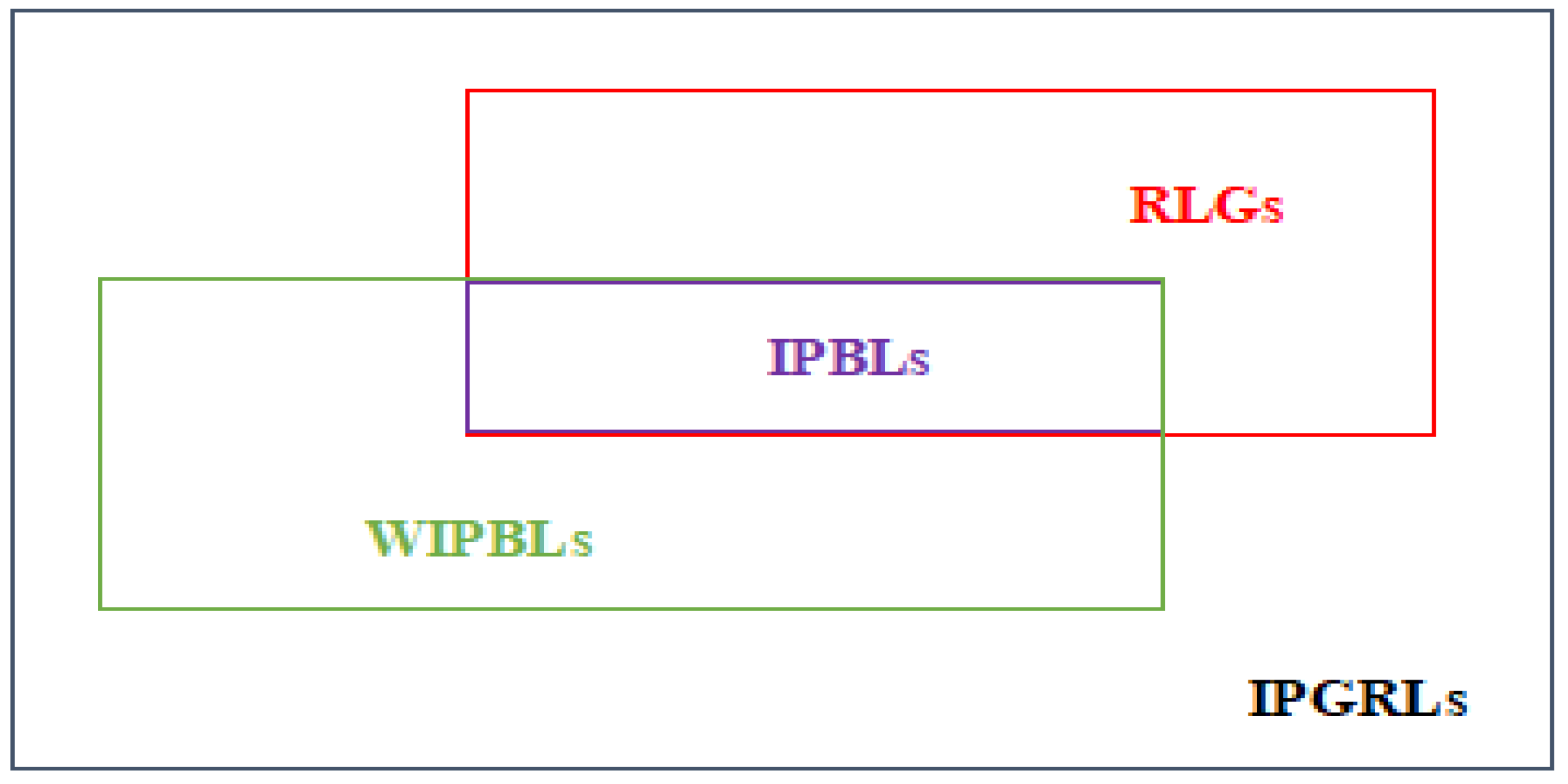
It is not difficult to find that WIPBLs and IPBLs are included in class IPGRL, and the intersection of WIPBLs and RLGs is the inflationary pseudo BL-algebras. Then the relation diagram between several types of algebras is as follows (see
Figure 2).