Abstract
The main purpose of this paper was to study the almost anti-periodic oscillation caused by external inputs and the global exponential synchronization of Clifford-valued recurrent neural networks with mixed delays. Since the space consists of almost anti-periodic functions has no vector space structure, firstly, we prove that the network under consideration possesses a unique bounded continuous solution by using the contraction fixed point theorem. Then, by using the inequality technique, it was proved that the unique bounded continuous solution is also an almost anti-periodic solution. Secondly, taking the neural network that was considered as the driving system, introducing the corresponding response system and designing the appropriate controller, some sufficient conditions for the global exponential synchronization of the driving-response system were obtained by employing the inequality technique. When the system we consider degenerated into a real-valued system, our results were considered new. Finally, the validity of the results was verified using a numerical example.
Keywords:
almost anti-periodicity; Clifford-valued recurrent neural network; mixed delay; global exponential synchronization MSC:
34K14; 34K24; 92B20
1. Introduction
A recurrent neural network is a recurrent neural network that takes sequence data as input and recurses in the evolutionary direction of the sequence, with all nodes connected in a chain. Research on recurrent neural networks started in the 1980s and 1990s and developed into one of the deep learning algorithms in the early 2000s [1]. Recurrent neural network has been applied in natural language processing, such as speech recognition, language modeling, machine translation and so on. It is also used for various time series forecasting. These applications of recurrent neural networks are closely related to their dynamic behavior. Therefore, the dynamics of recurrent neural networks have been extensively studied over the past few decades.
As a high-dimensional neural network, the Clifford-valued neural network not only includes real-valued, complex-valued and quaternary-valued neural networks as its special cases, but also has greater advantages than low-dimensional neural networks in dealing with multidimensional data. In recent years, they have attracted more and more attention [2,3,4,5,6,7,8,9,10,11].
On the one hand, it is well known that periodic and almost periodic oscillations are the focus of qualitative research on differential equations [12,13,14]. Anti-periodic oscillation is a special form of periodic oscillation, but it can reflect a particularly accurate oscillation and has many important applications, such as in interpolation problems [15,16], wavelet theory [17], neural networks [18,19,20,21,22,23,24,25,26,27], etc. In the past decade, anti-periodic oscillation has been widely studied. Recently, the concept of almost anti-periodic functions was proposed in [28], which is a generalization of the concept of anti-periodic functions. Any anti-periodic function is an almost anti-periodic function, but an almost periodic function is not necessarily an almost anti-periodic function. At the same time, it is difficult to investigate the existence of almost anti-periodic solutions to differential equations because the space consists of almost anti-periodic functions has no vector space structure. Consequently, it is significant and challenging to study the almost anti-periodic oscillation of neural networks.
On the other hand, the synchronization of neural networks has a wide range of applications in the fields of secure communication [29], image processing [30], and information science [31]. Therefore, for more than ten years, the synchronization of neural networks has become a hot issue in the research of neural network dynamics.
In the light of the above discussion and considering the ubiquitous time delay effect [3,4,5,6,32,33], in this work, we focused on the following Clifford-valued recurrent neural networks with mixed delays:
where corresponds to the state of the pth unit at time t and is a real Clifford algebra that will be defined in the next section; are the activation functions, are the connection, the discretely delayed connection and the distributively delayed connection weights between the qth neuron and the pth neuron, respectively; represents the external input on the pth neuron at time t; corresponds the transmission delay; denotes the rate at which the pth unit resets its potential to the quiescent state when disconnected from the network and external input. The kernel function is a positive continuous integrable function with .
The system (1) is supplemented with the initial values
The main aim of this work was to investigate the existence and global exponential synchronization of almost anti-periodic solutions to the network (1). The important contribution of this paper is that this is the first paper to study the almost anti-periodic oscillation of neural networks by employing the fixed point theorem and inequality technique. The difficulty of this paper is that the sum and product of two almost anti-periodic functions are not necessarily almost anti-periodic functions, and the sum of an almost anti-periodic function plus a non-zero constant is not necessarily almost anti-periodic. This makes it difficult to study the existence of almost anti-periodic solutions of differential equations directly by using the fixed point theorem. In order to overcome this difficulty, we first prove that the network under consideration has a unique bounded continuous solution by using Banach fixed point theorem. Then it is proved that the bounded continuous solution is also an almost anti-periodic solution according to the definition and inequality technique. Therefore, the results and methods of this paper are new.
Remark 1.
In recently published papers [25,26], the existence and exponential stability of almost anti-periodic solutions of inertial neural networks on real sets and time scales were studied by constructing appropriate Lyapunov functional and inequality techniques, respectively. It is worth pointing out that the results and methods in this paper are different from those in [25,26].
The remainder of this paper is organized as follows: In Section 2, we introduce some symbols, definitions, and a preliminary lemma. In Section 3, we establish the existence and uniqueness of almost anti-periodic solutions of (1). In Section 4, we study the synchronization problem. In Section 5, we provide a numerical example to illustrate the validity of our results. Finally, we draw a conclusion in Section 6.
2. Preliminaries
Let , then a real Clifford algebra over can be described as
in which satisfying and . In addition, and are called the generators of , which meet the multiplication rules: , and .
For , we denote and for , we denote , then is a Banach space.
Let be the collection of bounded and continuous functions , then with the norm where is a Banach space.
Definition 1
([34]). A function is said to be almost periodic if for each , there exists an such that in every interval with length l contains a number τ satisfying
We will denote by the set of all such functions.
Definition 2
([28]). A function is said to be almost anti-periodic if for each , there exists an such that in every interval with length l contains a number τ satisfying
We will denote by the collection of all such functions.
Example 1.
- Let , then one can easily show that f is not periodic or anti-periodic but almost anti-periodic.
- Let , then one can easily show that is almost periodic, not almost anti-periodic.
From Definitions 1 and 2 and Example 1, one can conclude that
Definition 3.
Function is called almost anti-periodic if for every , is almost anti-periodic.
The symbols we use are as follows:
We need the following hypothesises to prove our main results:
- For , , and are continuous and integrable such that .
- For , there exist positive constants , and such that for all ,
- and .
It is easy to show that
Lemma 1.
If is a bounded solution of system (1), then ζ satisfies the following integral equation:
and vice versa.
3. Almost Anti-Periodic Solutions
Take a positive constant such that , where
Then we have
Theorem 1.
Let hypothesises – be fulfilled. Then system (1) admits a unique almost anti-periodic solution in
Proof.
Consider the operator defined by
where , for any and ,
Then, by implementing a standard reasoning process, one can show that maps into .
Next, we show that has a fixed point in . Indeed, for any , one infers that
by and invoking the Banach fixed point theorem, has a unique fixed point in , hence, is a unique bounded continuous solution of (1).
Since for , for each , there exists such that
Define , from the above inequality, we have
as a result, we deduce that
which implies that is almost anti-periodic. This ends the proof. □
4. Synchronization
Let us consider the following system as the response system:
where presents the state variable of the system, presents a controller, the rest of the symbols are the same as those appearing in system (1).
The initial values of system (5) are
The following nonlinear state-dependent controller is designed:
where .
Definition 4.
Theorem 2.
Let – hold. If the following conditions are fulfilled:
- For , .
- For , there exist positive constants such that for all ,
- For , denote , then
Proof.
From (6), for , we find
For , set
where .
For , we have by and as by the definition of . Hence, by the continuity of , we can choose a positive constant such that , which implies that
From , we obtain
then
For any , it is obvious that
We ascertain that
If not, then there is a such that
and
Hence, from (7), one obtains
This completes the proof. □
5. Illustrative Example
Example 2.
By simple calculations, we have
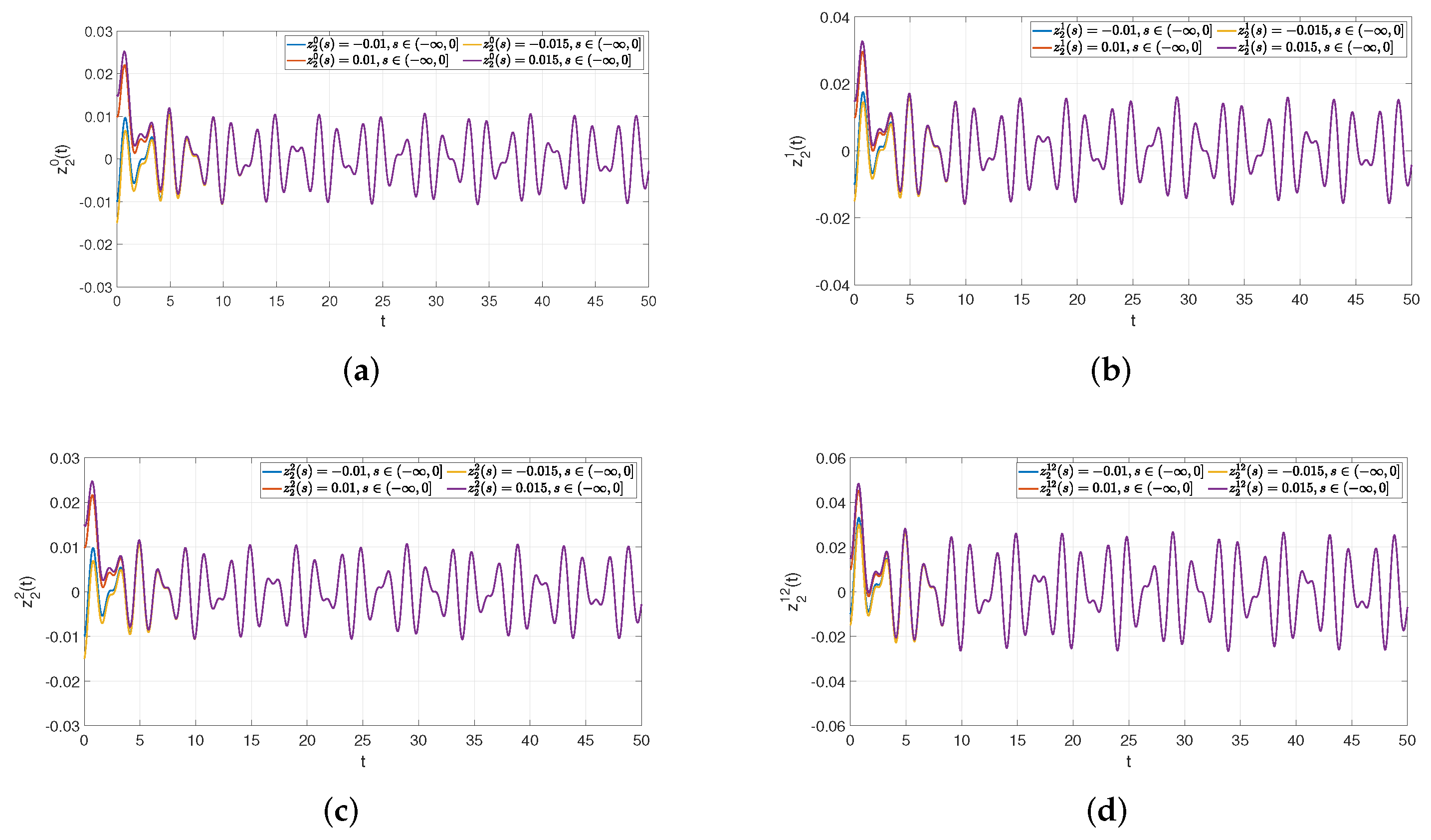
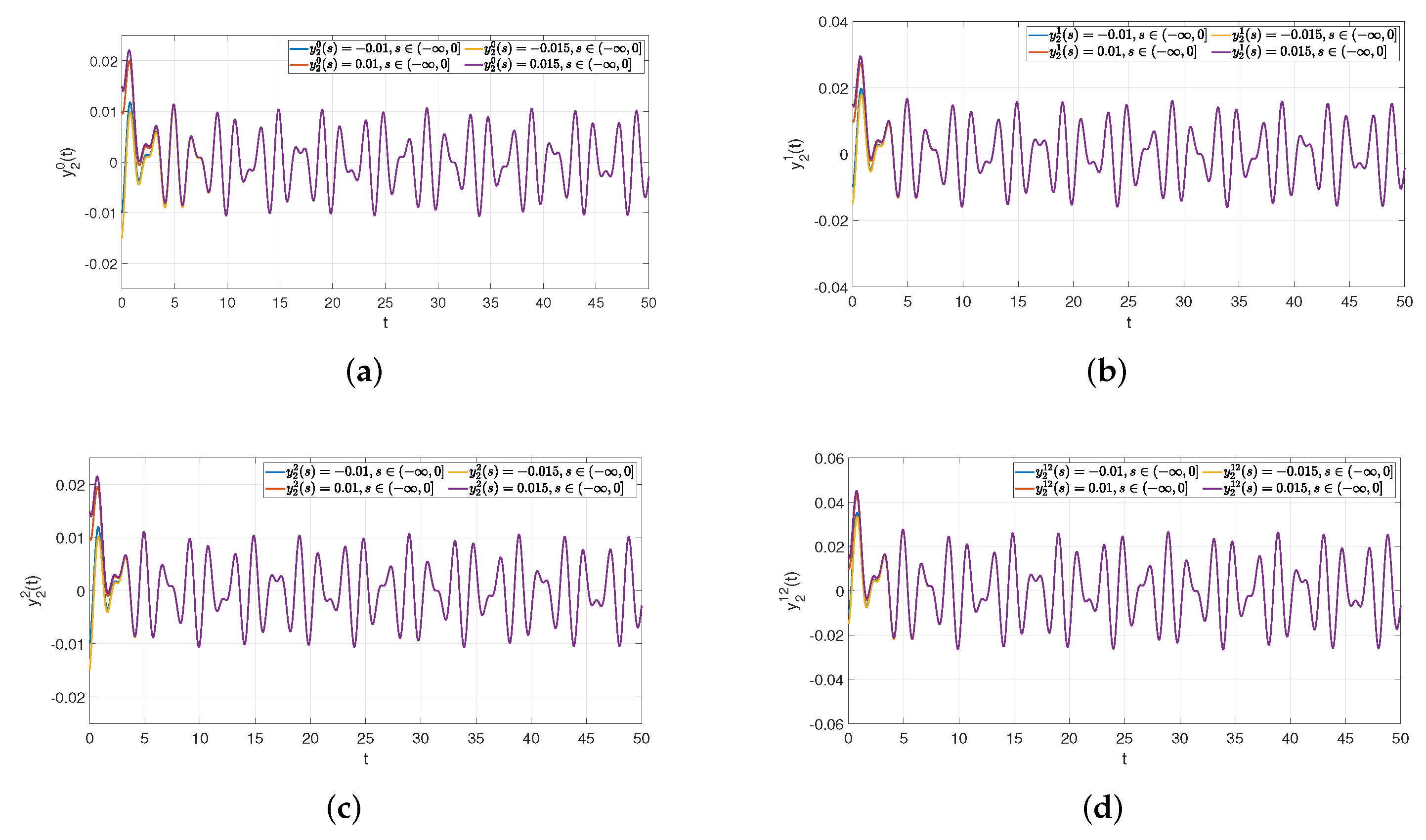
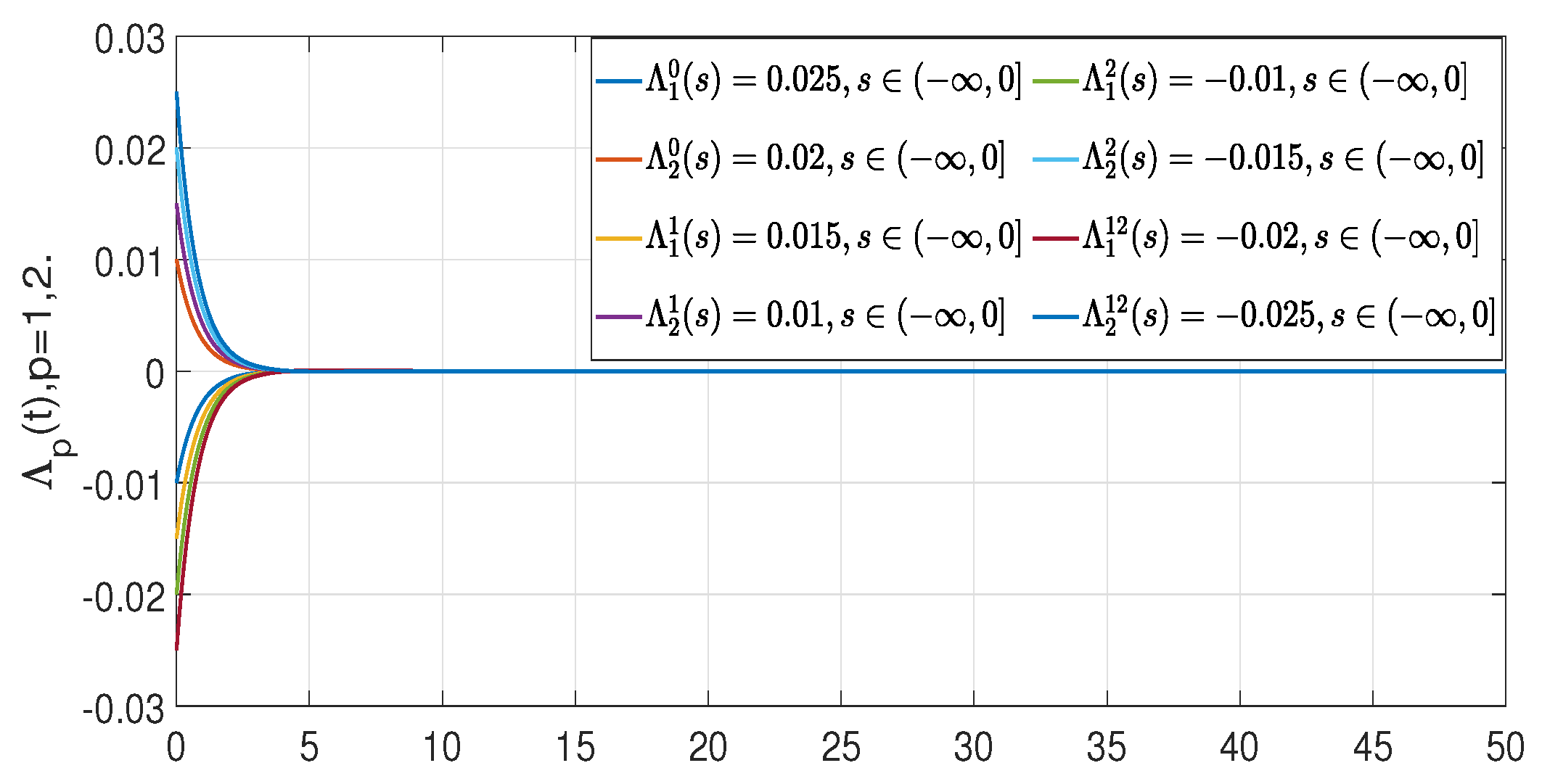
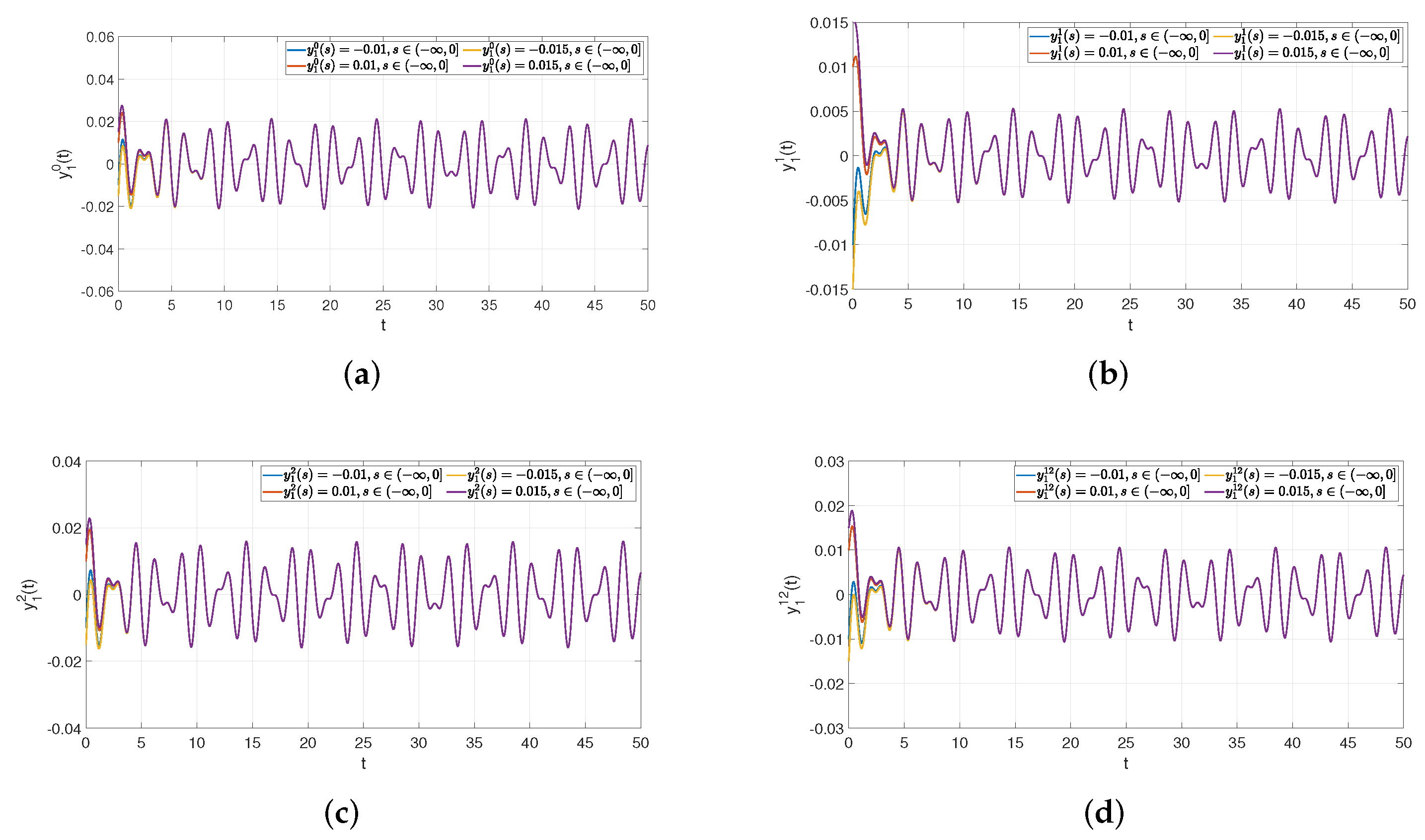
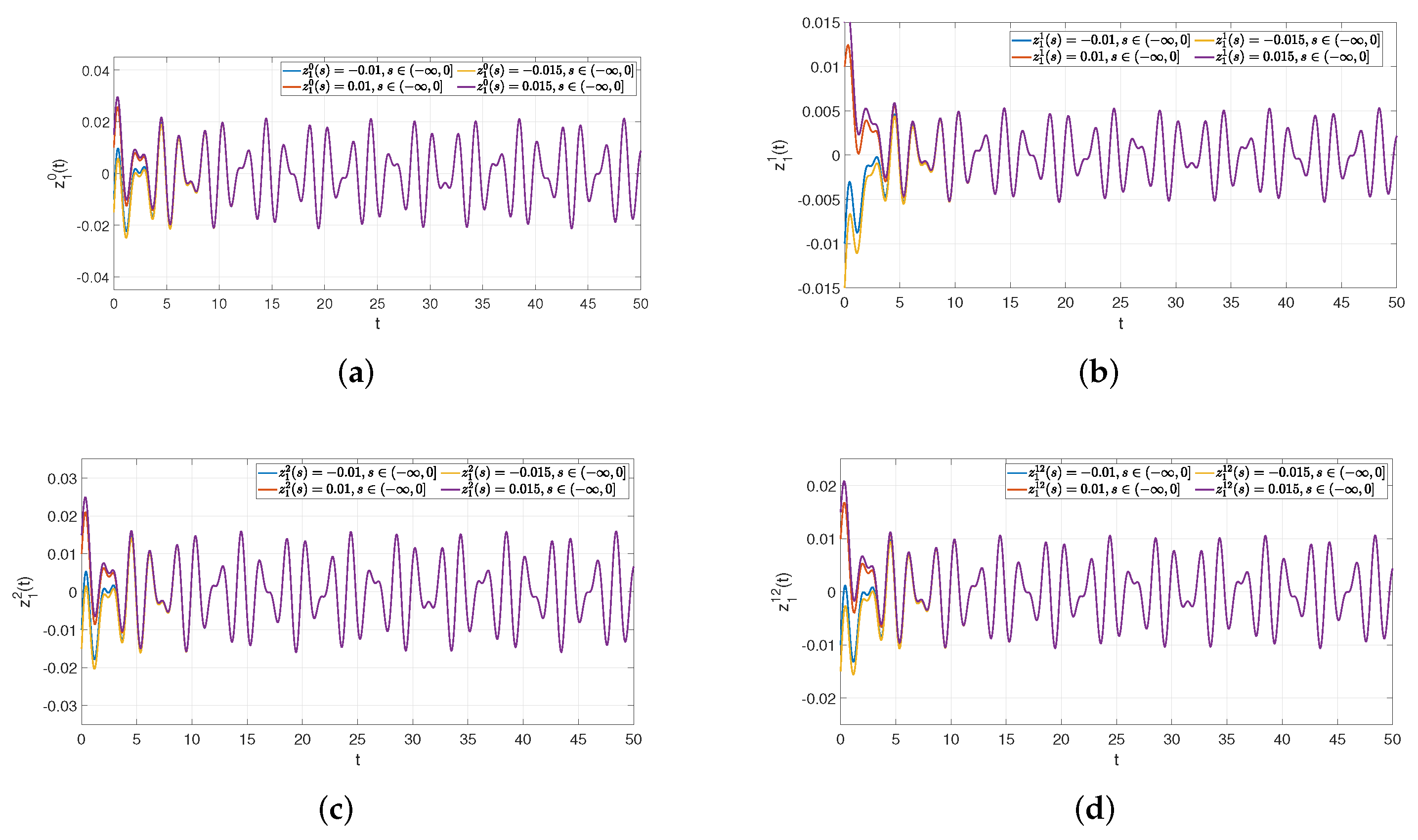
Take , then, conditions – are verified. From Theorems 1 and 2, system (1) possesses a unique almost anti-periodic solution and (1)–(5) are globally exponentially synchronized (see Figure 1, Figure 2, Figure 3, Figure 4 and Figure 5).
Figure 1.
Curves of of system (1) with different initial values. (a) with different initial values; (b) with different initial values; (c) with different initial values; (d) with different initial values.
Figure 2.
Curves of of system (1) with different initial values. (a) with different initial values; (b) with different initial values; (c) with different initial values; (d) with different initial values.
Figure 3.
Curves of of system (5) with different initial values. (a) with different initial values; (b) with different initial values; (c) with different initial values; (d) with different initial values.
Figure 4.
Curves of of system (5) with different initial values. (a) with different initial values; (b) with different initial values; (c) with different initial values; (d) with different initial values.
Figure 5.
Synchronization.
6. Conclusions
In this paper, a novel approach was used to investigate the existence of almost anti-periodic solutions excited by external inputs and the global exponential synchronization for a class of Clifford-valued neural networks. Even though this paper considered usual real-valued neural networks, our results are new. The approach used in this paper can be employed to study the existence of almost anti-periodic solutions to other forms of neural networks.
Author Contributions
Conceptualization, Y.L.; Formal analysis, Y.L.; Investigation, W.Q. and Y.L.; Writing—original draft, W.Q. and Y.L.; Writing—review & editing, Y.L. All authors have read and agreed to the published version of the manuscript.
Funding
This work is supported by the National Natural Science Foundation of China under Grant No. 11861072.
Data Availability Statement
Not applicable.
Conflicts of Interest
The authors declare no conflict of interest.
References
- Schmidhuber, J. Deep learning in neural networks: An overview. Neural Netw. 2015, 61, 85–117. [Google Scholar] [CrossRef] [Green Version]
- Rajchakit, G.; Sriraman, R.; Vignesh, P.; Lim, C.P. Impulsive effects on Clifford-valued neural networks with time-varying delays: An asymptotic stability analysis. Appl. Math. Comput. 2021, 407, 126309. [Google Scholar] [CrossRef]
- Li, Y.; Li, B. Pseudo compact almost automorphy of neutral type Clifford-valued neural networks with mixed delays. Discrete Contin. Dyn. Syst.-B 2022, 27, 4703–4724. [Google Scholar] [CrossRef]
- Rajchakit, G.; Sriraman, R.; Lim, C.P.; Sam-ang, P.; Hammachukiattikul, P. Synchronization in finite-time analysis of Clifford-valued neural networks with finite-time distributed delays. Mathematics 2021, 9, 1163. [Google Scholar] [CrossRef]
- Liu, Y.; Xu, P.; Lu, J.; Liang, J. Global stability of Clifford-valued recurrent neural networks with time delays. Nonlinear Dyn. 2016, 84, 767–777. [Google Scholar] [CrossRef]
- Li, Y.; Wang, X. Almost periodic solutions in distribution of Clifford-valued stochastic recurrent neural networks with time-varying delays. Chaos Solitons Fractals 2021, 153, 111536. [Google Scholar] [CrossRef]
- Xia, Z.; Liu, Y.; Kou, K.I.; Wang, J. Clifford-valued distributed optimization based on recurrent neural networks. IEEE Trans. Neural Netw. Learn. Syst. 2022, 1–12. [Google Scholar] [CrossRef]
- Li, Y.; Wang, X.; Huo, N. Besicovitch almost automorphic stochastic processes in distribution and an application to Clifford-valued stochastic neural networks. Commun. Nonlinear Sci. Numer. Simul. 2022, 111, 106488. [Google Scholar] [CrossRef]
- Cao, Y.; Li, B. Existence and global exponential stability of compact almost automorphic solutions for Clifford-valued high-order Hopfield neutral neural networks with D operator. AIMS Math. 2022, 7, 6182–6203. [Google Scholar] [CrossRef]
- Rajchakit, G.; Sriraman, R.; Lim, C.P.; Unyong, B. Existence, uniqueness and global stability of Clifford-valued neutral-type neural networks with time delays. Math. Comput. Simul. 2022, 201, 508–527. [Google Scholar] [CrossRef]
- Rajchakit, G.; Sriraman, R.; Boonsatit, N.; Hammachukiattikul, P.; Lim, C.P.; Agarwal, P. Exponential stability in the Lagrange sense for Clifford-valued recurrent neural networks with time delays. Adv. Differ. Equ. 2021, 2021, 256. [Google Scholar] [CrossRef]
- Diagana, T. Almost Automorphic Type and Almost Periodic Type Functions in Abstract Spaces; Springer: New York, NY, USA, 2013. [Google Scholar]
- Kostić, M. Almost Periodic and Almost Automorphic Type Solutions to Integro-Differential Equations; W. de Gruyter: Berlin, Germany, 2019. [Google Scholar]
- Levitan, M. Almost Periodic Functions; G.I.T.T.L.: Moscow, Russia, 1959. (In Russian) [Google Scholar]
- Aftabizadeh, A.R.; Aizicovici, S.; Pavel, N.H. On a class of second-order anti-periodic boundary value problems. J. Math. Anal. Appl. 1992, 171, 301–320. [Google Scholar] [CrossRef] [Green Version]
- Du, J.Y.; Han, H.L.; Jin, G.X. On trigonometric and paratrigonometric Hermite interpolation. J. Approx. Theory 2004, 131, 74–99. [Google Scholar] [CrossRef] [Green Version]
- Chen, H.L. Antiperiodic wavelets. J. Comput. Math. 1996, 14, 32–39. [Google Scholar]
- Li, Y.; Qin, J.; Li, B. Existence and global exponential stability of anti-periodic solutions for delayed quaternion-valued cellular neural networks with impulsive effects. Math. Meth. Appl. Sci. 2019, 42, 5–23. [Google Scholar] [CrossRef] [Green Version]
- Shao, J. Anti-periodic solutions for shunting inhibitory cellular neural networks with time-varying delays. Phys. Lett. A 2008, 372, 5011–5016. [Google Scholar] [CrossRef]
- Xu, C.; Zhang, Q. Existence and global exponential stability of anti-periodic solutions for BAM neural networks with inertial term and delay. Neurocomputing 2015, 153, 108–116. [Google Scholar] [CrossRef]
- Xu, C.; Li, P. On anti-periodic solutions for neutral shunting inhibitory cellular neural networks with time-varying delays and D operator. Neurocomputing 2018, 275, 377–382. [Google Scholar] [CrossRef]
- Peng, G.; Huang, L. Anti-periodic solutions for shunting inhibitory cellular neural networks with continuously distributed delays. Nonlinear Anal. Real World Appl. 2009, 10, 2434–2440. [Google Scholar] [CrossRef]
- Huang, C.; Long, X.; Cao, J. Stability of antiperiodic recurrent neural networks with multiproportional delays. Math. Meth. Appl. Sci. 2020, 43, 6093–6102. [Google Scholar] [CrossRef]
- Luo, D.; Jiang, Q.; Wang, Q. Anti-periodic solutions on Clifford-valued high-order Hopfield neural networks with multi-proportional delays. Neurocomputing 2022, 472, 1–11. [Google Scholar] [CrossRef]
- Arbi, A.; Tahri, N.; Jammazi, C.; Huang, C.; Cao, J. Almost anti-periodic solution of inertial neural networks with leakage and time-varying delays on timescales. Circuits Syst. Signal Process. 2022, 41, 1940–1956. [Google Scholar] [CrossRef]
- Arbi, A.; Tahri, N. Stability analysis of inertial neural networks: A case of almost anti-periodic environment. Math. Meth. Appl. Sci. 2022; in press. [Google Scholar] [CrossRef]
- Gao, J.; Dai, L. Anti-periodic synchronization of quaternion-valued high-order Hopfield neural networks with delays. AIMS Math. 2022, 7, 14051–14075. [Google Scholar] [CrossRef]
- Kostić, M.; Velinov, D.A. Note on almost anti-periodic functions in Banach spaces. Kragujev. J. Math. 2020, 44, 287–297. [Google Scholar] [CrossRef]
- He, W.; Luo, T.; Tang, Y.; Du, W.; Tian, Y.C.; Qian, F. Secure communication based on quantized synchronization of chaotic neural networks under an event-triggered strategy. IEEE Trans. Neural Netw. Learn. Syst. 2019, 31, 3334–3345. [Google Scholar] [CrossRef]
- Wen, S.; Zeng, Z.; Huang, T.; Meng, Q.; Yao, W. Lag synchronization of switched neural networks via neural activation function and applications in image encryption. IEEE Trans. Neural Netw. Learn. Syst. 2015, 26, 1493–1502. [Google Scholar] [CrossRef] [Green Version]
- Wan, X.; Yang, X.; Tang, R.; Cheng, Z.; Fardoun, H.M.; Alsaadi, F.E. Exponential synchronization of semi-Markovian coupled neural networks with mixed delays via tracker information and quantized output controller. Neural Netw. 2019, 118, 321–331. [Google Scholar] [CrossRef]
- Arbi, A. Novel traveling waves solutions for nonlinear delayed dynamical neural networks with leakage term. Chaos Solitons Fractals 2021, 152, 111436. [Google Scholar] [CrossRef]
- Guo, Y.; Ge, S.S.; Arbi, A. Stability of traveling waves solutions for nonlinear cellular neural networks with distributed delays. J. Syst. Sci. Complex. 2022, 35, 18–31. [Google Scholar] [CrossRef]
- Corduneanu, C. Almost Periodic Oscillations and Waves; Springer: New York, NY, USA, 2009. [Google Scholar]
Publisher’s Note: MDPI stays neutral with regard to jurisdictional claims in published maps and institutional affiliations. |
© 2022 by the authors. Licensee MDPI, Basel, Switzerland. This article is an open access article distributed under the terms and conditions of the Creative Commons Attribution (CC BY) license (https://creativecommons.org/licenses/by/4.0/).