Abstract
We theoretically analyzed the interaction between surface water waves and a thin muddy seabed. Wave motion in the inviscid water layer was assumed to be irrotational and the soft mud was modeled as a linear viscoelastic fluid. Under the Boussinesq approximation for nonlinear long waves, we present a set of depth-integrated equations that can be solved for the depth-averaged horizontal water particle velocity and the free-surface displacement. The long wave model needs to be solved numerically in general. For the cases of linear progressive waves and solitary waves, further analytical solutions were obtained. The model-predicted wave amplitude attenuation rate was shown to reasonably agree with the field data. Our analysis suggests that the elasticity of mud can potentially enhance the wave damping efficiency of a muddy seabed. The present formulations generalize several existing linear and nonlinear models for the wave–mud problem reported in literature.
MSC:
76B15
1. Introduction
Interactions between surface water waves and bottom cohesive sediments have attracted remarkable attention for several decades. On one hand, as waves propagate over a muddy seabed, work is carried out by the wave loading to excite the motion of cohesive sediments. The amount of wave energy losses in the process can be considerable, as confirmed by systematic field studies conducted in many coastal areas around the world, such as the Gulf of Mexico [1,2,3], Suriname, South America [4], Allepey, India [5], and Cassino Beach, Brazil [6], among others. On the other hand, the motion of mud induced by the surface waves not only reversely affects the wave field but also imposes significant impacts on the seabed morphology and biological activities in the benthic boundary layer [7]. In the present study, we focused on the immediate effects of a muddy seabed on the fate of surface waves. The change in coastline is of greater consequence in the long run and requires separate consideration [8].
The rheological behaviors of bottom fluid mud can change dynamically since they depend on both the wave climate and sediment concentration [8]. To model the response of cohesive sediments to surface waves and the reverse effects of seabeds on wave propagation, many wave theories based on simple rheological models with time-invariant constants for bottom fluid mud have been proposed, including Newtonian fluid mud [1,9,10], a deformable elastic bed [11,12], a viscoelastic model [13,14,15], and Bingham plastic mud [16,17]. Results produced by the past models showed favorable comparisons with laboratory data, including linear long waves over a denser viscous fluid [1], linear progressive waves over a soft viscoelastic bed [15], and solitary waves over a viscous fluid bed [18]. These theoretical studies showed that, due to the presence of a muddy seabed, the wave amplitude can be attenuated significantly over a propagation distance of only a few wavelengths, and an extremely high damping rate occurs when the thickness of the mud layer is comparable to its internal boundary layer [1,9,14,15].
Although most of the previous studies primarily considered waves of infinitesimal amplitudes [1,9,11,12,13,15], a few nonlinear theories have also been reported for the model wave–mud problem [8,10,14]. For instance, the method of Stokes expansion was employed to obtain asymptotic equations for waves at an intermediate depth over a viscoelastic seabed [8,14]. In shallow water, it is well known that Stokes’ approach has only a limited applicability. Boussinesq-type equations were derived by the use of the standard treatment of the perturbation method for long waves over a muddy seabed [10]. In nearshore water, long waves are more relevant. In addition, rheological tests on field samples have demonstrated that the fluid mud most often behaves like a viscoelastic material [8,19]. However, the existing model for nonlinear long waves over a muddy seabed developed by Liu and Chan [10] only considered Newtonian fluid mud. Therefore, the main objective of this paper is to present a theoretical model for nonlinear long waves over a viscoelastic muddy seabed. In particular, we idealized the seabed as a generalized linear viscoelastic fluid [20] and followed the methodology proposed by Liu and Chan [10] to obtain a set of depth-integrated equations for long wave propagation, with the effects of a viscoelastic muddy seabed considered. The theoretical model is more general than the existing results since it considers wave nonlinearity and adopts a more complex rheological model for the bottom mud. It reduces to the equations for Newtonian fluid mud by Liu and Chan [10] when the elasticity of mud is neglected. The model also recovers those previous results for small amplitude waves over a viscoelastic seabed [13,14,15] when the surface waves are indeed of infinitesimal amplitudes. New findings of the effects of mud properties on wave damping are presented and discussed.
The paper is organized as follows. Section 2 is devoted to the development of the theoretical model. The assumptions and simplifications are also discussed. Section 3 presents the depth-integrated equations for long waves and several corresponding results at both elastic and viscous limits. A comparison of model predictions with field measurements and a set of parameters that were studied to understand the effects of mud properties are also presented and discussed. Lastly, Section 4 summarizes the key findings of the study and discusses the limitations of the present work, as well as future research directions.
2. Formulations
2.1. Assumptions and Simplifications
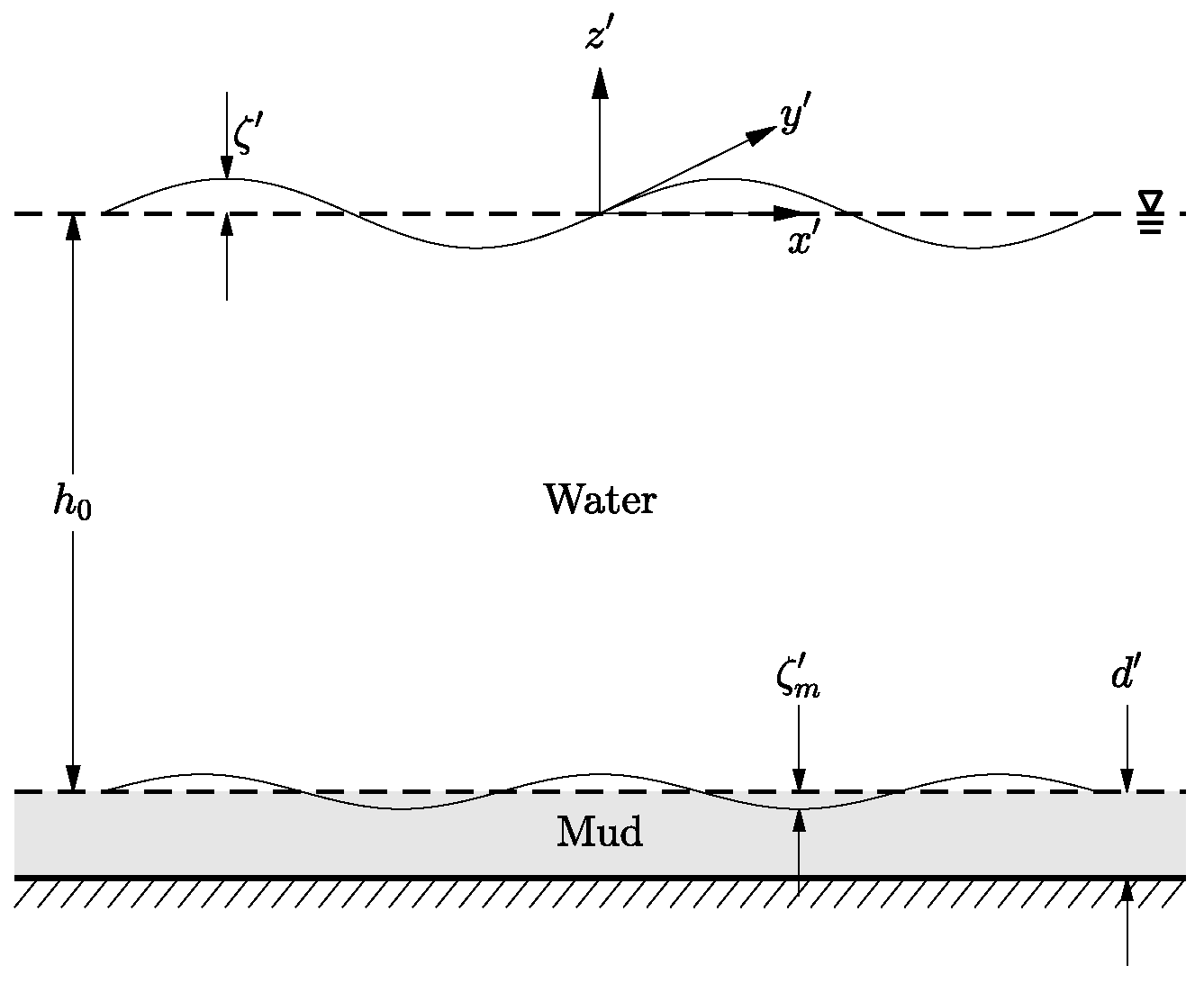
We considered an inviscid water body overlaying a layer of heavier fluid mud as shown in Figure 1. The sea water and the bottom mud were assumed to be perfectly immiscible. The water body has a constant depth , and the thickness of the mud layer is . The two-layer configuration illustrated in Figure 1 is typical in theoretical wave–mud studies [1,8,9,10,14].
Figure 1.
An immiscible two-layer system for surface long waves over a muddy seabed. water depth, mud thickness, free-surface displacement, water–mud interfacial displacement, horizontal coordinates, vertical axis. The mud layer is on top of a solid bottom.
We adopted the typical Boussinesq approximation for long water waves:
where and measure the relative importance of wave nonlinearity and frequency dispersion, respectively, with and representing the characteristic wave amplitude and wavelength of incident waves. The motion of the fluid mud is considered to be at low Reynolds numbers:
where the Reynolds number of mud is
with being the kinetic viscosity of mud. This requirement implies that the immiscible condition can be satisfied since, in the water–mud system, a sharp density interface surpasses the possible turbulence.
Past studies [10,14,15] have suggested that, in many coastal environments, the thickness of mud, , can be much smaller than but comparable to the Stokes’ boundary layer of mud defined as
In other words, in the present study, we focused only on the case where
An immediate implication is that the interfacial displacement at the water–mud interface becomes relatively small since
where is the free-surface displacement. This further suggests that all of the conditions to be satisfied at the water–mud interface can be approximately applied at [10].
2.2. Water Layer
Following the classical water wave theory, the motion of sea water is governed by the Laplace equation for an inviscid irrotational flow. We introduce the common dimensionless variables for long waves:
where is time, g is the gravitational acceleration, is the density of sea water, denotes the total pressure, and and are the corresponding water particle velocity components in the horizontal and vertical directions. We reiterate that the coordinate system is defined in Figure 1.
Accordingly, the familiar Laplace equation in the dimensionless form reads
where is the velocity potential and is the horizontal gradient operator. We remark that the order of the magnitude argument in (6) has been evoked so that the water–mud interface is fixed at .
Along the free surface, we require the usual kinematic and dynamic boundary conditions, i.e.,
Once is known, the pressure field can be evaluated from the unsteady Bernoulli equation as
To derive the approximate model for long waves with the consideration of bottom fluid mud, we first adopted the standard perturbation approach by expanding the velocity potential as a power series in the vertical coordinate z [21]:
Using the above expansion in the Laplace equation, (8), we obtained
and
where and represent, respectively, the horizontal and vertical components of the water particle velocity at the water–mud interface, . We remark that, for the canonical Boussinesq equations for long waves over a horizontal solid seabed, the no-flux condition requires , suggesting that each with odd n vanishes [21]. For the present wave–seabed problem, the wave-driven mud motion leads to a non-zero .
Since (6) suggests that the interfacial displacement is negligible in comparison to the free-surface displacement, it becomes obvious that the vertical component of mud flow velocity, , is in the orders of
which is different from that of the vertical component of the water particle velocity suggested in (7). From the continuity of vertical velocity across the water–mud interface, it follows that
Similarly, from (10), we obtain
Let us define the depth-averaged horizontal velocity as
Substituting (20) into (18) and (19), we finally arrive at
and
respectively, which constitute the Boussinesq-type depth-integrated long wave equations with the effects of a thin fluid muddy seabed considered. In the absence of the mud layer where the solid bottom is also frictionless, and, consequently, these equations reduce to the conventional Boussinesq equations [21].
2.3. Muddy Seabed
Clearly, (16) suggests that, under our assumptions, the vertical mud flow velocity, , is orders of magnitude different from the vertical water particle velocity, . Hence, new normalizations for the flow dynamics inside the muddy seabed were introduced as [10]
where represent the dimensionless mud flow velocity components, is the pressure, and denotes the stress tensor. Recall that the thickness of mud is as given in (4) and (5); it is therefore more convenient to define a stretched coordinate [10],
so that the mud layer occupies . We remark that, by the use of (6), the dimensionless thickness of the mud layer is
which becomes a constant of .
Accordingly, inside the mud layer, , the law of conservation of mass states that
and the dimensionless momentum equations are
where the stresses are
and
Recall (16) suggesting that, at the water–mud interface,
Since the order of the accuracy of the wave equations for the water–mud system, (21) and (22), is , (31) implies that it is sufficient to keep only the leading-order term of as far as these long wave equations are considered. As a result, at the leading order, the vertical momentum equation, (28), reflects a vertically uniform pressure within the mud layer
Similarly, the horizontal momentum equation, (27), reduces to
By further requiring the continuity of normal stress at the interface between the inviscid water layer and the muddy seabed and also keeping the same order of accuracy, with the help of (11) and (19) to treat the pressure term in (33), we obtain the new form of the horizontal momentum equation as
where
is the density ratio. In the vertical directions, the corresponding boundary conditions are
and
satisfying, respectively, the no-slip condition and the assumption of inviscid water. It becomes clear that (34) connects the hydrodynamics of sea water with the flow motion inside the mud layer. In turn, it provides the closure necessary for the depth-integrated wave equations, (21) and (22), since is related to by (31) and then (26). For instance, if the fluid mud is idealized as a Newtonian fluid, i.e., depends only linearly on , can be obtained analytically as a function of ; hence, through (20) [10]. It follows that (21) and (22) can then be solved for and . Of course, depending on the actual rheological behaviors of the bottom fluid mud, the present wave–mud problem can be far more complicated. This is discussed in the following.
2.4. A Linear Viscoelastic Muddy Seabed
We modeled the fluid mud as a generalized linear viscoelastic material whose rheological behaviors follow [20]
where is the stress tensor, denotes the displacements, and are empirical constant coefficients, and the orders P and Q, which are also determined experimentally, represent the use of a limited discrete record for the continuous relaxation function. For instance, for the representative Maxwell and Kelvin–Voigt models [20],
where is the dynamic viscosity and is the shear modulus of elasticity. Similarly, at the viscous limit,
and
for a purely elastic material.
Following the constitutive equation, (38), the stress term in the equation for mud flow, (34), satisfies
where
represents the dimensionless horizontal displacements of mud,
is the dimensionless vertical displacement, and the remaining empirical coefficients are nondimensionlized as
It is unlikely that we can directly apply the implicit stress–strain relationship suggested by (42) into the momentum equation, (34). However, provided the necessary initial conditions are available, the method of Laplace transformation may allow us to apply (42) more conveniently. In other words, by the convention integral transform, we obtained from (42) an explicit expression in the transformed domain as
where
defines the Laplace transform and the exact forms of and depend on the empirical coefficients and , orders of derivatives, and the initial conditions. As an example, for the representative rheological models defined in (39), we have
where
is a dimensionless parameter for the competition effects by viscosity and elasticity. The conveniently defined Wi is related to the Weissenberg number commonly used in the study of viscoelastic flows.
Using the stress–strain relationship suggested by (46), the two-point boundary value problem, (34) with (36) and (37), can be converted into its equivalent problem in the s-domain as
where is the horizontal water particle displacements at the water–mud interface. The problem can be readily solved to obtain
with describing the mud motion in response to the surface wave loading. The inversion is
where , by definition, is
In the above, the path of integration defined by is a vertical line parallel to and on the right of the imaginary axis in the complex s-domain. Consequently, the horizontal mud flow velocity can be obtained since
Using (26), the vertical component is
In general, the response function, i.e., in (55), needs to be evaluated numerically. However, analytical results are possible if is not too complicated. For instance, if the mud follows the Kelvin–Voigt model, with the use of the Cauchy’s residue theorem for inversion, we obtain
and
where
and
Similarly, if the mud acts like a Newtonian fluid,
and
where is reduced from (60). We note that (64) and (65), after some algebraic manipulations, recover the results reported by Liu and Chan [10], who studied long waves over a viscous mud layer and obtained the solutions in the form of complementary error functions.
Finally, using (31), the expression for is available in the form of as
where is shorthand for the lengthy function in (65) and its exact form depends on the actual rheological behaviors of the mud. This completes the depth-integrated model, (21) and (22), which can now be solved for wave hydrodynamics under the effects of a muddy seabed. Afterward, the solutions for the wave-induced mud flow are obtained by (56) and (57).
3. Examples and Discussions
3.1. Model Equations for the Wave-Mud Problem
In summary, a set of depth-integrated equations for long waves over a thin viscoelastic muddy seabed is formulated as
where represents the mud response function. The model equations can be solved numerically following the typical numerical solvers for Boussinesq-type equations [22]. However, for incident waves of canonical waveforms, such as sinusoidal waves and solitary waves, analytical solutions are possible if the rheological behaviors of the fluid mud can also be described by a simple model. For instance, if we consider in the two-dimensional setting a solitary wave over a muddy seabed, following the same procedure suggested by Liu and Chan [10], we obtain from (67) the free-surface displacement as
where is the moving coordinate, is a slow time, and the varying wave height due to the presence of the bottom mud is governed by
where is the leading-order term of . If the mud can be idealized by the Kelvin–Voigt model, it can be deduced from (59) and (66) that
We reiterate that and have been defined in (60) and (61), respectively. Hence, using (69) and (71), we obtain
The evolution equation can be integrated numerically to obtain the wave height variation in a solitary wave.
Solutions for sinusoidal waves are also analytically tractable [10]. With the consideration of a muddy seabed, the free-surface displacement of a simple harmonic wave is formulated as [10]
where and account for the possible wavenumber shift and the change in wave amplitude due to the mud layer, respectively. Using (74) in (67) and keeping only the leading-order terms, we show that
where
due to periodicity. Again, assuming the Kelvin–Voigt model for the mud layer and using (74) in (70), we obtain
where remains the same as defined in (72). It follows that
and
3.2. Linear Progressive Waves with Mud at Elastic or Viscous Limit
Asymptotically, for sinusoidal waves, the amplitude attenuation rate given in (79) can be approximated by
which has a possible maximum at
For a purely elastic seabed, defined in (72) reduces to
Hence, (80) approaches , verifying that there is no amplitude attenuation as has been reported in literature [13]. In addition, (81) reflects the resonance due to the elasticity of mud at
which again agrees with the known result [8].
If a Newtonian fluid mud layer is considered, the numeric obtained by (79) and (78) is identical to those reported by Liu and Chan [10]. However, we take a step forward to deduce from (80) the asymptotic result of (79) as
where the local maximum occurs at
Since we require , the peak damping is expected at . The explicit criterion is similar to the graphical results presented in literature [1,9,14,15].
3.3. Comparisons with Field Observations
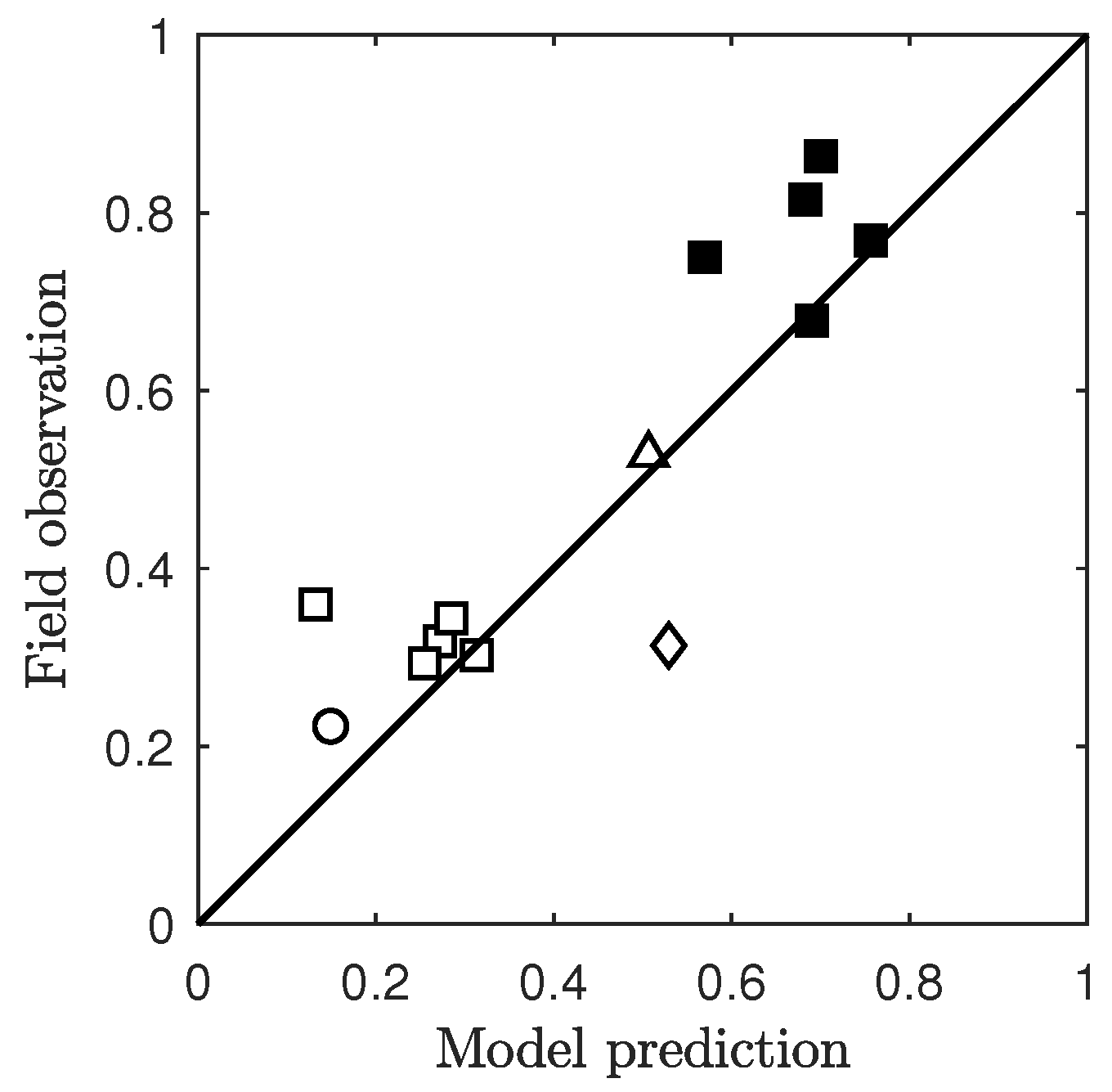
To examine the performance of the present long-wave model, Figure 2 compares the predictions of wave amplitude attenuation with the field observations reported by Tubman and Suhayda (TS76, ∆ in the figure) [2], Wells and Coleman (WC81, ☐ and ■) [4], Mathew (M92, ◇) [5], and Rogers and Holland (RH09, ⃝ ) [6]. These field experiments were conducted in East Bay, Louisiana (TS76), Suriname, South America (WC81), Allepey, India (M92), and Cassino Beach, Brazil (RH09), respectively. Considerable wave damping was observed in all experiments. Specifically, the measured wave height reduced from 0.54 m to 0.285 m over a distance of 3.35 km in TS76; 0.93 m to 0.19 m over 17 km in WC81; 0.67 m to 0.21 m over 0.3 km in M92; 3.19 m to 0.71 m over 22 km in RH09 [2,4,5,6]. It is important to note that, due to the random nature of actual coastal waves, significant wave heights, , and peak wave periods, , were reported by these field studies. However, in our calculations, we have assumed monochromatic waves with wave height and wave period . Consequently, a swift analytical prediction of amplitude attention as given by (79) becomes feasible. We reiterate that the present theoretical model is limited to the case of constant water depth, which is no longer true in the field. In fact, the water depth decreased inshore from 19.2 m to 5.3 m over a distance of 3.35 km in the experiment reported by TS76 [2]; 8.7 m to 7.5 m over 22 km in WC81 [4]; roughly 10 m to 5 m over 0.3 km in M92 [5]; 15 m to 9 m over 22 km in RH09 [6]. In our model predictions, we have adopted the water depth at the first wave gauge station in each experiment. All other model inputs, such as mud properties (, , , ), are taken from the field studies [2,4,5,6,23]. Table 1 summarizes the parameters used in our model predictions. Detailed experimental conditions are available in these field studies; we do not reiterate them here.
Figure 2.
Wave amplitude attenuation: comparison between model predictions and field observations. ∆: field study reported by Tubman and Suhayda [2]; ☐ and ■: Wells and Coleman [4]; ◇: Mathew [5]; ○: Rogers and Holland [6]. See Table 1 for the model inputs.
Table 1.
Parameters used in the theoretical predictions of amplitude attenuation for the field examples presented in Figure 2. Symbols (∆, ☐, ■, ◇, ○) represent the corresponding cases shown in the figure.
As can be seen in Figure 2, which plots the amplitude ratio between two wave gauge stations and, hence, the amplitude attenuation rate, , defined in (79), the agreement between the theoretical predictions and the field observations [2,4,5,6] is overall acceptable. We reiterate that, for the field experiments, the amplitude attention rate is calculated using the significant wave heights. Considering several simplifications that have been made in the theoretical model, the result presented in Figure 2 is quite encouraging.
3.4. Effects of Mud Properties
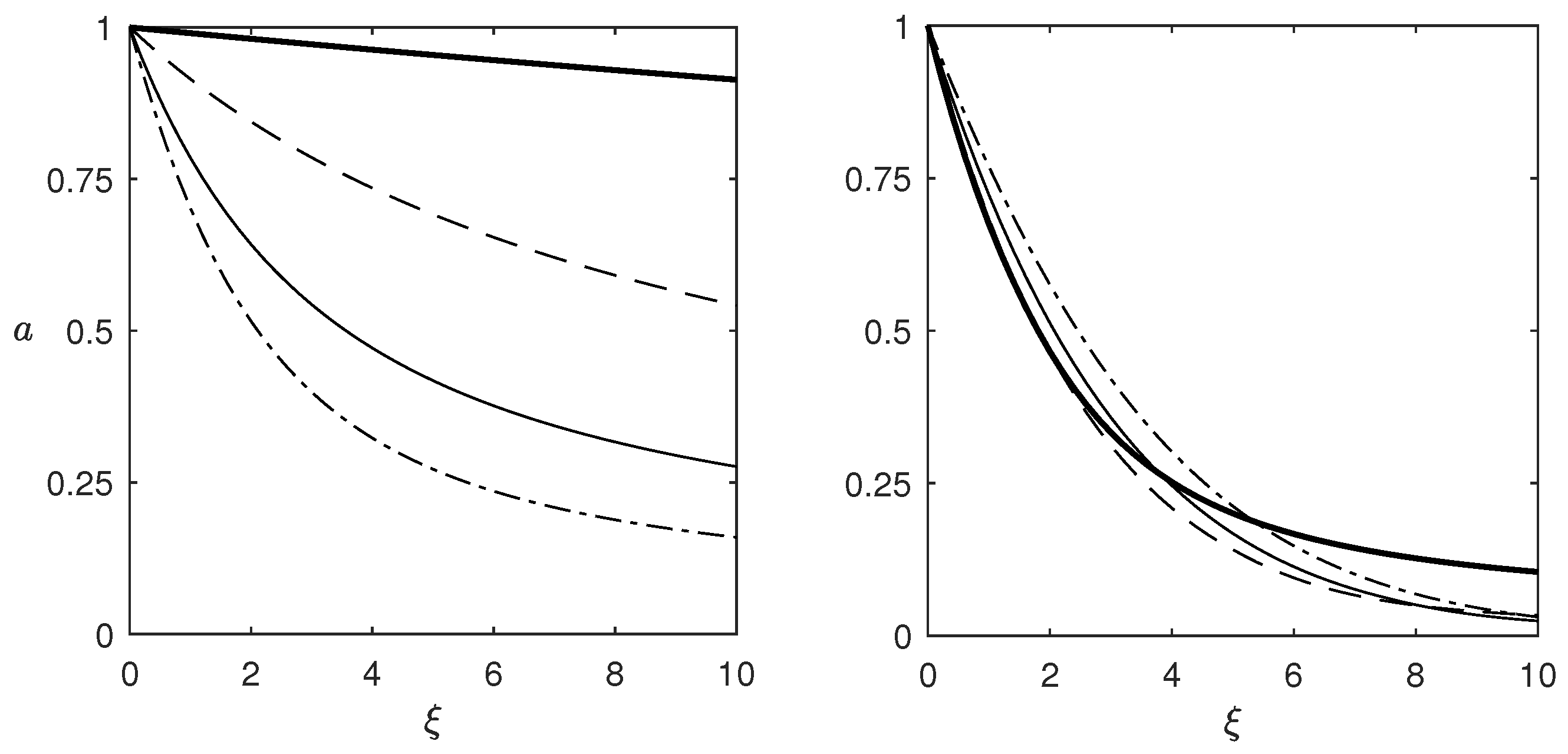
We shall discuss the impacts of mud thickness, d, and the value of Wi, which quantifies the relative strength of viscous and elastic behaviors as defined in (49). Since the wave–mud problem considering waves of infinitesimal amplitudes has been studied at length [13,14,15], we focus only on the case of solitary waves. Figure 3 presents the damping of a solitary wave under different dimensionless mud thicknesses, d, but at a fixed . We observe from the left panel of the figure that, for , the wave height attenuates significantly faster as the mud becomes more elastic (smaller Wi). However, the effects of d become insignificant if , as presented in the right panel of Figure 3. This suggests that, similar to the case of linear progressive waves [13,14,15], viscous damping does not grow unbounded with the dimensionless thickness d since the viscous effects are mostly dominant within the boundary layer. We reiterate that, for the case of sinusoidal waves, we are able to deduce an explicit formula to predict the thickness for maximum attenuation, as given in (81). Unfortunately, we are unable to do so for solitary waves since the evolution of wave height, (73), needs to be evaluated numerically.
Figure 3.
Effects of dimensionless mud thickness, d, on the damping of a solitary wave: dimensionless wave height, a, as a function of dimensionless time, . Left: 0.5 (bold line), 1 (dashed line), 1.5 (solid line), 2 (dashed-dotted line). Right: 2.5 (bold line), 5 (dash line), 7.5 (solid line), 10 (dashed-dotted line). In all cases, .
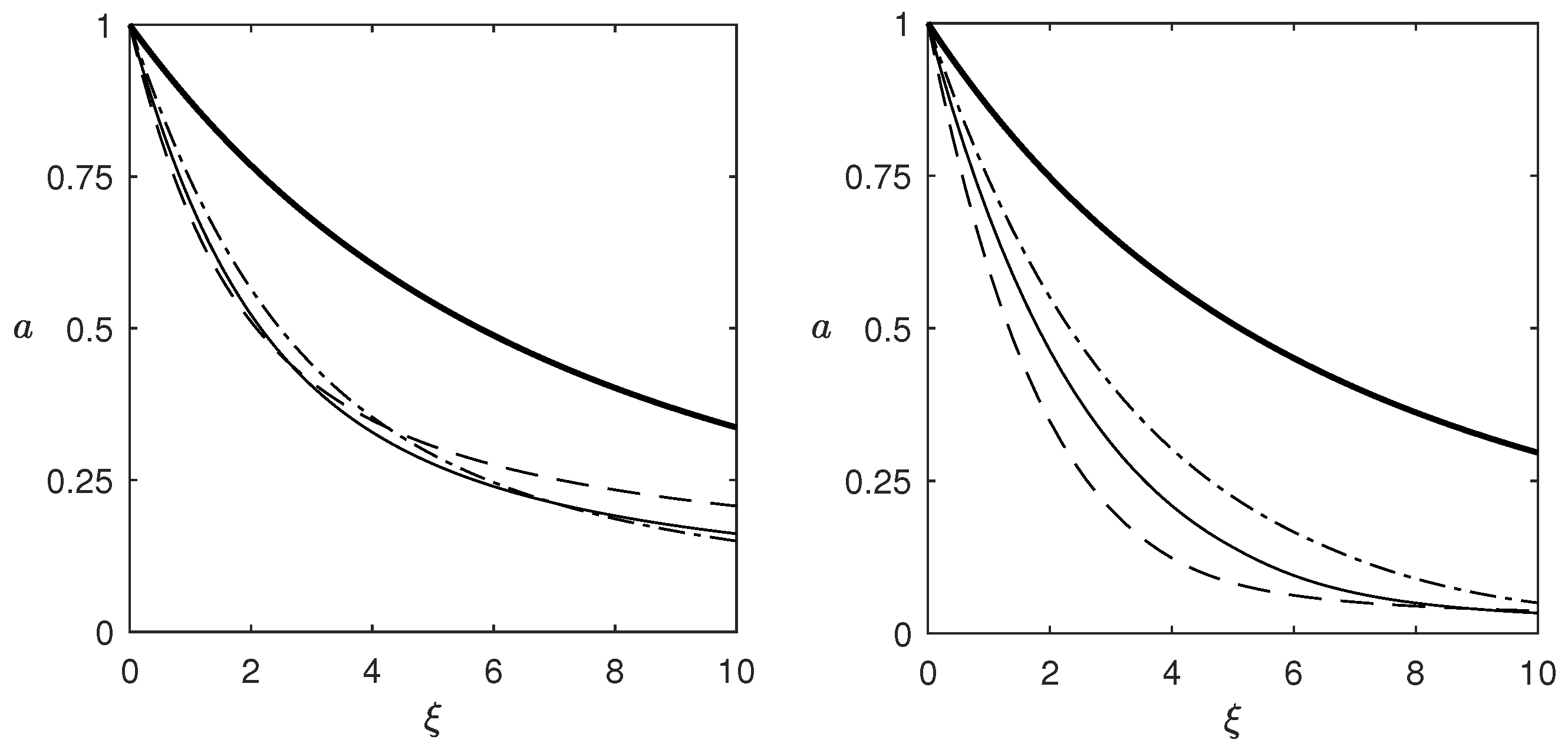
To understand the effects of Wi, in Figure 4, we plot the variation in wave height with respect to different values of Wi. The dimensionless mud thickness is fixed at either (left panel in Figure 4) or (right panel). As can be seen in the figure, a viscoelastic mud causes considerably larger damping than a Newtonian fluid mud (). When the dimensionless thickness is fixed at as presented in the left panel of Figure 4, the further increase in elasticity—say, from down to —to make the mud more elastic has little impact on the wave damping. On the other hand, if the dimensionless thickness is fixed at (right panel), a more elastic mud (smaller Wi) always produces a much stronger attenuation. We note that, during the oscillation motion, due to elasticity, a portion of energy in mud is converted into thermal energy by viscous dissipation, whereas the rest sustains the mud flow or even feeds back to the wave field. Since is roughly the boundary layer thickness, elastic oscillation is quickly damped out. Consequently, any increase in elasticity becomes insignificant. For , elastic oscillation facilitates more energy transfer outside the so-called boundary layer. Therefore, wave damping is enhanced by the increase in elasticity.
Figure 4.
Damping of a solitary wave under various values of Wi: dimensionless wave height, a, as a function of dimensionless time, . Bold lines: (Newtonian fluid); dashed-dotted line: ; solid lines: ; dashed lines: 0.5. Left: . Right: .
4. Concluding Remarks
We present a set of depth-integrated equations that can be used to model nonlinear long waves over a muddy seabed. The bottom mud is idealized as a linear viscoelastic fluid and the thickness of the mud layer is assumed to be small. If the elasticity of mud reduces to zero, i.e., Newtonian fluid mud, or only small amplitude waves are considered, our model recovers previous results reported in literature. The comparison between the model-predicted wave amplitude attenuation with field data shows an encouraging agreement. A parameter study on the effects of mud properties reveals the following points:
- Maximum wave damping occurs when the thickness of mud is about the same as the typical boundary layer thickness;
- A viscoelastic seabed is more efficient in wave damping than a Newtonian fluid mud, as elastic oscillation enhances the wave amplitude attenuation;
- The increase in elasticity in a viscoelastic seabed only has significant impacts on amplitude attenuation when the dimensionless mud thickness is larger.
We reiterate that the present model is limited to the case of a constant water depth. We also assume that the water body is inviscid and that the mud is homogeneous. In fact, following the common laminar boundary layer treatment for waves over a smooth and solid bottom [24], a viscous water boundary layer can be installed right above the water–mud interface to smooth the sharp velocity difference at the interface. However, the correction is expected to be negligible since the water viscosity is several orders of magnitude smaller than the typical viscosity of mud [15]. To account for the vertical variations in mud properties, the idea of adopting multiple mud layers [25] can, in principle, be implemented in our formulations as long as the rheological behaviors of each layer follow a linear viscoelastic model. Finally, considerable interfacial waves in the wave–mud system have indeed been observed in the field [26]. This violates our scaling argument on a thin mud layer. Consequently, our theory breaks down. At the moment, we do not see an easy path to overcome this mathematical difficulty. A potential candidate is to formulate the problem in the Lagrangian coordinates. The existing Lagrangian model for the wave–seafloor problem considers only small-amplitude progressive waves [27]. We think that it is worthwhile to explore the possibility of extending the analysis for more general wave fields. Nevertheless, supported by the encouraging comparison with field observations that has been shown previously, we believe that there are still many opportunities where the present model is applicable.
Funding
This research was funded by the Ministry of Science and Technology, Taiwan [110-2221-E-002-058].
Institutional Review Board Statement
Not applicable.
Informed Consent Statement
Not applicable.
Acknowledgments
The present work is motivated by an earlier study on a related wave–mud problem. The author thanks P. L.-F. Liu for introducing him to studying wave–mud interactions and for many helpful discussions and useful suggestions during the early stage of this work. The author thanks the anonymous reviewers for their careful reading of the manuscript. Their constructive feedback has helped to improve and clarify the paper.
Conflicts of Interest
The author declares no conflict of interest.
References
- Gade, H.G. Effects of a non-rigid, impermeable bottom on plane surface waves in shallow water. J. Mar. Res. 1958, 16, 61–82. [Google Scholar]
- Tubman, M.W.; Suhayda, J.N. Wave action and bottom movements in fine sediments. In Proceedings of the 15th Coastal Engineering Conference, Honolulu, HI, USA, 11–17 July 1976; pp. 1168–1183. [Google Scholar]
- Elgar, S.; Raubenheimer, B. Wave dissipation by muddy seafloors. Geophys. Res. Lett. 2008, 35, L07611. [Google Scholar] [CrossRef] [Green Version]
- Wells, J.T.; Coleman, J.M. Physical processes and fine-grained sediment dynamics, Coast of Surinam, South America. J. Sediment. Petrol. 1981, 51, 1053–1068. [Google Scholar]
- Mathew, J. Wave–Mud Interaction in Mudbanks. Ph.D. Dissertation, Cochin University of Science and Technology, Cochin, India, 1992. [Google Scholar]
- Rogers, W.E.; Holland, K.T. A study of dissipation of wind-waves by mud at Cassino Beach, Brazil: Prediction and inversion. Cont. Shelf Res. 2009, 29, 676–690. [Google Scholar] [CrossRef]
- Foda, M.A. Sea floor dynamics. In Advances in Coastal and Ocean Engineering; Liu, P.L.-F., Ed.; World Scientific: Singapore, 1995; pp. 77–123. [Google Scholar]
- Mei, C.C.; Krotov, M.; Huang, Z.; Huhe, A. Short and long waves over a muddy seabed. J. Fluid Mech. 2010, 643, 33–58. [Google Scholar] [CrossRef] [Green Version]
- Dalrymple, R.A.; Liu, P.L.-F. Waves over soft muds: A two layer model. J. Phys. Oceanogr. 1978, 8, 1121–1131. [Google Scholar] [CrossRef] [Green Version]
- Liu, P.L.-F.; Chan, I.-C. On long-wave propagation over a fluid-mud seabed. J. Fluid Mech. 2007, 579, 467–480. [Google Scholar] [CrossRef]
- Mallard, W.W.; Dalrymple, R.A. Water waves propagating over a deformable bottom. In Proceedings of the 9th Offshore Technology Conference, Houston, TX, USA, 2–5 May 1977. OTC-2895-MS. [Google Scholar]
- Yamamoto, T.; Koning, H.L.; Sellmeigher, H.; Hijum, E.V. On the response of poro-elastic bed to water waves. J. Fluid Mech. 1978, 87, 193–206. [Google Scholar] [CrossRef]
- MacPherson, H. The attenuation of water waves over a non-rigid bed. J. Fluid Mech. 1980, 97, 721–742. [Google Scholar] [CrossRef]
- Ng, C.-O. Water waves over a muddy bed: A two-layer Stokes’ boundary layer model. Coast. Eng. 2000, 40, 221–242. [Google Scholar] [CrossRef]
- Liu, P.L.-F.; Chan, I.-C. A note on the effects of a thin visco-elastic mud layer on small amplitude water-wave propagation. Coast. Eng. 2007, 54, 233–247. [Google Scholar] [CrossRef]
- Mei, C.C.; Liu, K.-F. A Bingham-plastic model for a muddy seabed under long waves. J. Geophys. Res. 1987, 92, 14581–14594. [Google Scholar] [CrossRef]
- Liu, K.-F.; Mei, C.C. Effects of wave-induced friction on a muddy seabed modelled as a Bingham-plastic fluid. J. Coast. Res. 1989, 5, 777–789. [Google Scholar]
- Park, Y.S.; Liu, P.L.-F.; Clark, S.J. Viscous flows in a muddy seabed induced by a solitary wave. J. Fluid Mech. 2008, 598, 383–392. [Google Scholar] [CrossRef]
- Jiang, F.; Mehta, A.J. Mudbanks of the southwest coast of India. Part IV. Mud viscoelastic priperties. J. Coast. Res. 1995, 11, 918–926. [Google Scholar]
- Malvern, L.E. Introduction to the Mechanics of a Continuous Medium; Prentice Hall: Hoboken, NJ, USA, 1969; pp. 306–327. [Google Scholar]
- Mei, C.C. The Applied Dynamics of Ocean Surface Waves; World Scientific: Singapore, 1989; pp. 504–511. [Google Scholar]
- Lynett, P.J. A Multi-Layer Approach to Modeling Generation, Propagation, and Interaction of Water Waves. Ph.D. Dissertation, Cornell University, Ithaca, NY, USA, 2002. [Google Scholar]
- Soltanpour, M.; Haghshenas, S.A. Fluidization and representative wave transformation on muddy beds. Cont. Shelf Res. 2009, 29, 666–675. [Google Scholar] [CrossRef]
- Dean, R.G.; Dalrymple, R.A. Water Wave Mechanics for Engineers and Scientists; World Scientific: Singapore, 1991; pp. 262–268. [Google Scholar]
- Maa, J.P.-Y.; Mehta, A.J. Mud erosion by waves: A laboratory study. Cont. Shelf Res. 1987, 7, 1269–1284. [Google Scholar] [CrossRef]
- Traykovski, P.; Geyer, W.R.; Irish, J.D.; Lynch, J.F. The role of wave-induced density-driven fluid mud flows for cross-shelf transport on the Eel River continental shelf. Cont. Shelf Res. 2000, 20, 2113–2140. [Google Scholar] [CrossRef]
- Ng, C.-O.; Zhang, X. Mass transport in water waves over a thin layer of soft viscoelastic mud. J. Fluid Mech. 2007, 573, 105–130. [Google Scholar] [CrossRef] [Green Version]
Publisher’s Note: MDPI stays neutral with regard to jurisdictional claims in published maps and institutional affiliations. |
© 2022 by the author. Licensee MDPI, Basel, Switzerland. This article is an open access article distributed under the terms and conditions of the Creative Commons Attribution (CC BY) license (https://creativecommons.org/licenses/by/4.0/).