Teaching Practices for Scientific Argumentation in K–12 Classrooms


Abstract
1. Introduction
2. Theoretical Framework
3. Literature Review
4. Development of the Framework
4.1. Synthesis of the Literature
4.2. Assembling the Literature
4.3. Generating and Testing Candidate Practices
4.4. Criteria Used to Evaluate Candidate Practices
4.4.1. The Practice Has the Potential to Support a Focus on Equity
4.4.2. The Practice Is Doable at a Productive Grain Size
4.4.3. The Practice Is Usable Across Contexts
4.5. Candidates Considered and Set Aside
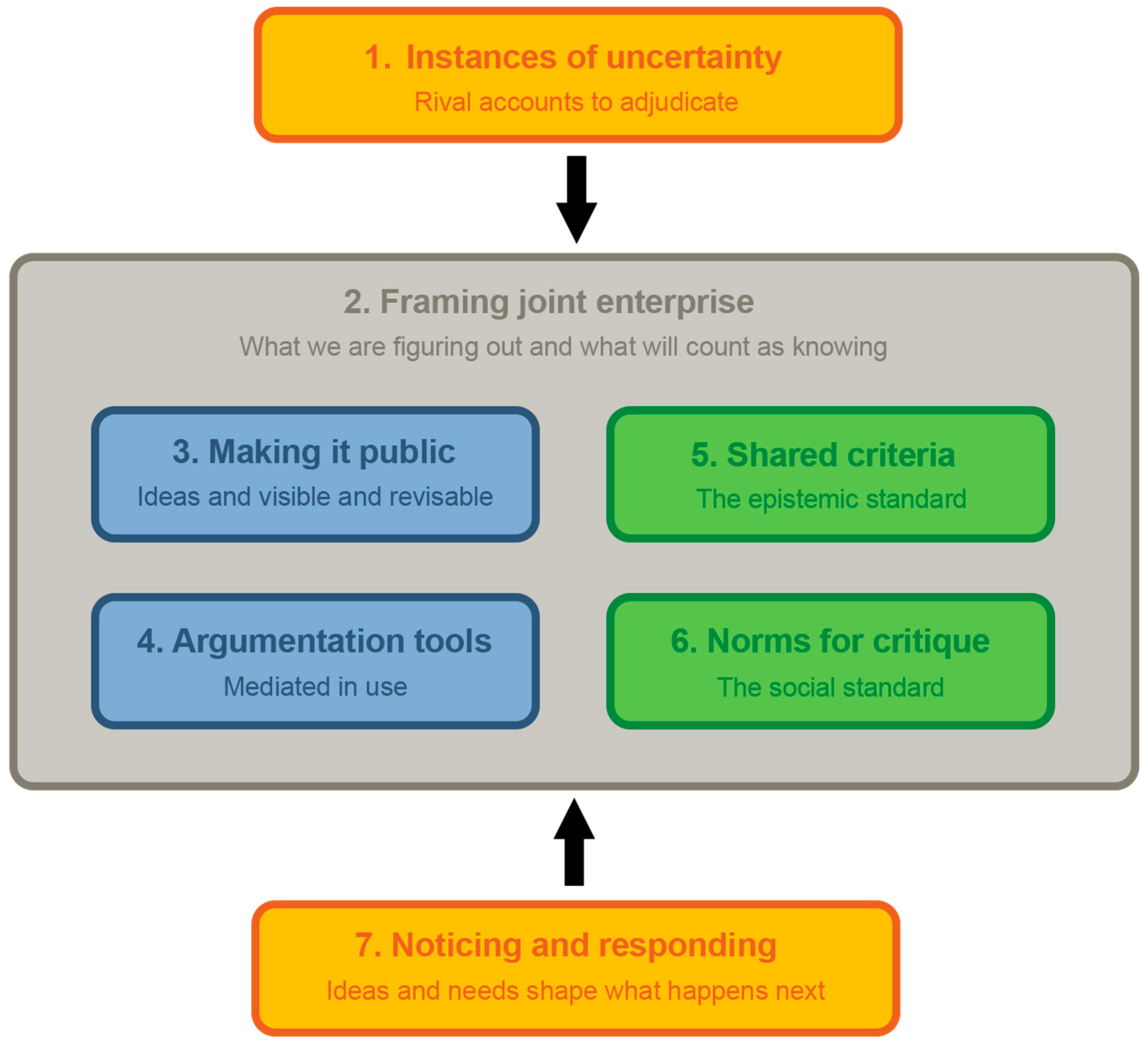
5. The Seven Foundational Teaching Practices
5.1. Practice 1: Creating and Leveraging Instances of Uncertainty
5.2. Practice 2: Framing Joint Enterprise
5.3. Practice 3: Making Argumentation Public
5.4. Practice 4: Introducing and Mediating Argumentation Tools
5.5. Practice 5: Establishing and Refining Shared Criteria for What Counts as an Acceptable Argument
5.6. Practice 6: Developing and Maintaining Norms for Critique and Disagreement
5.7. Practice 7: Noticing and Responding to Student Reasoning and Needs
5.8. How the Practices Relate to One Another
5.9. Near-Misses in Enactment
5.10. Relationships to Existing Frameworks
5.11. Equity Within the Framework
5.12. Enacting the Practices Under Institutional Constraint
6. Discussion and Limitations
7. Implications
Funding
Institutional Review Board Statement
Informed Consent Statement
Data Availability Statement
Conflicts of Interest
References
- Allen, J., & Rogers, M. P. (2015). Putting ideas on paper: Formulating scientific explanations using the claim, evidence, and reasoning (CER) framework. Science and Children, 53(3), 32–37. [Google Scholar] [CrossRef] [Scilit]
- Altun, E., & Ozsevgec, T. (2025). Making argumentation-based learning and teaching happen: Exploring the development of pre-service science teachers’ argumentation competencies. Science & Education, 34(6), 4057–4106. [Google Scholar] [CrossRef] [Scilit]
- Alzen, J. L., Buell, J. Y., Edwards, K., Griesemer, C. D., Zhang, Y., Passmore, C., Penuel, W. R., & Reiser, B. J. (2025). Developing science classroom expectations that encourage risk-taking for learning science together. Science Education, 109(6), 1716–1732. [Google Scholar] [CrossRef] [Scilit]
- Asterhan, C. S., & Schwarz, B. B. (2007). The effects of monological and dialogical argumentation on concept learning in evolutionary theory. Journal of Educational Psychology, 99(3), 626. [Google Scholar] [CrossRef] [Scilit]
- Australian Government Department of Education. (n.d.). V9 Australian curriculum. Available online: https://www.australiancurriculum.edu.au/ (accessed on 23 May 2026).
- Aydeniz, M., & Ozdilek, Z. (2016). Assessing and enhancing pre-service science teachers’ self-efficacy to teach science through argumentation: Challenges and possible solutions. International Journal of Science and Mathematics Education, 14(7), 1255–1273. [Google Scholar] [CrossRef] [Scilit]
- Bang, M., & Medin, D. (2010). Cultural processes in science education: Supporting the navigation of multiple epistemologies. Science Education, 94(6), 1008–1026. [Google Scholar] [CrossRef] [Scilit]
- Bang, M., Warren, B., Rosebery, A. S., & Medin, D. (2013). Desettling expectations in science education. Human Development, 55(5–6), 302–318. [Google Scholar] [CrossRef] [Scilit]
- Bell, P. (2013). Promoting students’ argument construction and collaborative debate in the science classroom. In Internet environments for science education (pp. 143–172). Routledge. [Google Scholar]
- Bell, P., & Linn, M. (2000). Scientific arguments as learning artifacts: Designing for learning from the web with KIE. International Journal of Science Education, 22(8), 797–818. [Google Scholar] [CrossRef] [Scilit]
- Belland, B. R., Glazewski, K. D., & Richardson, J. C. (2008). A scaffolding framework to support the construction of evidence-based arguments among middle school students. Educational Technology Research and Development, 56(4), 401–422. [Google Scholar] [CrossRef] [Scilit]
- Berland, L. K. (2011). Explaining variation in how classroom communities adapt the practice of scientific argumentation. Journal of the Learning Sciences, 20(4), 625–664. [Google Scholar] [CrossRef] [Scilit]
- Berland, L. K., & Hammer, D. (2012). Framing for scientific argumentation. Journal of Research in Science Teaching, 49(1), 68–94. [Google Scholar] [CrossRef] [Scilit]
- Berland, L. K., & McNeill, K. L. (2010). A learning progression for scientific argumentation: Understanding student work and designing supportive instructional contexts. Science Education, 94(5), 765–793. [Google Scholar] [CrossRef] [Scilit]
- Berland, L. K., & Reiser, B. J. (2011). Classroom communities’ adaptations of the practice of scientific argumentation. Science Education, 95(2), 191–216. [Google Scholar] [CrossRef] [Scilit]
- Berland, L. K., Russ, R. S., & West, C. P. (2020). Supporting the scientific practices through epistemologically responsive science teaching. Journal of Science Teacher Education, 31(3), 264–290. [Google Scholar] [CrossRef] [Scilit]
- Berland, L. K., Schwarz, C. V., Krist, C., Kenyon, L., Lo, A. S., & Reiser, B. J. (2016). Epistemologies in practice: Making scientific practices meaningful for students. Journal of Research in Science Teaching, 53(7), 1082–1112. [Google Scholar] [CrossRef] [Scilit]
- Boran, G. H., & Bag, H. (2016). The influence of argumentation on understanding nature of science. International Journal of Environmental and Science Education, 11(6), 1423–1431. [Google Scholar]
- Boyer, E. (2016). Preservice elementary teachers’ instructional practices and the teaching science as argument framework. Science & Education, 25(9), 1011–1047. [Google Scholar] [CrossRef] [Scilit]
- Brown, J. S., Collins, A., & Duguid, P. (1989). Situated cognition and the culture of learning. Educational Researcher, 18(1), 32–42. [Google Scholar] [CrossRef]
- Calabrese Barton, A., & Tan, E. (2020). Beyond equity as inclusion: A framework of “rightful presence” for guiding justice-oriented studies in teaching and learning. Educational Researcher, 49(6), 433–440. [Google Scholar] [CrossRef] [Scilit]
- Campbell, T., Gray, R., & Fazio, X. (2019). Representing scientific activity: Affordances and constraints of central design and enactment features of a model-based inquiry unit. School Science and Mathematics, 119(8), 475–486. [Google Scholar] [CrossRef] [Scilit]
- Carpenter, S. L., Kim, J., Nilsen, K., Irish, T., Bianchini, J. A., & Berkowitz, A. R. (2020). Secondary science teachers’ use of discourse moves to work with student ideas in classroom discussions. International Journal of Science Education, 42(15), 2513–2533. [Google Scholar] [CrossRef] [Scilit]
- Cavagnetto, A. (2010). Argument to foster scientific literacy: A review of argument interventions in K–12 science contexts. Review of Educational Research, 80(3), 336–371. [Google Scholar]
- Cavagnetto, A., Hand, B., & Norton-Meier, L. (2010). The nature of elementary student science discourse in the context of the science writing heuristic approach. International Journal of Science Education, 32(4), 427–449. [Google Scholar] [CrossRef] [Scilit]
- Cetin, P. S., Metin, D., Capkinoglu, E., & Leblebicioglu, G. (2016). Seeking the trace of argumentation in turkish science curriculum. Science Education International, 27(4), 570–591. [Google Scholar]
- Chen, H.-T., Wang, H.-H., Lu, Y.-Y., Lin, H., & Hong, Z.-R. (2016). Using a modified argument-driven inquiry to promote elementary school students’ engagement in learning science and argumentation. International Journal of Science Education, 38(2), 170–191. [Google Scholar] [CrossRef] [Scilit]
- Chen, Y., Benus, M. J., & Hernandez, J. (2019). Managing uncertainty in scientific argumentation. Science Education, 103(5), 1235–1276. [Google Scholar] [CrossRef] [Scilit]
- Chen, Y., & Techawitthayachinda, R. (2021). Developing deep learning in science classrooms: Tactics to manage epistemic uncertainty during whole-class discussion. Journal of Research in Science Teaching, 58(8), 1083–1116. [Google Scholar] [CrossRef] [Scilit]
- Chen, Y.-C. (2020). Dialogic pathways to manage uncertainty for productive engagement in scientific argumentation: Y.-C. Chen. Science & Education, 29(2), 331–375. [Google Scholar] [CrossRef] [Scilit]
- Chen, Y.-C. (2025). Cultivating a higher level of student agency in collective discussion: Teacher strategies to navigate student scientific uncertainty to develop a trajectory of sensemaking. International Journal of Science Education, 47(3), 440–473. [Google Scholar] [CrossRef] [Scilit]
- Chen, Y.-C., Hand, B., & Norton-Meier, L. (2017). Teacher roles of questioning in early elementary science classrooms: A framework promoting student cognitive complexities in argumentation. Research in Science Education, 47(2), 373–405. [Google Scholar]
- Chen, Y.-C., Hand, B., & Park, S. (2016a). Examining elementary students’ development of oral and written argumentation practices through argument-based inquiry. Science & Education, 25(3), 277–320. [Google Scholar] [CrossRef] [Scilit]
- Chen, Y.-C., Park, S., & Hand, B. (2016b). Examining the use of talk and writing for students’ development of scientific conceptual knowledge through constructing and critiquing arguments. Cognition and Instruction, 34(2), 100–147. [Google Scholar] [CrossRef] [Scilit]
- Chen, Y.-C., & Qiao, X. (2020). Using students’ epistemic uncertainty as a pedagogical resource to develop knowledge in argumentation. International Journal of Science Education, 42(13), 2145–2180. [Google Scholar] [CrossRef] [Scilit]
- Chin, C., & Osborne, J. (2010). Supporting argumentation through students’ questions: Case studies in science classrooms. The Journal of the Learning Sciences, 19(2), 230–284. [Google Scholar] [CrossRef] [Scilit]
- Christodoulou, A., & Osborne, J. (2014). The science classroom as a site of epistemic talk: A case study of a teacher’s attempts to teach science based on argument. Journal of Research in Science Teaching, 51(10), 1275–1300. [Google Scholar] [CrossRef] [Scilit]
- Clark, D., & Sampson, V. (2006). Personally-seeded discussions to scaffold online argumentation. International Journal of Science Education, 29(3), 253–277. [Google Scholar] [CrossRef] [Scilit]
- Clark, D., Stegmann, K., Weinberger, A., Menekse, M., & Erkens, G. (2007). Technology-enhanced learning environments to support students’ argumentation. In Argumentation in science education: Perspectives from classroom-based research (pp. 217–243). Springer. [Google Scholar]
- Colley, C., & Windschitl, M. (2016). Rigor in elementary science students’ discourse: The role of responsiveness and supportive conditions for talk. Science Education, 100(6), 1009–1038. [Google Scholar] [CrossRef] [Scilit]
- Crombie, A. (1994). Styles of scientific thinking in the European tradition: The history of argument and explanation especially in the mathematical and biomedical sciences and arts (Vol. 1). Duckworth. [Google Scholar]
- Çetin, P. S., & Eymur, G. (2017). Developing students’ scientific writing and presentation skills through argument driven inquiry: An exploratory study. Journal of Chemical Education, 94(7), 837–843. [Google Scholar] [CrossRef] [Scilit]
- Davis, E. A., Kloser, M., Wells, A., Windschitl, M., Carlson, J., & Marino, J.-C. (2017). Teaching the practice of leading sense-making discussions in science: Science teacher educators using rehearsals. Journal of Science Teacher Education, 28(3), 275–293. [Google Scholar] [CrossRef] [Scilit]
- Davis, K. S. (2003). “Change is hard”: What science teachers are telling us about reform and teacher learning of innovative practices. Science Education, 87(1), 3–30. [Google Scholar] [CrossRef] [Scilit]
- Demircioglu, T., & Ucar, S. (2015). Investigating the effect of argument-driven inquiry in laboratory instruction. Educational Sciences: Theory & Practice, 15(1), 267–283. [Google Scholar]
- Duschl, R. (2007). Quality argumentation and epistemic criteria. In S. Erduran, & M. Jiménez-Aleixandre (Eds.), Argumentation in science education: Perspectives from classroom-based research (pp. 159–175). Springer Academic Publishers. [Google Scholar]
- Duschl, R. (2008). Science education in three-part harmony: Balancing conceptual, epistemic, and social learning goals. Review of Research in Education, 32, 268–291. [Google Scholar] [CrossRef] [Scilit]
- Duschl, R., & Osborne, J. (2002). Supporting and promoting argumentation discourse in science education. Studies in Science Education, 38, 39–72. [Google Scholar] [CrossRef] [Scilit]
- Edelson, D. C., Reiser, B. J., McNeill, K. L., Mohan, A., Novak, M., Mohan, L., Affolter, R., McGill, T. A., Buck Bracey, Z. E., & Deutch Noll, J. (2021). Developing research-based instructional materials to support large-scale transformation of science teaching and learning: The approach of the OpenSciEd middle school program. Journal of Science Teacher Education, 32(7), 780–804. [Google Scholar] [CrossRef] [Scilit]
- Engle, R. A. (2012). The productive disciplinary engagement framework: Origins, key concepts, and developments. In Design research on learning and thinking in educational settings (pp. 161–200). Routledge. [Google Scholar]
- Engle, R. A., & Conant, F. R. (2002). Guiding principles for fostering productive disciplinary engagement: Explaining an emergent argument in a community of learners classroom. Cognition and Instruction, 20(4), 399–483. [Google Scholar] [CrossRef] [Scilit] [PubMed]
- Engle, R. A., Langer-Osuna, J. M., & McKinney de Royston, M. (2014). Toward a model of influence in persuasive discussions: Negotiating quality, authority, privilege, and access within a student-led argument. Journal of the Learning Sciences, 23(2), 245–268. [Google Scholar] [CrossRef] [Scilit]
- Erduran, S., Ardac, D., & Yakmaci-Guzel, B. (2006). Learning to teach argumentation: Case studies of pre-service secondary science teachers. Eurasia Journal of Mathematics, Science and Technology Education, 2(2), 1–14. [Google Scholar] [CrossRef] [Scilit]
- Erduran, S., & Jiménez-Aleixandre, M. P. (2008). Argumentation in science education. In Perspectives from Classroom-Based Research. Springer. [Google Scholar]
- Erenler, S., Cetin, P. S., & Eymur, G. (2025). Impact of argument-driven inquiry activities on pre-service science teachers’ views of the nature of scientific inquiry in the context of climate change education: S. Erenler et al. Science & Education, 34(4), 2251–2281. [Google Scholar]
- Fakhriyah, F., Rusilowati, A., & Susilaningsih, E. (2021). Argument-driven inquiry learning model: A systematic review. International Journal of Research in Education and Science, 7(3), 767–784. [Google Scholar] [CrossRef] [Scilit]
- Fan, Y., Wang, T., & Wang, K. (2020). Studying the effectiveness of an online argumentation model for improving undergraduate students’ argumentation ability. Journal of Computer Assisted Learning, 36(4), 526–539. [Google Scholar] [CrossRef] [Scilit]
- Ford, M. (2008a). Disciplinary authority and accountability in scientific practice and learning. Science Education, 92(3), 404–423. [Google Scholar] [CrossRef] [Scilit]
- Ford, M. (2008b). ‘Grasp of practice’ as a reasoning resource for inquiry and nature of science understanding. Science & Education, 17, 147–177. [Google Scholar] [CrossRef] [Scilit]
- Ford, M. (2012). A dialogic account of sense-making in scientific argumentation and reasoning. Cognition and Instruction, 30(3), 207–245. [Google Scholar] [CrossRef] [Scilit]
- Garet, M. S., Porter, A. C., Desimone, L., Birman, B. F., & Yoon, K. S. (2001). What makes professional development effective? Results from a national sample of teachers. American Educational Research Journal, 38(4), 915–945. [Google Scholar] [CrossRef] [Scilit]
- González, N., Moll, L., & Amanti, C. (2005). Funds of knowledge: Theorizing practices in households, communities and classrooms. Erlbaum. [Google Scholar]
- González-Howard, M., & McNeill, K. L. (2016). Learning in a community of practice: Factors impacting English-learning students’ engagement in scientific argumentation. Journal of Research in Science Teaching, 53(4), 527–553. [Google Scholar] [CrossRef] [Scilit]
- González-Howard, M., & McNeill, K. L. (2019). Teachers’ framing of argumentation goals: Working together to develop individual versus communal understanding. Journal of Research in Science Teaching, 56(6), 821–844. [Google Scholar] [CrossRef] [Scilit]
- González-Howard, M., & McNeill, K. L. (2020). Acting with epistemic agency: Characterizing student critique during argumentation discussions. Science Education, 104(6), 953–982. [Google Scholar] [CrossRef] [Scilit]
- Gray, R. (2026a). A program-level framework for practice-based, equity-centered science teacher education. Journal of Science Teacher Education, 1–25. [Google Scholar] [CrossRef] [Scilit]
- Gray, R. (2026b). Beyond representation: Epistemic justice in science education through the historical sciences and indigenous knowledge. Science & Education, 1–20. [Google Scholar] [CrossRef] [Scilit]
- Greeno, J. (1998). The situativity of knowing, learning, and research. American Psychologist, 53(1), 5–26. [Google Scholar] [CrossRef] [Scilit]
- Grooms, J., Sampson, V., & Enderle, P. (2018). How concept familiarity and experience with scientific argumentation are related to the way groups participate in an episode of argumentation. Journal of Research in Science Teaching, 55(9), 1264–1286. [Google Scholar] [CrossRef] [Scilit]
- Grossman, P., Hammerness, K., & McDonald, M. (2009). Redefining teaching, re-imagining teacher education. Teachers and Teaching: Theory and Practice, 15(2), 273–289. [Google Scholar] [CrossRef] [Scilit]
- Gutiérrez, K., & Rogoff, B. (2003). Cultural ways of learning: Individual traits or repertoires of practice. Educational Researcher, 32(5), 19–25. [Google Scholar] [CrossRef] [Scilit]
- Ha, H., Chen, Y., & Park, J. (2024). Teacher strategies to support student navigation of uncertainty: Considering the dynamic nature of scientific uncertainty throughout phases of sensemaking. Science Education, 108(3), 890–928. [Google Scholar] [CrossRef] [Scilit]
- Ha, H., & Kim, H.-B. (2022). How a marginalized student’s attempts to position himself as an accepted member are constrained or afforded in small-group argumentation. Cultural Studies of Science Education, 17(3), 915–935. [Google Scholar] [CrossRef] [Scilit]
- Hacking, I. (2012). “Language, truth and reason” 30 years later. Studies in History and Philosophy of Science, 43, 599–609. [Google Scholar] [CrossRef] [Scilit]
- Hammer, D., & Elby, A. (2003). Tapping epistemological resources for learning physics. The Journal of the Learning Sciences, 12(1), 53–90. [Google Scholar] [CrossRef] [Scilit] [PubMed]
- Hammer, D., Goldberg, F., & Fargason, S. (2012). Responsive teaching and the beginnings of energy in a third grade classroom. Review of Science, Mathematics and ICT Education, 6(1), 51–72. [Google Scholar]
- Hand, B. (2007). Science inquiry, argument, and language: A case for the science writing heuristic. Sense Publishing. [Google Scholar]
- Hand, B., Chen, Y.-C., & Suh, J. K. (2021). Does a knowledge generation approach to learning benefit students? A systematic review of research on the science writing heuristic approach. Educational Psychology Review, 33(2), 535–577. [Google Scholar] [CrossRef] [Scilit]
- Hand, V., & Gresalfi, M. (2015). The joint accomplishment of identity. Educational Psychologist, 50(3), 190–203. [Google Scholar] [CrossRef] [Scilit]
- Henderson, J. B., McNeill, K. L., González-Howard, M., Close, K., & Evans, M. (2018). Key challenges and future directions for educational research on scientific argumentation. Journal of Research in Science Teaching, 55(1), 5–18. [Google Scholar] [CrossRef] [Scilit]
- Infante, P., & Licona, P. (2021). Translanguaging as pedagogy: Developing learner scientific discursive practices in a bilingual middle school science classroom. Journal of Bilingual Education and Bilingualism, 24(7), 913–926. [Google Scholar] [CrossRef] [Scilit]
- Jang, J., & Hand, B. (2017). Examining the value of a scaffolded critique framework to promote argumentative and explanatory writings within an argument-based inquiry approach. Research in Science Education, 47(6), 1213–1231. [Google Scholar] [CrossRef] [Scilit]
- Jiménez-Aleixandre, M. (2007). Designing argumentation learning environments. In S. Erduran, & M. Jiménez-Aleixandre (Eds.), Argumentation in science education: Perspectives from classroom-based research. Springer Academic Publishers. [Google Scholar]
- Jiménez-Aleixandre, M., & Crujeiras, B. (2017). Epistemic practices and scientific practices in science education. In Science education: An international course companion (pp. 69–80). Springer. [Google Scholar]
- Jiménez-Aleixandre, M., Rodriguez, M., & Duschl, R. A. (2000). “Doing the lesson” or “doing science”: Argument in high school genetics. Science Education, 84(6), 757–792. [Google Scholar] [CrossRef] [Scilit]
- Jin, Q., & Kim, M. (2021). Elementary students’ epistemic understandings in their classroom scientific argumentation. Canadian Journal of Science, Mathematics and Technology Education, 21(3), 553–570. [Google Scholar] [CrossRef] [Scilit]
- Johnson, C. (2006). Effective professional development and change in practice: Barriers science teachers encounter and implications for reform. School Science and Mathematics, 106(3), 150–161. [Google Scholar] [CrossRef] [Scilit]
- Kang, H., & Windschitl, M. (2018). How does practice-based teacher preparation influence novices’ first-year instruction? Teachers College Record, 120(8), 1–44. [Google Scholar] [CrossRef] [Scilit]
- Kang, H., Windschitl, M., Stroupe, D., & Thompson, J. (2016). Designing, launching, and implementing high-quality learning opportunities for students that advance scientific thinking. Journal of Research in Science Teaching, 53(9), 1316–1340. [Google Scholar] [CrossRef] [Scilit]
- Kang, H., & Zinger, D. (2019). What do core practices offer in preparing novice science teachers for equitable instruction? Science Education, 103(4), 823–853. [Google Scholar] [CrossRef] [Scilit]
- Kazemi, E., Franke, M., & Lampert, M. (2009). Developing pedagogies in teacher education to support novice teachers’ ability to enact ambitious instruction. In Crossing divides: Proceedings of the 32nd annual conference of the mathematics education research group of Australasia (Vol. 1, pp. 12–30). Mathematics Education Research Group of Australasia (MERGA). [Google Scholar]
- Kelly, G., & Chen, C. (1999). The sound of music: Constructing science as a sociocultural practice through oral and written discourse. Journal of Research in Science Teaching, 36(8), 883–915. [Google Scholar] [CrossRef] [Scilit]
- Kelly, G., & Licona, P. (2017). Epistemic practices and science education. In History, philosophy and science teaching: New perspectives (pp. 139–165). Springer. [Google Scholar]
- Kelly, P. (2006). What is teacher learning? A socio-cultural perspective. Oxford Review of Education, 32(4), 505–519. [Google Scholar] [CrossRef] [Scilit]
- Khishfe, R. (2014). Explicit nature of science and argumentation instruction in the context of socioscientific issues: An effect on student learning and transfer. International Journal of Science Education, 36(6), 974–1016. [Google Scholar] [CrossRef] [Scilit]
- Kind, P. E., & Osborne, J. (2017). Styles of scientific reasoning: A cultural rationale for science education? Science Education, 101(1), 8–31. [Google Scholar] [CrossRef] [Scilit]
- Kloser, M. (2014). Identifying a core set of science teaching practices: A delphi expert panel approach. Journal of Research in Science Teaching, 51(9), 1185–1217. [Google Scholar] [CrossRef] [Scilit]
- Krist, C., Machaka, N., Voss, D., Mathayas, N., Kelly, S., & Shim, S.-Y. (2023). Teacher noticing for supporting students’ epistemic agency in science sensemaking discussions. Journal of Science Teacher Education, 34(8), 799–819. [Google Scholar] [CrossRef] [Scilit]
- Kuhn, D. (1993). Science as argument: Implications for teaching and learning scientific thinking. Science Education, 77(3), 319–337. [Google Scholar] [CrossRef] [Scilit]
- Kuhn, D., Zillmer, N., Crowell, A., & Zavala, J. (2013). Developing norms of argumentation: Metacognitive, epistemological, and social dimensions of developing argumentive competence. Cognition and Instruction, 31(4), 456–496. [Google Scholar] [CrossRef] [Scilit]
- Kulatunga, U., Moog, R. S., & Lewis, J. E. (2013). Argumentation and participation patterns in general chemistry peer-led sessions. Journal of Research in Science Teaching, 50(10), 1207–1231. [Google Scholar] [CrossRef] [Scilit]
- Lampert, M. (2010). Learning teaching in, from, and for practice: What do we mean? Journal of Teacher Education, 61(1–2), 21–34. [Google Scholar] [CrossRef] [Scilit]
- Lampert, M., Beasley, H., Ghousseini, H., Kazemi, E., & Franke, M. (2009). Using designed instructional activities to enable novices to manage ambitious mathematics teaching. In Instructional explanations in the disciplines (pp. 129–141). Springer. [Google Scholar]
- Lampert, M., Franke, M. L., Kazemi, E., Ghousseini, H., Turrou, A. C., Beasley, H., Cunard, A., & Crowe, K. (2013). Keeping it complex: Using rehearsals to support novice teacher learning of ambitious teaching. Journal of Teacher Education, 64(3), 226–243. [Google Scholar]
- Lave, J., & Wenger, E. (1991). Situated learning: Legitimate peripheral participation. Cambridge University Press. [Google Scholar]
- Lee, O., Quinn, H., & Valdés, G. (2013). Science and language for English language learners in relation to next generation science standards and with implications for common core state standards for English language arts and mathematics. Educational Researcher, 42(4), 223–233. [Google Scholar] [CrossRef] [Scilit]
- Levin, D., Hammer, D., Elby, A., & Coffey, J. (2012). Becoming a responsive science teacher: Focusing on student thinking in secondary science. National Science Teachers Association. [Google Scholar]
- Levin, D. M., Hammer, D., & Coffey, J. E. (2009). Novice teachers’ attention to student thinking. Journal of Teacher Education, 60(2), 142–154. [Google Scholar] [CrossRef] [Scilit]
- Licona, P., & Kelly, G. (2020). Translanguaging in a middle school science classroom: Constructing scientific arguments in English and Spanish. Cultural Studies of Science Education, 15(2), 485–510. [Google Scholar] [CrossRef] [Scilit]
- Licona, P., & Kelly, G. (2022). Translanguaging in middle school science: Written arguments about issues of biodiversity. In Translanguaging in science education (pp. 173–201). Springer International Publishing. [Google Scholar]
- Loewenberg Ball, D., & Forzani, F. M. (2009). The work of teaching and the challenge for teacher education. Journal of Teacher Education, 60(5), 497–511. [Google Scholar] [CrossRef] [Scilit]
- Lombardi, D., Bickel, E. S., Bailey, J. M., & Burrell, S. (2018). High school students’ evaluations, plausibility (re) appraisals, and knowledge about topics in earth science. Science Education, 102(1), 153–177. [Google Scholar] [CrossRef] [Scilit]
- Luehmann, A., Zhang, Y., Boyle, H., Tulbert, E., Merliss, G., & Sullivan, K. (2024). Toward a justice-centered ambitious teaching framework: Shaping ambitious science teaching to be culturally sustaining and productive in a rural context. Journal of Research in Science Teaching, 61(2), 319–357. [Google Scholar] [CrossRef] [Scilit]
- Manz, E. (2015). Representing student argumentation as functionally emergent from scientific activity. Review of Educational Research, 85(4), 553–590. [Google Scholar] [CrossRef] [Scilit]
- Manz, E., & Suárez, E. (2018). Supporting teachers to negotiate uncertainty for science, students, and teaching. Science Education, 102(4), 771–795. [Google Scholar] [CrossRef] [Scilit]
- McDonald, M., Kazemi, E., & Kavanagh, S. (2013). Core practices and pedagogies of teacher education: A call for a common language and collective activity. Journal of Teacher Education, 64(5), 378–386. [Google Scholar]
- McNeill, K. L. (2009). Teachers’ use of curriculum to support students in writing scientific arguments to explain phenomena. Science Education, 93(2), 233–268. [Google Scholar] [CrossRef] [Scilit]
- McNeill, K. L., Fine, C. G., Lowell, B. R., & Affolter, R. (2026). Teachers’ customizations of storyline science curriculum: Adapting for their students and instructional contexts. Science Education, 110(3), 739–755. [Google Scholar] [CrossRef] [Scilit]
- McNeill, K. L., González-Howard, M., Katsh-Singer, R., & Loper, S. (2017). Moving beyond pseudoargumentation: Teachers’ enactments of an educative science curriculum focused on argumentation. Science Education, 101(3), 426–457. [Google Scholar] [CrossRef] [Scilit]
- McNeill, K. L., & Knight, A. (2013). Teachers’ pedagogical content knowledge of scientific argumentation: The impact of professional development on k-12 teachers. Science Education, 97, 937–972. [Google Scholar] [CrossRef] [Scilit]
- McNeill, K. L., & Krajcik, J. (2009). Synergy between teacher practices and curricular scaffolds to support students in using domain specific and domain general knowledge in writing arguments to explain phenomena. The Journal of the Learning Sciences, 18(3), 416–460. [Google Scholar] [CrossRef] [Scilit]
- McNeill, K. L., Lizotte, D., Krajcik, J., & Marx, R. (2006). Supporting students’ construction of scientific explanations by fading scaffolds in instructional materials. The Journal of the Learning Sciences, 15(2), 153–191. [Google Scholar] [CrossRef] [Scilit] [PubMed]
- McNeill, K. L., Marco-Bujosa, L., González-Howard, M., & Loper, S. (2018). Teachers’ enactments of curriculum: Fidelity to procedure versus fidelity to goal for scientific argumentation. International Journal of Science Education, 40(12), 1455–1475. [Google Scholar]
- McNeill, K. L., & Pimentel, D. (2010). Scientific discourse in three urban classrooms: The role of the teacher in engaging high school students in argumentation. Science Education, 94(2), 203–229. [Google Scholar] [CrossRef] [Scilit]
- Medin, D., & Bang, M. (2014). Who’s asking?: Native science, western science, and science education. MIT Press. [Google Scholar]
- Mercier, A. K., & Hinman, T. B. (2025). Preservice teachers’ framing and noticing of elementary students’ ways of communicating scientific ideas. Journal of Research in Science Teaching, 62(4), 942–970. [Google Scholar] [CrossRef] [Scilit]
- Mesci, G., Erdas-Kartal, E., & Yeşildağ-Hasançebi, F. (2025). The effect of argumentation-based inquiry on preservice teachers’ understanding of the nature of science, inquiry, and scientific literacy. Teaching and Teacher Education, 162, 105064. [Google Scholar] [CrossRef] [Scilit]
- National Research Council. (2012). A framework for K-12 Science Education: Practices, crosscutting concepts, and core ideas. National Academies Press. [Google Scholar]
- Nielsen, J. A. (2013). Delusions about evidence: On why scientific evidence should not be the main concern in socioscientific decision making. Canadian Journal of Science, Mathematics and Technology Education, 13(4), 373–385. [Google Scholar] [CrossRef] [Scilit]
- Nussbaum, E. M., Sinatra, G. M., & Poliquin, A. (2008). Role of epistemic beliefs and scientific argumentation in science learning. International Journal of Science Education, 30(15), 1977–1999. [Google Scholar] [CrossRef] [Scilit]
- Nussbaum, E. M., Van Winkle, M. S., Tian, L., Putney, L. G., Huerta, M., Perera, H. N., Dove, I. J., Herrera, A. N., & Carroll, K. R. (2024). Extending science instruction beyond the CER: Use of critical questions in the argumentation of middle school science students. Science Education, 108(5), 1420–1447. [Google Scholar] [CrossRef] [Scilit]
- Osborne, J. (2010). Arguing to learn in science: The role of collaborative, critical discourse. Science, 328(5977), 463–466. [Google Scholar] [CrossRef] [Scilit] [PubMed]
- Osborne, J. (2014a). Scientific practices and inquiry in the science classroom. In Handbook of research on science education, Volume II (pp. 579–599). Routledge. [Google Scholar]
- Osborne, J. (2014b). Teaching scientific practices: Meeting the challenge of change. Journal of Science Teacher Education, 25(2), 177–196. [Google Scholar] [CrossRef] [Scilit]
- Osborne, J., Erduran, S., & Simon, S. (2004). Enhancing the quality of argumentation in school science. Journal of Research in Science Teaching, 41(10), 994–1020. [Google Scholar] [CrossRef] [Scilit]
- Osborne, J., Henderson, J. B., MacPherson, A., Szu, E., Wild, A., & Yao, S. (2016). The development and validation of a learning progression for argumentation in science. Journal of Research in Science Teaching, 53(6), 821–846. [Google Scholar] [CrossRef] [Scilit]
- Osborne, J., Simon, S., Christodoulou, A., Howell-Richardson, C., & Richardson, K. (2013). Learning to argue: A study of four schools and their attempt to develop the use of argumentation as a common instructional practice and its impact on students. Journal of Research in Science Teaching, 50(3), 315–347. [Google Scholar] [CrossRef] [Scilit]
- Penuel, W. R., Fishman, B. J., Yamaguchi, R., & Gallagher, L. P. (2007). What makes professional development effective? Strategies that foster curriculum implementation. American Educational Research Journal, 44(4), 921–958. [Google Scholar] [CrossRef] [Scilit]
- Philip, T. M., & Azevedo, F. S. (2017). Everyday science learning and equity: Mapping the contested terrain. Science Education, 101(4), 526–532. [Google Scholar] [CrossRef] [Scilit]
- Pimentel, D. S., & McNeill, K. (2013). Conducting talk in secondary science classrooms: Investigating instructional moves and teachers’ beliefs. Science Education, 97(3), 367–394. [Google Scholar] [CrossRef] [Scilit]
- Reiser, B. J. (2018). Scaffolding complex learning: The mechanisms of structuring and problematizing student work. In Scaffolding (pp. 273–304). Psychology Press. [Google Scholar]
- Reiser, B. J., Novak, M., McGill, T. A., & Penuel, W. R. (2021). Storyline units: An instructional model to support coherence from the students’ perspective. Journal of Science Teacher Education, 32(7), 805–829. [Google Scholar] [CrossRef] [Scilit]
- Robertson, A. D., Scherr, R. E., & Hammer, D. (2016). Responsive teaching in science and mathematics. Routledge. [Google Scholar]
- Rosebery, A. S., Ogonowski, M., DiSchino, M., & Warren, B. (2010). “The coat traps all your body heat”: Heterogeneity as fundamental to learning. The Journal of the Learning Sciences, 19(3), 322–357. [Google Scholar] [CrossRef] [Scilit]
- Rudolph, J. (2005). Epistemology for the masses: The origins of “the scientific method” in American schools. History of Education Quarterly, 45(3), 341–376. [Google Scholar] [CrossRef] [Scilit]
- Rudolph, J. (2023). Why we teach science (and why we should). Oxford University Press. [Google Scholar]
- Sadler, T. D., & Zeidler, D. L. (2005). Patterns of informal reasoning in the context of socioscientific decision making. Journal of Research in Science Teaching, 42(1), 112–138. [Google Scholar] [CrossRef] [Scilit]
- Sampson, V., & Clark, D. (2011). A comparison of the collaborative scientific argumentation practices of two high and two low performing groups. Research in Science Education, 41(1), 63–97. [Google Scholar] [CrossRef] [Scilit]
- Sampson, V., Enderle, P., Grooms, J., & Witte, S. (2013). Writing to learn and learning to write during the school science laboratory: Helping middle and high school students develop argumentative writing skills as they learn core ideas. Science Education, 97(5), 643–670. [Google Scholar] [CrossRef] [Scilit]
- Sampson, V., Grooms, J., & Walker, J. (2011). Argument-driven inquiry as a way to help students learn how to participate in scientific argumentation and craft written arguments: An exploratory study. Science Education, 95(2), 217–257. [Google Scholar] [CrossRef] [Scilit]
- Sampson, V., & Walker, J. (2012). Argument-driven Inquiry as a way to help undergraduate students write to learn by learning to write in chemistry. International Journal of Science Education, 34(10), 1443–1485. [Google Scholar] [CrossRef] [Scilit]
- Sandoval, W. (2005). Understanding students’ practical epistemologies and their influence on learning through inquiry. Science Education, 89(4), 634–656. [Google Scholar] [CrossRef] [Scilit]
- Sandoval, W., & Reiser, B. (2004). Explanation driven inquiry: Integrating conceptual and epistemic scaffolds for scientific inquiry. Science Education, 88(3), 345–372. [Google Scholar] [CrossRef] [Scilit]
- Sandoval, W. A., & Millwood, K. A. (2005). The quality of students’ use of evidence in written scientific explanations. Cognition and instruction, 23(1), 23–55. [Google Scholar] [CrossRef] [Scilit] [PubMed]
- Shwartz, Y., Weizman, A., Fortus, D., Krajcik, J., & Reiser, B. (2008). The IQWST experience: Using coherence as a design principle for a middle school science curriculum. The Elementary School Journal, 109(2), 199–219. [Google Scholar] [CrossRef] [Scilit] [PubMed]
- Simon, S., Erduran, S., & Osborne, J. (2006). Learning to teach argumentation: Research and development in the science classroom. International Journal of Science Education, 28(2–3), 235–260. [Google Scholar] [CrossRef] [Scilit]
- Southerland, S., Kittleson, J., Settlage, J., & Lanier, K. (2005). Individual and group meaning-making in an urban third grade classroom: Red fog, cold cans, and seeping vapor. Journal of Research in Science Teaching, 42(9), 1032–1061. [Google Scholar] [CrossRef] [Scilit]
- Stroupe, D. (2014). Examining classroom science practice communities: How teachers and students negotiate epistemic agency and learn science-as-practice. Science Education, 98(3), 487–516. [Google Scholar] [CrossRef] [Scilit]
- Stroupe, D. (2022). Naming and disrupting epistemic injustice across curated sites of learning. Journal of the Learning Sciences, 31(2), 317–334. [Google Scholar] [CrossRef] [Scilit]
- Stroupe, D., Gotwals, A., Christensen, J., & Wray, K. A. (2022). Becoming ambitious: How a practice-based methods course and “macroteaching” shaped beginning teachers’ critical pedagogical discourses. Journal of Science Teacher Education, 33(6), 683–702. [Google Scholar] [CrossRef] [Scilit]
- Stroupe, D., Hammerness, K., & McDonald, S. (2020). Preparing science teachers through practice-based teacher education. ERIC. [Google Scholar]
- Stroupe, D., Suárez, E., & Scipio, D. (2025). Epistemic injustice and the “Nature of Science”. Journal of Research in Science Teaching, 62(4), 901–941. [Google Scholar] [CrossRef] [Scilit]
- Tan, E., & Calabrese-Barton, A. (2008). Unpacking science for all through the lens of identities-in-practice: The stories of Amelia and Ginny. Cultural Studies in Science Education, 3(1), 43–71. [Google Scholar] [CrossRef] [Scilit]
- Thompson, J., Hagenah, S., McDonald, S., & Barchenger, C. (2019). Toward a practice-based theory for how professional learning communities engage in the improvement of tools and practices for scientific modeling. Science Education, 103(6), 1423–1455. [Google Scholar] [CrossRef] [Scilit]
- Walker, J., & Sampson, V. (2013). Learning to argue and arguing to learn: Argument-driven inquiry as a way to help undergraduate chemistry students learn how to construct arguments and engage in argumentation during a laboratory course. Journal of Research in Science Teaching, 50(5), 561–596. [Google Scholar] [CrossRef] [Scilit]
- Walker, J., Van Duzor, A. G., & Lower, M. A. (2019). Facilitating argumentation in the laboratory: The challenges of claim change and justification by theory. Journal of Chemical Education, 96(3), 435–444. [Google Scholar] [CrossRef] [Scilit]
- Warren, B., Ballenger, C., Ogonowski, M., Rosebery, A., & Hudicourt-Barnes, J. (2001). Rethinking diversity in learning science: The logic of everyday language. Journal of Research in Science Teaching, 38, 529–552. [Google Scholar] [CrossRef] [Scilit]
- Warren, B., Vossougho, S., Rosebery, A., Bang, M., & Taylor, E. (2020). Re-imagining disciplinary learning. In Handbook of the cultural foundations of learning. Routledge. [Google Scholar]
- Watkins, J., & Manz, E. (2022). Characterizing pedagogical decision points in sense-making conversations motivated by scientific uncertainty. Science Education, 106(6), 1408–1441. [Google Scholar] [CrossRef] [Scilit]
- Weiss, K. A., McDermott, M. A., & Hand, B. (2022). Characterizing immersive argument-based inquiry learning environments in school-based education: A systematic literature review. Studies in Science Education, 58(1), 15–47. [Google Scholar] [CrossRef] [Scilit]
- Wenger, E. (1998). Communities of practice: Learning, meaning, and identity. Cambridge University Press. [Google Scholar]
- Wertsch, J. V. (1991). Voices of the mind: Sociocultural approach to mediated action. Harvard University Press. [Google Scholar]
- White, P. J., Ardoin, N. M., Eames, C., & Monroe, M. C. (2023). Agency in the anthropocene: Supporting document to the PISA 2025 science framework (OECD education working papers, No. 297). OECD. [Google Scholar]
- Windschitl, M. (2019). Disciplinary literacy versus doing school. Journal of Adolescent & Adult Literacy, 63(1), 7–13. [Google Scholar] [CrossRef] [Scilit]
- Windschitl, M., & Calabrese Barton, A. (2016). Rigor and equity by design: Locating a set of core teaching practices for the science education community. In Handbook of research on teaching (pp. 1099–1158). American Educational Research Association. [Google Scholar]
- Windschitl, M., Thompson, J., & Braaten, M. (2008). Beyond the scientific method: Model-based inquiry as a new paradigm of preference for school science investigations. Science Education, 92(5), 941–967. [Google Scholar] [CrossRef] [Scilit]
- Windschitl, M., Thompson, J., & Braaten, M. (2018). Ambitious science teaching. Harvard Education Press. [Google Scholar]
- Windschitl, M., Thompson, J., Braaten, M., & Stroupe, D. (2012). Proposing a core set of instructional practices and tools for teachers of science. Science Education, 96(5), 878–903. [Google Scholar] [CrossRef] [Scilit]
- Yun, S. M., & Kim, H.-B. (2015). Changes in students’ participation and small group norms in scientific argumentation. Research in Science Education, 45(3), 465–484. [Google Scholar] [CrossRef] [Scilit]
- Zhou, D. (2024). “Learn to Argue” and “Argue to Learn”: Meta-analysis of effective instructional design for online scientific argumentation activities. Interactive Learning Environments, 32(9), 4857–4880. [Google Scholar] [CrossRef] [Scilit]
- Zohar, A., & Nemet, F. (2002). Fostering students’ knowledge and argumentation skills through dilemmas in human genetics. Journal of Research in Science Teaching, 39(1), 35–62. [Google Scholar] [CrossRef] [Scilit]


| Candidate | Why It Was Considered | Why It Was Set Aside |
|---|---|---|
| Eliciting students’ initial ideas | Widely documented and consequential for participation | Not specific to argumentation, and distributed across Practices 1, 2, and 7 |
| Teaching the structure of an argument explicitly | Appears in most argumentation- focused curricula | A move within Practice 4, and one that produces the near-miss when enacted without the other practices in place |
| Pressing students for evidence-based reasoning | The single most documented teacher move in this literature | Sits at the move grain size rather than the practice grain size, and is one way of enacting Practices 3, 5, and 7 |
| Assessing and providing feedback on written arguments | Consequential for what students conclude the work is for | Largely Practice 5 applied to individual products after the fact, and therefore not doing the second kind of work required |
| Organizing and managing small-group collaboration | Necessary for most argumentation to occur at all | General to collaborative instruction and already named in existing frameworks (Kloser, 2014) |
| Connecting science to students’ lives and communities | Central to equitable participation | Treated as an aspect of Practice 2 and as constitutive of all seven rather than separate, since naming it as its own practice would license enacting the others without it |
| Building consensus and bringing arguments to closure | Classes must eventually settle questions | Set aside because premature closure is what Practice 1 holds off, and because closure managed by the teacher is the mechanism through which epistemic assimilation occurs (Stroupe et al., 2025) |
| Style of Reasoning | What the Argument Establishes | What the Criteria Attend to |
|---|---|---|
| Mathematical deduction | That a relationship holds necessarily, given the representation adopted. | Whether the representation captures the relevant quantities and whether the derivation follows validly. |
| Experimental evaluation | That a manipulated factor accounts for an observed difference. | Whether the comparison isolates the factor claimed and whether the difference exceeds what ordinary variation would produce. |
| Hypothetical modeling | That a proposed mechanism accounts for a phenomenon. | Whether the mechanism explains what is observed and generates expectations that can be checked against further evidence. |
| Categorization and classification | That the entities under study are of distinct kinds. | Whether the features used to sort are applied consistently and whether the resulting categories do explanatory work. |
| Probabilistic reasoning | That a pattern in a population supports a prediction within stated bounds. | Whether the sample supports the inference and whether uncertainty is represented rather than suppressed. |
| Historical and evolutionary reasoning | That a past event or sequence best explains the traces available in the present. | Whether the account is the best available explanation of those traces and whether independent lines of evidence converge on it. |
| Practice | Enactment That Instantiates the Practice | Enactment That Resembles It |
|---|---|---|
| 1. Creating and leveraging instances of uncertainty | The task is built so that the available evidence supports more than one defensible account, and the teacher holds off on adjudicating long enough for competing accounts to be developed and compared. | The teacher poses a question with a known answer and treats the interval before students produce it as uncertainty, closing the discussion as soon as the expected answer appears. |
| 2. Framing joint enterprise | The class works on a question it is trying to settle together and on how it will know when the question is settled, and the teacher returns to both often so that students can say what is at stake and why it is not yet resolved. | The teacher announces an objective and tells students they will argue like scientists, and the activity ends once the class reaches the correct answer. |
| 3. Making argumentation public | Claims, the evidence offered for them, the grounds for treating that evidence as acceptable, and the points at which accounts diverge are recorded where the class can see them, return to, and revise. | Groups present finished arguments in turn to the teacher while classmates wait for their own turn, with no mechanism by which one group’s thinking bears on another’s. |
| 4. Introducing and mediating argumentation tools | The teacher introduces a tool by modeling the thinking it is meant to make visible, then returns to it to ask whether it is helping, adapting or setting it aside when it is not. | The tool is distributed as a worksheet to be completed and collected, and quality is judged by whether the sections are filled in rather than by whether the argument holds. |
| 5. Establishing and refining shared criteria for what counts as an acceptable argument | The class builds a written account of what the discipline treats as an acceptable argument, applies it to arguments students have produced, and revises it when students meet cases it does not handle. | The teacher supplies a rubric at the start of the unit, refers to it when grading, and leaves it unchanged regardless of the arguments students produce. |
| 6. Developing and maintaining norms for critique and disagreement | Disagreement is treated as ordinary and is directed at ideas, and the teacher intervenes on how a critique is made rather than on whether one is made at all. | Norms are posted as rules for respectful talk, and disagreement is discouraged in practice because the teacher redirects whenever an exchange becomes uncomfortable. |
| 7. Noticing and responding to student reasoning and needs | The teacher follows what students are saying closely enough to recognize an unanticipated idea or an emerging disagreement as an opening, and changes what happens next in response. | The teacher circulates, acknowledges contributions warmly, and then proceeds with the planned sequence regardless of what was said. |
| Practice | Kloser (2014) | Windschitl et al. (2012) | Gray (2026a) | What Specification for Argumentation Adds |
|---|---|---|---|---|
| 1. Creating and leveraging instances of uncertainty | Linking science concepts to phenomena; engaging students in investigations | Constructing the big idea | Instructional sequences | A phenomenon is selected so that the available evidence supports more than one defensible account, and the opening is sustained rather than resolved, because the object is a contest among accounts rather than engagement with a phenomenon |
| 2. Framing joint enterprise | Building classroom community | Constructing the big idea | Positioning students as sensemakers; teaching toward a clear learning goal | The enterprise has a second object alongside the phenomenon, which is what will count as knowing, and it is negotiated with students rather than assumed |
| 3. Making argumentation public | Facilitating classroom discourse | Helping students make sense of material activity | Constructing and organizing public records; representing student reasoning | What is recorded includes the justifications offered and the points at which accounts diverge, and the record stays open for revision rather than serving as a display of results |
| 4. Introducing and mediating argumentation tools | Constructing and interpreting models | No counterpart, though the analysis of priming and face-to-face tools addresses this work | Strategies | The tool is introduced by modeling the thinking it is meant to make visible and is adapted or set aside when it stops helping, and its use is judged by whether the argument holds rather than by whether it was completed |
| 5. Establishing and refining shared criteria for what counts as an acceptable argument | No counterpart | No counterpart | A gotta-have-it list, at the level of strategies | The entire practice. Criteria are built through use rather than supplied, are specific to the style of reasoning in play, and are revised when the class meets cases they do not handle |
| 6. Developing and maintaining norms for critique and disagreement | Building classroom community; facilitating classroom discourse | No counterpart | Orienting students to one another and to the discipline | Disagreement is treated as ordinary rather than as a breakdown, and the teacher intervenes on how a critique is made rather than on whether one is made at all |
| 7. Noticing and responding to student reasoning and needs | Eliciting, assessing, and using student thinking about science; providing feedback | Eliciting students’ ideas to adapt instruction | Eliciting and responding to student ideas; making sense of students’ participation to inform instruction | What must be noticed is different. The openings are an emerging disagreement, an unanticipated justification, and a contribution the class’s criteria have no place for |
| Practice | Foci Most Engaged | What Is at Risk in This Practice | What an Equity-Oriented Enactment Attends to |
|---|---|---|---|
| 1. Creating and leveraging instances of uncertainty | Disciplinary engagement, identity | An opening is genuine only for students who have grounds to be uncertain about it, so a phenomenon drawn from a narrow band of experience distributes uncertainty unevenly before any student has spoken | Whether the phenomenon gives all students grounds for doubt, and whether uncertainty is being sustained for the class or only for those who do not already hold the canonical answer |
| 2. Framing joint enterprise | Identity, justice, disciplinary engagement | Who is included in the collective the teacher invokes, whose formulation of the problem counts as a legitimate starting point, and what the class is told will settle a disagreement | Whether students can see themselves in the question, and whether the terms on which the class will settle it leaves room for the ways of reasoning students bring |
| 3. Making argumentation public | Access, disciplinary engagement | Visibility raises the cost of contributing, and that cost falls unevenly on students whose ways of speaking do not match the register of school science; a public record can also fix an idea in terms its author would not recognize | Whether contributions are represented in terms their authors endorse, and who is bearing the risk of being visible |
| 4. Introducing and mediating argumentation tools | Access, disciplinary engagement | Tools carry assumptions about the linguistic and cultural resources students bring, and the same written structure can supply a shared frame or impose an additional barrier depending on how it is mediated | Whether the tool is making reasoning visible or substituting a format for it, and for which students each is happening |
| 5. Establishing and refining shared criteria | Disciplinary engagement, justice | Criteria that register only canonical forms of evidence produce contributory injustice, in which a justification fails to count not because it is weak but because the criteria have no place for it | Whether the class can put its criteria in question when it meets a contribution they do not accommodate, rather than only applying them |
| 6. Developing and maintaining norms for critique and disagreement | Access, identity | Norms framed as rules for respectful talk suppress disagreement, and whether a critique is heard as critique rather than as rudeness or as deference depends on whose manner of disagreeing the class recognizes | Whether the norms govern how a critique is made rather than whether one is made, and whose way of registering disagreement is legible to the class |
| 7. Noticing and responding to student reasoning and needs | All four | Teachers notice what they expect, so reasoning that does not take an anticipated form goes unregistered, which is the mechanism through which the other six practices fail without anyone observing that they have | Whether unanticipated reasoning is registered as reasoning rather than as confusion or as off-task talk |
Disclaimer/Publisher’s Note: The statements, opinions and data contained in all publications are solely those of the individual author(s) and contributor(s) and not of MDPI and/or the editor(s). MDPI and/or the editor(s) disclaim responsibility for any injury to people or property resulting from any ideas, methods, instructions or products referred to in the content. |
© 2026 by the author. Licensee MDPI, Basel, Switzerland. This article is an open access article distributed under the terms and conditions of the Creative Commons Attribution (CC BY) license.
Share and Cite
Sampson, V. Teaching Practices for Scientific Argumentation in K–12 Classrooms. Educ. Sci. 2026, 16, 1506. https://doi.org/10.3390/educsci16091506
Sampson V. Teaching Practices for Scientific Argumentation in K–12 Classrooms. Education Sciences. 2026; 16(9):1506. https://doi.org/10.3390/educsci16091506
Chicago/Turabian StyleSampson, Victor. 2026. "Teaching Practices for Scientific Argumentation in K–12 Classrooms" Education Sciences 16, no. 9: 1506. https://doi.org/10.3390/educsci16091506
APA StyleSampson, V. (2026). Teaching Practices for Scientific Argumentation in K–12 Classrooms. Education Sciences, 16(9), 1506. https://doi.org/10.3390/educsci16091506