2.1. Visual Literacy and Multimodal Reading
The implications of the concept of visual literacy, first coined by John Debes in the late 1960s (
Arizpe & Styles, 2016), have become increasingly broad and significant. The shared visual culture that transcends age groups and cultural backgrounds is a clear consequence of globalization. While this common visual repertoire provides considerable opportunities through a shared understanding of narrative conventions and the communicative functions of images (
Arizpe et al., 2014), it also requires a specific form of literacy that enables individuals to decode, analyze, and interpret the information conveyed visually (
Gomes-Franco-e-Silva, 2019;
Nodelman, 2017). Although visual communication may appear to operate with a certain degree of “transparency,” the reading of images requires explicit knowledge of the implicit visual competencies that readers already possess in order to articulate and reflect upon them (
Kress & van Leeuwen, 2020). In this regard, much of visual communication depends on an understanding of the visual codes that underpin the transmission of meaning (
Kümmerling-Meibauer & Meibauer, 2013). Picturebooks constitute a representative example of these contemporary multimodal texts, demanding visual literacy that extends beyond recognizing the relationship between words and images to include an understanding of visual codes such as figure–ground distinction, the functions of line and colour, perspective, composition, and other graphic conventions (
Kümmerling-Meibauer & Meibauer, 2013).
Meaning-making in picturebooks arises from the dynamic interplay of multiple semiotic resources, each of which contributes distinct affordances that readers must recognize and interpret to construct coherent meaning (
Pantaleo, 2020). Although the present study focuses primarily on the visual mode, other semiotic resources (including verbal language, narrative sequencing, and the materiality of the book) also play an essential role in this process. While each mode can be examined independently according to its own representational resources (
Lewis, 2006;
Pantaleo, 2020), a comprehensive interpretation of a picturebook requires an integrated reading that considers how these modes interact both within individual visual sequences and across the narrative as a whole (
Serafini & Reid, 2024).
Sipe (
1998) emphasized the complementary narrative functions of the visual and verbal modes, arguing that images primarily organize spatial relationships, whereas written language structures narrative temporality. However, the interplay of these semiotic systems alone is insufficient to generate meaning. Rather, meaning emerges through the transactional relationship between the multimodal text and the reader, whose cultural knowledge, prior experiences, and intertextual understandings actively shape the interpretive process. It is within this dialogic space that the meanings of the picturebook are negotiated and ultimately constructed (
Lewis, 2006).
From this perspective, the relationship between text and image cannot be understood as a straightforward correspondence between two semiotic systems that merely coexist by explaining one another. Rather, it should be conceived as a dynamic interaction in which each mode complements, extends, qualifies, or even challenges the meanings conveyed by the other. This interdependence also gives rise to interpretive gaps that require readers to engage in active inferential reasoning. Consequently, picturebook reading demands sustained attention to meanings that are implied rather than explicitly represented (
Albers, 2008). Interpretation therefore relies on readers’ ability to identify the visual and verbal cues that shape the interaction between modes and to formulate hypotheses about the complex ways in which these multimodal relationships generate meaning.
This distinctive nature of the picturebook has led several scholars to emphasize the slow and deliberate reading it requires (
Arizpe et al., 2014;
Pantaleo, 2020). Without careful attention to the details, variations, and interrelationships embedded within the visual and verbal narrative, readers cannot achieve the holistic understanding that these multimodal texts demand. Accordingly, picturebook reading involves two complementary interpretive processes. The first concerns the construction of the narrative’s referential meaning; identifying what happens, how events are connected, and how characters and situations evolve throughout the story. The second entails the reader’s subjective meaning-making, encompassing the associations, hypotheses, and inferences elicited through engagement with the text (
Martínez-Carratalá et al., 2024). This interpretive dimension becomes particularly significant when images themselves call for verbal articulation (
Arizpe et al., 2014;
Nodelman, 2010), requiring readers to organize, narrate, and verbalize what is communicated visually. Such a process is especially evident in wordless picturebooks, where visual interpretation assumes the primary role in constructing the narrative.
These interpretive demands become even more pronounced in the case of the wordless picturebook, where readers are required to reconstruct an implicit verbal narrative from visual representations alone (
Kümmerling-Meibauer & Meibauer, 2013). Rather than simplifying the reading process, the absence of written text places greater interpretive demands on readers (
Martínez-Carratalá & Rovira-Collado, 2022), who must reconstruct the narrative by interpreting a complex visual code. This process involves identifying relationships between scenes and sequences, as well as interpreting spatial arrangements, compositional variations, and other visual features that guide narrative comprehension (
Painter et al., 2014). It also requires readers to draw upon their cultural knowledge and intertextual experiences (
Arizpe et al., 2014) to complete a narrative that unfolds through a visual discourse offering only partial guidance (
Beckett, 2014). This active process of narrative reconstruction has led scholars to identify wordless picturebooks as particularly well suited to the collaborative construction of meaning (
Arizpe et al., 2014). Within this context, shared discussion enables readers to compare interpretations, negotiate inferences, and make their meaning-making processes explicit.
Wordless picturebooks further foreground the process of transduction (
Pantaleo, 2020), insofar as they require readers to transform meanings constructed in the visual mode into verbal representations of an implicitly unfolding narrative. This process demands that readers establish causal relationships, discriminate among salient visual cues, and hierarchize semiotic resources in order to produce a coherent verbal narrative. Consequently, meaning is not simply retrieved from the visual text but actively reconstructed through the translation of information across semiotic modes. Such transductive activity underpins the considerable educational value of wordless picturebooks across different educational contexts (
Martínez-Carratalá et al., 2024), since the verbal reconstruction of visual sequences can be adapted to readers’ levels of literary competence, making these works equally suitable for novice and expert readers alike. Furthermore, many of these picturebooks incorporate interpretive scaffolds, such as maps, legends, or visual keys, that facilitate readers’ navigation of increasingly complex visual systems (
Kümmerling-Meibauer & Meibauer, 2013). This is particularly evident in the coded picturebook, a format closely related to the artist’s book (
Beckett, 2014), in which narrative meaning emerges through the interplay of symbolic signs, spatial organization, and culturally shared visual conventions.
2.2. Coded Picturebooks and Warja Lavater’s Work
The narrative and affective potential of visual forms, colour, and composition, discussed in the previous section, provides a useful starting point for understanding the distinctive characteristics of the coded picturebook. This format is based on the premise that meaning in picturebooks does not necessarily depend on figurative representation. Instead, meaning can be constructed through the arrangement of simple geometric forms, such as circles, squares, and triangles, as well as through chromatic contrasts and the spatial organization of these minimal visual elements. From this perspective, even subtle variations in shape, colour, or composition can produce significant differences in readers’ emotional and narrative responses, as demonstrated by
Bang (
2023). The effectiveness of geometric forms in early childhood has been associated with children’s sensitivity to symmetry, contrast, and basic shapes.
Pankenier Weld (
2015) argues that these visual preferences constitute an early visual grammar that was subsequently explored by the Russian avant-garde, whose artists recognized the expressive and communicative potential of elementary geometric forms.
The coded picturebook can therefore be understood as a distinctive form of visual narrative: a wordless—or almost wordless—picturebook composed of symbolic signs and accompanied by an introductory visual key that establishes the correspondence between those signs and the characters, settings, and objects that constitute the narrative world (
Hamaide-Jager, 2019). This format demonstrates that images do not merely support verbal comprehension but operate through their own semiotic system, which readers must actively decode and reconstruct. Consequently, engaging with coded picturebooks requires a form of visual literacy that extends beyond image recognition to encompass the interpretation of semiotic systems, recurring visual patterns, compositional variations, and internal relationships through which meaning is constructed. Although these narratives contain little or no written text beyond the initial visual key, their interpretation depends on the existence of a recognizable hypotext, signalled by both the title of the picturebook and the identification of its characters. Consequently, coded picturebooks function as rewritings of traditional folktales rooted in the oral tradition (
Beckett, 2015). Readers therefore rely not only on the visual code presented in the picturebook but also on their intertextual knowledge to reconstruct the underlying narrative. Narrative meaning thus remains implicit within the visual sequence, and it is through the interaction between the visual code and the hypotext that readers actively construct meaning.
Strictly speaking, the corpus of coded picturebooks remains relatively small, although broader classifications have been proposed that encompass a wider range of visually encoded narratives. Nevertheless, the work of the Swiss artist Warja Lavater occupies a central position within this format, both because of its pioneering character and the lasting influence of its visual language. Trained in graphic design in Zurich under the influence of Ernst Keller, the Bauhaus, and the Swiss Style, Lavater developed a visual esthetic grounded in the communicative potential of typography, composition, and elementary geometric forms (
Beckett, 2012). Her stay in New York between 1958 and 1960 further strengthened her interest in public visual communication systems, including signage, pictograms, and graphic symbols associated with urban environments (
García Blanco, 2022;
Meunier, 2013). These influences culminated in the creation of her Folded Stories, also known as her
Imageries, which reconceptualized the leporello as an artistic and narrative medium.
A defining characteristic of the coded picturebook, and particularly of Lavater’s work, is that it does not simply translate a verbal narrative into a visual system, nor does it merely replace recognizable figurative representations with abstract forms. Rather, it establishes a system of visual codes that reinterprets the hypotext through a distinct semiotic framework. Meaning emerges from pictograms capable of conveying actions, movement, transformation, and emotional states. Although the relationship between the visual signs and the elements of the source narrative is initially established through the visual key, Lavater’s reinterpretation extends far beyond this one-to-one correspondence. Instead, readers are invited to construct a second-order interpretation by actively engaging with the semiotic system itself. Consequently, the narrative functions as a rewriting of the original tale, in which meaning is co-constructed through the interaction between the visual code and the reader’s intertextual knowledge. It is the reader’s active engagement with the proposed visual code that ultimately transforms the system of pictograms into a coherent verbal narrative.
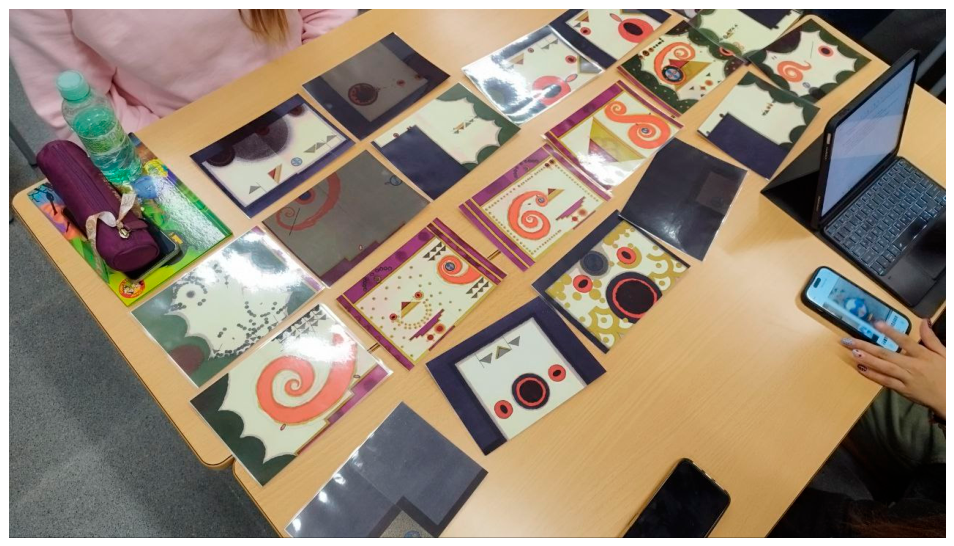
Although the classroom activity described in this study required dismantling the accordion-fold structure of the book, it is important to acknowledge that Lavater’s artistic conception is fundamentally grounded in its material form. The leporello allows the narrative to unfold along a continuous horizontal axis, transforming the story into a spatial journey that can be apprehended in its entirety at a single glance. Consequently, Lavater’s Imageries support two complementary modes of reading: a sequential reading that follows the progression of individual scenes and a global reading made possible when the leporello is fully unfolded. In this configuration, the continuous strip of paper functions simultaneously as a temporal axis, guiding the narrative sequence, and as a unified visual surface that invites readers to perceive the work as a whole.
Another defining characteristic of Lavater’s work is its close adherence to the structural organization of the hypotext, a feature that aligns her visual narratives with the narrative models developed within the formalist tradition. Accordingly, the stories preserve the canonical narrative progression of initial situation, conflict, development, resolution, and final situation. In a further connection with formalist narratology, Lavater’s work also reflects the distinction between fabula (story) and syuzhet (plot). Fabula refers to the sequence of events that constitutes the source narrative, whereas syuzhet denotes the way in which those events are selected, organized, and reconfigured within the visual narrative.
This section concludes by emphasizing the pivotal role of the reader in constructing meaning from these
Imageries. Narratives composed through pictograms do not give rise to a single verbal realization of the hypotext; rather, each reading reconstructs the narrative in light of the reader’s prior knowledge, cultural background, and personal experience. In this respect, Lavater’s
Imageries preserve the oral and variable nature of traditional folktales, as each reading generates a new reconstruction of the story through the interpretation of its visual signs (
Montanaro Staples, 2016). The experimental nature of Lavater’s work also situates it within the tradition of the artist’s book, as reflected both in its formal characteristics and in its publication history through institutions such as the Museum of Modern Art (MoMA) and Adrien Maeght (
Beckett, 2013). At the same time, these works have been appropriated by child readers through playful exploration and interpretive experimentation, as Lavater herself observed (
Gromer & Lavater, 1991). In the case of
Cendrillon, discussed in the following sections, the greater complexity of its coding system, compared with Lavater’s earlier works, further intensifies readers’ interpretive engagement (
Beckett, 2010), making it a particularly valuable resource for investigating visual literacy. Its educational value lies precisely in the demands it places on readers to observe, infer, and verbally articulate the narrative encoded within the visual sequence. This pedagogical potential provides the rationale for the present study, in which visual reading is conceptualized as a process of narrative mediation through which meanings constructed in the visual mode are transduced into verbal discourse. Within this framework, generative artificial intelligence (GenAI) is examined as a mediating tool to support this process of verbalization.
2.3. Generative AI as a Tool for Narrative Mediation
The integration of generative artificial intelligence (GenAI) into educational contexts has prompted growing interest in its potential to support innovative teaching practices, while also generating substantial research and critical debate regarding its role in creative and academic writing. Current scholarship consistently argues that the educational value of GenAI should not be understood in terms of the immediate production of texts, but rather in its capacity to support the successive stages of the writing process. In the specific context of creative writing, this process involves generating ideas, selecting and transforming narrative elements, and organizing them into a coherent narrative through the interconnected phases of planning, drafting, and revision (
Onbasili, 2026;
Oruç et al., 2026). Within this framework, GenAI can support writers by facilitating idea generation, character development, plot construction, and the improvement of narrative coherence (
Kızıltaş, 2025). Among its most frequently reported educational benefits are increased learner motivation and writing self-confidence, as well as a reduction in the anxiety and creative blocks that often accompany creative writing tasks (
Behrens et al., 2025;
Oruç et al., 2026).
Nevertheless, the benefits associated with GenAI are frequently accompanied by important pedagogical concerns, some of which appear to contradict the advantages reported in the literature (
Bruch & Brenden, 2026;
Niloy et al., 2024). For example, AI-assisted writing may become superficial when expressive and rhetorical decision-making is delegated to technology. Previous research suggests that, although GenAI can improve the organization, fluency, and presentation of written texts, its use may ultimately constrain creativity if the processes of idea generation, revision, and critical reflection are transferred from the writer to the AI system. Another frequently discussed concern is the risk of shifting the educational focus from the development of writing competence to the acquisition of technical proficiency in using AI tools (
Botturi et al., 2025). Consequently, the educational value of GenAI should be assessed not primarily in terms of the texts it produces, but rather according to the cognitive and pedagogical processes it supports throughout the writing process.
These considerations make it essential to situate the use of GenAI within an explicit and carefully designed pedagogical framework. Its integration into educational practice should not rely on the spontaneous use of AI tools but rather be embedded within instructional designs that clearly define learning objectives, learning activities, and the pedagogical role of the teacher (
Jiang et al., 2026). To ensure that GenAI contributes meaningfully to learning, students must possess sufficient prior knowledge of the subject matter and receive appropriate guidance to formulate effective prompts and critically evaluate the relevance and quality of AI-generated responses (
Borge et al., 2024;
Rovira-Collado et al., 2025). These considerations place teachers at the centre of the educational process. Their role extends beyond facilitating access to the technology to mediating learning, fostering critical reflection, and supporting students in making informed pedagogical and communicative decisions throughout the writing process (
Kızıltaş, 2025;
Muñoz Martínez et al., 2025).
The integration of GenAI into educational settings also requires a broader understanding of literacy that extends beyond conventional notions of reading and writing as exclusively verbal practices. The mediation of algorithmic technologies highlights that literacy also involves the selection, orchestration, and transformation of multiple semiotic resources operating within specific communicative contexts (
Kladaki et al., 2025;
Lim, 2026;
Mishra, 2025). This perspective is particularly relevant to the instructional activity presented in this study, in which students are required to transform an abstract visual code into a coherent verbal narrative. Although GenAI can mediate this process, its effective use depends on students’ ability to formulate appropriate prompts, identify potential biases, omissions, or distortions in AI-generated outputs, critically evaluate the resulting texts, and recognize that these technologies are not neutral but are shaped by the social practices through which meaning is constructed (
Burriss & Leander, 2024;
Thomson et al., 2025). Conceived in this way, GenAI has the potential to foster metacognitive reflection on both visual reading and narrative writing while making explicit the processes through which visual interpretation is transduced into verbal discourse. Accordingly, the classroom experience based on Lavater’s
Cendrillon was designed as a sequence of visual interpretation, verbalization, AI-assisted story generation, and critical revision, with the aim of examining how pre-service teachers interpret and narratively reconstruct the meanings conveyed by a coded picturebook.