Systematic Review

Linguistic Diversity and Pedagogical Practices in Early Childhood and Primary Education: A Systematic Review of the Literature

Department of Early Childhood and Primary Education, Faculty of Education, University of Malta, Msida Campus, 2080 Msida, Malta
*
Author to whom correspondence should be addressed.
Educ. Sci. 2026, 16(9), 1362; https://doi.org/10.3390/educsci16091362
Submission received: 17 June 2026 / Revised: 14 August 2026 / Accepted: 19 August 2026 / Published: 24 August 2026
(This article belongs to the Special Issue Cross-Cultural Education: Building Bridges and Breaking Barriers)

Abstract

This article presents a systematic review of recent literature on classroom pedagogy adopted in early and primary education to address linguistic diversity in early childhood and primary education. The study aims to answer the research question: ‘What does the literature say about current pedagogical practices and trends in addressing multilingualism in early and primary education?’ The review synthesizes evidence from a period of five years (2019–2024), utilising keywords such as “multilingualism,” “classroom pedagogy,” and “early and primary education.” From an initial screening of 806 studies, a total of 46 studies focusing on pedagogical practices in early childhood and primary education were included in this review. Findings highlight a shift towards multilingual pedagogies that recognise and build on learners’ linguistic and cultural strengths, particularly through translanguaging, multilingual and multimodal scaffolding, culturally responsive teaching, and practices that promote student agency, identity, and well-being. Emerging trends emphasise flexible use of learners’ full linguistic repertoires, digital and multimodal learning, and more formative and inclusive approaches to assessment, while highlighting the need for sustained teacher professional development and systemic changes to curriculum, assessment, and language policy to move beyond persistent monolingual norms. These findings have practical and policy implications, highlighting the need to strengthen teacher professional learning and develop curriculum, assessment, and language policies that embed multilingualism as a resource for learning. This synthesis contributes to a deeper understanding of how educational systems can adapt to and embrace linguistic diversity, ultimately improving educational outcomes for early and primary school-aged learners.

1. Introduction

Schools, as reflections of the societies in which they operate, are experiencing major demographic shifts in response to global mobility trends in recent years. One of the key implications of a growing flow of migration in an increasingly interconnected world is the emergence of a linguistically diverse student population and a sharper awareness of the complexities surrounding bilingual, multilingual and plurilingual contexts (Correia Ibrahim, 2022; Council of Europe, 2018). Other important implications include issues related to integration, equity and access, inclusion and cultural diversity, curriculum adaptation, teacher preparation and teacher professional development. Malta offers a pertinent example of this phenomenon. In recent years, the rapid transformation of the country’s social fabric, brought about by a steady influx of economic and other types of migrants, has made it essential to pause and take stock of what is happening in our schools. However, Malta is not the only state to be undergoing such rapid changes in terms of population growth and diversity.
The statistics tell their own story. In the European Union (EU), 6.8% of the population were non-EU citizens in 2024, while 10.4% were born outside the EU (Eurostat, 2025). Malta offers a stark, accelerated reflection of this global mobility. While the country’s non-Maltese demographic hovered just over 20% in 2021 (National Statistics Office, 2023), more recent official figures (National Statistics Office, 2025) reveal that the proportion has surged past 29% to approach nearly a third of the total population. As a result, understanding the impact of these demographic changes on various aspects of school life has become a pressing priority.
In early childhood settings and in primary schools, similarly to other educational sectors, these changes translate into new challenges and opportunities, especially in terms of language and literacy acquisition. Schools and teachers must navigate the complexities of diverse and inclusive classrooms, where learners from varied cultural, linguistic, and familial backgrounds are developing foundational skills, competencies, and attitudes through language. Many schools are developing a multilingual identity, with learners speaking a multitude of languages, and instruction happening in one common language or more (May, 2014). Yet studies also show discrepancies between teachers’ supposedly positive attitudes towards multilingualism and the absence of existing plurilingual practices in classrooms (Camenzuli et al., 2022; De Angelis, 2011; Haukås, 2016). This disconnect may also reflect a wider policy–practice gap, whereby multilingualism is acknowledged at the level of policy discourse without being consistently operationalised through structures, resources and pedagogical guidance that support learners’ full linguistic repertoires (Bonello et al., 2026). Key questions arise: What language is used for instruction, and in which subject areas? Which languages are thriving, and which are at risk of disappearing? How do teachers ensure that students’ home languages feature in daily classroom practices and are used to facilitate learning and understanding? These are not simply technical and administrative questions; they strike at the heart of what it means to educate in a changing society. These are critical issues that educational professionals, academics, school leaders and others invested in the field of education must consider carefully. They point towards five interconnected dimensions of multilingual education that emerged inductively in this study and that are particularly relevant to changing school contexts: the pedagogical practices used to support multilingual learners; students’ agency, identity and well-being; classroom dynamics and the role of teachers; curriculum and assessment; and the growing role of technology and multimodal practices.
This paper presents a systematic review of the recent literature and research that looks at pedagogical practices and approaches used in early childhood and primary education to tackle linguistic diversity. It seeks to answer the following research question: ‘What does the literature say about current pedagogical practices and trends in addressing multilingualism in early and primary education?’ This question enabled the researchers to cast a wide but focused net on empirical data that specifically explored pedagogy for linguistic diversity. The main objective of the systematic review of literature was to analyse and integrate evidence from local and international research studies on current practices and trends in education that seek to address language learning and linguistic diversity in early and primary education. More specifically, the review sought to map the existing scientific evidence around the pedagogy, approaches, and practices implemented in early and primary classrooms where multilingualism characterises the educational landscape. In doing so, it aimed to create a reliable and updated picture of what is currently happening in relation to classroom pedagogy and multilingualism for schools catering for learners aged 3 to 11 years. Moreover, key findings and recommendations from the review are intended to offer a comprehensive overview of effective strategies and emerging trends in classroom pedagogy that can help support linguistic diversity, ultimately improving educational outcomes for all learners.

2. Methods

A systematic review of peer-reviewed literature was conducted, adhering to the Preferred Reporting Items for Systematic Reviews and Meta-Analysis guidelines (Page et al., 2021), to analyse the literature on multilingualism, classroom pedagogy, and early and primary education from 2019 to 2024. This guaranteed a rigorous process that enabled the researchers participating in this analysis to search, screen and synthesise evidence from international and local research studies in a structured and uniform manner.
The institutional discovery portal HyDi (University of Malta), a unified discovery service that aggregates results across multiple academic databases, was utilised to collect literature on multilingualism and classroom pedagogy in early and primary education. The eight databases included in HyDi are: Career & Technical Education Database (ProQuest), Emerald Insight, ERIC (USDE), International Encyclopaedia of Education (3rd edition), Education Collection (ProQuest), Education Magazine Archive (ProQuest), SAGE Knowledge Complete Books and Reference Collection, and SpringerLink. Literature retrieval was conducted between April and May 2024. To ensure reproducibility, the systematic search was executed at the platform level using the precise Boolean combination: (“multilingualism” AND “classroom pedagogy”). Initial exploratory scoping tested broader keyword combinations (including “linguistic diversity”, “early childhood”, “early childhood education”, and “primary education”). However, these queries yielded a high volume of non-specific results. The search strategy was therefore finalised to the core string “multilingualism” AND “classroom pedagogy” to ensure high topic specificity across the aggregated databases within the HyDi system.
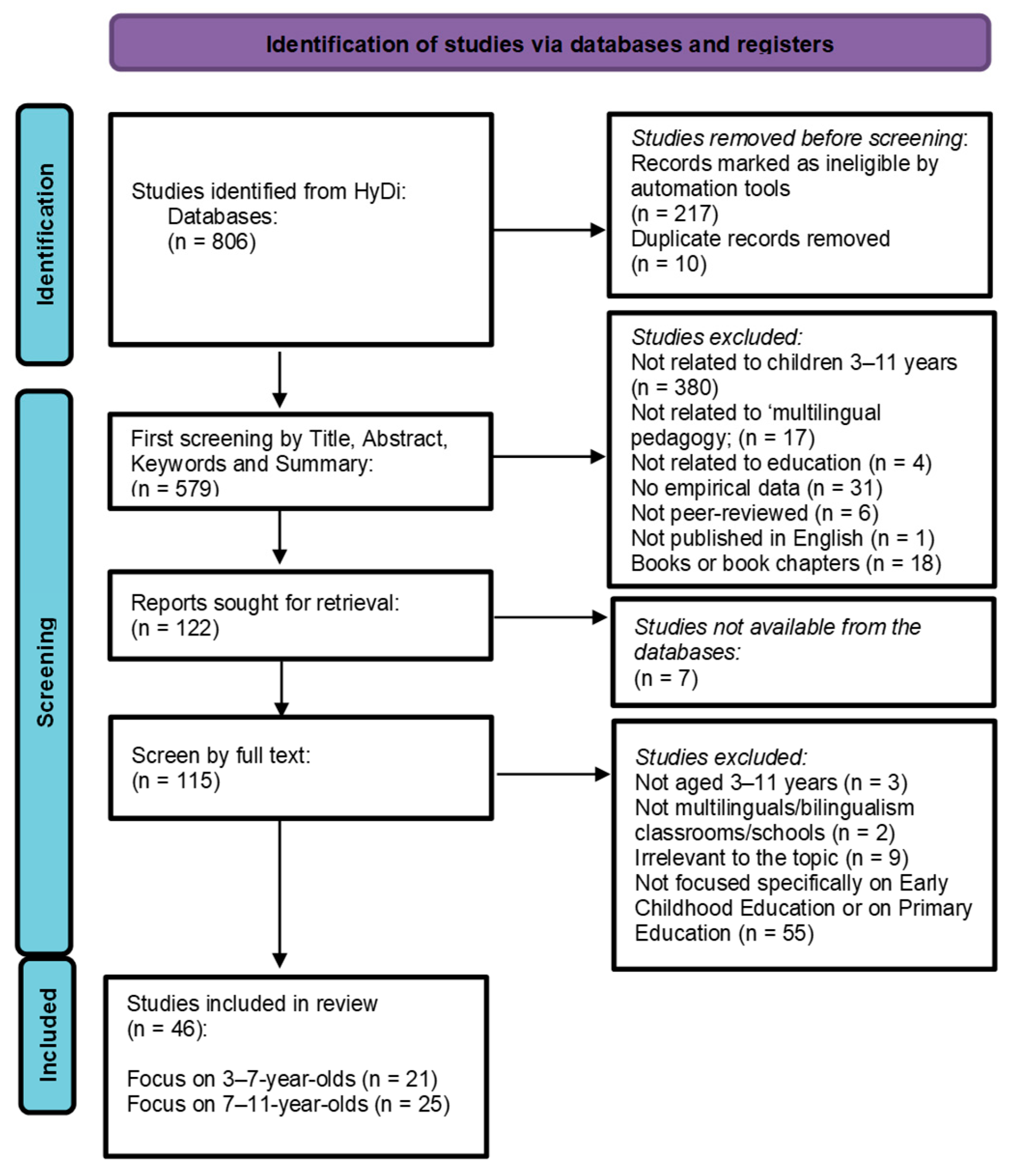
The screening and selection process is illustrated in Figure 1. As can be seen, a total of 806 publications were identified in the first search (first-step screening) and, following the automatic removal of ineligible studies, 589 papers remained for screening. The studies that were automatically removed were not published in English, were not peer-reviewed, and were published prior to 2019. Following this procedure, 10 duplicate studies were removed. Of the 579 studies, 380 were not related to children aged 3–11 years, 17 were not related to multilingual pedagogy, 4 were not related to education, 31 lacked empirical data, 6 were not peer-reviewed, 1 was not published in English, and 18 were books or book chapters. As per literature review conventions, grey literature was not considered for inclusion. Consequently, a total of 457 studies were excluded from the review, resulting in 122 studies remaining for analysis in the subsequent phase.
In this second step screening phase, the researchers collaborated to retrieve the 122 studies from various databases. The studies unavailable from the databases (n = 7) were excluded, resulting in a total of 115 studies for analysis in the subsequent phase of the review. All the full texts from this section were retrieved.
The studies that progressed to the third stage of screening were rigorously analysed. The papers were distributed to the researchers, with each study receiving two assigned reviewers. The full texts of the studies were assessed for quality and verified to ensure that the main focus of each reviewed study aligned with the research question established within the parameters of this research. Where disagreements arose between reviewers, these were discussed and resolved through consensus, with the researchers revisiting the inclusion criteria and the full-text evidence until agreement was reached. At this stage, 14 studies were excluded for the following reasons: 3 included learners not aged between 3–11 years, 2 did not address classroom pedagogy in mainstream multilingual or bilingual settings, and 9 were deemed irrelevant to the topic.
This analysis resulted in 101 papers for inclusion. However, due to the nature of the research question, it was decided that the review should be divided into two sections: one focusing only on pedagogical practices in early childhood education and one focusing only on pedagogical practices in primary education. Considering that both local and international literature (Ministry for Education and Employment, 2012; UNICEF, 2023) classify children up to the age of seven as part of early years education, we utilised the following age brackets to categorise the articles into early and primary education stages: 3–7 years for early years and 7–11 years for primary years. Thus, during the second reading of the 101 studies retained for review, a further step was added whereby the researchers separated the studies into three categories:
  • Pedagogical practices in early childhood education (3–7 years);
  • Pedagogical practices in primary education (7–11 years);
  • General pedagogical practices.
Due to the extensive number of available studies, for the purpose of this paper, articles referencing general pedagogical practices without an explicit focus on either early childhood or primary education were omitted (n = 55). This selection process resulted in a final sample of 46 studies for inclusion in the review. Of these 46: 21 studies focused on pedagogical practices in early childhood education (3–7 years); and 25 studies focused on pedagogical practices in primary education (7–11 years). Therefore, this analysis included 46 papers, with Figure 1 (PRISMA flow chart) above detailing the methodological steps undertaken by the researchers. While this criterion ensured context-specific relevance, it may have omitted broader pedagogical insights that could otherwise inform early childhood and primary frameworks. This limitation highlights a potential avenue for a more extensive and comprehensive future review.
The table attached as Appendix A to this paper summarises the key findings relevant to the current study’s aims and provides a visual synthesis of the results. It includes information about the authors, the year of publication, the characteristics of the study, whether the focus is on early (age range: 3–7 years) or primary years (age range: 7–11 years), and the design and data collection methods used in each of the 46 studies.
The evidence base comprised qualitative, quantitative and mixed-methods designs. Methodological quality was assessed using the Mixed Methods Appraisal Tool (MMAT) (Hong et al., 2018). The methodological diversity was appropriate to the review question because translanguaging in early childhood and primary education is a complex, socially situated phenomenon that requires attention to classroom interaction, teacher beliefs, pedagogical decision-making and children’s meaning-making. Two researchers independently appraised the included studies, compared their judgements, and resolved discrepancies through discussion and consensus with a third researcher. Overall, the included studies demonstrated good to high methodological quality, with most meeting the MMAT criteria across their respective study designs, although some limitations relating to sample size, contextual specificity, and reporting of methodological procedures were identified. This collaborative process enhanced the consistency and transparency of the quality assessment.
For the purpose of this paper, a thematic analysis approach was employed to analyse the data derived from the selected studies. Each article included in the systematic literature review was carefully examined to extract information relevant to the central research question concerning pedagogical practices and trends in accommodating multilingualism in early childhood and primary education. The analysis was guided by Braun and Clarke’s (2006) six-phase framework. Initial coding followed a primarily inductive approach, with codes generated from recurring concepts, practices, and patterns identified across the included studies, while remaining informed by the focus of the research question. The coding process therefore allowed themes to emerge from the evidence rather than imposing predetermined categories on the dataset. The initial coding and subsequent thematic analysis were undertaken by two members of the research team with co-researchers involved in reviewing the developing codes and themes. Where differences in interpretation arose, these were discussed collaboratively and resolved through discussion and reference back to the original studies and research question.
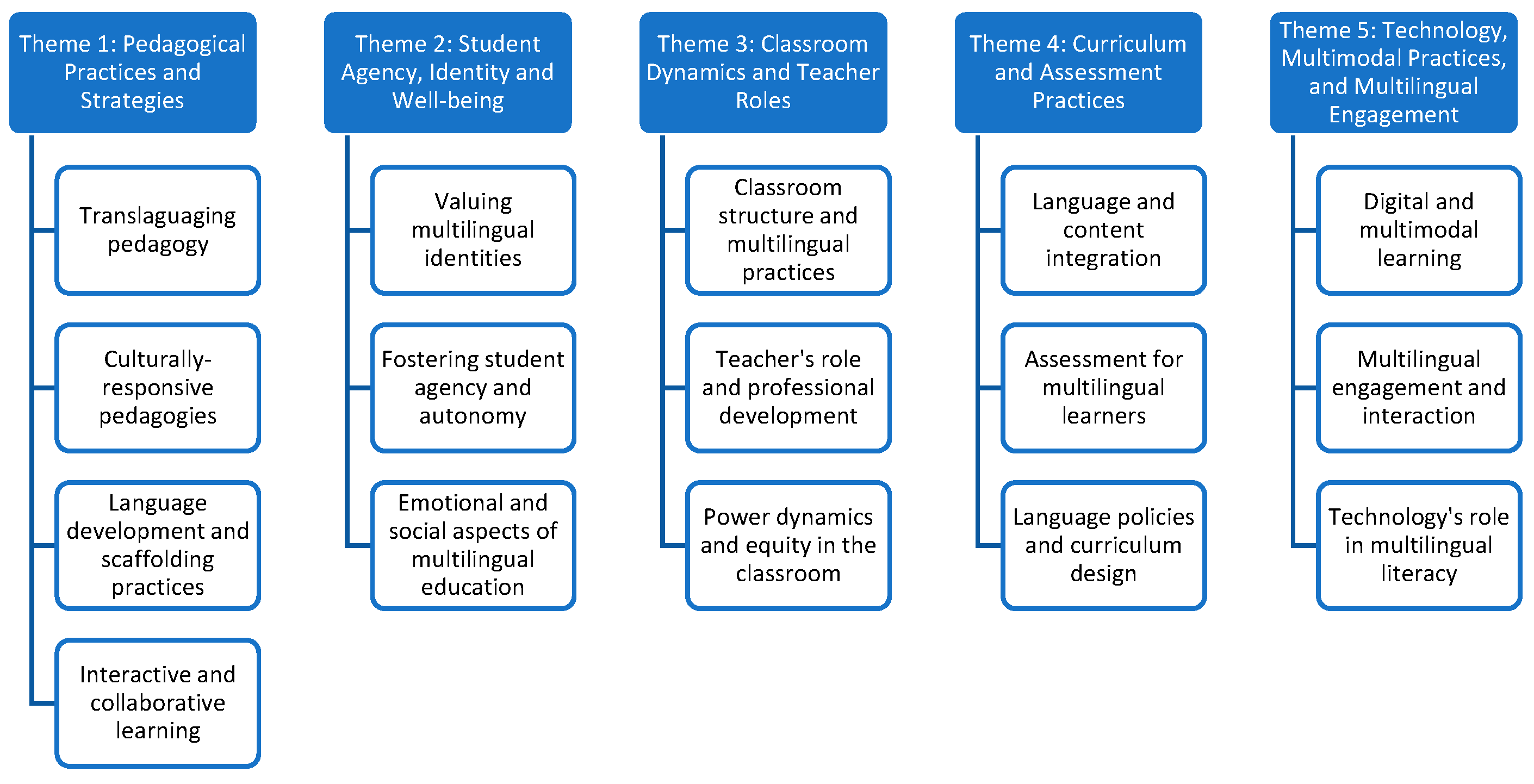
Following an initial familiarisation with the data, initial codes were generated across the dataset. These codes were then organised through a process of searching for potential themes, which were subsequently reviewed and refined to ensure internal coherence, distinctiveness and relevance to the research aims. The final stages involved defining and naming the themes, resulting in five overarching thematic categories presented below. These themes structured the synthesis and interpretation of findings presented in this paper.

3. Results and Analysis

The study sought to examine pedagogical approaches and trends that help accommodate multilingualism in mainstream early childhood and primary classrooms and to suggest actionable recommendations for both policy and practice. Motivated by global and local concerns around promoting social justice and equity in education, the study responds to the growing linguistic diversity in classrooms resulting from increased global mobility. Five overarching themes that address the main research question guiding this systematic literature review (SLR) emerged. These themes are discussed in detail below.

3.1. Research Question (RQ) and Emerging Themes

RQ. What does the literature say about current pedagogical practices and trends in addressing multilingualism in early and primary education?
This SLR brings together recent scholarly research on the primary approaches and emerging trends adopted in multilingual classrooms and schools serving children aged 3 to 11. Essentially, it organises the core findings into five main themes, offering clear insights into what current studies regard as effective pedagogical strategies and school practices that value and integrate children’s full linguistic repertoires. These approaches support every child’s right to learn, feel a sense of belonging, and succeed in inclusive educational environments. The themes displayed in Figure 2 are the following: pedagogical practices and strategies; student agency, identity and well-being; classroom dynamics and teacher roles; curriculum and assessment practices; and lastly, technology, multimodal practices, and multilingual engagement. While each theme highlights a distinct dimension of multilingual education, the analysis demonstrates that they are closely interconnected: pedagogical practices and strategies shape students’ agency, identity and well-being. These in turn impact the dynamics in a multilingual classroom and teacher roles, while curriculum and assessment structures enable or constrain their enactment. Technology and multimodal practices cut across these dimensions by expanding opportunities for participation, meaning-making and multilingual engagement. In this section, each theme will be presented and analysed, followed by a discussion that seeks to directly answer the questions posed by this study.

3.1.1. Pedagogical Practices and Strategies

Studies included in this review highlight the value of using multiple languages as both a resource and a pedagogical tool within multilingual classrooms (Charamba, 2023; Rajendram, 2023). This approach has been shown to enhance communication in authentic and meaningful ways, transcending the artificial boundaries often imposed when languages are treated as separate and fixed entities (Charamba, 2023). Known as ‘translanguaging’, this practice enables students to make use of their entire linguistic repertoire regardless of whether their languages are considered “home”, “school”, or “community” languages to support learning, communicate ideas, and construct meaning collaboratively.
Translanguaging can be viewed as an intentional and pedagogically robust strategy that recognises the fluid and dynamic essence of language use in bilingual and multilingual classrooms. Inclusive learning spaces are created in settings where translanguaging is adopted as a means to engage, build confidence, and foster academic achievement for diverse learners. This orientation is supported by Pacheco et al. (2019), who illustrate how teachers’ strategic participation in translingual literacy events reshapes classroom power relations and opens new avenues for shared meaning-making. Similarly, Ossa Parra and Proctor (2021) show that literacy instruction embedded in translanguaging promotes critical and creative engagement by shifting focus away from vocabulary-level accuracy towards interpretive depth and agency.
One powerful insight emerging from this review is the way in which translanguaging practices help break down barriers to access and equity. Tian (2022) demonstrates how the intentional integration of translanguaging pedagogies carefully balanced with the need to sustain minoritised language spaces can deepen content understanding and support learners in making meaningful cross-linguistic connections. Rajendram (2023) reinforces this by showing how translanguaging not only enhances learning outcomes but also validates and celebrates students’ cultural and linguistic identities. In their studies, Charamba (2022, 2023), Menken and Sánchez (2019) and Poza (2019) further illustrate how these inclusive strategies provide space for voices and languages that have formerly been marginalised, thereby shifting classroom power dynamics. This shift permits students from diverse linguistic backgrounds to participate fully and meaningfully in classroom discourse. Moreover, students are empowered to take ownership of their own learning through opportunities for interactive and collaborative learning when translanguaging is used as an effective pedagogical strategy for community building and learning scaffold (Bose, 2021; Phyak, 2023; Rajendram, 2023).
Scaffolding strategies ranging from sentence frames and visual aids to the use of bilingual glossaries emerged as significant in providing temporary but purposeful support to learners navigating tasks in an additional language (Flognfeldt et al., 2020; Gonzales & Machado, 2022). Such scaffolds serve as pedagogical tools that mediate access to content and empower emerging bilinguals to engage more confidently in linguistic discourse. Shepard-Carey (2021) extends this argument by showing how failure to activate multilingual resources limits students’ inferencing abilities, particularly when background knowledge and vocabulary access are constrained. Scaffolding thus operates not as remediation, but as a mechanism for epistemic access. Alongside these practical supports, the development of metacognitive and metalinguistic awareness was regarded as central to fostering learners’ capacity to reflect critically on their language use, thereby promoting more meaningful and sustained learning (Bauer, 2019; Hopewell & Abril-Gonzalez, 2019; Leonet & Saragueta, 2023).
Notably, this reflective stance extended beyond students to encompass teachers themselves. Research points to the transformative potential of teacher self-reflection, whether through pushing oneself out of one’s own comfort zone (Hopewell & Abril-Gonzalez, 2019) or drawing more deliberately on their full linguistic and pedagogical repertoires (Iversen, 2020). Additionally, Hill et al. (2020) illustrate how engaging with translanguaging pedagogy prompts teachers to interrogate curriculum organisation, language norms, and their own linguistic identities. Teachers’ reflective stance is thus viewed by these studies as a necessary dimension in the creation of responsive and inclusive language learning spaces.
A culturally responsive pedagogical orientation has been shown to exert a transformative influence on learners’ integration and participation within language classrooms, particularly when these learning spaces are constructed to affirm students’ lived experiences and foster socio-emotional connectedness (Hopewell & Abril-Gonzalez, 2019; Troyan et al., 2021; Wissman, 2021). Such approaches reposition learners as agentic meaning-makers, whose cultural and linguistic resources are regarded as pedagogical assets (Christ & Cho, 2021). However, despite the effectiveness of such approaches, the implementation of culturally responsive practices often unfolds within educational structures that remain anchored in monolingual ideologies, standardised assessment regimes, and inflexible curricular expectations (Pesch, 2021). These systemic constraints create tensions that limit the scalability of such pedagogies, highlighting the need to move such practices from a mere localised innovation to broader curricular and policy shifts (Troyan et al., 2021; Wissman, 2021). Within this broader vision, the integration of translanguaging pedagogies within culturally relevant curricula that use culturally relevant material offers the potential to shift linguistic hierarchies. By valuing the full spectrum of students’ language and cultural repertoires, these practices affirm multilingual identities and resist reductive notions of language learning that privilege dominant linguistic norms (McClain & Schrodt, 2021; Menken & Sánchez, 2019; Song et al., 2022).

3.1.2. Student Agency, Identity, and Well-Being

The growing linguistic diversity in schools, driven by increased global mobility, requires pedagogies that go beyond linguistic accommodation to nurture multilingual learners’ holistic development. The second theme examines how inclusive pedagogical practices in multilingual classrooms influence learners’ sense of agency, identity, and emotional well-being. These dimensions are not peripheral but deeply intertwined with students’ ability to thrive academically and socially. A key premise explored in the literature is that valuing and affirming the importance of bilingual and multilingual identities in classrooms helps enhance students’ communicative and learning processes.
Hopewell and Abril-Gonzalez (2019), for instance, illustrate how a second-grade teacher helped reframe bilingualism as an asset, using Spanish and English in flexible ways that facilitate the strengthening of relationships, the interjection of humour, the explanation of complex ideas, and the development of metacognitive awareness. Similarly, Song et al. (2022) use a case study of a third-grade teacher to illustrate how translanguaging supports socio-emotional learning (SEL) where teachers create safe and caring spaces for multilingual learners’ creative linguistic expression and multilingual identities. Using their home languages alongside English helps develop their linguistic and academic confidence as well as a positive sense of self. Stavrakaki and Manoli (2023) show that language portraits can offer valuable pedagogical insights into students’ emotional and identity-based relationships with their languages, yet for such insights to translate into sustained change, they must be embedded within structural and policy frameworks rather than presented as isolated classroom activities. Carbonara et al. (2024) extend this argument by demonstrating how children who are exposed to multilingual pedagogies are more likely to produce more cognitively complex narratives across languages, suggesting that identity affirmation and academic development are mutually reinforcing. This is also portrayed by Hyun et al.’s (2022) study, which shows how collaborative multilingual identity text projects foster positive multilingual identities while encouraging linguistic risk-taking. Tian (2022) further illustrates that such approaches enable students to express a fuller picture of their academic capabilities while fostering greater awareness and affirmation of their bi/multilingual and bi/multicultural identities.
Having said this, the transformative potential of practices that view students’ multiple identities as central to the learning process is often at odds with the demands of standardised curricula and assessment regimes. Without recognition and support at policy level, such inclusive efforts may remain marginal to mainstream educational practice. Wissman’s (2021) study points to this structural tension, contrasting the richness of a culturally sustaining lens where children are enabled to draw upon their multiple languages, faith traditions, and migration experiences with the constraints of assessment systems that fail to fully acknowledge or value their linguistic and cultural repertoires. Similarly, Rajendram (2023) demonstrates how student identity work is highly susceptible to suppression in the absence of systemic ideological and policy reform. In her study, student-led translanguaging mainly flourished in peer-supported spaces. These findings are echoed by Vaish (2019), who notes that effective translanguaging requires educators to respond contingently to students’ utterances.
Student agency in multilingual classrooms is empowered through active participation in tasks and activities that enable students to construct meaning using their language and cultural repertoires. Charamba (2023) supports this view, demonstrating how translanguaging in South African classrooms increased students’ access to disciplinary content, while Ayob and Omidire (2021) observed heightened classroom participation when students’ home languages were integrated into instruction. Some studies illustrate the ways in which translanguaging pedagogy encourages students to take intellectual risks rather than use the usual traditional processes in teaching and learning (Ayob & Omidire, 2021; Charamba, 2022). This helped make a shift from passive reception to an active, multilingual stance that facilitated conceptual understanding. Rabbidge (2019) also cautions that teacher-controlled discourse can limit agency even in translanguaging contexts.
This is not to say that student agency is evenly distributed simply using inclusive pedagogy alone. Engagement cannot be assumed to follow from translanguaging alone. Rajendram’s (2023) study in a Malaysian classroom points to the substance of peer dynamics and school policy in shaping translanguaging spaces. More flexibility and ownership over linguistic choices become possible in collaborative, multilingual groups, whereas learners tend to feel more constrained and unable to fully leverage their cognitive and semiotic resources in environments where peers negatively influence language use.

3.1.3. Classroom Dynamics and Teacher’s Role

As multilingualism increasingly characterises mainstream early childhood and primary classrooms, the role of teachers and the dynamics they cultivate within classroom spaces emerge as central to the enactment of equitable and inclusive pedagogies. The literature reviewed under this theme highlights that classroom environments are not neutral settings but socially and ideologically constructed spaces in which language hierarchies are either reproduced or disrupted. Teachers play a pivotal role as mediators of language use, participation, and power, shaping the extent to which multilingualism is legitimised as a resource for learning.
A consistent finding across the literature is the importance of flexible classroom environments in enabling multilingual pedagogies. For instance, Hopewell and Abril-Gonzalez (2019) demonstrate that when classroom environments are flexible, students and teachers collaboratively use bilingualism for a range of social, relational, and cognitive purposes, including humour, clarification, and metalinguistic reflection. This suggests that multilingual pedagogy is not simply instructional but relational and contextual. Flognfeldt et al. (2020) show that while teachers frequently employ formative practices attentive to students’ cognitive, physical, and socio-emotional development, there are considerable missed opportunities to leverage multilingualism as a pedagogical resource, particularly within assessment practices governed by standardised norms. The notion of flexible environments is further complicated by restrictive translanguaging spaces that are influenced by peer dynamics and policy discourses that shape classroom interaction (Rajendram, 2023). Dillon and Gallagher (2019) extend this insight by highlighting how co-teaching arrangements in bilingual contexts can support inclusive practices, while also exposing tensions arising from unclear language ideologies. Flexibility in multilingual classrooms thus becomes fragile and contingent. These studies demonstrate that, without explicit teacher mediation and institutional support, multilingual spaces may be undermined by these hidden power dynamics and dominant language ideologies.
Beyond flexibility, several studies draw attention to the vitality of classroom environments as a critical dimension of multilingual education. Giæver and Jones (2021) conceptualise classrooms as sites of vitality where language development unfolds in unpredictable and emergent ways. They caution against rigid adherence to standardised language models, arguing that such approaches risk overlooking the less logical, affective, and creative dimensions of multilingual language development. Similarly, Stavrakaki and Manoli (2023) show how practices such as language portraits bring emotional and symbolic dimensions of language to the fore, revealing how classroom spaces can support identity expression and emotional connection to learning.
To further highlight the important role of teachers in shaping classroom dynamics and multilingual pedagogical practice, the literature points to teacher professional development as a key factor. Several studies demonstrate that focused professional learning in translanguaging pedagogy can significantly shift teachers’ attitudes towards multilingualism and home languages (Aleksic & Bebic-Crestany, 2023; Hill et al., 2020; Kirsch et al., 2020). However, their findings also reveal the non-linear and often contradictory nature of such change. Teachers frequently adopt hybrid positions, expressing positive attitudes towards multilingualism while simultaneously reverting to monolingual practices, which in turn highlights the deep-rooted nature of monoglossic ideologies.
Adopting a translanguaging stance involves a fundamental ideological shift that challenges traditional notions of language separation, control, and authority. This shift often requires teachers to embrace uncertainty and relinquish some degree of linguistic control in the classroom, creating space for students to take risks and draw on their full linguistic repertoires. In this context, teacher professional development emerges as a critical site not only for pedagogical growth but also for reimagining teacher identity in relation to multilingual learners. For example, Dutton and Rushton (2023) illustrate how collaborative professional learning around identity texts can support teachers in making pedagogical and resource selections that value student agency, voice, and linguistic diversity. This aligns with broader research emphasizing that teachers’ pedagogical choices such as the selection of texts, materials, and classroom activities serve as powerful mediators of multilingual inclusion (Charamba, 2022; Menken & Sánchez, 2019; Turner et al., 2021). Menken and Sánchez (2019), for instance, demonstrate that intentionally incorporating students’ home languages, multilingual texts, and linguistic landscapes into classroom practice challenges dominant monoglossic ideologies and repositions students as competent, dynamic bilinguals. Similarly, Charamba (2022) shows that translanguaging practices in primary classrooms can help break the “monoglossic mould,” countering linguistic hegemony. In many ways, these findings highlight the need for professional development to go beyond the acquisition of strategies to address deeply embedded language ideologies. Without sustained, reflective, and supported learning, translanguaging risks becoming superficial and only selectively applied.
In addition, such inclusive practices are often constrained by broader structural constraints within educational systems. Dutton and Rushton (2023) highlight how classroom pedagogy is influenced by pressures such as high-stakes testing, time limitations, and the persistence of monolingual norms, all of which can narrow curricular and instructional possibilities. Within such contexts, opportunities to implement multilingual and culturally responsive pedagogies may be limited, requiring teachers to actively challenge dominant practices and create space for learners’ linguistic and cultural resources. As a result, the enactment of inclusive approaches often depends on teachers’ willingness and capacity to negotiate these constraints and reframe classroom practices in more linguistically inclusive ways.

3.1.4. Curriculum and Assessment Practices

In multilingual educational contexts, curriculum and assessment do more than organise learning. They signal whose languages, knowledge, and ways of meaning-making are valued. While teachers increasingly adopt pedagogies that embrace linguistic diversity, the literature points to enduring tensions with curriculum and assessment frameworks that remain largely monolingual in orientation. This lack of alignment limits the emancipatory potential of multilingual pedagogy and continues to shape inequitable conditions for learning in early childhood and primary classrooms.
A growing body of literature presents curriculum as a key site for reimagining multilingual education in more expansive and inclusive ways. Multiliteracies-based curriculum approaches are repeatedly identified as enabling multilingual learners to access learning through diverse linguistic, semiotic, and embodied resources. Curiel and Palmer (2023) illustrate how curricula that legitimise multiple languages and modes of expression support emergent bilinguals’ engagement with disciplinary knowledge, positioning language not as a barrier to learning but as a dynamic resource through which understanding is constructed.
Similarly, Tian and Lau (2022) demonstrate that curriculum designs integrating multilingual, multimodal, and multisensory resources foster deeper meaning-making, particularly in vocabulary development. Their work highlights how curriculum can function as an interactional space where learners draw flexibly on linguistic, visual, and embodied resources, challenging linear and monolingual models of progression. Menken and Sánchez (2019) extend this argument by showing that curriculum reform through the inclusion of multilingual texts, translanguaging strategies, and linguistic landscapes can contribute to shifts in school-level language ideologies. However, they caution that such reforms are often unevenly enacted and remain vulnerable in the absence of systemic support and policy alignment.
Beyond expanding access through multimodality, several studies emphasise the importance of conceptual coherence across languages. Pierson and Grapin (2021) postulate that translanguaging must be explicitly connected to disciplinary practices if it is to support deep conceptual learning. Bucknam and Hood (2021) argue that meaningful bilingual learning requires deliberate curricular alignment between content and language instruction across languages. Their findings draw attention to structural limitations, particularly the lack of appropriate instructional materials, which constrain teachers’ capacity to design coherent multilingual learning trajectories. Stavrakaki and Manoli (2023) contribute an affective and relational dimension to this discussion, showing how insights into learners’ emotional connections to languages elicited through practices such as language portraits can inform curriculum designs that attend to both cognitive and identity-related aspects of learning.
Assessment emerges across the literature as a particularly contested domain in multilingual education and remains a persistent bottleneck. While formative assessment practices offer possibilities for recognising learners’ diverse linguistic resources, these possibilities are frequently constrained by summative assessment systems grounded in monolingual norms. Flognfeldt et al. (2020) show that teachers often engage in assessment-for-learning (AfL) practices that attend to learners’ cognitive, physical, and socio-emotional development. However, multilingualism is rarely positioned as a legitimate resource within assessment processes, and concerns are raised about the equity of standardised national screening tests that fail to capture multilingual learners’ full repertoires.
Hopewell and Abril-Gonzalez (2019) illustrate how assessment embedded within flexible bilingual environments can support metalinguistic awareness and relational learning, reframing assessment as a dialogic and developmental practice rather than a mechanism of measurement and control. Similarly, Stavrakaki and Manoli (2023) demonstrate that tools such as language portraits can serve as informal assessment practices, offering educators insights into learners’ linguistic experiences, attitudes, and identities without reducing learning to discrete linguistic outcomes. Despite these promising approaches, the literature consistently identifies assessment as a structural block in multilingual education. Menken and Sánchez (2019) argue that monolingual assessment practices persist even in contexts where multilingual pedagogies are actively promoted, undermining shifts in classroom practice and reinforcing deficit perspectives of emergent bilingual learners. Translanguaging pedagogies remain constrained when assessment frameworks continue to privilege standardised, monoglossic outcomes.

3.1.5. Technology, Multimodal Practices and Multilingual Engagement

In multilingual classrooms, technology and multimodal practices are increasingly positioned as mediating tools through which learners negotiate meaning, express identity, and participate in learning. Far from being neutral additions, digital and multimodal resources shape how language is used, valued, and recognised within educational spaces. This theme suggests that when thoughtfully integrated, technology can expand opportunities for multilingual engagement, whilst when uncritically adopted, it risks reproducing existing linguistic hierarchies and inequities.
A substantial body of research highlights the potential of multimodal and digital practices to broaden how learning is expressed and recognised in multilingual classrooms. Studies focusing on digital composing and multimodal inquiry demonstrate that technology enables learners to draw on a wide range of semiotic resources, including oral language, writing, visuals, sound, gesture, and humour. Rowe (2019, 2022) shows that when emergent bilingual students compose multilingual digital texts, they engage in complex academic and social meaning-making, often positioning themselves and their peers as authors and translators with valuable linguistic resources. Notably, the use of humorous language that might otherwise be labelled as off-task behaviour is revealed as a purposeful strategy for negotiating meaning and participation. Humphrey (2020) illustrates how multimodal analysis of semiotic choices in images as well as critique of their own and experts’ texts can help foster audience awareness and critical literacy, which can be highly impactful to multilingual learners.
Similarly, Tian and Lau (2022) illustrate how multimodal and multisensory resources support the co-construction of meaning in vocabulary instruction, enabling students to engage creatively with linguistic form and meaning. Their findings suggest that multimodality functions not merely as scaffolding toward monolingual proficiency but as a central mechanism for conceptual learning. Rosales Chavarria (2021) similarly emphasises the importance of the prepared environment in bilingual Montessori settings, highlighting how classroom routines, carefully designed multisensory materials, and pedagogical adaptations can create meaningful opportunities for second language development within everyday classroom life. Curiel and Palmer (2023) extend this perspective within science education, demonstrating that multiliteracies-based projects allow emergent bilinguals to integrate language, visuals, and collaborative dialogue to construct disciplinary knowledge.
Beyond expanding expressive possibilities, technology-mediated practices also shape patterns of participation and power in multilingual classrooms. Digital spaces can enable learners to participate in ways that disrupt traditional hierarchies of language and expertise. Rowe (2019) demonstrates how digital composing environments facilitate peer collaboration and mutual recognition of linguistic expertise, supporting more inclusive participation structures.
However, the literature also cautions that technology alone does not guarantee shifts in classroom power relations. Charamba (2023) shows that while multimodal and multilingual practices in science classrooms increase opportunities for meaning-making, their impact is dependent on the extent to which language boundaries are softened and student contributions are legitimised. Rabbidge (2019) similarly warns that even in translanguaging-friendly contexts, teacher-controlled interactional patterns can limit student agency, suggesting that digital and multimodal tools cannot in themselves disrupt deep-rooted participation norms. Kiramba and Harris (2019) further illustrate that when students’ home languages are bracketed out, participation is often reduced to silence, rote repetition, or surface-level engagement, accentuating the importance of how multilingual engagement is framed and sanctioned.
Several studies expose the affective and relational dimensions of multimodal and technology-mediated practices. Ayob and Omidire (2021) show how storyboards enabled learners to express emotions, perspectives, and understanding through translanguaging, highlighting multimodal practices as both cognitive and emotional resources. Song et al. (2022) demonstrate that multilingual writing supported through digital tools can simultaneously foster academic learning and socio-emotional development, challenging artificial separations between these domains. Hopewell and Abril-Gonzalez (2019) further illustrate how bilingual practices involving humour and dialogue support relational connectedness and metalinguistic awareness, findings echoed in digital composing contexts. These studies suggest that multimodal and digital practices create spaces where learners’ emotional engagement, relationships, and sense of belonging are intertwined with academic learning, which is often marginalised in monolingual, assessment-driven educational cultures.
Despite the pedagogical promise of technology and multimodal practices, the literature consistently highlights structural constraints that limit their transformative potential. Hofslundsengen et al. (2020) reveal considerable disparities in access to books, writing spaces, and digital devices in early years settings, raising concerns about equity and material conditions for multilingual engagement. Flognfeldt et al. (2020) identify missed opportunities to recognise multilingual competencies within assessment practices, a critique that extends to multimodal digital work that often remains invisible in formal evaluation frameworks.
Wissman (2021) further illustrates the tension between innovative, culturally sustaining, multimodal literacy practices and intervention settings governed by standardised assessment expectations. In such contexts, inclusive practices are layered onto existing structures rather than embedded within them, rendering them fragile and vulnerable to marginalisation.

4. Discussion

4.1. Application to Practice

4.1.1. What Practical Lessons Can Be Drawn from Current Pedagogical Approaches to Multilingualism?

The literature reviewed identifies several practical lessons for early childhood and primary education, with translanguaging, purposeful scaffolding, culturally responsive pedagogy, multimodal learning, and the development of metalinguistic and metacognitive awareness emerging as particularly significant. Translanguaging, as evidenced across the literature, emerges as an epistemological stance that reshapes how knowledge is accessed and constructed. Central to this reorientation is the recognition of learners’ full linguistic repertoires as legitimate and valuable resources for meaning-making. The effectiveness of such an approach, however, lies in its intentionality: when strategically enacted, it enables learners to navigate complex content, build cross-linguistic connections, and participate more equitably in classroom discourse.
At the same time, an important finding reveals that translanguaging does not operate in isolation. Its impact is amplified when combined with purposeful scaffolding and culturally responsive practices. Strategies such as visual supports, sentence frames, bilingual glossaries, multilingual texts, and other linguistic and multimodal resources provide learners with meaningful access to disciplinary knowledge and support confident participation in classroom discourse. Similarly, practices such as multilingual identity texts, language portraits, and culturally relevant materials recognise learners’ linguistic and cultural repertoire as valuable resources, supporting not only academic engagement and meaning-making but also learners’ sense of identity, belonging, and agency. This reframing is meaningful, as it shifts the narrative from deficit to potential, positioning multilingual learners as capable meaning-makers rather than learners in need of compensation. Furthermore, the development of metalinguistic and metacognitive awareness emerges as a crucial dimension, enabling learners to reflect on and strategically deploy their linguistic resources in increasingly sophisticated ways. Such practices depend on teachers intentionally designing opportunities for comparison, reflection, discussion, and flexible language use.
Equally, the reviewed studies highlight that effective practice is deeply contingent upon the role of the teacher. Teachers are not merely implementers of strategies but critical mediators of multilingual spaces, shaping patterns of participation, language use, and classroom power. Their beliefs, assumptions, and pedagogical choices influence whether linguistic diversity is legitimised or marginalised. A key practical lesson, therefore, is the need for sustained and reflective professional development that moves beyond learning individual strategies and encourages teachers to examine monolingual assumptions, language norms, curriculum choices, and their own linguistic identities. However, the literature also cautions against an over-reliance on individual teacher agency. While teacher reflection and professional learning are necessary, they are insufficient in the absence of supportive curriculum, assessment, school-level, and policy structures.
Finally, the review points towards the growing importance of multiliteracies, multimodal and technology-mediated practices. Digital composing, visual and multisensory resources, storyboards, and other multimodal activities enable learners to draw on oral language, writing, images, sound, gesture, and other semiotic resources to construct and communicate meaning. Yet, technology and multimodality do not automatically produce more inclusive learning environments; their impact depends on whether learners’ multilingual contributions are legitimised and whether teachers create opportunities for genuine participation and collaboration. Based on our analysis, the practical lesson is clear: effective multilingual pedagogy requires coherence across practice, belief, and structure, where classroom strategies are supported and reinforced by the wider educational system.

4.1.2. How Do Current Pedagogical Trends Shape the Effective Inclusion of Multilingual Learners?

The pedagogical trends identified across the reviewed literature contribute to a more expansive understanding of inclusion, moving beyond linguistic access towards participation, agency, identity, belonging, and well-being. One of the key points highlighted in our analysis is the notion of power and authority. Multilingual pedagogies, particularly those grounded in translanguaging and multimodal engagement, reconfigure classroom participation by disrupting traditional hierarchies of language and knowledge. Rather than positioning learners as deficient users of a dominant language, inclusive spaces are created through multilingual approaches where the classroom becomes a rich and meaningful learning space that views individual students as competent, resourceful and capable of drawing on rich linguistic and cultural repertoires as part of a community of learners. This shift is particularly significant in early and primary education, where foundational experiences of schooling shape learners’ sense of self and their relationship to learning.
The literature consistently demonstrates that when students’ languages and identities are affirmed within classroom practices, there is a corresponding increase in engagement, confidence, and willingness to participate. Inclusion, in this sense, is not simply about being present in the classroom, but about being recognised, heard, and valued. Translanguaging and culturally sustaining pedagogies play a central role in this process, enabling learners to construct meaning in ways that are both cognitively and affectively meaningful. Moreover, multimodal and technology-mediated practices further expand opportunities for participation, allowing learners to express understanding through diverse modes that transcend linguistic constraints.
A further emerging trend is the movement towards multiliteracies and multimodal forms of participation. Digital composing, multilingual texts, visual resources, gesture, sound, and multisensory learning expand the ways in which multilingual learners can express understanding and demonstrate competence. These approaches challenge narrow conceptions of literacy and language development by recognising that meaning-making occurs across linguistic, visual, embodied, digital, and social modes.
The literature identifies assessment as one of the most significant areas of tension in multilingual education. While formative and dialogic practices can attend to learners’ cognitive, physical, linguistic, and socio-emotional development, standardised assessment systems frequently continue to privilege monolingual linguistic outcomes. Practices such as language portraits and flexible bilingual assessment demonstrate possibilities for recognising learners’ linguistic experiences, identities, and developing repertoires.
However, a more critical engagement with the literature reveals that such inclusive practices are often uneven and highly dependent on context. No matter how innovative an early childhood educator or primary school teacher may be in terms of pedagogical repertoire used, classrooms remain embedded within educational systems that frequently reproduce monolingual norms. Curriculum frameworks that separate languages, assessment systems that privilege standardised linguistic outputs, and policy environments that inadequately recognise multilingualism all serve to limit the transformative potential of these pedagogical trends. As a result, inclusion is often partial, experienced only in specific moments or under specific circumstances rather than sustained as a structural condition. Importantly, the predominantly US, Anglophone and European/Nordic evidence base also requires caution when considering the transferability of these findings to Malta. Although the pedagogical principles identified in the review offer useful directions for practice, their application within the Maltese context cannot be assumed to be straightforward, given Malta’s distinctive linguistic ecology, educational history, policy context, and the coexistence of Maltese and English alongside increasingly diverse multilingual repertoires. The limited representation of Maltese and other non-European contexts therefore highlights the need for context-sensitive interpretation and for further research examining how these pedagogical approaches can be adapted and evaluated within Maltese early childhood and primary settings.
Moreover, the studies highlight that this misalignment places a disproportionate burden on teachers and schools to enact inclusion within constrained conditions. Even the most committed and reflective practitioners may find their efforts curtailed by systemic limitations. This points to a critical tension at the heart of current pedagogical trends: while they offer powerful tools for reimagining inclusion, their impact heavily relies upon broader institutional and ideological shifts.
In this light, the effective inclusion of multilingual learners cannot be achieved through pedagogy alone. It requires a coherent and systemic approach in which curriculum, assessment, teacher education, and policy are aligned with the realities of linguistic diversity. For Malta, this also means critically considering how internationally emerging approaches can be meaningfully adapted to the local linguistic and educational context, rather than assuming that evidence generated predominantly in other national settings is directly transferable. The emerging direction in the literature is therefore towards an educational model in which multilingualism is not treated as an additional consideration or intervention for particular learners, but as a normal and valuable feature of contemporary early childhood and primary classrooms. Only when this principle is reflected across both everyday pedagogical practice and wider educational structures can the inclusive potential of current multilingual pedagogical trends be fully realised.

4.2. Limitations of the Study

It is worth acknowledging some limitations that must be taken into consideration when interpreting the research findings of this review. Firstly, the restriction to English-language, peer-reviewed studies may have excluded relevant research, particularly from multilingual contexts. Secondly, although the review was open to including local (Maltese) literature, no studies met the inclusion criteria, resulting in a lack of direct local representation. The diversity of educational settings and study designs also limits the generalisability of the findings. Additionally, much of the evidence is drawn from small-scale, classroom-based studies, with limited longitudinal insight into sustained impact. Moreover, non-peer-reviewed literature or grey literature was not included in the studies reviewed and this may have excluded some relevant practice-based innovations in the field. Finally, while the analysis brings to the fore practices implemented by practitioners including early childhood educators and primary school teachers, it gives less attention to the perspectives of other stakeholders such as students and families. The review provides a strong and meaningful overview of current research. Yet, its findings need to be understood in light of the different contexts in which the studies were conducted, as well as the gaps that still exist within the available evidence.

5. Conclusions

In drawing together the findings of this systematic literature review, it becomes increasingly evident that multilingualism is no longer a peripheral concern but a defining characteristic of early childhood and primary education. The reviewed literature converges on a clear and compelling message: contemporary classrooms are linguistically diverse spaces, and pedagogical responses must move beyond accommodation towards intentional, theoretically grounded, and systemically supported practice.
Across the studies examined, multilingual pedagogies such as translanguaging, scaffolding, and culturally responsive approaches are consistently positioned as effective means of enhancing access, participation, and meaning-making for young learners in early childhood and primary classrooms. These approaches reframe linguistic diversity as a resource rather than a challenge, enabling children to draw on their full linguistic repertoires in ways that support both cognitive development and identity formation. At the same time, the literature stresses the idea that such practices are not neutral or technical choices. They are deeply ideological, requiring educators to critically reflect on entrenched beliefs about language, learning, and ability.
However, the review also reveals a persistent dissonance between innovative classroom practices and the broader educational structures within which they are situated. Monolingual curricula, standardised assessment regimes, and limited policy alignment continue to constrain the sustainability and scalability of multilingual pedagogies. As a result, responsibility for enacting inclusive practices is placed disproportionately on individual teachers, rendering meaningful change uneven and, at times, fragile.
In this light, the implications for policy and practice are both urgent and far-reaching. There is a clear need to move beyond isolated examples of effective practice towards coherent, system-wide approaches that embed multilingualism within curriculum design, assessment frameworks, and teacher education. Concretely, teacher education and continuing professional development should incorporate sustained preparation in translanguaging, culturally responsive pedagogy, multilingual scaffolding, and critical reflection on language ideologies, rather than treating multilingualism as a specialist or optional area of training. In parallel, assessment policies should be reviewed to provide greater scope for formative and multimodal approaches that recognise learners’ full linguistic repertoires, rather than relying predominantly on standardised monolingual measures of attainment. Professional learning must therefore extend beyond the acquisition of strategies to engage more deeply with teachers’ beliefs, identities, and agency as educators in linguistically diverse settings. Equally, school leadership plays a critical role in cultivating environments that are not only inclusive in principle but enacted in practice through supportive structures, resources, and shared vision.
Ultimately, this review points towards a necessary reimagining of early childhood and primary education as spaces where linguistic diversity is recognised, valued, and actively sustained. Creating such spaces requires collective responsibility across policy, practice, and the community to ensure that schools become places where all learners experience a genuine sense of belonging. For policymakers and educational leaders, the priority should therefore be to align teacher preparation, curriculum, assessment, and school-level support so that multilingual pedagogies can be implemented consistently rather than depending on individual teacher initiative. In this sense, responding to multilingualism is not simply an educational imperative, but a social and ethical one: a commitment to equity, inclusion, and the affirmation of every child’s linguistic and cultural identity.

Author Contributions

All authors contributed to the conceptualisation of the funded research project of which this paper forms part. Each author contributed to the systematic literature review as follows: methodology, R.C. and C.B.; validation, J.M., J.D. and T.M.; formal analysis, all authors; writing—original draft preparation, R.C. and C.B.; writing—review and editing, all authors; project administration, J.M.; funding acquisition, C.B. and J.M. All authors have read and agreed to the published version of the manuscript.

Funding

This research was funded by the University of Malta’s Internal Research Grants Programme—Research Excellence Fund—“2022 Call”. The research project is called ‘Addressing linguistic diversity in Malta: Teacher education and classroom pedagogy in early and primary education’.

Institutional Review Board Statement

Per standard procedures, a REDP form with code EDUC-2024-00291 was submitted for records to the University Research Ethics Committee (UREC) of the UNIVERSITY OF MALTA on 22 March 2024. No approval or permission was required due to the nature of the study, i.e., a systematic literature review that does not involve primary data collection.

Data Availability Statement

No new data were created or analyzed in this study. The secondary data supporting the conclusions of this article will be made available by the authors on request.

Acknowledgments

The project’s research support officers—R. Camenzuli and M. Vella—were involved in the search, screening and selection phase of the SLR.

Conflicts of Interest

The authors declare no conflicts of interest.

Abbreviations

The following abbreviations are used in this manuscript:
AfLAssessment-for-Learning
HyDiHybrid Discovery (The University of Malta library search tool)
NSONational Statistics Office
PRISMAPreferred Reporting Items for Systematic Reviews and Meta-Analysis
SELSocio-emotional Learning
SLRSystematic Literature Review

Appendix A

Table A1. Data Extraction Table.
Author & YearCharacteristics of the StudyEarly Childhood or Primary EducationMethod
Charamba (2023)Explores the role language plays in the academic performance of multilingual students in South Africa during science lessons.PrimaryVideo-recorded lesson observations, teacher interviews.
Bose (2021)A teaching design experiment for fostering meaning using language support in the maths classroom.PrimaryTeaching design is put into practice, tested and revised.
Pacheco et al. (2019)Examines a third-grade teacher’s strategic participation in translingual practice and the ways this shaped emerging bilingual students’ meaningful engagements with texts.PrimaryAnalysis of small-group guided reading, buddy reading, and an interactive read-aloud; analysis of post-instruction interviews.
Rowe (2022)Explores how third-grade emergent bilingual students use humorous language when composing eBooks.PrimaryMicroethnographic analyses.
Menken and Sánchez (2019)Intensive professional development and technical assistance project to change language education policy from monolingual in English to multilingual pedagogy for emergent bilingual students.PrimaryComparative case study, interviews, field notes, classroom observations.
McClain and Schrodt (2021)Describes how translanguaging pedagogy within a culturally responsive curriculum made space for multilingualism in a kindergarten classroom.Early yearsAction research project.
Christ and Cho (2021)Describes how read-alouds can support literacy opportunities for emergent bilingual students by sharing power with them when discussing culturally relevant texts.PrimaryFace-to-face conversations between teachers and pull-out groups of students.
Ossa Parra and Proctor (2021)Design, implementation and examination of students’ engagement with the content taught in a set of translanguaged lessons.PrimaryEthnomethodological analysis of discourse and interactions using conversation analysis and discourse analysis.
Troyan et al. (2021)How translanguaging can be used to enact a culturally sustaining pedagogy.Early yearsVideo observations and field notes, interviews.
Phyak (2023)Explores how teachers use translanguaging to create a multilingual classroom space and engage students with their multilingual identities and epistemologies in the classroom.Early yearsEthnographic study, classroom anecdotes, observation notes, interviews with teachers.
Gonzales and Machado (2022)Explores how teachers can use translanguaging pedagogies to allow children to engage their full language repertoires in the writing classroom.PrimaryParticipant observation, interviews, lesson plans and writing.
Curiel and Palmer (2023)Explores the interactions of a group of third graders carrying out a project in a science class, using discourse analysis.PrimaryAudio- and video-recorded observations, field notes.
Bucknam and Hood (2021)Describes language use by four first-grade students during Mathematics and Language Arts instruction in a one-way 50/50 Mandarin immersion classroom.Early yearsVideo- and audio-recordings, semi-structured focus group interview.
Hopewell and Abril-Gonzalez (2019)Examines how and for what purposes a second-grade teacher and her students used Spanish and English in support of language development.Early yearsQualitative linguistic ethnography.
Bauer (2019)Examines the development of specific writing skills among kindergarten dual language students.Early yearsClassroom observation.
Hofslundsengen et al. (2020)Investigates how literacy is supported in Nordic preschools as reflected in the physical environment of classrooms.Early yearsStructured observation.
Wissman (2021)Explores the possibilities and tensions that emerged when a literacy specialist brought a culturally sustaining lens to her work in a reading intervention setting with five emergent bilinguals.Early yearsCase study, class transcripts, interviews, student writing and artwork, fieldnotes.
Humphrey (2020)A professional learning intervention with teachers of young multilingual learners engaged in science inquiry.Early yearsDiscourse analysis of texts written by students, multimodal texts.
Giæver and Jones (2021)Investigate how dialogue in a multilingual preschool develops.Early yearsParticipant observations, informal interviews.
Dillon and Gallagher (2019)Explores teachers’ experiences with intercultural teaching for biliteracy in public kindergarten schools in the UAE.Early yearsFocus group interviews.
Rabbidge (2019)Investigates whether student participation was affected by teachers’ translanguaging practices.PrimaryClassroom observations, semi-structured interviews.
Kiramba and Harris (2019)Investigates how two teachers of English language arts and science utilized their students’ linguistic repertoires in EMI classrooms and the patterns of participation that ensued in the process of student knowledge construction.PrimaryCase study, field notes and audio recordings of classroom discourse.
Charamba (2022)Investigates the role played by language in the academic performance of 40 fourth-grade Science and Technology students at a primary school in Bikita district, Zimbabwe.PrimaryPre-tests, post-tests, videos, observations, interviews.
Carbonara et al. (2024)Investigates whether exposure to multilingual pedagogies enhances emergent bilingual children’s narrative abilities.PrimaryBackground questionnaire, cloze test, written narrative retelling task.
Tian and Lau (2022)Explores the potential of pedagogical translanguaging in Chinese vocabulary instruction by focusing on one Chinese Language Arts lesson in a multiethnic Grade 3 Mandarin–English dual language bilingual education classroom in a U.S. public school.PrimaryParticipatory design research including audio/video recordings, observational field notes, memos, semi-structured interviews, teaching and learning artefacts.
Hill et al. (2020)Aims to understand early childhood teachers’ experiences and perceptions of implementing translanguaging pedagogy in writing.Early yearsMultiple case study.
Song et al. (2022)Illustrates how translanguaging is used as a pedagogical strategy to support multilingual learners’ SEL through case stories.PrimaryCase studies.
Iversen (2020)Investigates how pre-service teachers capitalise on their own and their students’ linguistic repertoires during field placement in multilingual, mainstream schools in Norway.PrimaryFocus groups, classroom observations.
Rajendram (2023)Examines the tension between the affordances of student-led translanguaging in a Grade 5 Malaysian classroom with an English-only policy, and the constraints to learners’ use of translanguaging.PrimaryVideo recordings, semi-structured interviews.
Pesch (2021)Discusses kindergarten teachers’ pedagogical practice with multilingual children and parents, as well as discourses in the kindergarten curriculum.Early yearsCase study, observations.
Tian (2022)Explores how translanguaging allocation policy could be strategically and purposefully implemented in a Grade 3 Mandarin classroom in a U.S. Mandarin–English dual language bilingual education program where the majority of the students were English-dominant speakers.PrimaryParticipatory design research, including classroom and design meeting recordings, observational field notes, teacher and students’ artefacts, interviews.
Aleksic and Bebic-Crestany (2023)Aims for an improvement of early education classroom quality through teachers’ acquisition of practical and theoretical knowledge and skills regarding multilingual education, more specifically through their participation in a professional development course on translanguaging pedagogy.Early yearsMixed methods
Design-based research including questionnaires, focus groups and video observations.
Dutton and Rushton (2023)Reports how literary texts can be used to foster EAL/D students’ poetry writing and represent their identity.Early yearsCase study, redesign cycle.
Shepard-Carey (2021)Explores classroom instances in which two second-grade emergent multilinguals encountered difficulties with inference-making, specifically when their first language or background knowledge was not accessed to support inference-making.Early yearsCase studies, audio data, reading texts, field notes, lesson analyses.
Vaish (2019)Explores the implementation of a translanguaging approach to teach reading skills in English with simultaneous bilinguals who speak substantial amounts of Malay and Chinese at home.Early yearsVideo-recorded observations.
Poza (2019)Analyses language practices that 5th grade students in a two-way bilingual education program used to position themselves relative to peers and to transcendent scripts about ethnicity and ability (academic and linguistic) that attach themselves to students through their various classifications.PrimaryObservation, recordings, semi-structured interviews.
Ayob and Omidire (2021)Reports on utilising storyboards to explore learners’ perspectives and emotions in a study that uses translanguaging as an intervention with Grades 5 and 6 learners in two schools in a South African township.PrimaryStoryboard technique.
Pierson and Grapin (2021)Proposes a disciplinary perspective on translanguaging that leverages the synergy between translanguaging and contemporary conceptualizations of content learning.PrimaryStudent artifacts, classroom videos, student interviews.
Stavrakaki and Manoli (2023)Investigates migrant children’s attitudes towards languages through language portraits in order to help educators obtain insights into student multilingual repertoires and experiences.PrimaryLinguistic portraits, semi-structured interviews.
Hyun et al. (2022)Investigates the design and implementation of collaborative multilingual identity text projects in a Spanish–English two-way immersion school.PrimaryInterviews, classroom observation notes, recordings, student-generated artifacts.
Rosales Chavarria (2021)Seeks to recover insights through a reflective process with the intention to develop a second language Montessori program for 3- to 6-year-olds that aligns better with Montessori pedagogy.Early yearsReflective analysis.
Flognfeldt et al. (2020)Explores the role of multilingualism in language assessment in the Norwegian school context.Early yearsClassroom observations, individual and group interviews.
Rowe (2019)Examines second-grade, multilingual students’ practices during a Writing Workshop activity that invited them to use both their heritage languages and English.Early yearseBook compositions, video recordings, participant observations, fieldnotes.
Kirsch et al. (2020)Investigates seven early education practitioners’ attitudes toward multilingual activities and translanguaging as well as their actual practices in Luxembourg.Early yearsQuestionnaires, observations, interviews.
Turner et al. (2021)Discusses the leveraging of resources—and related goals—of a linguistically diverse cohort of students in one of these government-funded bilingual programs.PrimaryDesign-based study including classroom observations, teacher reflections.
Leonet and Saragueta (2023)Describes a study of 72 primary school students who participated in an intervention based on translanguaging pedagogies.PrimaryFocus groups, class observations.

References

  1. Aleksic, G., & Bebic-Crestany, D. (2023). Translanguaging stance of preschool teachers working with multilingual children in Luxembourg. International Journal of Multilingualism, 20(1), 50–67. [Google Scholar] [CrossRef] [Scilit]
  2. Ayob, S., & Omidire, M. F. (2021). Storyboards as a qualitative method of exploring learners’ experience with the use of a multilingual support strategy. International Journal of Qualitative Methods, 20. [Google Scholar] [CrossRef] [Scilit]
  3. Bauer, E. B. (2019). Kindergartners’ writing in a dual-language classroom. Language Arts, 96(4), 213–223. [Google Scholar] [CrossRef] [Scilit]
  4. Bonello, C., Muscat, T., Camilleri, R., Deguara, J., Milton, J., Camenzuli, R., & Vella, M. (2026). Comparative analysis of language policies in Malta and the European schools language policy. European Journal of Education & Language Review, 2(1), 3. [Google Scholar] [CrossRef] [Scilit] [PubMed]
  5. Bose, A. (2021). Fostering meaning in a trilingual mathematics classroom by connecting everyday and school mathematical ways of talking: A design approach. ZDM Mathematics Education, 53(2), 405–417. [Google Scholar] [CrossRef] [Scilit]
  6. Braun, V., & Clarke, V. (2006). Using thematic analysis in psychology. Qualitative Research in Psychology, 3(2), 77–101. [Google Scholar] [CrossRef] [Scilit]
  7. Bucknam, J., & Hood, S. J. (2021). Student language use in a one-way Mandarin immersion classroom. RELC Journal, 52(3), 425–439. [Google Scholar] [CrossRef] [Scilit]
  8. Camenzuli, R., Lundberg, A., & Gauci, P. (2022). Collective teachers’ beliefs about multilingualism in Maltese primary education. International Journal of Bilingual Education and Bilingualism, 26(4), 379–394. [Google Scholar] [CrossRef] [Scilit]
  9. Carbonara, V., Scibetta, A., & Torregrossa, J. (2024). The benefits of multilingual pedagogies for multilingual children’s narrative abilities. International Journal of Multilingualism, 21(2), 645–669. [Google Scholar] [CrossRef] [Scilit]
  10. Charamba, E. (2022). Pushing linguistic boundaries: Translanguaging in a bilingual science and technology classroom. Journal of Multilingual and Multicultural Development, 43(10), 951–965. [Google Scholar] [CrossRef] [Scilit]
  11. Charamba, E. (2023). Translanguaging as bona fide practice in a multilingual South African science classroom. International Review of Education, 69(1–2), 31–50. [Google Scholar] [CrossRef] [Scilit]
  12. Christ, T., & Cho, H. (2021). Sharing power in read-alouds with emergent bilingual students. The Reading Teacher, 75(3), 269–278. [Google Scholar] [CrossRef] [Scilit]
  13. Correia Ibrahim, N. (2022). Educating early years and primary English language teachers multilingually. In D. Valente, & D. Xerri (Eds.), Innovative practices in early English language education. Palgrave Macmillan. [Google Scholar] [CrossRef] [Scilit]
  14. Council of Europe. (2018). Common European framework of reference for languages: Learning, teaching, assessment. Companion volume with new descriptors. Council of Europe. Available online: https://rm.coe.int/cefr-companion-volume-withnewdescriptors-2018/1680787989 (accessed on 6 March 2026).
  15. Curiel, L. C., & Palmer, D. K. (2023). Collaborative translanguaging and transmodal literacies: Learning the language of science in a dual-language classroom. Research in the Teaching of English, 57(4), 355–377. [Google Scholar] [CrossRef] [Scilit]
  16. De Angelis, G. (2011). Teachers’ beliefs about the role of prior language knowledge in learning and how these influence teaching practices. International Journal of Multilingualism, 8(3), 216–234. [Google Scholar] [CrossRef] [Scilit]
  17. Dillon, A. M., & Gallagher, K. (2019). The experience of co-teaching for emergent Arabic-English literacy. Qualitative Report, 24(7), 1556–1576. [Google Scholar] [CrossRef] [Scilit]
  18. Dutton, J., & Rushton, K. (2023). Representing identity: The importance of literature and the translanguaging space for EAL/D early years literacy learning. Education Sciences, 13(6), 569. [Google Scholar] [CrossRef] [Scilit]
  19. Eurostat. (2025). EU population diversity by citizenship and country of birth. European Commission. Available online: https://ec.europa.eu/eurostat/statistics-explained/ (accessed on 6 March 2026).
  20. Flognfeldt, M. E., Tsagari, D., Šurkalović, D., & Tishakov, T. (2020). The practice of assessing Norwegian and English language proficiency in multilingual elementary school classrooms in Norway. Language Assessment Quarterly, 17(5), 519–540. [Google Scholar] [CrossRef] [Scilit]
  21. Giæver, K., & Jones, L. (2021). Putting Arendt, Bakhtin and atmosphere to work: Exploring different paths concerning the language development of multilingual children. Contemporary Issues in Early Childhood, 22(2), 183–194. [Google Scholar] [CrossRef] [Scilit]
  22. Gonzales, G. C., & Machado, E. (2022). Taking the leap: Supporting multilingual writers through translanguaging. The Reading Teacher, 75(6), 685–692. [Google Scholar] [CrossRef] [Scilit]
  23. Haukås, Å. (2016). Teachers’ beliefs about multilingualism and a multilingual pedagogical approach. International Journal of Multilingualism, 13(1), 1–18. [Google Scholar] [CrossRef] [Scilit]
  24. Hill, K., Ponder, J. M., Summerlin, J., & Evans, P. (2020). Two language books: The power and possibilities of leveraging multilingual texts for critical translanguaging pedagogy. Journal of Higher Education Theory and Practice, 20(12), 197–209. [Google Scholar] [CrossRef] [Scilit]
  25. Hofslundsengen, H., Magnusson, M., Svensson, A.-K., Jusslin, S., Mellgren, E., Hagtvet, B. E., & Heilä-Ylikallio, R. (2020). The literacy environment of preschool classrooms in three Nordic countries: Challenges in a multilingual and digital society. Early Childhood Development and Care, 190(3), 414–427. [Google Scholar] [CrossRef] [Scilit]
  26. Hong, Q. N., Fàbregues, S., Bartlett, G., Boardman, F., Cargo, M., Dagenais, P., Gagnon, M.-P., Griffiths, F., Nicolau, B., O’Cathain, A., Rousseau, M.-C., Vedel, I., & Pluye, P. (2018). The Mixed Methods Appraisal Tool (MMAT) version 2018 for information professionals and researchers. Education for Information, 34(4), 285–291. [Google Scholar] [CrossRef] [Scilit]
  27. Hopewell, S., & Abril-Gonzalez, P. (2019). Por qué estamos code-switching?: Understanding language use in a second-grade classroom. Bilingual Research Journal, 42(1), 105–120. [Google Scholar] [CrossRef] [Scilit]
  28. Humphrey, S. (2020). The role of teachers’ disciplinary semiotic knowledge in supporting young bi/multilingual learners’ academic and reflexive multiliteracies. Language and Education, 35(2), 140–159. [Google Scholar] [CrossRef] [Scilit]
  29. Hyun, J., Bettney Heidt, E., & Prasad, G. (2022). Designing critical multilingual multiliteracies projects in two-way immersion classrooms: Affordances and impacts on students. Canadian Journal of Applied Linguistics, 25(3), 1–32. [Google Scholar] [CrossRef] [Scilit]
  30. Iversen, J. Y. (2020). Pre-service teachers’ translanguaging during field placement in multilingual, mainstream classrooms in Norway. Language and Education, 34(1), 51–65. [Google Scholar] [CrossRef] [Scilit]
  31. Kiramba, L. K., & Harris, V. J. (2019). Navigating authoritative discourses in a multilingual classroom: Conversations with policy and practice. TESOL Quarterly, 53(2), 456–481. [Google Scholar] [CrossRef] [Scilit]
  32. Kirsch, C., Aleksić, G., Mortini, S., & Andersen, K. (2020). Developing multilingual practices in early childhood education through professional development in Luxembourg. International Multilingual Research Journal, 14(4), 319–337. [Google Scholar] [CrossRef] [Scilit]
  33. Leonet, O., & Saragueta, E. (2023). The case of a pedagogical translanguaging intervention in a trilingual primary school: The students’ voice. International Journal of Multilingualism, 21(4), 2112–2130. [Google Scholar] [CrossRef] [Scilit]
  34. May, S. (Ed.). (2014). The multilingual turn: Implications for SLA, TESOL and bilingual education. Routledge. [Google Scholar]
  35. McClain, J. B., & Schrodt, K. (2021). Making space for multilingualism: Using translanguaging pedagogies to disrupt monolingual language ideologies within a culturally responsive kindergarten curriculum. The Reading Teacher, 75(3), 385–388. [Google Scholar] [CrossRef] [Scilit]
  36. Menken, K., & Sánchez, M. T. (2019). Translanguaging in English-only schools: From pedagogy to stance in the disruption of monolingual policies and practices. TESOL Quarterly, 53(3), 741–767. [Google Scholar] [CrossRef] [Scilit]
  37. Ministry for Education and Employment. (2012). A national curriculum framework for all. Government of Malta. Available online: https://curriculum.gov.mt/a-national-curriculum-framework-for-all-2/ (accessed on 6 March 2026).
  38. National Statistics Office. (2023). Census of population and housing 2021: Final report: Population, migration and other social characteristics. Vol. 1, NSO. Available online: https://nso.gov.mt/themes_publications/census-of-population-and-housing-2021-final-report-population-migration-and-other-social-characteristics-volume-1/ (accessed on 11 May 2026).
  39. National Statistics Office. (2025). World population day: 11 July 2025 (News release No. 122/2025). NSO. Available online: https://nso.gov.mt/wp-content/uploads/NR-122-2025.pdf (accessed on 11 May 2026).
  40. Ossa Parra, M., & Proctor, C. P. (2021). Translanguaging to understand language. TESOL Quarterly, 55(3), 766–794. [Google Scholar] [CrossRef] [Scilit]
  41. Pacheco, M. B., Daniel, S. M., Pray, L. C., & Jiménez, R. T. (2019). Translingual practice, strategic participation, and meaning-making. Journal of Literacy Research, 51(1), 75–99. [Google Scholar] [CrossRef] [Scilit]
  42. Page, M. J., McKenzie, J. E., Bossuyt, P. M., Boutron, I., Hoffmann, T. C., Mulrow, C. D., Shamseer, L., Tetzlaff, J. M., Akl, E. A., Brennan, S. E., Chou, R., Glanville, J., Grimshaw, J. M., Hróbjartsson, A., Lalu, M. M., Li, T., Loder, E. W., Mayo-Wilson, E., McDonald, S., … Moher, D. (2021). The PRISMA 2020 statement: An updated guideline for reporting systematic reviews. BMJ, 372, n71. [Google Scholar] [CrossRef] [Scilit] [PubMed]
  43. Pesch, A. M. (2021). “They call me anneanne!” Translanguaging as a theoretical and pedagogical challenge and opportunity in the kindergarten context in Norway. Acta Borealia, 38(1), 23–42. [Google Scholar] [CrossRef] [Scilit]
  44. Phyak, P. (2023). Translanguaging as a space of simultaneity: Theorizing translanguaging pedagogies in English medium schools from a spatial perspective. The Modern Language Journal, 107(1), 289–307. [Google Scholar] [CrossRef] [Scilit]
  45. Pierson, A. E., & Grapin, S. E. (2021). A disciplinary perspective on translanguaging. Bilingual Research Journal, 44(3), 318–334. [Google Scholar] [CrossRef] [Scilit]
  46. Poza, L. E. (2019). “Los dos son mi idioma”: Translanguaging, identity, and social relationships among bilingual youth. Journal of Language, Identity & Education, 18(2), 92–109. [Google Scholar] [CrossRef] [Scilit]
  47. Rabbidge, M. (2019). The effects of translanguaging on participation in EFL classrooms. Journal of Asia TEFL, 16(4), 1305–1322. [Google Scholar] [CrossRef] [Scilit]
  48. Rajendram, S. (2023). Translanguaging as an agentive pedagogy for multilingual learners: Affordances and constraints. International Journal of Multilingualism, 20(2), 595–622. [Google Scholar] [CrossRef] [Scilit]
  49. Rosales Chavarria, R. (2021). Second language corner for children’s house: A practitioner–researcher journey into bilingualism in Montessori education. Journal of Montessori Research, 7(1), 67–82. [Google Scholar] [CrossRef] [Scilit]
  50. Rowe, L. W. (2019). Emergent bilingual students’ translation practices during eBook composing. Bilingual Research Journal, 42(3), 324–342. [Google Scholar] [CrossRef] [Scilit]
  51. Rowe, L. W. (2022). Emergent bilingual students’ use of humour in digital composing: Academic and social work. Journal of Early Childhood Literacy, 22(1), 122–146. [Google Scholar] [CrossRef] [Scilit]
  52. Shepard-Carey, L. (2021). The inference-making of elementary emergent multilinguals: Access and opportunities for learning. Journal of Early Childhood Literacy, 21(4), 499–537. [Google Scholar] [CrossRef] [Scilit]
  53. Song, J., Howard, D., & Olazabal-Arias, W. (2022). Translanguaging as a strategy for supporting multilingual learners’ social emotional learning. Education Sciences, 12(7), 475. [Google Scholar] [CrossRef] [Scilit]
  54. Stavrakaki, A., & Manoli, P. (2023). Exploring migrant students’ attitudes towards their multilingual identities through language portraits. Societies, 13(7), 153. [Google Scholar] [CrossRef] [Scilit]
  55. Tian, Z. (2022). Challenging the ‘dual’: Designing translanguaging spaces in a Mandarin-English dual language bilingual education program. Journal of Multilingual and Multicultural Development, 43(6), 534–553. [Google Scholar] [CrossRef] [Scilit]
  56. Tian, Z., & Lau, S. M. C. (2022). Translanguaging flows in Chinese word instruction: Potential critical sociolinguistic engagement with children’s artistic representations of Chinese characters. Pedagogies, 17(4), 282–302. [Google Scholar] [CrossRef] [Scilit]
  57. Troyan, F. J., King, N., & Bramli, A. (2021). Enacting culturally sustaining immersion pedagogy through SFL and translanguaging design. Foreign Language Annals, 54, 567–588. [Google Scholar] [CrossRef] [Scilit]
  58. Turner, M., D’warte, J., & Slaughter, Y. (2021). Drawing on students’ diverse language resources to facilitate learning in a Japanese-English bilingual program in Australia. Language Teaching Research, 25(1), 61–80. [Google Scholar] [CrossRef] [Scilit]
  59. UNICEF. (2023). Early childhood development: UNICEF vision for every child. Available online: https://www.unicef.org/media/145336/file/Early%20Childhood%20Development%20-%20UNICEF%20Vision%20for%20Every%20Child.pdf (accessed on 6 March 2026).
  60. Vaish, V. (2019). Translanguaging pedagogy for simultaneous biliterates struggling to read in English. International Journal of Multilingualism, 16(3), 286–301. [Google Scholar] [CrossRef] [Scilit]
  61. Wissman, K. K. (2021). Bringing a culturally sustaining lens to reading intervention. Journal of Literacy Research, 53(4), 563–587. [Google Scholar] [CrossRef] [Scilit]
Figure 1. Preferred Reporting Items for Systematic Reviews and Meta-Analysis (PRISMA) flow chart. Source: Page et al. (2021).
Education 16 01362 g001
Figure 2. Five themes that emerged from the SLR.
Education 16 01362 g002
Disclaimer/Publisher’s Note: The statements, opinions and data contained in all publications are solely those of the individual author(s) and contributor(s) and not of MDPI and/or the editor(s). MDPI and/or the editor(s) disclaim responsibility for any injury to people or property resulting from any ideas, methods, instructions or products referred to in the content.