1. Introduction
Higher education institutions are increasingly required to respond simultaneously to several complex strategic demands: ensuring access to quality education, adapting teaching and learning processes to digital environments, supporting learners with diverse professional and personal responsibilities, and integrating sustainability objectives into university activity (
Findler et al., 2019;
Sakka et al., 2026;
UNESCO, 2020). In this context, hybrid education or blended learning can no longer be regarded only as a temporary solution for organising courses. When properly designed and managed, it may become a managerial option through which universities combine direct interaction with the flexibility of online activities, the use of digital resources and more efficient planning of the educational process (
Bernard et al., 2014;
Buhl-Wiggers et al., 2023;
Garrison & Kanuka, 2004).
The relevance of this format is particularly visible in postgraduate psychopedagogical training programmes. Unlike students enrolled in traditional undergraduate programmes, participants in teacher-training programmes are generally adults who have already completed higher education studies and who attend training activities while also fulfilling professional and family responsibilities. Their participation in face-to-face activities may be influenced not only by motivation to learn, but also by available time, work schedule, distance from the university, commuting costs, and access to digital environments (
Kara et al., 2019;
Knowles et al., 2015;
Merriam et al., 2007). For this reason, the management of hybrid education cannot be reduced to the use of online platforms. It also requires coherent instructional design, functional technological infrastructure, teacher preparation, clearly defined assessment procedures, and support measures for learners’ autonomy, self-regulation, and digital competence (
Kara et al., 2019;
Knowles et al., 2015;
Merriam et al., 2007).
Research on blended and hybrid education has shown that the effectiveness of such models depends on the pedagogical and instructional integration of online and face-to-face activities, not merely on the availability of technology (
Bernard et al., 2014;
Buhl-Wiggers et al., 2023;
Garrison & Kanuka, 2004). Hybrid formats may improve flexibility and accessibility, but they may also generate difficulties when online activities are insufficiently designed, interaction is limited, assessment criteria are unclear, or participants do not have the necessary digital competences (
Buhl-Wiggers et al., 2023;
Kara et al., 2019). Consequently, the quality of hybrid education should be analysed from the perspective of the institution and the teacher, but also from the perspective of the learner. The perceptions of adult learners are relevant because they capture how programme organisation, teacher–student interaction, digital resources and time management are experienced in actual educational practice (
Kara et al., 2019;
Knowles et al., 2015;
Merriam et al., 2007).
From the perspective of the Community of Inquiry framework, the quality of hybrid education results from the relationship between teaching presence, cognitive presence and social presence (
Garrison et al., 2000). In the present study, participants’ evaluations of content adaptation, interaction with the teacher, clarity of activity organisation and adequacy of digital resources may be interpreted as expressions of how they experience teaching presence and the pedagogical organisation of the hybrid format.
Support for maintaining and expanding hybrid education may also be interpreted, with caution, in relation to the literature on educational technology acceptance. Models such as the Technology Acceptance Model—TAM—and the Unified Theory of Acceptance and Use of Technology—UTAUT—show that users’ intention to use or continue using a technology is influenced by their perceptions of usefulness, functionality, ease of use and facilitating conditions (
Davis, 1989;
Venkatesh et al., 2003). The present study does not test these models in full, because the instrument used does not include all their specific constructs. However, they provide conceptual support for interpreting the relationships between hybrid experience, perceived teaching quality, and support for continuing this format.
Alongside the digital transformation of education, universities are also expected to integrate sustainability into their strategies and organisational practices. In higher education, sustainability should not be reduced to a set of isolated ecological actions, such as waste reduction or energy saving. It can be more appropriately understood as an integrated organisational capability that connects governance, educational management, infrastructure, digital transformation and everyday academic practices (
Findler et al., 2019;
Sakka et al., 2026;
UNESCO, 2020). In line with the perspective proposed by
Sakka et al. (
2026), the institutionalisation of sustainability requires a shift from fragmented initiatives to a strategic approach in which governance, education, infrastructure, operations and stakeholder relations are coordinated within a coherent institutional framework. From this perspective, hybrid education can be analysed not only as a way of increasing teaching flexibility or reducing commuting, but also as part of university management that seeks to align institutional strategy, digital infrastructure, educational design and sustainability-oriented practices.
An important aspect of the ecological impact of higher education activities is mobility. Commuting to the university involves fuel consumption, traffic congestion and transport-related emissions, especially when participants use private cars or travel considerable distances (
Caird et al., 2015;
Kiehle et al., 2023;
Paredes-Canencio et al., 2024;
Valls-Val & Bovea, 2021). Reducing the number of physical attendances may therefore contribute to avoiding part of the emissions generated by travel (
Caird et al., 2015;
Roy et al., 2008;
Versteijlen et al., 2017). This contribution must, however, be interpreted with caution. Online and hybrid activities also involve energy consumption, digital infrastructure, the use of personal devices, internet connectivity and the operation of educational platforms. For this reason, emissions avoided through reduced commuting cannot be considered equivalent to a complete reduction in the carbon footprint of a programme. They represent only a partial estimate, limited to the transport component (
Caird et al., 2015;
Department for Energy Security and Net Zero & Department for Environment, Food and Rural Affairs, n.d.;
Roy et al., 2008;
Versteijlen et al., 2017).
The research gap addressed by the present study lies at the intersection of these dimensions. Existing studies often examine hybrid education, adult learning flexibility, teaching quality and institutional sustainability separately (
Bernard et al., 2014;
Findler et al., 2019;
Garrison & Kanuka, 2004;
Kara et al., 2019;
UNESCO, 2020). Much less attention has been paid to an integrated approach to the management of hybrid education in postgraduate psychopedagogical training, especially in programmes attended by adult learners who are professionally active. Moreover, studies that bring together learners’ evaluations of hybrid experience and teaching quality, an estimate of emissions associated with avoided commuting, and qualitative suggestions regarding institutional sustainability measures remain limited (
Caird et al., 2015;
Roy et al., 2008;
Sakka et al., 2026;
Valls-Val & Bovea, 2021;
Versteijlen et al., 2017).
The present study aims to contribute to reducing this gap by analysing how participants in a postgraduate psychopedagogical training programme evaluate the hybrid format in relation to teaching activity, ecological impact, attitudes towards sustainability and support for continuing hybrid education. The research was conducted within the Didactics of the Specialty course, organised by the Department for Teacher Training of the “Ion Ionescu de la Brad” University of Life Sciences of Iași, during the 2025–2026 academic year. The participants were adult learners with diverse academic and professional profiles, including doctoral students, teaching staff, master’s students, and individuals belonging to other professional categories.
The general objective of the research is to examine how learners enrolled in postgraduate programmes evaluate the management of hybrid education when teaching quality, accessibility and ecological sustainability are analysed together. More specifically, the study aims to describe participants’ perceptions of the hybrid teaching format, evaluate teaching quality through a revised construct, examine the associations between hybrid experiences, perceived ecological impact, attitudes towards sustainability and support for continuing this format, and estimate the avoided commuting distance and associated CO2 emissions on the basis of self-reported mobility data. The study also analyses differences in participants’ evaluations according to academic and professional status and identifies their suggestions for improving hybrid education from the perspective of sustainability.
The contribution of the study can be summarised in three directions. First, the research proposes an integrated analysis of hybrid education management in postgraduate psychopedagogical training by simultaneously considering perceived teaching quality, programme accessibility and ecological sustainability. Second, it corrects the interpretation of support for the continuation and expansion of the hybrid format by treating it as a distinct outcome variable, rather than as part of the construct measuring teaching quality, thereby avoiding conceptual overlap between predictor and outcome. Third, the study offers a cautious estimate of commuting-related emissions that may have been avoided, explicitly recognising that this represents only one component of the broader ecological impact of hybrid education.
2. Review of the Specialised Literature
2.1. Management of Mixed/Hybrid Education in Iasi University Education
Blended and hybrid education have become important organisational and pedagogical developments in contemporary higher education, as they combine the interactive dimension of face-to-face teaching with the accessibility, flexibility and resource diversity provided by digital learning environments. Unlike fully online education, hybrid education does not simply transfer teaching activities into a digital space. It requires a reconfiguration of educational management according to the learning objectives pursued, the competences to be developed, the nature of the teaching activity and the balance between synchronous, asynchronous, online and on-site components (
Bernard et al., 2014;
Garrison & Kanuka, 2004).
The literature indicates that blended learning can positively influence academic learning when the online and face-to-face components are carefully designed, pedagogically integrated, and institutionally supported (
Garrison & Kanuka, 2004). Therefore, blended learning should not be understood merely as a digital mode of course delivery, but as a complex educational management approach. Such an approach involves access to functional digital platforms, appropriate curriculum design, careful selection and organisation of learning content, continuous teacher–student interaction, monitoring of participation, and the maintenance of high standards in the teaching process.
Previous studies also show that the effectiveness of blended learning in higher education depends on the quality of instructional design and on the way digital technologies are integrated into the teaching and learning process (
Bernard et al., 2014). The technological component is important, but it is not sufficient on its own. Digital platforms must support pedagogical objectives, facilitate communication and feedback, and contribute to a coherent learning experience.
At the same time, research on blended learning highlights the continued importance of the face-to-face component in producing qualitative educational effects (
Buhl-Wiggers et al., 2023). For this reason, the management of hybrid education must ensure a balanced relationship between online and on-site activities. This is particularly relevant for postgraduate psychopedagogical training programmes organised through DPPD structures, where participants are already university graduates, often professionally active, and have high expectations regarding the relevance, clarity and practical usefulness of the teaching activities. In this context, hybrid education requires careful managerial planning so that flexibility does not lead to fragmentation and technological accessibility does not reduce the quality of the educational experience.
2.2. Training of University Graduates Through Postgraduate Programmes and the Need for Flexibility
Postgraduate psychopedagogical training programmes organised by Departments for Teacher Training are addressed to higher education graduates who did not complete teacher training during their initial university studies or who seek to obtain or consolidate pedagogical certification for a teaching career. In the case of the DPPD of the “Ion Ionescu de la Brad” University of Life Sciences of Iași, participants include doctoral students, engineers, economists, master’s students, resident physicians, and other graduates who are already active in their professional fields while completing the pedagogical training programme.
This profile differentiates postgraduate learners from traditional undergraduate students. Their participation in teaching activities is influenced by work schedules, family responsibilities, available time, distance from the university, access to digital technologies and available means of transport. Therefore, the organisation of postgraduate psychopedagogical training must consider the specific characteristics of adult learners.
The adult learning literature emphasises that adult learners tend to learn more effectively when training activities provide a certain degree of autonomy, are connected to their professional experience and have immediate applicability in the field for which they are preparing (
Knowles et al., 2015;
Merriam et al., 2007). In the context of teacher training, this means that postgraduate learners value flexible organisation, relevant learning content, practical examples and teaching activities that can be integrated into their professional and personal responsibilities.
Studies on online and distance education for adult learners also show that participation may be affected by technological difficulties, travel costs, rigid programme organisation and limited compatibility between training schedules and professional obligations (
Kara et al., 2019). From this perspective, hybrid education may reduce some of these barriers by combining direct pedagogical interaction with online access to courses, resources and communication. However, flexibility should not be understood as a simple reduction in physical attendance. It must be supported by coherent scheduling, reliable digital infrastructure, accessible learning materials and clear communication between teachers and learners.
For professionally active adult learners, hybrid education can therefore function as a managerial response to the need for accessibility and continuity in postgraduate training. At the same time, it must preserve the formative quality of psychopedagogical education, especially because these programmes prepare participants for future teaching responsibilities.
2.3. Quality of University Teaching Activity in the Form of Hybrid Learning Organisation
The quality of teaching in hybrid higher education depends on the extent to which online and on-site activities are pedagogically coherent, technologically supported and aligned with the learning outcomes of the programme (
Bernard et al., 2014;
Garrison & Kanuka, 2004). A hybrid format cannot be considered sustainable only because it uses digital technologies or reduces the number of physical meetings. It becomes educationally valuable when it maintains interaction, clarity, assessment transparency, feedback, and learner engagement.
Rigorous instructional design is therefore essential for hybrid education. Course content must be adapted to the format of delivery, learning activities must be organised in a way that allows continuity between online and face-to-face sessions, and digital platforms must be used as pedagogical tools rather than as simple repositories of materials (
Bernard et al., 2014;
Garrison & Kanuka, 2004). In this sense, the quality of hybrid teaching depends on both managerial decisions and the didactic competence of teaching staff.
Research on blended learning effectiveness from students’ perspectives confirms that learners’ evaluations are shaped by the coherence of course design, interaction, learning support and the perceived usefulness of the blended format (
Han, 2023). These elements are especially important in postgraduate programmes, where participants expect the learning process to be efficient, applicable and compatible with their professional responsibilities.
In hybrid psychopedagogical training, educational management must therefore ensure a balance between flexibility and academic rigour. Online activities should increase accessibility and support independent learning, while face-to-face activities should be used strategically for interaction, clarification, applied activities and the development of professional teaching competences. If this balance is not carefully managed, hybrid education may become fragmented, reduce student engagement, or create inequalities related to digital access and digital competence.
For this reason, maintaining the quality of teaching in a hybrid format requires more than technological availability. It requires institutional planning, teacher preparation, adapted curriculum design, clear assessment procedures, and continuous support for students. These aspects are directly connected to the managerial dimension of postgraduate psychopedagogical programmes and justify the inclusion of perceived teaching quality as a central construct in the present study.
2.4. University Sustainability and the Importance of Reducing the Carbon Footprint
Higher education institutions play an important role in the transition towards sustainability, both through the knowledge they produce and disseminate and through the way they manage their own educational, administrative and infrastructural activities (
Findler et al., 2019;
Sakka et al., 2026;
UNESCO, 2020). Universities are complex organisations that consume energy, use material resources, generate waste and involve daily mobility flows of students, teaching staff and administrative personnel. For this reason, sustainability in higher education should be understood not only as a curricular topic, but also as a managerial and institutional responsibility.
The carbon footprint of higher education institutions has been analysed in relation to several categories of emissions, including energy consumption, heating and cooling of buildings, use of materials, waste generation, and transport associated with university activities (
Paredes-Canencio et al., 2024;
Valls-Val & Bovea, 2021). Among these, mobility can represent an important source of emissions, especially in institutions where students and staff commute regularly over medium or long distances or rely predominantly on private cars (
Kiehle et al., 2023). Therefore, the organisation of teaching activities may influence not only educational accessibility, but also the environmental impact associated with academic travel.
Hybrid education may contribute to reducing part of the emissions associated with commuting when some physical attendances are replaced by online activities (
Caird et al., 2015;
Roy et al., 2008;
Versteijlen et al., 2017). However, this contribution must be interpreted with caution. The reduction in travel does not automatically mean a complete reduction in the carbon footprint of an educational programme. Online and hybrid activities also involve energy consumption related to digital platforms, internet use, personal devices, servers, and institutional infrastructure (
Versteijlen et al., 2017). Consequently, the ecological benefit of hybrid education should be examined as a partial and context-dependent effect, not as a general or unconditional environmental advantage.
The literature also highlights that the methods used to calculate university carbon footprints vary across institutions and studies (
Paredes-Canencio et al., 2024;
Valls-Val & Bovea, 2021). This methodological diversity makes it important to report clearly the data used, the emission factors applied, and the assumptions on which the estimate is based. In the present research, the ecological component is therefore limited to avoided commuting-related emissions, calculated on the basis of self-reported distance, means of transport, and number of physical attendances replaced by online activities.
From a managerial perspective, the relationship between hybrid education and sustainability requires careful institutional planning. Universities must balance the potential reduction in travel-related emissions with the energy and technological requirements of digital education (
Sakka et al., 2026;
Versteijlen et al., 2017). Sustainable educational management should therefore integrate digital infrastructure, teaching organisation, mobility reduction, energy efficiency and institutional environmental policies into a coherent strategy.
2.5. Conceptual Framework of the Research: University Educational Management, Quality of Applied Didactic Strategy and Sustainability
The literature reviewed above supports the development of a conceptual framework in which hybrid education is analysed as a managerial, pedagogical and sustainability-related phenomenon. In this framework, the organisation of hybrid education is influenced by three interconnected dimensions: educational management at university level, the perceived quality of teaching activities, and the institution’s orientation towards ecological sustainability (
Bernard et al., 2014;
Findler et al., 2019;
Garrison & Kanuka, 2004;
Sakka et al., 2026;
UNESCO, 2020).
The first dimension refers to the managerial organisation of hybrid education. This includes decisions regarding the distribution of online and face-to-face activities, the use of digital platforms, the scheduling of courses, the provision of technical support, the organisation of assessment and the institutional capacity to respond to the needs of adult learners. In postgraduate psychopedagogical training, these decisions are particularly important because participants are often employed adults whose participation is affected by time constraints, distance from the university and professional responsibilities (
Kara et al., 2019;
Knowles et al., 2015;
Merriam et al., 2007).
The second dimension concerns the quality of teaching. Hybrid education can be considered effective only if it preserves the pedagogical standards of the programme. This involves adapted learning content, meaningful interaction with teaching staff, fair assessment, learning motivation and adequate technical infrastructure (
Bernard et al., 2014;
Garrison & Kanuka, 2004;
Han, 2023). For this reason, the present study analyses perceived teaching quality as a central component of hybrid education management.
The third dimension concerns ecological sustainability. By reducing the need for repeated travel to the university, hybrid education may contribute to lowering commuting-related emissions (
Caird et al., 2015;
Roy et al., 2008;
Versteijlen et al., 2017). However, this potential benefit must be considered together with the digital and energy requirements of online teaching. Thus, the ecological contribution of hybrid education is interpreted in this study as a partial estimate of avoided commuting-related emissions, not as a complete assessment of the programme’s carbon footprint.
The postgraduate psychopedagogical training organised through the DPPD of the “Ion Ionescu de la Brad” University of Life Sciences of Iași provides a relevant institutional context for analysing these relationships. The programme addresses adult learners who seek pedagogical certification and who must combine training activities with professional and personal responsibilities. In this context, hybrid education management is relevant because it can support accessibility and flexibility while maintaining teaching quality and contributing, within clearly defined limits, to institutional sustainability objectives.
Based on this framework, the present study brings together learners’ perceptions of hybrid education, their evaluation of teaching quality, their awareness of the ecological impact of reduced commuting, and their support for the continuation and expansion of the hybrid format. This integrated perspective responds to the need for a more comprehensive analysis of hybrid education in postgraduate psychopedagogical training, where educational quality, adult learner accessibility, and sustainability-oriented management intersect (
Bernard et al., 2014;
Garrison & Kanuka, 2004;
Kara et al., 2019;
Knowles et al., 2015;
Merriam et al., 2007;
Sakka et al., 2026;
UNESCO, 2020;
Versteijlen et al., 2017).
3. Research Framework and Hypotheses
3.1. Theoretical and Conceptual Foundation of the Research
The research problem addressed in this study was not whether hybrid education is generally perceived as useful, but how adult learners enrolled in postgraduate psychopedagogical training programmes evaluate the managerial organisation of hybrid education when teaching quality, accessibility and ecological sustainability are analysed together.
Previous research has generally examined blended learning, adult learning flexibility and the sustainability of higher education institutions as separate areas of inquiry. By contrast, the management of hybrid education in postgraduate psychopedagogical training has received less attention, especially in programmes attended by professionally active adult learners whose participation is shaped by work obligations, distance from the university, access to digital technologies and available time.
The study has an exploratory character and is based on a cross-sectional descriptive-correlational design centred on participants’ self-reported perceptions. For this reason, the research does not aim to measure objective learning outcomes, identify actual behavioural changes or calculate the total carbon footprint of the programme. Instead, it analyses how participants evaluate their hybrid educational experience, the quality of teaching activities carried out in this format and the ecological relevance of reducing commuting to the university. It also examines the association between these perceptions and the support expressed for the continuation and expansion of the hybrid format.
The conceptual framework recognises that hybrid learning depends not only on institutional management and the instructional design developed by teaching staff, but also on learner-related characteristics such as learning autonomy, self-regulation, time management and digital competence. These characteristics are particularly relevant in postgraduate psychopedagogical training programmes, where participants have already completed higher education studies and most of them are professionally active (
Kara et al., 2019;
Knowles et al., 2015;
Merriam et al., 2007).
In the present study, these elements are used as contextual reference points that support the interpretation of the results. However, they were not measured through separate validated scales. This aspect is acknowledged as a limitation of the study and, at the same time, as a possible direction for future research.
3.2. Research Objectives
The general objective of the research is to analyse how adult learners enrolled in postgraduate psychopedagogical training programmes perceive the management of hybrid education in relation to perceived teaching quality, ecological sustainability and support for the continuation of the hybrid format.
The specific objectives of the study are the following:
O1. To describe participants’ perceptions of the hybrid teaching format in postgraduate psychopedagogical training.
O2. To evaluate the perceived quality of teaching in the hybrid format using the revised teaching quality construct, composed of items V.1–V.4.
O3. To analyse the associations between participants’ hybrid experience, perceived ecological impact, attitudes towards sustainability, revised teaching quality and support for the continuation of hybrid education.
O4. To estimate the avoided commuting distance and the associated CO2 emissions on the basis of self-reported distance, means of transport and physical attendances replaced by online activities.
O5. To analyse differences in respondents’ perceptions according to their academic and professional status.
O6. To identify participants’ suggestions for improving hybrid education from the perspective of sustainability and institutional educational management.
3.3. Research Hypotheses
Based on the conceptual framework and the research objectives, the study tests the following hypotheses:
H1. A more favourable experience of learning in a hybrid format is positively associated with higher perceived teaching quality in postgraduate psychopedagogical training. This hypothesis is grounded in the literature on blended learning, which shows that the coherent integration of online and face-to-face activities can support the quality of the educational experience. It is also supported by adult learning literature, which emphasises the importance of flexibility, autonomy and practical relevance in continuing education (Bernard et al., 2014; Garrison & Kanuka, 2004; Knowles et al., 2015; Merriam et al., 2007). H2. A more favourable evaluation of learning in a hybrid format is positively associated with a clearer perception of the ecological benefits generated by reducing commuting to the university. This hypothesis is based on the idea that academic mobility and travel to campus contribute to the carbon footprint of higher education institutions, while hybrid teaching and learning models may reduce part of the emissions associated with commuting (Caird et al., 2015; Kiehle et al., 2023; Roy et al., 2008; Valls-Val & Bovea, 2021; Versteijlen et al., 2017). H3. A clearer perception of the ecological benefits generated by reduced commuting is positively associated with more favourable self-reported attitudes towards ecological sustainability. This hypothesis is supported by the literature on education for sustainable development and by studies highlighting the role of higher education institutions in developing ecological awareness and responsibility (Findler et al., 2019; UNESCO, 2020; Valls-Val & Bovea, 2021). H4. More favourable self-reported attitudes towards ecological sustainability are positively associated with stronger support for the continuation and expansion of the hybrid format as an educational management option. This hypothesis is based on the idea that university sustainability should be integrated into institutional strategies rather than treated as a set of isolated ecological initiatives. From this perspective, the hybrid format may be considered a component of educational management oriented towards sustainability (Findler et al., 2019; Sakka et al., 2026;
UNESCO, 2020; Versteijlen et al., 2017). H5. Higher perceived teaching quality, measured through the revised construct composed of items V.1–V.4, is positively associated with support for the continuation and expansion of the hybrid format. In this study, item V.5, which refers to the recommendation to continue and expand the hybrid format, is treated separately as an outcome variable in order to avoid conceptual overlap with the teaching quality scale (Bernard et al., 2014; Garrison & Kanuka, 2004; Han, 2023). H6. Evaluations of hybrid experience, perceived ecological impact, attitudes towards sustainability, teaching quality and support for the continuation of the hybrid format differ according to respondents’ academic and professional status. This hypothesis is justified by the specific profile of adult learners, whose perceptions of online or hybrid learning may be influenced by professional responsibilities, time constraints, previous experience, autonomy and continuing training needs (Kara et al., 2019; Knowles et al., 2015; Merriam et al., 2007). 3.4. Schematic Representation of the Research Model
The proposed research model is based on participants’ experience with the hybrid format, which is analysed in relation to two main directions: perceived teaching quality and perceived ecological benefits resulting from reduced commuting. Hybrid experience is associated with perceived teaching quality, a relationship tested through H1, and with perceived ecological impact, a relationship tested through H2.
Perceived ecological impact is then associated with attitudes towards sustainability, a relationship tested through H3. These attitudes are further associated with support for the continuation and expansion of the hybrid format, a relationship tested through H4. Perceived teaching quality, measured through the revised V.1–V.4 construct, is associated with support for the continuation of the hybrid format, a relationship tested through H5.
Academic and professional status is used to analyse differences between groups, not as a moderating variable. This relationship is tested through H6.
4. Materials and Methods
4.1. Research Design
The research was designed as an exploratory empirical study, with a descriptive-correlational design, based on the application of a structured questionnaire among students enrolled in postgraduate psychopedagogical training programmes organised by the Department for the Training of Teaching Personnel (DPPD). The study aims to analyse respondents’ perceptions regarding hybrid education management, teaching quality, and environmental sustainability, while also estimating the avoided commuting-related CO2 emissions associated with the replacement of some physical attendances by online activities.
The methodological approach combines quantitative analysis of responses to items formulated on a Likert scale with qualitative analysis of open-ended questions. The descriptive-correlational design was deliberately chosen because the main objective of the study is to explore and describe the relationships between the model constructs, not to establish causal relationships. This methodological choice is consistent with the exploratory nature of the research and is explicitly stated as a limitation in the interpretation of the results.
4.2. Institutional Context and Participants
The study was conducted within the course Didactics of the Specialty, organised by the Department for the Training of Teaching Staff (DPPD) of the “Ion Ionescu de la Brad” University of Life Sciences (USV Iași), Romania, in the academic year 2025–2026. The Didactics of the Specialty course is part of the postgraduate psychopedagogical training programme, which is addressed exclusively to higher education graduates who aim to acquire or consolidate the pedagogical certification necessary for teaching activity, in parallel with exercising their basic profession.
A total of 258 questionnaires were received. One incomplete response was excluded from the analytical database; the final valid sample therefore included 257 respondents. Academic and professional status was recoded from the open-ended response as follows: responses mentioning both doctoral student and teaching staff were assigned to the combined group; responses mentioning only doctoral student, only teaching staff, or master’s student (alone or in combination) were assigned to the corresponding group; and all remaining responses were assigned to other professional categories. On this basis, the sample comprised doctoral students (N = 77; 30.0%), active teaching staff (N = 61; 23.7%), people who combine the status of doctoral student and teaching staff (N = 38; 14.8%), master’s students or combinations of similar statuses (N = 31; 12.1%), and other professional categories (N = 50; 19.5%), including resident physicians, engineers, economists, civil servants, DPPD graduates, farmers and dental technicians.
Inclusion criteria were active enrolment in the Specialty Didactics course in the DPPD postgraduate regime in the 2025–2026 academic year and voluntary participation in completing the questionnaire. The total number of enrolled eligible learners could not be established retrospectively from institutional records, so no formal response rate is reported, and no comparison between respondents and non-respondents was possible. Both points are acknowledged as limitations.
4.3. Research Instrument
The research instrument was an online questionnaire developed in Google Forms, entitled “Hybrid Learning and Ecological Sustainability in Higher Education”. The quantitative items were evaluated on a five-point Likert scale: 1 = total disagreement, 2 = disagreement, 3 = neutral, 4 = agreement, and 5 = total agreement.
The questionnaire was structured in five sections: (I) general identification data; (II) experience with the hybrid teaching format—7 items; (III) ecological impact and carbon footprint—5 items; (IV) attitudes towards ecological sustainability—5 items; and (V) quality of teaching in the hybrid format—5 items. Two open-ended questions were also included regarding the improvement of hybrid courses from a sustainability perspective and institutional measures to reduce the ecological footprint.
All items were created by the research team specifically for this study, starting from the conceptual dimensions identified in the literature on blended and hybrid learning, on the environmental impact of academic mobility and on sustainability in higher education (
Bernard et al., 2014;
Buhl-Wiggers et al., 2023;
Caird et al., 2015;
Findler et al., 2019;
Garrison & Kanuka, 2004;
Valls-Val & Bovea, 2021;
Versteijlen et al., 2017). No item was adapted from an existing instrument, and no published scale was reproduced, in whole or in part. The instrument is therefore original to this study, which has consequences for its psychometric status that are set out below.
Before administration, the draft questionnaire underwent an internal expert review carried out by three members of the research team. Each reviewer assessed the relevance of the items to the intended constructs, the clarity of the wording, and the coverage of each dimension, and the wording of several items was revised in response. The review was internal to the research team; no external panel of experts was consulted.
No formal pilot study was conducted prior to full data collection, and no separate pre-test sample was used. Consequently, the instrument should be regarded as supported by content validity established through expert review and by the internal consistency reported in
Section 4.5, and not as a fully validated psychometric scale. Construct validity was not established through confirmatory factor analysis on an independent sample, and the instrument has not been tested outside this institutional context. Validation on independent samples is listed among the directions for future research.
4.4. Operationalization of Variables
Experience with the hybrid format (7 items): efficiency of online courses compared to face-to-face ones (II.1), interaction with the teaching staff (II.2), compensation of physical absence through digital resources (II.3), preference for the hybrid format (II.4), personal time management (II.5), adequacy of the digital platform (II.6), and quality of the internet connection (II.7).
Ecological impact and carbon footprint (5 items): positive impact of reducing travel (III.1), awareness of the carbon footprint (III.2), importance of green energy in digital infrastructure (III.3), contribution to reducing urban pollution (III.4), and need for institutional green policies (III.5).
Attitudes towards ecological sustainability (5 items): the influence of sustainability on daily decisions (IV.1), hybrid education as an environmental policy tool (IV.2), the active role of universities (IV.3), the choice of the online format for ecological reasons (IV.4), and the link between digitalization and sustainability (IV.5).
Perceived quality of the teaching act in hybrid format (4 items): adaptation of content (V.1), fairness of online assessment (V.2), technical support and infrastructure (V.3), and learning motivation (V.4). Following the reviewers’ recommendation, item V.5 (recommendation to continue and expand the hybrid format) was removed from this construct and treated as a separate outcome variable measuring support for the continuation and expansion of hybrid education. This correction was introduced in order to avoid a part-whole overlap between the predictor and the outcome variable in the testing of H5.
4.5. Evaluation of the Instrument’s Reliability
The internal reliability of the instrument was assessed by the Cronbach’s alpha coefficient, calculated separately for each subscale. The values obtained were: α = 0.901 for the hybrid format experience subscale; α = 0.886 for the ecological impact subscale; α = 0.889 for the sustainability attitudes subscale; and α = 0.893 for the revised teaching quality subscale (V.1–V.4; α = 0.918 for the original five-item version including V.5). All values exceed the conventional threshold of α ≥ 0.70 recommended in the literature (
George & Mallery, 2019), indicating good-to-excellent internal consistency. Removing V.5 produced the largest drop in the alpha of the quality scale; of the five original items, it was the one most strongly correlated with the rest.
4.6. Estimation of the Aggregate Ecological Impact
The aggregate ecological impact was estimated based on the declared data on the distance from the university, the main means of transport, and the number of online sessions that replaced physical trips. The questionnaire asked for the one-way distance to the university, so the avoided distance was computed as a round trip. The item on avoided physical attendances was open-ended, and the answers varied in form. Plain numeric answers were used as reported. Missing answers, purely qualitative ones such as “all” or “many”, and answers given as percentages without an absolute base were excluded. This left 195 respondents in the base for the ecological estimate.
The emission factors used were taken from the UK Government Greenhouse Gas Conversion Factors for Company Reporting (
Department for Energy Security and Net Zero & Department for Environment, Food and Rural Affairs, n.d.), which provide distance-based conversion factors for road and rail passenger transport; comparable reference values for the same transport modes are also published by the IPCC (
Intergovernmental Panel on Climate Change, 2023) and the European Environment Agency (
European Environment Agency, 2023). The factors were differentiated according to the means of transport: 0.210 kg CO
2/km for personal car, 0.089 kg CO
2/passenger-km for bus or minibus, 0.041 kg CO
2/passenger-km for train, and 0 kg CO
2/km for walking or cycling. For travel by personal car, the baseline estimate assumed one respondent per vehicle, since vehicle occupancy was not measured by the questionnaire. The means of transport was an open-ended item, and the answers were recoded into four categories, including personal car, bus or minibus, train, and walking or cycling, together with other low-emission modes. The last category also included a very small number of tram, taxi, and ridesharing users. Because their number was very small, they were retained in the low-emission/other category for aggregation purposes; this decision may slightly underestimate avoided emissions and is acknowledged as a limitation of the estimate.
Calculation formula used:
Illustrative example: a respondent reporting a one-way distance of 20 km, usually travelling by personal car and declaring 8 avoided physical attendances, yields an avoided distance of 20 × 2 × 8 = 320 km and estimated avoided emissions of 320 × 0.210 = 67.2 kg CO
2. Aggregating the participant-level calculations led to an estimate of 81,283 km of avoided commuting travel and approximately 12,295 kg of avoided commuting-related CO
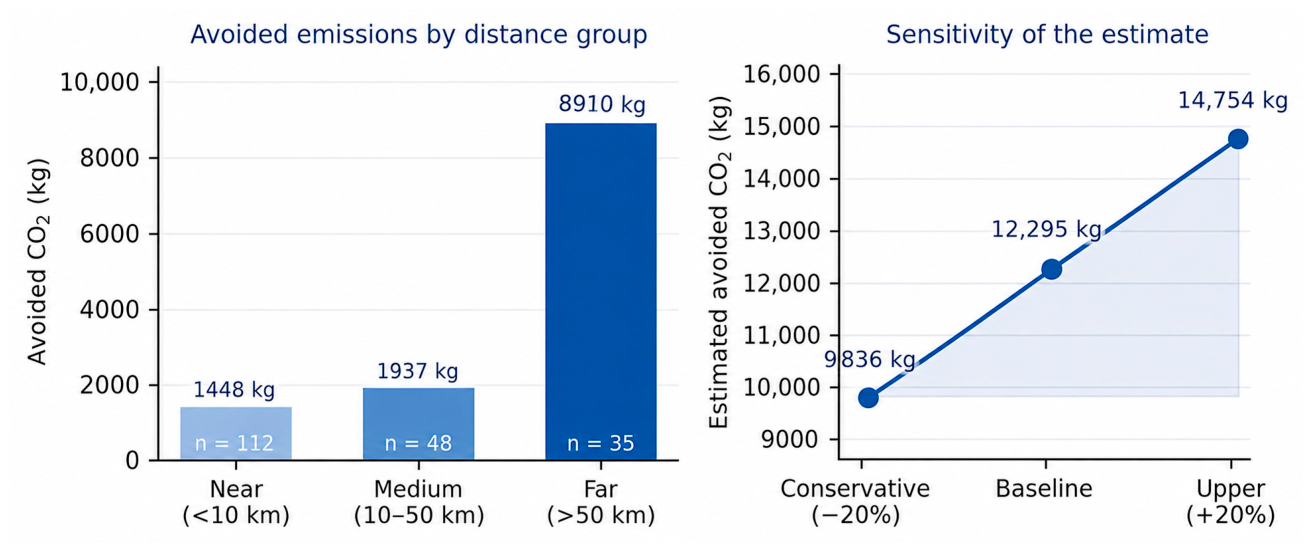
2 emissions. Varying the emission factors by ±20% gives a conservative scenario of 9836 kg and an upper scenario of 14,754 kg. The emission factors, units, sources, and assumptions used in the estimation of avoided commuting emissions are presented in
Table 1. The estimate is clearly sensitive to the transport assumptions.
The sensitivity analysis of the estimated avoided commuting emissions is presented in
Table 2.
This estimate is explicitly treated as a partial estimate of avoided commuting-related emissions based on self-reported data, not as a direct measurement of actual emissions or as the total carbon footprint of the programme. It excludes electricity consumption, heating and cooling of university buildings, the operation of digital platforms, internet use, personal devices, server infrastructure, and possible rebound effects.
4.7. Data Collection Procedure
The data were collected online, via Google Forms (Google LLC, Mountain View, CA, USA), in the academic year 2025–2026. Participants were recruited during the scheduled teaching activities of the Didactics of the Specialty course; the link to the questionnaire was distributed on the Microsoft Teams platform (Microsoft Corporation, Redmond, WA, USA) used for the course, and learners were invited to complete it during the session. Participants were recruited during the scheduled teaching activities of the Didactics of the Specialty course; the link to the questionnaire was distributed on the Microsoft Teams platform used for the course, and learners were invited to complete it during the session. Participation was voluntary, and the form explicitly stated the anonymous nature of the responses and the use of the data exclusively for scientific purposes. No incentives were offered and no reminders were sent.
4.8. Data Analysis Methods
Quantitative analysis included descriptive statistics—frequencies, percentages, arithmetic means, and standard deviations—calculated for each item and each subscale, internal reliability assessment through Cronbach’s alpha, Pearson correlations for all pairs of subscales and descriptive comparative analysis by subgroups. Qualitative analysis of the two open-ended responses was performed through inductive thematic coding. The unit of analysis was the complete open-ended response of each participant. Coding proceeded in four stages: repeated reading of all responses to identify recurrent ideas; inductive generation of preliminary codes; grouping of similar codes into broader themes; and review of the final thematic categories against the research objectives and the quantitative results. A codebook was compiled, specifying the name of each theme, its operational definition, and examples of statements assigned to it. The codebook used for the thematic analysis is provided in
Appendix A. Because many responses contained more than one suggestion, a single response could be assigned several codes; the reported thematic percentages are therefore not mutually exclusive and do not sum to 100%. Relative frequencies were computed on the full sample (N = 257); a total of 251 participants provided an answer to the first open-ended question and 246 to the second. The coding was carried out by one of the authors. There was no independent double coding, so no coder disagreements had to be reconciled, and no inter-rater agreement coefficient, such as Cohen’s kappa, was computed. The qualitative component is presented as an illustrative and supporting element of the study rather than as an independently validated analysis, and this is stated among the limitations.
In addition to descriptive and correlational analyses, inferential testing of the model included following four complementary analyses: (1) A multiple linear regression model estimated the prediction of support for continuing and expanding hybrid education (V.5) from hybrid experience, perceived ecological impact, sustainability attitudes and the revised teaching quality construct (V.1–V.4), with assumption checking and robust HC3 standard errors reported alongside ordinary least squares estimates; (2) differences between status groups were tested, for each subscale, by univariate ANOVA, doubled by Welch ANOVA and by the Kruskal–Wallis test, with post hoc Games–Howell; (3) because all constructs were measured with the same self-reported instrument at a single point in time, common method variance was assessed as an exploratory diagnostic using Harman’s single-factor test; and (4) as a robustness check for the ordinal outcome with a pronounced ceiling effect, the regression model was re-estimated with the dependent variable dichotomised (score of 5 versus 4 or lower) using binary logistic regression. Path models and latent-variable models were not retained. The design of this study is exploratory and descriptive-correlational, and the discriminant validity problems identified in the original estimation made those models difficult to defend.
4.9. Ethical Considerations
The research respected the principles of voluntary participation, complete anonymization of responses, and use of data exclusively for scientific purposes. The data were analysed exclusively at the aggregate level. No sensitive personal data was collected.
4.10. Methodological Limitations
The limitations of the study include: (1) self-reported data; (2) descriptive-correlational design that does not allow causal inferences; (3) differences between subgroups were tested by one-way ANOVA, Welch ANOVA and the Kruskal–Wallis test; only the hybrid experience subscale reached the conventional threshold under classical ANOVA (p = 0.036, η2 = 0.040), and this difference was confirmed neither by the Welch test (p = 0.190) nor by the Kruskal–Wallis test (p = 0.064), so no stable between-group difference was identified; (4) focus on a single institutional context, with limited generalizability; and (5) estimation of CO2 emissions based on standard factors and declared data, without direct measurements. Response bias is a further concern. Nineteen of the 22 items have means above 4.50, and 18 draw more than 70% maximum responses, so ceiling effects are severe. The highest means are concentrated in the teaching quality and hybrid experience subscales: V.1 (M = 4.86), II.6 (M = 4.83), II.5, V.2 and V.3 (all M = 4.82). Only the sustainability subscale escapes the ceiling, with IV.1 being the lowest item in the instrument (M = 4.09). The topics are also ones the institution visibly values, which makes social desirability difficult to rule out. Harman’s single-factor test placed the first unrotated factor at 55.16% of the total variance, above the usual 50% threshold for common method variance.
5. Results
This section presents the research results in order of model dimensions, without interpretation, which is reserved for
Section 6.
5.1. Respondent Profile
The distribution of respondents by academic and professional status is presented in
Table 3.
5.2. Mobility Profile of Respondents
The mobility profile of respondents, according to the main means of transport used for commuting to the university, is presented in
Table 4.
The avoided commuting distance and estimated avoided CO
2 emissions by distance group are presented in
Table 5.
The distribution of distances is positively skewed: the stated mean is 28.5 km, and the median is 7 km. Respondents in the “Far” group represent 17.9% of the respondents included in the ecological estimate and record a mean CO2 saving of 254.6 kg, substantially higher than the “Near” group.
5.3. Estimated Aggregate Ecological Impact
The aggregate estimate indicates 81,283 km of avoided commuting travel and approximately 12,295 kg of avoided commuting-related CO2 emissions. It rests on the 195 respondents who reported a usable number of avoided attendances. Distribution of avoided online sessions: 2–4 sessions (N = 42), 5–7 sessions (N = 53), 8–10 sessions (N = 65), 11–15 sessions (N = 20), and over 15 sessions (N = 13).
5.4. Experience with Hybrid Teaching Format
The descriptive statistics for the experience with hybrid teaching format subscale are presented in
Table 6.
5.5. Perceived Ecological Impact and Carbon Footprint
The descriptive statistics for the perceived ecological impact and carbon footprint subscale are presented in
Table 7.
5.6. Attitudes Towards Ecological Sustainability
The descriptive statistics for the attitudes towards ecological sustainability subscale are presented in
Table 8.
5.7. Quality of Teaching in Hybrid Format
The descriptive statistics for the revised quality of teaching subscale and the separate outcome item are presented in
Table 9.
5.8. Summary of Scores by Dimensions
The summary of mean scores and reliability coefficients by dimensions is presented in
Table 10.
5.9. Comparative Analysis by Subgroups
The mean scores on the analysed subscales according to academic and professional status are presented in
Table 11.
The differences are analysed here descriptively; their inferential testing (ANOVA) is presented in
Section 5.11.
5.10. Correlations Between Research Dimensions
The Pearson correlation matrix between the revised constructs is presented in
Table 12.
The bivariate associations with 95% confidence intervals are presented in
Table 13.
Strongest correlation: revised teaching quality with support for continuing the hybrid format (r = 0.833), followed by hybrid experience with revised teaching quality (r = 0.818). Weakest: sustainability attitudes with support for continuing the hybrid format (r = 0.571).
5.11. Inferential Analyses (Regression, ANOVA, and Kruskal–Wallis)
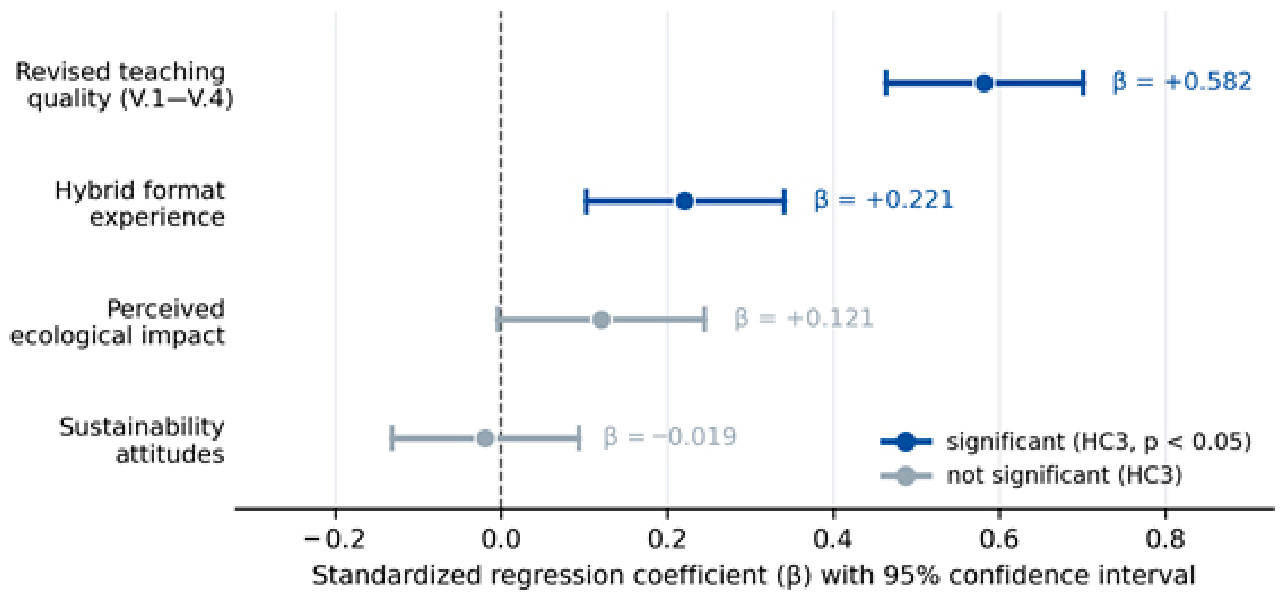
After correcting the measurement model, item V.5 was excluded from the teaching quality scale and analysed as a distinct outcome variable reflecting support for the continuation and expansion of hybrid education. The revised teaching quality subscale, based on items V.1–V.4, retained high internal consistency (Cronbach’s α = 0.893). The standardized regression coefficients and their 95% confidence intervals are presented in
Figure 1.
The estimated avoided commuting emissions by distance group and the sensitivity analysis of the aggregate estimate are presented in
Figure 2.
A multiple linear regression model was estimated with support for continuing and expanding hybrid education (V.5) as the dependent variable. The predictors were hybrid experience, perceived ecological impact, sustainability attitudes and the revised teaching quality construct. The model explained a high proportion of the variance in support for the hybrid format, R2 = 0.723, adjusted R2 = 0.718, F(4, 252) = 164.19, p < 0.001. Variance inflation factors ranged between 2.98 and 3.62, indicating moderate but acceptable collinearity.
Assumption checks showed clear departures from normality of the residuals (Shapiro–Wilk W = 0.709, p < 0.001; skewness = −0.53; kurtosis = 9.72) and strong heteroscedasticity (Breusch–Pagan LM = 58.24, p < 0.001; White LM = 106.25, p < 0.001). Both are what one would expect when 84.4% of the answers fall in the top category. HC3 standard errors are reported as the primary results, with ordinary least squares values alongside them for comparison.
The strongest independent predictor was the revised teaching quality construct (B = 0.803, SE_HC3 = 0.190, β = 0.582, and p < 0.001), followed by hybrid experience (B = 0.274, SE_HC3 = 0.104, β = 0.221, and p = 0.009). Perceived ecological impact did not remain a significant independent predictor under robust estimation (B = 0.133, SE_HC3 = 0.141, β = 0.121, and p = 0.347; p = 0.057 under ordinary least squares), and sustainability attitudes made no significant independent contribution (B = −0.019, SE_HC3 = 0.065, β = −0.019, and p = 0.771).
As a robustness check, the model was re-estimated with the outcome dichotomised (score of five versus four or lower). The logistic model confirmed the role of hybrid experience (OR = 7.16, 95% CI [1.91; 26.81], and p = 0.003) and of revised teaching quality (OR = 7.47, 95% CI [1.20; 46.40], and p = 0.031), and again showed no independent contribution of perceived ecological impact (OR = 0.77, p = 0.663). In this specification, sustainability attitudes did reach significance (OR = 4.07, 95% CI [1.31; 12.64], and p = 0.015). The estimate for this construct is evidently sensitive to how the model is specified.
The results of the multiple linear regression model predicting support for the continuation and expansion of hybrid education are presented in
Table 14.
The between-group comparisons by academic and professional status are presented in
Table 15.
H5 now rests on a clean test, since the recommendation item no longer sits inside the predictor construct. H4 is a different case. Sustainability attitudes correlate positively with support for continuing the hybrid format (r = 0.571, p < 0.001), but the association does not survive as an independent contribution once the other constructs are entered. H4 is best read as partially supported.
Differences by academic and professional status were slight. One-way ANOVA reached significance only for hybrid experience, F(4, 252) = 2.62 and p = 0.036, with a small effect size (η2 = 0.040). Group variances were far from equal, so Welch’s test is the appropriate reference here, and it did not confirm the difference (p = 0.190), and neither did Kruskal–Wallis (p = 0.064). Nothing significant emerged for perceived ecological impact, sustainability attitudes, revised teaching quality, or support for continuation. H6 is weakly supported at best, and it is a comparison between groups rather than a test of moderation.
Common method variance was examined with Harman’s single-factor test on all 22 Likert items. The first unrotated factor accounted for 55.16% of the total variance, above the conventional threshold of 50%. Common method bias cannot be ruled out. Harman’s test is a weak diagnostic, and the result should not be over-read in either direction, but it does set a limit on interpretation; the correlations and regression coefficients describe associations between self-reported perceptions, not causal relationships or objective educational effectiveness.
5.12. Qualitative Analysis of Open-Ended Responses
The answers below, translated from Romanian and reproduced without identifying information, give a sense of how participants moved from general perceptions to concrete proposals.
Several answers bundled together measures that the questionnaire had kept separate: “I propose optimising hybrid courses by reducing unnecessary travel, using digital materials instead of printouts, improving the energy efficiency of equipment and promoting sustainable educational platforms.”
The idea of a single platform recurred, often alongside concerns about data storage: “Using materials in electronic format instead of printouts; using a single platform for courses, assignments and communication; intelligent archiving of materials in order to avoid unnecessary data storage.”
Scheduling appeared as a sustainability measure in its own right: “Grouping on-site classes into compact days in order to reduce the frequency of commuting; alternating online and face-to-face activities in order to limit daily travel.”
On institutional measures, the proposals were broader: “USV Iași could reduce its ecological footprint through the complete digitalisation of materials and assessments, efficient use of energy in classrooms and laboratories, selective waste collection, the installation of renewable energy sources and the encouragement of sustainable transport.”
One answer named the underlying model directly: “The university can build a ‘green campus’ model adapted to hybrid and sustainable education, and can deliver theoretical courses online.”
Read alongside the quantitative results, these answers suggest that convenience was not the whole story. Participants tied the way hybrid courses are organised to how the university runs its digital infrastructure, its buildings and its energy. They also looked past commuting; waste collection and campus energy use came up as often as travel, and several respondents expected the institution itself to act, not just individuals.
The themes identified for Q1, regarding suggested improvements to hybrid courses, are presented in
Table 16.
The themes identified for Q2, regarding institutional measures to reduce the ecological footprint, are presented in
Table 17.
7. Conclusions
7.1. Summary of Main Conclusions
This study analysed the perceptions of 257 DPPD postgraduate students regarding hybrid education management, teaching quality, environmental impact of travel reduction and attitudes towards institutional sustainability.
First conclusion: There is a high and consistent level of self-reported acceptance of the hybrid format (overall score of 4.64; Cronbach’s alpha of 0.886–0.901).
Second conclusion: Perceived teaching quality and hybrid experience are strongly interconnected (r = 0.818); adaptation of content by teachers (V.1: M = 4.86) is the central factor of perceived quality.
Third conclusion: A quantifiable but partial ecological potential—an estimated 81,283 km of avoided commuting travel and approximately 12,295 kg of avoided commuting-related CO2 at the level of a single course, during an academic year.
Fourth conclusion: there is a significant values–behaviour gap (IV.1: M = 4.09 versus IV.3: M = 4.59), with direct curricular implications for psychopedagogical training.
Fifth conclusion: Master’s students require specific attention in the management of hybrid DPPD programmes (overall score of 4.37 versus the average of 4.64).
7.2. Implications for the Management of Postgraduate DPPD Programmes
(1) Continuation and formalisation of the hybrid format as a standard model, supported by 84.4% of participants. (2) Prioritisation of teacher training for hybrid teaching. (3) Grouping of face-to-face sessions into compact days. (4) Full digitization of teaching materials as an immediate institutional objective (absolute priority in the qualitative analysis: 41.6%).
7.3. Implications for University Sustainability Policies
The figure of roughly 12,295 kg can feed into the university’s annual sustainability reporting, labelled as a transport-related estimate. Respondents support broader institutional measures: solar panels on campus (28.0%), selective collection (16.3%), alternative transportation (10.5%), and institutional sustainability policies (2.3%).
7.4. Limitations and Future Research Directions
The study’s limitations include: a descriptive-correlational design that does not allow causal inferences; self-reported data collected with a single instrument at a single point in time; pronounced ceiling effects and possible social desirability bias; common method variance that cannot be excluded (Harman’s first unrotated factor accounted for 55.16% of the variance); a single institutional context; and a CO2 estimate built on declared data, limited to commuting and resting on a subset of 195 respondents.
Future directions: (1) longitudinal design; (2) sample expansion to more DPPD universities; (3) validation of the instrument on independent samples; (4) direct measurement of CO2 emissions; and (5) in-depth qualitative investigation of the perceptions of master’s students.
7.5. Final Conclusion
The results suggest that, when strategically managed and pedagogically supported, hybrid education may contribute to maintaining perceived teaching quality, increasing accessibility for employed adult learners, and reducing commuting-related emissions associated with academic mobility, as estimated in this study. These objectives are not competing, but complementary, provided that hybrid education is interpreted as a carefully designed educational management option and not as a universal replacement for face-to-face teaching.





 ,
,