


Article

Individual and System Factors Involved in First-Generation College Students’ Risk and Resilience: Qualitative Student Perspectives and Recommendations


School of Psychology and Brain Sciences, University of New England, Biddeford, ME 04005, USA
*
Author to whom correspondence should be addressed.
Educ. Sci. 2026, 16(8), 1309; https://doi.org/10.3390/educsci16081309
Submission received: 14 May 2026 / Revised: 29 July 2026 / Accepted: 5 August 2026 / Published: 16 August 2026

Abstract

Since the term ‘first-generation college student’ (FGCS) garnered increased attention in the 2000s, many institutions have implemented programming specifically for FGCS (e.g., bridge programs, first-year seminars). FGCS should be key stakeholders who inform programming. As such, qualitative research is needed to elevate FGCS voices. To date, little research has examined adjustment and well-being in FGCS. This study included qualitative interviews (approximately 30 min) concerning adjustment and well-being in FGCS (N = 24; 79% female, M age = 19, 92% White), defined as students whose parents have not completed a four-year bachelor’s degree. Participants’ responses were coded according to Bronfenbrenner’s Ecological Systems Theory levels, to account for the multi-layered systems (e.g., family, high school, university, peers) that impact their risk and resilience before and during college. One central theme was how seeking help from family, peers, and university resources promoted resilience. Conversely, individual risk factors (e.g., low socioeconomic status; insufficient guidance) interacted with the high school environment and economic landscape of higher education to confer risk. Overall, many challenges (e.g., mental health) improved over time. Students made recommendations for both high school and university staff about how to best support FGCS, which have implications for programming at the high school and university level.

1. Introduction

The categorical term ‘first-generation college student’ entered higher education nomenclature and began to inform financial aid decisions in the late 1970s, with the initial purpose to identify and support underrepresented students (Council for Opportunity in Education, 2026). Although the initial intention behind the term was to identify and support underrepresented students (Council for Opportunity in Education, 2026), some research has argued that the term ‘first-generation college student’ was socially constructed to benefit universities (i.e., in admissions and retention efforts) more than to support students with that lived experience (Wildhagen, 2015). For example, universities may rely on the category to diversify their student body, predict student support needs, and track predictors of retention (Wildhagen, 2015). Today, the free application for federal student aid (FAFSA), Federal TRIO grant programs, and some researchers define first-generation college students as those whose parents have no education from a four-year college institution while allowing two-year degrees (Council for Opportunity in Education, 2026; Stebleton et al., 2014; U.S. Department of Education et al., 2020; Wildhagen, 2015). Through a qualitative study involving interviews with first-generation college students, we hope to center and elevate students’ experiences with adjustment and well-being before and during college, to infuse student recommendations into university programming efforts. In our study, we define first-generation college students as students whose parents have not earned a four-year degree or the equivalent of a bachelor’s degree in the United States.
As of 2020, first-generation college students make up a substantial portion of college campuses, representing about 40% of undergraduates (National Center for Education Statistics, n.d.), leading some college campuses to have focused programming to support first-generation college students. Despite making up a sizable portion of higher education stakeholders, the literature on first-generation college students is relatively small, and sometimes inconsistent (e.g., regarding students’ mental health, level of family and social support, and help-seeking patterns). Understanding more details about their unique risk and resilience factors will help inform effective programming, interventions, and mental health services.
Developmental theories, like the developmental psychopathology perspective, increasingly recognize that different patterns of risk and resilience can lead to different pathways as adolescents transition into young adulthood (Leebens & Williamson, 2017). Considering both the developmental and clinical psychology literature (American Psychiatric Association, 2022; Bonanno, 2005; Comer & Comer, 2024; Leebens & Williamson, 2017), we define a risk factor as any variable (e.g., life event, condition, or attribute) that increases a student’s susceptibility to having a negative outcome (e.g., poor adjustment to college, mental health challenges, academic struggles). In contrast, we define a resilience factor (synonymous with protective factors) as a “positive developmental variable” that “helps to offset the impact of” risk factors and promote good outcomes (e.g., good adjustment or well-being, academic success) (Comer & Comer, 2024, p. 87). Recent research suggests that resilience represents a “complex, interconnected network” of individual traits and systems that interact with one another to positively impact developmental outcomes (Maltby, 2024, p. 228).
To date, the extant literature on first-generation college student adjustment and well-being has focused more on risk than resilience factors. Indeed, the literature has emphasized the risk factors associated with being a first-generation college student, noting that these students have unique personal factors and attributes that can make their college experience more challenging. For example, they are more likely to come from at-risk populations, such as marginalized groups, low socioeconomic status, and be children of immigrant parents (Jenkins et al., 2013). Challenges for first-generation college students start before even stepping foot onto campus. First-generation college students tend to have less information, support, preparation, and confidence upon entering college (House et al., 2020; Watts et al., 2023). Throughout college, first-generation college students report struggles with financial planning and financial distress (House et al., 2020; Watts et al., 2023). Additionally, one study identified interpersonal and help-seeking challenges like communication difficulties with professors and a lack of support from family back home (Watts et al., 2023). Furthermore, some research finds that first-generation college students have higher stress levels and less belonging on campus than continuing-generation college students, which could suggest a heightened need for mental health services (Stebleton et al., 2014). Despite this potential increased need, unfortunately, first-generation college students have been found to utilize mental health services at a lower rate (Bartholomew et al., 2025; Stebleton et al., 2014). Common treatment barriers included poor location, insufficient knowledge about services, and scheduling constraints (Stebleton et al., 2014). Overall, these risk factors and challenges are interrelated. The mix of demographic risk factors and having less support affects their college experiences and leads to less confidence and belonging on college campuses (Stebleton et al., 2014).
In contrast to the aforementioned studies, which document risk for first-generation college students, other studies have found non-significant differences in some of these risk factors (House et al., 2020; Wilbur, 2021). For example, one study of students presenting for on-campus counseling found no differences between first-generation and continuing-generation college students in mental health needs and social and family support (House et al., 2020). Although one previous study found heightened depressive symptoms in first-generation college students (Stebleton et al., 2014), the study on treatment-seeking students found no significant differences in psychological symptoms (e.g., anxiety, depression) between first-generation and continuing-generation students (House et al., 2020). A longitudinal study added more nuance to the mixed findings on depression by demonstrating that first-generation college students and continuing-generation students only significantly differed in depressive symptoms during high school (Wilbur, 2021). They also found that first-generation college students’ depressive symptoms declined across their college years, whereas continuing-generation students’ depressive symptoms were stable across the study, which may suggest an area of resilience for first-generation college students once they enroll in college. This suggests that significant differences in depression between groups may decrease over time, with high school being a uniquely vulnerable time for prospective first-generation college students. Our study aims to discover where and how first-generation college students gain their resilience to explain these discrepancies and consider how to best consider first-generation college students’ strengths in programming.
House et al. (2020) also measured contextual variables such as family support, social support, work hours, and engagement in extracurricular activities and found no significant differences between first- and continuing-generation college students. When contextualizing their many null findings that contradict some previous literature, the authors cautioned that the term first-generation college student does not fully capture the diverse intersectional identities these students hold. As such, mixed findings could be due to quantitative between-groups research not fully accounting for identity characteristics beyond first-generation status (e.g., socioeconomic status, racial and ethnic identity). Furthermore, the authors made sense of their findings by inferring that even if the immediate family lacks lived experience with the college process, their emotional support and optimism could protect the student from risks associated with being a first-generation college student (House et al., 2020). Overall, the inconsistent findings and lack of nuance from these quantitative studies highlight the need for qualitative research and examination of protective factors in this population.
Although risk factors have been more commonly studied, fortunately, a growing body of literature has elucidated protective factors of first-generation college students, which include both strengths within the individual and their broader support network (Alvarado et al., 2017; Azmitia et al., 2018; House et al., 2020; Watts et al., 2023). Regarding individual factors, Watts et al. (2023)’s qualitative study found that organizational and time management skills facilitated student success. Students also reported factors that fueled their motivation to complete college, such as clarity of career goals and wanting to create a path for future children. In this same study, students also reported that various support people (e.g., family, former teachers) motivated them to complete college. The students identified key supporters beyond the classroom, including mentors, advisors, and professors who were clear, communicative, and organized (Watts et al., 2023).
One theory that can help us contextualize risk and resilience in first-generation college students is Bronfenbrenner’s Ecological Systems Theory, due to its focus on different people (e.g., family, peers), settings (e.g., high school, university), and systems that influence an individual’s development (Bronfenbrenner, 1979) (see Figure 1 for a diagram representation). This theory suggests that a person’s development is influenced by bi-directional interactions (depicted with double-headed arrows) with the different environments and systems that surround them. In the center of all the systems is the individual, their genetics, and the choices they make. Closest to the individual is their microsystem, which includes their most intimate relationships and environments (e.g., nuclear family, peers, and school). The mesosystem is the interactions between microsystems (e.g., interactions between family and school). The next level is the exosystem, which includes indirect influences such as their parent’s workplace. At the societal level, the macrosystem includes cultural beliefs, social norms, and values that shape all other systems. Lastly, the chronosystem refers to changes across time. Overall, individual factors (e.g., a student’s mental health), surrounding environments (e.g., their school), and systems (e.g., the broader economy), and the bi-directional interactions amongst them can function as risk or resilience factors, which in turn, can facilitate poor or good developmental outcomes for the individual (Bronfenbrenner & Ceci, 1994). The current study utilized this theory as a framework for making sense of first-generation college students’ lived experiences in adjusting to college.
The previous literature on first-generation college students has several gaps, which impede a comprehensive understanding of their risk, resilience, and needs. First, the literature is marked by mixed findings, which may be due to these students’ complex, multi-faceted, intersectional identities (House et al., 2020), and can be best explored through qualitative data collection. Second, most of the literature on first-generation college students is quantitative (i.e., questionnaires) in nature. Indeed, only one study to date has used qualitative methods (Watts et al., 2023). Third, the extant literature has mostly focused on risk, rather than protective factors. Both research and theory inside and outside of the extant first-generation college student literature appropriately point to how protective factors likely contribute just as powerfully to their adjustment and success in college (House et al., 2020; Leebens & Williamson, 2017). Fourth, previous research has not grounded their examination in developmental theories like the ecological systems theory (Bronfenbrenner, 1979; Leebens & Williamson, 2017), which are helpful for understanding how individual and systemic factors converge to facilitate risk and resilience over time. Relatedly, most research has focused on individual student factors (e.g., demographic characteristics), largely ignoring the settings and environments that influence them. Fifth, although some previous research has identified a higher need for support and resources both academically and emotionally (House et al., 2020; Stebleton et al., 2014; Watts et al., 2023) and first-generation college students have complex intersectional, often marginalized identities, the extant literature has failed to collect recommendations directly from the students. Qualitative research is poised to fill this gap and elevate the voices of students from a range of backgrounds and identities whose voices may be excluded from programming decisions in secondary and higher education. Overall, qualitative research that can fully encapsulate first-generation college students’ multi-faceted identities, stories, and mix of risk and resilience factors is needed.
The current study aims to address each of these gaps through qualitative interviews, to add nuance and clarity to the extant literature’s mixed findings and learn directly from students about their experiences. Our first aim was to identify which individual factors and systems help (resilience factors) and/or hurt (risk factors) first-generation college students both before and during college. Our second aim was to seek recommendations from first-generation college students for high school counselors, university professors, and university personnel in charge of first-generation college student programming. Overall, this study aims to help universities, communities, and adults who interface with first-generation college students better support and understand the nuances of the first-generation college student population.

2. Materials and Methods

2.1. Study Inception

The current study was initially inspired by the first author’s experience teaching and mentoring first-generation college students at three separate higher education institutions. The first author was interested in understanding how faculty and other adults who interface with first-generation college students can best support their adjustment and well-being. Given that this was the research team’s first experience studying first-generation college students, we selected qualitative methods to hear directly from the students before pursuing follow-up studies of a quantitative, experimental, or intervention nature. The second and fourth authors conducted comprehensive literature searches that identified key gaps in the extant literature on first-generation college students, including a dearth of qualitative studies. The first author also consulted with the Assistant Dean of Students, who also implements a First-Generation Bridge Program (described in Section 2.3 below), when developing the project. Our literature review and conversations with the Assistant Dean of Student Affairs solidified our desire to conduct qualitative interviews with first-generation college students that we hoped would be a first step toward improving support and programming for first-generation college students at our institution and beyond.

2.2. Positionality Statement

Particularly given the nature of qualitative work, we find it essential to acknowledge the positionality that we bring to this investigation. Regarding the authors’ identities, all authors identify as cisgender, white women. Both the second and third authors identify as first-generation, while the first and fourth authors were continuing-generation college students. Therefore, we acknowledge that only some members of the investigative team are familiar with the lived experience of being a first-generation college student. All but the first author were undergraduates at the time of data collection and coding. The first author is a faculty member and a licensed clinical psychologist. Amid data collection, she was also invited to join the university’s First-Generation Student Working Group, which seeks to revamp and expand its First-Generation Bridge Program. Qualitative interviews were conducted by the first, second, and fourth authors. Coding was done by the first, second, and third authors. Results were written by the first author.

2.3. University Setting and First-Generation Bridge Program

The university where the research was conducted is in the Northeast United States, encompassing almost 8000 students of various academic programs, including undergraduate, post-baccalaureate pre-health, master’s, and doctoral. Considering only undergraduates (the focus of our study), the population contains slightly more than 2000 students. Notably, this university specializes in health professions and natural and social sciences degrees. This university has a high acceptance rate, accepting around 85.3% of applicants based on Fall 2025 acceptance statistics (University of New England Office of Research and Data Analytics, 2025). The university is predominantly White (88.4%) and female (69%). Of all degree-seeking undergraduates, 30.3% identified as first-generation college students (University of New England Office of Research and Data Analytics, 2025). Due to the sizable first-generation college student population, our university has developed programming to help ease their transition to college. First, all incoming freshmen who are first-generation college students receive an invitation for a First-Generation Bridge Program, held during the week before classes start their freshman year. The program is coordinated by the Office of Student Affairs and allows students to move in early and participate in social and academic events with other freshmen first-generation college students. Second, the program experimented with a loosely structured mentoring program available during the academic year, in which Bridge Program participants could opt for mentorship from staff or older students.
In line with qualitative inquiry, here are some descriptions of the university setting and first-generation resources from our participants. When asked to what extent the university meets their needs as a first-generation college student, some students described campus culture, its resources, and community as strengths. For example, one student responded, “… a great extent. I feel like this is a really great community and place to be, and there’s a lot of…, opportunities and resources that I have here.1” Another student explained feeling so connected they wished they could share specific experiences with people back home, stating, “…I wish some people in my family and community could come out–whether its New England or somewhere else–could experience… not only the college experience that I’m having up [here] but… I don’t know, social programs and stuff and everything going on up here.”

2.4. Participants

In the current study, 24 students (M age = 19.38, range 18–30) participated. More than half (54.2%) of students endorsed having someone in their nuclear or extended family who had obtained a college degree (associate’s, bachelor’s, or graduate degree), like a cousin (n = 3), aunt or uncle (n = 6), sibling (n = 3), or grandparent (n = 1). Only 12.5% of the sample (n = 3) indicated that one or both of their parents had an associate’s degree. Students ranged from freshman through senior status, and most participants were female (79.2%), followed by male (16.7%), and gender non-conforming (4.2%). Racial demographics (students could select all that apply) were: 91.7% White or Caucasian, 8.3% Black or African American, 4.2% Asian or Pacific Islander, 4.2% Hispanic or Latino, and 4.2% Native American or Alaskan Native. Most students reported being primarily raised in a small town (45.8%) or medium-sized town/suburb (29.2%), in comparison to farm/rural areas (12.5%), urban/big cities (8.3%), or small cities/large suburbs (4.2%). In terms of socioeconomic status, the most endorsed annual household income brackets were $75,000–$100,000 (30.4%) and $100,000–$200,000 (26.1%). However, the lowest ($0–$15,000; 21.7%) and highest income brackets (more than $200,000; 4.3%) were also endorsed, highlighting the wide variability in socioeconomic status in our sample. When asked how they were paying for college, most participants endorsed scholarships (79.2%), financial aid/loans (58.3%), and paying with their own funds (58.3%). Students were also asked questions about mental health care utilization. A large portion of students (66.7%) reported currently or previously utilizing mental health care (e.g., therapy on or off campus, medications). The Counseling Center was the most common mental health service utilized (37.5% of participants endorsed lifetime use), though some students utilized off-campus therapy.

2.5. Study Design and Procedures

This study was conducted in accordance with, and approved by, our university’s institutional review board. Participants were recruited from the first-generation college student population at University of New England (UNE). Various recruitment methods were used, including emails, social media (e.g., Instagram), and flyers posted around campus. We also made targeted recruitment efforts to diversify our participant sample regarding underrepresented gender and racial/ethnic identities. For example, we posted study flyers within the cultural exchange lounge. We also contacted coaches (e.g., the football coach) and professors (e.g., within the College of Business) to ask if they would forward an email or flyer advertising our study to students. Interested participants were asked to scan a QR code for more information regarding the study. The QR code led students to an electronic form in REDCap survey software version 16.0.15 (Harris et al., 2009, 2019), software created by Vanderbilt University in Nashville, Tennessee, United States. On the electronic form, participants provided contact information (i.e., name, email, etc.). After indicating interest in participating in the REDCap form, research staff emailed the participant to schedule an in-person interview.
Once scheduled, participants were emailed a link to an electronic consent form on REDCap, on which they indicated informed consent. Informed consent was obtained from all study participants. Next, they completed a series of questionnaires (also via REDCap), which took about 30 min to complete. Questionnaires included a demographics and background survey and several others that will not be reported here due to the qualitative focus of the report. Each semi-structured qualitative interview was conducted by trained research team members and lasted about 30–45 min. Once the interview concluded, each participant was given a $25 Amazon gift card for participating. Since we asked about mental health during the study, we also offered students a handout with mental health resources inside and outside the university.

2.6. Measures

  • Demographic and background questionnaire: This survey included questions about gender, race, grade, socioeconomic status/financial stability, means of paying for college, mental health treatment utilization, and background information regarding the participants’ nuclear family.
  • Qualitative interview (Appendix A): The semi-structured qualitative interview was created for the current study using a deductive approach informed by the extant literature on first-generation college students. Although Bronfenbrenner’s ecological systems theory was a guiding theory in our coding and analysis process (see Section 2.7 below), it was not utilized to draft our qualitative interview. All students were asked a range of questions that covered topics like their first-generation college student identity, challenges and resilience factors influencing their adjustment and well-being before and during college, and recommendations for high school and university personnel. We also asked about how emotion and mental health were handled in their family of origin, their mental health, and their mental health treatment preferences. All interviews were conducted by a research staff member within a private interview room in the lab. Interviews were recorded using a combination of a small handheld audio recorder and typed notes (for backup in case of technical errors) for later transcription.

2.7. Qualitative Approach and Analysis

Our coding and analytic procedure was a collaborative and interpretative paradigm, primarily inspired by the Braun and Clarke (2006) thematic analysis, and fitting most closely into “codebook thematic analysis” (Braun & Clarke, 2020, p. 133). Given the debate in the field about using saturation in qualitative work (Braun & Clarke, 2021), we also consulted grounded theory in how we applied saturation in our sampling and coding process (Saunders et al., 2017).
Undergraduate interviewers were trained by first observing the first author (also the principal investigator) lead an interview, then having the first author observe them administer an interview. The first author provided feedback about recommended qualitative interview practices and opportunities for follow-up questions during this training phase. Throughout data collection, the interviewers met weekly to debrief about emergent themes, how to reword certain questions when they were misunderstood by participants, and to assess whether theoretical saturation had been reached. Although saturation has many definitions (Saunders et al., 2017), here we observed recurring similar responses to our interview questions (rather than novel information or patterns) and felt that no further sampling of our student population would achieve a wider diversity of responses to study questions (Glaser & Strauss, 1967). No substantive changes were made to the qualitative interview during data collection.
Interviews were transcribed by the second, third, and fourth authors by listening to the audio recording. Transcription was done in Microsoft Word, without additional technology or AI assistance. Transcription occurred while data collection was still ongoing and during the four months after data collection was completed. After all interviews were transcribed, 20% of the transcripts were checked by another transcriber for any mistakes made during initial transcription. Minimal errors were found.
Braun and Clarke (2006)’s thematic analysis method encompasses six phases. Throughout all phases, we balanced rigor with continuous, collaborative dialog amongst coders. First, all coding team members (i.e., the first three authors) familiarized themselves with the data by reviewing a portion of transcripts by a combination of listening to and reading the transcripts. Coding team members reviewed at least 25% of the transcripts before beginning formal coding. This process occurred over a six-month to 1 ½ year period, depending on the study team member. Second, throughout a series of in-person meetings, the coding team collaboratively generated an initial code list that we thought represented key themes within the data. An inductive approach (i.e., allowing the themes to emerge from the data itself) to thematic analysis was used when generating the initial list (Braun & Clarke, 2006). Coders drafted a codebook in which overarching codes (i.e., risk factor/challenge, resilience factor/strength) and more specific codes (i.e., university, family, peers, etc.) were outlined. Any code could be double-coded as a risk factor or resilience factor (i.e., a factor that supported their adjustment, well-being, and/or academic success in college). For this aspect of coding, coders consulted our definition of risk and resilience factors (see Table 1), the overarching sentiment of the excerpt (i.e., sentiment analysis), to what extent the participant linked the factor to a good or poor outcome, and our knowledge of the extant literature on risk and resilience. Within our coding scheme and consistent with recent views of resilience as a network of individual traits and systems that collectively contribute to good outcomes (Maltby, 2024), the resilience factor served as a broad umbrella code that could be double-coded with any other code. In contrast, codes like persistence in the face of adversity were considered a specific code and one example within the broader resilience network (Maltby, 2024), that was thus often also double-coded as a resilience factor. While students did not have to face a particular stressful life event to demonstrate a resilience factor, persistence in the face of adversity captured instances when a student reported facing a stressor or traumatic life event that they navigated with strength. As with all codes, any coder discrepancy about whether to double-code with risk or resilience was discussed and resolved at a consensus meeting. A more substantive first draft of a codebook was primarily informed by the first author’s familiarity with the participant data (i.e., data familiarization process) and prior literature, thus a combined inductive–deductive approach.
In reviewing our initial codes, we noticed that different settings (e.g., university) and people (e.g., family) were key themes and that individual factors were frequently interconnected with settings and support people. Thus, we decided to reorganize codes and subsequent themes within Bronfenbrenner’s Ecological Systems Theory (Bronfenbrenner, 1979), using the following categories/levels: Individual, Microsystem, Mesosystem, Exosystem, Macrosystem, and Chronosystem (see Table 1 for definitions). For example, initial codes like family or peers were organized under the Microsystem category, which represents immediate environments and closest relationships. Bronfenbrenner’s theory was central to our coding, analysis, and interpretation of the data.
When drafting initial operational definitions for codes, researchers would occasionally seek outside frames of reference regarding traditional definitions. For example, if we were unsure how best to operationally define the code ‘culture,’ researchers searched the term via Google with a prompt like ‘culture’. Results for these searches would sometimes include summaries provided by AI regarding the concept (i.e., Google Gemini). However, when constructing final operational definitions, all coders conferred and agreed on how to best describe the theme within our data.
Beginning with the third step of thematic analysis, we used ATLAS.ti version 25 software, manufactured by Lumivero in Berlin, Germany. In the initial coding phase, four participant transcripts were coded independently by all three coders, according to the generated codebook. We did not statistically assess intercoder agreement prior to consensus coding, as this is not considered central to codebook thematic analysis (Braun & Clarke, 2020) and we expected to differ in how we coded each transcript, given our different positionalities (e.g., student versus faculty, first-generation versus continuing generation). Notably, although ATLAS.ti has AI tools available for qualitative coding, coders did not use them when transcribing, coding, or analyzing this data. The coding team met one to two times per week to discuss and resolve inconsistencies within codes via consensus coding. Once coders gained familiarity with the coding process, each transcript was coded by at least two coding team members. Discrepancies between coders were still resolved one to two times per week via consensus coding meetings. Through this process, the codebook was intermittently adjusted to best capture the themes present within the data, such as adding new codes or rewording codes. We reached saturation once about 75% of the transcripts were coded, at which time no new codes or reworded codes were needed. In this instance of saturation, we defined it as the point in coding when we no longer detected novel codes (Urquhart, 2017). Regardless of saturation, all participant transcripts were coded to ensure that all first-generation college student participant voices were represented in this manuscript. For the final step, coders discussed and explored co-occurrence between codes (e.g., insufficient guidance and high school), including visual exploration using ATLAS.ti.

3. Results

3.1. Overview

First-generation college students’ responses were grouped into six categories (Individual, Microsystem, Mesosystem, Exosystem, Macrosystem, and Chronosystem) based on Bronfenbrenner’s Ecological Systems Theory (Bronfenbrenner, 1979), which were further organized into eight themes under these categories (see Results Section 3.2, Section 3.3, Section 3.4 and Section 3.5). Four additional themes crosscut multiple levels of Bronfenbrenner’s theory and their specific interactions are described in Section 3.6. See Figure 1 for a diagram depiction and Table 1 for definitions and excerpt counts of the categories, resilience factors, and risk factors. See Appendix B for a comprehensive table of additional selected codes, their definitions, and counts.
Overall, risk factors (e.g., financial pressures, insufficient guidance) were coded at a similar frequency as resilience factors (e.g., clarity of career goals, supportive family). A sample excerpt coded as a risk factor is “some people… knew a lot about how college worked… And…, they had this knowledge from their parents or siblings and… I don’t have anybody… So that was definitely hard, I always had to go to… professors or… sometimes friends but definitely more of an outsider.” In contrast, here is a sample excerpt coded as a resilience factor, in which a student discussed their pride in their first-generation student status: “I think I more take pride in it, like I know I’m a little bit… less of a first-generation because my parents have done some school. But, at the same time, …I feel proud that I can further on that education and hopefully like achieve the dreams I want to.”
Most excerpts fell into the microsystem category, which included codes like family and peers, and the individual category, which included themes like help-seeking beliefs and behaviors and financial pressures. In contrast to the frequent codes in other categories, codes emerged within the exosystem category so infrequently that they will not be reported in the paper.

3.2. Individual Factors

Across the 22 different codes in this category, codes were more often double-coded as risk factors (101 excerpts; e.g., financial and academic pressures) than resilience factors (82 excerpts; e.g., clarity of career goals, persistence in the face of adversity).

3.2.1. Theme 1: A Portion of Students Described Intersectional Identities That Emphasized the Salience of Their Family of Origin and Socioeconomic Status to Their Identity

Although all students were asked “For you, what are the most important aspects of your background or identity?,” we coded intersectional identities infrequently (7 excerpts). In these excerpts, students provided in-depth, rich context to who they were beyond their first-generation student status, and which identity domains were most salient to them. For example, one student discussed the intersection between their family, first-generation student status, and socioeconomic status:
Participant:
…I’m the oldest daughter in my family and obviously I’m a first-generation student and I’m also the first person in [my] family who wants to have a career in… health care….
Interviewer:
Is there any… important aspects from… your upbringing or… any ethnic background or the community you came from… that’s important to your identity?
Participant:
I came from a really small town… and I… grew up, I wouldn’t say in poverty, but we definitely didn’t have a lot of money, and neither did the school system I went to… So, …resources …and taking AP classes… was very limited…
Another student similarly highlighted both their family of origin and socioeconomic status as central to their identity, saying “…definitely being raised by a single mom and…, that one’s a bigger one, being from a lower income household has definitely shaped a lot of college, as well as being… gender non-conforming and bi-sexual and… my general queer identity.” Another student also identified their family as central to their identity:
Participant:
…I think the most important aspects of my identity, is …my family orientation….
Interviewer:
Can you tell me a little bit more about what your family orientation looks like?
Participant:
…well both my parents are immigrants from Haiti, so… I identify as a Haitian American. And… I’m also a Christian…
In sum, a third of students described intersectional identities that often included their family of origin and socioeconomic status, among other demographic factors.

3.2.2. Theme 2: Students Most Often Reported Feeling Neutral or Proud of Their First-Generation Student Status and Typically Did Not Become Aware of the Term Until College Applications or Later

Students more often described neutral feelings or pride in their first-generation college student identity than stigma. For example, when asked how significant being a first-generation college student was to their identity, one student said, “…it’s not something I always think about, to be honest… I know I am a first-generation college student, but I don’t think it’s like—it probably is, but I don’t really look at it too significantly.” In contrast, other students found this identity characteristic to be very meaningful, like one student who said, “it means… a lot of hope. It means that I am able to accomplish my goals, no matter what boundaries are set on me. And it means I get to walk a path that others in my family were not able to.” Another student described a different benefit of being first-generation as a “bragging right in my family,” and added, “…a lot of people admire me for being a first-generation student, so I think it is just a fun part of my identity.” Most students reported not learning about the first-generation college student term until college applications and/or when our university reached out about the First-Generation Bridge Program.

3.2.3. Theme 3: Students Reported a Range of Resilience Factors, Like Persistence in the Face of Adversity, Independence/Self-Sufficiency, Clarity of Career Goals, and Beliefs Around the Value of Education, That Supported Their Ability to Thrive in College

When asked “what personal qualities, life circumstances, or resources have helped you be resilient throughout college?,” many students reported persistence in the face of adversity that stemmed from adverse childhood experiences (e.g., death of family members, poverty, and divorce) or learning disabilities. For example, one student shared how losing their father at a young age helped them be resilient throughout college, saying: “…I would say my loss. I had to be resilient for that. I was pretty young when I lost my dad, so… definitely getting through that, I was like, I can get through anything. So… anything that I come in contact with here, I’m like, I went through the worst possible thing that I can think of, so I can get through anything.” In a second exchange, another student shared how having dyslexia, moving around frequently, and sharing a small home with their family during childhood facilitated their resilience:
…growing up, I hit a lot of…, roadblocks…. I’m dyslexic and so it was really hard growing up trying to… read anything. …every single night I would read some sort of book or story and just keep doing it until I got better at it, ‘cause I was just like ‘no, I am doing this.’ …a lot of stuff in my childhood kind of prepared me for it. Like alright ‘you failed the first time, that’s fine, just try to do this again…’ …And… ‘…keep moving, it’s fine, don’t worry.’ Same thing when I moved a lot. I moved around a lot and so moving here, there were a bunch of people that were so anxious and worried because they’re, ‘oh I’ve never lived on my own or shared a bedroom with someone.’ I’m like ‘pfff I share a bed… with my sisters and mom,’ so I’m like ‘this is nothing.’ I’m like, ‘you guys are complaining [about] this.’ I’m like, ‘this is easy for me.’
Thus, overall, in many of the students we interviewed, previous experience successfully coping with adverse childhood experiences set the stage for adulthood resilience and grit.
Relatedly, students also frequently indicated strengths in terms of self-sufficiency, like one student who said:
I feel like it made me more independent… definitely having to figure out what I’m doing… applying to schools and… figuring out how I’m gonna pay for it has made me a lot more independent. So, when I have a problem, I’m like, okay I can figure it out, …there’s a way to figure this out where I’ve seen other people like, ‘I don’t know what to do,’ and I’m like, ‘oh I don’t know you have to… look it up or something.’ …The answer is out there, you just have to find it. Cause… they are kind of used to the answer being given to them.
This student’s quote highlights how they became resourceful from having to apply to schools more independently due to being first-generation. From an academic perspective, many students mentioned positive beliefs around the value of education and clarity of career goals, and that a career necessitating a college degree was driving motivator for starting and finishing college.

3.3. Microsystem Factors

Across 20 different codes within this category, codes were double-coded as resilience factors (106 excerpts; e.g., supportive families or peers, university support people, connectedness/belonging within the university) far more often than they were coded as risk factors (84 excerpts; e.g., strained family ties, a low-resource high school). Across all codes subsumed within a category, family was the most common code, highlighting how central family was to many of the students’ lives before and during college.

3.3.1. Theme 1: Although Peers (e.g., Friends and Acquaintances from Classes, Clubs) Fostered Strong Belonging on Campus, Peer Relationships Also Came with Interconnected Challenges (e.g., Comparing Themselves to Others and Worrying About Being ‘Behind’)

Students generally reported strong belonging within the university, even if they doubted fitting in early in college. For example, a first-semester Freshman commented, “… I’ve grown super close with the group of people I’m with now, … much quicker than I did with anybody at home. So, … I’ve gone home last weekend and I … miss the people here, which I’d never thought I’d say … So … I definitely feel like this is my home for the next four years and I didn’t expect to like it as much as I do.” Spaces that contributed to belonging included clubs, sports teams, and classes within their major. For example, the same Freshman commented, “I’m on the club hockey team, so just … belonging to a team, I guess. I grew up playing like four or five sports so, having a sport here makes it feel a lot better, like being at home.” Several students also commented that the high percentage of other first-generation college students enhanced their belonging. For example, one student who did not take part in the First-Generation Bridge Program said, “definitely … there’s a very big … community here of first-generation students and … I found … some friends who are first gen.”
On the other hand, peer relationships also came with challenges. One student highlighted how peer challenges were tied to being a first-generation college student:
Interviewer:
… what challenges have you faced … in the transition to college? I know you are super new and there might be more that come up, but anything so far?
Participant:
… I feel like so far, … being a first-generation student, I feel like sometimes I might be a bit behind my peers … they might know of things that I don’t know of … But then just in general as a college student … some people might be farther ahead. Or the constant worry that I’m not taking an initiative far enough than what my peers might be doing.
Interviewer:
Do you have any specific examples of … conversations or situations in which you’ve had this feeling that you’ve felt behind?
Participant:
… there could be a few different things … for example going to classes I feel like … you’ll hear … ‘oh blah blah blah, you might already know this,’ but you don’t already know it because … you don’t have that background experience … like a professor could be like ‘oh yeah you probably already know how to do this.’ Or you already know how to navigate this website because it’s a common website that’s used and I’m like oh well I’ve never used that before. So, I started feeling sort of behind … my peers when they already have an understanding of a website and I have to sit down and get to know it.
Another student was most worried about being ‘behind’ socially, stating:
I was worried a little bit. So … during the first-generation students’ day here some of them already knew each other and I was like ‘oh my god people already know each other, I know no one’ and that made me cry. I cried my first day. Um, my mom was like ‘… you’re fine, … I can guarantee you the majority of people here do not know anyone.’ And I’m like ‘no, they all know each other.’ And so … it was a bad day for like an hour I cried right outside the library before I had to go for a meeting.

3.3.2. Theme 2: Most Students Had Not Taken Advantage of the First-Generation Bridge Program and Reported Several Key Reasons for Declining Participation

Although all study participants were eligible and invited to participate in the First-Generation Bridge Program prior to our study, only a third of our participants took part in the program (n = 9). For students who declined participating (n = 15), top reasons were wanting more time at home, logistical (e.g., being unable to move in early due to parent’s work schedule), and stigma about being a first-generation college student (e.g., “I knew of it but I just didn’t want to do it because I didn’t want to stick out like a sore thumb to people.”). Related to wanting more time at home before college, one student mentioned how they were so aware of impending homesickness that they did not want to give up one to two days of time at home to move in early.

3.4. Mesosystem Factors

Codes within the mesosystem category were double-coded as risk factors (18 excerpts; e.g., moving to college making them feel ‘a little bit distanced’ from home) as often as they were double-coded as resilience factors (18 excerpts; e.g., family being ‘really supportive’ of them going to college; maintaining close relationships with family since starting college).

3.4.1. Theme 1: Students Missed Family, Friends, and the Comforts of Home, Even if Their Home Community Was Relatively Nearby

Many students mentioned missing family and friends, such as one student who said: “I definitely miss the community back home. I miss my high school friends. I miss my family sometimes too. … just the close connection I built before I got to college.” Another student agreed they found it challenging to be further from home and their closest ties: “Mainly moving away from home. Being … raised by a single mom we were very, very close, so being separated from her has been very challenging cause I’ve never really been separated from home, even though I’m only an hour and a half away.” Another student reflected how they miss cultural aspects of their family of origin (e.g., food), saying:
… I feel like me and my mom were really connected over … cooking food that she… and I grew up with, so … I … miss that when I’m here because you don’t get that, like you eat at the dining hall. And the food is so different from what I ate growing up. But, I think that … stuff makes a big difference, so when I go home … it’s nice to go home because I … miss that.
Despite missing family and friends, those who had strong family ties prior to college typically found various ways to maintain those ties during college (e.g., family visits, regular phone calls).

3.4.2. Theme 2: Students Reported How Their Family Members Encouraged, Inspired, or Facilitated Their College Education, While Most Denied Family Pressure to Attend College

For example, when asked how supported they felt by their family when applying to and attending college, one student said, “They were really supportive, I think they … really wanted me to go to college too … It’s been one of … my biggest goals because … I love learning and I want to keep going up education-wise, they’re very supportive about me coming to college …” Many students also commented on their family’s pride about them going to college (e.g., “my family is very proud of me and I am kind of … a little star that they show off.”). When asked whether they felt any external pressure from their family or others about going to college, one student said: “… honestly, no, because my parents … and … my family members, they were all like, ‘Do what you wanna do … as long as you have a plan … you’re good, you don’t have to go to college but you have to have some other sort of plan’ … So I knew that I had options …, but it was never some sort of pressure like you needed to go to school …” At the same time, one student added how their family’s pride that they attend college increases their academic pressures, commenting:
And … my parents are always like ‘oh we are really proud of you … we are living vicariously through you,’ but … sometimes that puts a little bit of pressure on me because I want to make sure I’m doing everything right and passing …. that’s another thing … not that they expect me to do good, but I want to make sure I’m keeping my grades up even though they can’t check my grades. … I want to make sure I’m making dean’s list and keeping grades up because everything I’m achieving, they are achieving too but through me.
In sum, overall, students mostly reported positive ways their family supported their university pursuits.

3.5. Macrosystem and Chronosystem Factors

Codes within the macrosystem domain were more often double-coded as risk (35 excerpts) than resilience (17 excerpts) factors. Chronosystem codes were most often neutral in sentiment, though were slightly more often double-coded as resilience (10 excerpts) than risk (7 excerpts) factors.

Theme 1: Regarding Both Attending College and Mental Health, Students Reported Intergenerational Changes

For example, many students defined being a first-generation college student as an intergenerational change that could have a positive impact on both their siblings and future children. Along this line, one student said:
… it’s pretty significant to me because I’m taking that first step vs. … my family. I’m making way for my younger brother who is … very excited to go to college in a few years. He’s currently … a freshman, so he’s very excited. I feel like by my going to college and taking that step, he’s now become a lot more interested. And by being here, I’m able to guide him in a way that my parents weren’t able to guide me. I can provide him with support like, oh you should do this versus that …
This exchange with another student focused on the impact they hope to make on future generations:
Interviewer:
… what does being a first-generation college student mean to you?
Participant:
I usually look at it as something that kind of like, [I] almost overcame. Like I said, I grew up very poor so I feel like the fact that I managed to get a higher education and that I’m actively … taking a higher step than … what my parents had, means a lot to me. And … for each generation it gets better and better.
Interviewer:
… So, you’re hoping to pave the path for maybe your kids ….
Participant:
Yeah.
Another student shared a similar sentiment, adding how they would like to pass their story onto their children:
… actually it’s very significant …, I would like to tell … my children one day that I’ve … completed college like my mother almost–she … tried to do it but then it wasn’t for her and she’s like ‘I can’t.’ So, she couldn’t finish it, and I just want to be like ‘I finished it, Mom, even though you couldn’t, I-I took the torch and I finished it.’ … so, I want to just … let them know that … even though she couldn’t fully finish her college degree, I did, and I hope one day that you can too, make yourself a better person, as well as the world.
Students also reported intergenerational changes in terms of emotional expression and mental health service utilization. For example, one student said, “My mom, she was raised with not really … attending to emotions, like she suppresses them, and I tend to do that too. But I’ve been trying to … get rid of that cause it’s not good.” Overall, students widely reported actively utilizing or being open to utilizing mental health care services (e.g., the college counseling center), and often were the first generation in their family to seek therapy. For example, here is one exchange regarding intergenerational changes in seeking therapy:
Participant:
They were against it for a long time. I was begging them for years. … I also didn’t really tell them that I was struggling as much as I was. … and so I had to plead to my mom to let me get help or else she won’t have a daughter. Um, and that’s when she kind of … opened her eyes. Once I started outwardly saying … exactly what’s going to happen, that’s when they started realizing. But my dad thought that I was just being weak and so he really didn’t want to, so I started going to help behind my dad’s back.
Interviewer:
… So, you were sort of the trailblazer … in … seeking counseling for the first time. And it sounds like your mom has sort of followed suit later in life. Okay.
Participant:
Yes, same with my sisters.

3.6. Central Themes of How Interactions Between Individuals and Systems Conferred Risk or Resilience

In line with Bronfenbrenner’s theory and our conceptual application to first-generation college students (Figure 1), codes within one level frequently interacted with codes within other levels. For example, individual factors commonly co-occurred with codes within the microsystem, macrosystem, and chronosystem. The following themes illustrate interactions between levels of Bronfenbrenner’s theory.

3.6.1. Theme 1: Individual Risk Factors (e.g., Low Socio-Economic Status, Insufficient Guidance) Interacted with the High School Environment (e.g., Low Resource) and Economic Landscape of Higher Education to Confer Risk

Many students identified insufficient guidance, few resources, or unhelpful messaging during high school regarding applying to and preparing for college. Unique to the first-generation experience, one student reflected on having no one in their immediate family to lean on for college-related information, saying, “So having no one to … learn from is really hard to start out college.” Although several examples of outstanding pre-college resources were mentioned (e.g., scholarships, certain coursework, college fairs, concrete assistance on applications), many students agreed that high school could have prepared them better for college. For example, when asked what resources they received before college to prepare them as a first-generation college student, one student said, “I didn’t really receive any … My high school lacked a lot in … preparing for college, especially for someone who had no experience. I had a specific teacher in high school that was very helpful with … my application … But my school itself was very lacking so … in that kind of situation … you’re sort of stuck.” Another student provided a similar comment, elaborating by comparing their experience to same-aged peers who received significant support: “… For helping us apply to college, I feel like I really received none. I know other people who went to … prep schools–they received a lot of help. They had … a whole class on how to apply to college and I was like ‘oh I kind of had to use google.’ … I had to look it up, … so there were … a lot of things I didn’t know and I just had to … look it up as I went.” All participants were asked to make recommendations to high school counselors, which are summarized in Table 2. For example, students often mentioned wishing they had received more guidance from high school counselors in terms of selecting which colleges to apply to and navigating the FAFSA.
Students’ perceived insufficient guidance around navigating financial systems continued throughout college. Economic systems (like FAFSA, student loans, and the price of higher education) were a source of confusion, stress, and pressure. For example, one student endorsed insufficient guidance around the economic landscape of higher education before and throughout college, which made them confused, such as this exchange:
Interviewer:
… what recommendations do you have for your high school teachers and counselors to better prepare other first-generation students prior to starting college?
Participant:
I think giving them … a lot more … advising specifically on … the financial aspect, that’s been the most challenging part …, it’s … very confusing trying to figure out all of your loans and scholarships and even at, … UNE there wasn’t a ton of guidance, …, on how to fill out all of these forms and these really complicated websites … Guidance on that has been the most challenging aspect … But, specifically … the whole financial and … logistics part, definitely could use a little more guidance and help …
Many students reported having less guidance in these economic domains due to being first-generation, like one student who said, “I … had to navigate it myself, where … my friends parents’ who had gone to college had a really big impact on … making sure they are applying to college, helping them apply to college, figuring out … financial aid, affording college …, and I’ve had to … figure that all out by myself and then tell my parents what we are doing because they don’t know what’s going on …” In response to which challenges they faced when transitioning to college, another student commented, “… the financial aspect--I really didn’t understand anything or how it works so … it was very confusing when I first came on campus how that looked and understanding … holds and … what you need to pay for … Saving for textbooks …” When asked to what extent the university has fulfilled their needs as a first-generation student, another student responded, “I would say, it has fulfilled my needs in all aspects except … guidance in finances is the main thing and maybe that’s cause I haven’t taken enough advantage of … financial counseling … but I’ve definitely been able to settle into it over time, but at the start of it, before I was on campus it was very confusing.” For many students, the economic landscape of higher education was more stressful when they identified as coming from poverty and/or low-resourced communities. For example, one student reflected on how acutely aware they are of the cost of every class period, and how this heightened academic pressures:
I also think about the socioeconomic class that you are in before you come to college and before you … go to your career. … Some that are in a higher tax bracket may not see the importance of going to the classes and how much money you are spending here … Cause it might be on … the lower spectrum of how much your parents are making a year. Versus on the other hand when you are paying for college and you will be paying for all of it, … it’s … more important … for you to … get out of bed …. and go to class and use the resources that are there …

3.6.2. Theme 2: Individual Factors (e.g., Help-Seeking Beliefs and Behaviors, First-Generation Student Status) Interacted with Microsystems (e.g., Family, Friends, and University Resources) to Promote Resilience and Protect Against Risk Factors (e.g., Insufficient Guidance)

Family were highlighted as key support people before and during college, whereas peers were primarily mentioned as support people during college. In response to the question “who have been your primary support people and/or mentors since coming to [college]?,” students listed family members (e.g., “definitely I feel like my parents and my older sister”) or peers (e.g., “one of my best friends”) more often than high school or university personnel. Although lacking parents who had attended college was sometimes linked with challenges (e.g., insufficient guidance in navigating college or feeling like an ‘outsider’), families (especially mothers) were more often mentioned as key support people. For example, one student recounted how her mother dove into social media resources to fully acquaint herself with college application tips and pre-college programs to make up for insufficient guidance about college her child was receiving in high school. Another student commented about her mother, “… she’s a good outlet especially when things are hard.”
In describing how their best friend supported them, another student responded, “I met him freshman year, he’s been extremely helpful and really pushes that … I’m growing as a person and that it’s gonna work out.” When asked what has helped them be resilient throughout college, one student said, “I found a really good group of friends that I … talk to a lot.” For several participants, peers (e.g., friends or coworkers) encouraged or linked them up with university resources. These exchanges ranged from simple (e.g., providing the email address for the Counseling Center) to comprehensive (e.g., the friend shepherded them through a study abroad experience). The student who studied abroad said, “one of my friends, who is also a first-gen, she also went with me … and … I … just followed her lead. It wasn’t super complicated–like, as complicated as it is for applying to colleges–but … you have to put in your information and … answer questions. Like write paragraphs … and … put in your flight information …” Thus, peers played an unexpected role in facilitating help-seeking and connecting students to key university resources.
Beyond help from family and friends, students reported largely positive feelings toward university resources (e.g., the First-Generation Bridge Program) and university support people that enhanced their confidence to finish college over time. Both university resources and support people were more often double-coded as a resilience (16 excerpts for both) than a risk factor (7 excerpts for both). For example, one student said, “… there’s so many resources at UNE that I have … a safety net to fall back on if I need help … there’s someone there for me, so that helps.” Students frequently mentioned advisors, professors (and their office hours), the Student Academic Success Center (which provides tutoring, exam reviews, and help with study skills), and the Counseling Center as helpful university resources that helped them be resilient during college. One student even commented on how university personnel’s friendly, welcoming attitude contributed to their belonging. Specifically, they said:
the library people are more than happy to show me how to do things … The people at the front desk in the Commons have been very accommodating when I’ve asked questions …. Everyone is very welcoming and open to answering questions which gives you a really nice chance of feeling like ‘oh I’m here, … I belong.’ And my [residential advisor]’s … always there when anyone has questions, so that kind of thing really gives you a feeling of belonging.
Students who participated in the First-Generation Bridge Program (n = 9) generally had positive experiences. For example, one student said, “I think it was really good. I’m still friends with people that I met … and … one of them are my roommates.” Students who participated in the First-Generation Bridge Program were asked to make recommendations to improve the program, which are summarized with exemplar quotes in Table 3. Overall, follow up in the form of email, additional programming, or peer mentors was recommended.

3.6.3. Theme 3: Students’ Help-Seeking Beliefs and Behaviors Were Influenced by Individual (e.g., Self-Sufficiency) and Microsystem (e.g., Family of Origin, Peers) Factors, and Either Functioned as a Barrier or Facilitator to Seeking Help, Resources, and Support People

Students reported help-seeking beliefs and behaviors related to both seeking academic support (e.g., attending faculty office hours) and mental health services (e.g., on and off campus counseling). These beliefs and behaviors evolved over time, with some students reporting an initial hesitancy about asking for help, but most eventually seeking help. Students’ help-seeking beliefs and behaviors were tied into their beliefs around the value of being independence/self-sufficient. Beliefs and behaviors around seeking mental health care were influenced by their family of origin and peers. For example, a student described how their family of origin influenced their help-seeking around mental health care:
Interviewer:
… so you said they … don’t believe mental illness is a thing at all … so did they have any … beliefs about causes …
Participant:
… for me anytime … I raised, … obviously mental illness is real, but they’d be like no you’re just sensitive like … it was just a no to all of it.
Interviewer:
… did they have any beliefs … surrounding seeking mental health treatment?
Participant:
No. [laughs]
Interviewer:
… have they had any experiences with mental health treatment in any of your family?
Participant:
Yes, … my dad was forced to go to therapy and anger management several times … Other than that … when I turned 18 I reached out and got help and then things started to change recently. So, two of my younger sisters have also gotten therapy now.
Interviewer:
… do you think that … experience with your family … deterred you from seeking … counseling …?
Participant:
… a little bit, yeah … I always knew I needed more help than I had but I definitely didn’t think I could get that help until I was old enough.
Another student shared that help-seeking barriers improved over time:
Interviewer:
… has anything gotten in the way of building relationships with support people at UNE?
Participant:
… probably myself … sometimes mentally … I like to push people away rather than going out. We’re getting better at that now, but … sometimes I definitely make it so I don’t think there’s resources but there are.
Interviewer:
Okay, and how comfortable would you say that you are asking for help? Whether it be academically or … mentally …?
Participant:
Probably in the middle, … -I’m not scared to ask help, I definitely think it’s important to ask help. Especially for … academics and I think it’s important to ask questions, … mentally it’s still scary and frustrating but I’m definitely more comfortable asking for help.
Other times, students shifted from initial hesitancy to seeking help due to increased familiarity with the support person or resource and/or an academic scenario that catapulted their need to a higher level (e.g., getting an F on their first exam leading them to attend office hours).

3.6.4. Theme 4: Many of the Interrelated Challenges Students Reported During College (e.g., Mental Health, Perceived Capability to Complete College, Time Management, Belonging) Improved over Time

Some students highlighted stressful aspects of college (e.g., transitioning, academic pressures), and how they were able to cope better over time. One student said:
And then this year since I’m a sophomore … I have a stronger basis so … coming back here I kind of know what I’m doing, but … my first year was … really rough because I was so stressed out from managing college classes and also you have to make friends at the same time and then also, I was worried about money obviously, that feels like a major stressor. So, I feel like the first year was just very stressful … the whole year, but this year is better because I figured it out more.
When asked how their mental health has been in college so far, another student said: “Currently, pretty good … given the circumstances I think I am grounded with … good coping mechanisms. I mean compared to last year, I was all over the place, … doing very poorly, I actually ended up fainting in a lab … from stress, they couldn’t figure out any other reason … but right now, things are really good and I think [the Counseling Center], they kinda gave me those coping skills to … Get through things better…”Another student specifically reflected on how their study habits have improved, saying, “Um, studying mechanisms. I was always … repetitive and … would … re-read things all the time and I never really applied what I was learning. And so, … with psychology courses you apply a lot of what you’re talking [about] and at first that was just so conflicting in my mind I didn’t know what I was doing. So, learning to switch the way I study … that was something, now I have a better handle on it.” In contrast, another student reported feeling academically, but not socially, confident at the beginning of college, saying “… outside of classes … I don’t think I was that capable.” They reflected on how now they feel so confident and capable they are an ambassador for orientation, responsible for orienting new students to campus. Overall, most, but not all, students reported some level of self-doubt at the onset of college, which transitioned into current confidence in their ability to complete college.

4. Discussion

4.1. Risk and Resilience Factors Within First-Generation College Students and Systems

The current study is only one of two qualitative studies which considers risk and resilience factors in first-generation college students. Our study expands on the only qualitative study to date (Watts et al., 2023), which called for several future directions such as examining the impact of support people outside of the immediate academic environment (e.g., family, former teachers) and how first-generation college students interact with university systems, which we addressed in our study. Four of the twelve themes in this study cut across the different ecological levels of Bronfenbrenner’s model. For example, we found that individual risk factors (e.g., low socio-economic status, insufficient guidance) interacted with the high school environment (e.g., low resources) and economic landscape of higher education to confer risk. Conversely, we found that individual factors (e.g., help-seeking beliefs and behaviors) interacted with microsystems (e.g., family, friends, and university resources) to promote resilience and protect against insufficient guidance. Our study provided a more nuanced understanding of first-generation students’ help-seeking beliefs and behaviors. Specifically, we found that students’ help-seeking beliefs and behaviors were influenced by individual (e.g., self-sufficiency) and microsystem (e.g., family of origin, peers) factors, and either functioned as a barrier or facilitator to seeking help, resources, and support people. Fortunately, our final central theme indicated that many of the interrelated challenges students reported during college improved over time (e.g., mental health, perceived capability to complete college, and time management).
Results of this study demonstrated a roughly equivalent amount of risk factors (e.g., financial pressures, insufficient guidance) as resilience factors (e.g., clarity of career goals, family support) for first-generation college students. Most excerpts fell into the microsystem category, which represents students’ closest environments, like family, peers, and the university (and its resources). This study suggests that first-generation college students lean on both their closest personal relationships (e.g., family and peers) and university resources and personnel (e.g., professors, advisors, the Counseling Center) throughout their college experience. Individual factors (e.g., help-seeking beliefs and behaviors and self-sufficiency) also played a prominent role in how individual students interfaced with supporting people and environments.
Students shared many individual factors that interacted with microsystem and macrosystem factors to shape different patterns of risk and resilience in college. Within the individual factor level, we will start by summarizing which findings were consistent with previous literature. First, individual factors were more commonly coded as risk (e.g., financial pressures) than resilience factors (e.g., persistence in the face of adversity), which is consistent with the extant literature’s findings that first-generation student status confers unique risks and challenges (House et al., 2020; Jenkins et al., 2013; Watts et al., 2023). Some of our findings on resilience factors (e.g., clarity of career goals) were also consistent with previous research (Watts et al., 2023). For example, our finding that students linked adverse childhood experiences with persistence in the face of adversity that helped them be resilient during college is consistent with a growing body of literature on first-generation student resilience (Alvarado et al., 2017; Azmitia et al., 2018).
Our findings on insufficient guidance and mental health are also largely consistent with past literature, while simultaneously adding nuance that quantitative data cannot. Consistent with previous research, our students often reported insufficient guidance (e.g., about the college application process), being from low socioeconomic backgrounds, and the majority of students struggled with navigating the economic aspects of higher education (House et al., 2020; Jenkins et al., 2013; Watts et al., 2023). Our findings add nuance to past literature by suggesting that insufficient guidance was a larger problem during high school than college, and that students often tried to make up for insufficient guidance by turning to their family and peers, rather than high school and university support people.
As anticipated and consistent with past literature, mental health challenges emerged as a prominent risk factor. Students’ stories about their anxiety, stress, and depression echo the extant literature’s suggestion that first-generation college students have a high need for mental health services (Bartholomew et al., 2025; Stebleton et al., 2014; Stebleton & Jehangir, 2020). However, our data add nuance to previous literature by suggesting that mental health tends to be most vulnerable early in college (freshman year) and improves over time, highlighting the importance of ensuring students are knowledgeable of how to access mental health resources (e.g., the counseling center) early in their college trajectory.
Although many findings on individual factors parallel the extant literature, our findings on help-seeking beliefs and behaviors and intersectional identities differ from the extant literature. In contrast to what would be expected from previous research (Bartholomew et al., 2025; Stebleton et al., 2014), help-seeking beliefs and behaviors were double-coded as resilience factors slightly more often than risk factors. Thus, depending on the student and the type of help (e.g., academic versus mental health), it is important for high school and university staff to realize that individual variation in help-seeking beliefs and behaviors can either present challenges or confer strengths. Several students reported peers as key support people who either connected them to university resources and/or facilitated them seeking help (e.g., to go see their advisor or to make an appointment at the Counseling Center). This suggests that university staff might consider how to spread key resources through peer support or peer mentors, who might seem less intimidating than faculty. Unexpectedly, and in contrast to the extant literature (House et al., 2020), intersectional identities were only coded rarely. This was likely due to our largely homogenous sample. Although the number of excerpts was small, our findings within this domain add nuance to the previous literature by highlighting how central family was to their intersectional identities, whether that be the structure of their household or their role within the family.
We found that family and peer support buffered against individual risk factors, like insufficient guidance and mental health challenges, illustrating how interconnected individuals were with their microsystems. Indeed, and in contrast to individual factors, microsystem factors were more commonly coded as resilience than risk factors, which adds nuance to findings that first-generation college students tend to have unique challenges regarding support upon entering college (Watts et al., 2023). When focusing specifically on family, this was the most common code within all categories, with our students often reporting that family acted as an inspiration and support while completing their college degrees. Our study adds clarity and nuance to the extant literature on family support for first-generation college students. On the one hand, students reported insufficient guidance around certain aspects of college (e.g., applications, finances) that they linked to their parents’ lack of experience with college, which might represent lower instrumental support. On the other hand, most students reported high levels of emotional and social support from their parents (e.g., parental pride and encouragement; mothers being their go-to when in distress). Overall, our data contrast with and clarify past literature by suggesting that family represents a greater source of resilience than risk for most first-generation college students.
Shifting to academic environments, results regarding certain themes (i.e., insufficient guidance during high school) are consistent and corroborate previous research. For example, research has reported that risks for first-generation college students can occur before even stepping onto campus, such as possessing less information or preparation prior to entering college (Watts et al., 2023). Within this investigation, students frequently agreed that high school could have better prepared them for college applications and what to expect in college. Therefore, while some students reported having excellent resources prior to college (e.g., a financial class, a secretary who helped them with online college applications), it is important for high school staff to bolster pre-college resources for first-generation college students. Additionally, our findings are consistent with prior research that finds that resources within college (i.e., professors, mentors, or other role models) can act as protective factors (Watts et al., 2023). Indeed, university resources were more often double-coded as a resilience factor than a risk factor. To expand upon this, students frequently reported that university resources (i.e., professors, the Student Academic Success Center, the Counseling Center) facilitated resilience during college.
Our findings within the mesosystem category expand upon previous research by discussing the interactions between a student’s family of origin and the university. Mesosystem codes (e.g., the impact of college on the connection to home and family’s influence on going to university) were double-coded as risk factors (e.g., missing home) at an equivalent frequency as they were coded as resilience factors (e.g., family supporting their career aspirations). Our finding that family was often an inspiration for completing college is consistent with previous research (Watts et al., 2023). To our knowledge, no previous studies have examined the impact of college on connection to home and family of origin for first-generation college students. Although many students reported missing friends, family, and/or traditions from home, most students had effective strategies for maintaining connections. Future studies might examine if homesickness is different or more pronounced in first-generation college students.
Shifting to broader societal factors (i.e., the macrosystem) that impact first-generation college students, the economic landscape of higher education was a prominent theme and risk factor. Indeed, economic system factors (e.g., poverty, navigating financial aid) were commonly double-coded as risk factors. Our findings about the economic system suggest that many students experienced insufficient guidance and financial pressures before college (e.g., being unaware of scholarship deadlines), during the college application process (e.g., how to fill out the FAFSA), and during college (e.g., how to navigate student loans). In addition to students’ excellent recommendations in this arena that will be discussed in Section 4.2, we suggest that both high school and university staff consider how to enhance first-generation college students’ financial literacy, to help them better navigate the economic landscape of higher education.
In terms of changes over time (i.e., the chronosystem), although the economic landscape of higher education tended to remain stressful throughout college, many other factors previously discussed improved over time. Our findings on things that have improved since starting college and intergenerational changes are also consistent with some previous research. For example, our findings that students retrospectively reported that their mental health improved during college are in line with one longitudinal study (Wilbur, 2021). Overall, we found that many factors that were initially risk factors at the start of college improved over time (e.g., mental health, self-doubt in the ability to navigate or complete college). Our qualitative perspectives from students do not support previous findings that first-generation college students are less confident (House et al., 2020; Stebleton et al., 2014; Watts et al., 2023). To expand on this, although many students reported doubts about their capabilities or worries about being behind in one specific domain (e.g., adjusting to academic pressures or making friends) when they started college, all students reported current confidence in their ability to finish college. Thus, our study adds nuance to the extant literature by clarifying that first-generation college students’ confidence builds as college proceeds, and they typically have confidence in some domains but not others at the onset of college.
In terms of intergenerational changes, our results echo previous findings that some first-generation college students are motivated to go to college to pave the way for their future children (Watts et al., 2023). However, we add to the extant literature by noting that first-generation college students reported many intergenerational changes above and beyond being the first to go to college (e.g., intergenerational changes in mental health care utilization and emotional expression). Our findings about mental health care utilization were inconsistent with previous studies that suggest that first-generation college students use mental health services at a low rate (Bartholomew et al., 2025; Stebleton et al., 2014). In our study, a large portion of students reported that they are currently utilizing or previously used mental health care. Students who never utilized mental health treatment reported that they had not needed it, but that they would be open to pursuing therapy in the future. The counseling center was the most common mental health service utilized. Our themes within the chronosystem domain were optimistic in nature, suggesting that most challenges that students face improve throughout college. On the other hand, these findings might be biased by our sample, as we did not interview students who were on leave or who had left the institution early without graduating. Students who go out of their way to take part in a research study may have had a better college experience than those who do not participate.

4.2. Recommendations for High School and University Personnel

In this study, students provided many recommendations for high school personnel for how to better support and prepare first-generation college students. Some of these recommendations concern instrumental or logistical support. One student suggested that the first step would be for high school staff to know which students are prospective first-generation college students. Once students are identified, our participants thought distinct programming could be helpful, like support navigating the financial aspects of college applications. For example, one student mentioned participating in a financial class prior to college, which they thought would be helpful for other students. Other participants recommended introducing students to college-level procedures (e.g., syllabi) in high school. Additionally, students recommended providing concrete application support, such as a counselor or teacher reviewing their college essays and informing them early about first-generation college scholarships, some of which students must apply to in their junior year.
Other suggestions for high school staff focused more on how to support students on an emotional or interpersonal level. For example, one of the students’ recommendations includes shifting the tone of how some high school counselors and teachers discuss college. Specifically, multiple students reported instances in which high school staff used extreme messaging or scare tactics, centered around how essential it is to go to college or about how hard college will be. Although this messaging could be harmful to all students, it could be particularly ineffective, anxiety-producing, and discouraging for first-generation college students. Another student suggested linking prospective first-generation college students with high school teachers and staff who are also first-generation. A previous study has shown that early positive support networks, especially during high school, had a positive association with students’ perceptions of self-efficacy and belonging within the university setting (Hagler et al., 2024). Our findings and this previous study collectively support the idea of connecting first-generation college students with supports as early as high school. Overall, most of our participants collectively agreed that more support is needed during high school for first-generation college students.
Students also offered recommendations to university personnel, which involved feedback on the First-Generation Bridge Program, which occurs prior to orientation, and follow-up afterwards. The main constructive feedback about the Bridge Program was that it was an ‘overload’ of material. Since students collectively agreed that follow-up in the form of additional communication/email and additional programming after the Bridge Program would be helpful, we recommend that some of the material covered in the Bridge Program can be disseminated throughout the academic year. Students also recommended a more structured mentoring program. Regarding follow-up communication, we recommend that university staff consider which route of communication can best alert students to resources and events (e.g., email, social media, GroupMe). In terms of programming, students were interested in both professional development (e.g., resume building) and social events, to maintain a sense of community among first-generation college students. A previous study on first-generation college student learning communities (i.e., first-year seminars for first-generation college students) may collectively address some of our participants’ recommendations. These first-year seminars included specific assignments and materials related to first-generation college student experiences and challenges and implemented intentional and regular connections with students, faculty, and staff. Students in the first-year seminars exhibited more belonging, intellectual growth (e.g., analytical thinking, engagement with different opinions), and interpersonal development (e.g., ability to function within a team) compared to non-participating first-generation college students and continuing-generation students (Markle & Stelzriede, 2020). Although such a first-year seminar was not directly suggested by our participants, first-year seminars specifically for first-generation students could fill both this professional development and community-building need, and address the fact that our students collectively agreed that freshman year was the most challenging to navigate (Markle & Stelzriede, 2020). These first-year seminars relate to Bronfenbrenner’s mesosystem construct, as they have the potential to connect different supports of first-year students (e.g., faculty who may become mentors, classmates who may become friends) in one place.

4.3. Strengths, Limitations, and Future Directions

Our study is the first to code and analyze qualitative data in alignment with a developmental theory (Bronfenbrenner, 1979). This facilitated a multi-faceted understanding of first-generation college student experiences, their support people, and surrounding environments, and how they interact to either hamper or facilitate success in college. This guiding framework consistently encouraged us to look beyond the individual student, and we feel that this theory makes the findings even more concretely relevant to key stakeholders (e.g., universities, high schools, parents) by contextualizing their statements within key settings and larger societal factors. Furthermore, this study filled a gap by directly asking first-generation college students for recommendations to high school and university personnel. These recommendations can be used to improve university programming (e.g., bridge programs) and interactions between students and staff (e.g., how high school counselors can best be supportive). Overall, our qualitative study allowed us to closely analyze factors within the individual and every system surrounding them, and the extent to which these factors and systems confer risk and resilience.
Despite its strengths, the study has several limitations, including our study sample, cross-sectional methodology, and the research team’s positionality. Several considerable sample limitations constrain our study’s generalizability including minimal demographic diversity, substantial first-generation student resources within the university infrastructure, and lack of students who terminated their bachelor’s degree. First, the sample included predominantly White females, representing an even greater percentage of White females than the institution’s demographics. Although we made recruitment efforts to increase the representation of non-female participants and students from marginalized racial/ethnic groups, future research at more diverse institutions is essential to fully explore the various intersectional identities of first-generation college students and how intersectionality can most thoughtfully be considered in programming for first-generation college students. Second, all participants were recruited from one private school in the Northeast, an institution with unique characteristics, such as a heavy health-professions focus, a large first-generation student population, and established programming tailored for first-generation college students. This may have impacted our findings because students may have felt greater belonging than in previous studies because of this large first-generation college student presence, the number of first-generation-specific resources, and that most students were from the Northeast. It is imperative that future studies incorporate a wide variety of colleges and universities that range in tuition cost, geographic location, demographic makeup, and percentage of first-generation college students. Third, our definition of first-generation college student was more inclusive (i.e., allowing parental associate degrees) than some previous studies (Bui, 2002; House et al., 2020). These inclusion criteria and the fact that most of our sample had siblings or extended family with college experience may have impacted their level of resilience and perceived family support.
As a final sample limitation, since all participants voluntarily and proactively elected to participate in this study, they were likely more engaged with the university and its community than students who elected not to take part. Relatedly, our sample only captures the perspective of these highly engaged and currently enrolled first-generation college students, negating the perspectives of students who had or are planning to discontinue the pursuit of a bachelor’s degree. Therefore, the generalizability of our study has reduced applicability due to this potential bias. Students who discontinued their education or faced a higher number of academically related difficulties, such as a lack of access to first-generation-specific programming and resources, may report considerably different experiences in comparison to our sample. These factors potentially skew the findings of our sample toward a more positive view of their university experience and therefore may not include a completely comprehensive first-generation student perspective. Future studies should strive to incorporate the voices of first-generation college students who have or are planning to transfer or discontinue their university studies. Overall, due to the unique sample and university context, findings should be replicated in more institutions with more diverse student populations and college trajectories.
Although we extended previous literature by examining change over time (i.e., chronosystem factors) on a range of constructs (e.g., capability to finish college, mental health), our study was cross-sectional in nature, and students may have been biased in their retrospective reporting. Thus, future longitudinal studies are warranted to capture the first-generation college student experience across an extended period. In addition to its design, our research team’s positionality brought a mix of strengths and weaknesses. In terms of strengths, three researchers were currently enrolled undergraduates during data collection, two of whom identified as first-generation college students. Team members’ lived first-generation college student experience provided valuable insights that helped sustain our mission of understanding the college experience through the lens of first-generation college students. Additionally, the first author is the sole faculty member on the university’s First-Generation Student Working Group, which allowed her to talk with key stakeholders (e.g., First-Generation Bridge Program staff and student orientation leaders) throughout the study. Thus, information from these stakeholders inspired how we analyzed and presented the data (i.e., to ensure that we shared information in a way that was concretely helpful for university staff). In terms of weaknesses, we are all white, cisgender women. As a result of this singular positionality and lack of lived experience with certain marginalized identities (e.g., marginalized racial/ethnic groups, transgender and male identities), pertinent issues specific to first-generation college students’ complex intersectional identities could have been missed.

5. Conclusions

This study is one of the few pioneering studies to qualitatively examine individual and systemic factors that confer risk and resilience among first-generation college students, centering student voices as the key stakeholder. Overall, our findings suggest that the extant literature may be underestimating the resilience of first-generation college students, especially in terms of their help-seeking and support networks, possibly due to the lack of consideration of change over time. As such, future longitudinal studies are warranted. We provide concrete, student-centered recommendations to improve pre-college and college-level programming for first-generation college students. For example, we recommend that both high school and university staff consider how to enhance the financial literacy of first-generation college students (e.g., via a financial literacy class in high school or a component of a first-year seminar in college) to help them navigate the economic landscape of higher education. We also hope that hearing about first-generation college students’ experiences will help high school and university staff working in specific capacities (e.g., counseling centers, instructors) understand how to best support and interact with first-generation college students. When implementing new initiatives with first-generation college students, we recommend continuing to center their voices, such as seeking their feedback at multiple intervals and across multiple modalities (e.g., anonymous pre- and post-surveys; focus groups mid-year and end-of-year).

Author Contributions

Conceptualization, A.M.S., E.L.F. and M.A.E.M.; methodology, A.M.S., E.L.F. and M.A.E.M.; formal analysis, A.M.S.; investigation, A.M.S., E.L.F., and M.A.E.M.; resources, A.M.S.; data curation, A.M.S., E.L.F. and B.N.C.; writing—original draft preparation, all authors; writing—review and editing, all authors; visualization, A.M.S.; supervision, A.M.S.; project administration, A.M.S. All authors have read and agreed to the published version of the manuscript.

Funding

This research received no external funding.

Institutional Review Board Statement

The study was conducted in accordance with the Declaration of Helsinki, and approved by the Institutional Review Board of the University of New England (protocol code 0624-13 and 31 July 2024).

Informed Consent Statement

Informed consent was obtained from all subjects involved in the study.

Data Availability Statement

Currently, data are not publicly available to protect the privacy and vulnerability of participants. During the informed consent process, participants did not consent to their full transcripts being publicly available. Thus, we are unable to provide this data. Researchers who are interested in the data are encouraged to contact the corresponding author, who is happy to consider specific requests.

Acknowledgments

We would like to thank the University of New England, for providing start-up funds for Shaw, which allowed this project to come to fruition. We would also like to thank Shane Long, Assistant Dean of Students at the University of New England, for supporting our recruitment for the study and inviting Shaw to participate in the First-Generation Student Working Group. We would also like to thank Josh Mangin, Research Compliance Training Manager at University of New England, for consulting with Shaw on qualitative methodology and analysis, including reviewing a draft of the methods and results. We would also like to thank Vanesa Mora Ringle, for consulting with Shaw on the qualitative analysis during the revision of the final manuscript. We would also like to thank Emily Wood, Coordinator of the Sustainable Innovation Center at University of New England, for giving us invaluable feedback on the codebook. We would also like to thank undergraduate research assistants Tucker DeCosta and Madelyn Cote for assisting with managing references in Zotero. During the preparation of the codebook, the author(s) occasionally consulted Google Gemini when making definitions for codes. The authors reviewed the suggested definitions and take full responsibility for the definitions within the final codebook.

Conflicts of Interest

The authors declare no conflicts of interest. As there was no external funding, no funders had a role in the design of the study; in the collection, analyses, or interpretation of data; in the writing of the manuscript; or in the decision to publish the results.

Abbreviations

The following abbreviations are used in this manuscript:
FGCSFirst-Generation College Student
GPAGrade Point Average
FAFSAFree Application for Federal Student Aid
QR codeQuick Response
AIArtificial Intelligence
REDCapResearch Electronic Data Capture

Appendix A. Qualitative Interview

The aim of this interview is to understand the experiences and pressures of being a first-generation college student. More specifically, we are interested in how being a first-generation student has shaped your college experience and what resources have helped you overcome obstacles and find success at school. As a way to better understand your perspective, we would also like to explore what resources could better support you throughout your college career. We really appreciate your time and willingness to speak with us. Do you have any questions before we get started?
  • General Overview:
For you, what are the most important aspects of your background or identity? (By background or identity, I mean, for example, the communities you belong to, the languages you speak, where you or your family are from, your race or ethnic background, your gender or sexual orientation, or your faith or religion.)
How significant is being a first-generation college student to your identity?
What does being a first-generation college student mean to you?
When and how did you learn about the term first-generation college student?
How has the label of first-generation college student impacted you? (Positive? Negative? Relevant origin experiences)
2.
Pressures and Influences:
What were your major motivations for going to college? (External or internal pressures; who?)
What challenges did you face in the transition to college? (financial? uncertainty?) How supported did you feel by your family or parents in transitioning to college?
What have your major challenges been since starting college? Which of these pressures relate to you being a first-generation college student, if any? (Financial, academic like grade turbulence, mental health, home life, ‘achievement guilt’)
To what extent do you feel like you belong at UNE? What factors contribute to your sense of belonging?
To what extent has your college experience impacted your sense of connection to your family and home community?
How capable did you feel to navigate college when you started? And how capable do you feel to complete college now? (‘imposter syndrome,’ academic adequacy)
What personal qualities, life circumstances, and/or resources have helped you be resilient throughout college?
3.
Knowledge and Use of First-Generation Student Resources
What kind of resources have you received before college (e.g., high school counselor) to prepare you as a first-generation college student?
How has this experience influenced your journey to and in college?
What recommendations do you have for your high school teachers and counselors to better prepare first-generation students prior to starting college?
Who have been your primary support people and/or mentors since coming to UNE? (e.g., professors, faculty advisor/mentor, academic advisor, coach, residential advisor, club president, club advisor, older students)
Has anything gotten in the way of building relationships with support people and/or mentors at UNE? How comfortable are you asking for help?
UNE has a First Generation Bridge Program for first-generation college students that includes both programming the summer prior to Freshman year and mentorship throughout college. Are you aware of this program? Have you participated in this program?
[If pursued resources:]
What contributed to your decision to take advantage of this program? (e.g., method of contact)
How was your experience with the First Generation Bridge Program? How did these services align with your expectations?
What recommendations would you make to the program to improve your remaining college experience? What recommendations would you make to the program to improve the initial experience for incoming first-generation students?
[If didn’t pursue resources:]
What discouraged you from taking advantage of the First Generation Bridge Program?
[For all students:]
To what extent has UNE fulfilled your needs as a first-generation student? (Explain why or why not?)
4.
Norms about mental illness and treatment-seeking
What sort of norms did your family have around emotions growing up? To what extent were emotions openly discussed? How did your family express emotions?
What sort of beliefs did your family have about mental illness growing up? For example, what beliefs did they hold about causes of mental illness?
What beliefs do your family have about seeking mental health treatment? What experiences has your family had with mental health treatment, if any?
5.
Mental Health Treatment
How has your mental health been at University of New England thus far?
What factors have contributed positively or negatively to your mental health during college?
Have you pursued mental health treatment during college?
[If pursued treatment:]
What barriers did you face in starting mental health treatment (e.g., wait times)?
Did you actually receive mental health treatment?
[If did not pursue treatment:]
What would you say primarily stopped you from seeking these services? (Heard from other students, waitlisted, nervous, didn’t need services, etc.)
If your mental health worsened in the future, would you consider mental health treatment?
24. What types of mental health treatment would you be open to pursuing? (Counseling center? Therapist outside of the counseling center? Medication? Group therapy? Support group? Telehealth? In person?) Why would that be your preferred method of treatment?
Thank you very much once again for taking the time to talk to me about your thoughts and experiences surrounding being a first-generation college student. We will be using the information from these interviews to better understand the different pressures and experiences surrounding being a first-generation student and how college programs can better help this community.

Appendix B. Additional Codes, Definitions, and Number of Associated Excerpts

Codes and Categories 1DefinitionTotal Number of Excerpts
Individual Factors
Help-seeking Beliefs and
Behaviors
Opinions, attitudes, and actions related to asking others for assistance, including both academic and mental health support.126
Mental HealthTheir own psychological well-being in the past or currently.86
Insufficient GuidanceGaps in knowledge due to a lack of support people or resources before or during college.80
Self-Sufficiency/
Independence
Pattern of behavior involving the ability to navigate challenges (e.g.,
academic, adjustment, social) independently.
62
Emotional Suppression/
Expression
Their own or their family of origin’s tendency to withhold or share emotions during times of distress or joy.58
Academic PressuresAny comments about challenges or stress related to classes, grades, etc.52
Financial PressuresAny statement about personal finances either before or during college or worries about future financial capabilities.36
Clarity of Career GoalsCareer trajectory and/or long-term vision for their career.35
First-Generation Term MeaningHow they define the term ‘first-generation college student,’ and how the term applies to them.33
Pride in First-Generation StatusPositive feelings about being a first-generation college student.29
First-Generation Term AwarenessHow and when they came to learn about the term ‘first-generation college student.’28
Persistence in the Face of AdversityInstances when student reports facing a stressor or traumatic life event that they navigated with strength.27
Beliefs around the Value of EducationAny comments about personal values (or lack of) around education, learning, and/or academics.23
Microsystem Factors
FamilyTheir nuclear family (i.e., parents, siblings).193
PeersFriends, classmates, romantic partners, or acquaintances from university or home with whom they have either age or education level in common.159
University ResourcesCollege-level resources, most likely about their current university, though if they attended another college institution prior, that would also apply.99
UniversityExcerpts about the university setting or campus once they have started college except if the comment has to do with a more specific code, like belonging, a recommendation, resources, or support people.95
High SchoolThe setting or time period of high school.83
University Support PeoplePeople who provide support during college (e.g., professors, advisors, staff, or friends).69
Non-Academic, Unpaid Time CommitmentsActivities outside of class and paid work, such as athletics and clubs.54
Connectedness/Belonging within the UniversityThe extent to which they feel like they fit in socially in college, including factors that contribute to belonging.51
Pre-College ResourcesResources they received or lacked before college that were meant to support their college preparation.42
Professors or FacultyAny excerpts about professors and faculty members.29
Mesosystem Factors
Impact of College on Connection to Home/Family of OriginExcerpts describing how being in college has influenced their connection to their home community, including family or friends.43
Family’s influence on going to universityWays in which family impacted the student’s desire to apply for or ability to attend college.33
Macrosystem Factors
Mental Health CareComments about mental health care, such as mental health utilization, the physical setting, barriers (e.g., access or waitlists) and treatment preferences.101
Economic SystemLarger economic systems, like the FAFSA, loans, scholarships, or the economic climate of their home community.64
CultureThe culture of the individual, their family of origin, their home community, their nation of origin, or the university or classroom, such as language, religion, food, and values.37
Chronosystem Factors
ChildhoodSomething that occurred during childhood, like beliefs or dreams they had or adverse childhood experiences.42
Things that have improved since starting collegeFactors that have changed for the better since starting college.35
Intergenerational ChangesActual or desired changes across generations (e.g., wanting to change for their future children, or the individual taking a different path from their parents’ or grandparents’ experiences).23
1 The final codebook included six categories and 66 codes. Excerpt frequencies for particularly common and meaningful codes are depicted above.

Note

1
When reporting participants’ direct quotes, given the small university setting and the sensitive nature of the interview questions, we are prioritizing protecting participant confidentiality, and we will not associate each participant’s response with a pseudonym. Rather, we will state something like “One student said …” when quoting them. When relevant with student quotes, we have replaced irrelevant speech (e.g., filler words such as ‘like’ and ‘um’) with “...”

References

  1. Alvarado, A., Spatariu, A., & Woodbury, C. (2017). Resilience & emotional intelligence between first generation college students and non-first generation college students. FOCUS on Colleges, Universities & Schools, 11, 1–10. [Google Scholar]
  2. American Psychiatric Association. (2022). Diagnostic and statistical manual of mental disorders, fifth edition, text revision (DSM-5-TR) (5th ed.). American Psychiatric Association. [Google Scholar] [CrossRef] [Scilit]
  3. Azmitia, M., Sumabat-Estrada, G., Cheong, Y., & Covarrubias, R. (2018). “Dropping out is not an option”: How educationally resilient first-generation students see the future. New Directions for Child and Adolescent Development, 160, 89–100. [Google Scholar] [CrossRef] [Scilit] [PubMed]
  4. Bartholomew, T. T., Tsai, C., Valdivia-Jauregui, L., Alvarez Murillo, A., Molina, A., & Morales, A. (2025). First-generation college students’ hope for change through counseling: A comparative study. Cogent Mental Health, 4(1), 2449856. [Google Scholar] [CrossRef] [Scilit] [PubMed]
  5. Bonanno, G. A. (2005). Resilience in the face of potential trauma. Sage Journals, 14(3), 135–138. [Google Scholar] [CrossRef] [Scilit]
  6. Braun, V., & Clarke, V. (2006). Using thematic analysis in psychology. Qualitative Research in Psychology, 3(2), 77–101. [Google Scholar] [CrossRef] [Scilit]
  7. Braun, V., & Clarke, V. (2020). One size fits all? What counts as quality practice in (reflexive) thematic analysis? Qualitative Research in Psychology, 18(3), 328–352. [Google Scholar] [CrossRef] [Scilit]
  8. Braun, V., & Clarke, V. (2021). To saturate or not to saturate? Questioning data saturation as a useful concept for thematic analysis and sample-size rationales. Qualitative Research in Sport, Exercise and Health, 13(2), 201–216. [Google Scholar] [CrossRef] [Scilit]
  9. Bronfenbrenner, U. (1979). The ecology of human development. Harvard University Press. [Google Scholar]
  10. Bronfenbrenner, U., & Ceci, S. J. (1994). Nature-nurture reconceptualized in developmental perspective: A bioecological model. Psychological Review, 101(4), 568–586. [Google Scholar] [CrossRef] [PubMed]
  11. Bui, K. (2002). First-generation college students at a four-year university: Background characteristics, reasons for pursuing higher education, and first-year experiences. College Student Journal, 36, 3–11. [Google Scholar]
  12. Comer, R. J., & Comer, J. S. (2024). Psychopathology, science and practice (12th ed.). Worth Publishers. [Google Scholar]
  13. Council for Opportunity in Education. (2026). TRIO defines first-generation college student. Available online: https://coenet.org/first-generation-college-student/ (accessed on 23 January 2026).
  14. Glaser, B. G., & Strauss, A. L. (1967). Discovery of grounded theory strategies for qualitative research (1st ed.). Transaction Publishers. Available online: https://books.google.com/books/about/The_Discovery_of_Grounded_Theory.html?id=oUxEAQAAIAAJ (accessed on 14 July 2026).
  15. Hagler, M. A., Christensen, K. M., & Rhodes, J. E. (2024). A longitudinal investigation of first generation college students’ mentoring relationships during their transition to higher education. Journal of College Student Retention: Research, Theory & Practice, 25(4), 791–819. [Google Scholar] [CrossRef] [Scilit]
  16. Harris, P. A., Taylor, R., Minor, B. L., Elliott, V., Fernandez, M., O’Neal, L., McLeod, L., Delacqua, G., Delacqua, F., Kirby, J., & Duda, S. N. (2019). The REDCap consortium: Building an international community of software platform partners. Journal of Biomedical Informatics, 95, 103208. [Google Scholar] [CrossRef] [Scilit] [PubMed]
  17. Harris, P. A., Taylor, R., Thielke, R., Payne, J., Gonzalez, N., & Conde, J. G. (2009). Research electronic data capture (REDCap)—A metadata-driven methodology and workflow process for providing translational research informatics support. Journal of Biomedical Informatics, 42(2), 377–381. [Google Scholar] [CrossRef] [Scilit] [PubMed]
  18. House, L. A., Neal, C., & Kolb, J. (2020). Supporting the mental health needs of first generation college students. Journal of College Student Psychotherapy, 34, 157–167. [Google Scholar] [CrossRef] [Scilit]
  19. Jenkins, S. R., Belanger, A., Connally, M. L., Boals, A., & Durón, K. M. (2013). First-generation undergraduate students’ social support, depression, and life satisfaction. Journal of College Counseling, 16(2), 129–142. [Google Scholar] [CrossRef] [Scilit]
  20. Leebens, P. K., & Williamson, E. D. (2017). Developmental psychopathology: Risk and resilience in the transition to young adulthood. Child and Adolescent Psychiatric Clinics of North America, 26(2), 143–156. [Google Scholar] [PubMed]
  21. Maltby, J. (2024). Networking trait resilience: Unifying fragmented trait resilience systems from an ecological systems theory perspective. Journal of Personality, 93, 216–232. [Google Scholar] [CrossRef] [Scilit] [PubMed]
  22. Markle, G., & Stelzriede, D. D. (2020). Comparing first-generation students to continuing-generation students and the impact of a first-generation learning community. Innovative Higher Education, 45(4), 285–298. [Google Scholar] [CrossRef] [Scilit]
  23. National Center for Education Statistics. (n.d.). Parents’ highest education level by race/ethnicity and gender (National Postsecondary Student Aid Study: 2020 Undergraduates). U.S. Department of Education.
  24. Saunders, B., Sim, J., Kingstone, T., Baker, S., Waterfield, J., Bartlam, B., Burroughs, H., & Jinks, C. (2017). Saturation in qualitative research: Exploring its conceptualization and operationalization. Quality and Quantity, 52, 1893–1907. [Google Scholar] [CrossRef] [Scilit] [PubMed]
  25. Stebleton, M. J., & Jehangir, R. R. (2020). A call for career educators to recommit to serving first-generation and immigrant college students: Introduction to special issue. Journal of Career Development, 47(1), 3–10. [Google Scholar] [CrossRef] [Scilit]
  26. Stebleton, M. J., Soria, K. M., & Huesman, R. L., Jr. (2014). First-generation students’ sense of belonging, mental health, and use of counseling services at public research universities. Journal of College Counseling, 17(1), 6–20. [Google Scholar] [CrossRef] [Scilit]
  27. University of New England Office of Research and Data Analytics. (2025). Freshman profile trends. Available online: https://www.une.edu/sites/default/files/2025-10/2-9%202025%20Fall%20Trends%20in%20First-Generation.pdf (accessed on 9 May 2026).
  28. Urquhart, C. (2017). Grounded theory for qualitative research: A practical guide. Sage Research Methods. [Google Scholar] [CrossRef] [Scilit]
  29. U.S. Department of Education, Nunez, A.-M., & Cuccaro-Alamin, S. (2020). First-generation students: Undergraduates whose parents never enrolled in postsecondary education [Dataset]. National Center for Education Statistics.
  30. Watts, G. W., Garfield, T. A., & Davis, M. T. (2023). Experiences, supports, and strategies of first-generation college students. College Teaching, 71, 38–48. [Google Scholar] [CrossRef] [Scilit]
  31. Wilbur, T. G. (2021). Stressed but not depressed: A longitudinal analysis of first-generation college students, stress, and depressive symptoms. Social Forces, 100(1), 56–85. [Google Scholar] [CrossRef] [Scilit]
  32. Wildhagen, T. (2015). “Not your typical student”: The social construction of the “first-generation” college student. Qualitative Sociology, 38(3), 285–303. [Google Scholar] [CrossRef] [Scilit]
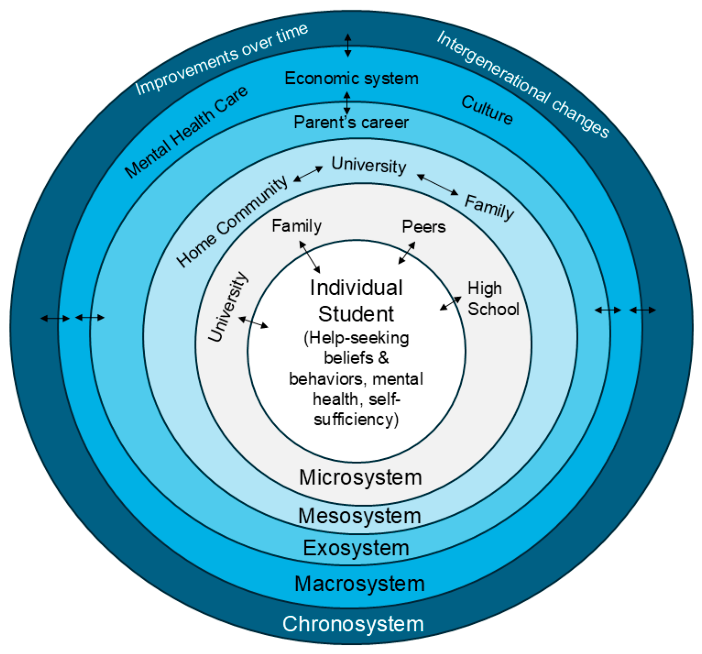
Figure 1. Coding diagram depicting the different systems that impact the individual student, based on Bronfenbrenner’s Ecological Systems Theory. Arrows represent bi-directional relationships between levels and within each system.
Education 16 01309 g001
Table 1. Select codes, definitions, and number of associated excerpts.
Codes and Categories 1DefinitionTotal Number of Excerpts
Resilience Factors/StrengthsPotential resilience or protective factors, or strengths, that support their adjustment, well-being, and/or academic success in college.260
Risk Factors/
Challenges
Potential challenges or barriers to adjustment, well-being, and/or academic success in college, or risk factors that could increase their likelihood of negative outcomes in college.257
Individual FactorsInternal and external factors that are specific to the first-generation college student’s experience, feelings, beliefs, and/or behaviors.802
Microsystem FactorsClosest relationships and immediate environments that the
individual directly participates in.
957
Mesosystem FactorsConnections/interactions between two Microsystem factors.116
Exosystem Factors 2Social settings and environments that indirectly impact the
individual and in which they do not directly participate.
13
Macrosystem FactorsCultural and societal influences on an individual’s development.255
Chronosystem
Factors
Changes over time.137
1 The final codebook included six categories (depicted in bold) and 66 codes. Excerpt frequencies for the categories and two cross-cutting codes are depicted above. 2 Because exosystem themes emerged so infrequently, they are not reported in the paper.
Table 2. Exemplar recommendations for high school personnel.
RecommendationsSample Quotes
Some students recommended introducing high school students to college-level procedures in high school (e.g., syllabi and college schedule course blocking).“The syllabus was very helpful … having things listed out and a contract between the student and teacher … Some of my teachers in high school didn’t really help me prepare for some of the classes. So… have… something that both the student and teacher can stick to in high school instead of jumping around a lot.”
Multiple students recommended avoiding extreme messaging or scare tactics around needing to be a college graduate or how difficult college will be.“… I got more pressure from the schools that I’ve gone to. … My high school had a lot more pressure. … One of my classes brought in this… person… to come talk to the class, and I went home crying that day because he sat there and scared the shit out of us being like ‘you can’t take a gap year, you have to go to college, you have to do this.’”

“… definitely tell them to just see it through …, give it a chance. … I had this one teacher that [would say] ‘all this stuff won’t fly in college, … you can’t act a certain way.’ … But I kind of found out … I haven’t changed much, … I’m doing pretty well. … So don’t be so harsh on students … we’re all young, we all make mistakes … some classes are going to be better than others …”
One student recommended offering concrete application support, like offering to look over college essays.“… ask … ‘what are your plans?’ early on, like end of junior year …, ask, … ‘what are your plans after school? Are you thinking about applying to colleges? Do you want me to look over your essay? … have you looked into application deadlines?’ … because those were all stuff that I had no clue and it was just like ‘oh, … I have to do this and I feel like I was rushed for time.’”
One student recommended identifying which students intend to be first-generation college students.“… talk about it more at school…. I don’t think my counselor knew I was the first person in my family to go to college. So … opening that up as a question, … between the school and the student to figure out if there is a better way to support them.”
One student recommended having distinct programming based on first-generation student status.“… definitely bring more attention to it … making sure students know that they’re a resource and that I know some schools do … a meeting where they talk about college life … but maybe doing … a separate meeting for students who want to know more, who are going to be a first-generation student.”
Many students recommended more support on navigating the financial aspects of college applications and affording college (e.g., FAFSA, scholarship applications, loans). One student also reported how helpful a first-generation scholarship has been to them, so making students aware of these scholarships, how early to apply, and perhaps even supporting them with applying would be helpful.“Especially for scholarships, that was another big thing, … no one told me about scholarships and … make sure you need to apply to them. And … a lot of the big ones it seemed really were given out junior year which was weird. Um, or at least … the ones that my school sent out …, the most they gave us was a PDF with … links and … the bigger scholarships you had to be a junior and I was like ‘well I’m a senior so I can’t apply to those.’”

“… I have a really amazing scholarship that’s helped me out. It’s a first-generation scholarship and … I could basically ask them for … any … advice or help and they’d be able to give it to me, which is amazing …, so it’s a 4 year scholarship and they cover … everything basically … I got it my junior year of high school and I did … zoom meetings to … prepare for the application process and we did zoom meetings on how to manage your time in college … And once I got here, there’s not as much contact, but I can reach out … whenever I
need for anything.”

“Yeah, I’d say we have … a …, financials class, … I thought it was very useful … Especially for … getting a job … down here and … making sure that you’re not spending it all, I guess.”
One student recommended hearing from people with lived experience (e.g., high school counselors who were first-generation).“I’d say … sharing personal experiences if they are also a first-gen … that could be helpful.”
Table 3. Exemplar recommendations for university personnel to improve first-generation college student resources.
RecommendationSample Quotes
Some students felt that the Bridge Program was an ‘overload’ of material, so condensing the program may be helpful.“in some ways, the information was a bit overloading … they gave you so much in a 3-day span while we were doing things all day to the point where it was a huge overload.”

“… some of the activities were a little long …”
Several students wanted follow-up communication after the Bridge Program (e.g., via email or flyers about resources).“reaching out with emails every so often on … useful things around the school would be helpful. Especially in the first few weeks when you’re already overloaded with … classes … Reaching out with … helpful emails of stuff to not forget about … specifically talk about [the Student Academic Success Center] (SASC) and TutorTrac … I got a pamphlet, but I don’t know how to access any of it …, following up with an email with specific links or guidelines on how to access it all would be a good idea. And not even just SASC, … the library, … all those … platforms where they’re essential to your college experience, but you might feel a little lost on how to get started with them.”
Many students wanted follow-up programming after the initial Bridge Program, like professional development events or social events aimed at maintaining connections with people with shared experiences.“having professional development things because … fun activities is good but also … having … something to professional development I think is good …. Anything like resume or just … learning something …”

“I think at least something … once a semester …, like a first-gen appreciation, I’m not … trying to say ‘appreciate me,’ but … to recognize that … we’re … the first in our family to go to college and it’s a big thing for a lot of people.”

“I think the social aspect is really hard and … that program was … good at … helping you build connections and stuff, so maybe holding … future events for us all to get together.”

“… there should be more programs … based on first-generational students and helping them …, navigate the way that college runs … I am super nervous about applying to grad school … so I honestly wish that there were more programs or events that are … informational … Or … groups who first-generational college students can get together and … talk about their experiences, because … there isn’t much of a community with that here.”
Some students thought having a more structured mentor program would be helpful.“doing a peer mentor with either students that are … first-generation or … yes with other first-generation students, I think would be helpful.”
Disclaimer/Publisher’s Note: The statements, opinions and data contained in all publications are solely those of the individual author(s) and contributor(s) and not of MDPI and/or the editor(s). MDPI and/or the editor(s) disclaim responsibility for any injury to people or property resulting from any ideas, methods, instructions or products referred to in the content.

