Do Executive Function Skills Moderate the Effect of Spanish Early Reading Skills on English Reading Trajectory

Abstract
1. Introduction
1.1. Cross-Language Transfer: The Role of Spanish Early Reading Skills in English Reading
1.2. The Role of Executive Function (EF) in English Reading
1.3. The Potential Moderating Role of EF in the Cross-Language Transfer
1.4. The Current Study
2. Methods
2.1. Data Source
2.2. Measures
2.2.1. English Reading Achievement
2.2.2. Spanish Early Reading Skills
2.2.3. Working Memory
2.2.4. Cognitive Flexibility
2.2.5. Inhibitory Control
2.2.6. Control Variables
2.3. Analytical Approach
Latent Growth Curve Analysis
3. Results
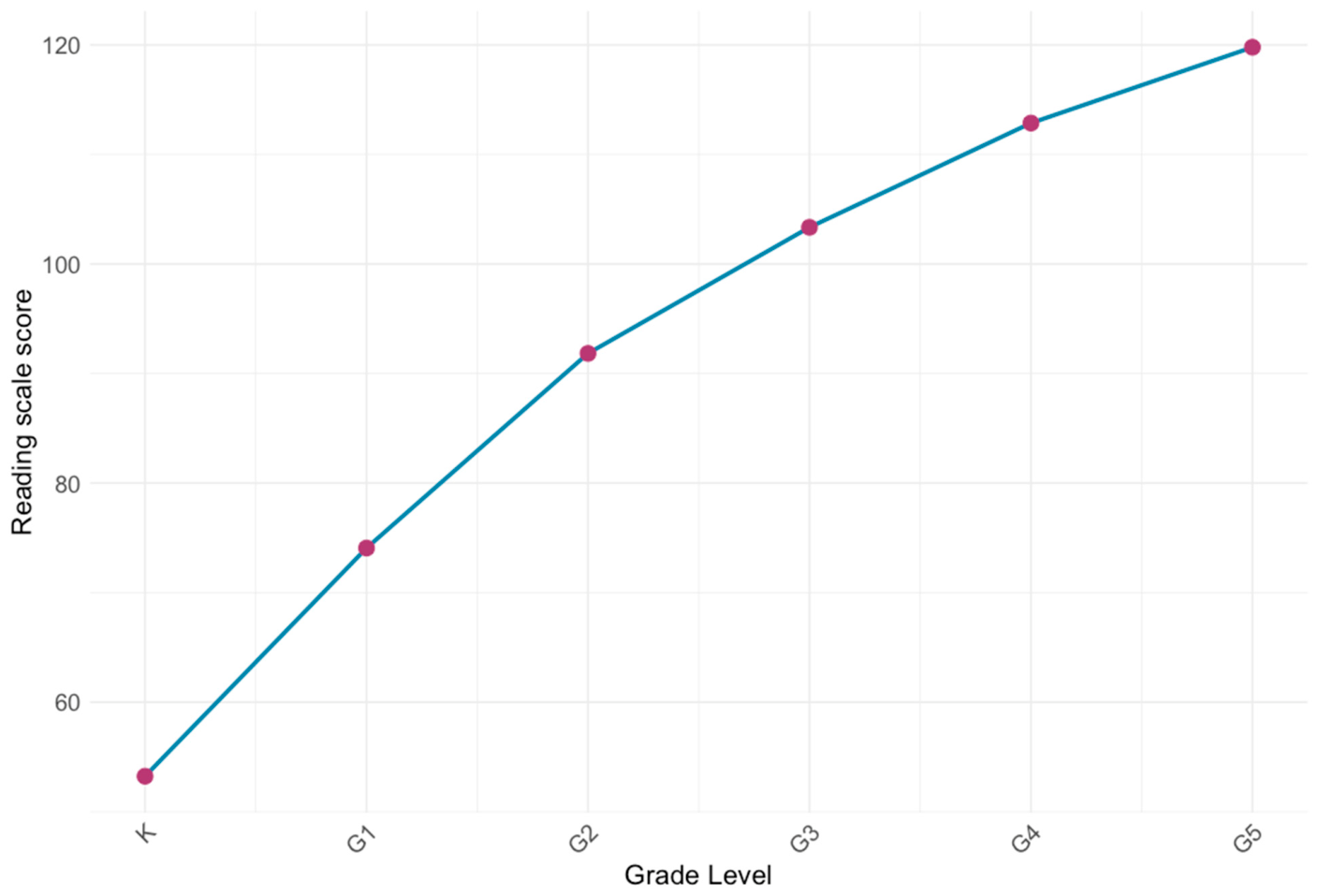
3.1. Unconditional Growth Curve Model
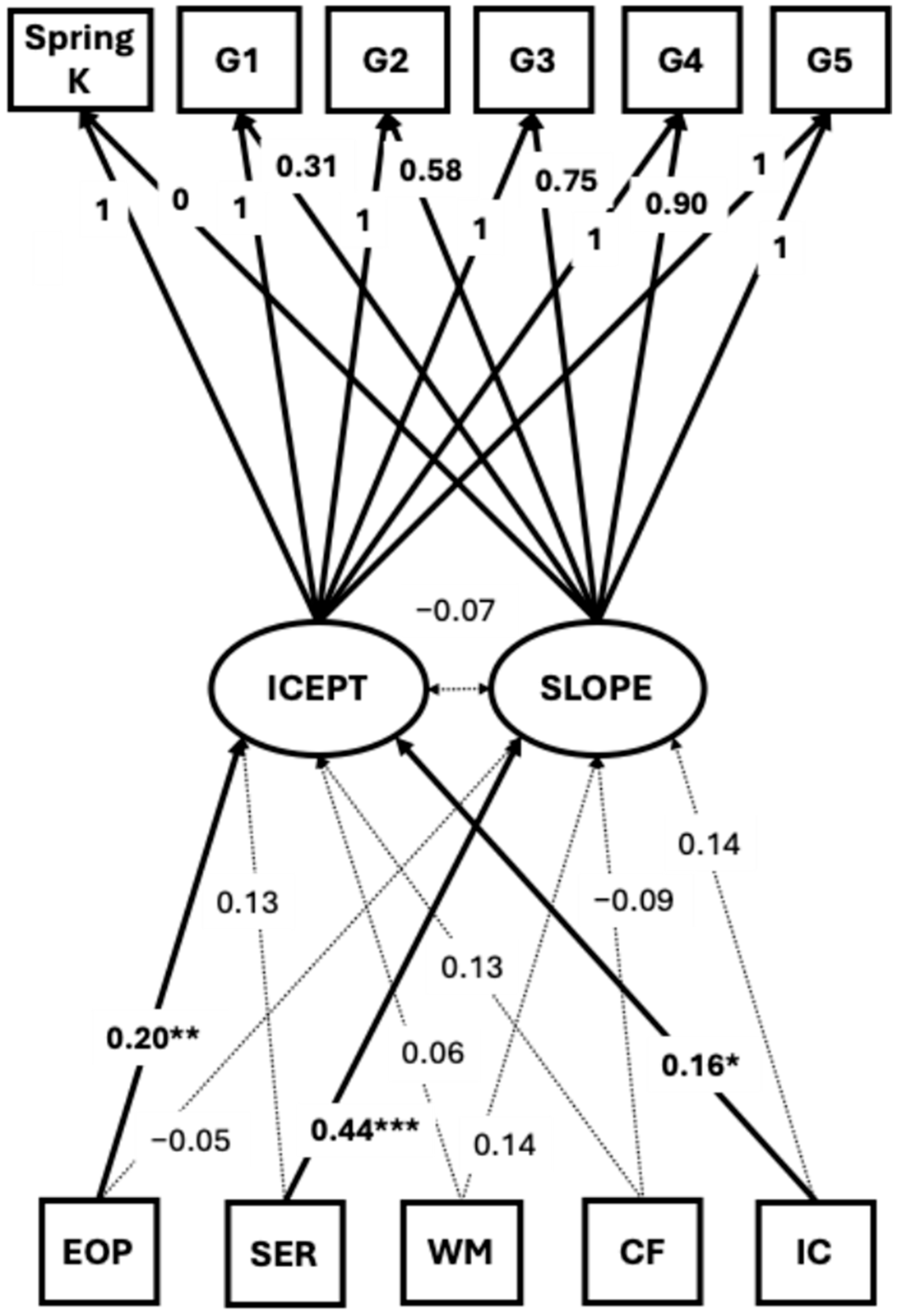
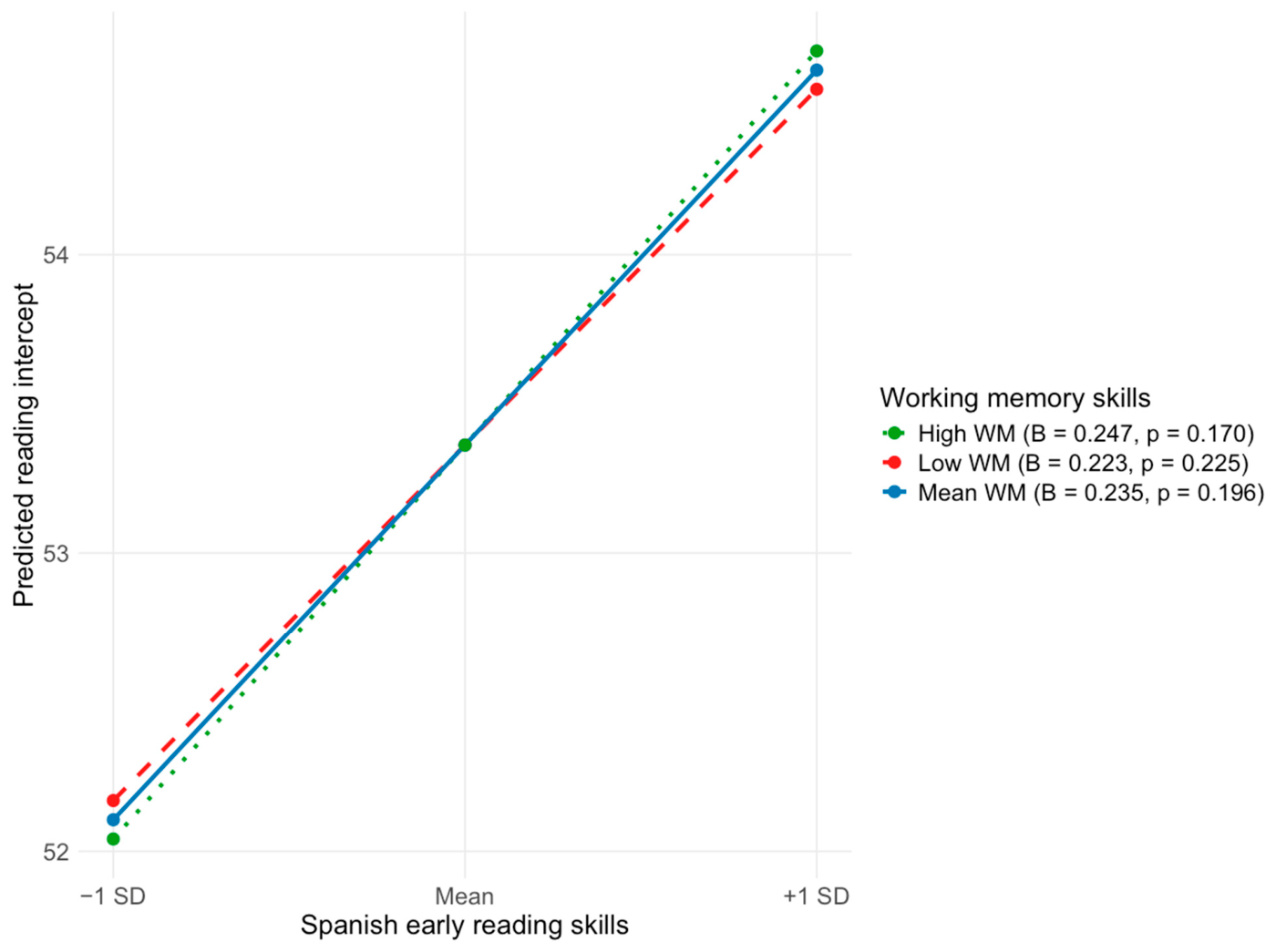
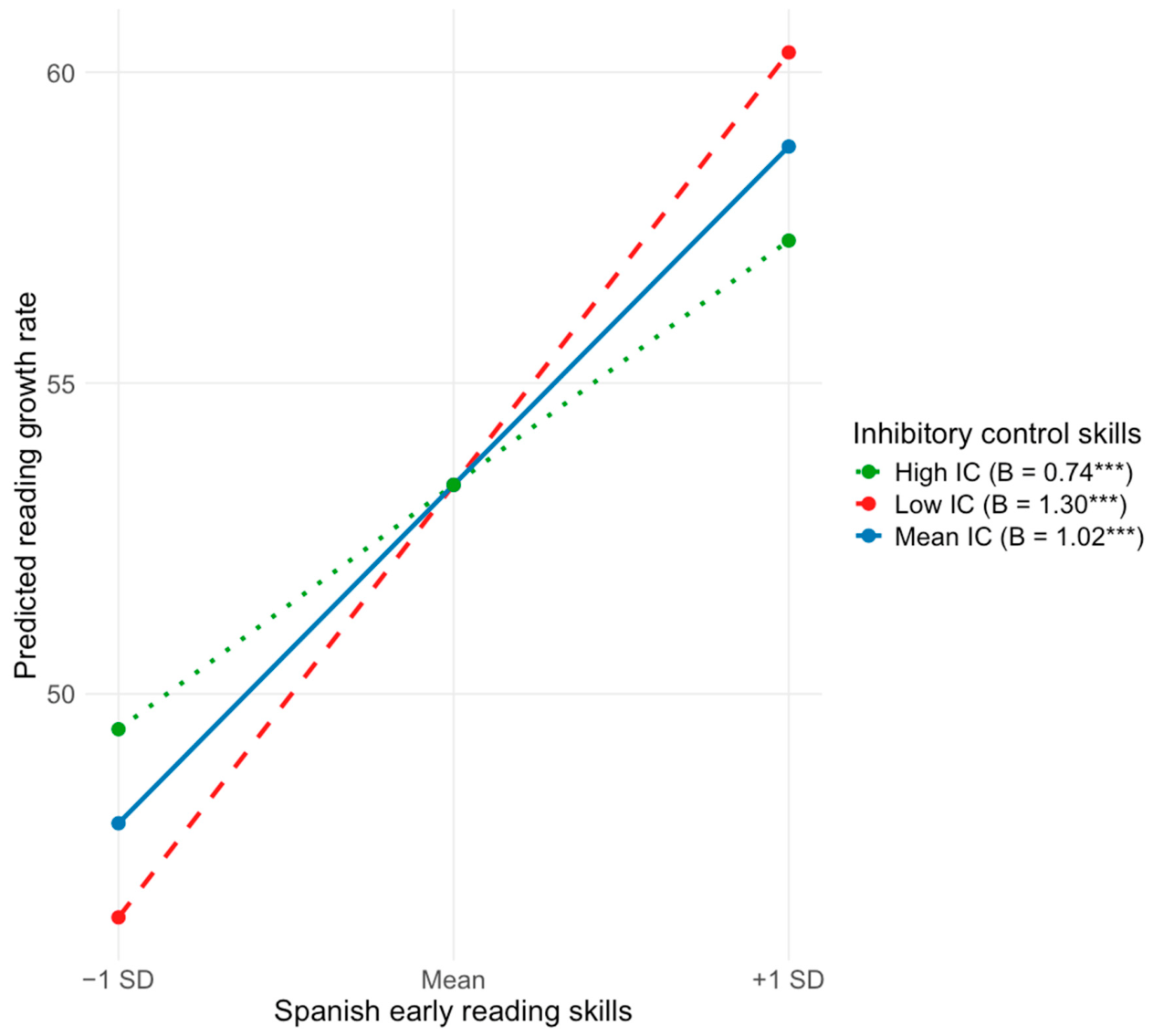
3.2. The Roles of Early Literacy and EF Skills
4. Discussion
4.1. Distinct Developmental Resources for Initial English Reading and Later Growth
4.2. EF as a Moderator in Cross-Language Transfer
4.3. Limitations and Future Directions
5. Conclusions
Author Contributions
Funding
Institutional Review Board Statement
Informed Consent Statement
Data Availability Statement
Acknowledgments
Conflicts of Interest
Abbreviations
| EB | Emergent Bilingual |
| EF | Executive Function |
| WM | Working Memory |
| IC | Inhibitory Control |
| CF | Cognitive Flexibility |
| ECLS-K:2011 | Early Childhood Longitudinal Study, Kindergarten Class of 2010–2011 |
| NCES | National Center for Education Statistics |
| L1 | First Language |
| L2 | Second Language |
| SES | Socioeconomic Status |
| FIML | Full Information Maximum Likelihood |
References
- Abedi, J. (2002). Standardized achievement tests and English language learners: Psychometrics issues. Educational Assessment, 8(3), 231–257. [Google Scholar] [CrossRef] [PubMed]
- Alfonso, S. V., & Lonigan, C. J. (2021). Executive function, language dominance and literacy skills in Spanish-speaking language-minority children: A longitudinal study. Early Childhood Research Quarterly, 57, 228–238. [Google Scholar] [CrossRef] [PubMed]
- Allan, N. P., Hume, L. E., Allan, D. M., Farrington, A. L., & Lonigan, C. J. (2014). Relations between inhibitory control and the development of academic skills in preschool and kindergarten: A meta-analysis. Developmental Psychology, 50(10), 2368–2379. [Google Scholar] [CrossRef] [PubMed]
- Bernhardt, E. B., & Kamil, M. L. (1995). Interpreting relationships between L1 and L2 reading: Consolidating the linguistic threshold and the linguistic interdependence hypotheses. Applied Linguistics, 16(1), 15–34. [Google Scholar] [CrossRef]
- Browne, M. W., & Cudeck, R. (1993). Alternative ways of assessing model fit. In K. A. Bollen, & J. S. Long (Eds.), Testing structural equation models (pp. 136–162). Sage Publications. [Google Scholar]
- Butterfuss, R., & Kendeou, P. (2018). The role of executive functions in reading comprehension. Educational Psychology Review, 30(3), 801–826. [Google Scholar] [CrossRef]
- Chen, P., Bobb, S. C., Hoshino, N., & Marian, V. (2017). Neural signatures of language co-activation and control in bilingual spoken word comprehension. Brain Research, 1665, 50–64. [Google Scholar] [CrossRef] [PubMed]
- Chen, X., Ramirez, G., Luo, Y. C., Geva, E., & Ku, Y.-M. (2012). Comparing vocabulary development in Spanish- and Chinese-speaking ELLs: The effects of metalinguistic and sociocultural factors. Reading and Writing, 25(8), 1991–2020. [Google Scholar] [CrossRef]
- Chung, S. C., Chen, X., & Geva, E. (2019). Deconstructing and reconstructing cross-language transfer in bilingual reading development: An interactive framework. Journal of Neurolinguistics, 50, 149–161. [Google Scholar] [CrossRef]
- Cummins, J. (1979). Linguistic interdependence and the educational development of bilingual children. Review of Educational Research, 49(2), 222–251. [Google Scholar] [CrossRef]
- Diamond, A. (2013). Executive functions. Annual Review of Psychology, 64(1), 135–168. [Google Scholar] [CrossRef] [PubMed]
- Duke, N. K., & Cartwright, K. B. (2021). The science of reading progresses: Communicating advances beyond the simple view of reading. Reading Research Quarterly, 56(S1), S25–S44. [Google Scholar] [CrossRef]
- Duncan, S. E., & De Avila, E. A. (1998). Pre-school language assessment scale (Pre-LAS 2000–English). CTB/McGraw-Hill. [Google Scholar]
- Duncan, T. E., Duncan, S. C., & Strycker, L. A. (2013). An introduction to latent variable growth curve modeling: Concepts, issues, and applications (2nd ed.). Routledge. [Google Scholar] [CrossRef]
- Farnia, F., & Geva, E. (2013). Growth and predictors of change in English language learners’ reading comprehension. Journal of Research in Reading, 36(4), 389–421. [Google Scholar] [CrossRef]
- Follmer, D. J. (2018). Executive function and reading comprehension: A meta-analytic review. Educational Psychologist, 53(1), 42–60. [Google Scholar] [CrossRef]
- Friedman, N. P., & Miyake, A. (2017). Unity and diversity of executive functions: Individual differences as a window on cognitive structure. Cortex, 86, 186–204. [Google Scholar] [CrossRef] [PubMed]
- Genesee, F., Geva, E., Dressler, C., & Kamil, M. (2006). Synthesis: Cross-linguistic relationships. In Developing literacy in second-language learners: Report of the national literacy panel on language-minority children and youth. Lawrence Erlbaum Associates. Available online: https://www.researchgate.net/publication/292697786_Synthesis_Cross-linguistic_relationships (accessed on 9 June 2026).
- Geva, E., & Ryan, E. B. (1993). Linguistic and cognitive correlates of academic skills in first and second languages. Language Learning, 43(1), 5–42. [Google Scholar] [CrossRef]
- Giguere, D., Tulloch, M. K., Core, C., & Hoff, E. (2024). Early skills that predict English reading ability: A longitudinal study of bilingual children from 5 to 10 years. Journal of Experimental Child Psychology, 246, 105993. [Google Scholar] [CrossRef] [PubMed]
- Goodrich, J. M., Lonigan, C. J., & Farver, J. M. (2013). Do early literacy skills in children’s first language promote development of skills in their second language? An experimental evaluation of transfer. Journal of Educational Psychology, 105(2), 414–426. [Google Scholar] [CrossRef] [PubMed]
- Green, D. W., & Abutalebi, J. (2013). Language control in bilinguals: The adaptive control hypothesis. Journal of Cognitive Psychology, 25(5), 515–530. [Google Scholar] [CrossRef] [PubMed]
- Hoover, W. A., & Gough, P. B. (1990). The simple view of reading. Reading and Writing, 2(2), 127–160. [Google Scholar] [CrossRef]
- Hoover, W. A., & Tunmer, W. E. (2022). The primacy of science in communicating advances in the science of reading. Reading Research Quarterly, 57(2), 399–408. [Google Scholar] [CrossRef]
- Hu, L., & Bentler, P. M. (1999). Cutoff criteria for fit indexes in covariance structure analysis: Conventional criteria versus new alternatives. Structural Equation Modeling: A Multidisciplinary Journal, 6(1), 1–55. [Google Scholar] [CrossRef]
- Hwang, H., Choi, S., Guha, M., McMaster, K., Harsch, R., & Kendeou, P. (2024). Indirect and direct contributions of executive functions to reading comprehension. Journal of Experimental Child Psychology, 243, 105925. [Google Scholar] [CrossRef] [PubMed]
- Incera, S., Martín, I. E., & Suárez-Coalla, P. (2025). The effects of attentional control and educational experience on reading ability in bilingual children. Revista de Logopedia, Foniatría y Audiología, 45(3), 100525. [Google Scholar] [CrossRef]
- Irwin, V., Wang, K., Jung, J., Kessler, E., Tezil, T., Alhassani, S., Filbey, A., Dilig, R., Mann, F. B., Barnett, M., Purcell, S., & Nachazel, T. (2024). Report on the condition of education 2024 (NCES 2024-144). U.S. Department of Education, National Center for Education Statistics. Available online: https://nces.ed.gov/pubsearch/pubsinfo.asp?pubid=2024144 (accessed on 9 June 2026).
- Jacob, R., & Parkinson, J. (2015). The potential for school-based interventions that target executive function to improve academic achievement: A review. Review of Educational Research, 85(4), 512–552. [Google Scholar] [CrossRef]
- Kaushanskaya, M., & Crespo, K. (2019). Does exposure to code-switching influence language performance in bilingual children? Child Development, 90(3), 708–718. [Google Scholar] [CrossRef] [PubMed]
- Kieffer, M. J., Mancilla-Martinez, J., & Logan, J. K. (2021). Executive functions and English reading comprehension growth in Spanish–English bilingual adolescents. Journal of Applied Developmental Psychology, 73, 101238. [Google Scholar] [CrossRef]
- Kilim, L., & Prior, A. (2025). Contribution of executive functions to reading comprehension in bilingual and monolingual 3rd grade children. Journal of Experimental Child Psychology, 260, 106333. [Google Scholar] [CrossRef] [PubMed]
- Kim, Y.-S. G. (2017). Why the simple view of reading is not simplistic: Unpacking component skills of reading using a direct and indirect effect model of reading (DIER). Scientific Studies of Reading, 21(4), 310–333. [Google Scholar] [CrossRef]
- Kim, Y.-S. G. (2020). Toward integrative reading science: The direct and indirect effects model of reading. Journal of Learning Disabilities, 53(6), 469–491. [Google Scholar] [CrossRef] [PubMed]
- Kim, Y.-S. G. (2023). Executive functions and morphological awareness explain the shared variance between word reading and listening comprehension. Scientific Studies of Reading, 27(5), 451–474. [Google Scholar] [CrossRef] [PubMed]
- Language and Reading Research Consortium (LARRC), Mesa, C., & Yeomans-Maldonado, G. (2021). English and Spanish predictors of grade 3 reading comprehension in bilingual children. Journal of Speech, Language, and Hearing Research, 64(3), 1–20. [Google Scholar] [CrossRef] [PubMed]
- Lee, J. (2010). Tripartite growth trajectories of reading and math achievement: Tracking national academic progress at primary, middle, and high school levels. American Educational Research Journal, 47(4), 800–832. [Google Scholar] [CrossRef]
- Lee Swanson, H., Orosco, M. J., & Lussier, C. M. (2015). Growth in literacy, cognition, and working memory in English language learners. Journal of Experimental Child Psychology, 132, 155–188. [Google Scholar] [CrossRef] [PubMed]
- Linck, J. A., Schwieter, J. W., & Sunderman, G. (2020). The differential role of executive functions in the cognitive control of language switching. Languages, 5(2), 19. [Google Scholar] [CrossRef]
- Mancilla-Martinez, J., Kieffer, M. J., Biancarosa, G., Christodoulou, J. A., & Snow, C. E. (2011). Investigating English reading comprehension growth in adolescent language minority learners: Some insights from the simple view. Reading and Writing, 24(3), 339–354. [Google Scholar] [CrossRef]
- Melby-Lervåg, M., & Lervåg, A. (2011). Cross-linguistic transfer of oral language, decoding, phonological awareness and reading comprehension: A meta-analysis of the correlational evidence. Journal of Research in Reading, 34(1), 114–135. [Google Scholar] [CrossRef]
- Miyake, A., Friedman, N. P., Emerson, M. J., Witzki, A. H., Howerter, A., & Wager, T. D. (2000). The unity and diversity of executive functions and their contributions to complex “frontal lobe” tasks: A latent variable analysis. Cognitive Psychology, 41(1), 49–100. [Google Scholar] [CrossRef] [PubMed]
- Muthén, L. K., & Muthén, B. O. (2024). Mplus (Version 8.11) [Computer software]. Muthén & Muthén. [Google Scholar]
- National Center for Education Statistics (NCES). (2024). English learners in public schools [The Condition of Education 2024]. U.S. Department of Education, Institute of Education Sciences. Available online: https://nces.ed.gov/programs/coe/indicator/cgf (accessed on 9 June 2026).
- Nugiel, T., Mitchell, M. E., Demeter, D. V., Garza, A., Cirino, P. T., Hernandez, A. E., Juranek, J., & Church, J. A. (2023). Brain engagement during a cognitive flexibility task relates to academic performance in English learners. Mind, Brain, and Education, 17(2), 149–160. [Google Scholar] [CrossRef] [PubMed]
- Ober, T. M., Brooks, P. J., Homer, B. D., & Rindskopf, D. (2020). Executive functions and decoding in children and adolescents: A meta-analytic investigation. Educational Psychology Review, 32(3), 735–763. [Google Scholar] [CrossRef]
- Peng, P., Barnes, M., Wang, C., Wang, W., Li, S., Swanson, H. L., Dardick, W., & Tao, S. (2018). A meta-analysis on the relation between reading and working memory. Psychological Bulletin, 144(1), 48–76. [Google Scholar] [CrossRef] [PubMed]
- Proctor, C. P., August, D., Carlo, M. S., & Snow, C. (2006). The intriguing role of Spanish language vocabulary knowledge in predicting English reading comprehension. Journal of Educational Psychology, 98(1), 159–169. [Google Scholar] [CrossRef]
- Proctor, C. P., August, D., Snow, C., & Barr, C. D. (2010). The interdependence continuum: A perspective on the nature of Spanish–English bilingual reading comprehension. Bilingual Research Journal, 33(1), 5–20. [Google Scholar] [CrossRef]
- Putnam, S. P., & Rothbart, M. K. (2006). Development of short and very short forms of the children’s behavior questionnaire. Journal of Personality Assessment, 87(1), 102–112. [Google Scholar] [CrossRef] [PubMed]
- Relyea, J. E. (2025). Unpacking heterogeneity: Executive function and reading development in U.S. multilingual children from kindergarten to third grade. Learning and Individual Differences, 120, 102690. [Google Scholar] [CrossRef]
- Relyea, J. E., & Amendum, S. J. (2020). English reading growth in Spanish-speaking bilingual students: Moderating effect of English proficiency on cross-linguistic influence. Child Development, 91(4), 1150–1165. [Google Scholar] [CrossRef] [PubMed]
- Relyea, J. E., Cho, E., & Zagata, E. (2023). First-grade multilingual students’ executive function profiles and links to English reading achievement and difficulties: A person-centered latent profile analysis. Annals of Dyslexia, 73(1), 29–52. [Google Scholar] [CrossRef] [PubMed]
- Shen, Y. (2025a). Early literacy and executive function profiles in Spanish–English emergent bilinguals. Learning and Individual Differences, 123, 102775. [Google Scholar] [CrossRef]
- Shen, Y. (2025b). Relative importance of early literacy and executive function skills on Spanish–English emergent bilinguals’ English reading achievement across primary years. Journal of Educational Psychology, 117(5), 701–716. [Google Scholar] [CrossRef]
- Shen, Y. (2025c). Working memory growth and early Spanish reading interact to shape reading and math gains for Spanish–English emergent bilinguals. Contemporary Educational Psychology, 81, 102366. [Google Scholar] [CrossRef]
- Shen, Y., & Goodrich, J. M. (2024). Cross-linguistic influence of early Spanish reading on English reading trajectories among Spanish–English emergent bilinguals: A latent class growth analysis. Journal of Educational Psychology, 116(1), 139–152. [Google Scholar] [CrossRef]
- Shen, Y., & Wang, R. (2024). Different roles of family socioeconomic status in academic trajectories between emergent bilinguals and their peers across primary years. Journal of Educational Psychology, 116(7), 1250–1266. [Google Scholar] [CrossRef]
- Spencer, M., Richmond, M. C., & Cutting, L. E. (2020). Considering the role of executive function in reading comprehension: A structural equation modeling approach. Scientific Studies of Reading, 24(3), 179–199. [Google Scholar] [CrossRef] [PubMed]
- Spiegel, J. A., Goodrich, J. M., Morris, B. M., Osborne, C. M., & Lonigan, C. J. (2021). Relations between executive functions and academic outcomes in elementary school children: A meta-analysis. Psychological Bulletin, 147(4), 329–351. [Google Scholar] [CrossRef] [PubMed]
- Swanson, H. L., Orosco, M. J., & Kudo, M. (2017). Does growth in the executive system of working memory underlie growth in literacy for bilingual children with and without reading disabilities? Journal of Learning Disabilities, 50(4), 386–407. [Google Scholar] [CrossRef] [PubMed]
- Taboada Barber, A., Cartwright, K. B., Hancock, G. R., & Klauda, S. L. (2021). Beyond the simple view of reading: The role of executive functions in emergent bilinguals’ and English monolinguals’ reading comprehension. Reading Research Quarterly, 56(S1), S45–S64. [Google Scholar] [CrossRef]
- Tourangeau, K., Nord, C., Lê, T., Sorongon, A. G., Hagedorn, M. C., Daly, P., & Najarian, M. (2015). Early childhood longitudinal study, Kindergarten class of 2010–11 (ECLS-K:2011): User’s manual for the ECLS-K:2011 kindergarten data file and electronic codebook, public version (NCES 2015-074). National Center for Education Statistics. Available online: https://files.eric.ed.gov/fulltext/ED566378.pdf (accessed on 9 June 2026).
- Tourangeau, K., Nord, C., Lê, T., Wallner-Allen, K., Vaden-Kiernan, N., Blaker, L., & Najarian, M. (2019). Early childhood longitudinal study, Kindergarten class of 2010–11 (ECLS-K:2011): User’s manual for the ECLS-K:2011 kindergarten–fifth grade data file and electronic codebook, public version (NCES 2019-051). National Center for Education Statistics. [Google Scholar]
- Wagley, N., Marks, R. A., Bedore, L. M., & Kovelman, I. (2022). Contributions of bilingual home environment and language proficiency on children’s Spanish–English reading outcomes. Child Development, 93(4), 881–899. [Google Scholar] [CrossRef] [PubMed]
- Weaver, A., & Kieffer, M. J. (2022). Exploring the English language comprehension, reading fluency, and executive functions of Spanish–English bilingual adolescents with reading difficulties. Reading & Writing Quarterly, 38(3), 233–252. [Google Scholar] [CrossRef]
- Wei, T., Liu, X., & Barnard-Brak, L. (2015). Gender differences in mathematics and reading trajectories among children from kindergarten to eighth grade. Research in Education, 93(1), 77–89. [Google Scholar] [CrossRef]
- Welsh, J. A., Nix, R. L., Blair, C., Bierman, K. L., & Nelson, K. E. (2010). The development of cognitive skills and gains in academic school readiness for children from low-income families. Journal of Educational Psychology, 102(1), 43–53. [Google Scholar] [CrossRef] [PubMed]
- Woodcock, R. W., McGrew, K. S., & Mather, N. (2001). Woodcock-Johnson III tests of achievement. Riverside Publishing. [Google Scholar]
- Yeniad, N., Malda, M., Mesman, J., Van IJzendoorn, M. H., & Pieper, S. (2013). Shifting ability predicts math and reading performance in children: A meta-analytical study. Learning and Individual Differences, 23, 1–9. [Google Scholar] [CrossRef]
- Zelazo, P. D. (2006). The dimensional change card sort (DCCS): A method of assessing executive function in children. Nature Protocols, 1(1), 297–301. [Google Scholar] [CrossRef] [PubMed]



| Variable | Minimum | Maximum | Missingness % | Mean | SD |
|---|---|---|---|---|---|
| K reading | 32.58 | 86.15 | 2.27% | 53.36 | 10.47 |
| G1 reading | 32.77 | 114.32 | 6.82% | 74.07 | 15.25 |
| G2 reading | 45.91 | 137.80 | 9.09% | 91.90 | 16.22 |
| G3 reading | 65.55 | 144.23 | 11.36% | 103.59 | 15.53 |
| G4 reading | 76.62 | 149.07 | 13.64% | 113.76 | 15.43 |
| G5 reading | 73.63 | 157.35 | 14.29% | 120.46 | 16.02 |
| Spanish early reading skills | 2.83 | 29.12 | 0.00% | 12.80 | 5.35 |
| Working memory | 393.00 | 494.00 | 0.32% | 401.04 | 19.14 |
| Cognitive flexibility | 0.00 | 18.00 | 0.32% | 11.08 | 4.48 |
| Inhibitory control | 1.00 | 7.00 | 10.71% | 4.65 | 1.32 |
| English oral proficiency | 0.00 | 11.00 | 0.00% | 4.69 | 3.31 |
| Age | 57.57 | 81.93 | 0.65% | 66.14 | 4.27 |
| Female | 0.00 | 1.00 | 0.65% | 0.51 | 0.50 |
| SES | −2.33 | 0.40 | 13.64% | −1.08 | 0.38 |
| 1 | 2 | 3 | 4 | 5 | 6 | 7 | 8 | 9 | 10 | 11 | 12 | 13 | 14 | |
|---|---|---|---|---|---|---|---|---|---|---|---|---|---|---|
| 1. K reading | 1 | |||||||||||||
| 2. G1 reading | 0.64 *** | 1 | ||||||||||||
| 3. G2 reading | 0.59 *** | 0.83 *** | 1 | |||||||||||
| 4. G3 reading | 0.53 *** | 0.72 *** | 0.85 *** | 1 | ||||||||||
| 5. G4 reading | 0.54 *** | 0.74 *** | 0.82 *** | 0.84 *** | 1 | |||||||||
| 6. G5 reading | 0.49 *** | 0.70 *** | 0.78 *** | 0.83 *** | 0.84 *** | 1 | ||||||||
| 7. Spanish early reading skills | 0.22 ** | 0.43 *** | 0.44 *** | 0.44 *** | 0.46 *** | 0.51 *** | 1 | |||||||
| 8. Working memory | 0.14 | 0.29 *** | 0.31 *** | 0.33 *** | 0.30 *** | 0.36 *** | 0.50 *** | 1 | ||||||
| 9. Cognitive flexibility | 0.21 ** | 0.28 *** | 0.25 *** | 0.19 ** | 0.22 *** | 0.20 *** | 0.31 *** | 0.21 *** | 1 | |||||
| 10. Inhibitory control | 0.24 *** | 0.30 *** | 0.33 *** | 0.33 *** | 0.32 *** | 0.30 *** | 0.24 *** | 0.15 * | 0.26 *** | 1 | ||||
| 11. English oral proficiency | 0.20 ** | 0.16 * | 0.16 * | 0.11 | 0.11 | 0.10 | 0.07 | −0.02 | 0.09 | 0.06 | 1 | |||
| 12. Age | 0.11 | 0.15 *** | 0.20 ** | 0.11 | 0.13 * | 0.14 * | 0.39 *** | 0.23 *** | 0.25 *** | 0.11 | 0.11 | 1 | ||
| 13. Female | 0.20 ** | 0.22 *** | 0.24 *** | 0.23 *** | 0.21 ** | 0.22 *** | 0.24 *** | 0.06 | 0.14 * | 0.27 *** | 0.03 | 0.09 | 1 | |
| 14. SES | 0.09 | 0.12 | 0.10 | 0.08 | 0.12 * | 0.13 | 0.14 * | 0.14 * | 0.05 | 0.04 | 0.00 | −0.03 | 0.01 | 1 |
Disclaimer/Publisher’s Note: The statements, opinions and data contained in all publications are solely those of the individual author(s) and contributor(s) and not of MDPI and/or the editor(s). MDPI and/or the editor(s) disclaim responsibility for any injury to people or property resulting from any ideas, methods, instructions or products referred to in the content. |
© 2026 by the authors. Licensee MDPI, Basel, Switzerland. This article is an open access article distributed under the terms and conditions of the Creative Commons Attribution (CC BY) license.
Share and Cite
Zheng, Z.; Yan, L.; Shen, Y. Do Executive Function Skills Moderate the Effect of Spanish Early Reading Skills on English Reading Trajectory. Educ. Sci. 2026, 16, 1243. https://doi.org/10.3390/educsci16081243
Zheng Z, Yan L, Shen Y. Do Executive Function Skills Moderate the Effect of Spanish Early Reading Skills on English Reading Trajectory. Education Sciences. 2026; 16(8):1243. https://doi.org/10.3390/educsci16081243
Chicago/Turabian StyleZheng, Zihan, Lingyi Yan, and Ye Shen. 2026. "Do Executive Function Skills Moderate the Effect of Spanish Early Reading Skills on English Reading Trajectory" Education Sciences 16, no. 8: 1243. https://doi.org/10.3390/educsci16081243
APA StyleZheng, Z., Yan, L., & Shen, Y. (2026). Do Executive Function Skills Moderate the Effect of Spanish Early Reading Skills on English Reading Trajectory. Education Sciences, 16(8), 1243. https://doi.org/10.3390/educsci16081243