1. Introduction
Kindergarten represents a pivotal developmental stage in children’s lives, providing opportunities to acquire foundational skills such as self-regulation, positive social interactions, and attitudes that shape their ongoing learning and developmental pathways. This transition is not simply a change in physical environment but a complex developmental milestone that influences both immediate and long-term educational trajectories. The period of transition into kindergarten has been consistently recognized as critical for establishing children’s academic foundation, social–emotional competence, and overall adjustment to formal schooling (
Sands & Meadan, 2024). When managed effectively, the transition process supports children’s adaptation to new social and learning environments, which, in turn, positively influences academic achievement, social functioning, and emotional well-being (
Szydlo & Farnsworth, 2023). Conversely, poorly managed transitions may contribute to increased anxiety, reduced engagement, and persistent academic and behavioral challenges (
Szydlo & Farnsworth, 2023). Early social and emotional skills developed during this period are strong predictors of later school success, highlighting the importance of intentional planning and support during this developmental stage (
Wartmann, 2000).
Within the broader field of early intervention and early childhood special education (EI/ECSE), the transition to kindergarten represents a critical systems-level shift from early intervention services to school-based supports. This transition requires continuity in evidence-based, individualized, and family-centered practices delivered across home, community, and school settings. Despite this established knowledge base, challenges remain in translating evidence-based transition practices into consistent and high-quality implementation across diverse educational contexts.
The transition to kindergarten is particularly complex for children with disabilities. Unlike their typically developing peers, children with disabilities encounter an additional layer of transition as they adapt to differences in the nature and intensity of services, new instructional expectations, and classroom dynamics that may involve integration into inclusive settings (
Daley et al., 2011). For these children, a smooth transition can mitigate stress and anxiety, buffer against negative emotions, and support both academic and social growth (
Alberque & Matthews, 2024;
Szydlo & Farnsworth, 2023). Beyond child-specific benefits, the kindergarten transition process plays a vital role in the collaborative development of individualized educational goals that align with the expectations of children, families, and schools (
Kim, 2023). It also serves as a mechanism for identifying children’s strengths, abilities, challenges, and support needs in a way that promotes shared responsibility between educators and families (
Alberque & Matthews, 2024). When well supported, the transition for children with disabilities fosters inclusive communication, personalized services, and collaborative partnerships that enhance both learning and developmental outcomes (
Szydlo & Farnsworth, 2023).
Grounded in recommended practices within EI/ECSE, effective transition processes emphasize family-centered engagement, interdisciplinary collaboration, and the use of evidence-based strategies to support both child and family outcomes (
Division for Early Childhood, 2014). However, emerging research suggests that these practices are not consistently implemented, with variability influenced by contextual, structural, and resource-related factors (
Division for Early Childhood, 2014;
Daley et al., 2011;
Quintero & McIntyre, 2011).
For the purposes of this review, the kindergarten transition is defined as a multi-year continuum rather than a discrete event. This process begins up to two years prior to school entry, continues through the point of entry, and extends into the first two years of formal schooling (
Kim, 2023;
Alberque & Matthews, 2024;
Scheerder et al., 2017). Such an extended conceptualization highlights that the transition is an evolving process encompassing preparation, entry, and post-entry adjustment. Recognizing its longitudinal nature is essential for understanding the scope of parental involvement, the dynamic needs of children, and the importance of sustained supports throughout the early years of schooling. This continuum perspective is consistent with early intervention frameworks that prioritize proactive planning, continuity of services, and sustained support across developmental stages, rather than isolated or one-time transition activities.
A successful transition into kindergarten requires the coordinated involvement of families, educators, administrators, and other professionals engaged in children’s educational journeys (
Kim, 2023). Each stakeholder contributes unique expertise and responsibilities. Families, in particular, play a foundational role by advocating for their child’s needs, reinforcing learning goals at home, and building trust with school personnel (
Alberque & Matthews, 2024). Parents, as primary caregivers, are uniquely positioned to interpret their child’s developmental profile, communicate priorities to educators, and ensure that services remain aligned with the child’s evolving needs (
Alberque & Matthews, 2024). In addition, parents serve as advocates, decision-makers, and cultural informants whose insights reveal both the strengths and limitations of existing transition practices (
Scheerder et al., 2017). Recognizing and valuing parental perspectives is therefore critical for building equitable and inclusive transition systems that align with family-centered care models and the principles outlined in the Individuals with Disabilities Education Act (
IDEA, 2004). In this context, parents’ experiences provide essential insight into how evidence-based practices are enacted in real-world settings, including the extent to which systems effectively support family engagement, equity, and culturally and linguistically responsive practices.
Despite the importance of parental voices, the literature lacks a comprehensive and systematic synthesis of how families of children with disabilities navigate and experience the kindergarten transition. While several reviews have synthesized parental perspectives, existing reviews tend to focus on children without disabilities or approach transitions primarily from professional or systemic standpoints. For example,
Morawska et al. (
2026) conducted a systematic review of 61 studies on parents’ experiences during school transitions, but the majority of the included studies centered on typically developing children, offering only limited insight into families of children with disabilities. Similarly,
Fontil et al. (
2020) reviewed 39 studies concerning children with autism and other developmental disabilities but emphasized structural and professional barriers rather than families’ lived experiences. Other systematic reviews address school transitions in broader or later educational contexts (
Hughes, 2013;
Jindal-Snape et al., 2020;
Van Rens et al., 2018).
Hughes (
2013) and
Jindal-Snape et al. (
2020), for instance, focused on secondary school transitions, while
Van Rens et al. (
2018) examined interventions designed to support transitions but noted that families were frequently excluded from planning and evaluation processes. Collectively, these reviews provide valuable insights yet do not offer a comprehensive synthesis of parental perspectives specific to the kindergarten transition for children with disabilities. Moreover, limited attention has been given to examining how evidence-based transition practices are implemented, adapted, and experienced by families across diverse contexts, particularly in relation to issues of implementation fidelity, feasibility, and equity.
Addressing this gap is critical given that parents are not passive participants but central actors whose expectations, experiences, and advocacy profoundly shape transition outcomes. Their perspectives shed light on the relational, cultural, and systemic dynamics that either facilitate or hinder successful transitions (
Kim, 2023;
Starr et al., 2016;
Villeneuve et al., 2013). By focusing specifically on parental voices, researchers and practitioners can better understand not only the logistical and procedural aspects of transition but also the emotional and relational dimensions that underlie families’ experiences. Such insights are necessary to design more inclusive and responsive policies and practices that honor family expertise and strengthen home–school partnerships during this pivotal developmental stage. In addition, understanding parental perspectives can inform the development of innovative and scalable approaches, including technology-enhanced and coaching-based models, that support both families and educators in implementing effective transition practices.
The purpose of this systematic review is therefore to synthesize research on how parents of children with disabilities perceive and navigate the kindergarten transition. The review analyzes parental experiences, including their concerns, expectations, advocacy strategies, and perceived supports during this process. It also examines the extent to which these experiences reflect the use, implementation, and effectiveness of evidence-based transition practices within early intervention and early childhood special education systems. It further identifies recurring themes to highlight systemic challenges, effective practices, and gaps in current transition policies relevant to early childhood special education. Unlike broader reviews that conflate populations or emphasize educator perspectives, this review contributes uniquely to the field by offering a focused synthesis of parents’ lived experiences. By integrating insights related to practice, implementation, and family engagement, this review aims to inform future research, policy, and innovation in EI/ECSE. This systematic review is guided by the following research questions: (1) What are the descriptive characteristics of studies investigating parents’ perspectives on the transition to kindergarten for children with disabilities? (2) What is the methodological quality of studies included in this review? (3) What are the perspectives of parents on the transition to kindergarten for children with disabilities, including their expectations, challenges, and experiences of support?
2. Method
This study employed a systematic review methodology to explore and synthesize existing research on families’ experiences in the kindergarten transition process for children with disabilities. In addition, the review aimed to examine how these experiences reflect the use and implementation of evidence-based transition practices within EI/ECSE systems. A systematic review provides a structured approach to identifying, evaluating, and analyzing available evidence to produce a transparent, rigorous, and reliable synthesis of the literature (
Scheerder et al., 2017). The review was guided by the Preferred Reporting Items for Systematic Reviews and Meta-Analyses (PRISMA) framework (
PRISMA, 2020), ensuring methodological transparency and replicability. No prospective registration protocol was established for this review.
2.1. Search and Selection Procedures
A comprehensive search strategy was developed to identify peer-reviewed studies that examined parents’ experiences of the transition to kindergarten for children with disabilities. Consistent with the focus of this review, the search also aimed to capture studies describing transition practices, family engagement approaches, and implementation-related factors within EI/ECSE contexts. The search was conducted in February 2026 across the following electronic databases: Academic Search Complete, PsycINFO, Education Source, and Education Resources Information Center. These databases were selected for their broad coverage of education, psychology, and special education scholarship. Search terms were constructed using Boolean operators (AND, OR) and applied consistently across all four databases. The primary search string combined three conceptual clusters: (1) transition terminology: “kindergarten transition” OR “school transition” OR “transition to kindergarten”; (2) family participants: “parent*” OR “family” OR “caregiver” OR “mother” OR “father”; and (3) disability and perspective: “children with disabilities” OR “special needs” OR “developmental disabilities” AND “perspective*” OR “experience*” OR “perception*.” Search terms were applied to title, abstract, and keyword fields. Keywords were identified through prior literature and database indexing terms. Filters were applied to include only full-text, peer-reviewed journal articles published in English. No restrictions were placed on publication year to capture both foundational and recent contributions. Additional attention was given during screening to studies that described evidence-based practices, intervention strategies, or structured transition supports. The initial selection was based on screening titles, abstracts, and keywords for relevance. In addition, manual searches of reference lists from relevant reviews and empirical studies were conducted to identify additional eligible articles.
2.2. Inclusion and Exclusion Criteria
Studies were included in the review if they were published in a peer-reviewed academic journal, included parents or guardians of children with disabilities as primary participants, and focused specifically on the kindergarten transition process for children with disabilities. Eligible studies employed qualitative, quantitative, or mixed-methods approaches; were available in full text; and were written in English. For the purpose of this review, children with disabilities were defined broadly to include those with developmental delays, intellectual disabilities, autism spectrum disorder, and other recognized special education needs. Studies were also examined for their relevance to early intervention and early childhood special education practices, including the extent to which they described transition-related supports, services, or interventions. No geographic restrictions were applied in order to capture a diverse range of parental perspectives. Conversely, studies were excluded if they did not meet these standards. Specifically, studies were excluded if they were not published in peer-reviewed journals (e.g., dissertations, reports, or editorials), did not include parents or guardians as participants, focused exclusively on children without identified disabilities, or did not examine the kindergarten transition process.
2.3. Search Results
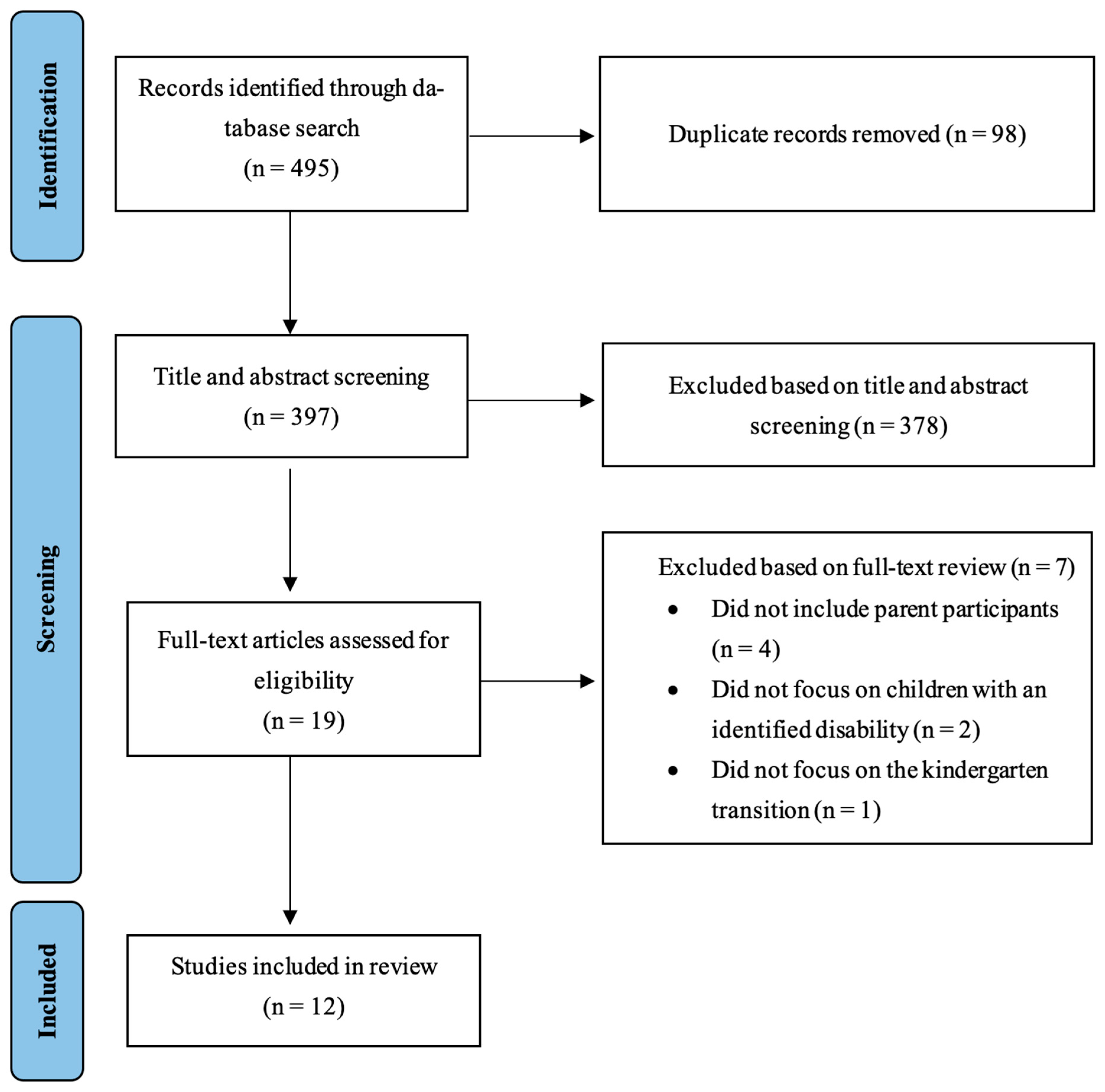
The database search initially yielded 495 articles. After removing 98 duplicates, 397 unique records remained. These records were downloaded as PDF files, assigned unique identification numbers, and stored in a centralized screening folder. A two-step screening process was conducted by the first author under the supervision of the co-author. In the first stage, titles and abstracts of all 397 records were reviewed, resulting in the exclusion of 378 studies that clearly did not meet inclusion criteria. The full texts of the remaining 19 studies were then examined in detail. Seven additional studies were excluded at this stage: four did not include parent participants, two did not focus on children with identified disabilities, and one did not address the kindergarten transition. Ultimately, 12 studies met all inclusion criteria and were included in the final synthesis. These studies collectively provided insight into parental perspectives as well as the implementation of transition practices across diverse contexts. The full selection process is summarized in the PRISMA flow diagram (see
Figure 1).
2.4. Data Extraction and Descriptive Coding
A coding spreadsheet was developed to systematically extract and organize study characteristics. The following variables were recorded for each study: (a) author(s), publication year, and country; (b) research design; (c) data collection tools or measures; (d) analytic strategies; (e) participant demographics (age, gender, cultural background); and (f) types of disabilities represented among children of participating parents. In addition, data were extracted on the types of transition practices described (e.g., individualized supports, family engagement strategies, structured programs) and any references to evidence-based or recommended practices when available.
2.5. Quality Assessment
The Mixed Methods Appraisal Tool (MMAT, Version 2018;
Hong et al., 2018) was used to evaluate the methodological quality of included studies. The MMAT allows for appraisal across five methodological categories: qualitative research, randomized controlled trials, non-randomized studies, quantitative descriptive studies, and mixed methods research. Each category contains five criteria, resulting in 25 appraisal items in total. In this review, only the criteria for qualitative studies and quantitative descriptive studies were applied, as no included studies used randomized controlled trials or mixed-methods designs. Of the 12 studies, nine were assessed using the quantitative descriptive criteria and three using the qualitative criteria. Each study was rated for each criterion as
Yes (Y) if the criterion was fully met,
Partially (P) if partially met, or
Not Reported (NR) if missing or unclear. A quality score was then calculated by dividing the number of “Yes” responses by five (the total criteria) and multiplying by 100. Percentage scores were used in this review as a descriptive reporting convention to facilitate the presentation and comparison of methodological characteristics across studies with different designs. These scores were not used to generate an overall quality ranking or as a basis for excluding studies from the review, consistent with MMAT guidance (
Hong et al., 2018). Instead, the criterion-by-criterion appraisal was emphasized, and detailed results for each MMAT criterion are presented in
Table 1. The MMAT was selected as the appraisal tool for this review because it is specifically designed to evaluate studies across multiple methodological categories, including qualitative and quantitative descriptive designs. MMAT is uniquely suited to reviews that synthesize methodologically diverse primary studies.
2.6. Thematic Analysis of Parental Experience
To analyze parental experience, an inductive thematic analysis was conducted following
Braun and Clarke’s (
2006) six-step framework. Themes were generated directly from the data rather than pre-determined categories. The process began with repeated readings of the results and discussion sections of each study, followed by line-by-line coding to capture parental experiences, expectations, and concerns (
Strauss & Corbin, 1998). Codes were iteratively compared and grouped into broader categories using the constant comparison method (
Miles et al., 2014). All coding was conducted manually using a structured coding table to document excerpts, codes, and analytic notes. Particular attention was given to identifying themes related to the implementation, accessibility, and perceived effectiveness of transition practices, as well as barriers and facilitators influencing their use.
2.7. Inter-Rater Reliability
Screening of titles, abstracts, and full texts was conducted by the first author under the supervision of the co-author. Data extraction and descriptive coding were similarly completed by the first author. To ensure consistency in the review process, inter-rater reliability (IRR) was calculated for screening, descriptive coding, quality assessment, and thematic analysis. A secondary researcher independently reviewed 41.7% of the included studies. Agreement rates were 100% for screening and descriptive coding, 92% for quality assessment, and 100% for thematic analysis. IRR was calculated using the percent agreement formula: IRR = Agreements ÷ (Agreements + Disagreements) × 100 (
Miles & Huberman, 1994). The high agreement rates indicated strong consistency and reliability in the review process.
4. Discussion
This review synthesized findings from 12 studies examining parents’ perspectives on the transition to kindergarten for children with disabilities. Situated within the broader context of EI/ECSE, families described the transition as a process marked by uncertainty, advocacy, and high emotional stakes. While studies varied in design, several consistent patterns emerged that highlight both ongoing challenges and opportunities for improving transition practices. Importantly, many of the practices valued by families align with established evidence-based and recommended practices; however, this review highlights persistent gaps in their implementation across settings.
One of the clearest findings was the importance of communication and collaboration between families and schools. Parents reported frustration with late or sparse information about placements and supports, inconsistent transfer of child-specific data from preschool to kindergarten, and limited involvement of kindergarten teachers in planning (
Villeneuve et al., 2013;
Starr et al., 2016;
Welchons & McIntyre, 2017). These breakdowns created avoidable stress for families and undermined continuity of care. At the same time, when schools engaged parents early through meetings, preschool visits, or child profiles, families felt better prepared and more confident (
Griebling & Gilbert, 2020;
Sands & Meadan, 2024). These findings echo existing recommendations from the Division for Early Childhood (DEC) that emphasize timely, two-way communication as central to effective transition planning. However, the inconsistency in implementation suggests a need for greater attention to implementation fidelity and system-level accountability to ensure that these evidence-based practices are delivered as intended.
A second key finding was parents’ emphasis on social–behavioral readiness over academic skills. Across studies, families consistently expressed greater concern about their children’s ability to regulate emotions, follow routines, and build peer relationships than about literacy or numeracy preparation (
McIntyre et al., 2010;
Hacıibrahimoğlu, 2022;
Kim, 2023). These priorities suggest that parents recognize adjustment to group expectations and social competence as prerequisites for academic learning. Yet many school-based transition activities, such as orientation days or registration events, primarily addressed logistics rather than behavioral or socio-emotional preparation (
Welchons & McIntyre, 2015;
Stormshak et al., 2021). This mismatch highlights a need for transition practices that explicitly support behavioral readiness alongside academic preparation. Aligning transition practices with evidence-based approaches that target social–emotional and behavioral competencies is critical, particularly within inclusive early childhood settings.
Third, the review underscores the pivotal role of supports and resources in shaping transition experiences. Families relied heavily on early intervention providers and community networks to navigate the process (
Starr et al., 2016;
Villeneuve et al., 2013;
Kim, 2023). Parents frequently described feeling a sense of “free fall” when these supports ended, illustrating the gap between early childhood services and school-based systems (
Forest et al., 2004). This discontinuity reflects a broader systems-level challenge in ensuring alignment and coordination across EI/ECSE and K–12 systems. At the same time, the few studies that evaluated structured transition programs or family interventions showed promising outcomes, including reduced parental anxiety and improved child adjustment (
Griebling & Gilbert, 2020;
Stormshak et al., 2021). These findings suggest that while informal and community-based supports are vital, more systematic, evidence-based transition programs could provide consistent benefits across settings. Scaling such programs and ensuring their accessibility across diverse contexts remain important priorities for the field.
Finally, the review points to systemic inequities and implementation gaps. Families with greater resources or familiarity with school systems were better able to advocate for individualized supports, while immigrant and linguistically diverse families faced additional barriers, including discrimination and lack of interpreters (
Hacıibrahimoğlu, 2022;
Sands & Meadan, 2024). Even when transition plans were developed, parents often reported that they were not fully implemented due to staffing shortages, administrative inconsistency, or resource constraints (
McIntyre et al., 2010;
Villeneuve et al., 2013). These findings highlight the need for structural reforms, including accountability systems to ensure follow-through and culturally responsive approaches to engage diverse families. Addressing these disparities is essential for advancing equity in early intervention and ensuring that all families have access to high-quality, evidence-based transition supports.
An additional implication of this review relates to the role of innovation and emerging approaches in supporting transition practices. Although limited, evidence from structured programs and family-focused interventions suggests promising directions for enhancing outcomes. Technology-enhanced approaches, such as digital communication platforms, virtual transition supports, and AI-supported coaching models, may offer potential for improving access, consistency, and personalization of transition services, though empirical evidence in this area remains limited. Future research should explore how such innovations might be integrated into EI/ECSE systems while maintaining fidelity to evidence-based practices.
Taken together, this synthesis shows that successful kindergarten transitions require more than generic orientation activities; they depend on intentional, individualized, and culturally responsive collaboration across systems. For families of children with disabilities, transition is both a critical developmental milestone and a test of how effectively early childhood and school systems work together. Strengthening communication, prioritizing behavioral readiness, expanding structured supports, and addressing systemic inequities are essential steps toward ensuring more equitable and positive transition experiences. Equally important is the need to bridge the gap between research and practice by promoting the consistent implementation of evidence-based transition strategies across diverse educational settings.
4.1. Limitations and Recommendations for Future Research
This review has several limitations that should be acknowledged. First, it was restricted to peer-reviewed journal articles published in English, which may have excluded relevant studies in other languages, dissertations, or reports from advocacy organizations. Second, the inclusion criteria focused on studies where parents were the primary participants. While this sharpened the focus on family perspectives, it may have overlooked insights from studies that included educators or other stakeholders. Finally, the review relied on the reporting quality of included studies, and many offered limited demographic or methodological detail. This lack of detail made it difficult to compare findings across different subgroups (e.g., disability types, cultural backgrounds, or socioeconomic contexts), which in turn constrains the depth and generalizability of the synthesis.
Given these limitations, future research should be more inclusive and representative of diverse family experiences. Studies should prioritize robust demographic reporting and purposive sampling to capture underrepresented groups such as families of color, immigrant families, single caregivers, and those from rural or low-income communities. Applying an intersectional lens is also critical to examine how factors like race, disability type, language, and socioeconomic status intersect to shape experiences. Finally, research should move beyond description to evaluate interventions such as structured transition protocols, family engagement programs, culturally responsive strategies, and cross-system collaboration, while involving families and educators as co-researchers to ensure findings are actionable and grounded in practice. Future research should also prioritize the evaluation of implementation outcomes, including feasibility, fidelity, acceptability, and scalability of transition practices, as well as the integration of innovative and technology-supported approaches to enhance service delivery.
4.2. Recommendations for Practice
The findings of this review highlight several practices that can strengthen the kindergarten transition for children with disabilities. Parents emphasized the need for early and ongoing communication, noting that timely updates and structured opportunities to engage reduced stress and built confidence (
McIntyre et al., 2010;
Griebling & Gilbert, 2020). Schools should begin transition planning at least six months before entry and offer both written and verbal guidance in accessible formats. Individualized communication tools such as transition notebooks or checklists can help families stay informed, while meetings and visits allow them to contribute meaningfully. Parents also reported feeling most empowered when treated as equal partners, underscoring the importance of empathetic collaboration where educators invite families to planning meetings, acknowledge their expertise, and follow up on shared decisions (
Welchons & McIntyre, 2015;
Forest et al., 2004). Culturally responsive approaches are equally essential, as linguistic and cultural differences shaped families’ engagement and trust with schools (
Quintero & McIntyre, 2011;
Starr et al., 2016).
Beyond communication, families identified continuity of services and emotional support as critical needs. Parents often expected preschool services to carry into kindergarten, yet poor coordination between systems created gaps that undermined progress (
Kim, 2023;
Hacıibrahimoğlu, 2022). Educators should prioritize cross-system collaboration through joint meetings and shared documentation to ensure smooth service delivery. Parents also described the transition as emotionally taxing, highlighting the value of reassurance, validation, and supports such as peer groups or transition counselors (
Sands & Meadan, 2024). Because families vary in what they find most helpful, schools should avoid one-size-fits-all approaches and instead offer a range of options from structured workshops and orientation programs to more relational strategies like home visits, family nights, and open classroom days. In addition, practitioners should consider integrating technology-supported tools, such as digital communication systems and virtual transition supports, to enhance accessibility, improve coordination, and support the consistent implementation of evidence-based practices.