


Abstract
Anxiety toward experimental sciences may hinder learning, confidence in teaching science, and the professional development of pre-service teachers. Science teaching self-efficacy and familiarity with the STEAM approach have been identified as protective factors, although evidence examining these variables together remains limited. The purpose of this study was to analyze the validity and reliability of a brief measure of science teaching self-efficacy among pre-service teachers through its relationships with anxiety toward experimental sciences, familiarity with the STEAM approach, and academic achievement in science. A quantitative, cross-sectional study was conducted with 325 students enrolled in Early Childhood and Primary Education programs at the University of Jaén, with a mean age of 21.05 years (SD = 2.79). Results indicated that factor analyses supported the unidimensional structure of the Brief Science Teaching Self-Efficacy Scale for Pre-Service Teachers (BSTSES-PST) and showed satisfactory internal consistency. Science teaching self-efficacy was negatively associated with anxiety toward experimental sciences and positively associated with STEAM familiarity and academic achievement. In conclusion, the BSTSES-PST is a valid and reliable instrument for assessing science teaching self-efficacy among pre-service teachers. Greater self-efficacy was associated with lower anxiety, greater STEAM familiarity, and higher academic achievement.
1. Introduction
Initial teacher education constitutes a fundamental stage for developing the competencies required for effective teaching (Soriano-Sánchez et al., 2026) and for preparing future teachers capable of fostering critical thinking in future generations (Aguada et al., 2023). In recent years, research on teacher education has shown growing interest in the role of emotional and motivational variables due to their influence on learning, professional confidence, and readiness to address contemporary educational challenges (Bardach et al., 2022; Gordon et al., 2023). Among these variables, teacher self-efficacy has been identified as one of the most important factors for understanding how future teachers perceive their professional capabilities, cope with complex situations, and develop positive expectations regarding their educational practice (Jiang et al., 2024). Furthermore, several studies have shown that self-efficacy beliefs influence not only teaching processes but also indicators related to teachers’ psychological well-being, resilience, and emotional regulation, which has led to their increasing inclusion in research on teacher health and well-being (Marcedula et al., 2026; Schwiering & Heyder, 2026).
Within the field of science education, the study of emotions has gained particular relevance due to the persistent difficulties associated with learning and teaching science (Membiela et al., 2023; Xie et al., 2025; Zembylas, 2006). Authors such as Smit et al. (2021) have shown that a considerable number of preservice teachers experience feelings of insecurity, concern, or nervousness when confronted with scientific content, experimental activities, or science-related assessment situations. These emotional experiences may negatively affect academic engagement, motivation toward science learning, and academic achievement (Valenzuela-Peñuñuri et al., 2024). The literature has also indicated that negative emotions developed during initial teacher education may persist throughout professional careers, influencing teachers’ willingness to implement innovative science activities and promoting teaching approaches that are less active or less focused on scientific experimentation (Marcedula et al., 2026; Schwiering & Heyder, 2026).
In this context, anxiety toward experimental sciences has become a construct of growing interest within educational research (Megreya et al., 2021; Soriano-Sánchez et al., 2026). Available evidence suggests that anxiety associated with the teaching and learning of science can act as a significant barrier to the development of positive educational experiences, limiting student engagement and reducing perceived competence when facing scientific tasks (Udo et al., 2004; Xie et al., 2025). Accordingly, negative relationships have been reported between anxiety and motivational variables, particularly those related to academic and professional confidence (Luo & Xiong, 2025). Furthermore, previous research indicates that anxiety toward science is a multifactorial construct influenced by a broad range of individual and educational factors, including prior learning experiences, attitudes toward science, perceived competence, academic achievement, previous success or failure in science-related tasks, and the quality of instructional experiences during teacher education (Galimova et al., 2024; Senler, 2016). Although some personal characteristics may also contribute to individual differences in anxiety, educational factors represent potentially modifiable variables that can be addressed through teacher education programmes (Bandura, 1997; Gordon et al., 2023). In particular, recent studies have shown that science teaching anxiety is inversely associated with teaching self-efficacy, suggesting that preservice teachers who experience higher levels of insecurity tend to perceive themselves as less capable of effectively teaching scientific content (Galimova et al., 2024). In addition, studies focusing on the development of specific science anxiety scales have demonstrated that anxiety is one of the most consistent predictors of science teaching self-efficacy among preservice teachers, explaining a significant proportion of the variance in these efficacy beliefs (Senler, 2016). Consequently, the central role of emotions in learning processes and academic achievement has been increasingly emphasized in the literature (Gordillo-León et al., 2026; Tzimas & Demetriadis, 2026).
Parallel to this, science teaching self-efficacy has received increasing attention within the specialized literature due to its ability to explain differences in teaching quality, the adoption of innovative methodologies, and teachers’ willingness to address challenges associated with science education (Megreya et al., 2021; Velthuis et al., 2014). The systematic review conducted by Gordon et al. (2023) highlights self-efficacy as one of the most extensively studied constructs in preservice science teacher education because of its close relationship with teaching practices and perceptions of professional competence (Megreya et al., 2021; Tschannen-Moran & Hoy, 2001). Likewise, recent studies have shown that training experiences based on active learning methodologies, integrated STEAM approaches, and innovative teaching strategies promote significant increases in teaching self-efficacy while simultaneously improving attitudes toward science and perceptions of professional preparedness (Jiang et al., 2024; Nafziger et al., 2026; Wiegand & Borromeo, 2023). Furthermore, higher levels of self-efficacy have been associated with greater persistence when facing difficulties and a more positive disposition toward implementing complex instructional practices, particularly in contexts related to the teaching of experimental sciences (Mohammed & Luguterah, 2024).
In recent years, the international expansion of the STEAM approach has introduced new training demands for preservice teachers (Stepanović Ilić et al., 2025). In the present study, the STEAM approach is understood as an interdisciplinary educational framework that integrates science, technology, engineering, arts, and mathematics through a range of student-centred pedagogical strategies, including inquiry-based learning, project-based learning, collaborative problem solving, and design-oriented activities. Accordingly, participants’ familiarity with the STEAM approach refers to their self-perceived knowledge of and exposure to these educational principles and methodologies during their initial teacher education. These approaches promote the interdisciplinary integration of science, technology, engineering, arts, and mathematics through pedagogical methodologies focused on problem solving, creativity, and inquiry-based learning (Pocalana et al., 2024). Several studies have shown that participation in STEAM-related educational experiences fosters the development of pedagogical competencies, enhances professional confidence, and strengthens self-efficacy perceptions regarding the teaching of integrated scientific content (Stepanović Ilić et al., 2025; Wiegand & Borromeo, 2023). Furthermore, recent evidence suggests that familiarity with STEAM approaches may positively influence teachers’ willingness to implement innovative teaching methodologies and persist in complex educational activities, particularly when such experiences provide opportunities for success, collaboration, and active learning (Cibulskaitė, 2024).
The conceptualization of science teaching self-efficacy has evolved from multidimensional models toward more parsimonious approaches focused on a global perception of professional competence. In this regard, although traditional scales distinguished between personal teaching efficacy and teaching outcome expectancy, recent evidence supports more efficient unidimensional structures for assessing teachers’ confidence in science instruction (Haatainen et al., 2021). For example, the Science Teaching Efficacy Belief Instrument (STEBI) was originally developed to differentiate between Personal Science Teaching Efficacy (PSTE) and Science Teaching Outcome Expectancy (STOE) (Enochs & Riggs, 1990). However, subsequent research has highlighted difficulties in consistently replicating this factorial structure across different cultural contexts and populations of pre-service teachers (Bleicher, 2004; Slater et al., 2021). From the perspective of Bandura’s Social Cognitive Theory (Bandura, 1997), both dimensions reflect beliefs related to the perceived ability to positively influence student learning through science teaching and may therefore be conceptualized as closely interrelated components of a broader construct of science teaching efficacy. Indeed, Bandura (Bandura, 2001) defined self-efficacy as individuals’ beliefs in their capability to organize and execute the actions required to achieve desired outcomes. From this perspective, the various facets of science teaching self-efficacy can be interpreted as closely related components of an overall perception of competence in science instruction, particularly within the context of initial teacher education.
In addition, the growing need for brief yet psychometrically robust instruments has encouraged the development of shortened versions of established scales, particularly in studies that simultaneously examine emotional, motivational, and pedagogical variables (Marsh et al., 2005). Reducing the number of items not only decreases participants’ response burden but also facilitates the inclusion of complementary measures without compromising the psychometric quality of the instrument, provided that item selection preserves the conceptual coverage of the construct being assessed (Coste et al., 1997; Stanton et al., 2002). In the context of initial teacher education, this approach is especially relevant given the close relationship between personal efficacy beliefs, expectations regarding the impact of teaching, and confidence in addressing the challenges associated with science instruction (Gordon et al., 2023; Velthuis et al., 2014). Therefore, it is important to develop abbreviated versions that integrate representative items from the PSTE and STOE dimensions within a more parsimonious structure that is appropriate for the cultural context in which it is intended to be used. Such an approach would enable the assessment of a global perception of science teaching efficacy while maintaining adequate conceptual representation and facilitating its use in research examining the interplay of emotional, motivational, and educational variables associated with science teaching self-efficacy among pre-service teachers (Slater et al., 2021).
The Present Study
Furthermore, these variables may be understood within a broader framework of professional readiness for science teaching during initial teacher education. Drawing on Social Cognitive Theory (Bandura, 1997, 2001), self-efficacy beliefs influence emotional responses, learning behaviours, academic engagement, and perceptions of competence. Accordingly, science teaching self-efficacy, anxiety toward experimental sciences, familiarity with the STEAM approach, and academic achievement can be conceptualized as interconnected dimensions of future teachers’ readiness to teach science effectively. Examining these variables simultaneously may therefore provide a more comprehensive understanding of the psychological, educational, and motivational factors that contribute to successful science teacher preparation. Despite advances in this field, evidence integrating these variables among preservice teachers remains limited. Moreover, the recent validation of instruments assessing anxiety toward experimental sciences (Soriano-Sánchez et al., 2026), together with the availability of brief and psychometrically robust measures of science teaching self-efficacy (Slater et al., 2021), has enabled researchers to move beyond scale validation toward examining the interplay between emotional, motivational, pedagogical, and academic factors. Such an integrated approach may help identify protective factors that enhance emotional well-being, professional confidence, and preparedness for science teaching. Therefore, the aim of the present study was to examine the validity and reliability of a brief version of a scale designed to assess science teaching self-efficacy among preservice teachers, while also considering its relationship with anxiety toward experimental sciences, familiarity with the STEAM approach, and academic performance in Experimental Science subjects. Based on the existing literature, the following research hypotheses (H) were proposed:
H1.
The abbreviated version of the new Science Teaching Self-Efficacy Scale will demonstrate adequate psychometric properties, as evidenced by a stable factorial structure, satisfactory internal consistency reliability indices, and acceptable measurement invariance across gender.
H2.
Science teaching self-efficacy will be negatively associated with anxiety toward experimental sciences, indicating that preservice teachers with higher levels of self-efficacy will report lower levels of anxiety toward experimental sciences.
H3.
Familiarity with the STEAM approach and academic performance in Experimental Science subjects will be positively associated with science teaching self-efficacy and will be negatively associated with anxiety toward experimental sciences.
Overall, the present study provides an abbreviated and psychometrically robust version of the Science Teaching Self-Efficacy Scale for preservice teachers while offering new evidence that science teaching self-efficacy, familiarity with the STEAM approach, and academic achievement are associated with lower levels of anxiety toward experimental sciences. These findings contribute to a better understanding of the factors that promote professional confidence, emotional well-being, and preparedness for science teaching during initial teacher education.
2. Materials and Methods
2.1. Study Design and Participants
This quantitative study employed a cross-sectional descriptive design in accordance with the STROBE guidelines for observational studies (Vandenbroucke et al., 2007). A convenience sampling strategy was used, with participants recruited based on their accessibility and willingness to participate in the study. The sample consisted of 325 pre-service teachers enrolled in Early Childhood Education (n = 87, 26.8%) and Primary Education (n = 238, 73.2%) degree programmes. Participants had a mean age of 21.05 years (SD = 2.79; range = 18–40). Of the total sample, 69.5% (n = 226) were female and 30.5% (n = 99) were male.
2.2. Measures
First, sociodemographic information was collected through a brief ad hoc questionnaire. The variables included gender, age, degree program (Early Childhood Education or Primary Education), average grades in subjects related to experimental sciences, academic year, and level of familiarity with the STEAM approach. The latter variable was assessed using a single-item measure: “What level of familiarity do you consider yourself to have with the STEAM educational approach (Science, Technology, Engineering, Arts, and Mathematics)?” Responses were recorded on a five-point Likert scale ranging from 1 (No familiarity) to 5 (High familiarity or mastery of the approach). These variables were used for descriptive purposes and to examine potential differences in science teaching self-efficacy and experimental science anxiety levels. Given the multifactorial nature of science anxiety reported in previous research, these sociodemographic and educational variables were included to provide a broader characterization of the participants and to explore their potential associations with science teaching self-efficacy and anxiety toward experimental sciences.
To assess science teaching self-efficacy, the Brief Science Teaching Self-Efficacy Scale for Pre-Service Teachers (BSTSES-PST), an eight-item instrument adapted from the Science Teaching Efficacy Belief Instrument for Pre-Service Teachers (STEBI-B; Slater et al., 2021), was developed and validated in the present study. Item selection was based on both theoretical and psychometric criteria, retaining representative items from the original Personal Science Teaching Efficacy (PSTE) and Science Teaching Outcome Expectancy (STOE) dimensions. Participants responded using a five-point Likert scale ranging from 1 (Strongly disagree) to 5 (Strongly agree). Higher scores indicated greater levels of science teaching self-efficacy.
Anxiety toward experimental sciences was assessed using the Brief Experimental Sciences Anxiety Scale for Pre-Service Teachers (BESAS-PST), which comprises nine items evaluating different situations related to learning, assessment, and academic activities in the field of Experimental Sciences. Example items include: “Taking a written examination in Experimental Sciences makes me feel anxious” and “I feel insecure when carrying out practical activities or solving Experimental Sciences problems in the classroom or laboratory.” Participants responded to each item by imagining the situations described and indicating the level of anxiety they would experience on a five-point scale, where 1 = No anxiety, 2 = Mild anxiety, 3 = Moderate anxiety, 4 = Considerable anxiety, and 5 = High anxiety. Higher scores reflected greater levels of anxiety toward experimental sciences. In the original validation study, the scale demonstrated excellent internal consistency (α = 0.91), and in the present study, internal consistency was also excellent (α = 0.93).
2.3. Procedure
Prior to data collection, participants were informed during their regular classes about the aims of the study, the voluntary nature of their participation, and the confidentiality of their responses. Informed consent was obtained from all participants before participation. They were subsequently provided with a QR code that allowed access to the questionnaire through Google Forms. Anonymity was ensured by avoiding the collection of any personally identifiable information. The estimated completion time for the questionnaire was approximately 5 min. Following data collection, the dataset was screened prior to analysis to verify the absence of missing values and the suitability of responses for subsequent statistical procedures. The internal structure and reliability of the instrument were then examined following the procedures described in Section 2.4. The study was approved by the Ethics Committee of the University of Jaén (Reference No. CH-251030/FEB.PRY) and was conducted in accordance with the ethical principles of the World Medical Association’s Declaration of Helsinki (World Medical Association, 2013). Only the research team will have access to the study data. All research materials will be stored securely and confidentially in accordance with the applicable data protection regulations.
2.4. Data Analysis
Data analysis was conducted in two phases following the procedure proposed by Álvarez-García et al. (2017) for instrument validation, whereby the sample is randomly divided into two independent and homogeneous subsamples. The first subsample (n = 156) was used to perform the exploratory factor analysis (EFA), whereas the second subsample (n = 169) was used to conduct the confirmatory factor analysis (CFA) for instrument validation. The size of both subsamples was considered adequate, as methodological guidelines recommend a minimum of 5 to 10 participants per item in psychometric validation studies (Mundfrom et al., 2005). Regarding the objectives of each phase, the EFA was conducted to examine the internal structure of the scale, whereas the CFA was used to empirically test the proposed factorial structure. Factor extraction was performed using Principal Axis Factoring (PAF), as this method is particularly appropriate for identifying latent constructs based on the common variance shared among items. Given the theoretical assumption that the dimensions under study were related, an oblique rotation was applied, allowing for the estimation of inter-factor correlations.
To determine the optimal number of factors to retain, several complementary criteria widely accepted in the psychometric literature were employed: eigenvalues greater than 1, inspection of the scree plot, and parallel analysis based on common factor analysis. The combination of these criteria allowed for a well-supported dimensionality decision based on both empirical evidence and theoretical considerations. Additionally, descriptive and correlational analyses were conducted to complement the interpretation of the results. Internal consistency was evaluated according to the criteria proposed by Polit and Beck (2006), considering values of 0.80 or higher as acceptable and values approaching 0.90 as optimal. A CFA was subsequently conducted to empirically test the factor structure identified in the exploratory phase. Model fit was assessed using the indices recommended in the specialized literature (Hu & Bentler, 1999): the χ2/df ratio, Comparative Fit Index (CFI), Incremental Fit Index (IFI), Goodness-of-Fit Index (GFI), Root Mean Square Error of Approximation (RMSEA) with its 90% confidence interval (CI), and Standardized Root Mean Square Residual (SRMR).
The confirmatory model was estimated using robust maximum likelihood (MLR), an approach suitable for potential departures from multivariate normality in Likert-type variables. Although the items employed a Likert response format, they were treated as approximately continuous due to the number of response categories and the approximately normal distribution observed in the descriptive statistics, thus supporting the use of robust maximum likelihood estimators (Rhemtulla et al., 2012). In addition, 5000 bootstrap resamples with 95% bias-corrected confidence intervals were generated to examine the stability of the estimated parameters and strengthen the robustness of the inferences. Missing data were handled using the Full Information Maximum Likelihood (FIML) procedure; however, no missing values were detected in the dataset. Finally, to examine the stability of the proposed factorial structure, the confirmatory model was estimated in the second independent subsample (n = 169) to cross-validate the factor structure.
To examine the equivalence of the instrument’s factorial structure across gender, measurement invariance was assessed using multigroup confirmatory factor analysis (MG-CFA). Following the recommendations of Chen (2007), three progressively restrictive hierarchical models were estimated: configural, metric, and scalar invariance. Configural invariance evaluates whether the same factorial structure is maintained across groups; metric invariance constrains factor loadings to be equal across groups; and scalar invariance additionally constrains item intercepts to equality, allowing latent mean comparisons across groups. Model comparisons were performed using changes in the Comparative Fit Index (ΔCFI), with values equal to or below 0.01 considered evidence of invariance (Chen, 2007). Additionally, Differential Item Functioning (DIF) by gender was examined using linear regression models to explore potential item-level bias. Significant effects of group membership or interactions between group and total score were interpreted as evidence of possible differential item functioning. Once the factorial structure of the instrument had been confirmed, additional analyses were conducted to examine science teaching self-efficacy from a substantive perspective. Specifically, the relationships among science teaching self-efficacy, anxiety toward experimental sciences, familiarity with the STEAM approach, and science grades were examined using Pearson correlation analyses (Cohen et al., 2013). To facilitate the visual interpretation of the primary association between science teaching self-efficacy and anxiety toward experimental sciences, a Bayesian Pearson correlation plot, including a bivariate scatterplot with a fitted regression line, was also generated.
All analyses were performed using JASP statistical software (Version 0.18.3) for Windows (JASP Team, 2024).
2.5. Content Validation
To ensure the content validity of the new instrument, an expert judgment procedure was employed, a method widely recognized for its usefulness in evaluating the relevance, clarity, and representativeness of items in relation to the construct being assessed (Polit & Beck, 2006). The panel consisted of six experts in Science Education and educational research methodology, with demonstrated experience in initial teacher education and the validation of psychometric instruments. The experts evaluated each item in terms of conceptual adequacy, semantic clarity, and relevance to the Spanish university context. To quantify the degree of agreement among the experts, the Content Validity Index (CVI) was calculated following the recommendations of Polit and Beck (2006). The experts rated each item using a four-point scale (1 = not relevant; 2 = somewhat relevant; 3 = quite relevant; 4 = highly relevant). The item-level content validity index (I-CVI) was calculated as the proportion of experts who assigned ratings of 3 or 4 to each item. In addition, the scale-level content validity index (S-CVI/Ave) was estimated as the average of the I-CVI values across all items.
3. Results
The content validation results indicated a high level of agreement among the experts. The item-level content validity index (I-CVI) values ranged from 0.83 to 1.00 across all items, exceeding the recommended threshold of 0.78 for panels consisting of six experts. The scale-level content validity index based on the average method (S-CVI/Ave) was 0.93, indicating excellent content validity of the adapted instrument.
3.1. Phase 1: Exploratory Factor Analysis
The descriptive statistics of the eight items showed mean scores ranging from 3.17 to 3.99. Item 4 recorded the lowest mean score (M = 3.17, SD = 0.83), whereas Item 6 presented the highest mean score (M = 3.99, SD = 0.75). Likewise, Items 3 (M = 3.98, SD = 0.79), 8 (M = 3.96, SD = 0.76), and 7 (M = 3.93, SD = 0.76) also achieved relatively high mean values. Overall, the results reflected a favorable response pattern among participants, with most scores being above the midpoint of the scale. The variability of responses was moderate, with standard deviations ranging from 0.75 to 0.84. Item 1 showed the greatest dispersion (SD = 0.84), whereas Items 6, 7, and 8 exhibited the lowest variability (SD = 0.75–0.76), indicating a relatively consistent pattern of responses across participants. Regarding the normality of the distributions, skewness values ranged from −0.70 to 0.90. The most negative skewness value was observed for Item 2 (Skewness = −0.70), whereas the highest positive skewness value corresponded to Item 4 (Skewness = 0.90). Kurtosis values ranged from −0.78 to 0.97, with the lowest value found for Item 3 (Kurtosis = −0.78) and the highest value for Item 2 (Kurtosis = 0.97). Overall, skewness and kurtosis indices were within the thresholds recommended by Curran et al. (1996), supporting the assumption of approximate normality and confirming the suitability of the data for conducting the exploratory factor analysis (EFA).
Factor extraction revealed a unidimensional structure (n = 156). The retained factor had an eigenvalue of 3.42 and explained 42.8% of the total variance. Sampling adequacy was supported by a Kaiser–Meyer–Olkin (KMO) index of 0.87 and a significant Bartlett’s test of sphericity, χ2(28) = 480.59, p < 0.001. Internal consistency was good, with Cronbach’s alpha (α = 0.84) and McDonald’s omega (ω = 0.83) exceeding the recommended threshold of 0.80. The communalities (h2) ranged from 0.16 to 0.59, with the highest values observed for Items 6 (0.59) and 8 (0.58) and the lowest for Item 4 (0.16) (Table 1).
Table 1.
Factor loadings and communalities.
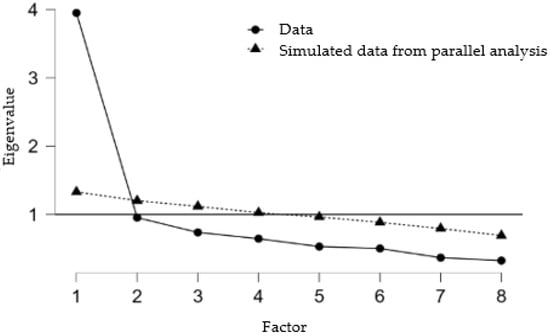
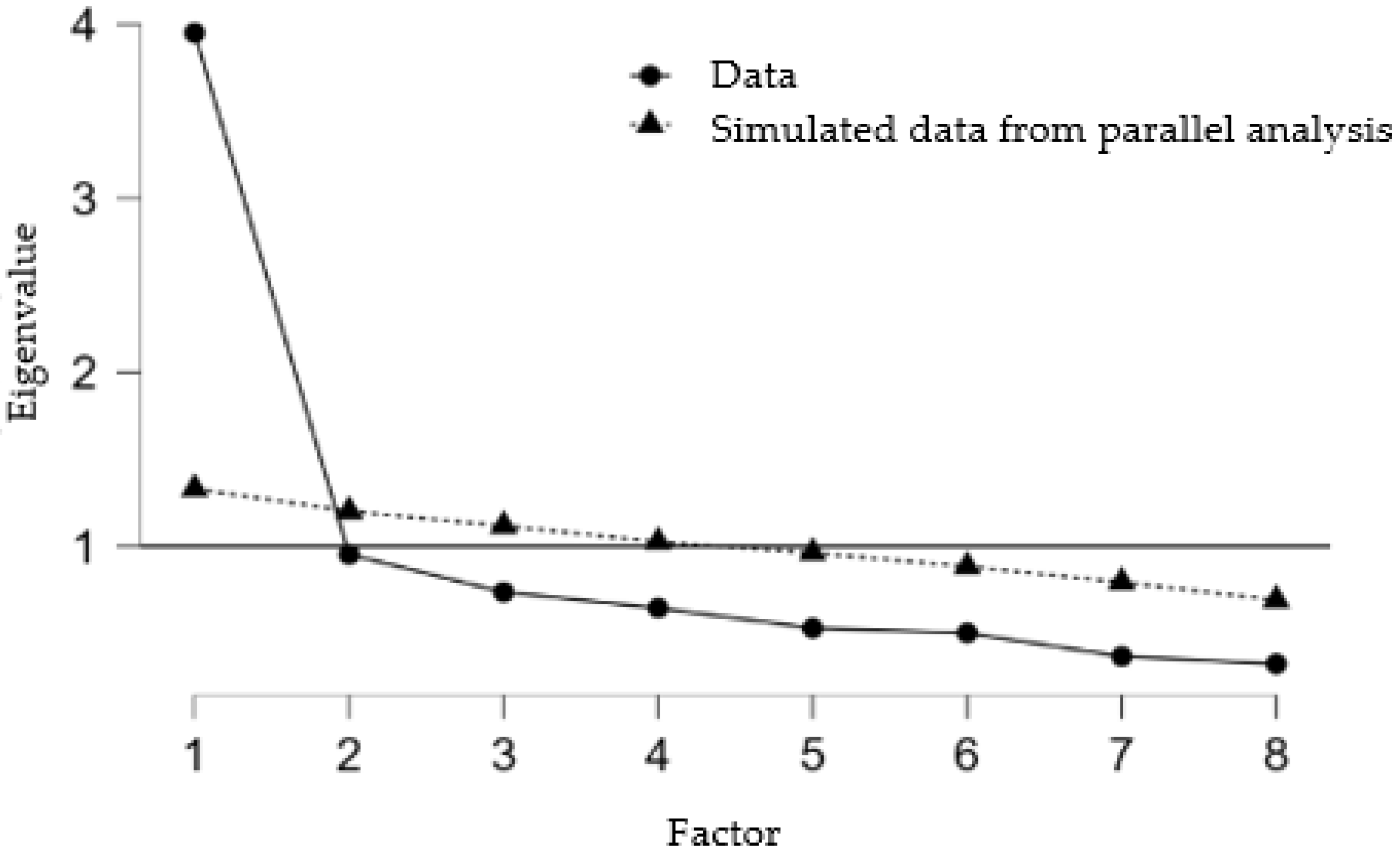
Regarding internal consistency, the scale demonstrated satisfactory reliability, with a Cronbach’s alpha of α = 0.84 and a McDonald’s omega of ω = 0.83. Figure 1 presents the scree plot obtained from the EFA, which showed a clear inflection point after the first factor. Consistent with the eigenvalue-greater-than-one criterion and visual inspection of the scree plot (Lloret-Segura et al., 2014), the results supported the retention of a single-factor solution.
Figure 1.
Scree plot and parallel analysis results from the EFA of the BSTSES-PST. The graph illustrates the observed eigenvalues and those obtained from the parallel analysis, supporting the retention of a single-factor solution.
Finally, bivariate correlations among the items were examined (Table 2). The inter-item correlations were positive and statistically significant, supporting the internal coherence of the scale and aligning with methodological recommendations for the interpretation of oblique factor structures (Hair et al., 2018).
Table 2.
Pearson inter-item correlation matrix for the eight items of the BSTSES-PST. All correlations were positive and statistically significant, providing evidence of the internal coherence of the scale.
3.2. Phase 2: Confirmatory Factor Analysis
In the second phase, a CFA was conducted using the second independent subsample (n = 169), following the analytical strategy described in Section 2.4, in which the first subsample was used for the EFA and the second for the CFA. The aim of this analysis was to test the factorial structure identified during the exploratory phase. The model was estimated using robust maximum likelihood (MLR), and parameter confidence intervals were obtained through 5000 bootstrap resamples to examine the stability of the estimates.
The results indicated that the one-factor model demonstrated an excellent fit to the data: χ2(17) = 19.98, p = 0.27, χ2/df = 1.18. Incremental fit indices reached excellent values (CFI = 0.99, TLI = 0.98, IFI = 0.99), while absolute fit indices were also satisfactory (GFI = 0.97, SRMR = 0.05). Furthermore, the root mean square error of approximation was low (RMSEA = 0.03, 90% CI [0.00, 0.08]), indicating a very good model fit (Table 3). These findings support the adequacy of the unidimensional factor structure identified in the exploratory phase.
Table 3.
Fit indices for the proposed models.
To provide additional evidence of construct validity, the Average Variance Extracted (AVE) was calculated as an indicator of convergent validity. The obtained value was AVE = 0.40. Although this value is slightly below the conventional threshold of 0.50, previous research has suggested that convergent validity may still be considered acceptable when factor loadings are statistically significant and the measurement model demonstrates an adequate overall fit (Hair et al., 2018).
In the present study, all factor loadings were statistically significant (p < 0.001), and the confirmatory factor analysis supported the adequacy of the proposed model, with excellent fit indices (CFI = 0.99, TLI = 0.98, IFI = 0.99, GFI = 0.97, RMSEA = 0.03, SRMR = 0.05). Taken together, these findings provide additional support for the convergent validity of the scale.
3.3. Measurement Invariance Across Gender
Measurement invariance across gender was examined using multigroup confirmatory factor analysis. First, the configural model showed an excellent fit to the data (χ2 = 45.21, df = 34, CFI = 0.99, RMSEA = 0.03), indicating that the factorial structure of the scale was equivalent for both women and men. Subsequently, constraining the factor loadings to assess metric invariance did not result in a substantial deterioration of model fit (χ2 = 48.67, df = 41, CFI = 0.99, RMSEA = 0.02), with no change observed in the CFI index (ΔCFI = 0.00). Similarly, the scalar invariance model demonstrated an adequate fit to the data (χ2 = 55.82, df = 48, CFI = 0.98, RMSEA = 0.03), with only a minimal decrease in CFI (ΔCFI = −0.01). Overall, the changes observed in the CFI index remained below the recommended threshold of 0.01, supporting configural, metric, and scalar invariance across gender. These findings indicated that the scale measured science teaching self-efficacy equivalently in both groups, allowing for meaningful comparisons between women and men.
3.4. Relationship Between Science Teaching Self-Efficacy and Anxiety Toward Experimental Sciences
The results of the Pearson correlation analysis examining the relationships among science teaching self-efficacy, anxiety toward experimental sciences, familiarity with the STEAM approach, and science grades are presented in Table 4 (n = 325). The findings revealed a moderate and statistically significant negative correlation between science teaching self-efficacy and anxiety toward experimental sciences (r = −0.35, p < 0.001), indicating that participants with higher levels of self-efficacy tended to report lower levels of anxiety toward experimental sciences. Furthermore, familiarity with the STEAM approach was positively and significantly associated with science teaching self-efficacy (r = 0.33, p < 0.001) and negatively associated with anxiety toward experimental sciences (r = −0.30, p < 0.001). These results suggest that greater familiarity with the STEAM approach is related to higher confidence in teaching science and lower levels of anxiety toward experimental sciences.
Table 4.
Correlations between science teaching self-efficacy, anxiety toward experimental sciences, and familiarity with the STEAM approach, and science grades.
Grades in Experimental Sciences courses showed a positive and statistically significant correlation with science teaching self-efficacy (r = 0.31, p < 0.001) and familiarity with the STEAM approach (r = 0.34, p < 0.001). In addition, grades were negatively associated with anxiety toward experimental sciences (r = −0.32, p < 0.001), indicating that students with higher academic achievement tended to report lower levels of anxiety.
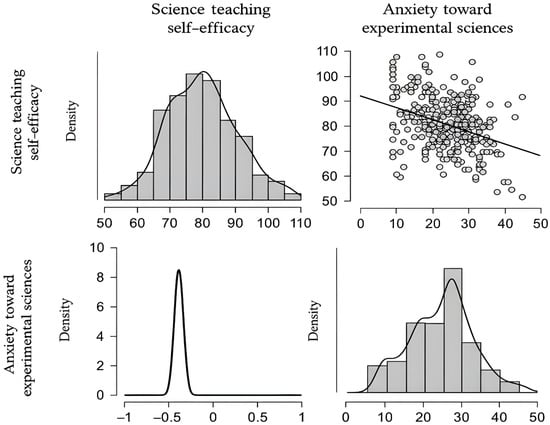
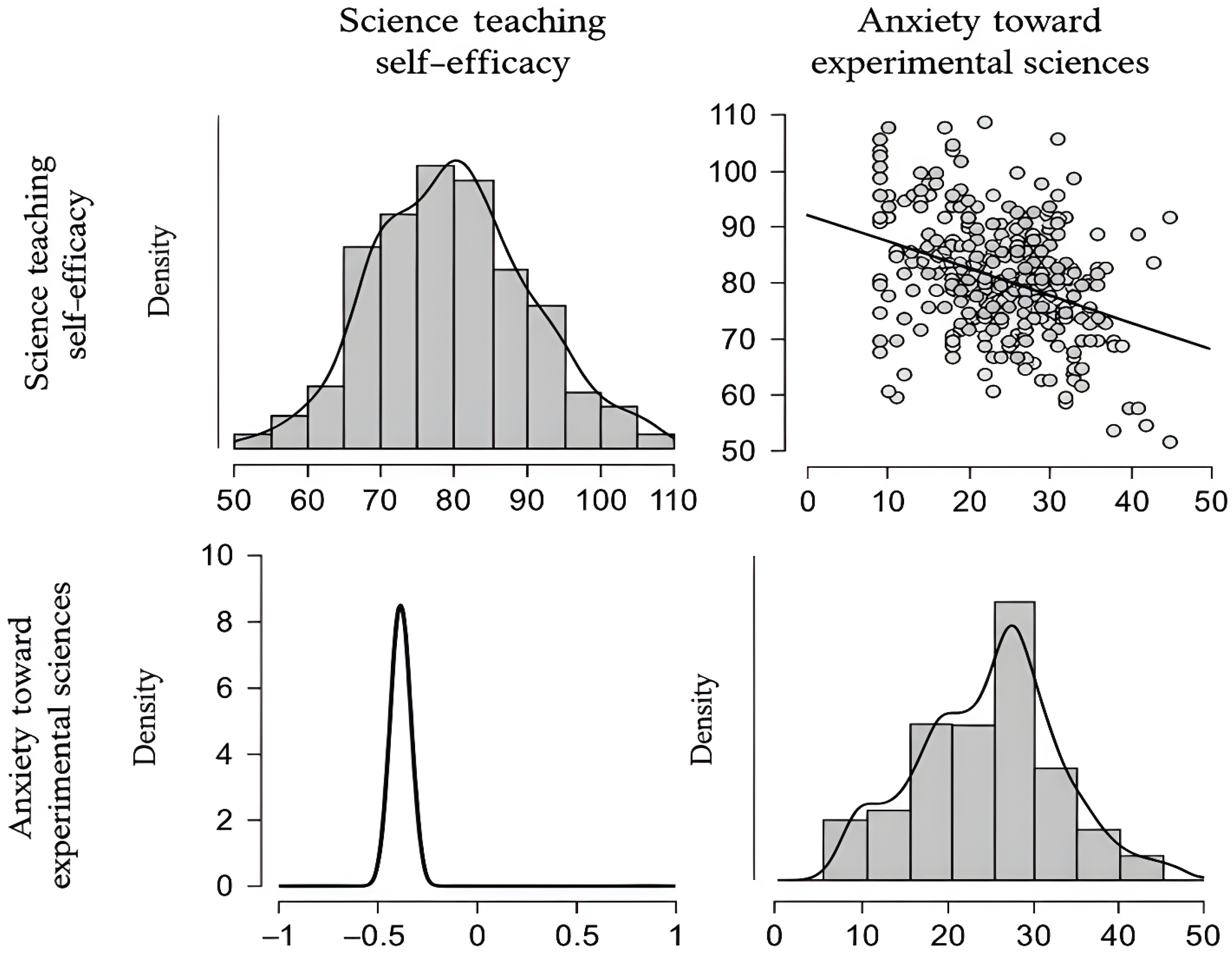
Figure 2 presents the scatterplot, which supports this pattern and shows that participants with higher levels of science teaching self-efficacy tended to report lower levels of anxiety toward experimental sciences. The fitted regression line clearly illustrates this inverse relationship.
Figure 2.
Relationship between science teaching self-efficacy and experimental science anxiety.
The Bayesian correlation analysis corroborated the negative association between science teaching self-efficacy and anxiety toward experimental sciences (r = −0.35, n = 325; 95% CI [−0.44, −0.25], BF10 = 1.227 × 10⁸). In addition, the linearity test favored a linear over a quadratic model (BF01 = 0.141), indicating that the relationship was adequately described by a negative linear trend with no meaningful evidence of nonlinearity.
4. Discussion
The results obtained allowed the objective of the present study to be achieved. Analyses conducted using the new science teaching self-efficacy scale, the Brief Science Teaching Self-Efficacy Scale for Pre-Service Teachers (BSTSES-PST), revealed significant relationships between science teaching self-efficacy, anxiety toward experimental sciences, familiarity with the STEAM approach, and academic achievement in science during initial teacher education. In this regard, with respect to H1, the results support the adequacy of the psychometric properties of the BSTSES-PST. Both EFA and CFA supported a stable unidimensional structure, accompanied by satisfactory reliability indices and measurement invariance across gender. These findings support the usefulness of a more parsimonious approach to assessing science teaching self-efficacy and are consistent with previous studies that have reported difficulties in consistently replicating the original two-factor structure of the STEBI across different contexts and populations of pre-service teachers (Bleicher, 2004; Slater et al., 2021). From an applied perspective, the availability of a brief and psychometrically sound measure may facilitate the inclusion of science teaching self-efficacy in studies that simultaneously examine emotional, motivational, and educational variables, reducing respondent burden without compromising measurement quality (Coste et al., 1997; Stanton et al., 2002).
Regarding H2, the results suggest a negative relationship between science teaching self-efficacy and anxiety toward experimental sciences. This finding is consistent with Bandura’s Social Cognitive Theory (Bandura, 1997, 2001), which posits that efficacy beliefs influence how individuals interpret and cope with potentially stressful situations. Consequently, pre-service teachers who perceive themselves as more capable of teaching scientific content tend to experience lower levels of anxiety when facing tasks related to experimental sciences. These results are consistent with recent studies reporting negative associations between anxiety and self-efficacy in science education contexts (Galimova et al., 2024), as well as with research highlighting the role of self-efficacy in teachers’ psychological well-being, resilience, and emotional regulation (Marcedula et al., 2026; Schwiering & Heyder, 2026), and with evidence suggesting that teachers’ psychological characteristics are closely associated with teacher effectiveness, well-being, retention, and interpersonal relationships (Bardach et al., 2022).
Furthermore, these findings are particularly relevant given that anxiety may negatively affect the psychological well-being of pre-service teachers, generating emotional distress that can influence both their academic training and subsequent professional development (Gilar-Corbi et al., 2025). This interpretation is further supported by recent evidence indicating that academic emotions play a significant role in learning outcomes and educational adjustment processes (Xie et al., 2025).
In light of these results, anxiety toward experimental sciences may be understood as an emotional response characterized by feelings of tension, worry, insecurity, or discomfort experienced by pre-service teachers when engaging in situations related to the learning, understanding, or teaching of scientific content, particularly content associated with experimental sciences such as biology, geology, physics, chemistry, and astronomy. This response may negatively influence perceived confidence in teaching science, participation in scientific activities, and willingness to teach science in the future. In turn, elevated levels of anxiety may adversely affect pre-service teachers’ academic and emotional well-being, hindering the development of positive learning experiences and a more favorable disposition toward science teaching.
Regarding H3, familiarity with the STEAM approach appears to be positively associated with science teaching self-efficacy and negatively associated with anxiety toward experimental sciences. These findings are consistent with previous research highlighting the potential of STEAM experiences to strengthen perceptions of professional competence, promote active learning methodologies, and foster more positive attitudes toward science teaching (Jiang et al., 2024; Luo & Xiong, 2025; Nafziger et al., 2026; Stepanović Ilić et al., 2025; Wiegand & Borromeo, 2023). From the perspective of Social Cognitive Theory (Bandura, 1997, 2001), greater familiarity with innovative pedagogical approaches such as STEAM may contribute to the development of self-efficacy beliefs by enhancing perceptions of preparedness and competence for teaching science, particularly experimental sciences, during initial teacher education. Similarly, academic achievement in Experimental Science courses appears to be positively associated with science teaching self-efficacy and negatively associated with anxiety toward experimental sciences. This finding suggests that academic success and perceptions of competence are closely linked during initial teacher education. Moreover, it is consistent with previous studies highlighting the influence of emotions on learning processes and academic achievement (Gordillo-León et al., 2026; Tzimas & Demetriadis, 2026; Valenzuela-Peñuñuri et al., 2024).
The findings of the present study suggest that science teaching self-efficacy, familiarity with the STEAM approach, and academic achievement are associated with more positive and less anxiety-provoking experiences related to experimental sciences. Although these were the variables examined in the present study, anxiety toward experimental sciences is likely to be influenced by additional psychological, educational, and contextual factors. Therefore, the present findings should be interpreted within the broader multifactorial nature of science anxiety described in previous research. From this perspective, promoting educational experiences that strengthen professional confidence and encourage active participation in scientific activities may contribute not only to improving initial teacher preparation but also to enhancing the emotional well-being of future teachers. The findings of the present study have important educational implications for initial teacher education. First, the observed relationship between science teaching self-efficacy and lower levels of anxiety toward experimental sciences highlights the need to promote educational experiences that strengthen pre-service teachers’ confidence in teaching scientific content. The incorporation of active learning methodologies, inquiry-based activities, hands-on laboratory experiences, and problem-solving approaches may foster more positive perceptions of pre-service teachers’ ability to teach science effectively. Therefore, initial teacher education programmes should provide repeated opportunities for mastery experiences, supervised science teaching practice, constructive feedback, and exposure to inquiry-based and STEAM-oriented learning environments, as these experiences may strengthen science teaching self-efficacy while reducing anxiety toward experimental sciences among pre-service teachers.
Second, the positive association between familiarity with the STEAM approach and science teaching self-efficacy, together with its negative association with anxiety toward experimental sciences, suggests that integrating STEAM experiences into initial teacher education programs may provide benefits that extend beyond the development of disciplinary and pedagogical competencies. Such approaches may contribute to creating more meaningful learning experiences, enhancing professional confidence, and fostering more positive attitudes toward science teaching. This interpretation is consistent with recent evidence suggesting that STEAM-oriented learning environments enhance engagement, professional confidence, and the development of interdisciplinary teaching competencies among pre-service teachers (Jiang et al., 2024; Wiegand & Borromeo, 2023).
The availability of the BSTSES-PST offers a brief, valid, and reliable instrument for identifying strengths and training needs related to science teaching self-efficacy (Appendix A). Its use may facilitate the design and evaluation of interventions aimed at strengthening future professional confidence, reducing anxiety, and promoting emotional well-being during initial teacher education. Despite its contributions, the present study is not without limitations. First, the cross-sectional design prevents the establishment of causal relationships among the variables examined. Although significant associations were identified, the direction of these relationships cannot be determined. Second, the sample was selected through convenience sampling and consisted of students from a single university context, which limits the generalizability of the findings to other populations of pre-service teachers. Finally, familiarity with the STEAM approach was assessed through a self-perception measure. Future research could therefore incorporate more specific indicators related to actual levels of knowledge, training, or participation in STEAM experiences.
Future research could employ longitudinal designs to examine how science teaching self-efficacy and anxiety toward experimental sciences evolve throughout initial teacher education and during the first years of professional practice. Such studies would provide a deeper understanding of the stability, development, and factors influencing these variables over time. Furthermore, continued examination of the psychometric properties of the BSTSES-PST across different cultural contexts, educational levels, and teacher populations would help expand the evidence regarding its validity, reliability, and practical utility. Finally, future studies could incorporate additional psychological and educational variables, such as motivation, metacognition, digital teaching competence, and academic emotions (Xie et al., 2025), as these constructs have been associated with self-regulation, professional learning, pedagogical adaptation, perceptions of teaching competence, and educational well-being (Gilar-Corbi et al., 2025; Michalsky, 2024). Considering these variables jointly may contribute to the development of more comprehensive explanatory models capable of identifying the factors that promote positive educational experiences, academic well-being, and higher-quality professional preparation among future teachers.
5. Conclusions
The present study provides evidence supporting the validity and reliability of the unidimensional structure of the BSTSES-PST as a brief instrument for assessing science teaching self-efficacy among pre-service teachers. Beyond its psychometric contribution, the findings show that higher levels of science teaching self-efficacy are associated with lower levels of anxiety toward experimental sciences, highlighting the importance of strengthening competence beliefs to promote more positive educational experiences and greater academic well-being. Furthermore, science teaching self-efficacy is positively associated with familiarity with the STEAM approach and higher academic achievement in science, and negatively associated with anxiety toward experimental sciences. These findings suggest that experiences of academic success and exposure to innovative methodologies play an important role in preparing future teachers who are more confident, competent, and self-assured in teaching science.
This study contributes to a better understanding of the psychological and educational factors associated with science teaching during initial teacher education. The findings highlight the need to promote educational experiences that strengthen science teaching self-efficacy, reduce anxiety toward experimental sciences, and foster the development of scientific literacy, a key competence for addressing the educational, scientific, and technological challenges of the twenty-first century. Ultimately, strengthening science teaching self-efficacy during initial teacher education may represent an important strategy for preparing confident, emotionally resilient, and scientifically competent teachers capable of promoting meaningful science learning for future generations. Finally, from a practical perspective, these findings suggest that initial teacher education programmes should not focus solely on developing scientific knowledge but also on fostering future teachers’ confidence through active learning experiences, supervised teaching practice, and innovative approaches such as STEAM. Addressing modifiable educational factors associated with science anxiety may contribute to improving both the well-being of pre-service teachers and the quality of science education provided to future generations.
Author Contributions
Conceptualization, J.G.S.-S., and D.A.-R.; methodology, J.G.S.-S., R.Q.L., S.S.R., and D.A.-R.; software, J.G.S.-S.; validation, J.G.S.-S. and D.A.-R.; formal analysis, J.G.S.-S.; investigation, J.G.S.-S., R.Q.L., S.S.R., and D.A.-R.; resources, J.G.S.-S. and D.A.-R.; data curation, J.G.S.-S., and D.A.-R.; writing—original draft preparation, J.G.S.-S.; writing—review and editing, J.G.S.-S. and D.A.-R.; visualization, J.G.S.-S., and D.A.-R.; supervision, D.A.-R.; project administration, J.G.S.-S., and D.A.-R. All authors have read and agreed to the published version of the manuscript.
Funding
This research received no external funding.
Institutional Review Board Statement
The study was conducted in accordance with the Declaration of Helsinki, and approved by Ethics Committee of the University of Jaén, reference CH-251030/FEB.PRY.
Informed Consent Statement
Informed consent was obtained from all subjects involved in the study.
Data Availability Statement
The data presented in this study are available upon reasonable request from the corresponding author. They are not publicly available due to ethical and privacy restrictions.
Conflicts of Interest
The authors declare no conflicts of interest.
Appendix A
Please indicate your level of agreement with each of the following statements using a five-point response scale, where 1 = Strongly disagree, 2 = Disagree, 3 = Neither agree nor disagree, 4 = Agree, and 5 = Strongly agree.
Table A1.
Item Composition of the BSTSES-PST.
References
- Aguada, M. R., Pipitone, C., & Marbà, A. (2023). Aprender a formular preguntas investigables en la formación inicial del profesorado de educación primaria [Learning to formulate researchable questions in pre-service teacher education]. Revista Eureka sobre Enseñanza y Divulgación de las Ciencias, 20(2), 2601. [Google Scholar] [CrossRef] [Scilit]
- Álvarez-García, D., Núñez, J. C., Barreiro-Collazo, A., & García, T. (2017). Validation of the cybervictimization questionnaire (CYVIC) for adolescents. Computers in Human Behavior, 70, 270–281. [Google Scholar] [CrossRef] [Scilit]
- Bandura, A. (1997). Self-efficacy: The exercise of control. Freeman. [Google Scholar]
- Bandura, A. (2001). Social cognitive theory: An agentic perspective. Annual Review of Psychology, 52, 1–26. [Google Scholar] [CrossRef] [Scilit] [PubMed]
- Bardach, L., Klassen, R. M., & Perry, N. E. (2022). Teachers’ psychological characteristics: Do they matter for teacher effectiveness, teachers’ well-being, retention, and interpersonal relations? An integrative review. Educational Psychology Review, 34(1), 259–300. [Google Scholar] [CrossRef] [Scilit]
- Bleicher, R. E. (2004). Revisiting the STEBI-B: Measuring self-efficacy in preservice elementary teachers. School Science and Mathematics, 104(8), 383–391. [Google Scholar] [CrossRef] [Scilit]
- Chen, F. F. (2007). Sensitivity of goodness of fit indexes to lack of measurement invariance. Structural Equation Modeling: A Multidisciplinary Journal, 14(3), 464–504. [Google Scholar] [CrossRef] [Scilit]
- Cibulskaitė, N. (2024). Primary school teachers’ self-efficacy and difficulties in implementing STEAM education. International Journal of Academic Studies in Technology Education, 2, 169–186. [Google Scholar] [CrossRef] [Scilit]
- Cohen, J., Cohen, P., West, S. G., & Aiken, L. S. (2013). Applied multiple regression/correlation analysis for the behavioral sciences (3rd ed.). Routledge. [Google Scholar] [CrossRef] [Scilit]
- Coste, J., Guillemin, F., Pouchot, J., & Fermanian, J. (1997). Methodological approaches to shortening composite measurement scales. Journal of Clinical Epidemiology, 50(3), 247–252. [Google Scholar] [CrossRef] [Scilit] [PubMed]
- Curran, P. J., West, S. G., & Finch, J. F. (1996). The robustness of test statistics to nonnormality and specification error in confirmatory factor analysis. Psychological Methods, 1(1), 16–29. [Google Scholar] [CrossRef]
- Enochs, L. G., & Riggs, I. M. (1990). Further development of an elementary science teaching efficacy belief instrument: A preservice elementary scale. School Science and Mathematics, 90(8), 694–706. [Google Scholar] [CrossRef] [Scilit]
- Galimova, E. G., Prokopyev, A. I., Aytuganova, J. I., Zakharova, V. L., Shindryaeva, N. N., & Kolomoets, E. N. (2024). Examining the relationships among anxiety associated with teaching science, interest in science, and self-efficacy. Eurasia Journal of Mathematics, Science and Technology Education, 20, em2447. [Google Scholar] [CrossRef] [Scilit] [PubMed]
- Gilar-Corbi, R., Izquierdo, A., & Castejón, J. L. (2025). Emotional factors in the psychological well-being of future teachers: A structural model. Journal of Intelligence, 13(6), 70. [Google Scholar] [CrossRef] [Scilit] [PubMed]
- Gordillo-León, F., De-Juanas, Á., & Mestas-Hernández, L. (2026). Positive and negative affect as predictors of university academic performance: Systematic review and meta-analysis. Psychology, Society & Education, 18(1), 75–87. [Google Scholar] [CrossRef] [Scilit]
- Gordon, D., Blundell, C., Mills, R., & Bourke, T. (2023). Teacher self-efficacy and reform: A systematic literature review. Australian Educational Researcher, 50(3), 801–821. [Google Scholar] [CrossRef] [Scilit]
- Haatainen, O., Turkka, J., & Aksela, M. (2021). Science teachers’ perceptions and self-efficacy beliefs related to integrated science education. Education Sciences, 11(6), 272. [Google Scholar] [CrossRef] [Scilit]
- Hair, J. F., Black, W. C., Babin, B. J., & Anderson, R. E. (2018). Multivariate data analysis (8th ed.). Cengage Learning. [Google Scholar]
- Hu, L., & Bentler, P. M. (1999). Cutoff criteria for fit indexes in covariance structure analysis: Conventional criteria versus new alternatives. Structural Equation Modeling: A Multidisciplinary Journal, 6(1), 1–55. [Google Scholar] [CrossRef] [Scilit]
- JASP Team. (2024). JASP (Version 0.18.3) [Computer software]. University of Amsterdam. Available online: https://jasp-stats.org (accessed on 21 April 2026).
- Jiang, H., Chugh, R., Zhai, X., Wang, K., & Wang, X. (2024). Longitudinal analysis of teacher self-efficacy evolution during a STEAM professional development program: A qualitative case study. Humanities & Social Sciences Communications, 11(1), 1162. [Google Scholar] [CrossRef] [Scilit]
- Lloret-Segura, S., Ferreres-Traver, A., Hernández-Baeza, A., & Tomás-Marco, I. (2014). El análisis factorial exploratorio de los ítems: Una guía práctica, revisada y actualizada [Exploratory item factor analysis: A practical guide revised and updated]. Anales de Psicología, 30(3), 1151–1169. [Google Scholar] [CrossRef] [Scilit]
- Luo, Z., & Xiong, Y. (2025). Is anxiety always harmful? An exploration of the impact of language anxiety on EFL learning motivation, EFL competence and EFL academic performance. BMC Psychology, 13, 674. [Google Scholar] [CrossRef] [Scilit] [PubMed]
- Marcedula, F., Angelini, G., & Fiorilli, C. (2026). Teacher self-efficacy and well-being: The mediating role of satisfaction with students, colleagues, and parents. International Journal of Environmental Research and Public Health, 23(2), 150. [Google Scholar] [CrossRef] [Scilit] [PubMed]
- Marsh, H. W., Ellis, L. A., Parada, R. H., Richards, G., & Heubeck, B. G. (2005). A short version of the Self Description Questionnaire II: Operationalizing criteria for short-form evaluation with new applications of confirmatory factor analyses. Psychological Assessment, 17(1), 81–102. [Google Scholar] [CrossRef] [Scilit] [PubMed]
- Megreya, A. M., Szűcs, D., & Moustafa, A. A. (2021). The abbreviated science anxiety scale: Psychometric properties, gender differences and associations with test anxiety, general anxiety and science achievement. PLoS ONE, 16(1), e0245200. [Google Scholar] [CrossRef] [Scilit] [PubMed]
- Membiela, P., Acosta, K., Yebra, M. A., & González, A. (2023). Motivation to learn science, emotions in science classes, and engagement towards science studies in Chilean and Spanish compulsory secondary education students. Science Education, 107(4), 939–963. [Google Scholar] [CrossRef] [Scilit]
- Michalsky, T. (2024). Metacognitive scaffolding for preservice teachers’ self-regulated design of higher order thinking tasks. Heliyon, 10(2), e24280. [Google Scholar] [CrossRef] [Scilit] [PubMed]
- Mohammed, S. M., & Luguterah, A. W. (2024). Exploration of science teaching self-efficacy outside professional development context for inquiry-based teaching. Cogent Education, 11(1), 2377840. [Google Scholar] [CrossRef] [Scilit]
- Mundfrom, D. J., Shaw, D. G., & Ke, T. L. (2005). Minimum sample size recommendations for conducting factor analyses. International Journal of Testing, 5(2), 159–168. [Google Scholar] [CrossRef] [Scilit] [PubMed]
- Nafziger, B., Moldavan, A. M., & Brady, A. C. (2026). Examining growth in preservice science teaching and learning self-efficacy using mixed methods. Journal of Research in Science, Mathematics and Technology Education, 9(1), 23–43. [Google Scholar] [CrossRef] [Scilit]
- Pocalana, G., Robutti, O., & Ciartano, E. (2024). Resources and praxeologies involved in teachers’ design of an interdisciplinary STEAM activity. Education Sciences, 14(3), 333. [Google Scholar] [CrossRef] [Scilit]
- Polit, D. F., & Beck, C. T. (2006). The content validity index: Are you sure you know what’s being reported? Critique and recommendations. Research in Nursing & Health, 29(5), 489–497. [Google Scholar] [CrossRef] [Scilit] [PubMed]
- Rhemtulla, M., Brosseau-Liard, P. É., & Savalei, V. (2012). When can categorical variables be treated as continuous? A comparison of robust continuous and categorical SEM estimation methods under suboptimal conditions. Psychological Methods, 17(3), 354–373. [Google Scholar] [CrossRef] [Scilit] [PubMed]
- Schwiering, P., & Heyder, A. (2026). Experimental evidence on the effects of preservice teachers’ growth and fixed mindsets on teaching self-efficacy and anticipated instructional practices. Learning and Instruction, 102, 102266. [Google Scholar] [CrossRef] [Scilit]
- Senler, B. (2016). Pre-service science teachers’ self-efficacy: The role of attitude, anxiety and locus of control. Australian Journal of Education, 60(1), 26–41. [Google Scholar] [CrossRef] [Scilit]
- Slater, E. V., Norris, C. M., & Morris, J. E. (2021). The validity of the science teacher efficacy belief instrument (STEBI-B) for postgraduate, pre-service, primary teachers. Heliyon, 7(8), e07882. [Google Scholar] [CrossRef] [Scilit] [PubMed]
- Smit, R., Robin, N., & Rietz, F. (2021). Emotional experiences of secondary pre-service teachers conducting practical work in a science lab course: Individual differences and prediction of teacher efficacy. Disciplinary and Interdisciplinary Science Education Research, 3(1), 3–17. [Google Scholar] [CrossRef] [Scilit]
- Soriano-Sánchez, J. G., López, R. Q., & Airado, D. (2026). Adaptation and validation of a scale of anxiety toward experimental sciences in pre-service teachers: Implications for the teaching of experimental sciences. Education Sciences, 16(5), 741. [Google Scholar] [CrossRef] [Scilit]
- Stanton, J. M., Sinar, E. F., Balzer, W. K., & Smith, P. C. (2002). Issues and strategies for reducing the length of self-report scales. Personnel Psychology, 55(1), 167–194. [Google Scholar] [CrossRef] [Scilit]
- Stepanović Ilić, I., Peixoto, F., Dabić, M., Videnović, M., Castro, J., Ferreira, N., & Monteiro, V. (2025). Construction of a scale measuring primary teachers’ self-efficacy to teach STEAM: The STEAM-TSES. Frontiers in Education, 9, 1519327. [Google Scholar] [CrossRef] [Scilit]
- Tschannen-Moran, M., & Hoy, A. W. (2001). Teacher efficacy: Capturing an elusive construct. Teaching and Teacher Education, 17(7), 783–805. [Google Scholar] [CrossRef] [Scilit]
- Tzimas, D. E., & Demetriadis, S. N. (2026). Implementing learning analytics in education: Enhancing actionability and adoption. Computers, 15(1), 56. [Google Scholar] [CrossRef] [Scilit]
- Udo, M. K., Ramsey, G. P., & Mallow, J. V. (2004). Science anxiety and gender in students taking general education science courses. Journal of Science Education and Technology, 13(4), 435–446. [Google Scholar] [CrossRef] [Scilit]
- Valenzuela-Peñuñuri, R., Tapia-Fonllem, C. O., Fraijo-Sing, B. S., & Manríquez-Betanzos, J. C. (2024). Academic motivation and affective engagement toward science and math: The mediating role of self-efficacy. Frontiers in Education, 9, 1385848. [Google Scholar] [CrossRef] [Scilit]
- Vandenbroucke, J. P., von Elm, E., Altman, D. G., Gøtzsche, P. C., Mulrow, C. D., Pocock, S. J., Poole, C., Schlesselman, J. J., & Egger, M. (2007). Strengthening the reporting of observational studies in epidemiology (STROBE): Explanation and elaboration. Epidemiology, 18(6), 805–835. [Google Scholar] [CrossRef] [Scilit] [PubMed]
- Velthuis, C., Fisser, P., & Pieters, J. (2014). Teacher training and pre-service primary teachers’ self-efficacy for science teaching. Journal of Science Teacher Education, 25(4), 445–464. [Google Scholar] [CrossRef] [Scilit]
- Wiegand, S., & Borromeo, R. (2023). Promoting pre-service teachers’ professionalism in STEAM education and education for sustainable development through mathematical modelling activities. ZDM—Mathematics Education, 55(7), 1269–1282. [Google Scholar] [CrossRef] [Scilit]
- World Medical Association. (2013). World Medical Association Declaration of Helsinki: Ethical principles for medical research involving human subjects. JAMA, 310(20), 2191–2194. [Google Scholar] [CrossRef] [Scilit] [PubMed]
- Xie, J., Cho, K. W., Wei, T., Xu, J., & Fan, M. (2025). The effects of academic emotions on learning outcomes: A three-level meta-analysis of research conducted between 2000 and 2024. Learning and Motivation, 90, 102109. [Google Scholar] [CrossRef] [Scilit]
- Zembylas, M. (2006). Emotions and science teaching: Present research and future agendas. In M. de Souza, K. Engebretson, G. Durka, R. Jackson, & A. McGrady (Eds.), Beyond Cartesian dualism: Encountering affect in the teaching and learning of spirituality (pp. 123–132). Springer. [Google Scholar]

Disclaimer/Publisher’s Note: The statements, opinions and data contained in all publications are solely those of the individual author(s) and contributor(s) and not of MDPI and/or the editor(s). MDPI and/or the editor(s) disclaim responsibility for any injury to people or property resulting from any ideas, methods, instructions or products referred to in the content. |
© 2026 by the authors. Licensee MDPI, Basel, Switzerland. This article is an open access article distributed under the terms and conditions of the Creative Commons Attribution (CC BY) license.