1. Introduction
In 1990, Mellin-Olsen introduced the term exercise discourse to characterize mathematics classrooms dominated by routine problem solving, procedural work, and reproduction of methods (
Mellin-Olsen, 1990). This discourse is characterized by quantities of exercises with one solution to be solved, often prioritizing procedures, speed, and correctness (
Mellin-Olsen, 2009), not contributing to relational understanding or conceptual knowledge (
Hiebert & Lefevre, 1986;
Skemp, 1978). In contrast, investigative approaches have been discussed in mathematics education research (
Skovsmose, 2001) as ways of transforming mathematics teaching away from transmission models and rote learning (
Skovsmose & Säljö, 2008) towards exploration, discussion, and conceptual engagement.
The need for such pedagogical transformation has been widely recognized in the international arena. Over the past two decades, education systems across the world have engaged in large-scale curriculum reforms aimed at shifting from teacher-centered instruction towards student-centered, competency-based approaches (
OECD, 2019). These reforms emphasize the development of transferable competencies such as critical thinking, problem solving, collaboration, and student agency, reflecting broader societal and labor-market demands. However, a substantial body of international research indicates that this shift remains largely aspirational. Comparative evidence from large-scale studies such as the Teaching and Learning International Survey (TALIS), which gathers data from over 50 education systems, shows that classroom practices continue to be predominantly teacher-directed, with limited use of active, inquiry-based strategies (
OECD, 2025). This phenomenon is described as the “implementation gap” between the intentions of curriculum policy, and classroom practice. OECD analyses highlight that curriculum reform often fails to translate into practice because it requires deep changes in teachers’ beliefs, knowledge, and classroom routines, rather than merely changes in policy documents (
OECD, 2025). In this context, the Western Balkans, Eastern Europe, and Central Asia are experiencing challenges because the education systems continue to experience tensions between progressive curricular reforms and deeply rooted traditional teaching practices. OECD and UNICEF reports indicate that many countries in these regions face persistent difficulties related to teaching quality, educational equity, student engagement, and the development of higher-order thinking skills (
OECD/UNICEF, 2021;
UNICEF ECARO/OECD, 2024). A systematic review of 94 studies on learner-centered pedagogy across different contexts (
Sakata et al., 2022), specifically low- and middle-income countries, similarly identifies a gap and concludes that, despite strong policy promotion, most classrooms remain primarily teacher-centered. Factors constraining the gap closure were identified at different levels: at an individual level, teachers’ beliefs about the best way to help students learn pending toward traditional teaching; at a classroom level, lack of resources, infrastructure and class sizes; at a school and policy level, examination systems, overloaded curricula, institutional inertia, and ineffective professional development delivered over short periods and through transmissions-based lectures; at a wider level, cultural mismatches with the student-centered principles, and views about knowledge as fixed. Evidence from Asia further illustrates this pattern: even where learner-centered curricula are formally adopted, teachers tend to retain control of classroom processes and rely on traditional approaches, highlighting the difficulty of transforming deeply rooted pedagogical traditions (
Ho & Dimmock, 2023). In Turkey,
Biber (
2024) problematizes the same, that despite reforms with a constructivist focus on teaching, rote learning still predominates. Across contexts, reforms therefore often result in hybrid pedagogies, where elements of student-centered approaches coexist with established teacher-centered practices.
A key explanation for this gap lies in the central role of teachers and their ability and willingness to implement the curriculum (
Remillard, 2005) as the ones translating curriculum into teaching (
Remillard & Heck, 2014). International studies consistently show that teachers’ ability to enact reform depends on their access to sustained, practice-oriented professional development and supportive working conditions. OECD research demonstrates that high-quality professional development is strongly associated with more diverse and student-centered teaching practices across countries, yet many teachers report limited opportunities for such development within their systems (
Barrera-Pedemonte, 2016). Recent findings from TALIS 2024 further suggest that teachers across the Western Balkans continue to experience difficulties in implementing student-centered and inquiry-oriented pedagogies despite ongoing competency-based reforms (
OECD, 2026). As a result, curriculum reforms frequently remain at the level of policy discourse, without substantially reshaping classroom practice.
The same picture is evident in Albania, a post-socialist, resource-constrained country in South-Eastern Europe. While earlier improvements were noted in international assessments, recent results indicate persistent challenges in students’ mathematical reasoning, critical thinking, and ability to apply mathematics in real-world contexts (
OECD, 2023,
2024). In response to these challenges, educational reforms in Albania have aimed to align with European standards and to develop a competency-based curriculum. The Pre-University Education Curriculum Framework (
Ministry of Education and Sports, 2014,
2024) promotes critical thinking, problem-solving, and active learning through student-centered methods, digital technology, and STEM integration. Similarly, the Student-Centered Instruction Manual describes this approach as “a competency-based, student-centered approach to teaching and learning,” emphasizing pedagogical practices that support students’ exploration, collaboration, and reflection (
Institute of Education Development, 2018). In addition, Agency for Quality Assurance in Pre-University Education (
ASCAP, 2025) promotes contemporary methods and the integration of technology into teaching through its professional development programs.
Despite these reforms, the Albanian literature indicates that the implementation remains challenging, and traditional practices continue to dominate mathematics teaching, demonstrating a gap between reform intentions and classroom practice, very similar to the identified gap in an international context previously mentioned (
OECD, 2025). Factors such as frequent curricular changes, limited teacher autonomy (
Sila & Liftaj, 2023), insufficient professional development and institutional support for teachers, as well as lack of resources, constrain the implementation of innovative approaches (
Sila & Liftaj, 2023;
Sinaj & Xhabafti, 2025). Furthermore, teaching materials and practices often remain aligned with procedural and routine-oriented approaches (
Pepkolaj et al., 2025), and the use of technology often remains superficial, oriented toward ready-made algorithmic solutions rather than promoting exploration and critical thinking (
Foto & Shakaj, 2025).
At the same time, there are opportunities for change. From a professional perspective,
Kërënxhi and Gjoci (
2013) demonstrate that teachers’ involvement in innovative didactic models increases their self-confidence and their willingness to experiment with contemporary teaching methods. Students demonstrate interest in real-life applications of mathematics (
Kacerja, 2011), and inquiry-based and modelling approaches have been shown to foster engagement and meaningful learning (
Blum & Borromeo Ferri, 2009). Similarly, the findings of the Programme for International Student Assessment 2022 show that, although Albanian students’ performance in mathematics remains below the OECD average (
OECD, 2023), they demonstrate positive tendencies toward reflective and contextual learning (
OECD, 2024). These findings suggest significant potential for implementing investigative and exploratory methods of mathematics teaching.
International research emphasizes that preservice teachers need opportunities to experience and reflect on investigative and inquiry-based approaches during their education in order to implement them in practice (
Biber, 2024;
Blum & Borromeo Ferri, 2009;
Doerr, 2007;
Nguyen & Tran, 2025;
Polydoros & Antoniou, 2026;
Villareal et al., 2015), and mathematics teacher education plays a critical role in this regard. Research examples from different countries, such as
Biber (
2024) in Turkey,
Moreno et al. (
2024) in Spain, and
Nguyen and Tran (
2025) in Vietnam, show that integrating inquiry-based approaches in mathematics teacher education programs supports preservice teachers’ professional growth. In a special issue about Critical perspectives on mathematics teacher education in Education Sciences, one group of papers focus on research on coursework in initial teacher education (
Xenofontos & Nolan, 2023). In that special issue,
Ödmo et al. (
2023), in a study about transforming a traditional statistics course into having a more critical perspective, recommended that teacher education programs seriously consider the complexity of critical perspectives in the teaching of mathematics and of the PTs transferring them from teacher education into schools. However, teacher education programs often reflect the same traditional paradigms that reforms seek to change. This creates a need for interventions that expose preservice teachers to alternative pedagogical approaches and support the development of critical mathematical competence.
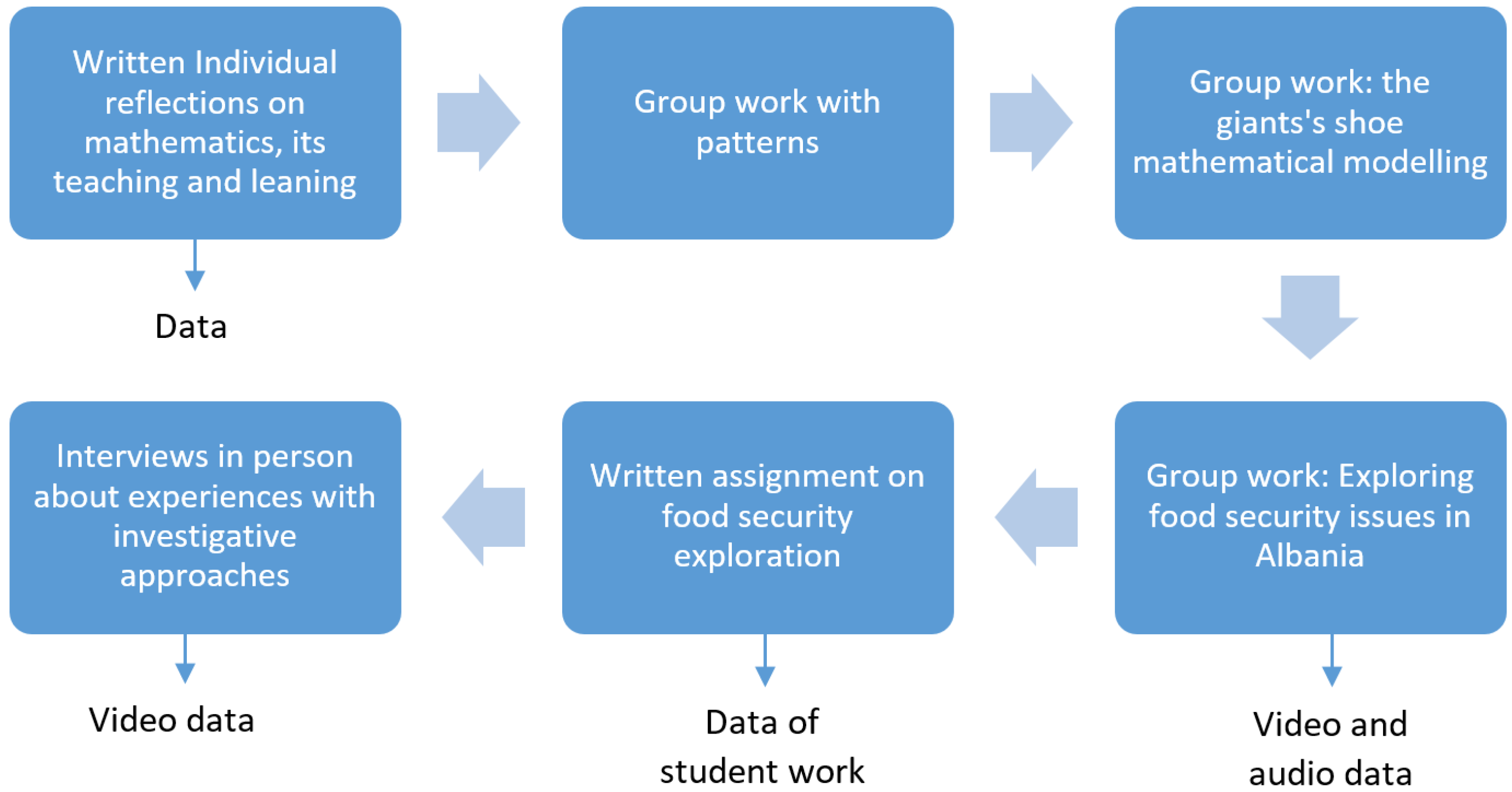
In response, the present study reports on the redesign of a mathematics education course in an Albanian university, in which preservice teachers engaged with investigative approaches, including mathematical modelling and inquiry-based tasks. Investigative approaches aim not only to develop mathematical skills but also to support critical mathematical competence, understood as the ability to use, reflect on, and critically evaluate mathematics in societal contexts (
Skovsmose, 2001).
The Albanian mathematics education system is used as a case study, a representative of the many countries where top-down competency frameworks in curricular reforms have been undertaken to align with Western European standards of education, yet the baseline classroom culture remains tethered to traditional, procedural, exercise-oriented instruction. Testing an investigatory intervention in this environment provides a rigorous boundary test for inquiry-based teacher education theories and the tensions that might occur.
This study examines preservice teachers’ (PTs) engagement with investigative approaches, focusing on the following research questions:
What characteristics of critical mathematical competence do PTs exhibit when engaging in investigative approaches?
What possibilities and barriers do Albanian PTs of mathematics express in relation to these approaches?
4. Results
The results in this section are organized based on the data collected and the focus. We will first present results about characteristics of critical mathematical competence in the PTs’ written work on the topic of food security and their group work on the topic, as well as some of the moments from the interviews in which they were directly asked about critical thinking. Afterwards, we follow the subsections on barriers and possibilities with data analyzed mostly from the two group interviews, but also from different moments during the group work, as well as the PTs written notes about mathematical teaching and learning.
In the interviews, all the PTs admitted that they had either not worked at all or worked very little with investigative teaching methods in mathematics. One of them gave one example of project work from high school, and none from teacher education.
4.1. Developing Critical Mathematical Competence—Barriers and Possibilities?
All groups immediately engaged with the food security task, and they had some clues about where to go since they had looked at the topic as required. However, they soon became unsure about how to proceed with choosing a problem to investigate. This was the first barrier in their work with investigative approaches, being used to traditional approaches and their respective socio-mathematical norms. In the following, we present the results from two of the groups, the same PTs who also were interviewed. Results from group 1 take more place, as they provided richer data.
4.1.1. Group 1
The two male students worked together on the topic of food security and started with a report from the Albanian Public Health Institute on feeding habits for school children. After a while, they became unsure about how to proceed further since the problem in the report was already “solved”, and calculations were presented based on data collected. They soon changed the topic to investigate food affordability for an average Albanian family by going to the Institute of Statistics (INSTAT) in Albania. They decided to compare the food affordability for an average Albanian family in 2012 versus in 2025. The years were chosen to ensure a longer time span to map the changes.
During the group work, the PTs discussed the general grocery basket to focus on over the two years, and went to several sources, but also estimated themselves the amount of food and the prices for a family of four. In their final written task, the PTs demonstrated both mathematical and technological knowing, as
Skovsmose (
1994) defines them.
Mathematical knowing was connected to using concepts such as change in percentage and calculating the total price for a grocery basket.
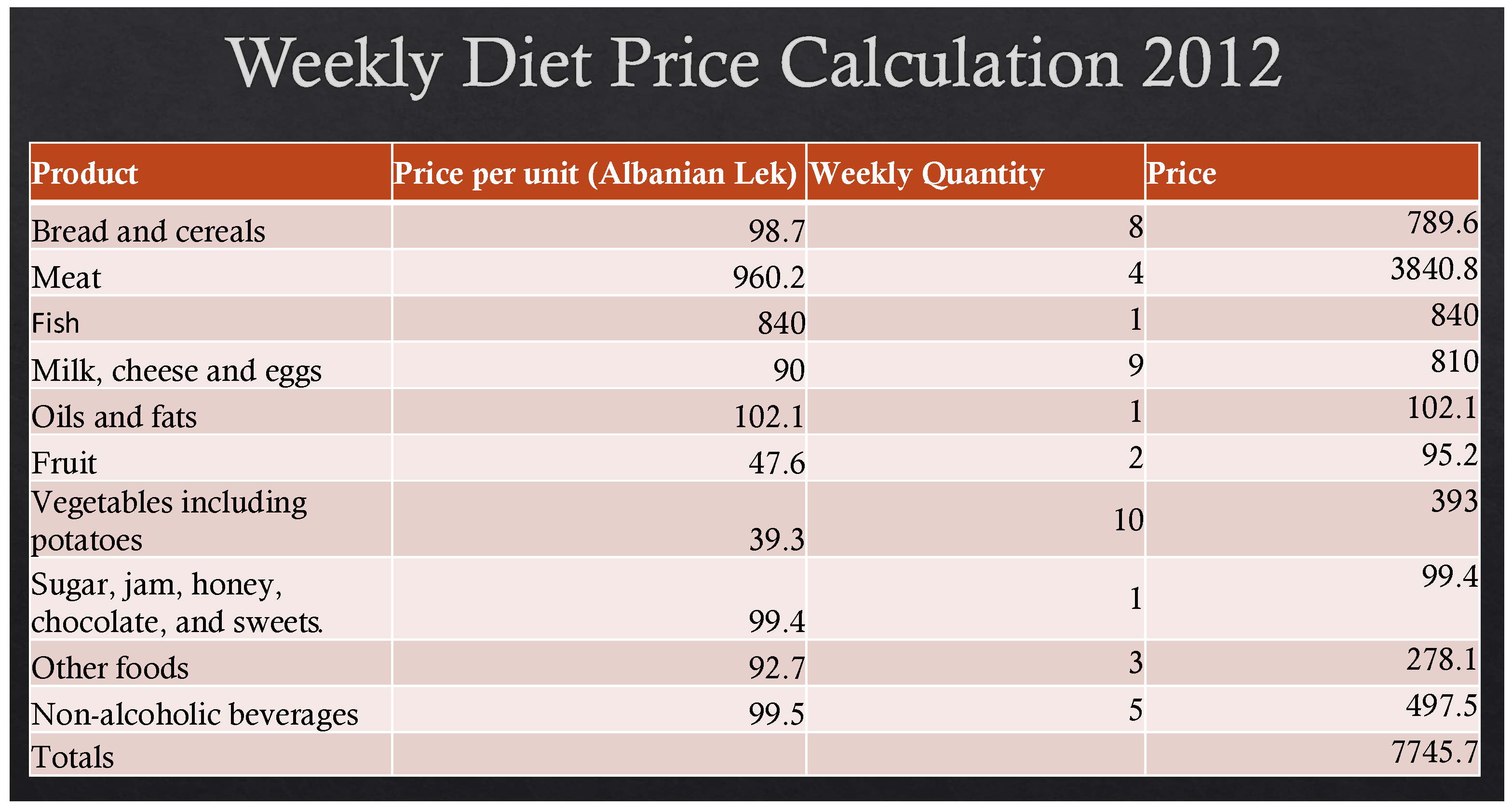
Technological knowing was when they used these concepts in the context of food security to say something about food affordability and its changes for Albanian families. They first presented a table of food in the grocery basket they considered necessary, then a table of the prices in 2012 and 2025 for comparison (see
Figure 2).
While the calculations on the right-hand side of
Figure 2 show PTs’
mathematical knowing and
mathematical capability in terms of
Geiger et al. (
2023), being able to set up the table with different kinds of food with the prices and costs is connected to their
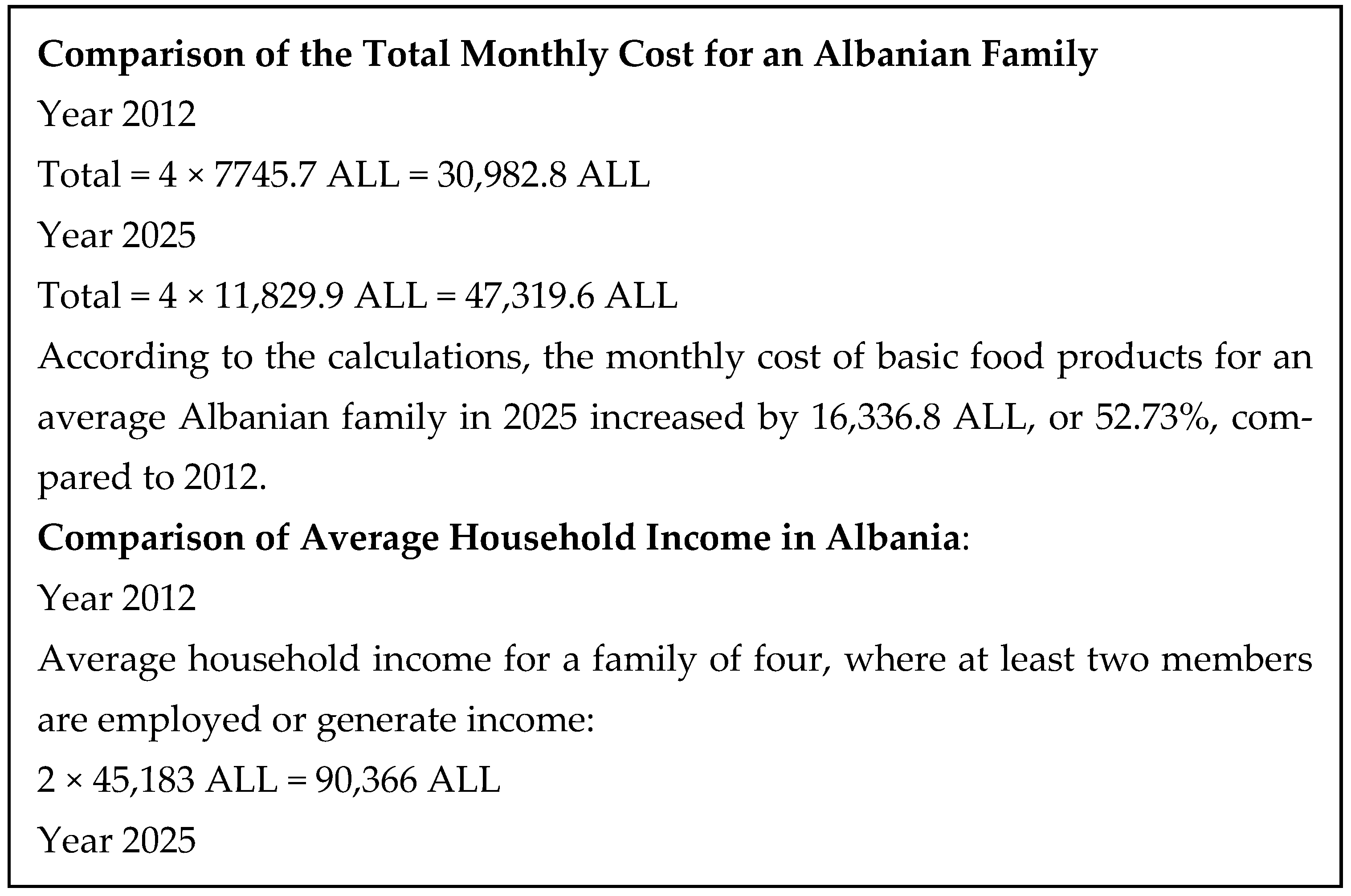
technological knowing, while also using their extra-mathematical knowledge in this process. Afterwards, they calculated and compared total monthly costs for an Albanian family and the average household income for 2012 and 2025 (
Figure 3). The calculations are based on official data from INSTAT about the average income for one person (45,183 ALL and 61,100 ALL in 2012 and 2025).
As a next step, PTs present the following calculations of the percentage of the total income for a family of four used to buy food: 30,982.8/90,366 × 100% = 34.28% in 2012, and 47,319.6/122,200 × 100% = 38.72% (in 2025). Until this phase, they showed different
mathematical abilities in using different kinds of mathematical concepts and procedures,
reasoning such as interpreting different information sources, structuring the problem to analyze food affordability, and generating arguments by integrating mathematical practices with their extra-mathematical knowledge about the topic. In the end, the PTs concluded that an average Albanian family would still be able to secure a sufficient and healthy amount of basic food. However, they also remarked that “food affordability” also depends on other living expenses, which can make it more difficult to secure essential food items. Moreover, the PTs recognize, both in the text and in the interview, that there are other variables to consider in addition to food prices and income to better investigate food affordability, such as other living expenses, as well as considering families with lower incomes. This way, the PTs showed
critical capability, as defined by
Geiger et al. (
2023), by showing awareness of other factors and how they influence the conclusions and
evaluating by judging the validity of their result in cases where the circumstances change. This can also be connected to
reflective knowing to a certain degree, since the PTs were able to point out other factors that would have changed the results of their investigation, thus reflecting on the effects of several mathematical variables on the result.
During the interview with the male PTs, they reflected more on the food security assignment. In the task, they had decided that since there was little growth in the report on food expenses against income in 2025, compared to 2012, the average Albanian family would still be able to afford to buy food. When asked about the criteria for them in deciding affordability, the PTs came up with several critical remarks about the data from INSTAT, showing
critical capability and
evaluating as defined by
Geiger et al. (
2023). They are aware that the average income as reported in the INSTAT data is not the reality for all Albanian families, but only for a small percentage of the population. When asked to reflect on what they would do differently in their assignment, one of them said, “Maybe look at the data validity to see how real that is, compare it to reality”.
However, we see the temporal aspect of developing critical competence in mathematics, from the first time we had a lesson with the PTs, to the patterns task, to the food security session and the written task, and ending with the interview. As Kim puts it, “the more you think about it, the better you understand the connection between food security and all the other aspects. We would then maybe do a more real comparison [of the 2012 and 2025 data on food affordability], we would find other data and result in a more real conclusion”.
Also, the fact that the PTs needed time and a conversation in the interviews to push their critical thinking further is an indicator of this time aspect.
4.1.2. Group 2
Three female students worked together on the topic of food security. All of them emphasize, in their written texts on mathematics teaching and learning, the relevance of mathematics to life and the importance of teachers using connections to real life in the classroom. They start group work by describing that they are going to investigate food security in Albania using statistical data, politicians’ opinions, and citizens’ opinions on the matter (data was available in Albanian media). While looking for materials, they discuss pesticides in vegetables, a complex issue, and struggle to find specific statistical data on the topic. Later, they start with their experiences about minimum income and food expenses in Albania versus the UK as an idea to show that it is more problematic for Albanian families with minimum income to provide food compared to English minimum income families. They search for numerical/statistical data to compare prices and income in Albania and in the EU to find out that Albania is at the end of the list for income and talk with discouragement about it.
The PTs demonstrate
mathematical knowing in terms of
Skovsmose (
1994) and
mathematical capability in terms of
Geiger et al. (
2023), but also
technological knowing, as they have now decided on some variables to consider for their exploration of food security, and they are looking for sources of data to put together and analyze the problem. In their written assignment, the PTs discuss price rises in basic products, rises in energy and transport prices, inflation, and dependence on imports as influencing monthly food costs, and thus bringing about difficulties for low-income families, which in turn influences their choice of good-quality foods versus cheaper food, thus showing
critical capability even though they are not yet using any data to support this.
Further in the written assignment, the PTs explored several factors about food security by looking at data such as tables, graphs, or index results from different sources such as INSTAT, national media, etc. They looked at issues about food safety in Albania and average income compared to EU countries, finding that 40–45% of the total family budget goes on “food and non-alcoholic drinks” in Albania as compared to 12–15% for EU countries, and explored the harmonized index of consumer prices, etc. They showed some characteristics of critical capability when drawing conclusions and reasoning when interpreting information from different sources.
After presenting
Table 2, comparing Albania to some EU countries, the PTs concluded that “the comparison should be made not only in terms of nominal prices, but also with regard to purchasing power…”.
However, compared to the first group, here the arguments were more spread throughout the text, giving the impression that each of the three PTs have taken responsibility for one piece of the text, and the text bears the imprint of this division of tasks.
During the interview where two of the PTs from this group participated, we could identify signs of critical competence in that they were able to reflect on a slow reveal graph about population growth and identify the connections of this graph to the food security issue. Anna gives an example: “this [population growth] has a negative influence, because more food sources are needed, spending also nonrenewable resources”. They both connect mathematical skills and knowledge, but also reflections about real consequences of e.g., population growth, analysis and argumentation, as important dimensions of critical competence in mathematics.
4.2. Barriers to Engaging with Investigative Approaches
The findings reveal several interconnected barriers related to participants’ prior experiences, the nature of investigative tasks, and contextual constraints. These barriers are grouped into three main categories: (1) prior orientations and norms, (2) challenges related to task openness, and (3) structural and contextual constraints.
4.2.1. Prior Orientations and Socio-Mathematical and Social Norms
Three of the female PTs (group 2) emphasize in their written individual texts that the better prepared the mathematics teacher is, the more efficient the teaching will be. One of the females and one of the male PTs similarly describe a successful mathematics lesson as: the teacher explaining a concept, visualizing using examples, showing all the steps in the problem-solving process, then giving students practice tasks while going around to give advice and correct mistakes. While the three female PTs and the two male PTs also mention critical thinking, student participation, problem solving, real-life examples or varied methods, the description of the successful mathematics lesson has many elements of traditional teaching, or the
exercise paradigm as
Skovsmose (
2001) described. This can be a barrier to embracing investigative approaches, in which handling uncertainty, because of the openness of the approaches and the tasks, is one important element.
Elements of the exercise paradigm were also present during the interviews. When PTs were asked why they were so quiet during the group work (they did not discuss so much, were busier with finding the information, had divided roles, one who writes, the others who find the information to use on the slides), they mentioned the fear of being wrong in their answers, or in using wrong mathematical concepts and even words, and being penalized for this. This is an indicator of the
socio-mathematical norms, in terms of
Yackel and Cobb (
1996), of Anna’s classroom. During the interview, while Anna (group 2) was answering about how they felt when working with the investigative approaches, she shared that she felt good that she could be wrong in her ideas and this was still valuable for them trying to think themselves, but she also identified one barrier:
Here [in Albanian teacher education], we don’t practice this [valuing mistakes], and this can stop us sometimes, fearing that if we say something wrong, we might get penalties.
This topic was also present later when Anna explained why they were so quiet in the group work, since we noticed that there were a lot of silent moments in the audio data:
We didn’t know how to express ourselves or talk, to not make mistakes when talking about definitions or using the right words, not talk in “popular” language, not as in everyday language.
Group 1 had also some silent moments during their group work which they similarly explained with lack of experience of being filmed.
Another barrier or difficulty for investigative approaches can be connected to a narrow perception of mathematical activity, often equating mathematics with numerical calculations and formal representations, which is the risk that
Skovsmose (
2001) has talked about if students only meet purely calculating tasks all the time in mathematics. For example, in group 2, while trying to formulate different variables using different sources on food prices and income in Albania during their group work, Kay seems to be impatient with the two other PTs who are not using numbers: “Well, you’re not doing anything in numbers. Nothing…all theories” expressing that she is stressed with the lack of numbers, even though they are early in the process, and they need to discuss variables. Later, Kay proposes again to build a table or a graph to represent some information and suggests using changes in percentages to summarize a problem, “from 2005 to 2018, food prices in Albania were between 68% and 78% of the average EU prices…In 2024 prices were for the first time equal, and even 1% higher in Albania. Look, we can write this very short. You have written a novel instead.” While all these elements are important in mathematics, as different representations have different functions, it does slightly suggest that doing mathematics is seen as doing these operations and representations, while things like modelling or reasoning as processes in mathematics are not so visible.
4.2.2. Challenges Related to Task Openness and Uncertainty
The open-ended nature of investigative tasks presented significant challenges. Participants initially struggled to formulate problems, identify relevant variables, and determine appropriate methods of inquiry, especially in the case of the food security task. Unlike structured tasks, the food security activity required them to define both the problem and the approach, which led to uncertainty and delays in progress. After searching internet articles about food security, they found written articles based on different data but were stuck when asked to use data themselves for investigating one chosen problem, not just presenting the report. While working with pattern tasks and modelling tasks with a more explicit requirement, the PTs were focused and managed to find strategies and assumptions for working; with the food security task, which was much more open and without a clearly defined requirement, the PTs had more difficulties.
One more aspect connected to openness, but also to the traditional ways of being in the mathematics classroom, is the uncertainty of the answers, as one possible barrier. Carole explains how she felt uncertain working with the food security task:
Carole: At the start, you feel good because you are exploring, but in the end, you feel a little shy. You say, “Is this correct?” My solution?
…And in the end, you wait for an answer…because you don’t know the end, you don’t know the answer. You only explain your method, how you solved it and don’t know.
Openness also created difficulties in navigating large amounts of information. Participants reported feeling overwhelmed when working across multiple data sources and expressed a preference for pre-structured information. This was present in many moments: while doing group work, they were not able to find the data, which was the starting barrier. In group 2, when working on the assignment, the PTs struggled to agree on what kind of data to include in it. They wanted to find official data, which was not always possible. One of them often insisted on including “real” data in the sense of including what they know from reality, even though that is not official data. “Expenses for our city, minimum expenses are around 100.000, I heard it in “Opinion”. Did you hear that? He said it right…So…”, where “Opinion” is a TV program. But she meets resistance from the others, “We will now start listening to ‘Opinion’ [ironically], there is no other way”. This indicates the cognitive demands associated with inquiry-based tasks, particularly for learners with limited prior experience in such approaches.
4.2.3. Structural and Contextual Constraints
During the interviews, when Group 2 talked about their own process with food security, they expressed their concerns about the lack of reliable data for Albania. When asked about the data sources they used, they expressed their mistrust:
Carole: In Albania, I believe only INSTAT has information and data, because the media are maybe affected by politics, Albanian politics.
Anna: And if you think, even INSTAT is a bit affected.
Here, the PTs problematized the effects of politics on data sources, making them a little, or not at all, reliable. Similarly, group 1 also problematized the data on average income they had retrieved from INSTAT. As Kim said, “They [the data] might not be correct, or they might not have been declared correctly…data might be missing”. The PTs thus have a concern about the lack of data and mistrust of the data sources available, as in
Kacerja and Julie (
2023).
In group 2, the PTs had different opinions on data availability or reliability concerning the use of explorative methods in schools. While both appreciated investigative approaches in mathematics, where they disagreed with each other was whether they could or could not ask students to collect or find data themselves in grade 9 or lower levels.
Carole: But do they [the students] bring correct sources? They don’t even know where the correct sources are…this affects…
Anna: It is not important that they bring correct sources; you can specify that.
While Carole is concerned that 9th graders do not know where to find correct data, Anna emphasizes the teacher’s role in checking and specifying that, thus directing the students. Anna is the same PT who also emphasized the value of mistakes in mathematics.
This barrier of data is also connected to the time aspect, since having limited time meant that the PTs needed to be quicker in finding the data. Time was another barrier mentioned and experienced on different occasions. During the group work, group 1 was discussing changing their topic, but struggled to find the data they could use. Dean said, “We need one week to do such kinds of studies”. In the interview, Kim also mentioned this aspect of missing time to go in-depth in their exploration, “We have used these numbers, averages, and such, we haven’t gone in-depth in the exploration. We would perhaps have done that if we had more time”. Time was again mentioned when the PTs were asked about what changes could have been introduced for them to have a better grasp of and better possibilities with investigative approaches. As group 2 puts it:
Carole: I would think to have it last longer…the students should try them twice to learn them better.
Anna: I would say try one method together, and then the students work in groups with the same method.
This matter of more time in trying out investigative approaches can also be seen as connected to the scarce experience PTs have had with them from before.
4.3. Possibilities
Despite the challenges identified, participants highlighted several important possibilities associated with investigative approaches. These are grouped into three main areas: (1) student engagement and active learning, (2) development of critical and mathematical thinking, and (3) pedagogical and professional relevance.
4.3.1. Student Engagement and Active Learning
Participants consistently emphasized that investigative approaches promote active student participation. As opposed to school students not being considered able to collect or find good data to work with on social issues tasks, as Carole mentioned in the interview, Anna opposed this by focusing on their role as teachers to ensure that the students did so. Thus, the data collection by students themselves was seen as a possibility. Anna explained this by contrasting it to the more traditional teaching of mathematics:
Students get everything served and do not manage to think, perhaps. But if they work with another method [investigative], then they might think “why did this happen?” They will find the consequences and start posing questions.
Rather than being provided with all necessary information, students are expected to engage with sources, interpret data, and reflect on findings. As Anna noted, this process can stimulate curiosity and deeper engagement with both mathematical and real-world issues.
These approaches activate students, as Carole says, which is again connected to Anna’s previous comment about students’ thinking processes, “In education in Albania, we have only traditional methods in which the teacher explains, and the students listen. These [investigative] methods make students active”. Anna sees this activation as a way for students to get engaged, when she reflects on what she would like to have experienced in her teacher education program:
It would have been better to have done this method, to understand better also how to behave with students and understand how they want us to teach them. Not to be rigid and then wonder why students don’t behave or study because they are not attentive, and there is chaos in the class. Maybe they like to explore more because they find it easier or more entertaining.
Anna sees activating the students as connected to them finding the methods more entertaining or interesting. Her description is also an attempt to move away from traditional classrooms with their norms towards more freedom and student involvement.
Instead of being served ready-made tasks or data, as in traditional approaches, Anna thinks that students are more inclined to start asking questions and think about consequences if they work with investigative approaches and collect their own data.
Group work was also viewed positively. When PTs worked with investigative approaches, they mostly worked in groups. This was something new to them as they admitted that this was not common in teacher education and it was only used with projects in school. Both interview groups expressed that they saw possibilities for working in groups and sharing with others, as possibilities to work better, to understand better, and to learn from each other.
Carole: It is a very good thing to collaborate because you communicate with others, you achieve better results because one person gives one idea, a second person gives another, and in the end, you get the final meaning. I think it is good to work in groups.
For Carole, working in groups helps achieve better results. For Kim in group 1, it was similar, also adding that when they stood and worked in their groups and could see what the other groups had done, this helped them learn more from each other.
4.3.2. Development of Critical and Mathematical Thinking
A major perceived benefit of investigative approaches was their potential to foster critical thinking and reasoning. As Carole’s previous comment discussed, Anna finds that these approaches make students think, develop logic, and argumentation:
These are valuable for students to search for data or other information, to find them, and work with them, because this helps them to reason, to think, not to be lazy, and have everything ready...Perhaps also from a logic point of view, it helps them develop their logic. Not to get things served ready, to learn them and forget them.
Group 1 emphasized students’ better understanding and making connections between mathematical concepts and other ideas when working exploratively, helping them to overcome difficulties
Anna: I agree with Carole; that this is valuable when thinking about how to plan teaching when students are experiencing difficulties in solving one problem or understanding a concept…maybe we can give one theme that they should find different sources of data about, so that they better understand the concept and maybe next time the continued conversation about the theme and the sources of data might make it easier for them to understand and to remember the ideas and the information.
The PTs do therefore have ideas about the help that investigative approaches can give students, but no examples to verify or exemplify their ideas, since they have not had any teaching practice yet. One concrete thing the PTs emphasized to have learned when working with modelling was “to translate a problem from real life into a mathematical situation” as Kim says. This can be seen as a possibility afforded by engaging with modelling tasks.
Group 1 focused on another possibility with investigative approaches, developing students’ critical thinking. When asked about any connections they might see between the investigative approaches we worked with in class and critical thinking, Kim and Dean highlighted that all of the tasks they had worked with had this potential.
Kim: All the tasks required critical thinking, it means you had to see things from a different point of view…it was not only about knowing one mathematical formula, which could be the standard solution, they had no standard solutions.
When the interviewer asks for further clarification, if they see the link between investigative approaches and critical thinking as being the fact that there is no immediate standard solution, Kim specifies, “Yes, this is a relevant element. You don’t have a fixed solution, an exact situation, because you need to think first”. By situation, Kim means “mathematical problems that can also be from real life and that are solved with mathematics”.
4.3.3. Pedagogical and Professional Relevance
Participants expressed strong interest in applying investigative approaches in their future teaching, starting with their teacher practice in a few weeks. They saw these methods as relevant for supporting student understanding, addressing learning difficulties, and making mathematics more meaningful. Group 1 mentioned during the group work that in their future classes, they could ask the students to collect data at home for the number of different foods: “If we are in a class with 30 students, we can collect 30 pieces of data and calculate the average”. The same group explained that “we want to do something ourselves” during the group work. In group 2, Carole mentioned the topic of statistics in her practicum, planning to give the students explorative tasks to find things themselves. She contrasts this with “students get everything ready and perhaps not being able to think”.
Some features initially experienced as barriers—such as openness, uncertainty, and the possibility of making mistakes—were later recognized as productive elements of learning. For example, participants reported that valuing mistakes contributed to a more supportive learning environment and encouraged deeper thinking. Anna, which was the one accentuating being afraid of saying things wrong and being penalized, when asked to reflect on how they felt when working in the sessions, said
Good because… even if you express your thought and that is wrong…still it is valuable because you have tried to think in logic ways…and we should not get penalized, because this is my thought. And we will probably learn more from it.
Similarly, the openness of the tasks, with many strategies and different solutions, was also seen as an opportunity by the PTs in some cases, as Dean explains what impressed him: “I was impressed that all three groups we were shared into, provided three different solutions or strategies that were worth it. We all got the same final answer”. He was talking about one pattern task where they had to find the formula for the nth element.
5. Discussion
Our study examined PTs’ engagement with investigative approaches in mathematics teacher education in Albania, a country that shares many common characteristics with others coming from highly structured teacher-centered mathematics education systems, to more progressive models by adopting Western competence-based curricula, and where the implementation gap persists. The findings point to both the potential of investigative approaches and the complexity involved in introducing them within a predominantly procedural educational tradition, especially when not many other measures, such as thinking about local structural constraints or better support for teachers, are considered.
A key goal of investigative approaches is to develop students’ critical competence in mathematics. Overall, participants demonstrated important elements of critical mathematical competence as defined by
Skovsmose (
1994), and by
Geiger et al. (
2023), as well as some elements as in
Kacerja and Julie (
2023). Their work on the food security task illustrates that even limited exposure to investigative approaches can support forms of reasoning, evaluation, and argumentation that extend beyond routine procedural work.
At the same time, deeper forms of reflection, especially concerning the broader role of mathematics in society as in reflective knowing, were less evident and appeared to develop gradually over the course of the intervention. All three components, the kinds of knowings (
Skovsmose, 1994), are important to develop critical mathematical competence. However, in the case of the Albanian PTs, this development proved to be extended in time, from day one to the interview data. This suggests that critical competence is not acquired through isolated experiences but requires sustained engagement, repeated opportunities for reflection, and explicit pedagogical support, extended in time.
The Albanian PTs demonstrated critical thinking, as did the Norwegian and the South African students, in the
Hauge et al. (
2026) study of food security. Our study highlights, however, how the social and socio-mathematical norms (
Yackel & Cobb, 1996) strongly shape PT’s engagement with investigative approaches. One example of this was the fear of being penalized for making mistakes as a barrier to fully engaging in investigation.
Biber (
2024) found similar results in Turkey, where PTs emphasized their previous experiences with mathematics, rote learning, and a traditional teacher role as influencing their engagement with investigative approaches. In addition, taking a teacher perspective, as the PTs will be in a year, in Norway,
Kacerja and Gustavsen (
2023) found that teachers emphasize the difficulty of students exploring mathematics when this is new to them, similar to research in modelling emphasizing that teachers need to have experienced mathematical modelling both as students and as teachers to be able to implement it in their classrooms (
Borromeo Ferri & Blum, 2010). This latter is also connected to the complexity of introducing new approaches, such as the critical perspectives, in mathematics teacher education, and the need for teacher education to actively handle and discuss this complexity for preparing PTs to navigate this complexity (
Ödmo et al., 2023).
However, PTs also showed that they acknowledged many possibilities, as they also embraced and expressed the fact that one can learn from mistakes coming from their engagement with the very open task on food security. This corresponds to the ideas of landscapes of investigation (
Skovsmose, 2001) as opposed to the exercise paradigm. This tension between the exercise paradigm, which the PTs were mostly used to, and the landscapes of investigation, which we introduced them to in the course and which they wish to embrace in their teaching, was often present in different data. Expressing such a desire to move towards landscapes of investigation in interviews is not synonymous with applying it. However, this means that training and supporting PTs in the long run, both at the university and in their teaching practice, is needed, as also previous research pinpoints (
Biembengutt & Hein, 2010;
Maaß & Engeln, 2018;
Nguyen & Tran, 2025), as well as facilitating their experiences with investigative approaches (
Biber, 2024;
Borromeo Ferri & Blum, 2010;
Niss et al., 2007). This also means that teacher education needs to be at the forefront of using investigative approaches consequently throughout the years, not just in one course, to give PTs time and space to get accustomed to them, and to be able to implement them in the future. As the PTs emphasized in the interviews, these approaches were totally new to them in their final year of teacher education, meaning that our efforts do not meet a fertile ground.
The open nature of investigative tasks, an essential feature of investigative approaches (
Artigue & Blomhøj, 2013;
Blum & Borromeo Ferri, 2009;
Skovsmose, 2001), proved to be both demanding and productive. On the one hand, the participants experienced uncertainty when they were asked to formulate problems, identify relevant variables, select data sources, and justify their reasoning without relying on predetermined procedures or fixed answers. Such uncertainty reflects the influence of traditional socio-mathematical norms, where mathematics is often associated with certainty, correctness, and procedural reproduction as also found in previous research (
Biber, 2024;
Burner et al., 2022;
Borromeo Ferri & Blum, 2013;
Kacerja & Gustavsen, 2023). On the other hand, the same openness also prompted participants to think differently, justify their reasoning, compare ideas and consider alternative perspectives, and interpret mathematical results in relation to real-life situations, in alignment with previous research (
Artigue & Blomhøj, 2013;
Blum & Borromeo Ferri, 2009;
Geiger et al., 2023). In this sense, the very aspects that created difficulty were also those that supported deeper learning and critical engagement.
The findings further revealed that organizational aspects, particularly time limitations and difficulties related to accessing reliable data, represented important barriers in the implementation of investigative approaches. Similar barriers have been identified in previous literature, where lack of time, unpredictability, limited resources, and insufficient materials are considered central obstacles to implementing modelling and inquiry approaches in mathematics education (
Biber, 2024;
Borromeo Ferri & Blum, 2013;
Maaß & Engeln, 2018). However, the PTs also identified possibilities related to good effects of investigative approaches on students’ learning, such as motivating them more, as also
Blum and Borromeo Ferri (
2009) emphasize, making them more interested, as in
Kacerja (
2011), helping them learn mathematics and apply it (
Blum & Borromeo Ferri, 2009), and experience meaningful mathematics as in
Artigue and Blomhøj (
2013) also. The issue of data reliability was especially visible in the food security task, where participants questioned the validity of official statistics and media sources, but also not knowing how to navigate the vast amount of data available as the Turkish PTs also did in
Biber (
2024). This emphasizes even more the need to support PTs in navigating data sources, and this requires facilitating them to experience such activities. While this uncertainty created frustration, it also encouraged critical reflection regarding how the quality, interpretation, and selection of data influence mathematical conclusions.
Rather than viewing barriers and possibilities as separate dimensions, the findings of this study suggest that they are deeply interconnected. Several aspects initially perceived as barriers, such as uncertainty, openness, lack of fixed procedures, or difficulties with data interpretation, later became opportunities for deeper reflection, discussion, and critical engagement. In this sense, the challenges experienced by the participants may themselves constitute an important part of learning to teach mathematics in an investigative way. Developing confidence in handling uncertainty, facilitating inquiry, and supporting reflective dialogue appears to require sustained exposure, repeated practice, and institutional support within teacher education programs.
These findings highlight the complexity of introducing investigative approaches in mathematics teacher education. The challenges identified in this study are not limited to the tasks themselves, but connected to broader educational traditions, classroom norms, institutional structures, and prior experiences with learning mathematics. As emphasized by
Ödmo et al. (
2023), the implementation of critical and investigative perspectives in mathematics teacher education is a gradual and complex process that requires both pedagogical and cultural transformation. In the Albanian context, where mathematics teaching continues to be strongly influenced by traditional, examination-oriented practices such efforts are particularly important. The findings therefore point to the importance of sustained and systematic integration of investigative approaches within teacher education programs. Short-term interventions can initiate change, but longer-term engagement is necessary to support PTs in engaging with investigative approaches.
6. Conclusions
We have pointed out several challenges associated with implementing investigative approaches that are not unique to Albania. International research has consistently demonstrated that moving from teacher-centered instruction towards inquiry-oriented and investigative mathematics teaching is a complex process across diverse educational systems. Similar challenges have also been documented in studies conducted in Turkey (
Biber, 2024), Norway (
Kacerja & Gustavsen, 2023), Vietnam (
Ho & Dimmock, 2023), and other contexts as in the review by
Sakata et al. (
2022), suggesting that many of these issues reflect broader processes of educational change rather than characteristics of individual national systems. Although educational traditions, curricular structures, and institutional conditions influence how these challenges are experienced, the development of critical mathematical competence and inquiry-oriented teaching has become an international priority in mathematics education (
Geiger et al., 2023;
Skovsmose, 1994,
2001). Examining these processes within the Albanian context, therefore, contributes not only to understanding local teacher education but also to the broader international discussion on how PTs learn to engage with investigative approaches in mathematics.
This study contributes to the growing body of research on investigative and inquiry-based approaches in mathematics teacher education by highlighting how such approaches are experienced in a context where they are not yet well established. It shows that while the introduction of investigative approaches may initially generate uncertainty and resistance, it can also open up possibilities for more reflective, critical, and meaningful engagement with mathematics. At the same time, the study indicates that the successful implementation of such approaches requires long-term pedagogical support, opportunities for repeated engagement, sufficient time, and structural conditions that make inquiry-based practices meaningful and sustainable within mathematics teacher education.
Our implementation of the investigative approaches can also indicate one way for teacher educators to work with these approaches in initial teacher education, but it can also be transferred further to a continuous professional development of teachers. This latter is strongly needed given the curricular reforms without the proper support for teachers to embrace the reforms, the lack of attention to the local structures, and the lack of resources for this work. This gives mathematics teacher education programs a big responsibility for further supporting the teachers’ work and providing appropriate professional development.




 ,
,