Organisation of Early Childhood Education Environments: Validation of a Self-Report Instrument for Assessing Quality, Pedagogical Dynamics and Educators’ Intentionality

 ,
,  ,
,  ,
,  ,
,  and
and
Abstract
1. Introduction
- What are Portuguese ECEC educators’ perceptions and practices regarding the organisation of the educational environment, specifically concerning quality, pedagogical dynamics and educators’ intentionality—their anticipatory considerations in planning the ECEC environment?
- What are the psychometric properties (factor structure, reliability, and validity) of the EduIn&Out Organisation of ECEC Environments Questionnaire as a self-report measure of educators’ perceptions and practices regarding the organisation of ECEC educational environments?
1.1. Quality in Early Childhood Education and Care Environment
1.2. Educational Intentionality
1.3. Fostering Participation Through Child-Centred Approaches
1.4. The Organisation of the Educational Environment in ECEC Contexts
1.4.1. Indoor and Outdoor Spaces
1.4.2. Time Management and Routine
1.5. Current Study
2. Materials and Methods
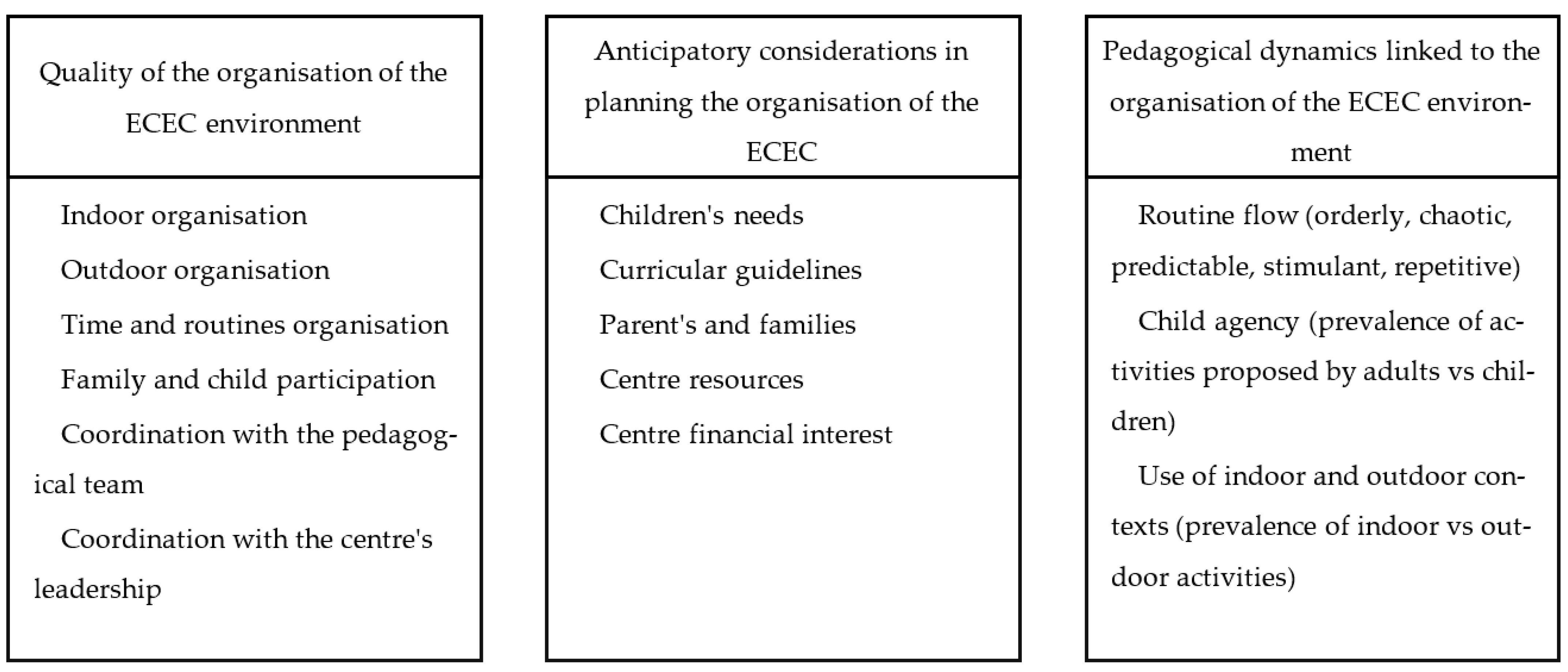
2.1. Instruments
2.1.1. Early Childhood Education and Care Quality Scale
Indoor Learning Environment Organisation
Outdoor Learning Environment Organisation
Time and Routines Organisation
Participation of Families and Children in the Environment Organisation
Coordination with the Pedagogical Team
Coordination with the Centre’s Leadership
2.1.2. Intentionality: Anticipatory Considerations in Planning ECEC Environment
2.1.3. Pedagogical Dynamics Linked to the Organisation of the ECEC Environment
2.1.4. Sociodemographic and Professional Information
2.2. Sample and Population
2.3. Data Analysis Procedures
3. Results
3.1. Psychometric Properties of the Questionnaire
3.2. Quality of the Organisation of the ECEC Environment
3.3. Intentionality: Anticipatory Considerations in Planning the Organisation of the ECEC Environment
3.4. Educators’ Characterisation of Pedagogical Dynamics in ECEC Environments
3.4.1. Routine Flow
3.4.2. Children Agency
3.4.3. Use of Indoor and Outdoor Contexts
3.5. Relationship Between the Variables in the Study
4. Discussion
5. Conclusions
Author Contributions
Funding
Institutional Review Board Statement
Informed Consent Statement
Data Availability Statement
Acknowledgments
Conflicts of Interest
Correction Statement
Abbreviation
| ECEC | Early Childhood Education and Care |
Appendix A

| Items | Loadings |
|---|---|
| Indoor organisation | |
| The organisation of the indoor learning space promotes children’s autonomy. | 0.874 |
| Children can move freely around the indoor learning space and access materials independently. | 0.790 |
| The organisation of the indoor learning space provides multiple opportunities for children to develop competencies across the different areas and domains of the OCEPE. | 0.823 |
| The materials are diverse and stimulate children’s curiosity and exploration. | 0.825 |
| There are sufficient materials in the indoor learning space for all children in the group. | 0.677 |
| New materials are introduced regularly for the children. | 0.716 |
| The organisation of the indoor learning space is flexible and is restructured according to the interests and needs of the children/group. | 0.789 |
| The indoor learning space allows children to experience moments of managed risk. | 0.609 |
| The indoor learning space includes areas or spaces that provide children with opportunities for withdrawal and privacy. | 0.65 |
| The indoor learning space reflects children’s identities and the diversity of their experiences through their original work (e.g., stories created by the children, their own writing, original artistic productions). | 0.735 |
| The spaces include a variety of natural elements (e.g., insects, small animals, a range of plants). | 0.643 |
| Technological materials are used to support and extend indoor learning space activities and themes (e.g., tablets, cameras, microscopes, telescopes). | 0.497 |
| Common areas of the preschool (e.g., library, gymnasium, other shared spaces) are incorporated into pedagogical planning. | 0.68 |
| Transitional spaces (e.g., corridors or entrances) are intentionally used to make the group’s experiences visible. | 0.722 |
| Transitional spaces (e.g., corridors or entrances) are used intentionally to extend the group’s activities. | 0.685 |
| The materials available in the indoor learning space include natural and reused materials. | 0.728 |
| Outdoor organisation | |
| The organisation of the outdoor space promotes children’s autonomy. | 0.885 |
| Children are able to move freely in the outdoor space and independently access materials and equipment. | 0.782 |
| The organisation of the outdoor space provides multiple opportunities for children to develop competencies across the different areas and domains of the OCEPE. | 0.875 |
| The materials and equipment are diverse and stimulate children’s curiosity and exploration. | 0.864 |
| There are sufficient materials in the outdoor space for all children in the group. | 0.762 |
| New materials are introduced regularly for the children. | 0.784 |
| The organisation of the outdoor space is flexible and is restructured according to the interests and needs of the children/group. | 0.821 |
| The outdoor space allows children to experience moments of managed risk. | 0.781 |
| The outdoor space includes areas or zones that provide children with opportunities for withdrawal and privacy. | 0.592 |
| The outdoor space reflects children’s identities and the diversity of their experiences through their original work (e.g., stories created by the children, their own writing, original artistic productions). | 0.734 |
| The outdoor space includes a variety of natural elements (e.g., insects, small animals, a range of plants). | 0.779 |
| Technological materials are used in the outdoor space to support and extend indoor learning activities and themes (e.g., tablets, cameras, microscopes, telescopes). | 0.523 |
| The materials available in the outdoor space include natural and reused materials. | 0.854 |
| Time and routines organisation | |
| Children have autonomy to choose the activities they engage in during their daily routines. | 0.8 |
| The daily routine is organised on the same day, allowing children to participate in decision-making. | 0.603 |
| The organisation of time and routines provides multiple opportunities for children to develop competencies across the different areas and domains of the OCEPE. | 0.883 |
| Throughout the day, differentiated time formats are provided, including whole-group, small-group, pair, and individual activities. | 0.835 |
| There is flexibility to adjust the routine in response to the interests and needs of the children/group. | 0.795 |
| Transitions between activities are smooth and calm and respect children’s pace, avoiding abrupt interruptions of what children are doing. | 0.800 |
| During transition moments, children know what to do or where to go without relying on the adult. | 0.738 |
| The routine includes a structure that provides the stability children need. | 0.783 |
| The unpredictability of certain situations can make it difficult to maintain a stable rhythm throughout the day. | Removed |
| It is possible to anticipate and organise the time required to meet the needs of the group. | 0.730 |
| Participation | |
| Children are listened to and participate in the planning of activities. | 0.899 |
| Families are consulted in order to adjust the routine so as to better respond to their needs and those of the children. | 0.750 |
| Children are listened to and participate in the organisation of the outdoor space and in the selection of materials. | 0.841 |
| Families’ opinions and ideas are taken into consideration in the organisation and use of the outdoor space or in the development of activities in natural settings. | 0.763 |
| Children are listened to and participate in the organisation of the indoor learning space and in the selection of materials. | 0.888 |
| Families’ opinions and ideas are taken into consideration in the organisation and functioning of the indoor learning group. | 0.659 |
| Coordination with the Pedagogical Team | |
| I have autonomy to make decisions regarding the organisation of the indoor learning space environment. | 0.880 |
| I have autonomy to make decisions regarding the organisation of time. | 0.778 |
| I actively participate with the educational team in decision-making regarding the organisation of shared and outdoor spaces within the educational setting. | 0.873 |
| I actively participate with the educational team in decision-making regarding the organisation of time at the educational setting (extracurricular activities, celebrations, arrivals and departures, meals). | 0.832 |
| Within the pedagogical team, we think about and discuss the organisation of materials and educational spaces. | 0.881 |
| Within the pedagogical team, we think about and discuss the organisation of time and routines. | 0.869 |
| There is collaborative work with educators from specialised areas (for example, music, English, physical education, swimming) to ensure continuity in the work developed with the group of children. | 0.652 |
| Coordination with the Centre’s Leadership | |
| I share the leadership’s/coordination team’s vision regarding the best way to organise and manage the indoor learning space. | 0.891 |
| I share the leadership’s/coordination team’s vision regarding the best way to organise, manage, and use the outdoor space (e.g., naturalised environments; risk and safety; exploration). | 0.945 |
| I share the leadership’s/coordination team’s vision regarding what is important in the planning and management of routines. | 0.945 |
| Needs and Interests Considered in Environment Organisation | Educadors’ Responses (%) | ||||||
|---|---|---|---|---|---|---|---|
| 1 | 2 | 3 | 4 | 5 | 6 | 7 | |
| Childres needs | 0.1 | 0.7 | 1.2 | 3.2 | 9.9 | 24.4 | 60.3 |
| Curricular Guidelines for Pre-School Education | 0.4 | 0.2 | 0.6 | 2.9 | 9.9 | 28.6 | 55.5 |
| Parents/Family solicitations | 1.5 | 1.7 | 7.1 | 18.8 | 28.7 | 23.9 | 18.2 |
| Educational centre’s resources | 0.2 | 1.1 | 4.0 | 11.6 | 20.4 | 31.8 | 30.8 |
| Educational centre’s financial interest | 3.2 | 2.5 | 7.0 | 20.9 | 27.7 | 22.4 | 16.2 |
| Pedagogical Dynamics | Educadors’ Responses (%) | ||||||
|---|---|---|---|---|---|---|---|
| 1 | 2 | 3 | 4 | 5 | 6 | 7 | |
| Routine Flow | |||||||
| Orderly | 3.2 | 1.5 | 3.2 | 13.9 | 29.3 | 33.4 | 14.6 |
| Chaotic | 41.7 | 24.0 | 14.9 | 12.0 | 4.9 | 1.3 | 1.1 |
| Predictability | 3.0 | 2.8 | 7.7 | 24.7 | 30.5 | 21.5 | 9.8 |
| Stimulant | 0.5 | 0.3 | 0.8 | 6.7 | 21.4 | 41.0 | 29.3 |
| Repetitive | 9.9 | 8.2 | 15.5 | 24.7 | 23.6 | 11.5 | 6.6 |
| Child Agency | |||||||
| Prevalence of activities proposed by children | 0.8 | 1.3 | 5.4 | 18.8 | 29.1 | 29.1 | 15.6 |
| Prevalence of activities proposed by adults | 5.2 | 6.3 | 12.0 | 29.9 | 27.5 | 15.1 | 4.1 |
| Balance between activities proposed by adults and children | 0.7 | 0.5 | 3.2 | 14.1 | 19.3 | 33.3 | 28.9 |
| Use of indoor and outdoor contexts | |||||||
| Prevalence of indoor activities | 4.9 | 4.1 | 6.3 | 25.8 | 27.7 | 24.2 | 7.0 |
| Prevalence of outdoor activities | 2.6 | 2.6 | 8.7 | 28.4 | 30.4 | 17.8 | 9.4 |
| Balance between indoor and outdoor activities | 0.8 | 0.7 | 4.6 | 11.8 | 18.8 | 33.3 | 30.1 |
| Different indoor and outdoor activities | 1.1 | 1.2 | 2.6 | 14.7 | 23.8 | 31.7 | 25.0 |
| Continuity between activities started in one space and moving to another | 1.6 | 0.8 | 4.9 | 15.1 | 25.2 | 31.8 | 20.6 |
References
- Albright, M., & Weissberg, R. (2010). School-family partnerships to promote social and emotional learning. In S. Christenson, & A. Reschly (Eds.), Handbook of school-family partnerships (pp. 246–265). Routledge. [Google Scholar]
- Australian Education Research Organization. (2025). Play-based learning with intentionality. Discussion paper. Available online: https://www.edresearch.edu.au/sites/default/files/2025-04/play-based-learning-with-intentionality-aa.pdf (accessed on 28 January 2026).
- Beames, S., Higgins, P., Nicol, R., & Smith, H. (2024). Outdoor learning across the curriculum. Theory guidelines for practice. Routledge. [Google Scholar]
- Bento, G. (2020). Grelha de observação de espaços exteriores em educação de infância: GO-exterior. UA Editora, Universidade de Aveiro, Serviços de Documentação, Informação Documental e Museologia. [Google Scholar] [CrossRef]
- Bento, G., & Costa, J. A. (2022). Outdoor spaces design in early childhood settings—Analysing opportunities for children’s play in Portugal. International Journal of Play, 11(3), 270–288. [Google Scholar] [CrossRef]
- Bento, G., & Dias, G. (2017). The importance of outdoor play for young children’s healthy development. Porto Biomedical Journal, 2(5), 157–160. [Google Scholar] [CrossRef] [PubMed]
- Berti, S., Cigala, A., & Sharmahd, N. (2019). Early childhood education and care physical environment and child development: State of the art and reflections on future orientations and methodologies. Educational Psychology Review, 31(4), 991–1021. [Google Scholar] [CrossRef]
- Bilton, H. (2020). Values stop play? Teachers’ attitudes to the early years outdoor environment. Early Child Development and Care, 190(1), 12–20. [Google Scholar] [CrossRef]
- Bilton, H., & Waters, J. (2017). Why take young children outside? A critical consideration of the professed aims for outdoor learning in the early years by teachers from England and Wales. Social Sciences, 6(1), 1. [Google Scholar] [CrossRef]
- Blyth, A., & Velissaratou, J. (2018). OECD school user survey: Improving learning spaces together. OECD Publishing. [Google Scholar]
- Bondioli, A. (2004). A observação do contexto educativo: Uma perspetiva de pesquisa sobre os tempos do cotidiano [The observation of the educational context: A perspective of research on everyday times]. In A. Bondioli (Org.), O tempo no cotidiano infantil: Perspectivas de pesquisa e estudos de caso (pp. 19–29). Cortez. [Google Scholar] [CrossRef]
- Bondioli, A. (2013). Construir compartilhando a qualidade: A contribuição das partes interessadas [Building by sharing quality: The contribution of stakeholders]. In A. Bondioli, & D. Savio (Eds.), Participação e qualidade em educação da infância (pp. 25–49). UFPR. [Google Scholar]
- Bondioli, A., Moro, C., & Castelo Branco, J. (2023). Apresentação: Sobre o debate acerca da qualidade e da avaliação em Educação Infantil. EDUR—Educação em Revista, 39, e41763. [Google Scholar] [CrossRef]
- Bondioli, A., & Nigito, G. (Eds.). (2011). Tiempos, espacios y grupos. El análisis y la evaluación de la organización en la escuela infantil: DAVOPSI. GRAÓ. [Google Scholar]
- Bronfenbrenner, U., & Morris, P. A. (2007). The bioecological model of human development. In Handbook of child psychology (Vol. 1). John Wiley & Sons. [Google Scholar]
- Brussoni, M., Gibbons, R., Gray, C., Ishikawa, T., Sandseter, E. B. H., Bienenstock, A., Chabot, G., Fuselli, P., Herrington, S., Janssen, I., Pickett, W., Power, M., Stanger, N., Sampson, M., & Tremblay, M. S. (2015). What is the relationship between risky outdoor play and health in children? A systematic review. International Journal of Environmental Research and Public Health, 12(6), 6423–6454. [Google Scholar] [CrossRef] [PubMed]
- Burchinal, M. (2018). Measuring early care and education quality. Child Development Perspectives, 12(1), 3–9. [Google Scholar] [CrossRef]
- Clarke, B., Sheridan, S., & Woods, K. (2010). Elements of healthy family-school relationships. In S. Christenson, & A. Reschly (Eds.), Handbook, school-family partnerships (pp. 61–79). Routledge. [Google Scholar]
- Collins, T. J., Jones, R. A., & Tonge, K. L. (2023). Educator perceptions of free-flowing routines in early childhood education and care. Journal of Early Childhood Research, 21(2), 147–161. [Google Scholar] [CrossRef]
- Cox-Peterson, A. (2011). Educational Partnerships. Connecting schools, families, and the community. SAGE. [Google Scholar]
- Dahlberg, G., Moss, P., & Pence, A. (2013). Beyond quality in early childhood education and care: Languages of evaluation (3rd ed.). Routledge. [Google Scholar]
- Dahlberg, G., Moss, P., & Pence, A. (2024). CIEC colloquium: Reflections on beyond quality at 25 years. Contemporary Issues in Early Childhood, 25(1), 131–145. [Google Scholar] [CrossRef]
- DGEEC. (2025). Educação em números—Portugal 2025. Direção Geral de Estatísticas em Educação e Ciência. Available online: https://www.dgeec.medu.pt/api/ficheiros/68d12a159864c806146a8494 (accessed on 30 December 2025).
- Douglass, A. L. (2019). Leadership for quality early childhood education and care. In OECD education working papers. OECD Publishing. [Google Scholar] [CrossRef]
- Eadie, P., Page, J., Levickis, P., Elek, C., Murray, L., Wang, L., & Lloyd-Johnsen, C. (2024). Domains of quality in early childhood education and care: A scoping review of the extent and consistency of the literature. Educational Review, 76(4), 1057–1086. [Google Scholar] [CrossRef]
- Early, D. M., Iruka, I. U., Ritchie, S., Barbarin, O. A., Winn, D. C., Crawford, G. M., Frome, P. M., Clifford, R. M., Burchinal, M., Howes, C., Bryant, D. M., & Pianta, R. C. (2010). How do pre-kindergarteners spend their time? Gender, ethnicity, and income as predictors of experiences in pre-kindergarten classrooms. Early Childhood Research Quarterly, 25(2), 177–192. [Google Scholar] [CrossRef]
- Edwards, C. P., & Gandini, L. (2018). The Reggio Emilia approach to early childhood education. In Handbook of international perspectives on early childhood education (pp. 365–378). Routledge. [Google Scholar]
- Edwards, S. (2021). Process quality, curriculum and pedagogy in early childhood education and care. In OECD education working papers (No. 247). OECD Publishing. [Google Scholar] [CrossRef]
- Fewster, C. (2010). Designing routines and transitions with children in early childhood settings. Educating Young Children: Learning and Teaching in the Early Childhood Years, 16(2), 42–44. Available online: https://search.informit.org/doi/10.3316/informit.385088598607240 (accessed on 27 March 2026).
- Fleer, M., Gomes, J., & March, S. (2014). Science learning affordances in preschool environments. Australasian Journal of Early Childhood, 39(1), 38–48. [Google Scholar] [CrossRef]
- Gariboldi, A. (2002). Os tempos cotidianos na pré-escola: As formas da sociabilidade. In A. Bondioli (Ed.), O tempo no cotidiano infantil (pp. 97–104). Cortez Editora. [Google Scholar]
- Gariboldi, A., & Pugnaghi, A. (2018). Relação educativa, avaliação e trabalho de equipe. Revista Linhas, 19(40), 94–115. [Google Scholar] [CrossRef]
- Gkloumpou, A., & Germanos, D. (2022). The importance of classroom cooperative learning space as an immediate environment for educational success. An action research study in Greek Kindergartens. Educational Action Research, 3(1), 61–75. [Google Scholar] [CrossRef]
- Grieshaber, S., Krieg, S., McArdle, F., & Sumsion, J. (2021). Intentional teaching in early childhood education: A scoping review. Review of Education, 9(3), e3309. [Google Scholar] [CrossRef]
- Hair, J. F., Black, W. C., Babin, B. J., & Anderson, R. E. (2014). Multivariate data analysis (Pearson new international edition). Pearson Education Limited. [Google Scholar]
- Hamre, B., Hatfield, B., Pianta, R., & Jamil, F. (2014). Evidence for general and domain-specific elements of teacher–child interactions: Associations with preschool children’s development. Child Development, 85(3), 1257–1274. [Google Scholar] [CrossRef] [PubMed]
- Harms, T., Clifford, R., & Cryer, D. (2008). Escala de avaliação do ambiente em educação de infância (Edição Revista (Centro de Psicologia da Universidade do Porto—Investigação Desenvolvimental, Educacional e Clínica em Crianças e Adolescentes, Trad.)). Livpsic/Legis Editora. (Original work published 1998). [Google Scholar]
- Harms, T., Cryer, D., Clifford, R. M., & Yazejian, N. (2017). Infant/Toddler environment rating scale (3rd ed.). Teachers College Press. [Google Scholar]
- Harrison, L. J., Wong, S., Press, F., Gibson, M., & Ryan, S. (2019). Understanding the work of Australian early childhood educators using time-use diary methodology. Journal of Research in Childhood Education, 33(4), 521–537. [Google Scholar] [CrossRef]
- Jeynes, W. H. (2025). What we now know about parental engagement, which will guide the future. Education and Urban Society, 57(5), 444–461. [Google Scholar] [CrossRef]
- Kiviranta, L., Lindfors, E., Rönkkö, M. L., & Luukka, E. (2024). Outdoor learning in early childhood education: Exploring benefits and challenges. Educational Research, 66(1), 102–119. [Google Scholar] [CrossRef]
- Kwo, M., Browning, M., & Penner, M. (2022). Refueling students in flight: Lessons in nature may boost subsequent classroom engagement. In R. Jucker, & J. Au (Eds.), High-quality outdoor learning. Evidence-based education outside the classroom for children, teachers and society (pp. 67–94). Springer. [Google Scholar] [CrossRef]
- Kwon, S., Tandon, P. S., O’Neill, M., & Becker, A. B. (2022). Cross-sectional association of light sensor-measured time outdoors with physical activity and gross motor competency among U.S. preschool-aged children: The 2012 NHANES National Youth Fitness Survey. BMC Public Health, 22(833), 2–9. [Google Scholar] [CrossRef] [PubMed]
- La Paro, K. M., Pianta, R. C., & Stuhlman, M. (2004). The classroom assessment scoring system: Findings from the prekindergarten year. The Elementary School Journal, 104(5), 409–426. [Google Scholar] [CrossRef]
- Leal, T., Gamelas, A. M., Abreu-Lima, I., Cadima, J., & Peixoto, C. (2009). Qualidade em educação pré-escolar. Psicologia, 23(2), 43–54. [Google Scholar] [CrossRef]
- Leggett, N. (2025). Intentional teaching and the intentionality of educators: Time for careful, considerate, collaborative, and reflective practice. Early Childhood Education Journal, 53, 1–9. [Google Scholar] [CrossRef]
- Li, C. H. (2016). Confirmatory factor analysis with ordinal data: Comparing robust maximum likelihood and diagonally weighted least squares. Behavior Research Methods, 48(3), 936–949. [Google Scholar] [CrossRef] [PubMed]
- Lopes da Silva, I., Marques, L., Mata, L., & Rosa, M. (2016). Orientações curriculares para a educação pré-escolar. Direção-Geral da Educação. Available online: https://www.dge.mec.pt/ocepe/sites/default/files/Orientacoes_Curriculares.pdf (accessed on 27 March 2026).
- Lundy, L. (2007). “Voice” is not enough: Conceptualising article 12 of the United Nations convention on the rights of the child. British Educational Research Journal, 33(6), 927–942. [Google Scholar] [CrossRef]
- Malavasi, L., & Zoccatelli, B. (2013). Documentar os projetos nos serviços educativos [Document projects in educational services]. APEI—Associação de Profissionais de Educação de Infância. [Google Scholar]
- Manning, M., Wong, G. T. W., Fleming, C. M., & Garvis, S. (2019). Is teacher qualification associated with the quality of the early childhood education and care environment? A meta-analytic review. Review of Educational Research, 89(3), 370–415. [Google Scholar] [CrossRef]
- Martin, A., Brophy, R., Clarke, J., Hall, C., Jago, R., Kipping, R., Reid, T., Rigby, B., Taylor, H., White, J., & Simpson, S. (2022). Environmental and practice factors associated with children’s device-measured physical activity and sedentary time in early childhood education and care centres: A systematic review. International Journal of Behavioral Nutrition and Physical Activity, 19, 84. [Google Scholar] [CrossRef] [PubMed]
- Mashburn, A. J. (2008). Quality of social and physical environments in preschools and children’s development of academic, language, and literacy skills. Applied Developmental Science, 12(3), 113–127. [Google Scholar] [CrossRef]
- Mashburn, A. J., Pianta, R. C., Hamre, B. K., Downer, J. T., Barbarin, O. A., Bryant, D., Burchinal, M., Early, D., & Howes, C. (2008). Measures of classroom quality in prekindergarten and children’s development of academic, language, and social skills. Child Development, 79(3), 732–749. [Google Scholar] [CrossRef] [PubMed]
- Mata, L., Nóbrega Santos, N., Pereira, M., & Brito, A. T. (in press). Educational environment in preschool: Educators’ self-efficacy. Revista Colombiana de Educación.
- Mata, L., & Pedro, I. (2021). Participação e envolvimento das famílias: Construção de parcerias em contextos de educação de infância. Ministério da Educação/Direção-Geral da Educação. Available online: https://www.dge.mec.pt/sites/default/files/EInfancia/documentos/participfamilias.pdf (accessed on 27 March 2026).
- McWilliam, R. A., Scarborough, A. A., Bagby, J. H., & Sweeney, A. L. (1998). Teaching styles rating scale. Frank Porter Graham Child Development Center, University of North Carolina at Chapel Hill. [Google Scholar]
- Melhuish, E., Ereky-Stevens, K., Petrogiannis, K., Ariescu, A., Penderi, E., Rentzou, K., Tawell, A., Slot, P., Broekhuizen, M., & Leserman, P. (2015). A review of research on the effects of early childhood education and care (ECEC) on child development. In Curriculum quality analysis and impact review of European early childhood education and care. CARE—European early childhood education and care publications. CARE—European Early Childhood Education and Care. [Google Scholar]
- Moore, G. T., & Sugiyama, T. (2007). The Children’s Physical Environment Rating Scale (CPERS): Reliability and validity for assessing the physical environment of early childhood educational facilities. Children, Youth and Environments, 17(4), 24–53. [Google Scholar] [CrossRef]
- Morin, A. J. S., Myers, N. D., & Lee, S. (2020). Modern factor analytic techniques. In G. Tenenbaum, & R. C. Eklund (Eds.), Handbook of sport psychology (4th ed., pp. 1044–1073). John Wiley & Sons, Inc. [Google Scholar]
- Neves, V. F. A., Goulart, M. I. M., & Santos, S. V. S. (2017). A conjugação de diferentes temporalidades na construção da ideia de qualidade na Educação Infantil [The intertwining of different temporalities in the construction of the idea of quality in Early Childhood Education]. RELAdEI: Revista Latinoamericana de Educación Infantil, 6(1–2), 42–60. Available online: https://revistas.usc.gal/index.php/reladei/article/view/4999 (accessed on 30 December 2025).
- Nigito, G. (2011). Por una pedagogía de la temporalidad [For a pedagogy of temporality]. In A. Bondioli, & G. Nigito (Eds.), Tiempos, espacios y grupos. El análisis y la evaluación de la organización en la escuela infantil: DAVOPSI (pp. 73–98). GRAÓ. [Google Scholar]
- OECD. (2021). Starting Strong VI: Supporting meaningful interactions in early childhood education and care, starting strong. OECD Publishing. [Google Scholar] [CrossRef]
- OECD. (2023). Education at a Glance 2023: OECD indicators. OECD Publishing. [Google Scholar] [CrossRef]
- Ozturk, Y., & Ozer, Z. (2022). Outdoor play activities and outdoor environment of early childhood education in Turkey: A qualitative meta-synthesis. Early Child Development and Care, 192(11), 1752–1767. [Google Scholar] [CrossRef]
- Pechtelidis, Y., Kozaris, I., Pantazidis, S., & Botonaki, A. (2023). Sowing the seeds of commons in education: Three case studies from the Horizon Project 2020 SMOOTH. Social Sciences, 12(10), 581. [Google Scholar] [CrossRef]
- Pereira, M., Fernandes, C., Brito, A. T., Santos, N. N., Pereira, B., & Mata, L. (2026). De dentro para fora da equipa com o EduIn&Out: Construindo um questionário sobre a organização de ambientes em contextos de educação pré-escolar [From within the team to the outside with eduin&out: Developing a questionnaire on the organisation of environments in early childhood education contexts]. In N. Ferreira, & A. T. Brito (Eds.), Atas do II colóquio internacional de reflexão sobre práticas integradas em educação. ISPA. [Google Scholar]
- Pereira, M., Santos, N. N., Brito, A. T., & Mata, L. (2025). Time and routines organization in early childhood education and care—Participation, opportunities, and constraints. Journal of Research in Childhood Education, 40, 391–410. [Google Scholar] [CrossRef]
- Perlman, M., Falenchuk, O., Fletcher, B., McMullen, E., Beyene, J., & Shah, P. S. (2016). A systematic review and meta-analysis of a measure of staff/child interaction quality (the classroom assessment scoring system) in early childhood education and care settings and child outcomes. PLoS ONE, 11(12), e0167660. [Google Scholar] [CrossRef] [PubMed]
- Philp-Clark, C., & Grieshaber, S. (2024). Teacher critical reflection: What can be learned from quality research? The Australian Educational Researcher, 51(2), 697–717. [Google Scholar] [CrossRef]
- Pianta, R., Downer, J., & Hamre, B. (2016). Quality in early education classrooms: Definitions, gaps, and systems. The Future of Children, 26(2), 119–137. [Google Scholar] [CrossRef]
- Porter, H. (2018). Educating outsider. Curriculum linked outdoor learning ideas for primary teachers. Bloomsbury. [Google Scholar]
- Prins, J., Wilt, F., Santen, S., Veen, C., & Hovinga, D. (2022). The importance of play in natural environments for children’s language development: An explorative study in early childhood education. International Journal of Early Years Education, 31(2), 450–466. [Google Scholar] [CrossRef]
- Rademacher, A., Bäker, N., von Düring, U., Hiltunen, V., & Goagoses, N. (2025). The effects of early childhood education and care quality on academic competences in early primary school: A systematic review and meta-analysis. European Journal of Psychology of Education, 40(4), 110. [Google Scholar] [CrossRef]
- Sağlam, M., Çelik, O. T., Tunç, Y., Kahraman, Ü., Açar, D., & Candemir, B. (2023). Meta-thematic analysis of quality in early childhood education and care. Humanities and Social Sciences Communications, 10(1), 966. [Google Scholar] [CrossRef]
- Sakellariou, M., & Banou, M. (2022). Play within outdoor preschool learning environments of Greece: A comparative study on current and prospective kindergarten educators. Early Child Development and Care, 192(6), 887–903. [Google Scholar] [CrossRef]
- Sando, O. J. (2019). The outdoor environment and children’s health: A multilevel approach. International Journal of Play, 8(1), 39–52. [Google Scholar] [CrossRef]
- Santos, A. M. M. (2017). Os tempos em educação de infância [The times in early childhood education] [Master’s thesis, Escola Superior de Educação de Lisboa]. Repositório Científico do Politécnico de Lisboa. Available online: http://hdl.handle.net/10400.21/8031 (accessed on 30 December 2025).
- Sheridan, S. (2007). Dimensions of pedagogical quality in preschool. International Journal of Early Years Education, 15(2), 197–217. [Google Scholar] [CrossRef]
- Sheridan, S. M., Edwards, C. P., Marvin, C. A., & Knoche, L. L. (2009). Professional development in early childhood programs: Process issues and research needs. Early Education and Development, 20(3), 377–401. [Google Scholar] [CrossRef] [PubMed]
- Slot, P. (2018). Structural characteristics and process quality in early childhood education and care: A literature review. (OECD Education Working Papers, 176). OECD Publishing. [Google Scholar] [CrossRef]
- Sluiter, R. M., Fukkink, R. G., & Fekkes, M. (2025). The Impact of process quality in early childhood education and care on socio-emotional development: A meta-analysis of longitudinal studies. International Journal of Environmental Research and Public Health, 22(5), 775. [Google Scholar] [CrossRef] [PubMed]
- Solang, D. J., Yunus, M., Rukmini, B. S., Kurnia, K., & Umam, K. (2024). The impact of early childhood education on long-term outcomes. The Journal of Academic Science, 1(4), 350–361. [Google Scholar] [CrossRef]
- Speldewinde, C., Infantino, S., & Campbell, C. (2025). Facilitated play in nature playgroups: An opportunity for early childhood science education. Education Sciences, 15(12), 1634. [Google Scholar] [CrossRef]
- Sreelasky, J. (2019). A forest-based environment as a site of literacy and meaning making for kindergarten children. Literacy, 53(2), 95–101. [Google Scholar] [CrossRef]
- Strong-Wilson, T., & Ellis, J. (2007). Children and place: Reggio Emilia’s environment as third teacher. Theory Into Practice, 46(1), 40–47. [Google Scholar] [CrossRef]
- Syslová, Z. (2019). The relation between reflection and the quality of a preschool teacher’s education performance. International Journal of Child Care and Education Policy, 13(4), 4. [Google Scholar] [CrossRef]
- Thornton, A. (2022). Teaching the primary curriculum outdoors—Learning through landscapes. Corwin. [Google Scholar]
- Tonge, K., Jones, R., & Okely, A. (2019). Quality interactions in early childhood education and care center outdoor environments. Early Childhood Education Journal, 47, 31–41. [Google Scholar] [CrossRef]
- Van Liempd, H. I. M., Oudgenoeg-Paz, O., Fukkink, R. G., & Leseman, P. P. (2018). Young children’s exploration of the indoor playroom space in center-based childcare. Early Childhood Research Quarterly, 43, 33–41. [Google Scholar] [CrossRef]
- Višnjić Jevtić, A. (2023). Collaboration theory: ECEC leading families to lead their own partnerships with ECEC. In A. R. Sadownik, & A. Višnjić Jevtić (Eds.), (Re)theorising more-than-parental Involvement in early childhood education and care (Vol. 40, pp. 127–141). International perspectives on early childhood education and development. Springer. [Google Scholar] [CrossRef]
- Vitiello, V. E., Booren, L. M., Downer, J. T., & Wiliford, A. P. (2012). Variation in children’s classroom engagement throughout a day in preschool: Relations to classroom and child factors. Early Childhood Research Quarterly, 27(2), 210–220. [Google Scholar] [CrossRef] [PubMed]
- Vuorisalo, M., Rutanen, N., & Raittila, R. (2015). Constructing relational space in early childhood education. Early Years, 35(1), 67–79. [Google Scholar] [CrossRef]
- Wait, S. (2019). Teaching and learning outside the classroom: Personal values, alternative pedagogies and standards. In S. Wait (Ed.), Outdoor learning research. Insights into forms and functions (pp. 8–23). Routledge. [Google Scholar]
- Wait, S., & Aronsson, J. (2022). Some impacts on health and wellbeing from school-based outdoor learning. In R. Jucker, & J. Au (Eds.), High-quality outdoor learning. Evidence-based education outside the classroom for children, teachers and society (pp. 171–191). Springer. [Google Scholar] [CrossRef]
- Zorec, M. B., & Vrankar, V. (2016). Children’s participation at daily routine in Slovene preschools. SHS Web of Conferences ERPA, 31, 1014. [Google Scholar] [CrossRef]

| Characteristics | Sample | Population | ||
|---|---|---|---|---|
| f | % | f | % | |
| Gender | ||||
| Female | 790 | 98.5 | 17,459 | 99.0 |
| Male | 9 | 1.1 | 183 | 1.0 |
| Other | 3 | 0.4 | - | - |
| Age | ||||
| <30 | 20 | 2.5 | 491 | 2.8 |
| 30–39 | 90 | 11.2 | 2203 | 12.5 |
| 40–49 | 241 | 30.0 | 5116 | 29.1 |
| 50–59 | 274 | 34.2 | 5599 | 31.8 |
| >60 | 177 | 22.1 | 4173 | 23.7 |
| Sector | ||||
| Public | 464 | 57.9 | 10,617 | 60.2 |
| Private | 338 | 41.1 | 7025 | 39.08 |
| Portugal Region—NUTS II | ||||
| Alentejo | 64 | 8.0 | 868 | 4.9 |
| Algarve | 28 | 3.5 | 750 | 4.3 |
| Lisbon | 273 | 34.0 | 6114 | 34.7 |
| Centre | 162 | 20.2 | 2661 | 15.1 |
| North | 227 | 28.3 | 5937 | 33.7 |
| Madeira | 27 | 3.4 | 651 | 3.7 |
| Azores | 21 | 2.6 | 661 | 3.7 |
| Characteristics | f | % |
|---|---|---|
| Children’s Age Heterogeneity | ||
| All children are the same age (homogeneity) | 231 | 28.8 |
| One year difference | 120 | 15.0 |
| Two-year difference | 212 | 26.4 |
| Up to a three-year difference | 239 | 29.8 |
| Educational levels in the school | ||
| Nursery | 293 | 36.5 |
| Preschool | 783 | 97.6 |
| 1st Cycle of Basic Education (1st to 4th grade) | 412 | 51.4 |
| 2nd and 3th Cycle of Basic Education (5th to 9th grade) | 111 | 13.8 |
| Secondary Education (10th to 12th grade) | 40 | 5.0 |
| Number of children in the preschool | ||
| Less than 50 | 254 | 31.7 |
| Between 50 and 100 | 342 | 42.6 |
| Between 101 and 200 | 166 | 20.7 |
| Between 201 and 300 | 28 | 3.5 |
| More than 300 | 12 | 1.5 |
| Pedagogical Model | ||
| Modern School Movement | 299 | 37.3 |
| Waldorf | 30 | 3.7 |
| High-Scope | 158 | 19.7 |
| Pedagogy of Participation | 173 | 21.6 |
| Reggio Emillia | 122 | 15.2 |
| Project-Based Learning | 408 | 50.9 |
| Model | χ2 | DF | p | X2/df | RMSEA [IC90] | CFI | TLI | SRMR |
|---|---|---|---|---|---|---|---|---|
| 4 Factors | 9216.63 | 1371 | <0.001 | 6.72 | 0.084 [0.083, 0.086] | 0.857 | 0.850 | 0.069 |
| 5 Factors | 7741.74 | 1367 | <0.001 | 5.66 | 0.076 [0.075, 0.078] | 0.884 | 0.878 | 0.065 |
| 6 Factors | 6591.84 | 1362 | <0.001 | 4.84 | 0.069 [0.068, 0.071] | 0.904 | 0.900 | 0.058 |
| 6 Factors + FGSR * | 6699.51 | 1365 | <0.001 | 4.90 | 0.070 [0.068, 0.071] | 0.903 | 0.898 | 0.059 |
| 5 Factors ** | 7272.39 | 1367 | <0.001 | 5.32 | 0.073 [0.072, 0.075] | 0.892 | 0.887 | 0.062 |
| Dimensions | N. of Items | ω | H | AVE | √ AVE | MSV | ASV | Higher Correlation |
|---|---|---|---|---|---|---|---|---|
| Indoor Organisation | 16 | 0.95 | 0.95 | 0.52 | 0.72 | 0.67 | 0.47 | 0.82 |
| Outdoor Organisation | 13 | 0.95 | 0.96 | 0.61 | 0.78 | 0.47 | 0.40 | 0.69 |
| Time and Routines Organisation | 9 | 0.93 | 0.94 | 0.61 | 0.78 | 0.67 | 0.45 | 0.82 |
| Family and Child Participation | 6 | 0.92 | 0.93 | 0.65 | 0.80 | 0.55 | 0.44 | 0.74 |
| Coordination with the Pedagogical Team | 7 | 0.94 | 0.95 | 0.68 | 0.83 | 0.51 | 0.46 | 0.71 |
| Coordination with the centre’s leadership | 3 | 0.95 | 0.95 | 0.86 | 0.93 | 0.51 | 0.31 | 0.71 |
| Items | N | M | SD | Min | Max | Sk | Ku |
|---|---|---|---|---|---|---|---|
| Intentionality | |||||||
| Children’s needs | 802 | 6.4 | 1.0 | 1 | 7 | −1.9 | 4.4 |
| Curricular Guidelines | 802 | 6.4 | 0.9 | 1 | 7 | −2.0 | 5.8 |
| Parents/Family solicitations | 802 | 5.2 | 1.3 | 1 | 7 | −0.6 | 0.2 |
| Educational centre’s resources | 802 | 5.7 | 1.2 | 1 | 7 | −0.9 | 0.3 |
| Educational centre’s financial interest | 802 | 5.0 | 1.5 | 1 | 7 | −0.6 | 0.3 |
| Pedagogical Dynamics | |||||||
| Routine Flow | |||||||
| Orderly | 757 | 5.3 | 1.3 | 1 | 7 | −1.1 | 1.7 |
| Chaotic | 757 | 2.2 | 1.4 | 1 | 7 | 1.1 | 0.6 |
| Predictability | 757 | 4.8 | 1.4 | 1 | 7 | −0.6 | 0.4 |
| Stimulant | 757 | 5.9 | 1.0 | 1 | 7 | −1.1 | 2.5 |
| Repetitive | 757 | 4.0 | 1.6 | 1 | 7 | −0.2 | −0.6 |
| Child Agency | |||||||
| Prevalence of activities proposed by children | 757 | 5.2 | 1.2 | 1 | 7 | −0.6 | 0.3 |
| Prevalence of activities proposed by adults | 757 | 4.3 | 1.4 | 1 | 7 | −0.4 | 0.0 |
| Balance between activities proposed by adults and children | 757 | 5.7 | 1.2 | 1 | 7 | −0.9 | 0.6 |
| Use of indoor and outdoor contexts | |||||||
| Prevalence of indoor activities | 757 | 4.7 | 1.4 | 1 | 7 | −0.7 | 0.3 |
| Prevalence of outdoor activities | 757 | 4.7 | 1.3 | 1 | 7 | −0.4 | 0.3 |
| Balance between indoor and outdoor activities | 757 | 5.7 | 1.3 | 1 | 7 | −1.0 | 0.8 |
| Different indoor and outdoor activities | 757 | 5.5 | 1.2 | 1 | 7 | −0.9 | 0.9 |
| Continuity between activities started in one space and moving to another | 757 | 5.4 | 1.3 | 1 | 7 | −0.9 | 0.9 |
| Quality Dimensions | N | M | SD | Min | Max | Sk | Ku |
|---|---|---|---|---|---|---|---|
| Indoor Organisation | 802 | 5.9 | 0.9 | 1.8 | 7 | −1.1 | 1.3 |
| Outdoor Organisation | 802 | 4.8 | 1.3 | 1 | 7 | −0.5 | 0.2 |
| Time and Routines Organisation | 802 | 6.1 | 0.8 | 2 | 7 | −1.2 | 2.1 |
| Family and Child Participation | 802 | 5.3 | 1.1 | 1 | 7 | 0.7 | 0.7 |
| Coordination with the Pedagogical Team | 802 | 6 | 1.2 | 1 | 7 | −1.2 | 1.5 |
| Coordination with the centre’s leadership | 802 | 5.7 | 1.6 | 1 | 7 | −1 | 0.3 |
| Intentionality and Pedagogical Dynamics | Quality of the Organisation of the ECEC Environment | |||||
|---|---|---|---|---|---|---|
| Indoor | Outdoor | Time & Routines | Participation | Coordination Pedagogical Team | Coordination Centre’s Leadership | |
| Intentionality | ||||||
| Children’s needs | 0.51 ** | 0.36 ** | 0.49 ** | 0.39 ** | 0.46 ** | 0.35 ** |
| Curricular Guidelines for Pre-School Education (OCEPE) | 0.47 ** | 0.29 ** | 0.48 ** | 0.35 ** | 0.37 ** | 0.26 ** |
| Parents/Family solicitations | 0.26 ** | 0.23 ** | 0.24 ** | 0.41 ** | 0.29 ** | 0.23 ** |
| Educational centre’s resources | 0.43 ** | 0.34 ** | 0.32 ** | 0.25 ** | 0.30 ** | 0.27 ** |
| Educational centre’s financial interest | 0.18 ** | 0.12 ** | 0.10 ** | 0.08 * | 0.16 ** | 0.16 ** |
| Pedagogical Dynamics | ||||||
| Routine Flow | ||||||
| Orderly | 0.27 ** | 0.16 ** | 0.34 ** | 0.20 ** | 0.25 ** | 0.15 ** |
| Chaotic | −0.27 ** | −0.14 ** | −0.30 ** | −0.10 ** | −0.21 ** | −0.11 ** |
| Predictability | 0.13 ** | 0.12 ** | 0.17 ** | 0.11 ** | 0.14 ** | 0.11 ** |
| Stimulant | 0.59 ** | 0.41 ** | 0.62 ** | 0.50 ** | 0.50 ** | 0.35 ** |
| Repetitive | −0.12 ** | −0.09 * | −0.10 ** | −0.07 | −0.06 | −0.02 |
| Child Agency | ||||||
| Prevalence of activities proposed by children | 0.48 ** | 0.31 ** | 0.51 ** | 0.57 ** | 0.38 ** | 0.27 ** |
| Prevalence of activities proposed by adults | −0.13 ** | −0.03 | −0.11 ** | −0.15 ** | 0.03 | 0.04 |
| Balance between activities proposed by adults and children | 0.47 ** | 0.35 ** | 0.56 ** | 0.48 ** | 0.44 ** | 0.28 ** |
| Use of indoor and outdoor contexts | ||||||
| Prevalence of indoor activities | −0.02 | −0.08 * | 0.00 | −0.07 | 0.05 | 0.06 |
| Prevalence of outdoor activities | 0.27 ** | 0.32 ** | 0.29 ** | 0.34 ** | 0.29 ** | 0.19 ** |
| Balance between indoor and outdoor activities | 0.46 ** | 0.46 ** | 0.51 ** | 0.48 ** | 0.47 ** | 0.36 ** |
| Different indoor and outdoor activities | 0.33 ** | 0.27 ** | 0.37 ** | 0.28 ** | 0.34 ** | 0.25 ** |
| Continuity between activities started in one space and moving to another | 0.49 ** | 0.38 ** | 0.51 ** | 0.51 ** | 0.49 ** | 0.30 ** |
Disclaimer/Publisher’s Note: The statements, opinions and data contained in all publications are solely those of the individual author(s) and contributor(s) and not of MDPI and/or the editor(s). MDPI and/or the editor(s) disclaim responsibility for any injury to people or property resulting from any ideas, methods, instructions or products referred to in the content. |
© 2026 by the authors. Licensee MDPI, Basel, Switzerland. This article is an open access article distributed under the terms and conditions of the Creative Commons Attribution (CC BY) license.
Share and Cite
Pereira, M.; Fernandes, C.; Santos, N.N.; Brito, A.T.; Cabral, S.; Mata, L. Organisation of Early Childhood Education Environments: Validation of a Self-Report Instrument for Assessing Quality, Pedagogical Dynamics and Educators’ Intentionality. Educ. Sci. 2026, 16, 976. https://doi.org/10.3390/educsci16060976
Pereira M, Fernandes C, Santos NN, Brito AT, Cabral S, Mata L. Organisation of Early Childhood Education Environments: Validation of a Self-Report Instrument for Assessing Quality, Pedagogical Dynamics and Educators’ Intentionality. Education Sciences. 2026; 16(6):976. https://doi.org/10.3390/educsci16060976
Chicago/Turabian StylePereira, Mónica, Carla Fernandes, Natalie Nóbrega Santos, Ana Teresa Brito, Sónia Cabral, and Lourdes Mata. 2026. "Organisation of Early Childhood Education Environments: Validation of a Self-Report Instrument for Assessing Quality, Pedagogical Dynamics and Educators’ Intentionality" Education Sciences 16, no. 6: 976. https://doi.org/10.3390/educsci16060976
APA StylePereira, M., Fernandes, C., Santos, N. N., Brito, A. T., Cabral, S., & Mata, L. (2026). Organisation of Early Childhood Education Environments: Validation of a Self-Report Instrument for Assessing Quality, Pedagogical Dynamics and Educators’ Intentionality. Education Sciences, 16(6), 976. https://doi.org/10.3390/educsci16060976