1. Introduction
Higher education institutions currently operate in contexts characterized by intensified demands for accountability, transparency, and demonstrable outcomes (
Hazelkorn, 2015;
Dill & Beerkens, 2013;
European Association for Quality Assurance in Higher Education [ENQA], 2015). Within this context, quality is no longer understood solely as compliance with external standards but increasingly as a dynamic process of institutional self-regulation, grounded in the systematic production, interpretation, and use of evidence for continuous academic and organizational improvement (
Harvey & Williams, 2010;
Stensaker, 2008). This transformation is embedded in broader shifts in higher education governance, where quality assurance systems have evolved toward hybrid configurations that combine regulatory frameworks, institutional autonomy, and internal capacities for organizational learning and evidence-informed decision-making (
European Association for Quality Assurance in Higher Education [ENQA], 2015;
Hazelkorn et al., 2018;
Williams, 2016).
Recent studies have emphasized the growing reliance on data-driven governance in higher education, particularly in post-pandemic contexts, where institutions are increasingly required to demonstrate impact through measurable indicators. This has also generated critical discussions regarding the limitations of employability metrics and the tension between the increasing use of indicators and the complexity of academic decision-making.
At the same time, recent critical scholarship has problematized this expansion, highlighting tensions associated with audit cultures, performativity, and the increasing datafication of academic work (
Strathern, 2000;
Shore & Wright, 2015;
Kitchin, 2014). From this perspective, the proliferation of quality mechanisms may operate not only as tools for improvement but also as instruments of standardization and control, reshaping academic practices and institutional priorities (
Slaughter & Rhoades, 2009). These debates underscore that the central issue is not merely the availability of data, but the conditions under which evidence is produced, validated, and mobilized within organizational settings. In this evolving landscape, the range of actors considered relevant for evaluating institutional performance has expanded significantly. Beyond traditional academic indicators, increasing attention has been paid to external stakeholders—including employers, territorial communities, and graduates—as key sources of information on educational relevance and system performance (
Jongbloed et al., 2008;
Hazelkorn, 2015). Among these, alumni communities occupy a particularly strategic position, as they provide retrospective and longitudinal perspectives on the adequacy of training processes, the relevance of graduate profiles, and the alignment between higher education and dynamic labor market conditions (
Brennan & Teichler, 2008;
Harvey, 2003;
Tomlinson, 2017;
Monteiro & Almeida, 2021).
While many institutions have developed robust alumni engagement strategies—often focused on networking, employability support, and institutional identity—these initiatives do not necessarily translate into systematic inputs for academic decision-making or curricular improvement (
Taylor & Bridger, 2018;
Schomburg & Teichler, 2006;
Sin et al., 2016). This gap highlights a central tension in contemporary quality assurance: the distinction between the production of information and its effective institutional use. The existence of data does not guarantee improvement; rather, it requires organizational arrangements that enable its interpretation, prioritization, and integration into decision-making processes (
Harvey & Newton, 2007;
Stensaker, 2008;
Kitchin, 2014).
From this perspective, the challenge of integrating alumni into quality assurance systems can be conceptualized as a problem of organizational translation (
Orlikowski, 1992;
Latour, 2005;
Nicolini, 2012;
Nutley et al., 2007). In this study, translation is understood as the organizational process through which dispersed alumni experiences, trajectories, and perceptions are transformed into validated, comparable, and actionable institutional evidence capable of informing academic decision-making. This process involves not only technical instruments for data collection, but also governance arrangements that define responsibilities, establish interpretative routines, and ensure that information effectively circulates toward spaces where academic decisions are made.
It involves moving from relational forms of engagement—such as participation, communication, and networking—toward structured processes capable of transforming alumni experiences, trajectories, and perceptions into usable evidence within institutional quality cycles. This transition requires not only technical instruments (e.g., surveys, tracer studies, data infrastructures) but also governance mechanisms that define responsibilities, establish analytical routines, and ensure that information circulates effectively toward spaces where academic decisions are made (
Dill & Beerkens, 2013;
European Association for Quality Assurance in Higher Education [ENQA], 2015;
Hazelkorn et al., 2018). These challenges acquire particular relevance in national contexts where quality assurance frameworks explicitly require evidence of stakeholder engagement and its impact on institutional improvement.
In Chile, the updated accreditation criteria and standards established by the National Accreditation Commission (CNA) in 2024 reinforce this orientation, placing increasing emphasis on bidirectional relationships with the society and on the use of evidence to support continuous improvement processes. Within this regulatory framework, alumni engagement is no longer considered a complementary activity but a strategic component of institutional quality systems, particularly in relation to employability, graduate follow-up, and the validation of training outcomes.
Against this backdrop, the central problem addressed in this study lies not in the existence of alumni engagement initiatives per se, but in the design of institutional architectures capable of articulating such engagement with formal quality assurance processes. Specifically, the key question is how universities configure organizational components, information systems, and governance arrangements to enable the transformation of alumni participation into evidence that can inform academic decision-making.
This study proposes a process model of institutional translation that explains how alumni engagement is transformed into institutional evidence within quality assurance systems. Rather than assuming a direct relationship between participation and improvement, the model identifies the organizational conditions, interfaces, and breakdowns that shape the transition from alumni engagement to academic decision-making.
This study contributes to this discussion through the analytical reconstruction of an institutional alumni management model that explicitly seeks to establish this articulation. Adopting a descriptive case study approach based on documentary analysis, the research does not aim to evaluate the effectiveness or impact of the model, but rather to examine its design logic and its declared capacity to connect alumni engagement with internal quality assurance mechanisms. In doing so, the study focuses on identifying structural components, mechanisms for data production and circulation, and governance conditions that define the potential for integrating alumni-derived information into institutional improvement processes.
More specifically, the study seeks to answer the following question: how does a higher education institution design its alumni management model in order to articulate the relationship with graduates with internal quality assurance processes? To address this question, the analysis examines the organizational architecture of the model, the mechanisms for monitoring and systematizing information, and the interfaces through which such information is expected to inform academic decision-making. By focusing on institutional design rather than implementation, the study aims to identify conditions of possibility, as well as potential limitations, associated with the integration of alumni into quality assurance systems.
1.1. General Background
Quality assurance has become one of the central axes of contemporary higher education governance, reflecting a shift from externally driven accountability mechanisms toward more complex systems that combine regulation, institutional autonomy, and internal capacities for organizational learning (
Maassen & Olsen, 2007;
Huisman & Stensaker, 2011). In this context, the effectiveness of quality systems depends less on the existence of evaluation instruments and more on the ability of institutions to generate, interpret, and mobilize evidence in a systematic and sustained manner (
Harvey & Williams, 2010;
Stensaker, 2008;
Hazelkorn et al., 2018). This perspective aligns with broader approaches that conceptualize quality not as a static attribute but as a dynamic process embedded in governance arrangements and decision-making practices.
1.2. Critical Perspectives on Quality Assurance and Use
Critical approaches to quality assurance have highlighted that the expansion of data-driven systems is not neutral. The increasing reliance on indicators and metrics may lead to processes of standardization and performativity, where complex educational processes are reduced to measurable outputs. From this perspective, the challenge is not only to generate evidence but to ensure that it is meaningfully interpreted and used within academic decision-making processes.
The consolidation of audit cultures and performance regimes has introduced new forms of control, standardization, and comparability that reshape institutional priorities and academic practices (
Strathern, 2000;
Shore & Wright, 2015). From this perspective, the increasing reliance on indicators, metrics, and data infrastructures raises questions about how evidence is constructed, whose knowledge is legitimized, and under what conditions information is translated into decisions (
Kitchin, 2014). These debates are particularly relevant for understanding the role of stakeholders in quality systems, as their inclusion does not automatically guarantee influence within institutional processes. Within this framework, the incorporation of external stakeholders has become a defining feature of contemporary quality assurance. The literature highlights that universities are increasingly expected to demonstrate their relevance through sustained interaction with their contexts, incorporating diverse sources of information into evaluation and improvement processes (
Jongbloed et al., 2008;
Hazelkorn, 2015). Alumni occupy a strategic position due to their capacity to provide longitudinal evidence on the relationship between training processes and professional trajectories. However, their contribution to quality depends not only on their participation but on the existence of institutional mechanisms that allow their perspectives to be captured, systematized, and integrated into decision-making processes (
Schomburg & Teichler, 2006;
Sin et al., 2016).
In this sense, the literature consistently identifies a gap between engagement and institutional use (
Thiedig & Wegner, 2024;
Oliver et al., 2014;
Organization for Economic Co-operation and Development, 2021). Many higher education institutions have developed extensive alumni relations systems—focused on networking, identity, and employability—yet face persistent difficulties in translating these interactions into structured inputs for academic improvement (
Hou, 2022;
Organization for Economic Co-operation and Development, 2021). This tension can be understood as a problem of organizational mediation: the transformation of dispersed experiences and perceptions into validated, comparable, and actionable evidence requires not only instruments but also governance arrangements that define responsibilities, establish analytical routines, and legitimize the use of information within academic contexts (
Harvey & Newton, 2007;
Stensaker, 2008;
European Association for Quality Assurance in Higher Education [NQA], 2015).
The relevance of these challenges is reinforced in policy frameworks that explicitly require the use of evidence derived from stakeholder engagement. In the Chilean context, the National Quality Assurance System—led by the CNA—has progressively incorporated these requirements, particularly in relation to public engagement, graduate follow-up, and employability. The updated accreditation criteria and standards (National Accreditation Commission, 2023) place increasing emphasis on bidirectional relationships and on the demonstration of results based on systematic information. This regulatory shift elevates alumni engagement from a relational function to a strategic component of institutional quality systems, requiring not only the production of data but also its integration into formal cycles of evaluation and improvement. This evolution highlights that the central challenge for alumni management is not limited to expanding participation or diversifying activities, but to designing institutional architectures capable of articulating the relationship with graduates with quality assurance processes. This implies moving from models centered on interaction toward models oriented to the institutional use of evidence, where the value of alumni information depends on its capacity to enter formal decision-making circuits. In this transition, the key issue is not only the availability of instruments but the configuration of interfaces between data production, organizational interpretation, and academic action.
Thus, the study of alumni management models provides a privileged lens to examine how universities attempt to resolve the tension between engagement and evidence (
Thiedig & Wegner, 2024;
Veluvali & Surisetti, 2023). Rather than assuming a direct relationship between participation and improvement, it becomes necessary to analyze the organizational conditions under which alumni-derived information can be transformed into an effective input for quality assurance. This includes examining how institutions define responsibilities, structure information flows, and establish routines that enable the translation of stakeholder knowledge into academic decisions.
In this way, the integration of alumni into quality assurance systems can be more precisely understood when considering how evidence is produced, circulated, and used within institutional contexts. From this perspective, the relationship between alumni engagement and quality assurance can be conceptualized as a multi-stage process that involves distinct but interdependent moments: First, participation refers to the involvement of graduates in institutional activities, networks, and feedback mechanisms. This stage is primarily relational and depends on the legitimacy of the institutional link. Second, capture involves the transformation of alumni experiences into structured data through instruments such as surveys, employability tracking systems, and monitoring tools. Third, circulation refers to the processes through which this information is transferred across organizational units, becoming available to actors with decision-making responsibilities. Finally, use involves the interpretation and incorporation of evidence into formal processes of evaluation, curriculum review, and academic planning.
This sequence highlights that the contribution of alumni to quality assurance is not automatic but mediated by organizational arrangements that enable—or constrain—the transition between stages, shifting the focus from the existence of alumni initiatives to the design of institutional architectures that regulate the relationship between engagement, information, and decision-making.
Then, Organizational structures and governance arrangements define the institutional capacity to coordinate alumni-related activities and sustain them over time. The existence of dedicated units, defined responsibilities, and resource allocation is critical for stabilizing information flows and ensuring that alumni-derived data can be integrated into formal processes of evaluation and improvement (
Dill & Beerkens, 2013;
European Association for Quality Assurance in Higher Education [ENQA], 2015). Without such arrangements, information tends to remain dispersed and weakly connected to decision-making processes.
Within this structural framework, domains such as employability, graduate follow-up, and lifelong learning acquire particular relevance as privileged interfaces for the production of evidence. Employability initiatives generate information on labor market insertion, career trajectories, and the adequacy of competencies developed during training (
Tomlinson, 2017;
Monteiro & Almeida, 2021). Graduate follow-up systems, including tracer studies and longitudinal monitoring mechanisms, offer more structured evidence on professional mobility and perceptions of training adequacy, provided that they are methodologically consistent and integrated into institutional information systems (
Schomburg & Teichler, 2006).
Lifelong learning, in turn, extends the relationship with graduates beyond initial training, creating opportunities to identify emerging skill demands and gaps in competencies. While often framed as a service or engagement function, this domain also constitutes a relevant source of feedback for the adaptation and redesign of educational programs. However, across these domains, a consistent pattern emerges: the production of information does not guarantee its contribution to quality assurance.
Technological infrastructures—such as alumni databases, customer relationship management systems, and data analytics platforms—enable the recording, traceability, and aggregation of information over time. These systems are frequently presented as key drivers of institutional capacity; nevertheless, their effectiveness depends on their integration with analytical routines and governance structures that allow transforming data into actionable knowledge (
Kitchin, 2014).
Nevertheless, not all elements of alumni management contribute equally to quality assurance. While relational components (e.g., networking, benefits, participation) operate primarily at the level of engagement, others—particularly those associated with monitoring, systematization, and data infrastructures—are more directly linked to the production and use of evidence. This differentiation suggests the existence of a gradient of formalization, ranging from practices with limited capacity for systematic data capture to structured mechanisms designed to generate comparable and usable information.
Thus, the central challenge for alumni management lies not just in expanding activities or services but in strengthening the articulation between relational infrastructures, informational systems, and governance arrangements.
3. Results
3.1. Reconstructing the Alumni Model from a Quality Assurance Perspective
In line with the objective of the study—to analyze how the design of an alumni management model is articulated with institutional quality assurance processes—the results are presented as an analytical reconstruction of the model based on three interrelated levels: (a) the relational foundations that sustain participation, (b) the mechanisms for evidence production, and (c) the organizational arrangements that mediate the circulation and use of information. This reconstruction does not aim to describe institutional practices exhaustively, but to identify the structural conditions through which alumni engagement is expected to be translated into evidence for decision-making. In this sense, the results reflect the declared institutional design rather than its empirical implementation.
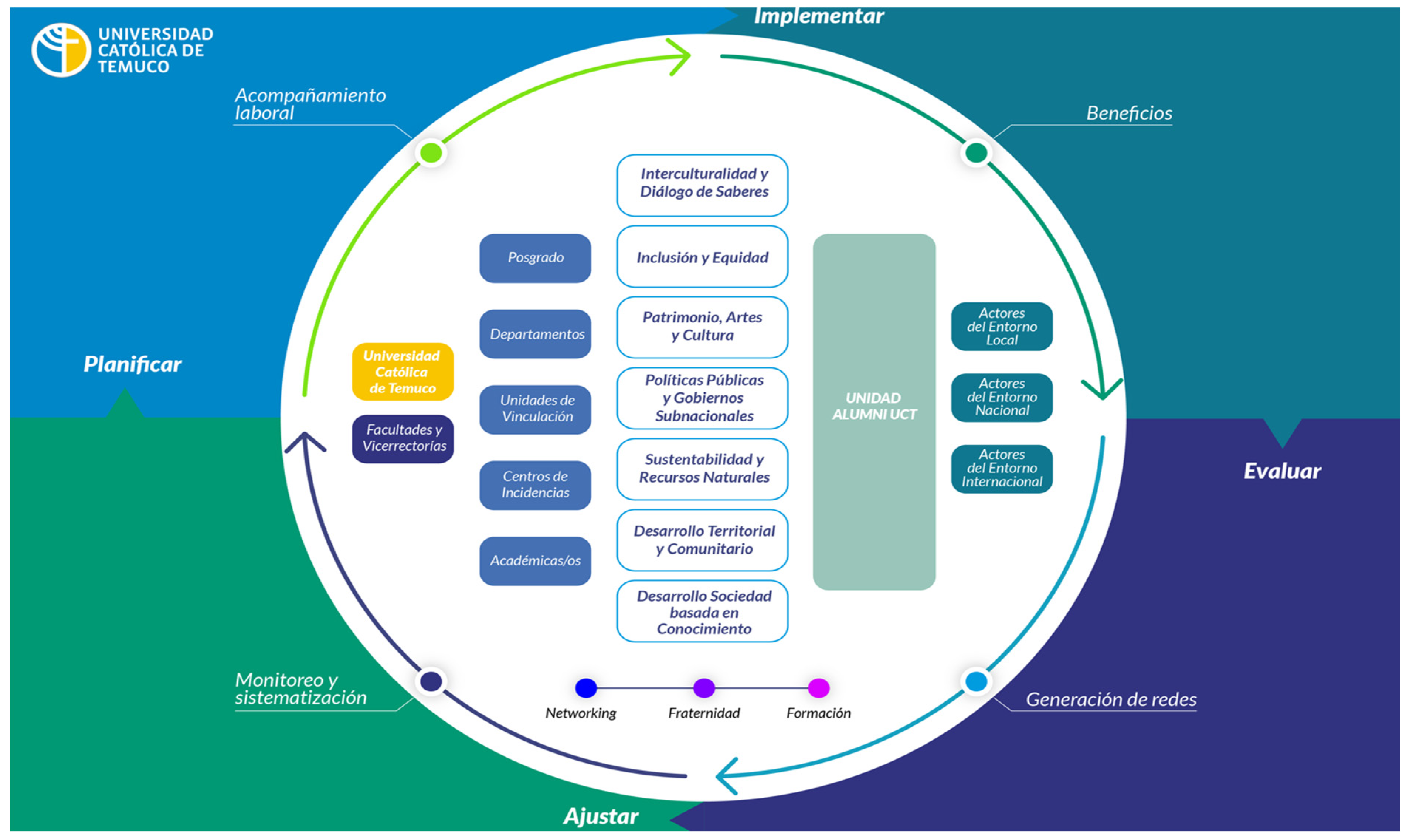
Figure 1 presents a synthetic representation of the institutional design of the alumni management model, highlighting its main components and their articulation with quality assurance processes.
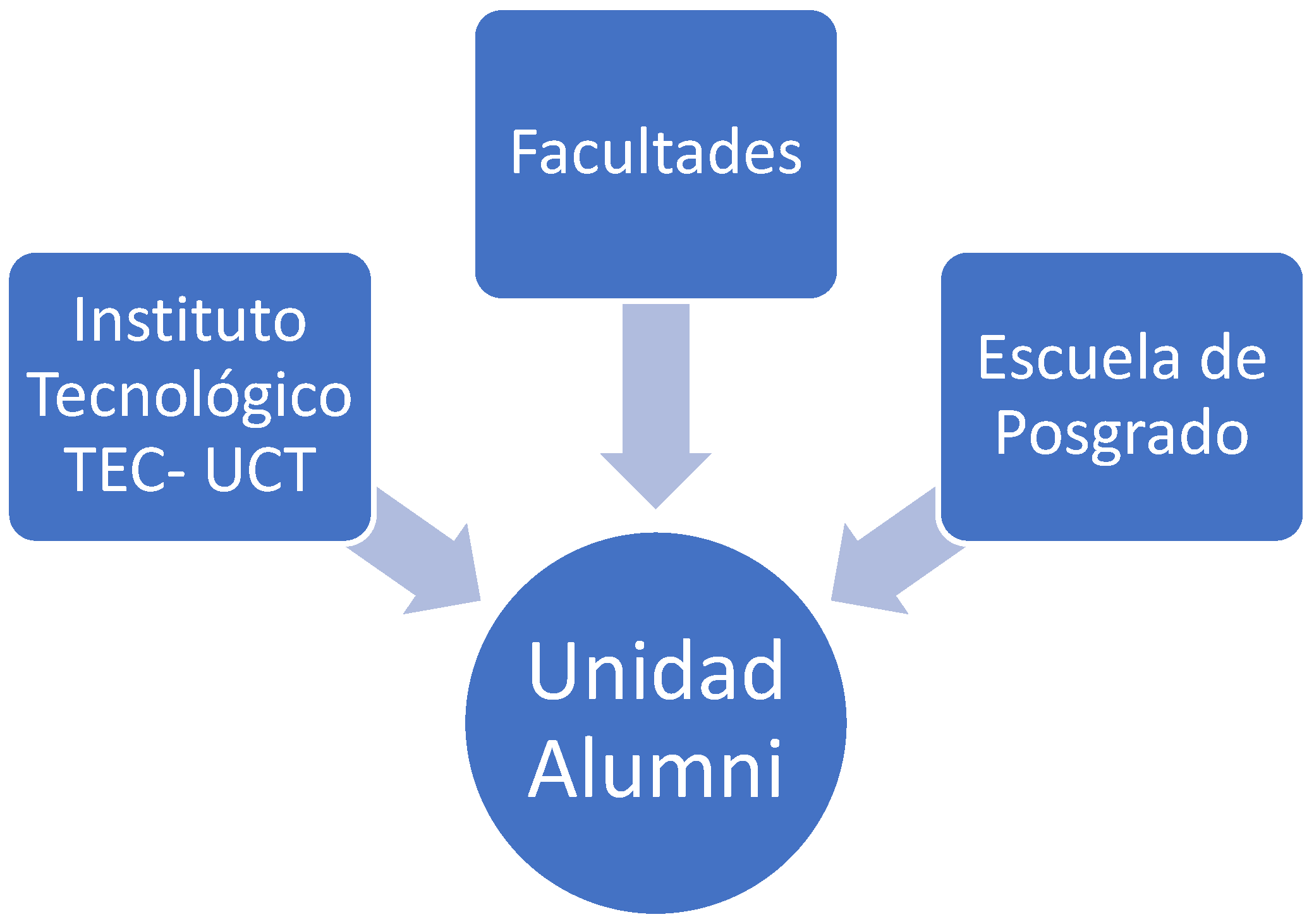
The model involves key institutional actors, including faculties and vice-rectors’ offices, departments, outreach units, research centers, and academics, as well as the Alumni Unit (UCT) and external stakeholders at local, national, and international levels. The thematic areas represented include interculturality and dialogue of knowledge, inclusion and equity, heritage, arts and culture, public policies and subnational governments, sustainability and natural resources, territorial and community development, and knowledge-based societal development.
Cross-cutting components include networking, fraternity, and training. The scheme is based on the analytical reconstruction derived from institutional documents.
3.2. Relational Foundations: Participation as a Necessary but Insufficient Condition
The analysis shows that participation is sustained not only through identity-building activities but also through the dimension of support throughout working life. In this domain, the model translates information on diverse labor trajectories into differentiated employability actions, including employability workshops, mentoring, career guidance, employer linkage, and support for entrepreneurial pathways. Recent institutional records identify 13 employability workshops with approximately 400 participants, in which alumni participate both as beneficiaries and as facilitators, mentors, or transmitters of professional experience. This configuration strengthens the situated character of employability actions and positions alumni as active actors in the institutional production and circulation of professional knowledge.
From a quality assurance perspective, these relational components play a foundational role, as they create the conditions under which alumni are willing to participate in institutional activities and feedback mechanisms. However, the findings indicate that participation alone does not ensure the production of usable evidence. While the model provides multiple opportunities for interaction, these are not systematically linked to mechanisms for capturing and formalizing the information generated through such interactions. This result highlights a key distinction between engagement and evidence: the existence of active alumni communities does not automatically translate into contributions to quality assurance unless specific mechanisms are in place to transform participation into structured information.
This indicates that participation operates as a necessary but insufficient condition for the production of usable evidence within institutional quality assurance systems.
3.3. Evidence Production: From Interaction to Data Capture
A second level of analysis concerns the dimension of monitoring and systematization, which constitutes the starting point of the model because it enables the production of evidence on alumni educational and professional trajectories. The most recent employability survey reached 3417 valid responses from a universe of 8412 alumni, representing a response rate of 40.62%, with differentiated information from undergraduate, technical-professional, and postgraduate programs. This information makes it possible to characterize labor insertion patterns, employment conditions, continuing education pathways, and diverse professional trajectories, including dependent employment, self-employment, and entrepreneurship. In this sense, monitoring and systematization operate as the empirical base of the model, transforming alumni trajectories into institutional evidence that can be mobilized for employability strategies and quality assurance processes.
These mechanisms represent the main interface between alumni engagement and quality assurance, as they enable the formalization of information that can potentially be used in processes of evaluation and improvement. Compared to relational activities, these instruments exhibit a higher degree of formalization, including defined periodicity, standardized indicators, and the possibility of aggregation across cohorts and programs.
Table 1 summarizes the correspondence between the main components of the model, their operational dimensions, and the mechanisms through which alumni-related information is produced and systematized.
However, the analysis also reveals that the capacity to produce evidence is not evenly distributed across the model. While some domains—particularly those related to monitoring and systematization—are explicitly designed to generate data, other areas remain primarily oriented toward interaction without systematic recording mechanisms. This unevenness suggests the existence of differentiated levels of formalization within the model.
This reveals a higher degree of formalization in data production compared to the institutionalization of its use, revealing an asymmetry that constrains the translation of information into actionable evidence.
3.4. Circulation and Organizational Interfaces: Conditions for Institutional Use
A third level of analysis examines how the institutional design conceptualizes the circulation of alumni-derived information toward academic and decision-making units. The circulation of alumni-derived information is organized through the dimension of networks and reciprocal collaborations, where evidence is connected with institutional actors and transformed into inputs for academic improvement. Through the UCT Labor Network, consultation spaces are activated with employers, academic units, and alumni, allowing the institution to gather information on labor market demands, graduate trajectories, and the adequacy of training processes. A central function of this dimension is the feedback of the formative itinerary, particularly in processes of curricular revision and graduate profile updating, where post-graduation experiences are incorporated into decisions about learning outcomes and professional competencies. In this stage, alumni operate as situated translators of professional experience, while the Internal Employability Council functions as the governance space that validates this information and projects it toward strategic decisions and institutional planning.
Figure 2 illustrates the institutional architecture through which alumni-derived information is expected to circulate across organizational units and reach decision-making processes.
From an analytical perspective, this represents a significant step beyond data production, as it acknowledges that information must be actively circulated in order to acquire institutional relevance. However, the analysis indicates that while the design specifies sources of information and general flows, it provides less detail regarding the procedures through which such information is interpreted, prioritized, and translated into decisions. This finding points to an asymmetry between the development of data production mechanisms and the definition of routines for their institutional use. While the model establishes pathways for circulation, the processes that ensure the effective appropriation of evidence within academic structures remain less clearly defined.
3.5. The Use of Evidence: An Emerging and Contingent Dimension
The final stage of the analytical model concerns the use of alumni-derived information in institutional decision-making. This stage is supported by the dimension of benefits and participation, which sustains the active relationship with alumni and creates conditions for the continuous circulation of information. Activities such as networking events, alumni meetings, advisory spaces, and participation in employability governance allow the institution to collect qualitative feedback on professional trajectories, emerging needs, and perceived gaps in training. In this process, alumni participation contributes not only to maintaining institutional belonging, but also to validating strategies, informing graduate profile review, and supporting the adjustment of formative processes. At the level of institutional design, the model explicitly recognizes the importance of incorporating alumni feedback into quality assurance systems and continuous improvement processes.
However, the analysis shows that this dimension is less developed compared to participation and data capture. The documents reviewed articulate the intention to use evidence but provide limited specification of the organizational routines, decision-making criteria, and accountability mechanisms required to ensure its systematic incorporation.
As a result, the use of evidence appears as an emerging and contingent dimension, dependent on the consolidation of governance arrangements that connect information with institutional action. This reinforces the idea that the potential contribution of alumni management in contributing to quality assurance depends not only on the production of data but on the existence of structures that enable its interpretation and use.
3.6. A Gradient of Formalization in the Alumni–Quality Interface
Our results suggest that the alumni management model operates as a process of institutional translation sustained by concrete institutional devices rather than by isolated engagement activities. Monitoring and systematization provide the empirical base of the model through mechanisms such as the employability survey, which reached 3417 valid responses from 8412 alumni (40.62%), enabling the identification of labor insertion patterns, continuing education trajectories, and entrepreneurial pathways. Support throughout working life activates this evidence through workshops, mentoring, and employability actions, including 13 institutional workshops with approximately 400 participants. Networks and reciprocal collaborations mediate the circulation of this information through the UCT Labor Network, employer consultations, and curricular feedback processes, while the Internal Employability Council validates and projects this evidence toward strategic and academic decisions. Breakdowns emerge when these moments are weakly connected: when participation does not lead to systematic capture, when information does not circulate through governance spaces, or when evidence is not incorporated into curricular review and graduate profile adjustment. In this sense, the contribution of the model lies in identifying the organizational conditions under which alumni engagement becomes institutional evidence rather than remaining limited to relational activity.
4. Discussion
The purpose of this study was to analyze how the design of an alumni management model attempts to articulate the relationship between graduates and institutional quality assurance processes. Rather than evaluating outcomes, the analysis focused on reconstructing the organizational architecture through which alumni engagement is expected to be translated into evidence for academic decision-making. The findings show that this articulation depends not on the intensity of participation alone, but on the existence of institutional mechanisms that enable the transformation of interaction into structured information and, ultimately, into actionable knowledge. In this sense, the results contribute to ongoing debates in higher education quality assurance, which emphasize that the contribution of evaluation systems relies less on the availability of data than on the organizational capacity to interpret and use it within decision-making processes (
Harvey & Williams, 2010;
Stensaker, 2008). The case analyzed illustrates that alumni management can play a relevant role in this process, but only when it is embedded within a broader architecture that connects relational, informational, and governance dimensions.
These findings are consistent with previous studies that identify a persistent gap between data production and its effective use in higher education quality systems.
A first key finding concerns the role of relational infrastructures as a necessary condition for the production of evidence. The emphasis on identity, networking, and lifelong learning reflects a model that prioritizes participation and engagement, which aligns with literature highlighting the importance of trust and reciprocity in sustaining stakeholder involvement (
Jongbloed et al., 2008). However, the study also shows that participation does not automatically translate into contributions to quality assurance. This reinforces the distinction between engagement and evidence, suggesting that the value of alumni communities lies not only in their activity levels but in the extent to which their experiences are systematically captured and formalized.
A second contribution relates to the identification of a differentiated capacity for evidence production within the model. While monitoring mechanisms such as se and employability tracking systems introduce elements of formalization, other domains remain primarily oriented toward interaction without systematic data capture. This finding is consistent with studies on graduate follow-up and tracer methodologies, which emphasize that the value of alumni information depends on its methodological consistency and its integration into institutional information systems (
Schomburg & Teichler, 2006). In this sense, the results highlight that the presence of data collection instruments, although necessary, is not sufficient to ensure their contribution to quality processes.
The analysis further reveals a critical asymmetry between the production of information and its institutional use. While the model defines channels for the circulation of alumni-derived data, it provides limited specification of the organizational routines through which such information is interpreted, prioritized, and translated into academic decisions. This pattern reflects a broader challenge identified in the quality assurance literature, where the consolidation of data infrastructures often outpaces the development of governance mechanisms required for their effective use (
Dill & Beerkens, 2013;
European Association for Quality Assurance in Higher Education [ENQA], 2015). In this regard, the case supports the argument that the central problem is not the absence of information, but the lack of institutionalized processes that enable its appropriation. However, it is important to note that this study does not provide empirical evidence that alumni-derived information effectively influences curricular or institutional decision-making processes.
From a broader perspective, these findings can be interpreted through the lens of critical approaches to quality assurance, which problematize the increasing reliance on data and indicators in higher education governance. As noted by
Strathern (
2000) and
Shore and Wright (
2015), the expansion of audit cultures may lead to the production of standardized forms of evidence that do not necessarily capture the complexity of institutional processes. In the case analyzed, this tension is reflected in the gap between the availability of alumni data and its effective use, suggesting that the challenge lies not only in producing information but in ensuring that it retains its analytical value within decision-making contexts.
One of the main analytical contributions of this study is the proposal of a process model of institutional translation that explains how alumni engagement may—or may not—become usable evidence within quality assurance systems. Rather than a merely descriptive sequence, the model identifies four interdependent stages—participation, data capture, circulation, and use—and highlights the organizational breakdowns that may occur between them. These breakdowns emerge when participation does not lead to systematic capture, when captured information does not circulate through governance structures, or when circulated evidence is not incorporated into curricular and strategic decisions. In this sense, the contribution of the model lies in offering a typology of organizational disconnection that helps explain why alumni engagement frequently remains at the level of relational activity rather than contributing to continuous improvement processes. This perspective also allows for a more nuanced understanding of the role of employability, graduate follow-up, and lifelong learning within alumni systems. Rather than being considered isolated functional areas, these domains can be interpreted as key interfaces in the production of evidence, linking alumni experiences with institutional processes of evaluation and program development.
The findings suggest that the potential contribution of alumni management in contributing to quality assurance depends on the alignment between relational infrastructures, informational systems, and governance mechanisms. The absence or weakness of any of these components limits the capacity of institutions to translate alumni engagement into processes of academic improvement. In this sense, the study reinforces the idea that quality assurance is not only a technical issue related to data collection, but a systemic challenge that involves organizational design, institutional culture, and decision-making practices.
Finally, the study has several limitations that should be acknowledged. As the analysis is based exclusively on documentary sources, it does not examine the actual implementation of the model or the perceptions of institutional actors. Consequently, it is not possible to assess the extent to which the mechanisms described operate in practice or to evaluate their impact on curriculum development and academic decision-making. Future research should address these dimensions by incorporating empirical data and comparative perspectives that allow for a more comprehensive understanding of the role of alumni in quality assurance systems.
5. Conclusions
This study examined how the design of an alumni management model can be articulated with institutional quality assurance processes, focusing on the organizational conditions that enable the translation of alumni engagement into usable evidence. Rather than assessing effectiveness, the analysis reconstructed the institutional architecture that connects participation, data production, circulation, and use within a single-case study. The findings indicate that the contribution of alumni to quality assurance does not depend primarily on the intensity of engagement, but on the degree of alignment between relational infrastructures, informational systems, and governance mechanisms. While participation and data capture are relatively well developed, the institutionalization of routines for interpreting and using evidence remains a critical and less consolidated dimension. This asymmetry suggests that the main challenge is not the generation of information, but its transformation into actionable knowledge within academic decision-making processes.
From an analytical perspective, the study proposes a process model of institutional translation in which disruptions between participation, capture, circulation, and use explain the limited contribution of alumni engagement to quality assurance processes. Rather than assuming a direct relationship between participation and improvement, the model identifies the organizational conditions under which alumni-derived information becomes institutional evidence capable of informing academic decisions. In this sense, the contribution of the study lies in offering a typology of organizational breakdowns that helps explain why stakeholder engagement frequently remains disconnected from formal processes of continuous improvement. The scope of the study is limited to the analysis of institutional design based on documentary sources and therefore does not allow for conclusions regarding implementation or impact. Future research should examine how these mechanisms operate in practice, the role of organizational actors in the interpretation of evidence, and the conditions under which alumni-derived information effectively informs curriculum development and academic planning.
We suggest that the strategic value of alumni management in contemporary higher education lies not in expanding engagement activities, but in consolidating institutional architectures capable of transforming alumni experiences into evidence that can inform decision-making processes. This shift positions alumni not only as participants in institutional life but as potential contributors to the governance of quality through the mediated use of their experiential knowledge.
Study Limits and Projections
The work focused on stated institutional design and did not examine effective practices or stakeholder perceptions. Future research should move from the description of institutional design to the generation of empirical evidence on its functioning and scope. In this line, future research could incorporate empirical data such as results of Alumni surveys with longitudinal analysis, indicators of employability and professional trajectories, records of participation in institutional activities and evidence of the use of this information in processes of curricular updating and academic decision-making. Future research should incorporate empirical data, such as decision-making processes, curriculum changes, or stakeholder perspectives, in order to assess whether the proposed model effectively contributes to institutional improvement.