1. Introduction
Efforts to deepen learning in school systems often stall, not primarily because teachers, students, parents, or community members resist them, but because leaders struggle to articulate what is genuinely new in their thinking in ways that distinguish it from familiar practices (
Bekerman & Zembylas, 2023;
Fullan, 2025). Without shared language, metaphors, and symbolic anchors that distinguish genuinely new practices from familiar routines, promising initiatives can blur into a stream of “just another change” and lose momentum (
Bekerman & Zembylas, 2023). This communication gap makes it challenging to build momentum for change. This review examines whether scenario-based approaches, embedded in professional learning and coaching, might equip leaders with the conceptual and communicative tools they need to help their systems make the changes necessary to support deeper learning.
In this review, shared language refers to the common terms and narratives leaders use to make innovation understandable across a system. Metaphors refer to figurative frames that help stakeholders interpret complex change. Symbolic anchors refer to visual, narrative, or conceptual reference points—such as diagrams, scenario names, images, or shorthand labels—that help stabilize meaning across diverse groups. This review uses the term symbolic anchors rather than “icons” to avoid suggesting fixed or universal symbols; in complex systems, these anchors are provisional, culturally situated, and subject to reinterpretation.
Educational systems today face unprecedented disruption. From global pandemics to accelerating technological change, leaders are expected to navigate complexity, foster innovation, and maintain organizational coherence—all under conditions of volatility, uncertainty, complexity, and ambiguity (VUCA) (
Finch et al., 2024;
Harris & Jones, 2020). In this landscape, traditional leadership models, rooted in stability and predictability, often fall short in preparing leaders to anticipate and adapt to rapidly shifting conditions (
Alonso-Yanez et al., 2021;
Brown & Friesen, 2025;
Couture & Murgatroyd, 2025). There is a growing recognition of the need for leadership development practices that go beyond technical competence and foster future-ready mindsets—those capable of imagining alternative futures, embracing uncertainty, and leading adaptive change (
Fullan, 2025;
Leithwood, 2021).
Strategic planning remains a dominant improvement mechanism in many school systems because it offers clarity, accountability, and alignment around goals. However, when educational change unfolds in complex adaptive systems, fixed plans can become brittle. They often presume stable conditions, linear implementation pathways, and predictable relationships between intervention and outcome. This does not make strategic planning irrelevant, but it suggests that leaders also require complementary approaches that help them rehearse uncertainty, surface assumptions, and adapt as conditions change. Scenario planning is examined in this review as one such complementary approach, not as a replacement for strategic planning, but as a practice that may strengthen leadership learning under conditions of complexity.
Originating in military and corporate strategy, scenario planning engages leaders in the structured exploration of multiple plausible futures to improve strategic thinking, communication, and organizational learning. Unlike forecasting, which attempts to predict a single most likely future based on current trends, scenario planning acknowledges uncertainty and prepares for a range of possibilities. Unlike traditional strategic planning, which sets fixed goals and prescribes a sequence of actions, scenario planning is iterative and adaptive, emphasizing the development of mental agility, shared language, and flexible response patterns. Although these distinctions are clear in theory, the literature reveals persistent conceptual ambiguity, with scenario planning often conflated with other planning methodologies (
Cordova-Pozo & Rouwette, 2023;
Tiberius, 2019). This lack of clarity limits its potential in practice, particularly in educational contexts.
Complexity theory provides a lens for understanding why scenario planning may be particularly relevant for educational leadership. Drawing from
Davis and Sumara (
2006) and
Uhl-Bien et al. (
2008), schools can be understood as complex adaptive systems—dynamic networks where change emerges through the interaction of diverse agents, feedback loops, and shifting contexts, rather than through linear cause-and-effect relationships. In such systems, leadership is less about exerting control and more about creating conditions for emergence: enabling distributed sensemaking, fostering adaptive capacity, and navigating uncertainty with openness. Scenario planning, when designed and facilitated with this complexity orientation, can be understood as a planning tool. The literature positions it as a generative practice through which leaders may rehearse adaptive moves, attend to weak signals, and test ideas in low-risk environments. Rather than attempting to eliminate uncertainty, complexity-informed scenario planning works with it, and may support leaders’ confidence and capacity to act when complete information is unavailable.
Existing scholarship establishes scenario planning as a valuable approach for strategic foresight, organizational learning, and decision-making under uncertainty. However, its application in educational leadership remains unevenly developed. What remains less clear is how scenario planning supports leaders not only to anticipate possible futures, but also to generate the shared language, metaphors, and symbolic anchors needed to communicate innovation across complex school systems. The gap addressed in this review is therefore both conceptual and practical: conceptually, the relationship among scenario planning, futures literacy, and complexity-informed adaptive leadership requires clearer synthesis; practically, educational leaders need more explicit guidance about the conditions under which scenario planning can support adaptive capacity, shared sensemaking, and inclusive innovation.
This integrative review examines how the literature conceptualizes the potential of scenario planning to support educational leaders in developing future-ready mindsets, shared language, metaphors, and symbolic anchors for innovation in complex systems. Drawing on a synthesis of relevant literature using AI-assisted research tools, the review considers the affordances, challenges, and leadership models associated with scenario-based professional learning. In doing so, it contributes to a growing discourse on how anticipatory and design-based approaches, grounded in complexity theory, can support innovation, sensemaking, and leadership development in education.
A literature review is warranted because the relevant scholarship is dispersed across several fields rather than consolidated within educational leadership. Scenario planning is discussed in strategic foresight, organizational learning, corporate strategy, public policy, professional learning, futures literacy, and complexity-informed leadership, but these bodies of literature do not yet offer a coherent account of how scenario planning may support educational leaders working in complex adaptive systems. An empirical study of a single leadership context could examine how scenario planning functions in one setting, but it would not address the prior conceptual task of clarifying how the construct has been defined, what mechanisms are proposed across fields, what conditions appear to shape its use, and where the evidence remains limited. For this reason, an integrative literature review is appropriate: it allows diverse theoretical, empirical, and applied sources to be synthesized in order to clarify the conceptual terrain, identify boundary conditions, and establish a foundation for future empirical research.
This review contributes to educational leadership research by reframing scenario planning as a complexity-informed leadership learning practice that supports three interrelated capacities: anticipatory sensemaking, communicative clarity, and symbolic anchoring for innovation. In doing so, it shifts scenario planning from a technical planning method to a professional learning practice that can help leaders make new ideas legible, discussable, and actionable across complex school systems.
2. Materials and Methods
This study is an AI-assisted integrative literature review (
Toronto & Remington, 2020) designed to synthesize scholarship on scenario planning, educational leadership, futures literacy, and complexity-informed adaptive leadership. Integrative reviews are appropriate when a field includes diverse theoretical, empirical, and methodological contributions and when the purpose is to generate conceptual synthesis rather than assess the effectiveness of a single intervention. In this study, the Consensus AI-assisted research synthesis platform (
www.consensus.app, accessed on 22 July 2025) was used to support the identification and semantic relevance ranking of candidate studies. Final decisions regarding inclusion, interpretation, thematic organization, and synthesis remained researcher-led. From this corpus, 100 highly relevant papers were purposively selected and a narrative, thematic synthesis was conducted guided by three questions:
How has scenario planning been conceptualized and used in educational leadership and related leadership-development literature?
What does the literature suggest about the potential of scenario planning to support future-ready mindsets, shared language, metaphors, and symbolic anchors for innovation?
What design conditions, limitations, and equity considerations shape the possible use of scenario planning in educational leadership professional learning?
2.1. Review Questions and Search Logic
The review questions were refined iteratively as the search process unfolded. Early searches revealed that the term “scenario planning” returned results heavily weighted toward corporate strategy and organizational management literature. To broaden the scope while maintaining conceptual relevance, related terms were tested, including foresight methods, scenario-based learning, future-oriented leadership, futures literacy, leadership development, and complexity-informed leadership. This iterative search logic allowed the review to capture literature from education, public policy, leadership studies, organizational learning, and cross-sector innovation contexts while remaining anchored in the central concern of how scenario planning may support educational leadership.
2.2. Researcher Positionality
Our dual role as both practitioners and researchers shapes this inquiry. Our professional practice involves supporting superintendents and system leaders as they design and implement innovation initiatives. This vantage point has given us sustained exposure to the challenges leaders face in communicating new ideas, building shared understanding, and navigating resistance, or perceived resistance, within their systems. Our decision to focus on scenario planning emerged from this practice-based curiosity: Could structured engagement with multiple plausible futures help leaders develop the mindset, language, and visual tools they need to make change possible? This question, while rooted in the practical realities of educational leadership, also reflects our commitment to research-informed practice.
2.3. Search Strategy and Data Sources
To examine whether scenario planning might be a viable approach to support educational leadership, we conducted an integrative literature review (
Toronto & Remington, 2020) using the Consensus AI-assisted research synthesis application (Consensus,
https://www.consensus.app, accessed on 22 July 2025). Consensus aggregates peer-reviewed scholarship from databases such as Semantic Scholar and PubMed and applies semantic relevance ranking to identify literature aligned with user queries, as shown in
Table 1. On 22 July 2025, at 9:03 a.m., three guiding review questions were entered into the Consensus platform.
2.4. Search Results and Selection Process
The initial searches, as shown in
Table 2, retrieved 2092 papers. After removing duplicates and excluding sources without abstracts, 1550 papers remained. Of these, 1088 were retained as potentially relevant based on semantic alignment with the guiding questions. The final 100 studies were purposively selected for full review because they demonstrated high relevance to at least one of the following areas: scenario planning or scenario-based learning; VUCA leadership and strategic foresight; shared language, metaphor, or communication in innovation processes; organizational adaptation and learning; professional learning or leadership development; and complexity-informed leadership.
Inclusion criteria were: peer-reviewed journal articles and scholarly book chapters published in English; sources available through the indexed academic databases accessed by Consensus; studies or theoretical works that explicitly engaged with scenario planning, futures literacy, strategic foresight, foresight methods, scenario-based professional learning, leadership development, or leadership in uncertainty; and sources with clear relevance to educational leadership, organizational learning, adaptive capacity, shared language, metaphors, symbolic anchors, innovation, or complexity-informed leadership. Because the purpose of this review was integrative conceptual synthesis rather than intervention evaluation, no restrictions were placed on research design. The review included conceptual, theoretical, empirical, and applied studies. No geographical restrictions were imposed, although the English-language and indexed-database scope of the search is acknowledged as a limitation. Searches were conducted on 22 July 2025; therefore, the literature published after that date was outside the scope of the review.
Exclusion criteria were: non-scholarly sources; duplicate records; sources lacking abstracts or sufficient bibliographic information to assess relevance; sources focused only on technical forecasting, modelling, or prediction without a leadership, learning, organizational, or educational dimension; sources that addressed education or leadership only tangentially; and sources with no clear connection to the guiding review question.
Screening was conducted through a combination of AI-supported semantic relevance ranking and manual researcher review, as shown in
Table 2. Consensus was used only to support retrieval and semantic relevance ranking. It was not used to determine final inclusion, conduct coding, generate themes, or write the synthesis. All studies included in the final review corpus were manually reviewed against the inclusion criteria. Where AI-ranked relevance and researcher judgment diverged, researcher judgment governed the decision, particularly when lower-ranked sources addressed educational leadership, equity, practitioner knowledge, or conceptual tensions not foregrounded by highly ranked results. Because this was a single-researcher integrative review, disagreements between multiple reviewers were not applicable; however, decisions were documented through iterative comparison against the guiding review questions and inclusion criteria.
2.5. Data Extraction and Narrative Thematic Synthesis
Data extraction focused on each study’s purpose, context, theoretical framing, methodological approach, key findings, and relevance to the three guiding questions. Rather than applying a statistical or meta-analytic procedure, we used narrative thematic synthesis to identify patterns, tensions, and conceptual relationships across the reviewed literature. This process involved four steps: first, repeated reading of the selected studies; second, grouping studies according to the three review questions; third, identifying recurring concepts such as foresight, adaptive capacity, shared language, distributed sensemaking, equity, and professional learning; and fourth, synthesizing these concepts into broader themes interpreted through complexity theory.
Themes were developed through both deductive and inductive movement. The guiding questions provided an initial organizing structure, while the repeated reading of studies allowed additional themes and tensions to emerge. For example, the importance of shared language and metaphors emerged strongly across literature on scenario planning and innovation communication, while concerns about equity, voice, and dominant narratives became more visible when the literature was read through culturally responsive and complexity-informed leadership perspectives.
2.6. Critical Reflection on AI-Assisted Research
While Consensus accelerated access to a broad body of literature, we recognize that AI-assisted synthesis tools are not neutral. They privilege certain forms of knowledge—formal, published, English-language, and often Western academic paradigms—while underrepresenting localized, Indigenous, relational, and community-based perspectives on leadership learning. This epistemological bias shapes what is visible in the dataset and what remains invisible. As such, the findings of this review should be interpreted as partial and situated, reflecting dominant discourses rather than the full spectrum of leadership practice.
Algorithmic bias in search relevance also risks reinforcing prevailing research patterns by prioritizing highly cited works, which may marginalize emerging or counter-hegemonic perspectives. Throughout this process, we attempted to mitigate these risks by manually reviewing lower-ranked but contextually relevant sources, cross-checking key terms against alternative academic databases, and drawing on my practitioner knowledge to identify gaps and contradictions.
Finally, the use of Consensus does not replace primary data. This study synthesizes and interprets existing scholarship rather than generating new empirical evidence. As such, the insights presented here offer a conceptual and theoretical foundation for future research that can empirically examine how scenario planning operates in the lived realities of educational leadership.
3. Results
This review examined how literature conceptualizes the potential of scenario planning to support educational leaders in developing future-ready mindsets, shared language, metaphors, and symbolic anchors for innovation in volatile, uncertain, complex, and ambiguous (VUCA) contexts. Three central questions guided the analysis.
The results are presented according to the three guiding questions. Within each section, we distinguished between patterns reported across the reviewed literature and our interpretation of those patterns through a complexity-informed leadership lens. Because this review synthesized a conceptually diverse body of literature rather than conducting a quantitative meta-analysis, we used qualitative descriptors such as “commonly reported,” “frequently emphasized,” “less consistently addressed,” and “limited evidence” to indicate the relative strength and distribution of findings across the reviewed studies (
Table 3).
This matrix is not intended to quantify the literature, but to make visible how different bodies of scholarship contributed to the synthesis and where the evidence remains strongest, emerging, or limited.
1. How does the literature position scenario planning in relation to leadership preparation and innovation in VUCA environments?
Across the reviewed literature, scenario planning was commonly positioned as a strategy that may strengthen leaders’ preparedness, flexibility, and innovation capacity in complex settings. Studies consistently show that scenario planning fosters strategic foresight, encourages robust decision-making, and strengthens organizational resilience (
Chermack & Chermack, 2011;
Carayannis et al., 2025;
Mortlock & Osiyevskyy, 2023;
Hillmann et al., 2018;
Schoemaker et al., 2018;
Kaivo-oja & Lauraeus, 2018). By deliberately engaging leaders in the exploration of multiple plausible futures, scenario-based training may help leaders move beyond traditional, linear planning models, encouraging them to anticipate discontinuities and prepare for unexpected shifts (
Shufutinsky et al., 2020;
Westover, 2025;
Moats et al., 2008;
Haarhaus & Liening, 2020).
Leadership models play a significant role in how scenario planning is enacted. Transformational leadership, the most frequently referenced model in the literature, is associated with empowering teams, fostering experimentation, and cultivating collaborative learning cultures (
Kilag et al., 2023;
Vermeulen et al., 2020;
Jakavonytė-Staškuvienė & Barkauskienė, 2023;
Voelkel, 2019). Distributed leadership also features prominently, particularly in its capacity to promote shared responsibility and collective sensemaking—conditions that support sustained innovation (
Rikkerink et al., 2015;
Aas, 2017;
Bratsch-Hines et al., 2023;
Fairman & Mackenzie, 2012).
Interpretation:
Despite its prominence, transformational leadership has not consistently delivered on its promise to foster experimentation and systemic innovation. As
Robinson (
2011) argues, its reliance on charismatic influence may not be sufficient for building the distributed capacity needed to navigate complex systems. From a complexity theory perspective, leadership in VUCA contexts requires more than inspiring vision—it requires fostering adaptive networks that can respond fluidly to emerging challenges. Scenario planning, when embedded in collaborative and distributed leadership structures, may help shift systems from reactive to adaptive by providing leaders with the opportunity to rehearse diverse responses and explore the implications of their decisions across interconnected parts of the system.
An equity lens also reveals a potential blind spot: without critical facilitation, scenario planning risks reinforcing dominant narratives about the future and excluding perspectives from historically marginalized communities (
Khalifa, 2018;
Shields, 2010). Ensuring diverse participation and deliberately including culturally responsive scenarios is essential if scenario planning is to prepare leaders for futures that are equitable as well as innovative.
2. How does the literature describe the relationship between scenario planning, shared language, metaphors, and symbolic anchors?
A recurring pattern across the literature is that well-facilitated scenario processes can significantly enhance leaders’ communicative capacity. Scenarios are often described as encouraging the co-creation of shared language and organizational metaphors that make abstract ideas tangible and facilitate alignment across diverse stakeholder groups (
Rodríguez & Rodríguez, 2015;
Lavikka et al., 2018;
Pereira et al., 2019;
Tyszczuk, 2021;
Tiberius, 2019). These narratives and symbolic tools act as anchors in times of change, enabling stakeholders to visualize and understand the rationale for new initiatives.
Participatory and creative scenario design may also stimulate imagination, leading to the development of symbolic anchors and conceptual frameworks for innovation (
Pereira et al., 2019;
Tyszczuk, 2021). When these visual and narrative tools are embedded in leadership communication, they can help distinguish new ideas from established practices, making innovation more visible and actionable.
Interpretation:
From a complexity standpoint, shared language and symbols serve as “attractors” in complex adaptive systems, patterns, or ideas that organize collective behaviour without requiring top-down control (
Davis & Sumara, 2006). Leaders who intentionally shape these attractors through scenario planning can help their systems orient toward desired futures more coherently. However, this process is not value-neutral. The metaphors and symbolic anchors that emerge from scenarios can embed cultural assumptions, and if diverse perspectives are not present, they may perpetuate inequities. Incorporating culturally responsive facilitation ensures that the language and symbols generated are inclusive and resonate across different community contexts.
3. How is scenario planning linked to organizational learning and leadership development in the literature?
The literature suggests that scenario planning may function as a mechanism for organizational learning. By stretching mental models, testing assumptions, and enabling the simulation of alternative strategies, scenario planning is theorized and, in some applied studies, reported to support adaptive capacity and complex decision-making skills (
Bood & Postma, 1997;
Mortlock & Osiyevskyy, 2023;
Drew, 2006;
Bouhalleb & Smida, 2020;
Zanoni & Vernizzi, 2025). It may also support leaders’ abilities to assess risks, evaluate uncertainties, and identify adaptive pathways—core competencies in learning organizations (
Kaivo-oja & Lauraeus, 2018;
Danevska, 2022;
K. Miller & Waller, 2003).
In educational settings, scenario-based professional learning often includes immersive simulations, role-play, and authentic problem-solving activities (
Storey & Cox, 2016;
Iftach & Shapira-Lishchinsky, 2023;
Aas, 2017;
Aas & Paulsen, 2019). Tools such as TeachLivE™ offer examples of how virtual simulations can strengthen leadership identity, allowing leaders to practice decision-making in context-specific, low-risk environments (
Storey & Cox, 2016).
Interpretation:
From a futures-thinking perspective, organizational learning through scenarios is less about predicting what will happen and more about expanding the range of what leaders are prepared to respond to. This aligns with complexity-informed leadership, where success is not measured by adherence to a plan but by the system’s ability to adapt in real time. Scenario planning can also help surface “weak signals” and early indicators of emerging trends that might otherwise be ignored in traditional planning.
Yet, the literature in education rarely addresses how such learning becomes embedded in leadership identity or organizational culture over the long term. Without sustained follow-up, scenario-based learning risks becoming a “one-off” event rather than a continuous process of adaptive capacity building. The challenge, then, is to move scenario planning from episodic training into the ongoing fabric of leadership practice.
3.1. Synthesis of Results
Taken together, the reviewed studies suggest that scenario planning may support leaders in preparing for uncertain futures while also cultivating the relational, cognitive, and symbolic capacities needed to work within complex adaptive systems. The strongest evidence across the literature relates to scenario planning’s contribution to strategic foresight, mental flexibility, and organizational learning. A second, somewhat more emergent strand of evidence points to its role in developing shared language, metaphors, and sumbolic anchors that help leaders communicate change. The least developed area in the literature concerns the long-term effects of scenario planning on leadership identity, organizational culture, and sustained innovation in educational systems.
However, educational leaders will only realize the potential of scenario planning if it is critically facilitated, inclusive of diverse voices, and embedded within broader systems of ongoing, iterative, professional learning. Without these conditions, it risks reproducing existing inequities, reinforcing dominant narratives, and remaining disconnected from the lived realities of educational leadership.
3.2. Challenges and Limitations
Despite its promise, the literature also surfaces several persistent challenges. Scenario planning suffers from conceptual ambiguity and methodological inconsistency, which hinder its broader application and empirical validation (
Cordova-Pozo & Rouwette, 2023;
Tiberius, 2019). Its potential value appears to depend leadership commitment, stakeholder engagement, and thoughtful integration into decision-making structures (
Cairns et al., 2016;
Samimian-Darash, 2016). Several studies highlight the need for more inclusive, imaginative, and iterative scenario processes to unlock their full transformational potential (
Pereira et al., 2019;
Tyszczuk, 2021;
Wuth et al., 2023).
The critical and divergent literature helped clarify the boundaries of these claims. Across the reviewed studies, scenario planning was not presented as a universally effective or context-neutral approach. Several sources caution that scenario planning can become overly procedural, detached from decision-making, or shaped by dominant organizational assumptions if it is not carefully facilitated. Other studies raise concerns about participation, power, and whose futures are imagined in the process. These divergent perspectives informed the interpretation of the findings by highlighting that scenario planning’s potential value appears to depend on facilitation quality, contextual fit, inclusive participation, and its integration into ongoing leadership learning rather than one-time planning activity.
Barriers to implementation—such as time constraints, lack of resources, and resistance to change—are particularly acute in educational contexts (
Tahir et al., 2024;
Liljenberg & Wrethander, 2020). Sustained support, alignment with school goals, and embedded professional learning structures are critical to success (
Aas, 2017;
Bratsch-Hines et al., 2023;
Poekert et al., 2020;
Óskarsdóttir et al., 2020).
4. Discussion
What became increasingly evident through this review is that scenario planning is positioned in the literature as supporting more than strategic foresight. It is also theorized as a practice that may cultivate adaptive capacities leaders need to navigate living, dynamic systems. From a complexity perspective, educational organizations are not mechanistic structures that can be managed through linear planning; they are complex adaptive systems (
Davis & Sumara, 2006;
Uhl-Bien et al., 2008) in which change emerges through local interactions, feedback loops, and ongoing sensemaking. In such systems, control is both illusory and counterproductive. Leadership is instead about creating the conditions for emergence: encouraging diverse perspectives, amplifying promising patterns, and navigating uncertainty with flexibility and humility.
When approached as a generative process rather than a predictive exercise, scenario planning mirrors the very nature of complexity. It invites leaders to explore multiple plausible futures, safely test ideas, and attend to weak signals that may otherwise be dismissed. This anticipatory work does not resolve uncertainty; it works with it, helping leaders become more comfortable making decisions with incomplete information. In this way, scenario planning becomes a form of leadership learning rooted in emergence rather than control, supporting not only the development of innovative ideas but also the capacity to notice, interpret, and respond adaptively to changing conditions.
From my work with superintendents, we have seen how quickly promising innovations can lose traction when leaders are unable to communicate them in ways that resonate across the system. Even when a new initiative has strong evidence behind it, if it is presented in language that feels abstract, overly technical, or indistinguishable from past practices, stakeholders may disengage. The literature reviewed here suggests that scenario planning has the potential to address this communication gap by fostering shared language, metaphors, and symbolic anchors. These symbolic tools act as “attractors” in complex systems—patterns that help coordinate action without requiring rigid control (
Davis & Sumara, 2006). By making the future visible and tangible, leaders can align diverse stakeholders around a shared sense of purpose.
Yet the promise of scenario planning comes with caveats. Without critical facilitation, it risks reinforcing dominant cultural narratives and excluding perspectives from historically marginalized communities (
Khalifa, 2018;
Shields, 2010). This is particularly salient in education, where decisions about the future have profound implications for equity, inclusion, and cultural responsiveness. If scenario planning is to prepare leaders for equitable futures, the process must intentionally incorporate diverse voices, especially those whose lived experiences may challenge dominant assumptions.
The literature also surfaces a persistent tension between leadership models. While transformational leadership is often linked to scenario-based professional learning, its track record for fostering deep experimentation is mixed (
Robinson, 2011). In practice, its emphasis on vision and inspiration may not be sufficient for cultivating the distributed adaptive capacity required in complex systems. Distributed leadership, by contrast, aligns more closely with complexity-informed approaches because it emphasizes shared responsibility and collective sensemaking. However, distributed leadership can falter without clear structures and norms for collaboration. Scenario planning offers a potential bridge between these models: it can provide a structured process for distributed sensemaking while also aligning with the aspirational, future-oriented dimensions of transformational leadership.
Another insight from this review is that scenario planning appears most promising when it is embedded in ongoing professional learning rather than offered as a one-off training. Complexity theory suggests that adaptive capacity develops through repeated cycles of interaction, reflection, and adjustment. Scenario planning should therefore be iterative; revisited and revised as conditions change, so that leaders continually refine both their strategic thinking and their communicative tools. Without this sustained engagement, scenario planning risks becoming a static product rather than a living practice.
Finally, the review highlights a striking gap in educational leadership literature: few studies trace the long-term effects of scenario planning on leadership identity, organizational culture, or innovation outcomes. Most research examines scenario planning as a discrete intervention rather than as an embedded practice over time. From a complexity-informed perspective, this is a missed opportunity. The most important outcomes of scenario planning, such as leaders’ increased tolerance for uncertainty, their capacity for distributed sensemaking, and their ability to create inclusive narratives of the future, are likely to develop gradually, through repeated exposure and application.
This review suggests that scenario planning may be well-suited to the realities of educational leadership in VUCA conditions. It aligns with complexity theory’s emphasis on emergence, adaptability, and distributed intelligence, while also offering tangible communication tools to help leaders land new ideas. Yet its effectiveness depends on inclusive facilitation, iterative design, and intentional integration into the ongoing rhythms of leadership practice. Without these elements, scenario planning risks becoming just another planning exercise, useful in theory, but disconnected from the adaptive work leaders must do in practice.
4.1. Integrating Scenario Planning, Futures Literacy, and Complexity-Informed Adaptive Leadership
Educational leaders today require more than strategies—they need capacities, methods, and mindsets that allow them to think and act in the midst of uncertainty. Three complementary frameworks—scenario planning, futures literacy, and complexity-informed adaptive leadership—offer distinct yet interdependent contributions to this work. Each stems from a different lineage but together they form a coherent approach to leadership learning in dynamic systems.
Scenario planning originated in the military and corporate strategy sectors (
Schoemaker, 1995;
Schoemaker et al., 2018;
Schwarz et al., 2019) as a structured method for exploring multiple plausible futures. Its power lies not in predicting what will happen, but in preparing leaders to imagine what
could happen, recognize emerging patterns, and rehearse adaptive responses. The process surfaces underlying assumptions, challenges mental models, and builds strategic agility through dialogue and reflection. In education, this translates into giving leaders a safe space to anticipate change, align around shared narratives, and make complexity visible to others (
Aas & Paulsen, 2019;
Mortlock & Osiyevskyy, 2023).
Futures literacy, a concept championed by UNESCO and developed substantially through Miller’s work, represents a broader capacity—the skill of using the future to understand the present (
R. Miller, 2018;
Poli, 2021). It is not a method but a mindset: the ability to engage imaginatively with uncertainty, to question dominant narratives, and to see the future as a resource for present action. When practiced regularly, futures literacy allows leaders to reframe problems, identify weak signals, and make meaning in the face of ambiguity. Within educational systems, this competency can shift leadership culture from reactive to anticipatory, enabling leaders to see possibilities where others see constraints.
Complexity-informed adaptive leadership, rooted in the work of
Uhl-Bien et al. (
2008) and
Heifetz and Linsky (
2002), extends these ideas into action. It views leadership not as a formal role but as a dynamic process that mobilizes people to learn, adapt, and innovate in the face of complex challenges. Adaptive leaders operate within systems characterized by interdependence and emergence, where outcomes cannot be controlled but can be influenced through experimentation, reflection, and distributed sensemaking. Leadership in this frame is about creating the conditions for adaptability, not prescribing solutions.
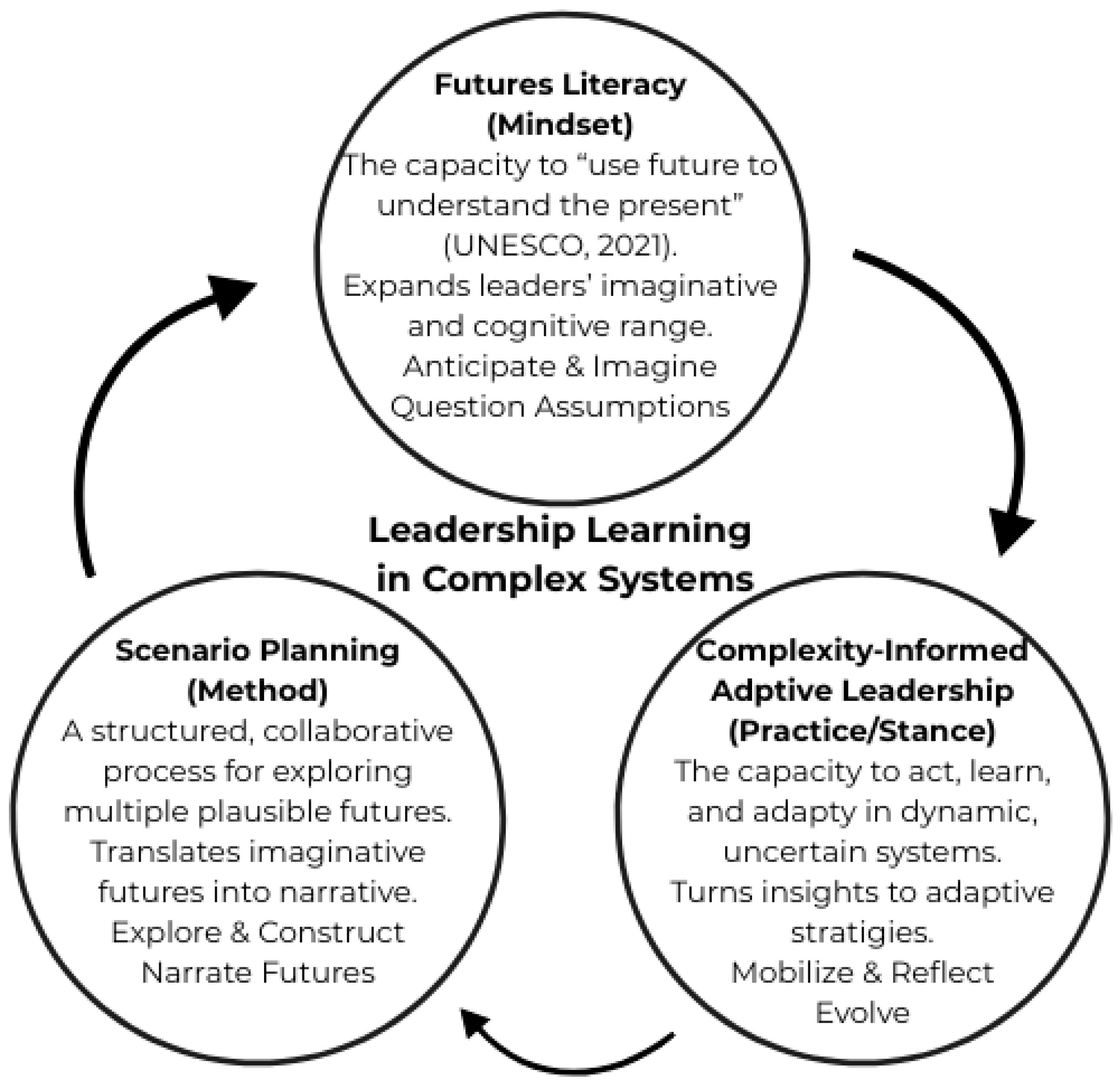
When viewed together, these three frameworks form an integrated cycle of anticipatory leadership learning.
Futures literacy cultivates the mindset—the ability to think expansively about multiple possible futures and question assumptions.
Scenario planning provides a possible method—the structured process through which leaders collaboratively imagine, test, and narrate these futures.
Complexity-informed adaptive leadership represents the stance—the practical enactment of these insights through iterative learning and adaptive action.
In this conceptual synthesis, futures literacy can inform scenario planning; scenario planning may strengthen adaptive leadership; and adaptive leadership may deepen futures literacy by grounding imagination in practice. This cyclical relationship moves leadership learning beyond episodic planning toward a sustained practice of sensemaking and adaptation. For educational leaders, integrating these three approaches offers a way to build not only foresight but also the communicative, relational, and systemic capacities needed to navigate complex change.
This model is offered as a conceptual synthesis generated from the integrative review, not as an empirically tested framework. It is intended to organize relationships identified across the literature and to guide future empirical, participatory, and design-based research.
Figure 1 presents an integrated model of futures literacy, scenario planning, and complexity-informed adaptive leadership. The model positions these three as interconnected elements of anticipatory leadership learning operating within complex adaptive systems.
Futures literacy provides the mindset—a cognitive and imaginative capacity that enables leaders to use the future to question assumptions and expand their thinking.
Scenario planning contributes the method—a structured, collaborative process through which leaders translate imaginative futures into shared narratives and communicative artifacts.
Complexity-informed adaptive leadership offers the practice or stance—the ability to act, learn, and iterate in uncertain, emergent conditions.
Together, these processes are proposed as a continuous learning cycle that may build leaders’ adaptive capacity and communicative clarity.
4.2. Practical Implications for Educational Leadership
For educational leaders, this review suggests that scenario planning is most useful when treated as a disciplined practice for learning, communication, and adaptive action rather than as a one-time strategic planning event. Leaders may use scenario processes to surface assumptions, rehearse responses to uncertainty, and develop shared language that helps stakeholders understand why innovation is needed and how it differs from familiar practice. To realize this potential, scenario planning should be embedded within ongoing professional learning cycles, include diverse stakeholder voices, and be facilitated with explicit attention to equity, power, and whose futures are being imagined.
For leadership developers and policy makers, the findings point to the importance of designing professional learning that builds futures literacy, collaborative sensemaking, and adaptive capacity over time. Scenario-based professional learning should not only ask leaders to imagine possible futures, but also support them in translating those futures into communicative tools, relational commitments, and iterative action within their own systems.
4.3. Contribution and Implications
This review contributes to educational leadership scholarship in three ways. First, it synthesizes a dispersed body of literature on scenario planning, futures literacy, complexity-informed leadership, and professional learning in relation to educational leadership in volatile, uncertain, complex, and ambiguous conditions (
Harris & Jones, 2020;
Kaivo-oja & Lauraeus, 2018). Second, it reframes scenario planning as more than a technical planning tool, positioning it as a leadership learning practice that can support adaptive sensemaking, dialogue, and creative foresight (
Bood & Postma, 1997;
Chermack & Chermack, 2011). Third, it advances the concept of symbolic anchoring by showing how shared language, metaphors, narratives, and visual referents may help leaders make innovation more legible across complex school systems (
Rodríguez & Rodríguez, 2015;
Pereira et al., 2019;
Tyszczuk, 2021).
The central contribution of this review is its integration of scenario planning, futures literacy, and complexity-informed adaptive leadership into a conceptual account of how leaders may learn to work with uncertainty rather than merely plan around it. While existing leadership scholarship often emphasizes either structural reform or individual leadership competence, this review situates leadership learning within a broader ecology of mindset, method, communication, and practice (
Davis & Sumara, 2006;
Uhl-Bien et al., 2008). By linking scenario planning with futures literacy, the review highlights cognitive and imaginative flexibility as foundational leadership capacities for educational systems facing uncertainty and change (
R. Miller, 2018;
Finch et al., 2024;
Poli, 2021).
For research, this synthesis shifts the central question from whether scenario planning is a useful planning tool to how scenario-based professional learning shapes leaders’ sensemaking, communication, and adaptive practice over time. Future studies should examine the mechanisms through which scenarios generate shared language, whose futures are included or excluded in scenario work, and how symbolic anchors influence the communication and uptake of innovation in school systems. Longitudinal and design-based studies are especially needed because the current literature is stronger on conceptual promise than on sustained empirical evidence in educational leadership contexts (
Cordova-Pozo & Rouwette, 2023;
Liljenberg & Wrethander, 2020).
For educational leaders, the findings suggest that scenario planning is most defensible when used as a facilitated learning routine rather than as a one-time planning exercise. Scenario-based professional learning can provide a structured process through which leaders rehearse adaptive responses, surface assumptions, test possible futures, and communicate complex ideas through shared language, metaphors, and symbolic anchors (
Rodríguez & Rodríguez, 2015;
Pereira et al., 2019). However, these benefits depend on inclusive facilitation, attention to equity and voice, and integration into ongoing leadership learning rather than episodic training (
Khalifa, 2018;
Shields, 2010;
Poekert et al., 2020).
For professional learning designers and policy makers, the review underscores the need for leadership development that is iterative, relational, and contextual rather than delivered through fixed frameworks or one-time interventions (
Poekert et al., 2020;
Liljenberg & Wrethander, 2020). Used in this way, scenario planning complements strategic planning by strengthening leaders’ capacity to anticipate uncertainty, build shared meaning, and adapt action as conditions change. The implication is not that scenario planning replaces existing planning processes, but that it can expand the repertoire of leadership learning practices available for working in complex educational systems.
4.4. Research Gaps
Despite growing scholarly interest in futures-oriented approaches to educational leadership, significant gaps remain in understanding how these frameworks operate in practice and interact over time. The literature offers strong conceptual grounding for scenario planning, futures literacy, and complexity-informed adaptive leadership, yet there is limited empirical evidence on how leaders develop, apply, and sustain these capacities in complex educational systems.
- 1.
Limited longitudinal and design-based research.
Most existing studies examine scenario planning as an isolated intervention rather than an iterative, embedded practice. There is a lack of longitudinal and design-based inquiry that traces how leaders’ anticipatory capacities evolve through cycles of futures literacy, scenario exploration, and adaptive action. Without this temporal perspective, the field cannot determine whether these approaches build lasting adaptive capacity or simply provide short-term cognitive stimulation.
- 2.
Underexplored integration across the three futures lineages.
Although futures literacy, scenario planning, and complexity-informed leadership are conceptually compatible, few studies explicitly examine their intersections. Understanding how these frameworks complement or reinforce each other—cognitively, relationally, and organizationally—would help clarify how leaders move between imagining futures, constructing scenarios, and leading adaptively. This integration is critical for developing coherent models of anticipatory leadership learning in education.
- 3.
Inattention to equity, voice, and power dynamics.
A recurring limitation in the literature is the lack of attention to whose futures are imagined and whose voices are heard in scenario processes. Because authority and accountability remain hierarchical in most districts, ‘distribution’ does not equal power parity; scenario processes must surface and negotiate these asymmetries. Scenario planning often privileges dominant narratives and excludes perspectives from historically marginalized communities. Similarly, distributed leadership is frequently discussed without examining the power asymmetries inherent in hierarchical systems (
Spillane, 2006;
Khalifa, 2018;
Shields, 2010). Future research should investigate how scenario and foresight processes can be designed to surface, rather than silence, diverse epistemologies and community knowledges.
- 4.
Absence of contextual and cross-sector studies.
The majority of empirical work on scenario planning originates from corporate or policy environments, with limited adaptation to educational settings. Research is needed to explore how contextual variables—such as district governance structures, cultural norms, and community priorities—shape the uptake and impact of scenario-based professional learning. Comparative studies across education systems, cultural contexts, and leadership levels (school, district, ministry) would yield valuable insights into scalability and transferability.
- 5.
Lack of methodological diversity and innovation.
Finally, the field would benefit from more participatory, mixed-methods, and design-based research that captures the relational and emergent nature of leadership learning. Complexity-informed methodologies—such as developmental evaluation, network analysis, and narrative inquiry—could illuminate how leaders co-create meaning and navigate uncertainty within real-world conditions.
In sum, addressing these gaps is essential for advancing educational leadership scholarship from conceptual exploration toward actionable, contextually grounded practice. Understanding how futures literacy, scenario planning, and adaptive leadership interact within complex adaptive systems can deepen our insight into how leaders learn, communicate, and act in uncertain times. For researchers and practitioners alike, this represents an invitation to study leadership not as a fixed skillset, but as a living, relational process of sensemaking and adaptation in motion.
4.5. Why These Gaps Matter
Addressing these gaps is not simply a matter of filling in missing pieces of scholarship. In complex adaptive systems, where cause and effect are non-linear and unpredictable, leadership learning must prioritize the development of adaptive capacity. This means equipping leaders to sense and respond to emerging patterns, engage diverse perspectives, and co-create shared meaning. Without sustained, equity-focused, and methodologically robust research into scenario planning, the field risks treating it as a static tool rather than as a living practice that evolves alongside the systems it seeks to serve.
As a practitioner-researcher, these gaps point directly back to the original concern: leaders struggle to land new initiatives not because the ideas lack merit, but because they often lack the language, symbols, and shared narratives needed to make innovation visible and actionable. Scenario planning holds promise as a way to build these communicative and cognitive resources, but only if leaders deepen their understanding of how it works, for whom, and under what conditions. This calls for research that is as iterative, inclusive, and adaptive as the futures leaders are trying to imagine.
4.6. Limitations
This inquiry was undertaken with the understanding that educational leadership occurs within complex adaptive systems, marked by unpredictability, emergence, and interconnectedness. From this perspective, limitations are not merely methodological constraints to be “controlled for,” but reflections of the inherent challenges of studying phenomena in motion. Complexity theory cautions against expecting closure or definitive answers; instead, it invites openness to the partial, the situated, and the not-yet-known (
Davis & Sumara, 2006;
Uhl-Bien et al., 2008).
4.6.1. Methodological and Epistemological Limitations of AI-Assisted Research Synthesis
This study relies on AI-powered research synthesis through the Consensus application to identify, rank, and summarize relevant scholarship. While Consensus offers efficient access to a vast body of peer-reviewed literature, it also introduces important epistemological constraints. Like most database search engines, Consensus privileges formal, published, English-language scholarship that aligns with dominant Western academic paradigms. As a result, localized, relational, and culturally grounded forms of leadership learning—particularly those documented in languages other than English or embedded in Indigenous, community-based, or equity-focused contexts—may be underrepresented or rendered invisible in the dataset.
These limitations are methodological as well as epistemological. Because Consensus relies on indexed databases and algorithmic relevance ranking, the search process may privilege highly cited, English-language, and easily retrievable publications. This may result in the overrepresentation of dominant scholarly conversations and the underrepresentation of emerging, localized, Indigenous, relational, or community-based knowledge. The review reflects the boundaries of the databases and ranking systems used, as well as the interpretive decisions made by the researcher.
This matters because, when practiced outside corporate or Western contexts, scenario planning may take forms that are more relational, iterative, or culturally specific than those described in the literature presented here. These absences shape not only what appears in the findings but also what futures and leadership practices are imagined as possible.
Algorithmic bias is another concern. Consensus rankings prioritize semantic relevance and citation count, which can inadvertently reinforce prevailing research patterns by privileging highly cited works while obscuring emerging or counter-hegemonic perspectives. To mitigate this, we manually reviewed lower-ranked but contextually relevant sources, cross-checked terms across alternative databases, and applied my practitioner expertise to identify and include works that might otherwise have been filtered out. Even so, the dataset reflects the limitations of the tool’s indexing and algorithmic design.
These constraints are both methodological and epistemological. Because Consensus relies on indexed databases and algorithmic relevance ranking, the review process may have privileged highly cited, English-language, and easily retrievable publications while underrepresenting emerging, localized, Indigenous, relational, community-based, or non-English scholarship. The resulting corpus should therefore be understood as shaped by the databases accessed through the AI platform, the tool’s ranking logic, and the researcher’s subsequent screening and interpretive decisions. While manual review, cross-checking, and practitioner knowledge helped mitigate these limitations, they could not fully eliminate the boundaries introduced by AI-assisted search and selection.
4.6.2. Scope of Inquiry
This review focuses on the potential of scenario planning to support the development of future-ready mindsets, language, and visual frameworks for leadership—not on its implementation or long-term impact in practice. While the literature provides strong conceptual support for scenario planning’s benefits, its capacity to change practice or influence system-level innovation in education remains to be empirically tested.
The review also focuses on educational leadership in VUCA conditions but does not fully account for contextual variations across policy environments, cultural settings, and organizational types. This limits the generalizability of the findings. Complexity theory reminds us that what works in one system may not work the same way in another, even under similar conditions, because patterns of interaction and feedback loops differ across contexts.
4.6.3. Novelty of Both the Method and the Topic
Both scenario planning in education and AI-assisted literature synthesis are relatively novel areas of research. The scholarship may not yet capture the full range of affordances or limitations of these tools, and the method itself may evolve rapidly in the coming years. Future empirical research—especially design-based, participatory, and longitudinal studies—will be essential to test, refine, and extend the insights surfaced here. This inquiry assumes educational leadership as activity within complex adaptive systems—dynamic networks characterized by uncertainty, emergence, and interdependence. In such systems, research can only offer partial, situated insights. These limitations reflect epistemic boundaries rather than defects of design.
These limitations are not weaknesses to be “fixed,” but reminders of the partial nature of all inquiry in complex systems. They reinforce the need for methodological pluralism, inclusivity in knowledge sourcing, and ongoing reflexivity about the perspectives that shape what we see and what we miss when researching leadership and innovation.
Both AI-assisted synthesis and integrated futures frameworks are emerging approaches in educational research. Their novelty means the literature base is still evolving, and the full affordances and challenges of these tools are not yet fully known. Future studies could further refine how digital tools like Consensus support rigorous, equitable synthesis across diverse knowledge systems.
4.6.4. Reflexive Limitation
Finally, as a practitioner-researcher, I acknowledge that my proximity to the work shapes both interpretation and insight. My experience supporting educational leaders inevitably informs what we notice and value within the literature. Rather than attempting to eliminate this influence, we approach it as a source of reflexivity—an example of complexity in practice, where meaning is co-constructed through the interplay between researcher, context, and emerging knowledge.
These insights set the stage for an integrated view of how futures literacy, scenario planning, and adaptive leadership can function as a continuous cycle of anticipatory leadership learning.
5. Conclusions
This review contributes to educational leadership scholarship by synthesizing literature on scenario planning and related futures-oriented approaches through a complexity-informed lens. It positions scenario planning not as a predictive or technical planning tool but as a practice of adaptive sensemaking that may help leaders rehearse uncertainty, surface assumptions, and develop shared language, metaphors, and symbolic anchors for innovation. By linking scenario planning with futures literacy and complexity-informed adaptive leadership, the review offers a conceptual synthesis of how educational leaders may cultivate anticipatory, communicative, and adaptive capacities in volatile, uncertain, complex, and ambiguous conditions.
The review also clarifies that scenario planning’s value depends on how it is designed and facilitated. It appears most promising when embedded in sustained professional learning, inclusive of diverse perspectives, attentive to equity and power, and revisited iteratively as conditions change. Without these conditions, scenario planning risks becoming a one-time exercise that reproduces dominant narratives rather than supporting meaningful adaptation.
Future research should examine how scenario planning operates in educational leadership practice over time. Longitudinal, participatory, and design-based studies are needed to understand how leaders develop futures literacy, how shared language and symbolic anchors evolve, and how equity, voice, and participation shape whose futures are imagined in scenario processes.