1. Introduction
In U.S. Spanish–English bilingual education, Spanish literacy instruction requires learners to develop orthographic competence as part of a broader biliteracy trajectory. This development differs from monolingual spelling development because students move between two writing systems with distinct phonological, orthographic, and grammatical demands. In this context, Spanish spelling accuracy is not merely a matter of memorizing rules; it involves managing cross-linguistic activation, applying language-specific conventions, and selecting among competing representations. Understanding how bilingual writers make orthographic decisions in Spanish is therefore central to designing instruction that supports biliteracy development in dual language and bilingual programs.
1.1. Orthography: Definition and Significance
Orthography organizes the written representation of Spanish across the world. From Buenos Aires to Mexico City and from Bogotá to Chicago, written Spanish connects millions of speakers through shared conventions that make meaning visible and transferable. Orthography occupies a central place in literacy development because it supports clarity, cohesion, and mutual intelligibility within a linguistic community. Rather than operating as a set of arbitrary prescriptions, orthographic norms function as socially constructed conventions that stabilize language across variation (
Berta, 2017). In the Spanish-speaking world, where pronunciation and vocabulary vary widely, this shared written code ensures communicative continuity and preserves the unity of the language (
Real Academia Española & Asociación de Academias de la Lengua Española, 2010).
In multilingual contexts such as the United States, this unifying function is especially relevant. Spanish-speaking students bring diverse dialects and linguistic repertoires to school, and instruction must affirm dialectal legitimacy while also ensuring access to a common written standard (
Potowski & Torres, 2023). Orthographic competence therefore functions not only as a linguistic skill, but also as a bridge across identities and educational trajectories.
From a biliteracy perspective, orthography forms a foundational layer for reading and writing across languages (
Dorta-Duque de Reyes, 2025). It also shapes academic participation and access to broader social spaces (
Robinson-Pant, 2023). Strengthening Spanish orthography in bilingual learners is therefore a structural component of long-term literacy development.
1.2. Spanish Orthography in U.S. Bilingual Education: Context and Instructional Challenges
The Hispanic student population in the United States continues to grow (
National Center for Education Statistics, 2024), and Spanish remains one of the most widely spoken languages globally (
Instituto Cervantes, 2023). However, intergenerational transmission of Spanish and access to formal literacy development vary across Spanish-speaking communities, including but not limited to those in the United States. In U.S. Spanish–English bilingual education, these dynamics are often reflected in learners’ asymmetrical proficiency across their two languages (
Escobar & Potowski, 2015). Such patterns produce complex literacy trajectories in which oral competence does not always align with academic writing proficiency, particularly in the development of stable orthographic representations in Spanish.
Given these linguistic realities, orthography occupies a central role in literacy development. Yet Spanish spelling instruction in U.S. Spanish–English bilingual education settings remains inconsistently addressed, particularly with respect to teacher preparation, instructional resources, and systematic access to Spanish literacy instruction. Teacher preparation programs in the United States offer limited specialized coursework for bilingual and Spanish language educators (
Gándara & Escamilla, 2017). As a result, many teachers enter classrooms without strong preparation in evidence-based practices for Spanish literacy instruction (
Beaudrie, 2020).
Potowski and Torres (
2023) further call for expanded university-level training designed specifically for heritage speakers and bilingual learners.
Research on teacher beliefs points to additional classroom-level challenges.
Sotomayor and Jeldrez (
2023) found that many educators associate grammar instruction with correct writing and spelling but lack clearly articulated methodological frameworks for teaching orthography systematically. Although spelling is widely recognized as essential to linguistic competence, teachers frequently report limited instructional resources and uncertainty about how to approach Spanish orthography. This difficulty is intensified by the fact that many educators have not received extensive formal instruction in academic Spanish.
1.3. Toward a Cognitively Grounded Framework for Accurate Spanish Spelling
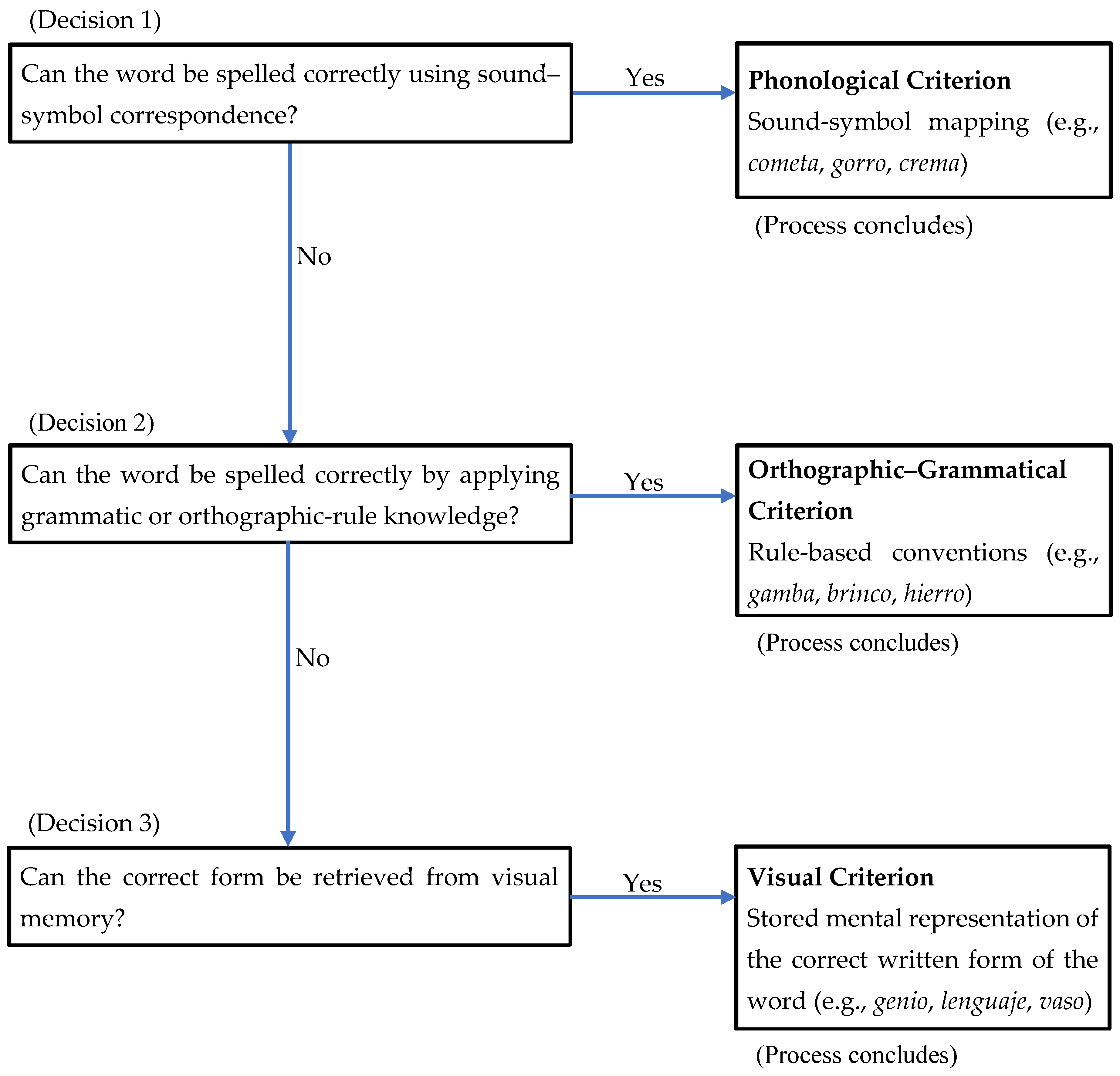
Addressing these instructional gaps requires a clearer conceptualization of the cognitive processes that underlie accurate Spanish spelling. Orthographic accuracy depends on three core mechanisms: phonological processing, orthographic–grammatical rule application, and visual memory. Together, these mechanisms structure Spanish orthographic decision-making in bilingual contexts.
Figure 1 synthesizes this sequential process by representing orthographic decision-making as a series of cognitive checkpoints.
1.3.1. Phonological Criterion
Spanish is characterized by a largely transparent phoneme–grapheme correspondence because its writing system primarily represents sounds rather than units of meaning (
Defior et al., 2002;
Sánchez Avendaño, 2008). This transparent orthography allows many words to be spelled correctly through attention to sound–symbol relationships. For instance, words such as
paleta or
forma can typically be encoded accurately by relying on their phonological structure.
However, this transparency is not absolute. An ideal orthography would establish a one-to-one correspondence between phonemes and graphemes, a condition that Spanish does not fully meet (
Real Academia Española, 1999). Historical and structural factors account for deviations, including the preservation of graphic relics, such as the retention of
v despite its phonemic merger with
b, and inconsistencies in representation, where a single grapheme corresponds to multiple phonemes (e.g.,
c,
g) or a single phoneme corresponds to multiple graphemes (e.g.,
y/
ll;
c/
qu for /
k/ in
ca–que–qui–co–cu). Thus, although phoneme–grapheme correspondence constitutes the structural foundation of Spanish spelling, it does not determine all orthographic decisions.
1.3.2. Orthographic–Grammatical Criterion
Even within a phonographically organized writing system, accurate spelling often requires the retrieval of lexical and orthographic information (
Weekes, 2005). This dimension becomes evident in accentuation, where the presence or absence of a written accent alters meaning (
sabana vs.
sábana), and in rule-governed conventions traditionally described as
reglas ortográficas (orthographic rules). For example, diminutives ending in
–illo or
–illa are spelled with
ll, allowing
cucharilla to be written correctly despite the phonological plausibility of
cuchariya.
Spanish orthography also contains areas of structural arbitrariness that require morphological and syntactic awareness (
Contreras-Wise, 2020). In dialects affected by seseo, where the graphemes
s,
c, and
z correspond to the same phoneme (/
s/), this criterion becomes particularly salient. In these contexts, phonology cannot distinguish between homophonous yet grammatically distinct forms, as in
ves (second-person singular of
ver) and
vez (a noun meaning “occasion”), or
haber and
a ver, which are phonologically identical but differentiated by grammatical function.
Rule-governed knowledge, however, has limits. Words such as
original or
girasol cannot be resolved through phonology or grammatical conventions alone; their correct spelling depends on retrieving their stored visual form. This distinction reflects psycholinguistic models of spelling that propose two complementary processing routes: a sublexical route based on phoneme–grapheme conversion and a lexical route that retrieves stored orthographic representations from memory (
Barry, 1994). This boundary introduces the need for a third dimension, the visual criterion, which accounts for the role of visual memory in orthographic accuracy.
1.3.3. Visual Criterion
A substantial proportion of Spanish words cannot be spelled through phonological or rule-based reasoning alone. When phoneme–grapheme correspondence is ambiguous, writers must access stored orthographic representations through the lexical route (
Cuetos Vega, 2011). Visual memory therefore plays a decisive role in orthographic competence, enabling writers to distinguish among homophonic forms that cannot be resolved through phonological or grammatical cues. When phonology provides no basis for differentiating graphemes, visual memory becomes indispensable (
Jiménez et al., 2014).
Research on orthographic processing further shows that spelling acquisition depends on the consolidation of visually encoded word forms. According to the self-teaching hypothesis, repeated encounters with written words allow readers to establish stable orthographic representations in long-term memory, gradually reducing reliance on phonological decoding (
Share, 1995,
1999). Visual memory supports the internalization and reproduction of the correct graphic structure of words (
Gabarró & Puigarnau, 1996).
For example, gente and the nonconventional form jente are phonologically equivalent in Spanish. Because phonology does not determine the correct grapheme in this case, accurate spelling depends on retrieving the stored visual representation of the word. In proficient writers, this retrieval often occurs automatically: the conventional form appears visually familiar, whereas the nonconventional alternative may produce a perceived mismatch with the stored written form. When uncertainty arises, writers may compare possible spellings before selecting the form that aligns with their established orthographic representation. In this sense, spelling accuracy depends on stable visual–lexical representations that support confidence in orthographic decision-making.
From a psycholinguistic perspective, spelling involves access to lexical representations as well as phoneme–grapheme conversion processes: writers may either rely on phoneme–grapheme conversion or retrieve familiar words directly from memory (
Barry, 1994;
Jiménez et al., 2008;
Kwok et al., 2017). Errors arise when activation spreads to competing entries that share phonological features but do not correspond to the intended form. Accurate spelling thus presupposes the existence of a stable and precise visual representation in long-term memory.
Collectively, these three criteria show that Spanish orthographic competence rests on the coordinated operation of phonological, orthographic–grammatical, and visual processes, each becoming decisive when the others reach their limits.
1.4. Orthographic Development in Bilingual Contexts: Biliteracy, Transfer, and Metalinguistic Awareness
Although the cognitive mechanisms underlying accurate Spanish spelling operate across learners, their development assumes distinct characteristics in bilingual contexts. In Spanish–English educational settings, orthographic learning unfolds at the intersection of two phonological, morphological, and orthographic systems that coexist within the learner’s linguistic repertoire.
Research on cross-linguistic transfer shows that literacy-related skills may move across languages when structural correspondences are present (
Cummins, 1979;
Koda & Reddy, 2008). Because Spanish has relatively transparent grapheme–phoneme correspondences and English has a deeper orthographic system (
Calero & Calero-Pérez, 2021), bilingual learners may experience both facilitative and negative transfer in spelling.
Negative transfer becomes evident when English graphemic patterns interfere with otherwise transparent Spanish forms. For example, the word pingüino is phonologically straightforward in Spanish; however, bilingual learners with strong exposure to English may hesitate because the grapheme w is highly frequent in English orthography, momentarily activating a competing representation, pinwino. Similarly, Spanish and English follow different punctuation conventions, including the placement of punctuation in relation to parentheses, which in Spanish typically falls outside the parenthetical element. When such structural differences are not clearly differentiated, learners may overgeneralize conventions from one language to the other, reinforcing forms that do not align with Spanish orthographic norms.
Metabilinguistic awareness, defined as the capacity to reflect on and analyze similarities and differences across languages (
Soltero, 2016), plays a central role in managing these cross-linguistic interactions. This capacity has been widely associated with bilingual development and literacy performance (
Bialystok, 2001). Writers must continually monitor which linguistic system is activated and which conventions govern the written form at a given moment. Orthographic ambiguity in bilingual contexts is therefore both cognitive and cross-linguistic.
From this perspective, orthographic development constitutes a core dimension of biliteracy formation rather than an isolated technical skill. The consolidation of stable orthographic representations in Spanish strengthens learners’ capacity to read, write, and reason across languages with precision and confidence.
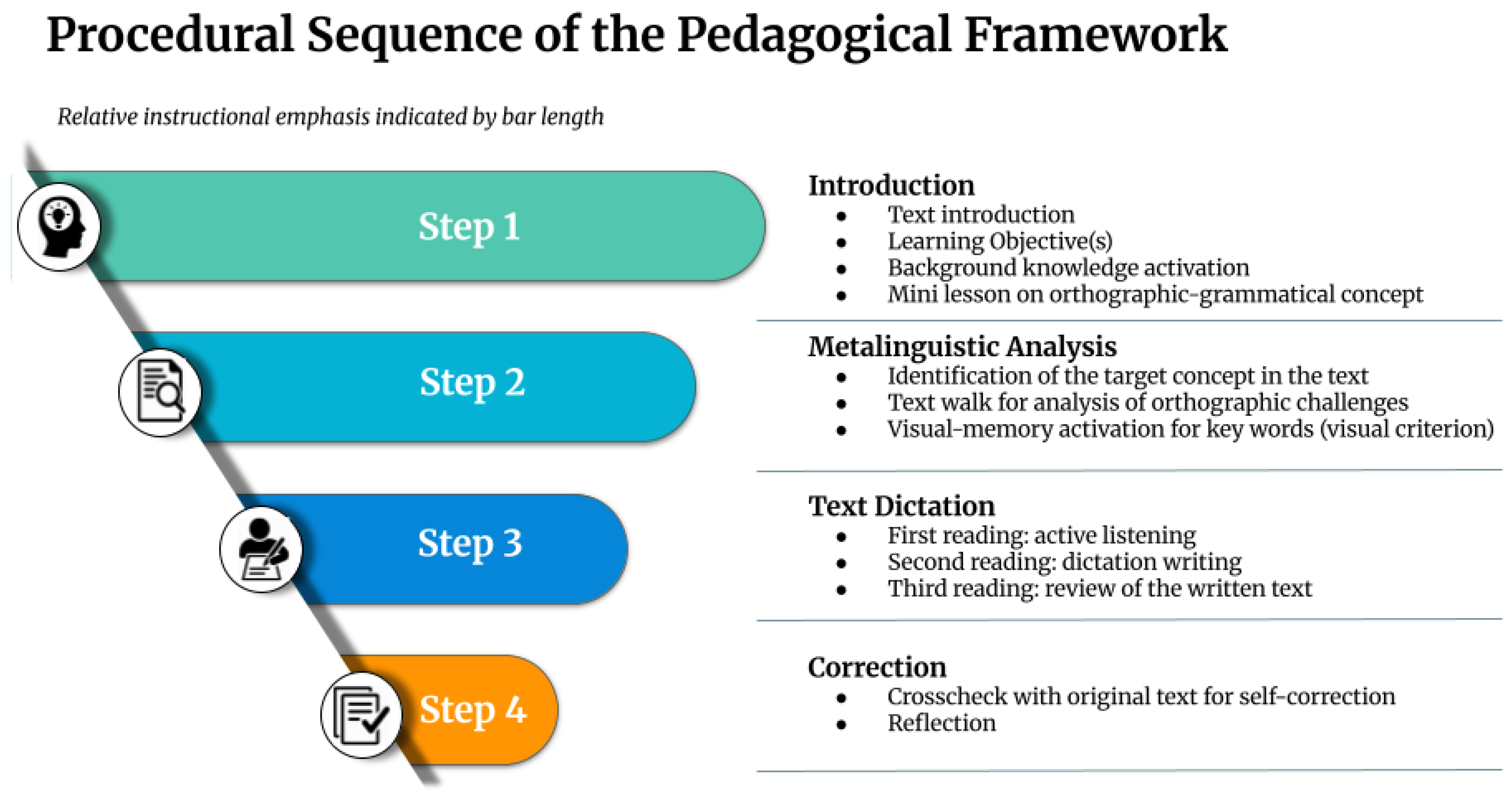
In this study, the pedagogical framework originally developed as Dictado Ideal is treated as the instructional operationalization of the proposed cognitive framework. It is intentionally structured around the three spelling criteria outlined above and designed to respond to the specific cognitive and cross-linguistic demands of Spanish–English bilingual contexts. This pedagogical framework seeks to support the coordinated development of biliteracy and the processes through which orthographic competence is established and sustained across languages. In this article, the term cognitive framework refers to the conceptual model of Spanish orthographic decision-making, whereas pedagogical framework refers to its instructional organization for bilingual literacy contexts. Expert evaluation of the pedagogical framework therefore provides evidence regarding its perceived coherence, relevance, and applicability as an instructional expression of the proposed cognitive framework.
Figure 2 presents the procedural sequence of the pedagogical framework evaluated in this study, showing how the instructional organization translates the cognitive criteria into a four-phase instructional sequence.
2. Materials and Methods
2.1. Research Design and Study Purpose
Building on this conceptualization of orthographic decision-making in bilingual contexts, the present study examines the pedagogical framework as the instructional organization of the proposed cognitive framework. Using a qualitative evaluative design, the study analyzes experts’ perceptions of the framework’s clarity, instructional coherence, pedagogical relevance, applicability, and refinement priorities in U.S. Spanish–English bilingual education contexts. The study did not assess student outcomes or classroom effectiveness. Instead, it examined how experts interpreted the framework, evaluated its perceived coherence and relevance, and identified conditions for refinement and future implementation.
The study followed a sequential process that included (a) preparing the pedagogical framework and supporting materials, (b) recruiting and screening expert participants, (c) collecting data through an open-ended questionnaire and interviews, (d) preparing and anonymizing the corpus, (e) conducting thematic content analysis through deductive and inductive coding, and (f) applying triangulation and quality-control procedures.
2.2. Context
The study was situated in U.S. Spanish–English bilingual education settings, including K-12 dual language and bilingual program contexts where Spanish is taught as a language of literacy and schooling. These settings include educational spaces connected to Spanish Language Arts, biliteracy, Spanish literacy, and, in some cases, teacher preparation related to Spanish instruction in bilingual contexts. They do not refer to a single institution or grade level, but to a broader instructional field in which learners develop biliteracy while moving across two writing systems and in which Spanish orthographic development may be shaped by transfer, interference, and cross-linguistic comparison between Spanish and English. Within this context, the pedagogical framework was presented to participants as a structured instructional sequence organized around a preparatory metalinguistic mini-lesson before dictation, followed by guided execution and reflection. The sequence explicitly articulated three cognitive criteria, phonological, orthographic–grammatical, and visual, alongside visual-memory activation and retrieval routines and a preventive orientation designed to limit early exposure to incorrect forms. Participants received a written description of the pedagogical framework and responded to open-ended prompts asking them to evaluate its clarity, instructional coherence, pedagogical relevance, applicability in bilingual contexts, and potential areas for refinement in relation to bilingual learners’ linguistic trajectories and classroom realities.
2.3. Participants, Sampling, and Corpus Composition
The final analytic corpus consisted of 44 expert participants with recognized experience in bilingual education and Spanish language and literacy instruction in Spanish–English contexts in the United States. In this study, experts were defined as professionals with at least six years of experience, preferably more than ten, in Spanish teaching, literacy/biliteracy, or the implementation, coordination, leadership, research, or pedagogical and curricular support of bilingual or dual language education programs. The purpose of this strategy was to identify participants with substantial and recognized expertise in Spanish–English bilingual education, Spanish literacy, biliteracy, curriculum design, instructional leadership, and research-informed practice. Recruitment initially drew on the researcher’s professional access to national and Chicago-based bilingual education networks, including district-level and instructional leadership contexts, and was later expanded through referrals to include experts from additional U.S. regions and professional domains.
Selection criteria prioritized (a) substantial professional experience in bilingual or dual language education, Spanish literacy/biliteracy, or program implementation and support, with a minimum experience threshold; (b) roles involving instructional leadership, professional learning, curriculum design, or research-informed practice; and (c) geographic diversity, with emphasis on Chicago-area contexts and the inclusion of participants from additional U.S. regions to broaden the interpretive range of perspectives. Recruitment began with direct invitations to identified experts and continued through participant referrals to additional professionals who met the study criteria. Participation was voluntary.
Table 1 summarizes the corpus by professional role, years of experience, geographic location, and area of expertise.
A data-cleaning process was conducted to ensure that the analytic corpus reflected the intended expert profile and that responses were based on a review of the pedagogical framework. Four responses were excluded from the initial dataset: one participant indicated that they had not reviewed the pedagogical framework, and three respondents did not meet the minimum experience threshold. After these exclusions, the final corpus was N = 44.
2.4. Instruments and Data Collection Procedures
Data collection offered two participation pathways. Participants could either review the written description of the pedagogical framework and complete the open-ended questionnaire independently, or participate in an interview in which the researcher presented the framework orally and guided them through the same open-ended questions. In both modes, participants engaged with equivalent substantive content; the difference lay in the mode of access and response, not in the content evaluated. The questionnaire was designed to elicit detailed expert feedback on core dimensions of the pedagogical framework, including clarity, structure, instructional coherence, integration of key strategies, anticipated learning contributions, applicability in bilingual contexts, and recommendations for improvement. Key strategies included explicit teaching of orthographic and grammatical criteria, visual-memory activation and retrieval routines, and reduced exposure to incorrect forms.
The instrument was created for this study based on the study objectives and the framework’s central dimensions: the three cognitive spelling criteria, the instructional components of the pedagogical framework, and its anticipated relevance for bilingual contexts. To strengthen methodological coherence, clarity, and usability, the questionnaire underwent specialized review focused on item clarity, alignment between questions and objectives, correspondence with the metacategories, categories, and concepts that framed the coding system, and ethical considerations such as consent language and confidentiality. Revisions following this review included separating prompts that could lead to overlapping interpretations, refining participant profile categories, and reducing identifiable data collection.
Before full administration, the instrument was piloted in both Spanish and English through five pilot administrations to identify ambiguous wording, improve the clarity of instructions, refine bilingual questionnaire items, and verify functional equivalence across languages. Adjustments were incorporated into the final version.
During the main data collection phase, materials were available in Spanish and English, and participants were invited to respond in their preferred language. This bilingual provision was intended to support accessibility and reduce language-based constraints on the specificity and nuance of expert feedback.
Data were collected over an extended period, from September 2024 to September 2025, as experts opted into participation. Four interviews were conducted with participants who selected the interview pathway. The interviews were transcribed verbatim and integrated into the analytic corpus.
2.5. Data Preparation and Management
Before analysis, responses and transcripts were organized to support systematic handling and confidentiality. Participants were assigned non-nominal identifiers, and data were stored securely with access restricted to the researcher. Documents were organized to support comparison by participation mode (questionnaire versus interview) and by language.
Because the dataset included responses in Spanish and English, English responses were translated into Spanish for integrated analysis using a conceptual rather than literal translation approach. This process prioritized the preservation of meaning, professional nuance, and argumentative intent. When phrasing carried important interpretive nuance, the original wording was retained as a reference point during analysis.
2.6. Analytic Framework and Coding
Analysis followed a thematic content analysis approach that combined deductive and inductive coding. Deductive coding was guided by an a priori analytic framework derived from the study objectives, the evaluative dimensions guiding the research, and the cognitive criteria described in the theoretical discussion. This framework organized analysis around four deductive metacategories: (1) pedagogical framework design, including clarity and instructional structure; (2) pedagogical strategies, including the mini-lesson, explicit criteria instruction, visual-memory activation and retrieval routines, and reduced exposure to incorrect forms; (3) expert-anticipated learning contributions, including anticipated orthographic improvement, metalinguistic awareness, and perceived relevance; and (4) applicability and refinement, including implementation conditions and recommendations for improvement.
Inductive coding was used to capture themes that emerged beyond the initial framework, especially when experts raised recurring concerns, conditions, or conceptual tensions not fully represented in the deductive structure. This deductive–inductive combination allowed the analysis to remain structured while remaining responsive to unexpected but meaningful patterns.
The coding process followed an iterative sequence:
Familiarization: all questionnaire responses and transcripts were read in full to identify preliminary patterns and recurring topics.
Initial deductive coding: segments were coded into the deductive metacategories and their associated codes, using definitions aligned to the study objectives.
Inductive coding: new codes were created when participants introduced repeated themes or conditions not captured deductively, and these were refined as patterns stabilized.
Code refinement and consistency checks: code definitions were revisited, merged when overlapping, and clarified to ensure consistent application across documents.
Comparative analysis: patterns were examined across participation mode (questionnaire versus interview) and participant characteristics, including role, experience, location, and expertise domains, with attention to convergences and meaningful divergences. These comparisons were interpreted qualitatively to identify role-based patterns of emphasis rather than statistical group differences.
Synthesis: themes were organized into result-ready categories, supported by representative excerpts, and interpreted in relation to the study’s evaluative focus as represented in the deductive coding.
Coding was conducted by the first author. To strengthen analytic consistency, the coding scheme was developed from the study objectives and refined through memoing, repeated reading, and iterative consistency checks. No independent inter-rater coding was conducted; therefore, the analysis emphasizes transparency, traceability, and triangulation rather than statistical intercoder agreement.
All coding and data management steps were conducted in ATLAS.ti, version 25.0.2, to support systematic coding, organization by document groups, memoing, and traceability of analytic decisions.
2.7. Trustworthiness and Ethical Considerations
Trustworthiness was strengthened through several procedures. First, findings were examined across the two participation modes, questionnaire and interview, to check for convergence and to clarify themes that required deeper elaboration. Because both modes addressed the same evaluative content, comparisons across modes were used as an interpretive consistency check rather than as a quantitative contrast. Differences between modes were examined as possible differences in discourse depth, elaboration, or contextual detail, particularly because interview responses sometimes allowed for more extended explanation.
Second, analytic comparisons across role, experience, location, and expertise domains were used to examine whether themes were broadly shared or context-dependent. Third, analytic decisions were documented through memos and iterative refinement of code definitions, supporting transparency and traceability. Throughout the analysis, both convergent perspectives and divergent cases were retained to avoid overstating consensus. Final interpretations were triangulated across participation mode, participant characteristics, the theoretical framework, and the four analytic propositions guiding the study.
Reflexivity was maintained through ongoing attention to the alignment among the study purpose, qualitative evaluative design, instrument construction, coding decisions, and interpretation of expert perceptions. This process supported epistemic vigilance by helping ensure that findings were presented as expert evaluations of perceived clarity, coherence, relevance, applicability, and refinement priorities, rather than as evidence of classroom implementation or student learning outcomes.
Ethical procedures included informed consent, voluntary participation, and the right to decline any question or withdraw from the study. Confidentiality was maintained through anonymization, the use of non-nominal identifiers, and reporting by professional role rather than by individual identification. Although some participants granted permission to be identified, the study prioritized consistent confidentiality practices across the corpus. Data were stored securely, with access restricted to the researcher.
3. Results
Findings are reported in relation to the four deductive metacategories that structured the analysis. These metacategories were synthesized into four analytic propositions: (1) clarity, instructional structure, and internal coherence; (2) pedagogical robustness of the instructional components; (3) expert-anticipated learning contributions and bilingual relevance; and (4) applicability and refinement priorities in bilingual contexts.
3.1. Analytic Proposition 1: Clarity, Instructional Structure, and Internal Coherence
The first proposition examined whether the pedagogical framework would be perceived as clear, structurally organized, and internally coherent. Findings indicate broad agreement with this proposition. The proposition was grounded in two direct deductive codes, clarity and instructional structure, through which internal coherence was interpreted.
Across participants, clarity was described in two complementary ways. First, experts highlighted macro-structural clarity, referring to the organization, sequencing, and overall logic of the pedagogical framework. Comments emphasized that the framework was not a loose collection of dictation activities, but rather a defined instructional sequence with recognizable stages and a consistent internal rationale. Participants described the structured pathway as moving students from preparation to execution and then to reflection, which they interpreted as pedagogically purposeful rather than merely procedural. As one participant explained, “In my opinion, the methodology is clearly explained. It is presented step by step, with a structured and coherent approach that facilitates understanding and application. It states the objectives precisely, especially the emphasis on positive learning and on avoiding a punitive view of dictation” (Institutional Academic 01). This response illustrates how clarity was associated not only with procedural transparency, but also with the pedagogical orientation of the sequence.
Second, participants emphasized instructional structure, referring to how responsibilities are distributed between teachers and students and how each phase supports the next. Experts particularly valued the framework’s explicitness about instructional roles. They noted that clarity is strengthened when teachers and students know what is expected at each point in the sequence, especially during the preparatory phase and during correction or reflection. This instructional structure supported the interpretation of internal coherence because it reduced ambiguity during implementation and increased the likelihood that teachers could replicate the intended learning process.
However, findings also revealed a consistent nuance. When experts requested changes, those requests rarely questioned the conceptual structure itself. Instead, they called for greater micro-operational specificity, especially through concrete examples and classroom-ready demonstrations. One participant captured this distinction by stating, “I think the structure of the methodology is solid and logical […] However, some aspects could be further detailed: the inclusion of concrete examples […] including a complete model dictation with all steps applied would help teachers better visualize how to put it into practice” (University Faculty 02). These comments indicate that participants viewed the structural design as conceptually coherent, while requesting greater operational specificity to support implementation across grade levels and student profiles.
3.2. Analytic Proposition 2: Pedagogical Robustness of the Instructional Components
The second proposition examined whether the pedagogical framework integrated pedagogically robust strategies for orthographic instruction, particularly through the combined implementation of the mini-lesson, explicit criteria instruction, visual-memory activation and retrieval routines, and reduced exposure to incorrect forms.
Expert responses frequently characterized the mini-lesson and explicit criteria instruction as instructionally relevant and mutually reinforcing. Rather than appearing as independent features, these components were described in relation to one another within the instructional sequence. Participants referred to the mini-lesson as the phase in which orthographic criteria are activated, clarified, and operationalized before dictation. As one participant explained, “The mini-lesson is useful because, in this step, students receive explicit spelling instruction. This direct instruction helps students make connections between what they already know and what they are learning” (School Leader 08). This response illustrates how the mini-lesson was interpreted not as an isolated preliminary activity, but as the instructional space in which students prepare to make more conscious spelling decisions.
Visual-memory activation and retrieval routines also emerged as a central component of the framework’s perceived pedagogical robustness. Participants valued the intentional attention to difficult words before writing, particularly because this preparation was understood as supporting the formation and retrieval of correct visual representations. One expert noted that “these techniques help students form a clear ‘mental image’ of the word, which strengthens their internal visual dictionary and significantly improves correct spelling” (Institutional Academic 01). This finding suggests that experts understood visual memory not as a peripheral support, but as a cognitive mechanism directly connected to orthographic accuracy and writing confidence.
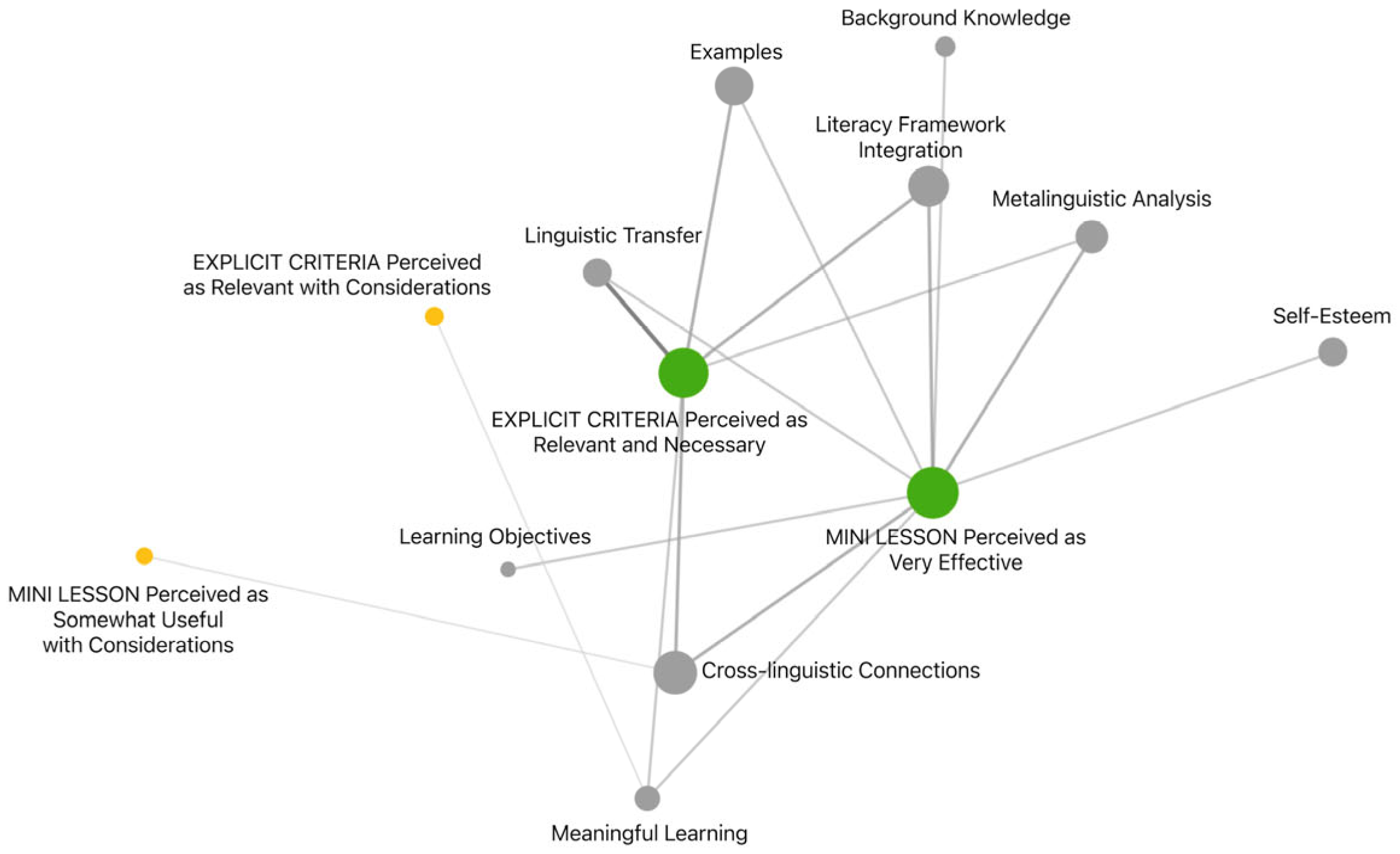
The force-directed code co-occurrence network (see
Figure 3) visually represents the relationships among these evaluative codes and associated thematic codes. In the network, the node corresponding to “Mini-lesson: Perceived as Very Effective” appears centrally positioned and connected to codes related to metalinguistic analysis, cross-linguistic connections, learning objectives, significant learning, and student self-confidence. Similarly, evaluative codes associated with the explicit teaching of orthographic criteria are linked to cross-linguistic connections and meaningful learning constructs.
The network suggests that expert judgments were articulated in relation to broader instructional and learning dimensions rather than to isolated procedural steps. The central positioning of the mini-lesson indicates that participants associated this phase with preparation for conscious orthographic decision-making, while the links involving explicit criteria instruction suggest that the criteria were viewed as tools for analyzing spelling patterns, activating prior knowledge, and making meaningful connections before writing. As one participant explained, “The integration of the mini-lesson allows dictation to stop being a merely evaluative activity and become a true learning opportunity” (National Specialist 03). Overall, the network and participant responses indicate that the pedagogical robustness of the framework lies in the coordination among preparation, explicit criteria instruction, visual-memory processes, and metalinguistic reflection, rather than in any single component alone.
Treatment of Error as an Instructional Dimension
Beyond the central integration of the mini-lesson, explicit criteria instruction, and visual-memory activation and retrieval routines, references to error emerged as a distinct thematic dimension within the dataset. Coded segments related to error focused on how incorrect forms are addressed within the sequence, the timing of correction, and the degree of exposure to incorrect spellings. These references appeared in relation to sequencing decisions, preventive orientation, and instructional clarity rather than as evaluations of the structural design itself.
Experts articulated different positions regarding the role of error in orthographic learning. Some segments emphasized limiting exposure to incorrect forms during initial encoding. One participant stated that “frequent incorrect spellings can confuse students and weaken memory,” adding that “by reducing exposure to spelling errors, the mental image of correct spelling is preserved and students’ visual memory of words is strengthened” (School Leader 12). This perspective aligns with the framework’s preventive orientation, in which initial exposure to correct forms is intended to support more stable orthographic representations.
At the same time, other participants emphasized guided reflection on error as part of metalinguistic processing and autocorrection. This tension was captured by one expert who stated that “it is very important that children do not internalize spelling errors,” while also noting that “we consider the moment of correction to be very powerful: students become aware, ‘oh, I wrote it incorrectly, and now I understand why I need to correct it’” (University Faculty 09). These responses suggest that the central issue was not whether error should be eliminated from instruction, but how exposure to incorrect forms should be timed, mediated, and transformed into reflective learning.
Importantly, references to error did not cluster around calls for redesign; rather, they were situated within implementation considerations and instructional calibration. As such, the treatment of error emerged as an instructional dimension requiring clearer articulation within the instructional sequence.
3.3. Analytic Proposition 3: Expert-Anticipated Learning Contributions and Bilingual Relevance
The third proposition examined whether experts anticipated meaningful learning contributions associated with implementing the pedagogical framework, particularly in relation to orthographic improvement, metalinguistic awareness, and relevance for Spanish–English bilingual contexts. This proposition was grounded in three deductive codes: expected success in the activity, anticipated improvement in spelling, and relevance and usefulness. These codes were analyzed together because expert responses frequently linked pedagogical relevance with expectations of student success and anticipated orthographic improvement.
This study did not measure student outcomes directly. The findings in this section therefore reflect professional judgments about potential learning contributions based on expert evaluation of the pedagogical framework.
Participants associated the instructional sequence with possible improvements in spelling accuracy. They described the preparatory phase, especially its explicit focus on orthographic criteria, as creating clearer conditions for making spelling decisions. Experts indicated that when students analyze spelling patterns before writing, errors may be reduced because decisions are made more consciously. As one participant stated, “I anticipate that students will be very successful because the dictation criteria are very clear” (School Leader 14). This response illustrates how anticipated success was linked to clarity, criteria, and preparation rather than to dictation as a corrective task.
Experts also connected anticipated success with orthographic improvement. Improvement was not framed only as a reduction in errors, but as a broader strengthening of students’ linguistic repertoire and confidence as writers. One participant noted that “the focus on improvement rather than on errors will help students continue their development in a way that amplifies their skills and linguistic repertoire” (School Leader 04). Another stated more directly that “an immediate improvement in students’ spelling skills would be observed” (University Faculty 09). Together, these comments suggest that experts interpreted the pedagogical framework as creating conditions for more conscious, accurate, and developmentally supportive spelling practice.
Metalinguistic awareness was also identified as a likely contribution. Participants referred to opportunities for students to reflect on language patterns, compare spelling alternatives, and identify rule-based differences. In bilingual settings, this reflection was often connected to managing transfer between Spanish and English and to recognizing when spelling decisions require attention to language-specific conventions. As one participant explained, “Highlighting the linguistic features of the Spanish language and improving students’ metalinguistic knowledge will be of greater benefit for a bilingual student, because it is not simply a matter of isolating the given language, but of allowing them to understand one language in relation to, or alongside, the other” (School Leader 02). This response captures the bilingual relevance of the framework: its value lies not only in supporting Spanish spelling accuracy, but also in helping students reason across languages.
In addition, experts referred to possible affective benefits. They described the shift from corrective dictation to guided preparation as potentially reducing anxiety and increasing student confidence. Some participants noted that students may be more willing to participate when they feel prepared before being evaluated. One expert connected this shift directly to the learner’s emotional positioning, explaining that “this structure is valuable because it allows experiential learning to take place in the first step, and that changes the intention of dictation. If it begins directly with: ‘I am going to read this text to you, you write it, and then we will spend most of the time correcting errors,’ then, as a student, […] I already enter feeling that I am not enough” (University Faculty 10). This response suggests that the framework’s preparatory orientation was perceived as both cognitively supportive and affectively supportive because it repositions dictation as a guided learning experience rather than an evaluative task centered on error.
Overall, expert-anticipated learning contributions were described in three interrelated areas: greater orthographic precision, stronger metalinguistic awareness, and improved student confidence during writing tasks. These contributions were not framed as measured outcomes, but as perceived learning possibilities derived from the framework’s emphasis on preparation, explicit criteria instruction, visual-memory activation, and bilingual comparison. A profile-based analysis of expert responses indicated that the expectation of orthographic improvement was not concentrated in a single professional group. Rather, the strongest pattern was convergence across roles: school leaders, district leaders, university faculty, and specialized participants generally linked anticipated improvement to the framework’s structured preparation. Differences appeared mainly as emphases. Practice-based roles tended to stress classroom implementation, student readiness, and the conditions needed for consistent enactment, whereas university and research-oriented participants more often framed improvement through conceptual coherence, metalinguistic analysis, and visual-memory processes.
3.4. Analytic Proposition 4: Applicability and Refinement Priorities in Bilingual Contexts
The fourth proposition examined whether the pedagogical framework was perceived as applicable within bilingual education settings and how experts framed its refinement and implementation. This proposition was grounded in two deductive codes: implementation in bilingual contexts and suggestions for refinement.
Participants consistently situated the pedagogical framework within dual language and bilingual programs. References to cross-linguistic transfer and connections between Spanish and English appeared frequently when participants described classroom relevance. Orthographic instruction was framed as particularly important in contexts where students move between two writing systems and must manage interference across languages. As one participant explained, “Yes, I can see this being very applicable in a bilingual instructional context. I think this approach, because it is so systematic in its design, could work extremely well, especially for students who are behind” (District Leader 04). This perspective suggests that applicability was linked not only to the framework’s instructional sequence, but also to its capacity to respond to the linguistic realities of bilingual learners.
Participants also connected applicability to broader goals of biliteracy development. One participant stated, “Yes, I absolutely think it would be very applicable to bilingual contexts. In our case, everything we do is within that holistic framework of biliteracy. The only thing I would say is that, as long as some connections between Spanish and English are established, that would be an added value” (University Faculty 09). At the same time, experts noted that this bilingual orientation should be made more explicit. As another participant explained, “It supports literacy in Spanish, but it needs to support biliteracy more explicitly as a tool for carrying out contrastive analysis between the two languages” (Research Scientist 02). Together, these comments indicate that experts perceived the framework as relevant for bilingual contexts while also identifying the need to strengthen its explicit treatment of cross-linguistic comparison.
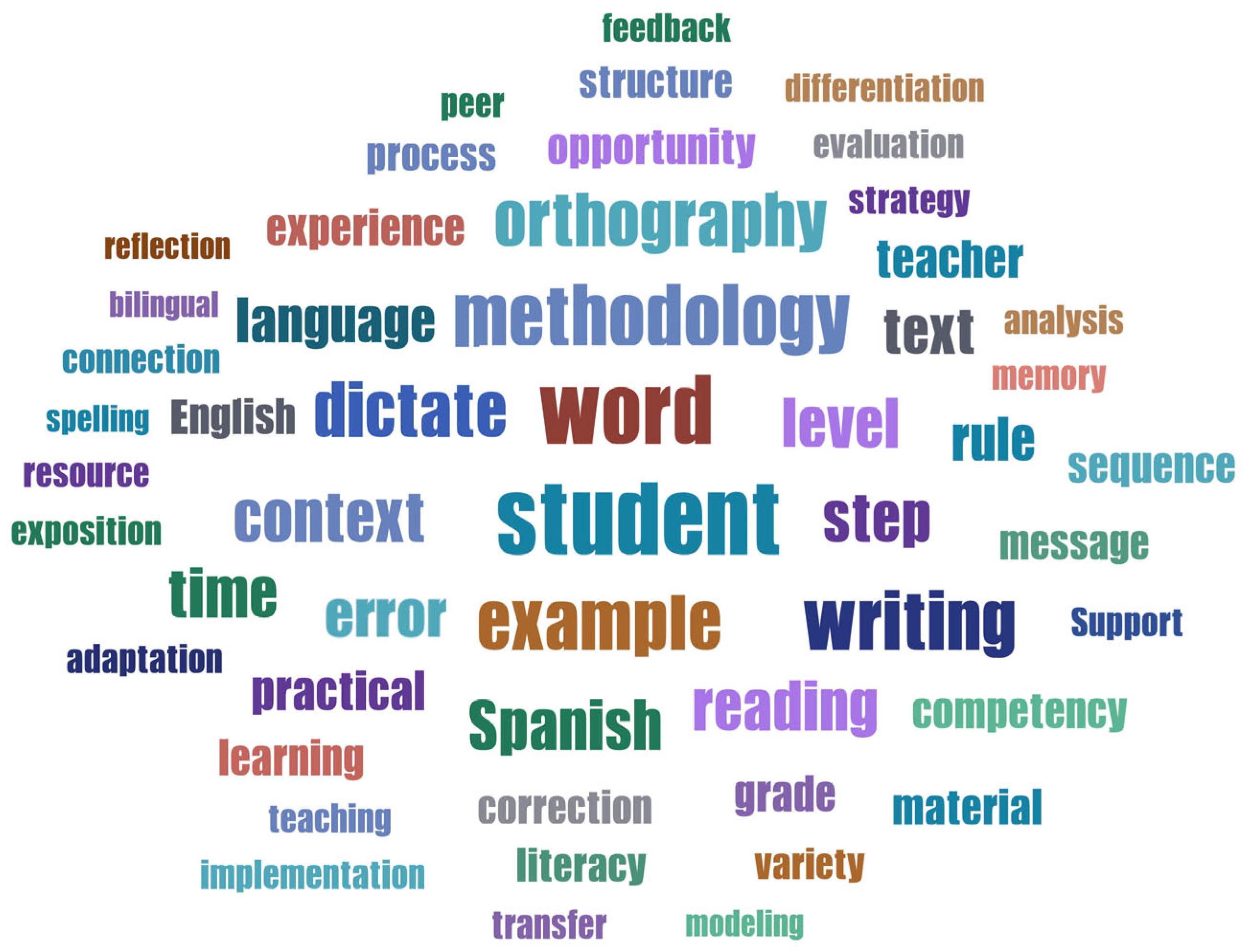
In addition to statements of relevance and applicability, participants provided detailed recommendations related to implementation. To synthesize these recommendations, a concept cloud was generated from the analytic category associated with suggestions for refinement (see
Figure 4).
Although high-frequency words such as student, word, and methodology appear prominently in the cloud, several conceptually significant terms also stand out. These include transfer, error, time, context, reading, writing, and literacy. Their presence and relative prominence reflect recurring attention to key themes identified across the corpus.
The term transfer indicates sustained concern with cross-linguistic influence and the need to address spelling decisions within a bilingual framework. The term error reflects ongoing attention to how incorrect forms are handled within instructional sequencing. The appearance of time and context suggests that participants emphasized pacing, frequency, and classroom conditions as important variables in implementation.
The prominence of reading, writing, and literacy aligns with repeated recommendations to integrate dictation within a broader literacy framework rather than treating it as an isolated exercise. Participants referred to connections between orthographic instruction and reading comprehension, writing development, vocabulary, and overall literacy practice. One district leader captured this broader orientation by recommending that the pedagogical framework be understood “not only as a spelling strategy, but as a tool for biliteracy development. Its strengths in building metalinguistic awareness, grammatical understanding, and visual word recognition make it highly valuable in bilingual education. To strengthen its contribution, it could be integrated into a broader literacy framework that includes connections to reading, vocabulary, and writing” (District Leader 08). This comment suggests that refinement should not only clarify procedures, but also strengthen the framework’s connection to biliteracy, vocabulary development, reading, and writing.
Taken together, the distribution of terms in
Figure 4 and the participant responses indicate that refinement priorities centered on five areas: clearer classroom-ready examples, stronger integration with broader literacy practices, explicit treatment of transfer between Spanish and English, calibrated handling of error, and attention to time, context, and level of implementation. These findings suggest that experts perceived the pedagogical framework as applicable in bilingual contexts while also identifying the conditions needed to strengthen its practical enactment.
4. Discussion
The purpose of this qualitative evaluative study was to examine expert perceptions of the clarity, internal coherence, pedagogical relevance, applicability, and refinement priorities of a pedagogical framework for Spanish orthographic instruction in bilingual contexts. Overall, expert feedback revealed broad convergence around the clarity and internal logic of the instructional sequence, particularly its emphasis on intentional preparation prior to writing. Participants valued this orientation because it shifts dictation away from a primarily corrective function and toward a structured process of preparation, metalinguistic analysis, visual-memory activation, and reflection. In this sense, the expert feedback supports a reconceptualization of dictation as a formative component of literacy development, consistent with critiques of traditional dictation practices that position spelling primarily as a corrective or punitive exercise (
Carratalá Teruel, 1993,
2013;
Cassany et al., 1994).
A central contribution identified by participants was, therefore, the preventive orientation of the pedagogical framework. Experts valued the way the sequence moves orthographic instruction toward preparation before writing. In this sequence, students are exposed to correct orthographic forms before production, with the aim of helping them establish stable orthographic representations in long-term memory. This process is consistent with models of orthographic learning that emphasize repeated encounters with accurate written forms as the basis for lexical consolidation (
Álvarez-Cañizo et al., 2018;
Share, 1995). Experts also valued metalinguistic analysis and visual-memory activation and retrieval before dictation to prioritize the consolidation of accurate orthographic representations and reduce reliance on post hoc correction. This approach aligns with research emphasizing the role of stored orthographic representations in mastering non-transparent or arbitrary orthography (
Jiménez et al., 2014) and with instructional models that highlight visual memory as a key pathway to orthographic competence (
Carratalá Teruel, 1993;
Gabarró & Puigarnau, 1996,
2010). However, expert feedback suggests that this preventive orientation requires clearer operational guidance, particularly through concrete examples and teacher-facing models that show how visual-memory activation and retrieval routines can be implemented in classroom practice.
At the same time, the tension identified in expert discourse regarding the treatment of error reflects a longstanding debate within orthography pedagogy. While preventive approaches emphasize minimizing exposure to incorrect forms, reflective perspectives on orthographic instruction emphasize conscious engagement with orthographic forms and the pedagogical value of examining errors as part of learning (
Rodríguez-Ortega, 2015;
Sánchez Avendaño, 2008). Rather than signaling a flaw in the instructional sequence, this tension underscores the need for careful pedagogical calibration. The findings suggest that a clearer articulation of how limited, purposeful error analysis and autocorrection can be integrated within a preventive structure may strengthen implementation coherence. The central question, therefore, is not whether error should be included or avoided entirely, but how it should be sequenced, mediated, and transformed into an opportunity for metalinguistic reflection.
Experts repeatedly recommended strengthening the pedagogical framework’s cross-linguistic component, not as an ancillary feature but as an explicit component of pre-dictation preparation. In their view, guided comparison across Spanish and English orthographic patterns can reduce guessing and increase students’ metalinguistic control, particularly for spellings that are plausible in English but nonconventional in Spanish, while also making the rationale for orthographic choices more transparent to learners. This recommendation is consistent with research showing that bilingual language systems can be simultaneously activated during writing tasks, allowing orthographic representations from both languages to facilitate or interfere with spelling decisions depending on cross-linguistic similarity (
Iniesta et al., 2021). It is also consistent with theoretical and instructional perspectives that emphasize the transfer of literacy-related skills across languages and the value of explicit cross-language connections in bilingual education (
Cummins, 2000;
August & Shanahan, 2006).
Finally, experts emphasized that orthographic instruction is most effective when embedded within broader literacy practices rather than implemented as an isolated routine. They recommended linking dictation work to authentic reading and writing so that orthographic learning is reinforced in contexts where students make meaning, develop voice, and apply conventions for communicative purposes. Several experts also noted that integrating oracy into this ecosystem, including discussion about language choices, collaborative reasoning about spelling decisions, and oral rehearsal of target forms, can strengthen the metalinguistic work that precedes dictation and support students’ confidence as bilingual communicators. This recommendation marks an important boundary for the framework: dictation may support orthographic accuracy, but it should not reduce biliteracy instruction to spelling accuracy alone. This positioning aligns with views of biliteracy as a dynamic, contextual practice that develops across modalities and is mediated by sociocultural experiences, making relevance and identity-affirming instruction central to sustained literacy growth (
García & Wei, 2014).
Given the evaluative nature of this study, the findings should be interpreted as evidence of perceived coherence, applicability, and refinement priorities rather than as evidence of student learning outcomes. Future research should empirically examine the implementation of this instructional sequence in classroom contexts, including its effects on independent writing and its interaction with different approaches to error treatment over time.
4.1. Implications for Practice
The findings suggest several practice-oriented implications for bilingual educators implementing structured orthographic instruction, particularly regarding the instructional work that occurs before dictation. First, the pedagogical framework’s contribution depends on preserving a clear pre-dictation phase in which students engage in explicit metalinguistic analysis of orthographic patterns and spelling decisions, thereby shifting dictation from an error-checking routine to a cognitively guided literacy practice (
Cassany et al., 1994;
Sánchez Avendaño, 2008). Second, teachers should incorporate targeted visual-memory activation and retrieval routines for words and patterns that cannot be reliably derived from phonology or rule-based spelling, because non-transparent or arbitrary orthography relies more heavily on stable visual–lexical representations (
Gabarró & Puigarnau, 1996,
2010;
Jiménez et al., 2014). Third, cross-linguistic connections should be taught explicitly during this prework to leverage transfer and reduce interference through guided comparison across Spanish and English orthographic patterns within an integrated view of biliteracy (
August & Shanahan, 2006;
Cummins, 2000;
Hornberger, 1989).
In summary, these implications suggest that structured orthographic preparation functions most coherently when metalinguistic reasoning, visual-memory processes, and cross-language contrast operate in coordination.
4.2. Limitations
This study was designed as a qualitative evaluative analysis grounded in expert judgment; therefore, the findings should not be interpreted as direct evidence of student learning gains. Although the final corpus included 44 experts and incorporated both open-ended questionnaires and four semi-structured interviews, participation was purposive and relied partly on snowball sampling. This sampling strategy may privilege perspectives from interconnected professional networks and limit statistical generalizability. The sample was also geographically concentrated in the Chicago area (26 of 44 participants), which may have shaped the perspectives represented, even though participants from several additional states were included to broaden the interpretive range. In addition, experts reviewed a written description of the instructional sequence rather than observing its classroom implementation, meaning that their evaluations reflect perceived coherence, applicability, and anticipated learning contributions rather than documented enactment. Finally, variation in participants’ program contexts, language backgrounds, and institutional roles, while analytically valuable, may shape interpretations of dictation, error treatment, and cross-language instruction in ways that warrant further contextualized investigation.