1. Introduction
In an era shaped by globalization, migration, and rapid digital transformation, higher education institutions face increasing responsibility to prepare educators who are culturally responsive, equity-minded, and globally aware. As classrooms become more diverse and sociopolitical tensions increasingly shape public discourse, teacher education programs must prepare educators not only to teach effectively but also to recognize systemic inequities, challenge dominant narratives, and cultivate inclusive learning environments that support belonging, achievement, and democratic participation. These demands extend beyond instructional technique to include professional dispositions, ethical responsibility, and sustained reflective practice.
Higher education is often positioned as a catalyst for knowledge societies that connect academic inquiry with civic participation, social cohesion, and equity (
Brennan & Teichler, 2008). Yet persistent disparities in access, representation, and inclusion reveal the limits of institutional reform when it is not paired with culturally responsive pedagogy, reflective professional development, and intentional approaches to documenting educator growth. In particular, scholars continue to call for research that examines how teacher education can cultivate equity-oriented professional dispositions alongside pedagogical knowledge and classroom practice.
Culturally responsive pedagogy (CRP) provides a robust framework for inclusive teaching by centering learners’ identities, legitimizing diverse ways of knowing, and disrupting exclusionary practices (
Gay, 2018;
Ladson-Billings, 1995,
2021). However, many teacher preparation programs remain constrained by Eurocentric curricular traditions and uneven engagement with Indigenous, intercultural, and global perspectives. These conditions can limit both equity-focused teaching and broader forms of global readiness. At the same time, prior research highlights a persistent gap between educators’ conceptual understanding of equity and their ability to translate that understanding into sustained pedagogical action.
Emerging scholarship suggests that bridging this gap requires intentional instructional design that integrates reflective practice, dialogic engagement, and structured feedback across the learning cycle. Calls for stronger evidence of educator development have also prompted increased interest in triangulated approaches that combine qualitative reflection with survey-based indicators of professional dispositions. Such approaches can help capture both lived experiences and broader patterns in equity-oriented beliefs and commitments, while still requiring careful interpretation.
This study addresses these needs by examining how structured reflection, dialog, and feedback supported educator development toward culturally responsive, equity-centered practice in two teacher education courses—one undergraduate course for preservice teachers and one graduate course for in-service educators. By integrating reflective writing, instructor reflexivity, peer observation, and an anonymous pre- and post-semester survey aligned with InTASC critical dispositions, the study offers a triangulated account of how equity-focused instructional design can function as a barrier-breaking approach within higher education.
The InTASC Model Core Teaching Standards (
Council of Chief State School Officers, 2013) provide a relevant framework for understanding the professional dispositions emphasized in this study. These standards highlight the importance of valuing learner diversity, creating inclusive learning environments, using assessment to support instruction, collaborating with families and colleagues, acting ethically, and engaging in ongoing reflection and professional growth. Collectively, these dispositions position teaching as a reflective, collaborative profession committed to the holistic development, achievement, and well-being of all learners across diverse contexts. Within this study, the InTASC-aligned survey served as a supplementary, descriptive measure that helped illuminate group-level shifts in participants’ self-reported equity-related commitments across the semester.
Viewed holistically, this study contributes empirical insight into how teacher education course design can support educators’ capacity to engage difference ethically, connect global perspectives to local action, and enact more inclusive pedagogies across career stages. In doing so, it responds to broader calls for higher education to prepare educators who can navigate cultural complexity, ethical responsibility, and democratic engagement in increasingly diverse educational contexts.
1.1. Purpose of the Study
The purpose of this qualitative study was to examine how culturally responsive pedagogy (CRP), reflective practice, and transformative learning were enacted and experienced within teacher education coursework designed to promote equity, inclusion, and global readiness. Specifically, the study investigated how the intentional integration of structured reflection, dialogic engagement, and iterative feedback within two university-level courses—one serving preservice educators and one serving in-service educators—supported the development of equity-minded teaching practices and professional dispositions.
Guided by Transformative Learning Theory (
Mezirow, 1991,
1997), Culturally Relevant Pedagogy (
Ladson-Billings, 1995,
2021), and critical-reflective traditions (
Freire, 1970;
Schön, 1983;
Brookfield, 1995), the study sought to understand how educators interrogated assumptions, confronted bias, and translated critical awareness into pedagogical action. Particular attention was given to how reflective processes functioned not only as instructional strategies, but also as ethical commitments shaping professional identity, instructional decision making, and commitments to equity and inclusion.
To strengthen analytic triangulation, the study also incorporated an anonymous pre- and post-semester survey aligned with InTASC critical dispositions. This survey complemented the qualitative dataset by providing descriptive, group-level indicators of participants’ self-reported beliefs related to bias awareness, ethical responsibility, equitable expectations, and culturally responsive teaching commitments. Because survey responses were anonymous and unmatched across time, these data were used cautiously and only to supplement qualitative interpretation rather than to support individual-level or causal claims.
By centering participants’ lived experiences and developmental trajectories, the study aimed to contribute empirical insight into how equity-centered teacher education can move beyond surface-level multiculturalism toward sustained, justice-oriented praxis. In doing so, the study responds to calls for higher education to address structural barriers and prepare educators capable of navigating cultural complexity, ethical responsibility, and democratic engagement in diverse learning contexts.
Research Questions
This study addressed the following research questions:
How do preservice and in-service educators conceptualize culturally responsive pedagogy at the beginning and end of equity-focused teacher education coursework?
How do structured reflective practices (e.g., reflective writing, dialogic feedback, and peer engagement) support transformative learning and equity-minded development among educators?
In what ways do educators confront and make meaning of personal and systemic bias through engagement with culturally responsive and anti-bias pedagogies?
How do global and intercultural learning experiences influence educators’ understanding of local equity issues and culturally responsive teaching practice?
How do preservice and in-service educators translate critical reflection into reported pedagogical action and instructional change?
2. Literature Review
2.1. Transformative Learning Theory in Higher Education
Transformative Learning Theory explains how adult learners revise frames of reference through critical reflection, discourse, and experiences that disrupt taken-for-granted assumptions (
Mezirow, 1991,
1997). Transformation is often initiated by a disorienting dilemma, an encounter that challenges prior beliefs and prompts learners to reassess meaning structures and construct more inclusive, complex perspectives. In higher education, transformative learning is frequently linked to preparing professionals who can engage complexity, develop ethical responsibility, and act with equity-oriented intent (
Liu, 2020). Increasingly, scholars also emphasize the role of higher education in cultivating professional dispositions and ethical commitments that shape practice over time, reinforcing the relevance of dispositional change as an indicator of transformative learning.
Subsequent scholarship has emphasized that transformative learning is not solely an individual cognitive process; it is also relational, dialogic, and shaped by social and institutional contexts (
Mezirow & Taylor, 2009).
Illeris (
2015) further argues that transformation involves cognitive, emotional, and social dimensions, requiring learners to integrate new knowledge with shifts in identity. In teacher education, transformative learning is particularly relevant because educators must confront positionality, privilege, and the structural conditions that shape learning opportunities. Studies suggest that transformation is strengthened when programs intentionally scaffold reflection and intercultural engagement, supporting educators to connect conceptual learning to professional practice and ethical action (
Jacobs & Haberlin, 2021;
Liu, 2020). Emerging research also highlights the value of combining qualitative reflection with survey-based measures of professional dispositions to capture developmental change across time and learning contexts.
2.2. Culturally Responsive Pedagogy and Equity-Oriented Teaching
Culturally responsive pedagogy (CRP) advances equity-oriented teaching by emphasizing academic success, cultural competence, and sociopolitical consciousness (
Gay, 2018;
Ladson-Billings, 1995,
2021). CRP positions educators as cultural mediators who affirm students’ identities and knowledge while actively challenging exclusionary practices and inequitable outcomes. As such, CRP extends beyond inclusive content or celebratory multiculturalism; it requires ongoing reflection, justice-centered instructional decision making, and attention to power in curriculum, classroom interaction, and institutional structures. Increasingly, scholars conceptualize CRP as encompassing both pedagogical practice and professional dispositions, including ethical responsibility, bias awareness, and commitment to equitable expectations for all learners.
Recent scholarship has expanded CRP through culturally sustaining and transnational frameworks (
Alim et al., 2020). Culturally sustaining pedagogy emphasizes sustaining and revitalizing students’ linguistic and cultural practices as part of academic success and systemic equity (
Paris & Alim, 2017). Transnational perspectives highlight global hybridity, intercultural dialog, and the need for teacher education to address learning across borders and diverse sociopolitical contexts (
Kim & Slapac, 2015). Empirical work underscores that equity-oriented teaching is strengthened when instruction is responsive to diverse cultural and linguistic backgrounds and supported by institutional commitments that dismantle structural barriers (
Salgado et al., 2024). Systematic reviews likewise indicate that implementation varies across regions and is shaped by policy support, professional learning structures, and contextual adaptation (
Koukoulidis et al., 2024). Taken together, this scholarship positions CRP as both a pedagogical approach and a moral imperative aligned with higher education’s responsibility to advance equity, inclusion, and global readiness.
2.3. High-Impact Strategies for Transformative and Inclusive Learning
High-impact educational practices can amplify transformative and inclusive learning when intentionally designed and equitably accessed. Research highlights reflective writing, critical readings and counter-narratives, dialogic instructor feedback, multimedia exemplars connecting theory to practice, and collaborative learning that supports empathy and perspective-taking (
Erickson, 2024;
Gay, 2018;
Jacobs & Haberlin, 2021;
Ladson-Billings, 2021;
Liu, 2020). These strategies engage learners cognitively and affectively, enabling educators to connect equity concepts to lived experience, professional identity development, and actionable instructional change.
Inclusive learning is strengthened when high-impact practices are embedded systemically rather than treated as isolated interventions.
Romsa et al. (
2019) argue that inclusive learning organizations intentionally structure diversity, reflection, and collaboration as institutional features. Related scholarship calls for inclusive excellence as a guiding principle, emphasizing equitable access to practices such as community-based learning, research engagement, and globally oriented pedagogies (
Cappiali, 2023). International research likewise indicates that these practices require regional contextualization to be effective and equitable, reinforcing the need for culturally responsive program design in teacher education (
Koukoulidis et al., 2024;
Mohamad Nasri et al., 2023). Increasingly, scholars advocate for triangulated evaluation approaches that combine reflective evidence with survey-based indicators of professional growth to capture both perceived and measurable shifts in equity-oriented dispositions.
2.4. Fostering Equity-Minded Educators Through Reflection and CRP
Developing equity-minded educators requires deliberate structures that support reflection, dialog, and the translation of insight into practice. Goal setting can function as a practical bridge between values and instructional action when educators articulate commitments such as fostering belonging, validating diverse identities, and challenging inequities and revisit these commitments across the learning cycle (
Clark, 2025).
However, research suggests that educators often struggle to move from reflective insight to sustained classroom change without pedagogical scaffolds and supportive environments (
Mälkki & Lindblom-Ylänne, 2012). This gap is particularly consequential for equity work, where good intentions must be paired with actionable strategies, accountability, and opportunities for feedback.
Autobiographical reflection is one such scaffold. Narrative reflection can surface assumptions, biases, and cultural lenses that shape instructional decisions and teacher identity (
Gunn et al., 2013). These processes align with transformative learning theory, which emphasizes that disorienting experiences and sustained reflection can catalyze cognitive, emotional, and relational shifts (
Illeris, 2015;
Mezirow, 1991,
1997). Building on this foundation, reflection-for-action has been conceptualized as an anticipatory stance positioning educators as agents of collaborative transformation (
Burhan-Horasanlı & Hart, 2024).
Peer feedback and mentoring further strengthen reflective growth by making equity work relational rather than isolated (
Lucey & White, 2017). Digital tools can also support reflection by providing “everyday evidence” that helps educators anticipate learner needs and adjust instruction in equity-enhancing ways (
Prieto et al., 2020). Collectively, these approaches reinforce a central argument: equity-centered teacher education is strengthened when reflective practice is structured, relational, action-oriented, and supported by multiple forms of evidence documenting educator growth over time.
2.5. Theoretical Framework
This study is anchored in an integrated framework that combines Transformative Learning Theory, Culturally Relevant Pedagogy, Critical Social Theory, Reflective Practice, and Pragmatist Pedagogy to examine how higher education can dismantle institutional barriers and foster equity, inclusion, and global readiness. Together, these theoretical traditions conceptualize educator learning as reflective, relational, experiential, and dispositional, supporting shifts in beliefs, professional identity, and instructional practice.
Transformative Learning Theory explains how adult learners revise their frames of reference through critical reflection, dialogue, and experiences that challenge existing assumptions (
Mezirow, 1991,
1997). In teacher education, this process illuminates how educators come to recognize the cultural, historical, and political dimensions of schooling, as well as their own positionality within systems of power (
Illeris, 2015;
Mezirow & Taylor, 2009).
Culturally Relevant Pedagogy operationalizes transformation in practice by clarifying what equity-centered teaching requires: academic success, cultural competence, and sociopolitical consciousness (
Ladson-Billings, 1995,
2021). When paired with transformative learning, CRP functions as both a pedagogical stance and a catalyst for perspective transformation (
Gay, 2018;
Paris & Alim, 2017).
Freire’s critical social theory frames education as a practice of freedom grounded in dialog and conscientização (
Freire, 1970). Reflective practice provides complementary mechanisms through Schön’s reflection-in-action and Brookfield’s critically reflective practice (
Brookfield, 1995,
1998;
Schön, 1983). Deweyan pragmatism anchors the framework in experience, inquiry, and democratic learning (
Dewey, 1938;
Biesta, 1995).
Collectively, this integrated framework guides analysis of educator learning trajectories and supports triangulation of qualitative and survey-based evidence documenting shifts in equity-oriented professional dispositions, pedagogical practice, and reflective praxis.
3. Methods and Materials
3.1. Research Design
This study employed a phenomenologically informed instrumental case study design to examine how preservice and in-service educators (
n = 44) developed equity-minded teaching practices through culturally responsive pedagogy (CRP) within two university-level courses. An instrumental case study approach was selected because it enabled in-depth examination of bounded instructional contexts while illuminating broader processes of educator reflection, pedagogical transformation, and equity-oriented action (
Merriam, 1998;
Stake, 1995;
Yin, 2002;
Yazan, 2015).
To address reviewer concerns regarding case delimitation, the study is explicitly bounded by two teacher education courses offered within a single institutional context during one academic semester. These cases are further delimited by clearly defined participant groups (preservice teachers, n = 23; in-service educators, n = 21), course structures, and equity-focused instructional activities.
Each course functioned as a bounded case with distinct contextual features, including course design, participant experience level, and instructional expectations. The cases were treated as instrumental rather than intrinsic, as the primary analytic purpose was not the courses themselves but the ways in which they served as sites for examining equity-oriented educator development.
Consistent with case study methodology, this study does not aim for statistical generalizability. Rather, it provides a contextually grounded, exploratory (pilot/case-based) analysis of educator learning within bounded settings.
In response to reviewer feedback regarding the phenomenological dimension, the study is phenomenologically informed in that it foregrounds participants’ lived experiences, interpretive meaning-making, and evolving understandings of culturally responsive pedagogy. The approach draws on hermeneutic phenomenology (
van Manen, 2011,
2017), emphasizing interpretation rather than formal phenomenological reduction or essentialist description.
The inclusion of both preservice and in-service cohorts enabled cross-case comparison of developmental trajectories across professional stages, strengthening the interpretive and comparative value of the study (
Crossley & Vulliamy, 1984;
Merriam, 1998). Survey data were incorporated as supplementary descriptive indicators and were not intended to measure individual-level change or support inferential claims.
3.2. Data Collection
Data collection drew on multiple sources designed to capture sustained reflection, pedagogical self-inquiry, and contextualized accounts of teaching and learning. The use of multiple data sources supported triangulation and enhanced credibility, consistent with phenomenological and case study traditions (
Stake, 1995;
Yin, 2002;
Yüksel & Yıldırım, 2015).
3.2.1. Student Reflections (n = 44)
Participants completed structured written reflections in response to prompts focused on cultural identity, positionality, recognition of bias, professional growth, and classroom practice. Reflective writing served as the primary qualitative data source, capturing participants’ interpretations of lived experience and evolving meaning-making over time (
Aguas, 2022;
van Manen, 2011).
3.2.2. Anonymous Pre- and Post-Semester Survey (InTASC Critical Dispositions)
Participants were invited to complete an anonymous survey at the beginning and end of the semester. Survey items used a five-point Likert scale (1 = strongly disagree to 5 = strongly agree) and assessed equity-related dispositions, including awareness of bias, ethical responsibility, equitable expectations, and culturally responsive teaching commitments. Of the 44 enrolled participants, 39 completed the pre-survey, and 19 completed the post-survey.
In direct response to reviewer concerns regarding the response rate and interpretation of survey findings, these data are treated explicitly as descriptive, group-level indicators. Because responses were anonymous and unmatched across time, the survey does not provide evidence of individual change and is used only to complement qualitative findings through triangulation.
3.2.3. Peer Observation Reports (n = 3)
Peer observations focused on instructional clarity, student engagement, and enactment of culturally responsive pedagogy. These observations provided an external perspective on instructional practice and supported analytic triangulation by situating participant learning within observable classroom contexts (
Miles, 2015;
Yin, 2002).
3.2.4. Instructor Reflexive Journals
Weekly instructor journals documented instructional decisions, feedback processes, classroom dynamics, and pedagogical adjustments. Reflexive journaling strengthened analytic rigor by making the researcher’s positionality explicit and supporting the interpretive demands of hermeneutic phenomenology (
Chan et al., 2013;
van Manen, 2011).
Participation in all aspects of the study was voluntary. Participants were informed of their right to withdraw at any time without penalty, consistent with ethical guidelines for qualitative research (
Sachs, 2010;
Spillman & Sade, 2007). The study was approved by the university’s Institutional Review Board (Protocol # 20210430LN0319), and all data were anonymized prior to analysis.
3.3. Data Analysis
Data were analyzed using thematic analysis following
Braun and Clarke’s (
2006) six-phase approach. This analytic strategy was selected for its flexibility and compatibility with phenomenologically informed case study research, allowing for systematic identification of patterns while preserving participants’ lived meanings (
Braun & Clarke, 2006;
van Manen, 2011;
Yazan, 2015).
To address reviewer concerns regarding analytic clarity, coding and theme development were conducted by the instructor–researcher using an iterative and reflexive process. Analytic rigor was supported through repeated engagement with the data, memo writing, and peer debriefing to refine codes and stabilize themes.
3.3.1. Familiarization
All data sources were read multiple times to develop deep familiarity with participants’ experiences, peer observation notes, and instructor reflections. Analytic memos were used to document early insights related to equity-minded teaching, intercultural awareness, and pedagogical transformation.
3.3.2. Initial Coding
Line-by-line inductive coding was conducted across datasets. Codes captured recurring concepts related to cultural identity, equity-oriented teaching, intercultural competence, recognition of systemic bias, and global–local dimensions of culturally responsive pedagogy.
3.3.3. Theme Development
Codes were clustered into broader conceptual categories through constant comparative analysis. Triangulation across reflections, survey trends, peer observations, and instructor journals supported identification of seven interrelated themes while preserving variation across participants and contexts.
3.3.4. Phenomenological Interpretation
Themes were interpreted through a hermeneutic lens to preserve participants’ lived meanings while situating those meanings within instructional and institutional contexts. Peer observation data and reflexive journals provided additional contextual depth for interpreting how CRP was enacted and experienced.
3.3.5. Cross-Case Comparison
A cross-case comparison between preservice and in-service cohorts was conducted to identify both shared developmental trajectories and differences associated with professional role, experience, and perceived agency. This step strengthened the comparative dimension of the analysis.
3.3.6. Survey Analysis
Survey data were analyzed descriptively by converting Likert-scale responses to numeric values and comparing pre- and post-course averages and response distributions.
In direct response to reviewer feedback, survey findings are interpreted cautiously due to the anonymous, unmatched design and lower post-survey response rate. These data are used only to triangulate qualitative themes and are not interpreted as evidence of causal relationships or individual-level change.
3.3.7. Disconfirming Evidence
To further address reviewer concerns regarding analytic rigor, disconfirming cases and variations in participant responses were actively examined and retained throughout analysis. Instances of limited, uneven, or contradictory evidence were incorporated into theme development to avoid overgeneralization and to reflect the developmental and non-linear nature of equity-oriented learning.
3.4. Trustworthiness
Trustworthiness was strengthened through triangulation across multiple data sources (student reflections, anonymous survey trends, peer observations, and instructor journals), peer debriefing, member checking with a subset of participants, and sustained reflexive journaling by the instructor–researcher (
Lincoln & Guba, 1985;
Samaras, 2011). An audit trail was maintained throughout analysis, including dated analytic memos, iterative codebook refinements, and theme development notes documenting how interpretations evolved through repeated engagement with the dataset.
Peer debriefing served as an important check against interpretive drift by allowing emerging themes to be reviewed with a colleague who challenged assumptions and helped ensure that claims remained grounded in evidence. Member checking supported interpretive resonance by inviting a subset of participants to respond to thematic summaries and indicate whether those summaries reflected their experiences. Given the dual instructor–researcher role, reflexive journaling was especially important for documenting positionality, instructional decision-making, and moments of interpretive tension or uncertainty.
Of note, variation and disconfirming evidence were retained rather than collapsed into a single linear narrative, particularly where participants described tensions between theoretical understanding and practical enactment or where professional context shaped differential uptake of course concepts. Tables and figures included in the manuscript (e.g.,
Table 1,
Table 2,
Table 3 and
Table 4 and
Figure 1) are intended to function as additional transparency devices by making analytic patterns, cohort comparisons, and conceptual relationships more explicit.
4. Findings
4.1. Introduction to Findings
This study explored how culturally responsive pedagogy (CRP), reflective practice, and transformative learning unfolded across two educator preparation contexts—one graduate-level course serving in-service teachers and one undergraduate course designed for preservice candidates. Analysis of participant reflections, peer observation reports, instructor reflexive journals, and anonymous pre/post InTASC disposition survey data yielded seven interconnected themes that illuminate how equity-minded educator development may occur through sustained reflection, dialogic engagement, and applied practice.
Guided by Transformative Learning Theory (
Mezirow, 1991,
1997), Culturally Relevant Pedagogy (
Ladson-Billings, 1995,
2021), and critical social theory (
Freire, 1970), the findings suggest that educator development was not linear or purely cognitive. Rather, it appeared developmental, relational, and ethically grounded, characterized by shifts in self-understanding, pedagogy, and professional accountability. Across cohorts, reflection functioned not only as a pedagogical strategy but also as an ethical stance—a way of engaging students, knowledge, and systems of power.
To strengthen confirmability, interpretations were triangulated across data sources and checked against raw data, peer debriefing, and member feedback. The themes presented below reflect patterns evident across both cohorts while also attending to differences shaped by career stage, professional context, and instructional responsibilities.
4.2. Shifts in Equity-Oriented Dispositions (InTASC Survey Findings)
To complement the qualitative findings and strengthen triangulation, participants completed an anonymous pre/post survey aligned with InTASC critical dispositions. Of the 44 enrolled participants, 39 completed the pre-survey and 19 completed the post-survey. Because responses were anonymous and could not be matched across time, survey results are interpreted only at the group level.
Overall, participants entered the courses with relatively high baseline dispositions, and descriptive response patterns suggest a shift toward stronger endorsement by semester’s end. Across items, the average score increased from 4.52 (pre) to 4.79 (post) on a 5-point scale. Response distributions also shifted from Agree toward Strongly Agree, with Strongly Agree responses increasing from 57.8% to 86.9% and Agree responses decreasing from 36.1% to 9.9%. These patterns should be interpreted cautiously. Because the survey design was anonymous and unmatched, and because post-survey participation was notably lower, the survey cannot support claims of individual change or statistically reliable change. Instead, these descriptive trends are presented as supplementary context that is broadly consistent with the qualitative themes. In particular, the survey patterns align with participants’ reflections describing increased awareness of bias, stronger ethical responsibility, expanded understandings of culturally responsive pedagogy (CRP) as justice-oriented praxis, and greater intentionality in linking reflection to pedagogical action. For example, one in-service educator reflected that “by applying CRT strategies, such as selecting books and materials that reflect my students’ cultural backgrounds, I saw increased enthusiasm for learning” (participant reflection, in-service educator). This comment exemplifies how participants’ reported dispositional growth was connected not only to belief shifts but also to observable changes in classroom engagement and instructional responsiveness.
4.3. Expanded Understandings of Culturally Responsive Pedagogy
Participants demonstrated a meaningful shift in how they understood culturally responsive pedagogy (CRP) over the semester. Early reflections—particularly among preservice educators—often framed CRP as additive or celebratory (e.g., holidays, foods, or visible cultural artifacts), a pattern consistent with critiques of surface multiculturalism that may leave dominant norms intact (
Ladson-Billings, 1995). Through sustained engagement with reflective writing, critical scholarship, and dialogic feedback, participants increasingly reconceptualized CRP as a justice-oriented and reflective praxis grounded in empathy, equity, and critical consciousness (
Ladson-Billings, 2021).
Consistent with this qualitative pattern, participants’ self-assessed ratings of culturally responsive and anti-bias teaching increased from a mean of 2.8 at the beginning of the semester to 4.0 at the end. These values derive from a course-based self-assessment artifact rather than the anonymous InTASC survey and are therefore interpreted as descriptive indicators of perceived growth rather than as formal evidence of measured individual change. Reported growth was most visible in four areas: (a) self-reflection and empathy, (b) recognition of bias and ethical responsibility, (c) integration of theory into instructional practice, and (d) leadership and advocacy for equity.
Across the dataset, participants described moving from limited awareness of bias toward more sustained reflective practice and stronger ethical self-assessment. Many reported greater confidence in designing equitable classrooms and integrating culturally and linguistically responsive strategies, including multilingual practices, family engagement, and inclusive communication. Others highlighted growing recognition of the political and ethical dimensions of teaching, noting a shift from viewing equity as an abstract ideal to understanding it as a professional responsibility and an ongoing commitment to learning. This shift was especially visible in participants’ growing recognition that culturally responsive pedagogy requires educators to adapt instruction and classroom norms in response to students’ lived realities rather than expecting families to assimilate to dominant school cultures. As one preservice educator reflected, “Rather than forcing families to conform to our cultural norms, we must conform our classroom and instruction to the needs of our families” (participant reflection, preservice educator).
Graduate participants more frequently articulated CRP as a systemic and relational framework, emphasizing curriculum critique, sociopolitical awareness, and advocacy aligned with
Freire’s (
1970) conception of education as a practice of freedom. Preservice educators more often emphasized care, humility, and belonging, suggesting emerging awareness that equitable teaching requires relational accountability as well as cultural understanding (
Villegas & Lucas, 2002). Despite these differences in emphasis, both groups moved beyond cultural celebration toward more critical and practice-oriented understandings of CRP.
Overall, these patterns suggest a shared developmental trajectory: participants moved from initial awareness toward more intentional practice, and in some cases toward leadership or advocacy for equity. This interpretation remains grounded in self-reported and reflective data; however, the convergence of multiple qualitative sources strengthens confidence in the broader thematic pattern.
4.4. Confronting Bias and Privilege: Discomfort as a Catalyst for Critical Consciousness
A central theme across cohorts was reflective discomfort as participants confronted personal and systemic bias. Engagement with counter-narratives and critical texts (
Loewen, 2018;
Sensoy & DiAngelo, 2017) produced what
Mezirow (
1997) describes as disorienting dilemmas—moments when existing assumptions were unsettled by difficult or unexpected insights. Participants grappled with positionality within structures of privilege and marginalization, illustrating the affective dimension of transformative learning (
Illeris, 2015).
Graduate participants tended to frame bias more structurally, with attention to policy, institutional norms, and curricular practices, whereas preservice participants more often emphasized internal and interpersonal dimensions of bias. Across both groups, iterative cycles of journaling, dialog, and feedback appeared to support movement from defensiveness toward stronger ethical accountability and more deliberate consideration of action (
Jacobs & Haberlin, 2021). Instructor feedback and dialogic spaces functioned as scaffolds that helped participants remain engaged with discomfort rather than withdraw from it. One participant captured this process directly, noting that “recognizing my biases was not easy, but it was necessary for creating an equitable learning environment” (participant reflection, in-service educator). This kind of reflection illustrates how discomfort often functioned not as resistance but as a productive entry point into deeper self-examination and professional responsibility.
By semester’s end, many participants described a shift from individual awareness toward broader responsibility. At the same time, not all reflections reflected the same depth of transformation, and this unevenness is important to retain analytically. Rather than suggesting uniform change, the data indicate that discomfort functioned as a meaningful but developmental catalyst for critical consciousness.
4.5. Global and Intercultural Awareness Linked to Local Action
Participants described increasing global and intercultural awareness through engagement with international case studies, Indigenous knowledge systems, and broader global education movements. Rather than remaining an abstract form of exposure, global learning often functioned as a reflective mirror that sharpened participants’ understanding of local responsibilities and inequities (
de Andreotti, 2006).
Participants drew parallels between global struggles for educational justice and inequities in their own communities, translating perspective-taking into commitments to local curricular and relational change. As one participant wrote, “I will continue to emphasize the importance of understanding systemic inequalities and taking action against them,” suggesting that global and historical inquiry helped participants connect broader structures of injustice to their own professional contexts (participant reflection, in-service educator). This pattern indicates that global learning was not experienced as detached content, but as a catalyst for localized ethical and pedagogical commitments.
Graduate participants more often articulated these connections in terms of policy reform, decolonization, or institutional critique, whereas preservice educators more often emphasized empathy, curiosity, and the importance of inclusive classroom relationships (
de Andreotti et al., 2015). Across cohorts, reflection appeared to mediate the move from global awareness to locally grounded action, aligning with experiential and pragmatic traditions that link learning to ethical practice (
Dewey, 1938;
Organisation for Economic Co-operation and Development, 2018).
4.6. Pedagogical Shifts and Transformative Practice: From Reflection to Action
Participants reported pedagogical shifts aligned with culturally responsive and justice-oriented teaching, including redesigning lessons, centering student voice, incorporating community knowledge, and questioning deficit narratives. These reported shifts illustrate reflective praxis as the effort to connect insight with pedagogical action (
Mezirow, 1991;
Freire, 1970).
Graduate participants more often described structural changes, such as curriculum redesign or stronger sociopolitical framing, whereas preservice participants more often emphasized relational practices, including inclusive texts, affirming classroom environments, and greater attention to identity. Course design appeared to support these shifts through reflective writing, multimedia case studies, dialogic discussion, and iterative feedback. Participants frequently cited instructor feedback and peer dialog as mechanisms that helped bridge theory and practice, enabling them to test, refine, and internalize equity-centered pedagogical choices. One preservice participant, for instance, reflected, “The first takeaway is that history books almost never convey the whole story, and it’s my job as the educator to make sure that my students are getting the full story” (participant reflection, preservice educator). This statement demonstrates a movement from conceptual awareness toward concrete curricular revision and a stronger commitment to presenting more complete and critically informed narratives in the classroom.
Importantly, the data suggest an emerging movement toward action rather than complete or uniform transformation. Participants often described intention, experimentation, or revised planning, which should be interpreted as meaningful but developmental forms of pedagogical change.
4.7. Instructional Strategies and Developmental Trajectories: Differentiated Pathways to Transformation
Participants consistently identified reflective writing, instructor feedback, multimedia exemplars, and scholarly readings as especially important to their learning (see existing
Table 2 and
Table 3). However, the ways these strategies supported development differed by cohort. Graduate educators more often valued theory-based engagement and dialogic feedback that challenged existing professional routines, whereas preservice educators highlighted visual media and collaborative activities that helped make abstract concepts more concrete.
Comparative analysis suggested four shared stages—awareness, reflection, application, and advocacy—but these were operationalized differently across professional contexts. The central role of course structures in supporting this developmental progression was reflected in participants’ own descriptions of the learning process. As one in-service educator noted, “This course taught and encouraged the deliberate and concentrated self-reflection surrounding biases, culture, and socialization” (participant reflection, in-service educator). This participant voice underscores how scaffolded instructional supports—particularly reflective writing and guided dialog—helped participants move from initial conceptual recognition toward deeper self-examination and, in many cases, toward greater confidence in enactment.
These findings underscore the importance of scaffolded, context-sensitive design in equity-centered coursework and suggest that CRP is enacted differently depending on educators’ authority, experience, and institutional positioning.
A cross-cohort analysis revealed shared developmental progression across four stages of transformative learning: awareness, reflection, application, and advocacy. While graduate students demonstrated deeper engagement with structural and theoretical critique, preservice teachers emphasized relational understanding and classroom-level application.
Notably, these findings indicate that transformative teacher education requires intentional scaffolding across cognitive, reflective, and applied domains. Culturally responsive pedagogy is enacted differently depending on educators’ developmental stages, with variation in how learners engage theory, practice, and advocacy within diverse educational contexts.
4.8. Teacher Reflection as a Catalyst for Equity and Growth: Reflection as Ethical and Professional Praxis
Reflection emerged as the central mechanism linking professional growth and equitable pedagogy. Peer observers described a “reflective community,” aligning with
Schön’s (
1983) conception of the reflective practitioner. Reflection was not confined to private writing; rather, it was enacted collectively through dialog, feedback, and shared meaning-making.
Participants identified as transformative, particularly instructor feedback and collaborative discussion, were also observed in practice (see
Table 4), which strengthens confirmability across data sources. Multilingual examples, responsive questioning, and adaptive instruction further illustrated how reflection informed real-time pedagogical decisions. This reflective praxis aligns with self-study approaches that connect professional identity to ethical responsibility (
Samaras, 2011). Participants’ reflections also revealed growing awareness of the ethical consequences of unexamined assumptions and everyday classroom interactions. As one in-service educator noted, “Microaggressions have a profound impact on students” (participant reflection, in-service educator). This participant voice illustrates how reflection functioned not only as a tool for instructional improvement but also as a means of recognizing harm, deepening ethical accountability, and strengthening equity-minded professional judgment.
Overall, reflection functioned not just as a method, but as a collective ethical stance that fostered equity, belonging, and agency within the learning community.
Table 4 further reinforces the alignment between participants’ reported learning and observed pedagogical practice. Peer observation evidence suggests that reflective, dialogic, and culturally responsive strategies were not only identified as meaningful by participants but were also visible in enacted teaching. This convergence strengthens the interpretation that reflection functioned as both a pedagogical and ethical practice, linking professional growth to equity-oriented instructional decision-making. These patterns provide an important bridge to the discussion that follows.
5. Discussion
This study examined how culturally responsive pedagogy (CRP), reflective practice, and transformative learning unfolded across two teacher education contexts, one serving pre-service teachers and the other serving in-service educators. The findings suggest that equity-minded educator development is neither linear nor uniform; rather, it emerges through sustained engagement with structured reflection, dialogic learning, productive discomfort, and iterative opportunities to apply theory in practice. Across cohorts, development was relational and context-sensitive, shaped by professional positioning, perceived agency, opportunities for enactment, and access to scaffolded pedagogical supports.
Importantly, the qualitative findings provide the strongest evidentiary basis for the study’s claims. While the descriptive survey patterns were broadly consistent with the thematic analysis, the anonymous, unmatched design and lower post-survey participation limit the interpretive weight of those data. Accordingly, the survey is best understood as supplementary contextual evidence rather than as confirmation of individual or statistically reliable change. Variation in participation between pre- and post-survey points should also be interpreted within established ethical and methodological norms of qualitative inquiry. Participation in such studies is inherently voluntary, and attrition is widely recognized as a persistent challenge in longitudinal or multi-phase qualitative research (
Edwards, 2005;
Sachs, 2010). Consistent with these considerations, this study prioritizes depth, contextual richness, and triangulated understanding over complete response continuity.
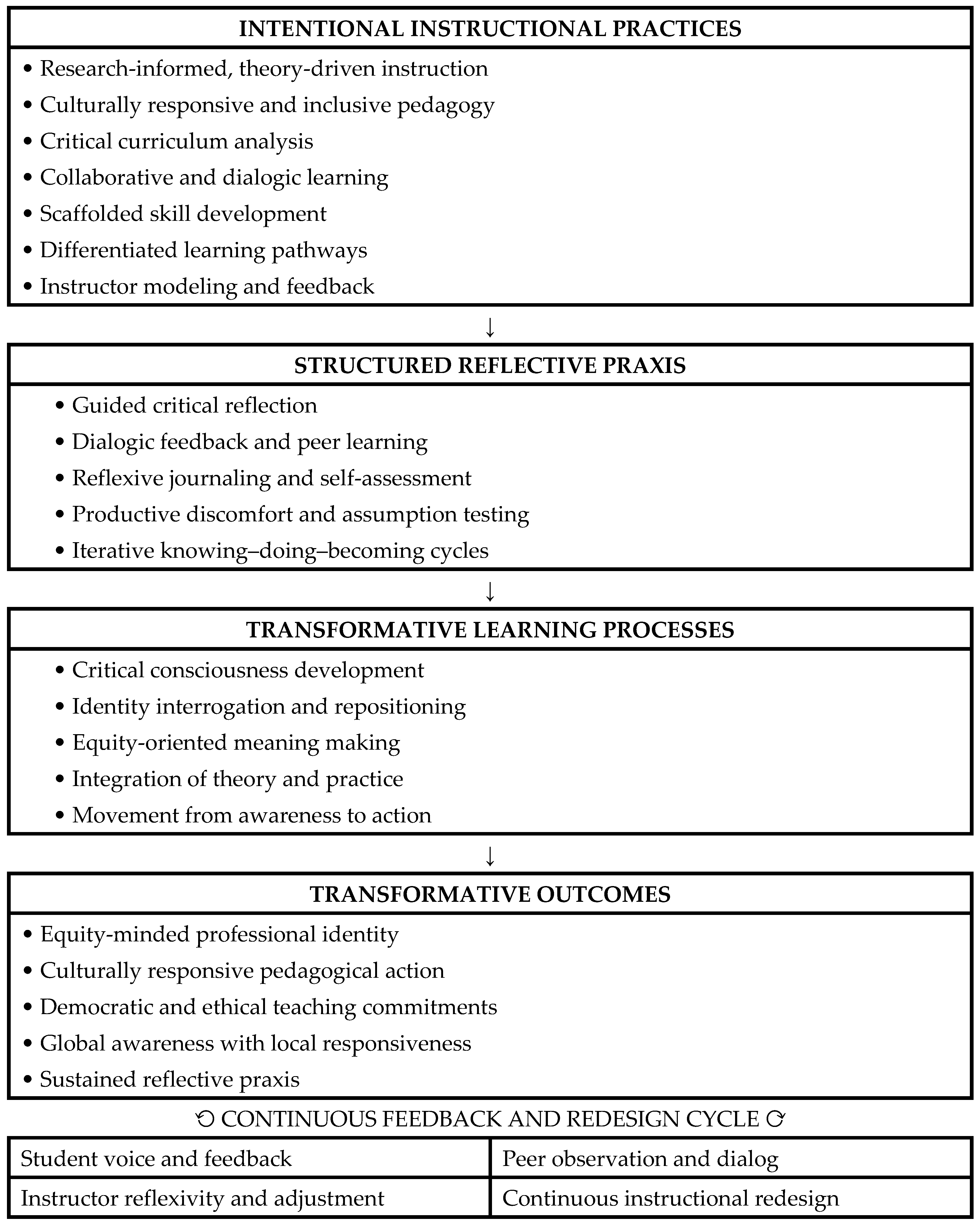
To synthesize these findings,
Figure 1 presents a conceptual model illustrating the dynamic relationships among instructional practices, reflective praxis, and transformative outcomes. The model highlights how iterative feedback processes sustain equity-oriented teacher development across contexts.
Building on the patterns summarized in the findings and represented in
Figure 1, the following subsections deepen this analysis by examining how participants reconceptualized culturally responsive pedagogy as a moral and pedagogical transformation rather than a set of discrete instructional strategies.
5.1. Culturally Responsive Pedagogy as Moral and Pedagogical Transformation
Participants’ expanded understandings of CRP suggest that culturally responsive teaching is best understood as a moral, epistemological, and pedagogical stance rather than merely a toolkit of strategies. Early conceptualizations often framed CRP as celebratory or additive; however, sustained reflection and dialogic engagement supported a shift toward CRP as justice-oriented praxis, consistent with
Ladson-Billings’ (
1995,
2021) articulation of CRP as simultaneously academic, cultural, and sociopolitical. This pattern is also consistent with
Mezirow’s (
1991) account of perspective transformation, in which learners critically reassess previously unexamined assumptions and reconstruct meaning systems that guide future professional action.
The findings further suggest that CRP development is not contingent on prior experience alone. Preservice educators described notable growth in ethical awareness, relational responsibility, and emerging instructional intentionality, while in-service educators articulated deeper structural critiques and leadership-oriented commitments. These complementary trajectories support the argument that CRP is developmentally enacted and can be strengthened when reflective and dialogic conditions are intentionally designed across instructional contexts.
5.2. Discomfort, Dialog, and the Development of Critical Consciousness
Consistent with
Freire’s (
1970) concept of conscientização, moments of discomfort emerged as productive catalysts for learning rather than barriers to engagement. Participants described disorienting dilemmas (
Mezirow, 1997) when confronting counter-narratives and systemic inequities, particularly in relation to race, language, power, and institutional norms. Rather than withdrawing, many participants described using reflection, dialog, and feedback to move toward stronger ethical accountability and professional growth.
This finding is especially relevant for higher education contexts that may be tempted to minimize discomfort in the name of safety or efficiency. The data instead suggest that discomfort, when paired with relational care, clear expectations, and sustained dialogic support, can function as an important condition for equity-centered learning. This balance aligns with
Brookfield’s (
1995) argument that critical reflection must be both intellectually rigorous and emotionally supported.
5.3. Global Perspectives as Catalysts for Local Justice-Oriented Action
Participants’ engagement with global and Indigenous education contexts appeared to strengthen their capacity to recognize inequities within their own communities. Rather than producing abstract global awareness, these comparisons often prompted locally grounded commitments to inclusion and justice consistent with
de Andreotti’s (
2006) model of critical global citizenship. This finding is especially relevant for Education Sciences because it suggests that global readiness and equity are mutually reinforcing rather than competing educational goals.
Graduate participants more often translated global insights into policy-oriented, curricular, or institutional reforms, whereas preservice educators articulated emerging commitments to inclusive classroom climates and culturally responsive relationships. Together, these findings suggest that global learning experiences, when critically framed through reflection and ethical inquiry, can deepen culturally responsive practice across developmental stages and professional contexts.
5.4. Reflection as Praxis: From Awareness to Action
Across the themes, reflection emerged as the central mechanism linking learning to action. Participants did not merely describe new understandings; they also reported redesigned lessons, revised materials, shifts in communication practices, and changes in professional self-understanding. These reported outcomes align with
Dewey’s (
1938) pragmatist view of learning as inquiry grounded in experience and with
Freire’s (
1970) conception of praxis as reflection and action upon the world.
At the same time, the evidence should be interpreted with appropriate caution. The findings suggest movement toward equity-oriented enactment rather than uniform or completed transformation. Reflection was most powerful when it functioned not as a one-time individual exercise, but as a collective practice supported by feedback loops, peer dialog, instructor modeling, and repeated opportunities to apply and refine equity-centered decisions.
To strengthen analytic transparency,
Table 5 cross-maps the major discussion claims with the corresponding findings, themes, and theoretical frameworks. This alignment demonstrates how each interpretive claim is grounded in empirical evidence and supported by the study’s integrated conceptual framework.
5.5. Researcher Reflexive Insights and Pedagogical Implications
This study also yielded several researcher–instructor insights regarding course design and pedagogical coherence. First, reflection appears most generative when it is deliberately structured, scaffolded, and dialogic. While teacher education frequently values reflection, the findings suggest that unstructured or episodic reflection may be insufficient for deeper professional change. Meaningful development appeared more likely when reflective activities were embedded across the semester, guided by critical prompts, peer dialog, instructor feedback, and opportunities for applied inquiry. The iterative responsive teaching process that informed these pedagogical adjustments is summarized in
Appendix A (
Table A1).
Second, the study clarified the productive role of discomfort in equity-centered and globally informed learning. As an instructor, it became evident that discomfort, when situated within trust, relational care, and explicit norms for dialog, can catalyze critical consciousness rather than resistance. Third, the findings underscored the importance of differentiated, developmentally responsive scaffolding. Preservice educators often entered equity work through affective, relational, and identity-oriented reflection, whereas in-service educators more readily engaged structural critique, curriculum analysis, and applied change.
Finally, the dual role of instructor–researcher underscored the need for sustained reflexivity and ethical responsibility. Ongoing journaling, peer feedback, and responsiveness to student voice served as both research strategies and core instructional practices, strengthening clarity, trust, inclusivity, and pedagogical responsiveness. To ensure analytic rigor and guard against theoretical overextension, each discussion claim is explicitly traceable to empirical evidence and interpreted through the study’s integrated theoretical framework. Transformative Learning Theory accounts for shifts in meaning-making and professional identity; Culturally Relevant Pedagogy anchors equity-oriented practice; Critical Pedagogy situates discomfort and dialog as ethical processes; Reflective Practice clarifies learning through action and feedback; and Deweyan pragmatism frames learning as experience-informed application. This explicit alignment strengthens transparency and supports the use of theory as an analytic lens rather than a post hoc overlay.
6. Implications
6.1. Implications for Teacher Education Practice
The findings suggest that reflection should be positioned as a foundational pedagogical infrastructure rather than as an ancillary instructional activity. Teacher education programs should intentionally embed iterative reflective cycles that integrate written reflection, dialogic engagement, collaborative sense-making, and applied inquiry across coursework and clinical experiences. When reflection is sustained and scaffolded, it may become a meaningful mechanism for moving educators from awareness toward equity-centered praxis and professional accountability.
Programs should also adopt developmentally responsive approaches to culturally responsive pedagogy (CRP). Preservice and in-service educators engage equity work from different professional locations, levels of authority, and experiential depth, necessitating differentiated instructional supports. Coursework may therefore benefit from providing relational and affective entry points for novice educators while also offering in-service teachers structured opportunities for systemic analysis, leadership, curriculum redesign, and policy-oriented critique.
The findings further suggest the importance of preparing educators to engage productively with discomfort, bias, and contested knowledge. Faculty development is especially important if teacher educators are to facilitate difficult dialogs, attend to emotional labor, and frame discomfort as a generative dimension of professional learning rather than a deficit to be avoided.
Finally, teacher education programs should intentionally integrate globally informed yet locally grounded pedagogies. Global case studies, Indigenous perspectives, and comparative education contexts can deepen educators’ understandings of equity while strengthening their capacity to enact culturally responsive practice within their own communities.
6.2. Implications for Institutional Policy and Program Design
At the institutional level, culturally responsive pedagogy and reflective competence should be embedded in program learning outcomes, accreditation frameworks, and faculty development initiatives. Institutions committed to equity and global readiness may benefit from supporting structures such as peer observation networks, reflective teaching communities, and equity-centered professional learning. Without institutional alignment, CRP risks remaining an individual commitment rather than becoming a more sustained, systemic practice supported by collective norms and accountable structures.
7. Limitations and Future Research
This study is bounded by its focus on two courses within a single institutional context, which limits transferability and generalizability. The instructor’s dual role as teacher and researcher introduces the potential for bias; however, this was mitigated through triangulation, reflexive journaling, peer debriefing, and member checking.
The findings rely primarily on reflective and self-reported data, capturing participants’ perceptions and professional meaning-making rather than direct evidence of sustained classroom or community impact. The inclusion of an anonymous pre/post survey strengthened triangulation; however, responses were unmatched, and the post-survey response rate was lower (19 of 44). This constrains claims about individual change over time and introduces the possibility of nonresponse bias. Accordingly, survey results are interpreted as descriptive, supplementary indicators rather than as evidence of statistically reliable change.
Consistent with prior scholarship, participant withdrawal may reflect personal or contextual circumstances rather than dissatisfaction with the study (
Edwards, 2005). While attrition presents analytic limitations, voluntary participation necessarily includes the possibility of withdrawal, and the researcher–participant relationship is not obligatory (
Sachs, 2010;
Spillman & Sade, 2007). As such, variation in response rates across time points is interpreted as part of the ethical and practical realities of qualitative inquiry rather than as a methodological flaw.
Future research should employ longitudinal and mixed-methods designs to examine how reflection-driven culturally responsive pedagogy (CRP) is enacted in classroom practice over time and into early-career teaching. Cross-institutional and cross-national studies would further illuminate how sociocultural contexts shape transformative learning processes. Incorporating student outcome data, community perspectives, and systematic classroom observations would strengthen understanding of CRP’s broader impact and sustainability.
8. Conclusions
This study suggests that culturally responsive pedagogy and transformative learning may be strengthened through the intentional integration of reflection, dialog, collaboration, and experiential engagement. Across preservice and in-service contexts, participants described movement from awareness toward action, including revised professional understandings, redesigned pedagogies, and stronger commitments to equity-centered practice.
Reflection emerged as the connective tissue between theory and praxis, enabling educators to navigate discomfort, interrogate assumptions, and begin enacting meaningful change. When positioned as a shared pedagogical ethos rather than treated only as an individual disposition, reflective praxis may help foster professional communities grounded in care, justice, and democratic responsibility.
At the same time, the study’s claims must remain proportionate to its design. The strongest contribution lies in the qualitative cross-case analysis of participants’ reflective learning and developmental trajectories. The descriptive survey data offer supplementary context but do not establish statistically reliable or individually verified change. Even with these limitations, the study offers useful pilot insight into how teacher education can create more intentional conditions for equity-minded, culturally responsive, and globally aware professional growth. These findings should be understood as contextually grounded and indicative rather than definitive, contributing to an evolving evidence base on reflective, equity-centered teacher education.