


Systematic Review of Interventions for Twice-Exceptional Autistic Learners

 , ,
, ,
Abstract
1. Introduction
Research Aim and Questions
- What interventions were implemented that either explicitly targeted 2e-ASL learners or included 2e-ASL learners, and how were these interventions characterised in terms of intervention type, outcome, setting, and duration?
- How effective were these interventions in improving developmental, behavioural, and academic outcomes for 2e-ASL students?
- What recommendations can be drawn for designing scalable, evidence-based supports?
2. Methods
2.1. Review Framework
2.2. Conceptual Definitions
2.3. Eligibility Criteria
2.4. Search and Screening Procedures
2.5. Data Extraction, Quality Appraisal, and Synthesis
3. Results
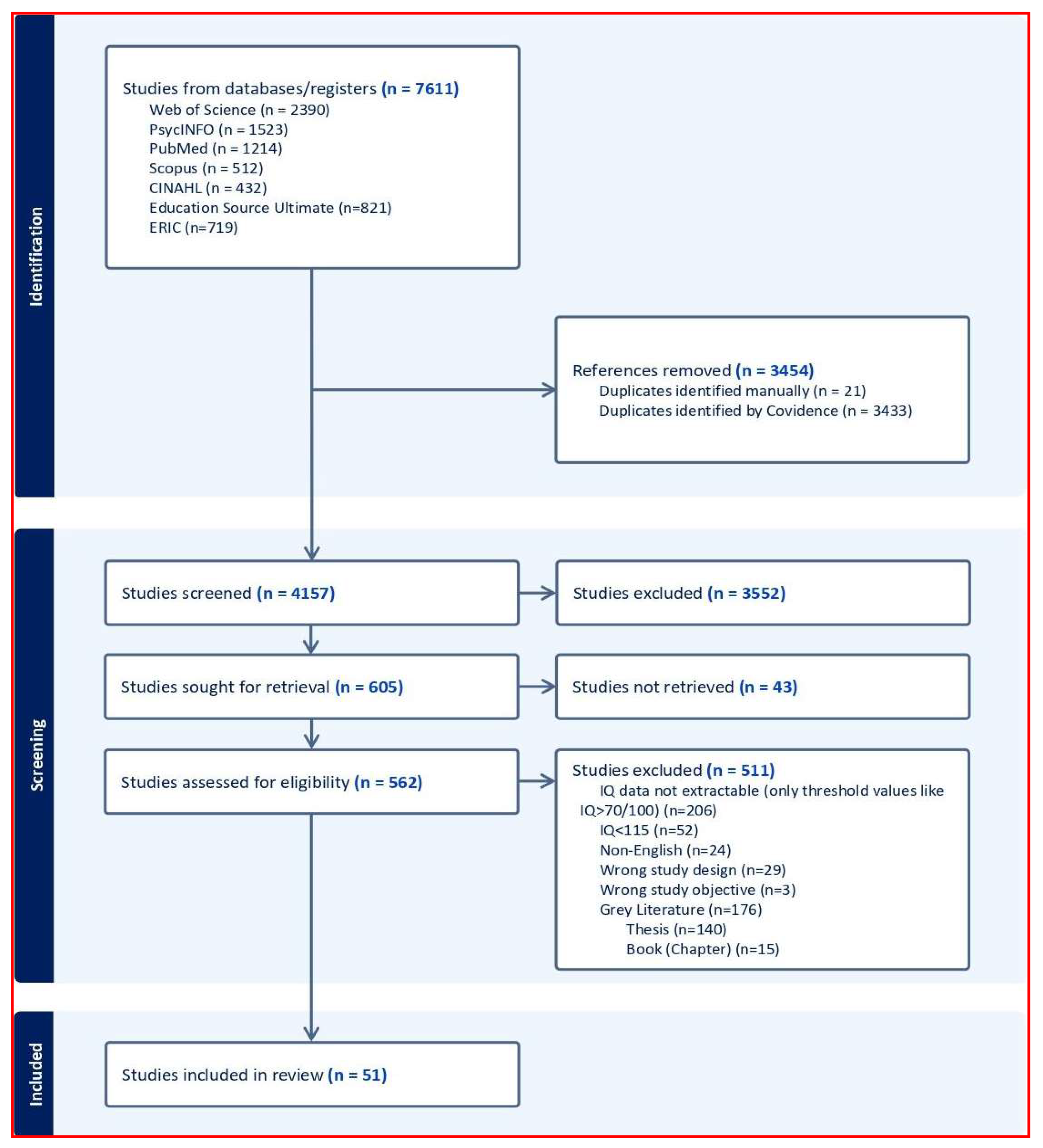
3.1. Study Selection
3.2. Descriptive Characteristics of Included Studies
3.2.1. Study Sample
3.2.2. IQ Reporting
3.2.3. Year of Publication
3.2.4. Research Settings
3.2.5. Intervention Type and Outcomes
3.3. IQ Characteristics of Participants
3.4. Characteristics and Outcomes of Interventions That Were Inclusive of 2e-ASL
3.4.1. Sensory/Perceptual Outcomes
3.4.2. Social Outcomes
3.4.3. Emotional Outcomes
3.4.4. Behavioural Outcomes
3.4.5. Academic Outcomes
3.4.6. Intellectual Outcomes
3.4.7. Language Outcomes
3.5. Characteristics and Outcomes of Interventions Specifically Developed for 2e-ASL
3.6. Effective Intervention Characteristics for 2e-ASL
3.7. Quality Appraisal
4. Discussion
4.1. Empirical Interventions (RQ: 1)
4.2. Effectiveness of Interventions (RQ: 2)
4.3. Recommendations (RQ: 3)
5. Conclusions
Author Contributions
Funding
Institutional Review Board Statement
Informed Consent Statement
Data Availability Statement
Acknowledgments
Conflicts of Interest
Appendix A

| Inclusion | Exclusion | Rationale | |
|---|---|---|---|
| P Population | Gifted and Autism Diagnosed IQ above 115. Focus on the child and adolescent population within the age range of 4 years–18 years. | Students who are only gifted or only have a diagnosis of autism. | By narrowing down to these ages, we can closely examine interventions that directly relate to the specific age group. |
| I Intervention | Empirical interventions specifically designed for autistic populations with an IQ above 115 (VIQ/PIQ or FSIQ). Interventions that include autistic participants with an IQ above 115, even if the intervention was not exclusively designed for this subgroup, provided that IQ data are reported and the inclusion of high-IQ or gifted participants is clear. Explore the interventions focusing on the developmental, behavioural and/or academic outcomes of children aged 4–18 years. Relevant to typical academic, clinical, home, or community environments. For example, programs designed to address behavioural challenges that can be applied both in school and home settings. Include studies with individuals having 2e-ASL as a comparison group. This is a common research practice and enhances the thorough evaluation of intervention effectiveness. | Interventions for individuals with IQ < 115 IQ data are not reported or cannot be extracted for autistic participants, making it impossible to determine whether the sample includes individuals with an IQ above 115. Studies which provide insights into the experiences, perceptions, and effectiveness of various interventions without any information on the intervention used. Interventions that are impractical or unfeasible to implement in typical academic, clinical, home, or community settings will be excluded. For example, interventions requiring expensive equipment not readily available in standard settings or highly specialised training not widely available. Interventions requiring specialised or highly controlled environments that are beyond the scope of typical settings. Primary focus on pharmacological and nutritional interventions, without addressing the broader developmental, behavioural, or educational outcomes. | To maintain a focus on empirical evidence, studies without clear details on the interventions employed will be excluded, ensuring the reliability of our review findings. To ensure the practical applicability of identified interventions, those requiring resources, equipment, or training beyond the norm in typical settings will be excluded. This exclusion is implemented to enhance the applicability of our investigation to a wider context. |
| C Comparison | Studies may or may not have a direct comparison group. | As we are focusing on evaluating the effectiveness of interventions, there might not be a direct comparison group in some studies | |
| O Outcome | Studies that report at least one or more of the specified outcome measures relevant in clinical, community, home, and educational settings: (a) developmental outcomes across physical, sensory/perceptual, intellectual, language, emotional, and social aspects (b) behavioural changes (c) academic outcomes | Studies that do not report relevant outcome measures related to developmental, behavioural, or academic aspects in 2e-ASL will be excluded. | |
| S Study Design | Empirical studies with various study designs (e.g., randomised controlled trials, quasi-experimental studies, longitudinal studies) that involve researcher-manipulated interventions. | Non-empirical studies and studies with insufficient methodological rigour, such as qualitative studies, observational studies, case studies, secondary analyses, study protocols, commentaries, opinion papers, and reviews without empirical data. Reviews and studies lacking sufficient detail on interventions or support strategies. | Empirical studies often provide results that are more generalisable. Non-empirical studies, especially qualitative studies and case studies, may focus on specific cases or small samples, limiting the scope for generalisability. |
| S Setting | Studies conducted in educational, community, clinical/healthcare, or home settings. | Studies conducted in highly specialised or controlled environments that are beyond the scope of typical settings. Studies that require specialised equipment for the intervention that is beyond the scope of typical settings. For example, studies involving advanced neuroimaging devices and highly specialised therapeutic tools are only available in research laboratories. | To ensure the practical applicability of identified interventions, those requiring resources, equipment, or training beyond the norm in typical settings will be excluded. |
| Language | English Language | Research published in a non-English language | |
| Years | Any year | ||
| Location | Any Location | ||
| Publication Type | Empirical studies published in peer-reviewed journals | The publication is not peer-reviewed, such as dissertations, conference abstracts, or other forms of grey literature. The article is a review, meta-analysis, theoretical piece, commentary, or protocol that does not report primary empirical data. |
Appendix B
| Population | Intervention | Compare | Outcome | Setting |
|---|---|---|---|---|
| Autistic learners with High IQ, 4–18 years | Range of interventions | No comparison | Assessing developmental (physical, intellectual, language, emotional, and social aspects), behavioural and academic outcomes | Typical educational, home, clinic, and community settings. |
- Sample Search Strategy
Appendix C
| Subgroup | N Studies | % of Total (n = 51) | IQ Range Summary |
|---|---|---|---|
| Highly gifted (≥130 in any index) | 33 | 64.71% | Most reported broad IQ ranges span from below average into the highly or profoundly gifted level (≥130 on at least one index). Many included mixed-ability cohorts rather than gifted-only samples. |
| Moderately gifted (115–129 only) | 16 | 31.37% | Reported IQ ranges clustered in the high-average to mildly gifted band (115–129). These studies did not include participants scoring ≥130 on any index. |
| Mentions gifted | 2 | 3.92% | The studies mentioned that the participants were gifted, but the IQ was not specifically mentioned. |
Appendix D
| Intervention (Citation) | Outcome Domain | Intervention Description | Setting of Delivery | Duration/Frequency | Key Findings | Efficacy Signal |
|---|---|---|---|---|---|---|
| Single domain interventions | ||||||
| Explicit–Implicit vs. Implicit-only Grammar Instruction (Bangert et al., 2019) | Language | Computer-based program taught novel grammatical forms (gender/person marking) by comparing Explicit–Implicit instruction (modelling, recasting, and direct rule explanation) against Implicit-only instruction (modelling and recasting), aiming to assess if explicit rules enhance grammatical acquisition. | Home | 2–4 sessions/week | Explicit–Implicit > Implicit-only for gender form; no person-form difference; limited maintenance/generalisation; receptive language predicted learning. | Mixed |
| Unstuck & On Target (UOT): Ages 14–22 (Pugliese et al., 2024) | Intellectual/EF | Cognitive–behavioural curriculum designed to increase independent, flexible problem-solving, planning, and self-advocacy skills, developed through multi-level community partnerships with autistic youth, families, and educators. | School | 25 lessons across one school year | Significant EF skill gains (flexibility, planning, learning new content, self-advocacy); high feasibility and satisfaction across stakeholders. | Positive |
| Metacognitive Training (MCT) (Goodman et al., 2017) | Intellectual | Use didactic lectures, interactive activities, and discussion focusing on EF, mental flexibility, and "big-picture thinking. Participants developed a final presentation on personal strengths/challenges for parents, aiding self-advocacy. | Clinical/Research setting | 7 × 90 min weekly | Insight/awareness improved ↑; high acceptability; limited symptom change. | Mixed |
| Unstuck & On Target (UOT) (Kenworthy et al., 2014) | Intellectual/EF | Cognitive–behavioural, school-based intervention targeting insistence on sameness, flexibility, goal-setting, and planning through self-regulatory scripts, guided/faded practice, and visual/verbal cueing implemented in small group sessions by school staff. | School | 28 sessions over the school year (30–40 min) | Significant improvements in flexibility, problem-solving, organisation; >80% improved flexibility; high fidelity and feasibility. | Positive |
| Mu-Rhythm Neurofeedback Training (mu-NFT) (Datko et al., 2018) | Neural | Operant conditioning-based neurofeedback training targeting sensorimotor mu-rhythm self-regulation to induce neuroplastic changes in the mirror neuron system, resulting in increased brain activation during imitation/observation tasks and reduced social symptom severity. | Clinical/Research setting | 20 h over several weeks | Increased mirror-neuron activation and reduced autism symptoms; neural improvements without behavioural change. | Positive |
| Audiovisual Temporal Binding Training (Feldman et al., 2023) | Perceptual | Computer-based perceptual training to narrow audiovisual temporal binding windows using adaptive, game-like synchrony and temporal-order judgment tasks with explicit feedback. | Clinical/Research setting | 8 sessions, over 2 weeks | No overall effect; participants with NVIQ > 117 and language > 98 showed gains on trained stimuli, but generalisation to untrained speakers required NVIQ > 123 and language > 114. | Mixed |
| UCLA PEERS for Adolescents (Chang et al., 2014) | Social | Manualised, parent-assisted group intervention teaching adolescents conversational skills, peer entry, and social planning through parallel parent–adolescent sessions. | Clinical/Research setting | 14 weekly 90-min sessions | Predictors of social skills gains identified; predictors: baseline parent ratings and responsibility/self-control; IQ not predictive; strongest effects for youth with basic social skills and insight into their difficulties. | Positive |
| Social Stories + Video Modelling (Sansosti & Powell-Smith, 2008) | Social | Computer-based intervention integrating digital Social Stories with brief peer video models; automated, narrated slides were followed by short video demonstrations prior to students entering unstructured recess settings. | School | Daily (once per day before recess) | “Joining-in” increased from 2.75% to 83.75% for high-IQ child; Limited generalisation, observed for one of three participants only; No report of any IQ related effect. | Positive |
| AR + Social Stories + CT Games (I.-J. Lee & Hsu, 2024) | Social | Multi-modal intervention combining social stories, augmented reality, and computational thinking games to support social cognition and reciprocity. Therapist-guided, staged from tabletop to semi-immersive physical activities. | Clinical/Research setting | 10 intervention sessions | Social responsiveness & judgement removed improved ↑; maintained. | Positive |
| CMAR-ST + CMMR-ST (I.-J. Lee & Huang, 2024) | Social | Dual-domain intervention that pairs a concept-mapping (CM) instructional framework with augmented-reality (AR) and mixed-reality (MR) technologies to address social skill deficits and develop structured teaching materials. | Clinical/Research setting | 20 × 60 min (1–2×/wk) | Shift from poor social judgement and limited reciprocity at baseline to mastery of social skills, including accurate interpretation of social cues and emotions, with improvements maintained long-term. | Positive |
| PEERS for Adolescents (Hill et al., 2017) | Social | Manualized, parent-assisted social skills program delivered through parallel parent and adolescent groups, teaching conversation skills, peer entry, and planning social activities via didactic instruction, role-play, rehearsal, and parent-supported practice. | Community | 14 weekly 90-min sessions | Social skills, autism symptoms, engagement, and knowledge improved ↑; anxiety reduced ↓ in 4/5 (partially sig.); pilot showed feasibility. | Positive |
| SCORE Skills Strategy Training (Webb et al., 2004) | Social | Structured, group-based curriculum teaching five social skills (Share ideas, Compliment others, Offer help/encouragement, Recommend changes nicely, Exercise self-control) using explicit steps, body language expectations (voice sound, facial expression, eye contact), modeling, role-plays, and cooperative games. | Community | 10 weeks, 13 × 60 min instructional sessions | 4/5 skills improved-compliment others, offer help/encouragement, recommend changes nicely, and exercise self-control; limited home transfer. | Mixed |
| Social Skills Training (SST ± Parent/Teacher Involvement) (Dekker et al., 2019) | Social | Manualised group program for high-functioning autistic children that teaches core social skills through instruction, role-play, feedback, and homework, with optional parent and teacher involvement to support generalization. | Clinical/Research setting | 15 weekly 90-min + 3 boosters | Socialization improved ↑; teacher cooperation/assertion/self-control improved ↑ (with PTI); gains stable 6 months. | Positive |
| Outpatient Clinic–Based Social Skills Group (Barry et al., 2003) | Social | Manualised small-group social-skills program teaching greeting, conversation, and play skills via rule-based scripts, modeling, role-play, and structured practice with feedback; targeted both initiations and responses, with typical peers used in separate play assessments after training. | Clinical/Research setting | 8 weekly 2 h sessions | Greeting improved ↑; conversation improved ↑ (trend); play improved ↑; clinic-based skills acquired. Generalization to home/school limited (greeting only); global measures non significant. | Mixed |
| Collaborative Tech + CBT (Join-In / No-Problem) (Bauminger-Zviely et al., 2013) | Social | CBT intervention using collaborative computer games to teach social concepts and practice peer collaboration and conversation, improving socio-cognitive understanding and peer interaction. | School | 12 sessions (6 + 6 modules, 45 min each) | Social understanding improved ↑; collaboration & conversation improved ↑; ToM (partial) improved ↑; early gains Join-In > No-Problem. | Positive |
| Facing Your Fears—Adolescent (FYF-A, CBT) (J. Reaven et al., 2012b) | Emotional | Modified group CBT for autistic adolescents, combining core CBT components with autism-specific adaptations such as peer-focused social skills training, parent–teen dyads, technology supports, and enhanced in-session exposure. | Clinical/Research setting | 14 sessions + booster, 90 min each | 46% treatment responders; reduced anxiety severity and interference; maintained at 3-month follow-up. | Positive |
| Facing Your Fears (FYF, CBT) (J. Reaven et al., 2012a) | Emotional | Manualised group CBT targeting anxiety via psychoeducation, coping skills, and graded exposure, adapted for autistic population with visual structure, concrete strategies, video modelling, and strength-based supports. | Clinical/Research setting | 12 × 1.5 h multi-family sessions | Significant reductions in anxiety severity vs. TAU; maintained 3–6 months; feasible and effective CBT model. | Positive |
| Coping Group: Fighting Worry & Facing Fears (CBT) (J. A. Reaven et al., 2009) | Emotional | Modified CBT program with child groups, parallel parent sessions, and parent–child dyads, using autism adapted CBT components (visual supports, structured worksheets, video modelling, strength-based activities) to target anxiety and social–emotional regulation. | Clinical/Research setting | 12 weekly 90-min sessions | Parent-reported anxiety reduced ↓; child self-report non significant; high attendance (96%) and fidelity (>85%). | Mixed |
| JeStiMulE Serious Game (Serret et al., 2014) | Emotional | Computer-based serious game using rule-based, multisensory training (visual, audio, vibrotactile) to teach recognition of basic and complex emotions via static/animated avatars, emphasising non-verbal cues and emotion categorisation across staged learning phases. | Clinical/Research setting | 8 sessions × 1 h, 2 per week over 4 weeks | Improved emotion recognition for avatars and photos; 91% learned visual faces non-verbal code-expression associations; feasible; no control or follow-up. | Positive |
| CBT for Anxiety in AS (Sofronoff et al. 2005) | Emotional | Manualised CBT using visual supports, Social Stories, and Comic Strip Conversations to teach anxiety regulation, with joint parent sessions to promote generalisation. | Clinical/Research setting | 6 weekly 120-min sessions | Anxiety & social worries reduced ↓; coping strategies improved ↑; parent involvement improved generalisation; high acceptability. | Positive |
| Surviving & Thriving in the Real World (STRW) (Duncan et al., 2018) | Behavioural | Manualised, group-based behavioral intervention; critical daily living skills that are strongly associated with poor adult outcomes (employment, independent living, postsecondary education, community participation); to prepare adolescents for independence. | Clinical/Research setting | 12 × 90 min, weekly sessions | Daily living skills improved ↑ (~2 years functional gain); maintained at 6-months. | Positive |
| Parent-Child Interaction Therapy (PCIT) (Solomon et al., 2008) | Behavioural | Manualised parent-coaching intervention using real-time operant-based coaching to increase positive behavior, reduce disruption, and strengthen parent-child shared positive affect. | Clinical/Research setting | 12 weekly sessions | Parent perception of disruptive behaviour reduced ↓; adaptive functioning improved ↑; shared positive affect improved ↑; parental stress non significant; relational improvements. | Positive |
| PDA/iPod prompting (Coach2Care) (Palmen et al., 2012) | Behavioural | Behavioural intervention using a Personal Digital Assistant (PDA) to improve independent daily transitions (movement between scheduled activities) to reduce supervisor dependency. | Clinical/Research setting | 11 intervention days; 10–11 days post intervention; 3 days follow up | Independent transitions significantly increased ↑; medium effect sizes for 3/4 participants; non-specific staff prompts decreased significantly ↓ but verbal instruction prompts unchanged; participants still needed prompts in 32–53% of transitions post-intervention. | Positive |
| PIRATES test-taking strategy (Songlee et al., 2008) | Academic | Comprehensive test-taking strategy instruction program; systematic test-taking strategy to improve performance on academic tests and reduce test anxiety. | School | 18 sessions of 50 min per 6 weeks | ≥90% mastery on controlled-practice probes for all participants. | Positive |
| Preschool Peer Social Intervention (PPSI) (Bauminger-Zviely et al., 2020) | Social | Manualised, school–based peer intervention for preschoolers that simultaneously targets play, interaction, and conversation through peer modelling, role–play, and problem–solving in mixed peer groups. | School | 3 sessions/week × 6 month | Play, interaction, conversation improved ↑; control group reduced ↓; gains generalised to everyday settings. | Positive |
| PEERS (Mandarin Version) (Lao et al., 2024) | Social | Manualised, community–based social skills program combining adolescent groups, parent coaching, and teacher consultation to teach conversation, peer entry, friendship, emotion regulation, and problem–solving. | Clinical/Research setting | 14 weekly 90–min sessions | Social skills knowledge, autistic communication traits, and self–esteem improved ↑; Gains were predicted by higher school support, lower baseline parental well–being, and reflective functioning. | Positive |
| Social Thinking Program (Crooke et al., 2008) | Social | Social cognitive curriculum using lessons to teach the “why” behind social behaviour through direct instruction, modelling, and practice, targeting expected communication, eye contact, and reduction of unexpected behaviours. | Clinical/Research setting | 8 weekly 1–h sessions | Expected verbal & eye–thinking behaviours improved ↑; Unexpected behaviours reduced ↓; improved social regulation. | Positive |
| Multidomain interventions | ||||||
| Secret Agent Society (SAS) Self-Directed Program (Sofronoff et al., 2017) | Emotional–Behavioural | Parent-delivered, CBT-based intervention integrating a computer game for emotion recognition and coping skills with parent training, home practice, and teacher support. | Home (parent-delivered; school tip-sheets) | 10-week course (12–18 weeks total) | Social skills and emotion regulation improved ↑, maintained at 6-week follow-up; parent self-efficacy and child behaviour problems improved ↑; child anxiety reduced ↓; anger/bullying knowledge improved ↑; anxiety knowledge improved ↑ only at follow-up. No control group; attrition ~32%; clinic-based SAS produced greater social skills gains than self-directed format. | Positive |
| Social Competence Intervention (SCI) (Stichter et al., 2010) | Social–Emotional– Intellectual | Group-based cognitive–behavioural program that targets social cognition by teaching facial expression recognition, conversational turn-taking, emotion understanding, and problem-solving through structured instruction, modelling, and guided practice. | Clinical/Research setting | 20 sessions over 10 weeks, 2 × 60 min | Parent-rated social ability, emotion recognition, EF improved ↑; small ToM (Faux Pas) gain; others non significant; no follow-up/control. | Mixed |
| SCI—Adolescent (CBT + ABA) (Stichter et al., 2016) | Social–Emotional– Intellectual | Manualised, school-based group intervention combining CBT and ABA principles to target social–cognitive deficits (perspective-taking, emotion recognition, EF) through scaffolded instruction and reinforcement. | School | 23 h total (2–3 sessions/week per semester) | Social responsiveness, motivation, EF improved ↑; ToM improved ↑; facial-emotion ID non significant; high feasibility. | Positive |
| SCI—Elementary (SCI-E) (Stichter et al., 2012) | Social–Emotional– Intellectual | SCI-E targets Theory of Mind, emotion recognition, and executive functioning using developmentally adapted CBT and ABA methods, including brief instruction, hands-on activities, visual supports, and repeated practice tailored to younger children’s attentional needs. | School | 20 sessions (10 weeks, 2 × 60 min) | Parent + teacher ratings show social & EF gains; basic emotion ID non significant; no follow-up. | Mixed |
| Cognitive–Behavioural Social–Emotional Program (Bauminger, 2002) | Social–Emotional–Intellectual | Ecological CBT intervention combining social–cognitive instruction with real-world peer practice, delivered by teachers with parent and peer involvement to enhance emotion understanding, problem-solving, and authentic social interaction. | School | 3 h/week for 7 month | Peer interaction improved ↑; ritualistic behaviour reduced ↓; social-problem-solving improved ↑; emotion understanding improved ↑; teacher-rated cooperation/assertion improved ↑. | Positive |
| CB for Affectionate Behaviour & Friendship Skills (Andrews et al., 2013) | Social–Emotional | Manualised CBT program using visual “feeling-thermometer” cues, role-play, and homework to teach distinctions between “like” and “love,” appropriate physical and verbal affection, and the expression of empathy. | Clinical/Research setting | 5 × 2 h session | Affection appropriateness improved ↑; empathy improved ↑ at follow-up; anxiety reduced ↓; social competence improved ↑; maintained 3 months. | Positive |
| PEERS (Lordo et al., 2017) | Social–Behavioural–Emotional | Structured, parent-assisted social skills curriculum in which adolescents learn conversational rules, peer entry and exit strategies, social networking skills, and coping with bullying, while parents receive parallel coaching in homework support and reinforcement. | Clinical/Research setting | 14 weeks, 90-min sessions | Anxiety, aggression, withdrawal reduced ↓; adaptability, leadership improved ↑; affect recognition ns; parents report adaptive functioning improved ↑. | Mixed |
| Junior Detective Training Program (JDTP) (Beaumont & Sofronoff, 2008) | Social–Emotional | Multi-component intervention using a detective-themed computer game, small-group sessions, and parent/teacher support to improve emotion recognition, regulation, social interaction, and bullying coping skills. | Clinical/Research setting | 7 weeks, 60 min | Parent-reported social & emotion-management improved ↑; emotion recognition non significant (ceiling); parent gains maintained 5 months; teacher gains partial. | Mixed |
| Social Competence Intervention for Young Children (SCIPYC) (Minne & Semrud-Clikeman, 2012) | Social–Emotional | Play-based group intervention for young children with HFA/AS that uses sociodramatic play to strengthen emotion recognition, social cue processing, and reciprocal peer interaction, with concurrent parent involvement to support generalisation. | Clinical/Research setting | 16 sessions (8 weeks, 2 × 1.5 h) | Parent-reported social cue recognition improved ↑: turn-taking improved ↑, emotion regulation improved ↑, perspective-taking improved ↑, and parent–child relations improved ↑. | Positive |
| MCIT: CBT + social skills + parent (White et al., 2009) | Social–Emotional | Manual–based CBT integrating individual therapy, parent education, and group therapy (skills practice) to concurrently target anxiety reduction and social skill deficits. | Clinical/Research setting | 13 individual + 5 group over 11 weeks | Anxiety reduced ↓; modest social skills improved. | Positive |
| SCI–A (Schmidt et al., 2011) | Social–Emotional | Cognitive behavioural, group–based intervention targeting social competence, emotion recognition, and EF across five instructional units, with an emphasis on improving social reciprocity and generalising skills to untrained, naturalistic settings | Clinical/Research setting | 20 × 60 min over 10 weeks | Peer interaction/engagement improved ↑; emotion recognition improved ↑; SRS communication improved ↑, motivation improved ↑. | Positive |
| Summer Treatment Program (STP) (Mitchell et al., 2015) | Social– Intellectual | School-style summer program using behaviour management (point system, daily report cards) and explicit social-skills instruction to improve attention, rule-following, communication, and group participation. | School | 6 weeks full-day (5 days/week) | Attention, rule-following, participation improved ↑, complaining reduced ↓, helping non significant; feasible intensive format. | Positive |
| Peer-Mediated Recess (“Recess Pals”) (Rodríguez-Medina et al., 2016) | Social– Behavioural | Peer-mediated recess intervention training typically develops peers to model and reinforce social initiations, leading to increased interaction, reduced off-task behaviour, and improved peer acceptance. | School | 14 sessions (4 weeks) | Social initiations & responses improved ↑; challenging behaviour reduced ↓; peer ratings improved ↑; immediate maintenance. | Positive |
| Discourse Comprehension (QAR-based) (Åsberg & Sandberg, 2010) | Language– Academic | Question Answer Relations framework to improve reading comprehension by explicitly teaching comprehension strategies, structuring tasks, and providing teacher scaffolding. | School | 2–3 sessions/week × 4 weeks (20–30 min) | Discourse comprehension improved ↑; decoding ns; teachers & students rated training engaging & sustainable. | Positive |
| Social Adjustment Enhancement Intervention (SAEI) (Solomon et al., 2004) | Social–Emotional– Intellectual | Group-based program targeting emotion recognition, Theory of Mind, and problem-solving, delivered through weekly child sessions with concurrent parent psychoeducation using instruction, modelling, and role-play. | Clinical/Research setting | 20 weekly 90-min sessions | Facial-emotion ID improved ↑; problem-solving improved ↑; ToM non significant; depression reduced ↓; greater gains for higher-IQ; feasible. | Positive |
| CBT for Anger Management (Sofronoff et al., 2007) | Emotional–Behavioural | Randomised, modified CBT program using Comic Strip Conversations, Social Stories, and role-play to teach emotion regulation and appropriate responses, with concurrent parent groups to support generalisation to home and school. | Clinical/Research setting | 6 weekly 120-min sessions (child + parent) | Anger episodes reduced ↓; constructive coping improved ↑; emotion awareness improved ↑; parent–child confidence improved ↑; skills generalised home/school. | Positive |
| Soles of the Feet (SoF) Mindfulness (Shah et al., 2022) | Behavioural–Emotional | Uses a structured, brief mindfulness technique that is directing attention to the somatic sensations on the soles of the feet to promote self-control, reduce emotional and physiological arousal, and immediately diminish observable challenging behavior in specific targeted contexts | School | 5 sessions; 20–30 min over 1–2 weeks | Observed challenging behaviour reduced ↓ for all; teacher ratings mixed; some burden noted. | Mixed |
| Cognitive–Behavioural–Ecological (CB–E) Social Skills Training (Bauminger, 2007) | Social–Emotional | Integrating CBT and ecological principles, this teacher–delivered school–based intervention with peer practice and parent involvement targeted emotion understanding, problem–solving, and peer interaction. | School | 3 h/week for 7 month | Positive peer interaction improved ↑; low–level behaviour reduced ↓; cooperation/assertion improved ↑; ToM & emotion understanding improved ↑; maintained at 4 mo. | Positive |
| Music–Mediated Intervention (MI) (MacDonald-Pregent et al., 2023) | Social–Emotional | Music–mediated intervention using improvised therapist– child musical interaction to enhance joint engagement, social communication, and emotion regulation via auditory–motor pathways, particularly for children with limited spoken language. | Clinical/Research setting | 8–12 weekly 45–min sessions | Social communication improved ↑; joint engagement improved t ↑; language ability moderated response; feasible & enjoyable; Lower VIQ → greater joint engagement gains | Positive |
| Small–Group Question–Asking Training (Palmen et al., 2008) | Academic–Intellectual | Small–group training consisting of feedback and self–management, used verbal feedback, role–play, a table game, and a flowchart to model correct question–asking and promote generalisation into natural tutorial conversations | Clinical/Research setting | 6 × 60 min (weekly) | Appropriate question–asking improved ↑; maintained at 1–month; visuals/self–monitoring aided transfer | Positive |
| File Box System + Self–Monitoring (Dorminy et al., 2009) | Intellectual–Behavioural | Organisational skills intervention using a portable, colour–coded file–box system and daily self–monitoring chart; teacher modelling with brief daily priming and minimal prompts | School | Daily (~1 month) | Filing accuracy improved ↑; retrieval speed reduced ↓; independence improved ↑; No report of any IQ related effect. | Positive |
References
- Aldawsari, H. K., Shahat, H. A., Gaber, S. A., Al-Ruwaili, H. A., Aldughaysh, A. M., & Mohmed, T. A. (2023). Developing productive thinking skills in the field of artistic works using the SCAMPER strategy for twice-exceptional students. International Journal of Learning, Teaching and Educational Research, 22(12), 1–20. [Google Scholar] [CrossRef] [Scilit]
- American Psychiatric Association. (2022). Diagnostic and statistical manual of mental disorders (5th ed., text rev.). American Psychiatric Publishing. [Google Scholar]
- Andrews, L., Attwood, T., & Sofronoff, K. (2013). Increasing the appropriate demonstration of affectionate behavior in children with Asperger syndrome, high-functioning autism, and PDD-NOS: A randomized controlled trial. Research in Autism Spectrum Disorders, 7(12), 1568–1578. [Google Scholar] [CrossRef] [Scilit]
- Antshel, K. M., Biederman, J., Doyle, A. E., Faraone, S. V., Fried, R., Petty, C., & Seidman, L. J. (2007). Is attention-deficit/hyperactivity disorder a valid diagnosis in the presence of high IQ? Results from the MGH longitudinal family studies of ADHD. Journal of Child Psychology and Psychiatry, 48(7), 687–694. [Google Scholar] [CrossRef] [Scilit] [PubMed]
- Assouline, S. G., Foley Nicpon, M., & Dockery, L. (2012). Predicting the academic achievement of gifted students with autism spectrum disorder. Journal of Autism and Developmental Disorders, 42(9), 1781–1789. [Google Scholar] [CrossRef] [Scilit]
- Austermann, Q., Reis, S. M., & Delgado, J. (2025). Evidence-based instructional practices for twice-exceptional students with autism. Gifted Child Quarterly, 69(1), 34–48. [Google Scholar] [CrossRef] [Scilit]
- Åsberg, J., & Sandberg, A. D. (2010). Discourse comprehension intervention for high-functioning students with autism spectrum disorders: Preliminary findings from a school-based study. Journal of Research in Special Educational Needs, 10(2), 91–98. [Google Scholar] [CrossRef] [Scilit]
- Bangert, K. J., Halverson, D. M., & Finestack, L. H. (2019). Evaluation of an explicit instructional approach to teach grammatical forms to children with low-symptom severity autism spectrum disorder. American Journal of Speech-Language Pathology, 28(2), 650–663. [Google Scholar] [CrossRef] [Scilit]
- Barry, T. D., Klinger, L. G., Lee, J. M., Palardy, N., Gilmore, T., & Bodin, S. D. (2003). Examining the effectiveness of an outpatient clinic-based social skills group for high-functioning children with autism. Journal of Autism and Developmental Disorders, 33(6), 685–701. [Google Scholar] [CrossRef] [Scilit]
- Bauminger, N. (2002). The facilitation of social-emotional understanding and social interaction in high-functioning children with autism: Intervention outcomes. Journal of Autism and Developmental Disorders, 32(4), 283–298. [Google Scholar] [CrossRef] [Scilit] [PubMed]
- Bauminger, N. (2007). Brief report: Individual social-multi-modal intervention for HFASD. Journal of Autism and Developmental Disorders, 37(8), 1593–1604. [Google Scholar] [CrossRef] [Scilit]
- Bauminger-Zviely, N., Eden, S., Zancanaro, M., Weiss, P. L., & Gal, E. (2013). Increasing social engagement in children with high-functioning autism spectrum disorder using collaborative technologies in the school environment. Autism, 17(3), 317–339. [Google Scholar] [CrossRef] [Scilit]
- Bauminger-Zviely, N., Eytan, D., Hoshmand, S., & Rajwan Ben-Shlomo, O. (2020). Preschool Peer Social Intervention (PPSI) to enhance social play, interaction, and conversation: Study outcomes. Journal of Autism and Developmental Disorders, 50(3), 844–863. [Google Scholar] [CrossRef] [Scilit]
- Beaumont, R., & Sofronoff, K. (2008). A multi-component social skills intervention for children with Asperger syndrome: The junior detective training program. Journal of Child Psychology and Psychiatry, 49(7), 743–753. [Google Scholar] [CrossRef] [Scilit]
- Burger-Veltmeijer, A. E. J., Minnaert, A., & Van den Bosch, E. (2011). The co-occurrence of intellectual giftedness and autism spectrum disorder. Learning and Individual Differences, 21(3), 290–297. [Google Scholar] [CrossRef] [Scilit]
- Cain, M. K., Kaboski, J. R., & Gilger, J. W. (2019). Profiles and academic trajectories of cognitively gifted children with autism spectrum disorder. Autism, 23(7), 1663–1674. [Google Scholar] [CrossRef] [Scilit] [PubMed]
- Casten, R. A., Ghazaleh, D., Albein-Urios, N., Chen, Q., & Uddin, L. Q. (2023). The combination of autism and exceptional cognitive ability is associated with suicidal ideation. Molecular Autism, 14, 23. [Google Scholar] [CrossRef] [Scilit] [PubMed]
- Centers for Disease Control and Prevention (CDC). (2014). Prevalence of autism spectrum disorder among children aged 8 years-autism and developmental disabilities monitoring network, 11 sites, United States, 2010. Centers for Disease Control and Prevention (CDC). [Google Scholar]
- Chang, Y.-C., Laugeson, E. A., Gantman, A., Ellingsen, R., Frankel, F., & Dillon, A. R. (2014). Predicting treatment success in social skills training for adolescents with autism spectrum disorders: The UCLA Program for the education and enrichment of relational skills (PEERS). Autism, 18(4), 467–470. [Google Scholar] [CrossRef] [Scilit]
- Charman, T., Pickles, A., Simonoff, E., Chandler, S., Loucas, T., & Baird, G. (2011). IQ in children with autism spectrum disorders: Data from the special needs and autism project (SNAP). Psychological Medicine, 41(3), 619–627. [Google Scholar] [CrossRef] [Scilit]
- Crooke, P. J., Hendrix, R. E., & Rachman, J. Y. (2008). Brief report: Measuring the effectiveness of teaching social thinking to children with Asperger syndrome (AS) and high functioning autism (HFA). Journal of Autism and Developmental Disorders, 38(3), 581–591. [Google Scholar] [CrossRef] [Scilit]
- Datko, M., Pineda, J. A., & Müller, R.-A. (2018). Positive effects of neurofeedback on autism symptoms correlate with brain activation during imitation and observation. European Journal of Neuroscience, 47(6), 579–591. [Google Scholar] [CrossRef] [Scilit]
- Dekker, V., Nauta, M. H., Timmerman, M. E., Mulder, E. J., van der Veen-Mulders, L., van den Hoofdakker, B. J., van Warners, S., Vet, L. J. J., Hoekstra, P. J., & de Bildt, A. (2019). Social skills group training in children with autism spectrum disorder: A randomized controlled trial. European Child & Adolescent Psychiatry, 28(3), 415–424. [Google Scholar] [CrossRef] [Scilit]
- Doobay, A. F., Foley-Nicpon, M., Ali, S. R., & Assouline, S. G. (2014). Cognitive, adaptive, and psychosocial differences between high ability youth with and without autism spectrum disorder. Journal of Autism and Developmental Disorders, 44(8), 2026–2040. [Google Scholar] [CrossRef] [Scilit] [PubMed]
- Dorminy, K. P., Luscre, D., & Gast, D. L. (2009). Teaching organizational skills to children with high functioning autism and Asperger’s syndrome. Education and Training in Developmental Disabilities, 44(4), 538–550. [Google Scholar] [CrossRef] [Scilit]
- Duncan, A., Ruble, L. A., Meinzen-Derr, J., Thomas, C., & Stark, L. J. (2018). Preliminary efficacy of a daily living skills intervention for adolescents with high-functioning autism spectrum disorder. Autism, 22(8), 983–994. [Google Scholar] [CrossRef] [Scilit]
- Feldman, J. I., Dunham, K., DiCarlo, G. E., Cassidy, M., Liu, Y., Suzman, E., Williams, Z. J., Pulliam, G., Kaiser, S., Wallace, M. T., & Woynaroski, T. G. (2023). A randomized controlled trial for audiovisual multisensory perception in autistic youth. Journal of Autism and Developmental Disorders, 53(11), 4318–4335. [Google Scholar] [CrossRef] [Scilit]
- Foley Nicpon, M., Allmon, A., Sieck, B., & Stinson, R. D. (2011). Empirical investigation of twice-exceptionality: Where have we been and where are we going? Gifted Child Quarterly, 55(1), 3–17. [Google Scholar] [CrossRef] [Scilit]
- Foley Nicpon, M., Doobay, A. F., & Assouline, S. G. (2010). Parent, teacher, and self-perceptions of psychosocial functioning in intellectually gifted children and adolescents with autism spectrum disorder. Journal of Autism and Developmental Disorders, 40(8), 1028–1038. [Google Scholar] [CrossRef] [Scilit]
- Gaber, S. A. (2022). The effectiveness of a training program to develop an attitude toward creativity in gifted children with autism spectrum disorder. International Journal of Learning, Teaching and Educational Research, 21(4), 365–379. [Google Scholar] [CrossRef] [Scilit]
- Gelbar, N. W., Cascio, A. A., Madaus, J. W., & Reis, S. M. (2021). A systematic review of the research on gifted individuals with autism spectrum disorder. Gifted Child Quarterly, 66(4), 266–276. [Google Scholar] [CrossRef] [Scilit]
- Goodman, L. R., Corkum, P., & Johnson, S. A. (2017). A metacognitive training pilot study for adolescents with autism spectrum disorder: Lessons learned from the preliminary stages of intervention development. Journal of Intellectual and Developmental Disability, 42(2), 204–210. [Google Scholar] [CrossRef] [Scilit]
- Hill, T. L., Gray, S. A. O., Baker, C. N., Boggs, K., Carey, E., Johnson, C., Kamps, J. L., & Varela, R. E. (2017). A pilot study examining the effectiveness of the PEERS program on social skills and anxiety in adolescents with autism spectrum disorder. Journal of Developmental and Physical Disabilities, 29(5), 797–808. [Google Scholar] [CrossRef] [Scilit]
- Hong, Q. N., Fàbregues, S., Bartlett, G., Boardman, F., Cargo, M., Dagenais, P., Gagnon, M.-P., Griffiths, F., Nicolau, B., O’Cathain, A., Rousseau, M.-C., Vedel, I., & Pluye, P. (2018). The Mixed Methods Appraisal Tool (MMAT) version 2018 for information professionals and researchers. Education for Information, 34(4), 285–291. [Google Scholar] [CrossRef] [Scilit]
- Kahveci, G., & Güneyli, A. (2023). Examining conjoint behavioral consultation to support twice-exceptional autism spectrum disorder and gifted students in preschool with academic and behavior concerns. Behavioral Sciences, 13(8), 674. [Google Scholar] [CrossRef] [Scilit]
- Kasari, C., & Smith, T. (2013). Interventions in schools for children with autism spectrum disorder: Methods and recommendations. Autism: The International Journal of Research and Practice, 17(3), 254–267. [Google Scholar] [CrossRef] [Scilit]
- Katusic, S. K., Voigt, R. G., Weaver, A. L., Barbaresi, W. J., Colligan, R. C., Killian, J. M., & Van Meter, K. C. (2021). IQ in Autism Spectrum Disorder: A Population-Based Birth Cohort Study. Pediatrics, 148(6), e2020049899. [Google Scholar] [CrossRef] [Scilit] [PubMed]
- Kenworthy, L., Anthony, L. G., Naiman, D. Q., Cannon, L., Wills, M. C., Luong-Tran, C., Werner, M. A., Alexander, K. C., Strang, J., Bal, E., Sokoloff, J. L., & Wallace, G. L. (2014). Randomized controlled effectiveness trial of executive function intervention for children on the autism spectrum. Journal of Child Psychology and Psychiatry, 55(4), 374–383. [Google Scholar] [CrossRef] [Scilit] [PubMed]
- Klinger, L. G., Cook, M. L., & Dudley, K. M. (2021). Predictors and moderators of treatment efficacy in children and adolescents with autism spectrum disorder. Journal of Clinical Child & Adolescent Psychology, 50(4), 517–524. [Google Scholar]
- Lao, U., Li, Y., Bai, W., Wang, Y., Li, Y., Xie, Y., Huang, X., Zhu, H., & Zou, X. (2024). Adaptation and feasibility of the Mandarin version of PEERS® for autistic adolescents. Journal of Autism and Developmental Disorders, 54(9), 3387–3399. [Google Scholar] [CrossRef] [Scilit]
- Lee, I.-J., & Hsu, H.-T. (2024). Applied augmented reality technology combined with social stories strategies and computational thinking games to improve the social skills of children with ASD. Interactive Learning Environments, 32(10), 6346–6374. [Google Scholar] [CrossRef] [Scilit]
- Lee, I.-J., & Huang, Y.-C. (2024). Improving social skills in children with autism spectrum disorder using augmented reality and mixed reality technology combined with concept maps. Universal Access in the Information Society, 24(2), 1255–1281. [Google Scholar] [CrossRef] [Scilit]
- Lim, L. (2021). Understanding twice-exceptionality (2e): A multi-systems perspective. International Journal of Childhood Education, 2(1), 1–11. [Google Scholar] [CrossRef] [Scilit]
- Lordo, D., Bertolin, M., Sudikoff, E., Keith, C., Braddock, B., & Kaufman, D. (2017). Parents perceive improvements in socio-emotional functioning in adolescents with ASD following social skills treatment. Journal of Autism and Developmental Disorders, 47(1), 203–214. [Google Scholar] [CrossRef] [Scilit] [PubMed]
- MacDonald-Pregent, A., Saiyed, F., Hyde, K., Sharda, M., & Nadig, A. (2023). Response to music-mediated intervention in autistic children with limited spoken language ability. Journal of Autism and Developmental Disorders, 54(4), 1438–1452. [Google Scholar] [CrossRef] [Scilit] [PubMed]
- Michaelson, L. J., Keenan, E. G., Yerys, B. E., & Kenworthy, L. (2021). A discrepancy between processing speed and verbal ability in gifted youth is genetically and diagnostically associated with autism [Preprint]. medRxiv. [Google Scholar] [CrossRef] [Scilit]
- Minne, E. P., & Semrud-Clikeman, M. (2012). A social competence intervention for young children with high-functioning autism and Asperger syndrome: A pilot study. Autism, 16(6), 586–602. [Google Scholar] [CrossRef] [Scilit] [PubMed]
- Mitchell, E. S., Mrug, S., Patterson, C. S., Bailey, K. J., & Hodgens, J. B. (2015). Summer treatment program improves behavior of children with high-functioning autism spectrum disorder. Journal of Autism and Developmental Disorders, 45(8), 2295–2310. [Google Scholar] [CrossRef] [Scilit]
- National Association for Gifted Children (NAGC). (2019). A definition of giftedness that guides best practice. Available online: http://www.nagc.org (accessed on 3 June 2026).
- Page, M. J., McKenzie, J. E., Bossuyt, P. M., Boutron, I., Hoffmann, T. C., Mulrow, C. D., Shamseer, L., Tetzlaff, J. M., Akl, E. A., Brennan, S. E., Chou, R., Glanville, J., Grimshaw, J. M., Hróbjartsson, A., Lalu, M. M., Li, T., Loder, E. W., Mayo-Wilson, E., McDonald, S., … Moher, D. (2021). The PRISMA 2020 statement: An updated guideline for reporting systematic reviews. BMJ, 372, n71. [Google Scholar] [CrossRef] [Scilit]
- Palmen, A., Didden, R., & Arts, M. (2008). Improving question asking in high-functioning adolescents with autism spectrum disorders: Effectiveness of small-group training. Autism, 12(1), 83–98. [Google Scholar] [CrossRef] [Scilit]
- Palmen, A., Didden, R., & Verhoeven, L. (2012). A personal digital assistant for improving independent transitioning in adolescents with high-functioning autism spectrum disorder. Developmental Neurorehabilitation, 15(6), 401–413. [Google Scholar] [CrossRef] [Scilit]
- Pugliese, C. E., Werner, M. A., Alexander, K. C., Cannon, L., Strang, J. F., Caplan, R., Klinger, L., Mandell, D., Dieckhaus, M., Handsman, R., Kenworthy, L., & Anthony, L. G. (2024). Development of a high school-based executive function intervention for transition-age autistic youth: Leveraging multi-level community partnerships. School Mental Health, 16(3), 862–878. [Google Scholar] [CrossRef] [Scilit]
- Ratto, A. B., Kenworthy, L., Yerys, B. E., Bascom, J., Wieckowski, A. T., White, S. W., Wallace, G. L., Pugliese, C., Schultz, R. T., Ollendick, T. H., Scarpa, A., Seese, S., Register-Brown, K., Martin, A., & Anthony, L. G. (2018). What about the girls? Sex-based differences in autistic traits and adaptive skills. Journal of Autism and Developmental Disorders, 48(5), 1698–1711. [Google Scholar] [CrossRef] [Scilit]
- Reaven, J., Blakeley-Smith, A., Culhane-Shelburne, K., & Hepburn, S. (2012a). Group cognitive behavior therapy for children with high-functioning autism spectrum disorders and anxiety: A randomized trial. Journal of Child Psychology and Psychiatry, 53(4), 410–419. [Google Scholar] [CrossRef] [Scilit]
- Reaven, J., Blakeley-Smith, A., Leuthe, E., Moody, E., & Hepburn, S. (2012b). Facing your fears in adolescence: Cognitive-behavioral therapy for high-functioning autism spectrum disorders and anxiety. Autism Research and Treatment, 2012, 423905. [Google Scholar] [CrossRef] [Scilit]
- Reaven, J. A., Blakeley-Smith, A., Nichols, S., Dasari, M., Flanigan, E., & Hepburn, S. (2009). Cognitive-behavioral group treatment for anxiety symptoms in children with high-functioning autism spectrum disorders: A pilot study. Focus on Autism and Other Developmental Disabilities, 24(1), 27–37. [Google Scholar] [CrossRef] [Scilit]
- Reis, S. M., Baum, S. M., & Burke, E. (2014). An operational definition of twice-exceptional learners: Implications and applications. Gifted Child Quarterly, 58(3), 217–230. [Google Scholar] [CrossRef] [Scilit]
- Reis, S. M., & Renzulli, S. J. (2025). Research-based strength-based teaching and support strategies for twice-exceptional high school students with autism spectrum disorder. Behavioral Sciences, 15, 834. [Google Scholar] [CrossRef] [Scilit]
- Rodríguez-Medina, J., Martín-Antón, L. J., Carbonero, M. A., & Ovejero, A. (2016). Peer-mediated intervention for the development of social interaction skills in high-functioning autism spectrum disorder: A pilot study. Frontiers in Psychology, 7. [Google Scholar] [CrossRef] [Scilit]
- Ronksley-Pavia, M. (2015). A model of twice-exceptionality: Explaining and defining the apparent paradoxical combination of disability and giftedness in childhood. Journal for the Education of the Gifted, 38(3), 318–340. [Google Scholar] [CrossRef] [Scilit]
- Sansosti, F. J., & Powell-Smith, K. A. (2008). Using computer-presented social stories and video models to increase the social communication skills of children with high-functioning autism spectrum disorders. Journal of Positive Behavior Interventions, 10(3), 162–178. [Google Scholar] [CrossRef] [Scilit]
- Schmidt, C., Stichter, J. P., Lierheimer, K., McGhee, S., & O’Connor, K. V. (2011). An initial investigation of the generalization of a school-based social competence intervention for youth with high-functioning autism. Autism Research and Treatment, 2011, 589539. [Google Scholar] [CrossRef] [Scilit]
- Serret, S., Hun, S., Iakimova, G., Lozada, J., Anastassova, M., Santos, A., Vesperini, S., & Askenazy, F. (2014). Facing the challenge of teaching emotions to individuals with low- and high-functioning autism using a new serious game: A pilot study. Molecular Autism, 5(1), 37. [Google Scholar] [CrossRef] [Scilit]
- Shah, M., Moskowitz, L. J., & Felver, J. C. (2022). Soles of the Feet mindfulness-based program for students with autism spectrum disorder and challenging behavior. Mindfulness, 13(5), 1342–1353. [Google Scholar] [CrossRef] [Scilit]
- Sofronoff, K., Attwood, T., & Hinton, S. (2005). A randomised controlled trial of a CBT intervention for anxiety in children with Asperger syndrome. Journal of Child Psychology and Psychiatry, 46(11), 1152–1160. [Google Scholar] [CrossRef] [Scilit]
- Sofronoff, K., Attwood, T., Hinton, S., & Levin, I. (2007). A randomized controlled trial of a cognitive behavioural intervention for anger management in children diagnosed with Asperger syndrome. Journal of Autism and Developmental Disorders, 37(7), 1203–1214. [Google Scholar] [CrossRef] [Scilit]
- Sofronoff, K., Silva, J., & Beaumont, R. (2017). The secret agent society social-emotional skills program for children with a high-functioning autism spectrum disorder: A parent-directed trial. Focus on Autism and Other Developmental Disabilities, 32(1), 55–70. [Google Scholar] [CrossRef] [Scilit]
- Solomon, M., Goodlin-Jones, B. L., & Anders, T. F. (2004). A social adjustment enhancement intervention for high-functioning autism, Asperger’s syndrome, and pervasive developmental disorder-NOS. Journal of Autism and Developmental Disorders, 34(6), 649–668. [Google Scholar] [CrossRef] [Scilit]
- Solomon, M., Ono, M., Timmer, S., & Goodlin-Jones, B. (2008). The effectiveness of parent-child interaction therapy for families of children on the autism spectrum. Journal of Autism and Developmental Disorders, 38(9), 1767–1776. [Google Scholar] [CrossRef] [Scilit]
- Songlee, D., Miller, S. P., Tincani, M., Sileo, N. M., & Perkins, P. G. (2008). Effects of test-taking strategy instruction on high-functioning adolescents with autism spectrum disorders. Focus on Autism and Other Developmental Disabilities, 23(4), 217–228. [Google Scholar] [CrossRef] [Scilit]
- Stichter, J. P., Herzog, M. J., Owens, S. A., & Malugen, E. (2016). Manualization, feasibility, and effectiveness of the school-based social competence intervention for adolescents (SCI-A). Psychology in the Schools, 53(6), 583–600. [Google Scholar] [CrossRef] [Scilit]
- Stichter, J. P., Herzog, M. J., Visovsky, K., Schmidt, C., Randolph, J., Schultz, T., & Gage, N. (2010). Social competence intervention for youth with Asperger syndrome and high-functioning autism: An initial investigation. Journal of Autism and Developmental Disorders, 40(9), 1067–1079. [Google Scholar] [CrossRef] [Scilit]
- Stichter, J. P., O’Connor, K. V., Herzog, M. J., Lierheimer, K., & McGhee, S. D. (2012). Social competence intervention for elementary students with Asperger’s syndrome and high-functioning autism. Journal of Autism and Developmental Disorders, 42(3), 354–366. [Google Scholar] [CrossRef] [Scilit]
- Webb, B. J., Miller, S. P., Pierce, T. B., Strawser, S., & Jones, W. P. (2004). Effects of social skill instruction for high-functioning adolescents with autism spectrum disorders. Focus on Autism and Other Developmental Disabilities, 19(1), 53–62. [Google Scholar] [CrossRef] [Scilit]
- White, S. W., Ollendick, T., Scahill, L., Oswald, D., & Albano, A. M. (2009). Preliminary efficacy of a cognitive-behavioral treatment program for anxious youth with autism spectrum disorders. Journal of Autism and Developmental Disorders, 39(12), 1652–1662. [Google Scholar] [CrossRef] [Scilit]
- Wolery, M., & Garfinkle, A. N. (2002). Measures in intervention research with young children who have autism. Journal of Autism and Developmental Disorders, 32(5), 463–478. [Google Scholar] [CrossRef] [Scilit]
- Wolff, N., Stroth, S., Kamp-Becker, I., Roepke, S., & Roessner, V. (2022). Autism spectrum disorder and IQ—A complex interplay. Frontiers in Psychiatry, 13, 856084. [Google Scholar] [CrossRef] [Scilit]
| N (%) | ||
|---|---|---|
| Study sample | 2e-Specific | 48 (94.12%) |
| 2e-Inclusive | 3 (5.88%) | |
| IQ mentioned | Only the IQ range | 34 (66.67%) |
| Specific IQ mentioned | 14 (27.45%) | |
| Gifted/2e | 3 (5.88%) | |
| Year of publication | 2000–2010 | 17 (33.33%) |
| 2011–2015 | 12 (23.53%) | |
| 2016–2020 | 11 (2.57%) | |
| 2021–2024 | 11 (21.57%) | |
| Setting | School | 18 (35.29%) |
| Home | 2 (3.92%) | |
| Community | 2 (3.92%) | |
| Clinical/Research setting | 29 (56.86%) | |
| Type of Intervention | Single-domain studies | 29 (56.86%) |
| Multi-domain studies | 22 (43.13%) | |
| Outcome | Social | 27 (52.94%) |
| Emotional | 23 (45.09%) | |
| Intellectual | 11 (21.56%) | |
| Behavioural | 8 (15.68%) | |
| Language | 3 (5.88%) | |
| Academic | 4 (7.84%) | |
| Sensory/Perceptual | 2 (3.92%) | |
| Physical | 0 |
| IQ Measure | Mean of Lowest Scores | Absolute Min | Mean of Highest Scores | Absolute Max | Overall Range |
|---|---|---|---|---|---|
| VIQ (N = 27) | 78.95 | 51 | 127.15 | 168 | 117 |
| PIQ (N = 21) | 73.49 | 48 | 129.43 | 147 | 99 |
| FSIQ (N = 38) | 80.75 | 35 | 131.35 | 160 | 125 |
| Intervention Focus | Intervention Type | Example Interventions (Citations) | Key Characteristics of the Interventions |
|---|---|---|---|
| Sensory/Perceptual | |||
| Foundational neural and perceptual mechanisms (neural self-regulation, neuroplasticity, multisensory temporal integration) | Technology-mediated physical training interventions | Mu-Rhythm Neurofeedback Training (Datko et al., 2018); Audiovisual Temporal Binding Training (Feldman et al., 2023) | Target low-level body functions rather than overt behaviour; Use neurofeedback or computer-based perceptual learning; Highly structured, repetitive training paradigms; Explicit, real-time performance or neural feedback; Delivered in controlled settings; Limited functional generalisation; moderated by baseline cognitive and language ability |
| Social | |||
| Conversational competence (conversation initiation/maintenance, joining groups, social planning) Social communication and pragmatic skills (joining in, maintaining interaction, greetings, group participation) | Manualised social skills programmes (CBT-informed); Modelling-based and technology-supported interventions | PEERS for Adolescents (Chang et al., 2014; Hill et al., 2017; Lordo et al., 2017; Lao et al., 2024); SCORE Skills Strategy Training (Webb et al., 2004); Outpatient Social Skills Group (Barry et al., 2003); Social Stories + Video Modelling (Sansosti & Powell-Smith, 2008); Social Skills Training ± Parent/Teacher Involvement (Dekker et al., 2019) | Explicit teaching of conversational rules and social scripts; Structured role-play and rehearsal; Video or narrative modelling of target verbal or non-verbal behaviours; Feedback and reinforcement; Parent-assisted homework to support generalisation; Explicit demonstration before real-world contexts; Structured practice with feedback |
| Play, interaction, and joint engagement (reciprocal play, collaboration, sustained interaction) | Peer-mediated and play-based interventions | Preschool Peer Social Intervention (Bauminger-Zviely et al., 2020); SCIPYC (Minne & Semrud-Clikeman, 2012); Peer-Mediated Recess/Recess Pals (Rodríguez-Medina et al., 2016); Music-Mediated Intervention (MacDonald-Pregent et al., 2023) | Peers as models and interaction partners; Structured and semi-structured play activities; Adult facilitation and scaffolding; Emphasis on reciprocal engagement and shared activity; Practice in naturalistic settings (playground, classroom) |
| Social cognition (Theory of Mind, perspective-taking, social cue interpretation, social judgement) | CBT-based social–cognitive interventions | SCI/SCI-E/SCI-A (Stichter et al., 2010, 2012, 2016; Schmidt et al., 2011); Social Adjustment Enhancement Intervention (Solomon et al., 2004); Cognitive–Behavioural Social–Emotional Program (Bauminger, 2002); CB-E Social Skills Training (Bauminger, 2007) | Explicit instruction in social reasoning and mental-state understanding; Emotion and cue recognition training; Scaffolded discussion and guided practice; Repeated application to social scenarios; Integration of cognitive and behavioural components |
| Social reciprocity and flexible responding (adaptive participation across contexts) | Multi-component and ecological social interventions | AR + Social Stories + CT Games (I.-J. Lee & Hsu, 2024); CMAR-ST + CMMR-ST (I.-J. Lee & Huang, 2024); Collaborative Tech + CBT (Bauminger-Zviely et al., 2013); Summer Treatment Program (Mitchell et al., 2015) | Multi-modal instruction (visual, digital, physical activities); Structured frameworks for complex social situations; Emphasis on flexibility and real-world application |
| Emotional | |||
| Emotional understanding (emotion recognition, categorisation, interpretation, emotional awareness) | CBT-based and rule-based emotional learning interventions | CB-E Social Skills Training (Bauminger, 2007); Social Adjustment Enhancement Intervention (Solomon et al., 2004); SCI/SCI-E/SCI-A (Stichter et al., 2010, 2012, 2016); SCIPYC (Minne & Semrud-Clikeman, 2012); JeStiMulE Serious Game (Serret et al., 2014); Secret Agent Society (Sofronoff et al., 2017) | Explicit instruction in emotion recognition and interpretation; Rule-based categorisation of emotions; Visual, multisensory, or play-based supports; Modelling and guided practice with feedback; Repeated exposure to emotional stimuli |
| Emotional regulation (arousal control, anxiety reduction, emotional coping, adaptive responding) | CBT-informed and mindfulness-based regulation interventions | CBT for Anger Management (Sofronoff et al., 2007); Soles of the Feet Mindfulness (Shah et al., 2022); Music-Mediated Intervention (MacDonald-Pregent et al., 2023); Junior Detective Training Program (Beaumont & Sofronoff, 2008); CBT for Anxiety in AS (Sofronoff et al., 2005); MCIT (White et al., 2009); Coping Group—Fighting Worry & Facing Fears (J. A. Reaven et al., 2009); Facing Your Fears (J. Reaven et al., 2012a); Facing Your Fears—Adolescent (J. Reaven et al., 2012b); PEERS—emotional coping component (Lordo et al., 2017) | Explicit teaching of regulation and coping strategies; Behavioural rehearsal, role-play, and guided practice; Attention-redirection and somatic grounding techniques; Graded exposure for anxiety reduction; Structured, scaffolded learning with visual supports; Parent or adult involvement to support generalisation |
| Behavioural | |||
| Independent functioning in daily routines (daily transitions, daily living skills, organisational behaviour, self-monitoring) | Behavioural skills training and self-management interventions | PDA/iPod Prompting (Palmen et al., 2012); Surviving & Thriving in the Real World (Duncan et al., 2018); File Box System + Self-Monitoring (Dorminy et al., 2009) | Targets functional, observable behaviours in everyday routines; Structured routines and task breakdown; Use of prompts, visual supports, digital aids, or organisational systems; Self-monitoring to promote independence and maintenance; Systematic reduction of adult prompting and supervision; Repeated practice in naturalistic settings |
| Reduction of off-task, disruptive, or challenging behaviour (off-task behaviour, solitary behaviour, disruptive behaviour, immediate self-control) | Behavioural regulation interventions | Peer-Mediated Recess—behavioural component (Rodríguez-Medina et al., 2016); Soles of the Feet Mindfulness (Shah et al., 2022); Parent–Child Interaction Therapy (Solomon et al., 2008) | Focus on decreasing frequency and intensity of observable problem behaviours; Use of reinforcement and clear behavioural expectations; Immediate regulation strategies (e.g., mindfulness-based attention redirection); Real-time feedback or coaching; Measurement of behaviour change in context |
| Appropriate behavioural responding and regulation (appropriate responses, anger-related behaviour, adaptive responding) | CBT-informed behavioural regulation interventions | CBT for Anger Management (Sofronoff et al., 2007); Parent–Child Interaction Therapy (Solomon et al., 2008) | Explicit teaching of appropriate behavioural responses; Behavioural rehearsal, modelling, and role-play; Practice across settings (home and school); Emphasis on replacing maladaptive behaviour with adaptive responses |
| Academic | |||
| Strategic engagement with academic tasks, including self-regulated learning behaviours and effective test-taking behaviours to improve performance and reduce test anxiety | Comprehensive, strategy-based academic training programmes. | PIRATES test-taking strategy (Songlee et al., 2008); Discourse Comprehension (Åsberg & Sandberg, 2010); Small group question answer training (Palmen et al., 2008) | Explicit instruction in academic strategies; mnemonic devices; modelling and thinking-aloud demonstrations; verbal rehearsal; role-play and game-based practice; guided and advanced practice with feedback; self-management and self-monitoring strategies |
| Intellectual | |||
| Executive functioning, cognitive flexibility, and problem-solving (planning, organisation, inhibition, flexibility, goal-setting, real-life problem solving) | Cognitive–behavioural and CBT-based executive-function curricula; Metacognitive and psychoeducational group interventions | Cognitive–behavioural and CBT-based executive-function curricula (Kenworthy et al., 2014; Pugliese et al., 2024; Stichter et al., 2010, 2012, 2016; Solomon et al., 2004). Metacognitive and psychoeducational group interventions (Goodman et al., 2017). Behaviourally structured, school-style programmes (Mitchell et al., 2015) | Explicit instruction in EF concepts (planning, flexibility, goal-setting, self-monitoring); direct teaching of the skill, why it matters, and how to apply it; structured problem-solving frameworks; modelling and thinking-aloud demonstrations; visual and verbal cueing; scaffolded and guided practice with systematic fading; repeated rehearsal across tasks; goal-plan-do-check routines; behaviour management and reinforcement systems; parent and teacher training to support generalisation across settings |
| Language | |||
| Higher-level language processes (discourse comprehension; grammatical form acquisition) | Instruction-based language interventions | Discourse Comprehension (QAR-based) (Åsberg & Sandberg, 2010); Explicit–Implicit vs. Implicit-only Grammar Instruction (Bangert et al., 2019) | Adult-guided or computer-mediated delivery; Explicit, structured teaching of rules, strategies, or linguistic forms; Direct strategy instruction for discourse comprehension and direct rule explanation for grammar; Implicit exposure (e.g., modelling, recasting) used but insufficient alone; Scaffolding through modelling, guided practice, and corrective feedback; Highly structured tasks with repeated practice and controlled input; Clearly defined, narrowly targeted learning objectives |
| Intervention (Name + Citation) | Domain | Intervention Description | Setting of Delivery | Duration/Frequency | Key Findings | Efficacy Signal |
|---|---|---|---|---|---|---|
| CBC + Visual Schedules + Curriculum Adaptation (Kahveci & Güneyli, 2023) | Language + Behavioural + Academic | Strength-based, individualised intervention involving needs assessment, visual-schedule workbooks, and curriculum adaptations aligned with student strengths, alongside instruction in self-monitoring and on-task strategies; implemented collaboratively across intervention, maintenance, and generalisation phases. | School-home conjoint | Multi-week phased | On-task behaviour or ability to remain focused on assigned tasks improved ↑; academic engagement imrpoved ↑; strongest when work is interest-linked/challenging | Positive |
| Training to develop attitude toward creativity (Gaber, 2022) | Intellectual (creativity attitude) | Creativity-focused training program that uses a structured, multi-stage curriculum and interactive techniques like brainstorming, free play, and dialogue to encourage the production of original ideas and foster positive emotional attitudes toward their talents | School | 26 sessions (3×/week; 40 min) | Creativity attitude improved ↑; gains maintained at 2-month follow-up; high engagement | Positive |
| SCAMPER technique program (Aldawsari et al., 2023) | Intellectual (productive thinking) | Arts-based, strength-focused intervention that uses structured, question-driven techniques to stimulate idea generation, creative synthesis, and critical analysis in artistic work | School | 4 main phases in 12 stages | Productive-thinking improved ↑ (ASD p = 0.006); ASD subgroup improved least vs. LD/ADHD | Positive |
Disclaimer/Publisher’s Note: The statements, opinions and data contained in all publications are solely those of the individual author(s) and contributor(s) and not of MDPI and/or the editor(s). MDPI and/or the editor(s) disclaim responsibility for any injury to people or property resulting from any ideas, methods, instructions or products referred to in the content. |
© 2026 by the authors. Licensee MDPI, Basel, Switzerland. This article is an open access article distributed under the terms and conditions of the Creative Commons Attribution (CC BY) license.
Share and Cite
Radhakrishnan, A.; Buckley, C.; O’Reilly, C.; Pagkratidou, M.; Stack, N.; Boran, L. Systematic Review of Interventions for Twice-Exceptional Autistic Learners. Educ. Sci. 2026, 16, 941. https://doi.org/10.3390/educsci16060941
Radhakrishnan A, Buckley C, O’Reilly C, Pagkratidou M, Stack N, Boran L. Systematic Review of Interventions for Twice-Exceptional Autistic Learners. Education Sciences. 2026; 16(6):941. https://doi.org/10.3390/educsci16060941
Chicago/Turabian StyleRadhakrishnan, Aiswarya, Ciara Buckley, Colm O’Reilly, Marianna Pagkratidou, Niamh Stack, and Lorraine Boran. 2026. "Systematic Review of Interventions for Twice-Exceptional Autistic Learners" Education Sciences 16, no. 6: 941. https://doi.org/10.3390/educsci16060941
APA StyleRadhakrishnan, A., Buckley, C., O’Reilly, C., Pagkratidou, M., Stack, N., & Boran, L. (2026). Systematic Review of Interventions for Twice-Exceptional Autistic Learners. Education Sciences, 16(6), 941. https://doi.org/10.3390/educsci16060941

