1. Introduction
In this article, we present a case study that investigates students’ and staff members’ perceptions and experience related to outdoor learning in Northern Norway. The literature employs a range of terms to describe teaching outside of the classroom, including outdoor learning, outdoor education, the classroom outside, or diverse learning environments (
Beames et al., 2024;
Jordet, 2010;
The Norwegian Ministry of Education and Research, 2017). We use the term outdoor learning since, in a Nordic context, outdoor learning is an established concept that refers to regular instruction outside of the classroom (
Barfod et al., 2016,
Remmen & Iversen, 2023). The impetus for our research project was an invitation to join a lower-secondary-level 1–10 school for a day of outdoor learning. The observations we made during this event, combined with conversations with both teachers and students, made us interested in the school’s practice and approach, providing the basis for our closer examination of how outdoor learning is integrated into the school’s pedagogical practice.
In Norway, the government has set a goal to increase the proportion of instruction that takes place outside of the classroom in learning environments that facilitate more practical, hands-on learning (
White Paper No. 34, (
2023–2024)). The White Paper emphasizes that practical learning beyond the classroom contributes to more relevant education, which is consistent with the 2020 national curriculum (LK20). This curriculum framework allows a wide range of school subjects to be included in outdoor learning while underscoring that the local community constitutes an important source of knowledge and a key learning setting. The Core Curriculum (Values and principles for Primary and Secondary education) highlights the importance of employing varied learning environments to promote students’ motivation and learning, and further states that education should help students develop respect for nature through outdoor experiences (
The Norwegian Ministry of Education and Research, 2017). Based on sociocultural learning and embodied views of learning (
Vygotskij, 2001;
Schilhab, 2021) and on place-based didactics (
Jordet, 2010), we see outdoor learning as a coherent practice that leverages local contexts for problem-solving and interdisciplinary work.
1.1. Purpose of the Study
While prior research on outdoor learning in the Nordic countries has largely been dominated by teacher perspectives, voices beyond teachers, especially perspectives from school leadership, have been notably underrepresented (
Remmen & Iversen, 2023). Internationally, scholars have likewise called for more research that illuminates students’ attitudes toward and reflections on outdoor instruction (
Ayotte-Beaudet et al., 2017). Furthermore,
Schilhab (
2021) underscores the need to examine the relationships among outdoor learning practices, the intentions of the curriculum, and governmental expectations. In this case study, we seek to address these gaps by adopting a whole-school approach that incorporates the perspectives of students, teachers, a teaching assistant, and the principal. Guided by this approach, we investigate how the perspectives of different actors can contribute to a deeper understanding of the role of outdoor learning and factors contributing to its success. This is examined through the following research questions:
What practices and contexts characterize and enable the school’s approach to outdoor learning?
How do students, teachers, the principal, and the teaching assistant experience outdoor learning as a learning environment?
What are the perspectives of teachers, the principal, and the teaching assistant on the professional competencies required for outdoor learning?
1.2. Literature and Theoretical Background on Outdoor Learning
Outdoor learning operates on the premise that place plays a central role in the learning process (
Braund & Reiss, 2006;
Jordet, 2010). It can occur across a range of settings, including natural areas, museums, businesses, parks, farms, and science centers. Instruction in these settings is not confined to a single pedagogical method but encompasses a diversity of approaches, much like classroom teaching. By implementing outdoor learning, schools broaden their perspective on learning by mobilizing a larger and more varied learning environment. Jordet defines outdoor learning as “regular and goal-directed activities outside the classroom” (
Jordet, 2010, p. 34).
Lauterbach et al. (
2024) show that outdoor learning in Norway is often inspired by traditions of outdoor life while emphasizing that all school subjects can be integrated into outdoor learning practice. Teaching outside the classroom is frequently tied to what occurs inside the classroom. However, the study reveals a decline in the use of outdoor learning from the upper primary to the lower secondary level, with the practice most commonly used at the early elementary level, indicating challenges in sustaining practice across the years of schooling. Several studies point to shortages of equipment, accessible nearby areas, and financial resources for transportation and additional staff as reasons why outdoor instruction may be deprioritized (
Becker et al., 2017;
Mygind et al., 2019;
Remmen & Iversen, 2023). These studies also highlight that the extensive number of learning objectives in the curriculum can discourage teachers from going outdoors. Furthermore, Nordic research indicates that weather and climate can pose challenges for outdoor instruction, particularly during the winter months (
Fägerstam & Grothérus, 2018;
Killengreen et al., 2023).
1.2.1. Learning and Outdoor Instruction
In their review of research on outdoor instruction in Nordic countries,
Remmen and Iversen (
2023) highlight that such instruction can increase learning outcomes, enhance students’ motivation and engagement, and improve their physical and mental health. Similarly, other studies have shown that regular outdoor instruction can promote students’ physical and social skills while also contributing to academic achievement (
Becker et al., 2017;
Jordet, 2010;
Lauterbach et al., 2024). These studies further emphasize that outdoor instruction positively affects relationships, both between teachers and students and among students themselves.
Jordet (
2010) argues that outdoor instruction alters school dynamics and that teachers are more successful in establishing strong relationships with students through this approach.
A study conducted in Northern Norway by
Killengreen et al. (
2023) underscores how the region’s distinctive natural environment and climate create unique opportunities for outdoor instruction, which can make it more relevant and engaging for students. The outdoor environment allows for unanticipated events and situations that can provide students with valuable, authentic learning experiences (
Jordet, 2010). Furthermore,
Braund and Reiss (
2006) argue that learning outside the classroom enables students to undertake more authentic scientific inquiries and experiments, which can strengthen their understanding of scientific processes and methods and thereby foster deeper insight into science.
Review articles synthesizing Nordic and international studies of outdoor learning highlight increased academic learning outcomes as a central theme in the literature (
Ayotte-Beaudet et al., 2017;
Becker et al., 2017;
Remmen & Iversen, 2023;
Schilhab, 2021). According to
Jordet (
2011), outdoor learning facilitates social interaction by engaging students in group work to solve practical tasks. This mode of work affords opportunities for active language use, which provides a foundation for effective learning and concept development. By using language in multiple ways and in varied contexts during outdoor learning, students can achieve a deeper understanding of subject matter and concepts. Sociocultural learning theory emphasizes that new concepts acquire richer meaning when students can connect them to their own experiences and observations (
Vygotskij, 2001).
Research has further indicated that teachers must intentionally establish strong links between instruction inside and outside the classroom to promote learning and concept development (
Remmen & Iversen, 2023). This entails designing a coherent learning sequence that includes preparatory work, outdoor activities, and follow-up work so that students’ conceptual understanding is strengthened (
Remmen & Frøyland, 2017).
Furthermore, several studies have underscored that outdoor learning can foster a deeper understanding of and respect for the environment, which is critical for cultivating attitudes and behaviors that support sustainable development (
Barrera-Hernández et al., 2020;
Braund & Reiss, 2006;
Lauterbach et al., 2024). Sustainable development is one of the three cross-curricular themes schools are required to address, and
Jordet (
2010) maintains that outdoor learning provides a productive arena for interdisciplinary work.
1.2.2. Professional Competence and Collegial Community
Remmen and Iversen (
2023) identify lack of time as a significant barrier to implementing outdoor learning and, in line with other studies, call for stronger support from school leadership in the form of more flexible timetabling (
Barfod et al., 2016;
Killengreen et al., 2023;
Neville et al., 2023). According to
Killengreen et al. (
2023), structuring regular and longer instructional blocks can promote increased use of outdoor learning. Research has also shown that a school climate characterized by trust and collaboration among teaching staff, supported by school leadership, is crucial for successful implementation (
Cosgriff, 2016;
Edwards-Jones et al., 2016;
Remmen & Iversen, 2023). Networks and collaboration among staff within the same school, as well as with teachers from other schools, can strengthen teachers’ confidence and competence in outdoor instruction (
Mannion et al., 2013).
Kerr (
2020) finds that the collaboration and sharing of practice among teachers engaged in outdoor learning foster competence and autonomy, which in turn can strengthen teachers’ confidence in delivering outdoor instruction. In addition, teachers’ personal interest in nature can contribute to a greater use of outdoor learning (
Killengreen et al., 2023).
However, several studies report that insufficient competence and low self-efficacy among teachers can hinder the adoption of outdoor learning (
Barfod et al., 2016;
Killengreen et al., 2023;
Neville et al., 2023).
Nundy et al. (
2009) argue that teachers’ roles during outdoor activities are shaped by their individual confidence in outdoor instruction. Preservice teachers report lacking sufficient preparation for outdoor instruction in their educational programs (
Borsos et al., 2022), and, according to
Bleicher and Lindgren (
2005), teachers tend to reproduce the methods to which they were exposed during their own training.
Schnekser and Riley (
2026) argue that teachers’ willingness to implement outdoor learning is influenced by their personal experiences, the use of outdoor learning in their own schooling, and the integration of outdoor learning in their teacher education programs.
Emstad et al. (
2020) emphasize that modeled instruction and authentic experiences in outdoor environments during teacher education are crucial for developing preservice teachers’ action competence and instructional practice. This underscores the importance of providing adequate training in outdoor learning in the teacher education, as without it, teachers may feel uncertain about teaching outdoors, leading to weak or inconsistent implementation.
1.3. Theoretical Framework
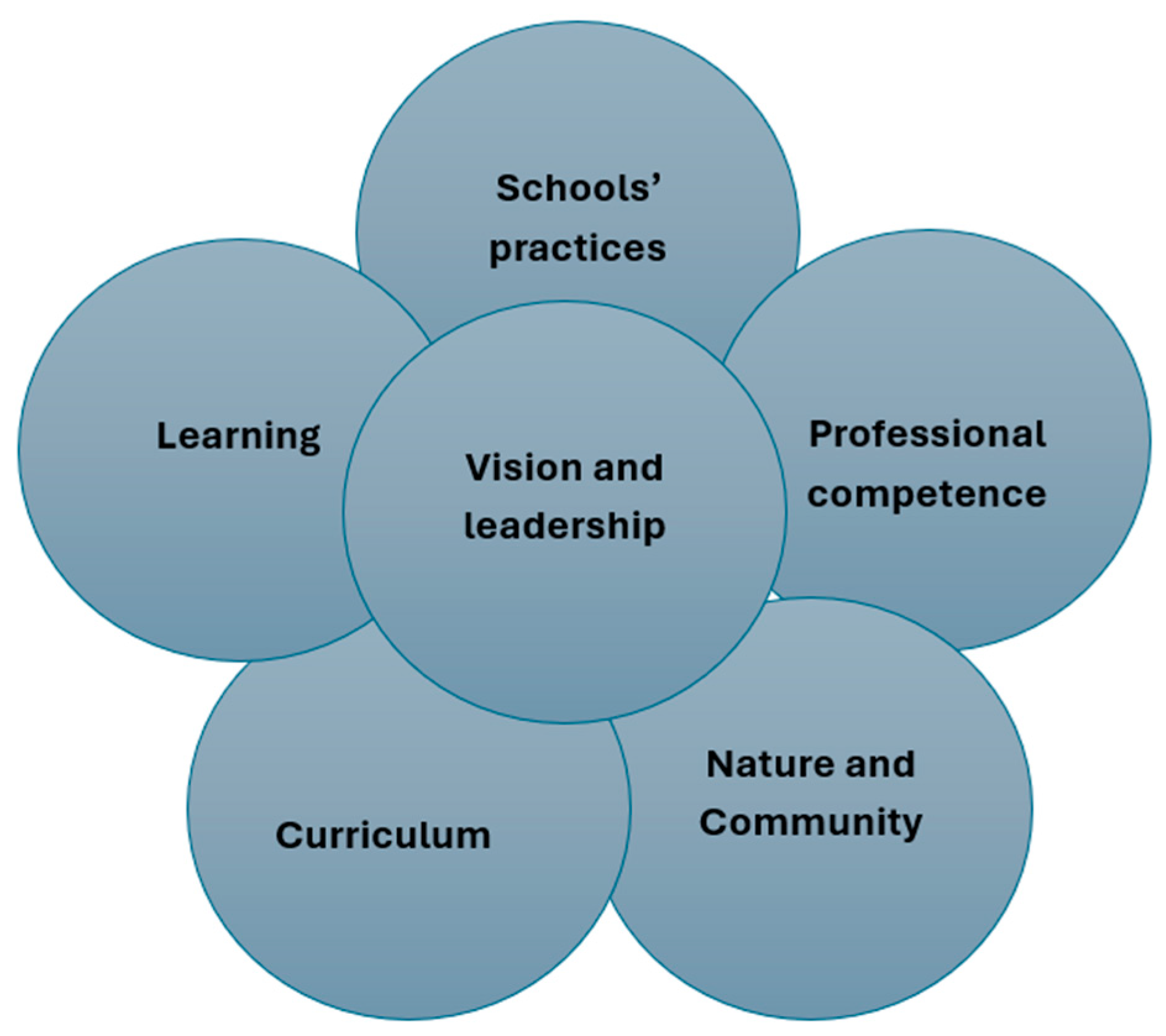
In this study, we examine outdoor learning using a whole-school approach, focusing on the perspectives of students, staff, and the principal. In our analysis, we draw on theoretical perspectives derived from a whole-school approach framework (
Wals & Mathie, 2022) comprising six interconnected elements, as illustrated in
Figure 1: Vision and Leadership, School Practices, Nature and Community, Curriculum, Learning, and Professional Competence. This approach underscores that outdoor learning should not be understood as an isolated mode of instruction but as an integral part of a school’s overall organization. In this sense, outdoor learning is shaped not only by teaching practices and the involvement of different actors, but also by the wider school environment, including school’s ethos, politics, culture and shared values. The understanding aligns with the health-promoting school framework (
World Health Organization and the United Nations Educational, Scientific and Cultural Organization, 2021).
When specifically related to outdoor learning, the “Vision and Leadership” category represents the school’s shared vision for outdoor learning and how school leaders enable, prioritize, and sustain it through strategic support and policy development. “School Practices” addresses how the school plans, organizes, and routinizes outdoor learning in ways that reflect the school’s culture and everyday practices. “Nature and Community” refers to the use of external learning environments and how these are integrated into outdoor learning through relationship with local places, resources, and community actors. “Curriculum” focuses on how the Core Curriculum and subject-specific learning objectives provide the basis for activities, while the “Learning” category represents how outdoor settings facilitate social and academic learning. The final category, “Professional Competence”, involves the development of collegial communities within the school, as well as individual teachers’ professional, personal, and social competencies in relation to outdoor learning.
2. Methods
Our objective in this study was to explore the diverse perspectives of stakeholders engaged in outdoor learning. To achieve this, we adopted a qualitative and holistic approach, utilizing interview data to address our research questions.
2.1. Participants
Over the past few years, one of the authors of this study has collaborated with a comprehensive school on development projects. This collaboration provided valuable insights into the school’s use of outdoor learning, motivating us to investigate the role of outdoor learning and the factors that enable its success. The school integrates outdoor learning into its curriculum, dedicating one day every other week throughout the school year to this approach, a practice it has maintained for more than 20 years. An outdoor school day runs normally from 8:30 to 13:00, making extensive use of the areas surrounding the school. The students typically participate in a variety of learning activities, designed using an interdisciplinary approach. At the lower secondary level (grades 8–10), all students participated in outdoor learning together. Out of the 20 students in these grades, we interviewed six students who were selected based on their attendance and willingness to participate in the interviews.
In addition to the students, we interviewed two teachers and one teaching assistant involved in outdoor learning at the lower secondary level. We also interviewed one teacher from the upper primary level (grades 5–7) and the school principal. Information about the study was provided in advance to students, guardians, and staff. All participants provided written consent before participating in the study. The study was conducted in accordance with the Declaration of Helsinki and was approved by the Institutional Review Board of the Sikt, Norwegian Agency for Shared Services in Education and Research (857161, approved 17 January 2024).
2.2. Data Collection
The interview guides for both students and staff were developed based on research questions and key literature on outdoor learning. Semi-structured interviews with students were conducted over two outdoor school days. The researchers also participated in the teaching activities on these days and engaged in informal conversations with students to build rapport and connect the discussions to specific activities.
The interviews with students lasted approximately 10–15 min and were conducted in the field. The interviews with teachers, the teaching assistant, and the principal lasted up to 45 min. All interviews were recorded using the Nettskjema Dictaphone, a secure mobile voice recorder application, which automatically transcribed and stored the recordings. The researchers reviewed the transcripts while listening to the audio recordings to ensure accuracy. Quotes were translated from Norwegian to English by the researchers, with assistance from
OpenAI (
2026), to ensure clarity and preserve the original meaning.
2.3. Analysis
The interviews with students and staff were analyzed separately using reflexive thematic analysis, following the methods described by
Braun and Clarke (
2022) and
Remmen (
2024). NVivo software (version 15.1.1) was used for coding.
Each researcher independently analyzed one student interview as a starting point. Together, we employed an inductive approach to develop a set of codes and compile a codebook. Using this codebook, we collaboratively coded all the student interviews. When new codes emerged, we revised the codebook and reanalyzed the material to ensure consistency. The same process was applied to the staff interviews, and a shared codebook was developed for this group.
For the staff interviews, six main themes were identified: visions and identity, practices, curricula, learning, professional competence, and nature and community. For the student interviews, four main themes were identified: practices, activities, learning, and interdisciplinarity. Using a deductive approach, we observed that the themes closely aligned with the categories inspired from the whole-school approach outlined in the theoretical framework, as illustrated in
Figure 1. Therefore, these categories were utilized in subsequent analyses. To ensure a clear and consistent understanding within each category, the codes were refined through an iterative process.
3. Results
In this section, we present analyses of interviews with students and staff at the school. We organize our results by research questions and use the six categories of the whole-school approach, merged in pairs, to guide the answers.
3.1. School Practices–Nature and Community
The school that we studied is in a small village in Northern Norway, with approximately 60 students enrolled across grades 1–10. It has conducted regular outdoor learning for more than 20 years. On outdoor learning days, students are divided into lower primary, upper primary, and lower secondary levels. Each group comprises around 20 students and has a regular outdoor learning day every other week. On such days, students are typically outside from approximately 8:30 a.m. to about 1:00 p.m. For the lower and upper primary levels, there are usually two teachers and one teaching assistant present, while the lower secondary level typically has one teacher and one teaching assistant.
School staff describe outdoor learning as working well in a small school with small class sizes, which makes it easier to facilitate and organize outdoor activities. Students are often accustomed to spending time outdoors in their free time, making the transition to outdoor learning natural and relatively unproblematic. As one teacher explained: “Yes, the contextual conditions are very favorable for making this feasible, and we have students who are used to being outdoors. Many of them spend time outside in their leisure time as well.” In staff interviews, the school’s location amid diverse natural environments was highlighted as a factor contributing to the success of outdoor learning. Both students and staff reported using the areas surrounding the school for outdoor activities. The most frequently used sites include forest and mountain areas, while the shore is a popular location in spring and summer. Other sites mentioned include areas around several lakes and a grill hut at the shore.
Staff reported that parents and students now seem somewhat more “fragile” with respect to weather conditions. Some students arrive poorly prepared for outdoor learning and lack sufficient equipment, with several students noting that they often become cold, particularly if they are not wearing appropriate clothing. One student remarked, “It can get cold. Today I didn’t bring good enough clothes, apparently.” The principal noted that they frequently receive inquiries from parents when the weather is poor but emphasized that outdoor school proceeds regardless of the weather. A teacher recounted that, while the school previously had a gamme (a traditional turf hut) used on winter excursions, which made it easier to undertake trips in cold and inclement weather, they now often remain near the school when winter weather is challenging.
Interviews with teachers and teaching assistants revealed that the school has a system to ensure that lack of equipment does not become a barrier to participation in outdoor learning. Although several staff members stressed the importance of appropriate clothing for spending extended time outdoors, a lack of suitable clothing is not perceived as a major problem, as students are often outside in their free time and generally have appropriate outerwear. Teachers believe that the school possesses most of the equipment needed to conduct activities, and that outdoor learning requires minimal equipment. One teacher frequently uses personal equipment for practical tasks and activities but emphasized that meaningful activities can be carried out with simple tools. They stated, “They think they need equipment, but give me a cup and a stick, and we can create most things […] we generate a great deal of academic content even when we have simple equipment.”
When planning the school year, staff take the required annual lesson hours as a starting point and allocate subject lessons to outdoor learning days. The principal explained that the lower secondary level can draw on annual lesson hours from science, Norwegian, physical education, and social studies, although the subjects vary from year to year. One teacher noted that outdoor learning days are also used for career orientation, during which students visit businesses or upper secondary schools.
A teacher reported that staff collaborate to some extent on integrating multiple subjects into outdoor activities, but that they take on the main responsibility. If the teacher responsible for outdoor school does not teach a particular subject, they collaborate with teacher of the relevant subject to plan outdoor activities. In the planning phase, they jointly review the curriculum competence aims to identify suitable activities that can be conducted outdoors.
3.2. Experience–Learning–Curriculum
Both staff and students are generally positive about outdoor learning. Several students reported that they prefer being outside and physically active, rather than sitting indoors with more theoretical subjects, and find that outdoor learning provides opportunities to apply knowledge in practice. Some students noted that they find it easier to learn when they are outdoors, and they look forward to outdoor learning during the school week.
Students also emphasized that outdoor learning strengthens the social climate in the class and helps them learn to collaborate. One student reflected on outdoor learning as follows: “You have a way to clear your head while still working. And you gain more knowledge about nature and about going on trips. It’s more social.” Teachers and the teaching assistant highlighted how important outdoor learning is for fostering cohesion and building relationships within the student group. They underscored that outdoor learning fosters closer relationships with students because interaction takes place differently than in the classroom. One teacher noted that outdoor schooling creates opportunities to build teacher–student relationships, as teachers have the chance to speak with each student on an outdoor learning day. Another teacher believes that strong relationships enhance learning and pointed out that there is less formality outdoors and more room for play. As one teacher stated, “When we’re out on a trip—around the campfire, engaged in play and fun—where we often take part in addition to organizing, we get to know each other in a real and genuine way.”
The interviews also indicate that students often experience outdoor schooling as a set of activities and tasks to be completed, rather than associating it with specific subjects. The following short exchange illustrates this:
Interviewer: “What subjects do you have today?”
Student: “Outdoor-school subject.”
Interviewer: “Outdoor-school subject? So, it’s not that the teacher says now you have physical education, and now you have…”
Student: “No. We just have outdoor learning. That’s what we call it.”
Interviewer: “Okay. But do you think it’s a subject?”
Student: “Yes, it’s educational. But it’s not really like a subject. It’s more like an activity, maybe. Or I don’t know …”
When reflecting on whether they experience interdisciplinary learning in outdoor instruction, most students believe it is interdisciplinary because they must draw on knowledge from multiple subjects simultaneously to solve tasks. Teachers, by contrast, were explicit that outdoor activities are planned to be interdisciplinary: “We touch on several subject areas. What’s so nice is that in the classroom, the world is divided into subjects. Outside, no one is saying that what we’re doing now is science.” One teacher added that outdoor learning days can also be structured by subject, but that transitions between subjects are often more fluid outdoors. Some students offered examples of specific subjects included in outdoor learning, and one said, “When we’re outside, of course there’s some gym in getting to the various places we go. Sometimes we have science—we’ve looked at the river ecosystem. Sometimes we have math, just by measuring the area of a site, for example. Or we have Norwegian through oral communication. So, we cover quite a lot of subjects.”
Staff believe that students work more practically in outdoor learning and that the experiences they gain outdoors foster deeper subject understanding. They also contended that students who struggle in the classroom often achieve greater learning outcomes outdoors. Several staff members said that most students look forward to outdoor learning, which increases their motivation to attend school. Both the principal and one of the teachers highlighted how outdoor schooling can create learning moments and situations that spark curiosity and interest among students. One teacher described how such situations can be used in instruction: “I remember we found a dead seal on the shore. We were supposed to move on and do something else, but we just had to stop and make use of that opportunity”.
In the interviews, teachers emphasized the preparations they undertake with students before outdoor learning. This may involve preparing equipment and introducing the topics they will work on outdoors. They did not define this as “preparatory work”, but rather described a holistic approach to learning in which the outdoor activity is an integral part of classroom instruction on a given topic.
Students reported learning practical skills, such as building fires, pitching tents, skiing, setting snares, and snik-fishing (leaving a fishing rod on the ice with the line out and unattended), through outdoor learning while understanding how these activities may be useful in natural settings. However, they rarely reflected on how these skills can be linked to disciplinary knowledge and the learning of concepts. In general, the interviews indicated that students could provide examples of several outdoor activities focused on preserving the natural environment, but the term sustainability was seldom mentioned explicitly. Students were also uncertain about what the term entails, though they cited activities such as beach clean-ups and picking up litter. One student reported having received teaching about sustainable development both in the classroom and in outdoor learning, and that they had discussed what the term entails and how it can be applied locally. Another student expressed enthusiasm for the topic but did not recall the details. A third student stated, for example, “Sustainable development is being able to keep nature in good condition. For example, not leaving things behind, or killing animals without reason.”
Most teachers emphasized Leave No Trace practices, the sustainable use of natural resources, and caring for nature when teaching sustainability as a theme in outdoor learning. The principal underscored the importance of providing students with positive experiences in nature: “I believe that if, through outdoor learning, they have good experiences related to being outdoors and taking care of what is around them—the natural environment.” Teacher interviews indicated that teachers plan outdoor learning activities intended to deepen students’ understanding of the concept of sustainability. However, the student interviews showed that, although students can cite practical activities, they are less able to connect these activities to this concept.
3.3. Professional Competence–Vision and Leadership
The principal stated that outdoor learning is an integral part of the school’s identity and culture. One of the school’s objectives is to cultivate resilient children, which the principal described as follows: “To cultivate resilient children. That is one of the most important things we work toward, and we believe that this [outdoor learning] is a very important tool.” The principal emphasized that outdoor learning has academic objectives and that activities conducted outdoors should be linked to the same learning outcomes as classroom instruction. However, they noted that different teachers may have different goals for outdoor learning: “Some teachers are excellent at it, academically speaking. Others think: ‘I got the students to walk all the way there. That was great.’ That is not quite where we want to be.”
Both the principal and the staff stressed that personal suitability and interest in outdoor learning are crucial for success. One teacher commented, “For it [outdoor learning] to have a genuinely positive atmosphere, it’s important to have both the personal skills and an interest in outdoor life.” Staff members pointed out that if a teacher who is not interested in outdoor learning is assigned to teach it, this may affect students. Furthermore, they believe that those who teach outdoors must be interested in it and must trust that it contributes positively to students’ learning. The principal was clear that those who work with outdoor learning must be comfortable being outside, stating “If you’re not an outdoor person, the outdoor learning isn’t going to be good. You’ll have some internal resistance to this, because it requires extra planning by each teacher to deliver a good outdoor learning.”
All staff members expressed a personal interest in outdoor life, and several teachers reported that outdoor learning was the main reason they chose to work at this school. Some teachers had formal training in outdoor life and outdoor learning. Two staff members were themselves students at the school when they were growing up, and they believe this experience strengthened their interest in outdoor life and outdoor learning.
The principal noted that the school could do more to prioritize professional development in outdoor learning to further develop and strengthen this part of teaching. They underscored that this is particularly important for new teachers, so that they can become familiar with how the school implements outdoor learning. Although the school engages in some experience sharing during staff development time, it is rare for outdoor learning to be highlighted as a collective topic. Another developmental area the principal emphasized is strengthening the academic content of outdoor learning. The school aims to better integrate what is done during outdoor learning with classroom instruction. To achieve this, the principal believes it is necessary to engage all teachers in outdoor learning. The principal also mentioned that the school wishes to develop a plan for outdoor learning that is well anchored within the staff. Such a plan would help strengthen both the academic content and the school’s identity as an outdoor learning school.
The teachers reported that they exchange experiences from outdoor learning among themselves, but that this often occurs when less experienced teachers seek advice from more experienced colleagues. One teacher said, “It isn’t as though we sit down together and exchange ideas,” but emphasized that they always receive help if they ask. The school does not have a long-term plan for outdoor learning, but instead relies on annual plans prepared by the teachers who lead outdoor learning for each school level, using these as the basis for teaching planning.
5. Conclusions and Implications
Using a whole-school approach, this case study provides an example of how a school in Northern Norway has integrated outdoor learning as part of its identity. The school’s location, with access to diverse natural environments, is highlighted as a key reason for this success. The results of the study also underscore the importance of leadership support, engaged teachers, and regularly scheduled time for outdoor learning, consistent with prior research (
Barfod et al., 2016;
Killengreen et al., 2023;
Remmen & Iversen, 2023). Such support can help entrench outdoor learning as a priority within the school’s instructional practice.
Our findings indicate that outdoor learning promotes practical, active, and student-centered learning, which can enhance students’ sense of relevance. This aligns with previous research (
Braund & Reiss, 2006;
Jordet, 2010) emphasizing that learning outside the classroom can provide more authentic and engaging learning experiences. The students refer to the subjects in outdoor learning as “outdoor-school subjects” and make little distinction among the traditional school subjects. They perceive that they must apply knowledge and skills from multiple subjects to conduct outdoor learning activities, and both students and teachers view outdoor learning as interdisciplinary.
Our study indicates that the school’s outdoor learning practices have the potential to promote students’ academic learning and environmental awareness. Realizing this potential, however, requires deliberate organization and facilitation by the school. The principal aims to develop a progression plan for outdoor learning to enable greater experience sharing among teachers. This could strengthen the professional community around outdoor learning and foster better integration between instruction outdoors and indoors. Over time, this approach may increase students’ learning outcomes.
This case study highlights how school identity and the local natural environment can play a key role in outdoor learning. This has implications for how outdoor learning can be adapted to different geographic contexts and how local resources can be leveraged to enrich learning experiences. Our study contributes to this field by identifying key organizational conditions necessary for successful implementation and by emphasizing the importance of aligning outdoor and indoor teaching. We conclude that sustained outdoor learning requires support from everyone involved in the school community.
Our study highlights the need for further research examining how outdoor learning can support students in acquiring new concepts. This is particularly relevant, as outdoor learning provides conditions that are well suited for concepts to become meaningful through connections to students’ personal experiences.