Article

Constructing Reality: Comparing Simulation Modalities in Initial Teacher Education
1
School of Education, Anglia Ruskin University, Chelmsford CM1 1SQ, UK
2
School of Communities and Education, Northumbria University, Newcastle upon Tyne NE1 8ST, UK
*
Author to whom correspondence should be addressed.
Educ. Sci. 2026, 16(6), 891; https://doi.org/10.3390/educsci16060891
Submission received: 18 March 2026 / Revised: 8 May 2026 / Accepted: 27 May 2026 / Published: 4 June 2026
(This article belongs to the Special Issue Transforming Teacher Education for Academic Excellence)

Abstract

Simulation-based learning (SBL) is increasingly used within Initial Teacher Education (ITE) to bridge the gap between theory and practice, enhancing pre-service teachers’ (PSTs) preparedness for the complexities of classroom practice. Despite its growing adoption, limited research has examined how simulation design shapes PSTs’ learning experiences. This study addresses this gap by exploring PSTs’ experiences of two low-technology simulation modalities, mixed-media and multiple-choice formats, implemented within undergraduate primary ITE programmes at two UK universities. Using a sequential mixed-methods design, quantitative data were collected from 249 PSTs through the Educational Practices Questionnaire for Teacher Educators (EPQ-TE) and the Preparing Educators for Practice in Simulation Questionnaire (PEPS-Q), alongside qualitative data from open-text survey responses and focus groups. Findings indicate that PSTs reported high levels of perceived quality, engagement, and preparedness across both modalities, with no statistically significant differences between formats or institutions. Reflexive thematic analysis was used to explore simulation design features valued by PSTs, identifying three key themes: authenticity and realism, the benefits and challenges of peer collaboration, and the role of scaffolding and feedback in supporting professional learning. These findings suggest that learning in SBL emerges through the interaction of scenario design, learner participation, and tutor facilitation, offering practical insights for teacher educators seeking to design and implement simulation-based learning within ITE, as well as recommendations for future research.

1. Introduction

Simulation-based learning (SBL) is increasingly presented as a ‘third space’ (Ledger et al., 2024, p. 339) for Initial Teacher Education (ITE), affording opportunities to engage with authentic dilemmas of practice, develop competencies and build confidence within safe learning environments (Ledger et al., 2019; Dalinger et al., 2020; Fischetti et al., 2022; Frei-Landau & Levin, 2022; Levin et al., 2025b). Pedagogically, SBL is associated with numerous learner benefits, including increased self-awareness and confidence (Fischetti et al., 2022; Levin & Muchnik-Rozanov, 2023), professional identity development (Flavian & Levin, 2024), and the transfer of previously taught knowledge into practice (Siddiqui et al., 2021; Nichol et al., 2025). Similarly, research suggests that SBL can improve communication skills (Kasperski & Crispel, 2022) and peer learning, enhancing pre-service teachers’ (PSTs) ability to provide and respond to feedback (Flavian & Levin, 2024).
Despite this growing evidence base, adoption within ITE contexts remains slow, with some sources attributing delays to technological, financial and operational concerns incurred by the implementation of high-technology simulation formats (Kaufman & Ireland, 2016; Ledger et al., 2024). Although SBL can take multiple forms, including roleplay, virtual reality, digital avatars, and paper-based scenarios, offering varying levels of fidelity and flexibility (Lindgren et al., 2022; Nichol et al., 2025), recent literature continues to overemphasise high technology forms of simulation-based learning (Bradley & Kendall, 2014; Dalinger et al., 2020; Dieker et al., 2014; Levin & Flavian, 2022; McGarr, 2021; Murphy et al., 2018). This persists despite limited evidence that these enhance educational outcomes relative to low-technology—and lower-cost—alternatives (Beaubien & Baker, 2002; Finan et al., 2012; Hammoud et al., 2008; Oh & Nussli, 2014) Similarly, there is a concerning absence of comparative studies examining the relative impacts of different simulation designs (Nichol et al., 2025) upon both learner experience and outcomes.
Without directly comparing different approaches within the broader field of simulation-based pedagogy, it remains unclear whether the added expense and complexity of high-technology-driven simulations are justified or whether a range of low-technology alternatives can achieve similar impact more accessibly and affordably. This dearth of information risks leaving teacher educators uncertain about which forms of simulation work, in which contexts, and for whom. Further research is therefore needed to advance conceptual and practical understanding of this pedagogy (Ade-Ojo et al., 2022), building upon conclusions derived from Chernikova et al.’s (2020) meta-analysis which call for deeper understanding of effective simulation design, impactful formats, and the scaffolding required for diverse learners.
This study therefore aims to address this gap by exploring how different simulation design features shape PSTs’ lived experiences of learning, guided by two research questions:
  • How do PSTs experience and evaluate two distinct forms of simulation-based learning in relation to their perceived preparedness for professional practice?
  • Which design features of simulation-based learning do pre-service teachers perceive as most valuable in supporting their learning and development?
In this paper, we first review existing literature to outline current understanding of the principles of effective SBL design, before describing the two simulation design formats (multiple-choice and mixed media) explored within the current study. We then present our research design and methodology, before outlining our findings, sharing conclusions and offering recommendations for future practice and research.

2. Existing Literature

SBL pedagogy is rooted in three interrelated theoretical perspectives: social constructivism (Vygotsky, 1978), cognitive load theory (Sweller et al., 2011), and experiential learning (Kolb, 2014). SBL can therefore be conceptualised as a contextually driven pedagogical approach grounded in experiential learning, in which learning reflects the real-world demands and complexities of professional practice. While models of SBL vary across disciplines, most share a common structure comprising a pre-brief, the simulated scenario, and a debrief phase that supports reflection and feedback (Rudolph et al., 2007; INACSL, 2016; Flavian & Levin, 2024). Established frameworks have been developed within fields such as medicine (Das et al., 2024), nursing (Jeffries, 2005; INACSL, 2016; Koivisto et al., 2018), and social work (Asakura, 2023), as well as for specific modalities including virtual reality (Han & Lim, 2020). However, despite this growing body of work, there remains no coherent or widely accepted framework for SBL design within initial teacher education (ITE). This absence is notable given that SBL is not inherently effective, but rather that its impact is contingent upon the ways in which it is designed and facilitated (Jeffries, 2005; Bradley & Kendall, 2014).
Across these diverse frameworks, several interrelated principles of effective SBL design can be identified. These apply irrespective of simulation modality or technology use and include: clarity of purpose and appropriate cognitive pitch; realism and authenticity; active participation and collaboration; structured facilitation; feedback and reflective debrief. While these principles are widely cited, their conceptualisation and relative importance vary across studies, and their application within ITE contexts remains under-theorised. As such, they are best understood not as fixed design criteria, but as interacting conditions that shape the quality of learning experiences.

2.1. Appropriate Pitch and Purpose

A consistent emphasis across the literature is the need for clearly defined and measurable learning objectives aligned with specific professional practices (Jeffries, 2005; INACSL, 2016; Dieker et al., 2014; Asakura, 2023). However, more recent studies extend this position, highlighting the importance of aligning objectives with learners’ developmental stage and the broader curriculum (Badiee & Kaufman, 2015; de Smale et al., 2015; Das et al., 2024). This reflects a shift from viewing simulation as a discrete activity towards understanding it as part of a sequenced pedagogical approach. Within this context, the selection of simulation formats must be driven by pedagogic intent rather than technological gimmickry, as poorly aligned or overly complex designs may undermine both authenticity and engagement (INACSL, 2016; Miller & Bourgeois, 2018; McCusker, 2021; Mulholland et al., 2023).
SBL environments are inherently demanding, as learners must interpret complex information and make decisions in real time (Fraser et al., 2015; Sun et al., 2017; Levin et al., 2025a). Consequently effective SBL design involves the careful sequencing of cognitive demand, progressing from simpler to more complex scenarios in line with learners’ developing expertise (Han & Lim, 2020; Das et al., 2024). Strategies such as scaffolding, explicit guidance, and task simplification can reduce extraneous load and support schema development (Mayer, 2009; Sweller et al., 2011). Notably, emerging research suggests that low-technology simulations may be advantageous in this regard, as they minimise additional cognitive demands associated with complex interfaces, allowing learners to focus on professional reasoning and decision-making (Sweller, 2019; Fragapane et al., 2018; Mulholland et al., 2022; Carey & Rossler, 2025). However, the extent to which these principles translate effectively to ITE, where practice is relational, context-dependent, and less procedurally defined, remains unexplored.

2.2. Realism and Authenticity

Authenticity is typically understood as the extent to which learning tasks reflect the realities of professional practice (Herrington et al., 2010; Chernikova et al., 2020; Theelen et al., 2020). However, despite widespread agreement regarding its importance (Dotger et al., 2008; Dalgarno et al., 2016; Codreanu et al., 2020), the concept itself is variably defined and operationalised. While some authors emphasise physical or technological fidelity as central to immersive experiences (Dieker et al., 2014), others argue that psychological and conceptual fidelity, where scenarios are perceived as believable and meaningful, are more influential in shaping learner engagement and outcomes (Norman, 2012; Hamstra et al., 2014; Carey & Rossler, 2025). This distinction highlights an important tension within the literature. High levels of physical fidelity may enhance realism (F), yet may also introduce practical and technical challenges (Dotger et al., 2008; Al-Ghareeb & Cooper, 2016; Dalgarno et al., 2016).
Conversely, studies emphasising conceptual fidelity suggest that minor physical inaccuracies are acceptable, provided that scenarios remain cognitively and emotionally credible (Norman, 2012; Carey & Rossler, 2025). As such, realism can be understood not as a fixed feature of simulation design, but as an emergent and subjective experience shaped by the interaction of multiple forms of fidelity. To address this complexity, several authors advocate involving experienced practitioners in simulation design to ensure alignment with the nuanced realities of professional practice (Jeffries, 2005; Rudolph et al., 2007; Garvey et al., 2021; Asakura, 2023). However, while this approach may enhance authenticity, it also raises questions about whose version of reality is represented and how this influences learner interpretation, an issue that remains underexplored within ITE contexts.

2.3. Learner Participation and Collaboration

Although SBL is often presented as a collaborative learning approach (Jeffries, 2005; Hyslop-Margison & Strobel, 2007), evidence regarding its effectiveness is mixed. Empirical studies consistently associate active participation with improved learning outcomes, increased motivation, and positive perceptions of the learning environment (Badiee & Kaufman, 2015). However, the nature of this participation is not without challenge. While some studies highlight the value of peer interaction and mutual learning (Levin & Flavian, 2022), others note dissatisfaction with group processes (Murray-Harvey et al., 2013). For example, Grossman et al. (2009) argue that PSTs should assume the role of teacher within simulations to support identity development, yet this expectation may increase performance pressure and cognitive demand. Similarly, while peer-roleplay can facilitate collaboration and shared learning (Levin & Flavian, 2022; De Coninck et al., 2018), it may also undermine perceived authenticity if participants struggle to suspend disbelief (Spencer et al., 2019). These tensions suggest that participation is not inherently beneficial, but is shaped by the design of roles, group dynamics, and the perceived credibility of the scenario.

2.4. Tutor Facilitation, Feedback, and Reflection

The role of facilitation, feedback, and reflection is central to effective SBL (Fanning & Gaba, 2007; Motola et al., 2013; INACSL, 2016; Koivisto et al., 2018; Han & Lim, 2020; Levin & Flavian, 2022), with some authors positioning the debrief as the most critical component of the simulation process (Jeffries, 2005; Burns, 2015). However, there is less consensus regarding how this should be enacted. Feedback within SBL may take multiple forms, including self-, peer-, and tutor-led evaluation (Burns, 2015). Yet research suggests that self- and peer-feedback alone may be insufficient to drive meaningful improvement, emphasising the importance of skilled facilitation in guiding reflection and linking experience to underlying theory (Fanning & Gaba, 2007; Decker et al., 2013).
Furthermore, the literature highlights the value of process-oriented feedback, which focuses on decision-making and reasoning rather than simply evaluating outcomes (Astwood et al., 2008). The timing of feedback is also considered significant, with immediate debriefing commonly recommended to maximise learning (Hall & Tori, 2017). Despite broad agreement on these principles, the facilitation of reflective dialogue remains highly dependent on educator expertise, raising questions about consistency and scalability within ITE programmes. In particular, the extent to which teacher educators are prepared to enact effective debriefing practices represents a critical, yet underexplored, dimension of SBL design.

3. Present Study

Taken together, the literature suggests that effective SBL design is not determined by any single feature, modality or format, but by the alignment between pedagogic purpose, cognitive demand, authenticity, participation, and reflective facilitation. However, these principles are largely derived from disciplines in which simulation is more established and often more procedurally defined. Their transferability to ITE remains unclear, particularly given the relational, interpretive, and context-specific nature of teaching practice. This highlights a significant lacuna in existing knowledge: the absence of a coherent, context-sensitive framework for simulation design in teacher education, and a limited understanding of how these design principles are experienced by PSTs themselves.
To address this gap, teacher educators from two UK universities collaboratively developed two low-technology ‘SimulatEd’ (Nichol et al., 2025) sessions to extend our existing SBL curricula. These sessions aimed to address common threats to confidence and preparedness reported by pre-service and early career teachers, informed by internal student and graduate surveys conducted by our respective institutions, discussions with partnership headteachers, and recent evidence regarding teacher confidence (UNESCO, 2024). From this process, we drew upon a shared, simulated class of primary-aged children to design two simulated scenarios: (1) Welcome Matviy: supporting learners with English as an Additional Language (EAL) within the primary classroom; and (2) Chelsea’s story: responding to challenges in mental wellbeing.
We adopted three key principles of simulation planning proposed by Van Notten (2006) to guide our design process: ‘why’—to clarify the purpose of the simulation scenario; ‘how’—to agree design and delivery; and ‘what’—to establish content. To examine how design features shape PSTs’ learning, simulations were developed in two low-technology formats: (1) mixed-media, using video, audio, and paper-based materials and (2) written scenarios with multiple-choice responses. Throughout the simulation planning stages, we utilised the expertise of colleagues across both our respective institutions, all of whom have previously been employed in professional practice. Expertise of students and partnership schools was also drawn upon through a process of consultation and feedback, ensuring that scenarios authentically replicated current teaching practice.
Across both HEIs, each SBL session was allocated three hours of face-to-face teaching, with equal emphasis placed upon theoretical input, SBL delivery, and facilitated debrief opportunities (Motola et al., 2013), providing opportunities for feedback as well as critical self-reflection by PSTs. While sessions followed the same overall structure, each simulation was purposefully designed to include distinct differences in format and the presentation of scenario content to enable comparison of PSTs’ experiences, and to identify specific design features perceived to be of value. The distinct design features employed within each simulation session are outlined in the table below.
Simulation design features.
Format: Mixed-MediaFormat: Multiple Choice
Focus: ‘Welcome Matviy’
Strategies to support a newly arrived pupil with English as an Additional Language (EAL)
Focus: ‘Chelsea’s Story’
Strategies to support a pupil’s mental health and wellbeing; safeguarding and professional collaboration
Simulation design features:
  • PowerPoint slides providing a written introduction to the scenario
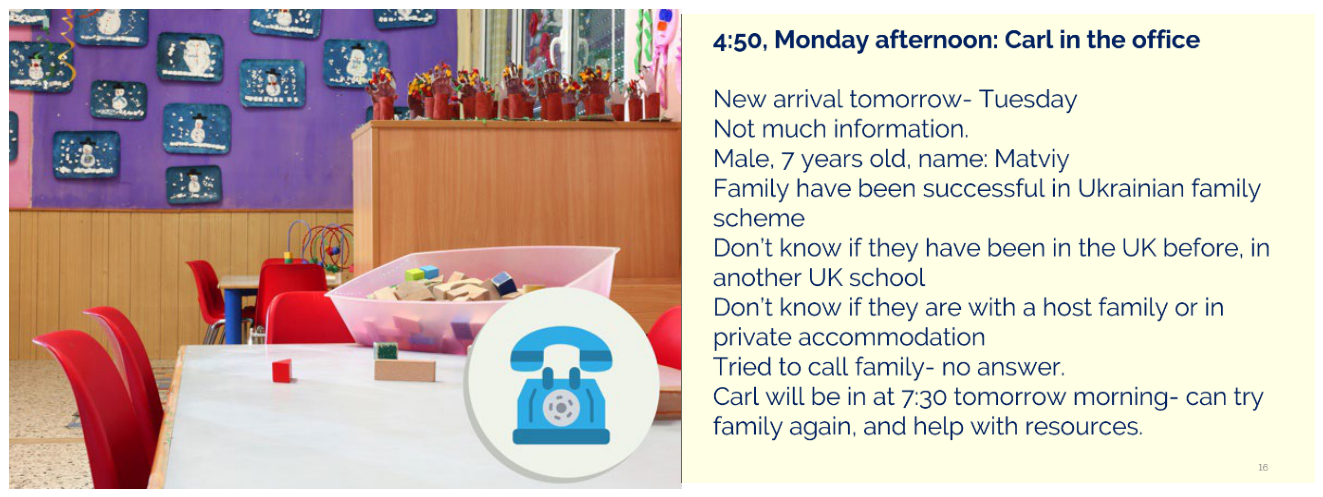
  • Voice recording to introduce the scenario: a simulated phone call from the school office
  • Paper-based scenarios representing events across a school week, including an account from a lunchtime supervisor, observations of learning and social interactions
  • Collaborative tasks
    -
    Timeline planning, requiring students to consider immediate actions, those for the next week and longer-term provision
    -
    Opportunity to rehearse barrier games, an EAL teaching strategy
Simulation design features:
  • PowerPoint slides providing a written introduction to the scenario.
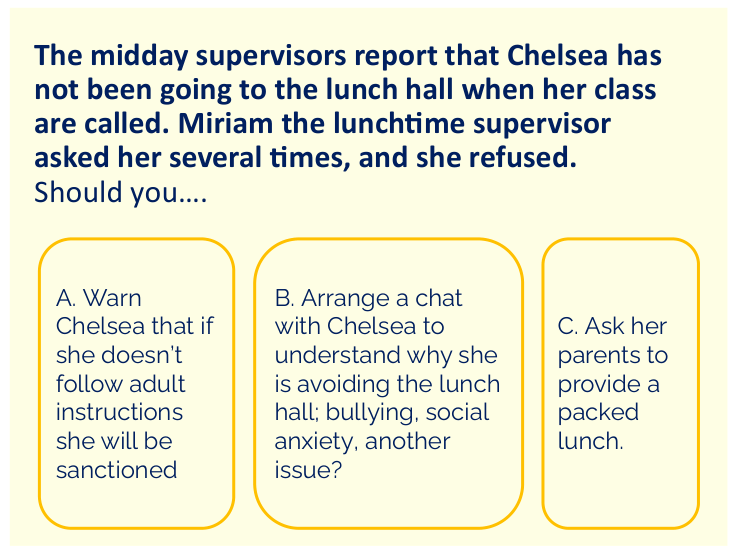
  • Multiple-choice responses to questions used to encourage students to respond to aspects of the unfolding scenario and engage in group discussion
  • Collaborative tasks
    -
    Planning questions to ask the pupil
    -
    Scripting the difficult conversation
    -
    Roleplay discussing concerns with Chelsea
In both universities, SBL sessions were delivered one week apart, with each cohort experiencing the ‘Welcome Matviy’ simulation first to ensure consistency across contexts. Sessions were facilitated by experienced academic tutors, all of whom had previously taught in school contexts. At University A, these sessions were delivered to a single cohort of 120 PSTs, facilitated by two tutors, whilst at University B sessions were delivered in four groups across three university campuses, with one tutor working with cohorts of between 20 and 24 PSTs. Example slides from each SBL session are included in Figure 1 and Figure 2.

4. Research Design and Methods

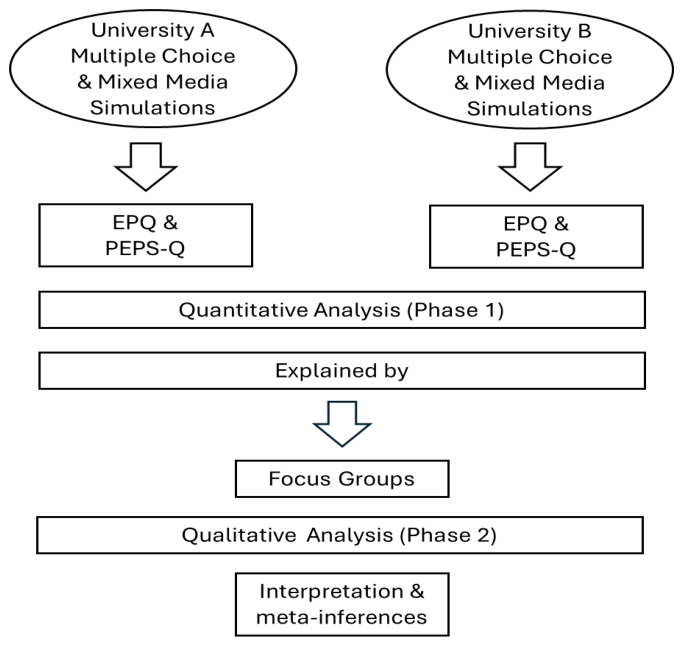
Adopting a sequential-explanatory mixed-method design (Creswell & Plano Clark, 2018), we positioned this study within a pragmatist epistemological framework (Creswell & Creswell, 2018; Morgan, 2007), which prioritises the use of multiple methods to generate complementary insights and address practical research questions. The adoption of a phased approach to gathering quantitative and qualitative data provided an opportunity to evaluate PSTs’ experiences of different simulation formats in relation to their perceived preparedness for professional practice (RQ1) and to identify which design feature PSTs perceive as most valuable in supporting their professional learning and development (RQ2).
In the first phase, quantitative data was collected after PSTs completed each simulation via two author-developed Likert-style scale questionnaires: Preparing Educators for Practice in Simulation Questionnaire (PEPS-Q) (Nichol et al., 2025) and a modified version of the Educational Practices Questionnaire (EPQ) (National League for Nursing (NLN), 2021). To address the first research question, we utilised these instruments to compare PSTs’ experiences and evaluations of two simulation modalities as measures of perceived educational practices and professional preparedness. The analytical procedures included making sense of descriptive statistical trends before applying more rigorous inferential methods to determine differences in modalities and institutional contexts. A further step examined the relationship between PSTs’ perceptions of educational practices and their feelings of readiness for professional practice.
Guided by trends and patterns from the quantitative data, we then developed a second phase of qualitative data collection to address the second research question. Open-text survey responses and focus group data were collected and analysed through a reflexive thematic analytic approach (RTA) (Braun & Clarke, 2022), designed to elicit PSTs’ reflections on specific design features of each simulation experience and the extent to which they perceived them as being valuable in developing their professional learning.
In the final stage, we integrated the quantitative and qualitative results to generate meta-inferences (Tashakkori & Teddlie, 2008) with the aim of developing a robust understanding and drawing meaningful conclusions. This process, represented in Figure 3, allowed us to examine PSTs’ experiences of both simulation formats and locate what design features they viewed as being valuable.

4.1. Participants

For this study a total of N = 249 survey responses were received, of which N = 244 were complete and retained for analysis (University A: n = 112; University B: n = 132). All participants were enrolled in the first year of an undergraduate Primary Education degree programme leading to Qualified Teacher Status (QTS) at one of two UK universities. Both programmes are compliant with the statutory Initial Teacher Training and Early Career Framework (DfE, 2019; DfE, 2024). At University A, sessions were delivered to a single cohort of approximately 120 PSTs by two tutors in a large group format. At University B, sessions were delivered across four smaller groups across three campuses, each facilitated by a single tutor with cohorts of 20–24 PSTs. All PSTs were studying full-time, achieved a minimum of General Certificate in Secondary Education (GCSE) Grade 4 (Grade C) in English, Mathematics, and Science, held a valid UK Disclosure and Barring Service (DBS) certificate, and had completed a pre-course health assessment. Demographic data beyond programme enrolment were not systematically collected, which represents a limitation acknowledged in the discussion. The majority of participants were consistent with the typical profile of undergraduate primary ITE cohorts in England (DfE, 2024), though prior school-based experience varied, as evidenced in participant accounts. For the qualitative phase, a purposive sub-sample of 11 PSTs participated in focus groups or individual interviews: n = 5 from University A and n = 6 from University B.

4.2. Ethical Considerations

The study was granted ethical approval by both universities’ ethics committees (University A: 7658; University B: 3317) and informed by accepted ethical guidelines for educational research (BERA, 2024), promoting transparency between the research team and participants and limiting power dynamics concerning data collection. Before each simulation session, PSTs were informed about the nature of the study, opportunities to withdraw, and issues of data confidentiality. Tutors were available to answer questions and provide further support. We replicated this approach in our data collection tools by supplying the same study information before each simulation session. All PSTs were debriefed at the end of their first simulation and re-briefed ahead of the second simulation.

4.3. Phase 1: Quantitative Design

Quantitative data were collected through two author-developed/modified questionnaires. The Educational Practices Questionnaire (EPQ-C) (National League for Nursing (NLN), 2021), a 22-item 5-point Likert scale (1 = strongly disagree—5 = strongly agree), was adapted to specifically tailor options relevant to the education context. The original EPQ-C has been predominantly used in Nursing and Healthcare simulations to assess the presence and importance of educational practices (Zalewska & Zarzycka, 2022; Tatum et al., 2024), with good reliability and validity across the original seven practice domains: Diverse Learning; Collaborative Learning; Active Learning; Student-faculty Interaction; Feedback; Time on Task; and High Expectations (National League for Nursing (NLN), 2021; Jawabreh et al., 2025).
Through a collaborative iterative process, teacher educators from both universities assessed the original EPQ-C and adapted it to fit the teacher education profile (here termed Educational Practices Questionnaire for Teacher Educators, EPQ-TE). We modified terminology to reflect the UK-based Higher Education (HE) context, rephasing items including: Student-Faculty Interaction to Student-Staff Interaction and Instructor to Tutor. These terminological shifts marked an opportunity to use language PSTs and teacher educators are familiar with. We also removed items and added new ones t o capture likely practices PSTs would be involved in. The new constructs, Engagement and Realism, were established to focus on these specific areas based on previous academic work that evaluated PSTs’ experiences in teacher education simulation (Nichol et al., 2025). The EPQ-TE also included items that were reverse-coded to mitigate acquiescence bias and broader item-response biases.
It is important to acknowledge that the adaptation of the EPQ-TE constitutes a substantive redevelopment of the original NLN instrument, and that formal psychometric validation and assessment of construct validity were not undertaken in this study. Instead, the reliability data reported below represent a preliminary indicator of the modified instrument’s consistency rather than a comprehensive validation. Future research should subject the EPQ-TE to more rigorous validation before broader use, and this should therefore be taken into consideration when interpreting the quantitative findings in this study. Similarly, the EPQ-TE adaptation was guided by the educational practices literature underpinning the original EPQ-C (National League for Nursing (NLN), 2021), ensuring theoretical coherence while extending the instrument’s applicability to teacher education simulation contexts.
The Preparing Educators for Practice through Simulation Questionnaire (PEPS-Q) (Nichol et al., 2025) (see Appendix B) is another author-developed instrument designed in response to the absence of scales that measure PSTs’ confidence and preparedness in SBL contexts in teacher education. Other scales tended to focus on learning outcomes (Levin et al., 2023) or require PSTs to be reflective of specific learning competencies (Viviani et al., 2023). However, in meeting the specific aims of this study we required the scales to connect PSTs’ simulated experiences to feelings of their professional preparedness. The PEPS-Q was therefore developed not only in response to an identified gap in the literature, but was also theoretically grounded in self-efficacy (Bandura, 1997) and preparedness frameworks within professional education (Motola et al., 2013). Items were constructed to reflect PSTs’ perceived readiness to enact professional knowledge in practice, aligning with the study’s broader conceptualisation of SBL as a bridge between theoretical knowledge and professional competence.
As with the EPQ-TE, we acknowledge that formal psychometric validation and assessment of construct validity relating to the PEP-Q was not undertaken in this study. Future research should therefore subject both scales to more rigorous validation before broader use, and this should therefore be taken into consideration when interpreting the quantitative findings in this study. The full EPQ-TE and PEPS-Q instruments are included in Appendix A and Appendix B.

4.4. Quantitative Analysis

Quantitative analysis was completed by two authors from the research team using the Statistical Package for Social Sciences (IBM SPSS, version 29). Data entry, cleaning and basic checks were completed before formal analysis. It should be noted that while PSTs at both universities were required to attend both simulation sessions, surveys were administered anonymously and could not be linked across sessions. Therefore, responses were treated as independent samples for the purpose of formal analysis, making this a pragmatic analytical decision rather than a preferred design feature. Its implications are discussed further in Section 6: Limitations.
Descriptive statistics, utilising the mean and median scores from both EPQ-TE and PEPS-Q scales, were used to identify observable trends and patterns across the dataset and to help establish the inferential plan. Following this, inferential testing through use of non-parametric tests was run to determine differences between the two simulation modalities and between universities. Separate analyses were performed on dependent measures (EPQ-TE & PEPS-Q subscales) to compare simulation modality experiences of all PSTs, combining data from both universities to investigate the main effect of simulation type. Further analyses were performed comparing each simulation modality between each university. This provided us with a comprehensive overview of where the main and interaction effects occurred.
Our analyses revealed data were not normally distributed as confirmed by the Shapiro–Wilk test (p < 0.05), and after visual inspection of multiple Q-Q plots from each subscale. Based on these violations, we decided upon a cautionary approach to limit chances of making incorrect statistical assumptions using non-normal data. In doing so we used a Mann–Whitney U test to compare the medians of two independent groups. For use in our study, the test compares the sum of ordinally ranked data between two groups (e.g., simulation modalities and University type) to determine if each group is the same or different. The multiple Mann–Whitney U tests on each of the 10 subscales (nine for the EPQ-TE and one from the PEPS-Q) could potentially lead to an increased risk of interpreting a Type 1 error. Therefore, within our analyses we applied a Bonferroni correction of dividing a = 0.05 by the total number of subscale comparisons (10) that provided a more conservative alpha level of 0.005 in determining statistical significance. The p-values reported in all the Tables are raw outputs following each analysis. Statistical significance was determined by comparing the raw p-values against the Bonferroni correction (0.005).
Findings were then used to inform the second qualitative phase of the study with an initial means of comparing data (Symonds & Gorard, 2010) to verify, enhance our understanding, and shape our meta-inferences. In this way, quantitative data through PSTs’ self-reported responses to the PEPS-Q and EPQ-TE surveys, reinforced by the qualitative experiences captured through focus group data, enabled a robust analytical appraisal of observable patterns that could be explained by reflective experiences.
Cronbach’s alpha tests were run for the EPQ-TE and PEPS-Q subscales and were judged to have a good to excellent internal consistency: Student-Staff Interaction (α = 0.81); Collaborative Learning (α = 0.71); Active Learning (α = 0.79); Feedback (α = 0.79); Time on Task (α = 0.74); High Expectations (α = 0.78); Diverse Learning (α = 0.76) Engagement (α = 0.79); Realism (α = 0.89) and the PEPS-Q (α = 0.90).
Suggesting that items within each subscale demonstrated suitable internal consistency across the PST sample. These internal consistency values provide preliminary evidence of reliability based on items that were theoretically informed by the literature and reviewed by the research team.

4.5. Phase 2: Qualitative Design

To gain insight into participants’ perceptions and experiences, three open-text questions were included at the end of the EPQ-TE survey, encouraging PSTs to reflect upon the value of simulation experiences, and identify opportunities for improvement. All survey participants were also invited to engage in a semi-structured interview or focus group, according to participants’ individual preferences. We facilitated two focus groups and one individual interview via Microsoft Teams. These were of approximately 60 min in duration and featured a total of 11 PSTs: n = 5 (University A) and n = 6 (University B).
The open-text questions and focus group schedule were developed prior to data collection and deliberately designed to evoke reflections on the specific design feature of the simulation—including the artefacts and media used, representations of reality and fidelity, and the structure of tasks—rather than on scenario content itself. This emphasis upon design features helped to mitigate the risk that qualitative responses would reflect differences in the subject matter of the two scenarios rather than focusing around simulation format and structure, ensuring that data remained anchored to RQ2.

4.6. Qualitative Analysis

To explore patterns across the qualitative data, we utilised Braun and Clarke’s (2022) six-phase process of reflexive thematic analysis (RTA). Our analysis team comprised teacher educators from both universities and brought together those directly involved in the design and delivery of both SBL sessions, and others who became involved later during analysis and writing. The familiarisation phase began with a group meeting of nine researchers, following which each researcher undertook an initial round of coding independently. Five members of this analysis team were directly involved in the design and delivery of the simulation sessions, which could introduce the possibility that their analytical interpretations could be influenced by a professional investment in positive outcomes. To minimise the potential risk of bias, the analysis process deliberately included four researchers who had no involvement in the design or delivery of the SBL sessions. Their role was to explicitly challenge emergent interpretations, probe assumptions, and offer alternative readings of the data.
Our use of RTA was an intentional choice which allowed insider perspectives to contextualise and illuminate the data with outsider perspectives challenging assumptions and offering new ways of interpretation, fostering depth and complexity (Nichol et al., 2025) and affording an important balance of familiarity and distance throughout the analytic process. Reflexivity is central to RTA as it requires researchers to actively attend to the way their own positionality shapes the research process (Braun & Clarke, 2022).
The open-text survey questions and focus group schedule were developed prior to analysis, with questions deliberately designed to elicit critical as well as positive reflections on simulation design features, reducing the risk that data collection itself was inadvertently shaped towards affirming the sessions’ value. We acknowledge that PSTs’ awareness of tutors’ involvement in the research may have introduced social desirability bias into their responses, and that this represents a limitation which cannot be fully resolved through analytical procedures alone. However, taken together, these strategies reflect our commitment to conducting a rigorous and transparent analysis while recognising, as Braun and Clarke (2022) argue, that researcher subjectivity is not a contaminant to be eliminated but a resource to be reflexively managed.
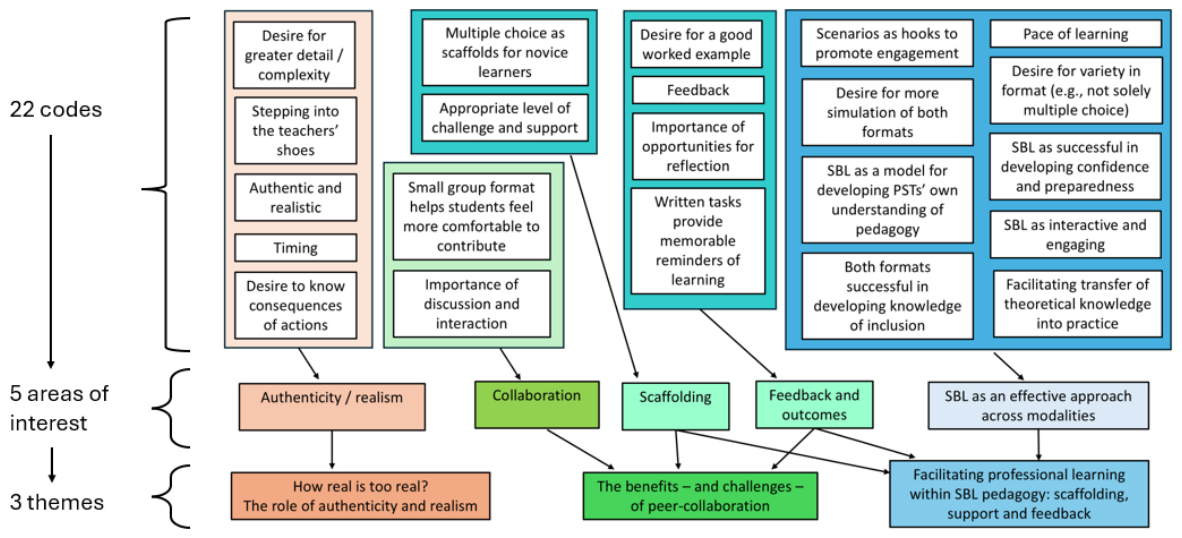
The team generated 22 shared codes, which were collated into a shared document and formed the basis of subsequent group discussion. Disagreements between team members were discussed collectively, ensuring that no single interpretation went uncontested. During phases three and four of the process, these codes were refined and clustered into broader patterns of meaning. After some space from the data, the team revisited this, re-examined the codes, and began to identify candidate themes. This process is represented in Figure 4 and demonstrates the refinement of these initial codes to develop five overarching areas of interest before subsequently reviewing the qualitative data alongside the quantitative to collectively agree upon our three final themes.

5. Findings and Discussion

Given the sequential-explanatory design of this study, in which quantitative findings directly shape the qualitative data collection phase, we have integrated findings and discussion to reflect the inherent interdependence of the two data strands (Tashakkori & Teddlie, 2008). Presenting both findings and discussion concurrently enables the quantitative patterns and qualitative meanings to illuminate one another in ways that a separated structure would obscure.

5.1. Phase 1: Quantitative Findings

Our quantitative findings respond to the first research question by examining PSTs’ evaluations of educational practices across both simulation modalities and their perceived preparedness for professional practice, as measured by the EPQ-TE subscales and the PEPS-Q respectively. It is important to note that the two simulation conditions differed not only in format (e.g., mixed-media and multiple-choice) but also in scenario content, with SBL1 focusing on EAL support and SBL2 on mental health and safeguarding. The delivery order was fixed, with all cohorts completing SBL1 before SBL2. Given the reliance on self-reported data, the fixed sequencing of conditions, and the variation in scenario content between sessions, some observed patterns may reflect factors other than simulation modality alone, such as PSTs’ prior knowledge or interest in the scenario topics. Nevertheless, the findings from Table 1 suggest a high level of agreement across all EPQ-TE and PEPS-Q subscales after PSTs attended each simulation modality. Most PSTs rated all educational practices highly and reported strong feelings of preparedness in both simulations, indicating that PSTs experienced both simulations positively in terms of educational practices and developing their professional preparedness.
Two noteworthy patterns include the Feedback subscale had a higher level of disagreement (19.3%) compared to the mixed-media simulation (8.0%), and Time on Task was notably higher for the multiple-choice simulation (55% strongly agree) compared to mixed-media simulation (13.6 strongly agree). Mann–Whitney-U tests comparing both modalities demonstrate that, with a Bonferroni-corrected alpha of 0.005, there were no statistical differences for any subscale (Table 1). Effect sizes were calculated using the formula r = |Z|/sqrt(N) (Fritz et al., 2012), where N = 244 and values of 0.10, 0.30, and 0.50 are conventionally interpreted as small, medium and large (Cohen, 1988). Across eight of the ten subscales, the effect sizes were negligible (r = 0.008–0.079), confirming that differences were of limited practical use. Feedback (r = 0.165) and Time on Task (r = 0.151) showed small effects, suggesting these subscales may reflect genuine, if modest, perceptual differences between modalities. The non-significant findings should therefore be interpreted cautiously given the sample sizes within individual modality comparisons. The descriptive differences we observed in Feedback and Time on Task, whilst not statistically significant, are discussed in the qualitative data, where PSTs explicitly present their perspectives on both formats. This convergence between the quantitative patterns and qualitative accounts provides a degree of explanatory coherence that the statistical findings alone cannot offer in greater depth.

5.2. Consistency Across University Contexts

Whilst the primary research questions focused on PSTs’ experiences of simulation modality rather than institutional context, comparisons between universities were conducted to assess whether contextual differences (e.g., cohort size, delivery format, and campus setting) might confound modality-level findings. Establishing consistency across institutional contexts strengthens the generalisability of the modality-level results and ensures that any observed differences can be more confidently attributed to simulation design rather than delivery setting.
To explore whether institutional context influenced PSTs’ experiences, further Mann–Whitney U tests compared EPQ-TE and PEPS-Q scores between University A and B for each simulation modality separately (e.g., mixed media: University A n = 67, University B n = 58; multiple choice: University A n = 45, University B n = 74), applying the same Bonferroni-corrected significance α = 0.005. For the mixed media simulation (Table 2), all subscales except Time on Task showed no significant differences between universities, suggesting institutional context did not uniquely influence PSTs’ perceptions of their learning environment. We interpret the difference for Time on Task to be likely down to the different tasks completed at each institution. Similarly, the IQR ranges also indicated more diverse views for University B’s PSTs for Feedback and Active Learning, which may be explained by delivery differences: University A delivered to a single cohort, while University B delivered to different groups across multiple campuses.
For the multiple-choice simulation (Table 3), no statistically significant differences emerged between universities, indicating a high degree of similarity in PSTs’ self-reported preparedness and learning experiences. The Collaborative Learning IQR was notably wider for University A (Mdn = 15; IQR = 7.00) than University B (Mdn = 15; IQR = 2.00), suggesting more diverse individual perceptions despite identical medians. This may reflect variation in individual PST views rather than structural differences in collaborative learning formats.

5.3. Relationships Between Educational Practices and Professional Preparedness

Given the non-significant results by university and modality, we then grouped data to look for any underlying associations among the subscales. This approach recognises that while institutions may employ diverse educational approaches, these may still lead to similar profiles of perceived preparedness. To explore these internal relationships, a series of Spearman’s rho correlations were run between the PEPS-Q composite score and the overall EPQ-TE composite score, as well as each of its nine subscales (see Table 4). All correlations were positive and statistically significant (p < 0.001), indicating that higher perceptions of educational practices were consistently associated with higher feelings of preparedness.
The strength of these relationships varied, ranging from a moderate positive correlation for Time on Task (ρ = 0.302) to a strong positive correlation for the Overall EPQ-TE score (ρ = 0.703). Realism (ρ = 0.699), Engagement (ρ = 0.682), and High Expectations (ρ = 0.628) also demonstrated strong positive associations with the PEPS-Q, while Staff-Student Interaction (ρ = 0.545), Feedback (ρ = 0.555), Diverse Learning (ρ = 0.606), and Active Learning (ρ = 0.596) showed moderate to strong positive relationships. Collaborative Learning (ρ = 0.426) also had a moderate positive correlation. These correlational findings provide an important complementary perspective to the previous Mann–Whitney U test results. While these results indicated no significant differences in the experiences of these subscales between universities or across simulation modalities, the consistent positive correlations suggest a robust interrelationship among these perceived educational practices and preparedness within the overall PST sample. Taken as a whole, we interpret that PSTs who perceive their educational practices as more effective are consistently more likely to report higher levels of preparedness and confidence following the simulation sessions. It reveals a fundamental link between how PSTs experience the simulation environment and how professionally ready they feel as a result of taking part.

5.4. Phase 2: Qualitative Findings

Findings from our quantitative data demonstrate relative consistency in PSTs’ experiences across both simulation modalities, irrespective of institutional context. This was also evident in our analysis of qualitative data, confirming the quantitative results in response to the first research question: How do PSTs experience and evaluate two distinct forms of simulation-based learning in relation to their perceived preparedness for professional practice? Our findings demonstrate that PSTs endorsed both simulation modalities as effective means of developing professional practice, reporting positive perceptions of their preparedness as a result of participation:
“simulation-based learning […] gives us experience of how things work in reality in the classroom. It gives us practice for the real thing which is the most valuable part of this course”.
(University B student, survey Q1)
Further PST accounts resonate with the wider literature through identifying numerous benefits of SBL, affording opportunities to:
These accounts indicate that PSTs perceived both simulation formats as valuable opportunities to practise decision-making, apply existing knowledge, and rehearse developing teacher identities within low-stakes environments. However, while participants consistently affirmed the overall effectiveness of SBL, their reflections also revealed nuanced distinctions in how specific design choices influenced engagement, learning experiences, and perceptions of authenticity.
In response to the second research question (Which design features of simulation-based learning do pre-service teachers perceive as most valuable in supporting their learning and development?), we conducted a more nuanced analysis of the qualitative data to distinguish specific design feature identified by PSTs across one, or both, simulation sessions to identify commonalities and areas of contrast. This analysis generated three themes:
  • How real is too real? The role of authenticity and realism;
  • The benefits and challenges of peer-collaboration;
  • Facilitating professional learning within SBL pedagogy through scaffolding, support, and feedback.
The following sections explore each theme in turn, integrating findings and discussion by presenting participant quotations as empirical data, directly followed by interpretive commentary. This ensures transparency in distinguishing between participants’ voices and the researchers’ analytical insights, while maintaining coherence in addressing the research questions.

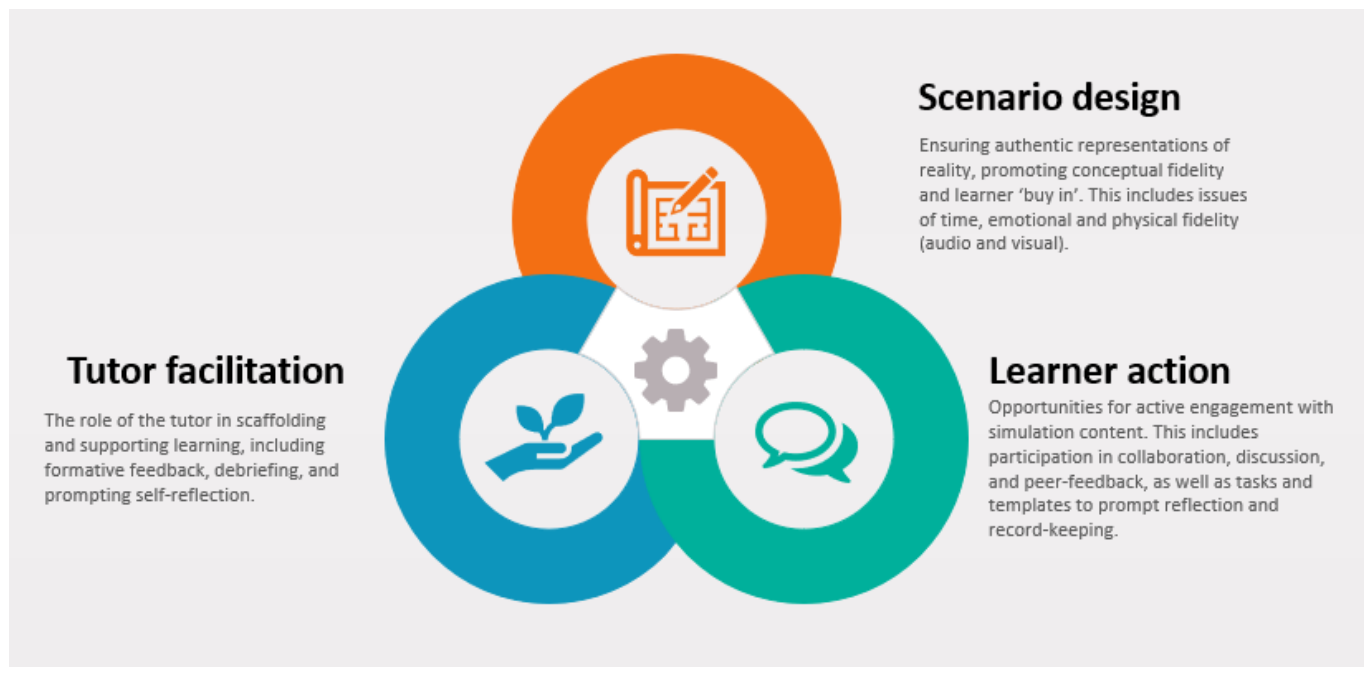
5.5. Scenario Design: How Real Is Too Real? Authenticity and Realism

Our analysis identified numerous considerations which further understanding of scenario design features which enhance—or inhibit—PSTs’ experiences of SBL, including emotional realism and psychological fidelity; physical fidelity; representations of time; and the delicate balance between realism and excessive cognitive load. Our findings support wider literature regarding the importance of perceived authenticity in SBL design (Theelen et al., 2020; Fischetti et al., 2022), suggesting that “The most beneficial aspect of simulation-based learning is the realism it possesses in relation to actual experiences a trainee teacher may encounter for the first time” (University A student, survey Q1). This account indicates this PSTs’ appreciation of opportunities to encounter realistic scenarios to rehearse “practical approaches to situations and how successful they may be” (University A student, survey Q1), thereby increasing preparedness (Nichol et al., 2025). It also reflects a wider trend from the quantitative data, suggesting that the degree of perceived realism in simulation scenarios predicts the level of professional preparedness and confidence amongst the PST sample (p = 0.669, p < 0.001).
Evident across the data were affirmative reflections from PSTs with prior experience of working in school environments, acknowledging that details included within simulated scenarios mirrored their own experiences in practice:
“especially with the EAL one. I connected with that a lot because I’ve worked in a school where it was such a high percentage of EAL kids that was every week, you know, “Right, you’ve got a new child starting on Monday coming from Romania. We don’t know anything else, just see what happens”.
(University A, student 1)
This, and similar, accounts illustrate the emotional realism, psychological fidelity, and physical fidelity embedded within this simulation. PSTs’ recollection of being told to “just see what happens” when working with new EAL pupils reflects the ambiguity and unpredictability often encountered in classrooms. In this way, this simulation may have produced similar emotional and cognitive pressure to practice, whilst still sufficiently supporting learning and reflection in a safe space.
PST accounts further emphasise the importance of precise details such as names, personal and academic histories and background information in constructing a believable identity of a ‘real’ child:
“I think when Matviy was initially introduced was really beneficial because before […] we were just talking about EAL students and how to help them and stuff. But when we were actually given a child and their history and their background and everything to actually apply it to, I felt that really helped conceptualise what that situation would be like” (University B, student E). “Perhaps an example photo of a pretend Chelsea-I feel photos are really impactful and seeing these will help us vision better what might be occurring. A photo is more impactful and can get us more into the simulation” (University B student, survey Q4).
These responses underscore how concrete identifiers can help construct a coherent and believable representation of pupils. The presence of Matviy and Chelsea as named individuals appears to have fostered perceptions of authenticity, encouraging PSTs to consider specific, tailored support rather than generic actions, and enhancing PSTs’ perceptions of engagement when compared to generalised or hypothetical discussions. This adds to the emerging literature regarding the value of low- and medium-technology forms of SBL in promoting PST engagement (Aagaard et al., 2025; Nichol et al., 2025), contrasting with the work of those such as Dieker et al. (2014, p. 29) who maintain that engagement in SBL is dependent on the ‘suspension of disbelief’ incurred through use of advanced technologies and immersive simulated environments. This is of particular import given the acknowledged relationship between student engagement and learning outcomes (Lei et al., 2018), motivation (Martin & Bolliger, 2018), resilience (Groccia, 2018), and participation (Frymier & Houser, 2016; Groccia, 2018), underscoring the potential value of low-technology forms of SBL within ITE.
Many PSTs also identified the valuable role of audio recordings within the mixed-media simulation—in the form of a simulated telephone call from a school receptionist—in establishing conceptual and physical fidelity and promoting engagement. Some PSTs suggested that this design feature enhanced perceptions of authenticity when compared with scenarios presented purely through text-based formats:
“I really liked the phone call aspect of the session. This felt very realistic of how the information would be delivered and I was able to feel all the emotions of receiving the information through the phone call such as feeling that “oh god” moment when you know something major has just happened”.
(University B student, survey Q1)
These perceptions did not appear to be influenced by familiarity with the staff member featured within the audio recording, as evidenced by the following responses from two PSTs in our respective institutions:
“I liked Carl acting as a receptionist in the phone call because it keeps it as something that’s going to happen. You know what I mean? I’ve seen it before and it could literally be, “This is going to happen the next day. OK. What pointers am I going to run through now that are going to get me prepared for this situation?”” (University A, student 1). “especially listening to the recording of the guy talking. It wasn’t just Kate reading it out, it was actually someone else’s voice that we didn’t know. So, it was like, “This is cool because I’m having to process the information as it’s coming in rather than reading it first and then hearing it”” (University B, student B).
These accounts demonstrate that, whilst one PST recognised the voice included within the simulated telephone call as their tutor, and one did not, both were motivated to engage with the subsequent simulation tasks. This could suggest that the inclusion of audio recordings within the scenario design—particularly its realism and alignment with prospective real-world experiences—may have been a contributing factor in motivating learners, rather than their recognition of the individual delivering the information. While we acknowledge the tentative nature of this interpretation, it does appear to contrast with wider literature on SBL, which cautions that excessive familiarity with actors or facilitators can undermine suspension of disbelief and reduce buy-in and perceptions of fidelity (Spencer et al., 2019).
Also noteworthy is the suggestion that cognitive engagement was heightened through the need to interpret and respond to auditory cues without prior context. This reflects a key affordance of audio- and video-based simulation design: it encourages active listening and decision-making in the moment. This resonates with wider literature regarding the potential benefits of situated and experiential learning (Kolb, 2014; Brown et al., 1989; Lave & Wenger, 1991). PSTs are not just reading about what might happen but are experiencing simulated events in a way that is contextually resonant with real-world practice, promoting deeper reflection and internalisation of professional responsibilities. As Eraut (1994) argues, such ‘hot action’ contexts, where decisions must be made rapidly with incomplete information, are central to professional competence yet often underrepresented in traditional teacher education programmes.
Representations of time within both simulated scenarios appeared to influence perceptions of authenticity and realism, particularly in relation to the gradual release of information, as well as elements of the scenarios which required an immediate response:
“the Matviy one made you think on the spot and it’s kind of like, “OK this is a real scenario”. What would you do with this phone call, because you have got a child coming in less than 24 h into your classroom, whereas Chelsea was spread across a longer time period than Matviy”.
(University A, student 2)
Accounts suggest that this design feature resulted in perceptions that the mixed-media simulation was more “intense” (University A, student 4)—and therefore more authentic—than the multiple-choice alternative, which did not create this same sense of immediacy. These accounts also reflect PSTs’ experiences of tasks which encouraged prioritisation. Here, perceived time pressure could be seen to enhance realism and emotional immersion, aligning with the findings of Kavakli & Konukbay (2024). The sense of urgency described by PSTs in the present study is intended to mirror the fast-paced decision-making required in actual classroom environments. The pressure creates a sense of responsibility and ownership, which strengthens the emotional connection to the scenario. Despite this, Vage et al. (2024) found the use of time pressure and other high-stress exercises led to a decline in accuracy in medical simulations, so this design feature should be considered carefully whilst planning SBL to better understand its potential applications within ITE contexts.
For other PSTs, the process of developing a timeline for key actions enabled participants to gain experience of “real-life scenarios and breaking it down” (University A student, survey Q1), mentally assuming the role of teacher by internally rehearsing questions to inform decision-making:
“it just gave me an insight into how to react to a phone call like that, how to prepare for the next day, especially if it is quite last minute and what to do over the next few weeks and months and also the amount of stuff you actually have to prepare. Who are they going to sit next to? If they’ve got lunch prepared. What time are they going to come in? I think it just gives you a bit of a timetable, like a structure to follow in case that ever does happen, and it was just for me, a lot of new information that I didn’t really know before”.
(University A, student 3)
This quote illustrates that simulation activities incorporating time pressures similar to those experienced in schools may encourage PSTs to face challenging situations in a low-stakes, safe environment (Kaufman & Ireland, 2019; Siddiqui et al., 2021), supporting decision making and aligning with real-life demands of the profession.
Similarly, some PSTs recognised that limiting access to information by deliberately withholding specific details at the outset of sessions allowed them to experience scenarios as they ‘unfolded bit by bit’ (University A, student 3), increasing their perceptions of conceptual fidelity.
“I think if everything was like dumped on you at the beginning and then you made the decisions, it’s not as realistic […] So having the limited knowledge made it feel more real and we have to work it out as it went along”.
(University A, student 3)
However, this notion of the deliberate withholding of information did raise important questions regarding the extent to which SBL can, and should, reflect reality in all of its nuances and complexities. For example, one PST expressed a preference for the simulation itself to reflect the unexpected nature of school life, and therefore to be introduced without prior warning:
“I would have liked to have not known about it before it happened. So, we were obviously told you’re going to have a phone call and they’re going to talk about this new student, whereas I think it would have been cool to have that element of surprise of, “Oh, I’m just preparing to go home and all of a sudden, I’ve just had this call” rather than be told. Because then you learn to regulate yourself professionally to get ready for that”.
(University B, student B)
These points raise the important question, ‘How real is too real?’, and reflect concerns regarding designing sufficiently authentic simulated scenarios to ensure learner buy-in, and some PSTs’ perceptions of verisimilitude, whereby all elements of a scenario aim to exactly replicate the realities of practice. Whilst we acknowledge the value of providing opportunities for PSTs to develop the professional self-regulation referenced in this account, the decision to provide prior warning was a deliberate one, designed in response to the early stage at which these SBL sessions were located within PSTs’ overall ITE programmes.
In this context, PSTs featured within this study were first-year undergraduates who were yet to experience their first in-school placement. It was therefore felt that a lack of prior warning may negatively influence PSTs’ engagement and ability to respond to the simulated scenario, as well as incurring high levels of cognitive load which have been shown to reduce the effectiveness of learning (Reedy, 2015; Sun et al., 2017). Providing advance notice was intended to enable PSTs to focus on professional reasoning and decision-making without the additional burden of excessive cognitive demand.
Our findings indicate that PSTs consistently value high levels of authenticity and realism within SBL, frequently associating more realistic scenarios with increased engagement. This resonates with the wider literature, as students often report higher levels of satisfaction with high-fidelity simulations (HFS) (Carey & Rossler, 2025). Despite this, educators must be wary of the ‘fidelity trap’ (Carey & Rossler, 2025) as HFS can also increase cognitive load to the point of overwhelming participants and thereby interrupting learning (Reedy, 2015; Mulholland et al., 2022). This connects back to the early discussion of cognitive load in that realism only supports learning when it generates the kind of load that helps learners build understanding, rather than crowding PSTs’ thinking with extraneous demand (Sweller, 1988; Sweller et al., 2011). This underscores the importance of carefully balancing authenticity with PSTs’ current degree of understanding and experience to avoid unnecessarily obstructing learning. Findings from the present study, in alignment with the wider literature, therefore suggest that the degree of realism is a critical pedagogical decision, and one that should incrementally shift as learners become more experienced in the field (Chernikova et al., 2024; Tremblay et al., 2023).

5.6. Learner Action: The Benefits—And Challenges—Of Peer-Collaboration

References to collaboration and discussion were prevalent across the data, with numerous PSTs describing this as “the best” (University A, student 1) or “most valuable” (University B student, survey Q1) aspect of both SBL sessions. Peer-collaboration enabled PSTs to “interact with other students and combine our ideas to further develop a way to help the pupil in the simulation” (University A student, survey Q1). These interactions afforded opportunities to listen to and “understand a range of opinions” (University A student, survey Q1), exposing PSTs to different ideas, experiences and perspectives, with participants suggesting that this enabled them to consider “what [others] would do in that scenario and it might help you think of things that you’d never thought about” (University A, student 2). In these accounts, collaboration was acknowledged to provide valuable support, increasing enjoyment and helping to build confidence in PSTs’ ability to assume their future professional role.
“I also really like collaborating just because it is still a new experience for a lot of us, knowing that if you might not have an idea straight away knowing somebody else on your table does helps you and benefits you. So, if we did have to then go down the route of doing independent work, at least you have a start of an idea because someone else has helped you with it”.
(University B, student F)
These accounts highlight the role of peer-collaboration as a catalyst for deeper thinking, perspective-taking, and solution-development during simulated-learning experiences and a potential method to overcome any initial challenges in identifying potential responses to scenarios (Nichol et al., 2025). This builds upon findings elsewhere in the literature, suggesting that SBL affords opportunities to engage in structured dialogue, thereby supporting PSTs to refine problem-solving skills, gain access to new ways of thinking, and learn to value and integrate diverse perspectives (Squires et al., 2025). In this way, peer-support within SBL may enhance professional development, with collaboration serving to foster a shared sense of purpose alongside development of supportive cultures for professional learning (Cordingley et al., 2003, 2015).
These findings from the qualitative analysis are also reflected in the quantitative results, with significant correlation between collaborative learning and professional preparedness (ρ = 0.426, p < 0.001), appearing to reinforce the notion that effective professional learning is co-constructed through authentic dialogue (Khong et al., 2023). However, the moderate correlation between PSTs’ responses suggests that, in this study, perceptions of the effectiveness of this education practice is context specific, and that collaborative working may be experienced differently due to variations in the delivery practices and cohort sizes at each university.
At University A, SBL sessions were delivered by two tutors to a large cohort of an average of 120 PSTs, while at University B session ns were delivered to groups of between 20 and 25 PSTs by a single tutor. Interestingly, PSTs at University A reported more positive experiences of collaboration which may suggest that opportunities to work in larger cohorts—affording opportunities to be exposed to, and engage with, ideas from a greater number of peers—were perceived to enhance this education practice. However, we acknowledge that this interpretation is necessarily tentative, and that variation in tutor facilitation style, group dynamics, or institutional culture between universities and campus locations may equally account for the differences observed. This reinforces the need for further research to ascertain how these differences influence PSTs’ experiences of collaboration within SBL.
It is also important to note that peer-collaboration within both simulation sessions was not universally successful. For example, some PSTs reported challenges in relation to both scripting and roleplay tasks, highlighting that task design, emotional safety, and group dynamics are crucial to successful engagement:
“when it comes to the roleplay element of when we collaborate. Sometimes it can be a little bit tricky when some people are a little bit more open to it than others, and sometimes that hinders the amount of collaboration that you can actually do because someone might be feeling a bit shy that day or not quite sure yet. So, you don’t perhaps get the same result as if you were just maybe just talking about it and maybe just discussing ideas”.
(University B, student B)
These concerns are also reflected in the moderate correlation found in the collaborative learning subscale (ρ = 0.426, p < 0.001). Such concerns reveal that some forms of collaboration demand more vulnerability than others, emphasising that not all learners are equally comfortable with performative or creative roles and that increased support may be needed to successfully scaffold PSTs’ engagement in tasks of this nature.
Whilst earlier analyses emphasise the benefits of peer collaboration in this study, the account therefore introduces a caveat: collaborative effectiveness may be contingent on participants’ comfort, confidence, and willingness to engage. This mirrors similar findings in other disciplines, suggesting that roleplay can significantly enhance both cognitive understanding and emotional engagement with complex social issues (Löfstrand & Zakrisson, 2025), but that those who struggle with participation or speaking up may experience anxiety that hinders their overall performance (Byrnes & Kiger, 1990; Whitney et al., 2025). This insight also highlights the potential challenges posed through roleplaying activities with peers, which can negatively influence participants’ ability to suspend disbelief and fully immerse themselves in the authenticity of the scenario (Dieckmann et al., 2007). This supports emerging findings in the context of ITE, underscoring the potential importance of structured support, flexibility (Dalgarno et al., 2016) and alternative modes of contribution for those less comfortable with immediate ‘performance’ within roleplay tasks (O’Regan et al., 2016), thereby ensuring accessibility and inclusion.
Some PSTs also emphasised the importance of positive social relationships in encouraging participation in collaborative tasks more broadly.
“I think it does work best when you’re working with the people that you’d normally sit with. [When] we got put in mixed-up groups I think that maybe contributes to people feeling a bit more nervous and a bit more reluctant to talk”.
(University B, student D)
A lack of engagement could occasionally be seen to incur frustration, leading to the following suggestion from one PST: “Other people need to offer more ideas. Please cold call!!” (University A student, survey Q2). While we do not necessarily advocate this strategy, this account again alludes to the issue of unequal participation within collaborative sessions and emphasises the importance of establishing conditions which are supportive and inclusive to enable all learners to fully partake in discussions.
Some PSTs also raised valid concerns regarding the degree to which collaboration alone can provide appropriate preparation for the often-solitary nature of classroom practice, recognising the importance of independent decision-making in their future roles.
“I think it’s important to learn to think from different perspectives, even if it’s just from hearing it from other people at first. But I think it is important that you’ve learned to come up with your own conclusion because you’re not always going to have someone to rely on in the classroom”.
(University B, student C)
The words “at first” here are important, underscoring the value of the support afforded through peer collaboration at this early point in PSTs’ training programmes. However, this also emphasises the importance of ensuring that this support is gradually removed over time, and that adequate opportunities for independent working and decision-making are integrated into SBL sessions—and across ITE programmes as a whole—to ensure that PSTs feel prepared to assume their professional responsibilities upon qualification.

5.7. Facilitating SBL: Scaffolding, Support and Feedback

This issue of the gradual release of responsibility, and the ways in which SBL can be used to increase professional autonomy over time, highlights the importance of effective tutor facilitation within broader SBL design. To mediate some of the potential issues identified in learner action and peer-collaboration, our findings demonstrate that tutors can deploy support through a range of structured activities, including scaffolding, formative feedback and debriefing to promote reflection and encourage PST thinking around key concepts.
Building on previous responses regarding the benefits of multiple-choice formats in promoting peer discussion, PSTs also acknowledged the advantages of this approach in scaffolding understanding of possible responses when compared with the more open information provided via the mixed-media alternative.
“for the Matviy one we got a table and we had to say what we would do to change the classroom right now, what we’d do in the next 7 to 14 days and then in the next few months. There wasn’t really any scaffold with that, and we just had to think of our own ideas, whereas with the Chelsea one, it was multiple-choice so we could discuss with each other and bounce ideas based on those options, so that one was a bit more scaffolded”.
(University A, student 4)
However, PSTs also identified further occasions where increased scaffolding would enable more successful engagement in specific simulation tasks. This was of particular concern in relation to roleplay tasks, which were perceived by some PSTs as ‘unstructured’ (University B student, survey Q2). It is also important to note that the degree of scaffolding PSTs required to confidently engage in roleplay was influenced by the particular role they were allocated, with some PSTs reporting increased challenges in assuming the role of pupil or parent, rather than that of teacher.
‘the parents who were in our group didn’t really have much input because we didn’t know what they were meant to be saying. […] I know that in a real life situation, you wouldn’t know which way it would go, but it felt like the teacher and the SENDCo knew what we were meant to be saying because we knew what had happened [but] the parents, we didn’t have their narrative so we didn’t know how that would go’.
(University B, student E)
This led some PSTs to express a desire for increased support to guide their participation and ensure that rehearsed interactions more closely represented those expected in professional practice, with PSTs themselves suggesting alternative approaches which could be employed to scaffold participation:
“with the roleplay […] we had to come up with our own way that it went, like the way the parents were and the situation. So, I think a lot of people got stuck thinking about that rather than the actual roleplay. […] it would probably be a bit more beneficial to have information cards for the people who are being the parents [to outline] where you want the situation to go because sometimes it feels a bit unguided” (University B, student C). “we could have […] the four people lined up at the front like Chelsea, the parents, the SENDCo and the teacher and we ask the questions. Then it’s not so crowded in the room with everyone discussing. You’re still getting a lot of ideas from everybody else and you’ve got the chance to ask your questions” (University B, student F).
These accounts suggest that, particularly at this early point in their training programme, scaffolds such as ‘character cards’, providing background information about characters, motivations and actions, could help guide roleplay participation, enhancing confidence and engagement. Similarly, PSTs can here be seen to express a preference for alternative approaches to whole-cohort roleplay activities, to instead advocate ‘hot seating’ techniques which reduce the number of PSTs required to actively participate in roleplay and instead involve remaining learners as observers. This approach is of particular interest as research in other disciplines indicates that hot seating approaches deliver equivalent learning outcomes for those in observer roles, whilst reducing the stress which may be incurred by actively assuming character roles (Bong et al., 2017; Ying et al., 2020).
In addition to scaffolding, PSTs’ responses also underscored the importance of feedback from both tutors and peers, as well as opportunities for debriefing and self-reflection, prompting participants “to reflect on my own practice and think about the progress I’ve made not only today but also [throughout] the programme as a whole” (University A student, survey Q1). For example, several PSTs emphasised the importance of discussing scenarios and decisions with tutors, who themselves have lived experiences of educational practice, to enhance professional knowledge and understanding:
“that was where we got most of our knowledge from […] when the lecturers were walking around and we were talking to them about our ideas and they were like, “Well, this is what we would do in this situation. What do you think about this?” and I just think that really did benefit the learning”.
(University A, student 2)
This account suggests that feedback and discussion, especially with experienced practitioners, are not peripheral but are instead central to the learning process within SBL sessions (Theelen et al., 2020). In healthcare simulations, Fanning and Gaba (2007) found that the perceived skills of the debriefer had the highest correlation to the perceived overall quality of the simulation experience. This is reflected in PST accounts which favourably compare feedback from tutors or in-service professionals with that available from peers:
“a few of the girls next to me had a completely different view on how they would approach Chelsea […] rather than going off my peers, I was just going off what the lecturer was saying because we’ve never been in those scenarios, so we don’t know what we’re going on about, whereas the lecturers have been involved in those scenarios […] so that boosted our confidence that we were right in what we were saying”.
(University A, student 3)
It is also interesting to note that PST responses demonstrated mixed perceptions regarding the importance of a ‘correct’, or definitive response to specific scenarios:
“with the simulation […] there’s no right or wrong answer. So, I feel if you were to do a lecture on it, we would automatically take what you said and do just that. When you do a simulation, there’s obviously loads of different directions that you can go in”.
(University A, student 5)
These accounts demonstrate appreciation for the open-ended nature of SBL sessions, affording opportunities to explore alternative, contrasting approaches and decisions. However, for some PSTs this lack of a clearly defined ‘correct’ response did raise concerns around their preparedness to respond to similar scenarios in practice, particularly without more definitive feedback around any failure to comply with professional responsibilities and statutory duties.
“I do sometimes feel like there’s not a lot of opportunity for us to know what we’re doing wrong? […] There might not be one singular right thing, but there will be a wrong thing to do and it’s hard to know whether what you’re doing is right or will be helpful or effective because you do it and then you move on”.
(University B, student C)
While acknowledging the nuanced realities of real-life scenarios, this account recognises that not all actions will be useful or appropriate, and that tutor feedback is required to explicitly address any misconceptions or omissions. Here, the phrase “you do it and then you move on” is also noteworthy as it reflects some students’ desire for closure from simulated scenarios, or to follow simulated pupils over a more sustained period. This is of particular interest as, while simulations may vary in duration, longer simulations are associated with greater effects on learning outcomes (Chernikova et al., 2020).
The issue of ‘moving on’ also reinforces the importance of formative feedback in SBL. This resonates with wider literature regarding the importance of a comprehensive debrief to conclude SBL sessions to ensure that this pedagogic approach fulfils its potential for enhancing professional knowledge and preparedness (Fanning & Gaba, 2007; Decker et al., 2013). The activity itself is not enough; it is the learning that occurs through reflection which most develops professional learning (Hall & Tori, 2017).
It is therefore crucial to ensure that how, when, and where feedback will be given is fully considered during the SBL design process. However, PSTs also recognised the challenges for tutors in providing targeted and meaningful feedback for individuals, with PSTs presenting contrasting preferences both for feedback “in smaller groups” (University A, student 4), and for working in larger cohort groups with multiple tutors “coming around quite often” (University A, student 4). Our data therefore highlights the importance of further exploration of possible approaches to feedback in SBL to better understand the impact of group size and student-tutor ratio, as well as other factors such as form of delivery, encompassing self-, peer-, and tutor or ‘expert’ feedback. Wider research suggests that self-reflection alone does not improve performance (Burns, 2015).
PSTs in the present study also suggested further potential approaches which these students have encountered elsewhere in their ITE programmes, which may also have applications in SBL contexts.
“maybe more people engage in [mentimeter] because they prefer to put an anonymous answer than put their hand up and contribute” (University A, student 1). “[Previously] we did an activity called micro-teaching where you recorded yourself and then you could then look back on it later […] And that was really, really helpful in terms of your own feedback […] And I suppose people took it more seriously as well because we knew we were being recorded” (University B, student B).
However, even when suggesting these alternative approaches, PST responses acknowledged the time constraints limiting tutors’ capacity to provide individual feedback for all participants, recognising that “there’s just no time for that” (University B, student C). Taken together, these accounts therefore highlight PSTs’ own recognition of the potential value of integrating familiar pedagogical tools into SBL contexts, emphasising that effective scaffolding requires a carefully designed repertoire of feedback and support mechanisms to appropriately respond to learner needs, group context, and the practical realities of delivery.

6. Limitations

Whilst this study has provided valuable preliminary insights into PSTs’ perceptions of SBL design across different simulation modalities, there are several limitations that must be considered. The fixed, non-random choice of research design was essential for standardising the delivery of the simulation sessions within a tight curriculum schedule for both Universities. Whilst this made pedagogical sense, there is potential for carryover bias based on the ordering of each simulation session (SBL Session 1 followed by SBL Session 2). PSTs could carry over learning experiences and familiarity of the first SBL session into the second session, thereby causing the observed direct differences to the simulation modality to be confounded by the ordering of each simulation. Our study is also cross-sectional, meaning causality cannot be determined between simulation modality and observed differences from the EPQ and PEPS-Q measures. Future studies should consider using a longitudinal research design with control groups to test whether PSTs’ perceptions change over a longer period of time. Demographic data (e.g., gender, age and school experience) would provide further detail on the impact of simulation modalities specific to learner profiles and characteristics.
Surveys were administered anonymously immediately following each simulation session, meaning PSTs’ responses could not be linked across sessions. As a result, responses were treated as independent samples for the purposes of Mann–Whitney U analysis. Whilst PSTs at both universities attended both simulation sessions, the independence assumption underlying the Mann–Whitney U modality comparison is a pragmatic analytical decision rather than a confirmed design characteristic. Future studies should consider matching participants across sessions, thereby adopting a within-subjects design and subsequent paired analysis with a view to understanding PST response variation across simulation modalities.

7. Conclusions

This study examines PSTs’ experiences of two low-technology SBL modalities to identify the design features they perceive as most valuable. In doing so, it responds directly to calls within the literature for comparative research seeking to better understand simulation design and its pedagogical implications within Initial Teacher Education (ITE) (Chernikova et al., 2020; Nichol et al., 2025).
In relation to the first research question, our findings demonstrate consistently high levels of engagement, perceived quality, and professional preparedness across both simulation modalities, with no statistically significant differences between formats. Through demonstrating PSTs’ positive experiences of two different forms of low-technology simulation, we therefore challenge implicit assumptions within parts of the literature which posit that increased technological sophistication or higher physical fidelity necessarily leads to enhanced learning outcomes (Dieker et al., 2014; Dalgarno et al., 2016). Instead, our findings support arguments that conceptual and psychological fidelity may be of greater importance than technological complexity (Norman, 2012; Carey & Rossler, 2025), suggesting that effective SBL does not depend on high-cost or high-technology solutions, but rather on the complex interplay between simulation scenario design, learner engagement, and tutor facilitation.
Addressing the second research question, the study identifies three interrelated design features—authenticity and realism, peer collaboration, and scaffolding through facilitation and feedback—as central to PSTs’ learning experiences. These findings reinforce key principles outlined in existing SBL frameworks (Jeffries, 2005; INACSL, 2016), while extending them through a more nuanced understanding of how these elements are experienced in ITE contexts. In particular, the data highlights the importance of balancing authenticity with cognitive load, supporting literature which cautions against the fidelity trap (Carey & Rossler, 2025) and emphasises the need for developmentally appropriate simulation design (Fraser et al., 2015; Han & Lim, 2020).
The findings relating to peer collaboration align with social-constructivist perspectives (Vygotsky, 1978), reinforcing the view that professional learning is co-constructed through dialogue and shared problem-solving. However, this study also extends existing literature by foregrounding the contingent nature of collaboration, demonstrating that its effectiveness is shaped by task design, learner confidence, and group dynamics. Similarly, while the importance of feedback and debrief is well established (Fanning & Gaba, 2007), this study provides further insight into PSTs’ desire for clearer evaluative guidance alongside opportunities for open-ended exploration, highlighting an ongoing tension between authenticity and instructional support.
Taken together, these findings contribute to a more integrated understanding of SBL as a design-supported pedagogy, in which learning emerges through the interaction of scenario, learner, and facilitator. In doing so, the study addresses a gap identified in the literature regarding how specific simulation design features influence PSTs’ experiences, rather than simply whether SBL is effective. Figure 5 conceptualises these components of SBL within teacher education contexts. We propose this model in the hope that this may provide a useful conceptual lens for understanding PSTs’ experiences, but note that this should be viewed as an evolving model that will require further testing and refinement through subsequent research.
From a theoretical perspective, our findings reinforce social constructivist interpretations of SBL as a socially mediated and contextually situated process, while also contributing to debates around fidelity, cognitive load, and experiential learning. They suggest that learning is not inherent to simulation itself, but is shaped by the quality of design and the opportunities for interaction, reflection, and meaning-making embedded within it.
From a practical perspective, the study offers several implications for teacher educators. First, it highlights the importance of designing simulations that prioritise authenticity and relevance while remaining appropriately scaffolded to support novice learners. Second, it underscores the need to structure collaborative activities in ways that are inclusive and sensitive to varying levels of confidence and participation. Third, it reinforces the critical role of tutor facilitation, particularly in providing timely, process-oriented feedback and structured debrief opportunities. Importantly, these findings demonstrate that such principles can be effectively realised through low-technology approaches, enhancing the accessibility and scalability of SBL within ITE.
In conclusion, this study reframes the question of effectiveness in SBL from a focus on modality to a focus on pedagogical design. By linking empirical findings to key debates within the literature, it offers both conceptual and practical insights into how simulation can be meaningfully integrated within teacher education. Future research should continue to explore how these design principles operate across different contexts and stages of professional development, as well as their longer-term impact on classroom practice.

Author Contributions

Conceptualization, R.F., C.C., D.N., C.L., W.G. and K.M.; Methodology, R.F., C.C., D.N., W.G. and K.M.; Software, C.C., D.N. and W.G.; Validation, C.C., D.N. and K.M.; Formal analysis, R.F., C.C., D.N., C.L., M.C., S.M., W.G. and K.M.; Investigation, R.F., C.C., D.N., C.L., K.H., W.G. and K.M.; Resources, R.F., C.C., D.N., C.L. and K.M.; Data curation, R.F., C.C., D.N., W.G. and K.M.; Writing—original draft, R.F., C.C., D.N., C.L., S.M., L.B., A.A., W.G. and K.M.; Writing—review & editing, R.F., C.C., D.N., C.L., M.C., J.D., W.G. and K.M.; Visualization, C.L. and K.M.; Supervision, C.C., D.N., W.G. and K.M.; Project administration, R.F., D.N., C.L., A.A. and K.M. All authors have read and agreed to the published version of the manuscript.

Funding

This research received no external funding. The APC was funded by Anglia Ruskin University.

Institutional Review Board Statement

The study was conducted in accordance with the Declaration of Helsinki, and approved by the Ethics Committee of Northumbria University (Approval code: 7658; date of approval: 15 January 2025) and Anglia Ruskin University (Approval code: 3317; date of approval: 21 February 2025).

Informed Consent Statement

Informed consent was obtained from all subjects involved in the study.

Data Availability Statement

Data are not publicly available due to privacy/ethical restrictions. The data that support the findings of this study are available from the authors upon request.

Conflicts of Interest

The authors declare no conflict of interest.

Appendix A. Modified Educational Practices Questionnaire (EPQ-TE)

Student-Staff Interaction
  • My tutor responded to my needs during the learning experience.
  • I learned from the comments made by the tutor before, during, or after the learning.
  • My tutor did not respond to my needs during the learning experience (R).
  • I had the chance to discuss the learning experience objectives with my tutor.
Collaborative Learning
  • I had the chance to collaborate with my peers during the learning experience.
  • I had the opportunity to discuss my thoughts with my peers during the learning experience.
  • I rarely had the chance to discuss my thoughts with peers during the learning experience (R).
Active Learning
  • I had the opportunity to reflect on my thinking during the learning experience.
  • I had the opportunity to reflect upon any emotions I experienced during the learning experience.
  • I was able to see what I have been taught can be used in my future practice.
  • The learning experience activities made my learning time more productive.
  • I rarely had the opportunity to reflect upon any emotions I experienced during the learning experience (R).
Feedback
  • I received feedback from the tutor about my thinking during the learning experience.
  • I had the opportunity to give and receive feedback from my peers during the learning experience.
  • I rarely had the opportunity to give and receive feedback from my peers during the learning experience (R).
Time on Task
  • I did not have time to complete tasks in this session (R).
  • I could complete the task in a reasonable amount of time.
  • In the given timeframe, there was enough time to understand the material.
High Expectations
  • The tutor provided an environment for learning that encouraged me to challenge my own thinking and abilities.
  • The objectives for the learning experience were clear and easy to understand.
  • The objectives for the learning experience were unclear and difficult to understand (R).
Diverse Learning
  • The session was designed to meet my particular needs.
  • My tutor was inclusive of different perspectives in thinking and learning.
  • The learning experience offered a variety of ways in which to learn the material.
  • The learning experience offered limited or no variety in how the material was presented (R).
Engagement
  • Simulation is a more interesting and engaging form of learning than more traditional lecture format.
  • The simulation session was relevant.
  • The simulation was useful to prepare me for my future practice as a primary school teacher.
  • The simulation was not useful to prepare me for my future practice as a primary school teacher (R).
Realism
  • The simulation created during this session was realistic enough to develop my understanding and skills.
  • Real life factors, situations, and variables were built into the simulation scenario.
  • The scenario resembled a real-life situation.
  • The scenario did not resemble a real-life situation (R).
©Copyright, National League for Nursing, 2021.
This instrument is a modified version of the Educational Practices Questionnaire-Curriculum (EPQ-C) originally created by Bette Mariani, Cynthia Sherraden Bradley, Amy L. Daniels, and Susan Gross Forneris, and copyrighted by the National League for Nursing (NLN) (2021). Modifications were made by the authors of this study to adapt it for use of educators and in particular pre-service teachers taking part in simulation-based learning activities involved in this study. The modifications of this instrument are the sole responsibility of the authors in this study.

Appendix B. Preparing Educators for Practice Through Simulation Questionnaire (PEPS-Q)

Nichol et al. (2025) Nichol, D., Mulholland, K., Counihan, C., Meller, S., Anderson, A., Luke, C., & Gray, W. (2025). Back to basics: Pre-service teachers’ experiences of ‘SimulatEd’, a suite of low-technology simulated-scenarios to promote preparedness for professional practice. Teaching and Teacher Education, 164, 105089.
  • Simulation added to my understanding of theory in primary education
  • The simulation was helpful in developing my skills as a primary school teacher
  • The simulation helped me to feel better prepared for my future practice as a primary school teacher
  • Simulation is an effective pedagogic approach which has supported my professional understanding
  • Simulation is a more interesting and engaging form of learning than more traditional pedagogic approaches
  • The simulation created during this session was authentic enough to develop my understanding and skills

References

  1. Aagaard, T., Bueie, A., & Frøytlog, J. I. J. (2025). Exploring simulated practice in teacher education: Opportunities to professionalize the teacher role. Education Sciences, 15(2), 182. [Google Scholar] [CrossRef]
  2. Ade-Ojo, G., Markowski, M., Essex, R., Stiell, M., & Jameson, J. (2022). A systematic scoping review and textual narrative synthesis of physical and mixed-reality simulation in pre-service teacher training. Journal of Computer Assisted Learning, 38, 861–874. [Google Scholar] [CrossRef]
  3. Al-Ghareeb, A. Z., & Cooper, S. J. (2016). Barriers and enablers to the use of high-fidelity patient simulation manikins in nurse education: An integrative review. Nurse Education Today, 36, 281–286. [Google Scholar] [CrossRef]
  4. Asakura, K. (2023). Toward a critical approach to simulation-based social work education: Guidelines for designing simulated client case scenarios. Journal of Social Work Education, 60(1), 102–114. [Google Scholar] [CrossRef]
  5. Astwood, R. S., Van Buskirk, W. L., Cornejo, J. M., & Dalton, J. (2008). The impact of different feedback types on decision-making in simulation based training environments. In Proceedings of the human factors and ergonomics society annual meeting (Vol. 52, pp. 2062–2066). SAGE Publications. [Google Scholar]
  6. Badiee, F., & Kaufman, D. (2015). Design evaluation of a simulation for teacher education. Sage Open, 5(2), 2158244015592454. [Google Scholar] [CrossRef]
  7. Bandura, A. (1997). Self-efficacy: The exercise of control. Freeman. [Google Scholar]
  8. Beaubien, J. M., & Baker, D. P. (2002). The use of simulation for training teamwork skills in health care: How low can you go? In Simulation in aviation training (1st ed., pp. 445–450). Routledge. [Google Scholar]
  9. Bong, C. L., Lee, S., Ng, A. S. B., Allen, J. C., Lim, E. H. L., & Vidyarthi, A. (2017). The effects of active (hot-seat) versus observer roles during simulation-based training on stress levels and non-technical performance: A randomized trial. Advances in Simulation, 2(1), 7. [Google Scholar] [CrossRef] [PubMed]
  10. Bradley, E. G., & Kendall, B. (2014). A review of computer simulations in teacher education. Journal of Educational Technology Systems, 43(1), 3–12. [Google Scholar] [CrossRef]
  11. Braun, V., & Clarke, V. (2022). Thematic analysis: A practical guide. Sage. [Google Scholar]
  12. British Educational Research Association (BERA). (2024). Ethical guidelines for educational research (5th ed.). BERA. Available online: https://www.bera.ac.uk/publication/ethical-guidelines-for-educational-research-fifth-edition-2024 (accessed on 7 May 2026).
  13. Brown, J. S., Collins, A., & Duguid, P. (1989). Situated cognition and the culture of learning. Educational Researcher, 18(1), 32–42. [Google Scholar] [CrossRef]
  14. Burns, C. L. (2015). Using debriefing and feedback in simulation to improve participant performance: An educator’s perspective. International Journal of Medical Education, 6, 118–120. [Google Scholar] [CrossRef]
  15. Byrnes, D. A., & Kiger, G. (1990). The effect of a prejudice-reduction simulation on attitude change 1. Journal of Applied Social Psychology, 20(4), 341–356. [Google Scholar] [CrossRef]
  16. Carey, J. M., & Rossler, K. (2025). The how when why of high-fidelity simulation. StatPearls Publishing. [Google Scholar]
  17. Chernikova, O., Heitzmann, N., Stadler, M., Holzberger, D., Seidel, T., & Fischer, F. (2020). Simulation-based learning in higher education: A meta-analysis. Review of Educational Research, 90(4), 499–541. [Google Scholar] [CrossRef]
  18. Chernikova, O., Stadler, M., Sommerhoff, D., Schons, C., Heitzmann, N., Holzberger, D., Seidel, T., Richters, C., Pickal, A. J., Wecker, C., Nickl, M., Codreanu, E., Ufer, S., Kron, S., Corves, C., Neuhaus, B. J., Fischer, M. R., & Fischer, F. (2024). The relation between learners’ experience in simulations and diagnostic accuracy: Generalizability across medical and teacher education. Computers in Human Behavior Reports, 15, 100454. [Google Scholar] [CrossRef]
  19. Codreanu, E., Sommerhoff, D., Huber, S., Ufer, S., & Seidel, T. (2020). Between authenticity and cognitive demand: Finding a balance in designing a video-based simulation in the context of mathematics teacher education. Teaching and Teacher Education, 95, 103146. [Google Scholar] [CrossRef]
  20. Cohen, J. (1988). Statistical power analysis for the behavioral sciences (2nd ed.). Lawrence Erlbaum. [Google Scholar]
  21. Cordingley, P., Bell, M., Rundell, B., & Evans, D. (2003). The impact of collaborative CPD on classroom teaching and learning. In Research Evidence in Education Library. EPPI-Centre, Social Science Research Unit, Institute of Education, University of London; Teacher Development Trust. [Google Scholar]
  22. Cordingley, P., Higgins, S., Greany, T., Buckler, N., Coles-Jordan, D., Crisp, B., Saunders, L., & Coe, R. (2015). Developing great teaching: Lessons from the international reviews into effective professional development. Teacher Development Trust. [Google Scholar]
  23. Creswell, J. W., & Creswell, J. D. (2018). Research design: Qualitative, quantitative, and mixed methods approaches (5th ed.). SAGE. [Google Scholar]
  24. Creswell, J. W., & Plano Clark, V. (2018). Designing and conducting mixed methods research (3rd ed.). Sage Publications. [Google Scholar]
  25. Dalgarno, B., Gregory, S., Knox, V., & Reiners, T. (2016). Practising teaching using virtual classroom role plays. Australian Journal of Teacher Education (Online), 41(1), 126–154. [Google Scholar] [CrossRef]
  26. Dalinger, T., Thomas, K. B., Stansberry, S., & Xiu, Y. (2020). A mixed reality simulation offers strategic practice for pre-service teachers. Computers & Education, 144, 103696. [Google Scholar] [CrossRef]
  27. Das, S., Ahmed, S. M., Murry, L. L., & Garg, R. (2024). Simcrafting: A comprehensive framework for scenario development for simulation. Indian Journal of Anaesthesia, 68(1), 31–35. [Google Scholar] [CrossRef] [PubMed]
  28. Decker, S., Fey, M., Sideras, S., Caballero, S., Rockstraw, L., Franklin, A. E., Gloe, D., Lioce, L., Sando, C. R., & Borum, J. C. (2013). Standards of best practice: Simulation standard VI: The debriefing process. Clinical Simulation in Nursing, 9(6S), S26–S29. [Google Scholar] [CrossRef]
  29. De Coninck, K., Valcke, M., Ophalvens, I., & Vanderlinde, R. (2018). Bridging the theory-practice gap in teacher education: The design and construction of simulation-based learning environments. In Kohärenz in der lehrerbildung: Theorien, modelle und empirische befunde (pp. 263–280). Springer Fachmedien Wiesbaden. [Google Scholar]
  30. Department for Education (DfE). (2019). Initial teacher training (ITT): Core content framework. Available online: https://assets.publishing.service.gov.uk/media/661d24ac08c3be25cfbd3e61/Initial_Teacher_Training_and_Early_Career_Framework.pdf (accessed on 26 May 2026).
  31. Department for Education (DfE). (2024). Working lives of teachers and leaders—Wave 2: Research report. Available online: https://assets.publishing.service.gov.uk/media/66e2d57c718edd8177131646/Working_lives_of_teachers_and_leaders_-_wave_2_-_main_research_report.pdf (accessed on 26 May 2026).
  32. de Smale, S., Overmans, T., Jeuring, J., & van de Grint, L. (2015). The effect of simulations and games on learning objectives in tertiary education: A systematic review. In A. de Gloria, & R. Veltkamp (Eds.), Games and learning alliance. GALA 2015 (Vol. 9599, pp. 1–10). Lecture Notes in Computer Science. Springer. [Google Scholar] [CrossRef]
  33. Dieckmann, P., Manser, T., Wehner, T., & Rall, M. (2007). Reality and fiction cues in medical patient simulation: An interview study with anesthesiologists. Journal of Cognitive Engineering and Decision Making, 1(2), 148–168. [Google Scholar] [CrossRef]
  34. Dieker, L. A., Rodriguez, J. A., Lignugaris Kraft, B., Hynes, M. C., & Hughes, C. E. (2014). The potential of simulated environments in teacher education: Current and future possibilities. Teacher Education and Special Education, 37, 21–33. [Google Scholar] [CrossRef]
  35. Dotger, B. H., Harris, S., & Hansel, A. (2008). Emerging authenticity: The crafting of simulated parent–teacher candidate conferences. Teaching Education, 19(4), 337–349. [Google Scholar] [CrossRef]
  36. Eraut, M. (1994). Developing professional knowledge and competence. Falmer Press. [Google Scholar]
  37. Fanning, R. M., & Gaba, D. M. (2007). The role of debriefing in simulation-based learning. Simulation in Healthcare: The Journal of the Society for Simulation in Healthcare, 2(2), 115–125. [Google Scholar] [CrossRef]
  38. Finan, E., Bismilla, Z., Whyte, H. E., Leblanc, V., & McNamara, P. J. (2012). High-fidelity simulator technology may not be superior to traditional low-fidelity equipment for neonatal resuscitation training. Journal of Perinatology, 32(4), 287–292. [Google Scholar] [CrossRef]
  39. Fischetti, J., Ledger, S., Lynch, D., & Donnelly, D. (2022). Practice before practicum: Simulation in initial teacher education. The Teacher Educator, 57(2), 155–174. [Google Scholar] [CrossRef]
  40. Flavian, H., & Levin, O. (2024). Using simulation-based learning to inform preservice teachers’ professional development. Teaching Education, 35(2), 145–161. [Google Scholar] [CrossRef]
  41. Fragapane, L., Li, W., Ben Khallouq, B., Cheng, Z. J., & Harris, D. M. (2018). Comparison of knowledge retention between high-fidelity patient simulation and read-only participants in undergraduate biomedical science education. Advances in Physiology Education, 42(4), 599–604. [Google Scholar] [CrossRef] [PubMed]
  42. Fraser, K. L., Ayres, P., & Sweller, J. (2015). Cognitive load theory for the design of medical simulations. Simulation in Healthcare: The Journal of the Society for Simulation in Healthcare, 10(5), 295–307. [Google Scholar] [CrossRef]
  43. Frei-Landau, R., & Levin, O. (2022). The virtual Sim (HU) lation model: Conceptualization and implementation in the context of distant learning in teacher education. Teaching and Teacher Education, 117, 103798. [Google Scholar] [CrossRef]
  44. Fritz, C. O., Morris, P. E., & Richler, J. J. (2012). Effect size estimates: Current use, calculations, and interpretation. Journal of Experimental Psychology: General, 141(1), 2–18. [Google Scholar] [CrossRef] [PubMed]
  45. Frymier, A. B., & Houser, M. L. (2016). The role of oral participation in student engagement. Communication Education, 65(1), 83–104. [Google Scholar] [CrossRef]
  46. Garvey, L., Willetts, G., Sadoughi, N., & Olasoji, M. (2021). Undergraduate nursing students’ experience of mental health simulation post-clinical placement: A qualitative study. International Journal of Mental Health Nursing, 30(1), 93–101. [Google Scholar] [CrossRef]
  47. Groccia, J. E. (2018). What is student engagement? New Directions for Teaching and Learning, 154, 11–20. [Google Scholar] [CrossRef]
  48. Grossman, P., Hammerness, K., & McDonald, M. (2009). Redefining teaching, re-imagining teacher education. Teachers and Teaching, 15(2), 273–289. [Google Scholar] [CrossRef]
  49. Hall, K., & Tori, K. (2017). Best practice recommendations for debriefing in simulation-based education for Australian undergraduate nursing students: An integrative review. Clinical Simulation in Nursing, 13(1), 39–50. [Google Scholar] [CrossRef]
  50. Hammoud, M. M., Nuthalapaty, F. S., Goepfert, A. R., Casey, P. M., Emmons, S., Espey, E. L., Kaczmarczyk, J. M., Katz, N. T., Neutens, J. J., Peskin, E. G., & Association of Professors of Gynecology and Obstetrics Undergraduate Medical Education Committee. (2008). To the point: Medical education review of the role of simulators in surgical training. American Journal of Obstetrics and Gynecology, 199(4), 338–343. [Google Scholar] [CrossRef]
  51. Hamstra, S. J., Brydges, R., Hatala, R., Zendejas, B., & Cook, D. A. (2014). Reconsidering fidelity in simulation-based training. Academic Medicine, 89(3), 387–392. [Google Scholar] [CrossRef]
  52. Han, H., & Lim, C. I. (2020). A developmental study on design principles for virtual reality based educational simulation. Journal of Educational Technology, 36(2), 221–264. [Google Scholar] [CrossRef]
  53. Herrington, J., Reeves, T. C., & Oliver, R. (2010). A guide to authentic e-learning. Routledge. [Google Scholar]
  54. Hyslop-Margison, E. J., & Strobel, J. (2007). Constructivism and education: Misunderstandings and pedagogical implications. The Teacher Educator, 43(1), 72–86. [Google Scholar] [CrossRef]
  55. International Nursing Association for Clinical Simulation and Learning (INACSL). (2016). Simulation design. INACSL Standards of Best Practice: Clinical Simulation in Nursing, 12, S5–S12. [Google Scholar]
  56. Jawabreh, N., Hamdan-Mansour, A., Harazne, L., & Ayed, A. (2025). Effectiveness of high-fidelity simulation on practice, satisfaction, and self-confidence among nursing students in mental health nursing class. British Medical Council of Nursing, 24, 622. [Google Scholar] [CrossRef] [PubMed]
  57. Jeffries, P. R. (2005). Designing simulations for nursing education. Annual Review of Nursing Education, 4, 161–177. [Google Scholar]
  58. Kasperski, R., & Crispel, O. (2022). Pre-service teachers’ perspectives on the contribution of simulation-based learning to the development of communication skills. Journal of Education for Teaching, 48(5), 521–534. [Google Scholar] [CrossRef]
  59. Kaufman, D., & Ireland, A. (2016). Enhancing teacher education with simulations. Tech Trends, 60, 260–267. [Google Scholar] [CrossRef]
  60. Kaufman, D., & Ireland, A. (2019). Simulation as a strategy in teacher education. Oxford Research Encyclopedia of Education. [Google Scholar]
  61. Kavakli, O., & Konukbay, D. (2024). How simulation training for nursing students in emergency internships affects triage decision-making and anxiety: A quasi-experimental study. Heliyon, 10(15), e35626. [Google Scholar] [CrossRef]
  62. Khong, T. D. H., Saito, E., Hardy, I., & Gillies, R. (2023). Teacher learning through dialogue with colleagues, self and students. Educational Research, 65(2), 170–188. [Google Scholar] [CrossRef]
  63. Koivisto, J. M., Haavisto, E., Niemi, H., Haho, P., Nylund, S., & Multisilta, J. (2018). Design principles for simulation games for learning clinical reasoning: A design-based research approach. Nurse Education Today, 60, 114–120. [Google Scholar] [CrossRef]
  64. Kolb, D. A. (2014). Experiential learning: Experience as the source of learning and development. FT Press. [Google Scholar]
  65. Lave, J., & Wenger, E. (1991). Situated learning: Legitimate peripheral participation. Cambridge University Press. [Google Scholar]
  66. Ledger, S., Ersozlu, Z., & Fischetti, J. (2019). Preservice teachers’ confidence and preferred teaching strategies using TeachLivE™ virtual learning environment: A two-step cluster analysis. EURASIA Journal of Mathematics, Science and Technology Education, 15(3), em1674. [Google Scholar] [CrossRef]
  67. Ledger, S., Mailizar, M., Gregory, S., Tanti, M., Gibson, D., & Kruse, S. (2024). Learning to teach with simulation: Historial insights. Journal of Computers in Education, 12, 229–366. [Google Scholar] [CrossRef]
  68. Lei, H., Cui, Y., & Zhou, W. (2018). Relationships between student engagement and academic achievement: A meta-analysis. Social Behavior and Personality: An International Journal, 46(3), 517–528. [Google Scholar] [CrossRef]
  69. Levin, O., & Flavian, H. (2022). Simulation-based learning in the context of peer learning from the perspective of preservice teachers: A case study. European Journal of Teacher Education, 45(3), 373–394. [Google Scholar] [CrossRef]
  70. Levin, O., Frei-Landau, R., Flavian, H., & Miller, E. C. (2025a). Creating authenticity in simulation-based learning scenarios in teacher education. European Journal of Teacher Education, 48(2), 291–312. [Google Scholar] [CrossRef]
  71. Levin, O., Frei-Landau, R., & Goldberg, C. (2023). Development and validation of a scale to measure the simulation-based learning outcomes in teacher education. Frontiers in Education, 8, 1116626. [Google Scholar] [CrossRef]
  72. Levin, O., Frei-Landau, R., & Goldberg, C. (2025b). “No pain, no gain”: Simulation-based learning in teacher education: The mediating role of simulation hindrances. PLoS ONE, 20(1), e0317255. [Google Scholar] [CrossRef] [PubMed]
  73. Levin, O., & Muchnik-Rozanov, Y. (2023). Professional development during simulation-based learning: Experiences and insights of preservice teachers. Journal of Education for Teaching, 49(1), 120–136. [Google Scholar] [CrossRef]
  74. Lindgren, R., Morphew, J. W., Kang, J., Planey, J., & Mestre, J. P. (2022). Learning and transfer effects of embodied simulations targeting crosscutting concepts in science. Journal of Educational Psychology, 114(3), 462–481. [Google Scholar] [CrossRef]
  75. Löfstrand, P., & Zakrisson, I. (2025). Exploring the impact of role-playing exercises on cognitive and emotional processes: A social-and educational psychological perspective. Frontiers in Psychology, 16, 1645213. [Google Scholar] [CrossRef]
  76. Martin, F., & Bolliger, D. U. (2018). Engagement matters: Student perceptions on the importance of engagement strategies in the online learning environment. Online Learning, 22(1), 205–222. [Google Scholar] [CrossRef]
  77. Mayer, R. E. (2009). Multimedia learning (2nd ed.). Cambridge University Press. [Google Scholar]
  78. McCusker, S. (2021). Alias the Jester–What can Clowns tell us about teaching? In A. Gillespie (Ed.), Early careers in education: Perspectives for students and NQTs (pp. 3–10). Emerald. [Google Scholar] [CrossRef]
  79. McGarr, O. (2021). The use of virtual simulations in teacher education to develop pre-service teachers’ behaviour and classroom management skills: Implications for reflective practice. Journal of Education for Teaching, 47(2), 274–286. [Google Scholar] [CrossRef]
  80. Miller, R. M., & Bourgeois, S. J. (2018). Teaching as entertainment: An examination of effects. Journal of Philosophy of Education, 3, 44–58. [Google Scholar]
  81. Morgan, D. L. (2007). Paradigms lost and pragmatism regained: Methodological implications of combining qualitative and quantitative methods. Journal of Mixed Methods Research, 1(1), 48–76. [Google Scholar] [CrossRef]
  82. Motola, I., Devine, L. A., Chung, H. S., Sullivan, J. E., & Issenberg, S. B. (2013). Simulation in healthcare education: A best evidence practical guide. AMEE guide 82. Medical Teacher, 35(10), e1511–e1530. [Google Scholar] [CrossRef]
  83. Mulholland, K., Luke, C., Meller, S., Nichol, D., Anderson, A., Herridge, D., & Gray, W. (2022). Exploring the use of simulation in a primary ITE context. Impact: Journal of the Chartered College of Teaching, 16, 60–62. [Google Scholar]
  84. Mulholland, K., Nichol, D., Counihan, C., Herridge, D., Anderson, A., Meller, S., Luke, C., & Gray, W. (2023). ‘We need more conversations like this’: The impacts of working with student pedagogic consultants in developing simulation-based pedagogies. Journal of Applied Learning and Teaching, 6, 1–12. [Google Scholar] [CrossRef]
  85. Murphy, M., Curtis, K., Lam, M. K., Palmer, C. S., Hsu, J., & McCloughen, A. (2018). Simulation-based multidisciplinary team training decreases time to critical operations for trauma patients. Injury, 49(5), 953–958. [Google Scholar] [CrossRef]
  86. Murray-Harvey, R., Pourshafie, T., & Reyes, W. S. (2013). What teacher education students learn about collaboration from problem-based learning. Journal of Problem Based Learning in Higher Education, 1(1), 114–134. [Google Scholar]
  87. National League for Nursing (NLN). (2021). Educational practice questionnaire-curriculum. Available online: https://www.nln.org/education/teaching-resources/tools-and-instruments (accessed on 26 May 2026).
  88. Nichol, D., Mulholland, K., Counihan, C., Meller, S., Anderson, A., Luke, C., & Gray, W. (2025). Back to basics: Pre-service teachers’ experiences of ‘SimulatEd’, a suite of low-technology simulated-scenarios to promote preparedness for professional practice. Teaching and Teacher Education, 164, 105089. [Google Scholar] [CrossRef]
  89. Norman, J. (2012). Systematic review of the literature on simulation in nursing education. The ABNF Journal, 23(2), 24–28. [Google Scholar]
  90. Oh, K., & Nussli, N. (2014). Teacher training in the use of a three-dimensional immersive virtual world: Building understanding through first-hand experiences. Journal of Teaching and Learning with Technology, 3(1), 33–58. [Google Scholar] [CrossRef]
  91. O’Regan, S., Molloy, E., Watterson, L., & Nestel, D. (2016). Observer roles that optimise learning in healthcare simulation education: A systematic review. Advances in Simulation, 1, 4. [Google Scholar] [CrossRef]
  92. Reedy, G. B. (2015). Using cognitive load theory to inform simulation design and practice. Clinical Simulation in Nursing, 11(8), 355–360. [Google Scholar] [CrossRef]
  93. Rudolph, J., Simon, R., Rivard, P., Dufresne, R., & Raemer, D. (2007). Debriefing with good judgment: Combining rigorous feedback with genuine inquiry. Anesthesiology Clinics, 25(2), 361–376. [Google Scholar] [CrossRef] [PubMed]
  94. Siddiqui, Z. S., O’Halloran, M., & Hamdorf, J. (2021). Using simulation to learn surgical skills in oral surgery: What do students think. Academia Letters, 3677, 1–7. [Google Scholar] [CrossRef]
  95. Spencer, S., Drescher, T., Sears, J., Fulchini Scruggs, A., & Schreffler, J. (2019). Comparing the efficacy of virtual simulation to traditional classroom role-play. Journal of Educational Computing Research, 57, 073563311985561. [Google Scholar] [CrossRef]
  96. Squires, K., Judd, B., Ryall, T., van Diggele, C., Britt, K., & Irwin, P. (2025). The impact of interprofessional simulation-based experiences in fostering the development of health professional students’ professional identity: A scoping review. Nurse Education Today, 153, 106828. [Google Scholar] [CrossRef] [PubMed]
  97. Sun, N. Z., Anand, P. A., & Snell, L. (2017). Optimising the design of high-fidelity simulation-based training activities using cognitive load theory: Lessons learned from a real-life experience. Journal of Simulation, 11(2), 151–158. [Google Scholar] [CrossRef]
  98. Sweller, J. (1988). Cognitive load during problem solving: Effects on learning. Cognitive Science, 12(2), 257–285. [Google Scholar] [CrossRef] [PubMed]
  99. Sweller, J. (2019). Cognitive load theory and educational technology. Educational Technology Research and Development, 68, 1–16. [Google Scholar] [CrossRef]
  100. Sweller, J., Ayres, P., & Kalyuga, S. (2011). Cognitive load theory. Springer. [Google Scholar]
  101. Symonds, J. E., & Gorard, S. (2010). Death of mixed methods? Or the rebirth of research as a craft. Education & Research in Education, 23(2), 121–136. [Google Scholar]
  102. Tashakkori, A., & Teddlie, C. (2008). Quality of inferences in mixed methods research: Calling for an integrative framework. In M. M. Bergman (Ed.), Advances in mixed methods research (pp. 101–119). Sage Publications. [Google Scholar]
  103. Tatum, J. L., Van Hoose, D. E., Esquivel, M. K., & McFall, P. M. (2024). Pilot study of interprofessional learning and engagement in culturally responsive nutrition simulations. Teaching and Learning in Nursing, 19(3), 269–274. [Google Scholar] [CrossRef]
  104. Theelen, H., Willems, M. C., van den Beemt, A., Conijn, R., & den Brok, P. (2020). Virtual internships in blended environments to prepare preservice teachers for the professional teaching context. British Journal of Educational Technology, 51, 194–210. [Google Scholar] [CrossRef]
  105. Tremblay, M. L., Rethans, J. J., & Dolmans, D. (2023). Task complexity and cognitive load in simulation-based education: A randomised trial. Medical Education, 57(2), 161–169. [Google Scholar] [CrossRef]
  106. UNESCO. (2024). Global Report on Teachers; addressing teacher shortages and transforming the profession. United Nations Educational, Scientific and Cultural Organization. [Google Scholar]
  107. Vage, A., Spence, A. D., McKeown, G., Gormley, G. J., & Hamilton, P. K. (2024). Simulate to stimulate? A systematic review of stress, learning, and performance in healthcare simulation. Ulster Medical Journal, 93(3), 119–126. [Google Scholar]
  108. Van Notten, P. (2006). Scenario development: A typology of approaches. In Think scenarios, rethink education (pp. 69–92). OECD Publishing. [Google Scholar]
  109. Viviani, W., Brantlinger, A., & Grant, A. A. (2023). Teacher preparedness and retention. Teacher Education Quarterly, 50(3), 54–77. [Google Scholar]
  110. Vygotsky, L. S. (1978). Mind in society: The development of higher psychological processes. Harvard University Press. [Google Scholar]
  111. Whitney, T., Cooper, J. T., & Snider, K. (2025). A comparison of role-play v. mixed-reality simulation on pre-service teachers’ behavior management practices. Journal of Special Education Technology, 40(1), 28–38. [Google Scholar] [CrossRef]
  112. Ying, Y., Yacob, M., Khambati, H., Seabrook, C., & Gerridzen, L. (2020). Does being in the hot seat matter? Effect of passive vs active learning in surgical simulation. The American Journal of Surgery, 220(3), 593–596. [Google Scholar] [CrossRef] [PubMed]
  113. Zalewska, K., & Zarzycka, D. (2022). Best educational techniques in high-fidelity simulation according to nursing students: Adaptation and validation of the educational practices questionnaire (EPQ). International Journal of Environmental Research and Public Health, 19(22), 14688. [Google Scholar] [CrossRef]
Figure 1. Example slides from ‘Welcome Matviy’, SBL 1, featuring the introductory telephone call from the school office.
Education 16 00891 g001
Figure 2. An example of the multiple-choice format adopted within ‘Chelsea’s Story’, SBL2.
Education 16 00891 g002
Figure 3. Sequential-explanatory mixed-method phases and analyses.
Education 16 00891 g003
Figure 4. Qualitative analysis process.
Education 16 00891 g004
Figure 5. The three components of effective SBL design.
Education 16 00891 g005
Table 1. A Comparison of EPQ-TE and PEPS-Q Subscale Ratings Between Mixed-Media and Multiple-Choice Simulations (University Combined).
SubscaleUniversity A & B SBL 1
(Mixed-Media)
(n = 125)
University A & B SBL 2
(Multiple-Choice)
(n = 119)
Level of Agreement %Level of Agreement %
SAAUDSDSAAUDSDUZpr
Staff-Student Interaction58.4 363.21.60.869.821.84.23.40.86852.5001.0970.2730.070
Collaborative Learning67.224.80.87.2061.326.91.710.107230.0000.4300.6670.028
Active Learning62.432.82.41.60.863.924.43.46.71.76777.0001.2270.2200.079
Feedback40.838.411.281.636.138.7519.30.86052.5002.5810.0100.165
Time on Task13.654.410.419.22.455.528.67.653.46167.0002.3600.0180.151
High Expectations55.238.442.405832.80.88.406796.5001.2280.2200.079
Diverse Learning4234.59.211.82.515.737.419.221.767344.500−0.1710.8640.011
Engagement6921.72.160.870.623.54.20.80.87205.500−0.4520.6510.029
Realism21.558.310.92119.369.76.73.11.17155.0000.5470.5840.035
PEPS-Q76.521.61.50.3080.3181.40.307373.0000.1230.9020.008
SA = strongly agree; A = agree; U = undecided; D = disagree; and SD = strongly disagreer = effect size, calculated as |Z|/√ N = 244; <0.10 (negligible), 0.10–0.29 (small), >0.30–0.49 (large).
Table 2. Comparative Mann–Whitney U results of EPQ & PEPS-Q Subscales (Mixed-Media Simulation).
SubscaleModalityUniversity A (n = 67)
Median
(IQR)
University B (n = 58)
Median
(IQR)
UZp
Staff-Student InteractionMixed-Media18 (3.00)19 (3.00)2307.5001.8470.065
Collaborative LearningMixed-Media15 (1.00)15 (2.25)1782.500−0.8920.372
Active LearningMixed-Media22 (5.00)21.50 (10.00)1855.100−0.4420.659
FeedbackMixed-Media12 (3.00)12 (9.00)1802.0000.7120.477
Time on TaskMixed-Media13 (7.00)11 (4.00)1203.500−3.7270.001
High ExpectationsMixed-Media14 (3.00)14 (3.00)1932.000−0.0570.955
Diverse LearningMixed-Media17 (3.00)17 (5.00)1907.5000.1780.859
EngagementMixed-Media19 (2.00)20 (2.25)1934.500−0.0450.964
RealismMixed-Media19 (9)19 (8.00)1892.000−0.2650.791
PEPS-QMixed-Media28 (5)29 (5.25)1872.5000.3650.715
Table 3. Comparative Mann–Whitney U results of EPQ & PEPS-Q Subscales (Multiple-Choice Simulation).
SubscalesModalityUniversity A (n = 45)
Median
(IQR)
University B (n = 74)
Median
(IQR)
UZp
Staff-Student InteractionMultiple-Choice19 (4.00)19 (3.25)1578.5000.4460.655
Collaborative LearningMultiple-Choice15 (7.00)15 (2.00)1594.5000.4530.650
Active LearningMultiple-Choice23 (4.50)22.50 (5.00)1561.000−0.5880.557
FeedbackMultiple-Choice14 (3.50)14 (3.00)1641.000−0.1380.890
Time on TaskMultiple-Choice13 (3.00)13 (3.00)1626.5000.2190.827
High ExpectationsMultiple-Choice15 (3.00)14.50 (3.00)1533.500−0.7800.435
Diverse LearningMultiple-Choice17 (4.50)17 (5.00)1604.000−0.3390.735
EngagementMultiple-Choice20 (2.50)19.50 (3.00)1562.500−0.6050.545
RealismMultiple-Choice20 (3)20 (4)1503.500−0.9660.334
PEPS-QMultiple-Choice29 (4.50)29 (6.00)1551.000−0.6610.508
Table 4. Spearman’s Rho Correlations Between EPQ-TE and PEPS-Q Subscales and the Overall PEPS-Q Score.
EPQ-TE ItemCorrelation Coefficient with PEPs-QSig. (2-Tailled)
Overall EPQ-TE0.703<0.001
Realism0.699<0.001
Engagement0.682<0.001
High Expectations0.628<0.001
Diverse Learning0.606<0.001
Active Learning0.596<0.001
Feedback0.555<0.001
Staff Student Interactions0.545<0.001
Collaborative Learning0.426<0.001
Time on Task0.302<0.001
Disclaimer/Publisher’s Note: The statements, opinions and data contained in all publications are solely those of the individual author(s) and contributor(s) and not of MDPI and/or the editor(s). MDPI and/or the editor(s) disclaim responsibility for any injury to people or property resulting from any ideas, methods, instructions or products referred to in the content.