Systematic Review

Navigating Colonial Legacies in Universities: Insights from Student Activism and Resilience in South Africa


Research and Innovation Division, University of Zululand, Private Bag X1001, Empangeni 3886, South Africa
*
Author to whom correspondence should be addressed.
Educ. Sci. 2026, 16(6), 887; https://doi.org/10.3390/educsci16060887
Submission received: 9 May 2026 / Revised: 30 May 2026 / Accepted: 30 May 2026 / Published: 4 June 2026
(This article belongs to the Section Higher Education)

Abstract

Notwithstanding the cruciality of the decolonisation project in decentring African perspectives and experiences in education, very few studies have explored the extent to which the Fallist Movements in South Africa have presented foundational pathways for academic staff to negate colonial legacies and recentre African thought systems. Through a systematic literature review of research from the public domain, this study couched within the decolonial lens explored university students’ concerns, embedded in the Fallist Movements in South Africa, and how academic staff could draw lessons from student actions to decolonise education. After screening the initial 65 entries, based on the exclusion and inclusion criteria, 19 research studies published between 2015 and 2025 were retained for analysis. Findings reveal three recurring concerns: disrupting positionality in colonial categories of universities, reasserting their Being, and agitating for a decolonised curriculum, of which these embodied the spirit of students’ resilience against cultural colonisation, epistemic erasure, and economic exclusion. Building on these findings, the paper argues that such resilience from students enlightens the strategies academic staff could learn to transform the decolonisation project into reality. Implications for the academic community in South Africa and comparable contexts are proposed to resuscitate the unfinished business of decolonising education.

1. Introduction

Although the decolonisation of education has gained currency in African education systems (Jansen & Walters, 2022; Ndlovu-Gatsheni, 2020), the project remains at the theorisation and diagnostic stages (M. Naidoo, 2024; Sibiya & Ndaba, 2023; Táíwò, 2019), creating an erudite gap in our perspicacity of why the education system in Africa is still patterned after the West, despite substantial research that has prescribed and directed the way forward (Mignolo, 2020; Ndlovu-Gatsheni, 2020). Substantial research also acknowledges that, although the decolonisation mantra dates to the early 20th century (Govender & Naidoo, 2023; M. N. Hlatshwayo & Fomunyam, 2019; Daniel & Miller, 2024), in South Africa, the decolonisation of education gained much greater prominence after what Jansen (2019) regarded as the ‘sloganeering’ uproar linked to the Fallist movements.
The regrettable trend of conflating transformative constitutionalism with decolonisation, or speaking about the two concepts interchangeably, is something that has unfortunately become ‘habitual among various South African law academics’ (Jansen, 2019, p. 255). Evidence also shows that the concept of decolonisation enjoys currency, theoretically, but it lacks such currency in practice (Govender & Naidoo, 2023; Táíwò, 2019). For instance, a study by M. Naidoo (2024) acknowledges that although the decolonisation of South African higher education has seen some changes in curricula, pedagogies, and research practices, the project has stagnated at an implementation level. Similarly, Mncube (2024) reports that there is also an increasingly strong call for decolonisation in educational content, though there is a lack of knowledge for the decolonisation process. Some studies reported that students have taken the leading role in the decolonisation process (Daniel & Miller, 2024; Govender & Naidoo, 2023; M. N. Hlatshwayo & Fomunyam, 2019), while lecturers are confined to its discussion, yet Sibiya and Ndaba (2023) have argued that lecturers have an essential role to play in moving decolonization debates in higher education from a discursive level to praxis.
While the above studies have credited students in their effort to drive the decolonisation of education (Ntombana et al., 2023; Sibiya & Ndaba, 2023), studies have surprisingly overlooked the insights of resilience offered by students that the academic community could harness to close the practical gap that has been pointed to as a limitation in several studies (Govender & Naidoo, 2023; Táíwò, 2019). Overlooking this interplay between the nuggets of resilience from the students and the decolonisation of education has clouded our discernment on the most effective ways that academic staff could follow to negate colonial legacies in education and recentre the African thought systems. The study was guided by two central questions:
  • How have university students navigated colonial legacies in the education system in South Africa?
  • What nuggets of resilience could university academic staff draw from student actions to decolonise higher education and promote epistemic justice?
The current study contributes to the debate on how to close the dissonance between the intents and the implementation of the decolonisation of education project by analysing how the students’ resilience against colonial structures could enlighten foundational strategies that the academic community could learn from to redress the epistemic injustices evident in the education sector in South Africa. By interrogating the intersectionality between practice in student resilience and the agentic behaviour of the academic community, this study opens new avenues, insights and strategies for university academics to transcend the mere theorisation of decolonisation to full practice that can halt the tentacles of coloniality.

1.1. Study Context

The context of the current study was the higher education environment in South Africa. The Fallist Movements were a pivotal wave of Black student protests in South African public universities that were fuelled by the demand to decolonise, and by extension, to Africanise higher education in South Africa. South African universities had been the sites of anti-colonial and -apartheid protests for many decades (Badat, 2023), and the various #tag campaigns that occurred between 2015 and 2018 have been part of a long history of student resistance (Jansen, 2019). The Fallist movements in South Africa manifest as the #RhodesMustFall and the #FeesMustFall. In these movements, university students expressed their concerns. The 2015 Fallist movement was started on 9 March 2015 by black students at the University of Cape Town (UCT), under the banner of #RhodesMustFall. The students drenched the bronze statue of racist Cecil John Rhodes in human excrement, demanding its removal from their campus, because to them, it symbolised white supremacy thinking, white arrogance, and other dehumanising aspects that have deep historical roots dating back to colonial-apartheid years (Ahmed, 2019; Kessi, 2025; Maluleka, 2021). Building on these acts at UCT, the #FeesMustFall movement also erupted first at the University of Witwatersrand in Johannesburg, in response to proposed tuition hikes. The #FeesMustFall Movement was also followed by many protest actions by students and workers across all public university campuses under the banner of #FeesMustFall over exorbitant tuition and hostel fees (Ahmed, 2019). The demands of students in the #tag campaigns that started across the country in 2015/16 are similar. The main demand is the cessation of White privileges and the provision of an Afrocentric education (Asante, 1991) because South Africans inherited a Eurocentric educational system that does not meaningfully serve the needs of most of them.

1.2. Resilience in Adversity

Resilience often connotes different meanings in different contexts, but in this paper, it is taken to mean an ability to anticipate, adapt, absorb or recover from adversity or setbacks (Brown & Moyo, 2023). Resilience is a positive adaptation, despite adversity (Brown & Moyo, 2023). Resilience can be conceived at the human level, institutional level, and community/society level (Brown & Moyo, 2023). Over the past 40 years, modern resilience studies have unveiled several fundamental lessons—the main one is that both individual and institutional level drivers are necessary to stimulate resilience. The drivers of resilience have shifted in emphasis from internal qualities at the individual level to factors outside the individual at the whole community or institutional level (Brown & Moyo, 2023; Werner, 1995).
In the education sector, resilience of an education system is its capacity to absorb, resist, and bounce back from shocks, while preserving the continuity of its essential functions. This definition encapsulates functional resilience (Dülks et al., 2023), which claims that extended sustainability recovery is multifaceted and involves returning to a pre-existing state or equilibrium—including an ongoing adjustment and proactive foresight of evolving conditions. Bouncing back to the conditions before the adversity is a marker for the achievement of resilience. Before colonisation and apartheid, South Africans had their own education system. Martinez (2009, p. 160, citing S. A. Hlatshwayo, 2000, p. 28) writes:
Before the landing of Jan van Riebeeck in 1652, indigenous South African education revolved around the maintenance of tribal culture and community. Customs, stories, and values were passed informally by parents and elders in society, and formally through initiation rites or apprenticeship to craftsmen… Its aim was to conserve the cultural heritage of the family clan.
The precolonial education system was aimed at accomplishing three fundamental tasks, which were to equip Indigenous people with the requisite knowledge, skills and attributes to function as productive members of society; to develop them in morals to build character and virtue as human beings; and to function as a vehicle of socialisation in society (Nwobodo, 2021). In other words, South Africans saw education as a mechanism to support their socialisation and resilience, rather than to produce labour force for production of goods and services. The socialisation was important because African society accumulated its knowledge through experience and through the wise sayings of the ancestors (Ibanga, 2016). The educational system was viewed as a reliable vehicle to transfer this knowledge to the next generation. The pedagogical strategies included songs, dance, parables, and folklore narration, usually by the elders (Ibanga, 2016). This was the system of education in vogue in South Africa until the incursion of Western educational systems.
Western colonisation disrupted South African educational systems. Smith (2012, p. 782) summarised the devastation, stating that ‘colonialisation and by extension, apartheid, brought a total disorganisation to the South African people.’ At the peak of the disruption and displacement of the Western educational system imposed in South Africa, segregation reigned supreme, and the purpose of education was designed differently for dissimilar socio-cultural groups, defined by Martinez (2009) and Ruperti (1973) as the White population, the Bantu Black population, the Coloured population, and the Indian population. This Western incursion, coupled with the segregated education model, signalled the start of the epistemic injustice that persists up to today. Scholars have characterised the epistemic injustice as one with three features: the marginalisation of non-Western knowledge production and dissemination; the coercion of Africans to abandon their ancestrality, cosmologies, ontologies, and epistemologies and brainwashing them to adopt and follow the ancestrality and cosmology of Western civilisation; and the dehumanisation of the African (Nwobodo, 2021; Mignolo, 2011; Maldonado-Torres, 2011; Ndlovu-Gatsheni, 2018).
Faced with the adversity of colonialism and coloniality, students have been engaging in ‘decolonial resilience’ (Govender & Naidoo, 2023; M. N. Hlatshwayo & Fomunyam, 2019) as reflected in distinct student movements, such as the Rhodes Must Fall movement, to challenge the forms of coloniality that impacted the continuity of their education, knowledge production and dissemination, and Being. Decolonial resilience involved multiple actions, including the rejection of the colonial curriculum and the dismantling of effigies of colonialisation across various university campuses and in public spaces (M. N. Hlatshwayo & Fomunyam, 2019; Ntombana et al., 2023; Sibiya & Ndaba, 2023). The student protest is a public expression of the refutation of coloniality in the university systems in South Africa. In other words, the students have adopted decolonial strategies that epitomized resilience discourses. The resilience discourse disentangles perspectives embedded in the lived realities, cosmologies, and histories of the oppressed South African people. Building resilience through decolonisation constitutes a call to delink, or to move away, from the deceit of coloniality and Western modernity that entrap the lived experience of the African subject (Mignolo, 2011). In this sense, decolonial resilience is a necessary vehicle for Africans to bounce back from Western subjectivities and coloniality of their Being.

1.3. Implementation of the Decolonisation Project

At a political level, the implementation of the decolonisation project has been both slow and elusive in South Africa. Several studies have been conducted that highlighted the dissonance between the intent and implementation of the decolonisation of education in South Africa (Mncube, 2024; M. Naidoo, 2024). A common finding in these studies is that rather than having tangible results, the much-hyped decolonisation project is still at the theorisation and diagnostic stages (Sibiya & Ndaba, 2023; Mncube, 2024; M. Naidoo, 2024). In their conceptual paper, for example, Sibiya and Ndaba (2023) concluded that the concept of decolonisation of education has primarily been discussed theoretically and in abstract terms without being applied in real-world situations. In fact, Sibiya and Ndaba (2023) have contended that there are a great deal of other aspects in the [higher] education system that need to be decolonised, but things are changing slowly, which is quite unsatisfactory for the student population and the academic community. These issues are related to the institutional culture (Metz, 2022).
For Metz (2022), a decolonised university is characterised by changes in five distinct dimensions of its institutional culture, which include the language of pedagogy and communication, the institutional aesthetics, the university governance arrangement, the curriculum, and research. In other words, to appropriately claim that a university has been decolonised, Metz (2022) contends that focus should be given, pedagogically, to teaching students typically African perspectives, theories, and approaches, and embedding these in African contexts and using literature written by Africans. Focus should also be given to African scholarship, which would see African theoretical perspectives been developed, studied, and utilised to address African issues. In a decolonised university, Metz (2022) believes that focus should be given to indigenous sub-Saharan language(s) as medium of pedagogy and communication whereby students learn in, and university affairs are conducted through, such language(s). Language of pedagogy and communication is linked to institutional aesthetic expectations. A fully decolonised university would see its institutional cultural aesthetics adorned with African symbols, rituals, ceremonies, effigies, and garments, and the cuisine and related practices, embedded in African cosmologies. Symbolism is central for building a distinctive African culture as well as university governance and management arrangement. Metz’s (2022) conclusion is that in a decolonised university, decision making should epitomise the way that decisions are made and enforced in the African cultural milieu. African decision making is typically characterised by a process of consultation, reconciliation, and consensus, which contrasts with western models of unilateral decisions (Metz, 2022).
The current criticisms of the decolonisation project stem from failures of implementation in these dimensions of institutional culture in universities in South Africa. A recent study by Mncube (2024) summarised the issue, stating that while there is a growing demand for decolonisation of education in South Africa, politically, there are still signs of a dearth of policies of decolonisation. Soudien (2011) put the issue more bluntly, lamenting that “…the transformation of what is taught and learnt in institutions constitutes one of the most difficult challenges this [higher education] sector is facing”. A decade earlier, Jansen (1998, pp. 109, 110–111) reached a similar conclusion about curriculum decolonisation, stating that ‘…much of the pedagogical practices [instruction] to be decontextualised, as well as [the curriculum] not directly engaged with African perspectives.’ Suttner (2010, pp. 525–526) and later Soudien (2011, pp. 17–27) appraised the research landscape and state of research practice in South African universities and concluded that the research contributions of South African scholarship are ‘…dominated by ideas of modernism and modernity…’ and the scholars have difficulty with ‘…working with knowledge forms and knowledge claims, which fall outside the particular modernist imagination”. A further illustration of the slow reform to decolonise the university is evidenced by the continued marginalisation of African languages as a medium of teaching and learning and communication in South African universities (Metz, 2022). Metz (2022) has concluded that colonial language use, particularly English, has increased substantially as the language of pedagogy in universities in South Africa. However, the universities that we are attempting to decolonise are rigged environments since they were designed in the patterns of Western universities and adhere to their norms, values, and epistemologies (Hendricks, 2018). The modern university is an inherently colonial institution. To break this underlying epistemological and cultural bedrock, universities must undergo a total revamp of their structure, ideology, and functioning.
Perceptions of decolonisation project implementation failure are likely to persist. However, Laakso and Adu (2024) cited the “Rhodes Must Fall” student movement, which started in 2015 as a new catalyst that sparked decolonisation reform in the university sector in South Africa. Laakso and Adu (2024) analysed African academic staff experiences in addressing the global knowledge asymmetries. They found that neocolonial forces disguised as relevance and demand for curriculum were more influential to motivate university leaders to authorise changes to an existing curriculum, or to add a new curriculum, than African demand for curriculum decolonisation. Furthermore, Laakso and Adu (2024) also found that international curriculum, divorced from the local African reality or context, were far more likely to progress rapidly through the national curriculum approval process than a curriculum aiming for decolonisation. Both findings implicate African leadership in the slow pace to decolonise the curriculum and university. In other words, while other obstacles to decolonise the curriculum may abound, particularly obstacles linked to the higher education political economy (for example, low investment research and pedagogical practice), the main one seems to be the African academic and political leaders themselves. The behaviour has led Ndlovu-Gatsheni (2020) to raise question about the commitment, epistemic capacities and epistemic self-determination of the leaders. That is, the willpower of these leaders to effectively engage in collective projects, particularly ones which promote the survival and flourishing of the oppressed African community. The apathy may well be linked to unconcern for both justice within institutions and justice claims for ethnic communities.
Nevertheless, studies have acknowledged the critical role students played in drives for university decolonisation in South Africa (Daniel & Miller, 2024; Msila, 2022). There have been suggestions that academic staff have not moved beyond theorisation to join students in practice to spearhead decolonisation initiatives (Laakso & Adu, 2024; Sibiya & Ndaba, 2023). According to Sibiya and Ndaba (2023), academic staff are crucial for advancing the decolonisation conversation and practice in higher education. They went on to argue that the greater independence of academic staff makes them better suited to lead innovative, hands-on projects and actions to achieve decolonisation in higher education. This argument suggests that academic staff need to be in the forefront of higher education reform.

1.4. Theoretical Framework

The study is guided by theories of decolonisation. There are many decolonial lenses—but they are all united by the tenet that coloniality constitutes the fundamental problem in the life of oppressed people (Mignolo, 2011; Jansen, 2019; Ndlovu-Gatsheni, 2020). Decoloniality is a call for the oppressed, entrapped and colonised people to liberate themselves from the structures and matrix of power framed through western colonization, and to construct new structures of power and produce knowledge aligned with their cosmologies (Asante, 1991; Maldonado-Torres, 2011; Mignolo, 2011; Ndlovu-Gatsheni, 2020; Grosfoguel, 2007, 2011, 2013). For oppressed Africans, the paradigm shift would lead to ‘de-Westernisation’ and the advancement of Afrocentric perspectives (Asante, 1991; Mignolo, 2011; Ndlovu-Gatsheni, 2020).
One of the most widely applied perspectives to advance decolonisation in universities, particularly in knowledge production, curriculum and pedagogy, is the Afrocentric theory. The Afrocentric theory places Africans or descendants of Africans at the centre of knowledge production and pedagogy (Asante, 1991). Asante (1991) advocates that Afrocentricity allows the African person to observe reality and to develop and transmit knowledge from their own standpoint. In other words, in processes of socialisation, knowledge production and education, the African students would be provided with the appropriate conditions to investigate and sense the world through their cosmological lenses. In the African university classroom contexts, Africans and African experiences would be ‘centred’ so that African students do not feel dislocated, inferior or as strangers in their own environment (Asante, 1991; Ndlovu-Gatsheni, 2020). Western education and knowledge production processes are anchored on Eurocentric and Americentric cosmologies. In these cosmologies, the African cultures, perspectives and Being are subaltern, resulting in the Eurocentric view still being presented as universal, and Africans continue to be caught up in being socialized outside of themselves (Ndlovu-Gatsheni, 2020; Jansen, 2019; Asante, 1991). The Afrocentric perspective challenges the western ideological domination and supremacy. It advocates for the centring of African experiences and cosmology in the knowledge that they produce and the in subjects that they study.

2. Methodology

We conducted the review using the recommended reporting items for systematic reviews and meta-analyses (PRISMA) guidelines to address the two questions above (Page et al., 2021). We created the research questions using the acronym ‘Population, Concept, and Context (PCC), where ‘population’ was represented by university students and academic staff, ‘concept’ was colonial legacies and decolonization of education, and ‘context’ was South African universities, to guarantee an organised and methodical review process. Next, using PRISMA guidelines as a reference, we implemented the following methodological steps: We formulated the research objectives and search strategy, crafted the selection procedure, created the inclusion and exclusion criteria and worked on data extraction and quality assurance concerns. After that, we carefully retrieved and selected research in accordance with predetermined criteria, generated pertinent data, carefully reviewed the evidence, presented the findings, addressed the focus of the study, and came to perceptive conclusions.

2.1. Search Strategy

To find pertinent papers published between 2015 and 2025 that reflected current advancements in the Fallist Movements, including colonial legacies and the decolonization agenda, a thorough search was carried out across several databases. Due to their coverage of educational research articles, the Scopus, Web of Science, ERIC, Google Scholar, JSTOR, and Science Direct databases were chosen for the literature search. These were judged to have a repository with the full-text articles that was relevant to shed light on the main research questions. The Boolean search string included: ‘navigating’ OR ‘circumnavigating’ AND ‘colonial legacies’ OR ‘coloniality’ OR ‘colonialisation’ AND ‘in universities’ OR ‘colleges’ OR ‘higher education institutions’ AND ‘nuggets’ OR ‘lessons’ AND ‘student’ AND ‘activism’ OR ‘movement’ AND ‘resilience’ OR ‘resistance’ AND ‘South Africa.’ To guarantee thorough coverage, synonyms and variations (such as ‘universities’ and ‘colleges’) were included. The computerised search was complemented by manual searches for reference lists from the included studies and important publications to find other pertinent sources.

2.2. Inclusion and Exclusion Criteria

The following criteria were to be met for a study to be included in the final analysis: (a) it must be a study published in peer-reviewed journals; (b) it must be a conceptual or theoretical paper; (c) it must report on student activism or movements in South African universities; and (d) it must report on student activism and the decolonization of education. Exclusion criteria focused on: (a) studies that did not reference student movements/activism in the decolonisation of education, for example, the study by Laakso and Adu (2024) that is only confined to faculty experiences of decolonising the curriculum in Africa as that was not the thrust of the study; (b) research that exclusively focused on youth movements and was not necessarily composed of university students, such as that of Charles (2019), was excluded because the current study concentrated on the Fallist movements by university students; (c) studies that were published before 2015 but were on the decolonisation of education, such as those of Davis et al. (2004) and Martinez (2009), were not selected for analysis, as these were not within the timeframe understudy and thus could not address the focus of the study; (d) studies that focused on student movements elsewhere other than South Africa, like those of Peters (2015) and Charles (2019), were also disqualified from the analysis because they were out of context to the study’s scope; and (e) studies that only focused on the decolonisation of education in South Africa or Africa and were not connected to university student movements (See Badat, 2023; Govender & Naidoo, 2023; Heleta, 2016; Mbembe, 2016; M. Naidoo, 2024) were not retained for analysis, as these could not draw insights from students on how lecturers could navigate colonial legacies.

2.3. The Selection Process

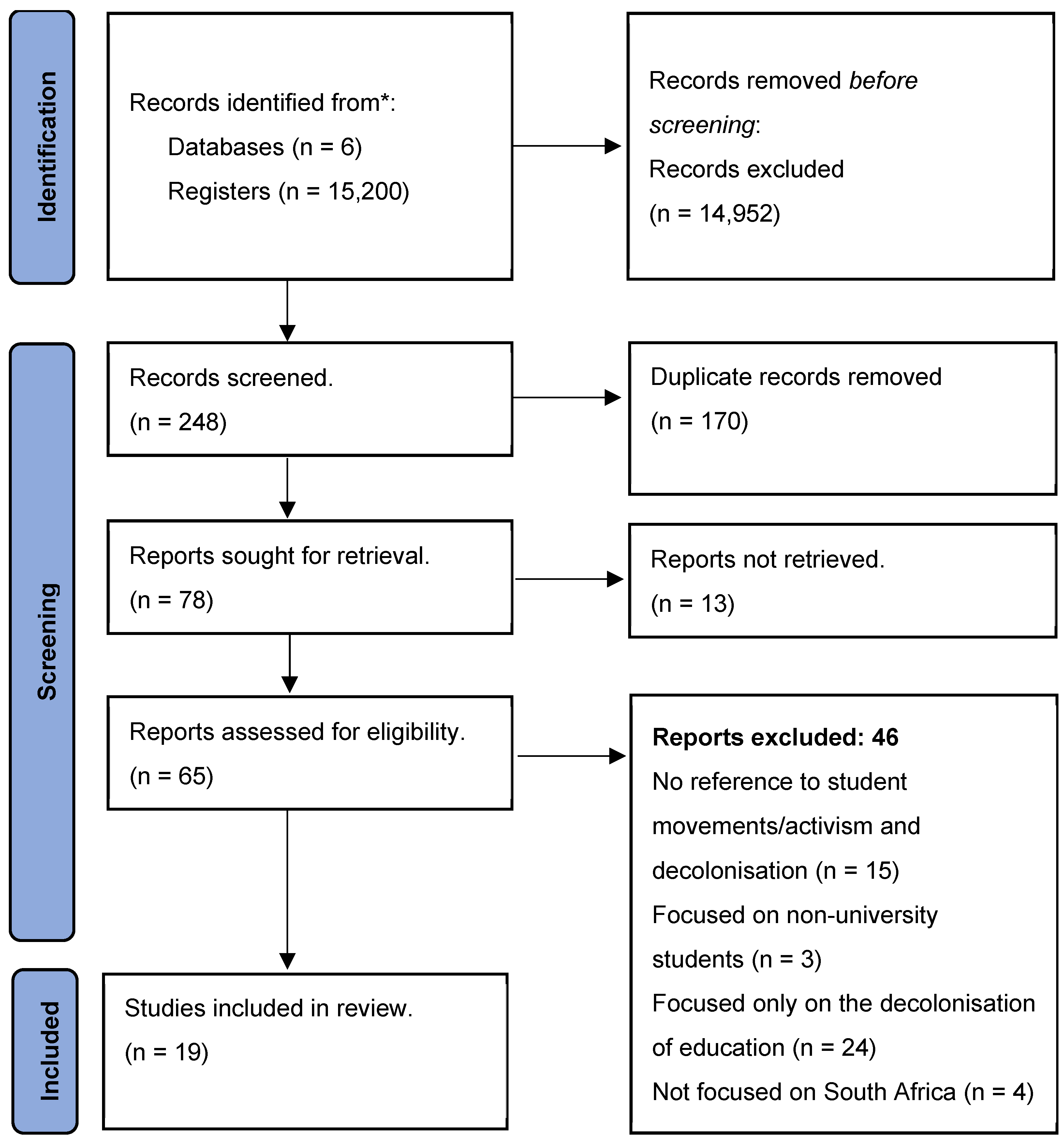
The selecting process consisted of three parts. Using the inclusion and exclusion criteria, two reviewers first independently reviewed the abstracts and titles. A conversation and collaboration with a third reviewer helped resolve the discrepancies that surfaced. Second, in order to confirm the research articles’ applicability and data accessibility, full-text evaluations were conducted. Figure 1 displays the number of studies that were screened, included, and excluded along with the rationale for their exclusion, as well as how the studies were chosen for additional research. Third, citations were tracked and duplications were removed using Mendeley Reference Manager v2.144.0, a reference management software. After the 65 articles were screened using the inclusion and exclusion criteria, it was discovered that 46 of them were eliminated because they met the exclusion criterion. The remaining 19 papers had their data curated.

2.4. Design

Quality Assurance

We used the Critical Appraisal Skills Programme (CASP, 2018)’s checklist (Long et al., 2020) to assess the 19 included studies that addressed the three main questions that the CASP tool focuses on when evaluating systematic reviews, which are: What are the primary findings and their validity? Are the results reliable? Are the findings relevant to the intended local population? The clarity of the research objectives and methods, the suitability of data collecting and analysis, the relevance to the Fallist Movements, and the rigor of presenting findings on the decolonisation of education were the main points of emphasis in this study. The studies were rated as high, moderate, or low quality. To ensure comprehensiveness, all relevant studies were included, and quality ratings were used to weight the findings in the synthesis. The CASP checklist was applied in this study to assess the quality of 19 included studies. Ten studies were rated as high quality, four as moderate, and one as low, with all included for comprehensiveness to ensure a broad evidence base. Quality ratings were used to weight findings in the narrative synthesis. To guarantee a wide body of evidence, data was generated from each of the 19 publications. To increase the credibility of the study, the two of us worked independently on data extraction and used an impartial third reviewer to resolve incongruities. The studies included for analysis are displayed in Table 1 below, showing the themes they addressed.

2.5. Data Analysis

The data of the 19 chosen studies were subjected to a thematic analysis (Braun & Clarke, 2006). In order to find recurrent trends pertaining to (1) disrupting positionality in colonial categories of universities, (2) reasserting their Being, and (3) agitating for a decolonised curriculum, each publication was reviewed multiple times. We meticulously reviewed the data line by line throughout the initial open coding phase, spotting concepts, patterns, and informational units. For us, comparison was an essential part of this phase since it made it simpler to identify and enhance new codes. Similar codes were grouped together to establish categories, which then became themes. The first level of abstraction and data organization was demonstrated by these categories, which arose from the linkages and relationships discovered between codes. The main analytical themes that arose from these codes are reported in the findings section.

3. Findings

The study explored how university students navigated colonial legacies in the education system in South Africa, and whether there were nuggets of resilience in the student actions that university academic staff could draw on to decolonise higher education and promote epistemic justice. Findings from document analysis showed that there were several waves of university student actions witnessed in South Africa. While these waves happened at different junctures, and at different universities, in South Africa, their purpose was similar—that is, to agitate for a decolonised university system. It is argued that the agentic behaviours of the students hold important lessons for university academic staff and leaders. The themes extracted from the documents reviewed are presented below.

3.1. Navigating Colonial Legacies in Higher Education

3.1.1. Positionality in Colonial Categories of Universities

To a larger extent, the way university students thought and acted was determined by the nature of the problems that they faced and the intellectual climate that prevailed at the time in South Africa. The “Fallist Movement”, which began in 2015 with the #RhodesMustFall agenda in South Africa, is a typical example. The #RhodesMustFall movement gave birth to other student movements (Msila, 2022). Remnants of colonisation and apartheid in the universities gave birth and impetus to these movements in South Africa. Excerpts from M. N. Hlatshwayo and Fomunyam’ (2019) paper, as well as from R. Naidoo’s (2004) work, revealed the apartheid-era categorisation of universities, which these scholars placed into three groups: (a) dominating tier, (b) intermediate tier, and (c) subordinate tier universities. The dominating tier universities are the British colonial era institutions, which R. Naidoo (2004) argued were vehicles for English ideals, ethics, and morals.
The dominant tier consisted of white English-medium universities that were set up in the colonial era for the British community. The intermediate tier were the Afrikaans-medium universities, also designated white, which were set up by the Afrikaans community during the Anglo-Boer war. Universities that were set up for the different groups of black South Africans were in the subordinate tier (R. Naidoo, 2004, p. 461) (paper 1).
The subordinate tier universities were starved of resources, research ecosystem, and opportunities for advanced studies. Black South Africans who championed the “Fallist Movements” gained admission into universities set up for British and Afrikaans communities and found a continuation of the colonial and apartheid legacies, which they had to navigate. The “Fallist Movements” became conscious that while the institutional framework and research output of the dominant tier universities remain globally recognized and competitive in a democratic dispensation, the subordinate tier universities continue to struggle for recognition and identity in their research and scholarship. The lived reality of Black Africans in the higher education system is one marked, as M. N. Hlatshwayo and Fomunyam (2019) attested, by inadequate funding, subpar facilities, and unstable social environments. They have had to navigate the binary imposed on the universities where they learn, with the most debilitating being the social labels in discourses of the historically advantaged, referring to the dominant and intermediate tiers, and the historically disadvantaged, referring to the subordinate tier group. The “Fallist Movements” are a confrontation of colonial and apartheid binaries that still define universities in the country.
Viewed differently, the agentic actions of students in the #RhodesMustFall movement reflected, for instance, confrontations with coloniality to reverse ‘cosmologicide’ in knowledge and learning. Kanu (2013) argues that the cosmology of a people is the nucleus holding together their value system, philosophy of life, social conduct, morality, folklores, myths, rites, rituals, norms, rules, ideas, cognitive mappings and theologies. In other words, it is the lens through which a people see reality, or perceive, conceive and contemplate their universe (Kanu, 2013; Mengara, 2001). The architects of the dominating tier universities (British) and the intermediate tier universities (Afrikaans), respectively, were clear about the central role of their cosmology in the institutions they established for themselves, but they downplayed the cosmology of the people they developed subordinate tier universities for. Then came the cosmological quagmire that Black South African students faced in the previously all-white universities:
In the dominant tier…universities… serve as an instrument of English values, ethics and morals. When the apartheid regime introduced the apartheid laws…, these universities became reserved for white students… [The intermediate tier universities] …acted as a socioeconomic and linguistic response to the dominant tier universities, and to help construct, maintain and extend Afrikaner national identity, values and cultural beliefs.… these universities …produce the apartheid, nationalist values… through the production of competing knowledge and ideologies as required and supported by the …regime. [S]ubordinated universities …set up for the different black South African ethnic groups… [grew] student movements and their concomitant political influence.
The stratification system produced both tangible and symbolic inequalities. The categorization labels introduced post-apartheid were intended to draw attention to the inequalities for the purpose of addressing them. In actuality, the categorizations have crystallized into status labels signifying a perpetual deficiency that serve as an excuse for underinvestment. This produces a situation in which historically becomes perpetually without changes in policy direction. Thus, the description of being historically disadvantaged institutions is that it makes disadvantage an immutable identity instead of an issue that could have been solved. The reason being that when describing institutions through their position during the apartheid era, one is saying that they will always be deficient in something hence making potential funders and partners feel like it would be better for them to avoid them. As a result, the institution will not get funding and research and as a result, the institutions remain in that category and therefore, receive no help.
The education of Black South Africans in the subordinate universities was to prepare them for a subordinate life in society, regardless of their cosmology. The Welsh Report, produced in 1936, made this point clear in its submission on the topic. The colonials asked:
Are we to Europeanise [them] as quickly as possible so that [they] can take [their] place in our pattern of Western civilisation with as little trouble as possible? Or are we to prepare [them] to develop along [their] own lines?
(Welsh, 1936, p. 233)
The failure to establish or maintain authentic African universities in South Africa (Badat, 2023) suggests that the material, structural and normative realities of research development, scholarly publishing and curriculum contents have been characterised by a persistent dominance of Eurocentric cosmologies in the tiers of universities. Afrocentric and Eurocentric cosmologies are not the same (Kanu, 2013), and bodies of research have shown that knowledge production is intertwined with cosmologies because cosmological perspective influences epistemology, methodology and ontology (Brown & Moyo, 2023; Peters, 2015; Viriri & Mungwini, 2010). In the eyes of the Black South African university students, the Afrocentric cosmology—i.e., their reality, being, and sustainer of the African universe—is absent from the curriculum they study and from the university campuses they traverse. In fact, such cosmology has been substituted and reduced to the margins of knowledge production and dissemination (Ndlovu-Gatsheni, 2015, 2018, 2020, 2022). The student activism in the previously all-white universities to counter exclusions of their cosmology is an important lesson, if the deeper issue regarding the whiteness of the student curriculum and university campuses or related colonial legacies is to be addressed (Peters, 2015).

3.1.2. Reasserting Their Being

The #RhodesMustFall student activism of 2015 was strengthened through the reemergence of the decolonial movement, which gained momentum at the turn of the 1990s in Africa, but which drew heavily from the Pan-African Movement of the late nineteenth century (Brown & Moyo, 2023). The decolonial movement acknowledges that all the atrocities of colonialism, imperialism and apartheid must be undone for black Africans to thrive. It calls on black Africans to “de-Westernise”, or “delink”, and “disobey” western coloniality (Mignolo, 2020), or to dismantle all forms of power relations that reproduce colonial differences (Maldonado-Torres, 2007). It inspires Africans to engage in “epistemological rebellion”, and to build resilience towards alternative paths of thinking and being. The Pan-African Movement explored how Black Africans, scattered around the world, could return to Africa, reunite, and rebuild a system of education and civilisation that embraces a common cosmology. The #RhodesMustFall student activism to remove the statue of Cecil Rhodes at the University of Cape Town and elsewhere (M. N. Hlatshwayo & Fomunyam, 2019), as well as other student campaigns such as those to remove the statute of King George V at the University of KwaZulu-Natal (Ntombana et al., 2023), exposed these issues, particularly as it relates to liberating Black Africana as ‘Being’.
At the core of the student campaigns across the previously classified dominant and intermediate university campuses is the rejection of the view, for instance, that the Rhodes statue represented whiteness as a singular mode of being in the world. In modernity, ‘Being’, as Maldonado-Torres (2007) points out, has a colonial side—interpreted, Eurocentrically, as those who can think and therefore are human, and ‘others’ who do not think or do not think properly, and therefore are not human and are dispensable. The decolonial literature has elevated Black African student consciousness and the students know that they and their ancestors are humans (Ndlovu-Gatsheni, 2020, 2022). The Cartesian formulation that Black Africans are incapable of thought and are not human is disproven, and the students perceive the drive to retain colonial effigies as attempts to privilege Eurocentric epistemology and coloniality of Being in the previously all-white universities and the wider societal context (Maldonado-Torres, 2007; Mignolo, 2020). Student activism is public mockery of the irrationality expressed in Western modernity regarding the absence of Being in others. The impetus to remove the statue of Cecil Rhodes at the University of Cape Town was, as M. N. Hlatshwayo and Fomunyam (2019, p. 63) comment:
…a deeply cultural act, guided towards eradicating [glare reminders] of colonialism…, and the cultural alienation that the statue invoked amongst students.
The student call for transformation was heeded. Black Africans understand the significance of reclaiming time and space, and by extension their Being, which had been trampled upon (Mazrui, 2006), but are deeply aware of the enormous narrative in Western modernity, which perceives the Black person as the condemned of the earth or as the people ‘not there’ (Fanon, 1965, 1968). The student activism is connected to this larger aspect of the decoloniality of Being. Maldonado-Torres (2007) argues that scrutiny of the key existential traits of the colonized or neo-colonised black reveals that unlike the European Being in Western modernity who achieves self-authenticity in the future at death, the existential reality of Blacks in Western modernity is such that they encounter death or self-authenticity on a day-to-day basis. That is why Fanon (1965, p. 128) writes in A Dying Colonialism that the black “…perceives life not as a flowering… but as a permanent struggle… experienced as unemployment, inferiority complex, lack of financial resources, endemic famine, and the absence of any hope for the future”. The daily death of the Black African students is exemplified in the #FeesMustFall campaign, which started in the same year as the #RhodesMustFall campaign, in several previously classified dominant and intermediate tier universities before spreading to others in South Africa (Ntombana et al., 2023; Sibiya & Ndaba, 2023). Sibiya and Ndaba (2023) as well as Ntombana et al. (2023) remark:
…the #FeesMustFall campaign was launched [in October 2015, which] eventually extended to all [public] universities… Initially, this protest advocated for no increases to the …tuition, arguing that most black and impoverished students could not afford the exorbitant expenditures of higher education.
One of the hashtags was #WitsAsinamali, meaning ‘we have no money’.
The protest actions of Black African students over financial resources to sustain their educational and related needs, and the wider social gnawing at their existence in universities in South Africa, tends to make their life something similar to what Fanon (1968) calls an incomplete death. The #FeesMustFall campaigns are remarkable events of Black African students confronting mortality, or what Gordon (2005, p. 4) calls their ‘hellish existence,’ as they navigate life in a neocolonial world. If student campaigns are to be viewed in this way, they imply that in the hell of the neocolonial world, Black African students at university campuses are to continually encounter extraordinary events—not limited to tuition or accommodation fees or debts. This point implies that Black conscious African students are likely to hold day-to-day campaigns or form other “Fallist Movements” in order to resist the coloniality of their Being or any attempts to normalize the extraordinary event. While the student agitation for change was heeded, the slogan “#WitsAsinamali”, which means “we have no money” (Ntombana et al., 2023), epitomizes the students’ resistance, refusal to die daily, rejection of all images of a colonial or neocolonial body, and assertion of real authority.
The students demanded free education or no fees; what they were doing was not to just assert authority, but to politicize the coloniality of Being, which was already premised on politics. In the eyes of those championing the essence of Western modernity, nothing good is supposed to come out from the Black social body, which they defined as sub-Other long ago (Fanon, 1968) and used to justify the continued manipulation of the material conditions of sub-Others, such as Black African students. Therefore, the student stance against fees, colonial effigies and cultures in the universities is important because it, among other things, is a counter force and resilience against dominant Western modernity perception of a dispensable Blackness, even under black political rulership, in post-apartheid South Africa.

3.2. Agitating for a Decolonised Curriculum and Pedagogy

Ndlovu-Gatsheni (2022) believes perception of a dispensable Blackness is part of the reasons African epistemology is disregarded in Western modernity and neocolonial world. Notwithstanding the Western, anti-black position, analysis of several of the papers on the #FallistMovements in universities in South Africa since 2015 revealed evidence of student calls for the decolonisation of higher education, or more specifically, the knowledge produced and fed to them through the curriculum (see Hardman, 2024; M. N. Hlatshwayo & Fomunyam, 2019; M. Naidoo, 2024; Badat, 2023; Waghid & Davids, 2016; Heleta, 2016). Hardman (2024) states:
Under the #feesmustfall banner, … in 2015 in South Africa …students … began to ask questions about knowledge in the academy. They questioned, for example, who determines what knowledge is being taught, whose knowledge is taught, and how the voices of previously marginalised people could be included in the re-development of university ways of knowing and knowledge production… #feesmustfall cast a light on the silences in Western colonial pedagogy.
(p. 147)
In Western modernity, only Europeans can ‘think’ (Baghidoost, 2018); such is the audacity of Eurocentrism. In other words, politics of geographic location and ethnic origin had in themselves been used as ontology and epistemology in Western modernity. Black students sensed epistemic colonial differences in their educational process, theory and practice in the universities in South Africa (Mignolo, 2020). Such concern is no doubt behind the series of questions that the students raised during their activism for change such as ‘whose knowledge?’ and ‘who determines the knowledge taught?’. These questions resonate with Ndlovu-Gatsheni’s (2013) conceptualization of the decoloniality of knowledge. As we contemplate the student questions, we should not lose sight of the philosophy of liberation in South Africa, as well as the wider continent, and its consequences (Mazrui, 2003). Undoubtedly, it was influential in making these university students and others aware in Western modernity of the pressing need for decolonisation, and the value of decolonial scholarship, or the urgency of decolonizing the curriculum, the pedagogy, the university systems, and their Being.
Students in South Africa raise questions about privileged knowledge in university curriculums, highlighting their role as champions in achieving a decolonised curriculum and African university.
One of the central messages that can be derived from these questions is that South Africa’s political liberation in 1994 did not liberate knowledge systems, because as it stands in universities, the dominant knowledge system continues to be the Western, neocolonial, neo-apartheid knowledge system, which privileges Eurocentrism and ways of knowing (Ndlovu-Gatsheni, 2017). Another message thrown up from the questions is the resilience of colonialism in the structures of society, particularly as a dominant way of knowing in the academy and social relations in South Africa. The argument in Western scholarships, which legitimises Western knowledge systems, Western ethnocentrism and knowledge producers as possessing powerful knowledge and as the knowledge of the powerful (Young, 2019), has long been discredited as a fallacy but the fallacy has remained difficult to eradicate in the academy in South Africa (Msila, 2022; Ndlovu-Gatsheni, 2018; Nyamnjoh, 2016; Mignolo, 1999; Waghid & Davids, 2016; Heleta, 2016). It is hardly any surprise then that, in their quest for curriculum decolonisation, students resorted, as Nyamnjoh (2016) asserts, to “nibbling at resilient colonialism [in the academy] in South Africa”, with the expectation that African intellectuals can pursue and bring African ways of knowing and knowledge systems into the academy.
A Eurocentric curriculum differs strongly from a decolonised curriculum and education—designed to halt the cultural alienation and estrangement of Black African people, and to, inter alia, embed them in their epistemologies, aesthetics, social structures, and cultural institutions (Msila, 2022; Ndlovu-Gatsheni, 2017). Unfortunately, cultural alienation in the learning environment exacerbated the protest for curriculum decolonialization and reform. Students asked:
Where are black lecturers, black non-academic staff? You move from one office to another, from one class to another, all you find is either a white or coloured [mixed race] lecturer. They don’t understand our situation as Black students, they don’t represent us, and this is part of the struggle.
Black university students’ classroom silence in historically White universities in South Africa is the feeling of not being understood and represented. The absence of Black African academics with whom they could identify and share cosmologies, worldviews, and cultural orientations influenced their silence. This revelation of alienation only emerged during the #FeesMustFall campaign, but it had long been suspected particularly among decolonial scholars who maintained that cultural and political difficulties exist in the learning setting of higher education for Black students (Msila, 2022; Nyamnjoh, 2016; Mazrui, 2003; Seepe, 2004; Botwe-Asamoah, 2005). Davis et al. (2004) identified five themes related to similar alienation among 11 Black students in a predominantly white southeastern university in the United States. Under one of the themes, ‘It Happens Every Day: Unfairness/Sabotage/Condescension’, Davis et al. (2004) reported white professors’ offensive comments, whereas under the theme ‘They All Seem the Same; I’m The One Who’s Different’, Davis et al. (2004, p. 425) found that students ‘felt relieved in classes taught by Black professors.’
The experience of students in South African universities highlights the urgent need for cultural decolonisation and the visibility of Black African identity and personality in the learning environment of the universities for Black students because past research illustrates that these difficulties have been barriers to education and graduation for Black students (Hooks, 1994; Laufer, 2012). The effort to decolonise the higher education academy in South Africa clearly needs to go beyond merely decolonising the curriculum or pedagogy, to include the structural, cultural and aesthetical spheres. The solution is an authentic African university, characterised by decolonial scholars as an institution that is culturally close to society; intellectually linked to the wider scholarly value of the world of learning (Mazrui, 2003); drives the development of African knowledge systems, epistemologies, and resilience; invests in Afrocentric curriculum and pedagogy (Msila, 2022; Ndlovu-Gatsheni, 2018); and delinks from Western modernity and supports African recovery of their Being (Mignolo, 1999, 2020; Maldonado-Torres, 2007).

3.3. Lessons from Student Agentic Actions for University Academic Staff

3.3.1. Understand University Indifference Towards Decolonial Praxis

In South Africa, the university environments and practices may have achieved Ali Mazrui’s highest stage of disempowerment, characterised as a conduit of western cultures (Mazrui, 2003; Walker, 2024). Academic staff have always been perceived as central figures in a university transformation process (Walker, 2024). However, with the persistence of power and privilege in the formal curriculum in South Africa (Jansen & Walters, 2022), academic staff have been criticised in recent years for being complicit in the movement to resist colonially shaped university transformation (Sibiya & Ndaba, 2023; Mbembe, 2016; Seyama-Mokhaneli, 2024). For instance, instead of joining the students’ #FallistMovement with tangible interventions to advance decolonial change, the academic staff engaged in theoretical discourses and stayed far away from praxis on how to decolonise the apartheid and colonially shaped university system. The insight that can be deduced for academics is that when they, as knowledge producers and change agents, ignore praxis and engage merely at a theoretical level, they achieve the curse that Ali Mazrui cautioned against, i.e., pushing the university politically closer to the State but more socio-culturally distant from segments of society (Mazrui, 2003). Seepe (2004), focusing on South Africa, hints that the colonially shaped universities are structured to reproduce themselves, which is a point of reflection for academics as they grapple to understand the university indifference towards decolonial praxis. Because “…the master’s tool will never dismantle the master’s house… [or] will never enable us to bring about genuine change” (Lorde, 2007, p. 112), Seepe (2004) concludes by suggesting coloniality is complex, stubborn, contradictory, and adaptive—thus, decolonial efforts must be equally responsive, agile, and dynamic. Coloniality is sustained by asymmetrical power relations that are historically determined and have their roots in colonial relations, which persist to be a defining feature of the dominance of the Global North in knowledge creation, particularly in South Africa and more generally in the Global South. Sebola-Samanyanga et al. (2025) contend that despite South Africa’s democratic transition, colonial epistemic frameworks still predominate in university curricula, obstructing attempts at decolonisation. African-centred approaches are marginalised or actively suppressed by institutional cultures, which continue to favour Western knowledge systems. It is commonly understood that neoliberal influences, such as the marketisation of universities, international ranking systems, rivalry for outside funding, and dominant power structures, define the modern university and pose serious challenges to decolonisation of education (Ndofirepi & Pietersen, 2025). These pressures frequently contribute to the perpetuation of structural injustices and put efficiency and financial measurements ahead of transformational needs.

3.3.2. Recognise the Philosophical Problem Regarding the Curriculum and Pedagogy

A central lesson emanating from the students’ #FallistMovements for academics is that the categorisation of the higher education system is still more or less the same as in the era of the colonial and apartheid rulership in South Africa, with the only shift being the labels being invoked. ‘Subordinate tier universities’ now wear the label ‘historically disadvantaged institutions’, whereas the ‘dominant and intermediate tier universities’ adorn the label ‘historically advantaged institutions’. The use of these labels in policy documents, everyday conversations and decision making is participation in, and maintenance of, coloniality. Even if the academic staff disagrees with the students concerning their actions to remove—symbolically or otherwise—the colonial effigies at their universities, it is evident that there is a general philosophical problem regarding the curriculum, pedagogy, and the physical environment of the academy, as well as the distance of the university from the cosmologies of the Black African population—and that no effort has been made to resolve it so far.

3.3.3. Be Role Models with Agentic Behaviour

The low proportion of African scholarship in global knowledge production and in the formal university curriculum, and the pervasiveness of Western pedagogical practices in the classroom in South African universities has long been recognized—a phenomenon which decolonial scholars have termed ‘epistemicide’ (Ndlovu-Gatsheni, 2015, 2022; Msila, 2022; Mazrui, 2003; Mamdani, 2016). The students’ agitation can be interpreted as nudges for academic staff, university leaders, and curriculum makers to deepen their reflection on their own decolonial consciousness, as well as their role in improving the student experiences through decolonising the learning environment, curriculum, structures and processes of the university. In this sense, the student activism directly challenges the academics to move out of their offices and lead the decolonisation of education, to be role models with agentic behaviour, targeted at re-centring the African thought system in knowledge production, scholarship, policy, governance, and the curriculum. These efforts are necessary to embed the Afrocentric loci of enunciation, epistemology, and cultures of scholarship in universities in South Africa (Mignolo, 1999).
As curriculum makers, and subject experts who set criteria for the kinds of learning experiences that are included or excluded from the curriculum (Mais-Thompson et al., 2025), academic staff cannot abdicate responsibility for marginalising African scholarship and learning experiences in the university curriculum delivered to Black African students. To avoid being perceived as collaborators and gatekeepers of coloniality in the eyes of students and the society (Ndlovu-Gatsheni, 2018), academic staff, particularly the Black academics, should embrace the revival of the university to align with their cosmology and identity—this is, to advance a coherent core of African languages for use in research and pedagogy; stem the epistemic violence against and deafness to the Afrocentric worldview and knowledge production; disrupt the hidden colonial and apartheid curriculum that supplies Black Africans with servitude education and replace it with a decolonised education whose purpose is to educate the African students to be resilient, to be leaders of society, to be astute handlers of power, with the skills to solve the problems they face in society, and to reproduce positive references to Africa (Mazrui, 2003; Ndlovu-Gatsheni, 2018).

3.3.4. Combine Efforts with Students to Pursue Coloniality as Ideology

At the same time, it is heartening that a new generation of African students in universities is actively pursuing coloniality as ‘ideology’. They could have easily remained non-agentic, considering the way in which social change to redress colonial and apartheid era atrocities in universities and society has been undermined, destabilized, and resisted over the last 35 years in South Africa (Seepe, 2004; Jansen & Walters, 2022). For Seepe (2004), there has been little progress in social change. One of the difficulties has been that the academic leaders, curriculum implementers, and policy makers have not combined efforts with students to pursue coloniality as ideology in Western modernity. Although frequently treated as something truthful or fixed, coloniality is an ideologically constructed social phenomenon (Maldonado-Torres, 2007). Therefore, when students and decolonial scholars talk about de-linking from Eurocentrism in pedagogy and the curriculum (Mignolo, 2020, 1999), Western epistemic rebellion (Ndlovu-Gatsheni, 2018), Western modernity and cosmology (Mazrui, 2003; Seepe, 2004), and a rejection of the colonial university model and structure (Nkrumah, 1970; Nyerere, 1974), they are not referencing anti-European sentiments, but rather an ideology that empowers people defined as Western (neo)colonialists. While academic staff and leaders are important to lead decolonialisation efforts given their direct involvement in the knowledge production, dissemination, and preservation process (Sibiya & Ndaba, 2023), in reality, Black academics and government policy makers have not yet begin to deconstruct and dismantle the ideology of ‘coloniality’ as it affects South African institutions in education, in government, in religion, and in the judiciary. This reality is perhaps the most salient lesson.
Jansen and Walters (2022, p. 238) show full awareness of the failure of the academy to address coloniality, arguing:
…for universities to deliver on the decolonisation of education project, a new radicalism is required that takes institutional analysis seriously as a point of departure for the decolonisation of knowledge.
Self-introspection is an immediate and urgent action that academics can pursue. Through self-introspection, academics can begin to understand and connect with the Black university students’ classroom silence in historically White universities in South Africa. There is a unique opportunity for academics, combining efforts with students, in South African universities to develop and define a clear idea of what a true decolonised knowledge and university looks like for the world.

4. Conclusions

Navigating colonial legacies in the higher education academy is a daily reality of Black students in universities in South Africa. The paper traced the lingering effects of colonial and apartheid legacies especially in the work of seven scholars who investigated the #FallistMovements that occurred in universities in 2015 and 2016 to show that university students navigated colonial legacies in the education system in three ways in South Africa. One of these is through their positionality in colonial categories of universities. The #FallistMovements are a confrontation of colonial and apartheid binaries that still define universities and the lived experiences of categories of students in the country. The reasserting of their Being is another way that students navigated the colonial and apartheid legacies. The rejection of the view that the Rhodes statue represented ‘whiteness’ as a singular mode of being in the world is illustrative of the student reassertion of their Being. The students’ rejection of all images of a colonial or neocolonial body, and assertion of authority by rejecting to pay tuition fees epitomized their refusal to participate in the ‘daily death’ that Fanon (1968) theorised. In all this activism was the student agitation for a decolonised curriculum, pedagogy and learning environment. They want a university environment that invests in Afrocentric curriculum and pedagogy and that drives the development of African knowledge systems, epistemologies, resilience, and support African recovery of their Being. The recognition of the Western hegemony and apartheid ideologies and their effects in the academy is a key lesson. The universities should resuscitate the unfinished business of prioritising deconstructing the current institutions and reconstructing African universities. The resilience of the students to continue to confront coloniality offers an opportunity for the academic staff to reflect on and think about the university indifference towards decolonial praxis and place more emphasis on impact in practice. Although the problem concerning the curriculum and pedagogy is philosophical, it is man-made. That is, the curriculum can be decolonised because it is an official selection of knowledge that structures knowledge in a manner that privileges a certain production of knowledge. The university needs to grow a new brand of academics, who can be role models with agentic behaviour and who are willing to combine efforts with students to dismantle coloniality and effect change. Furthermore, academic leaders are crucial in advancing the decolonisation discussions in higher education from a discursive to a practical level. To achieve an authentic African university requires academic leaders with a vision to disrupt coloniality as an ideology. However, while the endeavour to challenge this coloniality is viewed by many as a morally and intellectually necessary pursuit, the process is not easy to negotiate because of deeply embedded historical and structural inequalities. This is partly because those leaders with existing socio-economic authority, wealth, and influence resist attempts to implement necessary changes that threaten their privilege and hence use their power to maintain the status quo. That resistance makes systemic transformation difficult and slow. As such, the challenges of Global North dominance, particularly in knowledge production, involve a complex dynamic because of the inherent difficulty in negotiating this established power imbalance. Efforts to promote alternative perspectives and decolonise education and universities often face systemic resistance and entrenched structures that perpetuate the existing status quo.

Limitations of the Study and Future Research Directions

This study is limited to a systematic review of existing literature, which may not fully capture recent developments in the decolonisation initiatives by university lecturers in South Africa. Like other document-based research, the current study lacks empirical evidence, despite offering some important conclusions on how the academic staff can assist in navigating the colonial legacies in universities as they decolonise education. The findings must therefore be read with caution as they cannot be generalised. Considering that limitation, we propose that future studies must undertake empirical studies and interview students’ activists and university academics to have first-hand insights of the issues investigated herein to confirm, extend or refute, which ever will be appropriate. Additionally, the study focuses primarily on the Fallist movements in South Africa, limiting the generalisability of findings to other regions. Variability in the quality of reviewed sources and potential publication bias may also impact the comprehensiveness of the conclusions drawn. Thus, comparative studies between the South African student movements and other student movements from other countries could highlight common challenges and successful practices, enriching the global understanding of the decolonisation of education.

Author Contributions

Conceptualization, B.B. and P.C.; methodology, P.C.; software, B.B.; validation, B.B. and P.C.; formal analysis, P.C.; investigation, B.B.; resources, B.B.; data curation, P.C.; writing—original draft preparation, P.C.; writing—review and editing, B.B.; visualization, P.C.; supervision, B.B.; project administration, B.B.; funding acquisition, B.B. All authors have read and agreed to the published version of the manuscript.

Funding

This research received no external funding.

Institutional Review Board Statement

Not applicable.

Informed Consent Statement

Not applicable.

Data Availability Statement

All data generated in this study are contained within this paper.

Acknowledgments

The authors would like to acknowledge the contributions by the anonymous reviewers in shaping this article. The authors have reviewed and edited the output and take full responsibility for the content of this publication.

Conflicts of Interest

The authors declare no conflicts of interest.

References

  1. Ahmed, A. K. (2019). The rise of fallism: #RhodesMustFall and the movement to decolonize the university [Ph.D. thesis, Columbia University]. [Google Scholar]
  2. Asante, M. K. (1991). The Afrocentric idea in education. The Journal of Negro Education, 60(2), 170–180. [Google Scholar] [CrossRef]
  3. Badat, S. (2016). Available online: https://wiser.wits.ac.za/system/files/documents/Saleem%20Badat%20-%20Deciphering%20the%20Meanings%2C%20and%20Explaining%20the%20South%20African%20Higher%20Education%20Student%20Protests.pdf (accessed on 10 January 2025).
  4. Badat, S. (2023). Re-envisioning universities in Africa as African universities (pp. 12–39). Creating the New African University. [Google Scholar] [CrossRef]
  5. Baghidoost, B. (2018). Can non-Europeans think? Postcolonial Studies, 21(2), 267–270. [Google Scholar] [CrossRef]
  6. Botwe-Asamoah, K. (2005). Kwame Nkrumah’s politico-cultural thought and politics: An African-centered paradigm for the second phase of the African revolution. Routledge. [Google Scholar]
  7. Braun, V., & Clarke, V. (2006). Using thematic analysis in psychology. Qualitative Research in Psychology, 3, 77–101. [Google Scholar] [CrossRef]
  8. Brown, B. A., & Moyo, G. (2023). Recentring and building African thought systems: A theoretical and conceptual framework guiding a programme of actions. University of Zululand. [Google Scholar]
  9. Charles, E. (2019). Decolonizing the curriculum. Insights, 32(1), 24. [Google Scholar] [CrossRef]
  10. Cini, L. (2019). Disrupting the neoliberal university in South Africa: The #FeesMustFall movement in 2015. Current Sociology, 67(7), 942–959. [Google Scholar] [CrossRef]
  11. Critical Appraisal Skills Programme (CASP). (2018). Qualitative checklist. Available online: https://casp-uk.net/how-to-use-checklist/ (accessed on 14 February 2020).
  12. Daniel, A., & Miller, J. P. (2024). Imagination, decolonisation, and intersectionality: The #RhodesMustFall student occupations in Cape Town, South Africa. Social Movement Studies, 23(4), 495–516. [Google Scholar] [CrossRef]
  13. Davis, M., Dias-Bowie, Y., Greenberg, K., Klukken, G., Pollio, H. R., Thomas, S. P., & Thompson, C. L. (2004). A fly in the buttermilk: Descriptions of university life by successful Black undergraduate students at a predominately White Southeastern University. The Journal of Higher Education, 75(4), 420–445. [Google Scholar] [CrossRef]
  14. Dülks, J., Fekete, A., Karutz, H., Kaufmann, J., & Posingies, C. (2023). Identification of methodologies to quantify education system resilience—A scoping review. International Journal of Disaster Risk Reduction, 97, 1–22. [Google Scholar] [CrossRef]
  15. Fanon, F. (1965). A dying colonialism. Groove Press. [Google Scholar]
  16. Fanon, F. (1968). Black skin, white masks. Groove Press. [Google Scholar]
  17. Gordon, L. R. (2005). Through the zone of nonbeing: A reading of black skin, white masks in celebration of Fanon’s eightieth birthday. CLR James Journal, 11(1), 1–43. [Google Scholar] [CrossRef]
  18. Govender, L., & Naidoo, D. (2023). Decolonial insights for transforming the higher education curriculum in South Africa. Curriculum Perspectives, 43, 59–71. [Google Scholar] [CrossRef]
  19. Griffiths, D. (2019). Available online: https://www.sciencedirect.com/science/article/abs/pii/S0883035518312205#cited-by (accessed on 10 January 2025).
  20. Grosfoguel, R. (2007). The epistemic decolonial turn: Beyond political-economy paradigms. Cultural Studies, 21(2–3), 211–223. [Google Scholar] [CrossRef]
  21. Grosfoguel, R. (2011). Decolonizing post-colonial studies and paradigms of political-economy: Transmodernity, decolonial thinking, and global coloniality. Transmodernity: Journal of Peripheral Cultural Production of the Luso-Hispanic World, 1(1). [Google Scholar] [CrossRef]
  22. Grosfoguel, R. (2013). The structure of knowledge in Westernized universities: Epistemic racism/sexism and the four genocides/epistemicides of the long 16th century. Human Architecture: Journal of the Sociology of Self-Knowledge, 11(1), 73–90. [Google Scholar]
  23. Hardman, J. (2024). Decolonising pedagogy: A critical engagement with debates in the university in South Africa. Journal of Education, 94, 147–160. [Google Scholar] [CrossRef]
  24. Heleta, S. (2016). Decolonisation of higher education: Dismantling epistemic violence and Eurocentrism in South Africa. Transformation in Higher Education, 1(1), a9. [Google Scholar] [CrossRef]
  25. Hendricks, C. (2018). Decolonising universities in South Africa: Rigged spaces? International Journal of African Renaissance Studies—Multi-, Inter- and Transdisciplinarity, 13(1), 16–38. [Google Scholar] [CrossRef]
  26. Hlatshwayo, M. N., & Fomunyam, K. G. (2019). Theorising the #MustFall student movements in contemporary South African higher education: A social justice perspective. Journal of Student Affairs in Africa, 7(1), 61–80. [Google Scholar] [CrossRef]
  27. Hlatshwayo, S. A. (2000). Education and independence: Education in South Africa. Greenwood Press. [Google Scholar]
  28. Hooks, B. (1994). Teaching to transgress. Routledge. [Google Scholar] [CrossRef]
  29. Ibanga, D. (2016). Julius Nyerere’s philosophy of education: Implication for Nigeria’s educational system reforms. Africology: The Journal of Pan African Studies, 9(3), 109–125. [Google Scholar]
  30. Jansen, J. D. (1998). But our natives are different! Race, knowledge and power in the academy. Social Dynamics, 24(2), 106–116. [Google Scholar] [CrossRef]
  31. Jansen, J. D. (Ed.). (2019). Decolonisation in universities: The politics of knowledge. Wits University Press. [Google Scholar]
  32. Jansen, J. D., & Walters, C. A. (2022). The decolonisation of knowledge: Radical ideas and the shaping of institutions in South Africa and beyond. Cambridge University Press. [Google Scholar]
  33. Kanu, I. A. (2013). Trends in African philosophy: A case for eclectism. Filosofia Theoretica: Journal of African Philosophy, Culture and Religions, 2(1), 275–288. [Google Scholar]
  34. Kessi, S. (2025). Fallism ten years on: Reflections on the impact of the Rhodes must fall movement. New Agenda: South African Journal of Social and Economic Policy, 98(1), 1–14. [Google Scholar] [CrossRef]
  35. Kgatle, M. S. (2018). The role of the church in the #FeesMustFall movement in South Africa: Practical Theological reflection. HTS Theological Studies, 74(1), 1–8. [Google Scholar] [CrossRef]
  36. Laakso, L., & Adu, K. H. (2024). The unofficial curriculum is where the real teaching takes place: Faculty experiences of decolonising the curriculum in Africa. Higher Education, 87, 185–200. [Google Scholar] [CrossRef]
  37. Laufer, M. A. (2012). Black students’ classroom silence in predominantly white institutions of higher education [Masters thesis, Smith College]. Available online: https://scholarworks.smith.edu/theses/639 (accessed on 10 January 2025).
  38. Long, H. A., French, D. P., & Brooks, J. M. (2020). Optimising the value of the critical appraisal skills programme (CASP) tool for quality appraisal in qualitative evidence synthesis. Research Methods in Medicine and Health Sciences, 1(1), 31–42. [Google Scholar] [CrossRef]
  39. Lorde, A. (2007). Sister outsider: Essays and speeches by Audre Lorde. Crossing Press. [Google Scholar]
  40. Mais-Thompson, E., Brown, B., & Paul, N. (2025). Unique practices in teaching affective learning in a higher education applied curriculum. The Curriculum Journal, 36, 180–199. [Google Scholar] [CrossRef]
  41. Maldonado-Torres, N. (2007). On the coloniality of being: Contributions to the development of a concept. Cultural Studies, 21(2–3), 240–270. [Google Scholar] [CrossRef]
  42. Maldonado-Torres, N. (2011). Thinking through the decolonial turn: Post-continental interventions in theory, philosophy, and critique—An introduction. Transmodernity: Journal of PeripheralCultural Production of Luso-Hispanic World, 1(2), 1–36. [Google Scholar] [CrossRef]
  43. Maluleka, P. (2021). Fallism as decoloniality: Towards a decolonised school history curriculum in post-colonial-apartheid South Africa. Yesterday & Today, 26, 68–91. [Google Scholar] [CrossRef]
  44. Mamdani, M. (2016). Between the public intellectual and the scholar: Decolonisation and some post-independence initiatives in African higher education. Inter-Asia Cultural Studies, 17(1), 68–83. [Google Scholar] [CrossRef]
  45. Maringira, G., & Gukurume, S. (2017). Being Black’ in #FeesMustFall and #FreeDecolonisedEducation: Student protests at the University of the Western Cape. In M. Langa (Ed.), #Hashtag: An analysis of the #FeesMustFall Movement at South African universities. Centre for the Study of Violence and Reconciliation. [Google Scholar]
  46. Martinez, S. (2009). Controversial classrooms: How student protests and resistance changed the course of apartheid. The McNair Scholars Journal, 8, 159–172. [Google Scholar]
  47. Masango, C. T. (2023). “Asiphelelanga!” (We are not complete!): #FeesMustFall movement and higher education in post-apartheid South Africa. Safundi, 24(4), 239–265. [Google Scholar] [CrossRef]
  48. Mazrui, A. (2003). Beyond appropriation: Language, knowledge and discourse in the African context. In Z. Magubane (Ed.), Postmodernism, postcoloniality and African studies (pp. 99–125). Africa World Press. [Google Scholar]
  49. Mazrui, A. (2006). Nationalism, power and Africa at war. In Keynote speech at symposium on power and nationalism in modern Africa. Cornell University. [Google Scholar]
  50. Mbembe, A. J. (2016). Decolonising the university: New directions. Arts and Humanities in Higher Education, 15(1), 29–45. [Google Scholar] [CrossRef]
  51. Mbongwa, K., & Graham, L. V. (2022). In the beginning was the collective: Fallism, collectives, and “leaderlessness”. Safundi, 23(3–4), 170–188. [Google Scholar] [CrossRef]
  52. Mengara, D. (2001). Introduction: White eyes, dark reflections. In D. Mengara (Ed.), Images of Africa: Stereotypes and realities. Africa World Press, Inc. [Google Scholar]
  53. Metz, T. (2022). A relational moral theory: African ethics in and beyond the continent. Oxford University Press. [Google Scholar]
  54. Mignolo, W. D. (1999). I am where I think: Epistemology and the colonial difference. Journal of Latin American Cultural Studies, 8(2), 235–245. [Google Scholar] [CrossRef]
  55. Mignolo, W. D. (2011). The darker side of western modernity: Global futures, decolonial options. Duke University Press. [Google Scholar]
  56. Mignolo, W. D. (2020). On decoloniality: Second thoughts. Postcolonial Studies, 23(4), 612–618. [Google Scholar] [CrossRef]
  57. Mncube, S. (2024). Open educational resources as the panacea for the decolonisation of e-learning content in South Africa. Distance Education, 45(3), 418–438. [Google Scholar] [CrossRef]
  58. Msila, V. (2022). Bringing Africa into new epistemologies: Rethinking the University in Africa. Journal of Educational Research and Reviews, 10(3), 29–37. [Google Scholar] [CrossRef]
  59. Mutekwe, E. (2017). Unmasking the ramifications of the fees-must-fall-conundrum in higher education institutions in South Africa: A critical perspective. Perspectives in Education, 35(2), 142–154. [Google Scholar] [CrossRef]
  60. Naidoo, M. (2024). The mediation of coloniality in decolonisation developments in South African theological education. Religions, 15(2), 160. [Google Scholar] [CrossRef]
  61. Naidoo, R. (2004). Fields and institutional strategy: Bourdieu on the relationship between higher education, inequality and society. British Journal of Sociology of Education, 25(4), 457–471. [Google Scholar] [CrossRef]
  62. Ndlovu-Gatsheni, S. J. (2013). Why decoloniality in the 21st century? The Thinker, 48(10), 5–9. [Google Scholar]
  63. Ndlovu-Gatsheni, S. J. (2015). Ali A Mazrui on the invention of Africa and postcolonial predicaments: ‘My life is one long debate. Third World Quarterly, 36(2), 205–222. Available online: https://www.jstor.org/stable/24523153 (accessed on 10 January 2025). [CrossRef]
  64. Ndlovu-Gatsheni, S. J. (2017). The emergence and trajectories of struggles for an African university: The case of unfinished business of African epistemic decolonisation. Kronos, 43(1), 51–77. [Google Scholar] [CrossRef]
  65. Ndlovu-Gatsheni, S. J. (2018). The dynamics of epistemological decolonisation in the 21st century: Towards epistemic freedom. Strategic Review for Southern Africa, 40(1), 16–45. [Google Scholar] [CrossRef]
  66. Ndlovu-Gatsheni, S. J. (2020). African decolonization’s past and present trajectories. Current History, 119(817), 188–193. [Google Scholar] [CrossRef]
  67. Ndlovu-Gatsheni, S. J. (2022). Decolonization, development and knowledge in Africa: Turning over a new leaf. Routledge. [Google Scholar]
  68. Ndofirepi, A., & Pietersen, D. (2025). The mirror and the marketplace: Reflections on decolonial futures amid capitalist currents in African Universities. Journal of Educational Studies, 25(1), 212–224. [Google Scholar] [CrossRef]
  69. Nkrumah, K. (1970). Concienscism: Philosophy and the ideology for decolonisation. St. Martin’s Press. [Google Scholar]
  70. Ntombana, L., Gwala, A., & Sibanda, F. (2023). Positioning the #FeesMustFall movement within the transformative agenda: Reflections on student protests in South Africa. Education as Change, 27, 1–18. [Google Scholar] [CrossRef]
  71. Nwobodo, R. E. E. (2021). A dialogic of taboo in traditional Igbo society and the 21st Century mentality. Trinitarian International Journal of Arts and Humanities, 1(2), 100–115. [Google Scholar]
  72. Nyamnjoh, B. (2016). Rhodes must fall: Nibbling at resilient colonialism in South Africa. Langaa. [Google Scholar]
  73. Nyerere, J. (1974). Stability and change in Africa (1974). In J. Nyerere (Ed.), Man and development. Oxford University Press. [Google Scholar]
  74. Page, M. J., McKenzie, J. E., Bossuyt, P. M., Boutron, I., Hoffmann, T. C., Mulrow, C. D., Shamseer, L., Tetzlaff, J. M., Akl, E. A., Brennan, S. E., Chou, R., Glanville, J., Grimshaw, J. M., Hróbjartsson, A., Lalu, M. M., Li, T., Loder, E. W., Mayo-Wilson, E., … & Moher, D. (2021). The PRISMA 2020 statement: An updated guideline for reporting systematic reviews. BMJ, 372, n71. [Google Scholar] [CrossRef]
  75. Peters, M. A. (2015). Why is my curriculum white? Educational Philosophy and Theory, 47(7), 641–646. [Google Scholar] [CrossRef]
  76. Ruperti, R. M. (1973). Organogram of the south and southwest African education system. University of South Africa Press. [Google Scholar]
  77. Sebola-Samanyanga, K. J. P., Nkosi, H. Z., & Peter, K. (2025). The lingering coloniality of knowledge: Challenges to decolonising South African universities. Yesterday and Today, 34(1), 203–223. [Google Scholar] [CrossRef]
  78. Seepe, S. (2004). Towards an African identity of higher education. Vista University. [Google Scholar]
  79. Seyama-Mokhaneli, S. (2024). Critical conscious leadership for decolonisation: A Black consciousness perspective of authentically transforming leadership. Equality, Diversity and Inclusion: An International Journal, 43(9), 71–87. [Google Scholar] [CrossRef]
  80. Shai, K. B., & Molapo, R. R. (2018). The “Decriminalisation” of the #FeesMustFall movement in South Africa: An Asantean perspective. Commonwealth Youth and Development, 15(1), 16. [Google Scholar] [CrossRef]
  81. Sibiya, A. T., & Ndaba, M. (2023). Moving from discourse to praxis: Situating academics at the centre of decolonisation struggle. South African Journal of Higher Education, 37(3), 214–228. [Google Scholar] [CrossRef]
  82. Smith, L. T. (2012). Decolonizing methodologies: Research and indigenous peoples. Zed Books. [Google Scholar]
  83. Soudien, C. (2011). The contribution of radical Western Cape intellectuals to an indigenous knowledge project in South Africa. Transformation: Critical Perspectives on Southern Africa, 76, 44–66. [Google Scholar] [CrossRef]
  84. Suttner, R. (2010). ‘Africanisation’, African identities and emancipation in contemporary South Africa. Social Dynamics, 36(3), 515–530. [Google Scholar] [CrossRef]
  85. Taghavi, D. (2017). Exploring fallism: Student protests and the decolonization of education in South Africa [Master’s thesis, University of Cologne]. [Google Scholar]
  86. Táíwò, O. (2019). Rethinking the decolonisation trope in philosophy. Southern Journal of Philosophy, 57(S1), 135–159. [Google Scholar] [CrossRef]
  87. Viriri, A., & Mungwini, P. (2010). African cosmology and the duality of western hegemony: The search for an African identity. The Journal of Pan-African Studies, 3, 27–42. [Google Scholar]
  88. Waghid, Y., & Davids, N. (2016). Democratic engagement as denudation: Moving beyond risk taking. South African Journal of Higher Education, 30(4), 1–10. [Google Scholar] [CrossRef][Green Version]
  89. Walker, M. (2024). A capabilitarian approach to decolonising curriculum. Education, Citizenship and Social Justice, 19(1), 110–123. [Google Scholar] [CrossRef]
  90. Walsh, A. (2022). South Africa’s student activist turn in the decolonial present. Performance Research, 27(3–4), 150–160. [Google Scholar] [CrossRef]
  91. Welsh, G. H. (1936). The influence of primary education. In E. G. Malherbe (Ed.), Educational adaptations in a changing society (p. 437). Juta & Co. [Google Scholar]
  92. Werner, E. E. (1995). Resilience in development. Current Directions in Psychological Science, 4(3), 81–85. [Google Scholar] [CrossRef]
  93. Young, M. (2019). Knowledge and control. In New directions in the sociology of education. Macmillan Publishers. [Google Scholar]
Figure 1. PRISMA flow chart on the selection of studies.
Education 16 00887 g001
Table 1. Themes addressed by studies.
Author(s) & YearTitleTheoretical FrameContributions
1. Shai and Molapo (2018)The “Decriminalisation” of the #FeesMustFall Movement in South Africa: An Asantean PerspectiveAfrocentricityThe demand for quality and free higher education in South Africa.
2. Maluleka (2021)Fallism as Decoloniality: Towards a Decolonised School History Curriculum in Post-colonial-apartheid South AfricaA decolonial conceptual framework and Karl Maton’s Epistemic–Pedagogic Device as a theoretical frameworkThe advancement of an inclusive decolonial project that is concerned with relations within knowledge and curriculum and their intrinsic structures.
3. Hendricks (2018)Decolonising Universities in South Africa: Rigged Spaces?Pan AfricanismDecolonised education.
4. Taghavi (2017)Exploring fallism. Student protests and the decolonization of education in South Africa. Master’s thesis, University of Cologne Decolonised education, positionality in colonial categories.
5. Daniel and Miller (2024)Imagination, decolonization, and intersectionality: the #RhodesMustFall student occupations in Cape Town, South Africa.Not explicitly mentionedDecolonization and intersectionality.
6. Cini (2019)Disrupting the neoliberal university in South Africa: The #FeesMustFall movement in 2015 Reasserting their Being, Positionality in colonial categories, decolonising the university.
7. Ahmed (2019)The Rise of Fallism: #RhodesMustFall and the Movement to Decolonize the UniversityPan-Africanism, Black Consciousness and Black Radical feminismChallenge the epistemic architecture of universities in South Africa, Asserting their Being.
8. Masango (2023)“Asiphelelanga!” (We are not complete!): #FeesMustFall movement and higher education in post-apartheid South AfricaNot mentionedBetter access to education, epistemological transformation, and a more representative student and faculty population.
9. Mbongwa and Graham (2022)In the beginning… was the collective: Fallism, collectives, and “leaderlessness”Cultural reproductionAdvocated for decolonized, free university education, and an end to the exploitation and outsourcing of poorly paid Black university workers.
10. Walsh (2022)South Africa’s Student Activist Turn in the Decolonial PresentRace theorySolidarity against institutionalized neoliberalism. Identity and asserting their Being.
11. M. N. Hlatshwayo and Fomunyam (2019) Theorising the #MustFall Student Movements in Contemporary South African Higher Education: A Social Justice PerspectiveNancy Fraser’s social justice perspectivePositionality in colonial categories of universities, Reasserting their Being.
12. Kessi (2025)Fallism ten years on: Reflections on the impact of the Rhodes Must Fall movement. New Agenda: Decolonising education, Positionality in colonial categories of universities, and Reasserting their Being.
13. Ntombana et al. (2023)Positioning the #FeesMustFall movement within the transformative agenda: Reflections on student protests in South AfricaMarxist lensHaving a “liberated” education system that is fully transformed.
The decolonisation of systems and structures.
Exposed the limitations of the rhetoric surrounding decolonisation and the racial and socioeconomic equality.
14. Maringira and Gukurume (2017)Being Black in #FeesMustFall and #FreeDecolonisedEducation: Student protests at the University of the Western CapeNot clearly statedReasserting their Being.
15. Griffiths (2019)#FeesMustFall and the decolonised university in South Africa: Tensions and opportunities in a globalising worldNot explicitly explained.Free, decolonised education/university.
16. Kgatle (2018)The role of the church in the #FeesMustFall movement in South Africa: Practical Theological reflectionNot statedA free higher education.
17. Mutekwe (2017)Unmasking the ramifications of the fees-must-fall-conundrum in higher education institutions in South Africa: A critical perspectiveCritical perspectiveFee-free decolonised education system.
18. Hardman (2024)Decolonising pedagogy: A critical engagement with debates in the university in South AfricaVygotsky theoryThe call for fees to fall, a need to change the current curricula in the academy to reflect previously marginalised voices; a call to decolonise university-based knowledge.
19. Badat (2016)Deciphering the meanings, and explaining the South African Higher Education student protests of 2015–2016 The ‘decolonization of the university’, the social composition of academic staff, institutional culture, the inadequacy of state funding of higher education, the level and escalation of tuition fees, student debt, and the question of free higher education. It is not necessary here to set out the views and demands of the protestors on these issues.
Disclaimer/Publisher’s Note: The statements, opinions and data contained in all publications are solely those of the individual author(s) and contributor(s) and not of MDPI and/or the editor(s). MDPI and/or the editor(s) disclaim responsibility for any injury to people or property resulting from any ideas, methods, instructions or products referred to in the content.