1. Introduction
Teacher leadership is widely understood to be an important element of leadership practice that is distributed across a school community. Teachers can act as leaders through their influence on a variety of organizational objectives through the school and school district. Because teacher leadership tends to be closely linked to classroom practice (
Spillane et al., 2003), in some settings it may be an integral part of an instructional leadership approach, through the use of coaching models, mentoring, team leadership, etc. Given this proximity to instructional practice, the promise of critically oriented teacher leadership is increasingly considered a leverage point for generating equitable and just educational experiences for underserved students and students of color. However, how teachers develop and enact their leadership practice toward transformative change, and what factors influence their transformative teacher leadership, all remain important empirical questions.
This paper reports on research examining how four culturally relevant teacher leaders operationalize their transformative teacher leadership practice and how they make sense of their actual and aspirational influence within their school, especially as it pertains to equity, inclusion and justice. The participants were all teachers within urban schools at the time of the study. All of them have engaged in university-based leadership development activities, including pursuing administrative licensure through the same urban educational leadership program, with a particular focus on professional learning activities aligned with
Ladson-Billings’ (
1995b,
2023) framework for culturally relevant pedagogy (CRP) (
Scribner et al., in press). Building on this work, this study explores critically oriented teacher leadership by examining how four women teachers of color engaged their colleagues and influenced school and district activities toward equitable ends, embodying the tenets of transformative leadership theory (
Shields, 2025).
The development of culturally relevant teachers in teacher education is a well-developed area of study and scholars have developed and expanded analogous frameworks for culturally relevant leadership (
Horsford et al., 2011) and culturally responsive school leadership (CRSL) (
Khalifa, 2018). These frameworks explain how school administrators integrate community knowledge, cultural competence and critical consciousness in an effort to support academic excellence among marginalized students.
Watson (
2025) and
Horsford et al. (
2011) both highlight how the personal identities and experiences also inform one’s ability to enact leadership that is culturally relevant and emancipatory. However, there is limited discussion of how culturally relevant teachers influence their colleagues (i.e., acting as leaders toward their peers in the school settings) to implement CRP practices. We argue this type of influence (culturally relevant teacher leadership) can be seen as a form of transformative teacher leadership practice. The research presented here is guided by the following research question: How do culturally relevant teacher leaders of color operationalize transformative leadership?
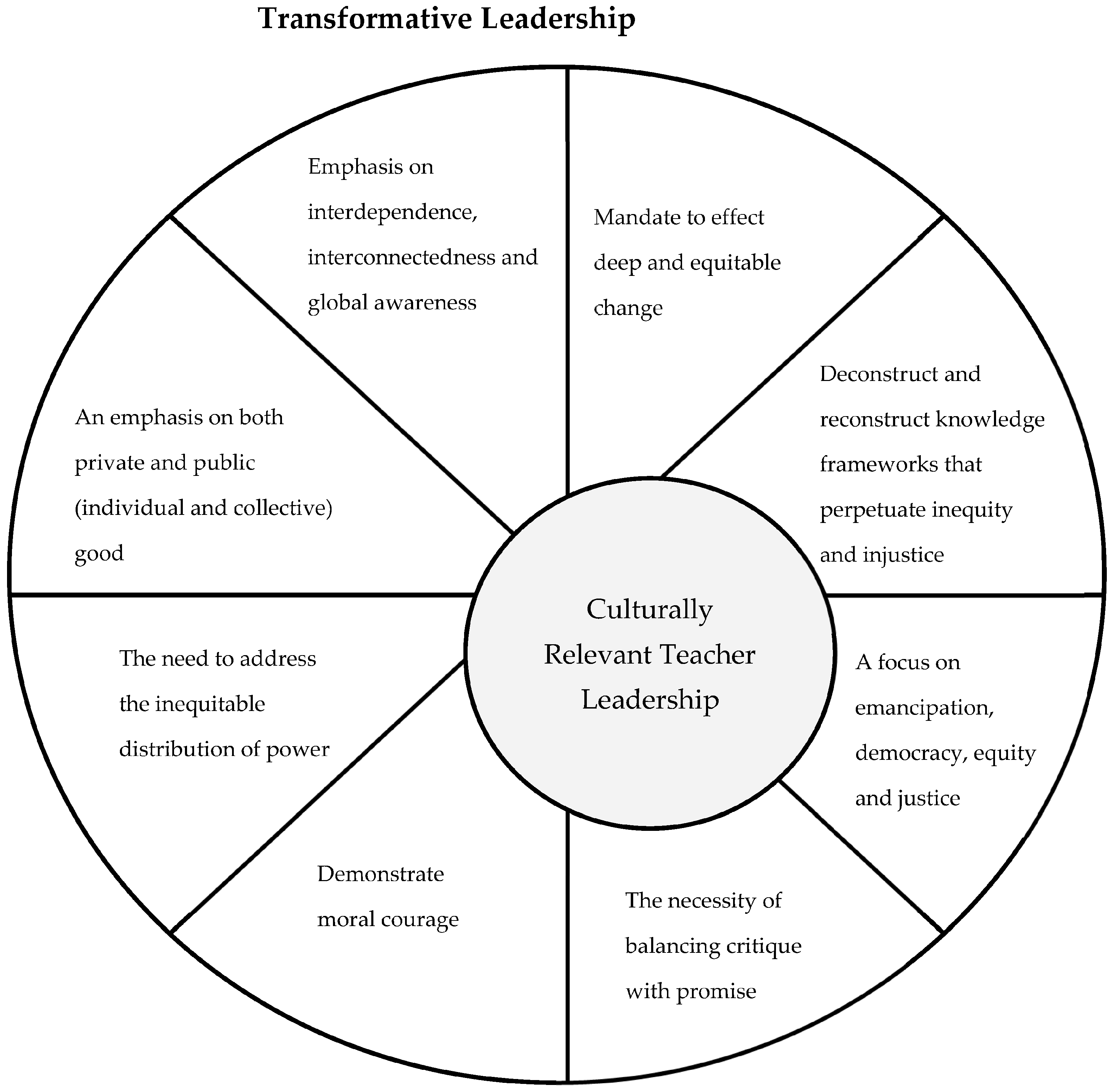
We investigated these questions by soliciting narratives of teacher leaders who exhibit critical consciousness visible through both their culturally relevant teaching and their influence in schools. Drawing from an analysis of data collected from in-depth interviews, document analysis and participant observations, we identified several themes illustrating how the teacher leaders’ view of students, families, community contexts and educational practice informed leadership actions aligned with transformative leadership theory (TLT). Our findings show various ways that the participants engage in transformative teacher leadership by detailing practices exemplifying one or more of the TLT tenets. In particular we focus on five of the eight tenets: (1) the mandate to effect deep and equitable change; (2) the need to deconstruct and reconstruct knowledge frameworks that perpetuate inequity and injustice; (3) a focus on emancipation, democracy, equity and justice; (4) the necessity of balancing critique with promise; and (5) demonstrate moral courage in the face of increasingly oppressive political environments. While there was evidence spanning all eight tenets, we found that given the teacher leaders’ positioning in their different contexts, their actions most substantively connected to these five tenets. In particular, we document how the teachers integrated their identities as educators, community activists, and women of color into their teacher leadership actions, linking larger societal inequities to their approaches to influencing practice in the school. This allowed for an analysis of culturally relevant teachers who, over time and through their development as critically conscious leaders, translated their practice into transformative teacher leadership.
2. Background Literature
Given increasing volatile and persistently inequitable contexts for educational institutions in the US, school and teacher leaders regularly confront pressure and, in some cases, explicit policies targeting justice-oriented discourse and practice. Examining when and how teacher leaders’ influence (i.e., leadership) may be transformative, as defined by
Shields (
2025), is important if we are to build capacity within and around schools to address pervasive inequity and to improve the conditions of traditionally marginalized communities. Scholars have increasingly been interested in how teacher leadership can contribute to equity and justice, beyond the normal operations of schools, and the typical internal performance metrics.
Shields (
2010,
2025) explains that limiting one’s focus to student achievement neither ensures improved equity nor does it necessarily contest the reproduction of inequity. For that reason, leadership across the school community (within and outside the school’s organizational boundaries) requires understanding how the focus and locus of educational change encompasses understanding how larger social, cultural and political forces must be disrupted to ensure better conditions for all students.
In this section, we review literature on teacher leadership to situate this study within the broader leadership literature. In doing so, we discuss how some research on teacher leadership might highlight one or more tenets of transformative leadership, even when transformative leadership is not an explicit framework. We note how documentation of various cultural and critically oriented examples of leadership broadly, and teacher leadership specifically, highlight instances of transformative leadership in North American contexts. Following this section, we build on this literature to articulate a conceptual framework illustrating the intersection of culturally relevant leadership and transformative leadership frameworks.
A scan of the literature reveals an increasing intersection of study of transformative leadership and teacher leadership. Some literature explicitly applies
Shields’ (
2025) framework to teacher leadership actions, while other critical analyses provide evidence that aligns to several of the transformative leadership theory (TLT) tenets. For example, one study of teacher leadership examines how inclusion-related professional learning shaped the perspectives of teacher leaders in ways that aligned with transformative leadership theory tenets (
Carrington et al., 2024). While this work connects the importance of teacher learning to teachers’ view of themselves as change agents, other critical scholarship provides additional observational evidence of transformative teacher leadership practice. While not always naming teachers’ leadership practice as “transformative,” a read of some of the critical scholarship on teacher leadership documents the enactment of certain transformative leadership tenets in their practice (
Pham, 2022;
Rojas, 2019).
Pham (
2022) spotlights how a Latina teacher leader of color organizes for action on behalf of Black students. With social change and racial justice as her guides, she documents how the moves of a teacher leader of color can serve as a counterhegemonic force in otherwise racialized and gendered social spaces.
Baker-Doyle (
2017) develops a transformative teacher development framework that explicates the dimensions of teacher leadership cultivated within three case studies of community organizational partnerships. This framework, while again, not citing
Shields’ (
2010,
2025) TLT specifically, delineates teacher leadership development across two domains (knowledge construction and relationship development) in which the teacher leadership competencies span four categories in each domain: (1) knowledge construction includes learning, techno-social development, modalities of learning and production and voice and storytelling; (2) relationship development includes sociopolitical development social capital and agency, role of the teacher and hybridity/third space. Across each of the categories,
Baker-Doyle’s (
2017) description of leadership relates to actions and dispositions necessary for the enactment of transformative leadership tenets as described by
Shields (
2025).
While transformative principal leadership is a more explored research terrain, the increasing prominence of teacher leadership as a necessary lever for change, as well as mounting evidence that critically oriented teacher leaders can be a driving force for equity and justice, suggests that examining teachers’ leadership through the TLT lens is merited (
Wenner & Campbell, 2017). Of course, transformative leadership brings with it its own set of questions pertaining to impact and support. For example, school and district leadership and policy can enable or inhibit equity-oriented, culturally relevant practices among teachers (
Horsford et al., 2011;
Marshall & Khalifa, 2018;
Waite, 2021). Given these hurdles, we are interested in how teacher leaders whose leadership can be described as transformative promote equity and justice in their schools in meaningful ways. Because culturally responsive and critically oriented leaders (teacher leaders and administrators alike) demonstrate the enactment of critical knowledge and dispositions (
Holmes & Young, 2018;
Horsford et al., 2011;
Marshall & Khalifa, 2018;
Waite, 2021), examining teacher leaders through the TLT lens can illuminate the synergies across various foci of critical teacher leadership as instances of transformative leadership, thereby expanding the evidence base for the complex work of advocating and achieving equitable and just educational outcomes within and beyond school walls.
4. Materials and Methods
This qualitative study was designed to examine how teacher leaders operationalize transformative teacher leadership. We did so by soliciting stories from teachers who were previously identified as culturally relevant teachers and teacher leaders through their participation in a larger study on culturally relevant pedagogy in mathematics and science and/or engagement in a leadership preparation program internship. Each teacher leader engaged in long-form interviews through which researchers were able to document narratives about how they enact transformative leadership in their practice. In this section, we describe who the participants were and how they were selected, the data sources, the data analysis process, and our researcher positionalities.
4.1. Participants
The participants in the study were known to the researchers for between 5 and 10 years, having gone through university teacher and administrator preparation programs and professional development projects—all of which were characterized as urban-focused programs centering on educational equity and justice. These participants stood out because of their commitment to CRP, their astute insights, and the interest and care with which they engaged their fellow teachers. All four of these participants identified as Black/African American women and were selected because of their experiences in formal teacher leadership roles. As noted above, all four had been engaged in larger projects. Their gender and race/ethnicity identities were not requirements to participate; however, their teacher leadership experiences and practices qualified them for this study. As an in-depth qualitative study, we limited the participation to these exemplars.
Over the course of the study, three of the participants advanced in their careers, assuming formal teacher leadership roles such as instructional coaching or team leadership responsibilities; one participant continued as a classroom teacher, but displayed leadership roles nonetheless and expanded the ways in which she led within the school and community. Below are more details about each participant. Pseudonyms are used for each participant to protect anonymity.
Benita. Benita works as an instructional coach in a large, urban school district and she identifies as a Black woman. Before this position, she taught in this same district for five years. Her experiences as an educator have been in different schools serving majority Black students with her total teaching experience being 8 years.
Danielle. Danielle began her career 16 years ago as an elementary level instructional assistant and she identifies as a Black woman. During that time, she became a classroom teacher (5 years ago), and an elementary instructional coach within a school building. Danielle is currently serving in her second year as district-level middle school STEM instructional coach. All of Danielle’s experiences as an educator have been in large, urban fringe districts.
Miranda. Miranda identifies as a Black woman who began her career as a middle school Spanish teacher at an urban charter school before moving to an urban fringe, public middle school 11 years ago. She eventually transitioned to become the lead AVID teacher at the school. Recently, Miranda became an assistant principal at an elementary school in a large, urban district.
Natalie. Natalie identifies as a Black woman and, over the course of the study, was an elementary school teacher at two different elementary schools in an urban fringe district. Natalie also attended K-12 schools in this same district and currently resides in the community. She served as a leader within the local teacher’s union and was active within the union affinity groups and professional development. Natalie has been a classroom teacher for 7 years, with over 10 years before that working in schools in various capacities (substitute teacher, coach, etc.)
4.2. Data Sources
Data were collected using a three-part protocol for in-depth interviews, participant observations and a review of relevant documents. The interviews followed
Seidman’s (
2019) protocol for investigating lived experiences. The three-part protocol focused on (1) relevant biographical experiences, (2) daily work experiences as it related to their work enacting and advocating culturally relevant practices in their schools, and (3) participants’ sensemaking of their past and current experiences and the factors that inhibited or enhanced their ability to do culturally relevant work as teacher leaders. Each interview lasted for at least an hour, and subsequent interviews were conducted approximately four to eight weeks apart, allowing the research team to review transcriptions, identify initial themes, and adapt subsequent protocols in order to pursue meaningful lines of inquiry. All four interviews were completed between the months of January and August in 2025.
Observations of their classroom and leadership practice occurred over a three-year period up to and including the period during which the above interviews were conducted. Field notes from participant observations of their classroom practice, as well as their work with other teachers and administrators provided information about their practice and allowed researchers to refer to some of these experiences during the in-depth interviews. Finally, other relevant documents, including participants’ artifacts from their work in schools, school and district policies referenced in the interviews, and state legislation (educational and otherwise) that impacted their work lives were examined to get a more detailed understanding of the contexts they were navigating on a daily basis.
4.3. Data Analysis
We engaged in a multilayered/multilevel analysis to explore themes identified within and across each narrative, seeking alignment with and transparent connections to the research questions (
Anfara et al., 2002). Preliminary coding was done using a constant comparative method (
Glaser, 1965). We individually coded transcripts and documents utilizing transformative leadership and CRP tenets as a guide. During this process, we identified ways in which the data aligned or conflicted with the transformative leadership tenets. We presented and negotiated our individual codes so that there was clarity and consensus. These coding collaborations also helped surface the most salient themes.
We also identified ways in which the teachers described challenges, conflicts and/or supports they encountered in their work. This allowed us to examine how their leadership actions intersected with organizational and policy threats or supports, and how these intersections shaped their leadership action. By doing this, we identified how they navigated and overcame contexts characterized by what
Shields (
2025) called VUCA (volatility, uncertainty, complexity and ambiguity). This way, we examined in what ways the operationalization of CRTL, as narrated by the teachers, was transformative. Finally, we analyzed across cases to iteratively refine and distill salient intersections of CRTL as examples of transformative leadership. The results are themes, based on the teacher leaders’ narratives, co-constructed based on researchers’ interpretations of the data and engagement with the participants.
4.4. Positionality and Reflexivity
We are three White-presenting faculty researchers (two Urban Teacher Education and one Educational Leadership) and one graduate student, originally from Ghana. The faculty researchers have had a relationships with the participants ranging from 5 to 10 years through professional development projects and preparation programs. Benita, Danielle and Natalie completed the teacher preparation program and a years-long professional development project with the teacher educators. Benita, Danielle and Miranda all completed the administrator preparation program with the educational leadership faculty member. Due to the long-term relationship, the participants were comfortable texting faculty with questions, requests for support, or advice prior to the initiation of this study. Given the faculty’s long-term engagement in each of the participant’s districts in a variety of capacities, they also shared somewhat of a shorthand when it came to discussing relevant reforms or policy and leadership changes.
On the other hand, while one member of the research team is non-white, no one on the team identifies as Black American. As a result, we were intentional during the interviews to seek clarification and check our assumptions. Even when the participants felt comfortable sharing instances when they experienced racism and assumed the researchers understood, we tried to make it a practice to seek clarification and explicit meaning of said experiences. The three-part interview protocol served us well in this respect, as we were able to revisit recordings and transcripts and check our understanding in subsequent interviews.
5. Results
Each of these Black women teacher leaders currently serve in urban school districts. All four recounted entering the teaching profession as fate, although three of them (Miranda, Benita, and Danielle) did not initially envision teaching as their career path; only Natalie had. Natalie, having grown up as the eldest daughter, eldest granddaughter, and eldest cousin, spoke about how she assumed a nurturing role in her family, which led her to believe that she was “being prepped to become a teacher.” The other three women, however, describe stumbling into the teaching profession, but in a way that felt as though it was always meant to be. Benita was a nursing major but was not very passionate about her anatomy classes, so she prayed for direction and dreamt of herself teaching kids; she took that as a sign. Danielle wanted to be a doctor but discovered her passion for working with underserved youth instead. Miranda tried to fight her teaching blood, as she came from a long line of educators, and only applied to the Teach for America program as a backup in order not to have “all her eggs in one basket” as her mother had advised; she got in, and she has been teaching ever since.
During the time of this study, all four women were working in contexts that were characterized by volatility, uncertainty, complexity and ambiguity (VUCA). For one, increasing volatility induced by anti-Critical Race Theory (anti-CRT) and anti-Diversity Equity and Inclusion (anti-DEI) movements by parent groups and subsequent policies threatened much of the equity-oriented work in which these teachers were actively engaged. Principal churn introduced uncertainty for some of the teachers who were navigating changing leadership roles, and shifting loyalties among administrative teams. In addition, the increasing presence of the United Stated Immigration and Customs Enforcement (ICE) in school communities was threatening student and family safety, and affecting school attendance. In all cases, these teachers were clear on their purpose, stance and advocacy; however, they were operating in a climate that was steadily becoming more and more hostile to the equity-oriented, culturally responsive orientation they were used to promoting.
In this section, we document how these four Black women enacted their identities, purpose, and influence as transformative teacher leaders. Focusing on five of the eight tenets of TLT (
Shields, 2025), we detail how their commitment to students, equity and culturally relevant pedagogy informed their leadership in ways that exemplify the transformative nature of their leadership. In different settings, each teacher leader: understood their purpose as affecting deep and equitable change; actively disrupted deficit perspectives about students and communities; understood and articulated the possibility of education as emancipatory; balanced critique with respect and support for colleagues; and demonstrated moral courage in the face of increasingly politicized times.
5.1. Purpose as Leaders: Mandate to Effect Deep and Equitable Change
For these teacher leaders, their professional purpose was tied to their desire to effect institutional change in order to achieve equitable outcomes for marginalized students. Miranda framed good teaching and leadership as inseparable from equity to the point that she rejected the label of “culturally relevant teacher,” clarifying that “you’re not doing education if you’re not doing equity.” She approached her teaching and leadership as a reflective practice. Rather than assuming that, if something worked, it would continue to work, she would collect data, analyze, and break it down in different ways, and then constantly ask, especially for her students with disabilities and those who were multilingual learners, “What about my teaching isn’t meeting their needs? What about my teaching isn’t working for them or isn’t having them grow on these assessments and other things?” This approach translated to her teacher leadership roles as well. Whether as a teacher leader of her district’s racial equity initiative, or as a department head, she was constantly refocusing her colleagues on how their work would impact access for underrepresented populations. She actively recruited non-English-speaking students to the AVID Program (a college going preparation program) and saw her role on the Equity Committee as a perfect fit for her leadership aspirations. In fact, she advocated to her principal to represent the school on the Equity Committee. For Miranda, her work as the district equity committee liaison was central to her influence at the school.
[The District Equity work] wasn’t presented at [our school] unless…I discussed it with people… I tried to pull in lots of different people and get lots of different voices, and even connected to a student organization we had at the time.
[Miranda interview 1].
For Natalie, her deep commitment to equity is integral to her identity and shapes her teacher leadership. She described her purpose in the following words:
That’s who I am…My mother trained me to be for the underdog. My father trained me to fight, stand up for something. That [you need to] stand up for something or [you] fall down for anything… that’s what he believed, that’s what we believe.
[Natalie interview 1].
As a teacher leader, Natalie ensured that her marginalized students were represented in her curriculum. She was the “go to” teacher to whom struggling students were sent, as she was seen as effective in teaching and addressing their social/emotional needs. Natalie’s influence extended beyond her own classroom. In the second school she taught in she describes doing a project for Black History month where her students created posters of significant Black individuals. These posters were hung up around the school and created a buzz among the students. Natalie explained,
Students came in and wanted to know what project this was and they wanted to do it. They wanted to be a part of this and I see my role as not just being the teacher for my class and my grade but also for all the children in the school.
[Natalie interview 2].
Equally important, Natalie’s role as a teacher leader in the teachers’ union was another manifestation of her purpose as an equity-oriented leader. Natalie sought leadership opportunities among the Black and Brown affinity groups in the teachers union, because she believed teachers of color were not only sorely needed in urban schools, but were too often unsupported in their roles.
Benita was explicit in how she connected her identity as a culturally relevant teacher leader to effecting equitable change. Her commitment to equity stemmed from her experience as a student of color who did not have a Black teacher until college. For Benita, the most important aspect of equitable change is the emphasis on being able to see and relate to those who have some shared experiences, and advocate based on this understanding. In other words, while content knowledge is vital, if a teacher does not know the child, much less know how to build a relationship with the child, inequities will persist. Benita was observed on multiple occasions talking with first graders about bed-times when they seem tired in class, communicating high expectations, while also asking about their family members, demonstrating her familiarity with students outside of school. She explains:
When you think about our district training, we’re always trained on the curriculum. They might have one person come and speak about, like, racial equity, or something like that, for maybe five or ten minutes. But, that’s it. Even in the [professional development] that we have throughout the year, our district never really … hits what it means to be culturally responsive. And, so I think it starts with the top down. Even in our building meetings, like, every time you go to a [professional development], it’s either a math [professional development] or it’s a reading [professional development]. But understand that before we can even get into content, we have to start with relationships. And so and just having the right heart and disposition towards students and families. Because that truly is a lot of our problem.
[Benita Interview 1].
Benita’s emphasis on relationships versus content was not an either/or proposition. Rather it was an acknowledgement that the ends of education in her view extended beyond internal performance measures. Instead they had everything to do with the educational potential and subsequent access to opportunities afforded to her students. Reflecting on her experience as a teacher as she was moving into the role of instructional coach, she said:
It wasn’t like a big ask for me to just focus on literacy. Because I believe that literacy is a civil right. In 5th grade I had kids that were reading on a kindergarten level. And so that was alarming, which was the reason why I made the jump down from 5th grade to 1st grade, because I was like Hey? You’re getting through all this schooling, and you’re getting to the 5th grade, and you still can’t read. I did [a literacy] training and fell in love with that. And I started doing that in my 1st grade classroom. So kids that … truly struggled with reading were making huge gains.
[Benita Interview 1].
In Benita’s view, understanding her purpose as an educator was inextricably tied to making sure her students succeeded later in life. This in turn translated to her role as an instructional coach working with elementary teachers in literacy.
Danielle currently works as a district-level instructional coach. However, when she talks about how she thinks about her work, she cannot separate that from what it means to be a Black woman, mother and educator.
I mean, when I think about myself and learning…what it means to be a black woman in the United States… that didn’t really start until I went to [an HBCU]…Now I’m a mom of two, and then I meet [my professors in the teacher education program]. So to have that passion reignited all over again, and that validation all over again… right now, [in education] we’re just hamsters on a wheel and like, and if we don’t change the policy, then nothing’s going to change for these kids. And so, I think that kind of passion like started from the work that we did [in the culturally relevant professional development program] because it just opened my eyes to, okay, there’s one, there’s another way to teach same standards, but another way to deliver that speaks to children, and we have to do something about the world that we live in. We can’t just keep taking it and be passer-byers. That’s like not going to work.
[Danielle Interview 1].
Danielle describes her development as a critical educator, and her evolving purpose as a teacher leader. She sees her role as an educator (including one who is now working with teachers) as a vehicle for “doing something about the world we live in.” Rather than being a passive teacher, content with being handed the proverbial teacher-proof lesson plans, Danielle applies her skills and knowledge of culturally relevant mathematics and science curricula as a call to teach for students rather than at them, with the purpose of opening up opportunities for each and every student. She did this in the classroom in 2021 when she revised a science lesson on germs to incorporate information about COVID-19, something all students had lived through and could relate to immediately, given the timing.
In each teacher leader’s case, their articulation of their purpose as effecting deep and equitable change is profoundly shaped by their own educational, personal and professional experiences as Black, educated women. Their positionality allows them to speak and act substantively, incisively and consequently about changes needed in their contexts, and for their students.
5.2. Disrupting Deficit Perspectives and Challenging and Reframing Low Expectations
Throughout their careers, despite their years of experience and various positions or work contexts, these teacher leaders were comfortable and skilled at challenging and reframing deficit perspectives. Miranda was consistently observed challenging peers’ understanding of racialized dynamics in professional development spaces. She explained her perspective this way:
My issue …is like people viewed anything [equity-related] as an addition to the plate versus the plate itself, and so, that then became hard as well as, if we’re really doing this with intentionality, it should be infused in all the things we do, like every PD [professional development] should actually be the equity PD. And so when we talk about, like getting students to speak in class, it’s not because, like now, students aren’t speaking, it’s because we have not created an environment where all students can thrive and are comfortable enough and safe enough to speak in class which, like that, is an equity issue.
[Miranda Interview 2].
Miranda’s Equity Committee work with her colleagues gave her ample opportunities to call out deficit perspectives as they were applied to students and families. For example, in 2021, Miranda created a video to give students an opportunity to voice what they were experiencing and going through at [the middle school]. This was a part of an asynchronous equity professional development. The students and families were asked if they were willing to participate, and were given the option of using, not using, or obscuring their voice/name/image. Students were asked:
- ○
What has your experience been like at [the school]?
- ○
How have you (or not) been shown that you are valued, loved, and cared for racially at [the school]?
- ○
What do you know to be true about your race here at [the school]? What are the expectations of your race here at [the school]?
- ○
What sort of racialized experiences have you witnessed here at school?
Staff were then asked to reflect using an online forum on the process of hearing from the students. Most staff participated, and all staff were sent the materials so that they could engage. Explaining the impetus and process, Miranda said:
I think I was getting fed up, hearing the same sort of stories [from my students] about kids and their experience or kids of color specifically, and their experiences in school, and why and how similar those were to my experiences in school [as a student of color]. And so we created a video, they could decide if they want to show their faces or just have audio. Their parents also had to sign, and it was shared with Staff, and their parents knew that, that it was going to be shared with their staff to then use towards professional development, and whether or not, they had their names there was also up to them, and so they [students and parents] had a lot of choice in how these things were presented… But that was a really cool moment…it was a cool opportunity for Staff to hear from students.
[Miranda Interview 2].
Miranda’s observed that students of color were still experiencing the kind of low expectations and discrimination that she remembered experiencing as a student herself. This reality informed the confidence with which she challenged her colleagues, saying things like: “I can’t support you as my colleague when you’re actually in the wrong [in how you spoke to a student]…we have to be mindful of how we are toward our students and interact with them.” She goes on to explain:
It’s crazy…[students shared] their experiences in school from lots of different backgrounds, in terms of like racial backgrounds, socioeconomic backgrounds, whether or not they were in honors classes or not, if they were classified as ENL at one point in life, or they had an IEP or a 504 plan like any of those things, there was a lot of that. I think a lot of staff members could really hear that and reflect. There was also a good amount [of the message] that was missed. I got some pushback on like, well, I didn’t hear from any SPED kids, and I was like, well, that’s because I can’t just tell you if they have an IEP.
[Miranda Interview 2].
Benita emphasized her belief that teachers’ deficit perspectives directly influence students’ outcomes, and therefore, it is important to confront and disrupt such perspectives. In her role as instructional coach, she recounted an instance involving a teacher who had low expectations for a student of color struggling with the “sh” and “ch” sounds. As Benita talked to the teacher, the teacher’s deficit mindset became more apparent. Benita said, “it’s always he can’t do this, and she [the teacher] will bring you proof that he can’t do it”. Benita stepped in the next day, and “he was getting it.” Benita recalls her reaction as she described the situation:
[Chuckling] I love when I can prove a teacher wrong … I took him back to his teacher, and I said, I don’t know what he wrote for you on Friday, but he wrote it today, and what I had to tell her, sometimes you have a preconceived notion of what [a student can do]… And I don’t do anything different.
[Benita Interview 2].
Danielle likewise, recognized that in her district “there is not so much of a lens of we want kids to be great.” She described the school culture as one with minimal structure and one where teachers are not held accountable to seeing students as capable and brilliant.
We just show up and we clock out. I think maybe the bell rings about like 3:50 or so, they’re in the parking lot by 4. So like in the one, there’s no structures here, either. Like for PLCs and common planning time. All those things don’t exist.
How teachers perceive the students in their classroom impacts how teachers show up. Danielle emphasizes how when teachers see their students as “just a kid that comes to me with nothing” it is hard for teachers to take time to design lessons specifically for them, to collaborate with each other or to be fully invested in the practice of teaching. This lack of connection to their students over time becomes an excuse for not creating engaging curriculum or learning opportunities for students. The teachers’ attitudes towards students are also reinforced by the administrators inability/unwillingness to expect meaningful PLC and common planning time. To change this, Danielle met with teachers and built trust and respect over the course of her first year at the school. She showed them that she too, was a teacher and that she knew what it felt like. All of this supported Danielle to become an influence and voice for the middle school math and science teachers in the district.
The teachers disrupt deficit perspectives and challenge and reframe low expectations in multiple ways but with the ultimate goal of helping teachers see students as capable and worthy of time and effort. While all of the work involves teachers, each of the stories described above used different leadership strategies to push teachers to rethink how they view students and to better understand the assumptions that they make.
5.3. Education as Emancipatory, for Individual Student Learning and Community Uplift
Part of having the instinct to disrupt deficit thinking is the ability of leaders to articulate the consequences of such perspectives on the educational and material opportunities made available to underrepresented students. There were several times during this study that the teacher leaders did so based on the vision of education as emancipatory and linked to both individual and community development. For example, Miranda saw that the district’s grading policy was problematic, and she advocated for what she called “humanity points”:
Mostly, kids have 59 points to fail, and only, well, they have like 10 points to get an A, and so I’m like, well, their chances are higher to fail because … there’s more points associated [with failure]. So I tried to get the district to do a 20% thing. So like 0–20 [would be] an F. I got a lot of pushback …like, no, we can’t do that…And so I… did some research…Ultimately, as a district, [at the] middle school level, the base is a 50. So then, if your basis is 50, then everything is 10, like 10 points to then get to whatever the next letter. So between a 50, so once you hit a 60, you’re at a D, and then once you, you’re at a C, and then an 80 is a B, and a 90 is an A, and so that then kind of changed some things. There are a lot of people who disagree with that fundamentally. And they’re, like, we’re giving students points. I just call them ‘humanity points’ like, because you are you and you are here, and you breathe and you contribute. This is where you start.
[Miranda Interview 2].
Natalie noticed the demographic shift in her school. Where the average teaching experience was 16 years, and the majority of teachers were experienced White women, the student population had significantly increased its Black student population. She said, “Out of 23, I had three White children [in my class].” She sought to intentionally ensure that her classroom served as a model for other teachers as a space that uplifted and reflected the community in which her students lived. She was strategic, saying, “I did not go in there like a bull in a china shop. I just said, okay, I’m going to be me, and I’m gonna do [culturally relevant instruction] in my classroom.” Natalie was met with some resistance: “[The principal] came in my room and saw the Black history stuff, the Hispanic heritage, the Native American, and then rolled her eyes.” Yet, she remained undeterred and continued to advocate for both learning and belonging opportunities for her students. For instance, she recounts a story of a sixth grader who had been in the school since first grade and clearly needed an IEP but had never received one. Natalie pushed back when principals claimed they had “tried…we’ve been trying to give her…intervention, since she was a first grader, and she doesn’t do anything but run out of the room.” Natalie was resolute: “I’m gonna do every damn thing that I can to make sure she gets what she needs,” and she did; Natalie framed her advocacy for the student as larger than the student, but one of systemic protection: “I’m protecting her. Because I know, as a young Black woman, you already had those strikes against you, and now you can’t read, now you can’t comprehend? No! Not gonna happen. Not on my watch.”
Natalie’s persistence with students was evident in the classroom.
Similarly, Miranda exemplified an understanding that volatility of anti-immigration actions, rhetoric and policies were having a detrimental effect on her students and their families.
I’ve had a lot of conversations with students. I teach 2 ENL classes, and I have had a lot of conversations with students around ICE {US Immigration and Customs Enforcement] and ICE in schools, and what that means…all of this language [in the news] around like mass deportation, and the underlying rules that, like families, have made so that they can keep their people safe, and how that impacts students in ways that, like our staff, wouldn’t necessarily know. So our principal has been talked about attendance, but things that aren’t taken into account in terms of our attendance, [like] the fact that I have families where, like certain parents, cannot drive
1… and so if they miss the bus, well, they miss school because their parent can’t drive.
[Miranda Interview 2].
Miranda sees it as her responsibility as a department chair and teacher leader to advocate for these students and make administrators and other teachers aware of the intervening forces and threats some families are facing. In another context, she makes explicit how adult silence in the school translates to support for hostility toward students of color. This was the case when there was an increasing use of racial slurs at her middle school.
I’ve confronted a lot of teachers on, like, their unwillingness to respond when they know that there is a clear breach. So we have an issue with racial slurs in our building. But again, when teachers hear these things and don’t say it, you made it okay. [As if] it’s actually okay for [students] to say it. And even if they don’t actually believe that, [the adults’] discomfort was prioritized over the safety of our building.
[Miranda Interview 1].
She points out these issues in an effort to influence a more welcoming and humane school climate for all students. As such, her willingness to name micro- and macro-aggressions impacting school life, and call her colleagues to task on these issues, exemplifies her concern for the individual students but also for the overall culture of the school and school community.
5.4. Balancing Critique and Disruption with Respect and Support for Teachers and Change
While these teacher leaders have shown throughout their career that they are not afraid of conflict or of voicing critique, they are also extremely committed to supporting teachers amid confusing and complex pressures. Danielle, a district-level instructional coach, commented on the reality of how teachers were being conditioned, socialized and generally treated. When talking about how students were underestimated and approached with low expectations, Danielle said
I think what the district doesn’t realize that they’ve done the same thing to the teachers. All of that lesson planning that you thought was helpful was just really you believing that [teachers] couldn’t do it.
[Danielle Interview 1].
As a teacher leader, Danielle addresses how it is important to support teachers if they are going to effect deep systemic change in terms of academic success. She describes how she has been able to get teachers to refocus their efforts, and reframe their view of what is possible:
They know that I’m in it for them, the teachers. Like, I don’t put things in place to make their life harder. Just to appease someone else…Everything I do is to make their life a little bit easier, so that they can do all that work they need to do to get the kids learning. And so, like, when they’re frustrated, and they’re like, well, the kids don’t know, and the kids can’t, okay, but they do know something. So, how can we build upon what they do know? And I always remind them, too, I was in your shoes. I loved being a classroom teacher. So, my initiatives…I try not to get detached from that space. To stay in the land of reality. They still have to implement this stuff. There’s still a lack of time, a lack of resources…
[Danielle Interview 3].
Benita has influenced teachers since she started in the classroom herself. While she will critique deficit orientations, and challenge colleagues who are quick to give up on children, particularly children of color, she is also observant of how teachers can improve.
A co-teacher that I co-taught with for 4 years in 1st grade…She transitioned into teaching… And so she’s still teaching, still to this day… I know a lot of the conversations that we were having, just as we were either co-planning units together, or different things like that has set her up for where she is now. Behavior, management in her classroom, and different things like that has made her, I would say, self-sufficient. So still to today, she’ll write me, and she’ll thank me for just different things that we’ve done together in the past, or how I’ve challenged her.
[Benita Interview 1].
In her current role as a school-level instructional coach for literacy, she has had several run-ins with resistant teachers who give up too easily on students. These teachers will push back, and sometimes even complain to the principal. She explains,
Sometimes [my coaching] does ruffle feathers [of teachers]… but then I just try to pull the teacher for a one on one, and let them know where my heart is coming from, tell them that I’m very passionate about [student learning]… [teachers] might say some things like [I] said this or whatever, but they can never tell [the principal] that I was wrong.
[Benita Interview 2].
While Benita does navigate pushback, particularly among White teachers, she is resolute in her advocacy for academic success for all students. She is able to navigate teachers’ White Fragility (
DiAngelo, 2018), without taking it personally, while keeping instructional improvement at the forefront.
5.5. Demonstrate Moral Courage in the Face of Oppressive Political Environments
Each of these teachers has operated within increasingly oppressive and volatile political environments. While each has moved into different roles throughout this study, as teacher leaders they occupy precarious positions in terms of authority and influence amid the political threats their administrators are also navigating. In at least one case, the precarity has led to a formal grievance and change in employment status. Natalie, who had been recruited to a new school in 2024 to help lead the 6th grade team due to her success with students of color at that level, was quickly met with hostility when she began openly advocating for culturally relevant pedagogy and initiatives schoolwide. While the impressive test scores at her former school were achieved
because of her CRP expertise, her principal at the new school, relatively new to her position, apparently got nervous. More anti-CRT and anti-DEI policies were being supported at the state house, and the state had opened up a web portal where parents and community members could report any educator accused of promoting “divisive ideologies,” a term used to attack progressive and race-conscious strategies and curriculum. It was at this time, during her first semester at the new school, that Natalie began feeling as though the principal and assistant principal were undermining her in PLC meetings and criticized for her activities with the union. By early in the spring semester, Natalie’s health was suffering given the constant harassment. It was at this time that she decided to file a grievance. She explained:
I’m doing this on purpose, I did not resign just yet. Because I want this to be recorded…to be able to help the people who come behind me, this is not gonna be swept under the rug. This will be recorded, if I have to be a freedom rider, so be it. So that’s what’s happening right now. And when I went to the meeting, not only did I have representation locally, I had the regional [union representative] with me, and [when] my HR sees that person, [and says, they] didn’t know [the union representatives] were coming, [so they]…would have called the [district] attorney. This is deep and wide. You look at me and think a certain way about me, but I may have connections, national connections, you have no idea. They had no idea that I was beyond a building rep, so that type of organization is the same type of organization that we needed for a civil rights movement. Same type of organization that we need to be able to get teachers treated correctly, to get our disabled students and students that have IEPs.
[Natalie Interview 3].
At the time of this writing, Natalie is holding fast in her complaint with the district. She is currently on unpaid leave, having exhausted her paid leave, and remains determined to hold the district accountable to how she was treated, and what she believes is right for an organization responsible for educating large numbers of students of color. While, given her current employment status, this may not be seen as a victory, we see these actions as evidence of moral courage in the face of extreme volatility—a context in which too few administrators are contesting.
Natalie’s case might be extreme, but the other teacher leaders also exhibited moral courage from their various roles. Miranda, for example, was never afraid to call her administrators (school and district) to task on a variety of issues. In addition to her “humanity points” grading reform, she was adamant about trying to influence hiring practices. For example, she reported that she would repeatedly advocate for her administrators to hire Latino/a/e faculty. “We don’t have any teachers who identify as Latino/a…we don’t have any and our population is growing.” Given her advocacy for opening up the AVID program to English-language-learning students, most of whom were from Latin American, Spanish-speaking countries, she understood the importance of the structural measures that needed to take place to support this vulnerable community.
Danielle reported how she showed her vulnerability among teachers who were resistant to her requests. She admitted that upon arriving at the new district as an instructional coach, she observed that teachers were being asked to do a lot but had not been taught how to use data to address their instructional planning. She was charged with teaching teachers how to do this, and was meeting resistance. She said she tried to be authentic with teachers:
But that can be a little rough for some people…The strongest personality got to see, like, my more vulnerable side one day, which then, I think, kind of gave her a different perspective…she was, a lot of times, the barrier in a lot of things that we were trying to do…She always felt like the district, whoever this entity is, is never thinking about teachers. They always put things on the teachers’ plates, and they’re not mindful, and so she was coming from a protective space.
But when I’m coming in and I’m trying to clean up things, that is absolutely bumping up against her. [She would say] Why do we have to do that? I don’t like that. That’s too much…And so once, we were talking about, I think it was data. And, you know, I just simply said…I got emotional…I was just like, at the end of the day, I am a single mom…I was like, my kids’ education is everything. Who their teacher is, what they’re learning, all of that stuff matters, and I was like, I can’t have my kids going to school here. This stuff is not okay. We can’t keep pretending like it is. And so I think that’s when she realized, okay, she’s not trying to attack teachers, that’s not what the district is trying to do. Like, we are trying to make a place for children, and right now, this is not it.
[Danielle Interview 3].
Danielle’s willingness to open up about her purpose, and the courage to be authentic and vulnerable, reveals the source of her moral courage. She is clear that she learns to navigate the precarity and volatility of external pressures and internal resistance to change, without it affecting her mental health. She says, “I do not seek validation from my job” to explain that she knows the work can be thankless and that her purpose in ensuring a quality education for students of color, particularly Black students who have been historically underserved, may not be shared by all of her colleagues. However, this does not stop her from her advocacy. This, in our view, exemplifies moral courage in the face of an institution that has not been kind to Black children, parents or educators.
6. Discussion
While the transformative leadership framework is grounded in various critical theories and encompasses attention to manifold effects of inequities on micro and macro levels, with long intersectional histories and various national contexts, it is important to highlight local instances and the enactments as they are manifested in particular cultural contexts. In this case, we highlight how four Black women teacher leaders, who practice and advocate for culturally relevant pedagogy, engaged in transformative leadership practices, amid VUCA conditions produced by increasingly authoritarian politics and austerity measures. As such, the results link local experiences to global concerns related to equity, justice and human dignity through educational leadership practice.
In this case, all four women prioritized the tenets of CRP in their leadership influence within their schools and districts. CRP represented their pedagogical and teacher-leadership values. Their leadership actions, that is, the ways in which they sought leverage for change, challenged the status quo, and sought to motivate others, reflecting the tenets of transformative leadership theory (TLT). As detailed in the results section, the teacher leaders challenged deficit-oriented knowledge frameworks, centered equity and emancipation, aimed to impact deep change, sought to both critique structures while also supporting and encouraging their peers and students, and exhibited moral courage, sometimes in the face of job-threatening circumstances. This analysis brings into relief the intersection of transformative leadership action and the values that propel it in a given cultural context. However, the translation of their transformative leadership action toward transformative organizations is hampered by their location in the organization.
Teacher leaders can occupy a myriad of roles in schools and districts. Typically, their influence is focused on classroom activity (
Spillane et al., 2003). However, what counts as
transformative teacher leadership is shaped by teachers’ critical orientations, especially amid tensions that constrain their roles as leaders without administrative authority. Based on these constraints, transformative leadership within
some domains of transformative leadership theory were more difficult to document across the teachers, based on their different roles. These include: (a) address the inequitable distribution of power; (b) emphasize both individual and collective (private and public good); and (c) emphasize interconnectedness, interdependence and global awareness. For example, redistribution of power was an area in which teacher leaders’ authorities might have been more limited. However, Miranda, as a department head, attempted to do this, both in terms of advocating creative scheduling schemes that prioritized diversifying AVID courses, and advocating for diverse hiring practices.
The emphasis on individual versus collective good and an ethic of interconnectedness and global awareness (as defined by
Shields, 2025) were informed by each teacher leader’s articulation and actions related to cultivating academic success, cultural competence and critical consciousness (the CRP tenets). That is, they fought for structural, cultural and pedagogical changes that would lead to academic success among students of color (teaching and learning for/as a private good), as well as development of cultural competence and critical consciousness among students
and teachers in ways that aimed to impact both the school communities and the broader communities within which they lived and worked (teaching and learning for/as a public good).
In addition to the limits of their roles, the teachers were also operating in increasingly politically polarizing times, where, amid increasing animosity and policy actions towards (and against) diversity, equity, and inclusion measures (
Lieberman, 2026), some administrators with whom they worked were responding with trepidation, fear, and in some cases, hostility to any efforts to resist these pressures and continue to advocate for culturally relevant instruction. In Natalie’s case, as described above, her principal openly antagonized her in front of her colleagues after announcing to faculty her (the principal’s) decision to cancel any Black History Month activities. Danielle experienced microaggressions from her supervisor at times when Danielle spoke up and when teachers would come to her for support (as the instructional coach) rather than go to the new administrator. Precarity associated with anti-DEI attacks on educational institutions and state funding agencies accentuate the political risks and threats for any educational leader—and teacher leaders do a delicate dance, given their influence, commitments and vulnerability in a non-union state. For Black women leaders at any level, the pushback and its consequences are amplified by anti-Black racism and sexism, causing undue distress (
Woods-Giscombé, 2010).
In fact, the participants’ identities as Black women cannot be understated.
Watson’s (
2025) Black feminist school leadership framework helps to clarify how Black women in particular enact educational leadership by grounding care, critical reflection, courage and community as essential components of their leadership practice. Based on this study, we see Watson’s framework illuminating the qualities that centered these teacher leaders. Care is evident in how these teacher leaders advocate for their students to thrive, and against actions inside or outside the school that can harm their students and families. These teachers’ courage was evident in their willingness to challenge norms and advocate for policy changes, despite their positions within the organizations. They exhibited their commitment to creating and sustaining community both in their collaboration with other teachers but also in a priority of uplifting the Black and Brown communities in which their students lived. Finally, these teacher leaders demonstrated critical thinking in their attentiveness to the deeply embedded inequities in school practices and their ability to articulate their effects and potential solutions.
7. Conclusions
For significant improvement and equitable change to occur, transformative teacher leadership can be a formidable force. However, supporting, developing and cultivating transformative
teacher leadership may, to borrow from
Ogawa and Bossert (
1995), be a necessary quality of a
transformative organization. Considering how different transformative leaders might be positioned within the organization as well as within the larger society, can provide insight into how to ethically support, count on, and follow the lead of women like those in this study.
The findings presented here also have clear implications for theory and research in school leadership. Research has been increasingly clear about the benefits of racial and cultural alignment among teachers and students (
Redding, 2019), but, at the same time, schools and districts tend to overburden teachers (and teacher leaders) of color. As such, we can reduce that burden and help teacher leaders of color thrive by understanding the personal and dispositional traits that move them to maneuver in school spaces. The experiences of these four Black women teachers leaders, and the conditions within which they work, provide concrete touchpoints to critical theories, especially TLT.
Continuing to broaden the empirical evidence of transformative leadership theory in action to include diverse examples localized in different cultural, national, political contexts can contribute increasingly sophisticated articulations of the TLT tenets. Understanding, through various critical methodologies, the ways in which transformative leaders navigate organizational and societal structures from different positions and vantage points is vital to make theoretical and practical connections across globalized contexts so as to accurately identify intersections, and their dissonance or harmony across contexts.
This study highlights the praxis of four transformative teacher leaders whose actions illustrated the personal, pedagogical, social and cultural commitments to equity informing their persistence in leading against the grain. The findings have significant implications for how we take in, teach, support, and learn from equity-oriented teacher leaders of color. While the contexts within which they worked over the 5–10 years the authors have known them can be characterized by high degrees of volatility, uncertainty, complexity and ambiguity, these teacher leaders exemplify a long-standing and sophisticated development of transformative leadership. Given an increasingly volatile context, the fact that all of these teacher leaders sought to obtain their administrative credentials is notable.