1. Introduction
Generative artificial intelligence (GenAI) and large language model (LLM) chatbots have rapidly gained prominence in language education. Reviews and meta-analytic work suggest that these tools can support language learning, but they also converge on a more cautious conclusion, namely that their pedagogical value is context-dependent rather than automatic. Systematic reviews of GenAI and ChatGPT in language education similarly show a rapidly expanding empirical base, while also emphasising variation in research designs, learner populations, target skills, and pedagogical implementations (
Lee et al., 2025;
Li et al., 2024,
2025). Earlier reviews of chatbot-supported language learning highlighted technological, pedagogical, and social affordances, while also noting design limitations and the need to understand how human and non-human interlocutors shape the learning process differently (
Huang et al., 2022;
Ji et al., 2023).
This need for caution is similarly reflected in empirical studies.
Tutton and Cohen (
2025), for example, argue that AI requires careful pedagogical orchestration if it is to support language learning, since it cannot replicate the distinctively social interactivity of the language classroom. Other studies report positive outcomes for chatbot-assisted conversational English (
Alenezi & Alenezi, 2025), teacher interest in AI-supported flipped English classrooms (
Ling, 2025), and AI-mediated informal digital learning in ESL writing (
Nguyen et al., 2025), yet these findings also reflect the heterogeneity of aims, contexts, and target constructs in the literature (
Wiboolyasarin et al., 2025). Productive engagement with GenAI also depends on more than tool availability, extending to learner agency (
Du & Alm, 2024), critical evaluation of AI output, and the ability to integrate AI strategically into communicative activity (
Alm, 2024). The issue, then, is to identify the conditions under which AI may support specific dimensions of communicative performance.
This question gains importance in light of the CEFR Companion Volume (CEFR/CV), which places mediation, online interaction, and plurilingual/pluricultural competence at the centre of contemporary language education and assessment (
Council of Europe, 2020). This emphasis reflects a broader reorientation of language education and assessment toward action-oriented, socially situated language use, with mediation, plurilingualism, and collaborative meaning-making occupying a central role (
North, 2021;
Piccardo et al., 2019). From this perspective, language performance cannot be reduced to the production of accurate forms alone, as it also involves the capacity to interpret, reframe, explain, and negotiate meaning with others.
Mediation is the construct that most directly connects this view of language performance with chatbot-based tasks, since it involves making meaning accessible for others through explaining, reframing, clarifying, and helping interlocutors reach workable understanding, often across linguistic or cultural boundaries (
Council of Europe, 2020). In digitally supported pedagogy, these processes are meaningful when learners must produce language while also managing misunderstandings, interpreting unfamiliar information, and adapting meaning to the needs of others. A chatbot may provide an interactional partner for mediation-oriented tasks, allowing these processes to be elicited in a focused and observable task environment.
This view of the chatbot as an interactional partner also reflects a broader shift in scholarship on AI-mediated language use. Recent work has treated AI not simply as another digital resource, but as a distinct interactional configuration within language education. Along these lines,
Muñoz-Basols and Fuertes Gutiérrez (
2025) understand AI as a new dimension of interaction in language learning, with implications for language contact, personalised practice, and pedagogically structured engagement with linguistic and intercultural content. However, much of this discussion remains conceptual and pedagogical in orientation rather than empirical. Further evidence is therefore needed on how such AI-mediated interaction relates to specific CEFR/CV-informed constructs, especially when mediation, online interaction, and pluricultural competence are examined separately rather than subsumed under broad measures of language gain.
This issue is singularly relevant in Official Language Schools (OLS) in Spain, a context in which adult learners in public language education may engage with AI-mediated tasks under conditions, expectations, and motivations that differ substantially from those of university students or younger school populations, who dominate much of the existing literature. Research on digital language immersion and virtual learning environments has shown that digitally mediated exposure may support the development of sociolinguistic and intercultural competence (
Soler Montes & Juan-Lázaro, 2025;
Yan & Lowell, 2025). However, this body of work has not generally examined chatbot-mediated written interaction as a mediation-oriented task format, nor has it typically analysed CEFR/CV-informed mediation, online interaction, and pluricultural competence as distinct dimensions.
To address this gap, the present study reports a small-scale intervention conducted with adult B2 learners in OLS, state-funded public institutions dedicated to adult language teaching within the non-university education system. The task was built around a fictional rather than a real national culture to control the input conditions, reduce the risk of reproducing essentialist claims about existing communities, and focus learners’ attention on inferencing, mediation, and interpretation. Participants had to resolve a hypothetical cultural misunderstanding between a Spanish visitor and a host from the fictional culture of Luxuria. The scenario included a series of potentially face-threatening incidents involving physical contact, conversational style at a formal meal, dress expectations, and appropriate behaviour toward domestic staff.
A central methodological feature of the present design lies in the use of a fictional culture as the basis for the task. In research on language, culture, and intercultural communication, real national or ethnic cultures can easily become reified through simplified descriptions or stereotypical assumptions (
Pöllmann, 2026), particularly when learners are asked to interpret unfamiliar behaviour under time-constrained classroom conditions (
Baker, 2015). By contrast, a fictional culture creates a controlled interpretive space in which all participants work from the same information base and in which culturally framed behaviour can be examined without attributing essentialised traits to existing communities (
Davis et al., 2019). This choice also aligns with simulation-based approaches to intercultural competence development, which use controlled intercultural encounters to support learners’ knowledge, adaptability, confidence, and assessment in culturally complex situations (
Johnson, 2010). The fictional culture was therefore used as a methodological device suited to the non-confirmatory aims of the study. Although this design reduces the ecological validity of the task, since real intercultural encounters are also shaped by lived experience, affect, and identity positioning (
Méndez García, 2017), it allows the task to foreground inferencing, clarification, explanation, and repair as core processes of mediation, while reducing the likelihood that learners’ performance will depend primarily on prior knowledge, personal experience, or preconceived representations of real-world groups (
Holden et al., 2021). The design nevertheless preserves the cultural dimension of the task, since participants still need to interpret norms, intentions, and expectations that are presented as socially meaningful within a coherent cultural frame.
Against this background, the present study addresses two related gaps, the limited evidence on chatbot use with adult learners in OLS and the relative scarcity of research that examines mediation as a construct in its own right rather than as part of broader, undifferentiated measures of language gain. It differs from closely related empirical work in three main respects. First, whereas previous studies on chatbot-assisted conversational English, AI-supported flipped classrooms, and AI-mediated informal digital learning have generally examined language development through broader measures of performance, engagement, or perception, this study separates online interaction, pluricultural competence, and mediation as distinct assessment dimensions. Second, it focuses on adult learners in OLS, a language-education setting that remains underrepresented in AI-mediated language learning research (
Rubio-Gragera et al., 2025). Third, it uses a controlled fictional-culture scenario designed to elicit mediation processes while reducing reliance on prior cultural knowledge or stereotypical representations of real-world groups. The contribution of the study therefore lies in bringing together chatbot-mediated written interaction, CEFR/CV-informed dimensional assessment, adult OLS learners, and a fictional-culture task designed to foreground mediation.
The study examines whether chatbot-mediated written interaction, compared with peer interaction, is associated with differences in online interaction, pluricultural competence, and mediation in an adult B2 EFL setting.
Accordingly, the study is guided by the following research questions:
(RQ1) To what extent is written interaction with a chatbot, as opposed to peer-to-peer written interaction, associated with differences in adult B2 learners’ performance in online interaction, pluricultural competence, and mediation?
(RQ2) Are any observed differences associated with chatbot-mediated interaction distributed across all assessed dimensions, or are they specifically concentrated in mediation?
(RQ3) What AI-specific interactional behaviours can be identified in the experimental group?
The following hypotheses were formulated as directional expectations appropriate to an exploratory design:
H1. The experimental group will outperform the control group in mediation;
H2. Any effect associated with chatbot-mediated interaction will be dimension-specific rather than global.
2. Materials and Methods
2.1. Research Design
This study adopted an exploratory comparative intervention design. Two instructional conditions were compared for a single mediation-oriented written task: chatbot-mediated interaction and peer-to-peer chatroom interaction. The study is preliminary in two senses. First, it investigates an under-researched configuration that combines adult language learners, CEFR/CV-based mediation assessment, and a fictional-culture scenario. Second, it aims to identify dimension-specific tendencies rather than to establish definitive causal claims. The present design was thus intended to test the pedagogical plausibility of a chatbot-supported task targeting mediation rather than to establish a stable causal effect across contexts. The study accordingly prioritises transparent task description, construct-sensitive assessment, and cautious interpretation over strong causal rhetoric.
2.2. Participants and Context
The participants were adult learners of English enrolled at B2 level in OLS. Participants were drawn from intact class groups in the OLS context, and no random assignment was carried out. Both groups were enrolled at the same CEFR level (B2), which provided a common curricular reference, although no formal baseline measure was collected for statistical equivalence testing. The control group comprised 16 learners and the experimental group 24 learners. This imbalance reflected the natural size of the intact class groups available at the participating OLS, together with differences in attendance and consented participation on the day of data collection. All learner texts were anonymised through participant codes before analysis. Because the sample was relatively small and the groups were unequal in size, the inferential analyses were interpreted cautiously and complemented with descriptive statistics and effect-size estimates. These features position the study as a small-scale exploratory intervention rather than a confirmatory trial, with reduced statistical power and limited scope for causal inference. At the same time, the participant profile remains educationally relevant because adult learners in OLS are still underrepresented in the emerging literature on AI-mediated language learning.
2.3. Task and Instructional Conditions
The pedagogical task required learners to address a simulated cultural misunderstanding involving a Spanish visitor and a host from a fictional culture. The use of a fictional culture was intentional. It enabled the researchers to design a common scenario with controlled cultural information, to avoid essentialising real-world communities, and to focus the task on mediation processes such as explanation, clarification, reformulation, and negotiation of culturally situated meaning. The fictional culture, named Luxuria, was associated with explicit norms concerning celebrations, fashion, dining etiquette, social hierarchy, gift-giving, and personal space. The task scenario presented learners with four specific incidents during the visitor’s stay with their host. The full task prompts administered to the experimental and control groups are provided in
Supplementary Material S1.
In the experimental condition, learners interacted in writing with a chatbot configured with information about the fictional culture and instructed to respond as a culturally knowledgeable interlocutor within the Luxuria scenario. Learners were asked to describe what had happened during their trip and to pose at least ten questions to the chatbot in order to identify the causes of the misunderstandings and consider how they could have been avoided. This requirement was introduced as procedural scaffolding, given learners’ limited prior experience with chatbots and the risk that they might otherwise treat the tool as a single-response information source rather than as an interlocutor for sustained inquiry. It was intended to promote sustained engagement with the scenario, although it also introduced a degree of task asymmetry between conditions by potentially encouraging more iterative clarification, reformulation, and advice-seeking in the experimental group. In the control condition, learners completed the task through peer-to-peer written interaction in a chatroom, with one member of each pair assuming the role of cultural expert familiar with the fictional culture. The peer assigned the role of cultural expert was provided with the same background information about Luxuria that informed the chatbot configuration, so that both conditions were based on a comparable cultural knowledge base. Both conditions were allotted the same time for task completion (45 min).
The task materials used in both conditions were initially generated with the support of ChatGPT-4o and were subsequently reviewed, revised, and pedagogically validated by the authors. Specifically, ChatGPT was used to help create the fictional culture of Luxuria and to draft the scenario prompts administered to the experimental and control groups. The cultural profile of Luxuria and the supporting materials used to configure the chatbot are provided in
Supplementary Material S2. For replicability, the chatbot was prompted to act as an English-teaching AI interlocutor for mediation practice, drawing on background materials about invented cultures and responding to learners as a culturally knowledgeable host in simulated intercultural offence scenarios. For consistency, all participants in the experimental condition interacted with the same initial chatbot configuration, which was instructed to respond in English, remain within the Luxuria scenario, and prioritise explanations of cultural norms and misunderstandings over general language correction. What varied across conditions was not the cultural problem itself, but the kind of dialogue through which cultural clarification and mediation were pursued, sustained inquiry with a configured chatbot or explanatory exchange with an informed peer. During task completion, researcher intervention was limited to procedural clarification and did not include guidance on content, interpretation, or strategy.
2.4. Data Sources and Instrument
The primary data source consisted of the written interaction texts generated in both conditions. The independent variable was instructional condition, operationalised in two levels: chatbot-mediated interaction and peer-to-peer chatroom interaction. The main dependent variables were the aggregated scores for online interaction, pluricultural competence, mediation, and the overall shared rubric. The six AI-specific items were analysed descriptively within the experimental condition and were not treated as between-group dependent variables. The texts were independently rated by two researchers using a rubric derived from CEFR/CV descriptors. The common rubric contained 23 items organised into three dimensions: online interaction (Items 1–6), pluricultural competence (Items 7–15), and mediation (Items 16–23). The experimental dataset also included six AI-specific items (Items 24–29) designed to capture behaviours associated with interaction with a chatbot. These supplementary items were informed by the construct of artificial intelligence literacy as operationalised by
Carolus et al. (
2023) in the Meta AI Literacy Scale (MAILS), a self-report instrument that measures core AI literacy facets such as using and understanding AI, while also addressing related competences such as AI self-efficacy and AI self-management. In the present study, the added items were not intended to reproduce the full scale, but to capture selected AI-related dimensions of learners’ engagement with the chatbot within the specific pedagogical task.
The rubric was designed to preserve the multidimensionality of the task rather than to reduce performance to a single outcome measure. Online interaction was assessed through learners’ management of written digital exchange, while pluricultural competence concerned their interpretation of the situation in relation to culturally framed expectations. Mediation, by contrast, referred to learners’ capacity to clarify, reformulate, and use the interaction to construct workable understanding. This distinction was important because pluricultural competence involved recognising and interpreting culturally situated assumptions, whereas mediation required learners to make those interpretations accessible to an interlocutor through explanation, reformulation, clarification, and advice. The AI-specific items were included to characterise behaviours unique to the experimental condition, such as asking culturally oriented questions or using the chatbot to explore appropriate behavioural and non-verbal alternatives. Given that agreement was stronger at the composite than at the individual-item level, especially for online interaction, the rubric should be interpreted as more robust at the level of composite scores than of individual descriptors.
Each item was scored on a three-point ordinal scale: 1 = Poorly, 2 = Partially, and 3 = Completely. Since the CEFR/CV provides descriptors but does not prescribe a specific procedure for measuring their degree of attainment, the three-point scale was adopted as a transparent and practicable way of distinguishing between limited, partial, and fuller realisation of each descriptor. This format was appropriate for the exploratory nature of the study because it avoided implying spurious precision while still allowing raters to identify meaningful differences in performance. At the same time, as with any concise ordinal scale, it may have reduced sensitivity to finer distinctions between performances, particularly in dimensions where textual evidence was less readily observable. The full assessment rubrics, including the CEFR/CV-informed descriptors and the AI interaction items used for the experimental condition, are provided in
Supplementary Material S3.
In addition to the numerical ratings, the raters recorded significant textual fragments as qualitative evidence; however, the present article reports only the quantitative strand. This limitation is intentional rather than incidental. The current paper concentrates on whether chatbot mediation is associated with dimension-specific performance tendencies.
2.5. Rating Procedure and Data Preparation
The two researchers rated the texts independently. Scores were first analysed separately to estimate inter-rater reliability. The verbal categories were then recoded numerically. Student identifiers were normalised to ensure accurate matching across raters, and aggregated scores were calculated at student level by averaging the two raters’ scores for each item and then computing mean scores for each dimension and for the overall shared rubric. Because inter-rater reliability was acceptable at the level of aggregated dimensions, the analyses prioritised composite dimension scores over isolated item-level contrasts. This decision was both psychometric and interpretive, as in a non-confirmatory study based on authentic written interaction, broader dimension scores provided a more stable and meaningful basis for comparing the two conditions.
2.6. Data Analysis
The analyses were conducted in SPSS Statistics v31. Inter-rater reliability for aggregated dimension scores was estimated with ICC(2,1), a two-way random-effects model appropriate when ratings are provided by independent raters and the intended inference extends beyond the specific raters involved. Given the ordinal rubric data, small sample size, and limited basis for assuming normality, between-group comparisons were conducted using Mann–Whitney U tests. Means are reported descriptively to facilitate comparison across aggregated rubric dimensions, whereas inferential interpretation relies on non-parametric results. Rank-biserial correlations were calculated as effect-size estimates for the Mann–Whitney U tests using the formula rrb = 1 − 2U/(n1n2), with positive values indicating higher scores in the experimental group. Effect sizes were interpreted descriptively, in keeping with the exploratory design. The analyses focused on the three shared dimensions of the rubric and on the overall shared score. Although p values were not adjusted for multiple comparisons, the mediation result would remain statistically significant under a Bonferroni threshold for the four shared outcomes. The six AI-specific items in the experimental condition were analysed descriptively, and no preregistration was conducted. The analytic code is available from the corresponding author on reasonable request.
4. Discussion
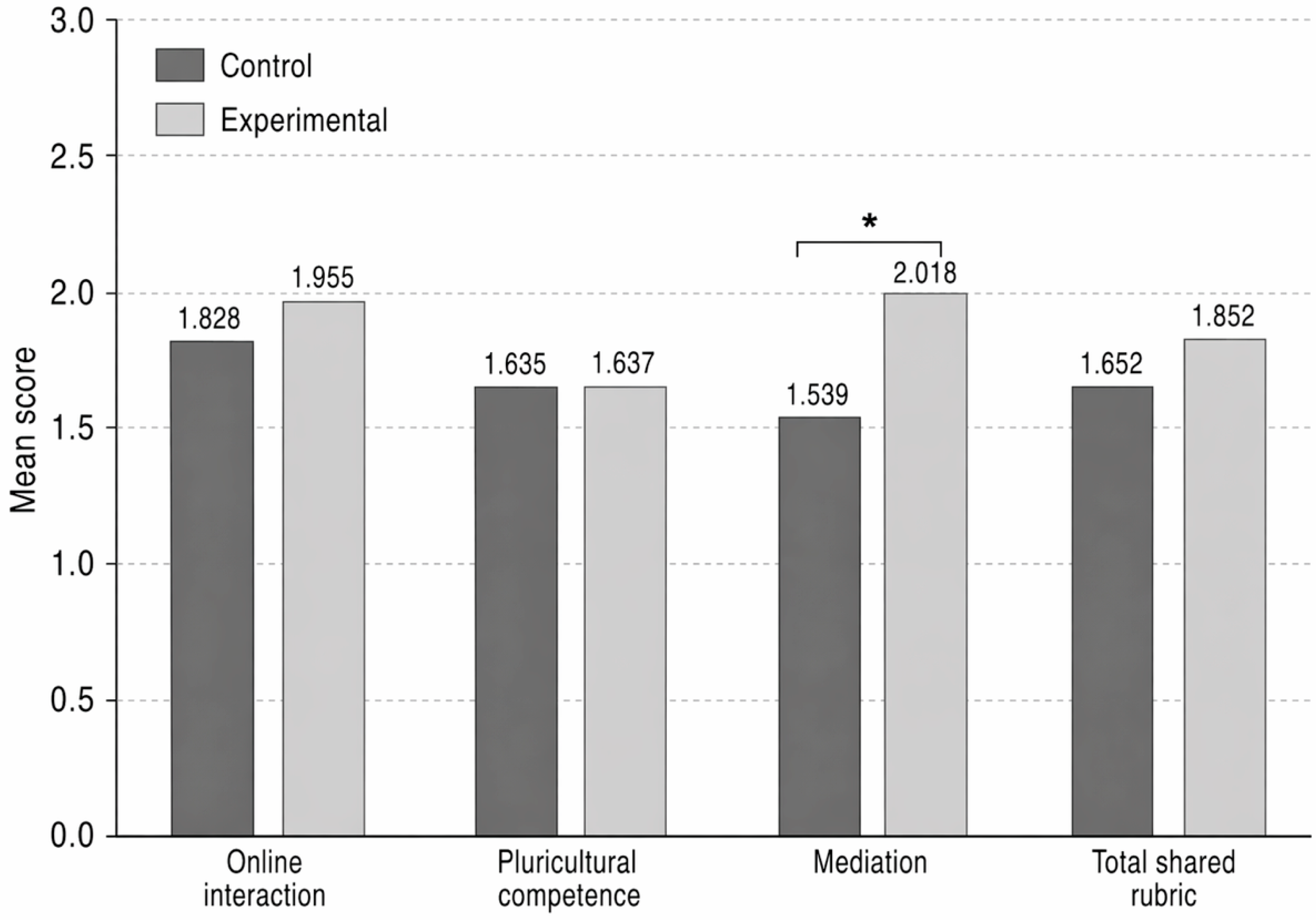
The findings point to a selective rather than generalised pattern associated with chatbot-mediated interaction. The experimental group did not outperform the control group in online interaction or pluricultural competence, nor did it show a statistically significant advantage on the total shared score. By contrast, the mediation dimension yielded the clearest difference, with a moderate-to-large effect size. This result is theoretically meaningful given the pedagogical focus of the task. Even so, this result should not be overinterpreted. One plausible interpretation is that the chatbot supported mediation-oriented discourse moves such as clarification, elaboration, reframing, and advice-giving. Another, more critical possibility is that the chatbot functioned as a more readily available and non-judgemental interlocutor than a peer, thereby making it easier for learners to sustain the questioning sequence required by the task. From this perspective, the observed advantage may reflect both the technological affordances of chatbot mediation and the interactional convenience of an interlocutor that remains consistently responsive throughout the task. The study thus supports a cautious, dimension-specific interpretation of chatbot affordances, but not a strong claim that AI improved overall communicative performance.
The AI-specific items further support this interpretation. Learners appeared to use the chatbot less as a tool for refining linguistic output than as a resource for obtaining culturally situated explanations, exploring behavioural alternatives, and clarifying non-verbal or sensitive aspects of the scenario. This pattern lends support to the view that the chatbot’s contribution was mediation-oriented rather than broadly linguistic.
These results align with current calls to move beyond generic claims about AI effectiveness in language education. Recent reviews suggest that chatbot-supported language learning can be beneficial, but they also emphasise variability across learning outcomes, task designs, and pedagogical conditions (
Huang et al., 2022;
Ji et al., 2023;
Lyu et al., 2025). Our data fit this more cautious line of interpretation. The chatbot did not appear to enhance every dimension of performance; instead, any advantage seems to have been concentrated in the construct most directly activated by the task. In this respect, the present findings extend previous empirical work on chatbot-assisted conversational practice, AI-supported flipped classrooms, and AI-mediated informal digital learning by showing that chatbot-related gains may be more visible when assessment distinguishes mediation from broader measures of language performance, engagement, or perception.
In relation to the working hypotheses, H1 received tentative support, as the experimental group obtained higher mediation scores than the control group. H2 was also tentatively supported insofar as only mediation reached statistical significance, although the total shared score showed a non-significant tendency favouring the experimental group. Similarly, the reliability analyses showed that aggregated dimensions were more dependable than isolated rubric items. However, the mediation effect should be interpreted as emerging from the chatbot-supported task configuration as a whole. Although the questioning requirement was pedagogically justified as procedural scaffolding for learners with limited prior chatbot experience, it also limits the extent to which interlocutor type can be separated from the degree of prompted inquiry in the experimental condition.
The fictional-culture scenario is central to this interpretation. Because the task did not rely on an existing national culture, learners could not simply reproduce familiar stereotypes or rely on prior real-world cultural knowledge. Instead, they had to work within a controlled but unfamiliar frame and make sense of behavioural norms, expectations, and misunderstandings through interaction (
Baker, 2015;
Davis et al., 2019). In the experimental condition, the chatbot functioned as a stable cultural informant within that frame. In the control condition, that role was assumed by a peer acting as cultural expert. The fact that mediation, rather than pluricultural competence, emerged as the clearest differentiating dimension suggests that the main affordance of the chatbot may have been interactional support for meaning-making rather than broader intercultural sophistication per se (
Holden et al., 2021).
The absence of a clear between-group difference in pluricultural competence also deserves fuller consideration. Although the scenario involved cultural misunderstanding, the task may have elicited practical problem solving more readily than deeper pluricultural reflection. At B2 level, learners may be better positioned to explain what went wrong and to formulate advice than to produce sustained evidence of decentring, perspective comparison, or critical reflection on cultural positioning. In addition, the fictional-culture design may have reduced reliance on stereotypes while also limiting some of the richer affective, experiential, and identity-related resources that often inform pluricultural engagement with real-world groups (
Baker, 2015;
Davis et al., 2019). The absence of a difference in this dimension is better understood as evidence that the task activated mediation and pluricultural competence to different degrees, despite the relationship between the two constructs. This reading accords with CEFR/CV B2 descriptors, which expect learners to do more than explain misunderstandings by recognising differing assumptions, reframing perspectives, and interpreting culturally situated behaviour on the basis of sufficient evidence. The results also accord with
Johnson’s (
2010) view that simulated intercultural encounters can support learners’ knowledge, adaptability, and confidence in culturally complex situations while allowing assessment to take place under controlled conditions.
The study has several limitations. Although inter-rater reliability reached acceptable levels for all aggregated dimensions, the stronger interpretability of composite scores than of isolated descriptors suggests that some CEFR/CV-informed categories may be difficult to apply consistently in short written mediation tasks. Such tasks may not always provide sufficient evidence of interactional development, multiple perspectives, or sustained intercultural positioning. This is especially true of B2 descriptors such as restating and reframing positions, recognising that what is taken for granted in one context may not be shared in another, interpreting cultural cues appropriately, and explaining how communicative practices may generate misunderstanding (
Council of Europe, 2020, p. 125). For this reason, inconsistent rating of some descriptors should be understood less as a weakness of the construct than as a limitation related to task brevity and the amount of observable evidence available.
In addition, the use of a fictional culture, while methodologically useful, necessarily limits ecological generalisation to real intercultural encounters. Task comparability across conditions also needs to be considered, since both groups were given the same amount of time to complete the task (45 min), whereas the experimental condition included a more explicit requirement for sustained questioning, which may itself have encouraged iterative clarification and reformulation. Moreover, because chatbot interaction may have been relatively novel for some learners, part of the observed engagement in the experimental condition could reflect a novelty effect rather than the affordances of chatbot-mediated mediation alone. The present article also reports only the quantitative strand of a broader dataset; more detailed insight into how learners positioned themselves culturally and how raters interpreted borderline cases requires qualitative analysis of the interaction logs.
Future research should test whether the same pattern holds in larger samples, in longitudinal designs, and in tasks that compare fictional and real cultural scenarios. Mixed-methods analyses of interaction logs would help clarify how learners formulate explanations, ask for clarification, and negotiate culturally shaped meanings when working with AI versus peers. More broadly, the findings support a research agenda that treats mediation as a particularly promising lens for investigating the pedagogical uses of chatbots in language education, while keeping pluricultural analysis analytically distinct and maintaining a critical view of whether observed gains reflect the technology itself or the interactional architecture built around it.
5. Conclusions
This exploratory study examined chatbot-mediated and peer-to-peer written interaction in a mediation-oriented EFL task carried out by adult B2 learners in OLS. Using a CEFR/CV-informed rubric, the study found no clear between-group differences in online interaction or pluricultural competence, but it identified a statistically significant advantage for the chatbot condition in mediation, which may be pedagogically promising in mediation-oriented task designs. Under the parameters of this task, the chatbot appeared to function less as a generic language helper than as a culturally configured interlocutor that supported learners’ attempts to clarify and repair a sequence of misunderstandings.
The findings do not support a claim of broad AI superiority. Instead, they suggest that chatbot use may be well suited to tasks that require learners to clarify, reframe, and negotiate meaning within a culturally framed scenario. However, this conclusion must remain cautious, as the observed mediation advantage may reflect the affordances of the chatbot as an interlocutor alongside the patient and continuously available nature of the system, the possible novelty of chatbot interaction for some learners, and the specific interactional demands imposed on the experimental group. The study thus contributes to current debates by showing that the pedagogical value of chatbot interaction may be dimension-specific and tightly linked to task design.
For practice, the results suggest that chatbots may be most productively used as complementary tools in mediation-oriented writing tasks rather than as wholesale substitutes for peer interaction. Their pedagogical value may be greatest when tasks are explicitly designed to elicit sustained questioning, clarification, reformulation, and culturally framed explanation, and when comparability between interactional conditions is carefully maintained.