4.1.1. Research Question 1: What Are the Current Practices in Teaching Reading and Literacy?
Quantitative Overview of Classroom Practices
To address Research Question 1, we employed a convergent mixed-methods framework (
Creswell & Plano Clark, 2017) combining quantitative survey items on instructional frequency with open-ended responses to explore current classroom practices in reading instruction.
Phonics Instruction: A repeated-measures ANOVA confirmed a significant difference in frequency across practices, F(2.11, 851.31) = 56.11,
p < 0.001, partial η
2 = 0.12. Results indicated that teachers reported frequent use of phoneme awareness modelling (M = 4.5) and activities where students manipulate phonemes (M = 4.3), with less frequent use of decodable texts aligned with phonics instruction (M = 3.9) (see
Table 2).
Whole Word and Word Structure Instruction: A repeated-measures ANOVA revealed significant variation in reported instruction of word structure F(2, 624) = 108.89, p < 0.001, partial η2 = 0.26. Structured spelling rule instruction (Q59, M = 3.9) was significantly more frequent than morphology (Q50, M = 2.9) or orthographic conventions (Q49, M = 3.0) (see 4).
Introducing sight words in context (Q39, M = 4.0) was significantly more common than explicitly teaching them as whole units (Q40, M = 3.4), F(1, 405) = 94.68,
p < 0.001, partial η
2 = 0.19. Nearly three-quarters of respondents indicated that they frequently or very frequently introduced sight words during reading, whereas a majority reported using explicit whole-word instruction frequently or very frequently (see
Table 3 and
Table 4).
Vocabulary and Comprehension: A repeated-measures ANOVA revealed significant variation in reported vocabulary strategies F(1.89, 607.59) = 649.83,
p < 0.001; teachers most frequently reported strategies that involved contextual use of new words (Q65, M = 4.1), while rote memorisation of definitions (Q66, M = 1.9) was used least (see
Table 5).
Similarly, significant variation emerged in reported reading comprehension strategies, F(2.90, 881.46) = 12.84,
p < 0.001. Follow-up Bonferroni-adjusted pairwise comparisons indicated that teaching the main idea (Q71, M = 3.56) was reported significantly more often than question generation (Q72, M = 3.18),
p < 0.05. Monitoring (Q70, M = 3.42) differed significantly from both, while summarising (Q73, M = 3.40) did not differ significantly from monitoring or main idea but was reported more than question generation (see
Table 6).
Qualitative Analysis of Classroom Practices
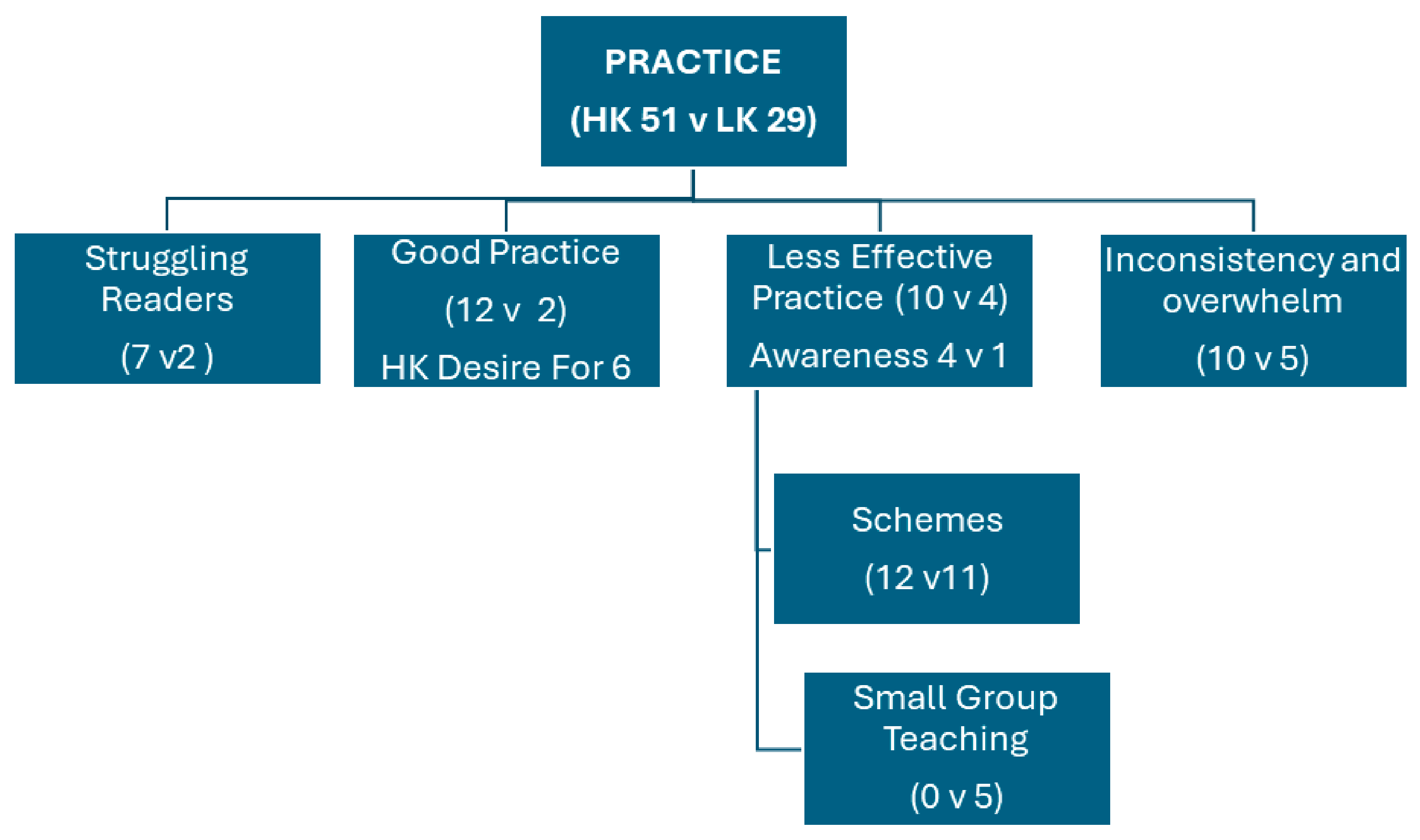
When teachers were asked to share their views on classroom practices, the qualitative data highlighted the significance of the perceived barriers teachers face in effective classroom practice. Teachers were much more focused on the barriers to practice, with 111 meaning units about barriers compared to 80 meaning units on practice itself. Many teachers also voiced their sense of frustration and failure in being unable to teach all the children in their class to read (See
Figure 1).
Classroom practices
Qualitative themes identified from the free-text responses were a commitment and desire from teachers to provide effective reading instruction but a sense of failure and overwhelm in not having the knowledge, skills, and training to do so in practice, particularly for those children who are most at risk:
‘I can identify when readers are struggling but do not yet have the right skills and experience to help them so left feeling deflated and like I’m failing.’
(LK 11)
and
‘I left my PGDE [Postgraduate Diploma in Teacher Education] not having a clue about how to teach reading because I wasn’t taught … It was how to teach spelling that set me on my SSP [Systematic Synthetics Phonics] journey since experienced teachers were vague in their answers when I asked them…’
(HK 17)
Inconsistency was a strong theme from the analysis of practice comments. The data demonstrated the lack of availability and implementation of aligned decodable readers to practise phonics skills and that the teachers felt the need for more. In the free-text responses, teachers described using multiple resources simultaneously, including phonics schemes, levelled readers, sight-word lists, and a variety of commercially published reading programmes. The highest number of text units in relation to practice were about the use of commercially produced schemes in the classroom. The variety of schemes used locally and nationally was seen as problematic for effective practice. Teachers reported the following:
‘There are so many different schemes/ways of doing things that it leaves you feeling overwhelmed and disengaged.’
(LK 11)
‘….need to make the teaching of reading the phonological approach the only way to teach reading as it’s based on research. Too many different ways being used, should be uniform …’
(HK 8)
Several participants described outdated methods as best practice or were using mandated schemes which were not evidence-based:
‘I now realise how deficient … (Mandated Local Authority Scheme) is. Decoding is regarded as a deficit (‘X relies on sounding-out’) and you’ll never hear the words encoding or segmenting either, unless you’re having a secret conversation with another closeted SSP believer.’
(LK 3)
Comments like these demonstrate the use of unevidenced resources, training, and schemes in practice and teachers who have been trained or who learned through these in schools and who consider them to be good practice. Furthermore, multiple schemes appeared to be used at times in a patchwork of approaches rather than with a focus on systematic structured phonics:
‘We’ve moved to [Scheme D] in the last few years, and the quality of reading instruction and comprehension has plummeted. We used to use [Scheme A] and [Scheme B], alongside [Scheme C] for teaching sounds. Now we rely on [Scheme D], a programme whose early reading includes no punctuation, no capital letters, no interesting characters, no continuity [Scheme A] is out of date, but children love the characters and stories and developed far better overall reading/ comprehension skills using this.’
(HK17)
The qualitative data also highlighted examples of good practice in classrooms and a clear desire from teachers to improve outcomes for their students:
‘I try to implement a love for reading through choral reading groups, paired with a reading buddy in class (mixed ability—providing feedback to their peers about their expression, fluency).’
(LK 6)
‘Fostering a love of ‘reading’ is part of our daily life in our class. We begin with a morning circle and children are encouraged to take a book to look at and share, we use the school library each week, we have a daily story and discuss.’
(HK 4)
‘My classroom practice for teaching reading and writing is mainly through the phonics based approach of [Scheme E]. Very heavy emphasis on phonics, segmenting and blending. We are play based for large chunks of the day but also have explicit instruction in Literacy every day.’
(HK 23)
Barriers to practice
Inductive coding yielded three barrier themes: (a) societal constraints outside the school, (b) structural and resource pressures inside the system, and (c) limited transfer of research into teacher preparation and professional training in practice. Of the barrier units tagged in the data set, 54% referenced structural issues, 29% societal factors, and 17% knowledge-transfer gaps.
Societal constraints
Teachers frequently pointed to home environments, screen time, and post-pandemic attendance as forces they cannot control:
‘Parents are also less accountable than they were years ago and there is an attitude of learning only being for school. In the not so distant past many children would come to school with some experience of reading with parents regularly and often some sound knowledge and a good vocabulary but this is becoming less so. Many also refuse to read reading books at home as this is seen as a school job. Screen time has certainly impacted this also.’
(HK 35)
Teachers felt changes in society and diversification of learning needs in children impacted their ability to teach effectively:
‘With 24 learners and 11 identified as ASN (additional support needs) I struggle to cater to the needs of those with difficulties in literacy. Attendance is a huge issue in my school.’
(LK 5)
Concerns were raised about the lessening amount of vocabulary that children enter school with, the lower literacy environments at home, and the implications of societal changes on effective classroom practice:
‘Some children come into P1 [the first year of Primary School] without having ever being introduced orally to rhyme, initial sounds etc and some children have. Those who have had a literacy rich experience prior to P1 I find have more words in their vocabulary which helps their comprehension skills and also pick up phonetic awareness initial sounds and rhyme etc much quicker than those without. The gap from day 1 of P1 can be very apparent in some children.’
(LK 18)
Structural and resource pressures
Teachers described curriculum overload, inconsistent guidance, dwindling support staff, and a lack of time and priority for literacy instruction:
‘Reading instruction is incredibly inconsistent across schools and local authorities … there is not a coherent consensus about how we [teach] reading and literacy….’
(HK 20)
‘…The amount of freedom teachers have is sometimes abused and results in a huge discrepancy between the experiences and support in learning children receive.’
(LK 19)
‘There has been a significant reduction in support while at the same time an increase in needs … while we strive to support the inclusion agenda on a shoestring budget.’
(HK 35)
Knowledge-transfer gaps
Many participants felt their initial or ongoing training in practice left them ill-equipped to meet diverse reading needs:
‘Probationers come out of university with very little knowledge of how to teach reading. Teachers are vilified for using traditional methods and are left floundering.’
(HK 21)
‘So many schools are ignoring the benefits of systematic synthetic phonics … I don’t think phonics or any teaching ‘how to read’ is done enough in ITE [Initial Teacher Education] etc.’
(HK 30)
Comments highlighted an over-reliance on schemes and uncertainty around their effectiveness. There were concerns of hidden knowledge/lack of access and self-discovery/self-teaching of new knowledge-enhancing practice, including the positive impact of evidence-based knowledge.
4.1.2. Research Question 2: What Is the Relationship Between Teachers’ Knowledge and Their Pedagogical Practice?
Quantitative Findings on Teacher Knowledge
Teacher knowledge was assessed using the TULIP measure, which was presented as an optional addition to the main survey, and it should be noted that participation was lower than in the main survey (
n = 122;
Table 7).
To determine whether the subsample of teachers who completed the optional knowledge section was broadly representative of the full sample, we compared distributions across the key demographic variables reported in
Table 1. Chi-square and independent t-test analyses indicated no statistically significant differences between the two groups (all
p > 0.05) in terms of gender, SIMD quintile of their school, age, years of teaching experience, class size, or participation in professional development related to literacy. This suggests that the subsample is demographically and professionally comparable to the broader participant pool.
The mean total knowledge score was 0.66 (SD = 0.09), indicating an average of 66% accuracy across phonological awareness, phonics (decoding/encoding), oral language, fluency, and reading comprehension.
The effect of knowledge domain was large and significant, F(3.44, 416.07) = 76.48,
p < 0.001, partial η
2 = 0.39 (Wilks’ Λ = 0.177,
p < 0.001). Bonferroni-adjusted pairwise comparisons (all
ps < 0.05) confirmed that teachers scored highest in phonological awareness (M = 0.81) and reading comprehension knowledge (M = 0.79); these two domains did not differ from one another. Knowledge of fluency (M = 0.75) was lower than phonological awareness but statistically equivalent to reading comprehension. Oral language structures (M = 0.59) exceeded phonics/decoding knowledge (M = 0.53) but fell below the three highest domains (see
Table 7).
Knowledge–Practice Link
To investigate whether literacy knowledge, as measured by the TULIP, moderates instructional practice, teachers were divided into low- and high-knowledge groups using a median split on the full TULIP knowledge test. The sample median was 37. Teachers who scored at or below this value were classified as having low knowledge (n = 69), whereas those who scored above it were classified as having high knowledge (n = 53).
A linear mixed-effects model was fitted with instructional practice (five levels) as the repeated factor and knowledge group (high vs. low literacy knowledge) as the between-teacher factor. Random intercepts were specified for teachers.
A strong main effect of instructional practice emerged, F(4, 325.78) = 93.29,
p < 0.001, η
2p = 0.534 (
Table 8). Teachers with high knowledge reported higher overall frequencies than low-knowledge peers, F(1, 112.93) = 5.76,
p = 0.018, η
2p = 0.049. A modest but significant practice × knowledge interaction was observed, F(4, 325.78) = 3.09,
p = 0.016, η
2p = 0.037.
Bonferroni-adjusted EMMs (
Table 9) showed that high-knowledge teachers devoted ≈0.47 scale points more to phonics and ≈0.43 more to word structure instruction than low-knowledge teachers (
ps ≤ 0.005). Differences for vocabulary, reading comprehension, and whole-word strands were non-significant (
ps ≥ 0.342).
The random-intercept variance was 0.132 (SE = 0.033), indicating 13% of unexplained variance lay between teachers. AR(1) residual parameters (σ2 = 0.471; ρ = 0.018) suggested minimal autocorrelation across strands.
Results from the linear mixed-effects model showed that teachers who have greater knowledge about literacy and language, as measured by the TULIP, tend to provide more phonics and word structure instruction compared to other aspects of reading instruction. In contrast, other strands appear similar across groups. This effect accounts for approximately 5% of the variance between teachers and remains consistent regardless of the covariance structure chosen.
Qualitative Analysis of the Knowledge–Practice Gap
Inductive coding of the free-text responses (109 meaning units from the high-knowledge quartile; 82 from the low-knowledge quartile) produced three cross-cutting themes (see
Table 10).
Qualitative themes paralleled the quantitative gap: High-knowledge teachers articulated a commitment to systematic phonics and word structure instruction (T1) yet still operated within mixed-method mandates (T2), while low-knowledge teachers most often voiced feelings of inadequacy (T3).
Those teachers with higher literacy knowledge highlighted the damage of lack of early intervention and the need for early increased explicit instruction and practice for at-risk readers:
‘The earlier literacy issues are identified the more chance there is of supporting children … many council policies are wait and see and don’t want to put anything in motion until P4 [the fourth year of Primary School], which in my mind is extremely unhelpful and actually detrimental to the children.’
(HK 31)
‘As a P1 teacher I feel I can identify children who are struggling and have dyslexic tendencies however no support is offered to provide additional input or resources as the children are considered too young. I have mixed feelings about this. The wait and see approach means some children will be left behind.’
(HK 2)
‘No shared understanding of how to teach, nowhere for teachers to go to be told how to do things. Every single person reinventing the wheel!’
(LK 2)
Teachers with more knowledge were more focused on training and knowledge gaps and needs, and the importance of addressing these, and teachers with less knowledge were more focused on societal and structural barriers to effective literacy provision. This highlights how increasing transfer of knowledge can professionally equip teachers in the face of perceived barriers
Along with lack of knowledge transfer and training, commercial schemes and limited resources were reasons for mixing methods:
‘We use readers that are based on sight words; however, personally, I would prefer using decodable texts that increase in difficulty with the more sounds that are taught … For some children, learning phonics and sight words that don’t conform to the rules is too much.’.
(HK 33)
‘Many teachers with responsibility for teaching beginning readers rely on commercially produced schemes as a result of lack of clear knowledge and direction on the teaching of reading that comes from all stakeholders …More use should be made of the research finding on phonemic awareness and phonic instruction for beginning readers. It should not be left to individual schools to seek out this basic of knowledge.’
(LK 23)