Multi-Level Barriers to Generative AI Adoption Across Disciplines and Professional Roles in Higher Education

 , , , ,
Abstract
1. Introduction
2. Barriers to GenAI Adoption in HE
3. Hypotheses
4. Methodology
5. Results
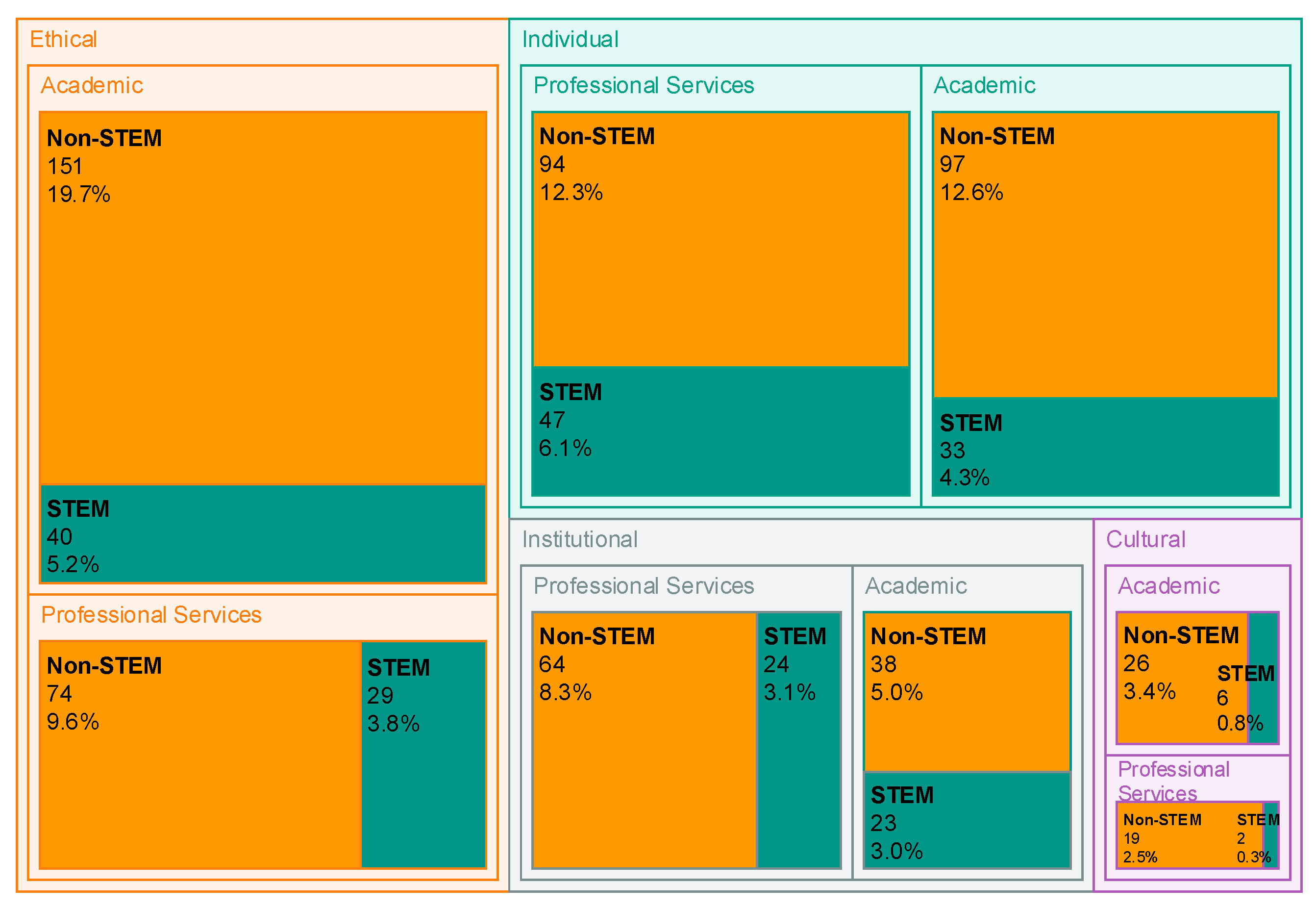
5.1. Barrier Distribution by Job Role and Discipline
5.2. Multinomial Regression of Barrier-Category Membership
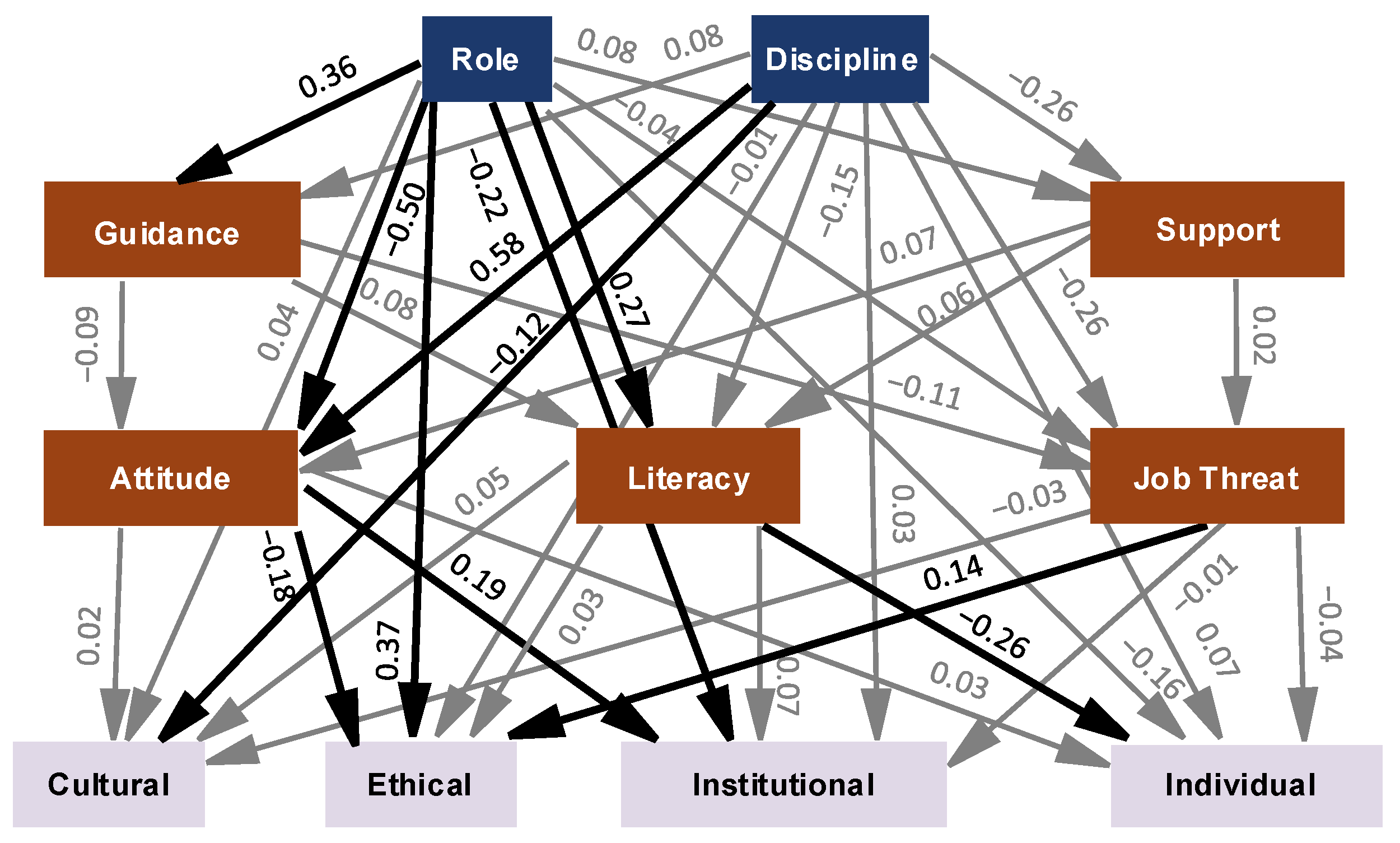
5.3. SEM and Hypothesis Evaluation
- Role → Guidance: b = 0.359, SE = 0.127, CR = 2.833, p = 0.005
- Role → Attitude: b = −0.498, SE = 0.139, CR = −3.594, p < 0.001
- Role → Ethical barriers: b = 0.372, SE = 0.098, CR = 3.786, p < 0.001
- Role → Literacy: b = 0.266, SE = 0.104, CR = 2.549, p = 0.011
- Role → Institutional barriers: b = −0.215, SE = 0.078, CR = −2.763, p = 0.006
- Discipline → Attitude: b = 0.579, SE = 0.156, CR = 3.722, p < 0.001
- Discipline → Cultural barriers: b = −0.121, SE = 0.057, CR = −2.145, p = 0.032
- Attitude → Ethical barriers: b = −0.179, SE = 0.043, CR = −4.200, p < 0.001
- Attitude → Institutional barriers: b = 0.189, SE = 0.034, CR = 5.575, p < 0.001
- Literacy → Individual barriers: b = −0.260, SE = 0.055, CR = −4.706, p < 0.001
- Job Threat → Ethical barriers: b = 0.138, SE = 0.040, CR = 3.483, p < 0.001
5.4. Free-Text Cluster Themes
6. Discussion
6.1. Adoption Beyond the Individual Level
6.2. PS Staff as a Distinct Site of GenAI Adoption
6.3. Gains and Trade-Offs of the Multi-Method Design
7. Conclusions
Author Contributions
Funding
Institutional Review Board Statement
Informed Consent Statement
Data Availability Statement
Acknowledgments
Conflicts of Interest
Abbreviations
| AI | Artificial Intelligence |
| GenAI | Generative Artificial Intelligence |
| GDPR | General Data Protection Regulation |
| HDBSCAN | Hierarchical Density-Based Spatial Clustering of Applications with Noise |
| HE | Higher Education |
| LLM | Large Language Model |
| MLR | Multinomial Logistic Regression |
| PS | Professional Services |
| SEM | Structural Equation Modelling |
| STEM | Science, Technology, Engineering, and Mathematics |
| TAM | Technology Acceptance Model |
| UMAP | Uniform Manifold Approximation and Projection |
| UTAUT | Unified Theory of Acceptance and Use of Technology |
References
- Abbas, M., Jam, F. A., & Khan, T. I. (2024). Is it harmful or helpful? Examining the causes and consequences of generative AI usage among university students. International Journal of Educational Technology in Higher Education, 21(1), 10. [Google Scholar] [CrossRef]
- Al-Abdullatif, A. M. (2024). Modeling teachers’ acceptance of generative artificial intelligence use in higher education: The role of AI literacy, intelligent TPACK, and perceived trust. Education Sciences, 14(11), 1209. [Google Scholar] [CrossRef]
- Alghamdi, A. A. (2025). University students’ perceptions of generative AI for critical thinking and creativity: The influence of self-efficacy and disciplinary differences. Innovations in Education and Teaching International, 1–15. [Google Scholar] [CrossRef]
- Allaoui, M., Kherfi, M. L., & Cheriet, A. (2020). Considerably improving clustering algorithms using UMAP dimensionality reduction technique: A comparative study. In International conference on image and signal processing. Springer International Publishing. [Google Scholar]
- Al-Samarraie, H., Sarsam, S. M., Ibrahim Alzahrani, A., Chatterjee, A., & Swinnerton, B. J. (2025). Gender perceptions of generative AI in higher education. Journal of Applied Research in Higher Education, 17(5), 1944–1958. [Google Scholar] [CrossRef]
- Al-Shabandar, R., Jaddoa, A., Elwi, T. A., Mohammed, A., & Hussain, A. J. (2024). A systematic review for the implication of generative AI in higher education. Infocommunications Journal, 16(3), 31–42. [Google Scholar] [CrossRef]
- An, Y., Yu, J. H., & James, S. (2025). Investigating the higher education institutions’ guidelines and policies regarding the use of generative AI in teaching, learning, research, and administration. International Journal of Educational Technology in Higher Education, 22(1), 10. [Google Scholar] [CrossRef]
- Ardito, C. G. (2025). Generative AI detection in higher education assessments. New Directions for Teaching and Learning, 2025(182), 11–28. [Google Scholar] [CrossRef]
- Arowosegbe, A., Alqahtani, J. S., & Oyelade, T. (2024). Perception of generative AI use in UK higher education. Frontiers in Education, 9, 1463208. [Google Scholar] [CrossRef]
- Asad, M. M., & Ajaz, A. (2024). Impact of ChatGPT and generative AI on lifelong learning and upskilling learners in higher education: Unveiling the challenges and opportunities globally. The International Journal of Information and Learning Technology, 41(5), 507–523. [Google Scholar] [CrossRef]
- Ayanwale, M. A. (2024). Using diffusion theory of innovation to investigate perceptions of STEM and non-STEM students’ adoption of chatbot systems in higher education: A multiple group analysis. In 2024 IEEE global engineering education conference (EDUCON). IEEE. [Google Scholar]
- Baig, M. I., & Yadegaridehkordi, E. (2025). Factors influencing academic staff satisfaction and continuous usage of generative artificial intelligence (GenAI) in higher education. International Journal of Educational Technology in Higher Education, 22(1), 5. [Google Scholar] [CrossRef]
- Batista, J., Mesquita, A., & Carnaz, G. (2024). Generative AI and higher education: Trends, challenges, and future directions from a systematic literature review. Information, 15(11), 676. [Google Scholar] [CrossRef]
- Bearman, M., Tai, J., Dawson, P., Boud, D., & Ajjawi, R. (2024). Developing evaluative judgement for a time of generative artificial intelligence. Assessment & Evaluation in Higher Education, 49(6), 893–905. [Google Scholar] [CrossRef]
- Cabero-Almenara, J., Palacios-Rodríguez, A., Loaiza-Aguirre, M. I., & Andrade-Abarca, P. S. (2024). The impact of pedagogical beliefs on the adoption of generative AI in higher education: Predictive model from UTAUT2. Frontiers in Artificial Intelligence, 7, 1497705. [Google Scholar] [CrossRef] [PubMed]
- Chan, C. K. Y., & Hu, W. (2023). Students’ voices on generative AI: Perceptions, benefits, and challenges in higher education. International Journal of Educational Technology in Higher Education, 20(1), 43. [Google Scholar] [CrossRef]
- Chiu, T. K. (2024). The impact of Generative AI (GenAI) on practices, policies and research direction in education: A case of ChatGPT and Midjourney. Interactive Learning Environments, 32(10), 6187–6203. [Google Scholar] [CrossRef]
- Christ-Brendemühl, S. (2025). Leveraging generative AI in higher education: An analysis of opportunities and challenges addressed in university guidelines. European Journal of Education, 60(1), e12891. [Google Scholar] [CrossRef]
- Dabis, A., & Csáki, C. (2024). AI and ethics: Investigating the first policy responses of higher education institutions to the challenge of generative AI. Humanities and Social Sciences Communications, 11(1), 1006. [Google Scholar] [CrossRef]
- Dai, K., Liu, Y., & Zhang, X. (2026). Generative AI in higher education: A bibliometric review of emerging trends, power dynamics, and global research landscapes. Computers and Education: Artificial Intelligence, 10, 100544. [Google Scholar] [CrossRef]
- Dai, Y., Lai, S., Lim, C. P., & Liu, A. (2025). University policies on generative AI in Asia: Promising practices, gaps, and future directions. Journal of Asian Public Policy, 18(2), 260–281. [Google Scholar] [CrossRef]
- Daniel, K., Msambwa, M. M., & Wen, Z. (2025). Can generative AI revolutionise academic skills development in higher education? A systematic literature review. European Journal of Education, 60(1), e70036. [Google Scholar] [CrossRef]
- Davis, F. D. (1989). Perceived usefulness, perceived ease of use, and user acceptance of information technology. MIS Quarterly, 13, 319–340. [Google Scholar] [CrossRef] [PubMed]
- DeVellis, R. F., & Thorpe, C. T. (2021). Scale development: Theory and applications. SAGE Publications. [Google Scholar]
- Essien, A., Salami, A., Ajala, O., Adebisi, B., Shodiya, A., & Essien, G. (2024). Exploring socio-cultural influences on generative AI engagement in Nigerian higher education: An activity theory analysis. Smart Learning Environments, 11(1), 63. [Google Scholar] [CrossRef]
- Evangelista, E. D. L. (2025). Ensuring academic integrity in the age of ChatGPT: Rethinking exam design, assessment strategies, and ethical AI policies in higher education. Contemporary Educational Technology, 17(1), ep559. [Google Scholar] [CrossRef]
- FakhrHosseini, S., Chan, K., Lee, C., Jeon, M., Son, H., Rudnik, J., & Coughlin, J. (2024). User adoption of intelligent environments: A review of technology adoption models, challenges, and prospects. International Journal of Human–Computer Interaction, 40(4), 986–998. [Google Scholar] [CrossRef]
- Gasaymeh, A.-M. M., Beirat, M. A., & Qbeita, A. A. A. A. (2024). University students’ insights of generative artificial intelligence (AI) writing tools. Education Sciences, 14(10), 1062. [Google Scholar] [CrossRef]
- Ghimire, A., & Edwards, J. (2024). Generative AI adoption in classroom in context of technology acceptance model (TAM) and the innovation diffusion theory (IDT). arXiv, arXiv:2406.15360. [Google Scholar] [CrossRef]
- Gigliotti, R., Vardaman, J., Marshall, D. R., & Gonzalez, K. (2019). The role of perceived organizational support in individual change readiness. Journal of Change Management, 19(2), 86–100. [Google Scholar]
- Hoernig, S., Ilharco, A., Pereira, P. T., & Pereira, R. (2024). Generative AI and higher education: Challenges and opportunities. Institute of Public Policy, 12(2), 45–60. [Google Scholar]
- Hosseini, M., Gao, C. A., Liebovitz, D. M., Carvalho, A. M., Ahmad, F. S., Luo, Y., MacDonald, N., Holmes, K. L., & Kho, A. (2023). An exploratory survey about using ChatGPT in education, healthcare, and research. PLoS ONE, 18(10), e0292216. [Google Scholar]
- Jayaram, Y., Sundar, D., & Bhat, J. (2024). Generative AI governance and secure content automation in higher education. International Journal of Artificial Intelligence, Data Science, and Machine Learning, 5(4), 163–174. [Google Scholar] [CrossRef]
- Jin, Y., Yan, L., Echeverria, V., Gašević, D., & Martinez-Maldonado, R. (2025). Generative AI in higher education: A global perspective of institutional adoption policies and guidelines. Computers and Education: Artificial Intelligence, 8, 100348. [Google Scholar] [CrossRef]
- Khlaif, Z. N., Ayyoub, A., Hamamra, B., Bensalem, E., Mitwally, M. A. A., Ayyoub, A., Hattab, M. K., & Shadid, F. (2024). University teachers’ views on the adoption and integration of generative AI tools for student assessment in higher education. Education Sciences, 14(10), 1090. [Google Scholar] [CrossRef]
- Kim, J., Klopfer, M., Grohs, J. R., Eldardiry, H., Weichert, J., Cox, L. A., & Pike, D. (2025). Examining faculty and student perceptions of generative AI in university courses. Innovative Higher Education, 50(4), 1281–1313. [Google Scholar] [CrossRef]
- Kutty, S., Chugh, R., Perera, P., Neupane, A., Jha, M., Li, L., Gunathilake, W., & Perera, N. C. (2024). Generative AI in higher education: Perspectives of students, educators and administrators. Journal of Applied Learning & Teaching, 7(2), 47–60. [Google Scholar] [CrossRef]
- Lan, G., Feng, X., Du, S., Song, F., & Xiao, Q. (2025). Integrating ethical knowledge in generative AI education: Constructing the GenAI-TPACK framework for university teachers’ professional development. Education and Information Technologies, 30(11), 15621–15644. [Google Scholar] [CrossRef]
- Lee, V. R., Parli, V., Hau, I., Hynes, P., & Zhang, D. (2025). Response to the Department of Education’s request for information on AI in education. Stanford University Human-Centered Artificial Intelligence. Available online: https://hai.stanford.edu/policy/response-to-the-department-of-educations-request-for-information-on-ai-in-education (accessed on 26 December 2025).
- Lindebaum, D., & Fleming, P. (2024). ChatGPT undermines human reflexivity, scientific responsibility and responsible management research. British Journal of Management, 35(2), 566–575. [Google Scholar] [CrossRef]
- Mah, D.-K., & Groß, N. (2024). Artificial intelligence in higher education: Exploring faculty use, self-efficacy, distinct profiles, and professional development needs. International Journal of Educational Technology in Higher Education, 21(1), 58. [Google Scholar] [CrossRef]
- McGrath, C., Pargman, T. C., Juth, N., & Palmgren, P. J. (2023). University teachers’ perceptions of responsibility and artificial intelligence in higher education—An experimental philosophical study. Computers and Education: Artificial Intelligence, 4, 100139. [Google Scholar] [CrossRef]
- McInnes, L., Healy, J., & Astels, S. (2017). hdbscan: Hierarchical density based clustering. Journal of Open Source Software, 2(11), 205. [Google Scholar] [CrossRef]
- Michel-Villarreal, R., Vilalta-Perdomo, E., Salinas-Navarro, D. E., Thierry-Aguilera, R., & Gerardou, F. S. (2023). Challenges and opportunities of generative AI for higher education as explained by ChatGPT. Education Sciences, 13(9), 856. [Google Scholar] [CrossRef]
- Nguyen, K. V. (2025). The use of generative AI tools in higher education: Ethical and pedagogical principles. Journal of Academic Ethics, 23(3), 1435–1455. [Google Scholar] [CrossRef]
- Nikolic, S., Wentworth, I., Sheridan, L., Moss, S., Duursma, E., Jones, R. A., Ros, M., & Middleton, R. (2024). A systematic literature review of attitudes, intentions and behaviours of teaching academics pertaining to AI and generative AI (GenAI) in higher education: An analysis of GenAI adoption using the UTAUT framework. Australasian Journal of Educational Technology, 40(6), 56–75. [Google Scholar] [CrossRef]
- Seabold, S., & Perktold, J. (2010, June 28–July 3). Statsmodels: Econometric and statistical modeling with python. 9th Python in Science Conference, Austin, TX, USA. [Google Scholar]
- Shata, A. (2025). “Opting Out of AI”: Exploring perceptions, reasons, and concerns behind faculty resistance to generative AI. Frontiers in Communication, 10, 1614804. [Google Scholar] [CrossRef]
- Shrivastava, P. (2025). Understanding acceptance and resistance toward generative AI technologies: A multi-theoretical framework integrating functional, risk, and sociolegal factors. Frontiers in Artificial Intelligence, 8, 1565927. [Google Scholar] [CrossRef] [PubMed]
- Strzelecki, A., & ElArabawy, S. (2024). Investigation of the moderation effect of gender and study level on the acceptance and use of generative AI by higher education students: Comparative evidence from Poland and Egypt. British Journal of Educational Technology, 55(3), 1209–1230. [Google Scholar] [CrossRef]
- Sullivan, M., Kelly, A., & McLaughlan, P. (2023). ChatGPT in higher education: Considerations for academic integrity and student learning. Journal of Applied Learning & Teaching, 6(1), 31–40. [Google Scholar] [CrossRef]
- Thüs, D., Malone, S., & Brünken, R. (2024). Exploring generative AI in higher education: A RAG system to enhance student engagement with scientific literature. Frontiers in Psychology, 15, 1474892. [Google Scholar] [CrossRef]
- Valdivieso, T., & González, O. (2025). Generative AI tools in Salvadoran higher education: Balancing equity, ethics, and knowledge management in the global south. Education Sciences, 15(2), 214. [Google Scholar] [CrossRef]
- Venkatesh, V., Morris, M. G., Davis, G. B., & Davis, F. D. (2003). User acceptance of information technology: Toward a unified view. MIS Quarterly, 27(3), 425–478. [Google Scholar] [CrossRef]
- Wang, H., Dang, A., Wu, Z., & Mac, S. (2024). Generative AI in higher education: Seeing ChatGPT through universities’ policies, resources, and guidelines. Computers and Education: Artificial Intelligence, 7, 100326. [Google Scholar] [CrossRef]
- Wang, T., Lund, B. D., Marengo, A., Pagano, A., Mannuru, N. R., Teel, Z. A., & Pange, J. (2023). Exploring the potential impact of artificial intelligence (AI) on international students in higher education: Generative AI, chatbots, analytics, and international student success. Applied Sciences, 13(11), 6716. [Google Scholar] [CrossRef]
- Watermeyer, R., Lanclos, D., Phipps, L., Shapiro, H., Guizzo, D., & Knight, C. (2025). Academics’ Weak(ening) resistance to generative AI: The cause and cost of prestige? Postdigital Science and Education, 7(4), 1171–1191. [Google Scholar] [CrossRef]
- Whitbread, M., Hayes, C., Prabhakar, S., & Upsher, R. (2025). Exploring university staff’s perceptions of using generative artificial intelligence at university. Education Sciences, 15(3), 367. [Google Scholar] [CrossRef]
- Williams, M. D., Rana, N. P., & Dwivedi, Y. K. (2015). The unified theory of acceptance and use of technology (UTAUT): A literature review. Journal of Enterprise Information Management, 28(3), 443–488. [Google Scholar] [CrossRef]
- Yusuf, A., Pervin, N., & Román-González, M. (2024). Generative AI and the future of higher education: A threat to academic integrity or reformation? Evidence from multicultural perspectives. International Journal of Educational Technology in Higher Education, 21(1), 21. [Google Scholar] [CrossRef]
- Zhang, Y., & Tang, Q. (2025). Integrating AI-generated content tools in higher education: A comparative analysis of interdisciplinary learning outcomes. Scientific Reports, 15(1), 25802. [Google Scholar] [CrossRef] [PubMed]
- Zhao, X., Liu, C., Philippakos, Z., Zahra, F., & Aydeniz, M. (2025). Reflections on the merit and perils of AI in higher education: Five early adopter’s perspectives. International Journal of Technology in Education and Science, 9(4), 522–544. [Google Scholar] [CrossRef]



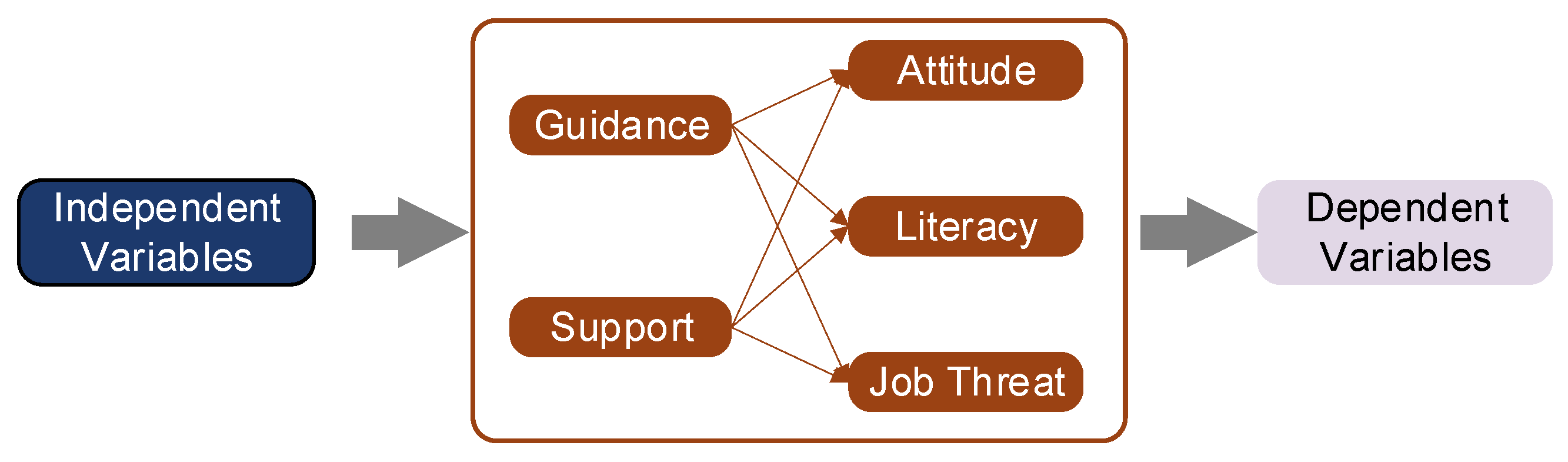
| Question | Options | Note | |
|---|---|---|---|
| Independent variables | In which department or unit do you work at the University? | Combo box (dropdown selection plus one line text box) | STEM or non-STEM |
| Which of the following best describes your current role? | Academic; Professional Services | Job Role | |
| Dependent variables | What are the main barriers to using GenAI in your teaching/work? | Lack of institutional guidance or policies (Ins); Concerns about academic integrity and student misuse (E); Limited personal knowledge or training on AI tools (Ind); Lack of time to explore and implement AI solutions (Ind); Ethical concerns about bias, privacy, or surveillance (E); Uncertainty about AI’s effectiveness in improving learning outcomes (Ind); Technical difficulties or lack of institutional support (Ins); Concerns about AI replacing human elements in teaching (E); Resistance from colleagues or institutional culture (C); Lack of funding or access to appropriate AI tools (Ins); Preference for traditional teaching methods (C) | Select three most important. |
| Mediator | How would you describe your current level of GenAI literacy? | Likert scale 1–5, no understanding to expert | Literacy |
| What is your overall view of GenAI in education? | Likert scale 1–5, very negative to very positive | Attitude | |
| I am concerned that GenAI will become a threat to my job in the next 5 years. | Likert scale 1–5, strongly disagree to strongly agree | Job Threat | |
| My institution/academic department has provided clear guidance on the acceptable and unacceptable uses of GenAI in teaching/work. | Likert scale 1–5, strongly disagree to strongly agree | Guidance | |
| My institution/academic department has provided sufficient resources to develop staff GenAI literacy. | Likert scale 1–5, strongly disagree to strongly agree | Support | |
| Free-entry texts | What are the main barriers to using GenAI in your teaching/work? | Free-text inputs |
| Model | −2 Log Likelihood | LR χ2 | df | p |
|---|---|---|---|---|
| Intercept-only | 41.569 | |||
| Final | 33.056 | 8.512 | 3 | 0.037 |
| Outcome Category | B | OR = Exp(B) | p | Notes |
|---|---|---|---|---|
| Ethical | −0.545 | 0.58 | 0.181 | Not significant |
| Individual | −0.857 | 0.424 | 0.035 | non-STEM lower odds than STEM |
| Institutional | −0.952 | 0.386 | 0.024 | non-STEM lower odds than STEM |
| Model | −2 Log Likelihood | LR χ2 | df | p |
|---|---|---|---|---|
| Intercept-only | 63.516 | |||
| Final | 33.959 | 29.558 | 3 | <0.001 |
| Outcome Category | B | OR = Exp(B) | p | Notes |
|---|---|---|---|---|
| Ethical | −0.196 | 0.822 | 0.522 | Not significant |
| Individual | 0.502 | 1.653 | 0.101 | Not significant |
| Institutional | 0.788 | 2.198 | 0.016 | PS staff higher odds than academics |
| ID | Size | Description | Representative Phrases |
|---|---|---|---|
| B1 | 21 | Opposed to GenAI integration | ‘I will not be integrating GenAI into my teaching’, ‘I do not intend to integrate GenAI’, ‘I am strongly against the integration of GenAI’, ‘No, I don’t plan to integrate AI into my teaching’, ‘I have no desire to embed genAI and support a ban’ |
| B2 | 20 | Copilot-only policy frustration | ‘Copilot is the only authorised tool’, ‘Copilot is inferior to ChatGPT/Claude’, ‘No approval for competitor products’, ‘Shifting guidance on data uploads’, ‘Poor quality and hallucinations’ |
| B3 | 15 | Erodes learning and integrity | ‘Undermines critical thinking and writing’, ‘Students bypass skills for instant gratification’, ‘Makes cheating hard to detect; devalues degrees’, ‘Produces superficially competent but inaccurate work’, ‘Shortcuts before learning underlying skills’ |
| B4 | 14 | Eroding critical thinking | ‘Students becoming too reliant on GenAI’, ‘GenAI obliterating students’ critical thinking skills’, ‘Students skip work trusting AI’, ‘Over-reliance on prompting instead of thinking’, ‘GenAI spreading misinformation as fact’ |
| B5 | 13 | Factual accuracy and reliability | ‘AI isn’t always correct!’, ‘When AI gets it wrong.’, ‘factual accuracy in finance’, ‘still checking the work’, ‘misinterpreted core message’ |
| B6 | 11 | Accuracy and trust concerns | ‘Some staff are mistrustful of it.’, ‘Not being accurate, so always have to check over what the output is.’, ‘It is not personal, and content may end up all sounding the same.’, ‘I don’t trust it to be either ethical or good enough quality.’, ‘Whether the information delivered is factual.’ |
| B7 | 11 | Institutional access and support barriers | ‘No access to latest AI tools-subscriptions required’, ‘University won’t provide licenses or premium versions’, ‘Policies make tool approval time-consuming’, ‘Lack of funding or licencing for AI tools’, ‘Departmental reluctance and low institutional uptake’ |
| B8 | 9 | Skill erosion and assessment validity | ‘Undermines critical thinking’, ‘Students over-rely on AI’, ‘Written essays become invalid’, ‘Homogenized writing styles’, ‘AI-generated factual errors’ |
| B9 | 9 | Concerns about AI use | ‘AI encourages shortcut assignments’, ‘Leads to shallow engagement with tasks’, ‘Students distrust teachers using AI’, ‘Teacher dependence may reduce attendance’, ‘Variability, cost and access issues’, ‘Students resent AI-driven grading’ |
| B10 | 9 | Unclear policy and guidance | ‘Unclear whether university policy allows it’, ‘No clear guidance on GDPR and confidentiality’, “Don’t know who to consult (IDG/legal)”, ‘Avoid using it due to policy uncertainty’, ‘Difficulty finding policies on university website’ |
Disclaimer/Publisher’s Note: The statements, opinions and data contained in all publications are solely those of the individual author(s) and contributor(s) and not of MDPI and/or the editor(s). MDPI and/or the editor(s) disclaim responsibility for any injury to people or property resulting from any ideas, methods, instructions or products referred to in the content. |
© 2026 by the authors. Licensee MDPI, Basel, Switzerland. This article is an open access article distributed under the terms and conditions of the Creative Commons Attribution (CC BY) license.
Share and Cite
Yang, J.; Öge, K.; von Mühlenen, A.; Akbulut, A.B.; Carey, T.S.; Okorro, C. Multi-Level Barriers to Generative AI Adoption Across Disciplines and Professional Roles in Higher Education. Educ. Sci. 2026, 16, 838. https://doi.org/10.3390/educsci16060838
Yang J, Öge K, von Mühlenen A, Akbulut AB, Carey TS, Okorro C. Multi-Level Barriers to Generative AI Adoption Across Disciplines and Professional Roles in Higher Education. Education Sciences. 2026; 16(6):838. https://doi.org/10.3390/educsci16060838
Chicago/Turabian StyleYang, Jianhua, Kerem Öge, Adrian von Mühlenen, Abdullah Bilal Akbulut, Tanya Suzanne Carey, and Chidi Okorro. 2026. "Multi-Level Barriers to Generative AI Adoption Across Disciplines and Professional Roles in Higher Education" Education Sciences 16, no. 6: 838. https://doi.org/10.3390/educsci16060838
APA StyleYang, J., Öge, K., von Mühlenen, A., Akbulut, A. B., Carey, T. S., & Okorro, C. (2026). Multi-Level Barriers to Generative AI Adoption Across Disciplines and Professional Roles in Higher Education. Education Sciences, 16(6), 838. https://doi.org/10.3390/educsci16060838