Exploring the Potential of Low-Barrier AI Tools for Culturally Responsive STEM Learning: Early Māori and Pacific Learner Insights from the TechTahi Platform
 ,
,
Abstract
1. Introduction
- 1.
- How do participants perceive the accessibility and usability of TechTahi following initial use?
- 2.
- What opportunities and challenges do participants identify when using TechTahi for digital creation?
- 3.
- How do participants perceive the cultural relevance and future potential of TechTahi as an AI-enabled learning tool?
2. Background
2.1. Māori and Pacific Participation in STEM
2.2. Structural and Cultural Barriers in STEM Education
2.3. AI-Assisted Programming, Accessibility, and Emerging Opportunities
3. The TechTahi Platform
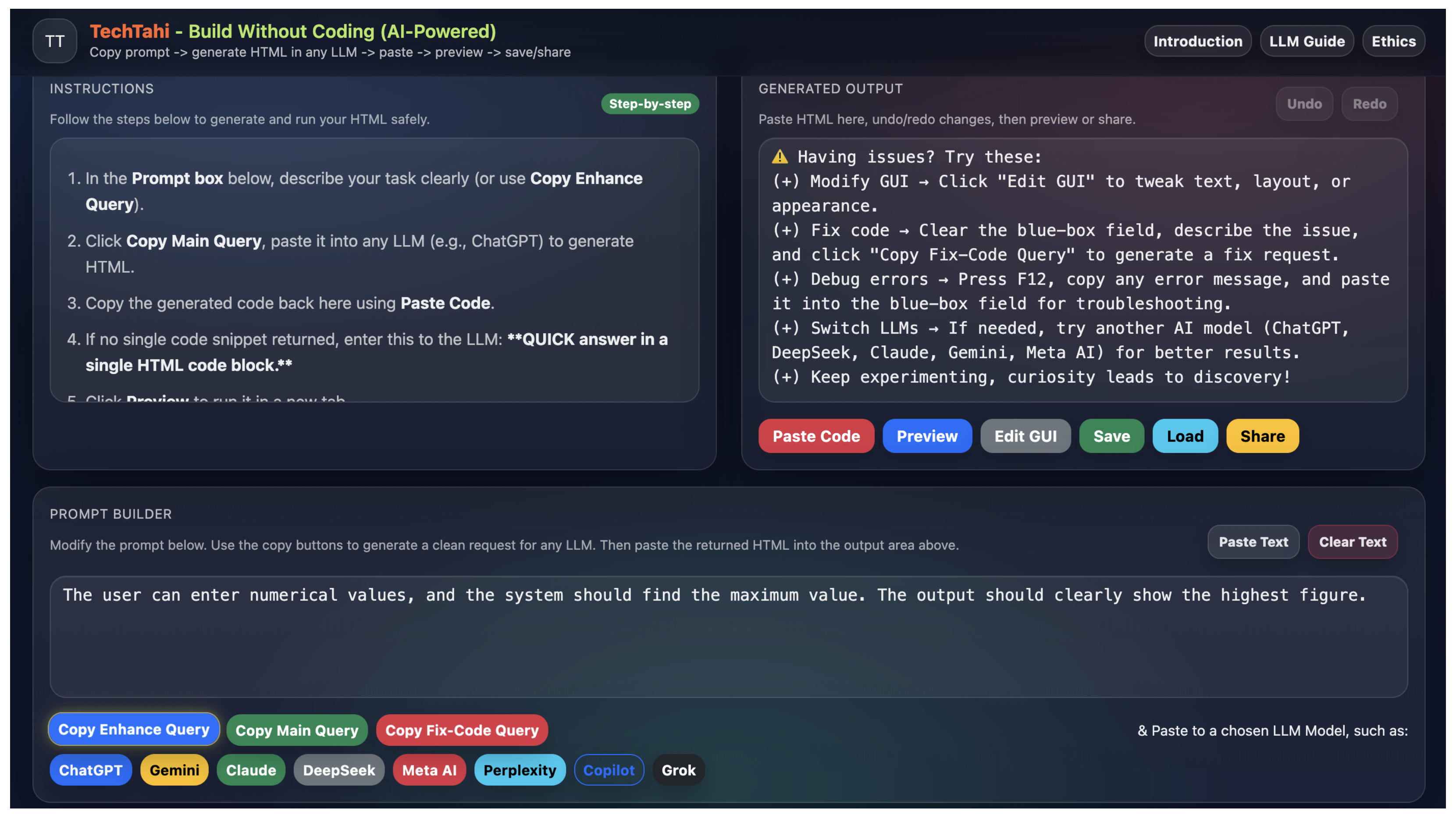
- describe desired input–output behaviour in natural language within a browser-based interface;
- send refined prompts to a choice of LLMs (e.g., ChatGPT, DeepSeek, Claude, Gemini, or Meta AI, depending on the versions publicly available at the time of use);
- paste the returned code into TechTahi and instantly preview a working application, without compilers or local tooling; and
- iteratively fix, enhance, and share applications using a guided, repeatable procedure.
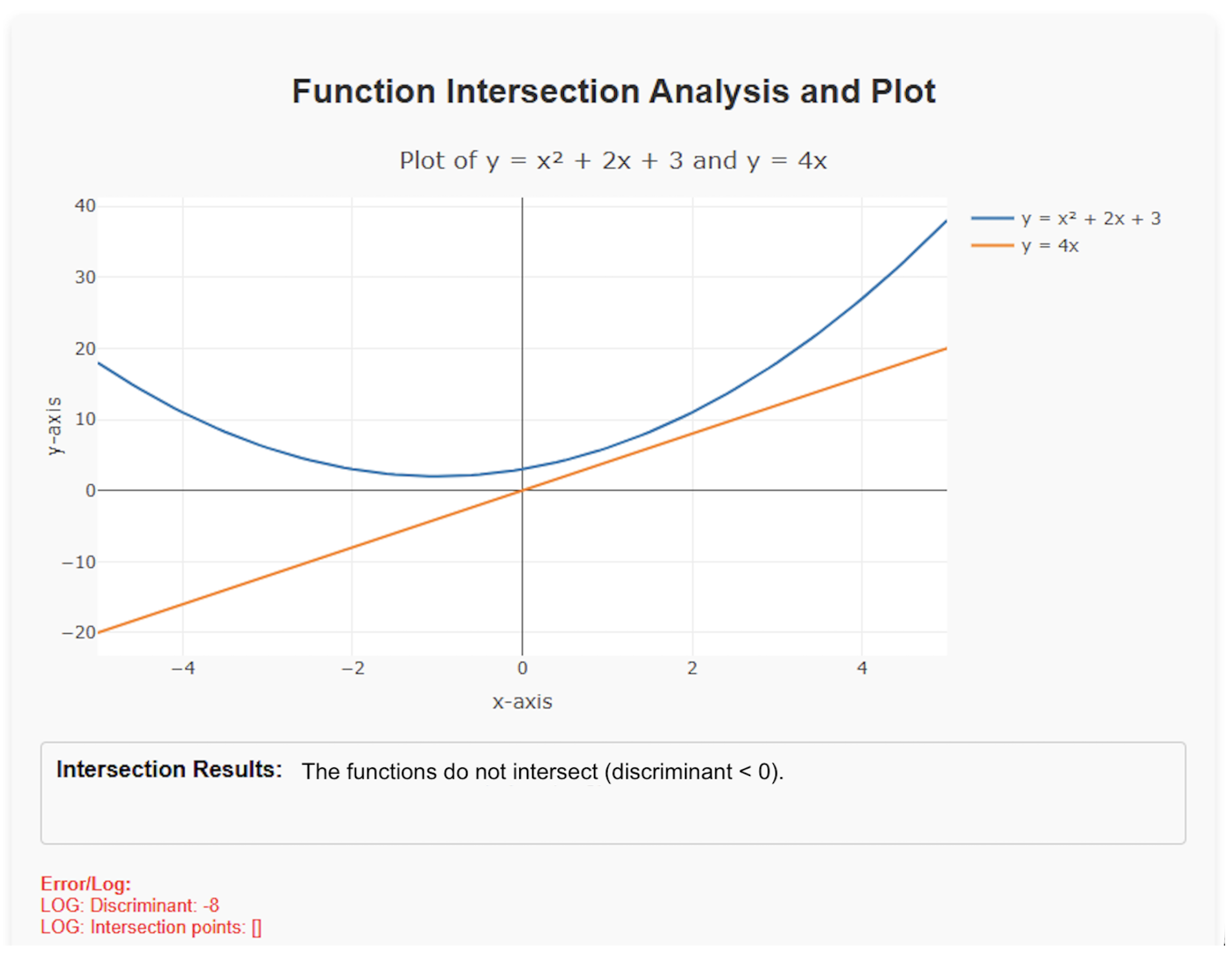
“draw 2 lines, one is y = x ^ 2 + 2x + 3 and y = 4x, and show if they cut each other or not and where”
3.1. Design Principles
- Syntax-free creation. Users should not be required to learn programming syntax, frameworks, or build tools. All interactions occur through natural-language descriptions of tasks, inputs, and outputs. Code generation is intentionally fast, typically returning results within 10–30 s, avoiding the long wait times, often minutes or hours, seen in other code-generation or live-coding systems.
- Zero-install, device-agnostic access. The platform runs entirely in the browser, requiring no local installation, compiler setup, or cloud-hosted environment. Only the necessary libraries are downloaded to the user’s device, and once generated, code remains fully local. This design aims to minimize centralized storage of user-generated project data and to support locally controlled workflows, supporting communities that prefer offline, cost-free, and privacy-preserving tools.
- Transparent AI orchestration. Rather than locking users into a single model, TechTahi interoperates with multiple LLM providers (ChatGPT, DeepSeek, Claude, Gemini, Meta AI, etc.). This enables experimentation, flexibility, and resilience against changes in any one service, while keeping the underlying orchestration clear and user-controllable.
- Community sharing and remixing. Users can publish, share, and remix creations through a dedicated sharing platform, supporting peer learning and community-driven innovation. These features are designed to remain simple and accessible, aligning with communities that value practicality and low barriers to participation.
3.2. User Workflow
3.3. Platform Architecture
- a browser-based user interface written in standard web technologies;
- a sandboxed runtime for executing user-provided HTML/CSS/JavaScript safely;
- a set of pre-crafted prompt templates for common operations (initial code generation, fixing code, GUI modification, debugging);
- storage and retrieval mechanisms for saving user projects and exposing them via the sharing platform; and
- lightweight server-side components that manage sessions and enforce security constraints (e.g., limiting network access from generated code).
3.4. Use Cases
Knowledge Creation and Digital Literacy
4. Methods
4.1. Study Design
4.2. Participants and Recruitment
4.3. Procedure
4.4. Survey Instrument
4.5. Analysis
4.6. Ethics
5. Exploratory Findings and Discussion
5.1. Accessibility and Ease of Use: Lowering Entry Barriers to Digital Creation
5.2. Growing Confidence and Emerging Computational Thinking
5.3. Learner Aspirations: Creative, Community-Oriented, and Culturally Relevant Projects
5.4. Points of Friction: Instructional Clarity and Cognitive Load
5.5. Overall Perceptions and Early Promise
6. Discussion
6.1. Early Implications for Culturally Responsive AI in STEM
6.2. Generative AI in Action
6.3. Comparison with Vibe-Coding Platforms
6.4. Design Implications for Future Development
6.5. Limitations and Future Research
7. Conclusions
Author Contributions
Funding
Institutional Review Board Statement
Informed Consent Statement
Data Availability Statement
Acknowledgments
Conflicts of Interest
Abbreviations
| LLMs | Large Language Models |
| AI | Artificial Intelligence |
| IDE | Integrated Development Environments |
| API | Application Programming Interface |
References
- Airini, D. B., Curtis, E., Johnson, O., Luatua, F., O’Shea, M., Rakena, T. O., Reynolds, G., Sauni, P., Huirua, T. S., Tarawa, T. S., Savage, T., & Ulugia-Pua, M. (2010). Success for all: Improving Māori and Pasifika student success in degree-level studies. Teaching and learning research report for the New Zealand Council for Educational Research. New Zealand Council for Educational Research. [Google Scholar]
- Bishop, R., Berryman, M., Cavanagh, T., & Teddy, L. (2009). Te Kotahitanga: Addressing educational disparities facing Māori students. Teaching and Teacher Education, 25(5), 734–742. [Google Scholar] [CrossRef]
- Chang, Y., Wang, X., Wang, J., Wu, Y., Yang, L., Zhu, K., Chen, H., Yi, X., Wang, C., Wang, Y., Ye, W., Zhang, Y., Chang, Y., Yu, P. S., Yang, Q., & Xie, X. (2024). A survey on evaluation of large language models. ACM Transactions on Intelligent Systems and Technology, 15(3), 1–45. [Google Scholar] [CrossRef]
- Chu, C., Abella, I., & Paurini, S. (2013). What helps Māori and Pasifika students succeed in tertiary education? Ako Aotearoa. [Google Scholar]
- Coleman, C., & Luton, J. (2021). Familiar ‘innovative’ spaces: ECE, drama, physical education, and marae-based learning. New Zealand Journal of Educational Studies, 56(Suppl. S1), 167–180. [Google Scholar] [CrossRef]
- Curtis, E., Reid, P., & Jones, R. (2014). Decolonising the academy: Implications for Māori students and academics. MAI Journal, 3(1), 40–52. [Google Scholar]
- Curtis, E. T., Wikaire, E., Lualua-Aati, T., Kool, B., Nepia, W., Ruka, M., Honey, M., Kelly, F., & Poole, P. (2012). Tātou Tātou; Success for all: Improving Māori student success. Ako Aotearoa. [Google Scholar]
- Durie, M. (2004, March 11). Exploring the interface between science and Indigenous knowledge. 5th APEC Research and Development Leaders Forum (pp. 2–21), Christchurch, New Zealand. [Google Scholar]
- Geng, F., Shah, A., Li, H., Mulla, N., Swanson, S., Soosai Raj, G., Zingaro, D., & Porter, L. (2026). Exploring student-AI interactions in vibe coding. In Proceedings of the 28th Australasian computing education conference (pp. 45–54). ACM. [Google Scholar]
- Hikuroa, D. (2017). Mātauranga Māori—The ūkaipō of knowledge in New Zealand. Journal of the Royal Society of New Zealand, 47(1), 5–10. [Google Scholar] [CrossRef]
- Holmes, W., Bialik, M., & Fadel, C. (2019). Artificial intelligence in education: Promises and implications. Center for Curriculum Redesign. [Google Scholar]
- Jones Brayboy, B. M., & Maughan, E. (2009). Indigenous knowledges and the story of the bean. Harvard Educational Review, 79(1), 1–21. [Google Scholar] [CrossRef]
- Kidman, J., & Chu, C. (2019). “We’re not treated like professionals”: Māori and Pasifika scientists’ experiences of academia (Tech. Rep.). Royal Society Te Apārangi. [Google Scholar]
- Kidman, J., Chu, C., Fernandez, S., & Abella, I. (2015). Māori scholars and the university. Ngā Pae o te Māramatanga. [Google Scholar]
- Kukutai, T., & Taylor, J. (2016). Indigenous data sovereignty: Toward an agenda. ANU Press. [Google Scholar]
- Lewis, D. (1994). We, the navigators: The ancient art of landfinding in the Pacific (2nd ed.). University of Hawai‘i Press. [Google Scholar]
- Li, L., & Wu, Z. (2022). How can no/low code platforms help end-users develop ml applications?—A systematic review. In International conference on human-computer interaction (pp. 338–356). Springer Nature. [Google Scholar]
- Luckin, R. (2018). Machine learning and human intelligence. The future of education for the 21st century. UCL Institute of Education Press. [Google Scholar]
- Macfarlane, A. H., Macfarlane, S., & Webber, M. (2015). Sociocultural realities: Exploring new horizons. HarperCollins. [Google Scholar]
- McAllister, T., Naepi, S., Walker, L., Gillon, A., Clark, P., Lambert, E., McCambridge, A. B., Thoms, C., Housiaux, J., Ehau-Taumaunu, H., Waikauri Connell, C. J., Keenan, R., Thomas, K.-L., Maslen-Miller, A., Tupaea, M., Mauriohooho, K., Puli’uvea, C., Rapata, H., Akevai Nicholas, S., … Alipia, T. (2022). Seen but unheard: Navigating turbulent waters as Māori and Pacific postgraduate students in STEM. Journal of the Royal Society of New Zealand, 52, 116–134. [Google Scholar] [CrossRef]
- McAllister, T. G., Kokaua, J., Naepi, S., Kidman, J., & Theodore, R. (2020). Glass ceilings in New Zealand universities. MAI Journal, 9(3), 272–285. [Google Scholar] [CrossRef]
- McLachlan, J., & Kukutai, T. (2020). Data sovereignty and the governance of algorithmic bias. Policy Quarterly, 16(1), 22–28. [Google Scholar]
- Millar, R. (1996). Towards a science curriculum for public understanding. School Science Review, 77(280), 7–18. [Google Scholar]
- Mou, J., & Olsson, C. (2019). Racism, coloniality, and whiteness in New Zealand tertiary STEM education. New Zealand Journal of Educational Studies, 54, 271–286. [Google Scholar]
- Naepi, S. (2019). Why isn’t my professor pasifika?: Snapshot of the academic workforce in New Zealand universities. MAI Journal, 8, 219–234. [Google Scholar] [CrossRef]
- Naepi, S., Wilson, E., Lagos, S., Manuela, S., McAllister, T. G., Kidman, J., Theodore, R., & Kokaua, J. (2021). Where are we now? Patterns of Māori and Pasifika enrolment in the natural and physical science and society and culture fields in Aotearoa New Zealand. Higher Education Research & Development, 40(1), 90–103. [Google Scholar] [CrossRef]
- Sinanaj, L., Ajdari, J., Hamiti, M., & Zenuni, X. (2022). A comparison between online compilers: A case study. In 2022 11th mediterranean conference on embedded computing (MECO) (pp. 1–6). IEEE. [Google Scholar]
- Stuckey, M., Hofstein, A., Mamlok-Naaman, R., & Eilks, I. (2013). The meaning of ’relevance’ in science education and its implications for the science curriculum. Studies in Science Education, 49(1), 1–34. [Google Scholar] [CrossRef]
- Thaman, K. H. (2009). Towards cultural democracy in Pacific education. International Journal for the Scholarship of Teaching and Learning, 3(2), 1–9. [Google Scholar]
- Thomas, G., & Durant, J. (1987). Why Should We Promote the Public Understanding of Science? Scientific Literacy Papers, Summer, 1–14. Available online: https://ocw.mit.edu/courses/sts-014-principles-and-practice-of-science-communication-spring-2006/resources/durant_promote/ (accessed on 14 May 2026).
- Worth, T. (2023, December). Barriers to diversity in the aotearoa tech sector (Tech. Rep.). Research Note. Research conducted by Te Whatu Hura|Toi Mai Research Advisor. Workforce Development Council. [Google Scholar]



| Survey Focus | Example Item | Response Format |
|---|---|---|
| Ease of use | “How easy was it to follow the TechTahi instructions?” | 5-point Likert-style scale |
| Confidence | “Did using TechTahi make you feel more confident experimenting with digital tools?” | Yes/Maybe/No |
| Accessibility | “Do you think TechTahi reduces barriers to learning to code?” | Yes/No/Unsure |
| Community relevance | “Do you think TechTahi could be useful in supporting te reo Māori, Pasifika, or other community projects?” | Yes/Maybe/No/Unsure |
| Cultural relevance | “What features could be added to make TechTahi more meaningful for Māori or Indigenous learners?” | Open-ended |
| User experience | “What was the most frustrating part of using TechTahi?” | Open-ended |
| Dimension | Vibe Coding (AI IDE) | TechTahi |
|---|---|---|
| Installation and setup | Requires downloading and installing an IDE (Cursor, Windsurf, etc.), managing API keys, and sometimes installing Git or language runtimes. | Runs entirely in the browser; no installation, compilers, or runtime configuration required. |
| Mental model | Users must understand projects, files, extensions, diffs, and sometimes terminals. | Users only need to understand input–output behaviour and basic web interactions (type, copy, paste, click). |
| Error handling | Relies on reading console error messages, navigating multiple files, and often consulting documentation. | Encourages copying any visible error message into the blue text area and using a “Fix-Code Query” template to request guided fixes from an LLM. |
| Tool complexity | IDE exposes many advanced features (MCP, extensions, rule files, multi-model orchestration) that can overwhelm beginners. | Single-page interface with explicit step-by-step instructions and a small set of clearly labelled buttons. |
| Speed from idea to prototype | Time is spent on environment setup, configuration, and debugging tool issues before code even runs. | Users can move from describing an idea to seeing a running prototype in a few iterations, often within minutes, as there is no environment overhead and generation typically completes in 10–30 s. |
| Device requirements | Assumes a laptop or desktop where software can be installed and updated. | Works on any modern device with a browser (including locked-down school machines, tablets, and shared lab PCs). |
| Sharing and remixing | Requires familiarity with Git, GitHub, or file sharing to distribute projects. | Integrated sharing platform allows users to publish and browse creations via simple web links. |
| Target audiences | Suited to aspiring developers and technically inclined users who are willing to learn IDE and version control concepts. | Designed for students, educators, and community members, including those with minimal technical background. |
Disclaimer/Publisher’s Note: The statements, opinions and data contained in all publications are solely those of the individual author(s) and contributor(s) and not of MDPI and/or the editor(s). MDPI and/or the editor(s) disclaim responsibility for any injury to people or property resulting from any ideas, methods, instructions or products referred to in the content. |
© 2026 by the authors. Licensee MDPI, Basel, Switzerland. This article is an open access article distributed under the terms and conditions of the Creative Commons Attribution (CC BY) license.
Share and Cite
Williams, T.; Nguyen, M.; Ka’ai, T.; Vallayil, M.; Tukimata, N.; Smith-Henderson, T. Exploring the Potential of Low-Barrier AI Tools for Culturally Responsive STEM Learning: Early Māori and Pacific Learner Insights from the TechTahi Platform. Educ. Sci. 2026, 16, 808. https://doi.org/10.3390/educsci16050808
Williams T, Nguyen M, Ka’ai T, Vallayil M, Tukimata N, Smith-Henderson T. Exploring the Potential of Low-Barrier AI Tools for Culturally Responsive STEM Learning: Early Māori and Pacific Learner Insights from the TechTahi Platform. Education Sciences. 2026; 16(5):808. https://doi.org/10.3390/educsci16050808
Chicago/Turabian StyleWilliams, Toiroa, Minh Nguyen, Tania Ka’ai, Manju Vallayil, Nogiata Tukimata, and Tania Smith-Henderson. 2026. "Exploring the Potential of Low-Barrier AI Tools for Culturally Responsive STEM Learning: Early Māori and Pacific Learner Insights from the TechTahi Platform" Education Sciences 16, no. 5: 808. https://doi.org/10.3390/educsci16050808
APA StyleWilliams, T., Nguyen, M., Ka’ai, T., Vallayil, M., Tukimata, N., & Smith-Henderson, T. (2026). Exploring the Potential of Low-Barrier AI Tools for Culturally Responsive STEM Learning: Early Māori and Pacific Learner Insights from the TechTahi Platform. Education Sciences, 16(5), 808. https://doi.org/10.3390/educsci16050808