1. Introduction
The digital transformation of educational systems has led to substantial changes in teaching and learning processes, shaping increasingly flexible, personalized, and data-driven environments. In this context, artificial intelligence applied to education has emerged as one of the most rapidly developing areas in contemporary educational research, offering tools capable of adapting teaching processes to students’ individual characteristics through recommendation systems, predictive analytics, and automated feedback (
Luckin et al., 2016;
Zawacki-Richter et al., 2019). In recent years, this field has experienced accelerated growth, particularly with the emergence of generative artificial intelligence models, which has intensified the debate regarding their potential to transform educational processes and enhance the personalization of learning (
Kasneci et al., 2023;
Dwivedi et al., 2023). In this regard, recent reviews highlight that artificial intelligence can significantly contribute to optimizing teaching practices, supporting data-informed pedagogical decision-making, and promoting more adaptive learning experiences (
Zhai et al., 2024).
From the perspective of inclusive education, the incorporation of digital technologies should not be understood solely as a technical innovation, but rather as an opportunity to advance towards more equitable and accessible educational models. Inclusive education involves not only ensuring students’ presence in the classroom, but also fostering their active participation, engagement in learning, and overall development within diverse contexts (
Booth & Ainscow, 2011;
UNESCO, 2021). In this sense, recent literature has emphasized that the impact of educational technologies largely depends on their pedagogical integration, the role of teachers, and their capacity to respond to student diversity (
Holmes et al., 2019). Furthermore, current studies underline that artificial intelligence can play a relevant role in reducing learning barriers when oriented towards personalization and accessibility (
Crompton et al., 2023).
In the case of students with Autism Spectrum Disorder, the need for structured, predictable, and adapted environments becomes particularly significant. The characteristics associated with this condition, including difficulties in social communication, behavioral flexibility, and sensory processing (
American Psychiatric Association, 2013), can substantially influence how students engage in school dynamics. Within this framework, empirical evidence has shown that certain digital tools can facilitate task comprehension, activity anticipation, and social interaction, particularly when designed from a student-centered perspective (
Odom et al., 2015;
Parsons et al., 2019). Additionally, more recent research suggests that artificial intelligence-based systems can provide personalized supports that enhance cognitive accessibility and participation in inclusive settings, opening new possibilities for educational intervention in students with ASD.
From a functional educational perspective, the characteristics associated with Autism Spectrum Disorder are closely related to processes of academic autonomy and self-regulation. Difficulties in behavioral flexibility, executive functioning, communication, and sensory processing may directly affect students’ ability to plan, organize, initiate, and complete learning tasks independently (
American Psychiatric Association, 2013;
Ozonoff et al., 1991;
Hill, 2004). In this sense, autonomy and self-regulation are not secondary variables, but core components of how students engage with the learning environment. Therefore, their inclusion within the multidimensional construct of socioeducational participation allows for a more comprehensive analysis of student involvement in inclusive educational settings.
Within this context, socioeducational participation emerges as a central construct for analyzing the quality of inclusive educational processes. Participation is understood as a multidimensional process that reflects students’ active involvement in school life, including observable engagement in academic tasks, interaction with peers and teachers, progressive autonomy in learning activities, and the capacity to regulate behavior and organize work. This conceptualization is consistent with engagement-based frameworks that integrate behavioral, cognitive, emotional, and social dimensions of student involvement (
Fredricks et al., 2004;
Bond & Bedenlier, 2019), as well as with disability-oriented perspectives that understand participation as both a process and an outcome of inclusion (
Imms et al., 2017). From this perspective, participation can be considered a key indicator of inclusive education, particularly when analyzing the experiences of students with Autism Spectrum Disorder.
Despite the growing interest in artificial intelligence in education, empirical evidence regarding its impact in authentic educational contexts remains limited. A large proportion of existing studies have been conducted in experimental settings or have focused on the design and validation of technological tools, which constrains the understanding of how these technologies function in real classroom situations (
Zawacki-Richter et al., 2019). This limitation is particularly relevant in the field of inclusive education and, more specifically, in the case of students with Autism Spectrum Disorder, where studies examining complex variables such as socioeducational participation remain scarce. Moreover, recent research has emphasized the need to move towards approaches that integrate the analysis of artificial intelligence with broader educational indicators, beyond a sole focus on academic performance (
Holmes et al., 2022;
Tlili et al., 2023).
In this regard, there remains a gap in the literature concerning studies that analyze the role of artificial intelligence-based educational tools in real inclusive contexts, taking into account multidimensional variables such as socioeducational participation. This limitation hinders a comprehensive understanding of the impact of these technologies on the educational experience of students with specific support needs and restricts the development of evidence-based pedagogical decision-making.
The present study was conducted in mainstream inclusive schools located in urban educational contexts in Almería (Spain), where digital educational records and AI-based learning tools were already integrated into routine teaching practice. This contextual clarification is relevant, as the use of these tools may be influenced not only by student characteristics, but also by school-level factors such as technological infrastructure, pedagogical organization, and teacher mediation.
Within this framework, the present study aims to analyze the association between the use of artificial intelligence-based educational tools and the levels of socioeducational participation of students with Autism Spectrum Disorder enrolled in inclusive educational settings, based on the analysis of data generated in everyday teaching practice. This approach provides empirical evidence grounded in real educational contexts, contributing to bridging the gap between technological development and its application in authentic classroom environments, as well as advancing the understanding of the role of artificial intelligence in promoting inclusive educational processes.
2. Materials and Methods
2.1. Research Design
The study was conducted using a non-experimental, observational, and comparative design based on the secondary analysis of anonymized educational data generated in natural teaching contexts. This type of design is particularly suitable for examining relationships between variables in real school environments without introducing modifications to pedagogical practice or altering ordinary learning conditions. In contrast to experimental and quasi-experimental designs, observational approaches allow educational phenomena to be analyzed as they naturally occur in the classroom, thereby preserving the ecological validity of the findings and enhancing their applicability to real educational settings (
Shadish et al., 2002).
From this perspective, the study did not involve random assignment of participants or the implementation of interventions designed by the research team. Instead, the analysis focused on identifying patterns of association between the regular use of artificial intelligence-based educational tools and levels of student participation among learners with Autism Spectrum Disorder, using data generated through routine educational practice. This approach ensures the integrity of the educational context and minimizes external interference in teaching and learning processes (
Cook & Campbell, 1979).
Given its non-experimental nature, the results should be interpreted in terms of association rather than causation. Nevertheless, the use of data derived from authentic educational settings provides added value in terms of ecological validity, as it reflects the actual functioning of variables in inclusive, non-intervened contexts.
2.2. Participants
The sample consisted of 60 students formally diagnosed with Autism Spectrum Disorder enrolled in mainstream schools implementing inclusive practices. Participants were drawn from four schools located in urban contexts, all of which had prior experience in the use of digital educational records and the integration of technological tools into teaching practice.
The sample included 34 males (56.7%) and 26 females (43.3%), with ages ranging from 8 to 14 years (M = 10.9, SD = 1.87). Regarding educational level, 63.3% of students were enrolled in Primary Education and 36.7% in Secondary Education. In terms of support provision, 41.7% received support within the mainstream classroom, 33.3% received combined support, and 25% received specific support on a periodic basis.
The data analyzed were obtained from anonymized institutional educational records in which the formal diagnosis of ASD was documented through school-based psychoeducational reports. The sample was selected using purposive sampling based on institutional accessibility, considering the availability of complete, consistent, and comparable records across schools. This approach allows access to contextually rich data with high ecological validity, although it limits the generalizability of findings to broader populations.
Participants were classified into comparison groups based on their regular use of artificial intelligence-based educational tools during the study period. Students were considered users when they engaged systematically with these tools as part of their regular educational activities, with a minimum frequency of three sessions per week sustained over at least one academic term, as recorded in the schools’ digital platforms. The non-user group consisted of students with no recorded use of such tools during the same period.
Preliminary analyses were conducted to assess group comparability. The results indicated no statistically significant differences in age, educational level, or level of pedagogical support (p > 0.05), supporting baseline equivalence between groups.
An a priori power analysis was conducted using G*Power version 3.1.9.7, establishing a minimum sample size of 54 participants to detect moderate effects (d = 0.50) with α = 0.05 and statistical power of 0.80. The final sample size (n = 60) exceeded this threshold, supporting the adequacy of the study for detecting meaningful differences between groups.
2.3. Research Objectives
The general objective of this study was to analyze the association between the use of artificial intelligence-based educational tools and levels of participation among students with Autism Spectrum Disorder in inclusive educational settings.
From this general objective, the following specific objectives were derived: to assess student participation levels based on available educational records; to analyze the sociodemographic and educational characteristics of the sample; to examine differences in participation according to the use of AI-based educational tools; to compare outcomes between users and non-users of these tools; to identify the dimensions most strongly associated with AI use; and to estimate the magnitude of the observed differences.
2.4. Variables
The grouping variable was the regular use of artificial intelligence-based educational tools within routine teaching practice. These tools consisted of adaptive digital learning platforms integrated into the educational environment, incorporating personalization functionalities through algorithms capable of adjusting content, task sequencing, and feedback according to student performance. These platforms allowed automatic adjustment of difficulty levels, generation of individualized activities, immediate feedback, and continuous monitoring of student progress.
These tools were used as part of regular classroom activities, functioning as complementary learning resources integrated into everyday teaching practice. Students interacted with adaptive tasks, guided exercises, and automated feedback systems, while teachers played an active role in mediating their use, selecting activities, and supporting student engagement throughout the learning process.
Regular use was defined as interaction with these tools at least three times per week within the school context, sustained over a minimum period of one academic term, thus providing a consistent and verifiable criterion of exposure to artificial intelligence.
The main variable was student participation, conceptualized as a multidimensional construct comprising behavioral engagement, social interaction, academic autonomy, and self-regulation.
The global participation index was calculated as the arithmetic mean of the four dimensions, previously transformed to a common scale ranging from 1 to 5 through a min–max normalization procedure, in which original values were proportionally rescaled to ensure comparability across indicators. In addition, age, educational level, and level of pedagogical support were considered as control variables in order to account for potential differences across participants.
2.5. Instruments
The analysis was based on indicators derived from educational record systems routinely used in the participating schools. These systems included institutional student records, digital teacher logs, and data generated by educational platforms used in everyday teaching practice.
The use of artificial intelligence-based tools was identified through activity logs generated by the digital platforms, which recorded frequency of use, number of sessions, and student interaction with adaptive content. These records provided an objective measure of students’ exposure to these tools.
The dimensions of participation were operationalized using systematically recorded indicators. Behavioral engagement was assessed through participation in tasks, time on task, and task completion. Social interaction was estimated based on participation in group activities and collaborative dynamics. Academic autonomy was measured through the degree of task completion with reduced teacher support, while self-regulation was approximated through indicators related to work organization and sustained activity.
These indicators were derived from structured teacher records routinely used in the participating schools, based on predefined observation criteria integrated into institutional assessment systems. Teachers systematically documented student engagement, interaction, and task-related behaviors as part of their regular pedagogical practice. Although these measures were not based on standardized external instruments, they followed consistent internal recording procedures across schools, ensuring a comparable and systematic approach to data collection.
Given that indicators were derived from multiple sources, a standardization process was applied, followed by transformation to a common 1–5 scale using linear rescaling procedures. The internal consistency of the global index was high, with a Cronbach’s alpha coefficient of 0.88.
2.6. Procedure
The procedure involved the collection, integration, and analysis of educational data generated over a full academic year within routine teaching practice.
In the first phase, schools with structured recording systems and documented use of digital tools were identified. Subsequently, anonymized data from students with Autism Spectrum Disorder were collected, including institutional records and platform-based data.
In the second phase, the data were organized into a structured analytical dataset using IBM SPSS Statistics version 31. This process included variable coding, format standardization, detection of outliers, and verification of data consistency.
Descriptive analyses were conducted using means, standard deviations, and frequencies. Assumptions of normality were assessed using the Shapiro–Wilk test, and homogeneity of variances was examined using Levene’s test.
After confirming these assumptions, independent samples t-tests were conducted to compare participation levels between users and non-users of AI-based tools. Effect sizes were calculated using Cohen’s d to estimate the magnitude of differences. The significance level was set at p < 0.05.
2.7. Ethical Considerations
This study was based on the secondary analysis of anonymized educational data derived from institutional records generated during routine school practice, without direct interaction with participants.
All data were anonymized by the participating schools prior to analysis, ensuring confidentiality and preventing individual identification. The analysis was conducted using aggregated data in accordance with principles of data protection and responsible data use.
Given the secondary nature of the study and the non-identifiable character of the data, formal ethical approval was not required within the applicable institutional framework.
3. Results
The analysis of the results was structured across multiple levels in order to systematically examine the relationship between the use of artificial intelligence-based educational tools and levels of student participation among learners with Autism Spectrum Disorder in inclusive settings. A progressive analytical approach was adopted, combining descriptive and inferential analyses to identify both general patterns and specific differences between groups.
3.1. Initial Descriptive Analysis of Student Participation
In the first phase, a descriptive analysis of student participation was conducted for the overall sample. The results indicate that the global index falls within a moderate range (M = 2.83; SD = 0.40), suggesting a medium level of student involvement in educational activities.
The analysis by dimensions reveals a differentiated pattern. Behavioral engagement shows the highest mean value (M = 3.02), indicating that students tend to participate in observable ways, particularly when activities are clearly structured. Social interaction presents slightly lower values (M = 2.96), reflecting moderate participation in interpersonal contexts.
In contrast, the dimensions of academic autonomy (M = 2.70) and self-regulation (M = 2.62) display lower scores, indicating greater difficulties in processes related to the independent management of learning. This pattern is consistent with existing literature on students with Autism Spectrum Disorder, where self-regulatory processes often require more intensive and sustained support.
Although score dispersion remains within moderate levels, some intragroup variability is observed, particularly in the dimensions of academic autonomy and self-regulation. This suggests the presence of heterogeneous profiles within the sample (
Table 1).
3.2. Comparison of Student Participation According to the Use of AI-Based Tools
The comparative analysis between students who used artificial intelligence-based educational tools and those who did not reveals a consistent pattern of differences in favor of the user group across all analyzed dimensions.
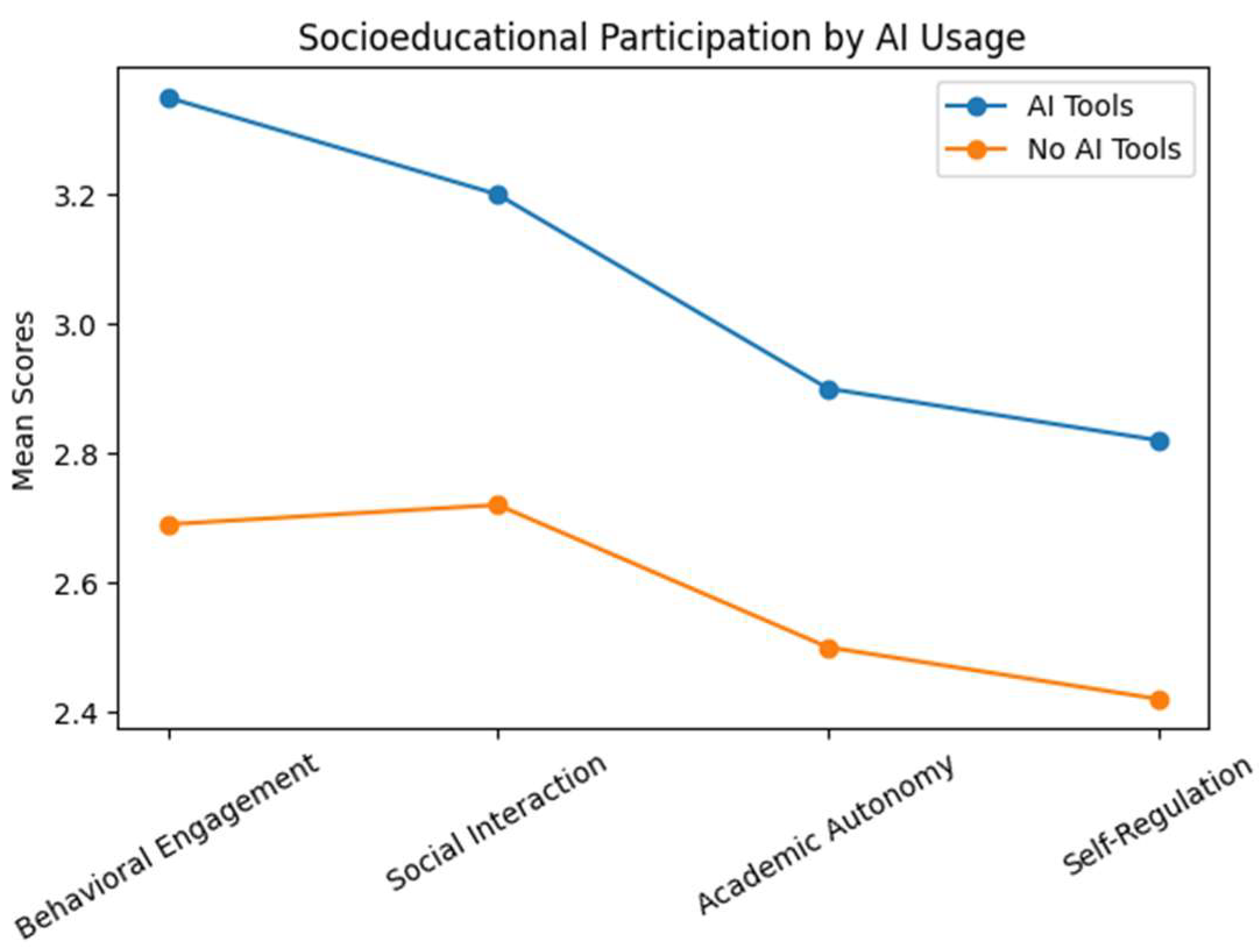
In terms of behavioral engagement, the group using AI-based tools showed a notably higher mean (M = 3.35) compared to the non-user group (M = 2.69). This difference suggests greater task activation and sustained involvement in academic activities, potentially associated with the dynamic adaptation of tasks and the immediate feedback provided by these platforms.
A similar pattern was observed in the dimension of social interaction, with higher scores for the user group (M = 3.20) compared to non-users (M = 2.72). This finding indicates that students exposed to these tools participated more frequently in interpersonal dynamics. This result may be related to the structured nature of the learning environment, which can facilitate task understanding and reduce uncertainty in social engagement.
Differences in academic autonomy (M = 2.90 vs. M = 2.50) and self-regulation (M = 2.82 vs. M = 2.42), although present, were less pronounced. This pattern suggests that AI-based tools may be more strongly associated with observable participation and behavioral activation than with internal processes such as self-regulation, which typically require more gradual development.
These findings should be interpreted with caution, as the use of AI-based tools is embedded within specific pedagogical contexts, which may involve the influence of additional uncontrolled variables in the present analysis (
Table 2).
3.3. Inferential Analysis and Effect Size
To examine the statistical significance of the observed differences, independent samples t-tests were conducted after verifying the assumptions of normality and homogeneity of variances.
The results indicate statistically significant differences across all dimensions of student participation. In particular, behavioral engagement showed a high t value (t = 5.48; p < 0.001), confirming the robustness of the difference between groups. Similarly, social interaction also revealed significant differences (t = 4.10; p < 0.001).
The dimensions of academic autonomy and self-regulation also yielded statistically significant results (p = 0.001), although with lower t values, suggesting a more moderate association between AI-based tool use and these dimensions.
From an applied perspective, effect size estimates further support the relevance of these findings. Behavioral engagement showed a large effect size (d = 1.41), followed by global participation (d = 1.25) and social interaction (d = 1.06). Academic autonomy (d = 0.93) and self-regulation (d = 0.90) presented moderate-to-large effect sizes.
Despite the consistency of these results, it should be noted that the magnitude of the effects may be influenced by contextual characteristics of the educational settings. Therefore, these differences cannot be attributed exclusively to the use of artificial intelligence-based tools (
Table 3).
3.4. Graphical Representation of the Results
To facilitate the visual interpretation of the findings,
Figure 1 presents the mean scores across participation dimensions according to the use of artificial intelligence-based educational tools.
The figure clearly illustrates the pattern identified in the previous analyses. Across all dimensions, the group using artificial intelligence-based tools shows higher mean scores. The most pronounced difference is observed in the Behavioral Engagement dimension, reinforcing its role as the primary domain associated with the use of adaptive technologies.
Similarly, the Social Interaction dimension displays a consistent difference, indicating greater participation in interpersonal dynamics among students in the user group. In contrast, the dimensions of Academic Autonomy and Self-Regulation show more moderate differences, suggesting that these processes may depend to a greater extent on additional factors beyond the use of technological tools.
3.5. Integrated Summary of the Results
The overall analysis of the findings reveals a consistent pattern of association between the use of artificial intelligence-based educational tools and higher levels of student participation.
This association is more pronounced in the external and observable dimensions of participation, particularly in behavioral engagement and social interaction. This pattern suggests that adaptive technologies may be linked to increased student activation and enhanced involvement in the educational environment.
In contrast, dimensions related to internal processes, such as academic autonomy and self-regulation, show more moderate differences. This indicates that these aspects may require more sustained interventions or the interaction of additional pedagogical factors.
Overall, the results provide consistent empirical evidence regarding the relationship between the use of artificial intelligence-based educational tools and student participation in inclusive contexts. However, their interpretation should be approached with caution, considering the observational nature of the study and the potential influence of contextual variables.
4. Discussion
The aim of this study was to analyze the association between the use of artificial intelligence-based educational tools and levels of student participation among learners with Autism Spectrum Disorder in inclusive educational settings. The findings reveal a consistent pattern of differences between students who use these tools and those who do not, providing relevant empirical evidence regarding their role in real educational contexts.
From an interpretative perspective, the results indicate that students using artificial intelligence-based tools show higher levels of participation, particularly in the dimensions of behavioral engagement and social interaction. These findings are consistent with recent research suggesting that AI-based educational systems can enhance student activation through personalized learning, adaptive difficulty, and immediate feedback (
Kasneci et al., 2023;
Zhai et al., 2024). In this regard, the ability of these tools to dynamically adjust tasks may contribute to maintaining attention and reducing disengagement in educational settings.
The greater differences observed in behavioral engagement reinforce the idea that adaptive technologies can play a key role in structuring academic activity. For students with Autism Spectrum Disorder, structured and predictable environments are essential for learning (
American Psychiatric Association, 2013). AI-based tools, by providing clear task sequences and immediate feedback, may reduce uncertainty and support sustained engagement in learning activities.
In relation to social interaction, the results also show significant differences in favor of the user group. Although this effect may initially appear indirect, it aligns with studies indicating that improved task comprehension and structured learning environments can facilitate participation in interpersonal dynamics (
Parsons et al., 2019). Furthermore, recent research highlights that artificial intelligence can contribute to creating more accessible learning environments, thereby supporting inclusion in shared activities (
Crompton et al., 2023). In this sense, technology does not replace social interaction but rather acts as a contextual facilitator that reduces barriers to participation.
In contrast, the differences observed in academic autonomy and self-regulation, although statistically significant, are of smaller magnitude. This pattern suggests that internal processes related to learning management and behavioral control are not solely dependent on the use of technological tools, but instead require progressive development and more complex pedagogical mediation. This interpretation is consistent with recent perspectives indicating that artificial intelligence alone does not guarantee the development of self-regulatory competencies, highlighting the importance of teacher support and structured instructional strategies (
Dwivedi et al., 2023;
Tlili et al., 2023).
From a broader perspective, the findings suggest that the impact of artificial intelligence-based tools is more pronounced in observable and external dimensions of participation, while their influence on internal processes is more limited. This contributes to a more nuanced understanding of the role of technology in inclusive education, moving beyond deterministic views and situating its effectiveness within the pedagogical context in which it is implemented.
In relation to existing literature, this study extends empirical evidence on artificial intelligence in education within real classroom settings, responding to calls for research that goes beyond experimental designs or technology-centered approaches (
Zawacki-Richter et al., 2019;
Holmes et al., 2022). Additionally, by focusing on participation as a multidimensional construct, the study contributes to a more comprehensive understanding of educational impact, in line with contemporary frameworks that emphasize broader dimensions of learning (
Bond & Bedenlier, 2019).
Despite these contributions, several limitations must be acknowledged. First, the observational design precludes causal inference between the use of artificial intelligence-based tools and levels of student participation. Second, the use of purposive sampling based on institutional accessibility limits the generalizability of the findings. Furthermore, the use of educational records from different schools may introduce variability in measurement, despite the standardization procedures applied.
Another relevant limitation concerns the potential influence of contextual variables, such as teaching practices, the level of technological integration, or the organizational culture of the schools. In this sense, the use of artificial intelligence-based tools may be embedded within broader pedagogical dynamics that also contribute to student participation. Therefore, the findings should be interpreted considering the educational context in which these tools are implemented.
5. Conclusions
The findings of this study demonstrate that the use of artificial intelligence-based educational tools is associated with higher levels of student participation among learners with Autism Spectrum Disorder in inclusive educational contexts. This association is particularly evident in dimensions related to behavioral engagement and social interaction, highlighting the potential of adaptive technologies to enhance observable involvement in learning activities.
However, the more moderate differences observed in academic autonomy and self-regulation suggest that these internal processes require sustained pedagogical support and cannot be fully addressed through technology alone. These results reinforce the importance of integrating artificial intelligence within structured teaching practices, where the role of the teacher remains central in guiding learning processes.
From an applied perspective, the findings support the use of artificial intelligence-based tools as a valuable pedagogical resource to promote inclusive education. Nevertheless, their effectiveness depends on their appropriate integration within instructional design and their alignment with the specific needs of students.
Overall, this study contributes to advancing the understanding of artificial intelligence in education by providing empirical evidence from real classroom contexts and highlighting its potential, as well as its limitations, in supporting inclusive educational processes.