Article

Key Predictors of Outdoor Science Teaching in Regular Classes
Faculty of Education, University of Ljubljana, 1000 Ljubljana, Slovenia
*
Author to whom correspondence should be addressed.
Educ. Sci. 2026, 16(5), 778; https://doi.org/10.3390/educsci16050778
Submission received: 11 February 2026 / Revised: 30 April 2026 / Accepted: 6 May 2026 / Published: 14 May 2026

Abstract

Outdoor science teaching provides meaningful, hands-on learning opportunities, yet remains inconsistently practiced in schools. This quantitative study investigated how specific teacher-level predictors associate with the frequency of outdoor science teaching in regular classroom time. A structured questionnaire was developed and administered to 258 Slovenian science in-service teachers, measuring their attitudes, self-efficacy, perceived support, professional development, connection to nature, and inclusion of nature. After reducing items through exploratory factor analysis, variables were then entered into an ordinal logistic regression model of outdoor teaching frequency. Teachers’ attitudes and self-efficacy emerged as the strongest predictors, while their professional development, support, connection to nature, and inclusion with nature were not significant. Supplementary correlations showed that teachers perceiving greater support or stronger connection to nature held slightly more positive attitudes. The correlation indicated a weak but positive link between accessible environments and outdoor teaching frequency. Based on these findings, we recommend actively fostering teachers’ positive attitudes and self-efficacy, as these personal factors are the primary drivers of how frequently outdoor science teaching occurs. To support the development of these personal factors, professional development programs should be systematically designed to build confidence, provide hands-on mastery experiences, and reinforce positive beliefs. Rather than being treated as predictors in their own right, these elements should be understood as structured pathways for strengthening the attitudes and self-efficacy that drive outdoor teaching practice.

1. Introduction

Outdoor education refers to learning that takes place beyond the classroom, ideally in natural or intentionally designed outdoor spaces (Borsos et al., 2022; Novljan & Pavlin, 2022). It includes overlapping concepts—such as outdoor teaching, nature-based education, place-based learning, and learning outside the classroom—each with distinct goals and levels of curricular integration (Falzon et al., 2025). We adopt a widely used conceptualization of outdoor education as a multifaceted framework encompassing diverse environments and purposes (Rickinson et al., 2004). Further, our definition excludes indoor or simulated experiences (e.g., museums, galleries, virtual field trips, zoos), which lack the immersive qualities of natural settings. In line with recent work, school laboratories are also excluded, with the focus placed on outdoor science teaching within school grounds or nearby areas (Ayotte-Beaudet et al., 2023).
Outdoor science teaching, as a distinct subset of outdoor and environmental education, engages students with scientific phenomena through direct observation, exploration, and inquiry (Goldman & Alkaher, 2023; Romero et al., 2022). Outdoor science teaching can also be understood as a form of place-responsive pedagogy, in which learning emerges through teachers’ and students’ sustained engagement with local environments and the social contexts of schooling (Mannion et al., 2013). It offers authentic, real-world contexts that foster not only conceptual understanding but also emotional engagement and social development (Mann et al., 2021; Romero et al., 2022). Such experiences can promote scientific knowledge along with environmental responsibility and sustainability awareness and therefore contribute to students’ holistic development (Haraldsson et al., 2024; Pirchio et al., 2021). From an educational research perspective, outdoor learning is not merely a change in location but a pedagogical approach whose value depends on how teachers integrate it into planned instruction, curriculum goals, and classroom management within formal schooling (Špernjak et al., 2026).
Despite increasing recognition of its benefits, the integration of outdoor teaching into school curricula remains inconsistent and often limited (Falzon et al., 2025). This challenge spans multiple disciplines, including science education—a field that is especially well-suited for outdoor instruction due to its emphasis on experiential methods and real-world relevance (Ayotte-Beaudet et al., 2017). Consequently, the key question is not whether outdoor learning is beneficial, but under which professional and institutional conditions teachers adopt it as a regular instructional strategy.

1.1. The Role of Teachers in Sustaining Outdoor Science Education

Whether outdoor teaching becomes a sustained and meaningful practice depends largely on teachers, who are often expected to invest additional time, energy, and personal resources when implementing approaches beyond conventional classroom routines (Dring et al., 2020). Teachers should not be left to navigate the complexities of outdoor instruction without adequate support (Schilhab, 2021). Strengthening outdoor science education requires a shared commitment from teachers, school leaders, researchers, and policy makers (Klopčič & Torkar, 2025).
A central consideration is not only teachers’ willingness to teach science outdoors, but also their perceived ability to do so within the constraints of the school environment. Beliefs, prior experiences, and confidence levels all shape professional decision-making in this context (Glackin, 2018; Schilhab, 2021). Social Cognitive Theory offers a useful lens here, emphasizing the role of self-efficacy—teachers’ beliefs in their capabilities to organize and execute instructional actions—as a key determinant of behavior (Bandura, 1986). In the context of outdoor teaching, self-efficacy is likely to influence not only whether a teacher considers taking students outside, but also how they plan for, manage, and reflect on such experiences. Those who feel competent in outdoor settings—individuals possessing contextual knowledge—are more likely to incorporate outdoor environments into their instruction. This form of knowledge encompasses disciplinary understanding, pedagogical skill, experience with field-based inquiry, and the ability to manage student behaviors in outdoor settings (Barnett & Hodson, 2001).
In addition, teachers’ personal experiences with nature and a preference for student-centered approaches to teaching may further encourage engagement with outdoor science instruction (Glackin, 2018; Torkar, 2014, 2015).
These interrelated dimensions shape how science is taught across settings, with outdoor instruction as one of the options.

1.2. Science and Outdoor Teaching in Slovenian Compulsory Education

Slovenia’s nine-year compulsory basic education system serves students aged 6 to 15 and is organized into three three-year cycles. The first two cycles (grades 1–6) correspond to primary education, while the third cycle (grades 7–9) is classified as lower secondary education (Eurydice, 2025).
Science is taught across all three cycles, although the subject structure and name changes over time. In the first cycle, science is introduced as the subject learning the environment, emphasizing basic observation and exploration of the natural world. In grades 6 and 7, science is taught as natural sciences (naravoslovje), integrating content from biology, chemistry, and physics. In the final cycle (grades 8 and 9), these disciplines are taught as separate subjects. Across all stages, the curriculum aims to develop students’ understanding of living and non-living systems through observation, inquiry, and real-world experiences grounded in environmental contexts (Skvarč et al., 2011).
Outdoor learning is explicitly embedded in the national curriculum and is primarily implemented through activity days and outdoor school (Šebjanič & Skribe-Dimec, 2019). Schools are required to organize 15 activity days annually, with three focused on science. While typically conducted outdoors, these may also involve visits to museums or science centers (Eurydice, 2025). Outdoor school, which is also compulsory, takes place at least twice during students’ education and often lasts three or more days in specialized centers, specifically the Centre for School and Outdoor Education (CŠOD—Center šolskih in obšolskih dejavnosti) (Šebjanič & Skribe-Dimec, 2019).
In addition to these structured forms, the curriculum encourages outdoor learning as part of regular subject teaching. Specifically, the natural sciences curriculum mandates that at least 40% of lessons involve student-active learning, including experimental or investigative work conducted indoors or, preferably, outdoors (Skvarč et al., 2011). This recommendation constitutes the central focus of the present study.
To teach natural sciences in grades 6 and 7, teachers are typically required to complete a five-year university degree in education or science, followed by a one-year supplemental certification program, which additionally prepares teachers to employ investigative and authentic practices in their science instruction (Eurydice, 2023, 2025).
In addition, teachers have the right and are expected to engage in regular professional development, either based on their own interests or aligned with the evolving needs and priorities of their schools (Eurydice, 2023).
While the Slovene curriculum refers to the subject as naravoslovje (natural sciences), comparable subjects are commonly termed science in the international literature; this terminology is therefore adopted throughout the article for consistency.

1.3. The Aim of the Research and the Research Questions

Existing research on outdoor science education spans several complementary but unevenly developed fields. A substantial body of work has examined the effects of outdoor teaching on students, with syntheses documenting positive academic, motivational, and socio-emotional outcomes across age groups and subject areas (Mann et al., 2021; Pulido et al., 2025). In parallel, teacher-focused research has primarily explored experiences, perceptions, and contextual conditions shaping outdoor education through qualitative and action-oriented designs, often based on small samples and case-based inquiry (Bertelsen et al., 2024; MacQuarrie, 2018; Patchen et al., 2024).
Other studies have investigated teacher-level characteristics—particularly perceived self-efficacy, outcome expectancy, attitudes, confidence, and preparedness—most often in the context of pre-service education or targeted professional development interventions (Cetken-Aktaş et al., 2025; Fuchs et al., 2026; Wolf et al., 2022). More recent systemic and survey-based research has expanded this perspective by examining a broader range of influencing factors, including school culture, leadership support, perceived costs, and contextual constraints; however, these factors are still rarely analyzed simultaneously within a single quantitative framework (Oberle et al., 2021; Pedonti et al., 2025; Špernjak et al., 2026).
At a broader conceptual level, outdoor and science education has also been discussed in relation to the ecology knowledge or climate and nature emergency, reinforcing its normative relevance (Ayotte-Beaudet et al., 2017; Mannion et al., 2013). Taken together, the literature provides substantial insight into outcomes, contexts, and individual predictors, yet remains characterized by a predominance of qualitative approaches, limited sample sizes, and fragmented examination of influencing factors. Consequently, there is limited empirical evidence on how multiple teacher-level predictors jointly relate to the frequency of outdoor science teaching in regular school practice.
To address this gap, the present study examines how a set of theoretically and empirically grounded teacher-level predictors relates to the frequency of outdoor science teaching among Slovene in-service teachers. A structured questionnaire was developed, grounded in specific predictors of outdoor science teaching practice identified in our previous study (Klopčič & Torkar, 2025) and further supported by findings from the related empirical and theoretical literature (more in InstrumentSection 2.3.).
This study examines which predictors are most strongly associated with teachers’ reported outdoor science teaching, thereby providing insight into how education policy and in-service teacher training can be designed to target these factors and address the limited use of outdoor education in science classrooms. Research was guided by the following questions:
RQ1: How frequently do teachers conduct science lessons outdoors during regular class time?
RQ2: How do specific teacher-level predictors associate with the frequency of outdoor science teaching?

2. Materials and Methods

This study employed a quantitative research design. It represents the first phase of a larger research project on outdoor science teaching in Slovenian schools.

2.1. Data Collection

The statistical population comprised Slovenian science teachers teaching the 6th and 7th grades (students aged 11 and 12). A non-probability convenience sample of 258 teachers was obtained via two-stage outreach.
First, the principals of all Slovenian primary schools were contacted via institutional email addresses retrieved from the Ministry of Education’s public database. They were asked to forward the survey invitation to science teachers in their schools. Following a modest initial response rate, a second reminder email was sent one month later to encourage participation.
In the second phase, a more targeted approach was adopted. We manually searched all Slovene school websites to identify and contact teachers whose email addresses were publicly available online. These teachers were approached directly via personalized emails. This strategy yielded approximately one-third of the total responses, although the process was labor-intensive and constrained by incomplete or unavailable contact information on some websites.
We contacted all 457 primary schools listed in the Ministry of Education’s public database of educational institutions. As no official public data are available on the exact number of teachers teaching natural sciences in Grades 6 and 7, the target population size could only be approximated. Based on the number of schools and the typical organization of science teaching in Slovenian primary education, we estimated the target population at approximately 1500 teachers. With 258 completed questionnaires, this corresponds to an estimated response rate of approximately 17%.
Participation was fully anonymous and voluntary.
Data were collected between 8 April and 19 June 2025 using the electronic survey platform 1KA, an open-source tool developed by the Centre for Social Informatics at the Faculty of Social Sciences, University of Ljubljana (General Description 1KA, 2025). The created data is deposited to the public repository Zenodo (Klopčič & Torkar, 2026).

2.2. Sample Description

The majority of the 258 science teachers identified as female (n = 237, f = 91.9%), with the remainder identifying as male (n = 21, f = 8.1%). The respondents reported an average of 18.7 years of teaching experience. Most taught both the 6th and 7th grades (n = 155, f = 60.1%,), with 18.6% (n = 48) teaching only 6th grade and 21.3% (n = 55) teaching only 7th grade.

2.3. Instrument

Data were obtained using a structured online questionnaire that was purpose-designed for this study and informed by our previous systematic review (Klopčič & Torkar, 2025), complemented by the relevant empirical evidence outlined in the following sections. The original questionnaire was administered in Slovene. For the purpose of this article, an English translation was prepared.
The instrument comprised two parts:
  • Demographic and contextual characteristics, including grade levels taught, years of experience, gender, frequency of outdoor instruction, participation in professional development related to outdoor teaching, and availability of natural settings around schools.
  • Six thematic sections were designed to capture selected key predictors that may shape the decision to teach outdoors. Except for the final pictorial item, all sections employed five-point Likert-type scales to assess the extent of agreement with each statement:
    • Teachers’ attitudes toward outdoor education (20 items): These items were adapted to assess teachers’ beliefs about outdoor science teaching, emotional engagement, and willingness to implement outdoor instruction (van Dijk-Wesselius et al., 2020).
    • Perceived support and constraints (17 items): Based on the barriers and support factors reported in previous studies (Ayotte-Beaudet et al., 2017; Dring et al., 2020; Dutta, 2023; Novljan & Pavlin, 2022; Scott et al., 2015), this section focuses on external conditions influencing outdoor teaching, including institutional, organizational, and structural constraints.
    • Teaching self-efficacy for outdoor science instruction (9 items): This section was adapted from two validated instruments—the Science Teaching Efficacy Belief Instrument (STEBI) (Riggs & Enochs, 1990) and the Teaching Outdoor Education Self-Efficacy Scale (TOE-SES) (Schumann & Sibthorp, 2013). STEBI assesses teachers’ beliefs about their effectiveness in science teaching, including content knowledge and instructional strategies, while TOE-SES measures confidence in managing field-based educational settings. Selected items were adapted to reflect core pedagogical tasks in outdoor science contexts, such as planning, safety, lesson adaptation, and curriculum alignment (Riggs & Enochs, 1990; Schumann & Sibthorp, 2013).
    • Connection to nature index (cNI) (16 items): Adapted from Cheng and Monroe (Cheng & Monroe, 2012), this scale measures emotional and cognitive engagement with nature across multiple dimensions that are relevant to teaching and personal orientation toward the natural environment.
    • Personal nature experience (3 items): Three supplementary items were included to capture aspects of teachers’ personal background: namely, time spent outdoors at present, time spent outdoors during childhood, and preference for rural versus urban living.
    • Inclusion of nature in self (INS): A single-item pictorial measure assessing perceived self–nature integration, adapted from Schultz (2002).

2.4. Pilot Testing and Instrument Validation

The questionnaire was pilot-tested on a sample of 15 in-service science teachers to assess clarity, structure, and interpretability. To ensure broader validity and linguistic inclusiveness, feedback was also obtained from a diverse panel of professionals, including language teachers, school psychologists, and science educators from related disciplines.
Revisions were made to improve the questionnaire structure or item clarity. Multilevel response options were used to increase the instrument sensitivity, and thematic groupings were clearly distinguished to improve the content validity.

2.5. Ethical Considerations

The study received approval from the Ethical Review Board of the University of Ljubljana, Faculty of Education. All procedures complied with institutional and national ethical guidelines for research involving human participants.

2.6. Statistical Analysis

Analyses were performed in August 2025 using IBM SPSS version 28. Descriptive statistics were produced for numeric variables (means, standard deviations, modes, and total frequencies), whereas nominal and ordinal variables were summarized by category frequencies and percentages. Not all procedures were executed on the full dataset (n = 258), as some of the respondents did not finish some of the questions in the questionnaire.
For bivariate correlations, Spearman’s rank correlation coefficient was applied due to the absence of a normal distribution. As the data were primarily measured on five-point scales, this procedure was deemed appropriate. To reduce the number of observed variables to a more manageable set of latent constructs, Exploratory Factor Analysis (EFA) was conducted, employing Principal Axis Factoring (PAF) with oblique (promax) rotation. The resulting factors were subsequently entered into an ordinal logistic regression model to predict the frequency of outdoor science teaching. Detailed values and procedures are reported in the Results Section.

3. Results

This section presents the results addressing the two research questions. First, descriptive findings illustrate how frequently teachers conduct outdoor science lessons during regular class time. Second, inferential analyses examine the associations between selected teacher-level predictors and the reported frequency of outdoor science teaching.

3.1. RQ1: How Frequently Do Teachers Conduct Science Lessons Outdoors During Regular Class Time?

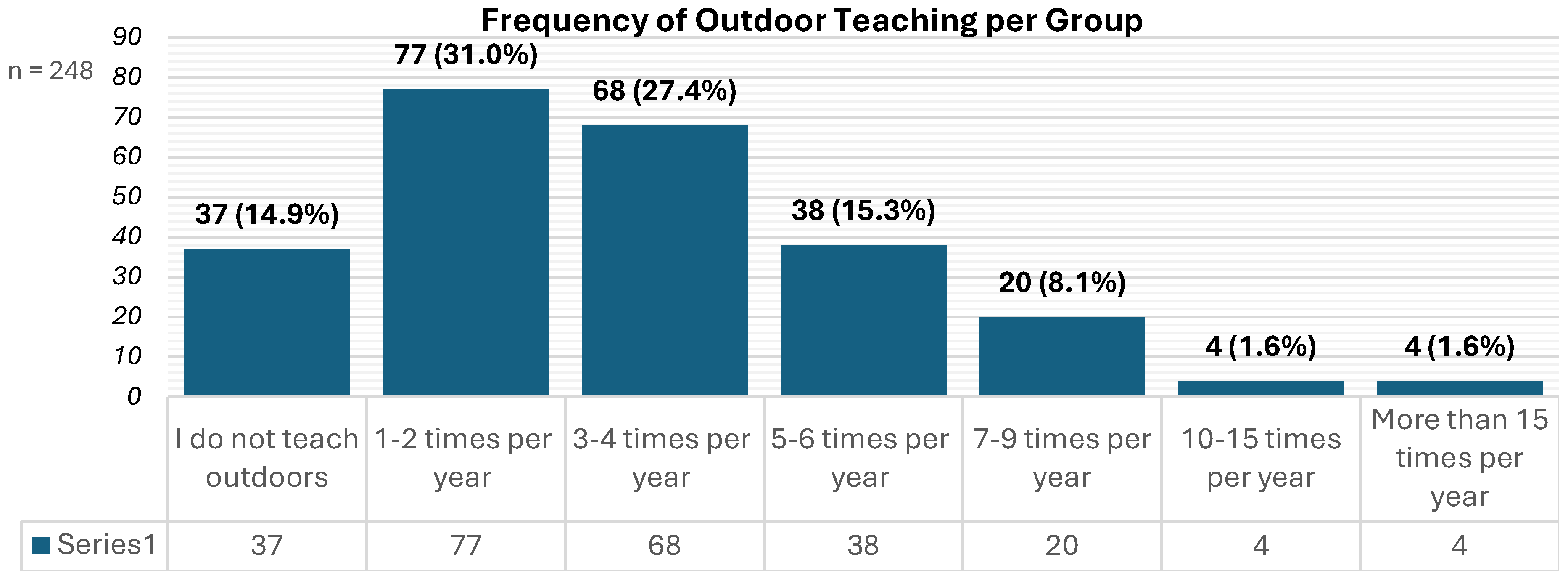
Of the 248 teachers, 31.0% reported conducting up to two outdoor science sessions per year and 27.4% reported three to four sessions; frequencies declined sharply beyond 10 sessions. Notably, about one in six teachers indicated never conducting outdoor lessons (Figure 1).

3.2. RQ2: How Do Specific Teacher-Level Predictors Associate with Frequency of Outdoor Teaching?

Predictors included inclusion with nature, professional development, and a block of Likert-type items. Inclusion with nature was measured with the seven-point inclusion of nature in self (INS) pictorial scale. Professional development was assessed by self-reported participation in outdoor education seminars or training, rated on a five-point descriptive scale ranging from never (1) to more than three times (5).
In addition, 65 five-point Likert-type items were included. Six of these were excluded due to low factor loadings (<0.25) or weak correlations (<|0.30|), leaving 59 items for analysis. Six reverse-worded items were recoded (R) for reliability analysis, although five were later excluded for the reasons noted above. The remaining items were treated as indicators for latent constructs.
All predictor variables were converted to standardized values (z-scores) to facilitate comparability across scales and variable types (Petz et al., 2012). The final set of 59 Likert-type items was subjected to exploratory factor analysis (EFA) using principal axis factoring (PAF) with oblique (promax) rotation, given the assumption of correlated factors and that this approach would provide the best fit to the data (n = 191). The sample size was reduced from 258 to 191 due to a listwise deletion of cases with missing responses across the items included in the factor analysis. The Kaiser–Meyer–Olkin (KMO) measure of sampling adequacy was 0.827, indicating meritorious adequacy, and Bartlett’s test of sphericity (χ2(1711) = 7220.19, p < 0.001) confirmed that the correlation matrix did not form an identity matrix, supporting its suitability for factor analysis. Explained variance and scree plot inspection were then used to determine the number of factors to retain.
Based on the total variance explained, Cattell’s scree plot, and its inflection point, a four-factor solution was retained, accounting for 46.73% of the variance. A threshold of 5% explained variance was additionally applied as a secondary criterion to support interpretability.
The six omitted items were TA11, TA12, TA13, TA19, TA20, and PB3 (see Table A5 in Appendix A). The factors reflected the predictors outlined in the research questions and were labeled teachers’ attitudes, support, self-efficacy, and connection to nature (with personal background). The factor analysis largely confirmed the theory-based grouping of items developed from the literature, indicating that the questionnaire’s structure was consistent with the intended predictors. Reliability was assessed using Cronbach’s alpha and McDonald’s omega, with all coefficients exceeding 0.90, indicating excellent internal consistency (see Table A1, Table A2, Table A3 and Table A4 in Appendix A).
After extracting four factors, the composite variables were computed by averaging the scores of their component items. For inclusion with nature and professional development, the original values were transformed into standardized ones as described above. These predictors were then tested for their ability to explain the frequency of outdoor science teaching. Given the ordinal nature of the dependent variable—with ordered categories but unequal intervals—ordinal logistic regression was applied.
The overall model was statistically significant (χ2(7) = 32.56, p < 0.001), indicating that the set of predictors effectively distinguished between the levels of outdoor teaching frequency. A goodness-of-fit test (Deviance, χ2(1212) = 633.786, p > 0.05) suggested an adequate model fit, as the predicted and observed values did not differ significantly. Pseudo-R2 statistics (Cox & Snell = 0.148; Nagelkerke = 0.153) indicated that approximately 15% of the variance in teaching frequency was explained by the predictors, reflecting modest explanatory power and suggesting that additional factors that were not included in the model may also influence outdoor teaching practices. Finally, the test of parallel lines (χ2(30) = 4.87, p = 0.999) indicated that the proportional odds assumption was not violated; however, the exceptionally high p-value warrants cautious interpretation, as it may reflect the limited sensitivity of the test, potentially indicating some degree of underfitting.
From the perspective of individual predictors shown in Table 1, the most significant is Teacher’s Attitudes (B = 0.697; SE = 0.212; Wald = 10.795, p = 0.001), which indicates that as attitudes turn more favorable, outdoor teaching sessions become more prevalent throughout the school year. Self-efficacy was also found to be statistically significant (B = 0.538; SE = 0.195; Wald = 7.600, p = 0.006) and considering the positive value of the coefficient, can be interpreted in such a way that as their self-assessment improves, the frequency of outdoor teaching increases. Other predictors were not statistically significant in this model.

3.3. Further Exploration of Significant Teacher-Level Predictors

In the regression model, several potential predictors of outdoor science teaching frequency were examined. Among these, two variables—teachers’ attitudes and self-efficacy—emerged as statistically significant. To better understand their influence, we further examined these predictors separately. In addition, descriptive and correlational analyses of environmental accessibility were included to provide contextual insight into how the availability of suitable outdoor settings may interact with these teacher-related factors.

3.4. Teacher’s Attitudes

Bivariate correlations using Spearman’s rank correlation coefficient (Table 2) indicate that the relationship between teachers’ attitudes and other predictors is significant in the case of support (p < 0.001, ρ = 0.265) and connection to nature (p < 0.001, ρ = 0.259); however, albeit positive, the strength is rather weak (ρ < 0.30).
Inclusion of nature was measured with the seven-point (A–G) inclusion of nature in self (INS) pictorial scale, which depicts overlapping Venn diagrams to capture the perceived human–nature relationship (Schultz, 2002). Responses were skewed toward the high end: 76.0% fell in E–G, none in A or B, 2.9% in C and 21.1% in D; the modal category was E (31.9%), indicating generally high inclusion with nature. However, its association with teachers’ attitudes was not statistically significant (ρ = 0.136, p = 0.053).
Professional development participation was low: 56.6% reported no outdoor (science)-related training. Among the remainder, 15.6% attended one session, 11.0% two, 2.5% three, and 14.3% more than three. Professional development was not associated with teachers’ attitudes (ρ = 0.030, p = 0.653). Frequently cited courses included workshops at the annual science conference, school-based study groups, CŠOD field programs, and Erasmus courses.

3.5. Self-Efficacy

There was no statistically significant correlation between teaching experience (measured in years) and self-efficacy (ρ = 0.088, p = 0.210).

3.6. Access to Outdoor Environments

Although the regression model focused on teacher-related psychological and experiential predictors, a supplementary analysis explored the role of environmental accessibility using Spearman’s rank-order correlation. While teachers’ perceptions of the importance of suitable environments were already captured within the support factor, the actual availability of specific outdoor sites represents a distinct contextual condition, rather than a teacher-level attitude, and was therefore examined separately. The number of suitable outdoor settings available to teachers was positively associated with the frequency of outdoor science teaching (ρ = 0.314, p < 0.001). Teachers with access to a greater diversity of nearby outdoor sites tended to conduct outdoor lessons more often.
The most commonly reported accessible settings included lawns or meadows (70.5%), forests (51.6%), concrete playgrounds (51.6%), school gardens (42.2%), and aquatic ecosystems (41.9%). Less frequently mentioned were raised or flower beds (29.1%), beehives (22.8%), and parks (19.8%). A small proportion of respondents (1.9%) also described other available spaces such as olive tree groves, fruit orchards, or purposefully designed outdoor classrooms equipped with benches and tables. Notably, 4.7% of teachers reported having no access to any suitable outdoor teaching environments.
Among those who reported conducting outdoor science lessons at least once (221 teachers), the most frequently used environments were lawns or meadows (75.5%) forests (65.2%), and school gardens (46.2%). Other commonly used spaces included aquatic ecosystems (41.3%), concrete playgrounds (29.9%), and raised or flower beds (26.1%). Less frequently used settings included parks (21.2%) and beehives (17.4%). A small proportion of teachers (3.3%) reported using other natural or semi-natural settings, such as olive tree groves, fruit tree groves, sea shores, botanical garden and learning trails.

3.7. Teaching Experience and Outdoor Teaching Frequency

Teaching experience was analyzed separately as a background variable and was not included in the regression model. The regression analysis was conceptually limited to the set of teacher-level psychological predictors. Teaching experience functions as a demographic descriptor, so it was examined descriptively and through correlation for contextual insight. A Spearman’s rank-order correlation showed no significant association between years of experience and the frequency of outdoor science teaching (ρ = 0.052, p = 0.415), indicating that years of teaching experience were not related to how often teachers taught outdoors.

4. Discussion

This study examined how frequently teachers conduct science lessons outdoors (RQ1) and which teacher-level predictors are most strongly associated with this practice (RQ2).
Overall, outdoor science teaching occurred with moderate frequency, suggesting that while many teachers are positively disposed toward outdoor learning, regular implementation remains uneven. In addressing multiple teacher-level predictors within a single analytical framework, this study extends previous research that has often focused on isolated factors or predominantly external barriers. The results suggest that internal teacher characteristics, particularly attitudes and self-efficacy, are more strongly associated with outdoor teaching frequency than structural constraints.
In the following sections, these findings are discussed in greater detail.

4.1. Attitudes and Self-Efficacy as Key Drivers of Outdoor Science Teaching

The findings indicate that psychological factors—particularly teachers’ attitudes and self-efficacy—play a more decisive role than structural or experiential variables in explaining variation in outdoor science teaching.
Teachers’ attitudes toward outdoor learning emerged as the strongest predictor of how frequently science lessons were conducted outdoors. This finding aligns with prior research emphasizing the central role of teachers’ beliefs, values, and pedagogical orientations in shaping instructional practice (Rickinson et al., 2004; Waite, 2011). Many studies identified teachers’ confidence and attitudes as recurrent enablers or barriers, often outweighing structural constraints such as time or resources. Even when schools provide access to outdoor spaces or administrative support, outdoor teaching ultimately depends on whether teachers perceive it as educationally meaningful and worth the associated effort (Dillon et al., 2006; Rickinson et al., 2004).
Although teachers in our sample generally expressed favorable attitudes—mean scores for most items exceeded the scale midpoint—variation within this positive range still mattered. Teachers with the strongest and most deeply internalized attitudes were those who most consistently implemented outdoor science teaching. Another recent study among Slovenian lower secondary science and biology teachers likewise reported broadly positive perceptions of outdoor education, suggesting that favorable evaluations of outdoor learning are widespread within the national context (Špernjak et al., 2026). This supports attitude–behavior theories suggesting that the strength of an attitude, rather than its mere presence, determines whether intentions translate into sustained action (Ajzen, 1991; Kaiser et al., 1999). Similar patterns have been observed in science education, where positive beliefs about inquiry-based learning are associated with greater use of experiential and place-based approaches (Carrier et al., 2014). Thus, attitudes appear to function as a motivational filter through which teachers evaluate whether outdoor teaching is instructionally legitimate and compatible with their everyday classroom practice.
Teachers’ self-efficacy also emerged as a significant predictor of outdoor science teaching. Self-efficacy reflects teachers’ beliefs in their ability to plan, manage, and successfully deliver instruction (Bandura, 1986). Extensive research has shown that higher self-efficacy is associated with greater openness to innovation, persistence in the face of challenges, and instructional flexibility (Jerrim et al., 2025; Schumann & Sibthorp, 2013; Skaalvik & Skaalvik, 2010; Tschannen-Moran & Hoy, 2001).
Within science education, self-efficacy has been operationalized through instruments such as the Science Teaching Efficacy Belief Instrument (STEBI), which distinguishes between personal teaching efficacy and outcome expectancy (Riggs & Enochs, 1990). Studies using this instrument show that teachers who feel capable of teaching science effectively are more inclined to engage students in inquiry-based and experiential learning (Deehan, 2017). These results suggest that self-efficacy functions as a key motivational resource, supporting teachers in translating pedagogical intentions into consistent outdoor science practice.
The findings underscore the importance of promoting high-quality professional development for both pre-service and in-service teachers, with a particular emphasis on outdoor education programs that intentionally build teachers’ positive attitudes and self-efficacy. Such programs should be intensive (Holden et al., 2011) and experiential in nature (Barrable et al., 2020), as short-term or isolated training experiences rarely lead to sustained improvements in teaching practice (Moseley et al., 2002).
Described recommendations are logical, but often not feasible for in-service teachers, for whom engaging in intensive outdoor education programs is difficult with all their school and family obligations. A sensible strategy would be to support science teachers by partnering them with specialized outdoor education practitioners—such as environmental education experts in nature parks, geoparks, bird-watching associations, and botanical gardens. These specialists could work alongside teachers in delivering outdoor education programs, gradually building teachers’ competencies for teaching in outdoor environments. This collaborative model mirrors the practice of “nature schools” in Finland, where outdoor education experts support local schools in implementing learning activities in nature and fostering teachers’ confidence and skills in outdoor pedagogy. Such programs should explicitly target both “what” and “how” subject-specific competencies (e.g., in science, ecology, and environmental sciences) and the practical skills required to plan, implement, and evaluate outdoor teaching (Sjöblom & Svens, 2019).
One effective way to promote teachers’ positive attitudes toward outdoor education and strengthen their self-efficacy is to engage pre-service science teachers systematically and longitudinally in outdoor education programs. Although outdoor education is widely regarded by practitioners as an important if not essential component of higher-education curricula, including science teacher education, there is strong evidence that fieldwork experiences have been declining in many countries, and this has been attributed to a range of academic, financial, and societal pressures (Fleischner et al., 2017; Scott et al., 2012).
Previous analyses indicate that the frequency with which teachers implement outdoor education is most strongly associated with their attitudes toward outdoor teaching and their sense of self-efficacy. These core psychological determinants do not develop in isolation, but may relate—sometimes only weakly—to a range of supporting factors. To further clarify the mechanisms underlying the regression model, correlations were performed for those two strongest predictors. This analysis aimed to explore how these key psychological variables relate to other teacher-level factors, such as connection to nature, perceived support, teaching experience, and prior training (professional development). A weak yet statistically significant association emerged between connection to nature and attitudes toward outdoor teaching. Teachers with a stronger sense of environmental connectedness tended to express slightly more positive attitudes, although the effect was modest. This finding is consistent with earlier research suggesting that emotional or affective affinity with the natural world, while important, rarely translates directly into sustained pedagogical change without complementary efficacy beliefs and systemic support (Ernst & Tornabene, 2012). Thus, valuing nature may foster openness toward outdoor teaching, but it does not automatically translate into practice (Dring et al., 2020).
A similarly weak positive relationship was observed between perceived support and teachers’ attitudes. This pattern suggests that while structural or administrative encouragement can facilitate outdoor science teaching, its influence remains limited unless teachers themselves possess the motivation and agency to explore available opportunities. Prior studies have noted the same conditional nature of institutional enablers—schools may offer access or flexibility, but uptake depends largely on teachers’ self-perceived competence and internal commitment (Waite, 2011, 2022).
Surprisingly, no meaningful correlations were found between professional development and teachers’ attitudes. In our sample, most respondents reported attending only short courses or occasional lectures, rather than extended training programs, which likely limited the depth of impact. This pattern aligns with longstanding evidence that brief or isolated professional development opportunities are insufficient to change instructional beliefs or confidence. Effective professional growth in science and environmental education typically requires longitudinal and sustained engagement supported by mentoring and collaborative reflection (Desimone & Garet, 2015; Luft & Hewson, 2014).
Finally, teaching experience showed no association with self-efficacy. This finding underscores that confidence in outdoor teaching does not simply accumulate with years of service. Rather, as Bandura (1997) conceptualized, self-efficacy is built through mastery experiences—through successful practice and positive feedback that reinforce teachers’ belief in their capability to act effectively in novel settings. Consequently, outdoor teaching competence is not acquired passively through years of service, but through specific teaching experiences and reflective practice. This highlights the importance of sustained, practice-oriented professional learning opportunities that allow teachers to plan, implement, and reflect on outdoor lessons. The relatively low levels of self-efficacy observed among teachers may be linked to their limited participation in professional development. Opportunities for mastery experiences, observing other teachers, and receiving feedback are critical for developing confidence. Teachers who engage less in professional development may therefore have fewer of these reinforcing experiences, which helps to explain the observed variation in self-efficacy.
Sustained change depends less on structural provisions alone and more on fostering self-efficacy through guided practice, long-term professional learning, and school cultures that value teaching beyond the classroom. This interpretation is consistent with broader evidence that intrinsic motivation and the personal value teachers assign to innovation are stronger predictors of behavioral change than external incentives or administrative mandates (Kottmann et al., 2024). To support these processes, professional development should focus on reflective, mastery-based learning that strengthens both self-efficacy and pedagogical conviction. At the same time, schools should ensure that safe and easily accessible outdoor spaces are available for regular use. Coordinating these psychological and structural supports may offer the most effective route to increasing both the frequency and quality of outdoor science learning.

4.2. Accessibility of Outdoor Learning Spaces

Access to suitable outdoor learning environments in the immediate vicinity of schools is widely regarded as a practical prerequisite for the regular implementation of outdoor science education. Proximity to natural or semi-natural spaces reduces logistical barriers, lowers time demands, and increases the feasibility of integrating outdoor activities into everyday teaching (Ayotte-Beaudet et al., 2025; Yamanoi et al., 2021). To examine whether such physical opportunities are associated with actual teaching practice, the relationship between the availability of accessible outdoor environments and the frequency of outdoor science teaching was explored. The variable accessible environments—representing the number of nearby outdoor areas—was analyzed separately to capture the physical opportunity.
A weak but positive association emerged, suggesting that easier access to outdoor spaces may facilitate more frequent teaching outside the classroom. However, both the present findings and previous research indicate that environmental access alone is insufficient to ensure sustained outdoor teaching. The recent Slovenian study already cited above likewise reported that many teachers have access to suitable natural areas near their schools, yet outdoor education remained less frequently implemented in everyday classroom practice.
Whereas that study primarily documented patterns of practice and perceived obstacles, their findings suggest that environmental availability alone does not explain how frequently outdoor teaching occurs (Špernjak et al., 2026). Instead, outdoor science teaching appears to emerge from the interaction between environmental affordances and institutional conditions: supportive school leadership legitimizes outdoor learning, while the proximity of suitable sites makes such support feasible in everyday practice (Beames et al., 2012; Dillon & Dickie, 2012; Waite, 2022).
Viewed in this way, environmental access should be understood as part of a broader educational ecosystem in which outdoor science teaching is embedded. Beyond its immediate pedagogical benefits, outdoor science education is increasingly recognized as a key component of environmental and sustainability-oriented education, reflecting wider European policy efforts to promote creativity, innovation, and responsible engagement with socio-ecological challenges (European Commission, 2021). From this perspective, the successful integration of outdoor spaces into science teaching depends on collective and coordinated engagement among teachers, school leaders, researchers, and policymakers (Bianchi et al., 2022).
While the present data did not confirm a direct effect of the support or environmental accessibility, this pattern is consistent with the ecological affordance perspective (Gibson, 1979; Nicol, 2014), which views outdoor teaching as the outcome of interacting personal, institutional, and environmental conditions. In this view, access to natural spaces represents only one dimension of opportunity—it enables but does not determine engagement. Similar conclusions have been drawn in research on children’s experiences of nature, where access alone did not guarantee meaningful interaction; instead, social and institutional contexts mediated how natural environments were used and valued (Adams & Savahl, 2017; Nicol, 2014).

4.3. Limitations and Implication for Further Research and Stakeholders

This study has several limitations that should be acknowledged. First, the use of a convenience sample may have introduced self-selection bias, potentially overrepresenting teachers with a prior interest in outdoor teaching. In addition, the sample size was relatively modest, which may limit the generalizability of the findings. Moreover, the length of the questionnaire may have contributed to the dropout and non-response bias.
Second, although the constructs demonstrated high internal consistency, some were refined based on exploratory factor analysis, which may limit the comparability with previous studies. Furthermore, while the statistical model met the required assumptions, its ability to detect more subtle patterns may be limited, meaning that some relationships could remain unobserved.
Third, the findings are based on quantitative modeling and therefore reflect general patterns rather than the full complexity of real classroom contexts. While these results provide insight into relationships among teacher-level factors, they may not fully capture the practical conditions in which teaching decisions are made.
Finally, although this study identifies the key predictors of outdoor science teaching, the findings reflect patterns derived from quantitative modeling. While these patterns provide insight into relationships among teacher-level factors, they might not fully account for the practical context in which teaching decisions are made. Because of the nature of the study, we cannot definitively conclude that positive attitudes and high confidence directly cause sustained outdoor teaching; other unmeasured factors may also contribute. Future research could therefore invite teachers to act as an expert group, reflecting on whether the identified patterns align with their professional experience and highlighting additional predictors—such as school culture, professional norms, perceived risks and challenges, or prior mastery experiences—that are not readily captured through our quantitative data.
Despite these limitations, several implications can be drawn for different stakeholder groups. As our findings suggest, sustained outdoor science teaching is primarily driven by internal teacher factors, particularly self-efficacy and attitudes, rather than structural support alone. For practicing teachers, this highlights the importance of strengthening confidence through reflective practice and collaborative professional learning to support implementation. For school leaders, the results indicate that structural provision is necessary but insufficient without a school culture that encourages experimentation, creates outdoor opportunities and actively fosters teacher confidence. For policymakers and teacher education programs, the findings emphasize the importance of embedding outdoor teaching systematically into pre-service and in-service training professional development programs, with a focus on developing self-efficacy through practical, mastery-based experiences.

5. Conclusions

Taken together, the results of our study indicate that sustained outdoor science practice is most likely when teachers hold strong positive attitudes toward outdoor science teaching and high confidence in their ability to teach outdoors. This aligns with evidence that internal drivers shape instructional behavior more reliably than external incentives or mandates (Kottmann et al., 2024). Once this psychological readiness is established, institutional support—through accessible outdoor spaces, practical assistance, and encouragement from colleagues and leadership—can effectively reduce the remaining barriers, helping outdoor teaching to evolve from an occasional enrichment activity into a regular and integrated part of science instruction.
In contrast to the fragmented nature of previous research on teacher-level predictors, our study integrates multiple diverse predictors within a single model and compares their relative importance in shaping decisions for outdoor science teaching, thereby providing a more comprehensive understanding of the determinants of outdoor teaching, with implications for teachers, school leaders, and policy development.

Author Contributions

Conceptualization, M.K. and G.T.; methodology, M.K.; validation, G.T.; writing—original draft preparation, M.K.; writing—review and editing, G.T.; supervision, G.T. All authors have read and agreed to the published version of the manuscript.

Funding

This research received no external funding.

Institutional Review Board Statement

The study was conducted in accordance with the Declaration of Helsinki, and approved by the University of Ljubljana, Faculty of Education. Ethical approval was obtained for purposes of doctoral research on 13 January 2025, under number 1/2025.

Informed Consent Statement

Informed consent was obtained from all subjects involved in the study.

Data Availability Statement

The created dataset is deposited to public repository Zenodo: Klopčič and Torkar (2026). Outdoor Science Education on Sample of Slovene Science Teachers [Data set]. Zenodo. https://doi.org/10.5281/zenodo.18289328.

Conflicts of Interest

The authors declare no conflicts of interest.

Appendix A

Table A1. Items for connection to nature (CNI) (with personal background (PB)) with descriptive statistics and reliability coefficients (Cronbach’s alpha and McDonald’s omega).
FactorStatement (Scale)NMSDMoCronbach’s αMcDonald’s ω
Connection to nature (CNI)
(with Personal Background (PB))
CNI8: I like to see wild animals living in a clean environment.2064.580.55150.9060.902
CNI10: Taking care of animals is important to me. 2054.540.6065
CNI4: I like to see wild flowers in nature. 2064.490.5905
CNI7: I like to garden.2054.480.6385
CNI3: I like to hear different sounds in nature.2064.420.6115
CNI2: I feel sad when wild animals are hurt.2064.440.6125
CNI1: Collecting rocks and shells is fun. 2064.390.5724
CNI9: I enjoy touching animals and plants. 2064.240.7174
CNI13: Being outdoors makes me happy. 2054.840.4185
CNI6: Being in the natural environment makes me feel peaceful.2063.900.9504
CNI11: Humans are part of the natural world. 2054.890.3405
CNI5: When I feel sad, I like to go outside and enjoy nature. 2053.980.9824
CNI12: People cannot live without plants and animals. 2054.920.3035
CNI15: Picking up trash on the ground can help the environment. 2054.680.5815
CNI14: My actions will make the natural world different. 2054.450.7825
CNI16: People do not have the right to change the natural environment. 2054.400.7895
PB1: As a child, I used to spend a lot of time in nature.2054.300.7455
PB2: I spend a lot of time in nature. 2054.580.6935
Note: N = number of respondents; M = mean; SD = standard deviation; and Mo = mode.
Table A2. Items for teachers’ attitudes (TA) with descriptive statistics and reliability coefficients (Cronbach’s alpha and McDonald’s omega).
FactorStatement (Scale)NMSDMoCronbach’s αMcDonald’s ω
Teachers’ Attitudes (TA)TA8: Students learn more outdoors than in the classroom.2263.510.91040.9160.917
TA16: I believe that outdoor science teaching should be a mandatory part of the school curriculum.2163.661.1464
TA5: Outdoor science classes encourage students’ curiosity.2274.110.7794
TA15: Students are more motivated to learn during outdoor science classes.2173.670.8344
TA6: Outdoor science classes enhance students’ innovation in solving scientific problems.2263.890.8204
TA3: Outdoor science classes contribute to students’ stronger connection with nature.2274.280.7454
TA4: Outdoor science classes strengthen the teacher–student relationship.2273.720.8204
TA1: Outdoor science classes improve collaboration among students.2273.870.8964
TA17: I wish I could teach science outdoors more often.2154.060.9184
TA7: Students are more focused during outdoor science classes.2252.930.9703
TA2: Outdoor science classes reduce behavioral problems in students.2273.101.0393
TA14: Outdoor science teaching increases students’ interest in the subject.2174.030.8414
TA10: In a real environment (e.g., a meadow), certain principles of nature are easier to demonstrate than in a classroom.2274.190.7954
TA9: Students look forward to outdoor science classes more than indoor ones.2274.370.7315
TA18: I prefer teaching science indoors to teaching it outdoors (R).2142.860.9413
Note: N = number of respondents; M = mean; SD = standard deviation; Mo = mode; and (R) = reversed coding employed.
Table A3. Items for support in outdoor settings (S) with descriptive statistics and reliability coefficients (Cronbach’s alpha and McDonald’s omega).
FactorStatement (Scale)NMSDMoCronbach’s αMcDonald’s ω
Support (S)S14: Available funding for outdoor science teaching equipment.2074.330.85250.9120.909
S13: Cooperation with external institutions (e.g., borrowing equipment, help with activity preparation).2084.140.9095
S12: Training for unexpected situations (e.g., injuries, behavioral issues).2083.911.0325
S11: Availability of additional professional development possibilities for teachers.2064.090.9284
S4: Acknowledgment of additional preparation time for outdoor lessons.2083.981.0905
S6: Flexible scheduling (e.g., easy rescheduling, possibility of teaching multiple periods in a row).2084.450.8385
S9: Possibility of student assessment in this form of instruction.2083.951.0135
S8: Clear pedagogical guidelines for comprehensive outdoor science teaching.2084.070.9515
S10: Prepared activities and materials intended for outdoor science teaching (worksheets, lesson plans, manuals).2084.290.8595
S15: Easy access to natural areas (e.g., lawns, gardens, parks, ponds).2084.380.7705
S3: Praise or reward for innovative approaches.2073.431.1203
S5: Option to divide the class into smaller groups (e.g., like in technology/home economics or ability grouping).2084.540.7855
S17: Precautions for student safety.2074.350.7605
S7: Curriculum that supports outdoor teaching.2083.961.0305
S2: Support from colleagues (willingness to accompany the group, help with activity preparations).2083.880.9854
S16: Favorable weather conditions.2074.091.0015
S1: Support from school leadership (encouragement for outdoor teaching).2063.521.0624
Note: N = number of respondents; M = mean; SD = standard deviation; and Mo = mode.
Table A4. Items for self-efficacy (SE) with descriptive statistics and reliability coefficients (Cronbach’s alpha and McDonald’s omega).
FactorStatement (Scale)NMSDMoCronbach’s αMcDonald’s ω
Self-efficacy (SE)SE3: I am familiar with teaching methods and strategies that are appropriate for outdoor instruction.2063.880.85540.9130.915
SE4: I can adapt science content for outdoor teaching.2064.020.7774
SE5: I feel capable of handling challenges related to outdoor teaching (e.g., weather, safety, logistics).2063.790.8914
SE2: I believe that planning and organizing outdoor science lessons is (or would be) manageable for me.2063.980.8174
SE9: I know how to use outdoor spaces and materials from the environment for teaching.2064.020.8204
SE6: I know how to motivate students to actively and constructively participate in outdoor science activities.2063.930.7394
SE7: I can achieve many science subject objectives through outdoor instruction.2063.780.8144
SE1: I have a good understanding of science content that is suitable for outdoor teaching.2064.270.6804
SE8: I feel physically fit enough to conduct outdoor science lessons.2054.060.9034
Note: N = number of respondents; M = mean; SD = standard deviation; and Mo = mode.
Table A5. The six omitted items TA11, TA12, TA13, TA19, TA20, and PB3.
TA11: During outdoor classes, students require more supervision to stay focused on learning.
TA12: Compared to classroom teaching, outdoor science teaching requires more preparation.
TA13: I find it more challenging to teach science outdoors than in the classroom.
TA19: Less content is covered in outdoor science classes compared to classroom teaching.
TA20: Outdoor science teaching is more exhausting for the teacher than classroom teaching.
PB3: If I could choose, I would prefer living in the countryside over the city, because I can have more contact with nature there.

References

  1. Adams, S., & Savahl, S. (2017). Nature as children’s space: A systematic review. The Journal of Environmental Education, 48(5), 291–321. [Google Scholar] [CrossRef]
  2. Ajzen, I. (1991). The theory of planned behavior. Organizational Behavior and Human Decision Processes, 50(2), 179–211. [Google Scholar] [CrossRef]
  3. Ayotte-Beaudet, J.-P., Berrigan, F., Deschamps, A., L’Heureux, K., Beaudry, M.-C., & Turcotte, S. (2023). K-11 teachers’ school-based outdoor education practices in the province of Québec, Canada: From local initiatives to a grassroots movement. Journal of Adventure Education and Outdoor Learning, 24(2), 334–347. [Google Scholar] [CrossRef]
  4. Ayotte-Beaudet, J.-P., Hasni, A., Vinuesa, V., Rodrigue-Poulin, É., Quintela Do Carmo, G., Beaudry, M.-C., L’Heureux, K., & Paquette, A. (2025). Impact of outdoor place-based learning on elementary school students’ ability to make unsolicited observations about living organisms over time. Journal of Biological Education, 59(3), 321–339. [Google Scholar] [CrossRef]
  5. Ayotte-Beaudet, J.-P., Potvin, P., Lapierre, H.-G., & Glackin, M. (2017). Teaching and learning science outdoors in schools’ immediate surroundings at K-12 levels: A meta-synthesis. Eurasia Journal of Mathematics, Science and Technology Education, 13(8), 5343–5363. [Google Scholar] [CrossRef]
  6. Bandura, A. (1986). Social foundations of thought and action: A social cognitive theory. Prentice Hall. [Google Scholar]
  7. Bandura, A. (1997). Self-efficacy: The exercise of control. W. H. Freeman. [Google Scholar]
  8. Barnett, J., & Hodson, D. (2001). Pedagogical context knowledge: Toward a fuller understanding of what good science teachers know. Science Education, 85(4), 426–453. [Google Scholar] [CrossRef]
  9. Barrable, A., Touloumakos, A., & Lapere, L. (2020). Exploring student teachers’ motivations and sources of confidence: The case of outdoor learning. European Journal of Teacher Education, 45(3), 356–372. [Google Scholar] [CrossRef]
  10. Beames, S., Higgins, P., & Nicol, R. (2012). Learning outside the classroom: Theory and guidelines for practice. Routledge. [Google Scholar] [CrossRef]
  11. Bertelsen, K., Bruun, T. H., & Guldager, J. D. (2024). When outdoor school is experienced as a forced break from the power of habit. Teaching and Teacher Education, 144, 104594. [Google Scholar] [CrossRef]
  12. Bianchi, G., Pisiotis, U., Cabrera Giraldez, M., Punie, Y., & Bacigalupo, M. (2022). GreenComp: The European sustainability competence framework (JRC Science for Policy Report No. EUR 30955 EN). Publications Office of the European Union. [Google Scholar] [CrossRef]
  13. Borsos, É., Banos-González, I., Boric, E., Lyngved Staberg, R., & Bencéné Fekete, A. (2022). Trainee teachers’ perceptions of outdoor education. Environmental Education Research, 28(10), 1490–1509. [Google Scholar] [CrossRef]
  14. Carrier, S. J., Thomson, M. M., Tugurian, L. P., & Tate Stevenson, K. (2014). Elementary science education in classrooms and outdoors: Stakeholder views, gender, ethnicity, and testing. International Journal of Science Education, 36(13), 2195–2220. [Google Scholar] [CrossRef]
  15. Cetken-Aktaş, S., Demirci, G. E., & Sevimli-Çelik, S. (2025). Beyond the classroom walls: Outdoor education for pre-service early childhood teachers. Journal of Early Childhood Teacher Education, 1–23. [Google Scholar] [CrossRef]
  16. Cheng, J. C. H., & Monroe, M. C. (2012). Connection to nature: Children’s affective attitude toward nature. Environment and Behavior, 44(1), 31–49. [Google Scholar] [CrossRef]
  17. Deehan, J. (2017). The science teaching efficacy belief instruments (STEBI A and B): A comprehensive review of methods and findings from 25 years of science education research (SpringerBriefs in Education). Springer. [Google Scholar] [CrossRef]
  18. Desimone, L. M., & Garet, M. S. (2015). Best practices in teachers’ professional development in the United States. Psychology, Society & Education, 7(3), 252–263. [Google Scholar]
  19. Dillon, J., & Dickie, I. (2012). Learning in the natural environment: Review of social and economic benefits and barriers (Natural England Commissioned Reports, No. 092). Natural England. Available online: https://publications.naturalengland.org.uk/publication/1321181 (accessed on 6 September 2025).
  20. Dillon, J., Rickinson, M., Teamey, K., Morris, M., Choi, M.-Y., Sanders, D., & Benefield, P. (2006). The value of outdoor learning: Evidence from research in the UK and elsewhere. School Science Review, 87, 107–111. [Google Scholar]
  21. Dring, C. C., Lee, S. Y. H., & Rideout, C. A. (2020). Public school teachers’ perceptions of what promotes or hinders their use of outdoor learning spaces. Learning Environments Research, 23(3), 369–378. [Google Scholar] [CrossRef]
  22. Dutta, D. (2023). Whose subject is it anyway? Negotiating disciplinary tensions in designing open-ended ecological pedagogies through an urban terrace farm. Environmental Education Research, 29(2), 194–211. [Google Scholar] [CrossRef]
  23. Ernst, J., & Tornabene, L. (2012). Preservice early childhood educators’ perceptions of outdoor settings as learning environments. Environmental Education Research, 18(5), 643–664. [Google Scholar] [CrossRef]
  24. European Commission. (2021). Science, society and defence: A challenge for European governance. Publications Office of the European Union. [Google Scholar] [CrossRef]
  25. Eurydice. (2023). Teachers and education staff. Available online: https://eurydice.eacea.ec.europa.eu/eurypedia/slovenia/teachers-and-education-staff (accessed on 6 September 2025).
  26. Eurydice. (2025). Teaching and learning in single-structure education. Available online: https://eurydice.eacea.ec.europa.eu/eurypedia/slovenia/teaching-and-learning-single-structure-education (accessed on 6 September 2025).
  27. Falzon, D., Conrad, E., & Camilleri, L. (2025). Outdoor and nature-based teaching in small, urban primary school contexts. Environmental Education Research, 31(3), 432–459. [Google Scholar] [CrossRef]
  28. Fleischner, T. L., Espinoza, R. E., Gerrish, G. A., Greene, H. W., Kimmerer, R. W., Lacey, E. A., Pace, S., Parrish, J. K., Swain, H. M., & Trombulak, S. C. (2017). Teaching biology in the field: Importance, challenges, and solutions. BioScience, 67(6), 558–567. [Google Scholar] [CrossRef]
  29. Fuchs, M., Čipková, E., & Kahan, J. (2026). The impact of an innovative continuing professional development programme for teachers on self-efficacy and outcome expectancy in the context of outdoor education. Journal of Adventure Education and Outdoor Learning, 22(1), 1–16. [Google Scholar] [CrossRef]
  30. Gibson, J. J. (1979). The ecological approach to visual perception. Houghton Mifflin. [Google Scholar]
  31. Glackin, M. (2018). ‘Control must be maintained’: Exploring teachers’ pedagogical practice outside the classroom. British Journal of Sociology of Education, 39(1), 61–76. [Google Scholar] [CrossRef]
  32. Goldman, D., & Alkaher, I. (2023). Outdoor environmental education: Grounding a tradition within environmental education. In J. Činčera, B. Johnson, D. Goldman, I. Alkaher, & M. Medek (Eds.), Outdoor environmental education in the contemporary world (pp. 11–32). Springer. [Google Scholar] [CrossRef]
  33. Haraldsson, K., Göranson, M., & Lindgren, E. C. (2024). “It is easier to learn when you are out”: An ethnographic study of teaching science subjects through outdoor learning at compulsory school. Journal of Outdoor and Environmental Education, 28, 337–352. [Google Scholar] [CrossRef]
  34. Holden, M. E., Groulx, J., Bloom, M. A., & Weinburgh, M. H. (2011). Assessing teacher self-efficacy through an outdoor professional development experience. Electronic Journalof Science Education, 12(2), 1–25. [Google Scholar]
  35. Jerrim, J., Prieto-Latorre, C., Marcenaro-Gutierrez, O. D., & Shure, N. (2025). Teacher self-efficacy, instructional practice, and student outcomes: Evidence from the TALIS video study. American Educational Research Journal, 62(2), 378–413. [Google Scholar] [CrossRef]
  36. Kaiser, F. G., Wölfing, S., & Fuhrer, U. (1999). Environmental attitude and ecological behaviour. Journal of Environmental Psychology, 19(1), 1–19. [Google Scholar] [CrossRef]
  37. Klopčič, M., & Torkar, G. (2025). Emerging themes of empirical research into outdoor science teaching: A systematic literature review. Journal of Outdoor and Environmental Education, 1–23. [Google Scholar] [CrossRef]
  38. Klopčič, M., & Torkar, G. (2026). Outdoor science education on a sample of Slovene science teachers [Data set]. Zenodo. [Google Scholar] [CrossRef]
  39. Kottmann, A., Schildkamp, K., & van der Meulen, B. (2024). Determinants of the innovation behaviour of teachers in higher education. Innovative Higher Education, 49(3), 397–418. [Google Scholar] [CrossRef]
  40. Luft, J. A., & Hewson, P. W. (2014). Research on teacher professional development programs in science. In N. G. Lederman, & S. K. Abel (Eds.), Handbook of research on science education (Vol. 2, pp. 889–909). Routledge. [Google Scholar]
  41. MacQuarrie, S. (2018). Everyday teaching and outdoor learning: Developing an integrated approach to support school-based provision. International Journal of Primary, Elementary and Early Years Education, 46(3), 345–361. [Google Scholar] [CrossRef]
  42. Mann, J., Gray, T., Truong, S., Sahlberg, P., Bentsen, P., Passy, R., Ho, S., Ward, K., & Cowper, R. (2021). A systematic review protocol to identify the key benefits and efficacy of nature-based learning in outdoor educational settings. International Journal of Environmental Research and Public Health, 18, 1199. [Google Scholar] [CrossRef]
  43. Mannion, G., Fenwick, A., & Lynch, J. (2013). Place-responsive pedagogy: Learning from teachers’ experiences of excursions in nature. Environmental Education Research, 19(6), 792–809. [Google Scholar] [CrossRef]
  44. Moseley, C., Reinke, K., & Bookout, V. (2002). The effect of teaching outdoor environmental education on preservice teachers’ attitudes toward self-efficacy and outcome expectancy. The Journal of Environmental Education, 34(1), 9–15. [Google Scholar] [CrossRef]
  45. Nicol, R. (2014). Entering the fray: The role of outdoor education in providing nature-based experiences that matter. Educational Philosophy and Theory, 46(5), 449–461. [Google Scholar] [CrossRef]
  46. Novljan, M., & Pavlin, J. (2022). Experiences of Slovenian in-service primary school teachers and students of grades 4 and 5 with outdoor lessons in the subject science and technology. Center for Educational Policy Studies Journal, 12(1), 189–215. [Google Scholar] [CrossRef]
  47. Oberle, E., Zeni, M., Munday, F., & Brussoni, M. (2021). Support factors and barriers for outdoor learning in elementary schools: A systemic perspective. American Journal of Health Education, 52(5), 251–265. [Google Scholar] [CrossRef]
  48. Patchen, A. K., Rakow, D. A., Wells, N. M., Hillson, S., & Meredith, G. R. (2024). Barriers to children’s outdoor time: Teachers’ and principals’ experiences in elementary schools. Environmental Education Research, 30(1), 16–36. [Google Scholar] [CrossRef]
  49. Pedonti, S., Becker, D. R., Watson, M. K., & Grist, C. L. (2025). Testing rural early educators’ attitudes toward children’s outdoor recreation in nature and science. Frontiers in Education, 10, 1585593. [Google Scholar] [CrossRef]
  50. Petz, B., Kolesarić, V., & Ivanec, D. (2012). Petzova statistika: Osnovne statističke metode za nematematičare. Naklada Slap. [Google Scholar]
  51. Pirchio, S., Passiatore, Y., Panno, A., Cipparone, M., & Carrus, G. (2021). The effects of contact with nature during outdoor environmental education on students’ wellbeing, connectedness to nature and pro-sociality. Frontiers in Psychology, 12, 648458. [Google Scholar] [CrossRef]
  52. Pulido, L., Pépin, A., Bergeron-Leclerc, C., Cherblanc, J., Godue-Couture, C., Laprise, C., Paquette, L., Nadeau-Tremblay, S., & Simard, S. (2025). The effects of outdoor teaching on academic achievement and its associated factors—A scoping review. Education Sciences, 15(8), 1060. [Google Scholar] [CrossRef]
  53. Rickinson, M., Dillon, J., Teamey, K., Morris, M., Choi, M.-Y., Sanders, D., & Benefield, P. (2004). A review of research on outdoor learning. InformalScience.org. Available online: https://informalscience.org/wp-content/uploads/2019/02/Review-of-research-on-outdoor-learning.pdf (accessed on 15 December 2025).
  54. Riggs, I. M., & Enochs, L. G. (1990). Toward the development of an elementary teacher’s science teaching efficacy belief instrument. Science Education, 74, 625–637. [Google Scholar] [CrossRef]
  55. Romero, V. F., Collins, M., Young, A., Laina, V., Dorph, R., Pande, A., Strang, C., & Foreman, J. (2022). Improving outdoor science teaching and learning: The implementation of a capacity-building model in outdoor science programs. Lawrence Hall of Science. Available online: https://lawrencehallofscience.org/wp-content/uploads/2022/05/Improving_Outdoor_Science_Teaching_and_Learning_2022.pdf (accessed on 15 December 2025).
  56. Schilhab, T. (2021). Nature experiences in science education in school: Review featuring learning gains, investments, and costs in view of embodied cognition. Frontiers in Education, 6, 739408. [Google Scholar] [CrossRef]
  57. Schultz, P. W. (2002). Inclusion with nature: The psychology of human–nature relations. In P. Schmuck, & W. P. Schultz (Eds.), Psychology of sustainable development (pp. 61–78). Springer. [Google Scholar]
  58. Schumann, S. A., & Sibthorp, J. (2013). The development and scaling of the teaching outdoor education self-efficacy scale. Journal of Outdoor Recreation, Education, and Leadership, 5(2), 161–164. [Google Scholar] [CrossRef]
  59. Scott, G. W., Boyd, M., Scott, L., & Colquhoun, D. (2015). Barriers to biological fieldwork: What really prevents teaching out of doors? Journal of Biological Education, 49(2), 165–178. [Google Scholar] [CrossRef]
  60. Scott, G. W., Goulder, R., Wheeler, P., Scott, L. J., Tobin, M. L., & Marsham, S. (2012). The value of fieldwork in life and environmental sciences in the context of higher education. Journal of Science Education and Technology, 21(1), 11–21. [Google Scholar] [CrossRef]
  61. Sjöblom, P., & Svens, M. (2019). Learning in the Finnish outdoor classroom: Pupils’ views. Journal of Adventure Education and Outdoor Learning, 19(4), 301–314. [Google Scholar] [CrossRef]
  62. Skaalvik, E. M., & Skaalvik, S. (2010). Teacher self-efficacy and teacher burnout: A study of relations. Teaching and Teacher Education, 26(4), 1059–1069. [Google Scholar] [CrossRef]
  63. Skvarč, M., Vilhar, B., Glažar, S. A., & Skribe-Dimec, D. (2011). Učni načrt: Program osnovna šola—Naravoslovje. Ministrstvo za šolstvo in šport; Zavod RS za šolstvo. Available online: http://www.mizs.gov.si/fileadmin/mizs.gov.si/pageuploads/podrocje/os/prenovljeni_UN/UN_naravoslovje.pdf (accessed on 15 December 2025).
  64. Šebjanič, E., & Skribe-Dimec, D. (2019). Primeri dobre prakse pouka na prostem v Sloveniji in tujini. Sodobna Pedagogika, 70(2), 70–85. [Google Scholar]
  65. Špernjak, A., Lukež, B., & Stanič, K. (2026). Outdoor natural science and biology education in lower secondary schools: Teachers’ practices and perceived obstacles. Education Sciences, 16(2), 232. [Google Scholar] [CrossRef]
  66. Torkar, G. (2014). Learning experiences that produce environmentally active and informed minds. NJAS—Wageningen Journal of Life Sciences, 69(1), 49–55. [Google Scholar] [CrossRef]
  67. Torkar, G. (2015). Creating meaningful life for a responsible and sustainable future. In V. W. Thoresen, D. Doyle, J. Klein, & R. J. Didham (Eds.), Responsible living (pp. 73–82). Springer. [Google Scholar] [CrossRef]
  68. Tschannen-Moran, M., & Hoy, A. W. (2001). Teacher efficacy: Capturing an elusive construct. Teaching and Teacher Education, 17(7), 783–805. [Google Scholar] [CrossRef]
  69. van Dijk-Wesselius, J. E., van den Berg, A. E., Maas, J., & Hovinga, D. (2020). Green schoolyards as outdoor learning environments: Barriers and solutions as experienced by primary school teachers. Frontiers in Psychology, 10, 2919. [Google Scholar] [CrossRef] [PubMed]
  70. Waite, S. (2011). Teaching and learning outside the classroom: Personal values, alternative pedagogies and standards. International Journal of Primary, Elementary and Early Years Education, 39(1), 65–82. [Google Scholar] [CrossRef]
  71. Waite, S. (2022). International views on school-based outdoor learning. In R. Jucker, & J. von Au (Eds.), High-quality outdoor learning (pp. 301–319). Springer. [Google Scholar] [CrossRef]
  72. Wolf, C., Kunz, P., & Robin, N. (2022). Emerging themes of research into outdoor teaching in initial formal teacher training. The Journal of Environmental Education, 53(4), 199–220. [Google Scholar] [CrossRef]
  73. Yamanoi, T., Soga, M., Evans, M. J., Tsuchiya, K., Koyanagi, T. F., & Kanai, T. (2021). What environmental and personal factors determine the implementation intensity of nature-based education in schools? Sustainability, 13(17), 9663. [Google Scholar] [CrossRef]
Figure 1. Frequency of outdoor science teaching among teachers.
Education 16 00778 g001
Table 1. Ordinal logistic regression results for six predictors of teachers’ frequency of outdoor science teaching.
95% CI
PredictorBSEWalddf.pLower BoundUpper Bound
Connection to Nature−0.2650.2341.27510.259−0.7240.195
Teachers’ Attitudes0.6970.21210.79510.0010.2811.113
Support−0.1030.2230.21310.644−0.5400.334
Self-efficacy0.5380.1957.60010.0060.1560.921
Inclusion with nature0.1610.1371.38910.239−0.1070.429
Professional Development0.1060.1280.68510.408−0.1450.357
Note: B = regression coefficient; SE = standard error; Wald = Wald chi-square statistic; df = degrees of freedom; p = significance level; CI = confidence interval (95%).
Table 2. Spearman’s rank correlation coefficient of teacher’s attitudes with four selected predictors.
SupportConnection to NatureInclusion with NatureProfessional Development
Teachers’ Attitudesρ [CI]0.265 [0.13; 0.39]0.259 [0.12; 0.38]0.136 [−0.01; 0.27]0.030 [−0.10; 0.16]
p<0.001<0.0010.0530.653
N208206204227
Note: ρ = Spearman’s rank correlation coefficient; CI = 95% confidence interval; p = significance level; and N = sample size. Confidence intervals are shown in brackets.
Disclaimer/Publisher’s Note: The statements, opinions and data contained in all publications are solely those of the individual author(s) and contributor(s) and not of MDPI and/or the editor(s). MDPI and/or the editor(s) disclaim responsibility for any injury to people or property resulting from any ideas, methods, instructions or products referred to in the content.