



Empowering Latine Adolescents Through Culturally Responsive Practices in an After-School Math Enrichment Activity

Abstract
1. Introduction
1.1. STEM Organized Activities and Culturally Responsive Practices
1.2. Promoting Youth Empowerment Through Culturally Responsive STEM After-School Activities
2. Current Study
3. Methods
3.1. Study Context
3.2. Participants and Procedures
3.3. In-Depth Qualitative Interviews
3.4. Plan of Analysis
3.4.1. Stage 1: Initial Open-Coding of Youth Empowerment Themes
3.4.2. Stage 2: Thematic Analysis of Empowerment Processes and Outcomes
3.4.3. Stage 3: Interpretive Mapping of Empowerment Processes and Culturally Responsive Practices
3.5. Researchers’ Positionality and Reflexivity
4. Results
4.1. Caring and Inclusive Relationships
“the mentors are really supportive. Like, when you feel like giving up, they’ll help you, and they’ll like, encourage you to keep trying.” Similarly, another student talked about “the way they don’t judge us, and the way that they explain and help me figure out problems and use activities to get us motivated.”
4.2. Cultural and Linguistic Affirmation
Here, cultural context appeared to make mathematical content feel more accessible and less intimidating. Rather than positioning math as abstract and unapproachable, culturally situated examples supported understanding and reduced anxiety. In doing so, these practices activated intrapersonal empowerment processes, as the student described shifts in confidence and perceived competence—moving from “I can’t do it” toward “I can do it” (Zimmerman, 1995). By situating mathematical learning within cultural contexts, mentors repositioned math as accessible rather than exclusionary, enabling students to see themselves as capable participants in the activity.“Yea, because it doesn’t seem that hard, because the ways that they showed us, like the Hawaiian culture, we did… we first did the example that the [mentors] did, and then we did it ourselves. And that made me feel like I can do it. And instead of just learning it and being scared of, ‘I can’t do it.’”
4.3. Empowerment and Engagement
4.3.1. Empowering Youth: Providing Opportunities for Contribution and Leadership
4.3.2. Having High Expectations: Supporting Persistence and Self-Confidence
These reflections suggest that high expectations, when paired with encouragement and scaffolding, cultivated a sense of competence and perseverance. Students described coming to view effort as meaningful and improvement as attainable, reinforcing intrapersonal and behavioral empowerment through structured challenge rather than pressure (Zimmerman, 1995). In this way, empowerment was experienced not as the absence of difficulty but as confidence built through supported struggle.“and, also, expect them to say it to themselves too. So, they think they’re good, they’re gonna do good. And when they… you’re gonna have a bad grade, [and when] that bad grade goes up, you’re like, really proud of yourself for giving yourself those compliments.”
4.3.3. Centering Youths’ Knowledge and Ways of Doing Things: Sharing Voice and Authority
Such instructional flexibility positioned students’ ways of thinking as legitimate and worthy of accommodation.“explain things in a way that the kids know, because not every kid learns the same way… some people understand by getting explained little by little, while others understand it by getting those things like, ‘you know this, and then you know that, and then you add it all together.’”
4.4. Relevance and Real-World Connections
5. Discussion
5.1. Theoretical Contributions
Culturally Responsive Practices as Mechanisms of Empowerment
5.2. Shared Power and Critical Reflection as Emerging Pathways
5.3. Implications for Practice
5.4. Strengths, Limitations, and Future Directions
6. Conclusions
Author Contributions
Funding
Institutional Review Board Statement
Informed Consent Statement
Data Availability Statement
Acknowledgments
Conflicts of Interest
Abbreviation
| STEM | Science, technology, engineering, and mathematics |
| 1 | Latine is a gender-neutral, non-binary term used to refer to people of Latin American origin that has been elevated by Spanish speakers in the United States over the use of Latinx to promote fluency in Spanish and integration into other terms (Miranda et al., 2023). |
References
- Allen, P. J., Chang, R., Gorrall, B. K., Waggenspack, L., Fukuda, E., Little, T. D., & Noam, G. G. (2019). From quality to outcomes: A national study of afterschool STEM programming. International Journal of STEM Education, 6, 37. [Google Scholar] [CrossRef]
- Aronson, B., & Laughter, J. (2016). The theory and practice of culturally relevant education: A synthesis of research across content areas. Review of Educational Research, 86, 163–206. [Google Scholar] [CrossRef]
- Atkins, K., Dougan, B. M., Dromgold-Sermen, M. S., Potter, H., Sathy, V., & Panter, A. T. (2020). “Looking at Myself in the Future”: How mentoring shapes scientific identity for STEM students from underrepresented groups. International Journal of STEM Education, 7, 42. [Google Scholar] [CrossRef]
- Bassett, R., Beagan, B. L., Ristovski-Slijepcevic, S., & Chapman, G. E. (2008). Tough teens: The methodological challenges of interviewing teenagers as research participants. Journal of Adolescent Research, 23(2), 119–131. [Google Scholar] [CrossRef]
- Boaler, J., & Staples, M. (2008). Creating mathematical futures through an equitable teaching approach: The case of Railside School. Teachers College Record, 110(3), 608–645. [Google Scholar] [CrossRef]
- Boveda, M., & Annamma, S. A. (2023). Beyond making a statement: An intersectional framing of the power and possibilities of positioning. Educational Researcher, 52(5), 306–314. [Google Scholar] [CrossRef]
- Braun, V., & Clarke, V. (2019). Reflecting on reflexive thematic analysis. Qualitative Research in Sport, Exercise and Health, 11(4), 589–597. [Google Scholar] [CrossRef]
- Brown, B. B., & Larson, J. (2009). Peer relationships in adolescence. In Handbook of adolescent psychology: Contextual influences on adolescent development (3rd ed., pp. 74–103). John Wiley & Sons, Inc. [Google Scholar] [CrossRef]
- Burton, L. (2009). The culture of mathematics and the mathematical culture. In O. Skovsmose, P. Valero, & O. R. Christensen (Eds.), University science and mathematics education in transition. Springer. [Google Scholar] [CrossRef]
- Carnevale, A. P., & Fasules, M. L. (2017). Latino education and economic progress: Running faster but still behind. Center on Education and the Workforce. Available online: https://cew.georgetown.edu/wp-content/uploads/Latinos-FR.pdf (accessed on 5 May 2025).
- Casler-Failing, S. L., Stevenson, A. D., & King Miller, B. A. (2021). Integrating mathematics, science, and literacy into a culturally responsive STEM after-school program. Current Issues in Middle Level Education, 26(1), 3. [Google Scholar] [CrossRef]
- Comstock, M., Litke, E., Hill, K. L., & Desimone, L. M. (2023). A Culturally responsive disposition: How professional learning and teachers’ beliefs about and self-efficacy for culturally responsive teaching relate to instruction. AERA Open, 9, 23328584221140092. [Google Scholar] [CrossRef]
- Creswell, J. W., & Poth, C. N. (2018). Qualitative inquiry and research design: Choosing among five approaches (4th ed.). Sage Publications. [Google Scholar] [CrossRef]
- Cruz, R. A., Manchanda, S., Firestone, A. R., & Rodl, J. E. (2020). An examination of teachers’ culturally responsive teaching self-efficacy. Teacher Education and Special Education, 43(3), 197–214. [Google Scholar] [CrossRef]
- Durlak, J. A., Weissberg, R. P., & Pachan, M. (2010). A meta-analysis of after-school programs that seek to promote personal and social skills in children and adolescents. American Journal of Community Psychology, 45, 294–309. [Google Scholar] [CrossRef]
- Ettekal, A. V., Simpkins, S. D., Menjívar, C., & Delgado, M. Y. (2020). The complexities of culturally responsive organized activities: Latino parents’ and Adolescents’ perspectives. Journal of Adolescent Research, 35(3), 395–426. [Google Scholar] [CrossRef]
- Faux, S. A., Walsh, M., & Deatrick, J. A. (1988). Intensive interviewing with children and adolescents. Western Journal of Nursing Research, 10(2), 180–194. [Google Scholar] [CrossRef]
- Fayer, S., Lacey, A., & Watson, A. (2017). STEM occupations: Past, present, and future. U.S. Bureau of Labor Statistics. Available online: https://www.bls.gov/spotlight/2017/science-technology-engineering-and-mathematics-stem-occupations-past-present-and-future/pdf/science-technology-engineering-and-mathematics-stem-occupations-past-present-and-future.pdf (accessed on 5 May 2025).
- Fredericks, S. J., & Caroleo, S. A. (2026). Afterschool education: A promising lever to promote excellence and equity. In J. A. Plucker, & M. S. Meyer (Eds.), The future of advanced education and talent development (pp. 123–132). Emerald Publishing Limited. [Google Scholar] [CrossRef]
- Gay, G. (2018). Culturally responsive teaching: Theory research, and practice. Teachers College Press. [Google Scholar]
- Hammond, Z. (2015). Culturally responsive teaching and the brain: Promoting authentic engagement and rigor among culturally and linguistically diverse students. Corwin Press. [Google Scholar]
- Hargrave, C. P. (2015). Counter space: Analysis of educational structures of an after-school program that fosters black academic success narratives. Journal of Negro Education, 84(3), 348–361. [Google Scholar] [CrossRef]
- Hill, C. E., Knox, S., Thompson, B., Williams, E. N., Hess, S. A., & Ladany, N. (2005). Consensual qualitative research: An update. Journal of Counseling Psychology, 52(2), 196–205. [Google Scholar] [CrossRef]
- Hoskins, K., & Barker, B. (2020). STEM, social mobility and equality: Avenues for widening access. Springer Nature. [Google Scholar]
- Jennings, L. B., Parra-Medina, D. M., Hilfinger-Messias, D. K., & McLoughlin, K. (2006). Toward a critical social theory of youth empowerment. Journal of Community Practice, 14(1–2), 31–55. [Google Scholar] [CrossRef]
- Keller, T. E., Perry, M., & Spencer, R. (2020). Reducing social isolation through formal youth mentoring: Opportunities and potential pitfalls. Clinical Social Work Journal, 48(1), 35–45. [Google Scholar] [CrossRef]
- Kirk, C. M., Lewis, R. K., Brown, K., Karibo, B., Scott, A., & Park, E. (2015). The empowering schools project: Identifying the classroom and school characteristics that lead to student empowerment: Identifying the classroom and school characteristics that lead to student empowerment. Youth & Society, 49(6), 827–847. [Google Scholar] [CrossRef]
- Krishnamurthi, A., Ballard, M., & Noam, G. G. (2014). Examining the impact of afterschool STEM programs. Afterschool Alliance. Available online: https://files.eric.ed.gov/fulltext/ED546628.pdf (accessed on 5 May 2025).
- Ladson-Billings, G. (1995). But that’s just good teaching! The case for culturally relevant pedagogy. Theory into Practice, 34(3), 159–165. [Google Scholar] [CrossRef]
- Ladson-Billings, G. (2017). The (r)evolution will not be standardized: Teacher education, hip hop pedagogy, and culturally relevant pedagogy. In D. Paris, & H. S. Alim (Eds.), Culturally sustaining pedagogies: Teaching and learning for justice in a changing world (pp. 141–156). Teachers College Press. [Google Scholar]
- Larson, R. W., & Walker, K. C. (2006). Learning about the “real world” in an urban arts youth program. Journal of Adolescent Research, 21(3), 244–268. [Google Scholar] [CrossRef]
- Levine, R. S., & Viano, S. (2025). Promising practices of out-of-school time programs for low-income adolescents: A systematic review. Journal of Adolescence, 97(5), 1145–1160. [Google Scholar] [CrossRef] [PubMed]
- Lin, A. R., Menjívar, C., Vest Ettekal, A., Simpkins, S. D., Gaskin, E. R., & Pesch, A. (2016). “They will post a law about playing soccer” and other ethnic/racial microaggressions in organized activities experienced by Mexican-origin families. Journal of Adolescent Research, 31(5), 557–581. [Google Scholar] [CrossRef]
- Miranda, A. R., Perez-Brumer, A., & Charlton, B. M. (2023). Latino? Latinx? Latine? A call for inclusive categories in epidemiologic research. American Journal of Epidemiology, 192(12), 1929–1932. [Google Scholar] [CrossRef] [PubMed]
- Morrow, S. L. (2005). Quality and trustworthiness in qualitative research in counseling psychology. Journal of Counseling Psychology, 52(2), 250–260. [Google Scholar] [CrossRef]
- Nasir, N. S., & Hand, V. (2008). From the court to the classroom: Opportunities for engagement, learning, and identity in basketball and classroom mathematics. The Journal of the Learning Sciences, 17(2), 143–179. [Google Scholar] [CrossRef]
- Nasir, N. S., & Vakil, S. (2017). STEM-focused academies in urban schools: Tensions and possibilities. Journal of the Learning Sciences, 26, 376–406. [Google Scholar] [CrossRef]
- National Academies of Sciences, Engineering, and Medicine. (2025). The future of youth development: Building systems and strengthening programs. The National Academies Press. [Google Scholar] [CrossRef]
- National Research Council. (2009). Learning science in informal environments: People, places, and pursuits. The National Academies Press. [Google Scholar] [CrossRef]
- O’Hara, G., Kennedy, H., Naoufal, M., & Montreuil, T. (2022). The role of the classroom learning environment in students’ mathematics anxiety: A scoping review. British Journal of Educational Psychology, 92(4), 1458–1486. [Google Scholar] [CrossRef] [PubMed]
- Riggs, N. R., Bohnert, A. M., Guzman, M. D., & Davidson, D. (2010). Examining the potential of community-based after-school programs for Latino youth. American Journal of Community Psychology, 45(3–4), 417–429. [Google Scholar] [CrossRef]
- Saldaña, J. (2021). The coding manual for qualitative researchers (4th ed.). SAGE. [Google Scholar]
- Simpkins, S. D., Riggs, N. R., Ngo, B., Vest Ettekal, A., & Okamoto, D. (2017). Designing culturally responsive organized after-school activities. Journal of Adolescent Research, 32(1), 11–36. [Google Scholar] [CrossRef]
- Soto-Lara, S., Yu, M. V. B., Pantano, A., & Simpkins, S. D. (2022). How youth-staff relationships and program activities promote Latinx adolescent outcomes in a university-community afterschool math enrichment activity. Applied Developmental Science, 26(4), 619–637. [Google Scholar] [CrossRef]
- U.S. Bureau of Labor Statistics. (2023, September 6). Employment in STEM occupations. Available online: https://www.bls.gov/emp/tables/stem-employment.htm (accessed on 11 April 2024).
- U.S. Department of Education. (2016). STEM 2026: A vision for innovation in STEM education. Office of Innovation and Improvement. Available online: https://www.ed.gov/sites/ed/files/2016/09/AIR-STEM2026_Report_2016.pdf (accessed on 11 June 2024).
- Williams, J. L., & Deutsch, N. L. (2016). Beyond between-group differences: Considering race, ethnicity, and culture in research on positive youth development programs. Applied Developmental Science, 20(3), 203–213. [Google Scholar] [CrossRef]
- Wray-Lake, L. (2019). How do young people become politically engaged? Child Development Perspectives, 13(2), 127–132. [Google Scholar] [CrossRef]
- Wray-Lake, L., & Abrams, L. S. (2020). Pathways to civic engagement among urban youth of color. Monographs of the Society for Research in Child Development, 85(2), 7–154. [Google Scholar] [CrossRef] [PubMed]
- Wycoff, T. M., Rosas, G., Pantano, A., & Simpkins, S. D. (in press). Addressing inequities in STEM through culturally responsive practices in an after-school math enrichment activity. International Journal of STEM Education.
- Yu, M. V. B., Liu, Y., Soto-Lara, S., Puente, K., Carranza, P., Pantano, A., & Simpkins, S. D. (2021). Culturally responsive practices: Insights from a high-quality math afterschool program serving underprivileged Latinx youth. American Journal of Community Psychology, 68(3–4), 323–339. [Google Scholar] [CrossRef]
- Zimmerman, M. A. (1995). Psychological empowerment: Issues and illustrations. American Journal of Community Psychology, 23(5), 581–599. [Google Scholar] [CrossRef]
- Zimmerman, M. A. (2000). Empowerment theory: Psychological, organizational and community levels of analysis. In Handbook of community psychology (pp. 43–63). Springer US. [Google Scholar] [CrossRef]
- Zimmerman, M. A., Eisman, A. B., Reischl, T. M., Morrel-Samuels, S., Stoddard, S., Miller, A. L., Hutchison, P., Franzen, S., & Rupp, L. (2018). Youth empowerment solutions: Evaluation of an after-school program to engage middle school students in community change. Health Education & Behavior, 45(1), 20–31. [Google Scholar] [CrossRef]
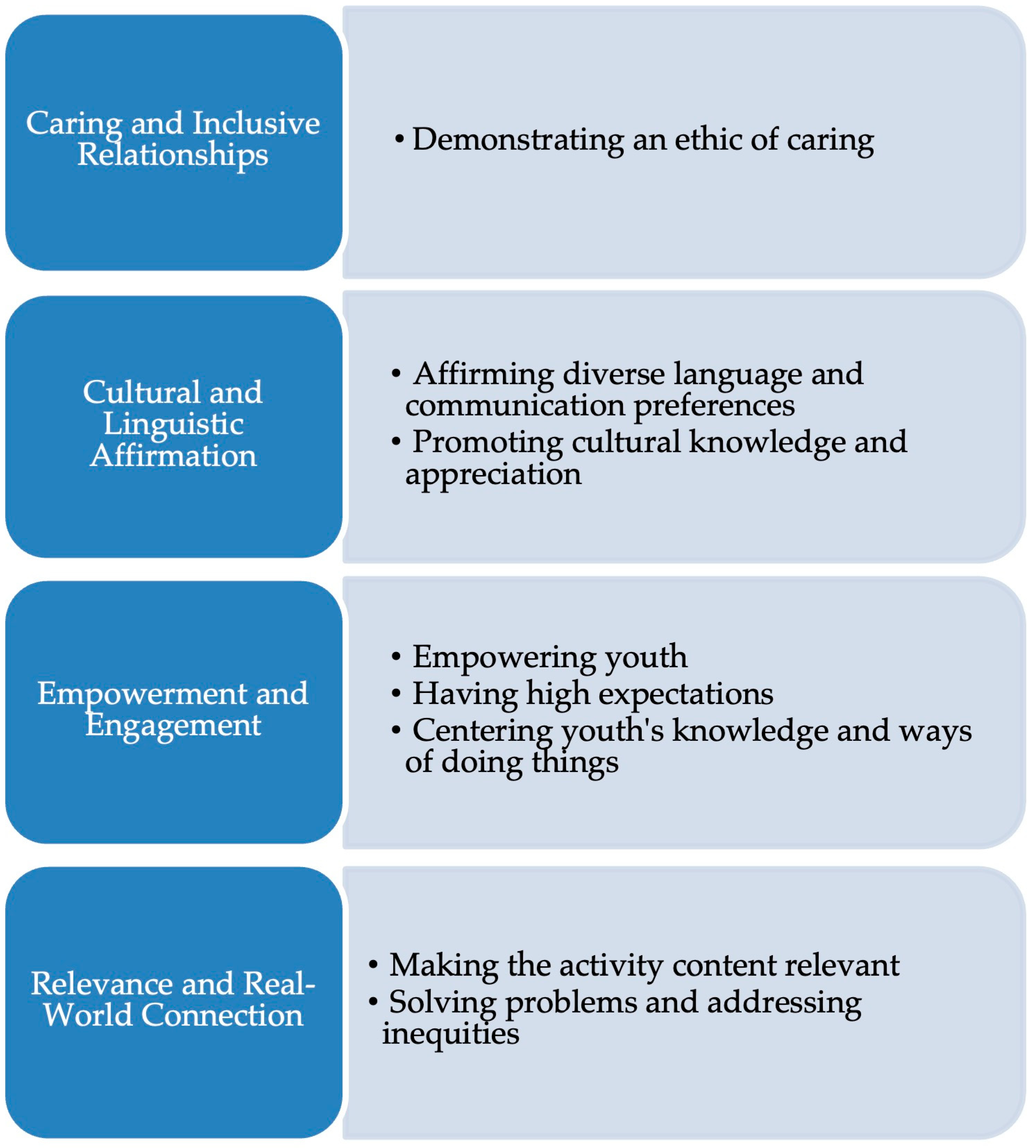

| Culturally Responsive Domain | Culturally Responsive Subdimension (n) | Defining Practices | Illustrative Quote |
|---|---|---|---|
| Caring and inclusive relationships | Demonstrating an ethic of caring (n = 13) | Mentors cultivate relational climates characterized by patience, encouragement, respect, and psychological safety that position youth as valued members of the learning community. | “The mentors are really supportive… when you feel like giving up, they’ll help you and encourage you to keep trying.” |
| Cultural and linguistic affirmation | Promoting cultural knowledge and appreciation (n = 3) | Instruction integrates culturally situated examples and affirms youths’ racial, ethnic, and linguistic identities as legitimate and meaningful resources within mathematical learning. | “We were using Mexico like an example […] I explained about Mexico because I’m Mexican […and that made me] feel more confident.” |
| Empowerment and engagement | Empowering youth (n = 79) | Participation structures provide structured opportunities for contribution, leadership, and shared responsibility, positioning youth as active contributors rather than passive recipients of instruction. | “Sometimes I just jump in, if I know my friends and like, I’m really close with I’m like, ‘Oh, this is this,’ like, I explain to them how to do it. Then sometimes, like, the mentors, like, ‘Oh, this person really understands it. So, you can help them.’ Little by little, I’ll be like, okay, and then I help…” |
| Having high expectations (n = 21) | Mentors communicate beliefs in youths’ capabilities by pairing meaningful challenge with relational support, scaffolding, and growth-oriented feedback. | “It provides me with hard problems I wouldn’t usually do in school. And when I finish and get it correct, I feel confident about myself.” | |
| Centering students’ knowledge and ways of doing things (n = 42) | Mentors recognize, validate, and incorporate youths’ existing knowledge, learning strategies, and perspectives into instructional practices and group problem-solving. | “Not every kid learns the same way… they explain things in a way that the kids know.” | |
| Relevance and real-world connection | Making the activity content relevant (n = 3) | Mathematical concepts are connected to youths’ lived experiences and broader life purposes, reinforcing perceived utility and meaning. | “…by telling them how important math is.” |
| Culturally Responsive Domain | Empowerment Processes | |||||
|---|---|---|---|---|---|---|
| Intrapersonal | Interactional | Behavioral | Environmental | Shared Power | Critical Reflection | |
| Caring and inclusive relationships | Confidence strengthened through encouragement and relational support | Trusting youth–mentor partnerships that normalize help-seeking | Greater willingness to attempt challenging problems | Psychological safety and sense of belonging | — | — |
| Cultural and linguistic affirmation | Identity-affirmed confidence when cultural knowledge is valued | Recognition of racial/ethnic identities within the learning space | Increased comfort contributing when personal background is legitimized | Inclusive climate across identities | — | Emerging awareness of identity as asset in learning |
| Empowerment and engagement | Self-belief developed through supported challenge and recognition of competence | Collaborative knowledge-building and peer learning | Leadership, contribution, and active participation structured into group work | — | Youth voice incorporated into instructional and activity decisions | — |
| Relevance and real-world connection | Purpose-driven confidence linked to perceived relevance of math | — | Engagement motivated by understanding math’s broader importance | — | — | Early forms of reflection on significance of mathematics beyond activity |
Disclaimer/Publisher’s Note: The statements, opinions and data contained in all publications are solely those of the individual author(s) and contributor(s) and not of MDPI and/or the editor(s). MDPI and/or the editor(s) disclaim responsibility for any injury to people or property resulting from any ideas, methods, instructions or products referred to in the content. |
© 2026 by the authors. Licensee MDPI, Basel, Switzerland. This article is an open access article distributed under the terms and conditions of the Creative Commons Attribution (CC BY) license.
Share and Cite
Wycoff, T.M.; Rosas, G.; Pantano, A.; Simpkins, S.D. Empowering Latine Adolescents Through Culturally Responsive Practices in an After-School Math Enrichment Activity. Educ. Sci. 2026, 16, 777. https://doi.org/10.3390/educsci16050777
Wycoff TM, Rosas G, Pantano A, Simpkins SD. Empowering Latine Adolescents Through Culturally Responsive Practices in an After-School Math Enrichment Activity. Education Sciences. 2026; 16(5):777. https://doi.org/10.3390/educsci16050777
Chicago/Turabian StyleWycoff, Taylor Michelle, Guadalupe Rosas, Alessandra Pantano, and Sandra D. Simpkins. 2026. "Empowering Latine Adolescents Through Culturally Responsive Practices in an After-School Math Enrichment Activity" Education Sciences 16, no. 5: 777. https://doi.org/10.3390/educsci16050777
APA StyleWycoff, T. M., Rosas, G., Pantano, A., & Simpkins, S. D. (2026). Empowering Latine Adolescents Through Culturally Responsive Practices in an After-School Math Enrichment Activity. Education Sciences, 16(5), 777. https://doi.org/10.3390/educsci16050777

