1. Introduction
The globalisation of higher education has fundamentally transformed the organisation, governance, and evaluation of national education systems. Over the past two decades, increasing cross-border student mobility, intensified competition for academic credentials, and the expansion of global labour markets have reshaped policy priorities for governments and higher education institutions worldwide (
Brown, 2022;
Organisation for Economic Co-operation and Development, 2012;
Tomlinson & Watermeyer, 2022). Within this context, postgraduate education has emerged as a strategic domain through which states seek to enhance national competitiveness, cultivate advanced human capital, and respond to international pressures associated with talent mobility.
As one of the largest contributors to global outbound student flows (
Economist Intelligence Unit, 2024), China occupies a distinctive position within the international higher education landscape (
Skinner, 2019;
Yu, 2025). For more than a decade, a substantial proportion of Chinese students have pursued postgraduate education overseas. This trend reflects not only individual educational aspirations but also structural challenges within the domestic postgraduate education system. These challenges include imbalances between academic and professional degree programmes, uneven social recognition of professionally oriented qualifications, and persistent tensions between labour market demand and existing policy arrangements (
Mok, 2016;
Mok & Han, 2016). Together, these factors have generated sustained policy concern regarding the capacity of domestic postgraduate education to retain talent and respond effectively to evolving social and economic needs. In response to these conditions, Chinese educational authorities have implemented a series of reforms aimed at strengthening professional postgraduate education. These reforms emphasise applied learning, closer collaboration between universities and industry, and expanded enrolment in professional degree programmes. Although such initiatives are often discussed as technical adjustments related to curriculum and capacity, they also represent broader governance strategies through which educational leadership seeks to reposition postgraduate education within an increasingly internationalised environment (
Ball, 2012;
Deem, 2001;
Mok, 2016). Assessing the effectiveness of these strategies therefore requires attention not only to institutional design and policy intent but also to how prospective postgraduate students interpret, evaluate, and respond to such reforms.
From an international education perspective, students’ educational decisions can be understood as an important form of policy feedback (
Marginson, 2011;
Mok, 2016). Their intentions reflect perceptions of educational value, service quality, and credential legitimacy that are shaped by globalised discourses of employability and competition (
Brown et al., 2010;
Tomlinson, 2017). Past literature has indicated that individuals’ intentions regarding education are diverse and influenced by constructs.
Jepsen and Varhegyi (
2011) developed a model incorporating variables such as postgraduate education promotion, knowledge, and awareness to predict students’ intentions to pursue postgraduate education. They revealed that postgraduate promotion is an important factor in students’ intentions, mediated by awareness and knowledge.
Zhu and Reeves (
2019) identified factors influencing the intentions of Chinese students to seek postgraduate education overseas, including financial and time costs, employment prospects, and the academic image and reputation of institutions. This study formed a framework based on those scattered viewpoints mentioning students’ intentions to seek education in various fields and proposed a consumer behaviour perspective that encompasses the generality of these viewpoints from the previous literature. This perspective, which originated in 1978 (
Schiffman et al., 2009), is primarily used for the analysis, examination, and application of consumer behaviour to the planning, development, and implementation of marketing strategies. In the context of consumer behaviour research, intentions can be predicted by the types of factors derived from their perceptions.
In addition, we consider that these perceptions are rarely formed in isolation. Instead, they are embedded within social networks that transmit information, expectations, and normative judgements regarding educational pathways (
N. Lin, 2002). Whatever the weak or strong ties within particular social networks in China, their overall influence on perceptions of intention is clear in each area, a conclusion that has been examined and confirmed by various studies (
Chen et al., 2018;
H. F. Lin, 2007;
Zhang & Kline, 2009).
Examining postgraduate education intention thus provides a valuable lens through which to assess how leadership, management, and policy initiatives are experienced at the micro level within globalised higher education systems. Building on this perspective, the present study investigates postgraduate students’ intentions toward professional degree education in China by integrating consumer behaviour theory and social network theory. Using quantitative data, the study examines the relationships between perceived quality of educational services, perceived educational value, and intention to pursue professional postgraduate education, while also exploring the moderating role of social networks. By reframing student intention as an indicator of governance outcomes under globalisation, this study contributes to international discussions on educational leadership, institutional management, and postgraduate education policy reform.
To address the above research focus, this study is guided by the following research questions.
How are students’ perceptions of educational service quality and educational value associated with their intention to pursue professional postgraduate education within an internationalised higher education context?
To what extent does perceived educational value mediate the relationship between perceived quality of educational services and students’ postgraduate education intentions?
How do social networks influence postgraduate education decision-making by shaping the relationship between perceived educational value and intention?
The following section reviews the relevant literature on globalisation, postgraduate education governance, and student decision-making to establish the conceptual foundation for the study.
2. Literature Review and Conceptual Background
The globalisation of higher education has significantly reshaped postgraduate education systems across national boundaries. Increased cross-border mobility, the international circulation of academic credentials, and the growing integration of labour markets have expanded the role of postgraduate education beyond national development objectives (
Altbach, 2006;
Marginson, 2011). Postgraduate qualifications are increasingly evaluated in relation to international standards of employability, professional recognition, and institutional reputation, positioning postgraduate education as a strategic domain within global competition (
Knight, 2004;
Organisation for Economic Co-operation and Development, 2019).
Within this global environment, professional postgraduate education has received heightened policy attention. In contrast to academically oriented programmes that traditionally emphasise research training, professional degrees are designed to align more directly with labour market demand and applied skill development (
Billett, 2011). Many countries have promoted professional postgraduate pathways as mechanisms for strengthening workforce competitiveness and responding to changing employer expectations in globalised economies (
Mok & Han, 2016). As a result, professional postgraduate education has become not only an academic pathway but also a policy instrument embedded within broader governance strategies.
Globalisation has also altered how postgraduate education is perceived by prospective students. Decisions regarding further study increasingly involve considerations of international credential value, career mobility, and long-term employment security (
Brooks & Waters, 2011). These considerations extend beyond institutional offerings and are shaped by global narratives concerning skill shortages, professional differentiation, and economic uncertainty (
Brown et al., 2010). In this sense, students’ postgraduate education decisions reflect how broader global changes influence individual evaluations of educational value and career opportunity.
The expansion of market-oriented governance has further transformed postgraduate education systems. Across diverse national contexts, higher education has experienced a gradual shift from state-dominated administration toward hybrid governance models that combine public regulation with market mechanisms (
Ball, 2012;
Deem, 2001). Under such conditions, students increasingly occupy the role of education consumers who evaluate programmes based on perceived returns, service quality, and opportunity costs (
Hemsley-Brown & Oplatka, 2010). From a leadership and management perspective, this shift requires institutions to balance public responsibility with responsiveness to student expectations. Policy initiatives that focus solely on enrolment expansion or financial investment may be insufficient if they fail to address how educational value is interpreted by prospective students. Governance effectiveness depends not only on policy design, but also on how policies are understood, trusted, and accepted by key stakeholders (
Mok, 2016). In postgraduate education, student perception functions as an important indicator of whether leadership strategies and management practices successfully translate policy objectives into meaningful educational pathways. Student decision-making is also socially embedded. Social networks play a central role in shaping educational choices, particularly in contexts characterised by information asymmetry and uncertainty (
Granovetter, 1973;
N. Lin, 2002). Through interpersonal relationships, students form interpretations of programme quality, institutional reputation, and employment prospects that extend beyond official policy communication. Within globalised education systems, social networks further function as channels through which international expectations and comparative judgements are localised (
Waters, 2006).
Synthesising these areas of the literature suggests that postgraduate education governance operates across multiple interconnected levels. At the macro level, globalisation and internationalisation shape national policy agendas; at the meso level, leadership and management practices influence institutional delivery; and at the micro level, students interpret these arrangements through perceived value, service quality, and socially embedded information. Student intention therefore provides a valuable analytical entry point for understanding how governance strategies are received and mediated within internationalised higher education environments.
3. Theoretical Framework
3.1. Consumer Behaviour, Perceived Quality, and Perceived Value in Postgraduate Education
The increasing marketisation of higher education has encouraged scholars to examine educational decision-making through consumer behaviour theory (
Kotler & Fox, 1985). Within market-oriented systems, education is no longer understood solely as a public good, but increasingly as an investment involving costs, risks, and anticipated returns. This perspective is particularly relevant for postgraduate education, where participation requires substantial financial commitment and opportunity cost.
Consumer behaviour theory emphasises that individuals make decisions based on perceived rather than objective characteristics (
Zeithaml, 1988). In the postgraduate education context, students evaluate programmes according to anticipated benefits such as employability, professional competence development, and long-term career mobility. As labour markets become increasingly globalised, these evaluations are shaped by international expectations regarding credential value and competitiveness (
Tomlinson, 2017). Conceptualising postgraduate students as evaluative actors allows intention to be understood as the outcome of subjective assessment processes. This approach aligns with governance perspectives that recognise the importance of stakeholder interpretation in shaping the effectiveness of educational policy interventions (
Marginson, 2018;
Mok & Qian, 2020).
Perceived quality of educational services refers to students’ evaluations of teaching effectiveness, curriculum organisation, institutional support, and administrative reliability (
Parasuraman et al., 1988). These perceptions are constructed through experience and interaction rather than objective measurement alone. Undergraduate educational experiences often serve as reference points for postgraduate decision-making. Positive encounters with institutional management, learning environments, and academic support can strengthen confidence in further study, while negative experiences may weaken future engagement (
Douglas et al., 2006). Within internationalised contexts, perceived service quality is also shaped through comparison with global standards and overseas educational narratives. Perceived quality therefore functions as an interpretive signal by which institutional leadership and management are evaluated by prospective postgraduate students.
Perceived educational value represents students’ overall judgements of educational benefits relative to associated costs (
Zeithaml, 1988). These judgements incorporate economic, social, and psychological dimensions, including employability prospects, social status, and long-term career security. Within professional postgraduate education, perceived value is closely linked to expectations of applied competence and labour market relevance (
Billett, 2011). Students assess whether postgraduate qualifications are likely to enhance their competitive position in uncertain and increasingly globalised labour markets. As such, perceived educational value functions as a central mechanism connecting educational experience with behavioural intention. Empirical research consistently suggests that perceived quality contributes to perceived value, which in turn influences decision-making (
Sweeney & Soutar, 2001). This mediating relationship is particularly relevant within education systems characterised by market logics and global competition.
3.2. Social Network Theory and Educational Decision-Making
While consumer behaviour theory highlights individual evaluation, educational decision-making rarely occurs in isolation. Social network theory provides insight into how interpersonal relationships shape perception formation and behavioural intention (
Granovetter, 1973;
N. Lin, 2002). Individuals rely on social ties to obtain information, interpret uncertainty, and validate decision-making processes. A study involving 616 college students highlighted the important role of network influence on student cohorts and the important roles of relationship length and their beliefs about support, care, and living a better life (
Zhang & Kline, 2009).
H. F. Lin (
2007) investigated online shopping behaviour under the Theory of Planned Behaviour (TPB) model and found external influences (e.g., professional opinions and media) and interpersonal influences (e.g., family, friends, and colleagues) on subjective norms (an interpreted factor of behavioural intention under the TPB model).
Chen et al. (
2018) investigated how social status is affected by the neighbour relationship in the community. They found that the social status of members can be reinforced by mutual assistance and familiarity between neighbours. Thus, the assignment of value to an objective is influenced by the values, opinions, and expectations of the social network. Undoubtedly, those who intend to seek postgraduate education (a professional degree) might have a job or previous job experience and have a certain judgement paradigm on value after graduating from higher education.
In postgraduate education contexts, social networks typically include family members, peers, academic staff, and professional contacts. These networks influence not only access to information but also the framing of educational value and perceived risk.
Liu and Morgan (
2016) investigated the decision-making of Chinese students about subjects and institutions for postgraduate education. They found that families and teachers play important roles in shaping the students’ decisions about postgraduate education. Otherwise, the relationship between members within a social network is similar to that between neighbours within a community. Students may be motivated to act to be recognised in their social network.
El-Hammadi (
2012) investigated Syrian pharmacy students’ intentions and attitudes toward postgraduate education and found that parental desire affects a student’s pursuit of further study (e.g., favourable location for postgraduate education). In this regard, students’ judgements of value might be changed and formulated by their social networks or relations. Advice and narratives transmitted through trusted relationships can reinforce or weaken student confidence in postgraduate pathways (
Burt, 2000).
Under the conditions of globalisation, social networks also function as channels through which international norms and comparative judgements circulate. Narratives concerning overseas study, credential hierarchies, and labour market competitiveness are often diffused through interpersonal interaction, shaping how domestic postgraduate options are evaluated (
Waters, 2006).
3.3. Integrated Conceptual Framework
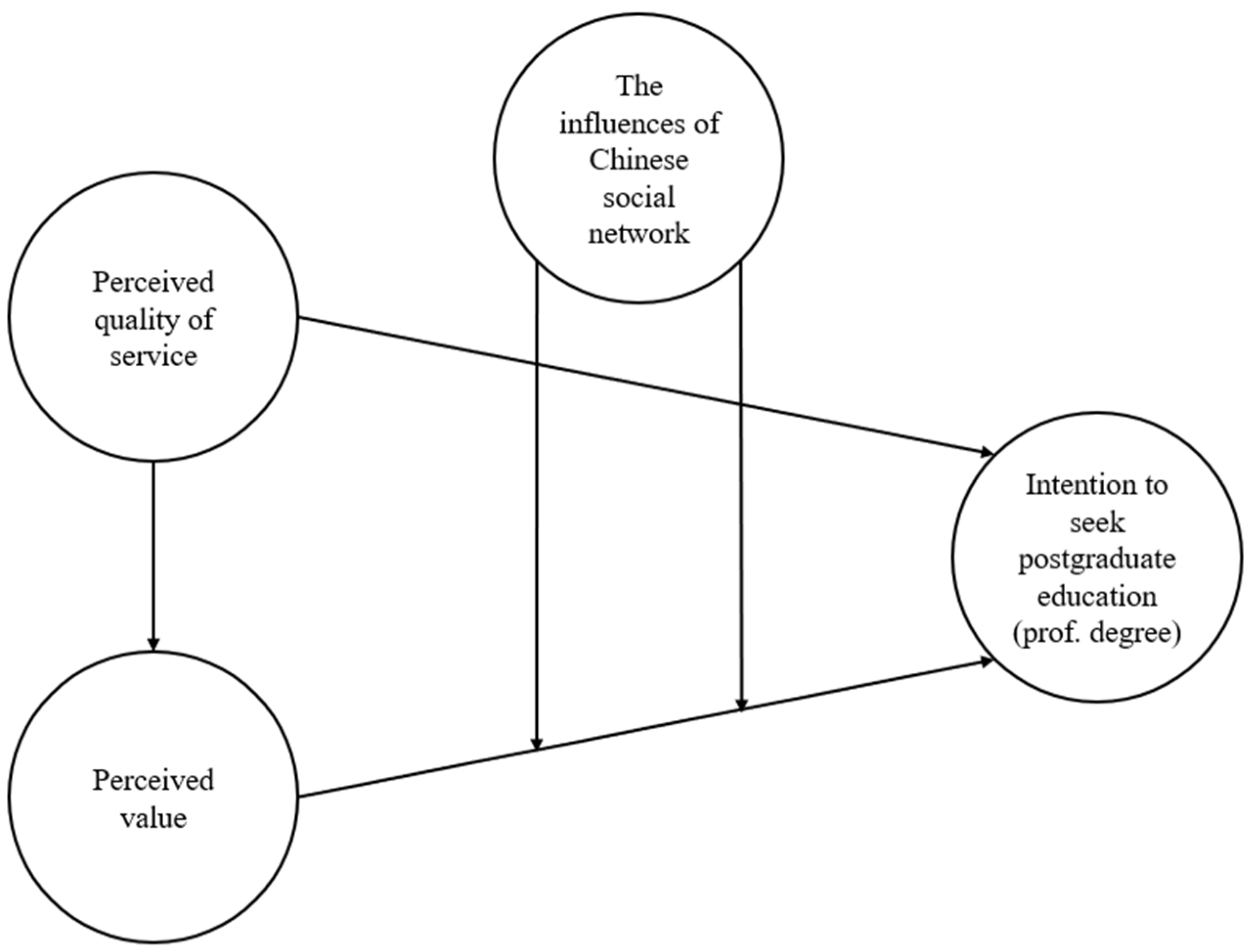
Integrating consumer behaviour theory and social network theory enables a more comprehensive understanding of postgraduate education intention. Consumer behaviour theory explains how students evaluate educational quality and value, while social network theory highlights the social embeddedness of these evaluations. Together, the two perspectives allow intention to be conceptualised as the outcome of both individual assessment and relational influence. Within the proposed framework (
Figure 1), perceived quality of educational services influences perceived educational value, which, in turn, shapes intention to pursue professional postgraduate education. Social networks are conceptualised as contextual factors that condition how perceived value translates into behavioural intention. This integrated perspective reflects the complexity of decision-making within internationalised higher education environments.
By linking micro-level perception with governance processes, the framework provides a theoretical basis for interpreting postgraduate education intention as an indicator of leadership effectiveness and policy communication under globalisation. It therefore establishes the foundation for the empirical analysis presented in the following sections.
4. Methodology
This study adopts a quantitative research design to examine postgraduate education intention within an internationalised higher education context. Quantitative approaches are appropriate for analysing relationships between latent constructs and for testing theoretically informed models incorporating mediating and moderating mechanisms (
Creswell & Creswell, 2017). A structured questionnaire survey was employed to capture students’ perceptions of the educational service quality, perceived educational value, and social influences associated with professional postgraduate education. The study adopts a confirmatory analytical orientation with the aim of identifying relational patterns rather than producing purely descriptive accounts. Data were collected through a questionnaire survey administered to undergraduate students enrolled in Guangzhou Higher Education Mega Center, one of the largest university clusters in southern China (including at least 10 universities, such as Sun Yat-sen University, South China University of Technology, and South China Normal University, Guangzhou University). This study employed a convenience sampling method. This approach is a non-probabilistic sampling method, in which the respondents are selected by investigators at a specific time and place to match the research topic. The survey object has a certain possibility of being selected by the convenience principle of the researcher. Such a sampling method is widely used in the study of intention;
Kaggwa et al. (
2017) and
Peng et al. (
2006) adopted a similar sampling method in their studies to collect student samples for statistical analysis. All junior and senior students learning and living in the collecting zones may be selected by the researcher based on the principle of convenience. Participation was voluntary, and all respondents were informed of the academic purpose of the study.
This study aimed to process the empirical analysis and examine the correlation of students’ psychological activities. The number of samples needed to reach a suitable quantity was determined based on several recommendations regarding the sample size for analyses.
MacCallum et al. (
1999) considered either the minimum sample size for a particular analysis or the minimum ratio of N to the number of variables
p (i.e., the number of survey items being subjected to factor analysis).
Comrey and Lee (
2013) provided the following guidance in determining the adequacy of sample size: 100 = poor, 200 = fair, 300 = good, 500 = very good, and 1000 or more = excellent. However, most studies that have investigated student cohorts have collected at least 300–500 samples and no more than 1000 samples. For example,
Lai et al. (
2012) collected 316 student samples from 4 regions in China, and
Pheunpha (
2019) collected 499 samples in his study. Based on these studies and considering time and financial ability, this study considered 500 samples as a good balance between the valid and the economical.
All constructs were measured using multi-item scales adapted from the established literature, with minor contextual modifications. Perceived quality of educational services was measured through items assessing teaching effectiveness, curriculum organisation, institutional support, and administrative reliability (
Parasuraman et al., 1988). Perceived educational value captured students’ evaluations of expected benefits relative to perceived costs (
Zeithaml, 1988). Postgraduate education intention was measured using intention-based items grounded in behavioural theory (
Ajzen, 1991). Social networks were operationalised through items assessing the perceived influence of interpersonal relationships on educational decision-making (
N. Lin, 2002). All items employed a seven-point Likert scale.
After the survey collection process, a final sample of valid responses was retained for analysis through data screening procedures, which included the removal of incomplete questionnaires and responses exhibiting patterned answering behaviour. Data analysis was conducted using structural equation modelling, which is appropriate for examining complex relational models involving mediating and moderating mechanisms (
Kline, 2023). Indirect effects were tested through bootstrap procedures, while moderation effects were examined using interaction terms following established analytical guidelines (
Hayes, 2017). The model fit was evaluated using multiple goodness-of-fit indices.
5. Findings
5.1. Descriptive Statistics
This section presents the descriptive characteristics of the sample and the statistical relationships between the key variables examined in the study. The respondents represent a diverse group of undergraduate students drawn from multiple academic disciplines and institutional backgrounds, providing an appropriate basis for examining postgraduate education intention (shown in
Table 1).
The results of the correlation between perceived quality of educational services, perceived educational value, social networks, and postgraduate education intention are reported in
Table 2. They indicate positive and statistically significant correlations between all key variables. In particular, perceived quality of educational services demonstrates a strong association with perceived educational value (r = 0.757,
p < 0.01), and both are positively related to the postgraduate education intention (r = 0.228, r = 0.291,
p < 0.01). Social network influence exhibits a significantly positive relationship with postgraduate education intention (r = 0.348,
p < 0.01). Social network influence is positively and significantly related to perceived quality of service (r = 0.305,
p < 0.01) and perceived value (r = 0.360,
p < 0.01). This indicates the relevance of interpersonal environments in postgraduate decision-making.
These results provide preliminary support for the proposed theoretical framework and justify further structural analysis.
5.2. Structural Relationships and Mediating Effects
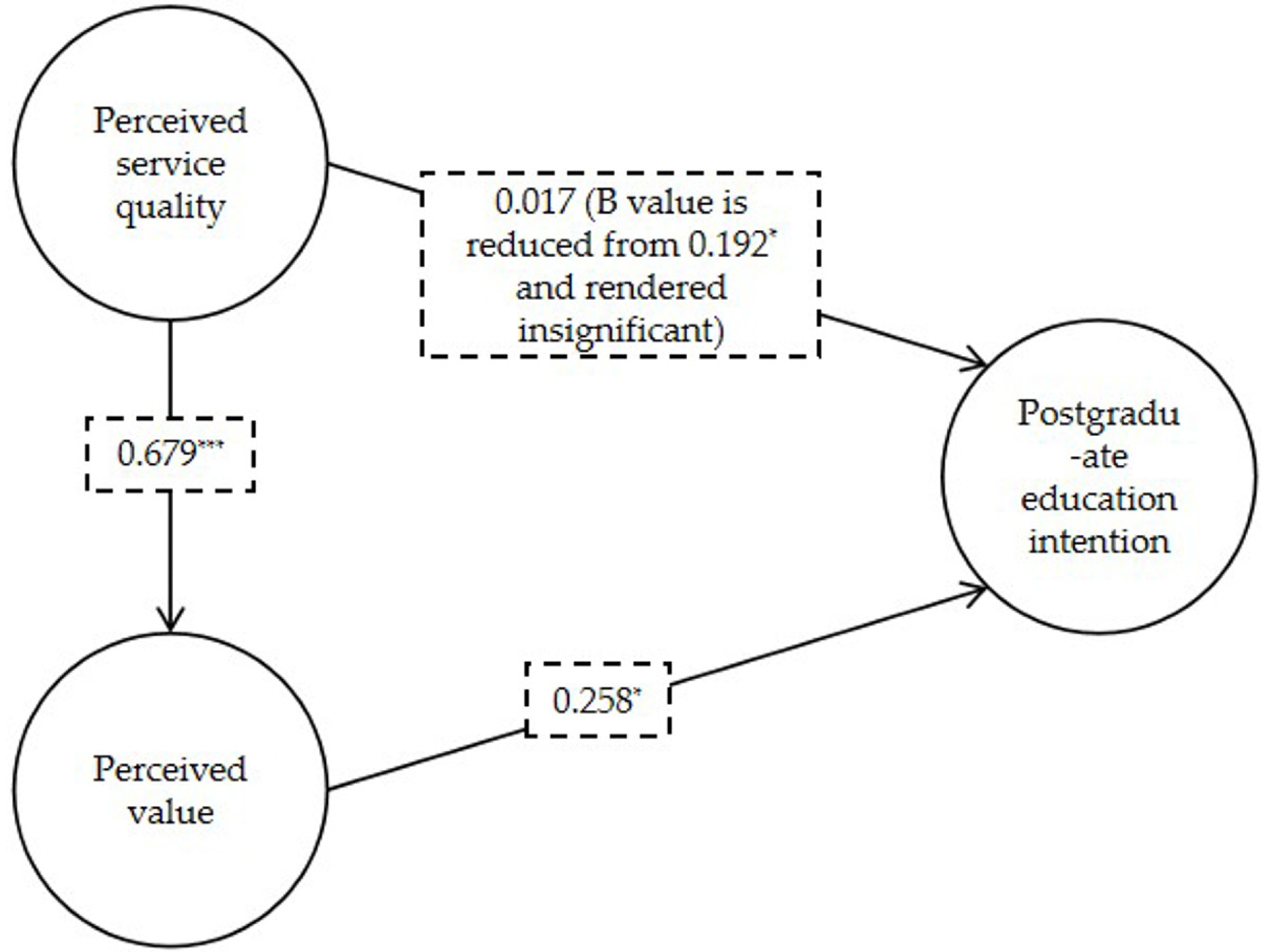
Structural equation modelling was conducted to examine the relationships between perceived service quality, perceived educational value, and postgraduate education intention. This study employed AMOS within SPSS 26.0 software. The results of the structural model are presented in
Table 3, and the estimated model is shown below (see
Figure 2).
The findings indicate that perceived quality of educational services has a significant positive effect on perceived educational value (B = 0.679 ***, p < 0.000). This suggests that students who report more positive educational experiences are more likely to perceive professional postgraduate education as valuable. Perceived educational value, in turn, exerts a significant positive effect on postgraduate education intention (B = 0.258 *, p < 0.011), indicating that value evaluation plays a central role in shaping a student’s intention to pursue professional postgraduate study.
When perceived educational value is included in the model, the direct effect of perceived service quality on postgraduate education intention vanishes (B = 0.017, p = 0.858 > 0.05; B value was reduced from 0.192 to 0.017). Thus, this study suggests that perceived value completely mediates the association between a student’s perceived quality of service and their intention to seek postgraduate education (professional degree).
To further substantiate this result, this study applied
Preacher and Hayes’s (
2004) test for an indirect effect, which utilises the bootstrap method for more reliable estimates. The bootstrap results in
Table 4 confirmed a significant indirect effect (indirect effect = 0.175, SE = 0.095, 95% CI [0.028, 0.223]). Thus, perceived value plays a completely mediating role in the influence of their perceived quality of service on a student’s intention to seek postgraduate education (professional degree). In other words, a student’s prior educational experiences influence postgraduate intention primarily through their impact on value perception rather than through direct effects alone.
These results highlight the central role of perceived value in postgraduate education decision-making and support the conceptualisation of value as a key interpretive channel through which educational governance and institutional practices are evaluated by students.
5.3. Moderating Role of Social Networks
To further examine the influence of the social context on postgraduate education intention, the moderating role of social networks was tested. The moderation analysis results are reported in
Table 5.
When the moderator (influence of social network) interacts with the independent variable (perceived quality of service), the interaction cannot statistically explain the dependent variable (student intention to seek postgraduate education). The interactive variable (influence of social network × perceived quality of service) has a positively insignificant effect on the intention to seek postgraduate education (professional degree) (B = 0.117, p = 0.089 > 0.05). Therefore, the moderator (social network influence) does not significantly impact the role of perceived service quality in relation to the student’s intention to pursue postgraduate education. The findings reveal that social networks do not significantly moderate the relationship between perceived quality of educational services and postgraduate education intention. This suggests that evaluations of educational service quality are primarily shaped by individual experience and are less susceptible to interpersonal influence.
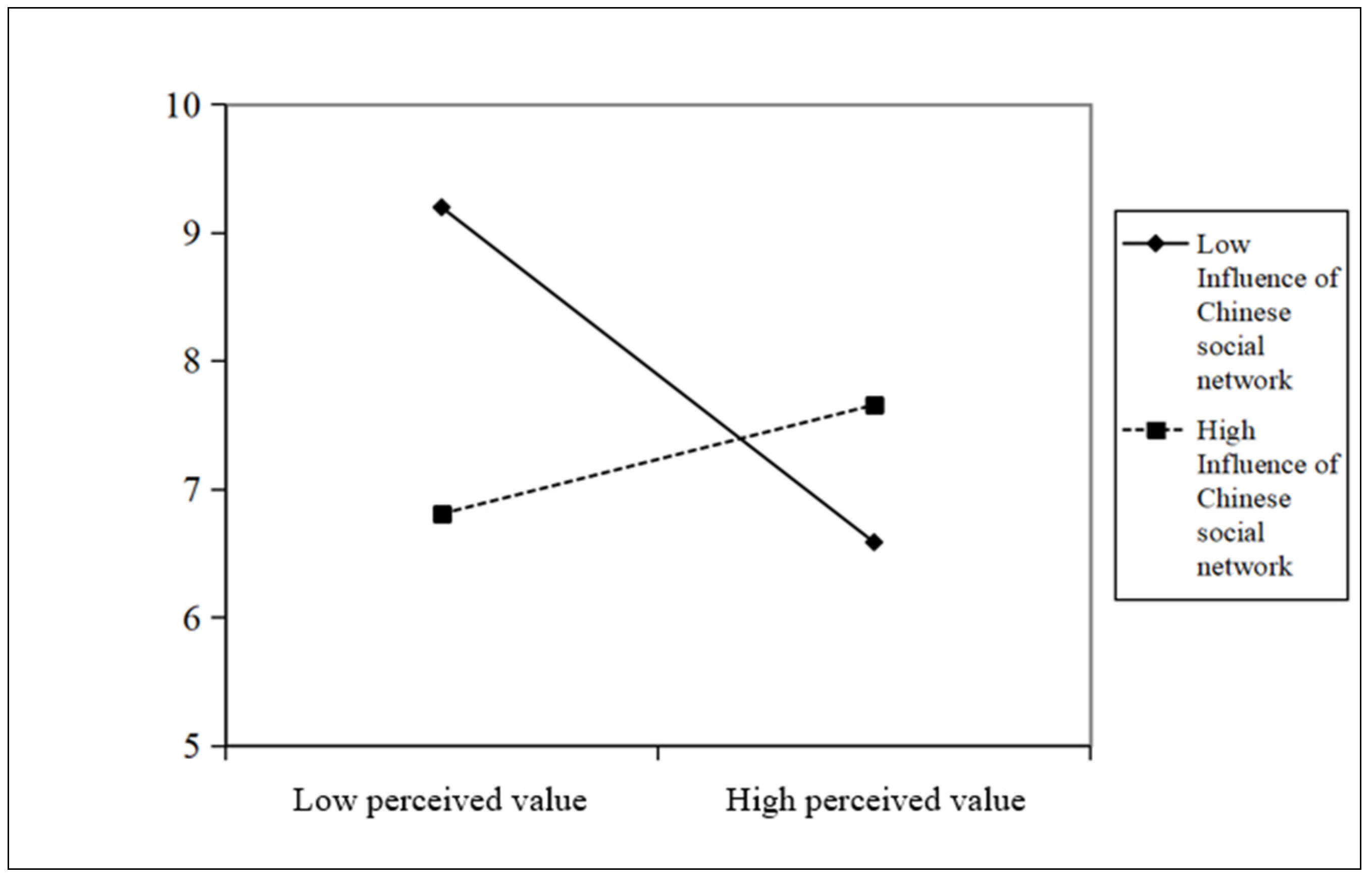
In contrast, the interaction between the influence of social networks and perceived value can statistically explain the student’s intention to seek postgraduate education (a professional degree). The results showed B = 0.153 and p = 0.038 < 0.05. R2 was 0.180, and the model is significant (F = 4.347, p = 0.038 < 0.05). Thus, the moderator (influence of social network) has a positively significant influence on the association between a student’s perceived value and their intention to seek postgraduate education (professional degree). Obviously, social networks significantly moderate the relationship between perceived educational value and postgraduate education intention. Specifically, the positive association between perceived value and intention is stronger for students who report higher levels of social network influence. This indicates that when students perceive professional postgraduate education as valuable, supportive information and normative reinforcement from social networks further strengthen their intention to pursue such programmes.
Overall, the findings demonstrate that postgraduate education intention is shaped by a combination of individual evaluation and social influence. Perceived educational value plays a central mediating role between educational experience and intention, while social networks function as an important contextual condition that amplifies value-based decision-making. Together, these results provide empirical support for the integrated theoretical framework proposed in this study.
In addition,
Figure 3 shows the variation differences in perceived value affected by the low social network against that influenced by the high one. The influence of the student’s perceived value on their intention to seek postgraduate education (professional degree) has become stronger, which is highly influenced by the social network. By contrast, the effect of perceived value on their intention to seek postgraduate education (professional degree) has become weaker, which is minimally influenced by the social network.
6. Discussion
This study examined postgraduate education intention within an internationalised higher education environment by integrating consumer behaviour theory and social network theory. The findings offer important insights into how educational leadership, institutional management, and policy design are interpreted at the individual level, particularly in systems undergoing structural reform in professional postgraduate education.
One of the most significant findings is the mediating role of perceived educational value in postgraduate education decision-making. Although perceived quality of educational services demonstrates a positive association with postgraduate intention, this relationship operates primarily through students’ evaluations of educational value. This suggests that favourable educational experiences alone are insufficient to motivate continued participation unless students are able to translate these experiences into meaningful expectations regarding future benefits (
Sweeney & Soutar, 2001;
Zeithaml, 1988). As
A. Kumar and Grisaffe (
2004) indicated, quality- and customer-oriented strategies have different effects on goods and services. From a governance perspective, this finding highlights the importance of value construction within postgraduate education reform. Policy initiatives aimed at expanding professional degree provision may have limited impact if students remain uncertain about labour market relevance, professional recognition, or long-term returns associated with such qualifications (
Mok, 2016;
Tomlinson, 2017). Therefore, educational leaders and institutional managers face the challenge of transforming service quality into credible value signals that align with students’ expectations within increasingly competitive employment environments, while individuals’ intrinsic values and their expectations are also influenced by both internal factors and the external environment (
Gahan & Abeysekera, 2009;
Patterson & Spreng, 1997). Within internationalised education systems, perceived value is shaped not only by domestic institutional practices but also by global reference points and societal constructs, as students frequently evaluate postgraduate options in relation to overseas education pathways and international credential hierarchies (
Brooks & Waters, 2011;
Marginson, 2016). Governance effectiveness thus depends on whether leadership and policy initiatives explicitly address value perception rather than relying solely on structural reform.
The findings also reveal the differentiated role of social networks in postgraduate education decision-making. Social networks do not significantly moderate the relationship between perceived service quality and intention, suggesting that assessments of educational quality are primarily grounded in personal experience rather than interpersonal influence (
Douglas et al., 2006). In contrast, social networks significantly strengthen the relationship between perceived educational value and postgraduate education intention. This pattern supports social network theory, which emphasises that individuals rely on interpersonal relationships to interpret uncertainty and validate long-term decisions (
Granovetter, 1973;
N. Lin, 2002). It also corroborates the previous literature discussing the impact of external factors on students’ perceptions. For example,
Jepsen and Varhegyi (
2011) found that postgraduate education promotion influences students’ intentions to pursue postgraduate education, while
Ojewumi (
2019) discovered that a strong social network is associated with a higher level of entrepreneurial intention. In internationalised contexts, socially transmitted narratives concerning employability, credential hierarchy, and labour market competitiveness circulate through peer interaction and shape how domestic postgraduate options are evaluated (
Brown et al., 2010;
Waters, 2006). These findings underscore the importance of informal information environments in postgraduate education governance.
The results further highlight the evolving responsibilities of educational leadership within internationalised postgraduate education systems. Leadership increasingly involves not only programme administration and institutional management, but also the management of perception, legitimacy, and trust within environments characterised by global comparison and intensified information circulation. Institutional management practices that prioritise operational efficiency alone may be insufficient if they do not address how students evaluate future outcomes (
Marginson, 2011). Transparent articulation of professional competencies, employment pathways, and credential recognition therefore plays a critical role in strengthening confidence in professional postgraduate education. At the policy level, the findings suggest that postgraduate education reform should be understood as a governance process rather than a purely technical adjustment. Policymakers must recognise students as stakeholders whose perceptions provide meaningful feedback on reform effectiveness (
Ball, 2012;
Marginson, 2018). In contexts characterised by sustained outbound student mobility, professional postgraduate education represents a strategic response to global competition, yet policy success depends on whether domestic programmes are perceived as legitimate and valuable alternatives within international education markets. This requires coordinated policy approaches that address quality assurance, professional recognition, and communication simultaneously, while acknowledging the influence of informal information circulation on student decision-making (
Mok & Qian, 2020). Finally, this study contributes to international education research by demonstrating how micro-level decision-making processes can illuminate system-level governance dynamics. Considering the recent shift toward quasi-deglobalisation, the internationalised higher education market has transitioned from a supply-side to a demand-side model, with customers now dominating the discourse on development. By integrating consumer behaviour and social network theory, this study provides empirical evidence and argumentation to support the introduction of governance involving students as stakeholders. Rather than treating the students as static, external factors, the findings illustrate how the students’ evaluative processes impact the establishment of university success (
P. M. Kumar & Aithal, 2020;
Roga et al., 2015). This perspective offers a more nuanced understanding of how to improve leadership effectiveness within globalised higher education systems by incorporating students’ views.
7. Conclusions
This study examined postgraduate education intention within an internationalised higher education environment by integrating consumer behaviour theory and social network theory. Using empirical evidence from undergraduate students in China, the study explored how perceived quality of educational services, perceived educational value, and social networks jointly shape intentions toward professional postgraduate education. The findings demonstrate that perceived educational value plays a central role in postgraduate decision-making. The student’s intention is influenced, even established, by the interaction between the perceived quality of the service and the perceived value. Positive educational experiences contribute to favourable perceptions, but the decisive role in behavioural intention is primarily played by students’ evaluations of value, rather than by their perceptions of the service itself.
The study also reveals the differentiated role of social networks. Although social networks do not significantly influence student evaluations of educational service quality, they substantially strengthen the relationship between perceived educational value and postgraduate intention. This indicates that postgraduate education decisions are not formed solely through individual assessment but are embedded within socially mediated information environments. In this pattern, the role of perceived value would also be re-emphasised, with value itself being the only important receptacle for changes caused by the external environment. This highlights the importance of value interpretation as a key mechanism linking educational provision with future study decisions.
From an international education perspective, these findings suggest that postgraduate education reform should be understood as a governance process shaped by both institutional practice and social interpretation. Educational leadership and policy initiatives aimed at strengthening professional postgraduate education must therefore address not only programme design and quality assurance, but also the communication and legitimisation of educational value within globalised education markets. By conceptualising student intention as a form of policy feedback, this study contributes to broader discussions on educational leadership, management, and policy in international education. The findings offer insights for education systems seeking to enhance the effectiveness of postgraduate education reform under conditions of global competition and transnational mobility.
8. Limitations and Future Research
Several limitations of this study should be acknowledged. First, the data were collected from undergraduate students within a specific regional context in China, which may limit the generalisability of the findings to other national or institutional settings. Future research could adopt comparative designs across regions or countries to examine whether similar decision-making mechanisms operate within different international education systems. Second, the study relied on cross-sectional survey data, which restricts the ability to capture changes in perception over time. Longitudinal approaches may provide deeper insight into how students’ evaluations of educational value evolve as postgraduate education reforms mature and labour market conditions shift. Third, although this study focused on perceived service quality, perceived educational value, and social networks, other factors may also shape postgraduate education intention, including institutional reputation, policy awareness, and family expectations. Future studies may therefore benefit from incorporating additional variables or qualitative methods to further explore the complexity of postgraduate decision-making. Despite these limitations, the study offers a theoretically grounded and empirically informed contribution to international education research by linking individual perceptions with governance outcomes, thereby providing a foundation for future inquiry into how higher education systems can respond more effectively to the challenges of globalisation.
Author Contributions
Conceptualization, A.L.; methodology, A.L.; software, G.K. and A. L.; validation, G.K. and A.L.; formal analysis, A.L.; investigation, A.L.; writing—original draft preparation, A.L.; writing—review and editing, G.K. All authors have read and agreed to the published version of the manuscript.
Funding
This research received no external funding.
Institutional Review Board Statement
The study was conducted in accordance with the Declaration of Helsinki, and approved by the Human Research Ethics Committee (HREC) Lingnan University (Hong Kong) (approval code: 2022.03.27, date of approval: 27 March 2022).
Informed Consent Statement
Informed consent was obtained from all subjects involved in the study.
Data Availability Statement
The original contributions presented in this study are included in the article. Further inquiries can be directed to the corresponding author.
Conflicts of Interest
The authors declare no conflicts of interest.
References
- Ajzen, I. (1991). The theory of planned behaviour. Organizational Behaviour and Human Decision Processes, 50(2), 179–211. [Google Scholar] [CrossRef]
- Altbach, P. G. (2006). Globalization and the university: Realities in an unequal world. In International handbook of higher education (pp. 121–139). Springer. [Google Scholar]
- Ball, S. J. (2012). Global Education Inc.: New policy networks and the neoliberal imaginary. Routledge. [Google Scholar]
- Billett, S. (2011). Vocational education: Purposes, traditions and prospects. Springer Science & Business Media. [Google Scholar]
- Brooks, R., & Waters, J. (2011). Student mobilities, migration and the internationalization of higher education. Springer. [Google Scholar]
- Brown, P. (2022). Higher education, credentialism, and social mobility. In The Routledge handbook of digital consumption. Taylor & Francis. [Google Scholar]
- Brown, P., Lauder, H., & Ashton, D. (2010). The global auction: The broken promises of education, jobs, and incomes. Oxford University Press. [Google Scholar]
- Burt, R. S. (2000). The network structure of social capital. Research in Organizational Behaviour, 22, 345–423. [Google Scholar] [CrossRef]
- Chen, H., Wang, X., Chen, G., & Li, Z. (2018). Upward social mobility in China: Do cities and neighbourhoods matter? Habitat International, 82, 94–103. [Google Scholar] [CrossRef]
- Comrey, A. L., & Lee, H. B. (2013). A first course in factor analysis. Psychology Press. [Google Scholar]
- Creswell, J. W., & Creswell, J. D. (2017). Research design: Qualitative, quantitative, and mixed methods approaches. Sage Publications. [Google Scholar]
- Deem, R. (2001). Globalisation, new managerialism, academic capitalism and entrepreneurialism in universities: Is the local dimension still important? Comparative Education, 37(1), 7–20. [Google Scholar] [CrossRef]
- Douglas, J., Douglas, A., & Barnes, B. (2006). Measuring student satisfaction at a UK university. Quality Assurance in Education, 14(3), 251–267. [Google Scholar] [CrossRef]
- Economist Intelligence Unit. (2024). In charts: The changing picture of China’s outbound study. Economist Intelligence Unit. [Google Scholar]
- El-Hammadi, M. (2012). Syrian pharmacy students’ intentions and attitudes toward postgraduate education. American Journal of Pharmaceutical Education, 76(8), 147. [Google Scholar] [CrossRef]
- Gahan, P., & Abeysekera, L. (2009). What shapes an individual’s work values? An integrated model of the relationship between work values, national culture and self-construal. The International Journal of Human Resource Management, 20(1), 126–147. [Google Scholar] [CrossRef]
- Granovetter, M. S. (1973). The strength of weak ties. American Journal of Sociology, 78(6), 1360–1380. [Google Scholar] [CrossRef]
- Hayes, A. F. (2017). Introduction to mediation, moderation, and conditional process analysis: A regression-based approach. Guilford Publications. [Google Scholar]
- Hemsley-Brown, J., & Oplatka, I. (2010). Market orientation in universities: A comparative study of two national higher education systems. International Journal of Educational Management, 24(3), 204–220. [Google Scholar] [CrossRef]
- Jepsen, D. M., & Varhegyi, M. M. (2011). Awareness, knowledge and intentions for postgraduate study. Journal of Higher Education Policy and Management, 33(6), 605–617. [Google Scholar] [CrossRef]
- Kaggwa, V. T., Sekiwu, D., & Naluwemba, E. F. (2017). Student expectations and quality of postgraduate education: The case for public universities in Uganda. Advances in Social Sciences Research Journal, 4(21), 25–50. [Google Scholar] [CrossRef]
- Kline, R. B. (2023). Principles and practice of structural equation modeling. Guilford Publications. [Google Scholar]
- Knight, J. (2004). Internationalization remodeled: Definition, approaches, and rationales. Journal of Studies in International Education, 8(1), 5–31. [Google Scholar] [CrossRef]
- Kotler, P., & Fox, K. (1985). Strategic marketing for educational institutions. Prentice Hall. [Google Scholar]
- Kumar, A., & Grisaffe, D. B. (2004). Effects of extrinsic attributes on perceived quality, customer value, and behavioral intentions in B2B settings: A comparison across goods and service industries. Journal of Business to Business Marketing, 11(4), 43–74. [Google Scholar] [CrossRef]
- Kumar, P. M., & Aithal, P. S. (2020). Internationalization of higher education: A stakeholder approach. Scholedge International Journal of Business Policy & Governance, 7(6), 84–93. [Google Scholar]
- Lai, L. S., To, W. M., Lung, J. W., & Lai, T. M. (2012). The perceived value of higher education: The voice of Chinese students. Higher Education, 63(3), 271–287. [Google Scholar] [CrossRef]
- Lin, H. F. (2007). Predicting consumer intentions to shop online: An empirical test of competing theories. Electronic Commerce Research and Applications, 6(4), 433–442. [Google Scholar] [CrossRef]
- Lin, N. (2002). Social capital: A theory of social structure and action (Vol. 19). Cambridge University Press. [Google Scholar]
- Liu, D., & Morgan, W. J. (2016). Students’ decision-making about postgraduate education at G University in China: The main factors and the role of family and of teachers. The Asia-Pacific Education Researcher, 25(2), 325–335. [Google Scholar] [CrossRef]
- MacCallum, R. C., Widaman, K. F., Zhang, S., & Hong, S. (1999). Sample size in factor analysis. Psychological Methods, 4(1), 84–89. [Google Scholar] [CrossRef]
- Marginson, S. (2011). Higher education and public good. Higher Education Quarterly, 65(4), 411–433. [Google Scholar] [CrossRef]
- Marginson, S. (2016). The dream is over: The crisis of Clark Kerr’s California idea of higher education (p. 260). University of California Press. [Google Scholar]
- Marginson, S. (2018). Higher education, economic inequality and social mobility: Implications for emerging East Asia. International Journal of Educational Development, 63, 4–11. [Google Scholar] [CrossRef]
- Mok, K. H. (2016). Massification of higher education, graduate employment and social mobility in the Greater China region. British Journal of Sociology of Education, 37(1), 51–71. [Google Scholar] [CrossRef]
- Mok, K. H., & Han, X. (2016). From ‘brain drain’ to ‘brain bridging’: Transnational higher education development and graduate employment in China. Journal of Higher Education Policy and Management, 38(3), 369–389. [Google Scholar] [CrossRef]
- Mok, K. H., & Qian, J. (2020). Governance reforms and changing accountability in higher education: Implications for China. Higher Education Policy, 33(2), 247–266. [Google Scholar]
- Ojewumi, K. A. (2019). Entrepreneurial intention among polytechnic students in Nigeria: The role of self-efficacy and social networks. African Journal for the Psychological Study of Social Issues, 22(1), 102–115. [Google Scholar] [CrossRef]
- Organisation for Economic Co-operation and Development. (2012). How is the global talent pool changing? OECD Publishing. [Google Scholar]
- Organisation for Economic Co-operation and Development. (2019). Education at a glance 2019: OECD indicators. OECD Publishing. [Google Scholar]
- Parasuraman, A. B. L. L., Zeithaml, V. A., & Berry, L. (1988). SERVQUAL: A multiple-item scale for measuring consumer perceptions of service quality. Journal of Retailing, 64(1), 12–40. [Google Scholar]
- Patterson, P. G., & Spreng, R. A. (1997). Modelling the relationship between perceived value, satisfaction and repurchase intentions in a business-to-business, services context: An empirical examination. International Journal of Service Industry Management, 8(5), 414–434. [Google Scholar] [CrossRef]
- Peng, H., Tsai, C. C., & Wu, Y. T. (2006). University students’ self-efficacy and their attitudes toward the Internet: The role of students’ perceptions of the Internet. Educational Studies, 32(1), 73–86. [Google Scholar] [CrossRef]
- Pheunpha, P. (2019). A factor analysis of student’ perceived service quality in higher education. ABAC Journal, 39(4), 90–110. [Google Scholar]
- Preacher, K. J., & Hayes, A. F. (2004). SPSS and SAS procedures for estimating indirect effects in simple mediation models. Behavior Research Methods, Instruments, & Computers, 36(4), 717–731. [Google Scholar] [CrossRef]
- Roga, R., Lapiņa, I., & Müürsepp, P. (2015). Internationalization of higher education: Analysis of factors influencing foreign students’ choice of higher education institution. Procedia-Social and Behavioral Sciences, 213, 925–930. [Google Scholar] [CrossRef][Green Version]
- Schiffman, L. G., Kanuk, L. L., & Das, M. (2009). Consumer behaviour. Pearson Education. [Google Scholar]
- Skinner, M. (2019, April 2). How China shapes global mobility trends. WENR. Available online: https://wenr.wes.org/2019/04/how-china-shapes-global-mobility-trends (accessed on 18 February 2026).
- Sweeney, J. C., & Soutar, G. N. (2001). Consumer perceived value: The development of a multiple item scale. Journal of Retailing, 77(2), 203–220. [Google Scholar] [CrossRef]
- Tomlinson, M. (2017). Forms of graduate capital and their relationship to graduate employability. Education + Training, 59(4), 338–352. [Google Scholar] [CrossRef]
- Tomlinson, M., & Watermeyer, R. (2022). When masses meet markets: Credentialism and commodification in twenty-first century higher education. Discourse: Studies in the Cultural Politics of Education, 43(2), 173–187. [Google Scholar] [CrossRef]
- Waters, J. L. (2006). Emergent geographies of international education and social exclusion. Antipode, 38(5), 1046–1068. [Google Scholar] [CrossRef]
- Yu, C. (2025). China’s rise as a study hub calls for an internationalisation rethink. Times Higher Education. [Google Scholar]
- Zeithaml, V. A. (1988). Consumer perceptions of price, quality, and value: A means-end model and synthesis of evidence. Journal of Marketing, 52(3), 2–22. [Google Scholar] [CrossRef]
- Zhang, S., & Kline, S. L. (2009). Can I make my own decision? A cross-cultural study of perceived social network influence in mate selection. Journal of Cross-Cultural Psychology, 40(1), 3–23. [Google Scholar] [CrossRef]
- Zhu, L., & Reeves, P. (2019). Chinese students’ decisions to undertake postgraduate study overseas. The International Journal of Educational Management, 33(5), 999–1011. [Google Scholar] [CrossRef]
| Disclaimer/Publisher’s Note: The statements, opinions and data contained in all publications are solely those of the individual author(s) and contributor(s) and not of MDPI and/or the editor(s). MDPI and/or the editor(s) disclaim responsibility for any injury to people or property resulting from any ideas, methods, instructions or products referred to in the content. |