Parent-Child Communication and Children’s Democratic Citizenship: The Roles of Growth Mindset and Peer Relationship


Abstract
1. Introduction
- How does parent–child communication influence the development of children’s democratic citizenship?
- Does a growth mindset mediate the relationship between parent–child communication and children’s democratic citizenship?
- Does the quality of peer relationships mediate the relationship between parent–child communication and children’s democratic citizenship?
- Do growth mindset and peer relationships exert a sequential (serial) mediating effect on the relationship between parent–child communication and children’s democratic citizenship?
2. Literature Review
2.1. Parent–Child Communication and Democratic Citizenship in Children
2.2. Parent−Child Communication, Growth Mindset, and Citizenship
2.3. Parent–Child Communication, Peer Relationships, and Democratic Citizenship
3. Materials and Methods
3.1. Research Participants
3.2. Research Instruments
3.2.1. Parent–Child Communication
3.2.2. Democratic Citizenship
3.2.3. Growth Mindset
3.2.4. Peer Relationship
3.3. Research Procedure
3.4. Ethical Consideration
3.5. Data Analysis
4. Results and Finding
4.1. Descriptive Statistics and Correlations Analysis
4.2. Serial-Multiple Mediation of Growth Mindset and Peer Relationships
4.3. Comparison of Indirect Effect
5. Discussion
6. Limitations and Directions for Future Research
- (1)
- Programs should include structured parent–child communication activities, such as guided dialog prompts, reflective journaling, and home-based discussion tasks, to strengthen positive communication patterns that are associated with democratic citizenship.
- (2)
- Instructional strategies should explicitly foster growth mindset through classroom practices, including feedback focused on effort and improvement, opportunities for challenge-based learning, and activities that encourage persistence and reflection.
- (3)
- Peer interaction components should be intentionally designed within classroom settings, such as cooperative learning, group problem-solving, and student-led discussions, to provide contexts in which students can practice democratic values and social responsibility.
7. Conclusions
Author Contributions
Funding
Institutional Review Board Statement
Informed Consent Statement
Data Availability Statement
Acknowledgments
Conflicts of Interest
References
- Allen, J., Balfour, R., Bell, R., & Marmot, M. (2014). Social determinants of mental health. International Review of Psychiatry, 26(4), 392–407. [Google Scholar] [CrossRef]
- Anderson, L. W. (2023). Civic education, citizenship, and democracy. Education Policy Analysis Archives, 31, 1–16. [Google Scholar] [CrossRef]
- Arizka, S. (2020). Concept of civic education and its realization in various countries. Jurnal Pendidikan Kewarganegaraan, 3, 29–38. [Google Scholar] [CrossRef]
- Bae, H. J., Baek, Y. W., & Song, C. H. (2018). The effect of communication competence on interpersonal competence of K-CESA. Journal of Core Competency Education Research, 3(1), 23–41. [Google Scholar] [CrossRef]
- Bae, J. (2025). [Korea’s democratic regression diagnosis series] ② Factors of democratic regression in the Korean presidential system (Working paper). East Asia Institute. Available online: https://www.eai.or.kr/press/press_01_view.php?no=10802 (accessed on 11 November 2025).
- Barnes, H. L., & Olson, D. H. (1982). Parent–adolescent communication scale. In D. H. Olson (Ed.), Family inventories: Inventories used in a national survey of families across the family life cycle (pp. 33–46). University of Minnesota. [Google Scholar]
- Barnes, H. L., & Olson, D. H. (1985). Parent-adolescent communication and the circumplex model. Child Development, 56(2), 438–447. [Google Scholar] [CrossRef]
- Belay, A., & Tefera, B. (2023). Civic engagement and its relationship with parental civic socialization of adolescents in Addis Ababa. Open Psychology Journal, 16, e187435012302170. [Google Scholar] [CrossRef]
- Blackwell, L. S., Trzesniewski, K. H., & Dweck, C. S. (2007). Implicit theories of intelligence predict achievement across an adolescent transition: A longitudinal study and an intervention. Child Development, 78(1), 246–263. [Google Scholar] [CrossRef] [PubMed]
- Bronfenbrenner, U. (1979). The ecology of human development: Experiments by nature and design. Harvard University Press. [Google Scholar]
- Byun, S., & Lee, S. (2021). Parents’ socioeconomic status and children’s educational outcomes: Has educational inequality worsened in Korea? Park Young Story. [Google Scholar]
- Cha, M. J. (2018). The second anniversary evaluation and tasks of the Gyeonggi-do democratic citizenship education ordinance. NGO Studies, 13, 1–26. [Google Scholar]
- Chae, K. S. (2015). The mediating effect of children’s empathy ability between parent–child communication and peer relationships of children [Ph.D. dissertation, Gachon University]. [Google Scholar]
- Cheon, Y. R., & Han, K. S. (2012). The relationship among peer relation disposition, relationship maintenance effort and school adjustment of gifted students and non-gifted students. Journal of Gifted/Talented Education, 22(4), 875–892. [Google Scholar] [CrossRef][Green Version]
- Cho, J., & Tak, J. (2021). A study on the antecedents affecting the growth mindset of adolescents: Focusing on openness, parental characteristics, and teacher characteristics. Korean Journal of Youth Studies, 28(3), 205–230. [Google Scholar] [CrossRef]
- Choi, A. R. (2021). The effect of parent–child communication on adolescents’ daily stress: The mediating effect of positive psychological capital. Journal of Open Parent Education, 13, 1–14. [Google Scholar]
- Choi, H. J., & Yoo, G. W. (2024). A structural model analysis of elementary school students’ perceived parenting style, relationships with teachers and peers, self-esteem, and citizenship. Children’s Education, 33(3), 153–175. [Google Scholar] [CrossRef]
- Choi, J. S., & Oh, J. W. (2018). A review of previous studies on Carol S. Dweck’s mindset theory. Journal of Arts Humanities and Social Convergence Multimedia, 8, 139–147. [Google Scholar]
- Choi, T. S., & Kim, J. K. (2015). The effects of school life adjustment and parenting style on school-age children’s depression: The moderating effect of parenting style types. Youth Studies Korea, 22, 595–617. [Google Scholar]
- Chu, B. W. (2021). Positive psychology and citizenship education. In B. Chu, I. Cho, J. Ryu, B. Lee, K. Lee, & B. Park (Eds.), Omnibus citizenship education (pp. 16–59). Howu Publishing. [Google Scholar]
- Do, K. S. (2004). The effect of parent–child communication and interpersonal intelligence on the quality of peer relationship among school children [Master’s thesis, Kyungnam University]. [Google Scholar]
- Dweck, C. S. (2006). Mindset: The new psychology of success. Random House. [Google Scholar]
- Eisenberg, N., & Mussen, P. H. (1989). The roots of prosocial behavior in children. Cambridge University Press. [Google Scholar]
- Gunderson, E. A., Gripshover, S. J., Romero, C., Dweck, C. S., Goldin-Meadow, S., & Levine, S. C. (2013). Parent praise to 1- to 3-year-olds predicts children’s motivational frameworks 5 years later. Child Development, 84(5), 1526–1541. [Google Scholar] [CrossRef]
- Ha, H. (2024). Estimation of the number of out-of-school youth in 2023. Youth Policy Evaluation Center, National Youth Policy Institute. Available online: https://www.ypec.re.kr/fileDownload?fileDownType=C&fileId=1¶mMenuId=MENU00312&titleId=1898 (accessed on 23 April 2026).
- Ha, J. H., & Han, C. W. (2021). The mediating effect of fixed mindset in the relationship between high school students’ perceived parenting style and self-esteem. Children’s Education, 30(3), 179–193. [Google Scholar] [CrossRef]
- Hair, J. F., Black, W. C., Babin, B. J., & Anderson, R. E. (2010). Multivariate data analysis. Pearson. [Google Scholar]
- Hayes, A. F. (2013). Introduction to mediation, moderation, and conditional process analysis: A regression-based approach. Guilford Press. [Google Scholar]
- Heo, J. Y. (2017). The relationship of mother’s emotional expressivity, parent-child interaction, and family strengths with child’s caring behaviors [Master’s thesis, Catholic University of Korea]. [Google Scholar]
- Hong, S. P. (2019). The effect of peer relationships on multicultural acceptability among elementary school students. Multicultural Education Studies, 12, 31–56. [Google Scholar] [CrossRef]
- Hummel, T. G., Cohen, F., & Anders, Y. (2023). Parents’ trust in their child’s preschool: Associations with child and family characteristics and aspects of parent–preschool communication. Early Education and Development, 34(5), 1057–1074. [Google Scholar] [CrossRef]
- Jang, E. (2019). Democratic citizenship education in Korea: The direction of social consensus and challenges of institutionalization. Citizen World, 34, 99–134. [Google Scholar] [CrossRef]
- Jung, M. S., Choi, H., & Jeon, Y. E. (2017). The effect of cooperative learning on democratic citizenship: Focusing on the mediating effects of peer support, teacher support, parental support, and social self-concept. Journal of Civic Education, 49, 127–145. [Google Scholar]
- Kim, D. (2020). Serial multiple mediating effects of self-esteem and cooperation on the relationship between perceived parental attitudes and peer relationships in children. Journal of Digital Convergence, 18(5), 485–495. [Google Scholar] [CrossRef]
- Kim, H. M. (2005). A study on the social democratic citizenship of elementary school students [Master’s thesis, Ewha Womans University]. [Google Scholar]
- Kim, H. R. (2021). The structural relationship among parenting attitude perceived by elementary school students, teacher relationship, peer relationship and academic engagement [Master’s thesis, Seoul National University of Education]. [Google Scholar]
- Kim, J. E. (2023). Global citizenship education in South Korea [Ph.D. dissertation, University College London]. [Google Scholar]
- Kim, J. E., & Choi, Y. M. (2017). The mediating effect of parental support on the relationship between children’s interpersonal competence and citizenship: A multi-group analysis of low-income and general families. Korean Journal of Care Management, 25, 5–26. [Google Scholar]
- Kim, J. H. (2020). A longitudinal analysis of the effects of growth mindset, reading activities, and citizenship among middle school students. Korean Journal of Youth Activity, 6, 123–141. [Google Scholar] [CrossRef]
- Kim, M. H., & Kim, S. H. (2017). Study on the individual and school factors affecting citizenship in students of Gyeonggi-do. Educational Research, 80, 143–167. [Google Scholar]
- Kim, M. O. (2015). A study on the Han counseling parent role training for enhancing parent-child communication and the relatedness, individuality [Ph.D. dissertation, Myongji University]. [Google Scholar]
- Kim, S., & Kim, N. (2024). Unveiling the evolving educational inequality from upper secondary to higher education in South Korea: From effectively maintained inequality theory perspective. Higher Education, 89, 1637–1657. [Google Scholar] [CrossRef]
- Kim, W. J. (2012). The influence of home environment and school experience on high school students’ citizenship: Focusing on social participation awareness and community spirit. Korean Journal of Youth Studies, 23, 201–222. [Google Scholar]
- Kim, Y., & Um, M. Y. (2018). The effect of parents’ socioeconomic status on academic achievement: Focusing on the mediating effect of parental emotional support and student’s ego resilience. Korean Journal of Social Welfare Studies, 49(4), 5–30. [Google Scholar] [CrossRef]
- Kline, R. B. (2016). Principles and practice of structural equation modeling. Guilford Press. [Google Scholar]
- Kohlberg, L. (1984). The psychology of moral development: The nature and validity of moral stages (Vol. 2). Harper & Row. [Google Scholar]
- Lee, G. (2020). Towards inclusive values in democratic civic education: Based on public perceptions. Korean Journal of Public Administration, 34(1), 171–194. [Google Scholar] [CrossRef]
- Lee, G. (2022). Relationships among factors influencing democratic citizenship for the development of effective citizenship education moral education as a school subject. Journal of Ethics Education Studies, 66, 489–519. [Google Scholar] [CrossRef]
- Lee, K., Kim, H. Y., & Yoo, S. S. (2023). Unsupportive school, isolated classroom, and self-blaming teacher: A narrative inquiry of 10 years experienced teacher, Sunyoung. Korean Journal of Sociology of Education, 33(4), 71–105. [Google Scholar] [CrossRef]
- Lee, S. H., & Choi, J. E. (2019). A structural analysis of the relationships among grit, growth mindset, basic psychological needs, and parents’ positive parenting attitudes in school-age children. Journal of Family and Quality of Life, 37(3), 155–168. [Google Scholar] [CrossRef]
- Lee, S. H., & Moon, S. B. (2020). An analysis of the causal relationships among parents’ positive parenting attitudes, teacher support, children’s basic psychological needs, growth mindset, and grit. Journal of Korean Home Management Association, 38(3), 35–52. [Google Scholar] [CrossRef]
- Lee, Y. J., & Kim, D. J. (2019). Mindset and peer relationships of elementary school students: Verification of the mediating effects of grit and self-regulation. Journal of Korean Sport Science and Physical Education, 24(2), 209–222. [Google Scholar] [CrossRef]
- Levine, C., Kohlberg, L., & Hewer, A. (1985). The current formulation of Kohlberg’s theory and a response to critics. Human Development, 28(2), 94–100. [Google Scholar] [CrossRef]
- Lim, S. (2013). Analysis of mother-adolescent children communicative action based on Habermas’ theory of communicative action. Journal of Civic and Youth Studies, 4, 24–50. [Google Scholar]
- Luthans, F., & Youssef, C. M. (2007). Emerging positive organizational behavior. Journal of Management, 33(3), 321–349. [Google Scholar] [CrossRef]
- McCutchen, K. L., Jones, M. H., Carbonneau, K. J., & Mueller, C. E. (2016). Mindset and standardized testing over time. Learning and Individual Differences, 45, 208–213. [Google Scholar] [CrossRef]
- Min, H. Y. (1992). The relationship between the level of juvenile delinquency and parent-child communication, family cohesion, and adaptability. Journal of Korean Home Economics Association, 13, 112–124. [Google Scholar]
- Ministry of Education. (2022). 2022 revised national curriculum: General guidelines. Division of Curriculum Policy, Ministry of Education. [Google Scholar]
- Moeini, F., Hosseinpour, R., & Jafari, A. (2025). The structural model of democratic parenting based on parental stress index and couples’ communication patterns with the mediating role of wisdom. Applied Family Therapy Journal, 6(1), 37–46. [Google Scholar] [CrossRef]
- Molden, D. C., & Dweck, C. S. (2000). Meaning and motivation. In C. Sansone, & J. M. Harackiewicz (Eds.), Intrinsic and extrinsic motivation (pp. 131–159). Academic Press. [Google Scholar]
- Mueller, C. M., & Dweck, C. S. (1998). Praise for intelligence can undermine children’s motivation and performance. Journal of Personality and Social Psychology, 75(1), 33–52. [Google Scholar] [CrossRef]
- Na, H. W. (2014). The effects of a participation in self-governing activity program on democratic citizenship of students in innovation school [Master’s thesis, Ewha Womans University]. [Google Scholar]
- Ok, I., Cho, D., Jang, E., & Lee, J. (2018). Tasks and practical directions for global and democratic citizenship education from the perspective of lifelong education in a multicultural era (Final report). Industry–Academic Cooperation Foundation of Seowon University. [Google Scholar]
- Olson, D. H., Sprenkle, D. H., & Russell, C. S. (1979). Circumplex model of marital and family systems: I. Cohesion and adaptability dimensions, family types, and clinical applications. Family Process, 18(1), 3–28. [Google Scholar] [CrossRef]
- Organisation for Economic Co-operation and Development. (2024). Re-thinking future education in Korea: Towards student agency and well-being. Available online: https://www.oecd.org/content/dam/oecd/en/about/projects/edu/education-2040/6-bilateral-support/Re-thinking_Future_Education_in_Korea.pdf (accessed on 11 November 2025).
- Park, J. L. (2016). The relationship between parent–child communication perceived by upper elementary school students, smartphone overuse, and peer relationships [Master’s thesis, Inje University]. [Google Scholar]
- Park, S. Y. (2012). A comparative study on the background and purposes of youth citizenship education: Focusing on cases in the UK and the US. Youth Studies Korea, 19, 323–344. [Google Scholar]
- Parker, J. G., & Asher, S. R. (1993). Friendship and friendship quality in middle childhood: Links with peer group acceptance and feelings of loneliness and social dissatisfaction. Developmental Psychology, 29(4), 611–621. [Google Scholar] [CrossRef]
- Paunesku, D., Walton, G. M., Romero, C., Smith, E. N., Yeager, D. S., & Dweck, C. S. (2015). Mind-set interventions are a scalable treatment for academic underachievement. Psychological Science, 26(6), 784–793. [Google Scholar] [CrossRef]
- Pellegrini, A. D., & Bohn, C. M. (2005). The role of recess in children’s cognitive performance and school adjustment. Educational Researcher, 34(1), 13–19. [Google Scholar] [CrossRef]
- Podsakoff, P. M., MacKenzie, S. B., Lee, J. Y., & Podsakoff, N. P. (2003). Common method biases in behavioral research: A critical review of the literature and recommended remedies. Journal of Applied Psychology, 88(5), 879–903. [Google Scholar] [CrossRef] [PubMed]
- Riesch, S. K., Anderson, L. S., & Krueger, H. A. (2010). Parent-child communication processes: Preventing children’s health-risk behavior. Journal for Specialists in Pediatric Nursing, 11(1), 41–56. [Google Scholar] [CrossRef] [PubMed]
- Roh, Y.-R. (2004). Democratic citizenship education in the information age: A comparative study of South Korea and Australia. Asia Pacific Education Review, 5(2), 167–177. [Google Scholar] [CrossRef]
- Ryu, J. J. (2018). The moderating effect of life goals in the relationship between grit, self-determination, and growth mindset [Master’s thesis, Seoul National University of Education]. [Google Scholar]
- Seo, M. J. (2025). The longitudinal effect of maternal parenting stress on children’s social competence: A sequential dual mediation of parenting efficacy and parent–child interaction [Master’s thesis, Chonnam National University]. [Google Scholar]
- Twork, K., Ludwig, J., Kiess, W., & Poulain, T. (2025). Parent-child interaction frequency: Associations with age, sibling presence, and child health. Pediatric Research, 98, 114–120. [Google Scholar] [CrossRef]
- Westheimer, J., & Kahne, J. (2004). What kind of citizen? The politics of educating for democracy. American Educational Research Journal, 41(2), 237–269. [Google Scholar] [CrossRef]
- Yang, J. H., & Lee, J. H. (2010). Relationship between peer relationship, school life adjustment and pro-social behavior according to adolescents’ participation in sports activities. Korean Society of Sports Science, 39, 343–350. [Google Scholar] [CrossRef]
- Yang, Y. W., & Jung, J. L. (2017). The effects of mother’s self-differentiation on the child’s friendship quality through child’s self-differentiation and mother-child relationships. Korean Journal of School Psychology, 15, 361–378. [Google Scholar]


| Variable | Sub-Factors | Number of Questions | Cronbach’s |
|---|---|---|---|
| Parent–child communication | Open | 10 | 0.930 |
| Prblematic | 10 | 0.811 1 | |
| Total | 20 | 0.923 | |
| Democratic citizenship | Human rights | 5 | 0.880 |
| Responsibility | 5 | 0.877 | |
| Cooperation | 5 | 0.892 | |
| Democratic procedures | 5 | 0.871 | |
| Total | 20 | 0.820 | |
| Growth mindset | Growth | 4 | 0.918 |
| Fixed | 4 | 0.897 | |
| Total | 8 | 0.977 | |
| Peer relationship | Positive | 8 | 0.828 |
| Negative | 4 | 0.743 | |
| Total | 12 | 0.812 |
| Variables | 1 | 2 | 3 | 4 |
|---|---|---|---|---|
| 1. Parent–child communication | 1 | |||
| 2. Growth mindset | 0.486 ** | 1 | ||
| 3. Peer relationship | 0.280 ** | 0.402 ** | 1 | |
| 4. Democratic citizenship | 0.324 ** | 0.472 ** | 0.447 ** | 1 |
| Mean | 3.477 | 3.871 | 4.073 | 3.000 |
| SD | 0.734 | 0.479 | 0.823 | 0.401 |
| Skewness | −0.566 | −0.161 | −1.049 | −0.405 |
| Kurtosis | 0.669 | 0.171 | 1.143 | 0.955 |
| Variable | Growth Mindset | Peer Relationship | Democratic Citizenship | ||||||
|---|---|---|---|---|---|---|---|---|---|
| β | SE | t (p) | β | SE | t (p) | β | SE | t (p) | |
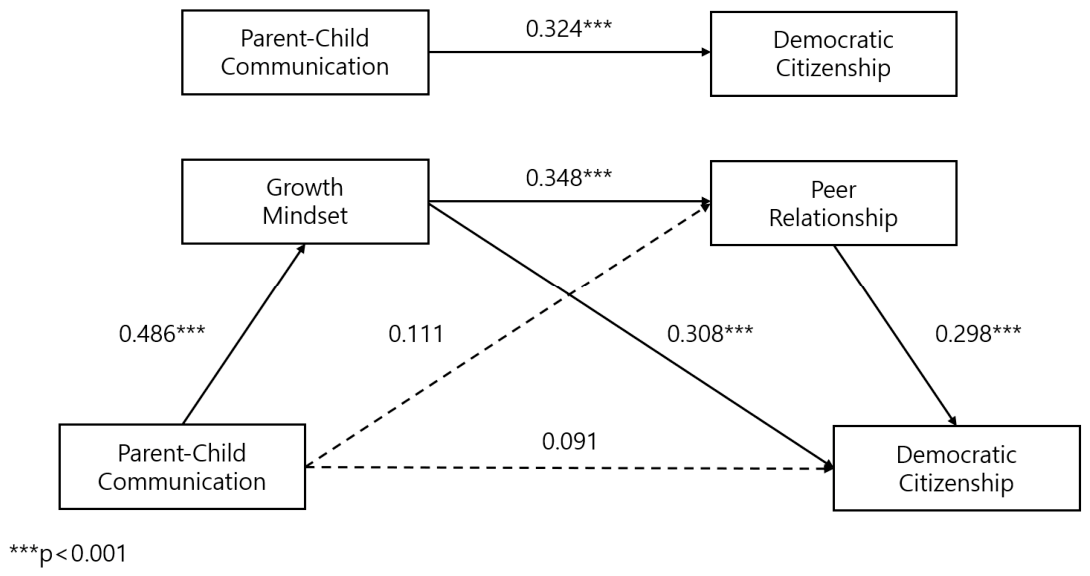
| Parent–Child Communication | 0.486 | 0.068 | 8.056 *** | 0.111 | 0.039 | 1.543 | 0.091 | 0.043 | 1.376 |
| Growth Mindset | 0.348 | 0.035 | 4.826 *** | 0.308 | 0.040 | 4.431 *** | |||
| Peer Relationship | 0.298 | 0.076 | 4.700 *** | ||||||
| Model Fit | F = 37.146 *** | F = 21.535 *** | F = 30.897 *** | ||||||
| R2 | 0.236 | 0.171 | 0.308 | ||||||
| β | Boot SE | LLCI | ULCI | |
|---|---|---|---|---|
| Total effect X → Y | 0.212 | 0.043 | 0.128 | 0.296 |
| Direct effect X → Y | 0.060 | 0.043 | −0.026 | 0.145 |
| Indirect effects | ||||
| X → M1 → Yt | 0.150 | 0.045 | 0.065 | 0.241 |
| X → M2 → Y | 0.033 | 0.024 | −0.008 | 0.087 |
| X → M1 → M2 → Y | 0.050 | 0.018 | 0.019 | 0.088 |
| Total indirect effect | 0.233 | 0.046 | 0.144 | 0.326 |
Disclaimer/Publisher’s Note: The statements, opinions and data contained in all publications are solely those of the individual author(s) and contributor(s) and not of MDPI and/or the editor(s). MDPI and/or the editor(s) disclaim responsibility for any injury to people or property resulting from any ideas, methods, instructions or products referred to in the content. |
© 2026 by the authors. Licensee MDPI, Basel, Switzerland. This article is an open access article distributed under the terms and conditions of the Creative Commons Attribution (CC BY) license.
Share and Cite
Yoon, G.; Lee, J. Parent-Child Communication and Children’s Democratic Citizenship: The Roles of Growth Mindset and Peer Relationship. Educ. Sci. 2026, 16, 708. https://doi.org/10.3390/educsci16050708
Yoon G, Lee J. Parent-Child Communication and Children’s Democratic Citizenship: The Roles of Growth Mindset and Peer Relationship. Education Sciences. 2026; 16(5):708. https://doi.org/10.3390/educsci16050708
Chicago/Turabian StyleYoon, Gabjung, and Jiyoung Lee. 2026. "Parent-Child Communication and Children’s Democratic Citizenship: The Roles of Growth Mindset and Peer Relationship" Education Sciences 16, no. 5: 708. https://doi.org/10.3390/educsci16050708
APA StyleYoon, G., & Lee, J. (2026). Parent-Child Communication and Children’s Democratic Citizenship: The Roles of Growth Mindset and Peer Relationship. Education Sciences, 16(5), 708. https://doi.org/10.3390/educsci16050708