1. Introduction
According to
Alarcão et al. (
2018), internationalization—understood as a marker of the university’s ongoing transformation, and defined as “transnational and transcultural acceptance and participation in the construction and dissemination of scientific, pedagogical, technological, and cultural knowledge” (p. 111)—is framed within a broader process of institutional change through which universities seek to adjust their core missions (education, innovation, and research) to the evolving demands of society.
Against this backdrop, understanding how research internationalization is interpreted, pursued, and justified by those who carry it out becomes particularly important—especially as internationalization agendas are currently being reshaped by post-pandemic conditions, geopolitical uncertainty, and accelerating digital transformations that alter the incentives, risks, and opportunities of transnational academic work (
Kapfudzaruwa, 2025;
Zhang & Wu, 2025). In this scenario, research internationalization becomes not only a strategic aspiration but also a contested and situationally constrained practice whose viability depends on how it is framed and enacted by academic actors within their institutions.
A substantial body of scholarship has examined the integration of an international dimension into higher education, predominantly through institutional or national lenses that frame internationalization rationales as strategic and policy drivers (
Aigner et al., 1992;
de Wit, 2000;
Knight, 1997,
2008;
Deng, 2025;
Caliskan & Buyukgoze, 2026). This article extends the scope by focusing on a micro-level perspective: it examines how Honduran university professors account for the aspects and factors that motivate them to internationalize their research activities and identifies the discursive positions that emerge from that analysis. This approach is of particular interest because, as
de Wit (
2013) states, university faculty are the main drivers of transnational scientific activities. Accordingly, aligning institutional aims with faculty objectives, and designing mechanisms that incorporate these discourses, can facilitate not only the implementation but also the consolidation and sustainability of international scientific activities within the university. Recent work further suggests that misalignments between policy and academic practice can generate frictions that weaken implementation, especially when internationalization is driven by externally oriented agendas that are only partially connected to academic rationales and institutional capacity-building needs (
Caliskan & Buyukgoze, 2026;
Deng, 2025).
The literature on internationalization rationales provides the theoretical framework for this study. Rather than treating internationalization as a unitary policy choice, the scholarship conceptualizes it as a multidimensional process in which overlapping rationales coexist, compete and change over time. Across this literature, institutional rationales for research internationalization converge around several recurring drivers: positioning international engagement as part of the universities’ broader transformation and adaptation of their core missions (
Alarcão et al., 2018); strengthening research quality, visibility, and reputational standing (
de Wit, 2000;
Knight, 2008); securing resources and diversifying funding streams amid competitive regimes and shifting incentive structures (
Georghiou, 1998;
Deng, 2025); and advancing strategic national and institutional goals related to competitiveness, capacity building, and, in some contexts, geopolitical or soft power agendas (
Aigner et al., 1992;
Sisavath, 2024;
Caliskan & Buyukgoze, 2026). At the same time, sociocultural rationales remain present insofar as internationalization is framed as promoting intercultural understanding and sustaining institutional identity within a globalizing environment (
Knight, 1997,
2008).
Aigner et al. (
1992) identify three non-mutually exclusive factors that drive internationalization: safeguarding international security, maintaining economic competitiveness, and fostering intercultural understanding.
Blumenthal et al. (
1996) reference four dimensions that underpin cooperation and academic mobility in higher education: economic, political, cultural, and academic–scientific–technological.
Wächter et al. (
1999) distinguish educational and economic rationales, those linked to cultural policy, and those associated with promoting peace and global responsibility, regional integration, and development.
Knight (
1997) and
de Wit (
2000) group together four sets of reasons that explain internationalization in universities: academic, sociocultural, political, and economic. While academic and sociocultural rationales initially predominated, economic and political rationales have gained prominence under conditions of intensified competition, shifting funding regimes, and the strategic use of higher education in national positioning (
de Wit, 2000;
Knight, 2008;
Deng, 2025).
Contemporary research underscores that rationales are also being reconfigured by disruption and differentiation across contexts. Comparative policy analysis shows that socio-economic rationales tend to dominate but manifest differently across the Global North and South as states interpret internationalization in line with national priorities, within an increasingly multipolar landscape that also reactivates political rationales (
Kapfudzaruwa, 2025). Studies of internationalization strategies highlight tensions between educational purposes and geopolitical or soft power ambitions, as well as concerns about policy coherence and the ethical implications of instrumentalizing internationalization (
Caliskan & Buyukgoze, 2026;
Deng, 2025). Concurrently, evidence from less-resourced higher education systems suggests that, in the post-COVID period, internationalization can be strongly motivated by resource assurance and academic rationales linked to strengthening institutional and human capacity, improving quality, and expanding digital capabilities, while also confronting administrative constraints (
Sisavath, 2024). Work on South–South higher education interactions likewise indicates that contemporary internationalization is increased by triple disruptions: pandemics, geopolitics, and technological change, which influence not only mobility patterns but also the normative and strategic frameworks through which cooperation is justified (
Zhang & Wu, 2025). At the same time, critiques emphasize that dominant conceptualizations remain strongly shaped by Western/Anglo-Saxon paradigms, while context sensitive accounts, particularly form the Global South, remain limited (
Kapfudzaruwa, 2025;
Sisavath, 2024).
In the conceptual terrain,
de Wit (
2000) argues that higher education institutions do not base their internationalization processes on a single, absolute rationale, but rather on a combination of rationales—often more implicit than explicit—whose relevance and hierarchy may vary over time. Recognizing the potential overlaps among categories,
Knight (
2008) introduces a distinction between national and institutional legitimating logics. At the national level, the dominant rationales relate to human resource development, the formation of strategic alliances, trade exchange, nation-building, and sociocultural development; at the institutional level, they include building an international brand or profile, revenue generation, student and staff development, the formation of strategic academic partnerships, and knowledge production.
Although Knight (
2008) acknowledges that individuals—researchers, faculty, and students—are the actors who promote, implement, participate in, or are the targets of internationalization processes, she does not incorporate individual-level rationales into her analysis, arguing that doing so would limit universal applicability, and objectivity of the generally accepted conceptualization of internationalization. Yet, research on academic practice suggests that individual motivations matter precisely because they shape the feasibility and meaning of internationalization on the programmatic level, and because they can diverge from policy rationales in ways that create implementation tensions (
Finkelstein et al., 2013;
Turner & Robson, 2007;
Trondal, 2010).
Taken together, this body of work serves as the theoretical point of departure for the present study in two ways. First, it establishes internationalization as a multidimensional process whose rationales tend to overlap rather than operate as single causes, and it provides a widely used conceptual reference for interpreting how internationalization is justified in higher education. Second, the literature has been developed predominantly from national or institutional standpoints, where rationales are framed as policy logics and governance drivers. Building on this framework, the analysis shifts the lens to the faculty level and examines how these drivers are articulated, combined, and contested in discourse within a Global South context, where structural constraints and capacity gaps condition the feasibility and meaning of research internationalization. The theoretical contribution, therefore, lies in mapping the relational configuration of discursive positions that make visible the tensions and complementarities through which faculty rationales take shape, thereby informing institutional governance and management efforts to align policy design and academic practice.
The study of the specific motives driving the internationalization of university research has received comparatively less attention, partly due to the perception that research is inherently international and that knowledge production requires researchers to engage with global scholarship (
Wächter et al., 1999).
Katz and Martin (
1997) argue that science is a social institution in which advances depend on interactions—often international—between scientists, which may take the form of formal, organized collaborations or informal links, including “invisible colleges” (
Crane, 1972) and broader knowledge networks. According to
Altbach and Knight (
2007), globalization has fostered a global labor market for scientists and academics, the integration of research, the use of English as a lingua franca for scientific communication and expanded access to information and communication technologies.
Georghiou (
1998) distinguishes between direct scientific and technological benefits—including higher-quality, larger scale, more agile, or lower cost research—and indirect strategic, economic, and political benefits, such as improving institutional reputation or accessing alternative sources of funding.
Van den Besselaar et al. (
2012) identify three reasons for the internationalization of research: expanding collaborator networks and accessing complementary knowledge to strengthen research quality and innovation performance; building research and development systems and more competitive innovation networks globally; and developing a global system of ideas and values that facilitates responses to global problems.
Woldegiyorgis et al. (
2018) add that faculty may view internationalization as instrumental for increasing scientific output and citations, consolidating academic reputation, and advancing professional careers.
Turner and Robson (
2007) argue that researchers’ individual motivations are generally cooperative and internationalist in nature, articulated through a values-centered discourse. Academics tend to distance themselves from the competitive and market-oriented motivations that predominate at national and institutional levels. According to
Finkelstein et al. (
2013), the internationalization of university faculty activities is driven primarily by personal values and preferences, rather than by academic disciplines or institutional guidelines. This discrepancy between individual rationales and the rationales underpinning university and government policies can generate tensions that are often reflected in practice. In this context, seeking compatibility between individual and institutional objectives, and establishing mechanisms for collaboration between central university administration and researchers, can facilitate the international development of faculty scientific activity (
Trondal, 2010).
Research Internationalization in Honduran Higher Education
In Honduras—a Global South higher education system where scientific capacity has historically developed under structural constraints (
Zelaya & Montañés, 2021a)—policies and normative instruments explicitly recognize scientific research as a priority within the national system. However, institutional practice has historically remained oriented almost exclusively toward undergraduate teaching, and this enduring imbalance has limited both the country’s scientific output and the international projection of Honduran researchers (
Zelaya & Montañés, 2021b). Bibliometric evidence illustrates the magnitude of this constraint. During the 2018–2022 period, a substantial share of Honduran higher education institutions reported no Scopus-indexed publications, while others produced only marginal output (
SCImago Research Group, 2024), suggesting a structurally weak research ecosystem in which research capacity and productivity are uneven and frequently underdeveloped.
At the policy level, the Honduran and regional governance environment provides an important backdrop for understanding how these rationales are formed and negotiated. Regional diagnoses developed within the Central American higher education internationalization system identify recurring obstacles to strengthening research internationalization, including limited resources, incentives, and time for research; weak graduate systems; and administrative constraints such as overhead charges or burdensome procedures associated with project implementation (
SIESCA-CSUCA, 2019). At the national level, higher education strategic planning has framed internationalization—particularly research internationalization—in relation to visibility, positioning, and collaboration with regional partners of mutual interest (
Consejo de Educación Superior de Honduras, 2014). Simultaneously, Honduras’s legal and institutional framework recognizes and supports international cooperation in education, science, technology, and innovation as part of national development efforts (
Congreso Nacional de la República de Honduras, 2012,
2014), reinforcing the notion that international engagement is a legitimate and desirable component of academic work.
At the institutional level, the National Autonomous University of Honduras (UNAH) constitutes a strategically significant site for examining faculty rationales. According to Article 160 of the Honduran Constitution, UNAH “enjoys the exclusive right to organize, direct, and develop higher and professional education in the country” (
Constitución de la República de Honduras, 1982, pp. 32–33). In practice, it also exhibits key characteristics associated with flagship universities, including system-level influence and a central role in national capacity formation (
Altbach, 2016). Recent national statistics indicate that UNAH serves the largest student population among Honduran higher education institutions, underscoring its structural weight within the system (
Dirección de Educación Superior de Honduras, 2025b). Moreover, UNAH’s academic community accounts for approximately 90% of the country’s public scientific output indexed in Scopus (
SCImago Research Group, 2024), making it an analytically informative setting for examining the discursive logic through which research internationalization is justified and pursued.
At the programmatic level the Honduran case also presents a distinctive pattern that makes case analytically relevant for research on internationalization rationales. Despite limited indexed output in many institutions, the proportion of publications involving international collaboration is comparatively high. In the Ibero-American ranking framework, international collaboration is operationalized as the percentage of an institution’s output coauthored by researchers affiliated with institutions in different countries (
de-Moya-Anegón et al., 2021). Under this criterion, 84.22% of Honduran publications indexed in Scopus include international co-authorship (
SCImago Research Group, 2024), indicating that international collaboration often functions not merely as an added value, but as a practical pathway through which research can be conducted, validated, and disseminated under conditions of constrained local capacity. This configuration directly motivates the present study: how do faculty members interpret and justify research internationalization when the institutional environment combines formal policy priority with limited domestic research support?
Taken together, these features make Honduras—and UNAH in particular—a relevant Global South scenario for analyzing research internationalization as a problem of governance and academic practice. The combination of formal policy prioritization, constrained research infrastructure, and high reliance on international co-authorship places faculty members at the center of a tension between aspiration and feasibility. In this context, mapping the discursive positions through which faculty rationales take shape offers empirically grounded insights into how internationalization is made meaningful in practice, and how institutional strategies may be strengthened by aligning governance mechanisms with the rationales, limitations, and expectations articulated by the academic community.
3. Findings
According to the participants’ accounts, one of the main drivers of the internationalization of university research is the need for financial resources to cover investments in infrastructure, equipment, and supplies required for scientific activity, as well as expenses related to fieldwork and the dissemination of results. The discourse further suggests that the planning and prioritization of research is often conditioned by external funding.
I am committed to […] creating a program with these institutions that want to provide funding, because in order to conduct research in many disciplines, funds are required for fieldwork […] investments in equipment, laboratories, etc. […] The bulk of our funding for research, for equipping ourselves with field equipment that generates the data we need, and carrying out research and outreach work comes from external cooperation. […] We would sit down and start brainstorming: who can we bleed, who can we take money from, how do we program it […] the grant involves going through this whole process of research methodologies in order to be able to present it and convince the donor that you can do the work and that they should give you the money. (DG.1) These international exchanges provide me not only with resources and technical support, but also with financial support. (DG.2)
It is argued that relationships with international peers and participation in academic consortia not only facilitate access to complementary financial resources but also strengthen institutional capacities for securing and managing external funding.
[…] an external expert in the field who would enable us to start presenting within those important international organizations […] they know where the money is, how you can access it, and how you can have a real opportunity […] we had to bring in someone from the outside to facilitate a workshop, we learned how to apply for grants and we submitted them… (DG.1) …after we worked with that institution, it served as a reference so that we can work with others and they allow us to participate in calls for proposals. (DG.4)
This view is reasonable, given participants’ accounts that the institutional and financial resources available for research within academic units are clearly insufficient. In many cases, these funds barely cover routine operating costs, which compels faculty to seek additional external resources in order to carry out scientific projects.
There are also the idiosyncrasies of our region, where money is not abundant […] We have also had funds managed by the university, but the bulk comes from external cooperation. Our budget goes to salaries and day-to-day expenses, but there is no budget for research […] We are a research institute with an allocated budget, but we cannot do research with that budget. (DG.1)
It is also argued that managing resources from internal competitive funds for research projects is excessively complex and bureaucratic. This, in turn, leads faculty to seek international funding, which, although it requires greater initial effort in terms of project formulation and submission, is perceived as administratively more agile and easier to manage.
We decided not to apply for, or rather to give up university grants, because the purchasing and liquidation procedures were too cumbersome… I told them: keep your money, I’d rather get it from somewhere else […] I always looked for funding outside the university because I prefer the hassle of looking for it rather than dealing with the university. (DG.1) The processes tend to be very slow bureaucratically within the university institution […] and they discourage researchers, who ultimately choose to maintain their personal networks and do research wherever they can. (DG.3)
From an economic perspective, the discourse suggests that some participants engage in international research primarily, or even exclusively, for economic reasons. This includes those who frame cross-border collaborations within an international consultancy scheme:
Within the topic of internationalization, the issue of knowledge production also has an economic impact. (DG.4) I want our collaborations to be paid for… I want them to be academic collaborations; we are not looking for consulting work. (DG.1)
Other discourses highlight the ethical dimension and political commitment—understood in the Aristotelian sense as concern for, and engagement with, the public sphere— as key factors shaping research internationalization. In Aristotle’s view, the political and the public are inseparable: human beings are
zoon politikon and achieve their fulfillment through participation in the
polis, where political action is oriented towards the governance of public affairs and the pursuit of the common good (
Aristóteles, 2017). From this standpoint, cross-border cooperation is said not only to enhance the quality of research activity but also to benefit the university as a whole. It is further claimed that such collaboration strengthens ethical standards and contributes to building the capacities of the national scientific system.
One vision is the strengthening of the capacity to carry out research in general: with its different ethical and research quality components (DG.2) …the aim is to form alliances to generate research between different countries and universities in order to, precisely, promote and this research (DG.3)
From the standpoint of the participants’ accounts, research internationalization is described as producing benefits that extend beyond individual researchers and accrue to the university as an institution. These perceived benefits include the training of local researchers, faculty, and students through research methods courses and workshops delivered by international scholars, as well as participation in scientific outreach activities. International mentoring of graduate students’ research and the dialogue that arises during the joint execution of projects are also highlighted.
The fact that you internationalize your research allows you to train teachers, even if they do not have a graduate degree […] it contributes to the training of professionals who have been able to go abroad. […] Would you like to come to Honduras to participate in this event, and apart from giving the talk, would you give us some training? We put together a 4- or 5-day workshop, and each research group brought in an international guest and [organized] a workshop in their specific area. (DG.1) Our students have had advisors from Costa Rica, the United States, Canada, and Mexico. That has been very enriching […] with that advisor who follows up with them, they form their own research groups, their own publications, and they grow and multiply. […] We ask those same contacts to collaborate so that they can offer a virtual lecture […] (DG.2) We must call Spain, Chile […] immediately, these are researchers with extensive experience and are willing to participate in these activities […] and start contributing. (DG.4)
In addition to strengthening capacity building through researcher training, participants suggest that internationalization facilitates interdisciplinary interaction and the pooling of expertise and resources to develop research projects of greater scope, impact, and relevance.
Strengthening the capacity to conduct research in general […] when I think of internationalization, multidisciplinarity comes to mind. One looks to international collaborators to fill any gaps one may have in the disciplines, to strengthen certain aspects. (DG.2) …scientists and researchers from different areas will contribute, so that research can be conducted from different perspectives, in a fairly holistic manner. (DG.4)
It is also suggested that international interaction supports compliance with the indexing criteria of local publications, while the publication of articles with international authorship enhances the prestige of local journals.
The elements that are evaluated on scientific articles, at least in indexed journals, is that scientific articles from other countries, foreign countries, can be published. […] One purpose of the [international] network is to give the journal an added value, and that is why we exchange scientific articles. (DG.3) When we have a journal, working to make it an international journal […] it is difficult for a major researcher to want to publish an article with us when they can do so in a higher-ranked journal, but there can always be collaborations to enhance the weight of our journal formats. (DG.4)
It is also argued that the internationalization of research is promoted as a means of achieving quality accreditation for institutional programs. Such evaluations are conducted in line with international standards, which place particular value on academic exchange and collaboration with scholars from other countries.
Establishing mechanisms and work processes of this kind in recent years in response to accreditation […] are very good total quality practices. (DG.1) A university that conducts research is a university that earns points internationally and in international rankings to be recognized. (DG.3)
One of the most decisive factors driving researchers to build relationships with international peers is the desire to exchange ideas, receive feedback, and sustain academic dialogue that improves project design and implementation, stimulates creativity, and enriches scientific output. International interaction also facilitates access to extensive information and cutting-edge scholarship, while enabling the acquisition of tacit knowledge derived from shared experience.
The rapprochement, the coming and going between researchers and sharing with colleagues in other parts of the world […] bringing our own knowledge, our own experiences. That greatly enriches research. […] A space for academic and scientific exchange that I can’t find… I don’t even remember having memorable spaces here to really talk about science. (DG.2) I have an idea and suddenly someone with more experience says it’s good, or that the idea is no good. That’s part of what helps us: the frankness and maturity to recognize that not all ideas are good… so as not to waste time. (DG.1) In order to share this knowledge that is so important. (DG.4)
From the discourse, faculty members appear to view the internationalization of their scientific output as a pathway to enhancing academic reputation. Although this does not always translate into the expected gains in terms of career progression, it does contribute to peer recognition and professional prestige, thereby reinforcing academic and social standing. In this regard, reputation is closely associated with the international communication of results and publication in high-impact journals that are well positioned in global rankings.
Who doesn’t like recognition for a job well done? […] You must do systematic work, be knowledgeable, have prestige; but that is achieved through associations that help generate articles that are published in journals that are read and referenced. (DG.2) It is healthy and excellent competition. We are in a constant battle with a certain someone: but our battle is that I am going to produce more articles than you, and mine will be in better journals. (DG.1) We all want to be known and so our research output can expand and reach more people… it is necessary to have these international relationships. (DG.3)
Consequently, the recognition that institutional and individual rankings confer on research conducted in collaboration with international peers becomes one of the main reasons why faculty seek to establish scientific exchange relationships with researchers from other countries.
Establishing mechanisms and work processes of this type in recent years responds to accreditation […] (DG.1) A university that conducts research is a university that gains points internationally and in international rankings to be recognized. (DG.3)
In this context, the limited availability of national journals that meet the indexing criteria of recognized databases poses a challenge for researchers. Consequently, one motivation driving internationalization is the desire to disseminate scholarly work in internationally recognized journals, preferably in English and with high citation potential, thereby increasing the visibility and impact of academic output.
Some make efforts to have [their work] published in international journals and to be seen. (DG.4) You can do a lot of research, but if it doesn’t circulate, if it doesn’t come out […] As a university, we have some journals, but not only are they not indexed, they also have no impact factor. […] Sometimes you have the material to publish, but if the impact factor of my university [is low] and I have the possibility of publishing in a journal with a higher impact factor […] You have to do systematic work, be knowledgeable, have prestige, but that is achieved through associations that help generate articles that are in journals that are read and referenced internationally […] once they are published in English, they become visible. (DG.2)
Finally, among the factors that contribute to research internationalization, as expressed in the group meetings, the desire to build and strengthen personal relationships, form friendships with colleagues who share common interests, and engage with other cultures also stands out. Intercultural experience offers researchers a broader view of the world, which, in turn, feeds back the university by informing practices and perspectives that can contribute to institutional improvement.
Ultimately, you become friends with the visitors, and another type of bond is created. […] The work caught my attention, I grabbed the email, wrote to him, and he replied; then they become colleagues, friends. (DG.1) Just going on an exchange opens a person up, teaches them, gives them another perspective… (DG.2) … I had the opportunity to go on a scholarship […] and that’s where this alliance and working with my teachers was born; when I returned, I retained a good friendship. (DG.3)
Although these sociocultural factors are regarded as an added value, they are rarely perceived as a sufficient driver, on their own, of research internationalization.
All the international research networks I have been involved with have come about through conferences I have attended in other countries. […] My personal experience is that any researcher who participates in conferences can go on a trip to learn about and see the culture and have a good time, but they must know that the purpose of a research conference trip is to generate networks. (DG.3)
4. Discussion
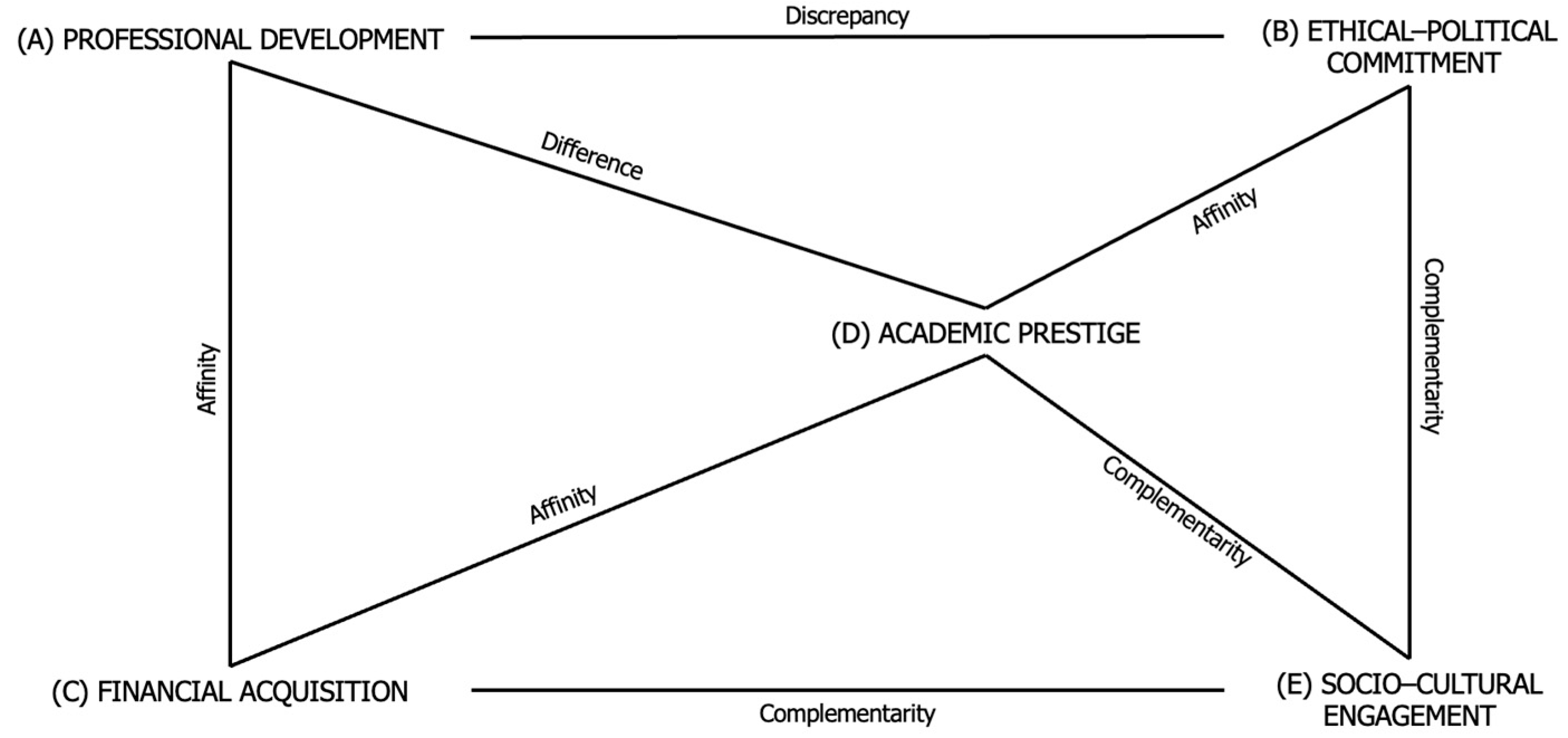
According to the discourse analysis, five discursive positions were identified regarding the rationales that drive faculty to internationalize their research activity. These positions, whose relational structure can be seen in
Figure 2, are: (A) Professional Development, (B) Ethical–Political Commitment, (C) Financial Acquisition, (D) Academic Prestige, and (E) Sociocultural Engagement.
Figure 2 also specifies the types of relations that connect these positions within the relational polyhedron (affinity, discrepancy, difference and complementarity), indicating how each position acquires meaning in relation to the others rather than operating as an isolated category.
Position (A) Professional Development frames the internationalization of research as being promoted for predominantly profit-oriented reasons. It is argued that the fundamental rationale for advancing research internationalization lies in obtaining personal economic benefits, which leads to prioritizing knowledge production and dissemination mechanisms linked to service provision and international consulting. This position maintains a discordant relationship with position (B) Ethical–Political Commitment, shows affinity with position (C) Financial Acquisition, and differs from position (D) Academic Prestige. In this line,
Altbach and Knight (
2007) note that globalization has enabled the emergence of a global labor market for scientists and academics, thereby stimulating the internationalization of research activities. However,
Turner and Robson (
2007) argue that faculty generally seek to distance themselves from competitive, market-oriented motivations. Instead, they ground their transnational activity in cooperative and internationalist rationales, articulated through a values-based discourse. The present findings suggest that this tension remains analytically relevant under contemporary conditions, as internationalization agendas increasingly intertwine with competitive funding regimes and externalized project logics (
Deng, 2025), potentially widening the gap between policy-driven incentives and the values-centered rationales that many academics mobilize in discourse (
Turner & Robson, 2007). In a structurally constrained Global South context, such as Honduras, this configuration can render internationalization simultaneously desirable and ambivalent (
Zelaya & Montañés, 2021): it may be pursued as a pathway to opportunity, while also being experienced as a dynamic where economic imperatives compete with academic and public commitments.
Consistent with the above, position (B) Ethical–Political Commitment groups together discourses organized around a commitment to scientific progress, the improvement of quality in the university’s research function, and the development of society and the public sphere. From this standpoint, research internationalization contributes to the training of the national academic community, strengthens institutional capacities to undertake larger-scale and higher-quality research, improves local systems of scientific dissemination, facilitates institutional accreditation, and enhances the university’s standing in academic rankings. In sum, this position prioritizes institutional benefits over individual gains, which helps explain its discrepancy with position (A) Professional Development. At the same time, it shows affinity with position (D) Academic Prestige and complements position (E) Sociocultural Engagement. The prominence of this position resonates with critiques warning that internationalization may become excessively instrumental when it is driven by externally oriented agendas that are only partially connected to institutional capacity-building needs (
Caliskan & Buyukgoze, 2026;
Deng, 2025). In that regard, the Ethical–Political Commitment position operates as a counterweight to purely competitive framings by re-centering internationalization on public value, institutional strengthening, and the ethical implications of transnational engagement, which have gained visibility amid geopolitical uncertainty and renewed contestation over the purposes of international academic cooperation (
Kapfudzaruwa, 2025).
Authors such as
Blumenthal et al. (
1996),
Aigner et al. (
1992),
Wächter et al. (
1999),
Knight (
1997), and
de Wit (
2000) have examined—through an institutional lens and in terms of national interest—the factors and rationales that justify integrating an international dimension into academic activities.
Georghiou (
1998) similarly analyzes the institutional drivers that foster international cooperation in industrialized countries, distinguishing between direct benefits for the development of science and technology—such as higher-quality or larger-scale research projects that are more agile or lower cost—and indirect benefits of a strategic, economic, or political nature, including improvements in institutional reputation and access to alternative sources of funding. While these frameworks remain conceptually productive, the present study also underscores a point raised in the recent literature: rationales are not only multiple but also configured through disruption and differentiation across contexts (
Kapfudzaruwa, 2025;
Sisavath, 2024;
Zhang & Wu, 2025). Accordingly, the discursive positions identified here should be read not as a static category but as situated discursive logics through which faculty interpret and justify internationalization in conditions shaped by capacity gaps, shifting incentives and the post-pandemic reorganization of academic work and mobility (
Zhang & Wu, 2025).
Position (C) Financial Acquisition is linked to the need to secure external resources from other countries to sustain scientific activity, given the limited local budget allocations assigned to research. This position aligns with position (A) Professional Development insofar as both are shaped by economic considerations. However, whereas position (A) prioritizes obtaining emoluments or fees through consultancy work or service provision, position (C) centers on securing funding to conduct research. Position (C) also maintains complementary relations with position (E) Sociocultural Engagement and shows affinity with position (D) Academic Prestige since it likewise seeks to enhance academic reputation and peer recognition through the internationalization of research activity. Consistent with this emphasis,
Knight (
2008) argues that, at the institutional level, economic factors—such as revenue generation, national economic competitiveness, and access to financial incentives—are among the main drivers for higher education internationalization. Yet, recent evidence from less-resourced higher education systems suggests that, in post-COVID conditions, internationalization may be strongly motivated by resource assurance and by drivers linked to strengthening institutional and human capacity, including the expansion of digital capabilities (
Sisavath, 2024). In this context, the Financial Acquisition position can be understood not merely as a marketized driver, but as a discourse of feasibility; it frames internationalization as a practical mechanism for making research possible in contexts where domestic support is insufficient and where participation in transnational networks functions as an enabling condition for undertaking, validating, and disseminating scientific work.
Position (D) Academic Prestige reflects that researchers engage internationally to increase the visibility and impact of their work, with the aim of enhancing their prestige and social and academic status. Although not always to the extent expected, this can also contribute to advancement in teaching and research careers. This position shows affinity with position (B) Ethical–Political Commitment and differs from position (A) Professional Development since it is grounded in the construction of academic and social standing rather than in the pursuit of personal economic gain. In addition, as the discourses suggest, the status gains associated with participation in international projects can have positive spillover effects on researchers’ home institutions, strengthening their academic standing. As
Woldegiyorgis et al. (
2018) noted, research internationalization has historically been sustained by the widely accepted view that research should be recognized as internationally relevant. For faculty, internationalization is therefore seen as a useful mechanism for increasing scientific output and improving citation indexes, both of which are central to building personal academic reputation. Similarly,
Wagner (
2006) argued that researchers engage in international academic activities not only to gain visibility among peers, but also to exchange ideas, foster creativity, and draw on complementary capacities that expand the scope and impact of their initiatives. At the same time, contemporary debates highlight that prestige-driven internationalization can reinforce uneven hierarchies when dominant standards and evaluation regimes remain strongly shaped by Western/Anglo-Saxon paradigms (
Kapfudzaruwa, 2025). From this perspective, Position (D) appears as double-edged: it motivates international engagement through recognized metrics of visibility and impact, while potentially binding researchers to external evaluative logics that may not align with local priorities, thereby reproducing the policy–practice frictions identified in analyses of internationalization governance (
Trondal, 2010;
Caliskan & Buyukgoze, 2026;
Deng, 2025).
Position (E) Sociocultural Engagement maintains a complementary relationship with positions (B) Ethical–Political Commitment, (C) Financial Acquisition, and (D) Academic Prestige, but not with position (A) Professional Development, since the latter is more focused on securing individual economic benefits. Position (E) is understood as an added value of research internationalization because it encourages the creation and strengthening of personal networks and engagement with other cultures. These dynamics, in turn, support the construction and maintenance of international networks and foster critical reflection on the procedures, management, and other research-related activities carried out by home universities.
Knight (
2008) also refers to sociocultural reasons as rationales of internationalization. These rationales seek to promote intercultural understanding within national and supranational university systems to counteract the homogenizing effects of globalization and to preserve each nation’s cultural identity and language (
Knight, 2008). The discursive position (E) Sociocultural Engagement holds that intercultural experience provides researchers with a broader global perspective, facilitates the configuration of informal networks that strengthen the university, and enables the development of friendships with international colleagues with whom they share interests, ideas, and lines of research. In terms of South–South higher education interactions, these relational and intercultural dynamics may also be read as enabling infrastructures for cooperation in a period marked by disruptions such as pandemic effects, geopolitical realignments, and technological change that reshape mobility patterns and the normative frameworks through which collaboration is justified (
Zhang & Wu, 2025). Sociocultural engagement is not merely ancillary; it functions as a connective layer that sustains the relational conditions under which other drivers become actionable.