Article

Inquiry-Based Knowledge Transformation: A Comparative Case of Two Secondary School Biology Teachers’ Involvement in an Extended Professional Learning Community Program


1
Department of Educational Leadership, Policy and Technology Studies, The University of Alabama, Tuscaloosa, AL 35487, USA
2
Department of Curriculum and Instruction, The University of Alabama, Tuscaloosa, AL 35406, USA
*
Author to whom correspondence should be addressed.
Educ. Sci. 2026, 16(4), 562; https://doi.org/10.3390/educsci16040562
Submission received: 20 December 2025 / Revised: 10 March 2026 / Accepted: 23 March 2026 / Published: 2 April 2026

Abstract

This article presents a qualitative case study of two secondary school biology teachers who aligned their teaching to inquiry through an extended professional learning community (PLC) program. The case study used an inquiry-based knowledge mobility model developed within a sociocultural learning theory (SLT) framework, specifically, the zone of proximal development (ZPD). Data were collected from four PLC meeting transcripts, two lesson observations, and two post-lesson reflection interviews. Four main inquiry-based themes directly emerged from PLC dialogue: scaffolding student agency, phenomenon-based learning, prioritizing process over right answers, and managing students’ preconceptions. Overall, results from the ZPD component of SLT indicated that one teacher’s pedagogical shift was mainly driven by his willingness to take conceptual risks, whereas the other teacher was procedurally driven. The cyclical model challenges traditional views on professional learning and highlights the role of teachers’ epistemological stances on inquiry teaching. This study offers guidance for designing PLCs that support authentic inquiry-based learning in secondary school science classrooms.

1. Introduction

Inquiry-based teaching, though recognized as valuable, remains inconsistently implemented (Wilcox et al., 2015). Many secondary school science teachers still struggle to integrate inquiry meaningfully within the constraints of state curriculum standards and institutional expectations (Ni et al., 2023). Central to overcoming these barriers is the establishment of the teacher professional learning community (PLC) in the 1960s. PLC is designed to reduce educator isolation by enabling teachers to learn from each other and refine inquiry-based practices, essential for shifting classroom instruction (Archer, 2012).
However, despite increasing research on PLCs and efforts to define effective inquiry-based science instruction, significant gaps remain in understanding how PLC-driven knowledge transforms teachers’ inquiry-based practice to produce deep learning and transferable student skills. This ongoing disconnect underscores the primary argument: that PLCs, although designed to promote inquiry-based pedagogy, have yet to reliably drive substantial instructional change in biology science classrooms (Ni et al., 2023, p. 30; Drayton et al., 2020, p. 985). As a result, secondary school teachers continue to struggle to leverage PLC initiatives for meaningful pedagogical shifts.
This study focuses on bridging the theory–practice gap in inquiry-based teaching and aligns with Giroux’s (1997) “language of possibility” framework. More essentially, we want to be intentional and avoid a deficit perspective that blames teachers for not integrating inquiry. Instead, we aim to clarify the complexity of inquiry-based instruction so that it is more understandable for teachers and students. We emphasize learning opportunities and processes rather than evaluating teacher quality or generalizing findings. This effort requires thoughtful decisions and teamwork. We further argue that for inquiry to flourish in biology, and indeed, all K-12 science classrooms, PLCs must support teachers’ own epistemic shifts toward inquiry-based thinking and conceptual risk-taking.
Our research employs a knowledge mobility model to document the nature of these shifts and examine key factors that may influence them in real time. By mapping teachers’ inquiry-based knowledge mobility cycle across PLC meetings, lesson enactments, teacher post-lesson reflections, and re-entry into the PLC dialogues, we provide key insights for those seeking ways to connect research and practice in teacher development. Without such process-level insight, the field would lack the resources to unlock the transformative power of shared inquiry-based knowledge fully. The purpose of this study is to understand how secondary biology teachers learn inquiry-based instructional practices through participation in a sustained PLC. Based on this, we ask: How do secondary biology teachers learn inquiry-based instructional practices through participation in an extended PLC?

2. Literature Review

2.1. Inquiry as a Cornerstone of Reform in Science Education

The centrality of inquiry in science education reform has roots in Dewey’s (1938), who framed science as an experiential and reflective process, rather than as a static body of facts. Dewey emphasized inquiry as active meaning-making through uncertainty and experience, laying the groundwork for later reform efforts. This vision was codified in the National Science Education Standards (NRC, 2000), which defined inquiry across three domains: (a) cognitive abilities, (b) understanding of scientific processes, and (c) inquiry-based teaching strategies. The standards positioned inquiry as essential for effective pedagogy and for preparing scientifically literate citizens, capable of reasoning through civic and societal challenges (Anderson, 2002).
Despite these commitments, the application of inquiry-based teaching has remained uneven. Teachers frequently misinterpret inquiry as synonymous with hands-on activities, rather than as sustained opportunities for reasoning and reflection (Wilcox et al., 2015). Structural pressures, such as standardized testing, curriculum pacing, and accountability regimes, exacerbate these challenges, narrowing the space for inquiry practices (Au, 2022; Berliner, 2020; Darling-Hammond, 2010). Research has underscored that episodic professional development (PD) workshops are insufficient for shifting practice; teachers require sustained opportunities for collaborative learning to interrogate, adapt, and refine inquiry pedagogy (Duschl & Grandy, 2008). In our case, we followed two biology teachers involved in an extended PLC program to understand how shared PLC inquiry-based knowledge is transferred into classroom practice.

2.2. Professional Learning Communities as Sociocultural Spaces for Teacher Learning and Sustained Inquiry-Based Reforms

Professional learning communities are increasingly understood as dialogical spaces that create opportunities for teachers to co-construct knowledge at varying levels and intensities. Globally, research on PLCs has explored aspects of teacher learning within PLCs, PLC structure, interpersonal and discursive dynamics of teachers in PLCs and shifts in classroom-based instruction. In a more recent Western study, the uneven alignment between PLC discussions and classroom practice was highlighted (Sager et al., 2025), while in the Global South, Nguyen et al. (2024) synthesized evidence into broad themes of efficacy, collaboration, and innovation.
A more encompassing example is the comparative study of Nigerian and South African mathematics teachers, in which Brodie and Sanni (2014) demonstrate that teachers’ divergent responses to misconceptions were mediated by curriculum demands and professional positioning. While Nigerian teachers vacillated between correcting, ignoring, or validating student misconceptions, South African teachers used PLC dialogue to clarify distinctions between equations and identities, enriching both content and pedagogical knowledge.
These prior findings underscore a key sociocultural dynamic: teachers’ knowledge is simultaneously constrained and enriched by context and practice, and pedagogical content knowledge (PCK) does not simply follow from subject expertise but can itself deepen content understanding (Mavhunga & Rollnick, 2013). We contend that, as educators and leaders who value access to quality knowledge for all, the constant use of ‘misconception’ to define students’ background knowledge, as seen in both the open literature and with our study participants, during the data collection process, misrepresents, self-limits, and is counterproductive to the scholarship of teaching and learning. Hitherto, we have replaced such language with ‘preconceptions’, acknowledging that all brains have something valuable to offer until disproved through facts and figures.

2.3. Conditions Shaping Inquiry-Oriented Transformation in Professional Learning Communities

Facilitation of high-quality, student-oriented teaching and learning in PLCs is important for effective science teacher PD (Meltzer & Otero, 2015), especially around the development of inquiry-based competence for teachers and students. Meaningful learning in PLCs requires intentional collaborative spaces where, as Farrell et al. (2021) emphasized, diverse forms of expertise connect to generate new knowledge.
Dialogue serves as the critical entry point for unpacking various forms of knowledge embedded in biology teachers’ PLC dialogues and decision-making processes. Therefore, critically examining these dialogic practices in PLCs is key to refining transformative teacher knowledge for academic communities advancing inquiry-based science pedagogy.

2.3.1. Dialogic Intensity, Quality, and Relational Capital/Trust

In PLC, dialogue is a collaborative and reflective conversation among educators aimed at improving teaching practice. Critically reflective dialogue (CRD) engages teachers in surfacing assumptions, exchanging feedback, and reframing their approaches, which fosters professional growth (de Groot et al., 2014). This process occurs both in-person and digitally, with asynchronous reflection allowing knowledge to evolve over time (Prilla et al., 2020). Effective dialogue draws on educators’ experiential knowledge, developed over years in the classroom, and is shared intuitively during discussions (Gess-Newsome, 1999).
For PLC dialogue to be impactful, trust and psychological safety are essential, enabling educators to challenge each other’s assumptions and provide constructive critique. Through ongoing, meaningful dialogue, teachers exchange insights, support one another, and develop new understandings that enhance classroom effectiveness. Structured feedback loops, such as pre- and post-reflection surveys and peer or student feedback, can help assess the impact of these dialogues on both professional growth and student outcomes.
In their seminal work on reflective practice, Schön and Argyris (1996) argued that dialogue bridging “espoused theories” and “theories-in-use” requires environments where collegial trust supports critical reflection. Accordingly, relational capital and trust create conditions for risk-taking and openness, allowing teachers to share uncertainties and test new strategies without fear of judgment. As Liou and Daly (2014) opined, such trust shapes not only knowledge flows but also teachers’ sense of belonging and legitimacy within their professional communities. In short, inquiry-based growth depends on PLCs functioning as relationally secure communities of practice, regardless of who is brokering knowledge or whose knowledge is being brokered.

2.3.2. Organizational Supports

Organizational support for PLCs involves structures that help teachers plan and refine inquiry instruction. Teachers need shared time for lesson design, access to materials, and learning focused on content and inquiry pedagogy. In their study, Urdanivia Alarcón et al. (2023) showed that inquiry work falters when preparation, tools, and methodological clarity are limited; thus, PLCs require leadership that protects planning time and coordinates resources. Accordingly, PLCs also benefit from routines for reflection, joint review of student work, and schoolwide expectations for inquiry. These supports create conditions where teachers strengthen practice and respond to challenges linked to inquiry-based teaching. Structural pressures such as standardized testing, curriculum pacing, and accountability regimes have also been reported to continuously narrow the space for authentic inquiry practice (Darling-Hammond, 2010; Au, 2022; Berliner, 2020).
Furthermore, Nguyen et al.’s (2024) review of PLCs across 70 studies in resource-constrained settings shows that mobilization of professional learning is shaped less by formal structures and more by cultural, relational, and infrastructural needs. PLCs in these contexts often evolve informally, with teachers adapting inquiry practices to local constraints such as large class sizes or limited materials. From their study, shared knowledge mobilization is not simply about the straightforward transfer of inquiry strategies from PLCs to classrooms, but more about teachers engaging in conversations that fit their cultural context and being willing to adapt (p. 102). This perspective underscores that participation and context are as decisive as identity and dialogue quality, complementing findings from Western countries (e.g., Lewis, 2023; Sager et al., 2025).
Specifically, Sager et al. (2025) connect structural support, especially instructional coaching, to effective inquiry-based teaching by emphasizing the translation from collective planning to classroom enactment that builds teacher confidence. For instance, in Mrs. Land’s classroom (case 3), they reported how strong alignment between PLC goals and classroom practice corresponded with consistent enactment of inquiry moves. Mrs. Land’s teaching reflected confidence and ownership of inquiry routines developed through PLC participation. The structure supported her positioning as a facilitator of sensemaking rather than a content deliverer. This differs from cases where less structured PLCs, devoid of coaching structures, discussed inquiry broadly without specifying how strategies would appear in lessons, resulting in weaker implementation. While the paper does not use explicit identity constructs, evidence shows that PLC structure shaped who teachers became in practice.
Regularized inquiry talks, coaching-mediated expectations, and accountability for enactment positioned teachers either as inquiry practitioners or implementers of scripted curriculum. Identity development followed structure-driven participation patterns instead of personal disposition alone, leading the authors to conclude that institutions offering differentiated coaching designed to individual classroom realities can promote more steady engagement with science instruction, help distribute teachers’ cognitive load to enact new teaching practices such as inquiry-based teaching, and better support teachers’ career development (p. 34). Such normalization shapes identity by defining inquiry teaching as expected practice within the organizational setting.
Collectively, these works elucidate the conditions that shape teachers’ disposition toward, orientation to, and uptake of shared PLC knowledge; nonetheless, they stop short of tracing the actual movements of this knowledge across contexts, making it difficult to understand how specific PLC interactions continuously shape teacher learning within these constraints—a gap we strive to fill through a knowledge mobility cycle model.

2.4. Theoretical Framework: Sociocultural Learning Theory (SLT)

Sociocultural learning theory illuminates how learning is shaped by culture and social tools (Vygotsky, 1986). The framework was particularly well-suited for this study, as it emphasizes how teachers learn through social interactions and collaborative engagement within a community of practice (Wenger, 1998). This framework can be used to identify key learning processes within PLCs through: (a) replays and rehearsals, where teachers reflect on past experiences (replays) and anticipate future teaching actions (rehearsals) as part of collaborative reflection (Horn, 2010); (b) extensions, where PLC discussions expand on problems of practice, enabling teachers to refine their instructional strategies (Horn & Little, 2010); (c) single-loop-double-loop learning, which is when teachers go beyond surface-level adjustments by questioning underlying assumptions and challenging established norms, leading to deeper instructional change (Van Lare & Brazer, 2013), and (d) zones of proximal developments (ZPDs), where individuals gain access to practices beyond their immediate experience through social interaction (Horn & Kane, 2015); in other words, the zone where learning (individual or collective learning) is perceived to be most effective.
Teacher PLCs have been theorized as “collective zones of proximal development,” where discourse structures the boundaries of what is possible for all participants (Horn & Kane, 2015, p. 376). In their mixed-methods study of learning in teacher workgroup conversations, they argued that teachers’ ability to learn from PLC conversations and plan future work was shaped primarily by their epistemological claims and representational practices. Teachers who used more replays or narration of actual classroom interactions emerged as more sophisticated with established collaborative routines and stronger organizational support than the beginner group, which mostly followed rehearsals (narrations of hypothetical or anticipated classroom interactions) (p. 391). They concluded that movement from beginner to sophisticated PLCs depends on organizational support.
In this paper, we focus only on the teachers’ ZPDs because of their centrality to the study’s design, in which the teachers served as our focal point. We draw from prior studies, especially Horn and Kane’s (2015), to illustrate the significance of each teacher’s ZPDs in a PLC program focused on instructional transformation. ZPD, initially developed for children’s learning (1978) and subsequently extended (e.g., Horn & Kane, 2015), posits that teacher learning occurs when individuals gain access to practices beyond their immediate experience through social interaction. In their view, PLCs function as horizontal learning spaces where colleagues’ representations of practice enable individual teachers, as the focal participant, to observe, imagine, and test alternative instructional moves grounded in shared PLC knowledge.

3. Materials and Methods

The lead author has a background in biology and served as the graduate coordinator and education specialist for the LIST-PLC program during the data collection period. The remaining two authors were senior colleagues with over 10 years of experience in educational research. This proximity created a strong rapport and disciplinary connection, facilitating the easy collection and interpretation of data.

3.1. Research Design

This study was designed within the NSF-funded Developing Leaders in Science Teaching (LIST)-NOYCE Track 2 program, a four to six-year initiative that supports science teachers’ leadership through extended PLCs and action research in the southeastern USA (Sunal et al., 2024). We got involved with the teachers during their sixth (and final) year of the LIST-PLC program. As such, this study takes a qualitative phenomenological approach to explore whether and how each teacher took up and aligned their classroom teaching practices to inquiry-based approaches.
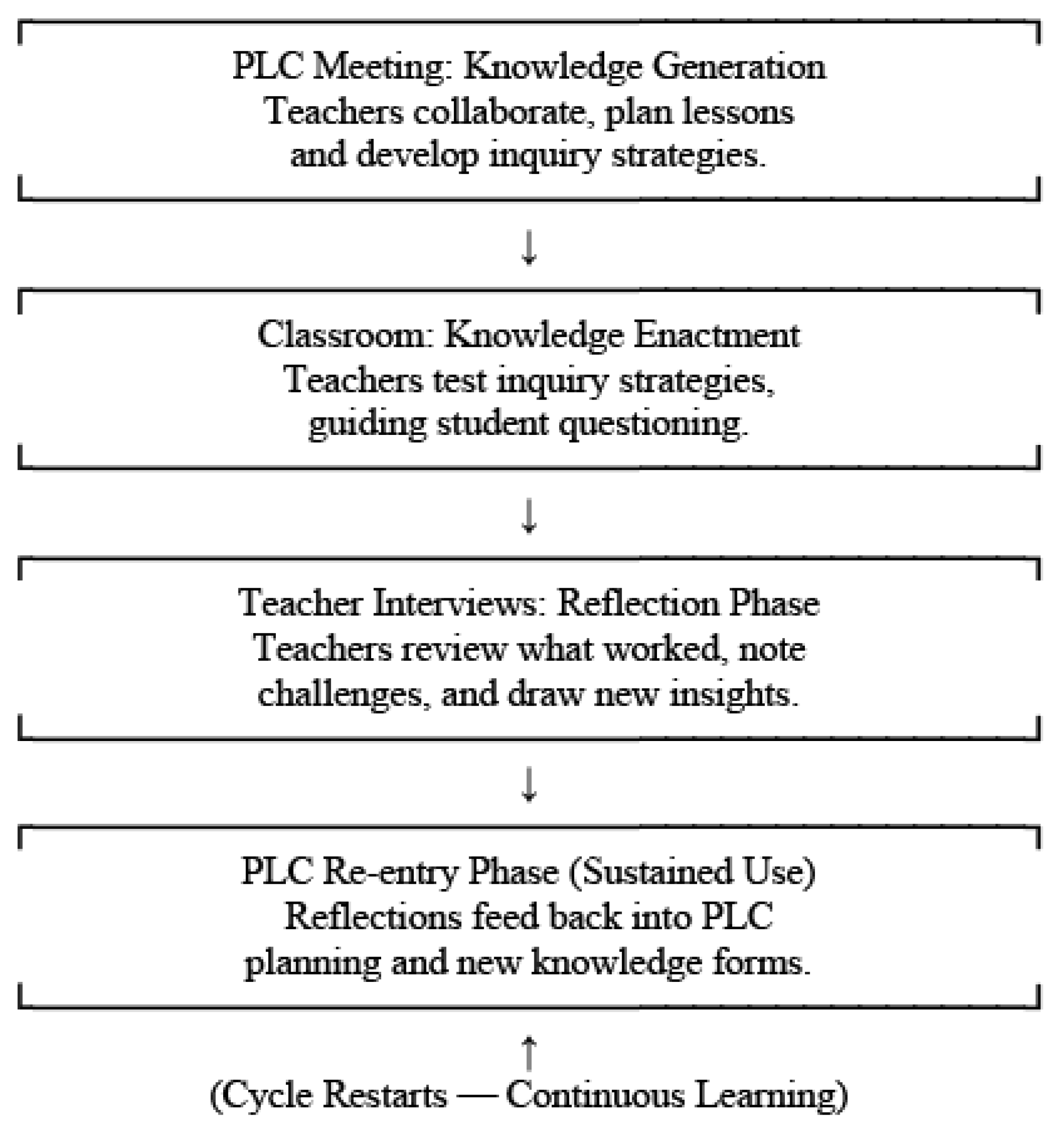
In designing this study, we wanted to explicitly capture how knowledge develops as a continuous cycle across four connected phases over one academic year: (a) generation, where PLC members plan and develop inquiry-based knowledge together; (b) enactment, where teachers individually test shared inquiry-based knowledge on their students; (c) reflection, where individual teachers through interviews, reflect on what worked, note challenges and draw new insights; and (d) re-entry, where individual teacher’s reflective insights feed back into their PLC dialogue for continued refinement (Figure 1). Linking each phase to a distinct data source enables a multidimensional view of each teacher’s learning trajectory.

3.2. Participants

We worked closely with two White male biology teachers, Lawson and Tan (pseudonyms), both members of the LIST cohort, and they appeared to be in their mid-20s at the time. Entering the program with undergraduate degrees in science, with no prior PLC experience, their development has followed a structured PLC cycle aligned with both their subject specialization and evolving professional roles. During the study, each teacher facilitated three PLC meetings.
Their first meeting (not included here) served as an introductory session, allowing members to become acquainted and to establish goals for the upcoming sessions, all aligned with the program’s focus on promoting inquiry-based teaching practices. Each teacher collaborated with four other professionals in their respective PLCs: (a) one experienced biology teacher; (b) one fellow teaching colleague; (c) one university science content expert; (d) one senior LIST cohort Fellow; and (e) one education specialist.
These members contributed both individually and collectively to support their team’s teacher. Typically, each meeting lasted for one hour. However, the level of active participation among team members varied, influencing both the depth of dialogue and the nature of decision-making during each session. Although both teachers had similar experience and involvement in the LIST-PLC, they taught at different public high schools in the southeastern United States. Lawson was responsible for a 10th-grade Pre-Advanced Placement biology course, while Tan taught 9th-grade regular biology.

3.3. Data Collection

This study was approved by the institutional review board (IRB), and individual consent was obtained from the two participating teachers. Data followed four phases: Phase 1: Knowledge Generation included two teacher-led PLC Zoom meetings, one from each teacher. Each PLC meeting lasted for 1 h. The Phase 1 meeting dialogue served as an entry point for unpacking how inquiry-based knowledge originated and got refined across other phases. In Phase 2: Knowledge Enactment, we collected approximately 1 h of lesson video for analysis from each teacher. These videos provided direct evidence of how shared inquiry-based knowledge was enacted in classrooms. In Phase 3: Knowledge Reflection, each biology teacher had one semi-structured interview session with the lead author, lasting up to 45 min. Semi-structured questions were used to elicit the reasons behind teachers’ pedagogical choices and approaches without necessarily drawing teachers’ attention to a particular subject of interest. In Phase 4: Knowledge Re-Entry, we documented each teacher’s follow-up PLC meetings (one per teacher), which served as a reflexive loop of the inquiry-based knowledge cycle, in which classroom practice informed teacher sensemaking and fed into subsequent PLC dialogues for sustained use.

3.4. Data Analysis

We conducted data analysis using the reflective thematic analysis (RTA) framework (Braun & Clarke, 2021) to ensure methodological transparency and rigor. Phase 1 PLC meeting transcripts were imported into NVivo version 15 and served as the primary data source for tracing the development of inquiry-based knowledge. To enhance reliability, peripheral interactions (e.g., humor and play) were intentionally excluded. Two researchers independently coded the Phase 1 PLC meeting transcripts. We then met to compare, discuss, and resolve discrepancies, documenting all decisions to maintain an audit trail. Throughout the process, we used NVivo’s features, including the AI Assistant, codebooks, thematic matrices, and visualizations, to support systematic, transparent coding.
Table 1 outlines the coding and theme development process based on the dialogue between teachers and their PLC members (Phase 1). Researchers first familiarized themselves with the transcripts before using NVivo’s AI Assistant to identify and summarize key information. We generated first-level descriptive codes using participants’ own language, followed by second-level codes to identify patterns across the data. All coding steps, including the use of the AI Assistant, code generation, and pattern identification, were documented to provide a transparent record. NVivo’s “Coding Stripes” and “Visualization” features were used to group and review emerging patterns systematically. For example, codes 1a and 1b were grouped as Pattern A—“Teacher restraint as deliberate strategy” (Table 1).
We continued to refine codes, including reviewing and consolidating second-level codes, and defined themes (third-level codes) through iterative team discussions, ensuring that each theme was coherent and distinct. For example, the theme “Scaffolding Student Agency” was developed through repeated deliberation and consensus-building, with all decisions and rationales documented for transparency. NVivo’s “Codebook” and “Thematic Framework Matrix” were used to finalize and validate themes. Final themes guided subsequent analysis of lesson videos, interview transcripts, and the follow-up PLC meeting transcripts, which were reviewed multiple times to ensure consistency and reliability. This systematic approach enhanced the transparency and reliability of our analysis and illuminated the social dynamics underlying knowledge development in inquiry-based PLCs.
The following instructional moves by teachers, and their students’ classroom participations served as indicators for authentic and procedural inquiries: Empirical Indicators of authentic inquiry included teacher withholding confirmation, student-driven questioning (i.e., students’ questioning, arising from genuine uncertainty, rather than by teacher-posed problems). Tolerance for unresolved thinking (i.e., teacher avoided forcing closure or intentionally delaying answers within a fixed time frame). Student negotiating ideas with peers (i.e., students debating and negotiating competing interpretations among themselves, with the teacher refraining from declaring a “correct” answer.
Empirical Indicators of procedural inquiry include teacher-designed protocols (i.e., providing students with a structured worksheet or data collection template). Teacher-led explanation (i.e., teacher failing to invite students to construct meaning from data collected). Limiting students’ choices (i.e., students’ autonomy is restricted to carrying out steps designed by the teacher). Direct answers (i.e., teacher correcting students’ misunderstanding directly rather than guiding them to revise their understanding through questioning and reasoning). We provide three key alternative interpretations grounded in the sociocultural learning theoretical framework, specifically, Vygotsky’s zone of proximal development (ZPD):
  • Developmental appropriateness: Procedural structure may serve as a deliberate scaffold for students with negative science identity, reflecting pedagogical intent rather than a deficit.
  • Teacher experience: Differences in classroom enactment may reflect variations in teacher prior experience or confidence; the analysis, therefore, focuses on alignment between professional learning community (PLC) knowledge, classroom practice, and post-lesson reflections, not on teaching effectiveness per se.
  • Analytic framework origins: The inquiry categories were not imposed by researchers but emerged from PLC dialogue analysis preceding classroom observation, ensuring that the framework reflected teacher-generated concerns.

We view authentic and procedural inquiry as structurally different approaches to supporting learning within the ZPD, without assigning value judgments to either. Both forms are situated as part of ongoing professional and student development, with each teacher working within their own ZPD supported by PLC participation.
Table 1. Analytical Coding of Knowledge Generation Phase (PLC Meeting 1 Transcripts).
First-Level Codes (Descriptive) Second-Level Codes (Patterns) Third-Level Codes (Themes)Theoretical Annotation and Link to Zone of Proximal Development (ZPD)
1a · Lawson & Tan
The teacher withholds information
“They have just the pictures to work with.”
1b · Tan PLC
PLCs advocate question redirection to students
“Ask them to come up with the next round …”
1c · Tan PLC
PLCs advocate epistemic shifts from teachers to students
“The questions you ask will help them see every angle.”
1d · Lawson
Teachers developing deliberate restraints
“They are going to hate it … seniors are not used to this.”
Pattern A
Teacher restraint as deliberate pedagogical positioning
Codes: 1a + 1d
Pattern B
PLC shifting epistemic authority toward students
Codes: 1b + 1c
Scaffolding Student Agency
Both PLCs collectively constructed an understanding that student agency requires active scaffolding through teacher restraint—positioning agency not as behavioral autonomy but as intellectual authority to construct and validate one’s own understanding.
Vygotsky’s Zone of Proximal Development is enacted socially here, both within the PLC and by the teachers, specifically Lawson. Teachers are the learners; the community scaffolds their shift toward relinquishing epistemic control. This underscores Lave and Wenger’s (1991) concept of legitimate peripheral participation: teachers negotiate what counts as “appropriate withholding” (Lave & Wenger, 1991, p. 112) through PLC dialogue before enacting it in classrooms.
2a · Lawson
The teacher emphasizes reasoning over correct answers
“They think it’s a very linear thing. They can’t switch.”
2b · Lawson
Teacher values mistakes as learning opportunities
“Their learning is hindered by their need for validation.”
2c · Tan & Lawson PLCs
The teacher encourages effort and persistence through difficulty
“You’re telling these kids to figure out the paths.”
Pattern A
Understanding methodology is valued over correct answers
Codes: 2a + 2c
Pattern B
Productive struggle as a pedagogical principle
Codes: 2b + 2c
Prioritizing Process Over Right Answers
Teachers value how students think, reason, and solve problems—not finding correct answers. PLC dialogue revealed that “unwillingness to be wrong” was identified as the primary obstacle to inquiry, reframing error as a productive learning condition.
This theme holds particular significance within sociocultural theory, as it illustrates how the professional learning community (PLC) collaboratively constructs a shared understanding of scientific thinking through dialogic interaction, rather than via top-down policy directives. The community’s identification of students’ “unwillingness to be wrong” exemplifies intersubjective meaning-making—teachers co-creating an interpretive lens through ongoing discourse. This process aligns with Wertsch’s (1991) concept of mediated action, wherein language within PLC dialogues serves as the principal tool that shapes subsequent classroom practices (Wertsch, 1991).
3a · Tan
The teacher designs activities around observable phenomena
“Watching students watch contractions decrease over time …”
3b · Tan
The teacher connects abstract concepts to tangible experiences
“… comparing a dry run and a cold run.”
3c · Tan PLC
PLC members advocate experience before explanation
“Ask them what they think would happen, then do the activity and revisit.”
3d · Lawson
The teacher uses phenomena to generate curiosity
“Why do we experience lactic acid fermentation?”
Pattern A
Phenomena as bridges between concrete and abstract
Codes: 3a + 3d
Pattern B
PLC communities collectively positioning phenomena within inquiry frameworks
Codes: 3b + 3c + 3d
Phenomenon-Based Learning
PLC dialogue consistently positioned phenomena not as endpoints for engagement but as entry points generating student questions, predictions, and investigations leading toward deeper conceptual understanding.
Within a sociocultural framework, phenomena act as semiotic tools—material and conceptual resources that organize attention and facilitate the formation of shared meanings (Vygotsky, 1978; Wertsch, 1991). In this study, both Professional Learning Communities (PLCs) independently recognized this function in two distinct lesson contexts (anaerobic respiration and phylogeny), indicating the presence of a community-level norm rather than individual idiosyncrasy. The observed cross-community convergence thus substantiates the theoretical claim that inquiry knowledge is socially mediated within PLC discourse before entering classroom practice (Grossman et al., 2001).
4a · Lawson & Tan PLCs
Community identifies anticipated preconceptions
“You’re expecting them to have some misconceptions right at the beginning.”
4b · Tan & Lawson
The teacher surfaces preconceptions through task design
“Maybe have the students create the questions as they go along.”
4c · Tan PLC
PLC members connect preconceptions to conceptual systems
“You can’t change it for them. Get them to change their beliefs.”
Pattern A
PLC anticipating preconceptions before classroom instruction
Codes: code 4a
Pattern B
Preconceptions as entry points for deeper understanding
Codes: code 4b
Pattern C
Strategies for surfacing student preconceptions
Codes: code 4c
Managing Students’ Preconceptions
Both PLCs framed misconceptions as productive learning opportunities while both teachers showed tension between discovery ideals and direct correction—revealing ongoing negotiation about the pedagogical status of students’ prior knowledge.
Sociocultural theory positions prior knowledge not as a cognitive deficit, but as a culturally situated understanding (Vygotsky, 1978). This theme carries theoretical weight because the Professional Learning Community (PLC) dialogue served a prospective function: teachers collectively rehearsed how to respond to student thinking before those students were present. Such anticipatory reasoning positions the PLC as a planning community that socially mediates teacher decision-making. The tension between discovery and correction reflects the community working through a genuine pedagogical problem.

4. Results

4.1. Biology Teacher’s Inquiry-Based Knowledge Mobility Journey

During Phase 1 (inquiry-based knowledge generation), four major themes emerged: (a) scaffolding student agency, (b) phenomenon-based learning, (c) prioritizing process over right answers, and (d) managing students’ preconceptions. Each served as a focal point for understanding how inquiry-based knowledge moved across the board.

4.1.1. Theme 1: Scaffolding Student Agency

The theme of scaffolding student agency encompasses teaching strategies that gradually transfer intellectual ownership and decision-making responsibility from the teacher to the students.
Lawson
Phase 1: Knowledge Generation. At his first PLC meeting, Lawson emphasized agency as intellectual autonomy (i.e., students generating questions and directing their own reasoning, not simply engaging with materials). According to him, “when students, especially honors and [advanced placement students], hit a wall, their first instinct is to shut down. And a lot of teachers, their first instinct is to immediately rush to help. They [students] have an unwillingness to be wrong.”
This initial perspective sparked a candid discussion among his PLC team about productive struggle and teacher restraint, which directly shaped Lawson’s lesson plan for a unit on biodiversity, adaptive radiation, and succession, focusing on plant phylogeny. Lawson said, “So, giving them just a starting out the lesson, put them together, group them together by eco-morphs, however you think. Let them have an ability to fail.” The education specialist responded, “Yeah, and if I know, they will be wanting to know what the categories are.” Lawson continued, “They want to know more information than they’re allowed to have. You are right, they are going to hate it, but it’s something that the seniors are not necessarily used to.”
The content expert asked, “Will you show the video in class?” Lawson responded, “Yes, the second day is where I’m going to pull in that video. Hopefully, having the students discuss and draw their own little phylogenetic tree.” The content expert added, “There’s not always a right answer until we struggle and search.” From this exchange, it became clear that Lawson’s plan was to create cognitive dissonance to foster students’ problem-solving skills. He also expressed concerns about systemic issues, such as “lax” attendance policies and teachers giving answers too quickly, which he believes undermine student motivation for inquiry-based science education. These statements position student intellectual ownership, including the capacity to fail, as constitutive of the agency goal, not incidental to it.
Phase 2: Enactment. Lawson’s video clip showed repeated instances of deliberate information withholding. Students were seen positioned in small groups of four to five, grappling with authentic scientific complexity around the RNA transcription process as one student asked, “Does termination remove thymine?” Another responded, “What do you think?” The group leader contributed, “So, termination removes Thymine and replaces it with Uracil. Does everyone agree?” The group nodded in agreement. The group leader continued, “Let me make sure we’re all on the same page,” and proceeded to outline the process.
These exchanges validated Lawson’s plans, as students worked through confusion together, echoing his PLC philosophy of “Let them figure it out. Let them explain themselves. They talk themselves into confidence.” Additionally, student utterances suggested that Lawson had successfully created a classroom culture in which students took intellectual ownership. However, there were instances in the video when students reverted to the teacher for validation. In such instances, Lawson reinforced agency rather than confirming or rejecting students’ preconceptions. The video strip captured his response: “Let’s think about the word initiation, initial, initiate. What do you think?” One student responded, “Initiation means to start something.” Lawson probed, “Just start something? What else?” The students did not respond and looked confused. When confusion persisted, Lawson jumped in: “Actually, primers are essentially replacing sugars.” This moment represented Lawson’s strategic adaptation that maintained student learning while acknowledging practical constraints on pure inquiry implementation.
Phase 3: Reflection. Lawson’s post-lesson reflection highlighted the core principles of his productive struggle teaching approach. He discussed this when asked about his level of confidence in teaching biology:
“If I’m not sure, they won’t be sure.” This statement introduced a nuanced tension not explicitly present in his PLC planning—the recognition that teacher uncertainty can undermine student agency even when the teacher intentionally withholds information to promote independence. It was also interesting to hear how Lawson’s understanding of student agency had integrated with broader philosophical views about what constitutes legitimate inquiry-based scientific knowledge. For instance, when asked to elaborate on his comment about students being “invested in” the content, Lawson said:
I try to tell them it’s not all just, you know, you have to know equations or numbers. When doing an inquiry, students need questions, but work to figure out those questions. I want them engaged and discussing whatever they’re interested in.
Phase 4: Re-Entry. In follow-up PLC meetings, Lawson justified his strategic teacher restraint approach through an extended metaphor, which we refer here as the parent–child metaphor:
If a child falls over, before they even start crying, the parent rushes in to see what’s wrong. Over time, that develops. If the teacher can take a step back and let the child figure out they’re hurt and actually need help, that’s a way to put them in the context of, now, this child has to start critically thinking.
Lawson’s dedication to strategic restraint is rooted in his understanding of what authentic inquiry implies. His parent–child philosophy became a model for other PLC members, especially his content expert, who remarked, “I think that’s huge, even at the high school.” This comment reinforced Lawson’s commitment to his teacher-restraint philosophy, as demonstrated throughout his knowledge-mobility journey.
Tan
Phase 1: Knowledge Generation. At his first PLC meeting, Tan described student agency broadly as “giving power to groups” to facilitate discussion and build explanations. Introducing his experiment on muscle fatigue and cellular respiration, he described the lesson plan to his PLC:
Students will submerge their hands into an ice bath and then, from there, give the power to the groups and say, okay, why is this specifically happening? What are your ideas? Students would then do clothespin trials, tracking contractions in ten rounds.
A question from his education specialist about the relationship between his planned activity and the PLCs’ inquiry focus prompted Tan to articulate how student agency would manifest in his clothespin muscle-fatigue experiment. Tan noted:
So, I would imagine the discussions would happen with those reflection questions. So, once they’re done graphing, essentially, there’s a lot of talking about explanation as to why there was a difference between the one that you put a rubber band on and the one that you didn’t put a rubber band on.
His response located student agency in the post-experiment discussion rather than in the experimental design or data interpretation. The PLC dialogue continued with Tan proposing: “Give the power to the groups and say, Okay, why is this specifically happening?” This statement articulated his vision of transferring intellectual authority to students during the explanatory phase.
Phase 2: Enactment. During class, Tan transferred agency explicitly with students taking responsibility for their reporting:
You’re going to need a few roles: a recorder, someone to actually do the activity, and someone to keep time. Read through those instructions. I’m gonna let you be big boys and big girls and try to figure it out.
The students counted: “64, 65 …” Tan asked, “What’d you get? 81.66? so, 82.”
When they struggled with explanations, Tan provided direct guidance: “The reason you’re seeing fewer contractions is that lactic acid builds up.” This pattern revealed agency operationalized at the manipulation level rather than at the level of intellectual ownership. In other words, students executed experimental protocols independently but received authoritative explanations of biological mechanisms rather than constructing them through guided inquiry.
Phase 3: Reflection. The post-lesson interview began with the researcher asking Tan to reflect generally on the lesson taught. When asked about what knowledge or skills he needed to develop as a teacher to teach the biology subject, he said in a somewhat defensive tone: “Originally, I was going to do the whole instructions, and I stopped myself. That was literally something I learned on the fly, which I kind of liked a little bit better.”
Tan’s post-lesson reflection disclosed real-time pedagogical decision-making that deviated from his PLC lesson plan. His response revealed that he had entered the classroom planning to provide comprehensive procedural instructions but made an in-the-moment decision to withhold some guidance. The phrase “something I learned on the fly” suggests this shift emerged during teaching rather than during PLC planning, suggesting that classroom enactment served as a learning site where Tan developed a new understanding of student agency.
The researcher then examined Tan’s understanding of what constitutes a disciplinary identity in science and how it might connect with student learning. Tan’s response revealed his conception of science education on a general note: “They don’t care … but just giving them those opportunities of being hands-on, I think that’s what really defines science.” This realization that hands-on engagement defines science for students highlights Tan’s shift toward procedural agency over conceptual autonomy during real-time teaching, rather than implementing PLC decisions.
Phase 4: Re-Entry. The re-entry discussion exposed misalignment between Tan’s enacted practice and the PLC’s vision of student agency. This was especially evident when his education specialist challenged his inquiry approach: “ Are you just going to tell them the answer? Or let them discover it? … is it really, truly inquiry?” Tan’s response acknowledged limitations: “You know, there’s a lot more to unpack that I know won’t be able to be addressed in a 90-min period.” Tan’s journey illustrates his success in fostering procedural agency, discovering the value of withholding instruction in practice. Yet, fully transferring conceptual ownership (i.e., students’ reasoning through the science) would remain a challenge for future PLC work.
This admission revealed that Lawson and Tan differed in how they supported student agency in the knowledge mobility cycle. Lawson fostered epistemic agency by encouraging students to generate questions, reason independently, and construct meaning with peers, aligning with his belief in student-driven inquiry. In contrast, Tan promoted procedural agency through structured, hands-on activities that guided understanding. While both teachers had coherent teaching approaches, only Lawson’s matched the agency discussed in his PLC by allowing students to grapple with the task before intervention, thus successfully extending inquiry and ZPD to his students.

4.1.2. Theme 2: Phenomenon-Based Learning

The theme of phenomenon-based learning involves using authentic, observable natural phenomena as the foundation for inquiry-based instruction. By presenting students with puzzling biological events, patterns, or processes that demand investigation and explanation, learning became contextually meaningful.
Lawson
Phase 1: Knowledge Generation. Lawson’s education specialist made an observation that led to deeper insights into phenomenon-based learning procedure. She noted, “I am trying to situate myself with the class. Okay, so you’re starting with not sort, but a categorization.” Lawson responded, “Right.” The education specialist continued, “But you’re going to limit them.” Lawson replied, “So, they wouldn’t necessarily be, you know, held back by that. … I know how they connect.” As the exchange continued, the content expert jumped in to provide further insights into evolutionary biology. He added: “All of them are evolutionarily just as advanced, because they’re still here today in their environment.” Lawson replied: “Exactly because we know the traits are determined by the genes. If you know the genes, then we can determine the traits. There’s not always a right answer, right? Until we struggle and search.”
At this stage, the PLC did not yet distinguish between a phenomenon that drives reasoning and one that drives engagement—an analytic difference that became important during the enactment phase. However, Lawson’s response showed how he used his content expert’s insight to present photosynthesis not as an isolated botanical process, but as an observable phenomenon closely linked to animal metabolism and human survival. He also argued that by exploring RNA transcription and evolutionary relationships, students could observe patterns and connections, making the process of categorization itself the phenomenon to investigate.
Phase 2: Enactment. Lawson’s students were observed engaging in interactive discussions among themselves, demonstrating active participation despite the anticipated complexity of the PLC group. Instead of beginning with definitions, Lawson presented categorization as the phenomenon for students to investigate. Students categorized DNA using only the provided pictures. The challenging lesson content led to productive struggle, as shown by students’ interactions. The group leader remarked, “I don’t think we’re getting this right.” Another student replied, “Does initiation come first, or are we meant to figure that out?” A third student asked, “Should we ask Mr. Lawson?” This instructional decision directly reflected the PLC’s discussion about using authentic biological phenomena as inquiry anchors.
Phase 3: Reflection. Lawson shared his position in the context of teaching biology when he was asked what skills he needed to develop as a biology teacher and why that would matter to students. He noted that his teaching style comes from personal experience: “I was not the strongest in cell biology, but practice helped me learn. I encourage effort, not just results.” This reflection disclosed that Lawson’s phenomenon-based pedagogy emerged from empathetic teaching. Lawson teaches molecular biology the way he needed to learn it. His personal struggle with abstract content informed his understanding. He believed molecular phenomena must be “graspable” through direct investigation, not just memorized facts, as he noted during a subsequent PLC meeting: “One of my pet peeves, is students focus solely on grades as the one reward they get academically. So, I try to make sure that I’m encouraging the effort, not the result.”
Phase 4: Re-Entry. Lawson’s effective use of complex molecular phenomena as investigative tools shaped his re-entry discussions on selecting and accessing phenomena. He clarified that phenomena need not be concrete or straightforward; abstract molecular relationships can become accessible when students engage in categorization and pattern recognition, supported by purposeful teacher restraint: “By allowing them, and especially starting young with our little freshman, that hopefully, in the long run, it will be beneficial to them to develop these skills of confidence in working out the problem, and confidence to be wrong, to have the wrong answer and say, Yeah, that’s okay. I’ll try again. I’ll try something new.”
His education specialist responded by emphasizing the need to rethink the role of mistakes in learning: “Mistakes are good, because from mistakes, you can learn.” This affirmation can be viewed in two ways: first, it confirms that phenomena that yield unexpected results create valuable learning opportunities. Second, it reinforces Lawson’s parent–child philosophy. Interestingly, both moments offer different learning opportunities for Lawson’s continuous growth in inquiry-based teaching.
Tan
Phase 1: Knowledge Generation. Tan’s PLC dialogue about phenomenon-based learning centered on the observable effects of temperature and fatigue on muscle performance. He described: “Students will submerge their hand into an ice bath … pull the handout, and then do the number of contractions again … and then maybe kind of leave it at that …” This description positioned the ice bath as creating an observable phenomenon, altered muscle performance, that would drive student inquiry into underlying mechanisms. Tan’s plan to “leave it at that” suggested he understood phenomenon-based learning required presenting puzzling observations before providing explanations. The content expert affirmed the phenomenological approach while adding methodological depth: “Good, are you going to have them graph individually and as a group? That way, you can talk about replicas and a very good representation of why we do experiments. So, I think it’s a good representation that science can vary. Every scientific experiment has variables with it.”
This contribution emphasized that experimental variability itself constituted a phenomenon worth investigating, moving beyond single observations to patterns across multiple trials. In this sentence, Tan positioned muscle fatigue and temperature effects as genuine sources of curiosity, not just motivational hooks.
Phase 2: Enactment. The phenomenon elicited genuine student engagement as they experienced muscle fatigue first-hand. During the experiment, students voiced their observations, with one exclaiming, “I got sweaty,” and another counting aloud, “64 … 65 …,” signaling their active participation and attention to changes in muscle performance. Before beginning, Tan assessed students’ prior knowledge by asking, “What were the two kinds of exercises we demonstrated yesterday?” Students responded with terms like running, speeding, squatting, and walking. Tan then prompted, “Alright, so, with those exercises yesterday, which exercise do we establish was an aerobic exercise?”
When one student answered, “Squat!” Tan quickly clarified, “[Student’s name], squat? No! Squat was anaerobic. Why did we say that?” Other students contributed, noting that aerobic exercise leads to fatigue, shortness of breath, and dehydration. Moving the lesson forward, Tan instructed, “Let’s combine what we did with both hands, but this time, we’ll change the temperature. [Tan calls on a student], you’re up! ready? 1, 2 …” During the activity, a student encouraged a peer by saying, “You got it, girl! You got it!”
As students tested muscle performance under different temperature conditions, they shared observations such as “I got sweaty,” highlighting their direct involvement. The hands-on nature of the experiment fostered authentic student investment, allowing them to feel muscle fatigue in real time, rather than just reading about it in textbooks. Peer encouragement further illustrated how hands-on inquiry facilitated engagement. However, when transitioning from observing the phenomenon to explaining it, Tan shifted to direct instruction, telling students, “That acid is forming because of cellular respiration, or a type of cellular respiration.” Instead of leveraging the phenomenon as a springboard for deeper student investigation, Tan used it to set up an authoritative explanation.
Phase 3: Reflection. During his interview, Tan explained that his lesson went beyond content delivery, a realization honed through PLC collaboration. Reflecting on student science disciplinary identity, he shared:
I wasn’t the best science student in the high school course. Yes, I didn’t have the grades for it, but it was frickin’ interesting. I think students get this idea of “Oh, if I have a bad grade, then I’m not good at science. And that’s what I wanna try to make sure that students don’t feel that way.
Tan structured his classroom to welcome all students, creating entry points for everyone, regardless of how they saw themselves as science learners. He noted,
I don’t expect you to love science. I don’t expect you to necessarily be good at science. … You could literally hate science guts, but at the same time, you still have opportunities to be hands on. They’re smart! Yes, all of them are smart. But I do have a lot of leaders in that class such that, if there is a weak link at a table, they can look to those leaders.
Through classroom experience, Tan realized that phenomenon-based learning combats negative science identity by making science real and hands-on. Leadership opportunities enabled students to become mentors and collaborators, focusing on connecting with the content rather than focusing all efforts on the right answers.
Phase 4: Re-Entry. Tan attributed his classroom limitations to insufficient time. The PLC discussion outlined how to modify his muscle fatigue experiment to leverage the phenomenon better to drive conceptual investigation. His education specialist responded by proposing some modifications. His education specialist responded by proposing some modifications:
This is a block, and it’s 90 min. In other words, you integrate your activities and the inquiry activities with the lesson itself, and you can freely go back and forth between them. Interspersing your introduction with activities, and then bringing them back into an explanation, kind of a classroom thing, back and forth is a better way to go. That’s probably the best way for them to get not only to learn, but to truly understand.
This modification highlighted the PLC’s dedication to supporting Tan in strengthening his practice. The ensuing discussion encouraged Tan to become more responsive to the unique dynamics of his classroom and to address contextual challenges actively. Rather than letting procedural or logistical constraints dictate the lesson, the group emphasized that Tan could leverage phenomena more intentionally to drive deeper conceptual investigation.
The observable difference, as shown in the knowledge mobility cycle, lies in the phenomenon’s function in each case. In Lawson’s lesson, the phenomenon was the epistemic problem students were working to resolve; the investigation could not continue without sustained student engagement with its puzzlement. In Tan’s lesson, the phenomenon served both as a driver of motivation and as a source of data, while the teacher provided conceptual resolution. These two approaches are pedagogically appropriate and reflect two distinct epistemological stances on the meaning of inquiry teaching: Lawson views phenomenon-based learning as a tool for student reasoning and inquiry, while Tan employs it as a means of engagement and information gathering. From this analysis, we can see how each teacher’s approach significantly supports or limits ZPD activation and, ultimately, their inquiry-based transformation.

4.1.3. Theme 3: Prioritizing Process over Right Answers

This theme is about teachers valuing how students think, reason, and solve problems, not just encouraging them to focus on finding the right answers.
Lawson
Phase 1: Knowledge Generation. In the PLC, Lawson affirmed his teaching philosophy around productive struggle. His conceptualization focused on cognitive processes (categorization, classification, negotiation) rather than just physical actions, positioning the reasoning process as the learning itself. When describing the categorization activity, he stated: “There is no direct right answer for the first one.”
This declaration positioned the inquiry as genuinely open-ended. And when his content expert asked: “Will you show the video in class?” Lawson replied: “The second day is where I’m going to pull in that video … At best, we’re going to start the video at the end of the class tomorrow, but it’ll be mostly developing the groupings of just the images first, hopefully having the students discuss.” Lawson integrated this understanding into his pedagogical approach, designing activities where procedural reasoning mattered more than matching a teacher-determined answer key.
Phase 2: Enactment. In class, Lawson guided students by questioning, not giving answers. Even when students reached an impasse, Lawson allowed their procedural thinking to continue before strategic intervention, as shown in the following example. Lawson asked, “So, you’re saying RNA replaces DNA?” One student in a group responded, “Yes, that’s what we think.” Lawson replied, “Actually, primers replace sugars. Once DNA is fully formed, there are no places for additional bonding.”
Lawson’s action reflected his dialogical stance when, during his second PLC meeting (see below), he challenged students’ constant need to validate answers, saying, “Did you follow your procedures? … The measurement is the measurement you took. You have data.” At the same time, he demonstrated his competence in balancing inquiry principles with students’ actual learning abilities by addressing their questions as soon as they reached an impasse. Lawson communicated that following proper procedures ensures accurate data, regardless of whether the results match predictions or textbook values.
Phase 3: Reflection. Lawson’s own struggles shaped his belief that repeated reasoning, not just repeating experiments, builds understanding. When asked, “What else do you know about biology concepts or ideas that you don’t really intend your students to know yet?” He replied:
One of the things that I struggled with, and I admitted to them that I struggled with [this] in my freshman college biology, was remembering all the processes on the Kreb cycle or citric acid cycle. So, I kind of emphasize my weaknesses in my life, I was not the strongest student in cell biology but through practice and repetition and wanting to learn it and master it, I was able to get along with it. It is something I overcame, as well as they can overcome.
For him, repeating reasoning was more powerful than memorizing answers. Lawson learned cell biology by repeatedly engaging in reasoning, not through memorization.
Phase 4: Re-Entry. During Meeting 2, Lawson offered his most nuanced perspective on process prioritization: “Did you follow your procedures? … It doesn’t matter; the result is what you got. The measurement is the measurement you took. Is the measurement you took right or wrong? You have data. Now you have to assess whether or not that data is right.”
The excerpt highlights a two-step approach to knowledge. First, as long as the correct procedures are followed, the data collected is considered valid, even if the results are unexpected (e.g., “the measurement is the measurement you took”). Second, once the data is collected, it is essential to critically evaluate whether the data makes sense and whether it was correctly collected (e.g., “now you have to assess whether or not that data is right”). In short, the framework separates following the right process from interpreting and understanding the results. Furthermore, Lawson developed the parent–child metaphor: parents must resist solving children’s problems to foster independence, and teachers must resist providing answers to allow procedural reasoning to build understanding. He contributed a nuanced understanding of timing, knowing when procedural struggle is productive rather than counterproductive. He emphasized, “Again, I almost follow up every answer that they give in class with, and how do you know?” His validated practice was most explicit once his student reached the authentic impasse point as discussed previously (e.g., “Actually, primers are essentially replacing sugars”), demonstrating that procedural repetition of reasoning (not just repetition of trials) builds conceptual understanding.
Tan
Phase 1: Knowledge Generation. Tan was determined to encourage students to think like scientists by focusing on process, not just the correct answers. He replayed his clothespin experiment: “Students will pinch a clothespin for ten 30-s trials, with roles split between performing the task, recording results, and ensuring accuracy.” A teacher colleague added, “Before we start collecting data for a lab, always show them what a direct, indirect line in the scatter plot looks like. As time increases level of activity or being able to clamp down on the clamps over time will decrease.” This feedback was intended to help Tan scaffold students’ analytical reasoning.
Phase 2: Enactment. In the classroom, Tan set the tone: “Your goal is to complete five to 10 trials.” Students took turns using their dominant and nondominant hands to gather data while Tan circled among the groups, ensuring everyone stayed on track. The observation captured systematic counting behaviors and collaborative data recording, indicating students engaged seriously with procedural requirements. Later, Tan said, “So, you all have different amounts of contractions going on here. Different averages. I want y’all to talk about that, compare them. Why are we getting all these different averages? What could it be?” Students reported experiencing pain and that their hands got tired. Tan probed, “Okay, be more specific. What about your hand? Yeah. Some people have stronger muscles than others. Think about it from an athlete’s perspective.”
While this process brought the PLC’s lessons on procedural data collection to life, Tan, however, provided authoritative explanations. For instance, after students completed data collection, Tan explained: “For us to go through respiration, we breathe in oxygen, and then, essentially, we take glucose, break it down to get ATP from it. Okay, so ATP is what those muscles are using to move.” Instead of letting students form their own hypotheses, Tan maintained control over their conceptual development process. The lesson remained what he would later characterize in his interview as “more hands-on than inquiry-based.”
Phase 3: Reflection Phase. The interview focused on Tan’s instructional practices. When asked, “What specifically do you intend your students to learn about this main topic or idea (concepts), and how did this class connect to the overall unit?” Tan explained his inquiry-based teaching philosophy, stating: “So essentially just being able to see like it’s not just saying, Oh, hey! You know, talking specifically about why and how, and then tying it all together to our entire photosynthesis equation.”
When the researcher followed up with, “So, what is your interpretation of the lesson generally? Is it hands-on or an inquiry-driven lesson?” Tan reflected, “I would say it’s more hands-on. There was a lot of information I had to kind of scaffold for them, and we’ve already gone over some of it. So, a little background knowledge and a little more support than it would take to consider this inquiry-based. But I think it’s more hands-on.”
Tan’s self-awareness in adapting his instructional approach to students’ needs highlights his commitment to reflective practice, a hallmark of effective teaching. Yet, his reflections also suggest he is still grappling with the foundational principles of inquiry-based instruction, despite his ongoing participation in a PLC centered on these strategies. This underscores the complexity of translating professional learning into classroom practice and the continual growth required to embrace inquiry-driven pedagogy fully.
Phase 4: Re-Entry. Tan’s decision to cut the trials from 10 to five was something he admitted he learned “on the fly” during his post-lesson interview, positioning him as someone who recognizes that students learn best when they engage authentically rather than through exhaustive repetition. He admitted being able to attain this feat due to the flexible affordances of a regular science classroom: “I have enjoyed teaching regular classes because they fit my personality. With honors or AP, I think it would have to be getting into that structured-based thing. You know, okay, let’s pound hard, what are these specific molecules? What do they look like?”
However, when his education specialist challenged whether it is “really, truly inquiry,” Tan was prompted to reflect on whether systematic procedures signified authentic inquiry or merely structured activity. This question highlighted the tension between Tan’s focus on procedural rigor and the PLC’s vision of inquiry as a student-driven process. We contend that this tension is more emergent than predetermined.
The data shows that both teachers emphasized process, but with distinct focuses. Lawson prioritized students’ cognitive engagement—reasoning, evaluating, interpreting—while Tan emphasized procedural steps: predicting, measuring, recording, and sharing. Both approaches reflect process-oriented teaching yet differ in whether process means fostering conceptual understanding or merely following procedures. Tan’s own comment during post-lesson reflection, “more hands-on than inquiry-based.” This self-assessment is analytically significant—it suggests Tan’s ZPD for inquiry-based teaching is actively developing, and that PLC participation is functioning as the more knowledgeable other supporting that development.

4.1.4. Theme 4: Managing Students’ Preconceptions

This theme examines how teachers identify and address students’ preconceptions (good, bad, or indifferent) about scientific concepts and processes.
Lawson
Phase 1: Knowledge Generation. The PLC discussion about students’ preconceptions emerged through Lawson’s response to his content expert about evolutionary thinking. He explained: “They think it’s a very linear thing. And then when they see it as a web with the complex branching and stuff, it’s like overload, breakdown.” This statement identified a common student misconception that evolution progresses linearly from simple to complex organisms rather than branching into diverse forms.
More importantly, Lawson’s response to his education specialist indicated his readiness to confront the linear evolution misconception that can potentially generate student resistance and cognitive discomfort: “Yes, you are right. They are going to hate it.” Rather than viewing this potential discomfort as a problem to avoid, Lawson framed it as an expected part of conceptual transformation. The exchange established a collaborative understanding that preconceptions serve as productive entry points for inquiry rather than as deficits that require correction before learning can proceed. This was well captured in the contribution offered by his content expert:
I’d be interested to see how you think this activity goes. I’ve seen it before, but I haven’t used it in class. It’s like you’re telling these kids to figure out the paths the runners took, and then they eventually get tricked into creating a phylogeny. And then you say, Oh, look, actually, you were just building a phylogeny. And these are the drive traits, or the stamps that these runners went through, or whatever. But anyway, I think this is a great activity.
Phase 2: Enactment. In class, Lawson let students voice their thinking even when it was off track. He used questioning to redirect students’ attention from memorizing correct sequences to reasoning about word meanings and their relationship to biological processes. He asked: “What’s the order again? If primers come in, where do they attach? How do they get bonded together like in the picture on the board?” He pointed to the board, and one student responded, “The first step in transcription is termination.” Lawson continued, “Let’s think about the word initiation, initial, initiate. What do you think?” One group leader responded, “Initiation means to start something.” Lawson continued, “Just start something? What else?” The students called out, “Get rid of something. End something.” Lawson said, “I can tell from your discussion that you know these definitions, though perhaps not in the correct order. What element from DNA replication did you identify as starting something?” One student responded, “Primase.” Lawson replied, “Good. Now consider what an RNA primer does.”
By allowing students to engage in such discussions with peers, Lawson let preconceptions linger, stepping back as students puzzled through their ideas. When they finally exclaimed, “We figured it out!” the moment felt earned. Allowing students to voice out preconceptions freely had become a way to illuminate confusion and a springboard for discovery, not a mark of shame or failure.
Phase 3: Reflection Phase. Lawson built on students’ prior knowledge but also modeled vulnerability as he reflected on the question about how he taught his class and why that should matter to his students’ learning: “I tell my students the truth. I’m honest with them. Earlier, they asked me what I did in school. My best practice is not to lie to my students. I’m honest with them. I tell them, you know, I studied biology-trees …”
His honesty made space for students to own their confusion, too. He recognized what students had learned before and turned their misunderstandings into starting points for discussion. Each lesson became a bridge connecting old knowledge with new ideas, as he further explained:
I teach them content; they connect that prior knowledge to the content, and then, because they see that it can be in a different context, in the first place, then they can take the content and stretch it out to other contexts.
Phase 4: Re-Entry. By the next PLC, Lawson’s results spoke for themselves. His willingness to surface students’ confusion in a caring and non-judgmental manner was now part of his teaching toolkit, demonstrating that struggle is developmental, not a deficiency:
As we get further and further into cell systems and genetics, as soon as students stopped, especially young students stopped being able to see it, they find it more and more difficult to comprehend chemical reactions. While someone who’s taking a chemistry course can identify what’s going on, what’s coming out and how the equilibriums work. And the minutia of that to a freshman, they know that if they put these two things together bubbles are going to come.
Lawson likened his role to a parent through his parent–child metaphor (i.e., “If a child falls over, before they even start crying …”). His classroom became a place where confusion was safe, and working through it led to real growth. By trusting the process, Lawson showed that preconceptions are not problems to fix but tools for building deeper learning. The reflection showed no reported distance between his intended and enacted approach.
Tan
Phase 1: Knowledge Generation. Tan’s PLC team recognized that students come with preconceptions. In the following exchange, they tried to help Tan rethink his preconception management approach. The education specialist asked, “So, you’re expecting that they’re going to have some preconceptions right at the beginning. Tan replied,
What I possibly could do is, if there are somewhat preconceptions or maybe questions that arise during the lesson, maybe at some point, take time write that question up on a whiteboard and just say, you know what, let’s stick a pin in this.
Tan’s response demonstrated his developing understanding of balancing student discovery with accurate content learning. Building on this, other PLC colleagues emphasized additional approaches for managing student preconceptions. Together, the team landed on a plan that used dialogue and experimentation to surface and address preconceptions, focusing on predictions and interpreting results. In one exchange, a teacher colleague offered, “You can ask the students, what do you think is going to happen if X, Y and Z …? And then as they’re writing those answers down, they can go ahead and do the activity and revisit those.” His education specialist contributed,
Have the students create the answers … and then maybe at the end of the lesson or the next lesson, you begin to clarify them. Get them [students] to change their beliefs. You can’t change it for them. That’s the way you get long-term understanding versus just a kind of a memory because you told it to them, and they forget next year and go right back to the wrong preconception.
The content expert added, “I would also challenge them because one thing that my college students still struggle with is tying this back in. Like you said, bridging into voted sentences. Like, where’s the CO2 coming from? Where’s the oxygen coming from?”
Phase 2: Enactment. The lesson video revealed Tan stepping in quickly, opting for clear explanations over letting students’ preconceptions linger when students mixed up anaerobic processes: “Why did we say it was an anaerobic process?” The students suggested pain and their hands getting tired. Tan replied, “Okay, be more specific. What about your hand?” He then re-engaged some distracted students and then continued, “Okay, so one thing to think about is muscles. Yes, they’re getting weaker. But what specifically is happening? What did you feel?”
As the lesson was coming to a conclusion, Tan quickly guided students toward recognizing the connection between muscle fatigue and anaerobic metabolism: “But what else do we use? The three letters that we talked about at the very beginning.” The students echoed, “ATP!” Tan then said, “Alright, so go back to your predictions. I want you to explain based off the data that we have: Did temperature have an effect on the number of contractions? Was your prediction supported?”
The observation pattern suggested Tan valued surfacing preconceptions through predictions but addressed them through authoritative instruction rather than guided discovery. The prompts might have encouraged individual reflections, but much of it remained procedural. Students did not have sufficient opportunities to learn from peers, as they were expected to answer those questions in their worksheet and submit it on Schoology. Tan himself later acknowledged that much of his inquiry approach was teacher-led.
Phase 3: Reflection Phase. Tan’s approach to managing students’ preconceptions surfaced when the researcher asked him, “How do you determine student knowledge?” Tan replied that he prefers to use targeted questions to guide students toward deeper understanding. He also stated that he can know if students are learning through their conversation:
Well, I test them. I think the best way that I like to identify if my students are learning, is discussion. Discussion with the person next to them. Dissuasion with me directly. Me asking them questions, you know, over their shoulder, me standing up in front of the room, going through the lecture, asking them direct questions, generating ideas, identifying those phenomena. And that’s how I identify that knowledge. Yes, formative assessment is a big part of it, but I prefer for them to be able to converse.
Using one of his lessons on photosynthesis, he further explained how he manages students’ preconceptions:
I think one common “misconception” students have about photosynthesis is that it just happens. There is no kind of explanation behind it. I think, really, getting down to a more academic level of identifying where those components actually come from. Saying, Okay, here’s where our oxygen comes from. Here’s where our Co2 comes from. These are what we call products. These are what we call reactants.
By shifting the focus to applying ideas through hands-on work, Tan hoped students would spot and fix their own preconceptions while tackling real problems.
Phase 4: Re-Entry. Meeting 2 discussion about preconceptions centered on distinguishing authentic inquiry from structured procedures. His PLC members identified a potential misconception in Tan’s practice: equating hands-on activities with inquiry-based learning, even when the activities might be guided procedures with predetermined outcomes. This challenge suggested the PLC identified a misconception in Tan’s pedagogical understanding rather than in student content knowledge. The re-entry discussion focused on helping Tan refine his conception of authentic inquiry, positioning his current understanding as incomplete rather than incorrect.
Later, Tan reported taking a bold step for the next unit by scrapping prewritten questions from handouts, instead giving students the reins to generate their own questions about the experiment:
Having them think of the questions, and kind of add that aspect of, you know, what could possibly happen, or what will happen with this clothespin lab when we start adding in temperature, but I don’t want to go ahead and, you know, just lay the question out in front of them. I kind of want to give them an opportunity to discuss with their group.
This move was meant to boost student agency and peer discussion; however, an implementation gap remained. While he understood that the investigation should shift learners’ epistemology and naive ideas, practice showed partial operationalization. Tan’s Meeting 2 contributions became more aspirational (what investigation should achieve) rather than fully validated (what he successfully implemented). His evolving approach created fertile ground for future growth, as noted by his education specialist:
Unless they discover it themselves and say, oh, that didn’t happen this way. My thinking was not right. That’s the way you get long-term understanding versus just a kind of memory. Yeah, so, in other words, get them to change their beliefs. You can’t change it for them.
The most striking difference in the teachers’ knowledge mobility pathway occurred here. Lawson approached preconceptions as an opportunity to reinforce inquiry by allowing them to linger until students reached an impasse, while Tan framed preconceptions as a science identity barrier (i.e., students’ belief that science is not for them), forcing him to offer an explanation as soon as he perceives any cognitive discomfort, rather than allowing students to grapple with tasks to evoke deep thinking. Both approaches revealed students’ thought processes but differed in how they reinforced inquiry-based ideals, student confidence, and sense of purpose. Evidence showed that Lawson students “figured out” the task presented to them independently as a group, attaining a sense of purpose, whereas Tan’s students never had the opportunity to achieve that. By allowing his students to remain in the zone of proximal development longer, Lawson’s students benefited greatly from his ZPD, foregrounding PLC’s inquiry-based mandates. Conversely, by stepping in too soon, Tan misses opportunities to help students transform their understanding and connect more meaningfully with science.

5. Discussion

PLCs can create conditions in which the boundaries of practice for individual teachers are expanded through others’ insights, collaborative dialogue (Horn & Kane, 2015), and effective scaffolding. Scaffolding is widely understood as putting Vygotsky’s ZPD into practice (Wells, 1999). In this study, PLC members used scaffolding in distinct ways to support each teacher’s inquiry-based learning trajectory, which was mediated by teachers’ openness to critical dialogue and decision-making. Lawson and Tan’s full participation during PLC meetings reflected their roles as the facilitators in their respective PLCs. However, their respective style of meeting facilitation generated various forms of scaffolding and learning opportunities.
Lawson, being our first focal person, demonstrated a pathway that reflected epistemic and social participation in his PLC. His connection of teachers’ restraints with the parent–child relationship demonstrates someone who goes beyond content knowledge to more basic relational dynamics that underlie an effective inquiry-based teaching and learning process. His PLC validation of his ideas reinforced his stance toward inquiry; thus, PLC scaffolding became a two-way negotiation. As Lawson internalized and broadened shared PLC knowledge, unbeknownst to him, he created learning opportunities for everyone, as evidenced by his content expert’s testimony: “I think that’s huge, even at the high school.” This participation typifies a developmental community where ZPD centers on collaboration and negotiation (Lave & Wenger, 1991).
In contrast, Tan’s PLC experience was more transactional, reflecting a conventional scaffolding approach. Rather than engaging critically, Tan preferred to remain on the receiving side of knowledge, only activating his inquiry-mindedness whenever he feels conceptually challenged by his PLC members—“Are you just going to tell them the answer? Is it really, truly an inquiry?” While such a scenario can serve as an essential catalyst for professional development within the ZPD through collaboration, reflection, and mediatory artifacts (Shabani, 2012, p. 113), we nonetheless argue that genuine transformation is only possible when one is willing to embrace the conceptual risks associated with an instructional reform practice, which also calls for a shift in one’s epistemological stance.
Vygotsky stressed the importance of mediated activity in the development of higher psychological functions, with language as a central psychological tool (John-Steiner & Mahn, 1996). Our knowledge mobility model revealed that PLCs help teachers develop such tools for inquiry-based teaching. Lawson’s parent–child metaphor, for instance, became a powerful mediator of teaching practice, shaping both his beliefs and those of his colleagues.
Lave and Wenger (1991) suggest that teachers either progress toward full participation in communities of practice or remain at the periphery. Yet, our findings complicate this binary: mere attendance at PLCs does not guarantee substantive epistemic engagement. For example, although Tan completed PLC tasks, he did not adopt an inquiry stance and frequently reverted to explanation rather than questioning. In contrast, Lawson engaged deeply—actively sharing, reworking, and applying ideas both during meetings and in the classroom. This level of participation aligns with Achinstein’s (2002) assertion that conflict and discomfort drive teacher growth—Lawson embraced such challenges, whereas Tan tended to avoid them.
Even though Tan sometimes implemented PLC suggestions, such as embedding prediction into his lab design, he often reverted to a more straightforward explanation when students struggled. His PLC interactions emphasize a surface-level adoption of inquiry principles, which he later admitted to being “hands-on”. Similar variability in PLC knowledge uptake and implementation has been reported (Lewis, 2023). In Lewis’s study, Cathy repositioned herself as an inquiry facilitator, adopting dialogic, student-centered strategies. At the same time, David persisted with traditional worksheets and bell work, reflecting entrenched beliefs about authority and motivation.
Despite shared access to the same PLC resources, our model revealed that teachers internalized PLC knowledge differently, which, in turn, significantly affected their transfer of professional knowledge into classroom practice. Both teachers’ learning communities revisited difficult lessons. They sometimes managed emotionally charged moments, yet each teacher’s ZPD was primarily shaped by their differential mediation of openness to risk-taking and their epistemological stances on what authentic inquiry implies—while Lawson resisted intervening, allowing students to “figure it out” on their own. Tan, on the other hand, failed to reframe student preconceptions as inquiry opportunities.
Nonetheless, we contend that Tan’s sudden realization to withhold instruction and to some extent, Lawson’s parent–child metaphor evolved from shared PLC knowledge that surpassed their individual background knowledge. This finding supports sociocultural theory’s claim that learning is fundamentally social, distributed across participants rather than contained within individuals (Wenger, 1998). Other researchers have defined a similar process as opportunity to learn (OTL) (Greeno & Gresalfi, 2008; Horn & Kane, 2015). OTL emphasizes available learning affordances. Thus, understanding a learner’s trajectory entails hypothesizing about the affordances enabling participation in particular ways (Greeno & Gresalfi, 2008).
Building on Engeström (2014), we argue that both teachers’ epistemic claims about inquiry-based teaching reflect personal relevance rather than broad commitment. Tan’s own reflection—“I have enjoyed teaching regular classes because they fit my personality. They don’t care but just giving them those opportunities of being hands-on”—reveals how such perspectives can limit reflection and post-PLC learning. In contrast, Lawson was willing to take risks to improve students’ inquiry-based competence, despite knowing that students often prioritize correct answers over process.
Expanding the ZPD into zones of free movement (ZFM) and promoted action (ZPA) (Valsiner, 1997) allows us to analyze how sociocultural constraints shaped each teacher’s growth. The intersection of what a teacher allows (ZFM) and what they promote (ZPA) defines the active ZPD, but contradictions generate an “illusory zone” (Blanton et al., 2005). In Lawson’s classroom, student interaction and hypothesis formed a broad ZFM supportive of inquiry, reflecting his flexible approach. Tan, conversely, maintained a narrower ZFM; while he supported inquiry in theory and followed a student-centered approach, his teaching remained teacher-centered.
Ultimately, each teacher’s ZPD—and their capacity for inquiry-based teaching was shaped by their approach to risk-taking and their epistemological claims about inquiry-based teaching. Lawson’s broader ZPD enabled deep understanding and growth through self-study and PLC engagement, while Tan’s narrower ZPD facilitated technique adoption but constrained deeper inquiry.

6. Conclusions

Vygotsky (1978) said, “What learners can do collaboratively or with help today, they can do independently and competently tomorrow,” implying that PLC facilitates performance before competence. Similarly, our findings indicate that transitioning from collaborative to independent inquiry requires more than just exposure to new ideas; this growth takes considerable time, numerous practice opportunities, and ongoing support from PLCs. Even in their sixth and final year of the LIST induction program, complete internalization of inquiry methods could not yet be guaranteed, highlighting the complexity of changing established teaching beliefs and habits, particularly when one has yet to embrace an inquiry stance, let alone take conceptual risk.
The study also clarifies that student-centered and inquiry-based teaching are not the same: both teachers employed student-centered strategies, but only one consistently practiced authentic inquiry. The difference between the two teachers highlights our key argument: participating in a PLC does not guarantee transformation in inquiry-based teaching. Authentic change relies on reflective practice and a willingness to shift instructional habits. Our findings show that PLCs promote growth by providing sociocultural mediation—not simply by offering strategies, but by creating spaces for teachers to reconceptualize teaching in ways that best align with their epistemological beliefs and what they consider a risk worth taking.
Ultimately, theory and practice inform each other when teachers share ideas in a learning group (PLC), try them in the classroom, reflect on what worked, and then discuss them again in the group. If teachers keep doing this over time, everyone learns more and gets better at teaching, both as individuals and as a group. Our findings confirm that PLCs support growth through sociocultural mediation—not just by transmitting strategies, but by cultivating zones where individual teacher learn to reconceptualize their teaching beliefs. Future research should investigate how embedding PLCs in inquiry-based reforms can better align scaffolding with teachers’ developing zones of practice over time. We conclude with Bryk’s (2015) distinguished lecture:
Rather than believing that the route to improved outcomes is to continually add new programs (aka “more parts”), this perspective directs us to focus first on increasing our understanding of the work systems that are creating unsatisfactory results, for it is in this ability to see the system that meaningful progress often depends (p. 470).
Likewise, sustainable transformation for teachers lies in a collaborative examination of the underlying challenges in teachers’ epistemological stances and instructional risk-taking—an area that needs more research.

Author Contributions

J.A. conceptualized the study for her doctoral dissertation, obtained consent from the subjects, collected and analyzed the data, and co-produced the final manuscript. E.N. and S.D. supervised the study, assisted with data coding, edited, validated, and co-produced the final manuscript. All authors have read and agreed to the published version of the manuscript.

Funding

This research received no external funding.

Institutional Review Board Statement

This study was approved by the University of Alabama Institutional Review Board under IRB code: UOAIRB-25-01-8258; date: 26 February 2025.

Informed Consent Statement

Informed consent was obtained from all subjects involved in the study.

Data Availability Statement

The data that support the findings will be available in University of Alabama ProQuest Dissertations & Theses Global at https://guides.lib.ua.edu/az/proquest-dissertations-and-theses-global (accessed on 22 March 2026). following a 2-year embargo from the date of publication to allow for commercialization of research findings.

Acknowledgments

We acknowledge the LIST program and its teachers for consenting to the study. During the preparation of this study, the authors used AI Assistant features in NVivo version 15 for theme generation and summarization. Additionally, Claude Sonnet version 4.5 was utilized for conducting the literature review, brainstorming ideas, and visualizing data. The authors have reviewed and edited the output and take full responsibility for the content of this publication.

Conflicts of Interest

The authors declare no conflicts of interest.

References

  1. Achinstein, B. (2002). Conflict amid community: The micropolitics of teacher collaboration. Teachers College Record, 104(3), 421–455. [Google Scholar] [CrossRef] [Scilit]
  2. Anderson, R. D. (2002). Reforming science teaching: What research says about inquiry. Journal of Science Teacher Education, 13(1), 1–12. [Google Scholar] [CrossRef] [Scilit]
  3. Archer, K. R. (2012). The historical context and development of professional learning communities [Ph.D. Thesis, University of Kansas]. [Google Scholar]
  4. Au, W. (2022). Testing, accountability, and the persistence of educational inequality. Educational Policy, 36(3), 451–472. [Google Scholar]
  5. Berliner, D. C. (2020). Standardized testing is killing our schools—And our students’ creativity. Phi Delta Kappan, 101(8), 56–63. [Google Scholar]
  6. Blanton, M. L., Westbrook, S., & Carter, G. (2005). Using Valsiner’s zone theory to interpret teaching practices in mathematics and science classrooms. Journal of Mathematics Teacher Education, 8(1), 5–33. [Google Scholar] [CrossRef] [Scilit]
  7. Braun, V., & Clarke, V. (2021). One size fits all? What counts as quality practice in (reflexive) thematic analysis? Qualitative Research in Psychology, 18(3), 328–352. [Google Scholar] [CrossRef] [Scilit]
  8. Brodie, K., & Sanni, R. (2014). “We won’t know it since we don’t teach it”: Interactions between teachers’ knowledge and practice. African Journal of Research in Mathematics, Science and Technology Education, 18(2), 188–197. [Google Scholar] [CrossRef] [Scilit]
  9. Bryk, A. S. (2015). 2014 AERA distinguished lecture: Accelerating how we learn to improve. Educational Researcher, 44(9), 467–477. [Google Scholar] [CrossRef] [Scilit]
  10. Darling-Hammond, L. (2010). The flat world and education: How America’s commitment to equity will determine our future. Teachers College Press. [Google Scholar]
  11. de Groot, E., Endedijk, M. D., Jaarsma, A. D. C., Simons, P. R. J., & van Beukelen, P. (2014). Critically reflective dialogues in learning communities of professionals. Studies in Continuing Education, 36(1), 15–37. [Google Scholar] [CrossRef] [Scilit]
  12. Dewey, J. (1938). Experience and education. Collier Books. [Google Scholar]
  13. Drayton, B., Bernstein, D., Schunn, C., & McKenney, S. (2020). Consequences of curricular adaptation strategies for implementation at scale. Science Education, 104(6), 983–1007. [Google Scholar] [CrossRef] [Scilit]
  14. Duschl, R. A., & Grandy, R. E. (2008). Teaching scientific inquiry: Recommendations for research and implementation. Brill. [Google Scholar]
  15. Engeström, Y. (2014). Learning by expanding: An activity-theoretical approach to developmental research. Cambridge University Press. [Google Scholar]
  16. Farrell, C. C., Penuel, W. R., Coburn, C. E., Daniels, J., & Steup, L. (2021). Research-practice partnerships today: The state of the field. William T. Grant Foundation. [Google Scholar]
  17. Gess-Newsome, J. (1999). Pedagogical content knowledge: An introduction and orientation. In Examining pedagogical content knowledge: The construct and its implications for science education (pp. 3–17). Springer. [Google Scholar]
  18. Giroux, H. A. (1997). Pedagogy and the politics of hope: Theory, culture, and schooling: A critical reader. Westview Press. [Google Scholar]
  19. Greeno, J. G., & Gresalfi, M. S. (2008). Opportunities to learn in practice and identity. In D. C. Pullin, J. P. Gee, E. H. Haertel, & L. J. Young (Eds.), Assessment, equity, and opportunity to learn (pp. 170–199). Cambridge University Press. [Google Scholar]
  20. Grossman, P., Wineburg, S., & Woolworth, S. (2001). Toward a theory of teacher community. Teachers College Record, 103, 942–1012. [Google Scholar] [CrossRef] [Scilit]
  21. Horn, I. S. (2010). Teaching replays, teaching rehearsals, and revisions of practice: Learning from colleagues in a mathematics teacher community. Teachers College Record, 112(1), 225–259. [Google Scholar] [CrossRef] [Scilit]
  22. Horn, I. S., & Kane, B. D. (2015). Opportunities for professional learning in mathematics teacher workgroup conversations: Relationships to instructional expertise. Journal of the Learning Sciences, 24(3), 373–418. [Google Scholar] [CrossRef] [Scilit]
  23. Horn, I. S., & Little, J. W. (2010). Attending to problems of practice: Routines and resources for professional learning in teachers’ workplace interactions. American Educational Research Journal, 47(1), 181–217. [Google Scholar] [CrossRef] [Scilit]
  24. John-Steiner, V., & Mahn, H. (1996). Sociocultural approaches to learning and development: A Vygotskian framework. Educational Psychologist, 31(3–4), 191–206. [Google Scholar] [CrossRef] [Scilit]
  25. Lave, J., & Wenger, E. (1991). Situated learning: Legitimate peripheral participation. Cambridge University Press. [Google Scholar]
  26. Lewis, E. (2023). Conflict of allegiance: Professional development challenges in transforming science teachers’ identities and practices. Journal of Biological Education, 57(4), 892–915. [Google Scholar]
  27. Liou, Y. H., & Daly, A. J. (2014). Closer to learning: Social networks, trust, and professional communities. Journal of School Leadership, 24(4), 753–795. [Google Scholar] [CrossRef] [Scilit]
  28. Mavhunga, E., & Rollnick, M. (2013). Improving PCK of chemical equilibrium in pre-service teachers. African Journal of Research in Mathematics, Science and Technology Education, 17(1–2), 113–125. [Google Scholar] [CrossRef] [Scilit]
  29. Meltzer, D. E., & Otero, V. K. (2015). A brief history of physics education in the United States. American Journal of Physics, 83(5), 447–458. [Google Scholar] [CrossRef] [Scilit]
  30. National Research Council [NRC]. (2000). Inquiry and the national science education standards: A guide for teaching and learning. National Academies Press. [Google Scholar]
  31. Nguyen, D., Boeren, E., Maitra, S., & Cabus, S. (2024). A review of the empirical research literature on PLCs for teachers in the Global South: Evidence, implications, and directions. Professional Development in Education, 50(1), 91–107. [Google Scholar] [CrossRef] [Scilit]
  32. Ni, L., Bausch, G., & Benjamin, R. (2023). Computer science teacher professional development and professional learning communities: A review of the research literature. Computer Science Education, 33(1), 29–60. [Google Scholar] [CrossRef] [Scilit]
  33. Prilla, M., Blunk, O., & Chounta, I. A. (2020). How does collaborative reflection unfold in online communities? An analysis of two data sets. Computer Supported Cooperative Work (CSCW), 29, 697–741. [Google Scholar] [CrossRef] [Scilit]
  34. Sager, M. T., Pierce, K., & Murillo, J. (2025). Enhancing inquiry-based science instruction: The role of professional learning communities and instructional coaching for elementary science teachers. Journal of Education and Learning, 14(5), 26–40. [Google Scholar] [CrossRef] [Scilit]
  35. Schön, D., & Argyris, C. (1996). Organizational learning II: Theory, method and practice. Addison-Wesley. [Google Scholar]
  36. Shabani, K. (2012). Teacher’s professional development from Vygotskian optique. Advances in Language and Literary Studies, 3(2), 101–120. [Google Scholar] [CrossRef] [Scilit]
  37. Sunal, D. W., Sunal, C. S., & Ogodo, J. A. (Eds.). (2024). Crossing the border from preservice to Inservice science teacher: Research-based induction as professional development. Emerald Group Publishing, NC. [Google Scholar]
  38. Urdanivia Alarcón, D. A., Talavera-Mendoza, F., Rucano Paucar, F. H., Cayani Caceres, K. S., & Machaca Viza, R. (2023, May). Science and inquiry-based teaching and learning: A systematic review. In Frontiers in education (Vol. 8, p. 1170487). Frontiers Media SA. [Google Scholar]
  39. Valsiner, J. (1997). Culture and the development of children’s action: A theory of human development. John Wiley & Sons. [Google Scholar]
  40. Van Lare, M. D., & Brazer, S. D. (2013). Analyzing learning in professional learning communities: A conceptual framework. Leadership and Policy in Schools, 12(4), 374–396. [Google Scholar] [CrossRef] [Scilit]
  41. Vygotsky, L. S. (1978). Mind in society: The development of higher psychological processes. Harvard University Press. [Google Scholar]
  42. Vygotsky, L. S. (1986). Thought and language. MIT Press. [Google Scholar]
  43. Wells, G. (1999). Dialogic inquiry: Toward a sociocultural practice and theory of education. Cambridge University Press. [Google Scholar]
  44. Wenger, E. (1998). Communities of practice: Learning as a social system. Systems Thinker, 9(5), 2–3. [Google Scholar] [CrossRef] [Scilit]
  45. Wertsch, J. V. (1991). Voices of the mind: A sociocultural approach to mediated action. Harvard University Press. [Google Scholar]
  46. Wilcox, J., Kruse, J. W., & Clough, M. P. (2015). Teaching science through inquiry: Seven common myths about this time-honored approach. The Science Teacher, 82(6), 62–67. [Google Scholar] [CrossRef] [Scilit]
Figure 1. Inquiry-based knowledge mobility cycle.
Education 16 00562 g001
Disclaimer/Publisher’s Note: The statements, opinions and data contained in all publications are solely those of the individual author(s) and contributor(s) and not of MDPI and/or the editor(s). MDPI and/or the editor(s) disclaim responsibility for any injury to people or property resulting from any ideas, methods, instructions or products referred to in the content.