1. Introduction
Epistemic agency is the capacity of individuals to take responsibility for their own knowledge-building processes and for contributing meaningfully to shared practices of inquiry (
Scardamalia & Bereiter, 2006). It entails identifying problems worth solving, setting goals for inquiry, and taking initiative in improving ideas within a community. In classroom settings, epistemic agency involves learners making informed decisions, asking questions, solving problems (
Bautista & Davis, 2024), and participating in the construction of knowledge (
Ko & Krist, 2019). When applied to teacher education, epistemic agency becomes central to the preparation of pre-service teachers (PSTs), who must not only deliver content but also critically examine how knowledge is constructed, communicated, and challenged in classrooms (
Brownlee et al., 2022;
Edwards, 2020). In science education particularly, this means engaging with inquiry, reasoning, and evidence-based practices (
Stroupe, 2014). Studies show that when teacher education programmes provide opportunities for reflection on authentic classroom problems, PSTs begin to see themselves as active participants in shaping knowledge and practice (
Heikkilä et al., 2023;
Yang & Markauskaite, 2023;
Zhou et al., 2025). This study therefore investigates how Physical Sciences PSTs enact epistemic agency when reflecting on learner struggles in Physical Sciences.
In this study, the term ‘learner struggles’ is used deliberately to refer to observable, context-dependent moments of difficulty that arise during learners’ engagement with specific Physical Sciences concepts, representations, or problem-solving tasks. Unlike learner difficulties, which often denote stable or generalised shortcomings (
Hlabane, 2016;
Ramdas & Yashoda, 2020;
Kaya et al., 2022), learner struggles are understood as situated and epistemically meaningful. They become visible through learners’ actions, such as diagram construction, equation selection, or graph interpretation, and through teachers’ noticing of these moments. This framing positions learner struggles not as deficits to be corrected but as opportunities for inquiry, interpretation, and pedagogical reasoning, making them particularly relevant for examining how pre-service teachers enact epistemic agency through reflective practice.
Reflective practice is a key pathway through which epistemic agency is enacted. Reflection enables teachers to think carefully about their teaching, interpret classroom experiences, and find ways to improve (
Roberts et al., 2021). It deepens awareness of teaching decisions and how these decisions affect learners (
Saimon & Mtenzi, 2021;
Suphasri & Chinokul, 2021). While lectures in teacher education often remain disconnected from practice (
Uştuk & De Costa, 2021), structured reflection helps PSTs link theory with classroom realities, especially when tasks focus on real challenges from their own teaching. When reflection is integrated into everyday teaching and shared with others, it supports growth in meaningful ways (
Roberts et al., 2021;
Suphasri & Chinokul, 2021). As PSTs reflect more deeply, they assume greater responsibility for identifying learning difficulties and exploring solutions, core features of epistemic agency.
Learners in Physical Sciences face persistent difficulties that provide a context for such reflection. Studies highlight struggles with abstract concepts, weak integration of mathematics, and misconceptions drawn from everyday experience (
Elmadhi et al., 2023;
Hlabane, 2016). Topics such as electromagnetism, electricity, and Newtonian mechanics are especially difficult when taught without concrete experiences (
Ramdas & Yashoda, 2020). Structural issues like overloaded curricula, limited resources, and language barriers further compound these struggles (
Elmadhi et al., 2023). For PSTs, identifying where learners falter is an essential step toward developing pedagogical insight and professional judgement (
Hlabane, 2016;
Kaya et al., 2022). By intentionally guiding PSTs to reflect on these challenges, teacher education enables them to enact epistemic agency through linking personal learning experiences with their emerging teaching practices (
Zhou et al., 2025;
Bautista & Davis, 2024).
A key dimension of this enactment is teacher noticing, which shapes how PSTs interpret and respond to learner thinking. Noticing involves attending to learners’ ideas, interpreting their meaning, and deciding how to act responsively (
Barnhart & van Es, 2015;
Chan et al., 2021). In Physical Sciences, where abstract content often causes difficulty (
Hlabane, 2016;
Kaya et al., 2022), effective teaching depends on noticing how learners reason through concepts, not just whether answers are right or wrong (
Tekkumru-Kisa & Richards, 2025). Noticing also underpins teachers’ support for learners’ epistemic agency, by valuing how learners ask questions, explain reasoning, and take ownership of ideas (
Krist et al., 2023). Structured opportunities such as video analysis or classroom reflections help PSTs see learners as active participants in knowledge construction (
Barnhart & van Es, 2015). Yet many PSTs struggle to bridge content knowledge with responsive pedagogy (
John, 2019), especially in under-resourced contexts or when facing unfamiliar topics (
Dhurumraj & Ramaila, 2024;
Boateng & Tatira, 2023). Research shows that when PSTs are supported to reflect on real learner struggles, their professional identities develop and they demonstrate agentive practices (
Abrantes & Bargamento, 2024;
Gumede, 2025).
Despite this, little is known about how reflective practices specifically support epistemic agency in Physical Sciences PSTs. Reflection is often treated as a means of evaluating performance rather than a space where PSTs construct knowledge, assume responsibility, and make sense of learner thinking (
Edwards, 2020;
Uştuk & De Costa, 2021). Moreover, while learning difficulties in Physical Sciences are well documented, few studies explore how PSTs engage with these difficulties through structured reflection. This study addresses this gap by investigating how reflective engagement with learner struggles serves as a context for enacting epistemic agency.
1.1. Purpose of the Study and Research Questions
The aim of this study was to explore how Physical Sciences PSTs enact epistemic agency through reflecting on learner struggles in the subject. Specifically, the study addressed four research questions:
Which Physical Sciences concepts and/or topics do PSTs identify as areas of learner struggles?
How do Physical Sciences PSTs make sense of these struggles?
What forms of epistemic agency are revealed in the reflections of Physical Sciences PSTs?
How does teacher noticing shape the enactment of epistemic agency?
1.2. Theoretical Perspectives
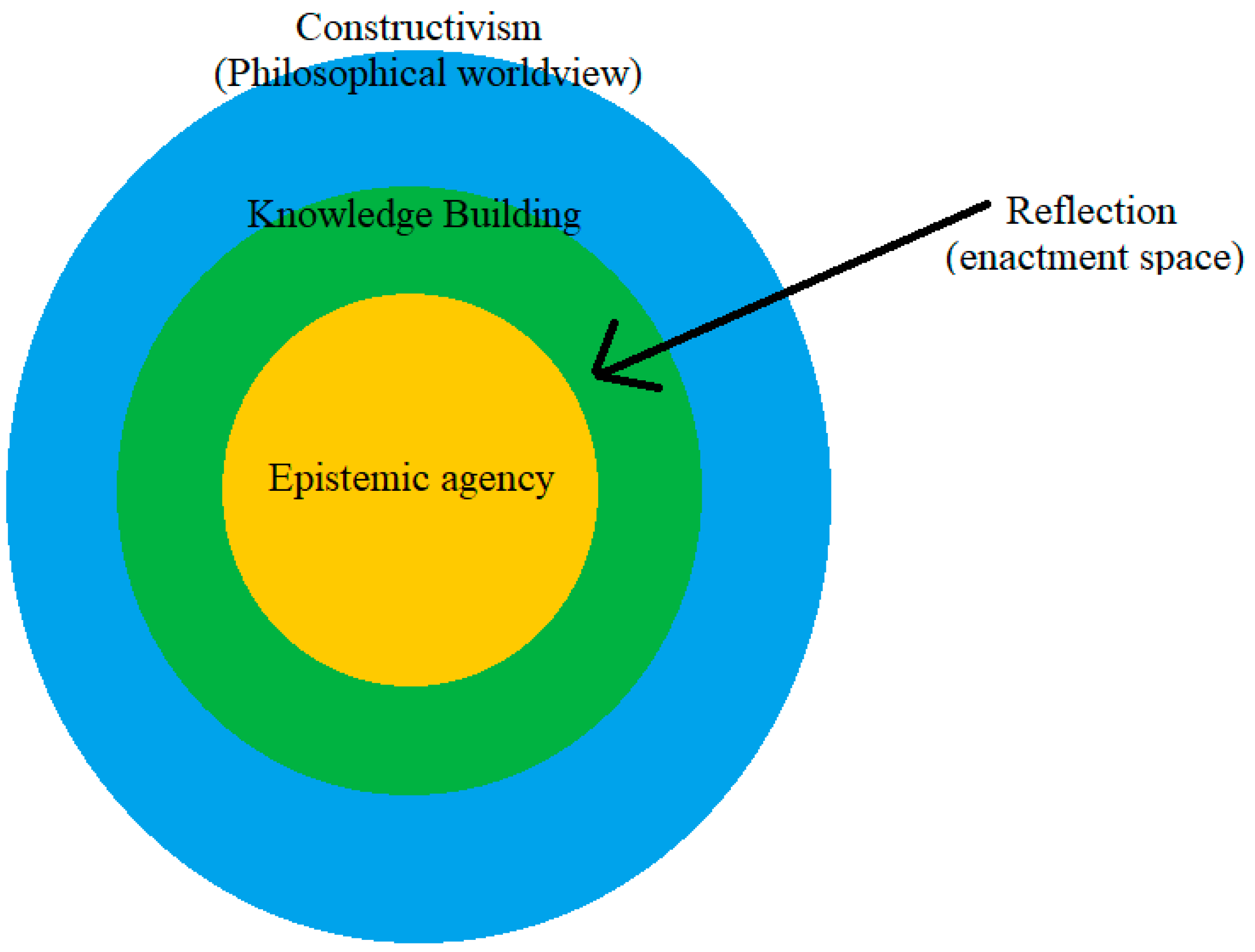
This study is framed by three connected lenses, namely, constructivism, knowledge building theory, and epistemic agency. Constructivism provides the philosophical grounding, knowledge building theory explains how communities advance collective understanding through the improvement of ideas (
Scardamalia & Bereiter, 2006), and epistemic agency serves as the innermost focus, emphasising the capacity of learners and teachers to author, evaluate, and take responsibility for knowledge (
Scardamalia & Bereiter, 2006).
Figure 1 illustrates how these lenses are conceptualised in a nested model, with reflection operating as the mechanism that connects them in practice.
The term “nested” is used deliberately to indicate a relationship of conceptual containment and dependency. Epistemic agency operates within knowledge-building practices, which themselves presuppose constructivist assumptions about knowledge as constructed and improvable. The nested structure therefore reflects not merely conceptual layering but the conditions that make epistemic agency observable and analytically meaningful in this study.
1.2.1. Constructivism as the Philosophical Foundation
At the broadest level, constructivism serves as the philosophical worldview, positioning knowledge as constructed, provisional, and socially mediated (
Rannikmäe et al., 2020). It departs from objectivist paradigms by asserting that learners actively build knowledge rather than absorb it passively, and that reality itself is constituted through interpretation and social practice (
Amineh & Asl, 2015). From a cognitive constructivist stance, Piaget’s genetic epistemology explains learning as the dynamic process of assimilation and accommodation, while Vygotsky’s sociocultural theory shifts attention to the role of cultural tools, interaction, and the zone of proximal development. Bruner further emphasises the cultural embeddedness of learning, framing it as entry into “ways of knowing” characteristic of a community (
Rannikmäe et al., 2020). Together, these perspectives establish learning as an active, interpretive, and socially situated process, thereby providing the philosophical basis for understanding how epistemic agency can emerge through participation in knowledge practices.
1.2.2. Knowledge-Building as a Collective Advancement of Ideas
Within this philosophical orientation, knowledge building theory provides a framework for understanding how communities advance collective understanding by treating ideas as improvable objects (
Scardamalia & Bereiter, 2006). In knowledge-building classrooms, discourse is directed toward the progressive improvement of explanations, models, and theories rather than the reproduction of authoritative knowledge (
Scardamalia & Bereiter, 2006). This shift from knowledge transmission to knowledge advancement positions learners and teachers as contributors to the development of shared understanding. In this study, therefore, reflection is understood not merely as a retrospective activity but as an epistemic process that supports the improvement of ideas, enabling learners and teachers to treat difficulties not as deficits but as opportunities for idea improvement (
Edwards, 2020;
Roberts et al., 2021).
1.2.3. Epistemic Agency as Legislative Responsibility in Knowledge Practices
At the innermost level lies epistemic agency, which makes explicit the responsibility of learners and teachers to take initiative in advancing knowledge practices. Research shows that epistemic agency is not merely individual but also shared, enacted through epistemic moves such as generating, critiquing, and structuring ideas, alongside regulative moves such as monitoring, coordinating, and negotiating (
Damşa et al., 2010). These epistemic and regulative actions enable participants to shape both the direction and quality of knowledge-building processes, rather than simply engaging in procedural participation.
Philosophical accounts deepen this educational view.
Elgin (
2013) conceptualises epistemic agents as legislators of epistemic realms who act with intellectual virtues such as rigour and sensitivity to evidence. This legislative metaphor emphasises that epistemic agents do not merely follow established knowledge norms but actively participate in shaping and sustaining them.
Sosa (
2013) distinguishes between animal knowledge, understood as passive states of belief, and reflective knowledge, which requires competent judgement and self-regulation. Reflective knowledge therefore represents a higher level of epistemic agency, as it involves deliberate evaluation and responsible endorsement of knowledge claims.
Building on these perspectives, we interpret epistemic agency in teacher education as requiring spaces where PSTs are positioned not only to master content but also to assume responsibility for advancing knowledge. This positioning enables PSTs to function as epistemic contributors who evaluate evidence, interpret learner thinking, and refine pedagogical understanding.
Ko and Krist (
2019) show that redistributing epistemic agency in classrooms entails opening up curricula so that learners make decisions about what counts as knowledge, while
Chuene (
2021) demonstrates in a South African context that epistemic agency can be fostered or constrained by the balance between epistemic virtues (e.g., attentiveness, humility) and vices (e.g., superficial error-spotting, uncritical reliance on authority).
1.2.4. Operationalising Epistemic Agency as an Analytical Lens
The analysis treated epistemic agency as a theoretical lens, operationalised through four dimensions that structured the coding process: (i) critical noticing of learner struggles, (ii) representational critique of tools and strategies, (iii) responsible pedagogical reasoning, and (iv) teacher noticing as a cross-cutting mechanism. These dimensions drew conceptually on
Damşa et al.’s (
2010) distinction between epistemic and regulative actions,
Elgin’s (
2013) account of agents acting with intellectual virtues such as rigour and sensitivity to evidence, and
Sosa’s (
2013) emphasis on reflective knowledge grounded in competent judgement. In this study, the categories were applied deductively as an analytic frame to interpret Physical Sciences PSTs’ reflections.
2. Materials and Methods
2.1. Research Design
This study adopted a qualitative case study design, drawing on
Merriam’s (
1998,
2015) conceptualisation of case studies as intensive and holistic analyses of a bounded system. The bounded case comprised a cohort of Physical Sciences PSTs enrolled in a final-year Classroom Research in Physical Sciences module at a South African university. The focus of the study was to examine how these PSTs enacted epistemic agency through reflective engagement with learner struggles within the context of the module. The case was bounded in terms of participants (Physical Sciences PSTs in one cohort), place (the Classroom Research module), and time (the first semester of the academic year). This boundedness enabled an in-depth examination of epistemic agency as it was enacted within a specific teacher education context (
Merriam, 2015). The design was appropriate for generating rich descriptions of PSTs’ reflective practices and for examining the meanings they constructed around learner struggles, using multiple qualitative data sources.
2.2. Research Context
The study was conducted within a final-year Bachelor of Education (BEd) module titled Classroom Research in Physical Sciences. The module introduces PSTs to classroom-based inquiry, with emphasis on identifying learning struggles, formulating researchable problems, engaging with literature, and developing classroom action research proposals. The module is taken concurrently with the final phase of teaching practice.
During the first semester, PSTs participated in lectures and activities designed to develop reflective habits and inquiry-oriented thinking. As part of this process, PSTs completed structured written reflection tasks that required them to identify specific learner struggles observed during teaching practice or recalled from prior schooling, interpret what these struggles revealed about learner thinking, and consider pedagogical responses. These reflections functioned both as pedagogical tools within the module and as research data. The use of course-embedded reflective tasks as data were consistent with qualitative research on teacher learning that examines naturally occurring reflective practices (
Edwards, 2020;
Stroupe, 2014).
The reflective writing tasks analysed in this study were introduced as a pedagogical and research intervention to support PSTs’ engagement with classroom-based reflection, particularly in relation to interpreting learner thinking. While the module develops classroom inquiry skills, it does not explicitly address epistemic agency or epistemic reasoning as formal learning outcomes. The reflective tasks therefore created structured opportunities for PSTs to engage with learner struggles as sites of inquiry, enabling examination of how epistemic agency could emerge through reflective interpretation of classroom experiences.
To extend and deepen the analysis, follow-up interviews were conducted with selected PSTs. The classroom thus served simultaneously as a site of instruction and a research setting, enabling the examination of epistemic agency as it emerged within authentic teacher education practices. The researcher’s dual role as lecturer and researcher was addressed through careful ethical procedures and analytic transparency. At the same time, this insider position strengthened data generation in practical ways. As a lecturer in the module, the researcher had sustained contact with the PSTs across the semester, which supported familiarity, rapport, and ease of communication during the reflection activities and interviews. Literature on positionality notes that insider or quasi-insider roles can enable access to participants and encourage more open participation, especially where participants experience the researcher as familiar and culturally situated within the setting (
Goundar, 2025). In this study, the established lecturer–student relationship helped to normalise reflective talk in the classroom and allowed participants to explain their reasoning in greater detail, rather than treating the interviews as unfamiliar or intimidating encounters.
The dual role also enhanced contextual understanding of the setting. In teacher–researcher work, insider knowledge can help the researcher notice significant classroom events and interpret them with sensitivity to local practice, while still requiring deliberate reflection to manage the tensions that come with role overlap (
Tabach, 2011). Similarly, teacher–researcher accounts highlight that long-term immersion and tacit knowledge of the field can be a key benefit of the double role, provided that the researcher remains attentive to ethical risks and power relations (
Nikkanen, 2019).
2.3. Participants and Sampling
Sampling was both convenient and purposive (
Cohen et al., 2000). Participants were 73 final-year Physical Sciences PSTs enrolled in the Classroom Research in Physical Sciences module. All participants had completed at least three teaching practice placements and therefore had prior classroom experience that enabled them to reflect on learner struggles encountered in authentic contexts. All written reflections produced by the cohort were included in the analysis to capture the full range of reflective engagement. For interviews, a purposive sub-sample of eight PSTs was selected based on the clarity and depth with which their written reflections articulated learner struggles related to Physical Sciences content. This approach allowed for breadth through reflections and depth through interviews.
2.4. Data Collection
Two complementary data sources were generated: written reflections and semi-structured interviews.
2.4.1. Written Reflections
All 73 PSTs completed structured written reflection tasks during the first semester as part of the module requirements. The reflection instrument was designed to elicit learner struggles as situated episodes of reasoning, rather than as generalised learning difficulties. Prompts required PSTs to:
Identify a specific Physical Sciences concept or topic,
Describe a moment where learners struggled during explanation or task engagement,
Interpret what the struggle revealed about learner thinking, and
Reflect on possible pedagogical responses.
The reflections were submitted hardcopies and anonymised prior to analysis.
2.4.2. Semi-Structured Interviews
Semi-structured interviews were conducted with eight PSTs whose written reflections articulated learner struggles in relation to Physical Sciences content. The interviews were designed as follow-up engagements to the written reflections and focused on elaborating how learner struggles manifested in classroom contexts, how PSTs interpreted these struggles, and how they reasoned about possible pedagogical responses. Interview questions were reviewed by the research supervisors to ensure alignment with the research questions and refined prior to administration. As part of the pre-prepared interview protocol, all participants were asked questions designed to extend and deepen their written reflections. For example, one guiding question asked: “Can you describe a specific classroom moment where you observed the learner struggle you identified in your reflection, explain what you think this revealed about the learners’ understanding, and describe how you responded or would respond pedagogically?” This question enabled participants to move beyond written descriptions by articulating concrete classroom episodes, interpreting learner thinking, and justifying their pedagogical reasoning. In addition, follow-up probes such as “What made you interpret the learners’ thinking in that way?” and “How did this influence your instructional decision?” were used to clarify meanings, deepen explanations, and elicit participants’ reasoning processes more fully, while maintaining consistency with the semi-structured interview design.
Interviews were audio-recorded with participants’ consent and transcribed verbatim. The interview data provided access to PSTs’ extended reasoning and sense-making processes, allowing for a more detailed examination of epistemic agency and pedagogical decision-making than was possible through written reflections alone (
Cohen et al., 2000;
Flick, 2018).
2.5. Data Analysis
Data analysis followed a theoretically informed thematic analysis that combined deductive and inductive processes, guided by
Braun and Clarke’s (
2006,
2021) approach. Analysis proceeded in several stages. First, written reflections and interview transcripts were read repeatedly to achieve familiarisation. Initial codes were generated inductively to capture patterns in how PSTs described learner struggles and reflected on them. These codes were then organised deductively using sensitising concepts drawn from epistemic agency and teacher noticing literature. Themes were reviewed, refined, and defined through iterative comparison across data sources. Analytic tables were constructed to trace how themes related to the research questions and to the Attend–Interpret–Decide cycle of teacher noticing.
Table 1 summarises how Braun and Clarke’s six phases were applied in this study.
2.6. Ethical Considerations
Ethical approval for the study was obtained from the university’s research ethics committee (approval code: TREC/1559/2023:PG). Participation was voluntary, and informed consent was obtained from all participants. To mitigate power dynamics associated with the researcher’s dual role as lecturer and researcher, participation in the research component was not linked to course assessment, and data were anonymised prior to analysis. The reflective writing tasks were not part of formal module assessment and were not graded. Participation did not influence course marks, progression, or academic evaluation. Participants were explicitly informed that there were no correct or expected responses and that the reflections were used to understand their reasoning about learner struggles rather than to evaluate their academic performance. These measures helped to minimise pressure to produce responses aligned with perceived academic expectations and supported voluntary participation.
2.7. Generative Artificial Intelligence (GenAI) Disclosure
Generative artificial intelligence tools were used during manuscript preparation to support academic writing and revision. In addition, AI-assisted transcription software (TurboScribe) was used to transcribe initial interview transcripts. All transcripts were subsequently checked against the original audio recordings, corrected where necessary, and verified prior to analysis. GenAI was not used in study design, data collection, data coding, data analysis, or interpretation of findings.
4. Discussion
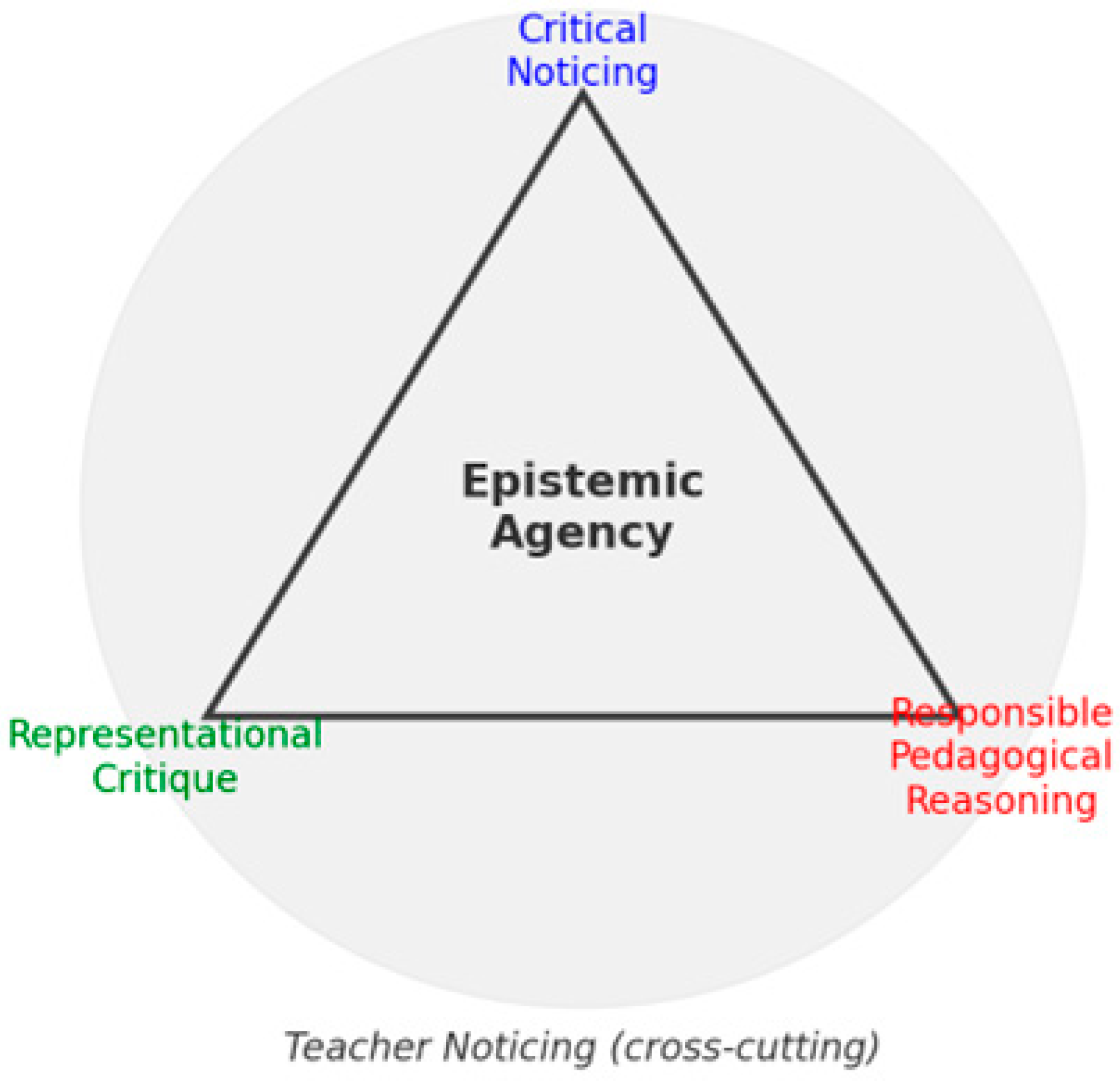
This study examined how Physical Sciences PSTs enacted epistemic agency through reflective engagement with learner struggles, as expressed in their written reflections and interviews. In this section, we explicitly integrate the findings from the two data sources while keeping their analytic roles clear: written reflections primarily show how PSTs attend to learner struggles across topics (RQ1) and begin to interpret them (RQ2), whereas interviews extend this work by revealing more elaborated interpretation, decision-making, and the operation of the noticing cycle (RQ2–RQ4). The argument advanced here is that reflective engagement with learner struggles supported PSTs’ epistemic agency through three connected dimensions, namely, critical noticing, representational critique, and responsible pedagogical reasoning, with teacher noticing (Attend–Interpret–Decide) functioning as the cross-cutting mechanism that links these dimensions into a coherent epistemic practice.
4.1. Analytic Framework for Epistemic Agency in Physical Sciences Teacher Education
Figure 2 presents an analytic framework derived from the findings, showing how epistemic agency was demonstrated through three connected dimensions in PSTs’ reflective reasoning and pedagogical sense-making: critical noticing, representational critique, and responsible pedagogical reasoning. Critical noticing refers to PSTs’ attention to patterned learner struggles and underlying reasoning difficulties. Representational critique captures PSTs’ evaluation of the adequacy of disciplinary tools such as graphs, equations, and diagrams for supporting learner sense-making. Responsible pedagogical reasoning reflects PSTs’ decisions to design and justify instructional responses that address learner struggles as epistemic opportunities. Teacher noticing operates as a cross-cutting mechanism that connects these dimensions through an Attend–Interpret–Decide cycle, giving coherence to how PSTs interpreted learner thinking and acted pedagogically.
4.1.1. From “Areas of Struggle” to Epistemic Sites of Work (RQ1 Through Attend)
The written reflections show that PSTs did not treat learner struggles as undifferentiated “difficulty,” but as topic-specific and patterned struggles that signal breakdowns in disciplinary sense-making. In identifying recurrent terrains of struggle (e.g., Doppler effect, atomic structure, Newton’s laws, and electrical circuits), PSTs were already engaging a key element of epistemic agency: selecting problems worth investigating and treating them as resources for inquiry (
Scardamalia & Bereiter, 2006). The analytic tables in the article summarise this “attending” work as fine-grained diagnosis, not mere error spotting—for example, repeated diagnoses such as mis-assigned signs in Doppler contexts, “current gets used up,” action–reaction confusion in mechanics, and “neutral vs none” in atomic structure.
From the standpoint of teacher noticing, this is the Attend phase: the capacity to recognise persistent patterns of struggle and to treat them as epistemically meaningful. The discussion framework explicitly defines critical noticing as moving beyond “surface-level errors” toward diagnosing underlying reasoning difficulties, illustrated by recognising that confusion with Doppler sign conventions can stem from misconceptions about relative motion. This form of attending aligns with scholarship arguing that teacher noticing is disciplinary and interpretive rather than merely perceptual (
Barnhart & van Es, 2015;
Chan et al., 2021;
Tekkumru-Kisa & Richards, 2025). It also resonates with science education work emphasising that productive teaching requires attention to learners’ reasoning processes rather than correctness alone (
Stroupe, 2014).
4.1.2. Sense-Making as Epistemic Agency (RQ2 Through Interpret)
A key contribution of the interview data is the richer evidence it provides for Interpret: how PSTs make sense of why learner struggles persist. Rather than relying on single-cause explanations, the findings show PSTs’ interpretations as multi-causal and reflective, often linking struggles to representational habits and the constraints of representation-first teaching. Notably, PSTs’ sense-making frequently involved reasoning about how learners’ engagement with disciplinary representations (graphs, equations, diagrams) can produce procedural success without conceptual understanding captured in the analytic claim that “correct graphs” do not necessarily indicate understanding in VPM.
This interpretive move matters because it locates learner struggles not only “in learners,” but in the epistemic relationship between learners and the tools of the discipline. The discussion framework terms this representational critique: questioning whether equations, graphs, diagrams, and classroom artefacts support or obscure conceptual understanding. This connects directly to epistemic agency as responsibility for the quality of knowing: PSTs evaluate the adequacy of knowledge tools rather than treating them as neutral carriers of content (
Elgin, 2013;
Sosa, 2013). It also aligns with accounts of epistemic agency in education that stress idea improvement and accountability to shared standards of explanation (
Scardamalia & Bereiter, 2006). Importantly, the data do not suggest that representational critique is uniformly deep; the analysis notes that “the depth of critique varied.” This variability is a productive analytic finding: it indicates that reflective tasks can surface critique, but teacher education must deliberately cultivate the epistemic dispositions and disciplinary tools needed to sustain it (
Edwards, 2020;
Ko & Krist, 2019).
4.1.3. Deciding as Responsible Knowledge Work (RQ3 Through Decide)
Epistemic agency becomes most visible when PSTs move from noticing and interpreting to acting: deciding on pedagogical steps that are accountable to the diagnosis. The analytic tables frame this as responsible pedagogical reasoning, where PSTs proposed concrete, content-specific interventions aligned with their diagnoses—for example, using 3D models/PhET simulations for atomic structure, staging free-body diagram construction in mechanics, and prioritising demonstration-based work in waves/circuits before symbol manipulation. These are not generic “strategies”; they reflect regulative actions that shape how knowledge work will proceed in the classroom, consistent with
Damşa et al.’s (
2010) account of epistemic agency as coordination and direction of inquiry activity. The draft explicitly links PST decision-making to regulative action and to designing contexts where learner ideas are treated as resources rather than obstacles (
Ko & Krist, 2019).
The findings also highlight the ethical texture of these pedagogical decisions. Drawing on
Chuene (
2021), the discussion argues that epistemic agency is strengthened by virtues such as attentiveness and humility and weakened by vices such as over-reliance on authority. Within the data, humility becomes visible when PSTs acknowledge their own histories of struggling and use that recognition to craft more empathetic, reasoning-focused interventions; by contrast, “explaining more clearly” is treated as a weaker response because it defers to authority and can bypass learner ownership. This distinction is analytically important: it shows that epistemic agency is not only about proposing actions, but about the epistemic quality of those actions—whether they support learners to participate in sense-making, explanation, and idea improvement (
Elgin, 2013;
Stroupe, 2014).
4.1.4. Teacher Noticing as the Organising Mechanism of Epistemic Agency (RQ4)
Across interviews, teacher noticing emerges not as an additional theme but as the organising mechanism through which epistemic agency is enacted. The analytic table on RQ4 makes this explicit: noticing connects (1) Attend to specific misconceptions, (2) Interpret why they occur, and (3) Decide on next pedagogical steps. This structure is crucial for addressing the reviewer’s request to discuss the three phases directly. In the atom interviews, for example, PSTs noticed misconceptions such as “electrons inside nucleus” and “neutral = none,” interpreted these as representational misunderstandings, and then planned pedagogical responses that included models/PhET and formative checks (oral explanations, quick quizzes, redraw tasks). In mechanics, noticing patterned free-body diagram errors led to a decision rule: re-sequence instruction so learners practice drawing and labelling vectors before moving to components or net-force calculations. In waves, noticing that learners “cram what they saw on the board” precipitated a shift to demonstration and simulation before equations, reframing representation as a reasoning tool rather than a product to memorise.
This finding strengthens current noticing scholarship by showing how noticing operates as a bridge between epistemic evaluation (interpretation and critique) and pedagogical action (decision-making), rather than as a stand-alone perceptual skill (
Barnhart & van Es, 2015;
Krist et al., 2023). It also clarifies how teacher education can cultivate epistemic agency: not by asking PSTs to “reflect” in general, but by structuring reflective work so that it reliably supports movement across Attend–Interpret–Decide in relation to concrete learner struggles.
4.2. Contributions and Implications
The study makes four contributions, each of which addresses what the editor and reviewers typically seek in a
Section 4.
Operationalising epistemic agency in teacher education through a concrete analytic framework. The analysis yields a framework composed of three connected dimensions, critical noticing, representational critique, and responsible pedagogical reasoning, with teacher noticing as the cross-cutting mechanism that gives coherence to them.
Reframing learner struggles as epistemic resources rather than deficits. The discussion argues that reflective engagement with learner struggles is not a neutral exercise but a site where epistemic agency can be fostered or constrained; the quality of agency depends on whether PSTs treat difficulties as resources for inquiry or as deficits to be corrected through authority.
Identifying representational critique as a distinctive form of PST epistemic agency in Physical Sciences. PSTs explicitly questioned whether boarded formulas, tidy graphs, and static diagrams supported sense-making and proposed re-mediation of representations, with VPM used as a clear case where procedural plotting can mask conceptual gaps.
Demonstrating content-specific pedagogical responsibility as a hallmark of epistemic agency. PSTs’ decisions were tightly coupled to diagnoses (e.g., models/PhET for atomic structure; staged free-body diagram practice; demonstration-based work before symbol manipulation), showing epistemic agency as disciplined responsiveness rather than generic strategy talk.
For Physical Sciences teacher education, these contributions point to a practical implication: programmes should design reflective tasks that (a) require PSTs to attend to concrete learner work or episodes, (b) scaffold interpretive reasoning about representations and underlying misconceptions, and (c) require decisions that are justified as responses to the diagnosis. In this way, reflective practice can be structured to cultivate epistemic agency as accountable knowledge work, rather than as compliance writing (
Edwards, 2020;
Uştuk & De Costa, 2021). Finally, the study extends theoretical accounts of epistemic agency (
Damşa et al., 2010;
Elgin, 2013;
Sosa, 2013) by situating them in the lived practices of teacher preparation, showing how epistemic agency can be enacted through the ordinary work of noticing learner struggles, critiquing the adequacy of representations, and designing pedagogical responses that treat learner thinking as improvable.
4.3. Limitations
This study was conducted with a single cohort of Physical Sciences PSTs at one South African university, and the findings should therefore be interpreted as contextually situated rather than broadly generalisable to all teacher education settings. The case was also bounded to the first semester, which means the analysis does not capture how epistemic agency may develop over longer periods or across subsequent teaching practice experiences. Although written reflections were not graded and did not contribute to course assessment, participants were aware that they were engaging in an activity facilitated by their lecturer, which may have influenced how they represented their reasoning or pedagogical intentions. Finally, epistemic agency was examined through PSTs’ written reflections and interviews rather than through direct observation of classroom teaching, and the findings therefore reflect how PSTs interpreted and reasoned about learner struggles, rather than how epistemic agency was enacted in real-time instructional practice.
5. Conclusions
This study examined how Physical Sciences pre-service teachers (PSTs) enact epistemic agency through reflective engagement with learner struggles. Using written reflections and semi-structured interviews, the study showed that learner struggles functioned as epistemically productive sites through which PSTs attended to learner thinking, interpreted sources of difficulty, and reasoned about pedagogical responses.
Written reflections primarily supported attending to learner struggles by identifying patterned difficulties across key Physical Sciences topics, including Newton’s laws, vertical projectile motion, electric circuits, atomic structure, and the Doppler effect. These struggles were treated as specific breakdowns in reasoning and representation rather than as general learning difficulties. Interviews extended this work by revealing how PSTs interpreted these struggles, often linking them to learners’ procedural engagement with disciplinary representations such as graphs, equations, and diagrams. Through this interpretive work, PSTs moved beyond error identification toward explaining how learners were reasoning.
Epistemic agency was most clearly enacted when PSTs decided on content-specific pedagogical responses that were accountable to their interpretations, such as re-sequencing instruction, using models and simulations, and foregrounding conceptual explanations. Across data sources, teacher noticing structured this work through an Attend–Interpret–Decide cycle, connecting reflection to principled pedagogical action. The study contributes by showing how epistemic agency in teacher education can be enacted through structured reflection on learner struggles, positioning PSTs as responsible participants in improving learners’ sense-making in Physical Sciences.