Article

Optometry Students’ Attitudes Towards Learning Communication Skills: A CSAS-Optom Study

by
Serap Azizoğlu
1,2,
Heather Connor
1,2 and
Moneisha Gokhale
1,2,*
1
School of Medicine, Deakin University, Geelong, VIC 3220, Australia
2
Institute for Mental and Physical Health and Clinical Translation (IMPACT), Deakin University, Geelong, VIC 3220, Australia
*
Author to whom correspondence should be addressed.
Educ. Sci. 2026, 16(3), 428; https://doi.org/10.3390/educsci16030428
Submission received: 8 January 2026 / Revised: 27 February 2026 / Accepted: 7 March 2026 / Published: 11 March 2026
(This article belongs to the Section Higher Education)

Abstract

Effective communication is central to patient-centred care; however, optometry curricula often prioritise technical skills over formal communication training. This study investigated optometry students’ attitudes toward learning communication skills using an adapted Communication Skills Attitude Scale (CSAS-Optom) and examined whether attitudes differed by gender, age, and year of study. A cross-sectional survey was conducted among optometry students using the CSAS-Optom, which includes Positive Attitude Scale (PAS) and Negative Attitude Scale (NAS) subscales, alongside demographic variables. Group differences were analysed using ANOVA and independent t-tests, and item-level responses were explored to identify trends relevant to communication education. A total of 189 students responded (response rate 76.5%), with representation across first-, second-, and third-year levels. Overall, students demonstrated positive attitudes toward learning communication skills, reflected by higher PAS scores (mean 4.04 ± 0.11) and lower NAS scores (mean 2.21 ± 0.10). Third-year students, female students, and those aged 18–25 years reported significantly more positive attitudes compared with their counterparts. These findings indicate that optometry students value communication skills training and are receptive to its inclusion in the curriculum. The CSAS-Optom appears to be a reliable tool for assessing attitudes in optometry education, and demographic differences suggest the benefit of tailored approaches to communication skills teaching.

1. Introduction

Effective communication is a core competency of healthcare professionals. Communication skills in healthcare are commonly conceptualised as the interpersonal, verbal and non-verbal competencies required to effectively exchange information, build therapeutic relationships, facilitate shared decision-making, and support patient-centred care (Crawford et al., 2017; Kwame & Petrucka, 2021; Maguire & Pitceathly, 2002). These skills encompass active listening, empathy, clarity in explaining diagnoses and management plans, responsiveness to patients’ concerns, and the ability to adapt communication to diverse groups and differing sociocultural contexts (Epstein & Street, 2011; Kwame & Petrucka, 2021). Frameworks for enhancing communication in healthcare are growing in Australia, with five core values at their centre, emphasising that effective communication should be equitable, inclusive, evidence-based, collaborative, and reflective (White et al., 2023).
For Australian optometrists, communication is formally recognised as a core professional competency under Domain 3: Communicator and Collaborator in the Entry-Level Competency Standards for Optometry (Optometry Australia, 2022), which require entry-level optometrists to communicate clearly, effectively, empathetically, and professionally with patients and their families or carers, and to collaborate with other professionals. Development of effective communication skills is essential for diagnostic accuracy; shared decision-making (Davis et al., 2008); treatment adherence (Zolnierek & Dimatteo, 2009); therapeutic success (Náfrádi et al., 2017); patient trust; and overall patient satisfaction (Biglu et al., 2017; Chen et al., 2025). Despite this, proficient communication skills remain challenging across healthcare professions. Suboptimal communication contributes to adverse outcomes, malpractice claims and patient aggression towards clinicians (Douglas et al., 2021; Gale et al., 2009), reinforcing the need to strengthen communication training early in professional education.
For learners to develop these competencies, they must first recognise the value of communication. In optometry—similar to other health disciplines—communication demands are substantial. Optometrists must explain ocular disease, convey prognosis, guide shared management decisions and support patients through long-term care plans. Evidence from health-professions’ curricula demonstrates that communication training enhances students’ communication confidence and patient-centred behaviours (Hausberg et al., 2012; Nguyen et al., 2024; Peimani et al., 2025; Yao et al., 2021). Embedding such training with clear learning outcomes, aligned assessments and structured practice, including role-play (Rider & Keefer, 2006), helps students appreciate its relevance to clinical competence (Denniston et al., 2017; Maguire & Pitceathly, 2002; Mata et al., 2021). Without this recognition, students may undervalue communication training, limiting engagement and skill development.
Problem-Based Learning (PBL), widely used in medical and health-professional programmes, is grounded in constructive, self-directed, collaborative and contextual learning (Choon-Huat Koh et al., 2008; Dolmans et al., 2005). Within PBL tutorials, students encounter clinical case scenarios in small groups, where the problem itself serves as a vehicle for developing clinical problem solving. Students are expected to articulate reasoning, question peers, role-play patient interactions, and present patient-centred management plans. These processes inherently require interpersonal and professional communication skills. As such communication is embedded within collaborative problem-solving activities, rather than taught solely as a discrete competency. In curricula where PBL is prominent, students’ attitudes toward communication learning may therefore be shaped by both structured skills teaching and repeated experiential application, guided by a facilitator during PBL. These environments positively shape teamwork attitudes and strengthen communication proficiency (Hande et al., 2015; Schmidt et al., 2011; Seneviratne et al., 2001). As PBL forms a major component of many medical programmes, including optometry, understanding how optometry students perceive communication training in a PBL-rich environment is important.
Although medicine (Busch et al., 2015; Pochrzęst-Motyczyńska et al., 2025; Zhang et al., 2019), nursing (Giménez-Espert et al., 2021), and dentistry (Mussalo et al., 2025), have explored students’ attitudes towards communication training, comparable research in optometry is lacking. These attitudes are critical, as they shape patient-centred care (Levinson & Roter, 1995), influence motivation and learning behaviours, and determine how effectively communication skills training is transferred into clinical practice. Understanding learners’ attitudes is essential for informing curriculum design and ensuring that communication education aligns with professional and accreditation expectations. The Communication Skills Attitude Scale (CSAS), developed by Rees, Sheard and Davies in 2002, is a widely used and validated instrument for assessing learners’ attitudes towards communication education (Rees et al., 2002). However, its application within optometry has been overlooked. Applying the CSAS in optometry would enable benchmarking of students’ attitudes against those in other health professions, identify areas of strength and gaps within current curricula, and guide refinement of communication training to align with Australia Entry-Level Competency Standards (Domain 3: Communicator and Collaborator) (Optometry Australia, 2022).

Research Aims and Hypotheses

Attitudes towards communication skills learning are shaped by educational exposure, professional identity formation, and practice opportunities within training environments. In health-professions education, attitudes may evolve with increasing clinical experience and curricular immersion. They may also vary according to demographic characteristics such as gender and age.
This study examined differences by year level to explore whether progression through a PBL-rich curriculum and increasing clinical exposure influences attitudes towards learning communication skills. Age and gender were included because prior research in medicine, nursing, and dentistry has shown associations between these demographic variables and both positive and negative attitude subscales, as measured by the CSAS.
Aims:
This study investigates optometry students’ attitudes towards learning communication skills using an adapted optometry-specific CSAS (CSAS-Optom). Specifically, this study aims to:
  • Assess overall optometry students’ attitudes towards communication skills learning;
  • Examine differences in Positive Attitude Scale (PAS) and Negative Attitude Scale (NAS) scores across year level, age and gender;
  • Identify which aspects of communication training are viewed most positively or negatively.
Hypotheses:
  • Overall attitudes towards learning communication skills would be positive (high PAS and low NAS scores).
  • Attitudes would vary by year level, reflecting progressive clinical exposure and increased integration of communication with patient care.
  • Gender differences would be observed, with female students demonstrating higher PAS scores, consistent with trends in other health disciplines literature.
  • Age may influence attitudes towards communication training, with older students potentially demonstrating a reduction in positive attitudes as shown in medical students’ literature.
By capturing these attitudes, this study provides an evidence base to support curriculum improvement and ensure communication training is effectively integrated into optometric education.

2. Materials and Methods

2.1. Ethics and Course Structure

Ethics approval for this study was obtained from the Deakin University Human Ethics Committee (Ethics No. 2017-320).
This study was conducted within the Bachelor of Vision Science/Master of Optometry programme at Deakin University (Australia), which is a 3.5-year qualification delivered over 10 trimesters. The curriculum incorporates Problem-Based Learning (PBL) across six trimesters, beginning in Trimester 3 of first-year and continuing through to Trimester 2 in third year. All student cohorts included in this study were therefore engaged in the PBL component of the programme.
Clinical exposure progresses across the degree, where first-year study is predominantly pre-clinical; second-year students undertake structured peer-to-peer simulated clinical skills and observe optometrists, while third-year students provide supervised patient care within optometry clinical settings. Communication skills training was embedded across all years of the curriculum using a scaffolded structure that integrates communication development into both theoretical and clinical learning activities.

2.2. Research Participants

All enrolled first-, second- and third-year optometry students (n = 247) were invited to participate in the study. A total of 189 students completed the survey (response rate 76.5%). Participant demographics are summarised in Table 2.
The sample comprised students across all three-year levels, with representation from both gender categories (female/male) and two age groups (18–25 years; ≥26 years). The majority of respondents were aged 18–25 years, reflecting typical entry pathways from secondary school or prior undergraduate study. A smaller proportion (10.1%) were aged ≥26 years, representing mature-aged students who may have had prior employment experience or alternative educational pathways before entering optometry. The age groups (18–25 years vs. ≥26 years) were selected to distinguish students likely to have progressed through continuous schooling from those more likely to have undertaken non-linear educational or professional trajectories.

2.3. Participation and Survey Administration

All enrolled first-, second- and third-year optometry students (n = 247) were invited to participate in completing the survey prior to a scheduled seminar day. Demographic data collected included age (18–25 years; ≥26 years), gender (female/male) and year level (first, second, and third year).
Participation was voluntary and anonymous. Technical staff distributed paper-based surveys and sealed collection boxes were provided at the end of the seminar day. Students could choose to return the survey blank, partially completed or not at all. No incentives were offered.
The survey was the CSAS-Optom, an adapted version of the original Communication Skills Attitude Scale (CSAS) (Rees et al., 2002). The CSAS consists of 26 items: 13 Positive Attitude Scale (PAS) items and 13 Negative Attitude Scale (NAS) items, rated on a 5-point Likert scale (1 = strongly disagree to 5 = strongly agree).
For the CSAS-Optom, wording was modified to reflect the optometry context. The term ‘doctor’ was replaced with optometrist, optometry student or optometry, depending on the sentence structure (Table 1). Item 15, a Negative Attitude Scale (NAS) item, from the original CSAS was removed because all clinical educators in the Deakin programme are clinicians, rendering the item irrelevant; however, the original numbering was retained to maintain comparability with existing CSAS literature. The final CSAS-Optom consisted of 25 items: 13 PAS items (1, 4, 5, 7, 9, 10, 12, 14, 16, 18, 21, 23 and 25) and 12 NAS items (2, 3, 6, 8, 11, 13, 17, 19, 20, 22, 24 and 26). Higher PAS scores indicate that students view communication skills learning as enjoyable, beneficial and relevant to their development, whereas higher NAS scores reflect perceptions that communication skills learning is unnecessary, irrelevant or a waste of time.

2.4. Data Analysis

Data were analysed using IBM SPSS Statistics (Version 24). Cronbach’s alpha was calculated separately for PAS and NAS to determine their internal consistency. Multivariate Analysis of Variance (MANOVA) evaluated differences in PAS and NAS scores across three-year levels, gender and age groups, with Bonferroni-adjusted post hoc analyses. Pairwise comparison was conducted using post hoc LSD testing. Statistical significance was set at p ≤ 0.05.

3. Results

A total of 247 optometry students were invited to participate, with 189 students completing the survey (response rate: 76.5%). Participants were predominantly female (n = 133, 70.3%), aged 18–25 years of age (n = 170, 89.9%). Year-level distribution was first year (n = 53, 28.0%), second year (n = 67, 35.5%) and third year (n = 69, 36.5%) (Table 2).
Internal consistency was high for both subscales (PAS 13 items: Cronbach’s α = 0.88 and NAS 12 items: Cronbach’s α = 0.77). Overall, mean scores demonstrated students held strong positive attitudes towards communication skills learning (PAS 4.0 ± 0.1) and low endorsement of negative attitudes (NAS 2.2 ± 0.5). Responses to individual questions were analysed using MANOVA comparing age, gender and year level showing significant results, F(25, 147) = 707.8, p < 0.0001. Interactions were found between year level and gender (F(50, 296) = 2.15) and between age, year level and gender (F(50, 296) = 1.71).

3.1. Effect of Year Level

There was a significant overall effect of year level on communication skills attitudes F(50, 296) = 1.51, p = 0.02. Mean PAS and NAS scores were broadly similar: first year: PAS 4.1 ± 0.6; NAS 2.3 ± 0.5; second year: PAS 3.9 ± 0.5; NAS 2.2 ± 0.5; third year: PAS 4.1 ± 0.5; NAS 2.2 ± 0.5. Pairwise comparison showed significant difference between first- and second-year PAS scores (p < 0.05, effect size r = 0.18, Cohen’s d = 0.36), no significant difference between second- and third-year PAS scores. Additionally, there was no significant difference in NAS scores between all year levels (Table 2).
Item-level analysis (Bonferroni-adjusted) revealed a small number of significant differences (Table 3). Two PAS items (14 and 16) were rated more positively (higher mean) by third-year students than second-year students (Figure 1A):
Item 14: “Learning communication skills has helped or will help me respect my colleagues”
Item 16: “Learning communication skills has helped or will help me recognise patients’ rights regarding confidentiality and informed consent”
These increases reflect greater appreciation of communication as an ethical and professional competency during the transition to intensive clinical training involving patient care.
Two NAS items (3 and 22) showed shifts in negativity across years (Figure 1B).
Item 3: “Nobody is going to fail their optometry degree for having poor communication skills”
Item 22: “My ability to pass exams will get me through optometry rather than my ability to communicate”
Both were rated highest (more negative) in first year, declined in second year, and showed a small rise again in third year (Table 3). This pattern suggests early misconceptions about the relevance of communication to assessment and professional competence, followed by adjustment as students engage more deeply with the curriculum.

3.2. Effect of Age

There was a significant difference between the age groups, F(25, 147) = 1.63, p = 0.04. The sample consisted of a majority (89.9%) of students that were between 18 and 25 years of age, and overall mean score for PAS and NAS were not significantly different for the 18–25 year group (PAS 4.0 ± 0.5; NAS 2.2 ± 0.5) and the ≥26 year group (PAS 3.8 ± 0.6; NAS 2.2 ± 0.5) (Table 2).
Individual item analysis revealed meaningful differences. Students 18–25 years of age scored significantly higher on PAS items 16 and 21 than students aged ≥26 years.
Item 16: “Learning communication skills has helped or will help me recognise patients’ rights regarding confidentiality and informed consent”
Item 21: “I think it’s really useful learning communication skills on the optometry degree”
This pattern indicates that younger students (18–25 years) may place greater value on the relevance of communication learning to their professional development (Table 3).

3.3. Effect of Gender

Participants were predominantly female (n = 133, 70.3%). There was a significant effect of gender on student attitudes, F(25, 147) = 2.03, p = 0.005. Female students demonstrated more positive and less negative attitudes overall (PAS 4.1 ± 0.5; NAS 2.1 ± 0.5) compared with males (PAS 3.9 ± 0.5; NAS 2.4 ± 0.5); (p < 0.05; PAS effect size r = 0.2 (Cohen’s d = 0.4), NAS effect size = 0.29 (Cohen’s d = 0.6) (Table 2).
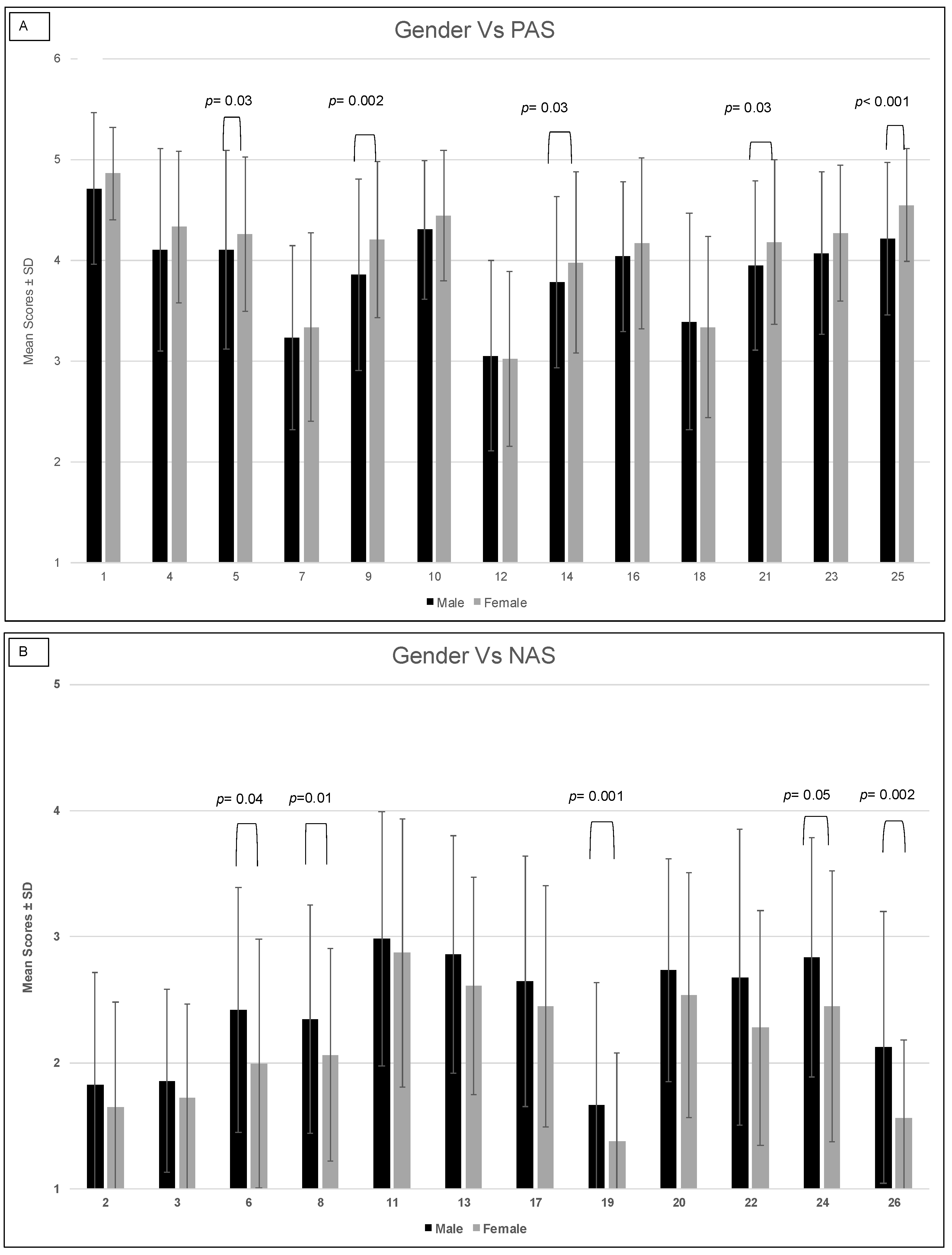
At an item level, using pairwise comparison (post hoc LSD), five PAS items were significantly higher in females (Figure 2A), including items 5, 9, 14, 21 and 25.
Item 5: “Learning communication skills has helped or will help me respect patients”
Item 9: “Learning communication skills in PBLs, workshops and clinical skills has helped or will help facilitate my team-working skills”
Item 14: “Learning communication skills has helped or will help me respect my colleagues”
Item 21: “I think it’s really useful learning communication skills on the optometry degree”
Item 25: “Learning communication skills is important because my ability to communicate is a lifelong skill”
Additionally, five NAS items were significantly higher (more negative) among males (Figure 2B), including items 6, 8, 19, 24 and 26 (Table 3).
Item 6: “I haven’t got time to learn communication skills”
Item 8: “I won’t/can’t be bothered to turn up to sessions on communication skills”
Item 19: “I don’t need good communication skills to be an optometrist”
Item 24: “I find it difficult to take communication skills learning seriously”
Item 26: “Communication skills learning should be left to psychology students, not optometry students”.

4. Discussion

This study demonstrates that optometry students generally hold strong positive attitudes and low negative attitudes towards learning communication skills. These findings are consistent with previous research across medicine and other health professions, which show that students recognise the value of communication training for clinical competence and patient-centred care (Rees & Sheard, 2003). Although Deakin’s Optometry programme does not offer a stand-alone communication unit, students’ positive attitudes may reflect the programme’s pedagogical design, particularly its Problem-Based Learning (PBL) structure, which inherently requires collaborative discussion, analytical reasoning, role-play and authentic communication in case-based scenarios. In our cohort, the lowest-rated PAS item was “communication is fun”, suggesting that although students value communication as a core clinical skill, they may not always enjoy the activities used to teach it. This suggests that communication is perceived as important, but effortful, reinforcing the importance of incorporating evidence-based, engaging, interactive and clinically relevant teaching methods.

4.1. Year Level Differences

While some studies have shown a decline in positive attitudes and/or an increase in negative attitudes towards learning communication skills with advancing levels of university years (Power & Lennie, 2012), others have found improvement in attitudes with increasing schooling level (Aryal, 2012). A higher university year level resulting in increased NAS and a decrease in PAS is seen as migration from patient-centred attitude in formative years to more doctor-centred attitudes in final years (Batenburg et al., 1999). Similarly, longitudinal evidence using the CSAS has demonstrated a significant decline in positive attitudes and a concurrent increase in negative attitudes from first to fourth year in medical students, despite structured communication training (Ruiz-Moral et al., 2021). Notably, this decline was driven by reduced enthusiasm for communication skills learning, while students’ intellectual recognition of its importance remained stable (Ruiz-Moral et al., 2021). In contrast to other studies showing a decline in attitudes, our study showed that attitudes were consistent for NAS across year levels. Students became slightly less positive in second year; however, they were more positive again by third year, when students are performing supervised consultations in clinic. This difference could be attributed to second-year students practicing on each other, while third-year students work with patients and must be adept in communication skills to elicit a detailed history and perform tests accurately.
The item-level analysis provides a more nuanced insights into how students’ beliefs evolve. Third-year students demonstrated more positive attitudes to items relating to respecting colleagues and upholding patient rights regarding confidentiality and informed consent (Figure 1A). These competencies align with the later stages of professional identity formation, where clinical exposure helps students integrate ethical, interpersonal and communication roles into their developing professional self-concept (Cruess et al., 2015). Encountering real patients may therefore make the relevance of communication more explicit than in pre-clinical years.
Interestingly, first-year students had significantly more negative attitudes to two NAS items (item 3—failing optometry for having poor communication skills and item 22—passing exams) compared to later year levels, indicating early misconceptions that communication skills are less important for assessment or academic progression. Similar patterns have been reported in early medical and nursing programmes, where early-year students often perceive assessments as purely academic rather than focused on interpersonal or patient-centred competencies (Novaes et al., 2023). Attitudes became less negative in second year, likely reflecting clearer links between communication, professionalism and case-based learning. The small rise in negativity in third year may relate to the transition into clinical environments, where increased pressure and uncertainty can temporarily reduce students’ confidence or create confusion about assessment priorities while approaching clinical assessments (Figure 1B).
Overall, these findings suggest that, while average attitudes appear stable across year levels, beliefs evolve in response to curricular emphasis and clinical exposure. Providing more explicit communication-focused assessment criteria, earlier standardised patient encounters and structured formative feedback may help reduce misconceptions about the central role of communication in clinical competence and professional readiness.

4.2. Age-Related Differences

Deakin’s optometry programme attracts a diverse student cohort, including school-leavers, graduates transitioning from other degrees and mature-aged students with prior employment experience. Mature-aged health-professional students may differ from younger peers in confidence, self-direction and interpersonal skills, and thus we examined whether attitudes towards learning communication skills varied by age.
Overall, age appeared to have a modest influence on attitudes toward communication training. Although the statistical analysis indicated an overall age effect, the two groups displayed comparable levels of positivity. The lack of significant differences in overall scores may be attributable to the small proportion of mature-aged students (10.1%), limiting statistical power to detect subtle differences.
However, item-level analysis revealed meaningful patterns. Students aged 18–25 years scored significantly higher on two PAS items: recognising patients’ rights regarding confidentiality and informed consent (item 16) and perceiving communication skills as a useful and important component of the optometry degree (item 21). These findings suggest that younger students may be more receptive to structured communication instructions and more likely to recognise its relevance early in their training. In contrast, mature-aged students may already have greater familiarity with concepts such as confidentiality and patient rights, reducing the novelty or perceived instructional value of these topics. Additionally, mature-aged students often report feeling more time-poor due to competing responsibilities, which may influence their engagement with communication-focused teaching (Harth et al., 1990; Kick et al., 2000).
These trends align with previous literature showing that younger and female students tend to be more enthusiastic learners of communication skills, particularly in medical education settings (Anvik et al., 2008; Rees & Sheard, 2002). Nonetheless, interpretation of our findings is limited by the broad age categories used and the small number of mature-age participants. Future studies will benefit from more refined age groupings and a larger mature-age sample to better explore how life experience and competing commitments shape attitudes towards communication training.

4.3. Gender Differences

Institutional enrolment data for Deakin University’s optometry programme show that 65–70% of students are female, consistent with the broader trends in optometry education. National workforce data indicate that new entrants of the optometry profession in Australia are predominantly female; for example, in an analysis of Australian Health Practitioner Regulation Agency (AHPRA) data indicates that 66% of new optometrists entering practice were women (Duffy et al., 2021). Internationally, similar patterns are observed: for example, in the 2024–2025 academic year, 73.0% of US optometry students were female, with 69.9% of graduates also women (Association of Schools and Colleges of Optometry, 2024). Thus, the gender distribution in our sample (70.3% female) aligns closely with both Australian and international demographic patterns, suggesting representativeness rather than sampling imbalance.
A significant effect of gender on communication attitudes was observed, with female students demonstrating more positive and less negative attitudes than male students. These findings are consistent with previous CSAS research across medical and health professions, where female learners typically report valuing communication skills more highly than males (Aryal, 2012; Busch et al., 2015; Mussalo et al., 2025; Pochrzęst-Motyczyńska et al., 2025; Rees & Garrud, 2001; Ruiz-Moral et al., 2021). Several factors may contribute to this pattern. Gendered socialisation and communication norms may predispose female students to place greater emphasis on interpersonal and empathetic skills. Female students may also perceive communication as more central to professional identity and patient-centred care, whereas male students may prioritise technical or knowledge based competencies (Graf et al., 2017). Evidence from healthcare research supports this tendency: female physicians engage in more patient-centred communication behaviours, such as active partnership, psychosocial counselling, emotionally focused talk, and disclosing more biomedical information (Roter & Hall, 2004).
Contextual and cultural factors further moderate these differences. For example, studies in Germany (Busch et al., 2015) and Nepal (Aryal, 2012) found significantly higher PAS and lower NAS scores among female students. In contrast, a non-western study reported no significant differences between males and females, suggesting that local educational culture and societal expectations influence how communication skills are valued (Marambe et al., 2012).
Although the gender-based differences we observed were robust and statistically significant, their practical implications remain unclear. Our study did not examine whether more positive attitudes among female students translate into better communication performance during clinical skills assessments, Objective Structured Clinical Examinations (OSCEs) or patient-examiner feedback. Existing literature is mixed: some studies report no meaningful change in attitudes following communication training (Batenburg & Smal, 1997), while others show improvements in student confidence and skill performance, even when the attitudinal change is modest (Knight et al., 2020). However, Cleland et al. reported poorer results for male students in their medical OSCEs (Cleland et al., 2005). Whether males’ comparatively less favourable attitudes result in weaker communication and assessment performance, or whether training mitigates attitudinal differences remains unknown for optometry students.
Overall, our findings align strongly with international literature: female optometry students consistently demonstrate more positive and less negative attitudes toward learning communication skills. Cleland et al. reported that female medical students demonstrated more positive attitudes towards learning communication in a study based at a Scottish University (Cleland et al., 2005), while similar results were reported by Mussalo et al. among dentistry students at the University of Helsinki (Mussalo et al., 2025). Understanding how these differences influence learning behaviours and clinical performance is an important next step for communication education in optometry.

4.4. Implications for Curriculum Design

Our findings have several important implications for optometry curriculum design. Overall, students demonstrated strong positive attitudes towards communication skills, indicating receptiveness to training and recognition of its professional relevance. However, fluctuations across year levels suggest transitional points that warrant attention. The reduction in positivity among second-year students implies that engagement may decrease before clinical exposure to patients, highlighting the value of integrating structured simulated consultations or standardised patient encounters at this stage to maintain motivation. Additionally, first-year students showed misconceptions about the role of communication in assessment and professional competence, suggesting that making communication learning outcomes and assessment criteria explicit from the start could reduce misunderstandings. Gender and age differences, with female and younger students reporting more positive attitudes, indicate that training should be inclusive and emphasise professional relevance for all learners, integrating reflective exercises that connect prior experience with learning objectives.
Optometry curriculum developers should capitalise on the findings of this study by rolling out communication curricula across all years, not only early or late stages. Literature suggests that communication skills tend to decline over time unless they are regularly reviewed and practiced; therefore, while there is a positive attitude towards learning communication skills, this should be optimised with evidence-based, engaging and enjoyable communication trainings.

4.5. Limitations

This study has several limitations. First, the adaptation of the CSAS for optometry (CSAS-Optom) may affect cross-professional comparability, as prior research has highlighted that instrument modifications can influence reliability and validity across different health disciplines (Stewart et al., 2012; Swan et al., 2023). Second, our age categories were broad, which limited our ability to detect subtle differences in how age influences attitudes; future research should use more granular age brackets. Third, participation was voluntary, which may have introduced self-selection bias, where students with more positive views of communication may have been more likely to respond. Fourth, the sample came from a single institution with a PBL based teaching structure, limiting generalisability across conventional optometry programmes with different curricular designs, demographics or teaching models. Fifth, racial identity was not evaluated as the cohort is multicultural; however, as non-western studies have shown no gender differences in attitudes, this could have been investigated further. Lastly, we did not link attitude scores to objective performance measures, such as, clinical assessments or oatient-rated communication, and thus cannot verify whether positive attitudes translate into improved competence or effectiveness in clinical practice. Future studies should investigate this relationship to establish whether fostering positive attitudes leads to measurable improvements in communication performance and patient care outcomes, which would provide stronger evidence for the impact of communication training in optometry education.

5. Conclusions

In conclusion, this study demonstrates that optometry students hold positive attitudes towards learning communication skills, which may be supported by the Problem-Based Learning (PBL) structure of Deakin’s optometry programme. Although attitudes were generally stable across year levels (dipping slightly in second year), younger students and female students showed more positive views, particularly regarding communication’s relevance to professional development. The low rating for “communication is fun” suggests that students may find learning activities effortful, highlighting the need for more engaging, interactive, and clinically relevant methods. These findings support integrating communication training throughout the curriculum, with targeted strategies at key transition points and clear links to assessment. Future research should adopt longitudinal designs to track changes in student attitudes over time and examine how these attitudes relate to observed clinical communication competence. Additionally, evaluating the impact of structured simulations, formative feedback, and comparisons with more traditional curricula would help optimise communication skills training in optometry education.

Author Contributions

Conceptualisation, S.A., H.C. and M.G.; Methodology, S.A., H.C. and M.G.; Formal analysis, S.A., H.C. and M.G.; Investigation, S.A. and H.C.; Resources, S.A. and H.C.; Data curation, S.A.; Writing—original draft, S.A.; Writing—review and editing, S.A., H.C. and M.G.; Visualisation, S.A.; Project administration, S.A. and H.C. All authors have read and agreed to the published version of the manuscript.

Funding

This research received no external funding.

Institutional Review Board Statement

The study was conducted in accordance with the Declaration of Helsinki and approved Deakin University Human Research Ethics Committee (DUHREC) on 2 November 2017 (2017-320).

Informed Consent Statement

No consent form, as the data was collected for educational purposes initially, and then used for research, when the ethics was approved. Participation was voluntary and anonymous.

Data Availability Statement

The raw data supporting the conclusions of this article will be made available by the authors on request.

Conflicts of Interest

The authors declare no conflicts of interest.

Abbreviations

The following abbreviations are used in this manuscript:
CSASCommunication Skills Attitude Scale
CSAS-OptomCommunication Skills Attitude Scale for Optometry
NASNegative Attitude Scale
PASPositive Attitude Scale
ANOVAAnalysis of Variance
PBLProblem-Based Learning
MANOVAMultivariate Analysis of Variance
LSDLeast Significance difference
SDStandard Deviation
OSCEsObjective Structures Clinical Examinations

References

  1. Anvik, T., Grimstad, H., Baerheim, A., Bernt Fasmer, O., Gude, T., Hjortdahl, P., Holen, A., Risberg, T., & Vaglum, P. (2008). Medical students’ cognitive and affective attitudes towards learning and using communication skills—A nationwide cross-sectional study. Medical Teacher, 30(3), 272–279. [Google Scholar] [CrossRef]
  2. Aryal, D. B. (2012). Attitude towards learning communication skills in medical students of Chitwan Medical College Chitwan Nepal. International Journal of Pharmaceutical & Biological Archive, 3(5), 1058–1061. [Google Scholar]
  3. Association of Schools and Colleges of Optometry. (2024). Applicant/student profile and prerequisites. ASCO. Available online: https://optometriceducation.org/future-students/resources/applicant-student-profile-and-prerequisites/ (accessed on 5 March 2026).
  4. Batenburg, V., & Smal, J. A. (1997). Does a communication course influence medical students’ attitudes? Medical Teacher, 19(4), 263–269. [Google Scholar] [CrossRef]
  5. Batenburg, V., Smal, J. A., Lodder, A., & De Melker, R. A. (1999). Are professional attitudes related to gender and medical specialty? Medical Education, 33(7), 489–492. [Google Scholar] [CrossRef]
  6. Biglu, M.-H., Nateq, F., Ghojazadeh, M., & Asgharzadeh, A. (2017). Communication skills of physicians and patients’ satisfaction. Materia Socio-Medica, 29(3), 192–195. [Google Scholar] [CrossRef] [PubMed]
  7. Busch, A.-K., Rockenbauch, K., Schmutzer, G., & Brähler, E. (2015). Do medical students like communication? Validation of the German CSAS (Communication Skills Attitude Scale). GMS Zeitschrift Für Medizinische Ausbildung, 32(1), 1–21. [Google Scholar] [CrossRef]
  8. Chen, X., Liu, C., Yan, P., Wang, H., Xu, J., & Yao, K. (2025). The impact of doctor-patient communication on patient satisfaction in outpatient settings: Implications for medical training and practice. BMC Medical Education, 25, 830. [Google Scholar] [CrossRef]
  9. Choon-Huat Koh, G., Khoo, H. E., Wong, M. L., & Koh, D. (2008). The effects of problem-based learning during medical school on physician competency: A systematic review. Canadian Medical Association Journal (CMAJ), 178(1), 34–41. [Google Scholar] [CrossRef]
  10. Cleland, J., Foster, K., & Moffat, M. (2005). Undergraduate students’ attitudes to communication skills learning differ depending on year of study and gender. Medical Teacher, 27(3), 246–251. [Google Scholar] [CrossRef]
  11. Crawford, T., Candlin, S., & Roger, P. (2017). New perspectives on understanding cultural diversity in nurse–patient communication. Collegian, 24(1), 63–69. [Google Scholar] [CrossRef]
  12. Cruess, R. L., Cruess, S. R., Boudreau, J. D., Snell, L., & Steinert, Y. (2015). A schematic representation of the professional identity formation and socialization of medical students and residents: A guide for medical educators. Academic Medicine, 90(6), 718–725. [Google Scholar] [CrossRef]
  13. Davis, J., Foley, A., Crigger, N., & Brannigan, M. C. (2008). Healthcare and listening: A relationship for caring. International Journal of Listening, 22(2), 168–175. [Google Scholar] [CrossRef]
  14. Denniston, C., Molloy, E., Nestel, D., Woodward-Kron, R., & Keating, J. L. (2017). Learning outcomes for communication skills across the health professions: A systematic literature review and qualitative synthesis. BMJ Open, 7(4), e014570. [Google Scholar] [CrossRef] [PubMed]
  15. Dolmans, D., De Grave, W., Wolfhagen, I., & van der Vleuten, C. (2005). Problem-based learning: Future challenges for educational practice and research. Medical Education, 39(7), 732–741. [Google Scholar] [CrossRef] [PubMed]
  16. Douglas, R. N., Stephens, L. S., Posner, K. L., Davies, J. M., Mincer, S. L., Burden, A. R., & Domino, K. B. (2021). Communication failures contributing to patient injury in anaesthesia malpractice claims. British Journal of Anaesthesia, 127(3), 470–478. [Google Scholar] [CrossRef]
  17. Duffy, J. F., Douglass, A. G., Hammond, D. S., & Woods, C. A. (2021). Demographics and distribution of new entrants to the optometry profession in Australia. Clinical and Experimental Optometry, 104(2), 222–228. [Google Scholar] [CrossRef] [PubMed]
  18. Epstein, R. M., & Street, R. L. (2011). The values and value of patient-centered care. The Annals of Family Medicine, 9(2), 100–103. [Google Scholar] [CrossRef] [PubMed]
  19. Gale, C., Hannah, A., Swain, N., Gray, A., Coverdale, J., & Oud, N. (2009). Patient aggression perceived by community support workers. Australasian Psychiatry: Bulletin of Royal Australian and New Zealand College of Psychiatrists, 17(6), 497–501. [Google Scholar] [CrossRef]
  20. Giménez-Espert, M. D. C., Maldonado, S., Pinazo, D., & Prado-Gascó, V. (2021). Adaptation and validation of the Spanish version of the instrument to evaluate nurses’ attitudes toward communication with the patient for nursing students. Frontiers in Psychology, 12, 736809. [Google Scholar] [CrossRef]
  21. Graf, J., Smolka, R., Simoes, E., Zipfel, S., Junne, F., Holderried, F., Wosnik, A., Doherty, A. M., Menzel, K., & Herrmann-Werner, A. (2017). Communication skills of medical students during the OSCE: Gender-specific differences in a longitudinal trend study. BMC Medical Education, 17(1), 75. [Google Scholar] [CrossRef]
  22. Hande, S., Mohammed, C. A., & Komattil, R. (2015). Acquisition of knowledge, generic skills and attitudes through problem-based learning: Student perspectives in a hybrid curriculum. Journal of Taibah University Medical Sciences, 10(1), 21–25. [Google Scholar] [CrossRef]
  23. Harth, S. C., Biggs, J. S. G., & Thong, Y. H. (1990). Mature-age entrants to medical school: A controlled study of sociodemographic characteristics, career choice and job satisfaction. Medical Education, 24(6), 488–498. [Google Scholar] [CrossRef]
  24. Hausberg, M. C., Hergert, A., Kröger, C., Bullinger, M., Rose, M., & Andreas, S. (2012). Enhancing medical students’ communication skills: Development and evaluation of an undergraduate training program. BMC Medical Education, 12(1), 16. [Google Scholar] [CrossRef]
  25. Kick, S., Adams, L., & O’Brien-Gonzales, A. (2000). Unique issues of older medical students. Teaching and Learning in Medicine, 12(3), 150–155. [Google Scholar] [CrossRef]
  26. Knight, A., Baldwin, C., Reidlinger, D. P., & Whelan, K. (2020). Communication skills teaching for student dietitians using experiential learning and simulated patients. Journal of Human Nutrition and Dietetics, 33(5), 601–613. [Google Scholar] [CrossRef] [PubMed]
  27. Kwame, A., & Petrucka, P. M. (2021). A literature-based study of patient-centered care and communication in nurse-patient interactions: Barriers, facilitators, and the way forward. BMC Nursing, 20(1), 158. [Google Scholar] [CrossRef] [PubMed]
  28. Levinson, W., & Roter, D. (1995). Physicians’ psychosocial beliefs correlate with their patient communication skills. Journal of General Internal Medicine, 10(7), 375–379. [Google Scholar] [CrossRef]
  29. Maguire, P., & Pitceathly, C. (2002). Key communication skills and how to acquire them. BMJ: British Medical Journal, 325(7366), 697–700. [Google Scholar] [CrossRef]
  30. Marambe, K., Edussuriya, D., & Dayaratne, K. M. P. L. (2012). Attitudes of Sri Lankan medical students toward learning communication skills. Education for Health, 25(3), 165–171. [Google Scholar] [CrossRef]
  31. Mata, Á. N. d. S., Azevedo, K. P. M. d., Braga, L. P., de Medeiros, G. C. B. S., Segundo, V. H. d. O., Bezerra, I. N. M., Pimenta, I. D. S. F., Nicolás, I. M., & Piuvezam, G. (2021). Training in communication skills for self-efficacy of health professionals: A systematic review. Human Resources for Health, 19(1), 1–9. [Google Scholar] [CrossRef]
  32. Mussalo, F., Karaharju-Suvanto, T., Salmela, E., Antila, A., & Pyörälä, E. (2025). Dental students’ attitudes and perspectives on communicating with paediatric patients and their parents. BMC Medical Education, 25(1), 1454. [Google Scholar] [CrossRef]
  33. Náfrádi, L., Nakamoto, K., & Schulz, P. J. (2017). Is patient empowerment the key to promote adherence? A systematic review of the relationship between self-efficacy, health locus of control and medication adherence. PLoS ONE, 12(10), 1–23. [Google Scholar] [CrossRef]
  34. Nguyen, B. N., Ng, J., Piano, M. E., Cochrane, A. L., & Guest, D. (2024). Improving optometry student interpersonal skills through online patient, clinician and student evaluation and feedback. Clinical and Experimental Optometry, 107(1), 83–92. [Google Scholar] [CrossRef]
  35. Novaes, F. P. S. S., Alves, J. G. B., & Grosseman, S. (2023). Communication in healthcare: Experience of students and professionals from teaching-learning to practice in health. International Journal of Medical Education, 14, 23–35. [Google Scholar] [CrossRef] [PubMed]
  36. Optometry Australia. (2022). Entry-level competency standards for optometry 2022. Available online: https://www.optometry.org.au/wp-content/uploads/Professional_support/Guidelines/Final_Entry-level-Competency-Standard-for-Optometry-2022.pdf (accessed on 5 March 2026).
  37. Peimani, M., Tanhapour, M., Majlesi, M., & Nasli-Esfahani, E. (2025). Training in communication skills for healthcare providers in chronic care: A systematic review. BMC Medical Education, 25(1), 1314. [Google Scholar] [CrossRef] [PubMed]
  38. Pochrzęst-Motyczyńska, A., Ostrowski, J., Sys, D., Pinkas, J., & Religioni, U. (2025). Evaluation of attitudes to learning doctor-patient communication skills in 427 postgraduate doctors using the Communication Skills Attitude Scale (CSAS) Questionnaire. Medical Science Monitor: International Medical Journal of Experimental and Clinical Research, 31, e947276. [Google Scholar] [CrossRef]
  39. Power, B. T., & Lennie, S. C. (2012). Pre-registration dietetic students’ attitudes to learning communication skills. Journal of Human Nutrition and Dietetics, 25(2), 189–197. [Google Scholar] [CrossRef] [PubMed]
  40. Rees, C., & Garrud, P. (2001). Identifying undergraduate medical students’ attitudes towards communication skills learning: A pilot study. Medical Teacher, 23(4), 400–406. [Google Scholar] [CrossRef]
  41. Rees, C., & Sheard, C. (2002). The relationship between medical students’ attitudes towards communication skills learning and their demographic and education-related characteristics. Medical Education, 36(11), 1017–1027. [Google Scholar] [CrossRef]
  42. Rees, C., & Sheard, C. (2003). Evaluating first-year medical students’ attitudes to learning communication skills before and after a communication skills course. Medical Teacher, 25(3), 302. [Google Scholar] [CrossRef] [PubMed]
  43. Rees, C., Sheard, C., & Davies, S. (2002). The development of a scale to measure medical students’ attitudes towards communication skills learning: The Communication Skills Attitude Scale (CSAS). Medical Education, 36(2), 141–147. [Google Scholar] [CrossRef] [PubMed]
  44. Rider, E. A., & Keefer, C. H. (2006). Communication skills competencies: Definitions and a teaching toolbox. Medical Education, 40(7), 624–629. [Google Scholar] [CrossRef]
  45. Roter, D. L., & Hall, J. A. (2004). Physician gender and patient-centered communication: A critical review of empirical research. Annual Review of Public Health, 25(1), 497–519. [Google Scholar] [CrossRef]
  46. Ruiz-Moral, R., Monge Martin, D., Garcia de Leonardo, C., Denizon, S., Cerro Pérez, A., & Caballero Martínez, F. (2021). Medical students’ attitudes towards communication skills training: A longitudinal study with one cohort. GMS Journal for Medical Education, 38(6), Doc107. [Google Scholar] [CrossRef]
  47. Schmidt, H. G., Rotgans, J. I., & Yew, E. H. (2011). The process of problem-based learning: What works and why. Medical Education, 45(8), 792–806. [Google Scholar] [CrossRef]
  48. Seneviratne, R. D., Samarasekera, D. D., Karunathilake, I. M., & Ponnamperuma, G. G. (2001). Students’ perception of problem-based learning in the medical curriculum of the Faculty of Medicine, University of Colombo. Annals of the Academy of Medicine, Singapore, 30(4), 379–381. [Google Scholar] [CrossRef]
  49. Stewart, A. L., Thrasher, A. D., Goldberg, J., & Shea, J. A. (2012). A framework for understanding modifications to measures for diverse populations. Journal of Aging and Health, 24(6), 992–1017. [Google Scholar] [CrossRef]
  50. Swan, K., Speyer, R., Scharitzer, M., Farneti, D., Brown, T., Woisard, V., & Cordier, R. (2023). Measuring what matters in healthcare: A practical guide to psychometric principles and instrument development. Frontiers in Psychology, 14, 1225850. [Google Scholar] [CrossRef]
  51. White, S. J., Condon, B., Ditton-Phare, P., Dodd, N., Gilroy, J., Hersh, D., Kerr, D., Lambert, K., McPherson, Z. E., Mullan, J., Saad, S., Stubbe, M., Warren-James, M., Weir, K. R., & Gilligan, C. (2023). Enhancing effective healthcare communication in Australia and Aotearoa New Zealand: Considerations for research, teaching, policy, and practice. PEC Innovation, 3, 100221. [Google Scholar] [CrossRef] [PubMed]
  52. Yao, M., Zhou, X., Xu, Z., Lehman, R., Haroon, S., Jackson, D., & Cheng, K. K. (2021). The impact of training healthcare professionals’ communication skills on the clinical care of diabetes and hypertension: A systematic review and meta-analysis. BMC Family Practice, 22(1), 152. [Google Scholar] [CrossRef] [PubMed]
  53. Zhang, Y., Jiang, G., Sun, Y., Zhao, X., & Yu, X. (2019). Adaptation of the Communication Skills Attitude Scale (CSAS) to surgical residents in China. Journal of Surgical Education, 76(2), 329–336. [Google Scholar] [CrossRef] [PubMed]
  54. Zolnierek, K. B. H., & Dimatteo, M. R. (2009). Physician communication and patient adherence to treatment: A meta-analysis. Medical Care, 47(8), 826–834. [Google Scholar] [CrossRef] [PubMed]
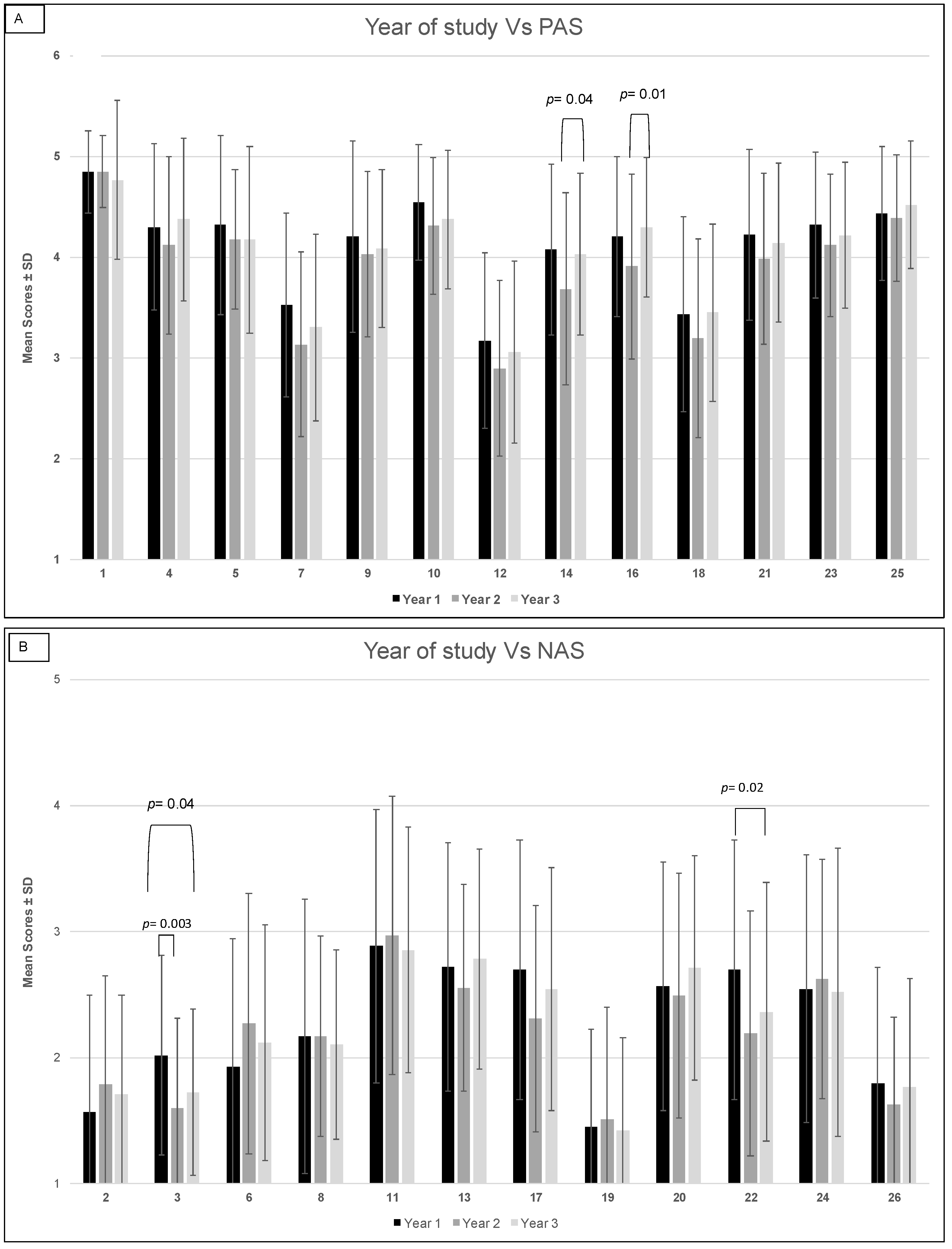
Figure 1. (A) Mean CSAS-Optom scores for PAS per item (x-axis) stratified for year level. Significant differences between year levels indicated with respective p-values. PAS (Positive Attitude Scale). (B) Mean CSAS-Optom scores for NAS per item (x-axis) stratified for year level. Significant differences between year levels indicated with respective p-values. NAS (Negative Attitude Scale), SD (Standard deviation). Items were scored as strongly disagree (1), disagree (2), neutral (3), agree (4) and strongly agree (5). Item numbers correspond to questions in Table 1.
Education 16 00428 g001
Figure 2. (A) Mean CSAS-Optom scores for PAS per item (x-axis) stratified by gender. Significant differences indicated with respective p-value. PAS (Positive Attitude Scale), SD (Standard deviation). (B) Mean CSAS-Optom scores for NAS per item (x-axis) stratified by gender. Significant differences indicated with respective p-value. NAS (Negative Attitude Scale), SD (Standard deviation). Items were scored as strongly disagree (1), disagree (2), neutral (3), agree (4) and strongly agree (5). Item numbers correspond to questions in Table 1.
Education 16 00428 g002
Table 1. Adapted Communication Skills Attitude Scale survey used for Optometry (CSAS-Optom). The original CSAS wording was modified by replacing terms related to medicine (e.g., doctor, medical school) with optometry or optometrist. Items are rated on a 5-point Likert scale (1 = Strongly Disagree, 2 = Disagree, 3 = Neutral, 4 = Agree and 5 = Strongly Agree).
Item No Question
1In order to be a good optometrist I must have good communication skills
2I can’t see the point of learning communication skills
3Nobody is going to fail their optometry degree for having poor communication skills
4Developing my communication skills is just as important as developing my knowledge of optometry
5Learning communication skills has helped or will help me respect patients
6I haven’t got time to learn communication skills
7Learning communication skills is interesting
8I won’t/can’t be bothered to turn up to sessions on communication skills
9Learning communication skills in PBLs, workshops and clinical skills has helped or will help facilitate my team-working skills
10Learning about communication skills will improve my ability to communicate with patients
11Communication skills teaching states the obvious and then complicates it
12Learning communication skills is fun
13Learning communication skills is too easy
14Learning communication skills has helped or will help me respect my colleagues
16Learning communication skills has helped or will help me recognise patients’ rights regarding confidentiality and informed consent
17Communication skills teaching would have a better image if it sounded more like a science subject
18When applying for optometry, I thought it was a really good idea to learn communication skills
19I don’t need good communication skills to be an optometrist
20I find it hard to admit to having some problems with my communication skills
21I think it’s really useful learning communication skills on the optometry degree
22My ability to pass exams will get me through optometry rather than my ability to communicate
23Learning communication skills is applicable to learning optometry
24I find it difficult to take communication skills learning seriously
25Learning communication skills is important because my ability to communicate is a lifelong skill
26Communication skills learning should be left to psychology students, not optometry students
Table 2. Demographics and Scores of Positive Attitude Scale (PAS) and Negative Attitude Scale (NAS) stratified by Year Levels, Age Groups and Gender.
Total1st Year2nd Year3rd YearMaleFemaleAge 18–25Age ≥ 26
Total Students247838083----
Students Responded (%)189 (76.5%)53
(63.9%)
67
(85%)
69
(82.1%)
56 (29.6%)133 (70.3%)170
(89.9%)
19
(10%)
Gender (male: female)56:13317:3617:5022:47--47:1239:10
Age (18–25: ≥26) 170:1948:561:661:8----
PAS (Mean ± SD)
Significance
4.0 ± 0.14.1 ± 0.63.9 ± 0.54.1 ± 0.53.9 ± 0.54.1 ± 0.54.0 ± 0.53.8 ± 0.6
1st to 2nd year:
p < 0.05
2nd to 3rd year:
p > 0.05
Gender: p = 0.04Age: p > 0.05
NAS (Mean ± SD)
Significance
2.2 ± 0.52.3 ± 0.52.2 ± 0.52.2 ± 0.52.4 ± 0.52.1 ± 0.52.2 ± 0.52.2 ± 0.5
Across all optometry levels
p > 0.05
Gender: p < 0.001Age: p > 0.05
p = level of significance set at 0.05; SD = standard deviation. Multivariate Analysis of Variance with Bonferroni correction was used.
Table 3. Communication Skills Attitude Scale (CSAS-Optom) Questions with Significant Differences and Interpretations for Year Level, Age and Gender, Stratified by Positive Attitude Scale (PAS) and Negative Attitude Scale (NAS).
Item NoCSAS-OptomSignificant Difference FoundInterpretation
Positive Attitude Scale (PAS)
5Learning communication skills has helped or will help me respect patients.Gender Difference: Female students scored significantly higher (4.37 ± 0.14) than male students (3.87 ± 0.17) (p = 0.03).Female students exhibit a stronger belief in the importance of communication skills for patient respect, which may reflect gender-based differences in attitudes toward patient care
9Learning communication skills in PBLs, workshops and clinical skills has helped or will help facilitate my team-working skills.Gender Difference: Female students scored significantly higher (4.29 ± 0.14) than male students (3.64 ± 0.16) (p = 0.002).Female students may value communication skills more as a tool for teamwork, suggesting that they see communication as a critical element in collaborative settings.
14Learning communication skills has helped or will help me respect my colleagues.Gender Difference: Female students scored significantly higher (4.06 ± 0.15) than male students (3.55 ± 0.17) (p = 0.03).
Year Difference: 3rd-year students scored significantly higher (4.08 ± 0.17) than 2nd-year students (3.48 ± 0.21) (p = 0.04).
Female students value communication skills in fostering respect among colleagues more than males. Additionally, 3rd-year students recognise the importance of communication for colleague respect more than 2nd-year students, possibly reflecting increased experience.
16Learning communication skills has helped or will help me recognise patients’ rights regarding confidentiality and informed consent.Year Difference: 3rd-year students scored significantly higher (4.23 ± 0.16) than 2nd-year students (3.67 ± 0.19) (p = 0.01).
Age Difference: Students aged 18–25 years scored significantly higher (4.10 ± 0.10) than students aged ≥26 years (3.70 ± 0.20) (p = 0.003).
As students’ progress in their studies, they increasingly recognise the role of communication skills in patient rights. Younger students (18–25) also seem to value these skills more than older students, which could be linked to greater exposure to patient-centred care in their curriculum.
21I think it’s really useful learning communication skills on the optometry degree.Age Difference: Students aged 18–25 years scored significantly higher (4.10 ± 0.10) than students aged ≥26 years (3.50 ± 0.20) (p = 0.006).
Gender Difference: Female students scored significantly higher (4.06 ± 0.14) than male students (3.59 ± 0.16) (p = 0.03).
Younger students tend to see communication skills as more beneficial for their optometry studies than older students. Additionally, female students may generally view these skills as more useful than male students do.
25Learning communication skills is important because my ability to communicate is a lifelong skillGender Difference: Female students scored significantly higher (4.60 ± 0.11) than male students (4.02 ± 0.12) (p < 0.001).Female students place more importance on communication skills as a lifelong skill, indicating a stronger recognition of the long-term value of these abilities compared to male students.
Negative Attitude Scale (NAS)
3Nobody is going to fail their optometry degree for having poor communication skills.Year Difference: 1st-year students scored significantly more negatively (2.34 ± 0.17) than 2nd-year students (1.43 ± 0.17) (p = 0.003) and 3rd-year students (1.77 ± 0.14) (p = 0.04).1st-year students are more likely to downplay the importance of communication skills in academic success, whereas higher-year students increasingly recognise their value.
6I haven’t got time to learn communication skills.Gender Difference: Male students scored significantly more negatively (2.37 ± 0.19) than female students (1.85 ± 0.16) (p = 0.04).Male students seem more likely to express time constraints as a barrier to learning communication skills, possibly reflecting different priorities or perceived workloads.
8I won’t/can’t be bothered to turn up to sessions on communication skills.Gender Difference: Male students scored significantly more negatively (2.51 ± 0.18) than female students (1.92 ± 0.15) (p = 0.01).Male students are more likely to show a lack of motivation toward attending communication skills sessions, which could indicate a lower perceived value of these sessions.
19I don’t need good communication skills to be an optometrist.Gender Difference: Male students scored significantly more negatively (1.91 ± 0.15) than female students (1.25 ± 0.13) (p = 0.001).Male students are more likely to underestimate the importance of communication skills in optometry practice, suggesting that they may view technical skills as more crucial.
24I find it difficult to take communication skills learning seriously.Gender Difference: Male students scored significantly more negatively (2.83 ± 0.21) than female students (2.29 ± 0.18) (p = 0.05).Male students are more likely to have a negative view of communication skills learning, potentially perceiving it as less important or relevant to their training.
26Communication skills learning should be left to psychology students, not optometry students.Gender Difference: Male students scored significantly more negatively (2.11 ± 0.15) than female students (1.50 ± 0.13) (p = 0.002).Male students are more likely to question the relevance of communication skills in optometry, suggesting a tendency to dismiss its importance compared to other disciplines.
Disclaimer/Publisher’s Note: The statements, opinions and data contained in all publications are solely those of the individual author(s) and contributor(s) and not of MDPI and/or the editor(s). MDPI and/or the editor(s) disclaim responsibility for any injury to people or property resulting from any ideas, methods, instructions or products referred to in the content.