


Abstract
This study investigates the pedagogical value of integrating AI-supported feedback with Error Analysis in university-level English as a Foreign Language (EFL) writing instruction, where English is the target language (TL). Adopting a comparative, corpus-based design, the research examines whether AI-mediated feedback can complement traditional teacher-led Error Analysis in reducing recurrent errors, improving grammatical accuracy, and supporting revision practices among Spanish L1 learners of English at the B2 (CEFR) level. Seventy participants completed two writing tasks over a twelve-week period, generating a learner corpus that was randomly assigned to two groups: AI-assisted feedback and teacher-mediated feedback. Quantitative Error Analysis and learner-perception surveys were conducted to assess both linguistic outcomes and attitudinal responses. Results indicate that students receiving AI-assisted feedback demonstrated lower rates of error repetition (25%) compared to those receiving teacher-based correction (40%), particularly in subject–verb agreement, preposition use, tense selection, and L1-induced lexical transfer in L2 English writing. Survey findings further reveal higher perceived levels of clarity, usefulness, and immediacy for AI-generated feedback, although participants continued to value teacher input for higher-order writing concerns. Overall, the findings suggest that AI-supported Error Analysis can contribute to short-term error reduction and foster learner autonomy. This study highlights the potential of blended and mixed feedback models within a focused pedagogical context and underscores the need for longitudinal research examining long-term retention, pragmatic development, and cross-context generalizability.
1. Introduction
Recent advances in Artificial Intelligence (AI) have generated significant interest in the potential that these new and emergent technologies seem to have in enhancing teaching, learning, and assessment in (higher) education; this feature is particularly evident within language education. In the teaching of English as a Foreign Language (TEFL), AI-based tools are increasingly employed to support written production through automated feedback, error detection, and revision guidance (Macías Borrego, 2025a). However, despite this growing academic and practical enthusiasm, there is still a solid need for theoretically, pedagogically principled and grounded research which situates these emergent technologies within the limits of clearly established frameworks of Second Language Acquisition (SLA) and Applied Linguistics, rather than treating AI as a purely technical solution (Macías Borrego, 2025b).
In this light, this study seeks to investigate the integration of AI-supported feedback tools for EFL writing and Error Analysis (EA) in the assessment of written samples of English at the B2 level of the Common European Framework of Reference for Languages (CEFR). Specifically, this study aims at exploring if and how AI-mediated feedback—primarily based on Natural Language Processing (NLP)—can complement traditional Error Analysis feedback to support EFL learners’ (1) grammatical accuracy, (2) textual appropriateness, and (3) revision practices in a university-level EFL course (D. Zhang, 2020).
In this regard, it is important to note and clarify that Artificial Intelligence is used here in a restricted and pedagogical sense. Instead of referring to general or human-like (simulating) intelligence, this study focuses on AI-driven language technologies, particularly NLP-based systems designed for automated writing evaluation. These (not so) emergent systems do rely on probabilistic models, large linguistic corpora, and rule-based hybrid architectures to identify grammatical, lexical, and discourse-level patterns in learner texts. It seems essential to note that these technologies do not “understand” human language in a human sense, but they can provide consistent, immediate, and scalable feedback, making them especially relevant for educational contexts with large student cohorts (Bolhuis et al., 2024).
While the previous seems to have been proved by recent research, the pedagogical value of AI-generated/mediated feedback cannot be evaluated independently of how learners process and respond to it. For this reason, this study is anchored in Error Analysis, a foundational approach within SLA that views learner errors not merely as language flaws but perceives and regards errors as evidence of the developing of learners’ interlanguage systems (Ellis, 2015). EA has long been used in error diagnosis and treatment of recurrent error patterns (so to avoid fossilisation of those); EA has therefore proven to be key in instructional design and promotion of learner awareness through targeted and mediated feedback. Thus, by combining EA with AI-supported tools, this study aims at positioning automated feedback within a cognitively and pedagogically meaningful framework, subsequently emphasising reflection and revision rather than error correction alone (Jodai, 2012).
Recent research has underlined not only the promises and the risks of AI in language education but also the idea that AI-based feedback systems have shown critical potential to enhance some of the key areas highlighted by the constructivist framework: learner autonomy, which potentially may lead to an increased revision frequency, and support form-focused learning when used as formative tools (Ranalli et al., 2022; Kukulska-Hulme et al., 2023). On the other hand, recent researchers also show caution against uncritical adoption of AI-mediated tools. These researchers point out concerns related to overreliance on automated feedback, potential bias in training data, reduced critical engagement, and academic integrity (Zhai et al., 2024). Thus, addressing these concerns requires careful pedagogical mediation and empirical investigation into how AI tools are included in instructional and assessment practices. In this regard, we aim at responding to this need by examining AI use not as a replacement for teacher feedback but as a supplementary resource integrated into a structured assessment design.
Methodologically, this study adopts a comparative corpus-based design, in which student texts produced in the same course context are analysed under two feedback modalities: (1) traditional Error Analysis (teacher-based) evaluation and (2) AI-mediated Error Analysis. In order to address key concerns regarding comparability and fairness among group and study units, all the participants (learners) received the same writing tasks, assessment criteria, and instructional initial input (McManus, 2024). In this sense, the comparison focuses on patterns of error reduction leading to successful rule application and not on individual performance, thus mitigating potential biases related to learner variability. It is essential to note that this study does not aim at establishing key causal superiority of AI feedback, rather it seeks to explore the pedagogical affordances and limitations if and when systematically aligned with EA principles (Xie, 2019).
Population-wise, this research was conducted in a university EFL course with 70 Spanish-speaking L1 learners enrolled in a B2 level course. Key previous studies have identified persistent difficulties in developing written proficiency (accuracy and coherence) as a key reason for low achievement and course abandonment in similar contexts (Cabrera, 2014; Hyland, 2019; Macías Borrego, 2023). Thus, we seek to prove the hypothesis that AI-supported feedback, when theoretically and pedagogically grounded, can offer a viable means of addressing this issue.
In this regard, this study primarily examines whether the integration of Error Analysis and AI-based writing feedback do support more effective writing development by (1) reducing recurrent grammatical and lexical errors and (2) improving learners’ application of grammatical rules. We firmly believe that by situating AI tools within SLA theory (addressing current ethical and methodological debates), this study may contribute to a more balanced and research-informed understanding of AI’s role in EFL assessment and writing instruction.
2. Literature Review
2.1. Error Analysis and Interlanguage in Second Language Acquisition
In contemporary applied linguistics theories, errors are no longer seen or understood as a simple flaw or deviation from prescriptive norms and rules but as a systematic reflection of language development, which does reveal learners’ hypotheses about the target language (Corder, 1967, 1993; Gass & Selinker, 2008; Selinker, 1969). Thus, errors do provide insight into cognitive language processing, learning strategies, and stages of interlanguage development (Ellis, 2015; Johansson & Hofland, 1994). For instance, Spanish-speaking EFL learners frequently demonstrate negative transfer from L1, resulting in recurring syntactic and lexical errors (Macías Borrego, 2024, 2025a).
In this regard, Error Analysis (EA) emerged as an alternative to contrastive analytical approaches, emphasising internal learning mechanisms rather than attributing learner errors solely to L1 interference (Richards & Richards, 2002; Macías Borrego, 2025a). In this sense, EA remains a key area in applied linguistics, being a valuable source for curriculum design and formative assessment in language pedagogical interventions (Macías Borrego, 2025a, 2025b).
A key concept developed within EA framework is the Interlanguage Hypothesis, which posits that learners do develop a systematic and evolving (inter)linguistic system which differs from and converges L1 and L2 rule systems (Selinker, 1969; Nemser, 1971). Interlanguage development reflects and elicits processes such as L1 transfer, overgeneralization of L2 rules, error fossilisation, and learners’ hypotheses about target-language usage (Brown, 1994; Gass & Selinker, 2008). Recent research has highlighted pragmatic failure and pragmatic competence as a key critical dimension of interlanguage (Murad & Mahmood, 2018), showing that learners’ errors go beyond grammar and vocabulary and do include inappropriate pragmatic and behavioural choices (Macías Borrego, 2024, 2025a).
From a pedagogical perspective, EA enables instructors to transform errors into diagnostic units and instructional teaching resources. This circumstance helps in promoting and noticing hypothesis testing and self-regulation (Clerk & Rutherford, 2010; Hyland, 2019). In writing instruction, EA integrated into iterative feedback cycles supports the development and approximation to grammatical accuracy and metalinguistic awareness (Ferris, 2011; Ellis, 2015). In this sense, recent findings from Spanish L1 EFL learners do demonstrate that targeted corrective feedback—whether AI-assisted or teacher-mediated—can reduce repeated errors substantially, thus mitigating error fossilisation (Macías Borrego, 2024, 2025a).
2.2. From CALL to AI-Supported Error Analysis
Computer-Assisted Language Learning (CALL) has significantly evolved from drill-based, behaviourist applications to interactive, learner-centred environments, leveraging multimedia and collaborative tasks (Levy, 1997; Chapelle, 2003; Chauhan et al., 2022). In this regard, the integration of AI (particularly Natural Language Processing or NLP) and machine learning seems to enable a dynamic Error Analysis and context-sensitive feedback, while helping create iterative revision cycles which help expand the possibilities of traditional EA (Popovic & Ney, 2022; Ranalli et al., 2022).
In this regard, platforms such as Grammarly.com and Trinka.ai do illustrate the use of AI-assisted feedback for grammar accuracy, vocabulary development, and discourse-level errors (Mogensen, 2022; Macías Borrego, 2023). Recent scientific evidence suggests that AI-supported feedback reduces repeated errors (mitigating error fossilisation) more effectively than traditional teacher correction in short-term interventions, as seen in studies reporting immediate decreases in error recurrence (Tran, 2025; Macías Borrego, 2024). Recent research also emphasises learner perception and satisfaction as key and critical mediators of feedback efficacy. Recent studies do show that students perceive AI-assisted feedback as clear, immediate, and useful for self-revision, enhancing motivation and engagement (Tran, 2025; Zhai et al., 2024). Thus, recent research seems to prove that AI tools not only reduce error repetition but also support learner autonomy and metacognitive engagement, reinforcing EA principles.
2.3. Artificial Intelligence in Educational Research and Pedagogy
The educational value of AI seems to lie in key areas underlined by the educational constructivist framework: (1) teaching personalization, (2) scalability of content and criteria, and (3) data-informed instruction, which serves to enable (4) tailored feedback and (5) adaptive learning environments (Luckin, 2016; Underwood & Luckin, 2011). Thus, in language learning, AI helps provide diagnostic feedback, which allows teachers to focus on higher-order aspects of writing while learners engage in revision and reformulations (Chaudhry & Kazim, 2021; Kessler, 2021).
In this regard, recent studies highlight both opportunities and limitations of AI within Educational Studies. On the one hand, AI efficiently addresses surface-level errors, such as grammar and lexical choices (Rabah, 2020); however, semantic, pragmatic, and discourse-level competencies remain challenging for these emergent systems (Shi & Aryadoust, 2024). Moreover, solid evidence on content retention and language internalisation is limited, reflecting a key gap in the research of the discipline: AI’s impact on long-term proficiency remains uncertain (Zhai et al., 2024; Tran, 2025). This highlights the importance of teacher mediation in AI-mediated instruction to scaffold AI feedback, particularly for complex interlanguage errors and pragmatic competence (Macías Borrego, 2025b).
2.4. Error Treatment in Spanish-Speaking EFL Contexts
Studies of Spanish L1 learners offer a key conclusion: the persistent role of negative transfer, which leads to fossilised errors in written production (Macías Borrego, 2024, 2025a). Recent research shows that empirical models of error treatment do integrate EA taxonomy with structured corrective feedback, which supports a systematic reduction in repeated errors and promotes error internalisation (Macías Borrego, 2024). AI-assisted approaches seem to amplify these benefits by providing immediate, targeted, and iterative feedback, which allows learners to track their development over time in error logs or diaries (Tran, 2025; Macías Borrego, 2023). Additionally, pragmatic failure remains a key challenge in Spanish-speaking learners, highlighting the need to include such feedback which needs to consider meaning and appropriateness, as well as form (Macías Borrego, 2025a).
3. Methodology
3.1. Research Objectives
The primary aim of this study is to explore and evaluate the effectiveness of AI-supported Error Analysis in the teaching and assessment of English as a Foreign Language (EFL), with particular reference to the development of written competence in a university-level course targeting B2 proficiency (CEFR). This study does not seek to establish definitive causal claims; here, we aim at adopting an exploratory and comparative perspective, with the key objective of emphasising pedagogical affordances and limitations. Specifically, this study aims to perform the following:
- Identify and assess the potential of AI-based feedback to support grammatical accuracy and appropriateness in written samples of B2 level EFL learners.
- Compare AI-assisted Error Analysis and traditional teacher-based EA to assess error reduction across collected written samples.
- Understand if AI-supported feedback enhances written efficiency in EFL university courses.
- Explore learners’ perceptions of AI-based feedback.
Our main motivation stems from the problem identified in the exercise of the teaching profession: there is persistent challenge in EFL instruction to address and fulfil the gap between written practice and timely, meaningful feedback; the delay in feedback has often been identified as a key limiting element in learners’ ability to revise and improve texts systematically (Fu & Li, 2022).
3.2. Research Questions and Hypothesis
Grounded in Error Analysis theoretical approaches, this study seeks to answer the following key questions:
- What pedagogically strategies can be used to integrate AI-based feedback in university-level EFL instruction?
- To what extent does AI-supported Error Analysis contribute to observable changes in learners’ written productions?
- Is AI-assisted feedback a viable tool for improving written accuracy in an EFL context?
- How do students perceive AI-based feedback?
In this regard, our exploratory hypothesis is as follows: AI-supported Error Analysis, when aligned with Error Analysis principles, impacts error reduction and error fossilisation.
3.3. Research Design
A comparative approach of corpus-based within-group design was adopted in the study design. For this approach, two learner corpora were compiled from the written productions of the same student group at different points in time (week 1 and week 12 of the course) which helps enable a longitudinal comparison of error patterns under distinct feedback conditions (IA-mediated vs teacher-based).
It is noteworthy to mention that while this study prioritises validity over strict experimental control, inferential statistical tests (error sampling and labelling) were incorporated to examine group differences in error reduction, which provides quantitative support alongside qualitative analysis.
3.4. Participants and Context
The population of this study includes seventy undergraduate students enrolled in a single EFL course at a public university in southern Madrid. Enrolled learners were all native Spanish speakers at the B1.3 level and aiming for the B2 level (both CEFR levels). Thus, key data regarding population is as follows:
- Inclusion: Entire cohort (n = 70) participated, reducing sampling bias.
- Anonymity: All data were anonymised for confidentiality purposes.
3.5. Data Collection and Corpus Compilation
Data were collected over a twelve-week instructional period according to the following key moments:
- Week 1: Prior to the beginning of the formal instruction, learners produced a 250-word opinion essay on a self-selected topic under regular classroom conditions. This constituted Corpus 1 (Monitor Corpus) and served as a baseline measure of written performance prior to the feedback intervention.
- Weeks 2–11: Regular course instruction was delivered in accordance with B2 (CEFR) learning objectives, with particular emphasis on writing development, grammatical accuracy, and revision strategies. During this period, learners engaged in guided writing practice and received structured teacher-mediated feedback on their written drafts. Feedback was provided after submission and returned within one week to ensure timeliness, pedagogical consistency, and comparability across assessment conditions. In these weeks, learners completed weekly writing tasks, totalling approximately 10 drafts per participant over the instructional period. After each draft submission, learners received teacher-mediated feedback, including both individual written comments and general group-oriented oral guidance, returned within one week to ensure timely and consistent support. Instruction was delivered in person, with learners engaging in guided writing exercises, peer discussion, and revision activities as part of their regular coursework.
- Week 12: Students produced a second 250-word opinion essay under equivalent classroom conditions. This constituted Corpus 2 (Analytical Corpus) and served as the primary unit of analysis for longitudinal comparison.
Overall, two comparable written texts per participant were collected, enabling contrastive Error Analysis between pre-intervention and post-intervention stages.
- Corpus 1: Initial essays collected prior to feedback interventions (week 1, Monitor Corpus).
- Corpus 2: Second essays produced after feedback, forming a confirmation corpus for longitudinal comparison. This corpus was compiled with the samples obtained in week 12 and is the main unit of analysis.
3.6. Corpus Division and Feedback Conditions
The Analytical Corpus (n = 70) corresponds to week 12 and was randomly split into two groups (n = 35 each):
- AI-Assisted Feedback: Essays analysed using Trinka.ai, which provided automated correction of grammatical, lexical, and structural errors. Content-level feedback was excluded to maintain alignment with Error Analysis principles.
- Teacher-Mediated Feedback: Essays corrected manually by the course instructor, focusing on the same error categories targeted by the AI tool (elicited in Section 3.9).
In this regard, to ensure random distribution of samples across the two analytical modalities, we made use of use the built-in auto-create groups feature offered by Moodle (main virtual and telelearning supplier in the institution).
3.7. Feedback Procedures
- AI-Assisted Feedback: The system (Trinka.ai) automatically identifies recurrent errors and provides corrections and suggestions to the learner.
- Teacher-Mediated Correction: The teacher manually corrects equivalent types of errors to ensure functional comparability with the AI-assisted feedback.
3.8. Learner Perception Data
To analyse and understand students’ perspectives and the influence of these in the feedback modality, a post-intervention survey was administered; this consisted of a Likert-scale items (1 to 5) measuring perceived usefulness, clarity, and motivation. Subsequently, responses were anonymized and analysed quantitatively (descriptive statistics, t-tests for group differences) and qualitatively (thematic coding), providing a more complete picture of feedback reception.
3.9. Analytical Procedure
Error Analysis served as the key analytical medium and involved a detailed, contrastive comparison of Corpus 1 (Monitor Corpus) and Corpus 2 (Analytical Corpus). This process focused on identifying recurrent grammatical errors, examining changes in rule application over time, and detecting evidence of error fossilisation or linguistic restructuring. By systematically comparing pre-intervention and post-intervention texts, the analysis aimed to reveal both the persistence of specific error patterns and the effectiveness of feedback in promoting accurate L2 English usage. This approach provides a structured framework for understanding how learners responded to corrective input, highlighting patterns of error reduction, adaptation, and developmental progress throughout the instructional period.
3.10. Ethical Considerations
Perception Analysis was conducted by examining survey responses to identify significant differences in perceived effectiveness and satisfaction between the two feedback modalities.
Regarding ethical considerations, participation in this study was entirely voluntary, and informed consent was obtained from all students prior to data collection. In this regard, participants were assured that their responses and written work would remain confidential, with all data anonymised. The research protocol, including data collection procedures and feedback interventions, was reviewed and approved by the corresponding University Ethical Committee, which granted formal permission for the study to be conducted in the classroom setting. All procedures were conducted in accordance with established ethical guidelines for research with human participants, ensuring respect for student autonomy, privacy, and well-being throughout the study.
4. Results
The results presented here derive from the contrastive analysis of Corpus 1 and Corpus 2, as described in the methodology section above. These findings do provide significant insights into the potential effectiveness of AI-supported Error Analysis to evaluate and provide feedback in written sample correction in English as a Foreign Language (EFL) instruction. In this section, we present a detailed examination of the impact of AI-assisted feedback on various categories, (1) error reduction, (2) the nature and frequency of recurrent errors, and (3) learner perceptions of feedback modalities, to offer a summarising view of the findings and their potential; we offer a final findings synthesis that integrates both quantitative and qualitative results.
4.1. Error Reduction Across Feedback Modalities
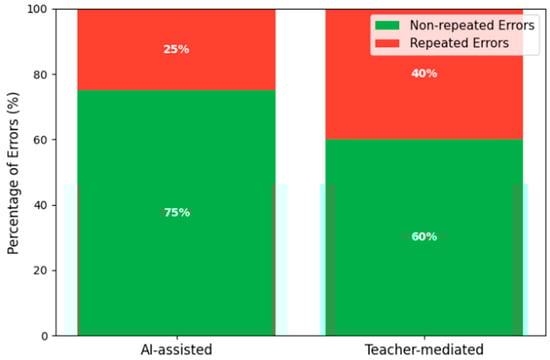
The primary objective of the study was, as presented in the hypothesis, to assess if and how AI-assisted feedback could facilitate or not a more effective correction of errors in EFL learners’ writings when compared to traditional teacher-based feedback. In this regard, contrastive analysis of the two corpora revealed a notable reduction in repeated errors among students in the AI-mediated feedback group. Significantly, only 25% of students in the AI-assisted group repeated the same errors in their second essay, in contrast to the 40% of students that did repeat errors in the traditional correction group. These data suggest a measurable advantage of AI-assisted feedback in promoting error recognition and correction and thus in reducing the tendency for error fossilisation, particularly in the context of short-term learning (Table 1).
Table 1.
Repetition of errors by feedback modality.
The table above presents the distribution of the percentage of repeated errors across feedback modalities. The AI-assisted group shows (as can be seen) a lower rate of error repetition, suggesting that automated feedback may improve learners’ ability to recognise and internalise corrective patterns. This advantage seems to be closely linked to the immediacy and specificity of AI-mediated feedback. This type of correction, unlike traditional correction, which may be constrained by time and teacher prioritisation, provides immediate structured guidance that encourages correction and reduces the possibility of error fossilisation. Even if 25% of students in the AI-assisted group still repeated some errors, the overall significant reduction demonstrates short-term efficacy.
Figure 1 (below) presents a visual comparison of error repetition across feedback modalities. The distribution obtained indicates a higher frequency of error recurrence in the teacher-mediated group, thus implying that AI feedback may provide learners with more consistent cues for error correction and detection. This finding highlights that AI systems are effective in an EFL context as they offer immediate, structured, and individualised guidance, allowing learners to actively engage with their mistakes and internalise corrective patterns more efficiently.
Figure 1.
Distribution of errors per analysis modality.
This situation clearly aligns with prior research in Second Language Acquisition (SLA) as it highlights the efficacy of immediate automated feedback systems in reducing error repetition. Z. Li and Hegelheimer (2013) demonstrated that technology-mediated feedback significantly enhances learners’ accuracy in L2 writing, particularly for recurring syntactic and lexical errors. Similarly, Z. V. Zhang and Hyland (2022) found that immediate, targeted feedback interventions facilitated more accurate revision strategies and improved overall writing fluency. In our study, the data obtained in this regard indicates that AI-assisted feedback is effective not only in mitigating the recurrence of errors but it also appears to help learners prompt reflection on their writing choices, even before producing subsequent drafts.
It is worth noting, however, that error reduction was not absolute; 25% of learners in the AI-assisted group continued to repeat errors, which suggests that while AI tools are beneficial in underlining and correcting deviations, certain errors do tend to fossilise. These long-term errors may require additional pedagogical intervention, such as explicit instruction or targeted practice guided by the instructor. Moreover, the reduction in error repetition, while statistically notable, shall be interpreted within the short-term scope of this study. In this regard, a more longitudinal research is needed to determine whether these improvements are sustained over time and whether they translate into lasting proficiency improvement.
4.2. Nature and Frequency of Errors
Understanding not only the frequency but also the types of errors is crucial for both EA and effective EFL practice. In this regard, both corpora revealed patterns of recurrent repeated errors that reflect persistent challenges in learner writing, thus leading to the need for error labelling and classification.
4.2.1. Error Classification and Patterns
Recurrent errors were classified according to common L2 writing challenges, including grammatical, lexical, syntactic, and discourse-level deviations and flaws. Preliminary analysis reveals that across both feedback modalities, the most frequent errors involved are as follows:
- Subject-verb agreement inconsistencies.
- Preposition misuse and missing articles.
- Verb tense errors, particularly in narrative sequences.
- Lexical choices, mostly influenced by their first language (L1 negative transfer).
The predominance of these errors is, in fact, consistent with previous existent SLA research indicating that L2 learners often struggle with morphosyntactic features that are absent or differently realised or performed in L1 (Gass & Selinker, 2008). Thus, the classification of errors is a key element that allows instructors to design data-driven interventions, focusing on structures that are systematically problematic for learners, rather than relying on anecdotal observation or intuition alone. In this light, recurrent errors observed in this study were labelled and categorised as follows (Table 2):
Table 2.
Categorisation of common recurrent errors identified.
4.2.2. Negative L1 Transfer
A central factor identified in both groups is the impact of negative transfer, that is, copying structures or adapting forms from the learners’ first language (Spanish) with a hindering result. In this light, the analysis revealed that a significant 72% of errors in the AI-assisted group and 77% in the teacher-mediated group could be attributed to L1 negative interference. This finding underlines the influence of L1 on the learners’ interlanguage development, thus reinforcing the critical need for explicit attention in areas in which transfer errors are more probable. In this regard, a significant proportion of errors were linked to negative L1 transfer (Table 3):
Table 3.
L1 Transfer error percentage distribution per modality.
In this category, we identified errors related to syntactic transfer, such as incorrect word order or article omission, that were particularly frequent, highlighting structural contrasts between Spanish and English that consistently challenge learners. The slightly lower proportion of L1-related errors in the AI-assisted group suggests that automated feedback may be particularly effective in drawing attention to transfer-induced mistakes, possibly due to the AI system’s ability to flag patterns that learners might overlook when reviewing traditional teacher comments and its immediacy. Thus, the slightly lower proportion of L1-related errors in the AI-assisted group suggests that AI feedback may be particularly effective at eliciting transfer-induced mistakes for learners to self-correct and self-reflect.
It is key to mention that these results also align with previous studies that documented the centrality of L1 interference in persistent error repetition and error fossilisation (Arabski, 2006; Selinker, 1972). Such errors can quickly solidify into habitual flawed practices, which are increasingly difficult to correct and avoid over time. Therefore, rapid interventions that combine AI-assisted error detection with strategic instructional scaffolding may offer a dual benefit: immediate correction and long-term prevention of fossilisation. In this regard, we strongly believe that the identification of recurrent error patterns and fossilisation tendencies together with their underlying causes do carry a significant pedagogical value. By systematically analysing the nature and frequency of errors, instructors can operate in the development of EFL curricula in order to perform the following:
- Prioritise high-frequency error types in lesson planning.
- Design explicit instruction that targets L1 interference.
- Employ feedback cycles to reinforce corrective patterns.
- Develop practice activities to address the identified weaknesses.
4.3. Learner Perceptions and Satisfaction
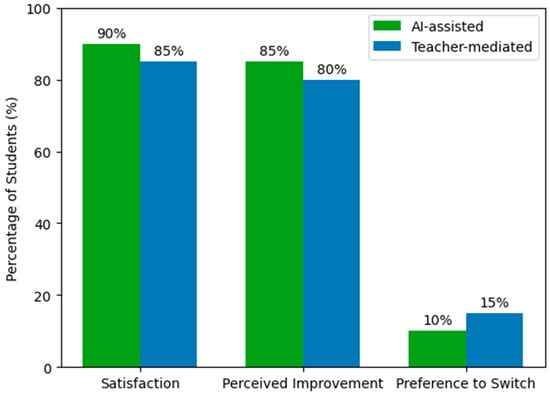
As outlined in the methodological section, in addition to objective measures of error reduction, this study aimed at examining learner perceptions of feedback modalities, as learner attitudes and motivation have been proven to be critical determinants of engagement and learning outcomes. In this regard, an anonymous voluntary post-intervention survey (using Microsoft Forms) assessed (1) satisfaction with the correction process, (2) the perceived effectiveness of feedback, and (3) preferences regarding alternative feedback modalities. We obtained a high degree of participation: out of 70 participants, 68 responded, which represents a 97% response rate.
4.3.1. Satisfaction and Perceived Effectiveness
Overall, learners showed high degrees of satisfaction with both feedback modalities and the study in general (Table 4).
Table 4.
Learner satisfaction and perceived utility of feedback modalities (Likert scale 1 to 5).
However, learners reported a slightly higher satisfaction for AI-assisted feedback. In this regard, participants highlighted several perceived benefits of AI support:
- Immediate feedback: Learners valued receiving corrections immediately after submission, allowing for prompt revisions of their texts.
- Guidance: AI feedback often provided specific explanations for errors (error logs), clarifying why a correction was needed in each case.
- Self-direction: Many students reported that AI-assisted feedback facilitated independent learning (even outside the classroom environment), enabling them to correct errors autonomously.
These perceptions, identified by the analysis of the post-test, are consistent with contemporary SLA studies, emphasising the importance of timely, individualised feedback in fostering self-regulated learning (Bitchener & Ferris, 2012; P. Li & Lan, 2022). The immediacy of AI feedback, in particular, seems to be the key and critical aspect as it seems to allow and to enhance learner engagement, thus encouraging repeated reflection on writing choices and long-term improvement.
4.3.2. Preferences and Limitations
Despite the general positivity toward AI-assisted feedback, a small minority of students indicated a preference for teacher-mediated correction. Reasons mentioned by the participants included the following:
- Desire for human judgement on stylistic or content-related issues that AI may not fully capture (consistent with the lack of pragmatic awareness in the current AI models outlined by Macías Borrego, 2025a).
- Perception that AI feedback can be mechanical or formulaic.
- Preference for the personal interaction and explanations provided by teachers.
In this regard, Figure 2 illustrates the overall learner satisfaction and perceived utility of the two feedback modalities.
Figure 2.
Learners’ satisfaction and preferences.
When taken as a whole, these responses highlight the complementary role of AI tools; even if these tools seem to be very effective and efficient in identifying and correcting formal errors, AI should not be viewed as a replacement for human pedagogical expertise, particularly in addressing higher-order writing concerns such as argumentation, cohesion, and style.
4.4. Data Synthesis
Taken together and seen as a whole, the combination of the quantitative and qualitative findings reveals several key insights into the role of both AE and AI in error correction and error reduction:
- AI-assisted Error Analysis seems to be effective in the reduction of the repetition of recurrent errors more effectively than traditional correction in a short-term intervention. This suggests that automated immediate feedback can enhance learners’ ability to recognise and internalise formulaic patterns.
- L1 interference remains a central factor in persistent errors, regardless of feedback modality. Thus, targeting transfer-related errors is essential for effective L2 and Foreign Languages instruction.
- Learner perceptions of AI-assisted feedback are generally positive, particularly in terms of clarity and immediacy.
Additionally, this study offers several practical implications for EFL instructors:
- The utility of blended feedback approaches that successfully combine AI-assisted feedback with teacher-mediated guidance may lead to better results.
- Writing cycle essentiality: Incorporating multiple drafts and continuous AI feedback can reinforce learning and reduce error fossilisation.
- Data-driven lesson planning: Analysis of common errors can inform instructional interventions, optimising class time and resources.
Limitations
While the results are promising, several limitations need to be taken into consideration:
- Short-term scope: This study captures immediate effects of AI-assisted feedback, but long-term retention and internalisation of corrections remain untested.
- Single AI platform: Findings are specific to Trinka.ai; outcomes may differ with other AI feedback systems.
- Survey limitations: Perceptions were captured via Likert-scale items and open-ended questions. Richer qualitative data could provide deeper insight into learner experiences.
- Context-specific sample: This study was conducted in a single course with learners of Spanish L1 linguistic and educational background, which may transfer validity.
5. Discussion
The present study provides evidence that the integration of Artificial Intelligence combined with Error Analysis (EA) can significantly enhance the teaching and learning of written competence of English as a Foreign Language (EFL). This is obtained by combining automated error detection with theoretically informed corrective strategies. In this light, learners greatly benefit from more immediate, structured, and individualised feedback, while educators, at the same time, obtain tools for monitoring patterns of persistent errors and an additional strategy and tool to monitor fossilisation tendencies.
However, even if AI systems demonstrate strong performance in detecting grammatical, lexical, and structural errors, they remain limited in their ability to address semantic, pragmatic, and discourse-level aspects of language use. These limitations are particularly significant because meaning-making in context-appropriate expressions and communicative competence are central to current language teaching and learning (Montrul & Sánchez-Walker, 2020; Allerton et al., 2003). This means that AI feedback may identify a prepositional or tense error but cannot always detect human-like meaning inferences such as idiomatic appropriateness or the coherence of argumentation in an essay. Consequently, learners might suffer misinterpretations or pragmatically inappropriate constructions unidentified by the automatic correcting systems. This could undermine learners’ communicative competence.
To address these limitations, educators should consider blended feedback approaches where AI tools are used for form-focused corrections and teachers provide higher-order, meaning-oriented feedback. Studies in SLA indicate that such complementary interventions enhance learning outcomes (Bitchener & Ferris, 2012; VanPatten & Smith, 2022). For example, automated systems can rapidly flag repeated grammatical errors across multiple drafts, thus freeing instructors to focus on tasks that require interpretive judgement, style guidance, and contextual sensitivity. Therefore, incorporating these technologies into curricular instructional practice could progressively bridge the gap between form-based correction and meaningful communication feedback, thereby enhancing the pedagogical utility of AI-assisted error detection and correction.
In this regard, a key risk lays in the over-reliance of AI tools, which may reduce learner engagement with reflective, self-directed revision processes and diminish the role of teacher-mediated scaffolding. While AI provides immediate and objective feedback, it cannot replace the judgement, motivation, and expertise of human instructors. Solid evidence suggests that learners who depend solely on AI feedback may fail to develop metacognitive skills necessary for error self-detection and self-correction, limiting long-term language development (Gass & Selinker, 2008; Bitchener & Ferris, 2012; Macías Borrego, 2025a).
6. Conclusions
In this study, we offer an exploratory and preliminary examination of the potential of Artificial Intelligence when combined with Error Analysis in the teaching and learning of English as a second or foreign language among Spanish L1 university students. The findings do suggest that integrating Artificial Intelligence with Error Analysis supports the development of a more individualised instructional approach, which is positively perceived and received by learners (according to their own views). This study also concludes that incorporation of the theoretical foundation of Error Analysis into everyday teaching practice is key to the development of written competence.
In this regard, the implementation and adoption of AI-based correcting models, capable of processing learner’ outputs, helps both instructors and learners to keep error logs which seem to have a key potential in both learners’ development and performance of linguistic abilities. These records can be used to identify recurring error patterns, to elicit and predict fossilisation patters, and as a source for evidence of error elimination. From this perspective, these approaches do promote engaging and effective learning environments that address persistent linguistic challenges, such as negative L1 transfer, which represents (as seen in the results) a major source of error in the learner population examined. Thus, reducing and preventing fossilisation of errors results in greater communicative accuracy and progress (aligning with Alderson, 2005).
At the same time, it is necessary to acknowledge the current limitations of AI tools in correcting and detecting flaws in human language use and human communication. While AI-driven systems show considerable effectiveness in analysing grammatical and lexical aspects of language, some other key dimensions of language learning (particularly pragmatics) continue to require human-mediated evaluation and feedback (Allerton et al., 2003; Montrul & Sánchez-Walker, 2020; Macías Borrego, 2025b). This means that as learners advance to higher proficiency levels, the role of teacher-provided feedback necessarily becomes more central; even if certain components of the instructional process can be supported by AI technologies some other areas remain exclusive to human intervention.
In this study, the error patterns observed (error recognition and labelling) do reflect the influence of L1-specific syntactic, lexical, and morphological forms and rules hindering production in their foreign language performance. In this regard, we need to note that the findings provide solid insights for similar learner populations, but they may not directly apply to students with different L1 backgrounds, age groups, or educational contexts. In this regard, to enhance generalizability, future research should include diverse learner populations, including speakers of typologically distinct languages, learners in secondary or adult education, and participants from varied institutional contexts. Moreover, to fully test validity of these studies, longitudinal studies are necessary to evaluate long-term retention and internalisation of corrective patterns. Additionally, it must be noted that while short-term error reduction is promising, sustained language development depends on repeated practice, feedback, and cognitive engagement over time (Arabski, 2006). Thus, longitudinal designs would allow researchers to assess whether AI-assisted interventions translate into durable improvements in writing proficiency or not and in what terms.
A key factor and finding of this study is the core idea of blended approaches that can be successful at combining automated feedback with teacher mediation in reflective learning cycles. In this regard, future research should expand participant diversity, include longitudinal assessments, and explore AI’s potential in higher-order language feedback, ensuring that technology complements rather than substitutes human instruction.
In conclusion, this study provides preliminary evidence that AI-assisted feedback can serve as an effective tool in EFL writing instruction, supporting error reduction, enhancing self-directed revision, and complementing traditional teaching methods. By systematically addressing recurrent errors and leveraging learner perceptions, educators can design more targeted, efficient, and engaging interventions, ultimately contributing to improved second language writing outcomes. While further research is required to establish long-term efficacy and generalizability, these findings highlight the promising role of AI tools in fostering autonomous, reflective, and accurate L2 writing practices.
Funding
This research received no external funding.
Institutional Review Board Statement
The study was conducted in accordance with the Declaration of Helsinki and approved by the Ethics Committee of Rey Juan Carlos University (protocol code: PIE-75- URJC-071120257612025; date of approval: 18 December 2025).
Informed Consent Statement
Informed consent was obtained from all subjects involved in the study.
Data Availability Statement
The data supporting the findings of this study are available upon reasonable request and under authorization of the Ethical Committee of Universidad Rey Juan Carlos. Due to privacy and ethical restrictions, the data are not publicly available.
Conflicts of Interest
The author declares no conflicts of interest.
Abbreviations
The following abbreviations are used in this manuscript:
| AI | Artificial Intelligence |
| AIED | Artificial Intelligence in Education |
| B1/B2 | Common European Framework of Reference levels B1/B2 |
| CALL | Computer-Assisted Language Learning |
| CEFR | Common European Framework of Reference for Languages |
| DLL | Digital Language Learning |
| EA | Error Analysis |
| EFL | English as a Foreign Language |
| ESL | English as a Second Language |
| IRAL | International Review of Applied Linguistics |
| L1 | First Language |
| L2 | Second Language |
| MALL | Mobile-Assisted Language Learning |
| NLP | Natural Language Processing |
| SLA | Second Language Acquisition |
References
- Alderson, J. (2005). Diagnosing foreign language proficiency: The interface between learning and assessment. Continuum. [Google Scholar]
- Allerton, D. J., Skandera, P., & Tschichold, C. (2003). Perspectives on English as a world language. English and American Studies in German, 7, 56–72. [Google Scholar]
- Arabski, J. (2006). Cross-linguistic influences in the second language lexicon. Multilingual Matters. [Google Scholar]
- Bitchener, J., & Ferris, D. R. (Eds.). (2012). Written corrective feedback in second language acquisition and writing. Routledge. [Google Scholar]
- Bolhuis, J. J., Crain, S., Fong, S., & Moro, A. (2024). Three reasons why AI doesn’t model human language. Nature, 627(8004), 489. [Google Scholar] [CrossRef] [Scilit]
- Brown, H. D. (1994). Principles of language learning and teaching. Prentice Hall. [Google Scholar]
- Cabrera, P. (2014). Spanish interference in EFL writing skills: A case of Ecuadorian senior high schools. English Language Teaching, 7, 40–48. [Google Scholar] [CrossRef] [Scilit]
- Chapelle, C. (2003). English language learning and technology: Lectures on applied linguistics in the age of information and communication technology. John Benjamins. [Google Scholar] [CrossRef] [Scilit]
- Chaudhry, A., & Kazim, E. (2021). Artificial intelligence in education (AIEd): A high-level academic industry note 2021. AI and Ethics, 1(1), 157–165. [Google Scholar] [CrossRef] [Scilit]
- Chauhan, C., Parida, V., & Dhir, A. (2022). Linking economy and digitalisation technologies: A systematic literature review of past achievements and future promises. Technological Forecasting and Social Change, 177, 121508. [Google Scholar] [CrossRef] [Scilit]
- Clerk, D., & Rutherford, M. (2010). Language as a confounding variable in the diagnosis of misconceptions. International Journal of Science Education, 22(7), 703–717. [Google Scholar] [CrossRef] [Scilit]
- Corder, S. P. (1967). The significance of learners’ errors. In J. C. Richards (Ed.), Error analysis: Perspectives on second language learning (pp. 19–27). Longman. [Google Scholar] [CrossRef] [Scilit]
- Corder, S. P. (1993). A role of the mother tongue. In S. Gass, & L. Selinker (Eds.), Language transfer in language learning (pp. 18–31). John Benjamins. [Google Scholar] [CrossRef] [Scilit]
- Ellis, R. (2015). Understanding second language acquisition (2nd ed.). Oxford University Press. [Google Scholar]
- Ferris, D. R. (2011). Treatment of error in second language student writing (2nd ed.). University of Michigan Press. [Google Scholar] [CrossRef] [Scilit]
- Fu, M., & Li, S. (2022). The effects of immediate and delayed corrective feedback on L2 development. Studies in Second Language Acquisition, 44(1), 2–34. [Google Scholar] [CrossRef] [Scilit]
- Gass, S. M., & Selinker, L. (2008). Second language acquisition: An introductory course (3rd ed.). Routledge. [Google Scholar]
- Hyland, K. (2019). Second language writing (2nd ed.). Cambridge University Press. [Google Scholar]
- Jodai, H. (2012). Error analysis in a new context: A comparative study of errors in general linguistics and CALL. The Iranian EFL Journal, 5, 332–345. [Google Scholar]
- Johansson, S., & Hofland, K. (1994). Towards an English–Norwegian parallel corpus. In U. Fries (Ed.), Creating and using English language corpora (pp. 45–62). Rodopi. [Google Scholar]
- Kessler, G. (2021). Technology and the future of language teaching. Foreign Language Annals, 51, 205–218. [Google Scholar] [CrossRef] [Scilit]
- Kukulska-Hulme, A., Dawadi, S., Giri, R. A., Devkota, K. R., Khan, R., & Gaved, M. (2023). Roles of languages and technology in teaching in marginalised communities. Prima Educatione, 7, 103–121. [Google Scholar] [CrossRef] [Scilit]
- Levy, M. (1997). Computer-assisted language learning: Context and conceptualization. Oxford University Press. [Google Scholar]
- Li, P., & Lan, Y.-J. (2022). Digital language learning (DLL): Insights from behavior, cognition, and the brain. Bilingualism: Language and Cognition, 25(3), 361–378. [Google Scholar] [CrossRef] [Scilit]
- Li, Z., & Hegelheimer, V. (2013). Mobile-assisted grammar exercises: Effects on self-editing in L2 writing. Language Learning & Technology, 17(3), 135–156. [Google Scholar]
- Luckin, R. (2016). Re-designing learning contexts: Technology-rich, learner-centred ecologies. Routledge. [Google Scholar]
- Macías Borrego, M. (2023). Towards digital assessment: Artificial Intelligence assisted error analysis in ESL. Integrated Journal for Research in Arts and Humanities, 3(4), 76–84. [Google Scholar] [CrossRef] [Scilit]
- Macías Borrego, M. (2024). Error corrective treatment in Spanish L1 ESL learners: Suggesting an empirical method. ES Review: Spanish Journal of English Studies, 45, 269–295. [Google Scholar] [CrossRef] [Scilit]
- Macías Borrego, M. (2025a). Análisis de errores: Del análisis contrastivo a la era de la inteligencia artificial. Editorial Universitas. [Google Scholar]
- Macías Borrego, M. (2025b). Análisis de errores y fracaso pragmático en aprendientes de inglés como LE. Archivum, 75(2), 313–352. [Google Scholar] [CrossRef] [Scilit]
- McManus, K. (2024). Replication studies in second language acquisition research. Studies in Second Language Acquisition, 46(5), 1299–1319. [Google Scholar] [CrossRef] [Scilit]
- Mogensen, T. Æ. (2022). Programming language design and implementation. Springer. [Google Scholar]
- Montrul, S., & Sánchez-Walker, N. (Eds.). (2020). Language dominance in bilinguals. Cambridge University Press. [Google Scholar]
- Murad, A. I., & Mahmood, A. H. (2018). Interlanguage and the models before. English Language Teaching Journal, 11, 95–108. [Google Scholar]
- Nemser, W. (1971). Approximative system of foreign language. IRAL, 9(2), 115–123. [Google Scholar] [CrossRef] [Scilit]
- Popovic, M., & Ney, H. (2022). Towards automatic error analysis of machine translation output. Computational Linguistics, 37(4), 657–688. [Google Scholar] [CrossRef] [Scilit]
- Rabah, A. M. T. (2020). Using artificial intelligence for developing English language teaching. International Journal of English Linguistics, 10(6), 40–53. [Google Scholar] [CrossRef] [Scilit]
- Ranalli, J., Li, Z., & Hyland, F. (2022). AI-assisted feedback in L2 writing. Language Learning & Technology, 26(3), 15–35. [Google Scholar]
- Richards, J. C., & Richards, R. S. (2002). Dictionary of language teaching and applied linguistics. Pearson. [Google Scholar]
- Selinker, L. (1969). Language transfer and fossilization. TESOL Quarterly, 3(1), 21–28. [Google Scholar]
- Selinker, L. (1972). Interlanguage. IRAL, 10(2), 209–231. [Google Scholar] [CrossRef] [Scilit]
- Shi, X., & Aryadoust, V. (2024). Longitudinal effects of AI-assisted feedback. Computer Assisted Language Learning, 37(5), 1123–1145. [Google Scholar]
- Tran, P. (2025). Learner perception and engagement with AI-mediated L2 feedback. Journal of Second Language Writing, 57, 101120. [Google Scholar]
- Underwood, J., & Luckin, R. (2011). What is AIED and why does education need it? A report. Available online: https://www.researchgate.net/profile/Joshua-Underwood-3/publication/241698223_What_is_AIED_and_why_does_Education_need_it/links/56e519d508ae68afa11068a7/What-is-AIED-and-why-does-Education-need-it.pdf (accessed on 25 February 2026).
- VanPatten, B., & Smith, M. (2022). Explicit and implicit learning in second language acquisition. Cambridge University Press. [Google Scholar]
- Xie, Q. (2019). Error analysis and diagnosis of ESL linguistic accuracy. Assessing Writing, 41, 47–62. [Google Scholar] [CrossRef] [Scilit]
- Zhai, X., Li, Y., & Wang, H. (2024). Pedagogical mediation of AI feedback. Language Teaching Research, 28(4), 543–567. [Google Scholar]
- Zhang, D. (2020). Progress of NLP towards human-level AI. Journal of Artificial Intelligence Practice, 3, 38–47. [Google Scholar]
- Zhang, Z. V., & Hyland, K. (2022). Fostering student engagement with feedback. Assessing Writing, 51, 100586. [Google Scholar] [CrossRef] [Scilit]



Disclaimer/Publisher’s Note: The statements, opinions and data contained in all publications are solely those of the individual author(s) and contributor(s) and not of MDPI and/or the editor(s). MDPI and/or the editor(s) disclaim responsibility for any injury to people or property resulting from any ideas, methods, instructions or products referred to in the content. |
© 2026 by the author. Licensee MDPI, Basel, Switzerland. This article is an open access article distributed under the terms and conditions of the Creative Commons Attribution (CC BY) license.